
I remember the first time I muted a movie and watched the picture without sound. The actors were speaking, the car was skidding, the door was slamming, but everything felt paper-thin and strange. That missing layer is exactly what Foley sound fills.
Foley is one of those crafts that everyone hears and almost nobody notices, and that is the point. In this guide I will walk you through what Foley sound actually is, where the name came from, the three categories every Foley artist works in, how the recording process works, the strange props that get used, and how you can try it yourself at home. If you have ever wondered what separates Foley from regular sound effects, or how someone gets paid to walk around a studio in shoes, you are in the right place.
Table of Contents
What Is Foley Sound?
Foley sound is the reproduction of everyday sound effects, such as footsteps, cloth rustling, and doors closing, that are added to films, videos, and other media in post-production to enhance audio realism. The craft is named after Jack Donovan Foley, an American sound effects pioneer at Universal Studios who developed the technique in the late 1920s and whose surname became the generic term for it.
In practice, Foley is the human-performed layer of sound that sits underneath dialogue and music. When you hear a character’s boots crunch across gravel, a leather jacket squeak as they turn, or a glass shatter on a tile floor, that audio was almost certainly recorded by a Foley artist watching the picture and re-creating the sound with props in a studio. It is not the same as ambience (rain, traffic, room tone), not the same as dialogue replacement (ADR), and not the same as synthesized or designed effects (laser blasts, spaceship roars).
Examples of Foley sound include:
- Footsteps on wood, gravel, grass, snow, concrete, or stairs
- Cloth movement, like a coat rustling or a shirt sleeve rubbing a table
- Hand and body interactions, including grabbing, picking up, or putting down objects
- Door opens and closes, including the squeak of hinges and the latch click
- Glass breaks, paper crumples, fabric tears, and similar small prop sounds
- Body sounds such as punches, falls, kisses, and breathing
That first paragraph is written as a direct, self-contained answer on purpose. Clean definitions like that are what search engines lift into featured snippets, and it is the single most useful thing you can take from this section.
The Man Behind the Name: A Short History of Foley Sound
Foley sound takes its name from Jack Donovan Foley, a Universal Studios sound effects artist who pioneered the technique in the late 1920s and whose surname became shorthand for the entire craft. The story of how he got there is short, slightly accidental, and worth telling.
Jack Foley was born in 1891 in New York and started working in the film industry around 1914, first in the costume department and later as a stuntman. When silent films transitioned to talkies, he moved into sound. The big shift came with The Jazz Singer in 1927, one of the first feature films with synchronized dialogue.
Recording dialogue and music was straightforward, but the small everyday sounds, like footsteps, cloth movement, and doors, were missing entirely. Foley and his colleagues at Universal began performing those sounds live while the picture played, capturing them alongside the production audio in a single take.
One of the earliest formal Foley sessions was for the 1929 film Show Boat, where Foley and a small crew performed an entire library of body and prop sounds live while watching the film on a monitor. That single-microphone, live-performance workflow became the template. By the 1930s and 1940s other studios were copying it, and the term “Foley” had already become the generic name for the work, even when other artists were doing it.
Foley worked at Universal until his death in 1967. He was never nominated for an Oscar, because the Academy still has no category for sound effects artistry, which remains one of the most cited quirks of the craft.
What Are the Three Types of Foley Sound?
The three main types of Foley sound are Feet, Moves, and Specifics. This three-part split is the standard way working Foley artists divide their day, and it traces back to the workflow Jack Foley used at Universal in the 1930s.
Feet
Feet, also called footsteps or foot Foley, covers every footfall in a scene. That means shoes on every surface you can imagine: hardwood, tile, carpet, gravel, grass, mud, snow, metal grating, wet concrete, squeaky floorboards. The surface, the shoe type, the weight of the actor, and the gait all matter, and the artist has to match every step to the picture exactly.
Footstep sessions are usually the most time-consuming part of a Foley day. Artists often wear multiple pairs of shoes in a single session, sometimes switching boots every few minutes.
Moves
Moves covers the clothing and body sounds a character makes while moving. Think of the rustle of a jacket as someone stands up, the swish of a cape, the creak of a leather glove, or the drag of a heavy coat. Moves sessions usually require the artist to wear or mimic the costume on screen so they capture the real fabric-to-fabric interaction.
If a character wears a heavy wool coat in every scene, the Foley artist will spend a long afternoon in a heavy wool coat. It is the least glamorous part of the job and one of the most important.
Specifics
Specifics covers every other prop interaction in a scene. Picking up a coffee cup, opening a car door, typing on a keyboard, ringing a doorbell, dropping a coin, lighting a cigarette, drawing a sword, or crushing a can all land under Specifics. This category is where Foley gets the most creative, because artists often re-create objects that do not exist in real life or cannot be recorded up close.
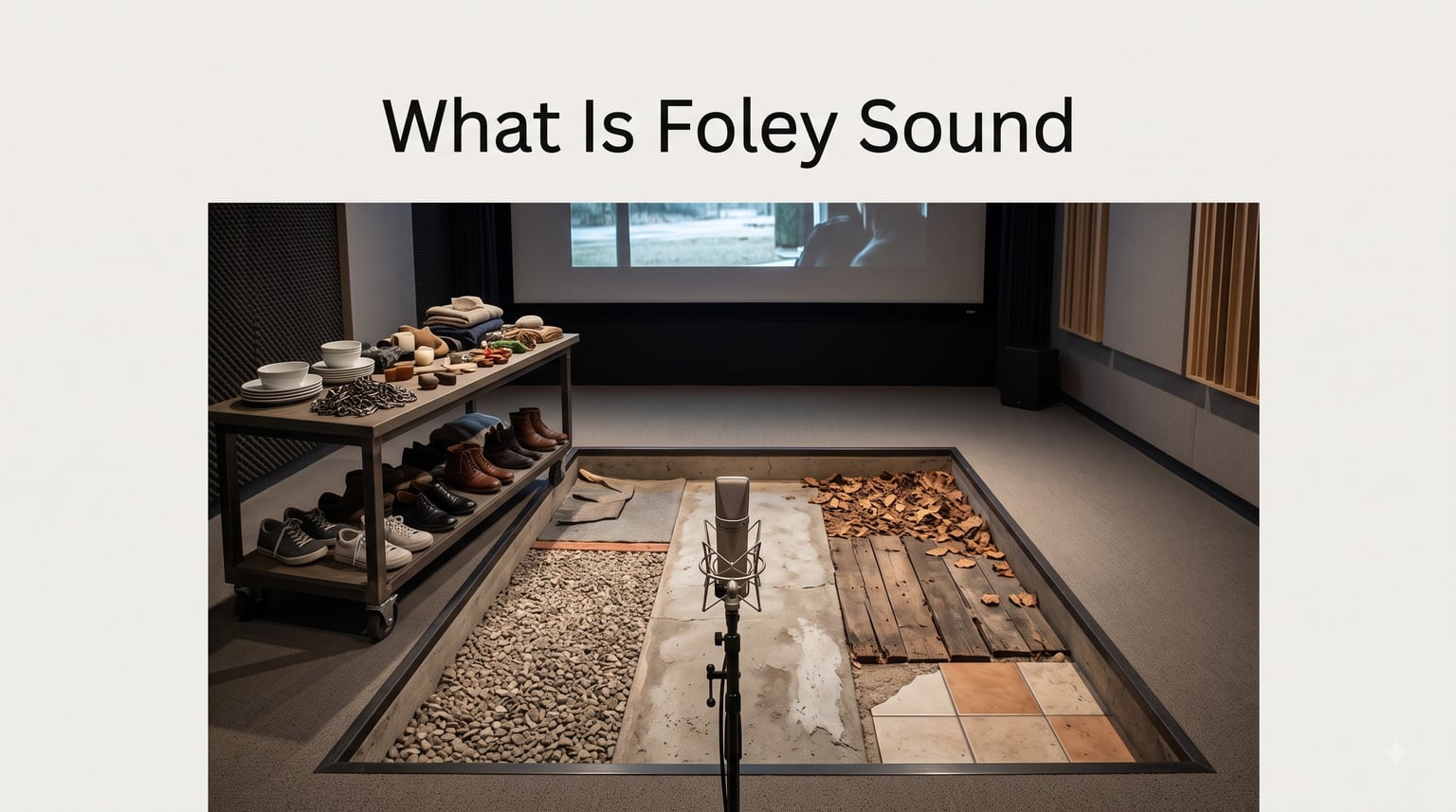
A Foley stage for Specifics looks like a prop shop exploded onto a soundstage. There are shelves of shoes, dishes, fabric, glass, paper, leaves, broken electronics, and dozens of mystery boxes that get pulled out for one specific cue.
Each of the three types is often performed by a separate specialist, sometimes two working together, so the layers can be recorded and balanced cleanly.
How Is Foley Sound Recorded?
Foley is recorded in a dedicated Foley stage, a soundproofed room that looks like a small movie set, where one or two artists watch the picture on a large monitor and perform the sounds live while an engineer captures everything. The setup is simple in concept and surprisingly demanding in practice.
Inside a Foley Stage
A traditional Foley stage has three main parts:
- The Foley pit: a sunken floor or set of platforms covered in different surfaces, such as wood, tile, gravel, sand, and carpet squares, that artists walk on to record footsteps.
- The prop table: an oversized rolling table holding everything an artist might need, including shoes, fabric, dishes, doors, doorknobs, and small hand props.
- The picture and mic setup: a large projection screen tied to the film’s edit, plus one or two high-quality condenser microphones aimed at the performance area and feeding a recorder like Pro Tools.
The artist stands in the middle, watches the picture roll, and performs the sounds live while the engineer records the takes. It is closer to acting and music performance than to traditional studio recording, because every cue has to land within milliseconds of the action on screen.
The Foley Recording Process, Step by Step
Here is the basic workflow a Foley team follows on a typical session.
- Cue and prep. The supervising sound editor hands the artist a cue sheet listing every sound needed, organized by Feet, Moves, and Specifics. Props and surfaces are gathered before the session.
- Picture sync. The artist watches the scene loop several times to absorb the timing, then goes again with headphones on, ready to perform.
- Performance and capture. The artist performs each cue live, with the engineer rolling picture and recording at the same time. Multiple takes are usually captured.
- Review and pickup. The team reviews the takes together and notes anything that needs to be re-cut, replaced, or augmented with a different prop.
- Editing and mixing. The recorded Foley is edited and cleaned, then combined with dialogue, ambience, and hard effects, with levels set against music in the final mix.
A full Foley day might cover only a few minutes of finished picture, depending on how dense the scene is. Action-heavy sequences with lots of movement can eat an entire day for a single minute of screen time.
Common Foley Tricks and Props Filmmakers Actually Use
Half the fun of Foley is the prop recipes: carefully chosen objects that sound nothing like the thing on screen but get used anyway because they sound right in the microphone. Here are the classics that get passed down from artist to artist.
- Frozen romaine lettuce for breaking bones and snapping wood. A head of lettuce, thawed just until floppy, snaps with a shockingly realistic joint-crack.
- A pouch of cornstarch or flour for powdery snow underfoot. Artists walk on it or crush it by hand.
- Cellophane and bubble wrap for fire crackle. Layered and crushed, they produce the bright, irregular pops of a real flame.
- Celery and carrots for breaking bones in fight scenes. Snapped at the right moment, they sell a punch or a wrist twist.
- Wet leather gloves for punches and slaps. A damp glove slapped on a phone book gives a much heavier thwack than a bare hand.
- Magnetic recording tape for swords unsheathing. Pulled taut and drawn across a sharp edge, it sings like a blade leaving a scabbard.
- Coconut shells for horse hooves on hard ground. The classic, clapped onto a hard floor for the sound of hooves in countless period films.
- A leather pouch filled with birdseed or rice for body falls. Thrown against a padded surface, it sounds like a body hitting the ground.
- An old phone book for fist impacts. Punching a phone book sounds far more dramatic than punching a wall, with no risk to the artist’s hand.
- Cornstarch mixed with water for mud and slush. Squished between the fingers or underfoot, it produces a convincing wet, sticky texture.
Every Foley artist keeps their own version of these tricks. Some are documented in books and interviews, while others are guarded like family secrets.
Foley vs Sound Design vs Field Recording vs ADR
Foley is the live, performance-based recreation of everyday sounds synced to picture; sound design is the broader construction of non-realistic or heavily processed audio; field recording is the capture of real-world sounds on location; and ADR is the re-recording of dialogue in a studio. These four crafts overlap constantly, which is why the difference is one of the most common beginner questions.
A useful way to separate them:
- Foley is what an artist performs in a studio to match the picture. Footsteps, cloth, and prop handling are the bread and butter.
- Sound design is everything built rather than performed. A laser blast, a spaceship engine, or an alien voice is usually layered and synthesized, not acted out.
- Field recording is capturing real environments and effects on location, from rain and traffic to a creaky door in an abandoned building.
- ADR (Automated Dialogue Replacement) is re-recording dialogue in a studio. It shares a workflow with Foley but serves spoken lines, not effects.
The four crafts feed into each other on the same film. A single scene might combine field-recorded ambience, Foley for footsteps and cloth, one ADR retake of a line, and a designed creature roar underneath, all balanced by the supervising sound editor.
Why Foley Sound Matters in Film and Television
Good Foley sound does four main things for a film: it adds realism, it cleans up dialogue, it carries emotion, and it gives the director control over what the audience hears. Together, they are a big part of the difference between a film that feels cinematic and one that feels like raw footage.
First, realism. A scene without footsteps, cloth movement, and prop handling feels wrong to the audience even when they cannot name why. The brain notices the missing layer and pulls the viewer out of the story.
Second, clean dialogue. Location shoots pick up HVAC hum, traffic, wind, and airplane rumble that contaminate the production audio. Foley is recorded in a controlled studio, so those small sonic events can be rebuilt cleanly around the dialogue.
Third, emotional emphasis. A footstep that lands slightly heavier than reality makes a character feel more menacing. A long pause before a door opens builds dread. Foley quietly shapes how the audience feels without changing a single frame.
Fourth, control. On set you get one take of the audio environment. In Foley you can redo a sound ten times until it is right, and if the director wants the glass to break differently in the third act, the team re-records it in an afternoon.
Professional Foley artists tend to say the same thing when asked about the job: the best Foley goes unnoticed. Even in 2026, with vast sound libraries and AI tools available, most big-budget films still record custom Foley, because if the audience notices the sound, the artist did not do their job.
How to Do Foley Sound at Home
You can do Foley at home on a budget. Indie filmmakers, podcasters, and game audio designers do it every day with household items, a decent microphone, and a quiet room. The trick is to start small, build a prop kit gradually, and focus on clean recording and tight sync.
Build a Starter Prop Kit
You do not need a giant library to begin. A practical starter kit for indie Foley includes:
- Two or three pairs of different shoes, such as sneakers, dress shoes, and boots
- Small squares of flooring materials, like wood, tile, carpet, and gravel in a tray
- A leather jacket, a cotton hoodie, a raincoat, and a wool sweater for Moves
- A small prop box with a coffee mug, keys, a phone, a lighter, scissors, paper, coins, and a glass jar
- A few of the classic tricks listed above, like cornstarch, frozen lettuce, and a phone book
You can assemble this over a weekend for very little money. It will cover most of the Foley a typical short film or podcast needs.
Recording Tips That Save Takes
A few habits will save you hours of frustration. Record in the quietest room you have, ideally a bedroom or closet with soft surfaces, and hang blankets or duvets to dampen reflections.
Place your microphone close to the action but out of frame, aimed at the point where the sound physically happens. A cardioid condenser mic is ideal if you have access to one. Record at 24-bit, 48 kHz so you have headroom for editing later.
Always capture a few seconds of room tone at the start and end of each session. You will need it when you start cutting and mixing.
Syncing Your Sounds
Most beginner Foley gets thrown away because the sync is off, not because the sound is wrong. The fix is mechanical: import your picture into your DAW, lock the video to a track, and lay each Foley cue directly under the frame where the action happens.
Even a free or cheap DAW like Reaper, GarageBand, or Audacity handles this. Nudge each clip by single frames until the sound lines up, and cut every cue cleanly so it does not bleed into the next moment.
Once you have done this a few times, Foley starts to feel like a vocabulary of small, repeatable actions. That is when it becomes genuinely fun.
Becoming a Foley Artist: Skills and Pay
Foley artists are performers, recordists, and improvisers at the same time. Most working artists today got in by working as runners or assistants at post-production houses, learning the workflow from the inside, then gradually performing on smaller sessions before moving up to features and television. There is no license or certification required, but a background in music, theater, dance, or audio engineering helps, because the work combines physical performance with technical skill.
Pay varies widely by region, market, and project. In major US production hubs like Los Angeles and New York, established Foley artists who stay consistently booked on features and prestige television can earn a comfortable six-figure annual income. Newer artists typically start as assistants at a much lower hourly rate.
Freelance work is the norm, and union session rates in the US are set through collective bargaining. Many artists supplement session work with library sound design, game audio, and teaching.
If you want to break in, the practical path is to intern at a post-production studio, build a small reel of Foley you recorded yourself, and start contributing to indie film and game projects. The craft rewards patience, observation, and good timing far more than expensive equipment.
Frequently Asked Questions
What is an example of a Foley sound?
A Foley sound is an everyday sound effect performed live in a studio by an artist watching the picture and re-creating it with props. Classic examples include footsteps on different surfaces, cloth rustling when a character moves, hands picking up or putting down objects, doors opening and closing, glass breaking, paper crumpling, and body interactions like punches or kisses. Foley reproduces the everyday sounds of human movement in sync with the on-screen action.
What are the three types of Foley sound?
The three main types of Foley sound are Feet, Moves, and Specifics. Feet covers all footfalls and footsteps. Moves covers clothing and body sounds like jacket rustles, cape swishes, and creaking leather. Specifics covers everything else, including prop interactions, door sounds, glass breaks, and any small object handling a character does in a scene. Most Foley artists specialize in one or two of the three categories.
How much do Foley sound artists make?
Foley artist pay varies widely by region, market, and project. In major US production hubs, established Foley artists who stay consistently booked on feature films and prestige television can earn a comfortable six-figure annual income. Newer artists typically start as assistants or apprentices at a much lower hourly rate. Many Foley artists freelance, combining session work with library sound design, game audio, and teaching to round out their income.
Do Foley artists still exist?
Yes, Foley artists are still in demand across film, television, animation, and video games. Modern productions use digital tools and large sound libraries, but live Foley performance remains the standard for footstep, cloth, and prop work because human timing and physical realism are hard to replicate from samples alone. Major Foley stages in Los Angeles, New York, and London stay booked year-round.
How to make your own Foley sound effects?
You can make your own Foley sound effects at home with a quiet room, a decent microphone, and a small prop kit. Start with a few pairs of shoes, squares of different flooring surfaces, a jacket or two, and a box of household props like keys, mugs, paper, and coins. Import your video into a DAW like Reaper, GarageBand, or Audacity, lock the picture to a track, and record each sound live while watching the scene. Then nudge each clip by single frames until it syncs cleanly.
Where can I find free Foley sound effects?
Free Foley sound effects are available from several reputable sources, including Freesound.org, the BBC Sound Effects archive (for personal and educational use), Zapsplat, and collections Foley artists publish on SoundCloud and YouTube. Many DAWs also bundle small Foley libraries. Free libraries work well for placeholders and indie projects, but most high-end productions still record custom Foley on a dedicated stage.
Final Thoughts on Foley Sound
Foley sound is the reproduced layer of everyday noise, footsteps, cloth, and prop handling, that makes a moving image feel like a real place, and it carries the name of a former Universal stuntman who helped invent the workflow in 1929. Once you know the three categories and the prop tricks, you start hearing Foley everywhere. Every step, every rustle, and every clink is a deliberate choice, and a good Foley artist makes those choices invisibly.
If you want to feel this for yourself, the next step is easy. Pick a 30-second scene from a movie you love, mute it, and re-record the Foley with whatever is lying around your house. You will understand within an hour why this craft is part art, part performance, and part obsession, and you will never watch a film the same way again.