
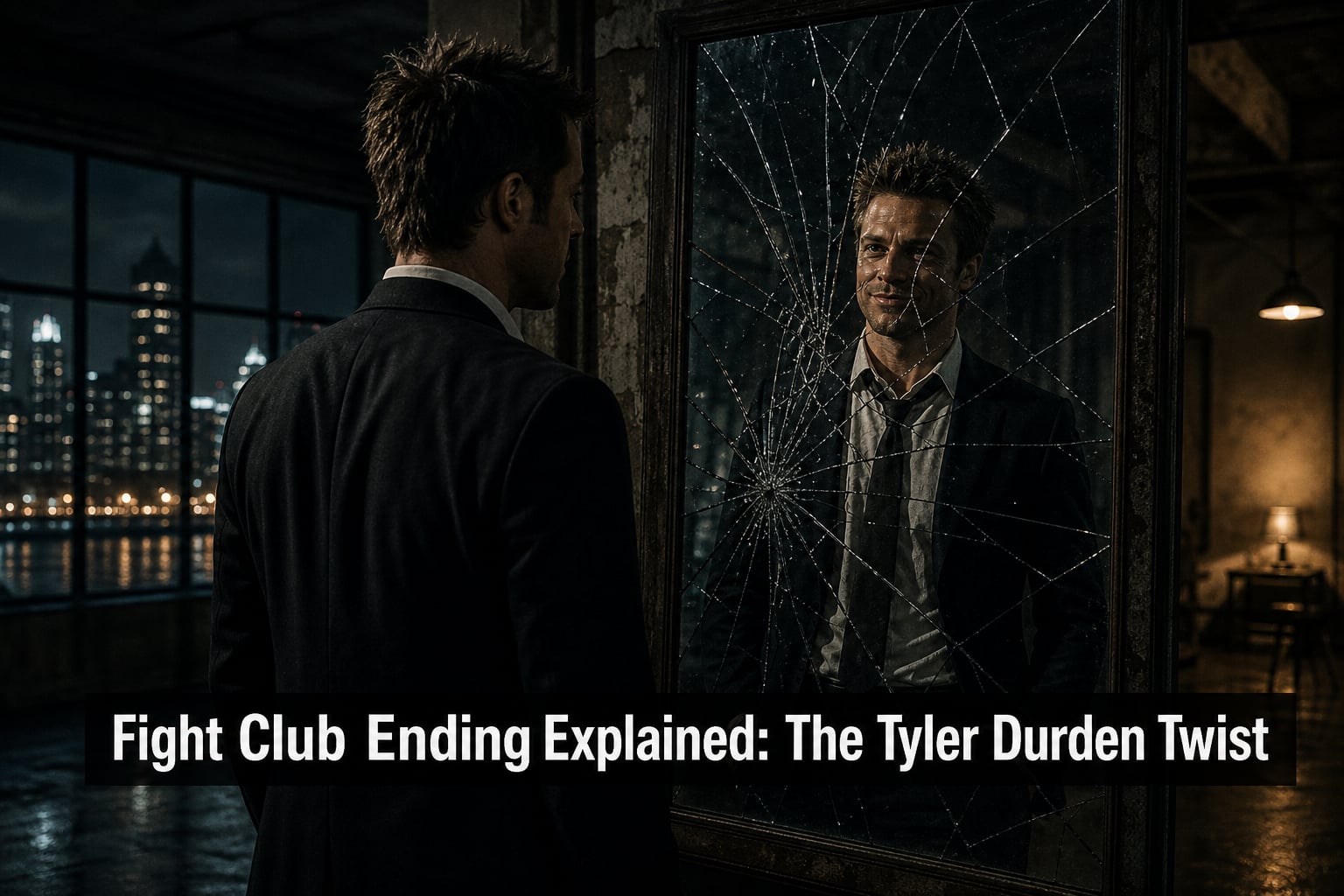
The Fight Club ending explained in one line: Tyler Durden does not exist. The charismatic, soap-making, anarchic visionary played by Brad Pitt is a figment of Edward Norton’s narrator’s fractured mind, an alter ego conjured from insomnia, depression, and an all-consuming hatred of modern consumer culture. Everything you thought you knew about the film flips the moment the narrator realizes he is Tyler. Below is the complete, analytically rigorous walkthrough of the twist, the shooting, Project Mayhem, the book differences, and why this 1999 film still unsettles viewers in 2026.
Table of Contents
Fight Club Ending Explained: Who Tyler Durden Really Is?
The central twist of Fight Club is simple and devastating: Tyler Durden is the narrator’s alter ego. They are the same person. Every fistfight, every anarchic prank, every late-night speech about IKEA furniture and lobotomized office workers has been the narrator performing an argument with himself.
Edward Norton’s character is never given a real name. The script calls him Jack, after a running gag about being “a slave to the IKEA nesting instinct” and the offhand line “I am Jack’s raging bile duct.” That namelessness is the point. He could be any over-caffeinated knowledge worker of the late 1990s, and the film wants you to feel that universality before the rug is pulled out.
The reveal lands at the exact midpoint of the film, but the clues have been stacking up since frame one. The narrator and Tyler are never shown in the same frame together in the early scenes. Tyler appears from nowhere, knows things he shouldn’t know, and disappears during the exact hours the narrator loses to insomnia-induced fugue states. When the narrator traces Tyler’s plane tickets, the names on every seat belong to people in his life. The film has been telling you. It just hasn’t been speaking loudly enough.
Once the narrator pieces this together, the entire structure of Fight Club rewrites itself. The “support groups for the dying” subplot becomes a coping mechanism. The careful construction of an idealized masculine friend becomes a dissociative coping strategy. The slow escalation from bare-knuckle brawls to coordinated terrorist activity becomes the narrator’s own self-destruction playing out in real time.
How and Why the Narrator Created Tyler Durden
The narrator didn’t choose to invent Tyler. Tyler emerged from a clinical-grade mental break driven by three compounding factors: severe insomnia, crushing depression, and what the film calls a “fight club” of mid-life malaise.
The insomnia comes first and is treated almost comically at the start. The narrator goes to his doctor begging for sleep, and instead receives the suggestion that he watch insomniacs die of brain tumors at support groups. This is dark satire, but it is also a depiction of someone whose nervous system has been so overloaded by consumerist despair that his body simply refuses to rest.
From that sleepless foundation, dissociation follows. Tyler shows up exactly when the narrator is at his most exhausted, and Tyler is everything the narrator is not. Tyler is charming where the narrator is awkward. Tyler is free where the narrator is enslaved. Tyler sleeps with Marla Singer without guilt; the narrator cannot even bring himself to ask. Tyler speaks in aphorisms that the narrator can only scribble into a notebook at three in the morning.
Chuck Palahniuk, who wrote the 1996 novel, has been explicit about the psychology. The narrator creates Tyler because the only acceptable version of masculinity in his world is one he cannot personally inhabit. Tyler is the id. The narrator is the over-socialized superego. They split because integrating them would require the narrator to feel things his therapist-recommended, IKEA-furnished, corporate-mandated life has forbidden.
What makes Fight Club brilliant is that this psychological unraveling is presented as a victory. For two-thirds of the film, Tyler is the most magnetic character on screen. The viewer, like the narrator, roots for him. The twist reframes that admiration as pathology. You have been cheering for a mental illness.
What Happens in the Final Scene: The Shooting Explained
The climax of Fight Club resolves in a single, deliberately ambiguous gunshot. The narrator, having realized he is Tyler, is being held at gunpoint by a “space monkey” loyal to Project Mayhem. Tyler demands that the narrator finish what he started. Marla, the only person who can pull the narrator back, is brought to the scene.
Here is where the trick lands. Tyler holds the gun to the narrator’s mouth. The narrator slowly lowers it. Then he pulls the trigger, sending the bullet through his own cheek and out below his ear. He survives. Tyler does not.
Reddit forums have debated the geometry of this shot for 25 years. The visual is clear: the bullet does not enter the brain. It exits below the ear. The narrator lives, and Tyler dies, because Tyler cannot exist inside a person who has accepted full responsibility for his own actions. Reintegration, not death, is the cure.
The symbolic meaning matters more than the physics. Shooting himself is the only way the narrator can kill the version of himself that he has been outsourcing. Tyler cannot be punched, starved, or abandoned. He can only be acknowledged, integrated, and let go. The bullet is not murder. It is acceptance.
Marla is there because she is the only other character who has sensed the duality from the beginning. She tells Tyler at one point, “I know you,” and the narrator takes it as flirtation. In hindsight, it is a warning. Marla is real, vulnerable, and uninterested in the narrator’s fantasy self. Her presence at the climax is the gravitational pull that pulls him back into his actual life.
Project Mayhem and the Continuing Explosions
Just when the narrator believes he has won, the camera pulls back. The buildings begin to fall. Project Mayhem’s bombs, wired to detonate at the precise moment the narrator “kills” Tyler, are already in motion. The narrator and Marla watch the skyline collapse hand in hand.
This is the bleakest note in the film. The narrator has won back his mind and possibly his life, but the body count is locked in. Tyler is dead, but Tyler’s ideology is now autonomous. The space monkeys will not stop. The architecture of modern consumer finance, the credit card companies, the police, the media, will all be erased regardless of what happens to the man who invented them.
David Fincher shoots this sequence with characteristic coldness. The narrator does not weep or rage. He just watches. Marla holds his hand. The bomb blast takes down a few skyrises. The shot holds. End credits.
The point is that the narrator has not defeated the system. He has merely stepped out of the driver seat before the crash. Project Mayhem was always going to be a suicide mission, and the narrator’s only victory is that he is no longer the one driving.
Fight Club the Film vs. Fight Club the Novel: Ending Differences
Chuck Palahniuk’s novel ends differently, and the difference tells you a lot about each medium’s priorities. In the book, after the narrator shoots himself, he wakes up in a mental hospital. The staff and patients treat him as Tyler Durden, their messianic leader. He is trapped inside the cult he created, while the physical body of Tyler continues to do harm.
The film, by contrast, ends with the buildings collapsing and Marla present. The novel ends with institutional capture and the inability to escape. The film ends with a kind of melancholic freedom.
Fincher’s choice is more cinematic. A hospital sequence would have felt like an epilogue. The collapsing buildings give the film a final visual that stays with the viewer. Palahniuk’s choice is more literary, leaning into the idea that the narrator cannot escape Tyler even after acknowledging the truth.
Both endings agree on one thing: the narrator does not get a clean victory. In the novel, he loses his autonomy. In the film, he loses the city. Either way, the system he tried to blow up keeps standing in some form.
Themes: Consumerism, Masculinity, and Modern Relevance
Fight Club is, on its surface, a movie about soap, suits, and bare-knuckle fighting. Underneath, it is a sustained assault on three targets: consumer culture, twentieth-century masculinity, and the psychological cost of both.
The consumer critique is the easiest to spot. The opening voiceover catalogs the narrator’s IKEA-filled apartment, his matching cutlery, his carefully curated bachelor lifestyle. Tyler later bombs a coffee shop and accuses the barista of being “someone who would rather work at a coffee shop than pursue a meaningful life.” The film treats consumerism as a soft lobotomy.
The masculinity argument is messier. In 1999, Fight Club felt like an honest, if extreme, interrogation of what it meant to be a man with no war to fight. In 2026, it reads differently. Some critics and viewers see the film as a cautionary tale about the dangers of unprocessed male rage. Others see it as a celebration of the same rage. The film’s refusal to pick a side is either brave or irresponsible, depending on who you ask.
What is clear is that the film refuses to flatter its audience. Tyler Durden is funny, handsome, and quotable. He is also a domestic terrorist running a cult built on emotional manipulation. The film wants you to notice both. If you leave the theater wanting to be Tyler, the film has failed. If you leave the theater questioning why so many men in your life feel pressured to be Tyler, the film has done its job.
This is why Fight Club has aged the way it has. It does not offer answers. It offers a diagnosis. The diagnosis is that an entire generation of men were trained to suppress everything except the urge to break things. Whether breaking things is the cure or the disease is the question the film leaves you holding.
The Unreliable Narrator Technique and Why the Twist Works
The Tyler Durden twist only works because the entire film is structured as an unreliable narration. From the first frame, the narrator is lying to you, but not intentionally. He is lying to himself, and the camera is complicit.
This is the technique that separates Fight Club from a generic twist ending. The viewer experiences the narrator’s delusion firsthand. When the narrator sees Tyler, we see Tyler. When the narrator loses time, we lose time. When the narrator finally sees the truth, we have to rewind the entire film in our heads.
It is a brutal rewatch value. The second time through, the film is essentially a different movie. Every scene with Tyler is now a scene of self-conversation. The scenes where the narrator blacks out and wakes up in unfamiliar cities are now scenes of blackout fugue. The film invites you to distrust your own memory of it.
Few films commit to the unreliable narrator this completely. The Sixth Sense plays with it. Gone Girl hides it. Fight Club lives inside it. The whole movie is a hallucination the narrator is having, and the audience is along for the ride.
Frequently Asked Questions
What is the twist in Fight Club Tyler Durden?
Fight Club’s twist reveals that Tyler Durden is the narrator’s imaginary alter ego – they are the same person. The narrator created Tyler due to a mental break caused by severe insomnia, depression, and disillusionment with consumer culture. Tyler represents the confident, rebellious, charismatic version of the narrator that he could not be in his waking life.
What happened to Tyler at the end of Fight Club?
At the end of Fight Club, the narrator kills Tyler by shooting himself through the cheek. The bullet exits below his ear, leaving the narrator alive but symbolically destroying his alter ego. After the shot, Project Mayhem’s bombs detonate and the surrounding buildings collapse. The narrator watches the destruction holding Marla’s hand, having regained his true identity but unable to stop the chaos he unleashed.
Why did Tyler say what’s that smell?
In Fight Club, the line about a strange smell is one of Tyler’s many cryptic, offhand comments that hint at his nature as the narrator’s suppressed desires. Tyler frequently makes casual remarks about bodily fluids, decay, and disorder that signal his rejection of sanitized consumer culture. The line also foreshadows Tyler’s later use of human fat from liposuction clinics to make artisan soap.
What did Tyler do to Marla’s mother?
Tyler is shown using fat extracted from liposuction clinics, including Marla’s mother’s procedure, to make handmade soap. The detail functions both as a dark joke about consumer-product sourcing and as a pointed personal attack on Marla. It also crystallizes Tyler’s transgressive philosophy: taking the byproducts of vanity-driven cosmetic surgery and turning them into something raw and homemade.
Final Thoughts on the Fight Club Ending Explained
The Fight Club ending explained above is, at its core, a story about a man who had to destroy himself to save himself. The narrator invents Tyler to escape his empty life, and in the process nearly destroys everything around him. The final shot of buildings collapsing into dust is not triumph. It is the cost of waking up.
Two decades later, Fight Club still rewards rewatching, debating, and arguing about. If the ending felt unclear the first time, it should feel clearer now. If it felt clear, the second viewing should break it open again. That is the whole point. Tyler Durden never stays dead for long.