
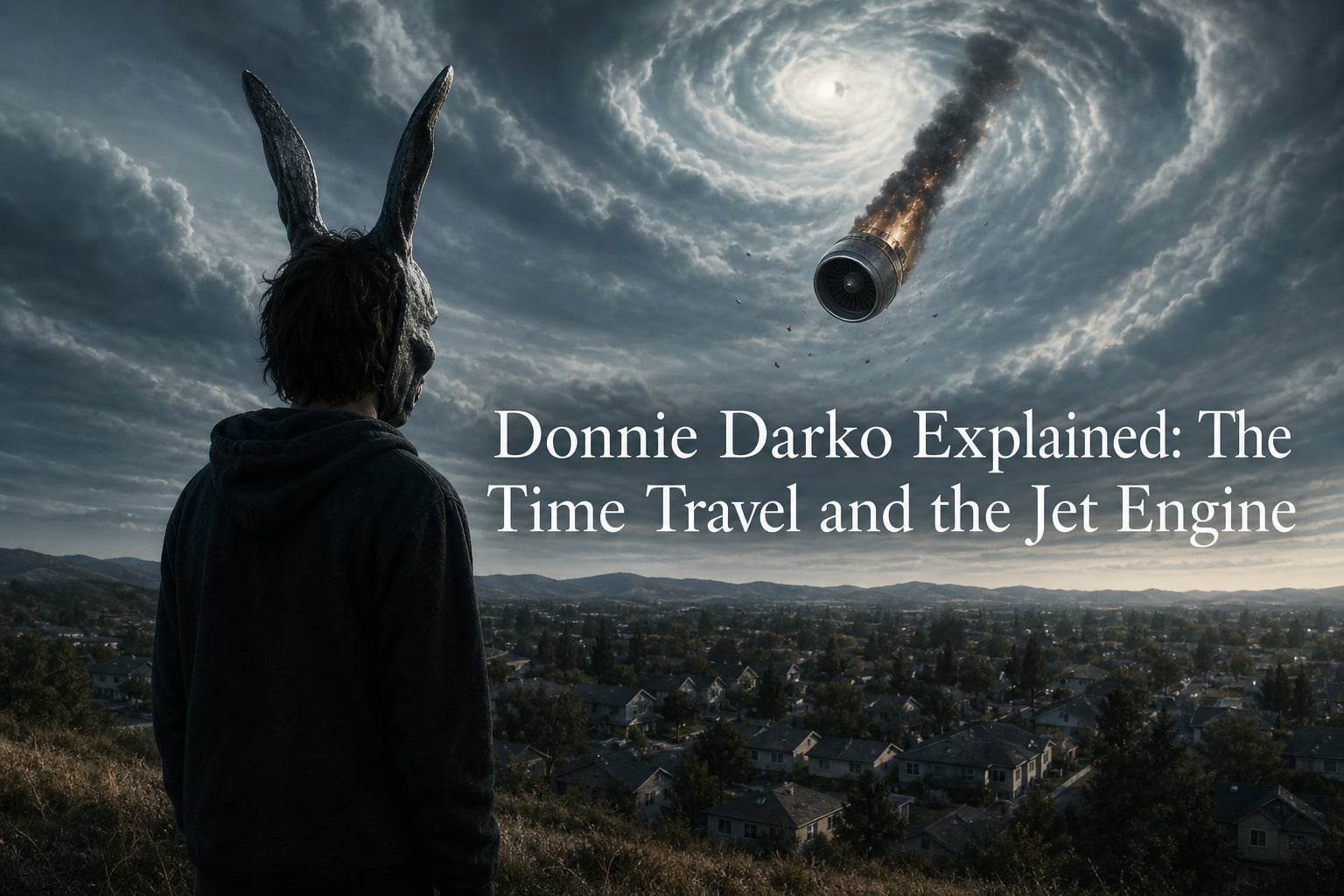
Spoilers for all of Donnie Darko follow. The short version of Donnie Darko explained time travel jet engine is this: Donnie is placed in a temporary Tangent Universe, survives a falling engine because Frank leads him away, and must later send that engine back through time. When the timeline resets, the engine falls where it was always meant to fall, killing Donnie but preventing the unstable branch from destroying the Primary Universe.
That answer is simple enough to say and surprisingly difficult to feel while watching the film. Richard Kelly tells the story through Donnie’s point of view, where therapy, medication, sleepwalking, school politics, family friction, and supernatural instructions all arrive in the same uneasy register.
The most useful way to approach the film is to separate its two layers. The theatrical cut gives us the events and the emotional stakes; The Philosophy of Time Travel, the book credited to Roberta Sparrow and foregrounded in the director’s cut, supplies names for the story’s time-travel machinery.
Quick framing: The book-based explanation clarifies the plot, but it does not cancel the film’s ambiguity about Donnie’s mental health, faith, or fear. Both readings can sit beside each other: the movie gives us a real time anomaly, while Donnie experiences it through an already troubled and highly subjective life.
Table of Contents
The rules come from The Philosophy of Time Travel
The Philosophy of Time Travel is the film’s rulebook, not merely a creepy prop. Roberta Sparrow, the elderly woman Donnie calls Grandma Death, wrote it before the events of the film, and Donnie receives its pages from his teacher Dr. Thurman.
Its terminology explains why the plot needs a chosen person, a misplaced object, and people who seem pushed into unlikely decisions. The book describes a normal Primary Universe, a rare Tangent Universe that splits away from it, an Artifact that appears inside that branch, and the people drawn into returning it.
The director’s cut makes this framework much easier to locate because excerpts appear on screen. The theatrical cut leaves more of the work to dialogue, image, and inference, which is one reason viewers can finish the movie knowing the emotions but still asking where the jet engine came from.
The book’s terms are plot tools rather than character diagnoses
Terms such as Living Receiver and Manipulated Dead describe jobs within the anomaly. They do not mean every person is consciously following a cosmic script, and they do not prove that every strange image is a literal message.
That distinction matters with Donnie. He is a teenager receiving psychiatric treatment, but the film also gives him information and abilities that reach beyond ordinary hallucination: he sees liquid paths extending from people, causes events at a distance, and later moves an engine through a time portal.
Warning: Do not treat the exact wording of the companion book as a complete scientific model. The film deliberately leaves questions about the initial cause of the Tangent Universe and the rules of the restored timeline partly open.
A Tangent Universe is a temporary, unstable branch of reality
The Tangent Universe in Donnie Darko is a duplicate offshoot of the Primary Universe, created when time becomes corrupted. It is temporary and unstable, which is why the story opens with an exact countdown: 28 days, 6 hours, 42 minutes, and 12 seconds.
That number is the lifespan of the branch, not a code for Donnie’s age, a prophecy about the election, or simply a Halloween mood setter. When the timer reaches zero, the Tangent Universe must be corrected or it collapses, with the book’s language warning of a black-hole-like catastrophe that would threaten the Primary Universe as well.
The Primary Universe is the baseline timeline. In it, the jet engine lands on Donnie’s bedroom at the start of the story and kills him; the Tangent Universe exists because that same event is diverted when Donnie follows Frank outside.
The 28-day clock measures the branch, not Donnie’s entire fate
Frank tells Donnie how long the world has left because Frank is pointing to the deadline for repair. The countdown runs from the initial split in early October until the return to the starting night near the end of October.
Inside those 28 days, events that look unrelated become necessary links: Donnie meets Gretchen, learns about the cellar door, burns Jim Cunningham’s house, sees his mother’s travel plans, and is present when Frank arrives at the party. The film asks us to notice that the branch is building a route back to its own beginning.
The Tangent Universe contains duplication, which explains the engine paradox
At the split, reality produces an extra version of the jet engine. One engine is associated with the plane that carries Donnie’s mother and sister during the Tangent Universe, while the other is the engine that crashes through Donnie’s roof at the beginning of that branch.
This duplicate is the Artifact, the abnormal object whose presence makes the branch dangerous. Sending it back does not invent a new engine from nowhere; it removes the extra object by carrying it through time to the moment the Primary Universe is restored.
Timeline shortcut: Think of the opening engine as an object that has already completed the ending’s trip. The story begins with the result of Donnie’s final act, then spends 28 days showing why he makes that act happen.
The jet engine is the Artifact that must leave the Tangent Universe
The jet engine in Donnie Darko is the Artifact: a duplicated object that appears when the Tangent Universe forms and has to be returned to the Primary Universe. It is not a random falling object, and it is not simply wreckage with no plane attached.
The film’s central paradox is intentional. Authorities cannot identify the engine’s origin after it falls because, at that point in the story, it belongs to a loop whose source has not been shown yet; the ending later connects it to the plane carrying Donnie’s mother home.
In the Tangent Universe, the plane has its engine and Donnie’s house has another one. When Donnie uses telekinesis at the end, he tears the engine free from the returning plane and sends it through the portal. The restored Primary Universe has one arriving engine: the Artifact has been returned to the instant that begins the loop.
The Artifact creates urgency because it cannot remain duplicated
The engine matters because the Tangent Universe is not a stable alternate life that Donnie can choose to keep. The Artifact marks it as malformed, and returning it is the repair that ends the branch before the predicted collapse.
This is why a purely mechanical answer, such as “the engine came from the plane,” is true but incomplete. It tells us the physical source, while the Artifact explanation tells us why that source becomes a time-travel problem and why Donnie is asked to resolve it.
The government investigation confirms the mystery without solving it
Federal investigators inspect the engine and cannot match it to a missing aircraft. Their confusion is a useful story signal: neither the adults nor conventional evidence can explain an object whose ordinary cause lies at the far end of a broken timeline.
The investigation is not a separate conspiracy that controls the movie. It grounds the impossibility in the everyday world, then leaves the cosmic explanation to the viewer who follows the loop through the ending.
Donnie is the Living Receiver chosen to return the Artifact
Donnie is the Living Receiver, the person selected inside the Tangent Universe to send the Artifact back and save the Primary Universe. The book describes the Receiver as unusually powerful and often tormented, which fits both Donnie’s frightening experiences and his growing ability to act on them.
His first survival is part of the assignment. Frank appears outside Donnie’s house, tells him the countdown, and lures him away from his bedroom moments before the engine falls, leaving Donnie alive in the only timeline where he can correct the error.
Donnie’s powers appear in stages rather than as a superhero inventory. His sleepwalking puts him where the plot needs him, his perception of liquid paths gives him glimpses of predetermined movement, and his later telekinesis lets him perform the one physical act no ordinary person could perform.
The liquid paths show Donnie a route through time
The translucent tubes emerging from chests are often read as people’s future paths. Donnie watches them point from a person toward a coming action, and he eventually steps into one himself when it guides him from his room.
The image does not mean every person lacks free will. It shows that, during this emergency, the branch is narrowing events toward a repair; Donnie can see the pressure of that course more clearly than anyone else.
Frank saves Donnie first and needs Donnie later
Frank the rabbit is terrifying because he is both Donnie’s rescuer and the person Donnie kills. In the Tangent Universe, Frank saves him from the engine at the opening; after Donnie shoots Frank near the end, dead Frank can become one of the Manipulated Dead and guide him toward the final return.
The apparent contradiction is the loop working in both directions. Frank can appear at the beginning because the version of him who dies later has already acquired the ability to influence the Receiver across the anomalous timeline.
Frank and Gretchen are the Manipulated Dead who guide Donnie
The Manipulated Dead are people who die within the Tangent Universe and can communicate with the Living Receiver. Frank becomes one when Donnie shoots him after Frank runs Gretchen over, and Gretchen becomes one when the collision kills her.
They are not villains running an independent plan against Donnie. Their function is to push or draw him toward the final choice, even though the result is painful and even though the living versions of these people do not understand what they are participating in.
Frank’s rabbit mask and wound make his identity visible before Donnie learns it. When Donnie sees the injured eye under the mask, the film is planting the image that will make sense after he fires the gun at the end.
Frank’s messages set up events rather than explain them all
“They made me do it” is Frank’s most revealing statement. It points to the way the Manipulated Dead are compelled by the needs of the Tangent Universe, but it does not supply a tidy answer for every instruction Frank gives Donnie.
Burning Cunningham’s house, for example, exposes the child-abuse material and leads to Cunningham’s arrest. That disrupts school, changes who attends the party, and helps place Donnie and Gretchen at the road where the fatal collision occurs.
Gretchen makes the sacrifice emotionally meaningful
Gretchen is more than a device placed in danger. Her relationship with Donnie gives him a version of connection and happiness that makes the ending hurt, because correcting the branch means surrendering the time in which he met her.
Her death also supplies the immediate reason Donnie has the gun in hand and sees Frank as a target. Once she dies, Donnie understands the loop’s cost with personal clarity instead of just accepting an abstract instruction from a rabbit.
The Manipulated Living create the route that Donnie needs
The Manipulated Living are people inside the Tangent Universe who, without fully realizing it, make choices that help the Living Receiver complete the repair. They include Donnie’s family, friends, teachers, Jim Cunningham, and in a special sense Roberta Sparrow.
They do not become puppets with blank minds. The framework says their fears, desires, arguments, and accidents are bent into a pattern that directs the Receiver toward the Artifact, which is why the movie’s messy subplots acquire a causal role after the fact.
Kitty Farmer pushes the school into a moral panic over the video of Cunningham. Karen Pomeroy gives Donnie Graham Greene’s The Destructors, a story that helps shape the arson episode, while Dr. Thurman provides pages from Roberta Sparrow’s book.
Donnie’s family sends the plane into the final position
Rose Darko takes Samantha to Los Angeles for Sparkle Motion, and Elizabeth travels with them. Their return flight places the plane above Middlesex at the exact moment Donnie needs an engine available to send through the time portal.
The fact that Donnie loves his family makes the sequence more unsettling, not less. He is not trying to harm them; the return of the Artifact places the engine in his bedroom in the restored timeline, while his family returns safely in the ordinary course of events.
Roberta Sparrow connects the old warning to the new Receiver
Roberta Sparrow’s history is deliberately incomplete, but the book identifies her as someone who understood the anomaly before Donnie did. Her isolation, her repeated trips to the mailbox, and her fixation on time suggest a person living with the aftermath of knowledge that no one around her shares.
Calling her Grandma Death is cruel and revealing. Donnie’s world has reduced a former guide to a neighborhood eccentric, yet the pages she wrote give him the vocabulary to recognize what Frank’s visits are really about.
The Ensurance Trap forces the choices that make the reset possible
The Ensurance Trap is the chain of events that makes the Living Receiver return the Artifact. It is not a trap in the sense of a villain locking Donnie in a room; it is a pressure system in which every detour closes off until one terrible action becomes the only way to repair reality.
In practical terms, it makes Donnie care about Gretchen, reveals the route to her house, brings Frank to the party, creates the car accident, and gives Donnie a reason to shoot Frank. The trap also gets Donnie onto the hill with a clear view of the portal and the returning plane.
The route to the climax follows a clear sequence
Frank wakes Donnie and prevents the opening engine from killing him.
Donnie receives the countdown and Roberta Sparrow’s book, giving the anomaly a deadline and a language.
Frank’s instructions lead Donnie to flood the school and expose Jim Cunningham, altering the adults’ plans.
Donnie and Gretchen go to Roberta Sparrow’s house on Halloween, where Frank’s car kills Gretchen.
Donnie shoots Frank, then recognizes the rabbit, the eye wound, and the loop that has guided him.
From the hill, Donnie opens the time portal and sends the engine back before the Tangent Universe can collapse.
Every link has an understandable local motive, which keeps the film from becoming arbitrary. Yet the links add up to an outcome no one except Donnie is positioned to carry out, and even he only understands it fully at the last possible moment.
Rewatch cue: Watch which character leaves, arrives, or changes plans after the Cunningham scandal. Those shifts are not filler; they are the trap arranging the positions needed for the Halloween finale.
The ending sends the Artifact back and restores the Primary Universe
At the end, Donnie stands on the hill above town, sees a vortex form in the sky, and uses telekinesis to pull the jet engine from his mother’s returning plane. He guides it through the time portal to the moment the Tangent Universe began, restoring the Primary Universe and eliminating the duplicate Artifact.
After the return, the movie cuts back to the opening night in the corrected timeline. Frank never wakes Donnie, so Donnie remains in bed when the engine crashes through his roof; the death that was postponed in the Tangent Universe now happens in the Primary Universe.
That is why the final engine can be both from the plane and apparently source-less to the investigators. In the restored world, it arrives through the portal as the result of Donnie’s action in the branch that has just been erased.
Donnie’s laughter shows that he understands the choice
Donnie laughs in bed shortly before the engine hits because he appears to remember enough of the Tangent Universe to know what is coming and why it matters. The film does not give him a speech of technical exposition, but his calm acceptance contrasts sharply with the fear that shaped most of his earlier life.
He has learned that returning the engine saves his family, prevents Gretchen’s death, and prevents the collapse of both universes. He also knows the repair removes the 28 days in which he and Gretchen fell in love, making the choice an act of sacrifice rather than a victory lap.
Donnie has to die because survival belongs to the broken branch
Donnie must die in the restored timeline because his survival was the result of Frank diverting him from the engine inside the Tangent Universe. If he escaped again after sending the Artifact back, the corrected timeline would immediately recreate the contradiction that the return was meant to remove.
This does not mean the film proves a universal rule that Donnie is “destined” to die in every imaginable reality. It means the particular repair we see requires the original event to occur: the engine kills the boy who was temporarily spared so he could send it home.
The religious and savior imagery strengthens the emotional reading of that decision. Donnie gives up his own future to preserve other people, but the movie keeps the act grounded in a specific causal problem rather than turning him into a simple saint.
The survivors retain emotional echoes after the reset
After the timeline resets, people who were deeply involved in the Tangent Universe seem to retain dreams, emotions, or fragments of recognition. Frank wakes in distress, Gretchen rides past Donnie’s house and seems unsettled, and characters who clashed in the branch appear changed by feelings they cannot explain.
These are not full memories that let everyone reconstruct the lost 28 days. They are emotional residues, which gives the ending its sad, humane texture: the universe has been repaired, but the people touched by it still carry a sense that something important has disappeared.
Grandma Death remains a guide, not a final answer machine
Roberta Sparrow’s appearance near the mailbox after the reset is a reminder that the book and its author mattered. The film never provides a full account of her own past as a possible earlier Living Receiver, so claims that she definitely lived through the same exact loop go beyond what the film establishes.
What the film does establish is enough: she wrote the text that explains the roles, Donnie receives it, and the town has overlooked the person most connected to the problem. Her quiet presence fits a story about knowledge surviving in partial, lonely forms.
Donnie Darko’s time travel works as a closed causal loop
The most coherent Donnie Darko plot explained reading is a closed loop: a Tangent Universe creates the duplicate engine, Donnie lives long enough to return it, and that return sends the engine to the opening moment where it kills him in the restored Primary Universe. The movie starts with the consequence and ends by showing the cause.
On a rewatch, track four things: the countdown, the movement of Donnie’s family, Frank’s eye and instructions, and each event that moves Donnie toward Roberta Sparrow’s house. You do not need every symbol to have one fixed meaning to see how the jet engine, time portal, and sacrifice hold the plot together.
FAQs
How did Donnie Darko send the jet engine back in time?
Donnie uses the telekinetic ability associated with the Living Receiver to pull the engine from his mother’s returning plane. From the hill above town, he directs it through the water-like portal in the sky to the moment the Tangent Universe began, restoring the Primary Universe.
What does 28 days, 6 hours, 42 minutes, and 12 seconds mean?
It is the lifespan of the Tangent Universe. Frank gives Donnie the exact countdown because the duplicate Artifact must be returned before the temporary branch collapses and threatens the Primary Universe.
What is the jet engine in Donnie Darko?
The jet engine is the Artifact, a duplicated object created with the Tangent Universe. Its physical source is the plane carrying Donnie’s mother and sister, but it becomes a time-travel problem because the extra engine has to be sent back through the portal.
How did Donnie originally survive the jet engine?
Frank, acting before his Tangent-Universe death as a Manipulated Dead guide, leads Donnie out of the house before the engine falls. Donnie survives only in the temporary branch so that he can later return the Artifact.
Why did Donnie have to die in Donnie Darko?
Donnie’s survival was the divergence created by Frank’s warning in the Tangent Universe. Once Donnie sends the engine back and restores the Primary Universe, he stays in bed for the original crash, accepting death so the corrected timeline and the people he loves can survive.
Who is Frank in Donnie Darko?
Frank is Elizabeth Darko’s boyfriend, who wears a rabbit costume on Halloween. After Donnie shoots him in the Tangent Universe, Frank becomes a Manipulated Dead figure who can guide Donnie, including by saving him from the opening engine crash.
Final Thoughts
Donnie Darko explained through the time travel rules is not a claim that the film has no ambiguity. It means the jet engine is a deliberate loop, Frank is a guide shaped by a later death, and Donnie’s final decision repairs the Tangent Universe at a painful personal cost.
That is why the ending works even when the mechanics feel daunting on a first watch. The science-fiction framework supplies the how, while the image of Donnie choosing to stay in bed supplies the emotional answer: he gives back the life that the broken timeline briefly gave him.