
On June 10, 2007, over twelve million people stared at their television screens in stunned silence. The screen had gone black mid-scene. No warning, no music swell, no slow fade. Just black. For several seconds, millions of Americans thought their cable had gone out.
That moment became one of the most analyzed, debated, and dissected scenes in television history. The Sopranos finale, titled “Made in America,” didn’t just end a show. It created a cultural fault line that still divides fans and critics today.
In this breakdown of the Sopranos finale explained, I’ll walk you through every detail of that final scene at Holsten’s diner. We’ll cover the evidence for and against Tony’s death, David Chase’s own statements about the ending, the significance of the man in the Members Only jacket, and why this particular cut to black has haunted audiences for nearly two decades.
Whether you just finished your first binge-watch or you’ve been arguing about this scene since 2007, you’ll find something new here. Let’s settle this once and for all.
Table of Contents
The Final Scene: What Happens in Holsten’s Diner?
The Sopranos finale explained properly starts with what we actually see on screen. The final sequence at Holsten’s Bloomfield Diner is a masterwork of tension and visual storytelling.
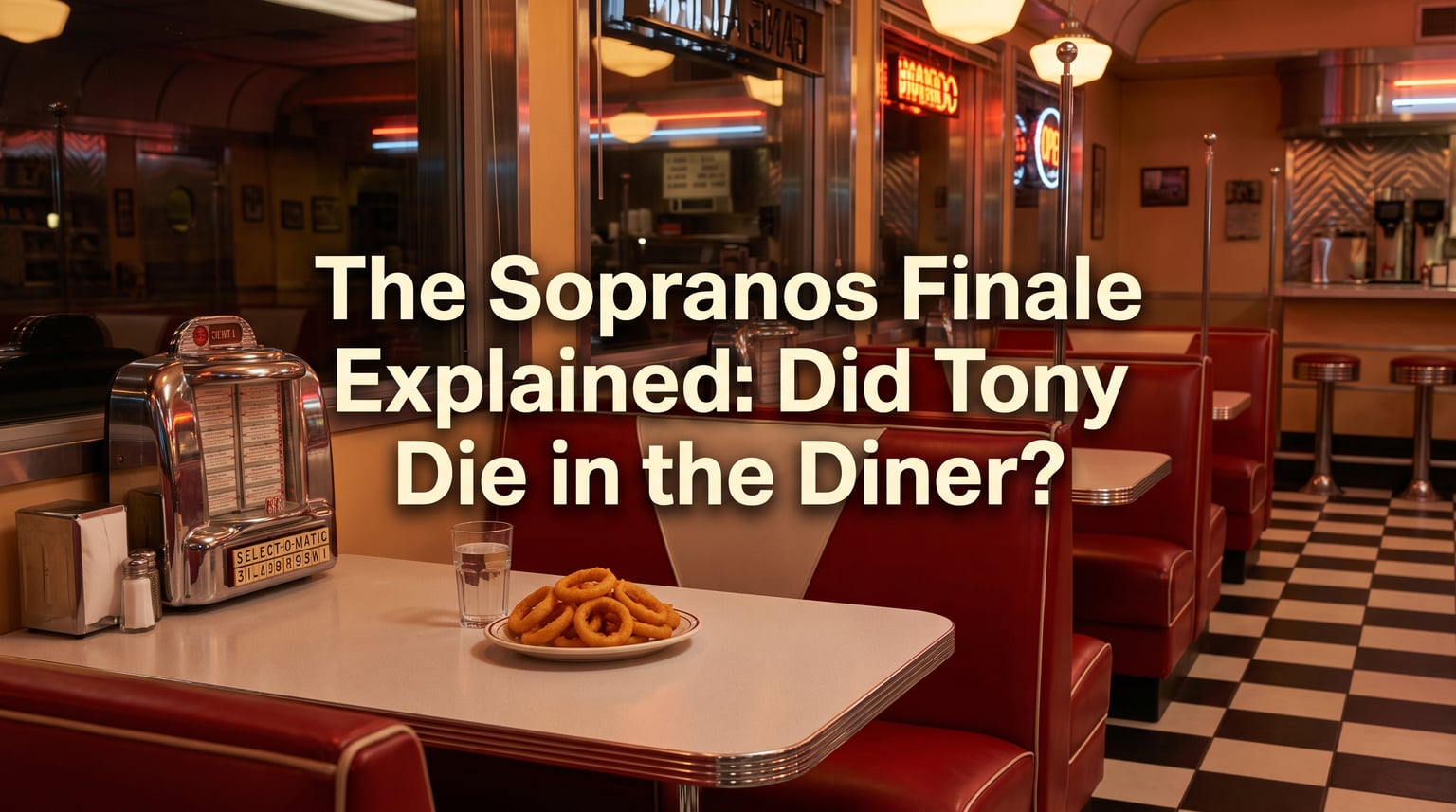
Tony arrives at the diner first. He slides into a booth, flips through a jukebox menu, and selects Journey’s “Don’t Stop Believin’.” The song plays over the scene, creating an almost nostalgic, comfortable atmosphere. This is Tony’s world. A family diner, comfort food, the sounds of the seventies.
Tony picks up an onion ring. Then another. He eats them with his fingers, the way he always does. Carmela arrives next, taking her seat across from him. They share a brief, almost warm exchange about onion rings being the best thing on the menu.
AJ arrives after, parking his car outside and making a dramatic entrance. There’s a brief moment of levity when he quotes his father’s own advice about “remembering the good times.” It’s a callback to earlier seasons, delivered with AJ’s trademark earnestness.
But Meadow is late. She’s having trouble parallel parking her car outside. This detail matters more than most viewers realize on first watch. Her delayed arrival extends the scene, prolonging the tension.
Throughout the scene, the camera work is deliberate. We see Tony repeatedly glancing at the door every time someone enters the diner. Each time the bell chimes, the camera snaps to the entrance, and we see what Tony sees. A man enters. A woman. A couple. Each time, no threat. Each time, a brief exhale.
Then the bell rings one final time. We assume it’s Meadow finally arriving. The shot cuts to Tony’s face, looking up. And then black. Silence. Ten seconds of absolute black screen. Then the credits roll.
That is everything we see. The question of whether Tony died in the diner depends entirely on how we interpret these images, this sequence, and the techniques used to construct them.
The Cut to Black: How the Sopranos Finale Ended
The cut to black is the single most discussed edit in television history. It wasn’t a fade. It wasn’t a dissolve. It was a hard cut, instantaneous, from a mid-scene shot of Tony’s face to nothing.
When this happened on June 10, 2007, the immediate reaction was widespread confusion. Millions of viewers genuinely believed their cable boxes had malfunctioned. HBO’s switchboard lit up. Internet forums exploded within seconds. Reddit threads that would run for years were born that night.
The first person I talked to about it said, “My TV broke at the worst possible moment.” They didn’t realize for another ten minutes that this was intentional. That reaction was replicated in living rooms across America.
David Chase chose this abruptness deliberately. The hard cut communicates something that a slow fade never could: suddenness. Finality. The absolute lack of warning that accompanies violent death. If you blink, you miss it. If you look away for one second, it’s already over.
The black screen held for approximately ten seconds before credits rolled. In those ten seconds, the viewer experiences something close to what Tony experiences (or stops experiencing). Total darkness. No music. No sound. Just absence.
This technique wasn’t random. Chase spent months working with his editor to get the timing exactly right. Every frame was calculated. Every second of black screen was a deliberate creative choice, not a technical accident.
Evidence That Tony Died
Now we get to the heart of the Sopranos finale explained. The evidence that Tony was killed in that diner is extensive, layered throughout the final season and the finale scene itself. Let’s break it down piece by piece.
1. The Point of View Shot Technique
This is the most critical piece of evidence, and it’s the one most casual viewers miss. Throughout the final scene, the camera alternates between two perspectives. We see wide shots of the diner, and we see what Tony sees when he looks up at the door.
Each time the door bell rings, the camera cuts to a point of view shot from Tony’s perspective. We become Tony. We see what he sees. This technique establishes a pattern: the audience is looking through Tony’s eyes.
In the final moment, when the bell rings that last time, the camera cuts to Tony’s face, then back to the POV shot. But instead of seeing Meadow walk in, we see nothing. Black screen. The POV shot continues, but there’s nothing to see because Tony is no longer alive to see it.
If the scene were simply ending without Tony’s death, we would see the family together one last time. Instead, the POV shot is severed. The observer has been eliminated.
2. Tony Never Hears the Shot
In Season 5, Tony and Carmela have a conversation about death. Tony describes what his uncle told him about being killed. The key line: “You probably don’t even hear it when it happens, right?”
This line is essentially a direct explanation of the final scene. If Tony is shot in the back of the head, he would not hear the gunshot. He would experience life, and then nothing. Just like the audience experienced the scene, and then nothing.
The cut to black is the cinematic representation of Tony’s perspective being permanently terminated. No sound. No warning. Just absence.
3. The Five-Times Rule
Pay close attention to the pattern in the final scene. Tony looks up at the door several times before the final cut. The camera cuts to his POV shot each time. On the fifth occurrence, when Tony looks up and the camera cuts to his POV, we get the black screen.
In filmmaking, establishing a pattern and then breaking it is a deliberate technique. The pattern tells the audience what to expect. Breaking it communicates that something has changed. Something has ended.
4. The Man in the Members Only Jacket
A man wearing a Members Only jacket enters the diner and sits at the counter. He’s identified only as “Man in Members Only Jacket” in the credits, played by Paolo Colandrea. This character appears to be watching Tony throughout the scene.
The Members Only jacket is loaded with significance within The Sopranos universe. It connects to Eugene Pontecorvo, a character from earlier seasons who wore a similar jacket and died by suicide. More on this connection in the next section.
The man goes to the bathroom. In The Godfather, Michael Corleone retrieves a gun from a bathroom before an assassination. The Sopranos is deeply influenced by The Godfather, and this parallel is almost certainly intentional.
5. The Last Meal: Onion Rings
Tony’s onion rings are more than a menu choice. They represent communion, a last supper shared with family before death. The camera lingers on Tony eating them, one by one, savoring what could be his final meal.
The religious imagery is subtle but present. Three family members at a table. A shared meal. The knowledge that this could be the end. Whether Chase intended a direct Eucharist parallel is debated, but the imagery reinforces the finality of the moment.
The Members Only Jacket Theory
The man in the Members Only jacket deserves his own deep dive because this detail has generated more fan theories than almost any other element of the finale.
First, let’s identify what we know for certain. A man in a tan Members Only style jacket enters Holsten’s diner before Tony’s family arrives. He sits at the counter, glances toward Tony multiple times, then walks to the bathroom. He does not return before the scene ends.
The Members Only jacket is a specific fashion reference that carries weight in The Sopranos universe. In Season 6, Part 1, Eugene Pontecorvo wears a similar jacket. Eugene is a character who kills himself after being denied permission to retire and move to Florida. His suicide is one of the most devastating scenes in the series.
Some fans connect the jacket to Eugene directly, suggesting the man in the diner is connected to Eugene’s family or crew, seeking revenge. Others interpret the jacket more broadly as a symbol of the disposable nature of mob associates.
The bathroom trip is where the Godfather parallel becomes almost impossible to ignore. In The Godfather, Michael Corleone goes to the bathroom to retrieve a hidden gun, then returns to shoot Sollozzo and Captain McCluskey. The Sopranos constantly references The Godfather throughout its run, and Tony himself references the film multiple times.
If the man in the Members Only jacket goes to the bathroom to retrieve a weapon, he would emerge, approach Tony from behind, and fire. Tony would not hear it, as established earlier in the series. The screen goes black. The family would witness the aftermath, but we, the audience, would not.
David Chase has never confirmed the identity of the man in the Members Only jacket. But the combination of the Godfather parallel, the watching behavior, the bathroom trip, and the jacket’s connection to a dead character creates a compelling circumstantial case.
David Chase’s Confirmation: What the Creator Actually Said
For years after the finale aired, David Chase refused to definitively explain the ending. He gave cryptic interviews, deflected questions, and seemed almost to enjoy the speculation. But over time, his statements became more direct.
In the immediate aftermath in 2007, Chase was asked point-blank whether Tony died. His response was deliberately evasive. He talked about the scene being about family, about the comfort of ordinary moments, about the fragility of life. He never said yes or no.
The breakthrough came in 2019 with the publication of “The Sopranos Sessions,” a book co-authored by Chase and television critics Alan Sepinwall and Matt Zoller Seitz. During interviews for this book, Chase came closer than ever before to confirming Tony’s death.
When asked directly whether Tony was killed, Chase initially said, “I don’t want to say.” When pressed, he paused and then said something to the effect of: “But you saw it, right?” When the interviewers asked if that meant Tony was dead, Chase responded, “I think he is.”
Later, in a 2021 interview with The Hollywood Reporter, Chase addressed the question again. He stated that the scene was designed to show what Tony’s life was like every day, the constant paranoia, the constant looking over his shoulder. But he also acknowledged that the death interpretation was valid and, in his words, “the most natural reading.”
It’s important to note that Chase has never released a formal, unambiguous statement saying “Tony died.” He has always maintained some degree of artistic ambiguity. But the trajectory of his statements over fifteen years moves consistently toward confirmation rather than denial.
The reason Chase preserves ambiguity even in his own interviews connects to the artistic purpose of the ending. More on that in a moment.
Why The Sopranos Finale Was So Controversial
The Sopranos finale explained isn’t just about what happened. It’s about why the reaction was so extreme. Few television events have generated this level of controversy and sustained debate.
First, there’s the immediate shock factor. Viewers in 2007 were not accustomed to this kind of ending. Prestige television was still relatively new, and audiences expected closure. Shows like The West Wing and Friends had recently ended with neat, satisfying conclusions. The Sopranos refused to play by those rules.
The cable malfunction confusion amplified the controversy exponentially. For the first time in television history, a significant portion of the audience genuinely didn’t know if the ending was intentional or a technical error. HBO’s servers crashed from people refreshing, trying to find out if something had gone wrong.
Then there’s the emotional investment factor. The Sopranos ran for six seasons over eight years. Audiences had spent eighty-six hours with Tony Soprano. They knew his flaws, his therapy sessions, his family dynamics, his panic attacks. To have that journey end with ten seconds of black screen felt, to many, like a betrayal.
On internet forums, particularly Reddit’s r/thesopranos which would become one of the most active TV subreddits, the debate raged for years. Some fans felt cheated. They wanted to see the death, to have closure, to say goodbye properly. Others felt the ambiguity was the entire point.
The controversy also stemmed from the show’s own legacy. The Sopranos is widely credited with launching the golden age of television. It paved the way for Breaking Bad, Mad Men, The Wire, and dozens of other prestige dramas. For a show that important to end this way felt like a statement about the entire medium.
And it was. The Sopranos finale challenged the assumption that television owed its audience a clean resolution. It suggested that great TV could end the way great literature ends, with ambiguity, interpretation, and ongoing discussion. That was controversial then. Now, it’s widely regarded as one of the greatest endings in television history.
The Foreshadowing: Death Was Coming All Along
One of the most compelling pieces of evidence for Tony’s death is the extensive foreshadowing throughout the final season. The Sopranos finale explained fully requires looking backward at the breadcrumbs Chase left throughout the show.
The Bobby Baccalieri Conversation
In Season 6, Tony and Bobby Baccalieri are on a boat, fishing. They have a quiet conversation about death in their line of work. Bobby says something that has become one of the most quoted lines in the series: “You probably don’t even hear it when it happens, right?”
Tony pauses. He doesn’t answer directly. The line hangs in the air. This conversation, placed in the final season, is a direct setup for the finale’s execution. Tony doesn’t hear it. We don’t see it. It just ends.
The Silvio Dante Coma Scene
Earlier in the series, Tony is shot by Uncle Junior and falls into a coma. During his coma dream sequence, he experiences an alternate reality where he’s a businessman named Kevin Finnerty. The dream explores themes of identity, death, and the afterlife.
In this dream, Tony encounters a bright light and a family gathering that resembles a vision of the afterlife. He’s told that his “father” is here, and that everything is fine. This near-death experience foreshadows the real death that comes later. The coma dream was practice for the real thing.
The Satriale’s Pork Store Foreshadowing
In one of the final episodes, there’s a scene where Tony walks into Satriale’s Pork Store. The camera holds on a painting on the wall depicting a mob hit. It’s subtle, almost subliminal, but it’s there. The painting shows exactly the kind of assassination that the finale implies.
This is the kind of detail that rewards multiple viewings. On first watch, you’d never notice it. On rewatch, knowing what’s coming, it’s impossible to miss.
The “Don’t Live to Be Old” Theme
Throughout the final season, multiple characters reflect on the difficulty of surviving in the mob life. The conversation between Tony and Bobby about growing old in this business carries an implied message: most don’t. The life Tony has chosen practically guarantees a violent end.
Phil Leotardo, the season’s main antagonist, is eventually whacked in front of his family. His death is violent, public, and sudden. It mirrors what may happen to Tony, just shifted to a different location.
Alternative Interpretations: Did Tony Survive?
While the evidence strongly supports Tony’s death, the Sopranos finale explained must acknowledge that alternative interpretations exist and have merit. David Chase’s ambiguity is intentional, and multiple readings are valid.
Life Goes On Interpretation
Some viewers argue that the cut to black simply means life continues. Tony will keep eating onion rings, keep looking over his shoulder, keep living in constant paranoia. The lack of a definitive death scene means Tony’s story doesn’t end because the anxiety never ends.
Under this reading, the finale isn’t about death at all. It’s about the purgatory of Tony’s existence. Every dinner could be his last. Every stranger could be an assassin. The black screen isn’t death, it’s the continuation of endless vigilance.
The Audience as Victim
Another interpretation holds that the audience, not Tony, is the one being killed. Throughout the series, we’ve been Tony’s confidant. We’ve seen his therapy sessions, his dreams, his most vulnerable moments. The cut to black ends our access to Tony’s inner world. We lose our connection to him.
This reading aligns with Chase’s own statements about the scene being about family and ordinary moments. The point isn’t whether Tony dies. The point is that our window into his life closes, and we’re left with the silence of no longer being part of his story.
The Chinatown Parallel
Film buffs have noted a parallel between the Sopranos finale and the opening of the 1974 film Chinatown, directed by Roman Polanski. In Chinatown’s opening, photographs are shown with time stamps, creating a sense of watching something unfold from a fixed perspective. The viewer is placed in the position of an observer who can see but not intervene.
The Sopranos finale uses a similar technique with its POV shots. We watch through Tony’s eyes, but we cannot change what happens. The cut to black is the ultimate expression of viewer powerlessness. We can only watch, and then we can’t even do that.
The Psychological Reading
Perhaps the most nuanced interpretation is psychological. Tony has lived with the constant threat of death for years. His panic attacks, his therapy sessions, his hypervigilance, all stem from this awareness. The finale doesn’t show his death because the show has always been about the experience of living with death’s constant presence.
Under this reading, the ambiguity is the thesis. Whether Tony dies in that moment or continues living, his life is defined by the possibility of sudden, violent end. The black screen represents the fear that haunts every moment of his existence.
FAQs
Did Tony Soprano die at the end of the series?
The evidence strongly suggests Tony was killed in the final scene at Holsten’s diner. The point-of-view shot technique, the man in the Members Only jacket going to the bathroom, and the cut to black all support the death interpretation. Creator David Chase confirmed in a 2019 interview for The Sopranos Sessions book that Tony died, stating ‘I think he is’ when asked directly.
Who was the man in the diner at the end of Sopranos?
The man in the Members Only jacket at Holsten’s diner is credited only as ‘Man in Members Only Jacket,’ played by Paolo Colandrea. Many fans connect him to Eugene Pontecorvo, a character from Season 6 who wore a similar jacket and died by suicide. His trip to the bathroom mirrors the assassination technique from The Godfather, where Michael Corleone retrieves a hidden gun from a bathroom before killing his targets.
Why was The Sopranos finale so controversial?
The Sopranos finale was controversial because millions of viewers initially thought their cable had malfunctioned when the screen cut to black. Audiences expected a definitive ending after investing six seasons in the show, and many felt cheated by the ambiguity. The ending challenged television conventions by refusing to provide closure, which was unprecedented for a prestige drama in 2007.
Why did Sopranos end in a diner?
David Chase chose Holsten’s diner because it represents the ordinary, comfortable American life that Tony Soprano simultaneously enjoys and corrupts. A diner is a public, family-friendly space that contrasts with the violence of Tony’s world. The setting reinforces that death can come anywhere, even in the most mundane and familiar environment.
Did Tony Soprano hear the shot that killed him?
No, Tony did not hear the shot. In Season 6, Bobby Baccalieri tells Tony that in their line of work, when it happens, you probably don’t even hear it. The cut to black represents Tony’s perspective being instantly eliminated with no sound or warning. This is why the audience also hears nothing, just sudden silence.
What did David Chase say about the Sopranos ending?
David Chase addressed the ending in multiple interviews over the years. In the 2019 book The Sopranos Sessions, when asked if Tony died, Chase responded ‘I think he is’ and asked the interviewers ‘you saw it, right?’ He has described the scene as depicting Tony’s daily life of constant paranoia, but his statements consistently point toward confirmation of Tony’s death rather than denial.
The Final Verdict: Did Tony Die in the Diner?
After examining the evidence, the foreshadowing, the cinematic techniques, and David Chase’s own statements, the most supported conclusion is that yes, Tony Soprano died in Holsten’s diner at the end of “Made in America.”
The Sopranos finale explained comes down to this: the point-of-view shot pattern, the man in the Members Only jacket, the bathroom trip, Bobby’s line about not hearing the shot, the five-time pattern, and Chase’s own 2019 confirmation all converge on the same answer. Tony was killed. The cut to black is his death, experienced from his perspective.
But the brilliance of the ending is that it doesn’t just tell us Tony died. It makes us experience the death the way Tony would. Sudden, without warning, without sound. One moment you’re watching a family share onion rings. The next moment, nothing. That’s what makes the Sopranos finale the most studied and debated ending in television history.
And that ambiguity, even in death, serves the show’s deepest theme. Tony lived every day with the knowledge that this could be his last meal, his last conversation, his last moment with his family. The finale doesn’t just end Tony’s life. It forces the audience to sit with that same awareness. The black screen is the final lesson Tony Soprano teaches us. In his world, death doesn’t announce itself. It just arrives.
That’s why we’re still talking about it nearly two decades later. And that’s why this scene will continue to be analyzed, rewatched, and debated for as long as people study television as an art form.