
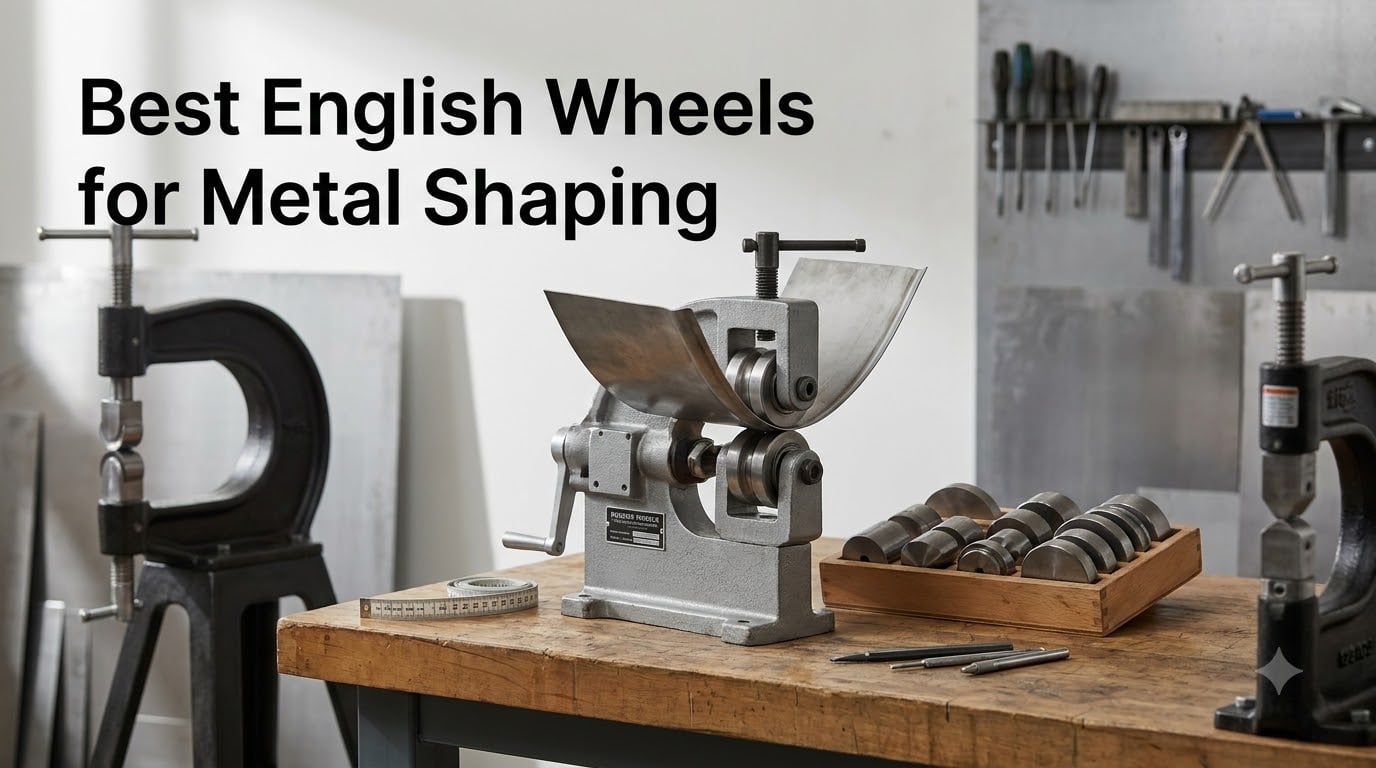
I’ve shaped enough practice steel to know that the best English wheels are not simply the biggest machines. They are the ones that match your panel size, material, available shop space, and willingness to learn.
This guide compares eight English wheels and two anvil sets for metal shaping. I focus on throat depth, material capacity, frame stability, included dies, and the practical details that determine whether a machine is useful on a real project.
An English wheel is a metalworking tool for forming compound, double-curved shapes in sheet metal. It passes the material between a rotating upper wheel and a lower anvil, using repeated light passes to stretch and compress the surface gradually. It is common in automotive restoration, motorcycle fabrication, aircraft work, and custom body-panel building.
English wheels have a learning curve, so a compact model is often the smarter first machine than a large professional wheel. Start with light pressure, practice on scrap, and let the machine make the curve instead of forcing it.
Table of Contents
Top 3 Picks for the Best English Wheels in 2026

KAKA INDUSTRIAL 28-Inch English Wheel
- 28-inch throat
- Six hardened anvils
- 18-gauge mild steel

KASTFORCE KF5018 Professional Benchtop Wheel
- 12-inch throat
- Four hardened dies
- 16-gauge mild steel

The Best English Wheels for Metal Shaping in 2026
| Product | Specifications | Action |
|---|---|---|
 Stark USA Benchtop English Wheel Stark USA Benchtop English Wheel |
|
Check Latest Price |
| KASTFORCE KF5018 Professional Benchtop |
|
Check Latest Price |
| KAKA INDUSTRIAL 28-Inch English Wheel |
|
Check Latest Price |
 Tandagy Heavy Duty Benchtop English Wheel Tandagy Heavy Duty Benchtop English Wheel |
|
Check Latest Price |
 Generic 8-Inch Throat English Wheel Generic 8-Inch Throat English Wheel |
|
Check Latest Price |
 JEGS 27-Inch English Wheel with Stand JEGS 27-Inch English Wheel with Stand |
|
Check Latest Price |
| Quaintfab 15-Inch Mini English Wheel |
|
Check Latest Price |
| Quaintfab 8-Inch Benchtop English Wheel |
|
Check Latest Price |
 LOUDERLUN Six-Piece Bottom Anvil Set LOUDERLUN Six-Piece Bottom Anvil Set |
|
Check Latest Price |
 JEGS Six-Piece Bottom Anvil Set JEGS Six-Piece Bottom Anvil Set |
|
Check Latest Price |
1. Stark USA Benchtop English Wheel — Compact and Flexible
Stark USA Shaping Sharper Benchtop Fabrication Workbench English Wheel Sturdy Sheet Metal Shaping Bench Motorcycle Automotive Panel Crafting Tool
27-pound steel frame
Quick-release anvil
Vise, bench, or stand mounting
Pros
- Small-panel capability
- Three mounting options
- Rounded upper wheel
Cons
- Limited throat for large panels
- Basic adjustment
The Stark USA is the kind of benchtop English wheel I’d recommend when space matters more than maximum panel width. Its 27-pound steel construction feels purposeful for a compact machine, and the quick-release lower anvil makes die changes less disruptive during practice.
I like the mounting flexibility. You can put it on a bench, clamp it in a vise, or use an optional welded stand, so the same tool can fit a small garage or a more permanent shop corner. The rounded upper wheel is a useful detail because beginners are already focused on pressure and path; reducing the chance of edge marks helps.
The trade-off is reach. This is aimed at motorcycle tanks, tank covers, seat cowls, aircraft fillets, and similar small jobs, not broad automotive panels. It also has fewer moving parts than more elaborate machines, which keeps setup simple but means you should not expect the same fine control found on a premium floor model.
What projects suit this wheel best?
Choose the Stark for a first wheel, a teaching setup, or a small-shop machine for localized shaping. It is especially sensible when you want a portable tool that can be stored away when the work is done.
Measure your largest intended panel before buying. A small wheel can shape a large panel in sections, but a throat that is too short makes broad compound curves slower and more awkward.
What should you watch before buying?
Mount it to a rigid surface and keep the upper wheel clean. Its value is highest for small jobs, so buying it for full-size restoration work may create a second-tool purchase later.
Community feedback is most positive on sturdiness and ease of use, while the review record consistently points to the size limitation. That makes it a sound starter, not a universal shop solution.
2. KASTFORCE KF5018 — Best Value Benchtop English Wheel
KASTFORCE KF5018 Professional Benchtop English Wheel Metal Fabrication Tool 12″ 305mm Throat Depth Forms up to 16 Ga 1.5mm Mild Steel, 4 Lower Die with Radius 1″, 2″, 3″, 5″, Hardness HRC35
12-inch throat
16-gauge mild steel
Four HRC35 lower dies
Pros
- Large throat for its size
- Four die radii
- Rotating wheel and anvils
Cons
- Some flex under low pressure
- Learning curve
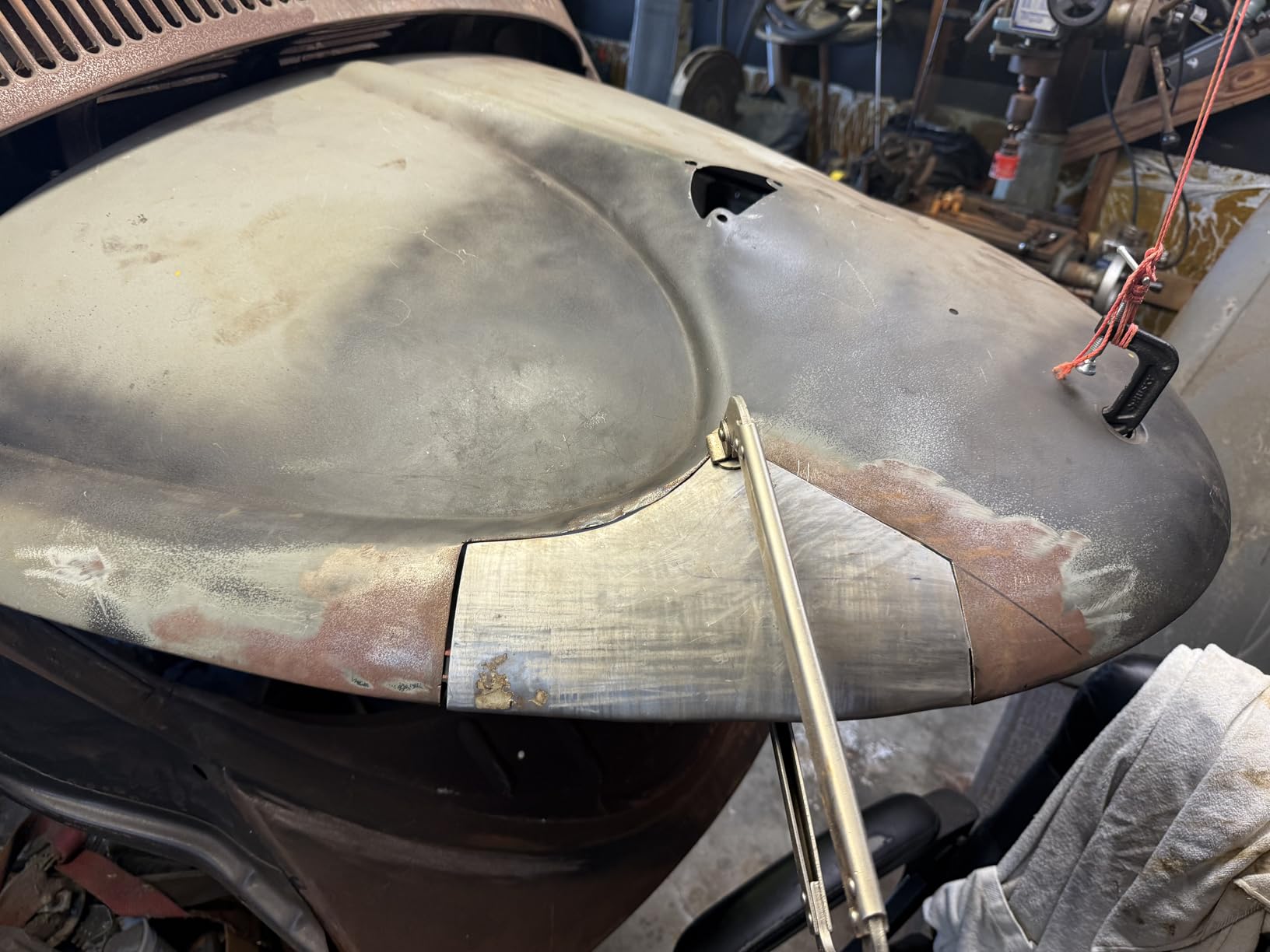
The KASTFORCE KF5018 is my pick for a small shop that wants more capability than a basic vise-mounted wheel. Its 12-inch throat, four lower dies, and stated capacity of up to 16-gauge mild steel give it a useful balance of reach and control.
The wheel and anvils can rotate 90 degrees, which makes it easier to approach a panel from another direction. I’d pay particular attention to the two thumb-screw vertical adjustment described in the review data; it is more convenient for a beginner than a set-screw arrangement when you are making frequent, small corrections.
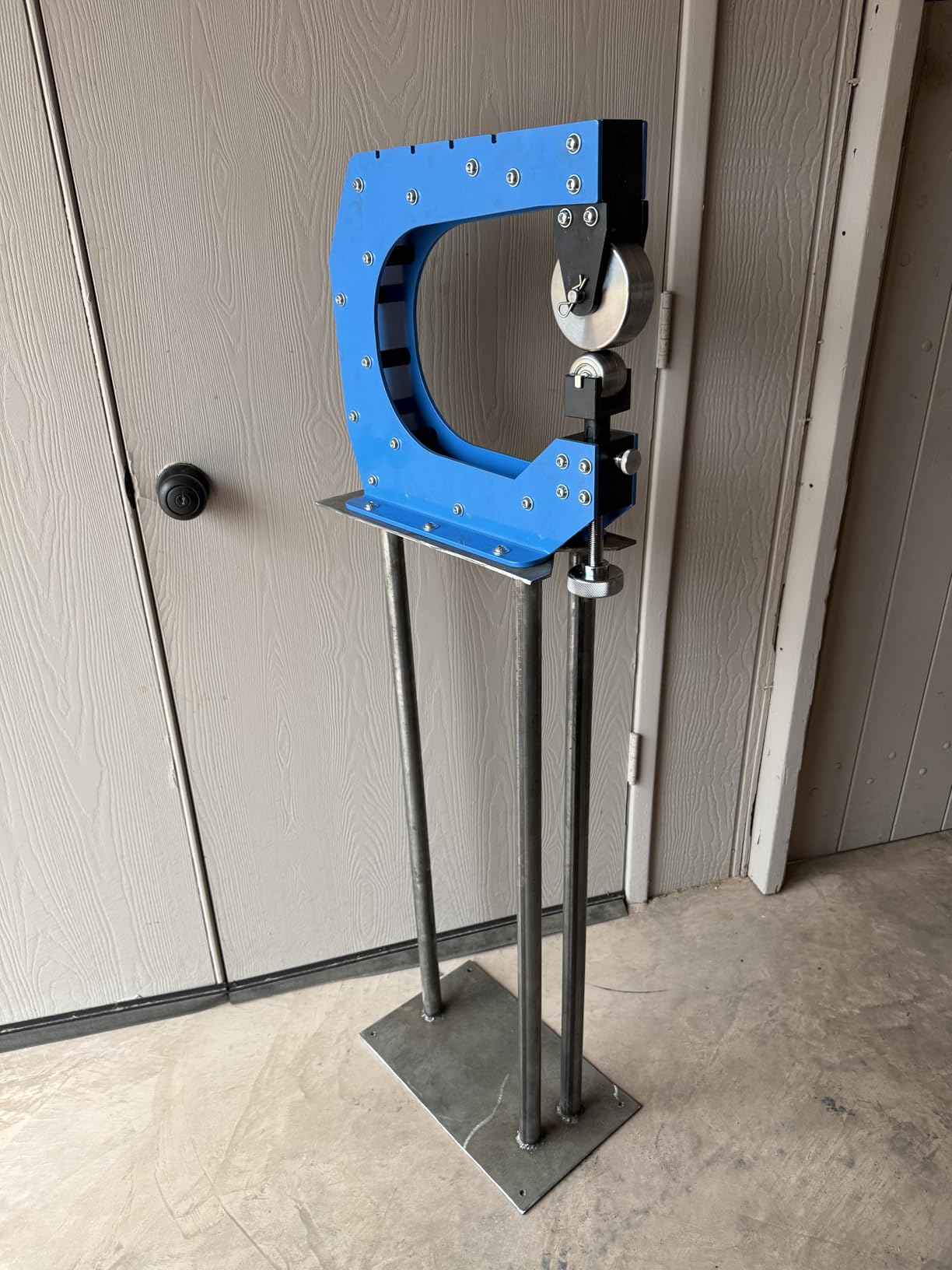
The machine is not magic. The review insights mention some flex at low pressure and the expected need to practice, so a stable bench and deliberate passes matter. The HRC35 hardness specification on the upper wheel and lower dies is a positive sign, but it does not replace careful setup.
Who gets the most from the KF5018?
This is a good match for patch panels, motorcycle work, and hobbyists who want a complete die set without moving to a heavy floor machine. It also suits a small restoration shop where the panel is larger than a starter wheel can comfortably reach.
Its 12-inch throat is not a substitute for a 27- or 28-inch machine. If your work regularly includes full door skins or broad fenders, step up before you spend time adapting your technique around a small frame.
How do you get cleaner results?
Use overlapping passes with light pressure and change radius gradually. The rotating assembly helps with access, but the machine still rewards a controlled feed rate more than aggressive force.
Inspect the panel between passes with a straightedge or template. That habit catches a developing crown before it becomes a difficult correction.
3. KAKA INDUSTRIAL 28-Inch — Best for Large Professional Panels
KAKA INDUSTRIAL English Wheel,28-Inch Throat 18 Gauge Metal Former for Steel and Aluminum, with 6 Forming Anvil Wheels for Auto Body, Motorcycle, Aviation Fabrication and Restoration F1.2X710
28-inch throat
18-gauge steel capacity
Six hardened anvil wheels
Pros
- Large working envelope
- Professional steel construction
- Versatile die radii
Cons
- 169-pound weight
- Permanent installation likely
The KAKA INDUSTRIAL 28-inch is the machine I’d shortlist when large automotive or aviation panels are the main job. The 28-inch throat gives you room to move across a complex panel, and the six CNC-finished hardened steel anvils cover a broad range of curve radii.
It handles up to 18-gauge mild steel, 14-gauge aluminum, and copper according to the product data. That range is useful in a fabrication shop, but the 169-pound weight and freight-style logistics make this a permanent installation rather than a machine you move around casually.
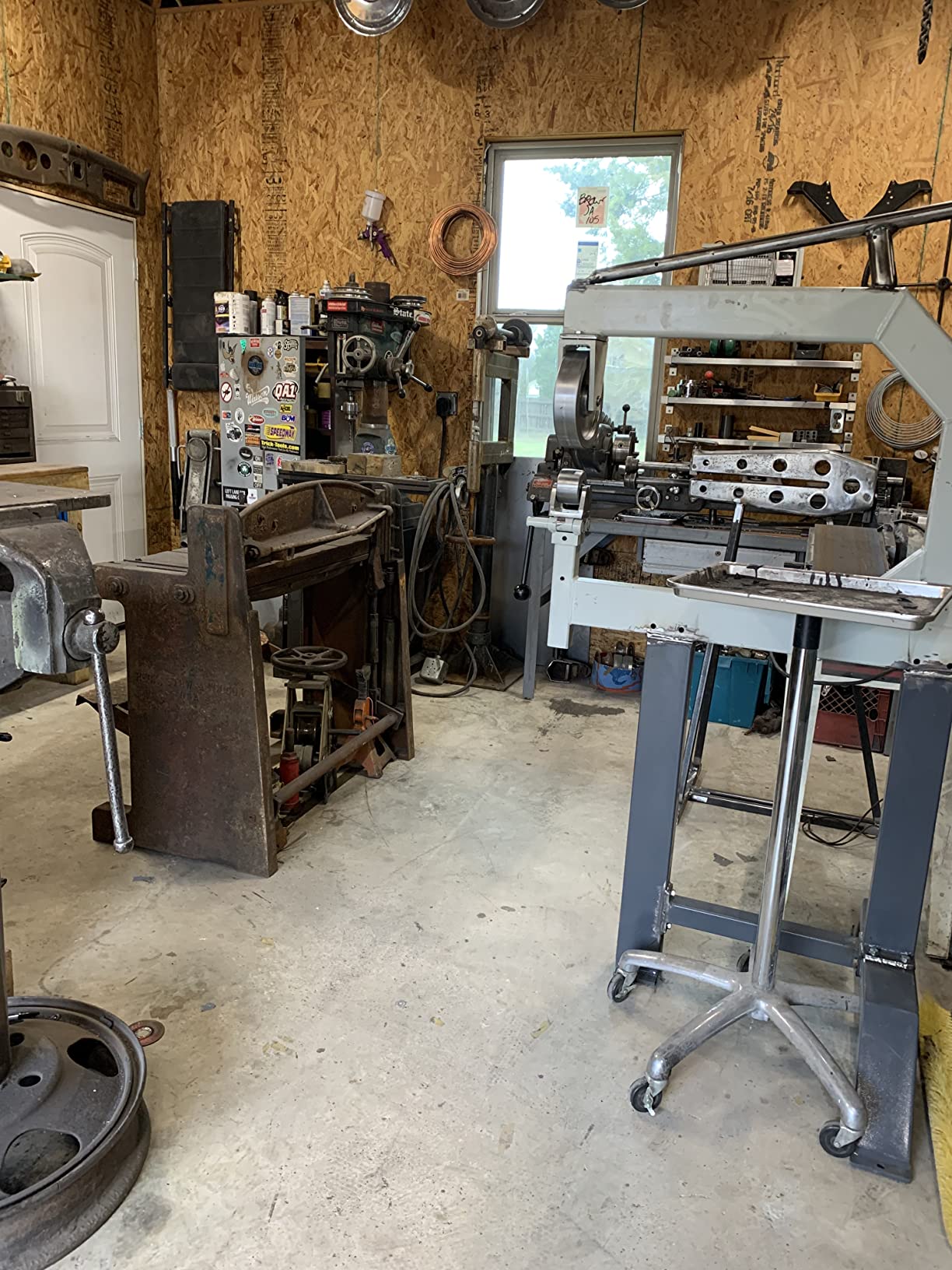
The review summary is unusually strong, with a 4.9 average from 28 reviews. I would still treat that feedback as a reason to investigate fit and finish, not as a substitute for checking the stand, floor loading, and delivery plan before ordering.
When is the extra throat worth it?
Choose this model for full-size body panels, complex compound curves, or a working shop that regularly changes between steel, aluminum, and copper. The larger envelope reduces the number of times you need to reposition a broad panel.
The six radii let you begin with a wider or narrower crown. I’d start with the smallest suitable radius for the task, then step upward only as the shape calls for a broader transition.
What are the practical drawbacks?
Floor space, shipping access, and setup are part of the buying decision. The lower anvil uses a quick-release system, but the machine’s mass means you should plan the location before delivery day.
For a beginner, this may be too much tool to learn on. A smaller machine is easier to store and less intimidating, while this KAKA model is better for someone who already knows how to read a panel and control an upper wheel.
4. Tandagy Heavy Duty Benchtop — Best for Learning and Small Repairs
Tandagy English Wheel Heavy Duty English Wheel for Metal Benchtop English Wheel
15-3/8-inch throat
16-gauge mild steel
Stainless steel construction
Pros
- Affordable learning tool
- Compact footprint
- Adjustable anvil yoke
Cons
- Small-scale capacity
- Limited evidence base
The Tandagy is a deliberately simple English wheel. Its 15-3/8-inch throat and stated capacity for 16-gauge mild steel, aluminum, and copper make it more capable than a toy-like bench accessory while keeping the overall format approachable.
The stainless steel frame and green powder coat are practical features in a small shop. The anvil yoke adjusts on both sides with thumb screws, and the upper wheel can be trued, which gives a new owner room to correct minor setup issues.
The review data is much thinner than it is for the larger models, so I would buy this for its intended use rather than for professional throughput. It is a teaching machine, a compact repair tool, or a way to decide whether wheeling is a technique you want to pursue.
Who should choose the Tandagy?
Choose it if you have limited workspace and want to learn on motorcycle tanks, fillets, small panels, or localized dents. It is also a reasonable first step for a student who needs to understand pressure, crown, and anvil selection.
It is less suitable for broad body panels. If you already know you need full-width automotive work, a deeper throat will save time and reduce repositioning.
What is the compromise?
The simple frame has few moving parts, which is easy to maintain but less adjustable than a premium machine. Its value comes from accessibility, not maximum precision under sustained production use.
Keep scrap pieces and make a series of test crowns before touching a visible panel. That protects the material and teaches you how the wheel responds to feed rate and pressure.
5. Generic 8-Inch Throat — Best Rotating Design for Small Shops
8 “ Throat Depth English Wheel
8-inch throat
90-degree rotating assembly
Seven lower dies
Pros
- Space-saving vise mount
- Micro adjustment
- Broad die selection
Cons
- Short standard throat
- Limited stock reported
This 8-inch model is interesting because it solves a small-shop problem in two ways: it mounts in a vise and its wheel and anvil assembly rotates 90 degrees. The standard throat is 8 inches, but the rotating design expands the working direction for panels up to 20 inches wide on an angular plane.
The micro-adjustable anvil and seven lower dies make it versatile for experimentation. The die radii run from 1/2 inch through 9 inches, plus a flat option, which is a useful range for learning how curve width changes the finished crown.
The compromise is reach. A narrow throat can still make small parts and patch panels, but it is not the first choice for full-size restoration. The product record also notes limited stock, so verify availability and the included die sizes before ordering.
Why does the rotating assembly matter?
It gives you a second working orientation without requiring a second machine. I’d use it when the panel geometry makes a straight approach difficult, then return to the standard orientation for broad, even passes.
Keep the vise and work surface rigid. A small machine can deliver smooth results when the frame does not move, but a flexible mount magnifies mistakes.
Is it suitable for a beginner?
Yes, with realistic project limits. It is a good training tool for sheet steel up to 18 gauge and aluminum up to 16 gauge, according to the supplied specifications.
Start with scrap and use the die changes to compare radii. The machine’s compactness is an advantage only if you accept that you will reposition more often on larger pieces.
6. JEGS 27-Inch with Stand — Large Capacity at a Workshop Scale
JEGS English Wheel with Stand [27 in. Throat]
27-inch throat
16-gauge steel capacity
Stand and adjustable anvil
Pros
- Heavy-duty construction
- Large throat
- Lower-anvil adjustment
Cons
- 176-pound weight
- Mixed finish and packaging feedback
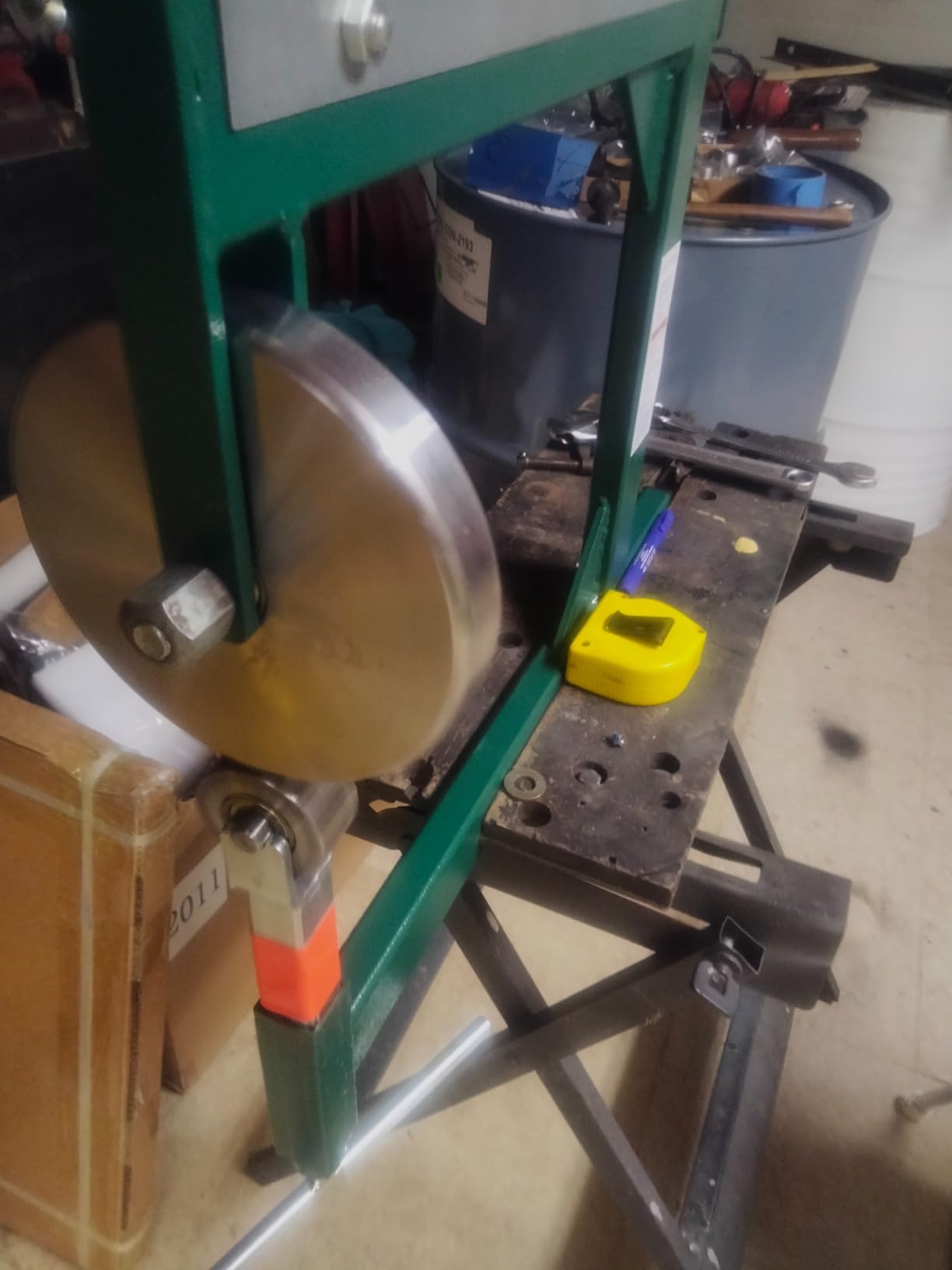
The JEGS 27-inch English wheel is built for a working garage. Its stand gives the 176-pound machine a stable home, while the 27-inch throat leaves enough room for substantial body-panel work.
The stated capacity is 16-gauge sheet steel, 14-gauge copper, and 14-gauge aluminum. That makes it a sensible middle ground for a restorer who wants more reach than a bench model but does not need the largest professional throat on the market.
![JEGS English Wheel with Stand [27 in. Throat] | 27 in. Throat Depth, Easy Adjustable Lower Anvil Wheel, Shapes, Sheet Steel to 16 Ga, Copper & Aluminum to 14 Ga customer photo 1](https://www.spencerlocke.net/wp-content/uploads/2026/08/B078WJ51MG_customer_1.jpg)
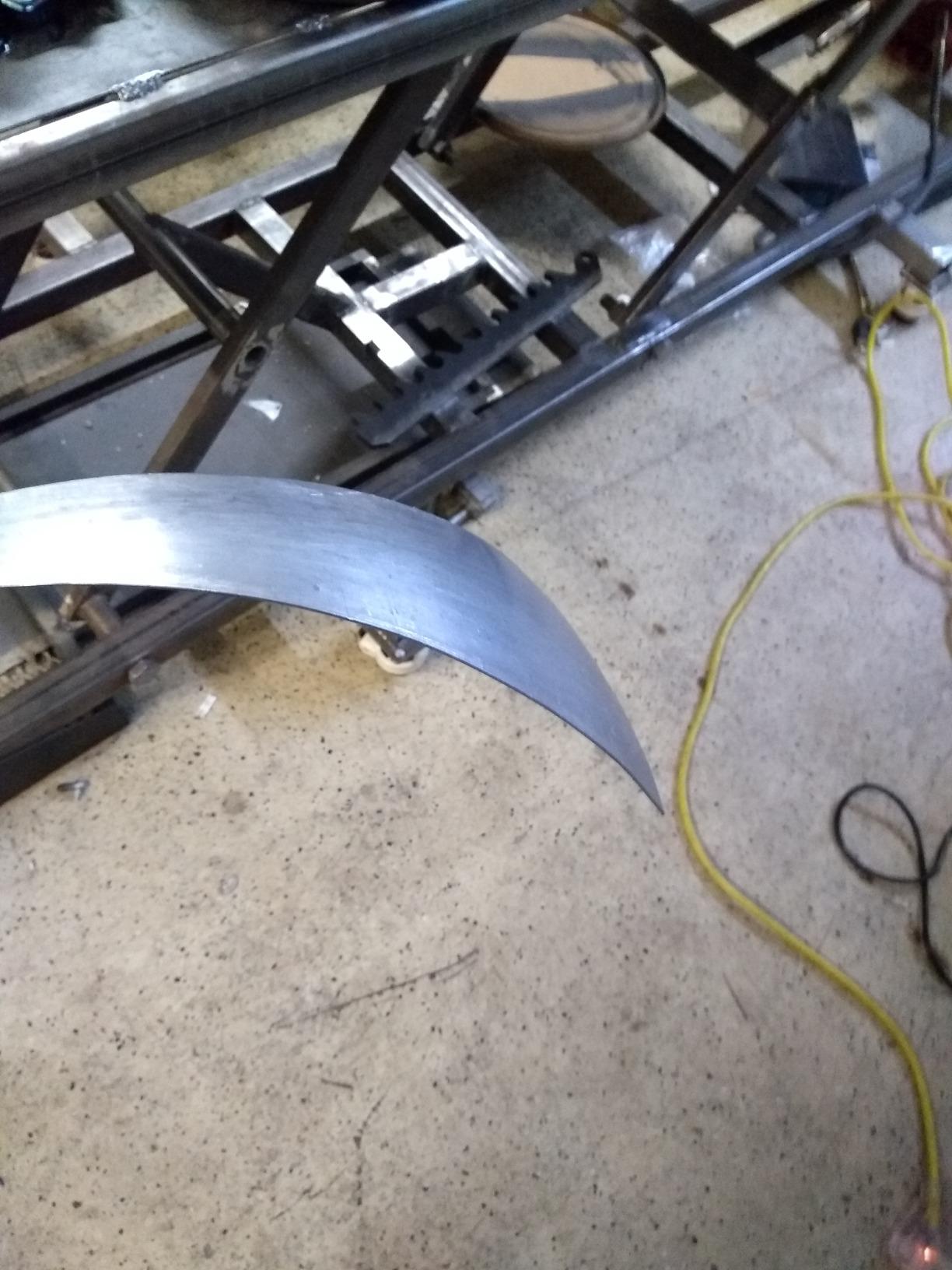
The review record is more mixed than the specification list. Users report heavy-duty construction and good upper-wheel runout tolerance, but also mention paint quality, missing parts, and occasional shimming needed to square the machine. I would inspect the shipment carefully and allow time for setup.
![JEGS English Wheel with Stand [27 in. Throat] | 27 in. Throat Depth, Easy Adjustable Lower Anvil Wheel, Shapes, Sheet Steel to 16 Ga, Copper & Aluminum to 14 Ga customer photo 2](https://www.spencerlocke.net/wp-content/uploads/2026/08/B078WJ51MG_customer_2.jpg)
Who is this machine for?
It fits a restorer or fabricator with permanent floor space and a need for full-width panels. The stand is useful if you want consistent height and easy access around the machine.
It is not the best choice for a renter, a mobile worker, or anyone who expects to move the tool between benches. Measure the route from delivery area to its final position before it arrives.
What should you inspect first?
Check the anvil adjustment, upper-wheel alignment, stand hardware, and surface finish before shaping valuable metal. Keep the machine clean and lubricated where the manufacturer directs.
The lower average rating means I would favor this model for its capacity and workshop role, not for a beginner seeking the easiest first experience. Community reports make inspection especially worthwhile.
7. Quaintfab 15-Inch Mini — Best Balanced Small-Shop Package
Quaintfab – Heavy Duty 15″ Throat Depth Mini English Wheel, Vise-mount and Table Mount, 7pcs anvil wheel: 1/2″, 1″, 1-1/2″, 2-1/2″, 5″, 9″, Flat, Form up to 18 gauge steel and 16 gauge aluminum
15-inch throat
18-gauge steel capacity
Seven-piece anvil set
Pros
- Sturdy 42.5-pound frame
- Complete die set
- Mico adjustment
Cons
- Short mounting bolt
- Some assembly required
The Quaintfab 15-inch is one of the more convincing all-around mini wheels in this group. It offers a 15-inch throat, a seven-piece lower-die set, and stated capacity for 18-gauge sheet metal and 16-gauge aluminum.
I appreciate that it can be vise-mounted or bolted to a workbench. That makes it easy to set up for a restoration project and easy to put away afterward, while the 42.5-pound weight still feels more planted than a tiny bench accessory.
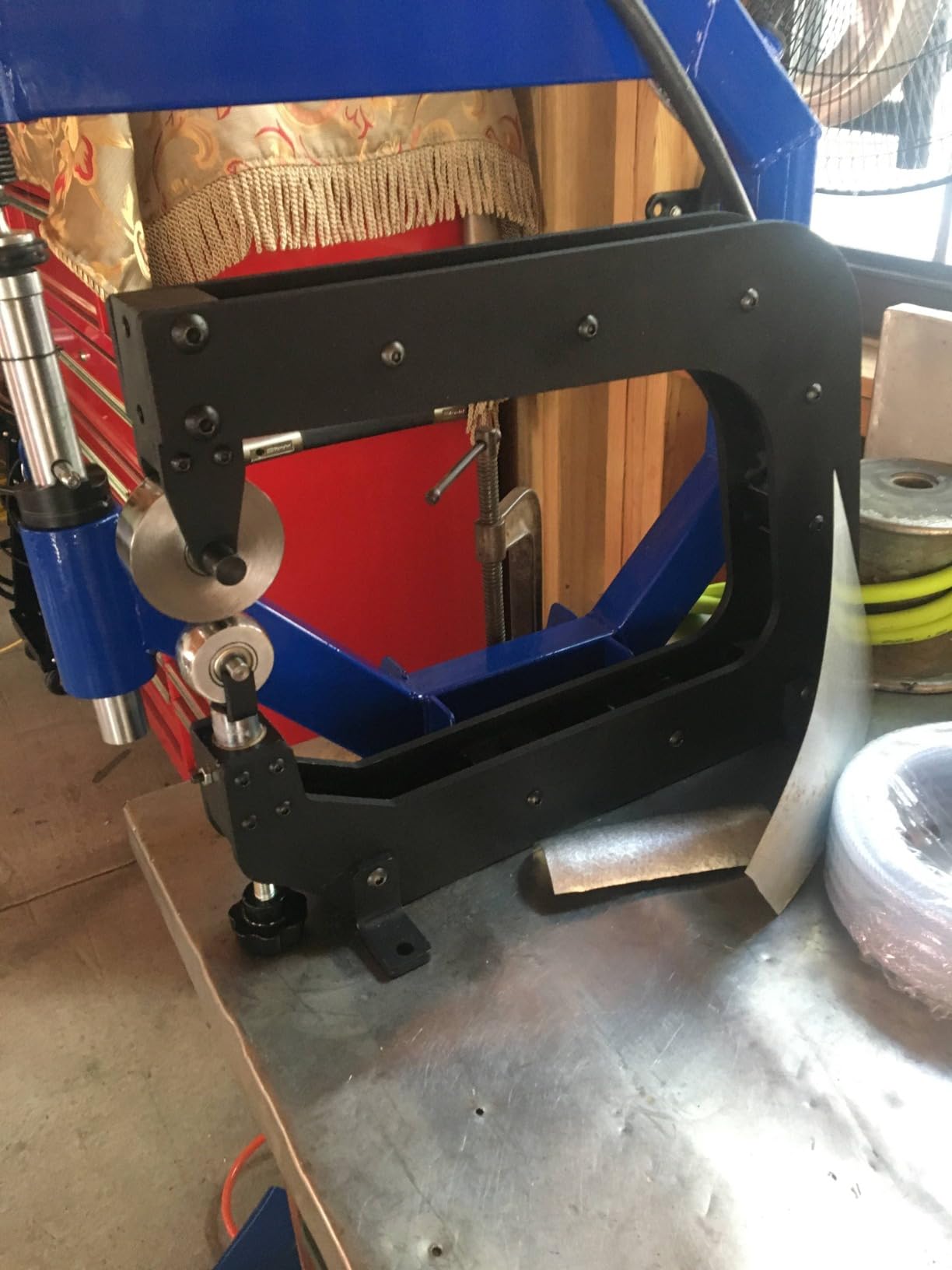
The micro-adjustable anvil and HRC40 wheel hardness are useful details. The review summary calls out smooth action and value, while also noting a short mounting bolt, no die rack, and some assembly with special tools. I would solve the mounting hardware before the first project.
What makes it a balanced choice?
It has more throat than an 8-inch wheel without the footprint of a 27- or 28-inch floor model. For a home shop working on automotive patches, that middle size is often the sweet spot.
The included radii cover 1/2, 1, 1-1/2, 2-1/2, 5, and 9 inches plus a flat die. That makes it easier to learn which crown a panel needs.
Where does it fall short?
It is not a full-size production wheel, and the mounting bolt deserves attention. Assembly is not difficult by default, but you should not discover missing tools after the machine is on the bench.
Use a rigid mount and check the anvil adjustment before making the first pass. The machine’s compact form rewards a careful setup more than a heavy hand.
8. Quaintfab 8-Inch — Best Compact Beginner Bench
Quaintfab – 8″ Throat Depth Mini Benchtop English Wheel, Vise-mount and Table Mount(Aluminum Connecting Spacer)
8-inch throat
90-degree rotating assembly
Compact vise mount
Pros
- Solid compact build
- Flat and round rollers
- Good beginner format
Cons
- Small project envelope
- Assembly required
The Quaintfab 8-inch is the smallest machine here, but it is not presented as a disposable novelty. Its compact benchtop format, 90-degree rotating wheel and anvils, and micro-adjustable anvil give a beginner a focused way to learn wheeling without taking over a room.
The stated capacity is 18-gauge steel and 16-gauge aluminum. The review summary describes a tank-like build for its size, and the perfect 5.0 rating is encouraging, though it comes from a small sample of 12 reviews.
The limitation is straightforward: an 8-inch throat is best for small panels and practice pieces. I’d use it to build technique and test anvil choices before deciding whether a larger machine is necessary.
Why pick the compact Quaintfab?
Choose it for a small workshop, a teaching bench, or a first project in motorcycle and sheet-metal fabrication. It keeps storage simple and gives you a full mini setup rather than a bare frame.
The rotating assembly helps when a panel needs a different approach, but it does not change the fact that large panels require more repositioning. Treat that as a useful constraint, not a failure.
What does a beginner need to know?
Assembly takes planning, so read the instructions and identify the required tools before mounting the unit. Use scrap to learn the relationship between pressure, feed, and crown.
The compact size makes the machine approachable, but a small throat cannot make a large curve disappear. Buy for the projects you can actually fit and finish.
9. LOUDERLUN Bottom Anvil Set — Best Radius Expansion for Compatible Wheels
LOUDERLUN 2″(Width) x 3″(OD) Bottom anvil dies set for english wheel
Six hardened radius dies
2-inch width
3-inch outer diameter
Pros
- Good polished finish
- Full radius range
- Heat-treated steel
Cons
- Compatibility may require fitting work
- Check axle dimensions
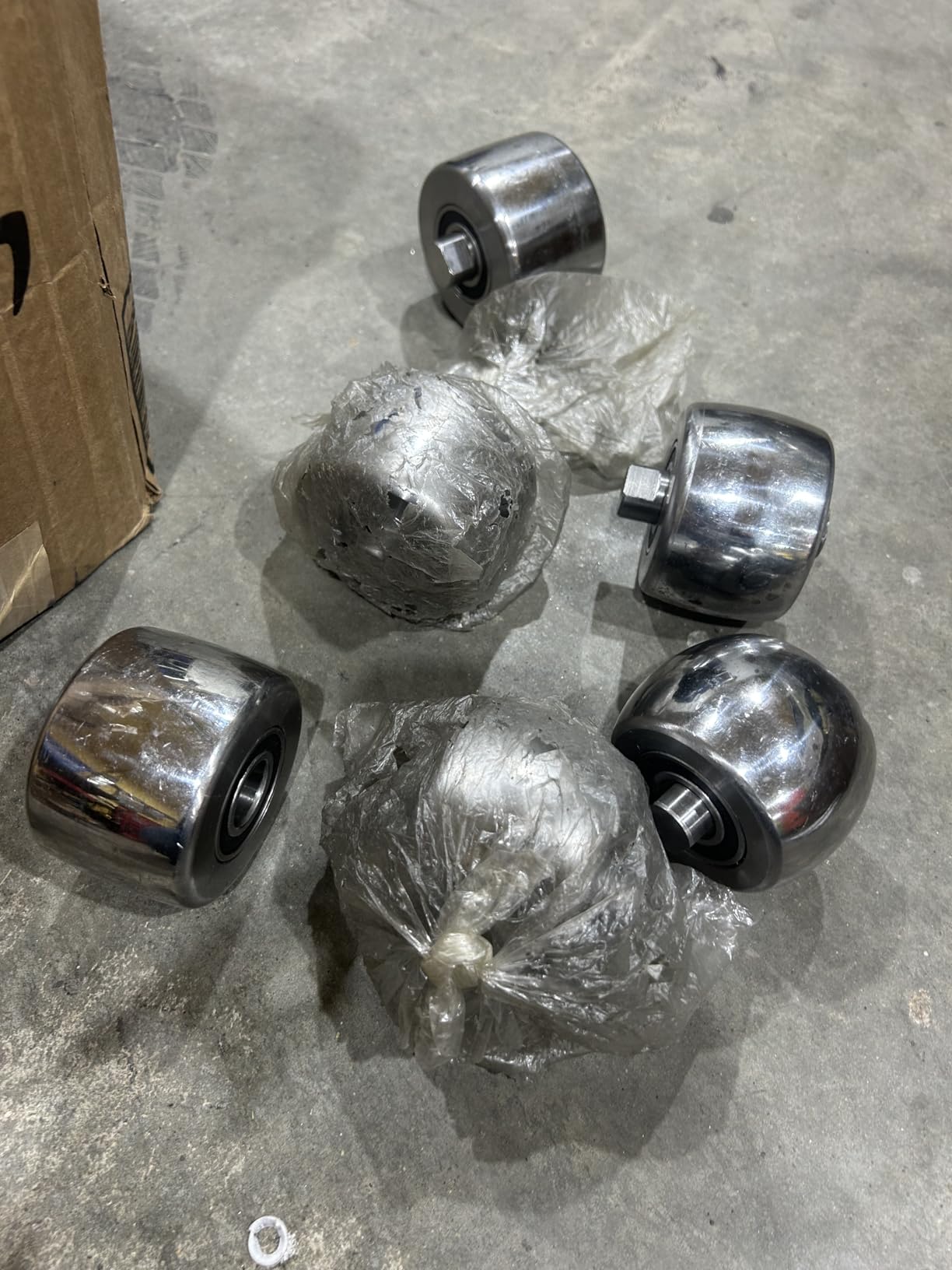
The LOUDERLUN set is not an English wheel, but it can matter almost as much as the machine. Anvils determine how the upper wheel contacts the sheet, so adding the right radii can expand a compatible wheel’s range without replacing the frame.
This set includes 2-, 3-, 4-, 6-, 8-, and 12-inch radius dies, each 2 inches wide and 3 inches in outside diameter. The steel is precision machined and heat treated, and the review summary says the polish and finish are generally good.
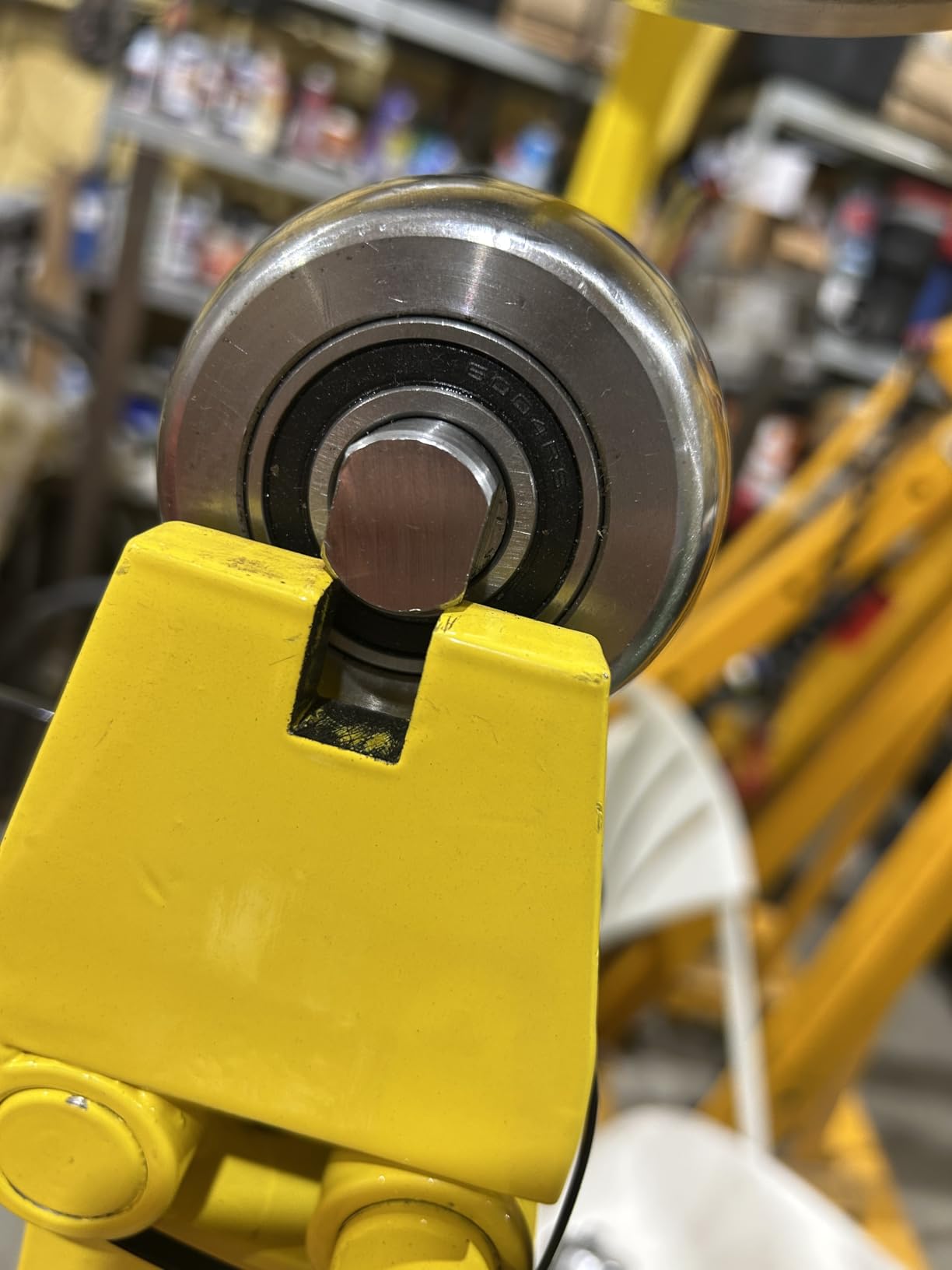
Compatibility is the catch. The product data names the F1.2X710, while some review comments mention Harbor Freight wheels and the possibility of machining or axle modification. I would measure the existing yokes, axle diameter, and die width before ordering.
When should you buy replacement anvils?
Buy them when your machine is sound but lacks the radii needed for your panel work. They are also useful when you want a wider, broader crown without changing upper-wheel settings.
Do not assume a die will fit because the listing mentions a similar model. Take three measurements, compare them with the seller’s dimensions, and ask for clarification if the fit is unclear.
What should you inspect on arrival?
Check each die for flat spots, bearing-like smoothness, and surface defects. Clean the contact faces and keep the set dry, because a damaged or rough die can mark the sheet before you notice the error.
The set is a strong value for a compatible machine, but it is not a shortcut around frame or upper-wheel problems. Confirm fit first and treat the dies as precision contact tools.
10. JEGS Bottom Anvil Dies — Best Fit-Oriented Six-Piece Upgrade
Bottom Anvil Dies 6 Piece
Six heat-treated steel dies
2- to 8-inch radii
25.2-pound set
Pros
- Harbor Freight fit reported
- Good weight
- Polished finish
Cons
- Packaging damage reports
- Surface finish varies
The JEGS six-piece set is a practical upgrade for owners who already have a compatible Harbor Freight-style wheel. It supplies 2-, 3-, 4-, 5-, 6-, and 8-inch radius dies, giving you a useful spread for medium and broad curves.
The review data specifically reports a good fit in the Harbor Freight English wheel, which makes compatibility a stronger part of this set’s story than it is for generic alternatives. Users also describe the dies as solid, well made, and nicely polished.
There are still precautions. Packaging damage, variation in black versus polished finish, and the need to clean and lubricate the dies to prevent rust are all reported. I would inspect the set immediately and add a simple storage routine.
Why choose this die set?
Choose it when you want a straightforward radius set for a compatible machine and value reported fit over universal compatibility. It is especially relevant to owners who already know their current anvils are limiting their curve choices.
Use the smallest radius that can make the transition you need, then move wider as the panel changes. A larger die does not automatically create a better panel; it creates a broader crown.
How do you protect the dies?
Wipe them after use, keep them dry, and lubricate them according to the wheel manufacturer’s guidance. Store them in a divided tray so the contact faces do not collide.
If the listing finish varies, treat that as a reason to inspect rather than a reason to reject the set. The radii and reported fit may still make it the right upgrade for your machine.
How to Choose the Right English Wheel for Metal Shaping?
Choose an English wheel by matching the machine’s throat depth, frame stability, and anvil system to the panels you plan to make. For a beginner, the right compact machine is usually more useful than an oversized professional model.
Choose throat depth by project size
Use an 8- to 12-inch throat for small panels, practice parts, motorcycle work, and localized repair.
Use a 15-inch throat when you want more reach in a small shop or work on patch panels and moderate body work.
Use a 27- to 28-inch throat for full-width automotive panels, large compound curves, and frequent professional fabrication.
Throat depth is the distance from the frame to the working area, not the maximum width of every panel. A larger throat gives you a longer straight run and more room to rotate the panel, but it also increases the machine’s footprint and moving weight.
My practical rule is to measure the widest panel you expect to shape and add working room for the upper wheel and anvil. If you cannot comfortably support the panel during a pass, the machine is too small even if its capacity number looks adequate.
Match the frame to your shop
Benchtop and vise-mounted wheels suit limited space and portable work. Floor models with stands suit permanent installations, broad panels, and repeated use, but you need a rigid floor, a clear working path, and a plan for moving a 150-pound-plus machine.
Frame material affects stability, but mounting matters just as much. A heavy wheel on a flimsy bench can perform worse than a lighter machine bolted to a solid steel workbench.
Understand the upper wheel and lower anvils
The upper wheel applies rolling pressure while the lower anvil controls the curve radius. A small-radius anvil makes a tighter transition; a large-radius anvil spreads the curve over a broader area; a flat die can help with blending and controlled flattening.
Wheel diameter and width also matter. A wider upper wheel can distribute pressure over a larger contact area, while a narrow wheel may be useful for tighter work but demands cleaner technique.
Before buying replacement anvils, confirm the axle, yoke opening, die width, and the radius range your machine can accept. The two die sets in this comparison are useful upgrades, but neither is a universal fit.
Check material capacity honestly
Capacity is a ceiling, not a target. An 18-gauge machine may shape thinner aluminum and copper differently from mild steel, so verify the material and use light passes on a scrap piece before starting the final panel.
Thickness, alloy, heat treatment, and curve severity all affect the result. A machine that handles mild steel may not be the right choice for a demanding aluminum panel, even when the published gauge numbers look similar.
Plan for the learning curve
English wheels reward light, repeated passes and a consistent feed rate. A heavy-handed approach can create wrinkles, uneven crowns, edge marks, or a panel that looks stretched before it looks shaped.
I would practice with three steps: make a series of crowns on scrap, change one variable at a time, and check the panel from several angles between passes. Watching a demonstration can help, but hand pressure and panel support still need to be learned on the material you plan to use.
Budget for the whole setup
Entry-level machines suit learning and small work, mid-range machines add throat depth and stronger construction, and professional floor models provide reach and stability for larger panels. Anvil sets, a rigid bench or stand, storage, cleaning supplies, and protective equipment belong in the total plan.
Buy the least machine that can comfortably do your real projects. You will learn faster, use the workspace more efficiently, and avoid paying for capacity you cannot exploit.
Maintain the wheel and dies
Keep the upper wheel and anvils clean, dry, and free of metal debris. Inspect contact faces for flat spots, check adjustment hardware, and store dies separately so polished surfaces do not rub together.
Follow the manufacturer’s lubrication instructions and address runout or looseness before the next project. Maintenance is not glamorous, but it is cheaper than replacing a marked panel.
Frequently Asked Questions
What are the different types of English wheels?
The main types are benchtop or vise-mounted wheels for small shops and portable work, and floor-standing wheels for large panels and professional fabrication. Some machines also add rotating wheel and anvil assemblies for a second working direction. The right type depends on panel width, available space, and the size of the material you plan to shape.
What size English wheel do I need?
Choose an 8- to 12-inch throat for small parts, motorcycle work, and practice pieces. A 15-inch model is a useful middle ground for patch panels and small restoration work. A 27- or 28-inch throat is better for full-width automotive panels, large compound curves, and frequent professional use. Measure your intended panel and allow room to support and rotate it comfortably.
Why are English wheels so expensive?
English wheels are expensive because a useful machine needs a rigid frame, precise rotating parts, hardened upper wheels, and accurately machined lower anvils. Larger machines also require more steel, more substantial stands, and freight-style shipping. A higher price can buy throat depth, stability, better tolerances, and a wider anvil system, but beginners do not need the largest model to learn good technique.
Which type of hammer is best for shaping metal?
For an English wheel project, the best hammer is usually a smooth-faced body or finishing hammer used for local correction, not a substitute for the wheel. A wheel makes broad compound curves; a hammer helps refine small areas, blend transitions, and address details the wheel cannot reach efficiently. Choose a comfortable, well-balanced hammer and keep its face clean to avoid marking the sheet.
Final Recommendation
The best English wheels for metal shaping are the machines that make your intended panels easier to support and shape. The KASTFORCE KF5018 is a strong all-around value for a small shop, the KAKA INDUSTRIAL 28-inch is the clear choice for large professional work, and the Quaintfab 15-inch offers a practical balance of reach, portability, and included anvils.
If you are new to wheeling, start with a rigidly mounted compact or mid-size machine, practice on scrap, and buy replacement anvils only after confirming compatibility. For full-width automotive work, choose a 27- or 28-inch floor model and plan the installation before the delivery arrives.
This 2026 buying guide is built around real specifications and review signals, not a promise that one machine fits every shop. Match the throat, mount, and die set to the panels in front of you, then let steady practice do the shaping.