
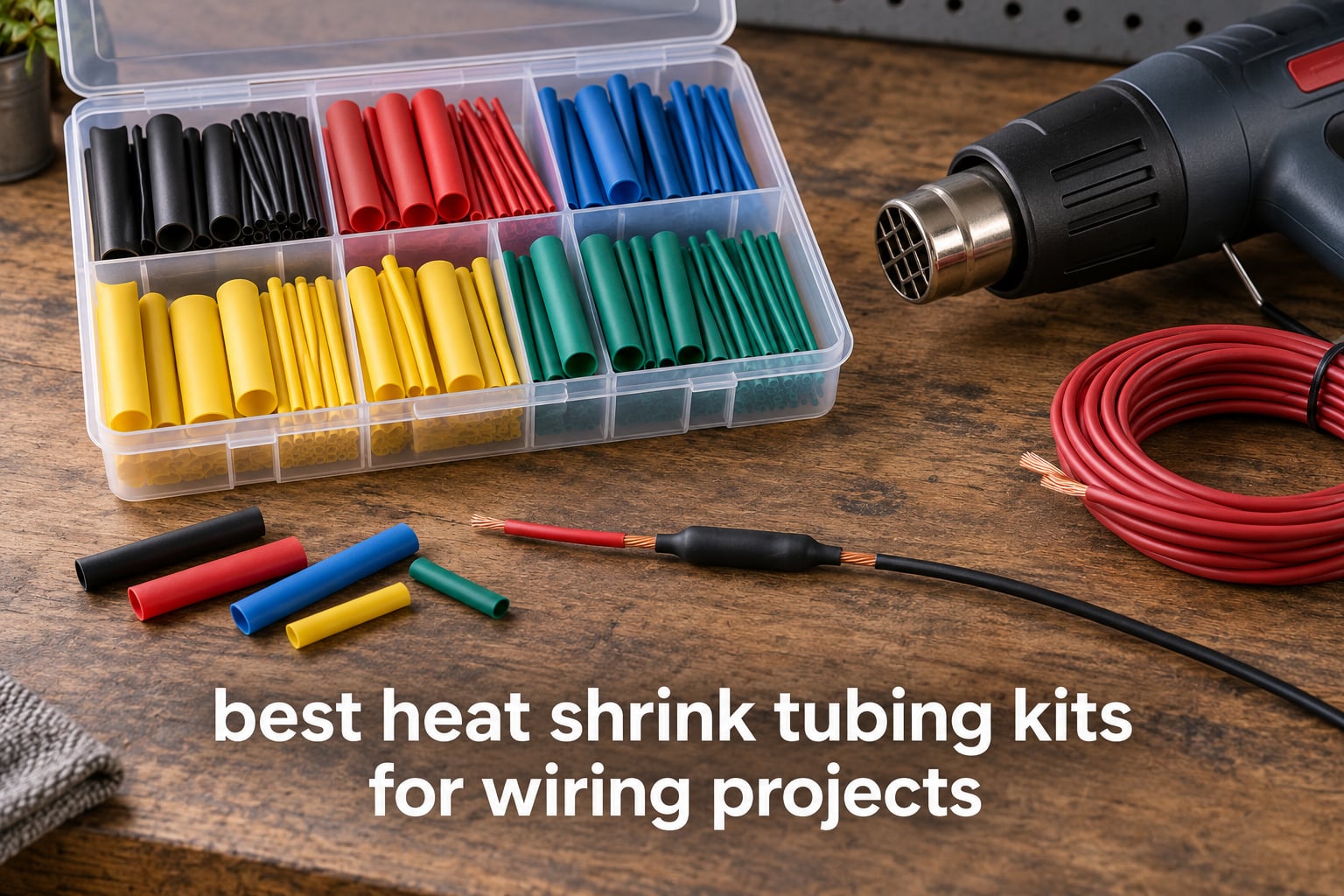
Heat shrink tubing is the cheapest insurance in a wiring project. A short length of polyolefin sleeve over a solder joint or a butt connector is the difference between a connection that survives a wet engine bay for a decade and one that corrodes into a headache. We pulled together the ten heat shrink tubing kits that earn consistently strong marks from people who use them on real work, and after comparing piece counts, shrink ratios, wall construction and certification marks, the Eventronic 400-piece 3:1 adhesive lined kit (B0BVVMCY86) is the one we would buy first. It sits at #2 in Industrial Heat-Shrink Tubing, carries a 4.7 star average across more than 33800 reviews, and gives you seven diameters from 3/32 inch to 3/4 inch pre-cut to 1.77 inch with a glue liner that actually flows when heated.
That last detail is the whole game. Single wall tubing insulates and takes abrasion, but it is not a seal. Dual wall adhesive lined tubing melts an inner film into the gap between sleeve and substrate, and that is what makes a joint survive salt spray, pond water and fuel vapour. If your project lives anywhere near moisture, the ratio and the liner matter far more than the number of pieces in the box.
Below that, we break down all ten kits, then spend real time on the decisions that actually change your outcome: 2:1 versus 3:1 versus 4:1 ratio, dual wall versus single wall, what heat source to use, and how to match tubing diameter to wire gauge without guessing. If you are also building metalwork into the same project, our guide to the best welders for small projects covers the other side of the bench.
Table of Contents
- Top 3 Heat Shrink Tubing Kits for Wiring Projects in 2026
- Best Heat Shrink Tubing Kits (October 2026)
- 1. Eventronic 400Pcs 3:1 Adhesive Lined Kit – Best Overall
- 2. Eventronic 600PCS 2:1 Assorted Sizes Kit – Best Value
- 3. Ginsco 580 Piece 2:1 Six Color Kit – Best for Electronics and Cable Repair
- 4. XHF 225 Pcs UL Listed 3:1 Marine Grade Kit – Most Versatile
- 5. MILAPEAK 270 Piece 3:1 Adhesive Lined Kit – Best for Marine Wiring
- 6. DHOOZ 900 Piece 12 Size Kit – Best for Piece Count
- 7. Haisstronica 220PCS 3:1 Kit – Best for Trailer Wiring
- 8. ALEKOR 240 PCS 3:1 Dual Wall Kit – Best for Outdoor Repairs
- 9. TKDMR 446 Pcs 4:1 Adhesive Lined Kit – Best 4:1 Shrink Ratio
- 10. Bates Choice 580 Piece 2:1 Kit – Budget Pick
- How to Choose a Heat Shrink Tubing Kit
- Frequently Asked Questions
- Who makes the best heat shrink tubing?
- Is 3:1 or 4:1 heat shrink tubing better?
- What heat shrink tubing is suitable for 30 AWG wire?
- What size heat shrink tubing for car wires?
- Is a hair dryer hot enough for heat shrink tubing?
- Can you use electrical tape instead of heat shrink tubing?
- Does heat shrink tubing expire?
- Final Recommendations by Use Case
Top 3 Heat Shrink Tubing Kits for Wiring Projects in 2026
Three kits stand apart from the rest of this list. The Eventronic 400-piece kit leads because it combines a genuine 3:1 ratio, a working adhesive liner and a size range that covers automotive work without filler pieces. The XHF 225-piece kit has a noticeably heavier wall than the commodity sleeves in this roundup and carries a UL listing, which is why it earns the premium slot. The Eventronic 600-piece kit is the volume value pick for anyone who wants the widest spread of small diameters.

Eventronic 400Pcs 3:1 Adhesive Lined Kit
- 3:1 shrink ratio
- Dual wall with adhesive lining
- 7 sizes from 3/32 inch to 3/4 inch
- Pre-cut to 1.77 inch

XHF 225 Pcs UL Listed 3:1 Marine Grade Kit
- UL Listed 3:1 ratio
- Adhesive lined inner wall
- 225 pieces in 8 sizes
- 3.45 inch length
- 66.5 feet of coverage

Eventronic 600PCS 2:1 Assorted Size Kit
- 600 pieces in 12 sizes
- 2:1 shrink ratio
- 5 color coded options
- Includes storage box
The other seven picks cover very different ground. Some maximize piece count, some pick only practical diameters instead of padding the box with micro sizes, and one is the only 4:1 kit in the group, which matters when you are covering a mismatched component.
Best Heat Shrink Tubing Kits (October 2026)
Every kit below appears in the detailed reviews that follow, in the same order. Piece count alone tells you very little, so read the ratio, the wall construction and the diameter range together before you commit.
| Product | Specifications | Action |
|---|---|---|
| Eventronic 400Pcs 3:1 Adhesive Lined Kit |
|
Check Latest Price |
| Eventronic 600PCS 2:1 Assorted Sizes |
|
Check Latest Price |
 Ginsco 580 pcs 2:1 Six Color Kit Ginsco 580 pcs 2:1 Six Color Kit |
|
Check Latest Price |
| XHF 225 Pcs UL Listed 3:1 Marine Grade |
|
Check Latest Price |
 MILAPEAK 270 Pcs 3:1 Adhesive Lined MILAPEAK 270 Pcs 3:1 Adhesive Lined |
|
Check Latest Price |
 DHOOZ 900 Pcs 12 Size 2:1 Kit DHOOZ 900 Pcs 12 Size 2:1 Kit |
|
Check Latest Price |
 Haisstronica 220PCS 3:1 Kit Haisstronica 220PCS 3:1 Kit |
|
Check Latest Price |
 ALEKOR 240 PCS 3:1 Dual Wall Kit ALEKOR 240 PCS 3:1 Dual Wall Kit |
|
Check Latest Price |
 TKDMR 446 Pcs 4:1 Adhesive Lined TKDMR 446 Pcs 4:1 Adhesive Lined |
|
Check Latest Price |
 Bates Choice 580 pcs 2:1 Kit Bates Choice 580 pcs 2:1 Kit |
|
Check Latest Price |
1. Eventronic 400Pcs 3:1 Adhesive Lined Kit – Best Overall
400Pcs Heat Shrink Tubing Kit, 3:1 Adhesive Lined Wire Shrink Wrap tubing
3:1 ratio
Dual wall adhesive lined
7 sizes 3/32 to 3/4 inch
Pre-cut 1.77 inch
Pros
- Wide size assortment in an organized plastic case
- Shrinks evenly with a heat gun or lighter
- Adhesive liner seals solder joints and looms well
- Covers automotive and marine joint work
- Good value for the piece count
Cons
- Wall thickness is thinner than premium sleeves
- Quantity of the largest sizes is low
This is the kit we keep reaching for. The seven diameters run from 3/32 inch to 3/4 inch, which is a genuinely useful spread for automotive work rather than a padded assortment, and everything arrives pre-cut at 1.77 inch, so there is no measuring before you start.
Shrink temperature is quoted at 80 to 125°C, which means a normal heat gun on medium is enough and a lighter works in a pinch. The shrinkage is even and predictable, and it grips a butt connector or a solder joint without leaving sticky residue on the wire outside the sleeve.
The adhesive lining is the reason this one wins. When you heat it, the inner film releases and flows out past the ends of the sleeve, which is your visual confirmation that the joint is sealed all the way through rather than just wrapped. That is the difference between an insulation job and a waterproof job.
Because it is dual wall, the outer layer handles abrasion and mechanical stress while the inner layer handles sealing. Buy this kit first, and treat the fact that it ranks so high in its category as a signal that a very large number of people made the same decision.
Where the 3:1 ratio earns its keep
A 3:1 sleeve is the practical middle ground. It will slide over a component that is meaningfully larger than the finished wire, then pull down tight onto whatever is underneath once heated, which means you can cover a splice that steps down in diameter without needing two different sizes.
It also improves the odds on a poorly proportioned repair. A 2:1 sleeve has to start at roughly twice the finished diameter or it will not pull down far enough to grip; a 3:1 sleeve gives you much more slack, so a slightly oversized sleeve still ends up looking correct.
Where it falls short for you
The wall is thinner than the heavy marine-grade sleeves in this list, and reviewers are consistent about that. It is right for a bench, a car interior, a junction box and most household work, but it is not the choice for a component sitting in salt water or under an engine that runs hot.
Quantities also lean toward the small end. If you are building a full harness you will burn through the larger diameters quickly, and you will end up cutting the 1.77 inch pieces short on the big sizes before you run out of the small ones.
2. Eventronic 600PCS 2:1 Assorted Sizes Kit – Best Value
600PCS Heat Shrink Tubing Kit 2:1 Assorted Sizes Wire Shrink Wrap Tubing
600 pieces in 12 sizes
2:1 shrink ratio
5 colors
Polyolefin with storage box
Pros
- Wide spread of small diameters
- 12 sizes cover electronics to thicker cables
- Shrinks evenly and holds without cracking
- Color coding helps identify circuits
- Organized plastic case included
Cons
- Wall is thinner than premium sleeves
- Some inside diameters run smaller than expected
- Shallow case lets large pieces mix
- Counts are not balanced across sizes
If your work is electronics and cable repair rather than automotive harness building, this is the kit that makes the most sense. Twelve sizes starting at 1/24 inch is where the majority of real hobby wiring lives, and 600 pieces means you will not ration lengths.
It is polyolefin in five color coded options, and it recovers to half its original diameter. That is the standard 2:1 behaviour and it does the job cleanly, shrinking evenly and staying flexible once cooled rather than becoming a rigid shell around the joint.
The colors are genuinely useful rather than decorative. Blue, green, red, yellow and black give you enough separation to identify circuits in a control box or a stereo build without a separate label, which is the same reason the six color kits turn up in customer photos.
Worth knowing that this is single wall construction with a polyolefin body, so it insulates and takes some abrasion but it does not seal a wet connection the way the dual wall kits do. For a dry splice or a cable end, it is all you need.
Why the small diameters matter more than they look
The 1/24 inch and 1/16 inch sizes in this kit are what make it useful for RC builds, headphone repairs, LED strips and small signal wiring. Those are exactly the projects where a 3/8 inch sleeve is dead weight, and where a thin wall is an advantage because it leaves the joint flexible.
Keeping a splice flexible matters more than most buyers expect. Rigid, thick insulation on a moving cable is exactly where a crack opens first, and a thin wall that grips without hardening lets the wire flex through the repair instead of pivoting on a stress riser.
What to watch before you buy
The included case is shallow. Larger pieces bounce out of their compartments and end up mixed with the small sizes, which is irritating but not fatal, and it is the single most repeated complaint in the reviews for this kit.
The piece count is also weighted heavily toward certain diameters rather than spread evenly, and some buyers report that listed inside diameters run smaller than expected. Measure the largest component you intend to cover and check it against the 1/2 inch maximum before committing.
3. Ginsco 580 Piece 2:1 Six Color Kit – Best for Electronics and Cable Repair
Ginsco 580 pcs 2:1 Heat Shrink Tubing Kit 6 Colors 11 Sizes Assorted Sleeving Tube Wrap Cable Wire Kit for DIY
580 pieces in 11 sizes
2:1 shrink ratio
-55°C to +125°C
16 compartment organizer
Pros
- Accurate 2:1 ratio with even shrinkage
- Strong insulation and mechanical protection
- Size range from tiny gauge to power wire
- Six colors simplify identification
- Compartmentalized case saves time
Cons
- About half the sizes go unused on typical work
- Useful mid range sizes run out first
- Thin case latches allow sizes to mix
- Shrinks early if held near a soldering iron
This one has been available since October 2016 and it has earned its place. The 2:1 ratio is accurate in practice, and the tubing shrinks tightly and evenly without melting, splitting or leaving sticky residue on the insulation.
The listed operating range of -55°C to +125°C is a real specification rather than a marketing line, and it covers everything from a cold garage to a warm engine bay. Buyers doing vintage stereo and electronics repair work rate it very highly for insulation and mechanical protection on splices.
The organizer is the detail that makes this kit pleasant to work from. Sixteen separated compartments across 11 diameters means you are not digging through a box of loose tubes to find the one you need, and that matters more the more projects you run.
One technique that shows up repeatedly in the reviews is worth adopting: slide the sleeve down the wire before you solder, so heat from the iron cannot activate the tubing while you are still working on the joint.
The size distribution is the real trade-off
This is where honest kit arithmetic matters. Buyers regularly note that roughly half the 11 diameters are so small they never use them, and that the handful of genuinely practical mid range sizes are the first to disappear. The 580 piece headline number flatters this kit more than the 11 size count does.
On the other hand, the break down is transparent: 1/24 inch and 1/16 inch at 80 pieces each, 1/12 inch at 100, and only 20 pieces each in the 15/64 inch and 5/16 inch sizes. If you work on 22 to 30 AWG signal wire all day, this is exactly the right ratio of stock.
When this is the wrong kit for you
It is a 2:1 single wall kit, so it is not a sealing solution and it will not shrink tightly onto a component much larger than the wire. If your project is automotive, marine or any exposed connection, a dual wall adhesive lined kit in the 3:1 or 4:1 class is the right call instead.
The case latches are also thin enough that tubes mix if the organizer is tossed in a toolbox, and the plastic can deform in a hot vehicle. A sealed bag inside the case fixes it cheaply.
4. XHF 225 Pcs UL Listed 3:1 Marine Grade Kit – Most Versatile
XHF UL Listed 225 Pcs Length 3.45″ 3:1 Waterproof Heat Shrink Tubing Kit 8 Size Marine Grade Adhesive Lined Heat Shrink Tube, Insulation Sealing Oil-Proof Wear-Resistant Black
UL Listed 3:1 marine grade
Adhesive lined inner wall
225 pieces in 8 sizes
3.45 inch length
Pros
- Noticeably thick and durable wall
- 3:1 ratio grips large connectors tightly
- Adhesive melts and oozes to confirm a seal
- Shrinks evenly over stepped diameters
- UL Listed for electrical confidence
- Handles outdoor and submersible work
Cons
- 8 sizes share only 4 case sections
- No printed guidance on center-out heating
Pick this kit up and the wall thickness is obvious immediately. It is a heavier sleeve than commodity tubing, and buyers consistently describe it as the difference between a repair that feels substantial and one that feels like a coin wrapper. The listing ranks at #1 in Industrial Heat-Shrink Tubing.
It is 225 pieces across 8 sizes from 3/32 inch to 3/4 inch, each cut at 3.45 inch, which totals 66.5 feet of linear coverage. That longer cut is more useful than it sounds, because most people cut 1.75 inch sleeves in half anyway.
The adhesive lined inner wall is the reason to buy this over a cheaper 3:1 kit. It melts smoothly and you will see it ooze from the ends as the seal completes, which is a visible confirmation that the joint is fully encapsulated rather than cosmetically covered.
Reviewers also report something rare: this tubing shrinking evenly along a single run that steps through different diameters, and holding a genuine waterproof, corrosion resistant seal on submersible pump leads, extension cords and antenna runs. Dual wall construction gives it anti-corrosion and high temperature resistance on top of the sealing.
Why the UL listing changes the decision
UL listed tubing is a different class of claim from a generic heat shrink sleeve. It means the product has been evaluated against a recognized insulation standard, which matters if the joint is feeding a mains circuit, a solar array, an EV charger or anything where a failure has consequences beyond a burnt smell in a project enclosure.
It also tends to correlate with thicker, more consistent wall material and a more reliable adhesive. If a connection is going into a wet location, a rated 3:1 adhesive lined sleeve is the safest generic choice available without ordering from a specialist distributor.
Where the kit design falls short
Storage is the one consistent complaint. Eight diameters are distributed across only four case sections, so sizes inevitably mix and you will hunt for a specific size. A deeper organizer with eight separate compartments would earn this product a fifth star, and it is a cheap fix if you add a small divided tray.
There is also no printed guidance on the recommended center-out heating technique, which is worth learning regardless. Starting at the middle and working outward gives you even contraction and a better seal than starting at one end.
5. MILAPEAK 270 Piece 3:1 Adhesive Lined Kit – Best for Marine Wiring
270 Pcs Heat Shrink Tubing Kit, 3:1 Adhesive Lined Marine Grade Shrink Wrap
3:1 ratio
Adhesive lined
UL certified 600V and 257°F
RoHS compliant
270 pieces
Pros
- UL certified for 600V and 257°F
- Adhesive lining seals against salt water
- 3:1 ratio gives a tidy finish
- Includes a storage container
- Black and red for polarity coding
Cons
- Piece count is weighted toward the smallest size
- Few large diameters for harness work
This kit is built for the environment it claims. The UL certification covers 600V and 257°F, and the listing states RoHS compliance and formaldehyde free construction, which are the numbers a marine or automotive customer should be looking for.
The adhesive lining is heat activated and seals against salt water and other liquids. In practice that means a bilge pump lead, a trailer plug connection or a battery cable termination can sit in a damp compartment without the joint slowly corroding from the inside out.
Buyers like the way the 3:1 ratio produces a tidy, finished result on a solder joint compared with wrapped electrical tape, which always looks and always feels like a temporary fix. Dual wall black and red covers the standard polarity coding, and the pieces cut at 3.5 inch.
One specification is worth noting for planning your work. The inner adhesive needs a heat source reaching 212°F before it softens and flows, so a cooler iron or a low setting heat gun will shrink the sleeve without activating the seal. Push the heat up until you see adhesive at the ends.
What UL certified to 257°F actually covers
That rating tells you the tubing can operate continuously at that temperature, not that you shrink it at that temperature. Shrink happens at a much lower figure, and the gap between the two is where a lot of confusion comes from. Certification also means the material has been tested for insulation and flame behaviour, which is what protects you if a connection runs hot.
For a boat, a truck or a hot engine bay, that continuous rating is the number that matters. A sleeve that shrinks fine but softens in a hot summer engine compartment will sag off the joint eventually, and that failure looks like a wire that simply fell off.
The piece count trap in this kit
The distribution is the weak point. Of the 270 pieces, 150 are 3/32 inch, with 80 at 1/8 inch, 20 at 3/16 inch, 12 at 1/4 inch and just 8 at 3/8 inch. If you are doing harness work, those 8 large pieces disappear in a single afternoon.
Buy it for the material quality and certification, not for the quantity. If you are building a full loom, plan to supplement the larger diameters with a separate roll rather than expecting this box to cover it.
6. DHOOZ 900 Piece 12 Size Kit – Best for Piece Count
900 Pcs Wire Heat Shrink Tubing Kit, Industrial Heat-Shrink Tubing for Wires, 2:1 Marine Grade Heat Shrink Wrap, Premium Large Electrical Waterproof Heat Shrink Tape,12 Sizes 6Colored Assorted, DHOOZ
900 pieces in 12 sizes
2:1 ratio
6 colors
Adhesive lined
Pre-cut 1.77 inch
Pros
- Very low cost per individual tube
- 12 sizes and 6 colors cover most gauges
- Thin wall leaves splices flexible
- Adhesive lining seals better than plain sleeves
- Doubles up easily for extra insulation
Cons
- Very thin wall offers little abrasion resistance
- Some users report the adhesive does not flow
- Better for indoor and protected wiring
Nine hundred pieces is the headline here, and it is genuinely useful if you work through tubing constantly. The arithmetic works out to an extremely low cost per individual sleeve, and for a hobbyist doing multiple projects a month, that changes how often you run out mid job.
Twelve sizes in six colors run from 1/24 inch up to 1/2 inch, and everything is pre-cut at 1.77 inch, which is 45mm. The 2:1 polyolefin construction shrinks cleanly and, importantly, leaves the splice flexible rather than turning it into a rigid lump.
That flexibility is a real feature. A thin wall that grips without hardening lets a cable move through the repair, which is exactly what you want on a door harness, a headphone lead or an RC chassis where the opposite of what you want is a stress riser.
The break down is well distributed compared with most kits in this list. You get 200 pieces at 1/24 inch, 200 at 1/16 inch, 100 at 1/12 inch, 80 at 1/10 inch, and then a long tail of 30 to 60 piece counts across the larger diameters, which means the larger diameters are not left empty.
Where flexibility helps and where it hurts
Thin wall is the right choice for signal wire, small signal harnesses and anything that flexes in service. It is also a poor choice for a wire that rubs against a bracket, passes through a sharp chassis edge or sits in a hot, wet engine bay, because there is simply not enough material to resist abrasion.
There is also a review-level caution about the adhesive lining. Most buyers report it sealing better than plain non-lined tubing, but at least one reports that the liner did not flow as described. If sealing is the point of your project, verify the adhesive on a test piece before you commit the whole joint.
How to get more out of a thin wall
Double sheathing is the workaround experienced users reach for. Fit one sleeve over the finished joint, then fit a second over the top, and you have doubled the wall thickness and the abrasion resistance for very little effort.
Treat this kit as general purpose bench supply for indoor and protected wiring, which is what it is best at, and keep a dual wall 3:1 kit on hand for the joints that live outside. Our guide to the best sanders for DIY projects covers the other common shop upgrade, since both tools tend to get bought at the same time.
7. Haisstronica 220PCS 3:1 Kit – Best for Trailer Wiring
haisstronica 220PCS 3:1 Heat Shrink Tubing Kit 6 Sizes 1/8″-3/4″ Black/Red
3:1 ratio
6 sizes from 1/8 to 3/4 inch
Dual wall with adhesive
Polyolefin
220 pieces
Pros
- Even shrinkage with adequate wall thickness
- Adhesive bonds well and holds a solid seal
- Shrinks at low to medium heat
- 6 sizes cover a good range of diameters
- Stays flexible and tough after shrinking
Cons
- Count is weighted to the smallest size
- Less adhesive flow than some kits
- A few sleeves can arrive stuck together
Trailer wiring is the ideal application for this kit, and the reason is the size floor. Everything starts at 1/8 inch and runs to 3/4 inch, so you are not fighting a box full of micro sleeves while you try to terminate a 14 AWG trailer lead.
It is dual wall with an adhesive coating, giving you a barrier against abrasion, chemicals and mechanical stress. Several buyers report using it on trailer and outdoor wiring projects where keeping moisture out of the connection was the entire goal.
One practical detail stands out: it shrinks evenly with low to medium heat. That means you do not need to sit a heat gun on the joint long enough to discolor the adjacent insulation or stress nearby components, which is a real risk with smaller wire gauges.
The material also stays flexible and tough after shrinking rather than going brittle or gummy, and the 6 diameter spread covers the wire gauges that show up on a seven pin connector without any gaps.
What makes adhesive lined the right call for a trailer
A trailer connector lives in a wet, salty, vibrating environment. Standard single wall shrink insulates, but water still finds a path along the wire under the sleeve and sits there against a copper conductor, and that is the beginning of a green, corroded, high resistance connection.
An adhesive lined sleeve closes that path. The inner film melts into the gap between the sleeve and the substrate, and the result is a sealed joint that resists both water and the chemical attack from road salt. This is the same reasoning that makes adhesive lined marine grade tubing the standard recommendation for vehicle rewiring work.
Honest limits on the quantity and the seal
The size distribution is the main drawback. The smallest diameter comes with roughly 90 pieces while the largest has around a dozen, so anyone whose work is mainly 3/4 inch coverage will exhaust the useful pieces quickly.
Some buyers also report less visible adhesive squeeze-out at the ends than they are used to from heavier kits, which is not necessarily a sealing failure but does make it harder to confirm the seal visually. A few sleeves can also arrive stuck together, so sort the case before you start a job rather than mid install.
8. ALEKOR 240 PCS 3:1 Dual Wall Kit – Best for Outdoor Repairs
ALEKOR 3:1 Dual Wall Heat Shrink Tubing Kit 240 PCS Black
3:1 ratio
240 pieces at 2 inch length
Dual wall adhesive liner
-67°F to 257°F
Solid case
Pros
- Highest average rating in the group
- No filler sizes of unusable tiny pieces
- 2 inch length gives full terminal coverage
- Reliable waterproof connections
- Sturdy stackable storage case
Cons
- Some buyers want pieces slightly longer
- Smallest sizes in the range may go unused
This kit scores highest on average rating in the whole group at 4.8 stars, and the reason is curation rather than quantity. It carries 240 pieces in a 1/8 inch to 5/8 inch range, and that range contains no filler sizes, which is the complaint that appears most often across every other kit here.
Every piece is cut at 2 inches, roughly 5mm longer than a standard kit. For covering a ring terminal or a butt connector that needs strain relief, that extra length is the difference between full coverage of the metal barrel and metal still exposed.
The material is flame retardant polyolefin rated from -67°F to 257°F. That wide range means the sleeve survives a cold outdoor enclosure and a hot one without going brittle or softening, and the self extinguishing rating is a meaningful claim on a connection inside a vehicle or a control panel.
Reported results include even shrinkage, a good adhesive bond and genuinely watertight outcomes when applied correctly, including pond equipment and outdoor cable repairs. The case is a solid rectangular box measuring 6.5 by 4.8 by 2.3 inches that stacks properly on a shelf.
Why no filler sizes is a real advantage
Assortment kits pad the box because micro sizes cost almost nothing to include. The result is a large headline number and a small number of pieces you actually use. This kit inverts that, so every one of the 240 pieces is a diameter you have a reasonable chance of reaching for.
That matters for anyone who finished a previous kit with a box of untouched 1/24 inch sleeves. It also keeps the box compact, which matters if bench space is limited.
Where it will not fit the job
The 1/8 inch floor rules out fine signal wire and small electronics work, so it does not replace a general purpose 2:1 assortment kit. If you need 30 AWG coverage you will need a kit with smaller diameters in the box.
The recurring wish is for slightly longer pieces than 2 inches, which some buyers feel would give even better terminal coverage on larger connectors. For most work 2 inches is adequate, and you can cut longer from a roll if you need more.
9. TKDMR 446 Pcs 4:1 Adhesive Lined Kit – Best 4:1 Shrink Ratio
TKDMR 446 Pcs Heat Shrink Tubing Kit – 4:1 Ratio Adhesive Lined, Marine Grade Shrink Wrap – Industrial Heat Shrink Tubing,Black
4:1 shrink ratio
446 pieces in 7 sizes
Adhesive inner film
600V rating
125°C shrink temp
Pros
- Only 4:1 kit here
- giving the tightest grip
- Adhesive film melts and bonds for waterproof results
- 446 pieces across 7 common diameters
- Pre-cut to 1.75 inch for fast installation
- 600V withstand with high flame retardancy
Cons
- Smaller review base limits long term seal feedback
A 4:1 ratio means a sleeve recovers to a quarter of its original diameter, and that extra reach is the entire reason to choose this kit. When you are covering a component that is much larger than the wire leaving it, a 3:1 sleeve may simply not pull down far enough to grip, and a 4:1 one will.
It is 446 pieces across 7 diameters from 3/32 inch to 3/4 inch, pre-cut to 1.75 inch, with an adhesive inner film that melts and bonds to the substrate. The rating is 600V withstand with a 125°C, which is 257°F, shrink temperature and high flame retardancy.
Buyers pick this kit specifically because it is easier to fit over mismatched or oversized components, and the 7 diameter range is convenient for general harness and electrical work. Installation is quick: cut to length, slide on, and apply hot air for a few seconds.
Because the ratio is higher, the same nominal size buys you more coverage tolerance, which is useful on a repair where you do not know exactly how large the barrel of the connector is. That flexibility is the practical argument for this kit.
When 4:1 is the right answer over 3:1
Choose 4:1 when the starting diameter of the sleeve is well above the finished diameter of the assembly. A thick battery cable termination, a large multi pin connector, a sensor body or a moulded component are the usual cases, because the sleeve has to bridge a large step and then pull tight.
Choose 3:1 for most wire and connector work where the wire itself is the thing being covered, and 2:1 for fine electronics work where the sleeve only has to grip a thin wire and a higher ratio risks over-contraction or thinning the wall as it shrinks.
The honest caveat on this pick
The review base is smaller than most of the kits here, which means there is less long term feedback on how the adhesive holds up over years in service. The adhesive is marketed and buyers report it melting and bonding tightly for a waterproof result, but the evidence base is thinner.
If the joint is mission critical, buy this alongside a well reviewed 3:1 dual wall kit rather than instead of one, and test a sample piece in the actual environment before you rely on it.
10. Bates Choice 580 Piece 2:1 Kit – Budget Pick
Bates- Heat Shrink Tubing Kit, 11 Sizes, 2:1 Ratio, 580 pcs, Heat Shrink Wrap, Wire Shrink Wrap Tubing, Wire Shrink Tubing, Wire Heat Shrink, Electrical Shrink Wrap Tubing, Shrink Tubing for Wires
580 pieces in 11 sizes
2:1 shrink ratio
6 colors
Adhesive softens at 212°F
Pre-cut lengths
Pros
- Very low cost per individual tube
- Adhesive seals for waterproof insulation
- Stays flexible after application
- Pre-cut so no trimming is needed
- Shrinks with a lighter when needed
Cons
- 2:1 ratio fits a narrower range of diameters
- Adhesive needs 212°F to activate
This is the general purpose bench kit. Five hundred and eighty pieces across 11 sizes and 6 colors, all pre-cut to common lengths so there is no measuring and no trimming, packed in a plastic case. For general purpose electrical insulation it covers an enormous range of jobs.
The adhesive inside softens at 212°F, and once it gets there it seals the connection for waterproof, long lasting insulation. Buyers also value that the tube stays flexible after application rather than becoming rigid, which keeps a repaired cable from acting as a hinge point.
One underrated detail: a lighter will shrink it. That is not true of every kit and it matters when you are on a roof, in a crawlspace or in a vehicle with no power access, since you do not need a heat gun to get a properly seated sleeve.
The six colors support color coding and cable identification, and the pre-cut lengths mean each size is already a usable length rather than a length you have to guess at while holding a wire in one hand.
Where a 2:1 kit is genuinely the right tool
For covering wire itself rather than a component, 2:1 is all you need. Slide a sleeve whose expanded diameter is roughly twice the wire diameter, heat it, and it pulls down to a tight, even insulation with no slack. Simplicity is the advantage, and it is why these kits stay popular for household and electronics work.
It also matters that 2:1 is more forgiving on thin insulation. A 3:1 or 4:1 sleeve on a very thin wire can over-contract and thin the wall further than you intended, whereas 2:1 lands where you put it.
Where it will not work as a sealing solution
The 2:1 ratio recovers less than the 3:1 and 4:1 kits, so it fits a narrower range of mismatched diameters. If you are covering a connector barrel significantly wider than the wire, this kit cannot pull tight enough to seal it properly.
The adhesive also needs 212°F to activate, so on a low setting or a quick pass you will get a mechanically sound sleeve with no seal at all. Heat it properly and look for the adhesive to flow before you call the joint finished. If you need a lot of sealed joints, put your budget into one of the dual wall 3:1 kits above instead.
How to Choose a Heat Shrink Tubing Kit
Most of the wrong kit purchases come down to answering the wrong question first. Buyers compare piece counts when they should be comparing ratios, and they compare prices when they should be comparing wall construction. Work through the seven factors below in order and the choice makes itself.
Shrink ratio explained: 2:1 vs 3:1 vs 4:1
Shrink ratio tells you how small the recovered inside diameter is relative to the expanded diameter. A 2:1 sleeve recovers to half its original size, a 3:1 sleeve to a third, and a 4:1 sleeve to a quarter.
Use 2:1 for wire-to-wire splices and fine electronics work where the sleeve only needs to grip the wire. Use 3:1 for connectors, harness repairs and anything where the sleeve has to bridge a step down in diameter, which is the most common real world case. Use 4:1 when the component is much larger than the wire, such as a thick battery cable termination or a moulded sensor body.
Higher is not automatically better. A very high ratio on a thin wire can over-contract and thin the wall more than you want, so match the ratio to the size jump rather than buying the biggest number available.
Single wall vs dual wall and adhesive lined
Single wall is one layer of polyolefin. It insulates, adds abrasion resistance and handles strain relief, and for a dry splice inside an enclosure it is completely adequate.
Dual wall adds an inner layer that melts into place when heated. That inner layer is usually adhesive lined, and it is what turns an insulated joint into a sealed one. For automotive, marine, outdoor, trailer or any vibration plus moisture environment, dual wall adhesive lined is the correct answer.
Buyers across DIY wiring forums converge on the same advice for vehicle work: adhesive lined marine grade tubing, properly shrunk, is a different product class from standard single wall. The visible test is adhesive squeeze-out at the ends of the sleeve. If you see none, keep heating.
Material types that matter
Polyolefin is the standard and covers most applications, with good flexibility, chemical resistance and a wide operating range. Nearly every kit in this roundup is polyolefin based.
PVC is cheaper and more flexible but generally has a narrower temperature range and lower chemical resistance. Silicone tubing handles far higher temperatures and is used near engines and ovens, but it is expensive and rarely appears in kit form. Fluoropolymer tubing is the answer for extreme heat and chemical exposure, and it is genuinely hard to source in kit form, which is a common frustration for people repairing sensor wiring.
AWG wire gauge to tubing size cross-reference
The rule is that the recovered inside diameter should sit comfortably larger than the wire’s outside insulation, and the expanded diameter should be large enough to slide over the finished joint. Most kits list expanded diameters, so match against the wire, not against the connector, when you are covering a splice.
In practical terms, 30 to 26 AWG signal wire wants a sleeve in the 1/24 to 1/16 inch range. 24 to 20 AWG, which covers most lighting and accessory circuits, sits in the 1/12 to 1/8 inch range. 18 to 14 AWG, typical for automotive circuits and trailer wiring, moves up to 3/16 inch and 1/4 inch. Anything at 12 AWG or heavier, including battery cables, wants 3/8 inch and up.
For a butt connector, measure the barrel rather than the wire. A red connector on 16 to 18 AWG wire typically needs a 3/16 inch sleeve at minimum, and a yellow connector needs 1/4 inch. If the sleeve is a squeeze to fit before heating, it is the right size.
Heat sources: heat gun vs hair dryer vs lighter
A heat gun is the right tool. Airflow is even, temperature is controllable, and you can work the heat from the center outward for uniform contraction. Keep it moving and keep it away from the wire insulation, since prolonged heat will damage the conductor insulation long before it hurts the sleeve.
A hair dryer works in a pinch for standard 2:1 and 3:1 polyolefin, which begins shrinking around 120 to 125°C and is within reach of a hair dryer on high. The problem is consistency and airflow distance, and it will not reliably activate an adhesive liner, so it is a tool for insulation rather than sealing.
A lighter is effective for a single small sleeve but it applies heat unevenly and will scorch or split the tube if you linger. Move it constantly and keep it on the sleeve rather than the wire.
Marine grade vs standard tubing
Marine grade is not a marketing flourish, it is a construction standard built around corrosion, UV exposure, standing water and constant flexing. In practice the differences you can feel are a thicker wall, an adhesive lined inner layer and tighter material control.
Using standard single wall tubing on a boat works until it does not, and when it fails the failure is inside the sleeve where you cannot see it. For below deck wiring, trailer connectors and anything exposed to salt, use the marine grade adhesive lined kits. For a dry interior circuit, standard 2:1 polyolefin is genuinely fine.
Reading certifications: UL, VW-1 and RoHS
UL listed means the product was evaluated against a recognized insulation standard, and it is the single most meaningful mark to look for on a kit. MILAPEAK in this list is certified to 600V and 257°F, and XHF is UL listed, which is what you want for anything beyond a hobby bench.
VW-1 is a flame rating that indicates the material will stop burning and self extinguish within a set time. It matters inside a vehicle, an appliance or a control cabinet where a fault could spread flame. RoHS compliance means restricted substances are absent, which matters if the product is going into equipment sold commercially.
Installation heat and service heat are different numbers, and products that quote both are more trustworthy. Shrink happens near 120 to 125°C for most polyolefin. Continuous operating temperature is what the sleeve tolerates once it is in place, and that is the number that decides whether it suits an engine bay or a cold trailer.
One more practical note before you buy anything. If your projects involve packaging or protecting finished assemblies rather than wiring, our shrink wrap machine guide covers a different tool for a different job, and the two are easy to confuse when you are setting up a new workshop.
Frequently Asked Questions
Who makes the best heat shrink tubing?
For kits, the Eventronic 400-piece 3:1 adhesive lined kit is the strongest all round choice, combining a real 3:1 ratio, a working adhesive liner and seven practical diameters with a 4.7 star average across more than 33800 reviews. For heavy wall and certification, the XHF 225-piece UL listed 3:1 marine grade kit is the premium option. For the highest volume of small sizes, the Eventronic 600-piece 2:1 assortment gives you the lowest cost per usable piece.
Is 3:1 or 4:1 heat shrink tubing better?
Neither is universally better. A 3:1 sleeve is the right default for most connector and harness work because it bridges a size step and pulls tight while still recovering predictably. A 4:1 sleeve is better when the component is much larger than the wire, such as a thick battery cable termination or a moulded sensor body, because it can contract far enough to grip. Use 2:1 for fine wire and small signal work.
What heat shrink tubing is suitable for 30 AWG wire?
For 30 AWG signal wire, use a sleeve in the 1/24 inch to 1/16 inch range. The recovered inside diameter should sit comfortably larger than the wire insulation, and the expanded diameter must slide over it. A 2:1 ratio is sufficient here and leaves the wall thicker, so it is a better choice than a 3:1 or 4:1 sleeve on such a thin conductor.
What size heat shrink tubing for car wires?
Match the sleeve to the wire or, better, to the connector barrel. For 18 to 14 AWG automotive circuits and trailer wiring, use 3/16 inch and 1/4 inch sleeves. A red butt connector on 16 to 18 AWG wire needs at least 3/16 inch, and a yellow connector needs 1/4 inch. For 12 AWG and heavier battery cable, move up to 3/8 inch and larger.
Is a hair dryer hot enough for heat shrink tubing?
Usually yes for standard 2:1 and 3:1 polyolefin, which begins shrinking around 120 to 125°C and is within reach of a hair dryer on high. It is not reliable for adhesive lined dual wall tubing, where the inner film needs sustained heat to flow. A heat gun gives you even airflow and controlled temperature, so use one for any joint that needs a real seal.
Can you use electrical tape instead of heat shrink tubing?
You can, but it is a downgrade in almost every way. Tape does not seal a joint against water, it can peel at the edges over time, it looks unfinished and it traps moisture against the conductor. Heat shrink tubing grips mechanically, insulates to a certified level, adds strain relief and, with an adhesive liner, seals the joint. Use tape as a temporary hold during assembly, not as the finished insulation.
Does heat shrink tubing expire?
Polyolefin tubing has a long shelf life when stored away from heat and direct sunlight, which is why older kits still perform well. It does not spoil in the way food does, but repeated UV exposure and storage in a hot vehicle will degrade the polymer and make it brittle. Keep unused tubing in its case in a dry, cool place and replace any tubing that has cracked or yellowed.
Final Recommendations by Use Case
The Eventronic 400-piece 3:1 adhesive lined kit is the best heat shrink tubing kit in 2026 for almost everyone reading this, because it combines a genuine 3:1 ratio, a glue liner that actually flows and seven diameters that cover real automotive work without padding the box. Start there unless you have a specific reason not to.
For wet, salty or exposed connections, go dual wall adhesive lined and match the kit to the job: XHF for a heavier wall and a UL listing, MILAPEAK for certified 600V and 257°F performance, or Haisstronica for trailer work where the 1/8 inch size floor matters more than anything else. For components much larger than the wire, the TKDMR 4:1 kit is the only one here that contracts far enough to grip.
For electronics, cable repair and general bench stock, the Ginsco 580-piece and Eventronic 600-piece 2:1 assortments cover small signal wire at very low cost per piece, and the ALEKOR 240-piece kit is the one to buy if you are tired of boxes full of sizes you will never touch. Whichever kit you choose, buy the adhesive lined version for anything that will see water, and heat it properly until you see the seal finish forming.