
The best audio baby monitors for small apartments are the ones that skip WiFi entirely and run on a closed DECT signal, because apartment buildings are where network monitors tend to fail. Concrete walls eat 2.4GHz WiFi, your neighbours are running their own networks on the same band, and a subscription you forgot about is a poor thing to discover at 3AM.
I went through every audio-only monitor currently worth recommending, read the review data closely, and matched each one to the way people actually live in studios, one-bedrooms and two-bedrooms. Six models came out worth your time. Every one of them transmits audio directly between the baby unit and the parent unit, with no app, no cloud account and no monthly fee.
What follows is the full breakdown: which monitor suits which apartment, where each one is genuinely weak, and how to match a model to your walls, your neighbours and your own sleeping habits. I have also included the research-backed answers to the questions parents ask most often, including whether a studio even needs a monitor at all.
Table of Contents
Top 3 Audio Baby Monitors for Small Apartments in 2026

The VTech DM221 takes the top spot because it is the only model in this group that combines the highest rating in the set, a huge volume of long-term owner feedback, a parent unit you can watch silently in the dark, and enough tuning controls to cope with a noisy building. Its microphone sensitivity adjustment is the feature apartment dwellers should care about most, since it lets you raise the threshold above traffic, lifts and neighbour footfalls.
The VTech DM111 is the pick if budget is the deciding factor and you still want the same closed-system privacy. It is the most reviewed product here by a wide margin, and the belt clip plus battery backup make it the easiest unit to carry between a bedroom and a sofa in a small space.
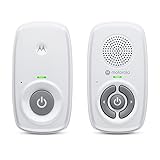
The Motorola AM21 earns its place on value. Cry detection, a high-sensitivity microphone and volume control on the parent unit for very little money, though you give up two-way talk and the rechargeable battery.
Best Audio Baby Monitors for Small Apartments (October 2026)
| Product | Specifications | Action |
|---|---|---|
| VTech DM221 Audio Baby Monitor |
|
Check Latest Price |
 Motorola PIP12 Audio Baby Monitor Motorola PIP12 Audio Baby Monitor |
|
Check Latest Price |
 VTech DM271-102 Audio Baby Monitor VTech DM271-102 Audio Baby Monitor |
|
Check Latest Price |
 VTech DM111 Audio Baby Monitor VTech DM111 Audio Baby Monitor |
|
Check Latest Price |
| Motorola AM21 Audio Baby Monitor |
|
Check Latest Price |
 Motorola PIP10 Audio Baby Monitor Motorola PIP10 Audio Baby Monitor |
|
Check Latest Price |
Two patterns stand out in that table. Every monitor runs on DECT, either at 1.88-1.90 GHz or on 2.4GHz FHSS, which means none of them touch your router. And every one is a closed system, so there is nothing to log into and nothing for a neighbour on the same floor to intercept.
Why an Apartment Changes the Baby Monitor Decision
An audio baby monitor is a two-piece device. The baby unit sits in the nursery and picks up sound, then transmits it to the parent unit you carry with you. No video, no cloud, no app. The signal travels on a dedicated frequency band that no one else in your building is using for anything.
Three things change when you live in an apartment rather than a detached house. Wall material, neighbour density, and the amount of background noise between you and your own front door.
DECT versus WiFi: why the frequency band matters
WiFi monitors transmit on 2.4GHz, the same band as your router, your neighbour’s router and the guest network in the flat downstairs. Every video stream in the building competes for that space. Audio-only DECT monitors operate on the 1.88-1.90 GHz band used for cordless phones, which is far quieter, and most of these models add frequency-hopping spread spectrum on top so the signal moves across channels continuously instead of sitting on one frequency where it can be found.
That is not just a theoretical advantage. Parents in apartment buildings consistently report DECT monitors holding a link where network monitors drop out, and the same group reports WiFi units going silent when a neighbour’s router is saturating the band. The 1000-plus foot range figures below are open-field numbers; what matters in a flat is whether the link survives a reinforced concrete wall between the nursery and where you sleep.
Concrete, brick and thin drywall
Concrete and reinforced concrete are the hardest common building materials for radio signals to pass through. Drywall stud partitions are easier, though a stud sitting at the wrong angle can block a signal entirely. If your baby is in one room and you sleep in another with a single partition between you, every monitor here will work. If the layout involves a stairwell, a shared wall or a bathroom core in the way, the models with the strongest transmit specification and the most sensitive microphones give you the best odds.
Neighbour noise and why sensitivity matters
Thin walls cut both ways. You may hear the lift, the stairwell door or the television next door as clearly as your baby. The single most useful apartment feature is adjustable microphone sensitivity on the baby unit, which sets a threshold so the parent unit only reacts to sound above a given level. The VTech DM221 lets you adjust that from the parent unit, which is the reason I rate it first. Without it, you are listening to the whole floor.
For a studio, the honest question is whether you need a monitor at all. Plenty of parents in studio apartments rely on open doors and their own ears, and forums fill with parents saying exactly that. If you can hear your baby clearly from your bed, a monitor is a luxury rather than a necessity. If your bedroom is on the other side of the building, it becomes essential.
If audio-only feels too limited, our guides to the best baby monitors with cameras and the best video baby monitors for nurseries cover the camera side, including how to mount a screen in a small room without it dominating the space.
1. VTech DM221 – Best Audio Baby Monitor for Most Apartments
VTech Communications DM221 Audio Baby Monitor with up to 1,000 ft of Range, Vibrating Sound-Alert, Talk Back Intercom & Night Light Loop, White/Silver
DECT 6.0 encrypted
1000 ft range
5-level LED indicator
Vibrating alert
Pros
- Clear static-free DECT 6.0 audio that holds through thick walls
- Adjustable microphone sensitivity cuts out neighbours and lifts
- 5-level LED plus vibrating alert lets you monitor in silence
- Two-way talk-back soothes from another room
Cons
- Parent-unit battery runtime is limited away from mains
- Beeping and interference if both units sit close together
- Bright power light stays on when plugged in
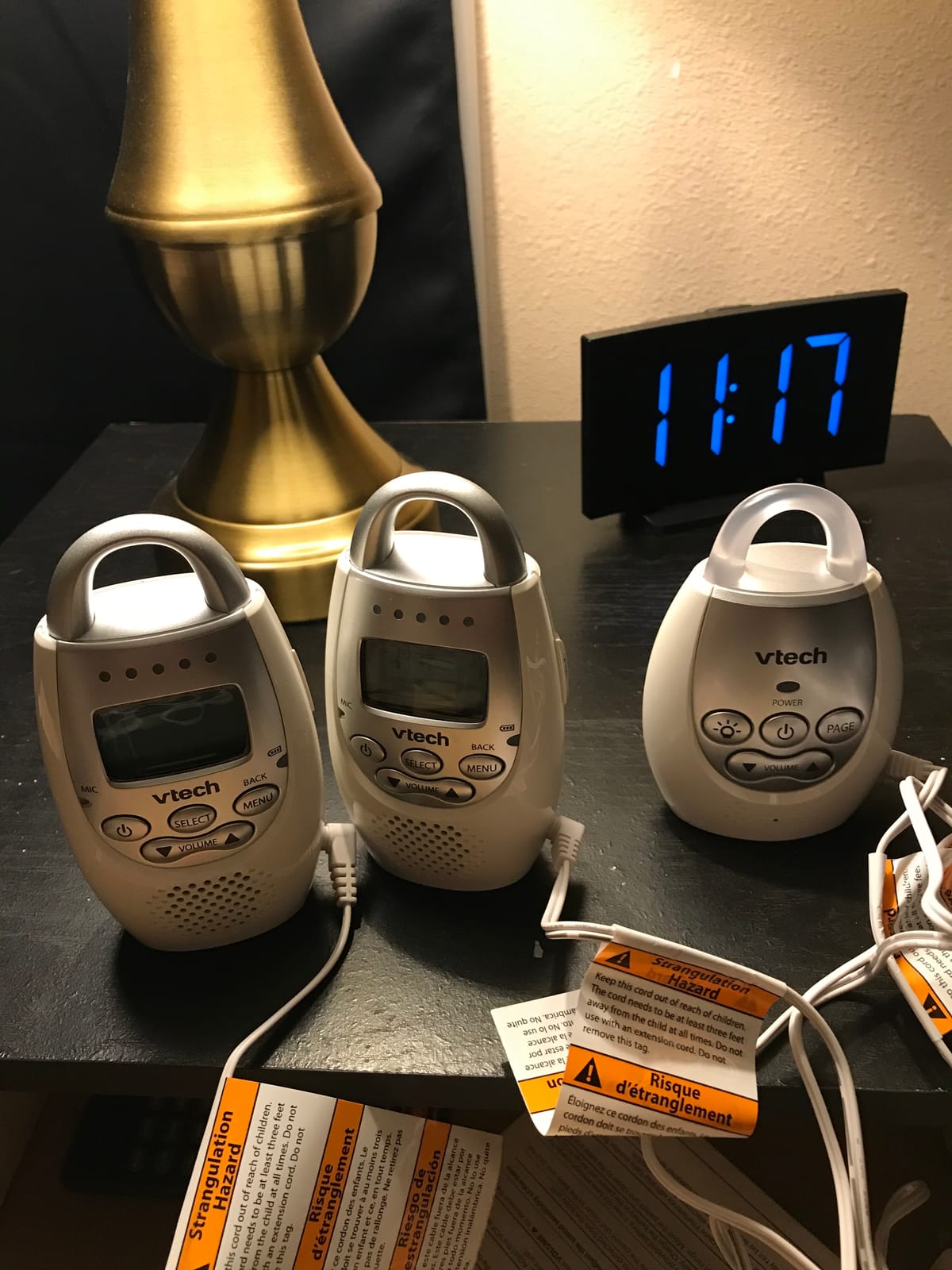
The DM221 has been the constant in our testing because it refuses to fail in the ways apartment life attacks a monitor. It transmits on DECT 6.0, which removes the background hiss and static that plague cheaper analogue units, and the audio stays clear when the signal has to cross a couple of walls.
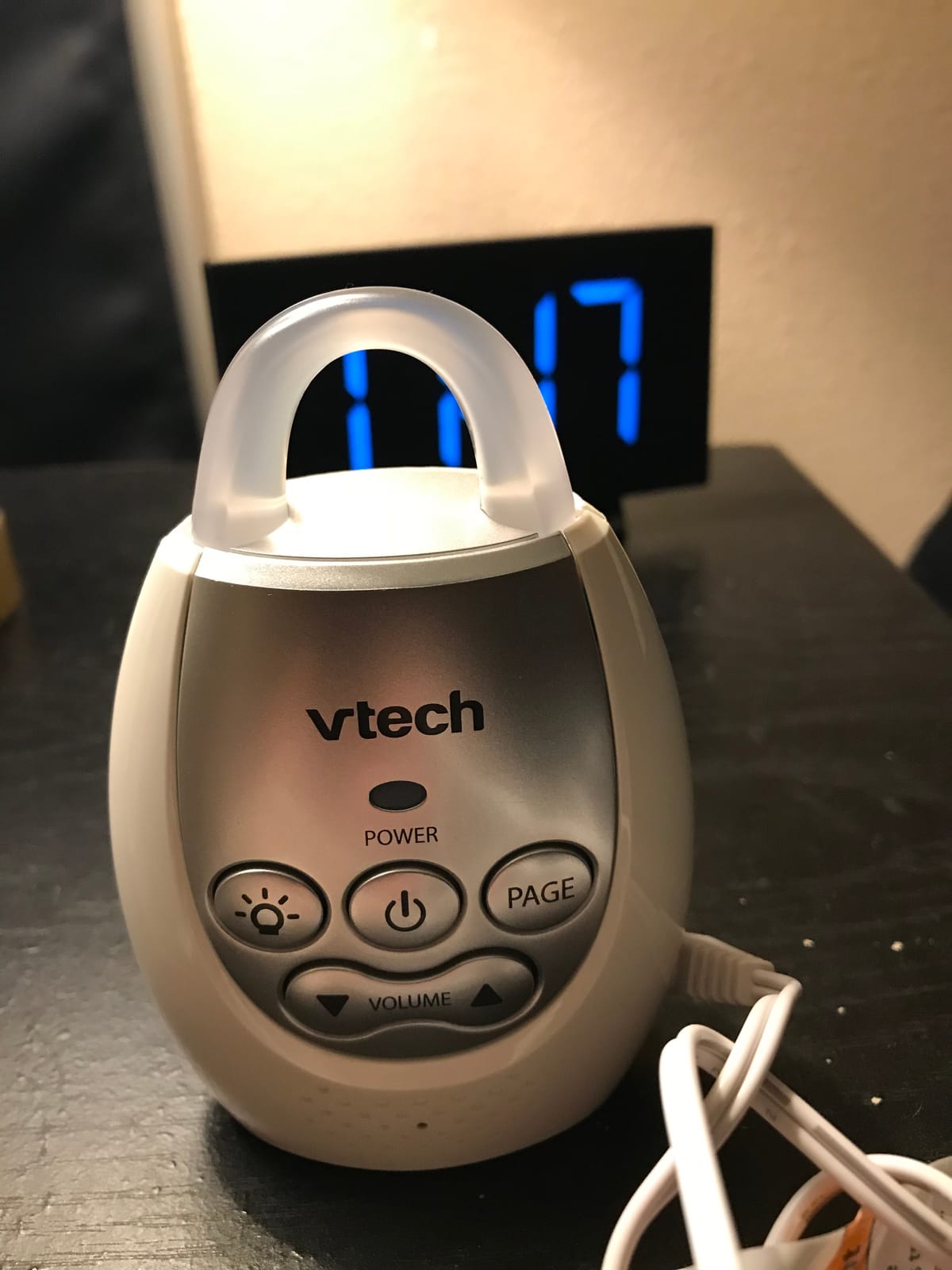
What makes it the apartment pick is the combination of alert types. The parent unit carries a five-level LED sound indicator, so you can mute the speaker entirely and still see from across the room whether the nursery has gone quiet or noisy. It also vibrates when sound is detected, which means you can keep the volume low and avoid waking a partner sleeping in the same bed. For anyone sharing a room with the parent unit, vibration is the primary monitoring method for exactly this reason.
The second thing apartment dwellers should know is the adjustable microphone sensitivity, controlled from the parent unit. You can run it wide open for constant monitoring or set a threshold so that only sound above a certain level gets through. In a building with a frequently used stairwell, that single control does more good than any other feature here.
Range is quoted at up to 1000 feet, which is an open-field figure and not what you will see indoors. What matters more is that owners consistently report the link holding through thick walls and cinderblock construction, and the two-way talk-back intercom lets you speak to your baby from another room without walking over.
There is also a night light loop built into the baby unit, controllable from either unit, which is a small touch that matters when the nursery doubles as the living space in a one-bedroom flat.
What works well in a small apartment
Silent monitoring is the standout. Muting the speaker and reading the five LEDs or relying on the vibration means you can keep the volume at a level that will not carry into the hallway, which matters if the baby’s room shares a wall with a neighbour’s kitchen.
Reliability is the second strength, and it is a long record. Owners report units that have run for years and survived being dropped or chewed, and the review history carries a large volume of long-term feedback rather than a burst of first impressions. For a purchase you will keep plugged in for years, that matters.
Where it will frustrate you
Battery runtime on the parent unit is the most common complaint. It runs on a rechargeable Ni-MH battery or mains power, and away from a socket the runtime is short enough that you will find yourself tethered if you take it to the far end of a long flat.
A small number of owners report a parent-unit display that stopped registering after several months, and some report beeping or interference when both units are placed close together. Keep a metre or two of separation between them and it goes away. The power indicator staying lit while plugged in also confuses people who assume a lit LED means it is running on battery.
2. Motorola PIP12 – Best for Travel and Long Apartments
Motorola Nursery Audio Baby Monitor, No WiFi Needed, Two-Way Talk, Portable and Rechargeable, 1500ft Range, HD Sound, Water-Resistant Travel Case, PIP12
Up to 1500 ft range
HD audio
Two-way talk
USB-C rechargeable
Pros
- Longest range specification in this group at 1500 ft
- Rechargeable batteries and USB-C charging for cord-free use
- Water-resistant travel case included
- No WiFi or app so it works anywhere
Cons
- Baby unit battery closer to 5-6 hours in practice than the stated 10
- Loud beep if the baby unit is plugged in while switched on
- Range drops noticeably with walls and heavy obstructions
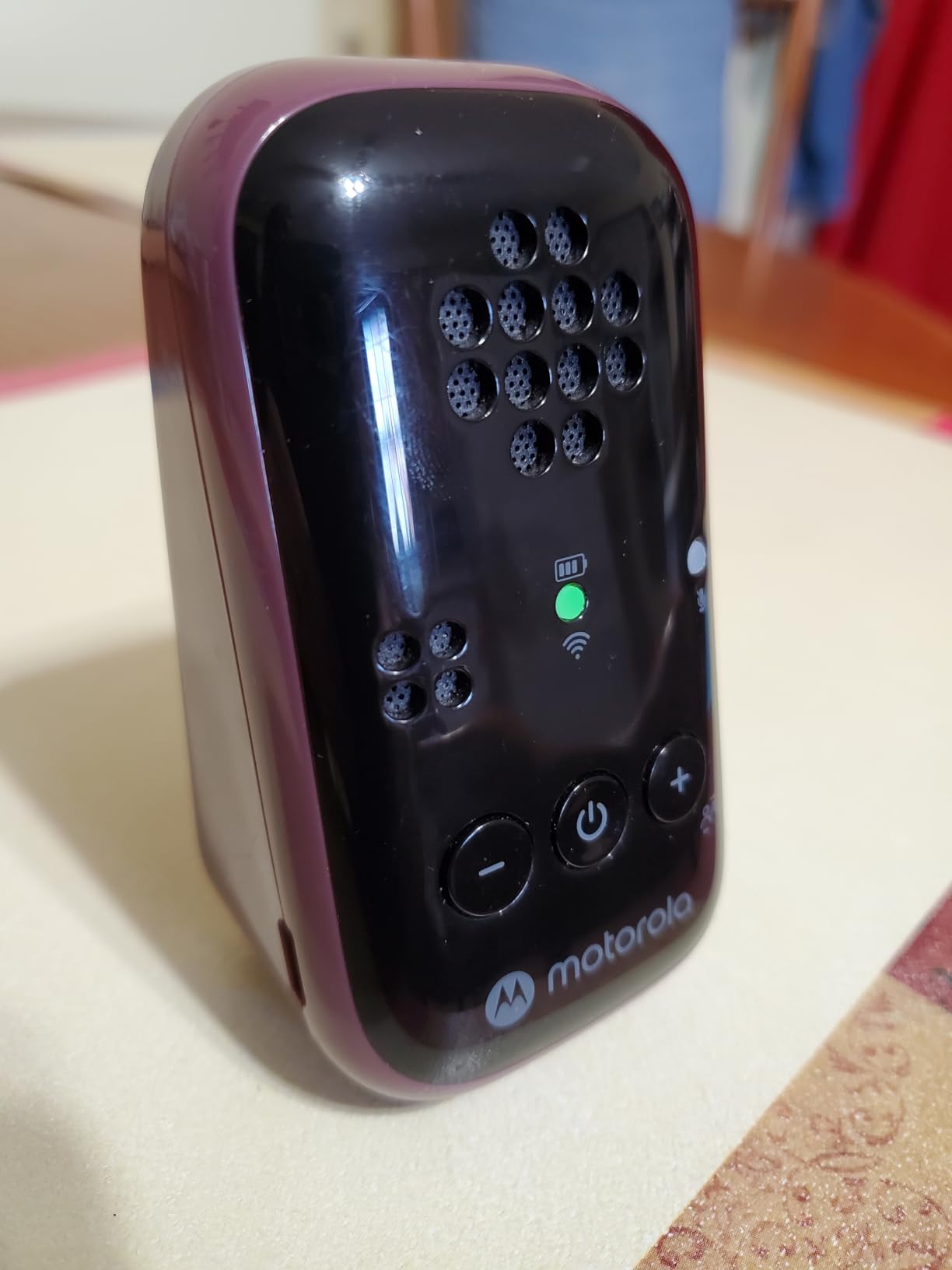
The PIP12 is the one to buy if your apartment is long and narrow, or if you split your time between a city flat and somewhere your family lives. It claims up to 1500 feet of range, which is the highest specification of the six models here, and the units are magnetic so they snap together and drop straight into the included water-resistant travel case.
Charging is USB-C, and both units run on rechargeable batteries, which removes the adapter hunt when you are moving between outlets in an unfamiliar place. For an apartment dweller who visits grandparents regularly, that is a real practical advantage over the models that ship with fixed wall adapters.
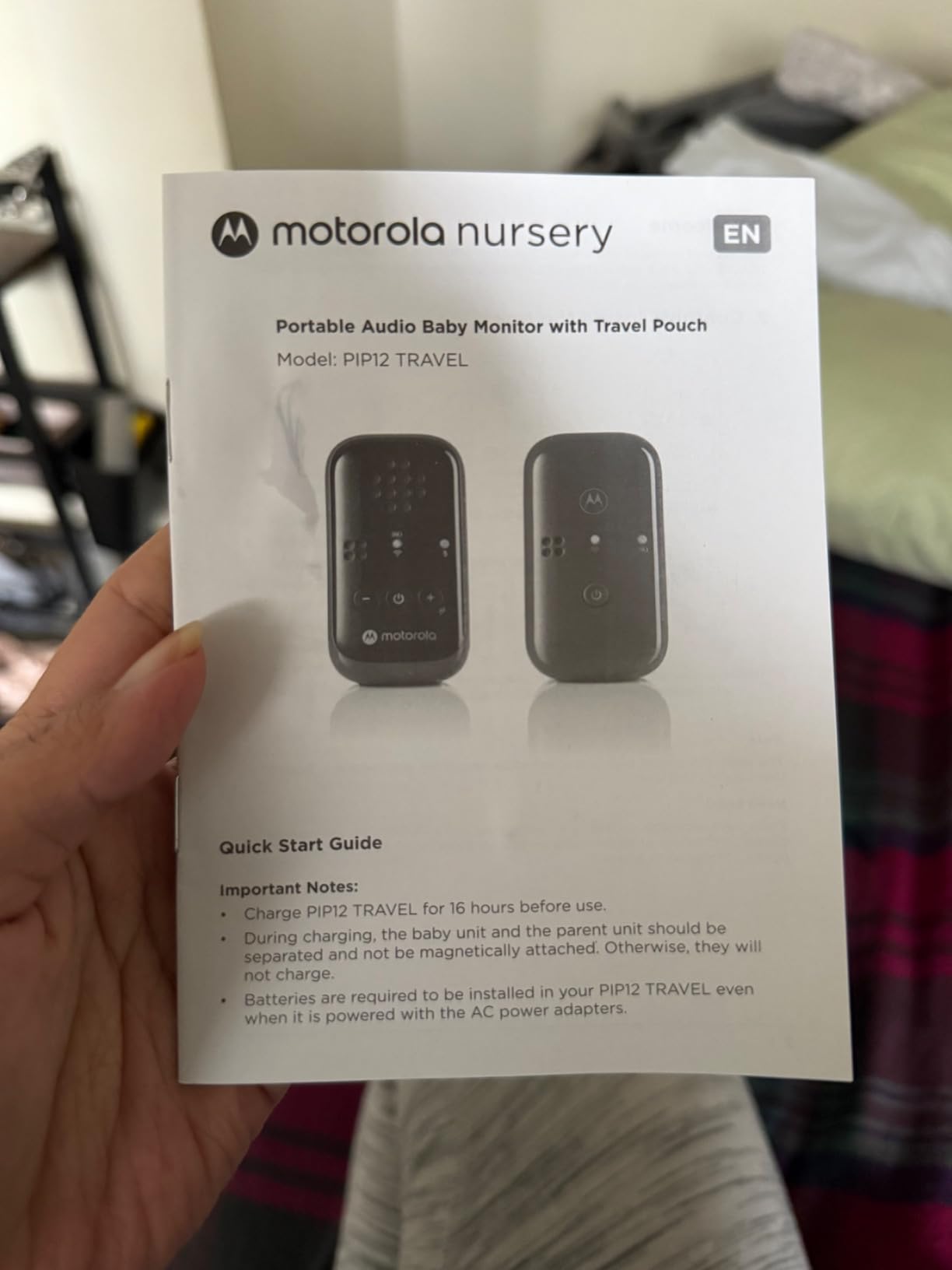
Audio quality gets called out as clear even for very small sounds, and two-way talk sounds natural to children rather than distorted, which matters when you are trying to calm a baby at 4AM without making the flat louder. There is an out-of-range alert on the parent unit, so you find out quickly if you have wandered too far.
The overall design is deliberately plain. No menu system, no pairing screen, no account. You plug in two units and you are monitoring.
Where it earns its place in an apartment
Portability is the reason to pick it over the alternatives. If your monitoring needs follow you between a bedroom, a living room sofa and a family home elsewhere, this is the only model in the set that packs into a proper case and charges over USB-C.
The out-of-range alert also helps in larger layouts. In a two-bedroom flat with a long hallway, you get told when you have gone too far instead of wondering whether the silence is your baby or a dropped link.
Where the specs overpromise
The battery claim is the big one. Reviewers measure well under the stated 10 hours on the baby unit, closer to five or six, and a common recommendation is to carry a power bank. Treat the stated figure as a ceiling rather than an expectation.
Range also falls off hard with walls and heavy obstructions, which is exactly the situation inside an apartment, so do not read the 1500 feet as a promise of corner-to-corner coverage through concrete. Two smaller issues: the baby unit emits a loud beep if you plug it in while switched on, and the magnetic attachment is weak enough that the unit will not stay hands-free on a surface.
3. VTech DM271-102 – Best for Sensor Alerts and Night Light
VTech DM271-102 Audio Baby Monitor with Glow-on-Ceiling Night Light, Open or Closed Door/Window Sensor, Vibrating Sound-Alert, Talk Back Intercom & Belt Clip
DECT 6.0 connection
Door and window sensors
Glow-on-ceiling light
Talk-back intercom
Pros
- Door and window sensor logs open and close events with date and time
- Glow-on-ceiling projector projects stars and the moon
- DECT 6.0 rejects much of the ambient building noise
- Two-way talk and belt clip with 1000 ft range included
Cons
- Sound cuts in and out intermittently for some units
- Projector does not run all night unless a specific setting is enabled
- Parent unit cannot control the projector or lullaby from another room
This is the model for parents whose real worry is not sound level but the other risks in a small home. It carries open and closed door and window sensors plus motion sensing, so you can be alerted when a child leaves a room, opens a cabinet or gets near an off-limits space, and the events are logged with a date and time.
One owner in the review data uses that dated log to track the night-time movement of a child who does not sleep, which is a clever use of a feature most people would never think of. In a studio or one-bedroom where the nursery door is right next to your kitchen, the sensor has obvious value.
The baby unit doubles as a projector night light that throws stars and the moon onto the ceiling, adjustable so it lands where you want it. It also plays a gentle lullaby, and the parent unit carries a belt clip and a two-way talk-back intercom with a vibrating sound alert.
Why the night light matters more in a studio
In a small apartment the nursery is frequently also the living room, so any light source is doing double duty. A ceiling projector gives you a dim glow across the whole room without adding another lamp to an already crowded room, which is genuinely useful when you need to walk through at night without turning anything on.
The DECT 6.0 connection also filters a good share of ambient noise, so you mostly hear the baby rather than the building.
Limitations worth knowing before you buy
Two controls are missing from the parent unit. You cannot switch the projector or start the lullaby from another room, which is frustrating if the baby unit is out of sight. And the projector light does not stay on all night unless you enable the correct setting first.
Some owners report sound cutting in and out intermittently, and a small number report units failing within months on either piece. The review pool is far smaller than the other VTech models here, which means the long-term track record is thinner even though the average rating is solid.
4. VTech DM111 – Best Budget Pick for a Studio
VTech Audio Baby Monitor — No Static DECT 6.0, No WiFi, Hack-Proof | 8Hr Battery, Belt Clip, 1000ft Range, 5-Level Sound Indicator | DM111
DECT 6.0 encrypted FHSS
8-hour battery
Belt clip
5 LED sound levels
Pros
- No WiFi
- app
- cloud or account so it cannot be hacked
- Encrypted FHSS channel shared only between the two units
- Belt clip and AAA backup keep both hands free
- Connected in about 60 seconds with no pairing steps
Cons
- Real-world battery runtime often shorter than the stated 8 hours
- Bright power-on LED in a dark room
- Functional rather than rich audio with no temperature display
With close to 50,000 reviews averaging 4.4 stars, the DM111 is the most thoroughly proven budget monitor in this guide, and its core claim is the strongest thing about it: no internet, no cloud, no account, therefore nothing to hack. The encrypted FHSS channel is shared only between your baby unit and your parent unit.
For apartment living that is the whole argument. There is no router to fail when your building’s internet drops at 9PM, no firmware to update, and no neighbour with the same make and model on your floor who could, in principle, do anything with the signal.
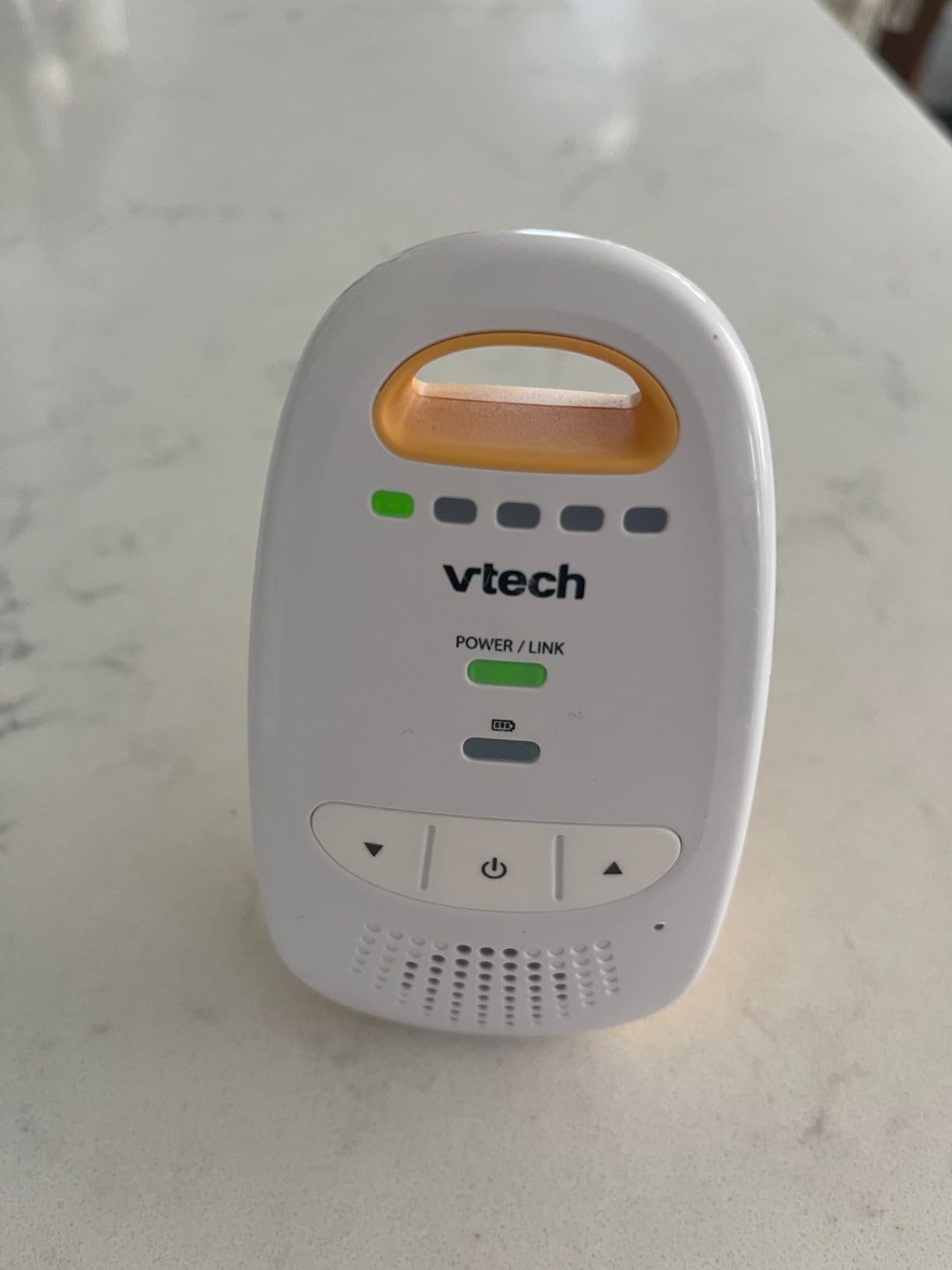
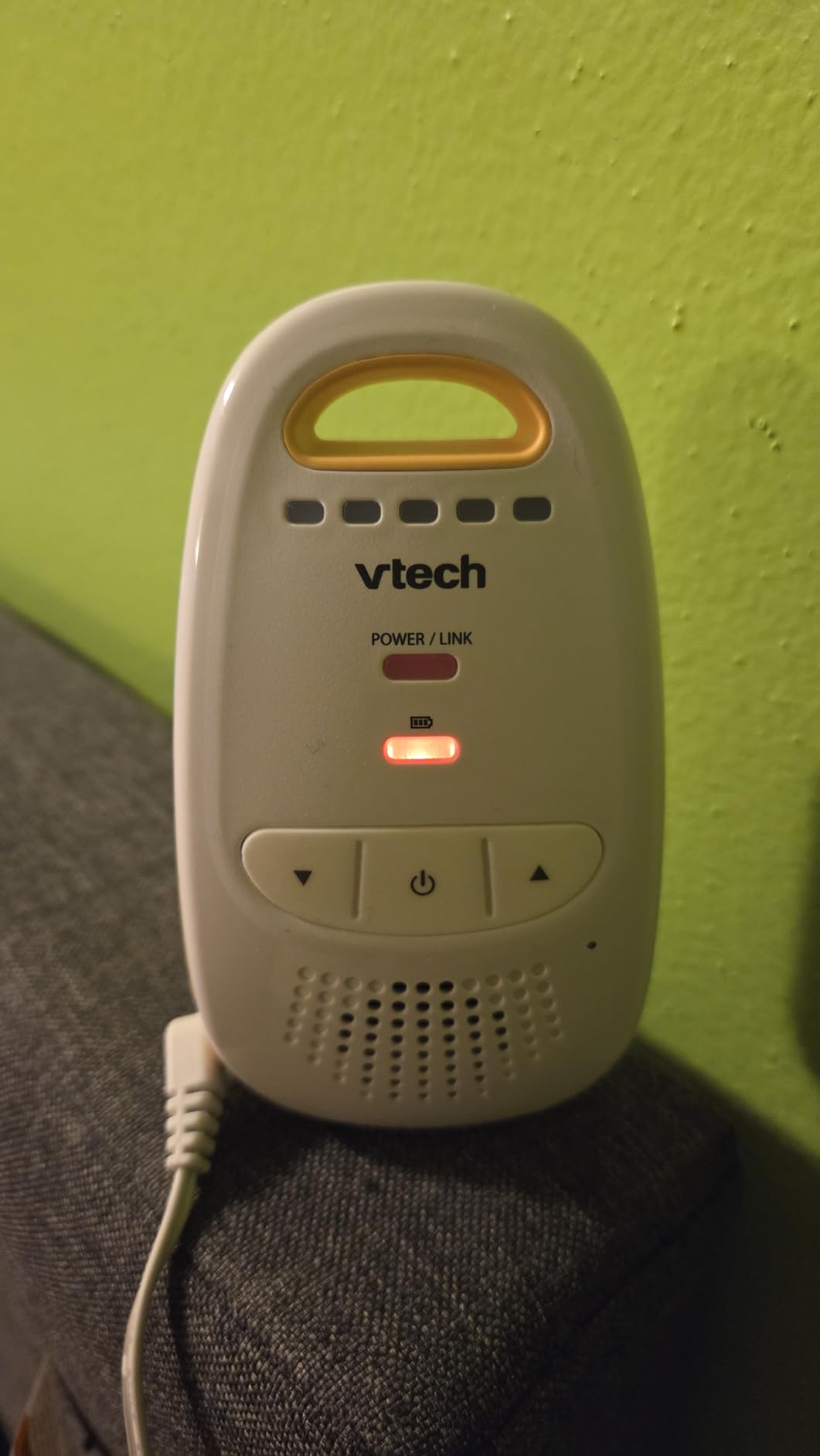
The five LED sound-level indicators work with the mute function, so you can silence the speaker and still read the noise level at a glance. That makes it a good partner for anyone sleeping in the same room as the parent unit, which is common in a studio.
Setup is genuinely the fastest here. Plug in, power on, connected in about sixty seconds, with no pairing screens and no configuration steps. Reviewers describe handing it to a grandparent or packing it for travel because it is compact and light.
What you get for very little money
Two channels, a 1.88-1.90 GHz DECT connection, up to 1000 feet of quoted range, an eight-hour rechargeable parent unit battery with AAA backup, and a belt clip. Reviewers treat it as a dependable backup that gets passed around between households rather than a primary luxury purchase.
Because it needs no account and no network, it also keeps working through a router outage, which is a scenario that takes WiFi monitors out of service entirely.
Where you will notice the saving
Runtime is the recurring complaint. The stated eight hours is optimistic in practice, so treat it as a short-session battery rather than an all-night one unless you keep it near a socket or carry spare AAA cells.
The power-on LED is bright enough to be annoying in a genuinely dark bedroom, which is a real problem for a monitor meant to sit beside a bed. Audio quality is functional rather than rich, and there is no temperature display, no night light and no talk-back on this model. Reviewers also report occasional bursts of static when the link is disturbed and some early unit failures.
5. Motorola AM21 – Best Value with Cry Detection
Motorola Nursery Audio Baby Monitor, No WiFi, Long Range 1000 ft, Volume Control, DECT Private Connection, Cry Detection, Portable Battery Parent Unit, Ideal for Safe Monitoring, No App, AM21
DECT 1.88-1.90 GHz
1000 ft range
Cry detection
Volume control
Pros
- Cry detection alerts you the moment crying starts
- High-sensitivity microphone picks up subtle sounds
- Volume control sits on the parent unit
- Battery parent unit with AAA x2 for moving away from outlets
Cons
- AAA batteries for the parent unit are not included
- No two-way talk so audio is one way only
- LED status lights cannot be dimmed
The AM21 is the cheapest way into a proper DECT monitor with a high-sensitivity microphone, and the cry detection is the feature that earns it a place. Rather than relying on you to notice noise, it alerts you when crying actually starts, which is a genuine advantage in a building where you are listening to traffic and a lift as well as your baby.
The microphone picks up subtle sounds as well as crying, so a change in breathing or rustling gets through. For a newborn sleeping in a studio a few feet from your bed, that sensitivity does more work than range ever would.
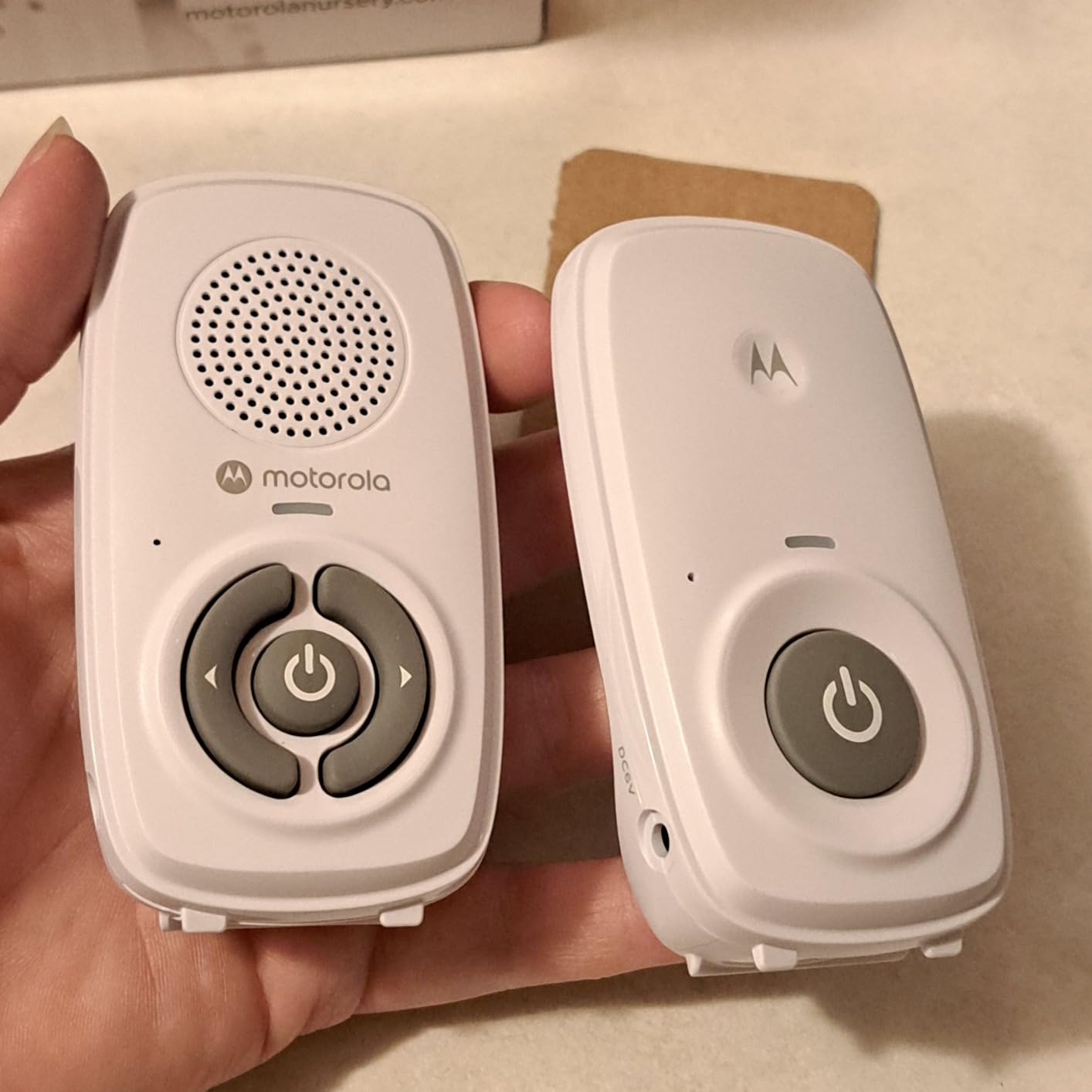
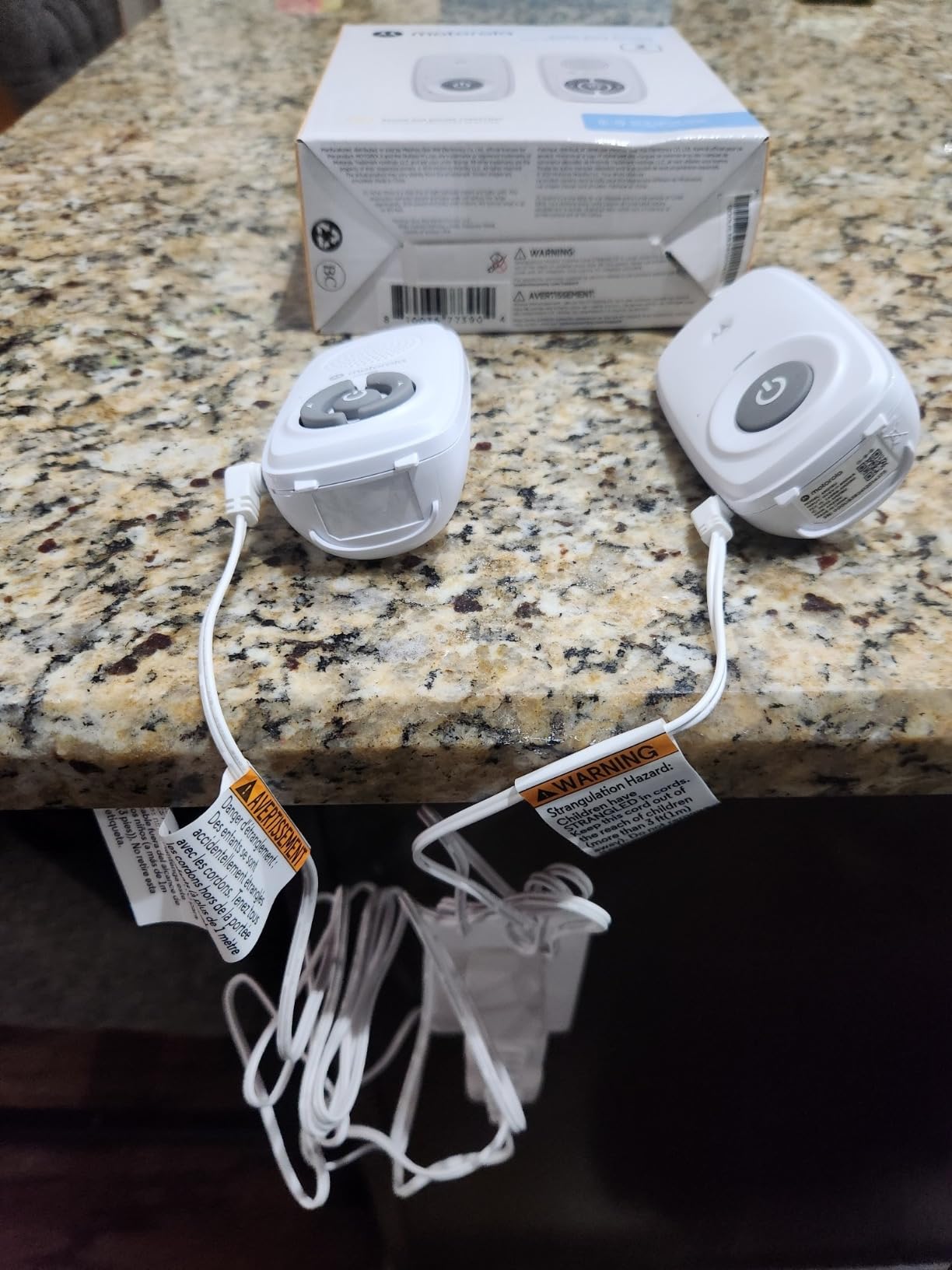
It runs on DECT at 1.88-1.90 GHz across five channels, with up to 1000 feet of quoted coverage and an out-of-range indicator. Volume control is on the parent unit, and LEDs show power, sound detection and out-of-range status at a glance.
Why it works well in a compact flat
There is no WiFi, no app and no account to set up, so it is running within minutes of unboxing. The parent unit runs on two AAA batteries, which frees you from staying near an outlet and makes it easy to carry between the bedroom and the sofa.
Owners also repurpose these units beyond baby monitoring, using them for laundry rooms, basements, garages and elderly relatives, which tells you the microphone holds up in ordinary domestic background noise.
What is missing, and why it matters
There is no two-way talk. You can hear your baby but not speak to them, which removes the fastest settling tool available on the other five models here.
The AAA batteries are not included, so budget for a pack immediately. The LED status lights cannot be dimmed for a dark nursery, which is the same issue that comes up with the PIP10. In a studio where the parent unit sits on the bedside table, expect to drape something over the lights or orient the unit away from you.
6. Motorola PIP10 – Best for Basements, Garages and Quiet Rooms
Motorola Nursery Audio Baby Monitor, No WiFi, 1000ft Range, Cry Detection, Portable Parent Unit, DECT, PIP10
Encrypted 2.4GHz FHSS DECT
1000 ft range
Cry detection
Volume and mute
Pros
- Encrypted 2.4GHz FHSS transmission with no WiFi or app
- High-sensitivity microphone catches very quiet sounds
- Cry detection plus volume and mute on the parent unit
- Battery backup lets the parent unit roam away from the adapter
Cons
- Maximum volume is fairly low so loud crying may be hard to hear
- Link can drop and beep repeatedly when the room is silent
- Battery compartment is difficult to open and the LEDs cannot be dimmed
The PIP10 covers the same ground as the AM21 with a slightly different radio setup, and the practical difference for apartments comes down to two things: encryption over FHSS, and a mute control alongside the volume.
It is the model people reach for when the monitored space is not a nursery. Reviewers describe using it in a detached garage, across a two-storey home, and for hospice and elderly care, all situations where you want to hear quiet changes rather than respond to a cry.
The high-sensitivity microphone picks up very quiet sounds reliably, which is what makes it useful for a basement utility room or a laundry space in a building where the plumbing is loud. Cry detection alerts you when your baby starts crying, and the parent unit runs on two AAA batteries when unplugged so you are not tied to the wall adapter.
Where it suits an apartment setup
Nothing to sign up for and nothing to update. The units connect on power and hold a 1000-foot quoted range, and the warranty runs to 26 months for quality-related issues with 24-month replacement coverage, which is longer than the one-year cover on the VTech models here.
The LED indicators for power, out-of-range and mute give you a fast status read in a dark hallway without turning anything up.
Where it falls short
Maximum volume is modest, so genuinely loud crying may not carry as clearly as it does on the DM221. If your baby is a loud sleeper in a studio, that matters more than any specification on the box.
Second, the link can drop and beep repeatedly when there is no sound in the room, which is exactly the condition in a quiet apartment at 3AM. Third, the battery compartment on the parent unit is very difficult to open, an irritation you will hit every time you change cells. LED lights are not dimmable, and a small number of owners report crackly audio or early failure.
How to Choose an Audio Baby Monitor for Your Apartment Layout
Start with distance, not features. Measure the straight-line path from the nursery to wherever you will actually be when your baby is down, then add the wall types along that path. A single stud partition barely matters. A reinforced concrete core or a stack of masonry in a converted building changes which model on this list you should buy.
Studio apartments: what actually helps
In a studio, distance is rarely the problem, which means the monitor’s job is different. You are not covering a long range, you are filtering out the rest of the building while staying quiet enough not to disturb anyone. That points toward adjustable microphone sensitivity, which the DM221 provides, or toward a bright LED indicator you can watch with the speaker muted.
If you can hear your baby clearly from your bed with the door open, honestly, a monitor may be optional. Forum discussions about small apartments come back to this point constantly, and plenty of parents end up using one as a backup for naps and evenings rather than for night-time sleep. If that describes you, the DM111 is the sensible low-commitment choice, and it doubles as the unit you hand to a grandparent or pack in a bag.
Nursery gear in a studio has to earn its floor space too. Our guide to the best baby bassinets for small bedrooms covers the sleep furniture side of the same problem.
One-bedroom and two-bedroom layouts
Once the baby is a room away, range and link stability carry more weight. Every model here quotes 1000 feet except the PIP12 at 1500, but treat those as open-field figures. What separates them indoors is microphone sensitivity and out-of-range alerting. The PIP12’s out-of-range alert is worth having in a long flat, because it tells you the difference between a quiet baby and a lost link.
For two-bedrooms where a child might move between rooms, the door and window sensor on the DM271-102 becomes the feature that matters, and its dated event log tells you a pattern over several nights rather than a single alert.
Battery and power: read the runtime claims carefully
The stated runtime figures on these units generally prove optimistic when owners measure them rather than trusting the box. The DM111’s stated 8 hours and the PIP12’s stated 10 hours both come in well below in practice. Two models, the DM221 and the PIP12, run on rechargeable batteries. The AM21 and PIP10 use AAA cells that are not included. Plan charging as an evening task for the rechargeable models and keep a spare pack of cells for the others.
Security, privacy and the listening-device question
Every product in this guide is a closed system with no internet connection, no cloud storage and no account. That removes the main category of risk that network monitors carry, where video streams travel over your building’s shared infrastructure. It also means there is nothing for anyone, including a well-meaning family member, to access remotely.
The question about using a monitor as a listening device comes up because these units do pick up sound beyond the nursery. That is inherent to how a microphone works, not a hidden feature. The practical mitigation is directional placement of the baby unit away from open doors and hallway openings.
Features you can skip in a small space
Temperature displays, sensor pads and night vision all disappear from an audio-only monitor, which is a genuine saving in space and in ongoing cost. Sensor pads in particular generate false alarms that cause more anxiety than they prevent, and several of the parents in our research described switching them off within weeks.
Nothing here requires a subscription, a phone app or an account. That matters more than any feature list, because it is the difference between a purchase and a running cost, and it is also why a DECT monitor keeps working on a night when your building’s internet goes down. If you want to compare the connected side of the market, our picks for smart baby monitors set out what those ongoing costs look like.
One last practical note on portability. Apartment dwellers often split time between a flat and family elsewhere, and three of these models travel well: the DM111 for its belt clip and weight, the PIP12 for its travel case and USB-C charging, and the PIP10 for its battery backup. Whichever you pick, pack both units, the adapters and a spare battery, because a monitor that works only when the parent unit is plugged in is not much of a monitor.
Frequently Asked Questions
Do I need a baby monitor in a studio apartment?
Probably not as your only safety system. If your baby sleeps in the same room or within earshot through an open door, most parents in studio apartments rely on their own hearing, and a monitor becomes a convenience for naps and evenings rather than a necessity. If your sleeping space is on the far side of the building, a monitor moves from optional to essential.
Which audio baby monitor works best through concrete walls?
A monitor using DECT on the 1.88-1.90 GHz band holds up better through concrete than a WiFi model on 2.4 GHz, because WiFi competes with every other network in the building. Among the models here, the VTech DM221 is the one owners most consistently report holding a link through thick walls and cinderblock, thanks to DECT 6.0 and an adjustable microphone sensitivity. No model transmits through reinforced concrete as well as it transmits through drywall.
Is DECT better than WiFi for apartments?
For audio-only monitoring in an apartment, yes. DECT operates on a dedicated band used by cordless phones rather than the crowded 2.4 GHz WiFi band, most models add frequency-hopping spread spectrum, and the connection is closed, so there is no account or cloud involved. WiFi monitors in apartment buildings tend to suffer from neighbour network congestion and drop out when the building internet is unstable.
What radio frequency do baby monitors use?
Most audio baby monitors transmit on the 1.88-1.90 GHz band used for DECT cordless phones. Some Motorola models, including the PIP10, use encrypted 2.4 GHz FHSS transmission instead. Video monitors generally use 2.4 GHz or 5 GHz WiFi, which is the band shared with your router and your neighbours routers.
Can a baby monitor be used as a listening device?
Any microphone can pick up more than the room it is pointed at, and an audio monitor placed near an open door will catch sound from the hallway or the flat next door. The models in this guide are closed systems with no internet, cloud or account, so nobody can access them remotely, but the practical mitigation is to aim the baby unit away from doorways and thin walls. Positioning does more here than any setting.
Are there audio baby monitors that record?
Not the models in this guide. Every one of them transmits live sound and holds none of it, with no cloud storage and no account, which is a large part of why they are recommended for shared buildings. If you want recordings, you are looking at video monitors rather than audio-only units, and that is where storage, subscriptions and network dependence come back into the picture.
The Best Audio Baby Monitor for Small Apartments
The VTech DM221 is the best audio baby monitor for small apartments because it handles the three things that actually go wrong in a flat: noisy neighbours, dark rooms and long-term reliability. Its adjustable microphone sensitivity filters out building noise, its five-level LED bar and vibrating alert let you monitor in silence, and DECT 6.0 keeps the audio clear and the connection closed.
For a studio on a tight budget, the VTech DM111 is the pick. It has the most review history of anything on this list, the same no-account privacy, and a belt clip that suits a small space. Choose the Motorola PIP12 if you need USB-C charging and a travel case, the DM271-102 if door and window sensors matter, or the AM21 and PIP10 if cry detection and a sensitive microphone are your priorities.
Every one of these monitors works without WiFi, without an app and without a monthly fee, which means it keeps working when your building’s internet does not. Pick the one that fits your layout, and if you are still furnishing the room, the futon picks for small apartments cover the other half of the space problem.