
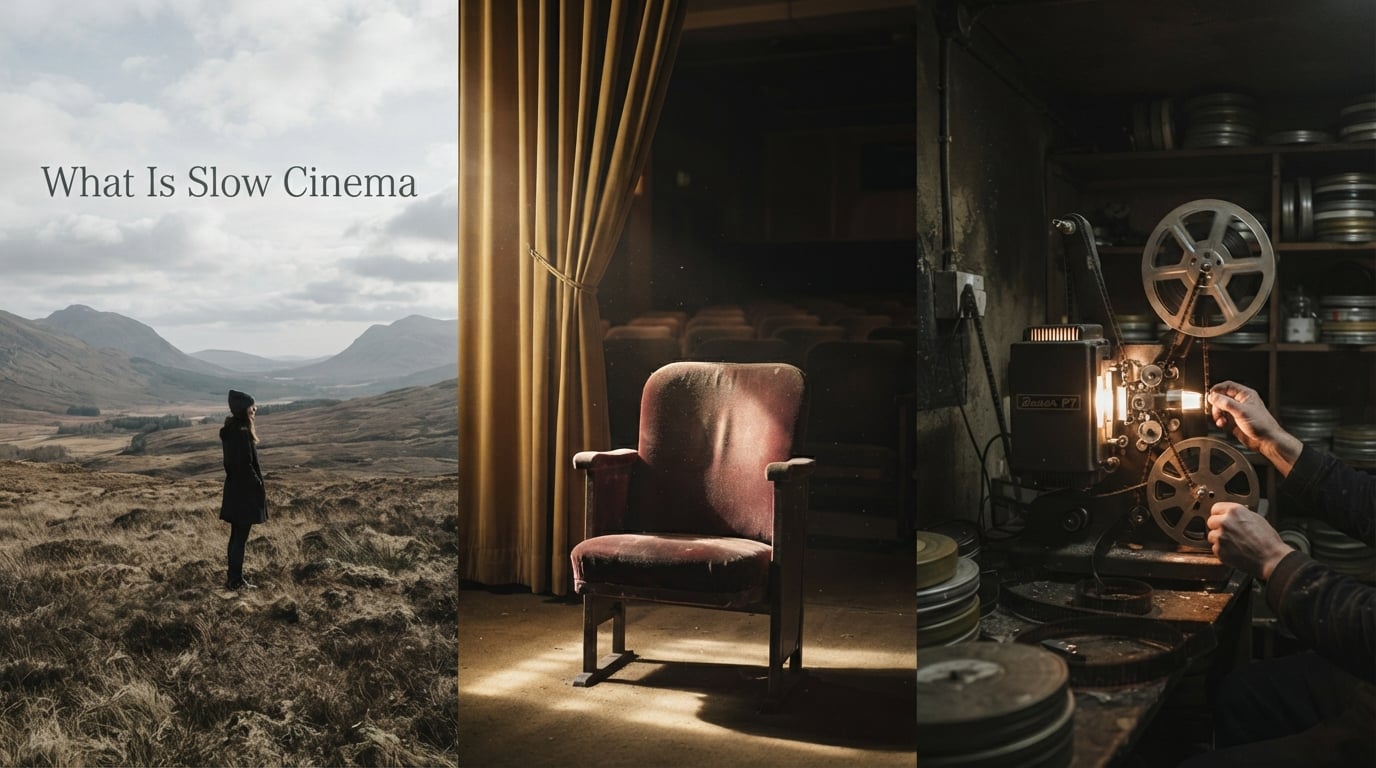
Slow cinema is an art-house film movement characterized by minimalist storytelling, long takes, sparse dialogue, and a deliberate pace that emphasizes atmosphere and contemplation over plot. I started watching these films three years ago after burning out on fast-cut thrillers, and the experience reshaped how I think about movies entirely.
In this guide, I’ll walk you through what slow cinema actually is, how it differs from mainstream filmmaking, the directors who shaped the form, the films I think everyone should see, and how to get the most out of viewing them. By the end, you’ll know whether this contemplative style is for you, and you’ll have a roadmap for diving in.
Table of Contents
What Is Slow Cinema?
Slow cinema is a genre of contemplative, minimalist filmmaking that uses extended long takes, sparse dialogue, and atmospheric soundscapes to create immersive, meditative viewing experiences. Sometimes called contemplative cinema or meditative film, it rejects the rapid editing, plot-driven urgency, and emotional manipulation of mainstream Hollywood storytelling in favor of patient observation.
The term started circulating in academic circles in the early 2000s, though the style itself has roots stretching back to the 1960s and 1970s. Film scholars use it to describe a loose grouping of directors who share a sensibility rather than a formal manifesto. There is no slow cinema “school” with a founding charter. Instead, you will find filmmakers from Russia, Hungary, Belgium, Taiwan, and the Philippines whose work happens to orbit the same set of ideas about time, presence, and attention.
What separates slow cinema from simply “boring” or “bad” filmmaking is intention. Every long take, every stretch of silence, every lingering shot of a hallway or a face is a deliberate choice meant to draw you into a different relationship with time. Where mainstream films use editing to control what you feel, slow cinema hands you the keys and asks you to sit with what’s on screen.
How Slow Cinema Differs from Mainstream Film
Mainstream cinema typically uses 600 to 1,000 cuts per hour. Slow cinema might use 30 cuts in an entire two-hour film, or sometimes far fewer. That single statistic captures most of the difference between the two approaches.
Mainstream film treats time as a problem to manage. Editors cut away from anything that might let the audience’s attention drift, and they compress events to keep momentum high. Slow cinema treats time as the actual subject. A seven-minute shot of a man walking across a field is not padding. It is the point.
Key Characteristics of Slow Cinema
Slow cinema is defined by several recurring formal choices that work together to produce its contemplative effect. Here are the traits you’ll encounter most often.
Long Takes and Minimal Editing
The long take is the signature technique of slow cinema. A single shot might run for three, seven, twelve minutes without a cut. Directors use this to preserve real time and let scenes breathe in a way that montage cannot replicate.
Andrei Tarkovsky was a master of this approach. His films feature stretches where almost nothing seems to happen, yet the duration itself creates meaning. Béla Tarr pushed this even further, with tracking shots that run for several minutes without dialogue or significant action. By the time a cut finally arrives, you have been pulled into the scene’s rhythm in a way no quick edit could achieve.
Static Camera and Carefully Composed Frames
Many slow cinema films rely on static or slowly tracking cameras rather than the handheld, mobile camera work common in action cinema. This stillness demands attention. You are not being guided around the frame. The composition itself becomes the information.
You will see wide shots of open terrain held for long periods, often with small human figures within them. The juxtaposition of stillness in the frame against the passage of time on screen produces a particular kind of reflection on human scale.
Sparse Dialogue and De-dramatization
Slow cinema strips dialogue down to its essentials. Conversations happen, but they rarely carry exposition or propel plot. Characters might speak a dozen sentences in an entire film. What is said often matters less than how it is said, or the silence that surrounds it.
This approach is sometimes called de-dramatization. The dramatic moments, when they arrive, feel earned rather than engineered. There are no false crescendos or forced reveals. The form mirrors life itself, where most hours pass without incident and yet everything is in fact changing.
Ambient Soundscapes and Diegetic Sound
Sound design in slow cinema leans heavily on ambient noise. The hum of a radiator, rain on a window, distant traffic, footsteps in a corridor. Music is often absent or used very sparingly.
This diegetic sound approach (meaning sound that exists within the world of the film) helps build atmosphere and grounds the viewer in physical reality. Instead of a swelling score telling you how to feel, you hear what the characters hear. The world around them becomes a character.
Real-Time and Extended Duration
Some slow cinema films run four hours, seven hours, or even longer. Béla Tarr’s Sátántangó runs over seven hours. Lav Diaz regularly produces films in the eight-to-ten-hour range.
Real-time sequences also appear frequently. A scene showing a meal might actually take as long as a real meal. The film respects your time by asking you to spend it, and that commitment often creates a more powerful emotional resonance than compressed storytelling.
Notable Slow Cinema Directors to Know
A handful of directors have defined and shaped the slow cinema movement. Knowing their names and their key works is the best way to start exploring the genre.
Andrei Tarkovsky (1932-1986)
Andrei Tarkovsky is the spiritual godfather of slow cinema for many viewers. His Russian films, including Mirror, Stalker, and The Sacrifice, established the contemplative template that later directors would build on. His theoretical writing in Sculpting in Time remains the most influential articulation of the slow cinema philosophy.
Tarkovsky believed cinema’s true material was time itself. His films reward patient viewers with images and moments that linger in memory long after the credits roll. He is also credited as a major influence on directors as varied as Lars von Trier, Christopher Nolan, and the entire contemplative film tradition.
Béla Tarr (1955-present)
The Hungarian filmmaker Béla Tarr is known for his rigorously austere later films, including Werckmeister Harmonies and The Turin Horse. These films feature extraordinarily long tracking shots, near-black-and-white cinematography, and stories of rural Hungarian life that move at the pace of the seasons.
Tarr’s Sátántangó is the film most often cited as the ultimate slow cinema commitment. At seven and a half hours, it is not a film you watch casually. It is an experience.
Chantal Akerman (1950-2015)
The Belgian filmmaker Chantal Akerman created Jeanne Dielman, 23, quai du Commerce, 1080 Bruxelles, a 1975 film that has become one of the most influential works in the entire slow cinema canon. It depicts three days in the life of a woman performing household tasks, with attention to duration and repetition that feels almost meditative.
Akerman’s influence extends across contemporary art cinema, feminism, and experimental film. Her work is widely taught in film schools and frequently appears on lists of the greatest films ever made.
Tsai Ming-liang (1957-present)
The Malaysian-born Taiwanese director Tsai Ming-liang makes films that move almost imperceptibly slowly. His works, including Stray Dogs and What Time Is It There?, feature extended static shots, minimal plot, and a recurring preoccupation with urban loneliness.
Tsai also makes shorter “walking” films that reduce cinema to its barest elements. His approach has become increasingly abstract over time, which makes him a fascinating entry point for viewers interested in the experimental edge of slow cinema.
Lav Diaz (1958-present)
The Filipino filmmaker Lav Diaz makes some of the longest narrative films in cinema history. Evolution of a Filipino Family runs over ten hours. Norte, the End of History runs four hours. His black-and-white images and extended durations have made him a major voice in contemporary slow cinema.
Diaz’s work often engages with Philippine history, colonialism, and trauma. The slow pace is not aesthetic indulgence. It gives weight to subjects that mainstream pacing could not accommodate.
Paul Schrader and Transcendental Style
The American filmmaker and critic Paul Schrader wrote Transcendental Style in Film in 1972, a foundational book that gave slow cinema a theoretical framework. Schrader identified patterns of stillness, repetition, and austerity in the works of directors like Yasujiro Ozu, Robert Bresson, and Carl Theodor Dreyer.
Schrader’s framework connects slow cinema to a longer tradition of films seeking spiritual or transcendent experience through formal restraint. His own films, including First Reformed and A Master Builder, draw explicitly on this lineage.
Essential Slow Cinema Films to Watch
If you are new to slow cinema, starting with the right film matters. Some works are gentler entry points. Others test even committed viewers.
Beginner-Friendly Entry Points
Paris, Texas (1984, Wim Wenders) is often the first slow cinema film I recommend to newcomers. It moves slowly but has a strong narrative pull, a memorable score, and a runtime of under two and a half hours. It is the gentlest door into the genre.
Certified Copy (2010, Abbas Kiarostami) is a talky but accessible film about originality and authenticity. At under two hours, it serves as a good introduction to Iranian cinema’s slow tendencies.
Columbus (2017, Kogonada) is a contemporary American film with static compositions, gentle pacing, and a story about two people connecting through architecture. It is often recommended as an ideal first slow cinema film for modern audiences.
Intermediate Commitments
Stalker (1979, Andrei Tarkovsky) is the classic Tarkovsky work most viewers tackle first. At 162 minutes and set in a mysterious “Zone,” it demands patience but rewards it richly.
Jeanne Dielman (1975, Chantal Akerman) is a 201-minute film that holds attention through the rhythms of domestic routine. Many viewers find it deeply moving on first watch.
Werckmeister Harmonies (2000, Béla Tarr) is a 145-minute Hungarian film with hypnotic long takes. It is a good entry point into Tarr’s later, more austere work.
Deep Cuts for Committed Viewers
Sátántangó (1994, Béla Tarr) is the seven-and-a-half-hour epic that tests even experienced viewers. Plan an entire day for it, and watch it with breaks if needed.
From Where They Stood (2023) and Days (2020, Tsai Ming-liang) represent more recent entries. Days is just 127 minutes but moves with extraordinary slowness. It is a meditative two-hander that rewards dedicated attention.
Where you can find these films varies. The Criterion Collection has released many of the canonical works on Blu-ray and streams a rotating selection through the Criterion Channel. MUBI features a curated slow cinema catalog. The BFI regularly programs retrospectives. For contemporary work, Netflix, the MUBI library, and arthouse streaming platforms like Ovid and Metrograph at Home have become reliable homes.
How to Appreciate Slow Cinema
Watching slow cinema is a skill you build. Here are practical tips that have helped me and the readers I have shared these films with over the years.
Set the Right Conditions
Watch in a quiet room without your phone. Watch at night when you are not tired. Watch alone or with one other person who is genuinely interested. Watch on the largest screen you can, because the compositions matter.
These are not snobbery rules. They are practical suggestions. Slow cinema rewards full attention. Half-watching it on your laptop while scrolling Twitter will produce a miserable experience, and you will likely dismiss a great film as boring.
Resist the Urge to Check Time
The single biggest adjustment new viewers must make is releasing the need to know how much longer the film will run. Slow cinema asks you to surrender to duration. Checking your watch every ten minutes breaks the spell.
When I noticed myself checking time during my first slow cinema film, I committed to leaving my phone in another room for the full runtime. By the second hour, the impulse had largely disappeared.
Let Images Work on You
Slow cinema communicates through image, sound, and duration rather than through plot and dialogue. Try watching with the volume off for ten minutes. Try looking only at the backgrounds of shots. Try letting the film’s rhythm carry you rather than tracking each narrative thread.
These small exercises unlock the meditative quality that makes slow cinema distinctive. Many viewers report the most powerful moments of slow cinema happen in quiet reflection after a film ends, not during the film itself.
Start With Shorter Works
Do not begin with Sátántangó. Begin with Columbus or Paris, Texas. Build your tolerance for duration gradually. Once you have watched three or four shorter slow cinema films and found them interesting, the longer works become far more accessible.
Accept That Some Films Will Not Click
Even committed slow cinema viewers have films that do not land for them. Lav Diaz’s work, for example, divides audiences sharply. That is fine. Slow cinema is a vast category with enormous variety within it. Finding your own taste inside it is part of the experience.
Frequently Asked Questions
What is an example of slow cinema?
Andrei Tarkovsky’s Stalker (1979) is a classic example of slow cinema. It features long takes, sparse dialogue, and extended scenes of characters traveling through a mysterious wasteland. The 162-minute film prioritizes atmosphere and philosophical reflection over plot momentum, which is typical of the contemplative film tradition.
Is 2001: A Space Odyssey slow cinema?
2001: A Space Odyssey shares some characteristics with slow cinema, particularly its long takes, deliberate pacing in certain sequences, and emphasis on visual storytelling. However, Stanley Kubrick’s film is more often classified as epic science fiction. Many of its contemplative stretches qualify as slow cinema moments, even if the film as a whole sits outside the strict definition.
What are the three types of cinema?
Film scholars commonly distinguish three broad categories of cinema. Mainstream or commercial cinema focuses on narrative momentum, broad audience appeal, and rapid editing. Art-house cinema prioritizes artistic vision, experimentation, and slower pacing. The third category is often called independent or experimental cinema, which pushes formal boundaries and includes movements like slow cinema. Slow cinema sits within the art-house tradition but is defined by specific formal choices.
How do I start watching slow cinema?
Start with shorter, more accessible slow cinema films like Wim Wenders’ Paris, Texas (1984) or Kogonada’s Columbus (2017). Watch in a quiet room without distractions, leave your phone in another room, and resist checking the time. Give yourself permission to sit with images and sounds without demanding constant plot progression. After three or four shorter works, longer commitments like Tarkovsky’s Stalker or Béla Tarr’s Werckmeister Harmonies become easier.
Why Slow Cinema Matters in 2026
Slow cinema matters now more than ever because our attention is constantly fragmented. Streaming platforms, social media, and the rhythm of modern life all push us toward shorter, faster, more stimulating content. Slow cinema offers a deliberate counterweight. It is an act of resistance to the assumption that engagement requires constant stimulation.
Watching a Tarkovsky film in 2026 is not just a film-going choice. It is a practice of attention. You leave the experience feeling like you have spent time in a different rhythm. That feeling is increasingly rare and increasingly valuable.
If this guide has sparked your curiosity, start with one of the beginner-friendly films I recommended. Watch it under the conditions I described. See what happens. From there, you will know whether slow cinema is a genre you want to explore further, and which of the major directors you want to follow next.