
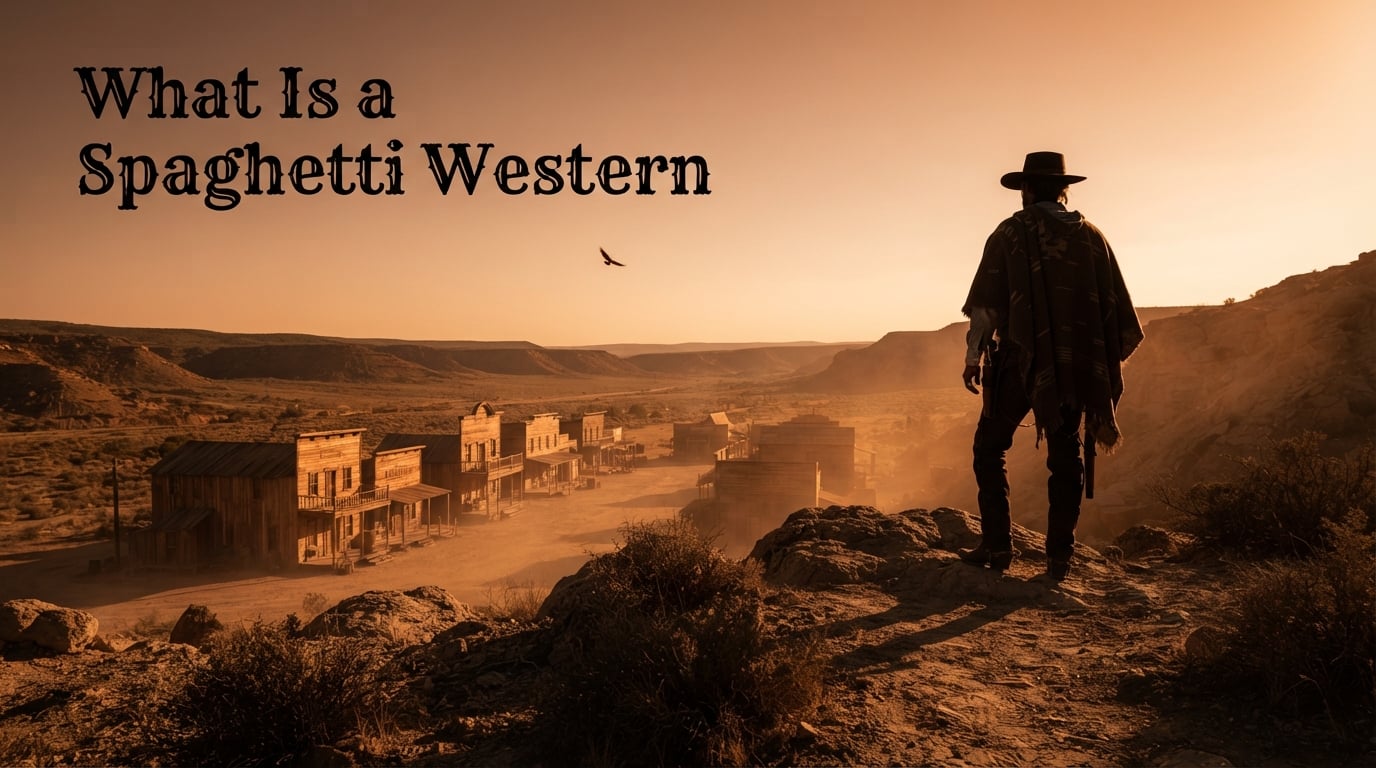
When I first watched A Fistful of Dollars in college, I had no idea the film came from Italy. The dusty Spanish desert, the squinting gunslinger, and the twangy electric guitar all felt like classic American Western to me. Then I learned Sergio Leone shot it near Madrid on a tight budget with a small Italian crew. That single discovery opened my eyes to one of cinema’s most fascinating subgenres.
If you have ever wondered what is a Spaghetti Western, you are in for a treat. Between 1964 and 1973, Italian filmmakers produced roughly 500 Western films that redefined the genre forever. They did it on low budgets, with international casts, and with a gritty operatic style that Hollywood had never attempted.
This guide walks you through the definition, history, key directors, defining traits, essential films, and lasting influence of the Spaghetti Western. By the end, you will understand why these films still captivate audiences in 2026 and beyond.
Table of Contents
What Is a Spaghetti Western? A Quick Definition
A Spaghetti Western is a low-budget Western film produced by Italian filmmakers, shot primarily in Europe (especially Spain and Italy), and released mostly between 1964 and the late 1970s. The term “Spaghetti Western” was coined by critics as a slightly mocking label for these Italian-made films, though fans have long since embraced it as a badge of cult honor.
Italian journalists also called the genre Western all’italiana, which translates to “Western in the Italian style.” Both names refer to the same body of work, films that took the American Western template and reinvented it with European sensibility, smaller crews, and rougher edges.
Here are the defining characteristics that set these films apart:
- Produced by Italian studios with Italian directors at the helm
- Shot on location in Spain, Italy, or the Yugoslav desert (standing in for the American West)
- Featured international casts often speaking different languages on set, with dialogue later dubbed
- Used low budgets and tight shooting schedules (often under six weeks)
- Centered on morally ambiguous anti-heroes rather than clean-cut cowboys
- Showcased stylized, operatic violence that pushed past Hollywood standards
- Featured iconic musical scores, most famously by Ennio Morricone
- Employed distinctive cinematography, including extreme close-ups and Techniscope widescreen
This combination made Spaghetti Westerns feel both familiar and strange. Audiences recognized the cowboy hats and six-shooters, but everything else carried a different rhythm, tone, and moral weight.
The Origin and History of the Genre
Spaghetti Westerns did not appear out of nowhere. They emerged from a perfect storm of Italian cinema economics, a sagging Hollywood Western genre, and a generation of Italian filmmakers hungry for global audiences.
By the early 1960s, the American Western had grown stale. Big-budget productions from John Ford and Howard Hawks had defined the genre for decades, but studios were losing interest. Audiences in Europe, however, still craved Westerns. Italian producers spotted a gap in the market and began filling it cheaply.
Italian studios had already built infrastructure producing sword-and-sandal epics like Hercules (1958) starring Steve Reeves. When the peplum craze faded around 1964, those same crews needed work. Westerns offered the perfect pivot: same dramatic stakes, different costumes.
The breakthrough came in 1964 with A Fistful of Dollars, directed by Sergio Leone. The film cost roughly $200,000 to make and earned tens of millions worldwide. Suddenly every Italian producer wanted a piece of the action. By 1967, around 50 Spaghetti Westerns were being produced per year, often with overlapping crews and shared sets in the Tabernas Desert of southern Spain.
The boom faded by the mid-1970s as audiences tired of the formula and tastes shifted. But the genre left a permanent mark on how filmmakers approach action, character, and storytelling.
Why “Spaghetti”?
The nickname came from American journalists in the late 1960s. They meant it as a jab, the same way “Spaghetti Junction” mocked a confusing highway interchange. The implication was that these Westerns were cheap, foreign, and perhaps not to be taken seriously. Italian filmmakers initially resented the term, but it stuck. Today it carries no negative weight and is the standard name for the genre worldwide.
The Three Sergios: Directors Who Defined the Genre
No discussion of Spaghetti Westerns is complete without the “Three Sergios,” the three Italian directors whose work defined the genre. Each brought a distinct vision, and together they shaped how audiences worldwide understood what a Western could be.
Sergio Leone (1929-1989)
Leone is the Godfather of the Spaghetti Western. Born in Rome, he worked as an assistant director on Italian epics like Ben Hur before creating his masterpiece, A Fistful of Dollars (1964). Leone is famous for his meticulous visual storytelling, lingering close-ups on actors’ eyes, and his willingness to wait for the perfect moment before a gunshot. He directed the Dollars Trilogy and the sprawling epic Once Upon a Time in the West (1968), often considered the genre’s finest hour.
Sergio Corbucci (1927-1990)
Corbucci matched Leone in popularity if not fame. He directed Django (1966), a brutal revenge film that inspired dozens of unofficial sequels and even the name of the modern Django framework. His other classics include The Great Silence (1968), set in a snow-covered frontier that subverted the usual desert setting. Corbucci leaned harder into political allegory and graphic violence than Leone ever did.
Sergio Sollima (1921-2015)
Sollima is the third Sergio and the most underrated of the trio. His The Big Gundown (1966) starred Lee Van Cleef as a relentless bounty hunter and tackled themes of corruption and class. Face to Face (1967) paired Van Cleef with Franco Nero as former enemies forced into an uneasy partnership. Sollima’s films carried sharper political edges than Leone’s and helped push the genre toward social commentary.
Defining Characteristics of Spaghetti Westerns
What separates a Spaghetti Western from an American one? The differences run deeper than just the country of origin. Italian filmmakers approached the genre with a fresh set of tools and priorities.
Anti-Hero Protagonists
The classic American Western hero, think John Wayne’s Ethan Edwards in The Searchers, stood for clear moral values. Spaghetti Western protagonists were almost the opposite. The Man with No Name played by Clint Eastwood is a mercenary who lets two gangs fight each other so he can profit. He cheats, betrays, and only loosely commits to heroism. This moral ambiguity felt new and dangerous to 1960s audiences.
Stylized, Operatic Violence
Spaghetti Westerns showed violence that Hollywood’s Production Code had long forbidden. Squibs burst with bright red blood. Bodies dropped with theatrical finality. Leone choreographed gunfights like dance sequences, with long wide shots followed by sudden extreme close-ups. The violence was stylized rather than realistic, but it felt raw compared to what came before.
The Music of Ennio Morricone
No element defines the Spaghetti Western more than its music. Ennio Morricone composed scores that mixed electric guitars, trumpets, whistles, harmonicas, and chanting voices into something entirely new. His theme for The Good, the Bad and the Ugly remains one of the most recognizable pieces of film music ever written. Morricone scored over 500 films in his career, and his Spaghetti Western work remains his most influential.
Distinctive Visual Techniques
Italian crews favored Techniscope, a 2-perf widescreen format that used half the film stock of standard 35mm. This cut costs but gave the films a grainy, gritty texture that suited their dark subject matter. Directors also used extreme close-ups on eyes, hands, and guns, often holding shots far longer than American editors would tolerate. The result was a unique visual rhythm that felt closer to opera than traditional Western.
Dubbed Dialogue and International Casts
Most Spaghetti Westerns were shot silent-style, with actors speaking any language they wanted on set. Dialogue was added later through dubbing in Italian, English, German, or Spanish. This meant the same film could sell across Europe without expensive reshoots. It also created the genre’s slightly unnatural cadence that fans either love or find distracting.
The Dollars Trilogy and Essential Films to Watch
If you want to understand Spaghetti Westerns, you need to watch at least the Dollars Trilogy. Sergio Leone’s three films starring Clint Eastwood form the genre’s central spine.
A Fistful of Dollars (1964)
Leone’s breakthrough was an uncredited remake of Akira Kurosawa’s Yojimbo. Eastwood plays a stranger who arrives in a Mexican border town controlled by two rival gangs. He plays them against each other for profit, then has to choose sides when innocent lives are at stake. The film launched Eastwood’s career and proved Italian Westerns could compete globally.
For a Few Dollars More (1965)
The sequel paired Eastwood with Lee Van Cleef as rival bounty hunters chasing the same outlaw. The film introduced the operatic duels and climactic standoff scenes that would become the genre’s signature. Morricone’s score for this film introduced the iconic two-note watch tick that drives one of cinema’s most famous endings.
The Good, the Bad and the Ugly (1966)
The trilogy’s masterpiece and one of the highest-grossing films of the 1960s. Set during the American Civil War, it follows three gunslingers (Eastwood, Van Cleef, Eli Wallach) racing to find a buried treasure of Confederate gold. The three-way Mexican standoff finale is cinema legend.
Once Upon a Time in the West (1968)
Often considered Leone’s masterpiece and one of the greatest films ever made. This one stars Charles Bronson as a harmonica-playing avenger, Henry Fonda as a villainous killer, and Claudia Cardinale as a widow defending her land. Leone took his time with long, almost dialogue-free opening sequences that built tension through imagery and music alone. The result is operatic, hypnotic, and unforgettable.
Other Essential Spaghetti Westerns
Beyond Leone, several films deserve a place on any starter list:
- Django (1966) – Sergio Corbucci’s brutal revenge tale that spawned dozens of unofficial sequels
- The Great Silence (1968) – Corbucci’s snowy, dark revenge Western with a tragic ending
- The Big Gundown (1966) – Sergio Sollima’s politically charged bounty hunter story
- My Name Is Nobody (1973) – A lighter comedy Western featuring Terence Hill
- Keoma (1976) – A late entry often called one of the genre’s last great films
- Trinity Is Still My Name (1971) – One of the famous comedy Spaghetti Westerns
Any of these makes a great starting point once you have sampled Leone’s main work.
Spaghetti Westerns vs American Westerns: Key Differences
How does a Spaghetti Western actually feel different from a John Ford film? The differences show up in tone, morality, and even in how the landscapes are framed.
Protagonists
American Western heroes tend to be honorable men protecting the community. Spaghetti Western protagonists are loners, often motivated by money, revenge, or simple survival. The Man with No Name does not save the town out of duty. He does it because the alternative means he cannot profit from the situation.
Violence
American Westerns of the classic era usually kept violence offscreen or brief. A fistful of dust and a body falling, that was the rule. Spaghetti Westerns showed wounds, blood sprays, and elaborate death sequences. The violence was stylized but more graphic, closer to the operatic bloodshed of samurai films than to Ford’s restraint.
Setting
American Westerns were shot on Western U.S. locations, real prairies, mesas, and ghost towns. Spaghetti Westerns shot in southern Spain (Tabernas, Almería) and the Italian Apennines used stand-ins for Monument Valley. The geography looks similar but the light is different, sharper and harsher. Many fans can tell the difference on sight.
Politics
American Westerns often mythologized Manifest Destiny and the frontier spirit. Spaghetti Westerns frequently carried subtexts about European politics, fascism, class struggle, and post-war disillusionment. Corbucci’s films in particular read as allegories for the failures of revolutionary movements.
Morality
Hollywood Westerns usually ended with clear winners and losers, good versus evil. Spaghetti Westerns loved ambiguous endings. Heroes died. Villains sometimes walked away. The line between right and wrong blurred in ways that felt more honest to many viewers.
Cultural Legacy and Modern Influence
The Spaghetti Western did not just entertain audiences in the 1960s. It reshaped how filmmakers approach action, character, and genre storytelling for decades afterward.
The Dollars Trilogy Made Clint Eastwood a Star
Before Leone cast him, Clint Eastwood was a TV actor on Rawhide. After A Fistful of Dollars and its sequels, he became a global icon. He would go on to direct and star in revisionist Westerns like Unforgiven (1992), which won the Academy Award for Best Picture and explicitly engaged with the legacy of the genre Leone had reinvented.
Influence on Modern Filmmakers
Quentin Tarantino has cited Leone as his biggest influence. Django Unchained (2012) is both a Spaghetti Western homage and a Tarantino original. Kill Bill (2003-2004) explicitly borrows Morricone-style scoring and Leone-style long shots. Robert Rodriguez, Edgar Wright, and dozens of other directors trace their action sensibility back to Spaghetti Westerns. Even video game franchises like Red Dead Redemption lean heavily on the genre’s visual language.
Morricone’s Lasting Musical Impact
Ennio Morricone won an honorary Academy Award in 2007 and a competitive one in 2016 for The Hateful Eight. His Spaghetti Western scores influenced film composers from Hans Zimmer to Gustavo Santaolalla. The twangy, whistling, trumpet-driven sound he pioneered still appears in trailers, TV shows, and video games today.
The Revival Continues
New Spaghetti Westerns keep appearing. Italian productions have come back in recent years, and American filmmakers like S. Craig Zahler (Bone Tomahawk, Brawl in Cell Block 99) carry the torch. Streaming services have also made classic films easier to find than ever. If you have wanted to explore the genre, 2026 is a great time to start.
Frequently Asked Questions
What is the difference between a Spaghetti Western and a regular western?
A Spaghetti Western is an Italian-made Western film from the 1960s and 1970s, shot in Europe with international casts and lower budgets. Regular American Westerns were typically produced in Hollywood with American crews, larger budgets, and a more mythic vision of the frontier. Spaghetti Westerns feature anti-heroes, stylized violence, dubbed dialogue, and operatic scores, often by Ennio Morricone. American Westerns traditionally featured clearer moral lines, cleaner heroes, and less graphic violence.
What is considered the best Spaghetti Western?
Many critics and fans consider Once Upon a Time in the West (1968) by Sergio Leone to be the best Spaghetti Western ever made. Other top contenders include The Good, the Bad and the Ugly (1966), Django (1966), and The Great Silence (1968). The Dollars Trilogy by Leone is widely considered the genre’s foundation.
What were Clint Eastwood’s Spaghetti Westerns?
Clint Eastwood starred in three Spaghetti Westerns directed by Sergio Leone: A Fistful of Dollars (1964), For a Few Dollars More (1965), and The Good, the Bad and the Ugly (1966). Together these films are known as the Dollars Trilogy. Eastwood played the iconic Man with No Name across all three films. He would later return to the Western genre with his own revisionist films like Unforgiven (1992).
Who is the most famous Spaghetti Western actor?
Clint Eastwood is the most famous Spaghetti Western actor, thanks to his starring role in Sergio Leone’s Dollars Trilogy. Lee Van Cleef runs a close second, appearing in several Leone films and many other Spaghetti Westerns throughout the 1960s and 1970s. Franco Nero (Django), Terence Hill (My Name Is Nobody), and Klaus Kinski are also widely recognized from the genre.
Final Thoughts on the Spaghetti Western
So what is a Spaghetti Western at its core? It is a group of Italian-made Western films from the 1960s and 1970s that took a tired American genre and reinvented it with European style, gritty realism, anti-heroes, and unforgettable music. The genre gave us iconic directors like Sergio Leone, Sergio Corbucci, and Sergio Sollima, plus a generation of actors whose faces became synonymous with the dusty frontier.
If you are new to Spaghetti Westerns, start with A Fistful of Dollars to learn the basics. Then watch the rest of the Dollars Trilogy and Once Upon a Time in the West to see how fast the genre matured. After that, branch out into Corbucci and Sollima’s darker corners.
Spaghetti Westerns reward patience, attention, and an open mind. They ask you to sit with long silences, soak in wide desert vistas, and accept heroes who are morally complicated. Once you tune in to their rhythm, you will understand why these films still inspire filmmakers in 2026 and why fans have built entire collections around them.