
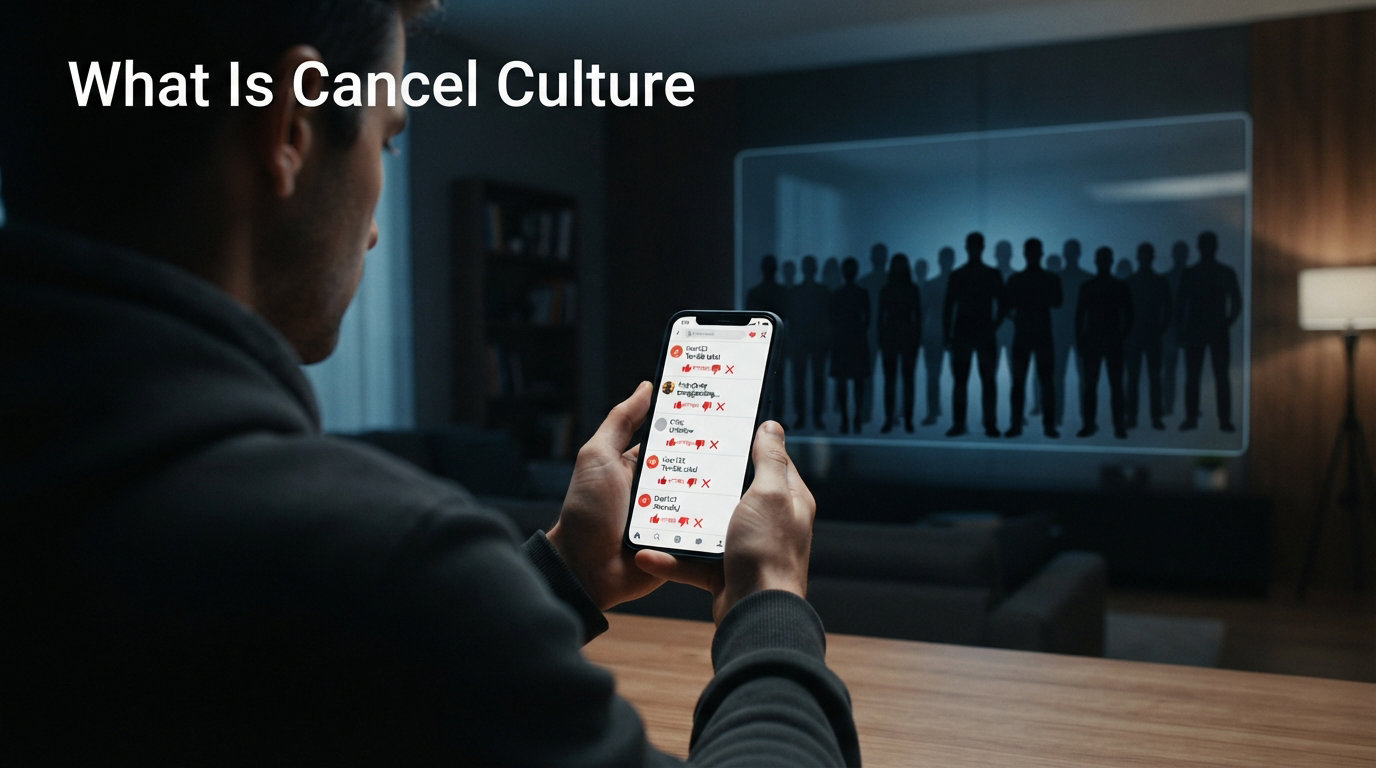
Cancel culture is the practice of withdrawing support from a public figure, brand, or ordinary person after they say or do something widely viewed as offensive. The goal is usually to punish, embarrass, or force a change in behavior through public pressure, often amplified across social media platforms.
I have been following this conversation for years, and the topic keeps evolving. Our team has read through the major academic studies, Pew Research surveys, and thousands of forum threads to put together a clear, honest guide. In this article, I will walk you through what cancel culture actually means, where it started, how it works in 2026, and why reasonable people disagree so strongly about whether it helps or harms society.
Table of Contents
What Is Cancel Culture? A Clear Definition
Cancel culture is a form of social ostracism where individuals, groups, or organizations face swift public backlash and the withdrawal of support after a perceived offense. The term is also used interchangeably with callout culture, consequences culture, and public shaming.
In simple words, cancel culture happens when large numbers of people decide together that someone should no longer have a platform, a job, or a fan base. The decision usually follows a statement, an old social media post, or an action that a critical mass of users considers unacceptable.
Four characteristics define most cancel culture incidents:
- A triggering event, such as a tweet, interview, or resurfaced clip.
- Rapid spread through hashtags, retweets, and group chats.
- Concrete demands, including firings, removals, or boycotts.
- Lasting consequences that often follow the person beyond the news cycle.
The Merriam-Webster dictionary added the term in 2021 after tracking a sharp rise in usage. That move alone shows how much the phrase had entered the everyday vocabulary by the early 2026s.
Where Did Cancel Culture Come From? Origins and History
Cancel culture did not appear out of nowhere. The modern version grew out of Black Twitter, a network of Black users on the platform now called X, during the early 2010s. Hashtags like #OscarsSoWhite in 2015 gave users a tool to call out the entertainment industry for ignoring Black creators and talent.
Those early campaigns were usually aimed at institutions and patterns, not individuals. By 2017 the phrase cancel culture itself was being used in TV shows and YouTube videos. The New York Times ran a major feature on it in 2018, and the conversation moved firmly into the mainstream.
Looking back further, the behavior is older than the hashtag. Forms of social ostracism, shunning, and public boycotts have appeared in most societies for centuries. The Civil Rights movement used economic boycotts to challenge segregation, and religious communities have practiced formal shunning for generations.
What changed in the 2010s was speed and scale. A single smartphone video could reach millions of viewers in hours. Once social media platforms turned complaints into viral moments, the modern form of cancel culture was fully formed.
How Cancel Culture Works in the Social Media Era
Cancel culture follows a predictable pattern. It almost always begins with a triggering event, then moves through a viral phase, and ends with real-world consequences. Understanding the steps helps you see why incidents escalate so quickly.
The first step is the trigger. Someone posts something offensive, a brand releases a poorly thought-out ad, or an old clip resurfaces. Often the original post would have caused a small stir in 2005. Today it is screenshot-ready and easy to share.
The second step is amplification. Algorithms reward content that drives strong reactions, so outraged replies and quote tweets push the original post into more feeds. Within hours, the post can trend on a platform or spill into traditional news.
The third step is organization. Users share contact details for advertisers, sponsors, or employers, and create petitions or email templates. Tools like Google Docs and shared spreadsheets turn thousands of individual complaints into one coordinated push.
The fourth step is consequence. Brands pull ads, sponsors end deals, employers place staff on leave, and platforms may suspend accounts. These are the deplatforming outcomes that critics call censorship and supporters call accountability.
The fifth step, often overlooked, is the aftermath. The cancelled person may apologize, double down, disappear, or quietly return later. Researchers have started tracking how often people come back, and the answer varies by industry and platform.
Notable Examples of Cancel Culture
Real cases show how the pattern plays out in practice. I have focused on incidents with clear public outcomes so you can see the full arc from trigger to consequence.
In 2017, actor James Gunn was fired as director of the Guardians of the Galaxy franchise after old tweets joking about topics like pedophilia resurfaced. More than a year later, Disney reversed the decision and rehired him. The case became a reference point for the debate over whether proportional punishment is possible.
In 2019, a single photo showing former Los Angeles Dodgers executive Andrew Friedman smiling near the dugout during the Astros sign-stealing controversy sparked a wave of online anger. He was not disciplined, but the incident showed how a moment of bad optics can snowball into weeks of headlines.
In 2020, several brands, including Aunt Jemima and Uncle Ben’s, retired long-used mascots during the racial justice protests following the death of George Floyd. The decisions were driven as much by employee pressure and consumer boycotts as by traditional advertising logic.
On the political side, U.S. Senator Ted Cruz and Representative Alexandria Ocasio-Cortez have both publicly clashed with the concept, with Cruz writing a book arguing it chills free speech and Ocasio-Cortez describing it as a response to decades of unaccountable power. The split reflects how the same label covers very different situations.
Workplace cases often fly under the radar. Universities have placed professors on leave, restaurants have fired chefs, and small business owners have faced review-bombing on Yelp and Google. These cases rarely make national news, yet they make up the bulk of real cancel culture incidents according to forum users and HR surveys.
The Debate: Accountability vs Censorship
The core disagreement over cancel culture is between two framings. Supporters see it as a long-overdue tool for accountability. Critics see it as a new form of censorship that punishes people without due process. Both views have evidence behind them.
Supporters argue that marginalized groups finally have a way to respond when powerful people or institutions cause harm. Before social media, a single consumer complaint rarely reached a CEO. Today, an organized push can produce results in days. For many users, this is the most democratic tool they have ever had.
Critics point to cases where the punishment far exceeds the offense. A college student lost a job offer over a decade-old tweet. A teacher was placed on leave for assigning a novel during a read-a-thon. In both situations, the targets said they had no real chance to explain or grow before the consequences hit.
A 2021 Pew Research study found that Americans are roughly split, with about half viewing cancel culture as a way to hold people accountable and about half viewing it as a form of censorship and punishment. That even split helps explain why the topic feels so divisive online and at family dinners.
Middle-ground voices suggest the answer depends on context. Calling out a powerful executive for repeated misconduct is one thing. Dogpiling a teenager for an ill-judged meme is another. Researchers often suggest we judge each incident on proportionality, intent, and the opportunity to respond rather than applying one blanket rule.
Political Perspectives on Cancel Culture
Cancel culture has become a partisan flashpoint in the United States and several other democracies. The split is sharp but not always clean, so I will walk through how each side tends to frame the issue.
Many on the political right argue that cancel culture disproportionately targets conservatives, religious believers, and anyone who questions progressive orthodoxy. They point to cases where users lost jobs over donations to political causes or jokes about cultural topics.
Many on the political left argue that the right ignored or even cheered similar tactics when they targeted liberal figures in earlier eras. They also point out that the loudest critics of cancel culture are often themselves powerful figures with large platforms.
Both sides agree on at least one thing. The pace of public judgment has increased sharply. Almost no one on either side thinks a thoughtful public conversation about right and wrong is happening in the same window where viral pile-ons unfold.
The polarization effect is well documented. Studies from More in Common and the Pew Center show that Americans overestimate how extreme the other political side is, partly because viral outrage content is the most visible. Cancel culture is both a product and a driver of that distortion.
The Psychological and Social Impact
Less attention is paid to the human cost on the people being targeted, and that is a gap worth filling. Forum users across Reddit and similar platforms consistently describe fear, anxiety, and in some cases lasting damage to mental health.
Targets report losing sleep, withdrawing from friends, and avoiding public speech entirely. Some describe intrusive thoughts and hypervigilance long after the original incident passed. These responses look similar to those documented in studies of online harassment and public humiliation.
There is also a chilling effect on bystanders. Teachers, writers, and ordinary employees say they self-censor more than they used to. Some avoid certain topics in class. Others decline to share personal views even in private group chats, afraid of a screenshot later.
The community side is more complicated. When a target is held to account after genuine harm, many users report feeling safer and more heard. When the target is punished disproportionately, the same communities report feeling guilty and divided later. The difference usually comes down to whether the response felt proportional.
Redemption is possible, though rarely smooth. Several public figures who were cancelled have rebuilt careers years later through consistent behavior change, public apologies that named specific harms, and quiet work in their field. The lesson from these comebacks is that growth, not silence, is what tends to bring people back.
International Perspectives on Cancel Culture
Cancel culture looks different outside the United States. In the United Kingdom, the press has historically been more aggressive toward public figures, so the social media version sits on top of an older tabloid culture rather than replacing it.
In much of East Asia, including Japan and South Korea, group harmony and social reputation carry heavy weight. Online pile-ons in those countries often focus on perceived slights to colleagues, classmates, or even strangers, with consequences that can include job loss and relocation.
European countries tend to treat hate speech through legal frameworks first, which changes the dynamic. Germany in particular enforces strict rules against online hate, so cancel culture cases often overlap with actual legal proceedings rather than functioning as a separate system.
None of these patterns are identical. Anyone trying to apply a U.S.-style cancel culture lens to a different country should slow down and learn the local context first. The behavior may look familiar, but the rules and consequences are usually different.
Frequently Asked Questions
What is cancel culture in simple words?
Cancel culture is when large groups of people publicly stop supporting someone, usually a public figure, after they say or do something many people see as offensive. The goal is to punish, embarrass, or change behavior through public pressure, and most of it now happens on social media.
What is an example of cancel culture?
A clear example is the 2017 firing of director James Gunn after old jokes he had posted resurfaced and trended online. Disney removed him from a major film franchise, then reversed the decision more than a year later. The case shows how a single viral moment can lead to immediate career consequences.
Is cancel culture a negative thing?
Cancel culture can be either helpful or harmful depending on context. Supporters see it as accountability for powerful people who cause real harm, while critics see it as disproportionate punishment without due process. A 2021 Pew Research study found Americans roughly split between these two views.
When did cancel culture start?
The modern version of cancel culture grew out of Black Twitter in the early 2010s, with campaigns like #OscarsSoWhite in 2015. The phrase itself became common around 2017 and entered mainstream dictionaries by 2021. Older forms of social ostracism and boycotts go back much further in history.
What is the difference between accountability and cancel culture?
Accountability usually means facing fair consequences for specific harm, with a chance to respond, learn, and make amends. Cancel culture often skips those steps and delivers immediate, public punishment that can be disproportionate. Many forum users argue the difference comes down to proportionality, intent, and opportunity to grow.
Final Thoughts on Cancel Culture
Cancel culture is now a permanent part of how we negotiate reputation, accountability, and free speech in 2026. The healthiest way to engage with it is to ask whether the response matches the harm, whether the target has a chance to respond, and whether the conversation leaves room for growth.
I encourage you to keep this nuance in mind the next time you see a viral pile-on online. Ask questions, slow the pace, and treat the people involved as humans. That habit will do more for the public conversation than any single hashtag.