
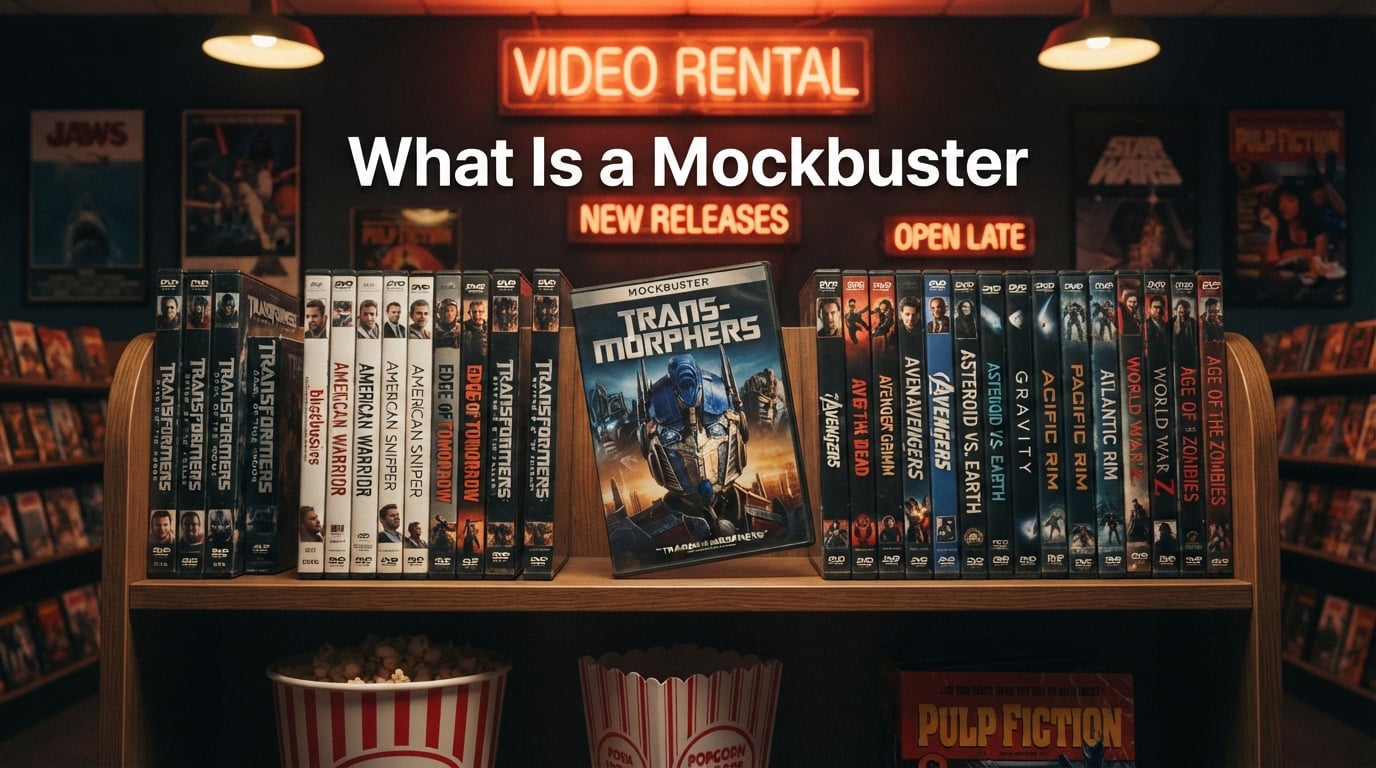
A mockbuster is a low-budget, direct-to-video film created to capitalize on the marketing and hype of a major studio blockbuster, often using similar titles and cover art. I first stumbled across one of these knockoffs at a flea market in the early 2000s. The cover looked like a major action film, the title was close enough to confuse me, and the actual movie had nothing to do with the Hollywood version I thought I was buying.
That experience is exactly the point of a mockbuster. They exist to ride the wave of a hit movie’s success without spending a dime on advertising. In this guide, I’ll walk you through what a mockbuster is, where the term came from, how they’re made, and why studios like The Asylum have built an entire empire on them. I’ll also touch on the new 2026 documentary that’s reigniting interest in this strange corner of film culture.
Table of Contents
What Is a Mockbuster?
A mockbuster is a film produced on a small budget with the explicit goal of mimicking a major studio release, usually through a similar-sounding title, matching genre, or parallel cover art. The term “mockbuster” combines “mock” and “blockbuster,” and you’ll sometimes see it spelled “knockbuster” or “mock buster.”
The word “blockbuster” originally referred to powerful aerial bombs used in World War II. After the war, the entertainment industry borrowed the phrase to describe anything oversized and explosive. By the 1970s, “blockbuster” meant a massive hit film like “Jaws” or “Star Wars.” A mockbuster flips that meaning on its head. Instead of being huge, it pretends to be huge.
Here are the key characteristics that define a mockbuster:
- Direct-to-video or streaming release rather than theatrical
- Title, poster, or concept closely resembles a major release
- Produced on a fraction of the original film’s budget
- Released around the same time as the film it’s imitating
- Often leans on CGI-heavy scenes that look “cheap” to trained eyes
I think the most useful way to recognize a mockbuster is to ask one question: would this movie exist without the bigger film it’s copying? If the answer is no, you’re probably looking at a mockbuster.
The History and Origins of Mockbusters
The mockbuster concept goes back further than most people realize. In the 1950s and 1960s, low-budget producers released quick knockoffs of monster and sci-fi hits. When “The Blob” hit theaters in 1958, independent outfits quickly filmed cheaper imitations to fill drive-in double features.
The practice exploded in the 1980s and 1990s with the rise of home video. Companies realized they could flood video store shelves with tapes that looked like big hits. A shopper browsing for “Aliens” might accidentally grab “Alien Predators” instead. The stores made money either way.
By the 2000s, the model became a science. Studios like The Asylum formalized the practice with “slipstream” releases. They would track upcoming blockbusters, design a similar title, and rush production to hit DVD shelves the same week as the original. “Transmorphers” arrived in 2007 just days before “Transformers,” and the same studio later dropped “Snakes on a Train” in 2006 to ride the wave of “Snakes on a Plane.”
Through the 2010s, mockbusters adapted to streaming platforms. The shelf space shifted from Blockbuster stores to Netflix and Amazon Prime search results. Now in 2026, a new documentary called “Mockbuster” is shining a spotlight on this entire subculture and the filmmakers who built careers on it.
How Mockbusters Are Made
Mockbusters are built on speed and cost efficiency above all else. The typical production cycle runs between 15 and 30 days, with budgets often under half a million dollars. Compare that to the $200 million average for a modern Marvel film, and you start to see the math that makes the model work.
The process usually starts with monitoring announced studio slates. Once a major release is locked in, the mockbuster team drafts a script that hits the same genre beats. Monster movie coming out? Make a monster movie. Alien invasion? Write a knockoff invasion. Sci-fi dystopia? Same formula.
After scripting comes a tight shooting schedule. Crews reuse the same sets, stock footage libraries, and digital effects pipelines across multiple productions. The Asylum reportedly uses the same monster costumes and creature assets for several films at once.
Cover art and packaging deserve special mention. The marketing team studies the original film’s poster and creates something intentionally similar. Fonts, color palettes, and taglines get matched closely enough to confuse casual browsers but not closely enough to trigger a trademark lawsuit.
Once the film is done, it goes straight to video or streaming. There’s no theatrical push, no press tour, and minimal advertising. The whole strategy depends on confusion at the point of purchase or click.
Famous Mockbuster Studios and Examples
The Asylum is the undisputed king of the mockbuster world. Founded in 1997 by David Michael Latt, David Rimawi, and Sherri Strain, the company has produced hundreds of mockbusters and built a cult following along the way. They operate out of Burbank, California, and release roughly 15 to 20 films per year.
Some of the most recognizable Asylum mockbusters include:
- Transmorphers (2007) — Their breakthrough hit, released days before Michael Bay’s “Transformers”
- Snakes on a Train (2006) — A clever wordplay on “Snakes on a Plane” that became an internet meme
- Sharktopus (2010) — Spawned a franchise of its own with multiple sequels
- Titanic II (2012) — Released on the 100th anniversary of the original Titanic sinking
- Atlantic Rim (2013) — A loose riff on “Pacific Rim”
- Sharknado (2013) — Became a cultural phenomenon despite (or because of) its absurd premise
The Asylum isn’t the only player in the game, though. Other studios like The Global Asylum, Suntime Entertainment, and various foreign producers have all tried their hand at the format. Outside the United States, mockbuster-style films flourish in markets where Hollywood blockbusters arrive late or with limited marketing.
One thing I find fascinating is how some mockbusters gain cult followings entirely on their own. “Sharknado” started as a typical Asylum production and turned into a six-film franchise with celebrity cameos and live-tweeted premieres. The line between “mockbuster” and “guilty pleasure” can get blurry fast.
Are Mockbusters Legal?
Yes, mockbusters are generally legal in the United States and most other countries, though they operate in a tricky gray area. The key distinction is between copyright and trademark law, and mockbusters exploit the gap between them.
Copyright protects specific creative expression. You can’t copy a screenplay, character design, or shot-for-shot sequence without permission. Trademark protects brand identifiers like logos, character names, and distinctive phrases. Titles, on their own, usually fall outside trademark protection unless they’re tied to a longer franchise.
This is why mockbusters can use titles like “Transmorphers” instead of “Transformers.” As long as they avoid specific copyrighted elements like character names (no Optimus Prime here), the law usually sides with the mockbuster producer. The studios behind the originals have sued, but most cases settle out of court or get dismissed.
That said, mockbusters do face legal risk when they cross certain lines. Using a logo, copying a character, or ripping off a distinctive piece of music can trigger a real lawsuit. Producers walk a careful line, and most studios hire legal teams to vet scripts, posters, and trailers before release.
The ethics are murkier than the law. Critics argue mockbusters intentionally deceive consumers. Defenders point out that buyers have a responsibility to read covers carefully. Either way, the legal system has mostly decided that imitation is not the same as infringement, at least in this corner of cinema.
Mockbusters in the Modern Streaming Era
Mockbusters have moved with the times. The shift from DVD to streaming created new opportunities and new challenges for the format. On the upside, platforms like Netflix, Amazon Prime, and Tubi offer infinite shelf space. A mockbuster can live next to the blockbuster it’s copying, which makes the entire concept even more effective.
On the downside, streaming algorithms can surface genuine hits just as easily as knockoffs. A consumer searching for “Transformers” might find “Transmorphers” right next to the real thing in the recommended row. That has helped keep the mockbuster business model alive.
The 2026 documentary “Mockbuster” has given the phenomenon renewed cultural relevance. The film interviews Asylum founders, tracks down rare mockbuster titles, and explores why audiences keep coming back to these low-budget oddities. Critics called it a “love letter to a strange corner of cinema,” and it’s sparked fresh conversations online.
Fan communities on Reddit, Discord, and dedicated forums continue to celebrate mockbusters. Some viewers collect them for parties and sleepovers. Others treat them like comfort food for a slow Friday night. Either way, the mockbuster isn’t going anywhere.
Frequently Asked Questions About Mockbusters
Are mockbusters legal?
Yes, mockbusters are generally legal because titles alone usually cannot be trademarked. As long as the mockbuster avoids copying specific copyrighted elements like characters, dialogue, or distinctive logos, it usually stays within the law. Major studios have sued individual mockbusters, but most cases settle or get dismissed.
What is an example of a mockbuster?
One of the most famous examples is Transmorphers, a 2007 low-budget sci-fi film released just before Michael Bay’s Transformers. The Asylum produced it on a tiny budget, and it became a defining title of the mockbuster genre. Snakes on a Train and Sharknado are other well-known examples.
Are mockbusters still made today?
Yes, mockbusters are still being made in 2026, mostly through studios like The Asylum and a handful of independent producers. The format has shifted from DVD to streaming platforms, but the basic model of releasing a similar-sounding film close to a major release remains the same.
Why do they call it a blockbuster?
The word blockbuster originally referred to a type of powerful World War II aerial bomb. After the war, Hollywood borrowed the term to describe oversized hit films like Jaws and Star Wars. A mockbuster takes that idea and creates a small, imitative film designed to look like one of those massive hits.
Conclusion
A mockbuster is more than just a cheap movie cash-in. It represents a strange, persistent corner of film culture where small studios compete with Hollywood by imitation rather than innovation. From 1950s drive-in double features to today’s streaming platforms, the model has survived by adapting to every shift in how we watch movies.
Now that you know what a mockbuster is, you might spot one the next time you scroll through your favorite streaming service. Whether you treat them as curiosities, party films, or guilty pleasures, they remain one of the most curious phenomena in modern entertainment.