
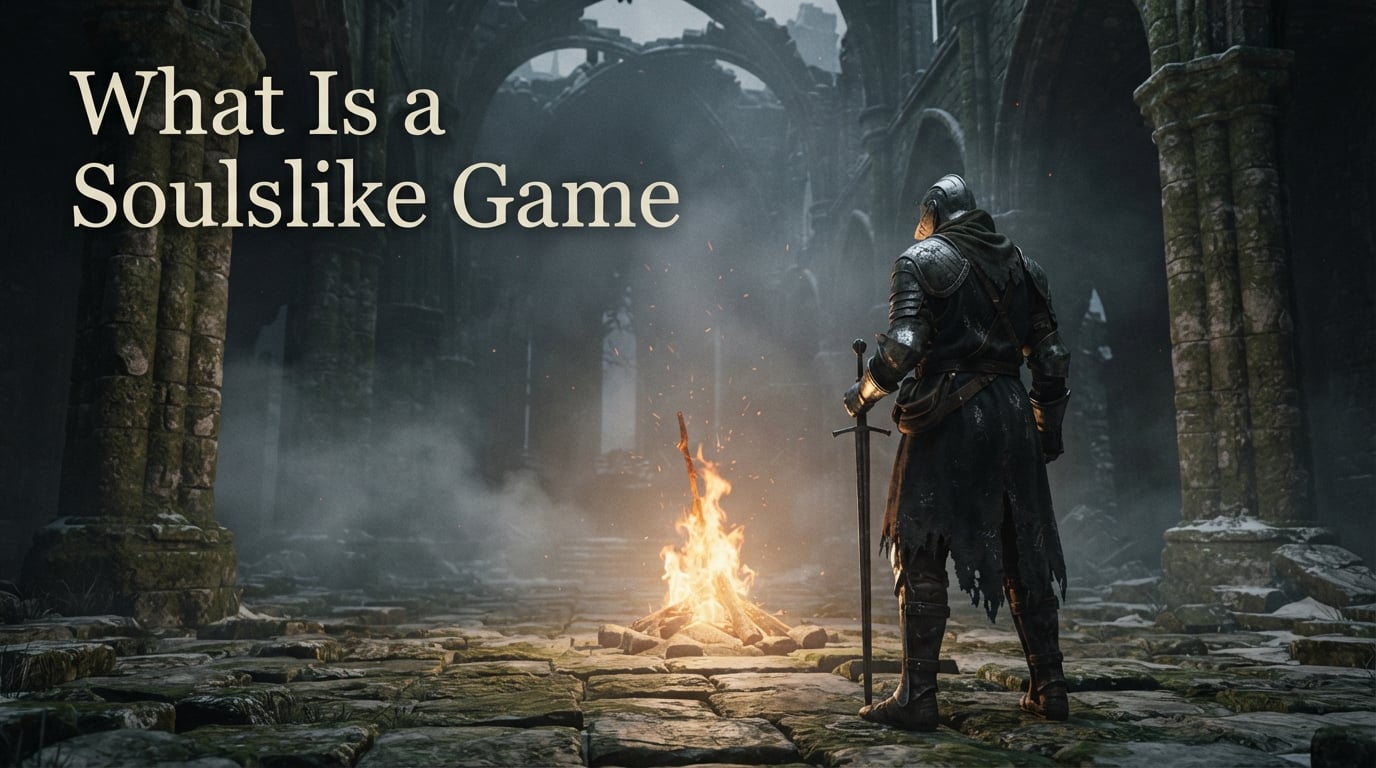
What is a Soulslike game? It is a subgenre of action role-playing games defined by punishing difficulty, stamina-based combat, checkpoint-based progress, and cryptic dark fantasy storytelling.
I first booted up Dark Souls years ago expecting a simple medieval action game. Within twenty minutes I had been ambushed, my souls currency had evaporated, and I was hooked on something I could not name. That something now has a label: Soulslike. Our team has logged hundreds of hours across FromSoftware titles and indie knockoffs, and the more we play, the more we notice how often the term gets misused online in forums, video essays, and even game marketing.
Some people call any hard game a Soulslike. Others confuse Soulslike with Soulsborne or think Hollow Knight counts. This guide cuts through the noise. You will get a clean definition, the mechanics that actually define the genre, real examples, and clear answers to the questions we see asked most on Reddit and gaming forums. Whether you are a curious newcomer or a veteran who wants the terminology nailed down, you will leave knowing exactly what makes a Soulslike a Soulslike.
Table of Contents
What Is a Soulslike Game? The Short Definition
A Soulslike (also spelled Souls-like) is a subgenre of action RPGs built around challenging but fair combat, stamina management, checkpoint-based progress, and a dark fantasy world where lore is hidden in item descriptions and environmental clues. The genre takes its name from FromSoftware’s Demon’s Souls and Dark Souls trilogy, which defined the formula starting in 2009 and continued through the early 2010s.
Think of it as a set of design rules, not a difficulty slider. A Soulslike game requires you to learn enemy patterns, manage a stamina bar that drains with every dodge or swing, and accept that death is a teaching tool rather than a failure state. You will lose progress, recover it, and try again. That loop, repeated until it clicks, is the genre.
Games commonly labeled Soulslike include Dark Souls, Elden Ring, Bloodborne, Sekiro: Shadows Die Twice, Lies of P, Blasphemous, Mortal Shell, and Steelrising. We will return to specific examples and what makes each qualify later in the guide, but for now the rule is simple: if it borrows the stamina combat, checkpoint respawn, and death-currency loop, it counts.
Core Mechanics That Define the Soulslike Genre
Most hard games share one trait: they punish you. What separates a Soulslike from a regular tough game is a specific bundle of mechanics working together. Here are the four pillars our team treats as non-negotiable when labeling a game in this space.
Stamina-Based Combat
Every attack, dodge, block, and sprint consumes a shared stamina bar. Spam attacks and you will run dry mid-combo, leaving yourself wide open. The system rewards rhythm and patience. Hit too many times in a row and your stamina regen pauses briefly, which is the moment most new players die and learn the lesson.
Stamina management is the heartbeat of Soulslike combat. It forces you to commit to a small number of swings, retreat, recover, and re-enter. Master the rhythm and even the toughest bosses feel readable. Forget it and you will die swinging at thin air while the boss laughs with a 12-hit combo.
Checkpoints That Reset Enemies
Bonfires in Dark Souls, Sites of Grace in Elden Ring, lanterns in Sekiro, and similar rest points in other games do two things at once. They heal you, refill your healing items, and respawn every enemy in the area. This trade-off is intentional. Resting feels powerful, but the world becomes dangerous again the moment you walk away.
This design keeps tension high. You cannot simply heal whenever you want without paying a price. Skilled players learn the routes between checkpoints and clear enemies in careful sweeps before committing to a checkpoint rest. New players usually burn through their items, panic-rest, and wonder why everything is hostile again, then repeat the loop until the level finally clicks.
Death Penalty and Currency Loss
Die in a Soulslike and you usually drop your accumulated currency (souls, runes, or echoes) at the spot of death. You have one chance to reach your bloodstain and reclaim it. Die again before reaching it and the previous stash is gone for good.
This mechanic makes every encounter a calculated risk. Do you push deeper into unknown territory or bank your currency at the checkpoint first? That tension is a signature Soulslike feeling, and it is why the death penalty belongs on this list. It also creates the most memorable comeback stories, where players recover a five-thousand-soul stash with one HP bar left and a hollow screaming behind them.
Challenging But Fair Boss Fights
Boss encounters are the genre’s showpiece. Each fight is a puzzle built from attack patterns, openings, and phase transitions. Bosses do not cheat (in the eyes of most players). They telegraph their moves, punish greed, and reward learning.
Our team has fought the same boss dozens of times in a single sitting, only to break through on attempt forty because we finally saw the wind-up for a tail swipe. That breakthrough is the Soulslike payoff, and it is what makes the brutal moments worth it.
Dark Fantasy Setting and Cryptic Lore
Soulslike games lean into grim, decaying worlds. Think crumbling kingdoms, fog-choked forests, ruined cathedrals, and enemies that look like they crawled out of a medieval nightmare. The aesthetic is part of the deal, not decoration, and it ties directly into how the story is told.
The lore is where things get interesting. Story is rarely handed to you through cutscenes. Instead, you piece together what happened by reading item descriptions, listening to sparse NPC dialogue, and observing where enemies are placed. Environmental storytelling does the heavy lifting.
This approach respects the player. It assumes you will explore, theorize, and discuss with others. The Souls community built wikis and lore theories for years because the games trust you to fill in the gaps yourself. If you love games that reward curiosity over handholding, this part will hook you harder than the combat ever will.
Souls vs Soulslike vs Soulsborne: What’s the Difference?
Three terms float around the genre, and forum posts make clear that even longtime players mix them up. Here is the clean breakdown so you can use each one correctly the next time someone asks.
Souls: Refers specifically to FromSoftware’s Dark Souls trilogy (Dark Souls 1, 2, and 3) and often Demon’s Souls as the spiritual predecessor. These are the games that created the formula.
Soulsborne: A portmanteau of Souls and Bloodborne. It covers FromSoftware’s Soulslike catalog, including Bloodborne, Sekiro, and Elden Ring. Some fans exclude Sekiro because its parry-driven combat shifts away from the dodge-roll core.
Soulslike: The umbrella term for any game that borrows the Souls formula, whether made by FromSoftware or another studio. Lies of P, Blasphemous, and Mortal Shell all qualify.
If you see “Souls-like” written with a hyphen, that is just the older spelling of Soulslike. Both mean the same thing and you can use either in conversation. Knowing the difference matters when you describe a game to someone, since “I played a Soulslike” is much more specific than “I played a hard game”.
What Games Are Considered Soulslike?
The genre has expanded far beyond FromSoftware. Here are the games our team and the broader community most often point to when defining the category, broken into FromSoftware and third-party entries.
FromSoftware’s Core Catalog
FromSoftware’s Demon’s Souls, Dark Souls trilogy, Bloodborne, Sekiro: Shadows Die Twice, and Elden Ring are the gold standard. Each added its own twist, but all share the core Soulslike pillars.
Elden Ring deserves a callout. It is open-world, which some fans worried would soften the genre. Instead, it kept the punishing combat and added a vast map packed with optional dungeons, bosses, and secrets. For newcomers in 2026, it is often the easiest entry point because you can explore at your own pace instead of walking down a single corridor of pain.
Third-Party Soulslike Games Worth Playing
Studios outside FromSoftware have built impressive Soulslikes. Lies of P channels Bloodborne’s gothic tone with weapon-assembly builds. Blasphemous translates the formula into a 2D pixel-art Metroidvania. Mortal Shell focuses on harden-into-shell defensive mechanics. Steelrising sets the action during the French Revolution.
Indie hits like Salt and Sacrifice, Thymesia, and Code Vein also count, even when they add twist mechanics. The test is whether the game keeps the Souls combat feel and death-penalty loop intact. If it does, it qualifies regardless of the studio on the box.
Why Difficulty Alone Does Not Make a Soulslike
This is the most common mistake on gaming forums. Reddit threads frequently debate whether Zelda: Breath of the Wild or other tough games “count” as Soulslikes simply because they have hard enemies. They do not, by community consensus.
Three reasons stand out. First, Soulslikes use the specific stamina-and-checkpoint loop. Most hard games do not. Second, Soulslikes tell their story through fragmented lore, not voiced cutscenes. Third, the death penalty is baked into progression, not optional punishment. Drop one of these and the label no longer fits.
That said, there is wiggle room. The genre evolves, and newer titles blur the lines. Our rule of thumb: if you removed all the mechanical pillars, would it still feel like a Soulslike? If the answer is no, it is probably just a hard game wearing a familiar label.
Soulslike and Metroidvania: The Hidden Connection
Experienced players often describe Soulslikes as 3D Metroidvanias, and the comparison holds up. Both genres reward exploration through interconnected maps, gated progression, and shortcuts that loop back to earlier areas.
You start with limited tools, fight forward into new zones, and unlock abilities that let you reach previously locked paths. Dark Souls’ interconnected world design and Elden Ring’s open-world shortcuts borrow the same loop. The difference is execution: Soulslikes layer this onto stamina-based real-time combat, while classic Metroidvanias lean on platforming and ability-gating.
That is why games like Hollow Knight spark debate. Hollow Knight shares the exploration loop but uses a more traditional healing-and-magic combat system. Most fans call it a Metroidvania with Soulslike flavor, not a true Soulslike.
FAQs
Is Elden Ring a Soulslike game?
Yes. Elden Ring is widely considered one of the most influential Soulslike games of 2026. It is built by FromSoftware, the studio that created the genre, and uses the same stamina-based combat, checkpoint respawn system, and punishing death mechanics as the Souls trilogy. Its open-world design does not soften the formula, it expands it.
What is the difference between Souls and Soulslike games?
Souls refers specifically to FromSoftware’s Dark Souls trilogy and often Demon’s Souls as the predecessor. Soulslike is the umbrella term for any game that follows the Souls design formula, including titles by other studios like Lies of P, Blasphemous, and Mortal Shell.
What games are considered Soulslike?
Popular Soulslike games include the FromSoftware catalog (Demon’s Souls, Dark Souls 1-3, Bloodborne, Sekiro, Elden Ring) and third-party titles like Lies of P, Blasphemous, Mortal Shell, Steelrising, Thymesia, Salt and Sacrifice, and Code Vein.
Is Zelda a Soulslike game?
No, Zelda: Breath of the Wild and Tears of the Kingdom are not Soulslikes, despite their difficulty. They lack the defining mechanics: there is no stamina-gated real-time combat, no checkpoint respawn system, and no currency-loss death penalty. Zelda is an action-adventure series with open-world exploration.
Is Hollow Knight a Soulslike?
Hollow Knight is best classified as a Metroidvania with Soulslike elements. It shares the exploration loop and difficult bosses, but its healing system, fast-paced platforming, and charm-based builds do not match the Souls combat formula closely enough to be called a true Soulslike.
What was the first Soulslike game?
Demon’s Souls (2009) by FromSoftware is considered the first true Soulslike. It introduced the stamina system, bonfire-style checkpoints, and punishing death mechanics that later defined Dark Souls and the entire genre.
Final Thoughts on What Defines a Soulslike
So what is a Soulslike game? It is a subgenre defined by specific mechanics, not by difficulty alone. Stamina-based combat, checkpoints that reset enemies, currency-loss death penalties, and dark fantasy lore told through the environment.
The genre keeps growing. New releases in 2026 continue to push the formula in directions FromSoftware never tried, from 2D pixel-art takes like Blasphemous 2 to ambitious open-world entries in the Elden Ring lineage. If you have been on the fence about trying one, pick up Elden Ring or Dark Souls Remastered, and give yourself permission to die a lot.
Death is part of the journey. So is the moment it finally clicks, and you walk away from a boss that killed you forty times thinking, “I could do that again.” That feeling is what makes Soulslikes stick, and it is what keeps players coming back long after the credits roll.