
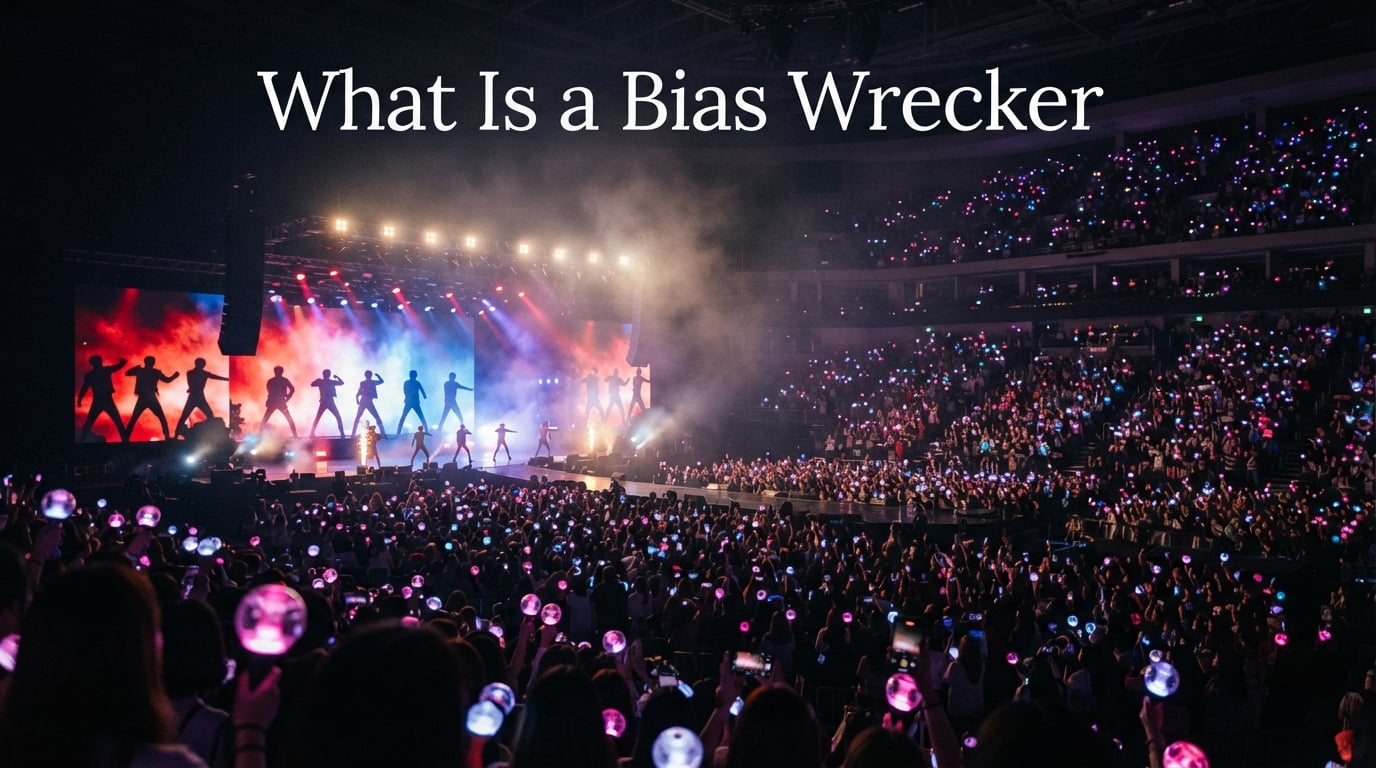
A bias wrecker is a member of a K-pop group who catches your attention almost as strongly as your favorite, tempting you to question your loyalty. In K-pop fandom culture, when you “stan” a group, you typically pick one member as your ultimate favorite, your bias. But then another member comes along with killer vocals, breathtaking visuals, or irresistible charisma and wrecks everything.
If you are new to K-pop, this term probably shows up everywhere — in fan forums, TikTok comments, YouTube reaction videos, and photocard trading threads. Understanding what a bias wrecker is helps you participate in fandom conversations and makes sense of the emotional rollercoaster that comes with being a fan.
In this guide, I will break down the bias wrecker meaning, where the term came from, how it differs from your bias, and real examples from groups like BTS. Whether you just discovered K-pop in 2026 or you are a longtime fan trying to explain the term to a friend, this article has you covered.
Table of Contents
What Is a Bias Wrecker?
A bias wrecker is the K-pop group member who threatens to steal the top spot from your declared favorite. Think of your bias as your number one — the member you gravitate to first, collect photocards of, and feel the deepest connection with. Your bias wrecker is the one who makes that loyalty wobble.
The term works exactly as it sounds. This person “wrecks” your bias by being so talented, charming, or visually striking that you cannot ignore them. One day you are perfectly happy with your bias, and the next day a fancam of another member goes viral and suddenly you are questioning everything.
Bias wreckers are not a negative thing. Most fans actually enjoy having one because it keeps their fandom experience exciting. You get to appreciate multiple members rather than tunnel-visioning on just one.
Many fans proudly list both their bias and their bias wrecker in their social media bios — it is that common. The beauty of a bias wrecker is that the role can shift constantly.
A member who was your bias wrecker last month might get replaced by someone else after a new comeback or music video drops. This fluidity is part of what makes K-pop fandom so engaging and addictive.
Bias vs. Bias Wrecker: What Is the Difference?
The difference between a bias and a bias wrecker comes down to ranking and stability. Your bias is your declared number one, the member you consistently favor over everyone else. Your bias wrecker sits just below that top spot, pulling at your attention without fully overtaking it.
Here is how fans typically describe the split. Your bias is who you feel personally connected to. Fans often say their bias reflects their own personality or resonates with them on a deeper level. You might relate to their backstory, their work ethic, or their sense of humor.
Your bias wrecker is more about attraction and admiration. This is the member who stuns you with their stage presence, blows you away with a high note, or makes you laugh unexpectedly in a variety show appearance. The connection is intense but sits just below your bias.
Many fans put it simply: your bias is the member most similar to you, while your bias wrecker is your ideal type. That distinction helps explain why the two roles feel so different emotionally — one feels like kinship, the other feels like a crush.
Where Did the Term “Bias Wrecker” Come From?
The term “bias wrecker” emerged from K-pop fandom communities online, likely originating on platforms like Tumblr, Twitter (now X), and Reddit in the early 2010s. As international K-pop fandoms grew rapidly during the second and third generation of K-pop groups, fans needed vocabulary to describe their complex feelings about multiple group members.
The word “bias” itself was borrowed from general English usage — meaning a preference or leaning — and repurposed by fans to mean their favorite idol. The modifier “wrecker” was a natural addition that English-speaking fans created to describe the chaos of having your favorite challenged.
Fanlore.org, a community wiki that documents fandom history, traces the term to international fan communities rather than Korean fan culture directly. Korean fans use the term “choe-ae” (최애), meaning “most favorite,” which serves a similar purpose but does not have an exact equivalent for “bias wrecker.”
By the mid-2010s, as groups like BTS, EXO, and TWICE exploded globally, the term had become standard vocabulary. Today in 2026, you will find “bias wrecker” used across every major fandom platform, from TikTok trends to Instagram fan accounts to YouTube video titles.
Why Do We Have Bias Wreckers? The Psychology
Having a bias wrecker is not random. There are real psychological reasons behind why we latch onto multiple members of a group. Fandom attachment mirrors many of the same social bonding mechanisms we experience in real life.
First, K-pop groups are deliberately designed so that every member appeals to a different audience. Entertainment companies like HYBE, SM Entertainment, and JYP Entertainment craft group lineups with diverse personalities, visual types, and skill sets. The goal is simple: maximize the number of fans who find someone to love.
Second, parasocial relationships, which are one-sided emotional bonds with public figures, naturally expand when you consume lots of content. The more variety shows, behind-the-scenes clips, and live streams you watch, the more members you get to know deeply. Familiarity breeds attachment.
Third, human attraction is plural. We are capable of appreciating many people for different reasons at the same time. One member might make you laugh, another might impress you with their dancing, and a third might have a singing voice that gives you chills.
None of this means you are being disloyal to your bias. It means you are engaging with the content the way it was designed to be consumed.
The Bias Shift: When Your Bias Wrecker Takes Over
A bias shift happens when your bias wrecker officially dethrones your original bias and becomes your new number one. This is one of the most discussed experiences in K-pop fandom, and it often catches fans off guard.
Concerts and live performances are the most common trigger for a bias shift. I have seen countless fans on Reddit describe the same scenario: they went into a concert with a firm bias and walked out questioning everything. Live energy, facial expressions, and stage charisma do not translate fully through a screen.
One fan on r/kpophelp shared that after attending an IVE concert, their bias shifted from Yujin to Wonyoung. Another BTS fan described starting with Jungkook as their bias, with Jimin as the bias wrecker, only to eventually switch completely.
A bias shift is not something you plan or force. It happens organically as your connection to members evolves over time. Some fans never experience one. Others go through multiple shifts across years of fandom involvement.
There is no shame in a bias shift. Your feelings are allowed to change. The K-pop industry designs content to keep you engaged and discovering new things about each member. Shifting is a sign you are fully invested in the music and the people behind it.
Related K-Pop Fandom Terms You Should Know
Understanding bias wreckers means understanding the broader vocabulary of K-pop fandom. Here are the essential related terms every new fan should learn.
Ult Bias (Ultimate Bias)
Your number one favorite across all of K-pop, not just one group. If you stan multiple groups, your ult bias sits above all your individual group biases.
Bias Line
When you cannot pick just one or two favorites, you might have a bias line, a small group of members who share the top spot. This is especially common in larger groups like Seventeen or NCT where the talent pool is deep.
Second Bias
The member who ranks just below your main bias. Think of this as your backup favorite — not quite a wrecker, but firmly in second place.
Stan
To be a dedicated fan of a group. Stanning means you actively follow their content, support their releases, and participate in the fandom community.
Maknae
The youngest member of a K-pop group. Maknaes are frequently cited as bias wreckers because of their endearing personalities and visible growth over time.
Aegyo
Cute, charming behavior that idols display on camera. A member showing unexpected aegyo is a classic bias-wrecking moment.
Visual
The member officially recognized as the most conventionally attractive. Visuals are powerful bias wreckers for obvious reasons and often appear in acting roles.
Bias Wrecker Examples in Popular Groups
Fans constantly debate who the biggest bias wreckers are in each group. Here are some commonly discussed examples across major K-pop acts.
In BTS, Jimin and V (Kim Taehyung) are frequently cited as bias wreckers. If your bias is Jungkook, there is a strong chance Jimin or V is wrecking you with their vocals, stage presence, or personality. The BTS fandom has joked for years about how difficult it is to maintain a single bias when the group has seven members this talented.
In BLACKPINK, Lisa is often named a top bias wrecker for her dance skills and stage charisma. In TWICE, members like Momo and Sana are legendary bias wreckers thanks to their energy and variety show moments.
In newer groups, TXT’s Yeonjun is notorious for wrecking biases after live performances. Fans frequently report attending TXT concerts with one bias and leaving with Yeonjun at the top of their list.
The reality is that bias wreckers exist in every group, from rookies to legends. The question is not whether you have one — it is whether you are willing to admit it.
Frequently Asked Questions
What does a bias wrecker mean?
A bias wrecker is a K-pop group member who catches your attention almost as strongly as your favorite member (your bias), making you question who your true number one really is. They challenge your loyalty through talent, visuals, or charisma.
What is the difference between bias and bias wrecker?
Your bias is your declared favorite member of a group, the one you consistently favor above all others. Your bias wrecker is another member who tempts you to switch favorites through their talent, visuals, or personality, but has not fully overtaken your bias yet.
Who is the bias wrecker in BTS?
There is no single official bias wrecker in BTS because the answer depends on each fan’s personal bias. However, Jimin and V (Kim Taehyung) are the most commonly cited bias wreckers among ARMY, regardless of who your original bias is.
Can a bias wrecker become your new bias?
Yes. This is called a bias shift, and it happens to many fans. Common triggers include attending concerts, watching new comebacks, or going down a viral fancam rabbit hole where a bias wrecker’s performance becomes too compelling to ignore.
Final Thoughts on Bias Wreckers
Understanding what a bias wrecker is unlocks a deeper appreciation for K-pop fandom culture. The term describes that thrilling, chaotic feeling when another member challenges your loyalty, and it is something nearly every fan experiences at some point.
Your bias represents your deepest connection, while your bias wrecker keeps things exciting and unpredictable. Together, they make fandom richer and more fun. Whether you are explaining the concept to a newcomer in 2026 or reflecting on your own bias journey, remember that there are no wrong answers in K-pop fandom.
The best part? Your bias and bias wrecker can change as often as your favorite songs. That constant evolution is what makes being a K-pop fan such a dynamic, ongoing adventure that keeps millions of people invested year after year.