
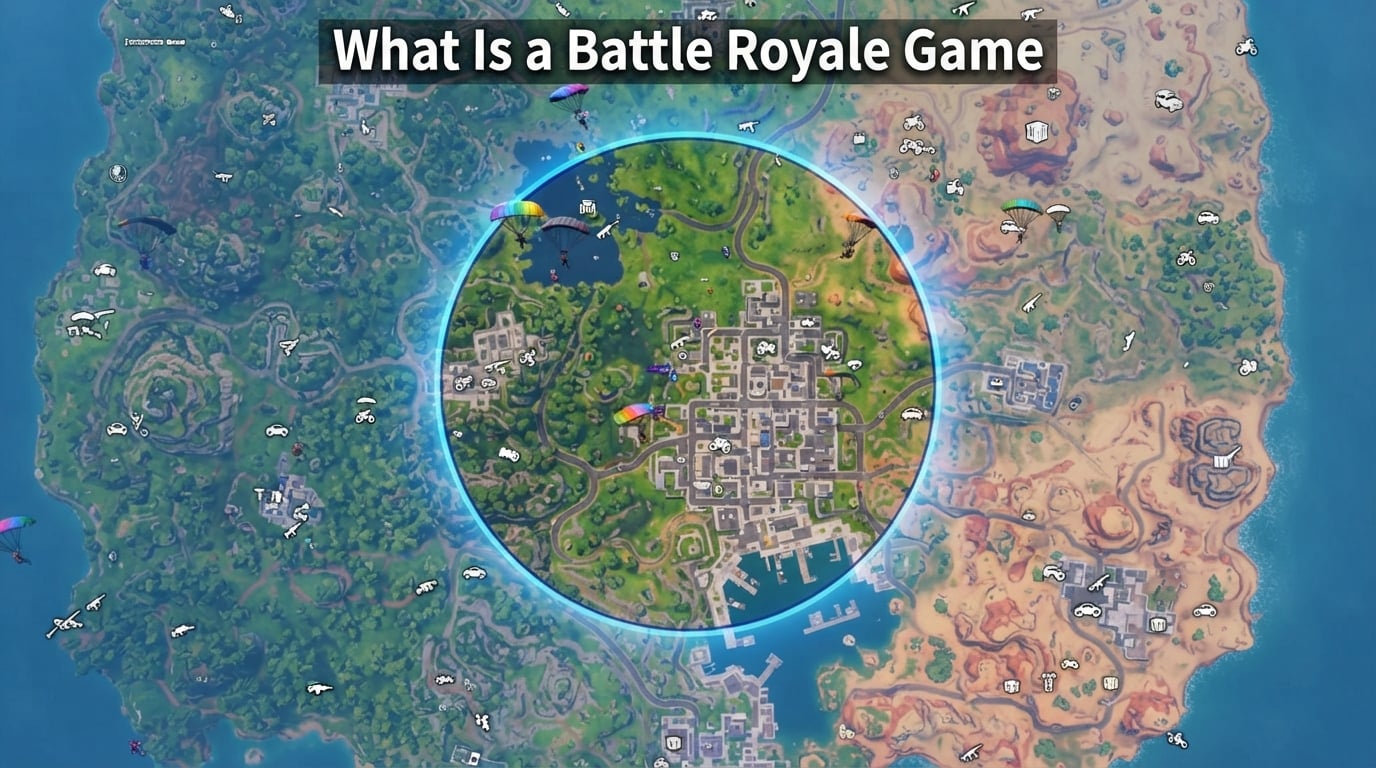
A battle royale game is an online multiplayer genre where dozens to hundreds of players drop in, scavenge for weapons, and fight until only one player or team remains while the map shrinks. Think PUBG, Fortnite, and Apex Legends ruling Twitch streams while their mobile counterparts pull in millions more from phones. In this guide, I’ll walk through exactly what a battle royale game is, how its core loop works, the most popular titles worth your time, and where the genre is heading in 2026.
You’ll leave this page knowing the core mechanics, the names that matter, the modes you’ll be matched into, and the history of how this genre took over gaming. Whether you’re brand new to shooters or a long-time gamer curious about the format, this is your starting point.
Table of Contents
What Is a Battle Royale Game?
A battle royale game is a multiplayer video game genre that blends last-man-standing gameplay with survival, exploration, and scavenging mechanics. Players typically start with nothing, loot weapons and armor from a large map, and compete to be the final survivor as a shrinking safe zone forces encounters.
Most matches include somewhere between 60 and 150 players in a single session, depending on the title. Classic 100-player matches are common in PUBG and Fortnite, while Apex Legends and Warzone lean toward 60. The genre sits at the intersection of shooters, survival games, and large-scale multiplayer competition.
The term “battle royale” itself comes from the Japanese novel and 2000 film Battle Royale, where students are forced to fight until only one remains. Game developers borrowed that name when early mods and indie projects used the same survival-of-the-fittest setup.
What separates a battle royale game from a regular shooter is the always-shrinking map and the equal-start philosophy. A typical match of Call of Duty multiplayer hands you a killstreak reward every few seconds; a battle royale match starts you with bare hands and asks you to out-think 99 other players.
You can spot a battle royale game by checking for five traits: a large map, scavenging for gear, a shrinking play zone, player elimination, and a single winner. If a game has most of those, it lives in this genre.
Modern battle royale games also tend to offer large free-to-play entry points with optional cosmetic microtransactions. That business model lets anyone with an internet connection and a compatible device join a match in minutes, which has helped the genre spread across consoles, PC, and mobile faster than almost any previous genre.
How Battle Royale Game Mechanics Work
Every battle royale game runs on the same basic loop, even when details vary by title. Here is the core sequence you’ll experience every single match.
- The Drop – You spawn above the map and pick a landing spot. Skydive in PUBG, launch from the Battle Bus in Fortnite, or jump from the dropship in Apex Legends.
- Looting – Once on the ground, you scramble for weapons, ammo, armor, healing items, and attachments. Some games, like Apex Legends, give you a pre-built character with unique abilities.
- Survive and Eliminate – You fight other players using whatever you find. Positioning, aim, and map knowledge decide most fights.
- The Shrinking Zone – A deadly circle slowly closes on the map, damaging anyone caught outside it. This forces scattered players into smaller, hotter zones and keeps matches from dragging.
- Last One Standing – The final few players or teams face off in a tiny area. Whoever survives wins the match.
Match length in most battle royale games runs between 15 and 30 minutes. Mobile versions like PUBG Mobile and Free Fire trim that down to 10-15 minutes for quick sessions, which fits short play periods like commutes or lunch breaks.
The Shrinking Safe Zone Explained
The shrinking safe zone is the heartbeat of every match. Without it, players could camp in corners forever. With it, the pace keeps building until the final circle. Most games announce each phase with on-screen alerts and a brief countdown so you have time to reposition.
Damage taken while outside the zone usually grows each phase. Early circles chip away a few hit points. Later circles melt you in seconds, so timing your moves inside the safe area becomes as important as aiming. The final circle in most games is small enough that two healthy players can see each other and decide the fight with positioning alone.
Looting and Inventory Management
Inventory management is one of the biggest skill ceilings in the genre. Knowing whether to grab a sniper rifle or a shotgun, when to swap armor, and how much healing to carry separates casual players from regular winners. A common rookie mistake is hoarding every item in sight instead of focusing on a balanced loadout that fits your playstyle.
Some modern battle royale games simplify this. Apex Legends auto-picks up better gear as long as your pack has space. Warzone adds a “loadout drop” system that lets you grab a custom class mid-match, which removes some of the RNG grind. Fortnite offers different weapon tiers and rarity colors so you can tell at a glance whether a pickup is worth swapping.
Squad Communication and the Ping System
Most battle royale games include a ping or callout system that lets you mark enemies, locations, and items without typing. Apex Legends popularized this with contextual pings that other players can see in their own language. Warzone, Fortnite, and PUBG all have similar systems now.
Good communication is the single biggest difference between an average squad and a winning one. Calling out a third-party enemy, warning your team about the next zone, or requesting healing items takes a few seconds and often decides the round.
Popular Battle Royale Games Worth Knowing
If you want to jump into the genre, these are the titles every player has heard of. Each takes the same loop and bends it with a unique twist. I’ll walk through the ones that shaped the genre and where each one fits today.
PUBG (PlayerUnknown’s Battlegrounds)
PUBG released in 2017 and basically invented the modern battle royale game. Built in the Unreal Engine, it focuses on realistic gunplay, large maps, and tactical squad play. PUBG Mobile and PUBG: New State continue that legacy on phones and remain hugely popular worldwide, with PUBG Mobile still drawing in millions of daily active users even years after launch.
If you like slow, tactical gameplay and authentic gun handling, PUBG is still the reference point. Erangel, its original map, remains one of the most iconic arenas in the genre and gets refreshed with reworked zones every major season.
Fortnite Battle Royale
Fortnite added a battle royale mode in 2017 and quickly became the biggest game in the world. Its building mechanic lets players construct walls, ramps, and towers in seconds, which separates it from every other shooter in the genre. A no-build mode now exists for players who want a more traditional feel, and the zero-build playlist has become the preferred mode for casual players and most of the competitive scene.
Fortnite’s live events also redefined what a battle royale game can do outside a match. Travis Scott concerts, Marvel crossovers, and live in-game story moments pull in viewers who have never played the game. It’s part battle royale, part cultural moment.
Apex Legends
Respawn Entertainment launched Apex Legends in 2019 with a hero-shooter twist: each legend has a tactical ability, a passive ability, and an ultimate ability. It features the fastest movement in the genre with slide-jumping, wall-running, and ping communication that became a fan favorite. Apex has built a strong esports scene and a stable ranked ladder that keeps competitive players hooked.
What makes Apex stand out is its emphasis on teamplay. Each legend brings a unique role, and the squad that combines abilities well tends to win late-game fights. It’s also the most beginner-friendly hero shooter because the ping system handles most of the communication work.
Call of Duty: Warzone
Warzone dropped in 2020 and brought the battle royale format to Call of Duty’s massive existing audience. Its Gulag feature lets eliminated players fight 1v1 for a second chance. Subsequent updates added Resurgence, Plunder, and more focused maps with shorter queues. By 2026, Warzone is the default battle royale game for millions of Call of Duty fans.
The loadout system, contract missions, and buy stations give Warzone a more arcade-like feel than PUBG. Matches move fast, and the loot economy lets squads gear up quickly when they survive early fights.
Fall Guys
Fall Guys proved that battle royale doesn’t need guns. It’s a multiplayer party game where colorful beans race through obstacle courses, and only a shrinking number qualify for each round. It opened the door for every non-shooter variant we see today. Stumble Guys and other clones followed the same model on mobile shortly after.
If you want battle royale tension without combat, Fall Guys is the cleanest example of how the format travels beyond shooters.
Mobile Battle Royale Hits
Mobile-first battle royale games like Free Fire, PUBG Mobile, and Wild Rift pull in hundreds of millions of players who game on phones. These titles run on lighter hardware and trim match length to fit quick sessions. They’re a massive entry point for new players in regions where console gaming isn’t as accessible.
Garena Free Fire in particular is the most downloaded battle royale game in many countries because it runs on low-end phones and matches finish in roughly 10 minutes. It’s a different pace than PC and console, but it still follows the same core loop.
Game Modes: Solo, Duo, and Squad
Most battle royale games offer three core matchmaking modes. Each one changes the teamplay dynamic and how you approach every fight. Many titles also rotate limited-time modes like 50v50, team deathmatch variants, or no-build playlists.
Solo mode drops you in with no teammates. Every other player is your enemy, and you win alone. This is the purest form of the genre and the ultimate test of individual skill. Solo matches in Fortnite and PUBG reward map knowledge, third-party awareness, and the ability to win 1v1 fights without anyone backing you up.
Duo mode pairs you with one teammate. Communication and reviving mechanics matter more here because getting knocked down usually means your partner has to come save you. Apex Legends and many mobile BRs lean heavily on duo play. Respawn timers and knockdown states often decide whether a duo can recover from a bad fight.
Squad mode is the most popular matchmaking choice in the genre. Fortnite runs squads of four, Apex Legends runs three, and Warzone supports up to four. Winning a squad match takes coordination, role assignment, and good callouts. Many players queue with friends using built-in party features or third-party voice chat apps.
Cross-platform play is now standard across the biggest battle royale games. PlayStation, Xbox, PC, Switch, and mobile players share the same matches in Fortnite, Warzone, and many others, which means queues stay fast and lobbies stay full. Cross-progression often carries your unlocks across devices as well.
Why Battle Royale Games Became So Popular
The genre’s rise came down to timing, accessibility, and streaming. Big Twitch and YouTube personalities dropping into Fortnite and PUBG gave millions of viewers a reason to install the game and try the format themselves. Unlike traditional shooters, every match tells a story because everyone starts from zero and only one player wins.
Free-to-play pricing also mattered. Removing the upfront cost let players download the game, queue up, and start playing within minutes. That accessibility pushed battle royale into mainstream gaming faster than any previous multiplayer genre.
High-stakes moments are another reason the format went viral. Every circle close, every final 1v1, and every surprise third-party encounter creates a clip-worthy moment that fans share online. The genre essentially built itself through word-of-mouth from viral moments.
The Evolution and History of Battle Royale Games
The battle royale genre didn’t appear in 2017 out of nowhere. Its roots stretch back nearly a decade to modding communities that were building on top of existing shooters. Understanding the history helps explain why every major shooter today ships with a battle royale mode.
Early Mods and Indie Roots
In 2013, the Hunger Games mod for Minecraft introduced many gamers to the survival-of-the-fittest format. Around the same time, the ARMA 2 DayZ mod called Last Man Standing by Brendan “PlayerUnknown” Greene laid the foundation for what would become PUBG. Both projects showed that large-scale last-man-standing matches were fun even when they were rough around the edges.
The 2017 Mainstream Breakthrough
H1Z1 launched in early 2026 years past, and PUBG’s March 2017 release on PC started the modern battle royale wave. By September 2017, Fortnite Battle Royale launched and exploded into mainstream culture, drawing players who had never touched an online shooter before. Both games hit Twitch’s top spots in the same year, and developers everywhere took notice.
Hero Shooters and AAA Franchises
Starting in 2018, big publishers wanted their piece of the pie. Call of Duty: Black Ops 4 added Blackout mode. EA and Respawn released Apex Legends in 2019 and pushed hero-ability design forward. By 2026, every major shooter franchise ships with at least one battle royale mode, and most have dedicated development teams behind those modes.
Battle Royale Fatigue and What’s Next
Veterans on forums like r/battleroyalegames often describe the gameplay loop as predictable now. The shrinking zone formula hasn’t changed much in years, and the genre feels crowded with similar titles. New battle royale releases have to work harder to break through, and some mid-tier games shut down within a year because they couldn’t hold an audience.
Developers are responding with bold experiments. Fortnite pushes live events and crossovers. Apex adds new legends and ranked seasons. Warzone experiments with Resurgence-style small-map modes. The next era of battle royale games may focus more on unique twists than the basic loop itself. Expect more 2v2 extraction shooters, more mobile-first entries tuned for short sessions, and ongoing crossover events that pull non-endemic audiences into the genre in 2026 and beyond.
Frequently Asked Questions
What defines a battle royale game?
A battle royale game is defined by five core traits: a large starting map, players dropping in with minimal or no gear, scavenging for weapons and supplies during the match, a safe zone that continuously shrinks to force fights, and a last-one-standing winner. The genre blends survival, exploration, and last-man-standing combat into a single multiplayer session.
What is the No. 1 battle royale game?
By player count and revenue, Fortnite has been the top battle royale game for most of its life. By competitive reach, Apex Legends leads the hero-shooter battle royale space. PUBG remains the standard for realistic tactical play, and Warzone dominates the Call of Duty audience. There’s no single definitive number one across all audiences.
Is Call of Duty a battle royale game?
Call of Duty itself is a military shooter franchise, not a battle royale game. However, it ships with a major battle royale mode called Call of Duty: Warzone, which is a full battle royale experience with its own map updates. So while the franchise is broader than battle royale, Warzone is one of the biggest games in the genre.
Why is it called battle royale?
The term comes from the 2000 Japanese film Battle Royale, based on a 1999 novel, where students are forced to fight each other until only one survives. The gaming genre borrowed the same survival-of-the-fittest concept, and modding communities like the ARMA 2 Last Man Standing mod and Minecraft Hunger Games adopted the name before PUBG made it mainstream.
Final Thoughts on Battle Royale Games
A battle royale game is one of the simplest genres to understand and one of the hardest to master. You drop, you loot, you survive the shrinking zone, and you try to be the last one standing. If you’re new to gaming, Fortnite’s no-build mode or PUBG Mobile is the easiest entry point. If you want a faster skill curve, jump into Apex Legends and start with the firing range. Whichever you pick, the format will give you matches that play out like short stories every time you queue up.