
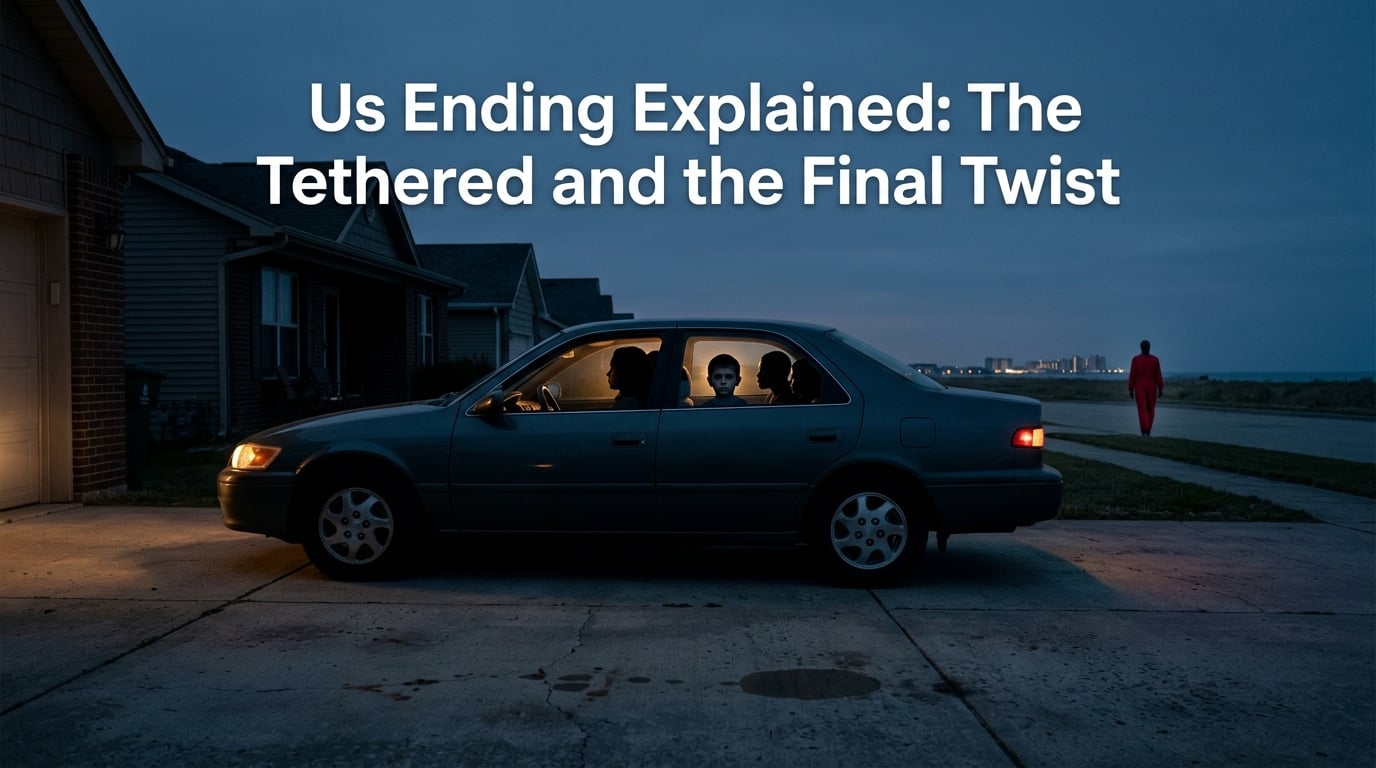
The Us ending explained in one line: the woman we follow for two hours as Adelaide is actually the Tethered who kidnapped the real Adelaide as a child and took her place above ground. Red, the silent red-suited figure who invades the Wilson family beach house, is the original Adelaide who spent more than three decades trapped in an underground mirror lab. Everything else in the film clicks into place once that switch is on the table.
I have rewatched Jordan Peele’s 2019 film four times while researching this piece, and each viewing surfaces another layer. The Tethered are not zombies. They are not ghosts. They are clones with a soul tether to their above-ground counterpart, engineered by the U.S. government and left to rot in tunnels beneath Santa Cruz. Below is a full breakdown of the plot, the symbolism, the Easter eggs, and the questions Peele refuses to answer on purpose.
Table of Contents
What Really Happened at the End of Us?
If you only have 30 seconds, here is the ending explained:
Young Adelaide met her double in a beach funhouse mirror in 1986.
The Tethered version dragged her underground and took her place.
The real Adelaide became Red and lived in the tunnels for 33 years.
At the end, Adelaide (the Tethered) kills Red and drives away as a family.
Her son Jason stares at her in the back seat, silently knowing she is not his mother.
That final look is the point. It reframes the entire movie from a survival horror picture into a story about the cost of stolen lives.
Who Are the Tethered in Us?
The Tethered are clones of every living person in the United States, created in a forgotten government experiment meant to give the government a remote puppeteering army. The U.S. government built tunnels beneath major cities and ran a program referenced in the film as Jeremiah 11:11.
The reference comes from the Book of Jeremiah: “Therefore thus saith the Lord, Behold, I will bring evil upon them, which they shall not be able to escape.” The project mirrors the phrase; whoever controls the Tethered controls the country. The clones share a soul bond with their surface counterparts. When the surface human eats, the Tethered feels the food. When the surface human dances, the Tethered mirrors the movement. When the surface human hurts, the Tethered hurts too.
The bond also flows the other way. The Tethered can choose to mirror their actions onto their above-ground self, which is exactly what happens during the home invasion in Us.
How the Tethered Were Created
The government abandoned the project once it lost control. The Tethered were left in the tunnels, untouched and unmonitored. They survived by mimicking what their above-ground selves did, which means they danced, ate, went through the motions of a life they could never really live. Peele describes them as the forgotten shadow population of America, the people the country walks on without noticing.
Red leads a quiet uprising. She organizes the Tethered into a long chain stretching across the country and walks them from the tunnels to the surface. It is Hands Across America 2.0, with vengeance.
Why Red Is the Only Tethered Who Can Speak
Red can talk because she is not a true Tethered. She is the original Adelaide, who was kidnapped into the tunnels as a child. She grew up hearing the surface world through her tether, watched her double live the life she should have had, learned the language, and used it to rally the others.
The other Tethered communicate in grunts because they were raised in tunnels with no language input. Red is the only one with a real childhood above ground. That is why her voice is so distinctive in the film and why her monologue about the beach is the emotional heart of the movie.
The Adelaide/Red Twist: What Really Happened in 1986
The Us ending explained through a single scene: the 1986 trip to the Santa Cruz boardwalk. A young Adelaide wanders away from her parents and enters a house of mirrors at the beach amusement park. Inside, she meets a girl who looks exactly like her. They reach for each other, hands pressed against the glass on opposite sides.
Then Adelaide is on the wrong side of the glass. She is in the tunnels. The girl above has her face, her name, her family. No one above ground notices the swap, because to them Adelaide came back from the funhouse a little quieter. The Tethered who replaced her plays the role so well she almost forgets she is not human.
Fast forward to the present. The Wilson family, Adelaide and Gabe plus kids Zora and Jason, take a beach vacation at the same boardwalk. Adelaide does not want to be there. She avoids the funhouse. She stares at the surf like she is reliving a memory she cannot quite reach. That is the sign that something is wrong: a Tethered walking the surface does not want to go back to the place that birthed her.
Red finds her. She wants her body back. The home invasion that follows is her attempt to reverse the swap with the same mirroring trick her doppelganger used on her as a child.
The twist lands at the end. Adelaide and Red fight in the tunnels. Adelaide chokes Red with her bare hands. She drives home with her family, and the movie reveals, line by line, that Adelaide is the Tethered. The real Adelaide was the woman in red the whole time.
The same trick Peele used with Get Out, a sympathetic surface character revealed to be the antagonist, hits here in reverse. This time the audience has been rooting for the monster.
Three Clues You Missed on First Watch
Peele does not hide the twist. He litters the film with signals. Here are three of the loudest.
1. Adelaide will not go near the funhouse. The Tethered does not want to return to the liminal space where she became human. The real Adelaide would feel conflicted around that mirror. The fake one is terrified of it. Watch her body language when the family walks past.
2. Jason is afraid of her from the start. Young Jason wears a wolf mask early in the film and stares at Adelaide in a way that feels like recognition. Kids sense things adults rationalize away. Peele has said in interviews that Jason has always known something is off about his mother.
3. Adelaide “forgot” to mention her past. The Tethered body has no real memories above ground. She fills in the gaps with what she learned through the tether. When asked about her childhood, Adelaide becomes evasive. When Gabe pushes, she changes the subject. The original Adelaide could not repress her real memories that cleanly.
Tiny clues also pepper the film: the way Adelaide holds her left hand after the fight (Red had a limp from the fire years earlier), the way she avoids the hospital check, even the family’s reluctance to enter the water on the beach. Everything loops back to one truth: the woman we trust is hiding who she is.
Hands Across America: What the Holding Hands Actually Means
Hands Across America was a 1986 charity event where millions of Americans held hands in a human chain across the continental U.S. The film opens on a news clip of the event, and the Tethered chain they form across the country is a direct replica.
The message is bitter. Hands Across America raised money for the homeless and hungry but did almost nothing measurable for them. It was performance, not substance. The Tethered chain is the same gesture turned hostile: a country linked hand to hand, ignoring the people underneath its feet.
Peele stacks the symbolism. The Tethered hold hands because their above-ground selves are connected through them. They are the literal underclass the country steps over to smile for the camera. Red leads her people to the surface to be seen, finally, even if being seen costs everyone their lives.
The chain stretches from coast to coast at the same hour Hands Across America ran. The film cuts between the two in the final montage. We watch the cheerful 1986 chain, then the 2019 Tethered chain, and the connection lands: nothing has changed. America still does not see the people it sits on top of.
The Final Scene: Jason’s Knowing Look
The last shot of Us is Jason in the back seat of the family car, staring at Adelaide in the rearview mirror. He does not blink. He does not smile. He knows.
Peele has confirmed in multiple interviews that Jason understands what happened in the tunnels. He watched his mother strangle Red, and he has spent the entire trip home putting the pieces together. The look is not a hint. It is a verdict.
What Jason does with that knowledge is the question Peele leaves open. He could tell his father. He could stay silent and let his mother pretend. He could grow up and live with the secret. The film ends on this ambiguity because Peele wants the audience to choose what they would do.
It is also the scariest version of the movie. Adelaide can mimic the gestures of motherhood, but she cannot fake it perfectly in front of her son. Jason is the only person who can see through her, and now he has to decide what to do about it.
Rabbit Symbolism in Us: The Underexplored Layer
Rabbits show up in Us in ways most critics underplay. Adelaide holds a stuffed bunny on the couch. Zora tucks a rabbit plush into bed. The opening carnival has a rabbit-themed ride. The Tethered attack is bookended by rabbit imagery. None of this is random.
Rabbits in American folklore signal reproduction, fertility, hidden populations, and tricksters. The Tethered are a hidden population bred in secret. They multiply fast. They emerge from underground warrens. They terrify the surface world the way rabbits terrified Australians: a quiet invasion that becomes impossible to ignore.
There is also a rabbit trickster called Brer Rabbit who appears in older American stories and gets out of trouble through wit. Red uses wit, not brute force, to organize the Tethered. She plays the long game the way Brer Rabbit outsmarts Brer Fox.
Jason wears a rabbit motif in his art project, and his wolf mask becomes a wolf-rabbit hybrid in the climactic fight. Adelaide as the Tethered is closer to the rabbit than the wolf: she looks soft, she hides in plain sight, she survives by being underestimated.
Put together, the rabbit imagery signals a hidden parallel civilization that the camera keeps almost-noticing. Adelaide keeps rabbits around her because rabbits remind her of what she is.
The VHS Tape Easter Eggs and Visual Clues
Peele is a movie nerd, and he hides clues in the props. The VHS tapes in the Wilson living room are key.
The tapes include C.H.U.D. (1984), about Cannibalistic Humanoid Underground Dwellers living under New York City. The Tethered are a direct homage. There are also tapes of The Man with Two Brains and The Goonies, plus a curious stray tape that sits in front of the others during a key scene.
The presence of C.H.U.D. on the shelf is a wink to horror fans: Peele is telling you what to expect before the Tethered appear. They live under the streets. They look human. They want out.
Other visual signals include:
A sign at the carnival that reads “Find Yourself.”
The Jeremiah 11:11 placard on the Tethered wall.
A Bible verse sticker Adelaide keeps on her car (the same Jeremiah reference).
A picture of young Adelaide inside the funhouse, captioned in the end credits as “1986.”
Scissors on a table in the home invasion scene, mirroring the Red Riding Hood art Zora is drawing.
Each clue is a fingerprint. The Tethered share a soul with their surface self, and Peele leaves soul-fingerprints all over the film for viewers who pay attention.
Jordan Peele’s Stated Intentions vs. Fan Theories
Jordan Peele has been open about the Us ending explained through social commentary. The film is about class, privilege, and the cost of pretending everyone has the same shot at the American Dream.
In interviews Peele has said the Tethered represent the marginalized people society ignores. They perform the rituals of life without any of the rewards. They are the homeless, the working poor, the underpaid. When Red says “we are Americans,” she means the underground population the country left behind.
Peele has said the Adelaide twist is a story about stolen lives. The Tethered Adelaide takes a place that was never meant for her and lives a comfortable suburban life for 33 years. The real Adelaide loses her family, her name, and her freedom. The monster is also the victim.
Fan theories go further. Some viewers argue the entire U.S. is the Tethered, and Adelaide is the only person who escaped. Others argue the film is a direct allegory for slavery, with the underground population representing people forced into a shadow life. Peele has not shut these readings down, because the film supports them.
What Peele has refused to confirm is whether Adelaide was always a Tethered or became one through the swap. Fans debate this on Reddit almost every month. The honest answer is that the film is structured so both readings work. Adelaide may have always been a shadow; the swap may have turned her into one. Either way, she is not the person her family thinks she is.
FAQs
Did Adelaide know she was a Tethered?
Adelaide buried the truth for 33 years. She took the real Adelaide’s place in 1986 and lived the surface life until the Tethered uprising forced her to confront what she had done. The film hints that she knew all along, but she repressed the memory to survive.
Was that the real mom at the end of Us?
No. The woman in the car is the Tethered who swapped with Adelaide as a child. The real mom, the original Adelaide, is Red, who was killed in the underground tunnels just before the credits.
Why is Red the only Tethered that can talk?
Red is the original Adelaide. She was born above ground, learned English as a child, and was only trapped in the tunnels at age nine. Every other Tethered was raised underground without language input, which is why they communicate in grunts and pantomime.
How did Jason know his mom was a Tethered?
Jason has been sensing something wrong his whole life. Jordan Peele has confirmed in interviews that Jason recognizes the truth by the end of the film. The wolf mask he wears and the way he avoids his mother’s gaze are signals the boy has always known his mother is not human.
What is the point of the Tethered in the movie Us?
The Tethered represent the people society ignores: the working poor, the homeless, the marginalized. Jordan Peele has described them as a shadow population the country walks on without seeing. They mirror the surface world’s actions to show how shallow that world’s privileges are.
Why did the Tethered hold hands in Us?
The chain mirrors Hands Across America, the 1986 charity event where Americans held hands across the country to fight homelessness. The Tethered chain is the same gesture with vengeance: a country linking hands while ignoring the people under its feet. Red organized it to make America finally see the underground population.
Conclusion
The Us ending explained through one image: Jason in the back seat, knowing. Peele does not want viewers to walk away comforted. He wants them to walk away unsettled, asking which characters they actually trusted and whether the country they live in deserves the trust they placed in it.
If you have not rewatched Us yet, the film rewards a second viewing. The clues stack up. The voice of Red carries more weight the second time. The Jeremiah 11:11 placard on the wall stops looking like set dressing and starts looking like a warning. Once you see the Tethered version of Adelaide, you cannot unsee her.
That is the point of Us in September 2026. It is a horror film with a political spine, and the twist is that the monster was always in the mirror. Watch again. Look closer. The rabbit on the couch is not decoration, and the boy in the wolf mask is not playing.