
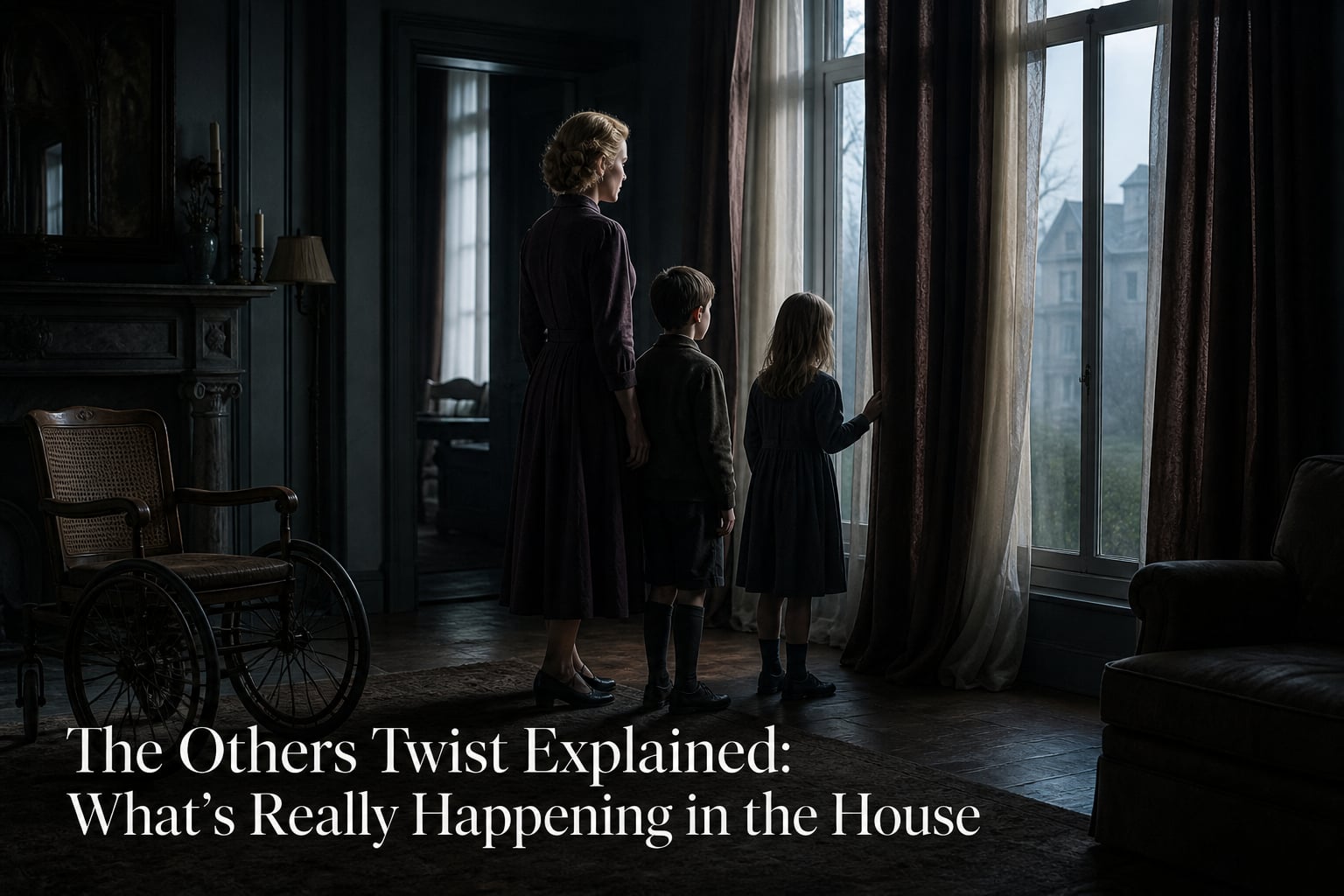
Major spoilers for The Others follow. The Others twist explained in one sentence is this: Grace Stewart smothered her children, Anne and Nicholas, then shot herself, so they have been ghosts in the Jersey house all along. The people Grace believes are invading are a living family trying to live in the same house.
That reversal is why Alejandro Amenábar’s 2001 Nicole Kidman horror movie lands so hard. The film spends its first half teaching us to see the world through Grace’s frightened, tightly controlled point of view, then makes us reassess every locked door, closed curtain, and unexplained voice.
Viewers commonly come away with the same practical questions: when did everyone die, were the servants dead too, and was Charles ever alive when he returned? Here is the full answer, with the timeline, séance, clues, photosensitivity, and the ending’s meaning laid out plainly.
Table of Contents
The Others twist explained: Grace and her children are the ghosts.
Grace, Anne, and Nicholas are not being haunted by the people they call “the others.” They are the ghosts haunting a living family that has moved into the house, and the living people experience Grace’s family as frightening presences who close doors, make noise, and refuse to leave.
At the séance, the two realities finally touch. Grace sees a medium speaking with Anne and Nicholas beside the living mother and child, which confirms that the woman she thought was an intruder is not a ghost at all.
The title changes meaning at that moment. From Grace’s side, the new family are “the others”; from the living family’s side, Grace and the children are the others. Neither side begins with the full picture, but the living family has the clearer reason to fear the house.
Direct answer: Grace killed Anne and Nicholas during a breakdown, then killed herself. The house’s apparent haunting is the collision between their dead family and a living family.
The events happened in a clear but concealed order.
The film does not show the fatal night in ordinary chronological order because Grace cannot fully face it. Put the revealed facts in sequence, and the plot becomes much easier to follow.
Charles goes to war and dies. Grace is told he has been killed, leaving her isolated with Anne and Nicholas in the large house.
Grace has a catastrophic breakdown. She smothers both children with a pillow, then immediately realizes what she has done.
Grace shoots herself. Anne later recalls waking after being smothered and seeing Grace holding a gun, a memory Grace has kept buried.
The family remains in the house. They continue a domestic routine as though nothing final has happened, unable or unwilling to understand their state.
A living family arrives. Their presence produces the noises, moved objects, and voices Grace reads as a hostile haunting.
This sequence also explains the house’s unstable rules. Grace thinks opening curtains is dangerous because Anne and Nicholas are supposedly severely photosensitive, yet the deeper danger comes from what light, visibility, and recognition might force her to confront.
Grace killed her children during a breakdown shaped by grief, not malice.
Grace smothers Anne and Nicholas, and the film gives no innocent alternative to that fact. It also frames the act as the worst moment of an overwhelmed mother who has lost her husband to war and is living in severe isolation, rather than as an act the story wants viewers to excuse.
Her reaction after the killings matters. When the children reappear, Grace recognizes the horror of what happened, takes the gun, and turns it on herself; the family then repeats life in the house without a stable awareness of death.
The post-war setting adds context without supplying a diagnosis. In 1945, grief, trauma, depression, and psychiatric distress carried intense shame and far fewer routes to open support, and the film uses that social silence to make Grace’s isolation feel suffocating.
Warning: The movie presents child murder and suicide. Its explanation is about grief, denial, and a supernatural afterlife; it is not a clinical account of mental illness or a justification for violence.
Charles was dead when he returned to the house.
Charles Stewart does return from the war, but he is not a living soldier who has somehow found his way home. He has died, and his brief reunion with Grace is a visit by another ghost who seems more aware than she is that he cannot stay.
His exhausted appearance and distant manner are clues. Charles says he must go back to the front, even though the war has ended, because the film treats him as someone caught in the pull of his death rather than someone capable of restarting family life.
Grace’s inability to keep him there echoes her broader refusal to accept loss. Charles can move away from the house, while Grace and the children stay because their traumatic final moments bind them to it.
The servants were ghosts before Grace’s family died.
Mrs. Mills, Mr. Tuttle, and Lydia are not accomplices working for the living family. They died decades earlier during a tuberculosis outbreak, then remained at the estate, which is why they understand its haunting better than Grace does.
Their calm manner can look suspicious on a first watch because they know more than they say. Mrs. Mills repeatedly nudges Grace toward recognition, but she does not force the revelation; Grace has to arrive at it when the séance makes denial impossible.
Lydia went silent because she had stopped speaking after death.
Lydia’s silence is not evidence that she is a living servant terrified of Grace. When she speaks near the end, she explains that she stopped talking because she was dead, placing her on the same supernatural side as Mrs. Mills and Mr. Tuttle.
The servants also leave briefly to find the gravestones that prove their deaths. That trip turns a question viewers often have into a concrete answer: the house already had resident ghosts before Grace, Anne, and Nicholas became part of it.
The séance reveals the living family’s point of view.
The séance is the explanation scene because it lets Grace see the people on the other side of the haunting. A medium writes automatically while the living family sits around a table, and Grace’s family appears to them as unseen voices and movements.
Automatic writing is a séance practice in which a medium writes messages believed to come from spirits. In the film, it gives physical form to a conversation that each family has misunderstood: Grace hears strangers in her home, while the living family hears ghosts refusing to let them settle there.
Anne’s response breaks the stalemate. She sees herself named and described by the living family, then remembers the pillow and the gun, making it impossible for Grace to retain the story that they are the innocent residents under attack.
The clues say Grace’s family is dead long before the ending.
The Others is built for a second viewing. None of the hints alone gives away the full answer, but together they show that the movie has been presenting a ghost story from the ghosts’ perspective.
The servants arrive after the old staff disappears. They behave as if they already know the house and its rules, not as strangers applying for work.
The house is often sealed. Grace’s strict instructions about curtains and doors create a world that is closed off from ordinary life, while also making the living family’s presence hard to see.
Grace never has a normal exchange with outsiders. Her experience is largely confined to the children, servants, Charles, and unexplained presences inside the estate.
Charles looks like he belongs somewhere else. His weary, disoriented return has the feel of a visitation, and he leaves when Grace asks him to stay.
The mourning photographs are literal evidence. Mrs. Mills’ album contains Victorian-era photographs of the dead, preparing the audience for a world where death can look almost ordinary.
Anne remembers the fatal night in fragments. Her recurring claim that Grace went mad is not childish invention; it is the suppressed truth of the family tragedy.
The voices and footsteps reverse the expected haunting pattern. What Grace calls intruders are the living occupants moving through rooms she believes belong only to her.
The fog outside is another useful visual clue, though it is not a piece of detective evidence by itself. It isolates the house from the ordinary world and makes Grace’s version of reality feel complete until the story opens a gap in it.
The children’s photosensitivity is partly real medicine and partly ghost-story logic.
Anne and Nicholas are described as unable to tolerate sunlight, which drives Grace’s obsessive curtain routine. Photosensitivity is a real sensitivity to sunlight, and a rare inherited condition called Xeroderma Pigmentosum can make ultraviolet exposure extremely harmful because the body cannot repair certain sun-related DNA damage effectively.
The film does not establish a medical diagnosis for either child. It borrows the fear associated with photosensitivity and uses it dramatically, so it would be a mistake to treat its depiction as an accurate case study of Xeroderma Pigmentosum.
On the story level, the condition supports the twist. Darkness lets Grace preserve a controlled household and avoid what open light might reveal; when the curtains disappear, her household loses the barrier that had helped sustain that illusion.
The Justus and Pastor story is a red herring about fearful assumptions.
Anne tells Nicholas a frightening story about a boy named Victor and the ghostly Justus and Pastor. Grace treats it as a possible explanation for the presence in the house, inviting viewers to suspect a conventional menace from the past.
That story works as a red herring because it encourages the same mistake Grace makes: inventing a threatening “other” before checking who actually has power, who is afraid, and who might be misunderstood. The film does not need Justus and Pastor to be its literal answer; it needs the tale to train us to expect the wrong kind of ghost story.
It also mirrors Anne’s divided position. She sees more than Grace does and is willing to entertain possibilities outside her mother’s rigid explanations, but she still lacks the whole memory until the séance.
The ending means grief can turn a home into a place of denial.
The final scene is not simply a surprise that Grace’s family is dead. It is a story about people holding onto a familiar routine because accepting the truth would mean facing loss, responsibility, and a future they cannot picture.
Grace’s Catholic language and the film’s references to limbo or purgatory give that refusal a spiritual vocabulary. The movie does not lay out a formal doctrine, but it uses the idea of souls stuck between recognition and release to show why Grace cannot move on.
The family’s decision to remain in the house is therefore sadder than a standard haunted-house victory. Grace says the house is theirs, but the statement reads as defiance born of fear: they have claimed the only place they understand, even though the living will keep returning.
The title’s reversal sharpens that theme. “The others” are not monsters with a fixed identity; they are whoever a frightened person refuses to see clearly. That is why the film’s atmosphere matters more than jump scares, a point many viewers recognize when they revisit it after knowing the twist.
The Others works best as a second-viewing mystery after the reveal.
On a first watch, the mystery is whether a mother can protect her children from an unseen threat. On a second watch, the more interesting question is how every character’s behavior changes once you know who is living, who is dead, and who is avoiding the truth.
Watch Mrs. Mills especially closely. She is not trying to terrorize Grace, and she is not simply withholding information for a cheap surprise; she is waiting for the family to reach a recognition that cannot be handed to them without resistance.
That is also why comparisons to The Sixth Sense come up so often. Both films ask audiences to reinterpret what characters could see and understand, but The Others gives its central ghost family a whole home and history, making the twist a study of grief inside domestic space.
FAQs
What actually happened in The Others?
Grace Stewart smothered her children, Anne and Nicholas, then shot herself. They are ghosts in the house, while the people they call intruders are a living family who moved in. The servants are ghosts too, having died years earlier during a tuberculosis outbreak.
Why did Grace smother her children in The Others?
The film shows Grace suffering an acute breakdown after the loss of her husband in the war and the isolation of life at the house. She smothers the children, recognizes the horror of the act when they return to her, and then kills herself. The film provides context but does not excuse her act.
Why did Lydia go mute in The Others?
Lydia is one of the dead servants. Near the end, she explains that she stopped speaking because she was dead, which confirms that her silence is part of the film’s supernatural logic rather than a reaction to a living employer.
What does the ending of The Others mean?
The ending is about grief, denial, and the refusal to release a familiar life after tragedy. Grace’s family remains in the house because accepting their deaths would mean accepting both loss and responsibility. The title also reverses perspective: the living family and the ghosts each see the other as the outsiders.
What was the twist at the end of The Others?
The twist is that Grace, Anne, and Nicholas have been dead throughout the movie. Grace killed the children and herself, so the supposed ghosts haunting them are actually the living residents of the house.
Was the husband alive or dead in The Others?
Charles was dead when he returned home. He had died in the war, and his brief visit is a ghostly reunion. His distant behavior and need to leave show that he cannot return to ordinary family life.
What is the point of the movie The Others?
The Others uses a haunted-house twist to explore how grief can trap people in denial. Its scares come from two families misunderstanding one another, while Grace must confront the event she has buried: the deaths of her children and herself.
Conclusion
The Others twist explained is not that the house contains a hidden monster. Grace, Anne, and Nicholas are the dead family, while the people they fear are alive; the ending makes every earlier disturbance part of a shared home seen from incompatible sides.
If you watch again, focus on the servants’ patience, Charles’s inability to stay, Anne’s broken memories, and the way Grace calls ordinary living sounds an invasion. Those details turn the ending from a surprise into a quiet, devastating story about what grief can make impossible to see.