
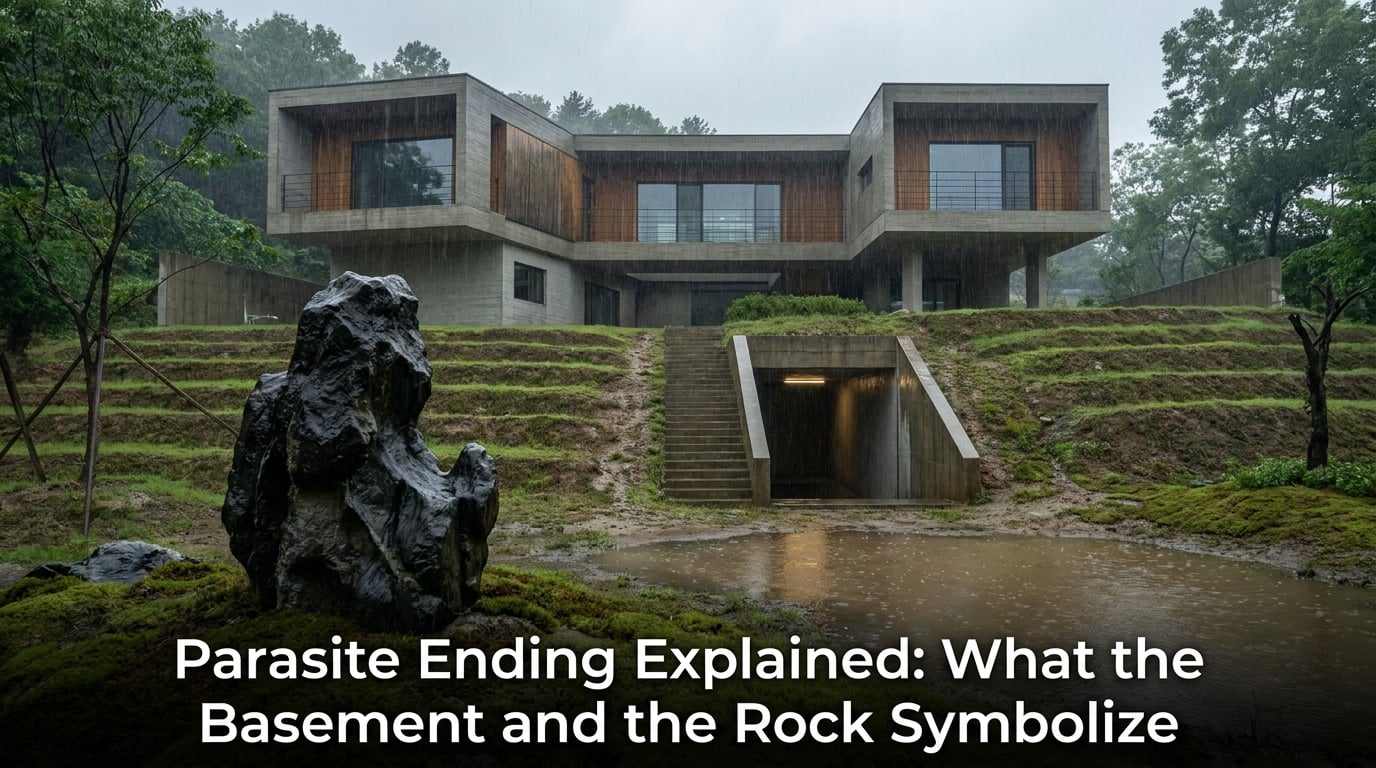
Spoilers follow. This Parasite ending explained guide answers what the basement and rock symbolize: they show that the Kim family’s apparent climb toward wealth is built on a false promise, while the people pushed below ground pay the cost. Bong Joon-ho turns a house, a stone, a flood, and even a smell into evidence that social class is not just money; it decides where people can live, move, and be seen.
The film works as a thriller, but its final images make its argument unusually plain. Ki-woo can imagine buying the Park house and freeing his father, yet the fantasy matters because the film has already shown how hard that ascent is for a family living in a semi-basement apartment.
That is why the scholar’s stone, the bunker, and the final letter belong in the same reading. Each begins as a possible route upward or outward, then becomes proof of confinement.
Table of Contents
Parasite ending explained: the basement and rock symbolize a blocked climb
The rock symbolizes the Kims’ hope that wealth can be reached, and the basement symbolizes the social position that keeps them from reaching it. Ki-woo’s dream at the end is moving because he still wants to rescue Ki-taek, but it is not presented as a realistic escape from economic immobility.
The Park house is arranged vertically: its owners occupy the bright upper rooms, Geun-sae survives below in a hidden basement bunker, and the Kims return to a home partly underground. Movement through the film repeatedly goes up or down stairs, so the characters seem to climb socially only to be sent back beneath the city.
Short answer: The scholar’s stone is a promise of prosperity that turns hollow and violent. The bunker is poverty made literally invisible, and Ki-woo’s closing plan shows why desire alone cannot cross the distance between the two worlds.
The scholar’s stone symbolizes a false promise of wealth
The rock in Parasite, called a scholar’s stone or suseok, represents aspiration before it represents danger. Min gives it to the Kim family as a good-luck gift and says it belongs with them, which makes it feel like a small, refined sign that their fortunes might change.
In Korean tradition, suseok are naturally shaped viewing stones valued for their suggestive forms and for contemplation. The film uses that cultural association with status and cultivated taste, then places the object in the Kims’ cramped semi-basement, where its promise feels both attractive and out of place.
The stone first gives Ki-woo a story about belonging
Ki-woo does not receive only a rock. He receives Min’s introduction to the Park family and a role that lets him enter their home as an English tutor, so the object becomes tied to the family’s improvised social climbing.
The Kims are resourceful, observant, and funny, not passive figures waiting for fortune. Still, the stone encourages a belief that the right opening, performance, or connection can place them permanently among the wealthy.
The irony is that the opportunity arrives through a wealthy friend rather than through a system that has changed. The gift is therefore a borrowed sign of access, not a foundation the Kims own.
The floating stone makes the promise visibly hollow
After the rain floods the Kims’ apartment with sewage, Ki-woo retrieves the stone. Viewers often focus on its later use as a weapon, but the earlier floating detail is just as revealing: a supposedly weighty emblem of fortune drifts in filthy water.
Forum discussions often read that detail as evidence that the stone is hollow or fake, which also helps explain why Ki-woo survives the blow to his head. Whether one treats the object as literally hollow or as a deliberately artificial-looking prop, the image undercuts the solidity of the future it promised.
The rock is not simply “bad luck.” It becomes a visual joke with painful consequences: the object that should ground the Kims in prosperity has no reliable weight when their home is submerged.
The stone becomes a weapon because Ki-woo mistakes violence for control
Ki-woo carries the rock down to the bunker believing he must resolve the threat posed by Moon-gwang and Geun-sae. He describes the object as clinging to him, a line that changes the question from “What can this bring me?” to “What demand has this hope placed on me?”
Geun-sae then uses the stone against Ki-woo. The reversal is exact: an emblem of educational and financial advancement becomes the instrument that almost destroys the young man meant to rise through it.
Bong Joon-ho has described the blow with the Korean phrase for a surefire kill. The fact that Ki-woo survives does not make the attack triumphant; it leaves him physically damaged and still unable to turn his plan into a path out.
Warning about a common reading: The rock does not mean that the Kims deserve what happens to them. Its false promise points toward a class system that makes a rare opening look like a dependable ladder.
The basement bunker symbolizes poverty made invisible
The basement bunker symbolizes the people whose labor and deprivation support comfort above them while remaining unseen. When the former housekeeper Moon-gwang reveals Geun-sae below the Park home, the film turns the Kims’ new “upstairs” success into another layer of the same hierarchy.
The Kims’ own home is a semi-basement, visible at street level but vulnerable to pests, public urination, and floodwater. Geun-sae’s bunker is worse: he is hidden entirely, dependent on food smuggled down by Moon-gwang and then by circumstance.
The bunker makes the Park home a wealth prison
The Parks do not know Geun-sae is there, yet their home can protect them only because other people clean, cook, drive, tutor, and manage the parts of life they do not see. The bunker exposes that comfort as dependent on an invisible workforce, even though the Parks are not shown personally imprisoning Geun-sae.
Geun-sae treats Mr. Park as a benefactor because the house and its lights give his isolated life a structure. His devotion is tragic precisely because Mr. Park has no idea that it exists.
This makes the home a prison in two directions. Geun-sae cannot leave safely, while the Parks’ wealth keeps them insulated from the human conditions that make their ease possible.
The Morse code turns a hidden person into a signal nobody reads
Geun-sae taps Morse code through the lighting system to thank Mr. Park. The boy Da-song treats the flickering as a ghostly sign, while the adults enjoy the convenience without asking who makes it happen.
At the end, Ki-taek uses the same method to communicate with Ki-woo. The message crosses the house, but it cannot restore a relationship or open the bunker door; Morse code is contact without rescue.
That distinction answers a frequent viewer question. Ki-woo can learn that his father is alive, yet knowing where he is does not give him the means to bring him home.
The stairs, rain, and smell show how class is felt
The stairs, rain, and smell show class as a physical experience rather than an abstract argument. Parasite keeps directing the Kims upward into the Park house and then downward through Seoul, making the city itself seem designed to return them to their assigned level.
The staircase motif turns social climbing into a repeated descent
Early on, Ki-woo climbs to the Park house and enters a sleek space that appears to reward his performance. The Kims later descend from that house after hiding under the table, then continue down streets and stairways until they reach the flooded semi-basement.
The sequence is long enough to feel punishing. It says more than “the Kims are poor”: even after they briefly occupy the Park family’s rooms, the route home only goes down.
The hidden stairs to the bunker make the pattern harsher. There is always another level beneath the one the Kims thought they had escaped.
The rain is relief for the rich and catastrophe for the poor
The storm washes the air for the Parks and makes the next day’s garden party possible. For the Kims, it fills their apartment with sewage and destroys the few belongings they have.
This contrast gives the flood imagery its force. The same rain is not experienced equally because shelter, elevation, and money decide whether it is a pleasant reset or a disaster.
Ki-woo saves the stone from the water, but the gesture is bleak. He rescues the token of a future while the present around him has been ruined.
The poor smell is the insult that cannot be washed away
Mr. Park repeatedly notices a smell shared by the Kim family, comparing it to people who ride the subway. The motif hurts because the Kims have already performed the speech, clothes, and jobs expected in the Park home, yet their bodies are still treated as evidence of where they belong.
At the garden party, Mr. Park recoils from Geun-sae’s smell while asking Ki-taek to retrieve the car keys. That reflex lands after the flood, the bunker confrontation, his daughter’s death, and a long chain of smaller humiliations.
The murder is not a rational response to one comment. The comment becomes the final reminder that, even amid an emergency, Mr. Park sees Ki-taek as a worker whose proximity is useful but whose humanity is repellent.
Key connection: The rock promises an ascent, the stairs stage an ascent and descent, the rain washes everything downward, and the smell tells the Kims that they cannot fully disguise the class position from which they started.
Ki-taek’s violence comes after a lifetime of humiliation
Ki-taek kills Mr. Park after Mr. Park’s reaction to Geun-sae’s smell activates the film’s accumulated class humiliation. It is a terrible act, not a heroic uprising or a simple plot twist.
Before the party, Ki-taek has listened to Mr. Park complain that his driver crosses a line, watched his family lose its home in the flood, and discovered that their supposed rise had placed them in conflict with people even more desperate. The garden-party chaos strips away the careful performance that had made their jobs possible.
The scene also refuses a tidy class-war conclusion. Mr. Park dies, but no social order changes; Ki-taek flees down into the bunker, repeating Geun-sae’s position rather than escaping it.
Ki-woo’s final house fantasy is a dream, not a solution
Ki-woo’s final vision of buying the Park house and greeting his father in the garden is a fantasy, not a scene the audience should read as completed fact. The film returns to Ki-woo in the semi-basement after the imagined reunion, making the emotional appeal of the plan inseparable from its improbability.
His letter is sincere. He says he will make money, buy the house, and free Ki-taek, but the film has spent its entire running time measuring how far his material reality is from that promise.
The final sequence shows the wish before returning to the facts
Ki-woo deciphers Ki-taek’s Morse code message and learns that he is alive in the bunker.
He imagines earning enough to purchase the house.
He imagines his father walking up from the basement and embracing him outside.
The film cuts back to Ki-woo writing from the semi-basement apartment.
That final return does not ridicule Ki-woo for hoping. It asks us to see hope honestly when the route to fulfilling it depends on wealth he does not have and systems the story has shown to be closed.
The song points to a timescale that makes the plan devastating
The closing song is associated with the idea that it would take centuries to buy the house. Search discussions sometimes call it the “564 years” song, while keyword research also surfaces “584 years”; the important point is not a disputed number but the deliberately impossible timeframe behind Ki-woo’s wish.
Bong Joon-ho’s ending is pessimistic because it does not claim that effort is meaningless. It shows that effort, talent, and longing do not erase structural inequality on the timetable of one son’s promise to his father.
Ki-taek remains alive, yet remains below ground. That is the ending’s quiet cruelty: the possibility of reunion exists in the imagination, while the actual conditions that would make it happen remain out of reach.
The title makes every family part of the parasite metaphor
The title does not identify one clean villain as the parasite. The Kims depend on the Parks’ household for work, the Parks depend on workers to make their lifestyle function, and Geun-sae lives hidden beneath the home while consuming what reaches him.
Calling only the Kims parasites would repeat the Park family’s limited view of the people serving them. Calling only the Parks parasites would miss the film’s painful point that scarcity makes the Kims fight Moon-gwang and Geun-sae instead of finding solidarity.
The parasite metaphor is therefore about dependence distorted by inequality. People need one another, but the house’s hierarchy decides whose needs are visible, whose labor is rewarded, and who can be discarded.
Frequently asked questions
What does the rock symbolize in Parasite?
The scholar’s stone, or suseok, symbolizes the Kim family’s hope for wealth and upward mobility. Its later use as a weapon and its floating in floodwater turn that hope into a false, hollow promise: an opening into the Park world is not the same as a secure escape from poverty.
Why did Ki-woo bring the rock to the basement in Parasite?
Ki-woo brings the rock to the bunker because he believes he must deal with Moon-gwang and Geun-sae, whose knowledge threatens the Kims’ jobs in the Park home. The act shows his desperation to protect the family’s new status, but Geun-sae turns the stone against him.
What does the ending of Parasite symbolize?
The ending symbolizes economic immobility. Ki-woo imagines becoming wealthy enough to buy the Park house and free Ki-taek, but the cut back to the semi-basement shows that this reunion is a wish rather than an achieved future.
What happens at the end of the basement in Parasite?
After killing Mr. Park, Ki-taek hides in the bunker where Geun-sae once lived. He sends Ki-woo a Morse code message through the house lights, but Ki-woo has no practical way to free him, leaving Ki-taek trapped below the Park home.
What is the floating rock in Parasite?
The floating rock is the scholar’s stone seen during the flood of the Kims’ semi-basement apartment. Its buoyancy has led many viewers to read it as hollow or fake, reinforcing the film’s idea that the prosperity it promises has no dependable substance.
Final Thoughst
This Parasite ending explained reading comes back to one hard idea: the basement and rock symbolize how a dream of mobility can be real in feeling but false in practice. The scholar’s stone offers Ki-woo an entrance, the house hides those excluded from its comfort, and the final fantasy offers love without a route to deliver it.
Watch the closing minutes again with the stairs, floodwater, and lights in mind. The film does not ask us to dismiss Ki-woo’s plan; it asks us to recognize what a society has made that plan cost.