
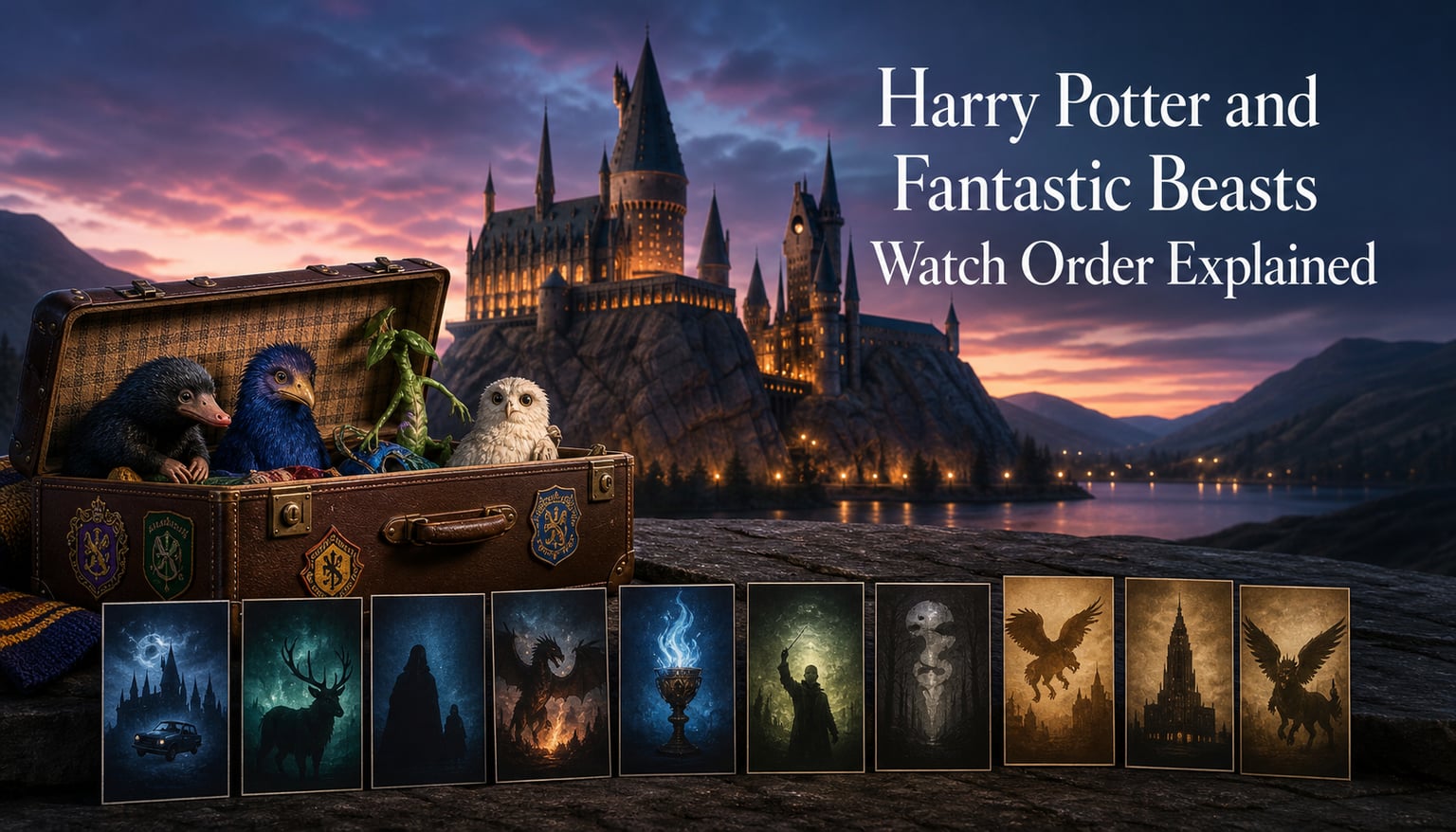
The Harry Potter and Fantastic Beasts watch order has two good answers: watch by release order if this is your first trip through the Wizarding World, or watch chronologically if you want the story’s internal timeline to lead. The complete screen collection currently has 11 films: eight Harry Potter movies and three Fantastic Beasts prequels.
For most newcomers, I recommend beginning with Harry Potter and the Sorcerer’s Stone and saving Fantastic Beasts for afterward. That is the order audiences first received the clues, characters, and expanding history of Hogwarts, and it protects several connections that play better after you know Harry’s story.
Chronological viewing begins about seven decades earlier with Newt Scamander in New York. It can be a rewarding rewatch, especially for viewers who want Albus Dumbledore and Gellert Grindelwald’s history before Harry arrives at Hogwarts, but it changes the way some later revelations land.
This guide gives you both lists, explains the difference without pretending one is mandatory, and answers the question that has left many viewers uncertain: what happened to Fantastic Beasts 4? It also separates what is essential for the central Harry Potter story from what is enjoyable extra context.
Table of Contents
The Harry Potter and Fantastic Beasts watch order explained: start with release order for a first watch
Watch the eight Harry Potter films first, in their theatrical release sequence, then watch the three Fantastic Beasts films in their release sequence. This is the simplest Harry Potter Fantastic Beasts watch order for beginners because the main series teaches the rules, stakes, and history of the Wizarding World as it goes.
If you are rewatching, use chronological order: the three Fantastic Beasts movies first, followed by the eight Harry Potter movies. That order follows the Harry Potter timeline from Newt’s work in the 1920s and 1930s through Harry’s school years in the 1990s.
Quick choice: Choose release order for your first viewing, for younger viewers who need the world introduced clearly, or if avoiding prequel spoilers matters. Choose chronological order when you already know Harry’s story and want the Dumbledore-Grindelwald conflict to come first.
You do not need Fantastic Beasts to understand the Harry Potter plot. The prequels add background about Dumbledore, Grindelwald, wizarding politics, and an earlier era of magic, while Harry’s eight films form a complete story on their own.
The chronological Harry Potter and Fantastic Beasts watch order starts with Newt Scamander
The chronological order below follows when each film is primarily set, not when it reached cinemas. A few entries contain prologues or flashbacks outside their main period, so think of the listed date as the film’s central setting rather than every minute on screen.
Fantastic Beasts and Where to Find Them is first because it is set in 1926
Newt Scamander arrives in New York with a case full of magical creatures, just as tensions rise between the American magical community and the non-magical world. The story introduces the first modern screen version of Grindelwald’s movement and establishes the prequel series as an adult-facing historical branch of the franchise.
It works as a beginning in timeline terms because it has no need for Harry’s school-year plot. Still, a first-time viewer may notice that the film treats certain names and family connections as meaningful before the main series has supplied all their weight.
Fantastic Beasts: The Crimes of Grindelwald is second because it is set in 1927
Newt is drawn into efforts to stop Grindelwald as the dark wizard builds followers across Europe. The film moves much of the action toward Paris and places a younger Dumbledore at the center of the conflict.
This is where the prequel thread becomes more dependent on the first film. Watch it after Fantastic Beasts and Where to Find Them, not as a standalone, because its alliances, family questions, and political threat continue directly from Newt’s earlier adventure.
Fantastic Beasts: The Secrets of Dumbledore is third because it is set in the 1930s
The third film continues the contest between Dumbledore’s allies and Grindelwald, with Newt again helping an international group resist him. It gives the clearest screen focus to Dumbledore’s personal history in the prequel trilogy and puts familiar Hogwarts associations in a much earlier setting.
Although the title sounds like a self-contained Dumbledore chapter, it expects you to know the first two Fantastic Beasts films. Watching in Fantastic Beasts chronological order means treating all three as one unfinished prequel arc before shifting to Harry’s era.
Harry Potter and the Sorcerer’s Stone is fourth because it is set in 1991
Harry learns he is a wizard, enters Hogwarts, meets Ron Weasley and Hermione Granger, and discovers that the school hides a dangerous secret. This is the real starting point for the main Harry Potter franchise and the best first movie for anyone new to the series.
Its place after Fantastic Beasts creates a long jump in the timeline, but the jump is easy to follow. Harry has no knowledge of Newt’s adventures, so the film naturally resets the perspective to a child discovering the magical world for the first time.
Harry Potter and the Chamber of Secrets is fifth because it is set in 1992
Harry’s second year at Hogwarts brings messages on the walls, attacks on students, and the reopened Chamber of Secrets. The movie deepens the school’s past while adding details that matter much later, including a key object tied to Voldemort.
Chronological viewers should not skip it because it starts threads that run through the rest of the Harry Potter movies in order. It also makes the series a little darker while keeping the school mystery format that defines the early entries.
Harry Potter and the Prisoner of Azkaban is sixth because it is set in 1993
During Harry’s third year, the apparent threat of escaped prisoner Sirius Black changes into a story about loyalty, memory, and Harry’s parents. The film introduces time travel, Remus Lupin, and the Marauders’ history.
This entry has a more self-contained mystery than some later films, but its emotional consequences are not temporary. Watching it in sequence gives later choices involving Sirius, Lupin, and Harry’s growing independence the context they need.
Harry Potter and the Goblet of Fire is seventh because it is set in 1994
The Triwizard Tournament comes to Hogwarts, and Harry is forced into a contest he did not enter. What begins with dragons, underwater tasks, and the Yule Ball turns into the point where the series openly returns Voldemort to the center of the story.
The tonal shift matters for a marathon. From here on, the films deal more directly with loss, fear, and a wider wizarding conflict, so it helps to let the early school adventures build toward this moment rather than jumping in at random.
Harry Potter and the Order of the Phoenix is eighth because it is set in 1995
Harry returns to a Ministry that refuses to accept Voldemort’s return, while Dolores Umbridge reshapes life at Hogwarts. Harry, Ron, and Hermione respond by forming Dumbledore’s Army to teach practical defense.
This film ties private school life to the larger political struggle in a way Fantastic Beasts viewers may recognize. Both branches show institutions reacting badly to danger, but Harry’s story stays focused on the personal cost of being disbelieved and targeted.
Harry Potter and the Half-Blood Prince is ninth because it is set in 1996
Dumbledore begins showing Harry memories that explain Voldemort’s past and the Horcruxes that protect him. At the same time, Draco Malfoy faces a task that puts Hogwarts under severe pressure.
This is the film that turns the final goal into a concrete mission. It also explains why the last two films are not optional duplicates: the story continues without a clean ending and needs both parts to resolve Harry’s conflict with Voldemort.
Harry Potter and the Deathly Hallows – Part 1 is tenth because it is set in 1997
Harry, Ron, and Hermione leave Hogwarts to search for Horcruxes while Voldemort’s control spreads. The film is deliberately a road story and a pressure-filled pause before the final battle, with the trio working without their usual teachers or school routines.
Watch it directly before Part 2. The two films adapt the final novel as a connected conclusion, and separating them for too long weakens the tension around the quest, the Deathly Hallows, and the fate of Hogwarts.
Harry Potter and the Deathly Hallows – Part 2 is eleventh because it concludes the story in 1998
The final film returns the conflict to Hogwarts and resolves the war with Voldemort. It pays off relationships, Horcrux clues, and character histories planted across the entire main series.
In chronological order, this is the end point of the current 11-film movie story. The Fantastic Beasts arc occurs far earlier and supplies historical texture, but the emotional resolution still belongs to Harry, Ron, Hermione, and the battle for Hogwarts.
Spoiler warning: Chronological order is not spoiler-free just because it comes first in the timeline. The Fantastic Beasts films assume that names such as Dumbledore and Grindelwald carry importance, and they can frame parts of the later Harry Potter experience differently.
The release order preserves the way the Wizarding World was first revealed
Release order starts with Harry and ends with Fantastic Beasts. It is the recommended order for a first watch because the prequels were made after the eight-film Harry Potter story and frequently build on the audience’s familiarity with that story.
Harry Potter and the Sorcerer’s Stone — released in 2001.
Harry Potter and the Chamber of Secrets — released in 2002.
Harry Potter and the Prisoner of Azkaban — released in 2004.
Harry Potter and the Goblet of Fire — released in 2005.
Harry Potter and the Order of the Phoenix — released in 2007.
Harry Potter and the Half-Blood Prince — released in 2009.
Harry Potter and the Deathly Hallows – Part 1 — released in 2010.
Harry Potter and the Deathly Hallows – Part 2 — released in 2011.
Fantastic Beasts and Where to Find Them — released in 2016.
Fantastic Beasts: The Crimes of Grindelwald — released in 2018.
Fantastic Beasts: The Secrets of Dumbledore — released in 2022.
The dates reveal the practical reason behind this approach: Fantastic Beasts is a prequel and spin-off made years after the main conclusion, not a missing opening chapter. Release order lets the original narrative establish the meaning of Hogwarts, Dumbledore, Voldemort, and the wizarding conflict before the prequels revisit earlier history.
It also makes the change in cast, setting, and tone less abrupt. You complete one eight-film coming-of-age story, then begin a three-film historical adventure centered on Newt rather than switching between eras halfway through a first marathon.
The best order depends on whether you want surprises or timeline context
Choose release order if you have never watched Harry Potter, are watching with someone who has not, or want to experience the franchise’s biggest developments in the sequence built for cinema audiences. This is the advice I would give to a friend who asks where to start, and it matches the concern fans often raise in watch-order discussions: prequels can reveal context before the original story has earned it.
Choose chronological order if you know the main eight films already and want the Harry Potter timeline to flow forward. You will see the older wizarding conflicts, Dumbledore’s earlier life, and a version of Hogwarts long before Harry receives his letter.
Choose Harry Potter only if your goal is the central story. The eight-film run is complete, coherent, and much easier to schedule; Fantastic Beasts adds optional background rather than a required chapter in Harry’s fight against Voldemort.
There is no need to alternate between franchises. The setting gap between the third Fantastic Beasts film and Sorcerer’s Stone is enormous, and no intercut order improves the plot. Keep each trilogy or series intact.
A simple rewatch plan: Watch the eight Harry Potter movies in release order when you want the strongest emotional through-line. Save the three Fantastic Beasts movies for a second pass, or place them first when your aim is specifically a chronological Wizarding World marathon.
The Fantastic Beasts films connect to Harry Potter through history, not required plot homework
Fantastic Beasts takes place decades before Harry Potter, so Harry, Ron, and Hermione do not appear. Its strongest connections are institutions, family names, and people who are already part of the main series’ history, especially Albus Dumbledore and the dark wizard Gellert Grindelwald.
Dumbledore is a Hogwarts professor in the prequels rather than the elderly headmaster Harry meets. Seeing him earlier can add texture to later references, but it also means you meet a familiar figure from a different point in his life and in a different storytelling mode.
Newt Scamander is the author of the Hogwarts textbook called Fantastic Beasts and Where to Find Them in the Harry Potter world. The prequel movies turn that brief book reference into a lead character and use magical creatures as a major part of the action.
Grindelwald matters because his rise and conflict with Dumbledore belong to wizarding history long before Voldemort’s return. The prequels offer context for that history, while the Harry Potter films deliver the story of Voldemort’s Horcruxes and Harry’s role in ending his rule.
Voldemort is not alive during the Fantastic Beasts era. Tom Riddle is born after the core Fantastic Beasts period, so the prequel trilogy is not a hidden early chapter of his plot; its antagonist and conflict are different.
Hogwarts appears in both branches, but its role changes. Harry Potter uses the school as Harry’s home and the center of each year’s mystery, while Fantastic Beasts visits it as one part of a wider international story involving New York, Paris, Berlin, and the British wizarding community.
The complete 11-film marathon takes planning, so split it into manageable sessions
The whole collection runs for roughly 25 hours, depending on which editions and credits you count. That is too much for a relaxed single-day watch, and the late Harry Potter films are emotionally heavier than the early ones.
A comfortable release-order schedule is four early Harry Potter films in one session, four later Harry Potter films in another, then the three Fantastic Beasts movies in a third. This keeps the main story together and avoids placing the two-part finale at the end of an exhausting day.
For chronological viewing, make the three Fantastic Beasts films the first session, then split Harry’s school years across two or three sessions. A break after Goblet of Fire is particularly natural because it marks the shift into the darker half of the saga.
Streaming availability changes by country and service, so check your local platform before planning a movie marathon. The order itself does not change with the service: follow the titles above rather than relying on an app’s collection display.
Fantastic Beasts 4 has no completed follow-up, but “canceled” needs careful wording
Fantastic Beasts 4 was planned as part of a larger prequel series, but there is no completed fourth film in the current 11-movie collection. The three released movies therefore end without turning the wider prequel setup into a finished five-film storyline.
Calling it “canceled” is a useful shorthand for viewers asking why the story stops after The Secrets of Dumbledore, but it can imply a specific formal announcement and a single public reason. The practical answer is simpler: no next installment has been announced or released, so the planned continuation has not happened.
The third film does resolve its immediate confrontation more than a pure cliffhanger would, yet it leaves larger character and political threads open. Go in expecting an unfinished prequel branch, not a final chapter with the same complete ending delivered by Deathly Hallows – Part 2.
That status is another reason Fantastic Beasts is optional for a newcomer. Watch it for Newt, Dumbledore, Grindelwald, and the earlier Wizarding World; do not wait for it before starting Harry Potter, and do not expect a fourth film to complete your understanding of Harry’s story.
FAQs
In what order should I watch Harry Potter and Fantastic Beasts?
For a first watch, see the eight Harry Potter films in release order, from Sorcerer’s Stone through Deathly Hallows – Part 2, then watch the three Fantastic Beasts films. For chronological order, watch the three Fantastic Beasts movies first, then the eight Harry Potter movies.
Why was Fantastic Beasts 4 canceled?
There is no completed or announced fourth Fantastic Beasts film in the current collection. “Canceled” is commonly used to describe the missing continuation of the planned larger series, but viewers should distinguish that from a publicly stated single official reason. The three released films remain an unfinished prequel branch.
Do I have to watch Fantastic Beasts before Secrets of Dumbledore?
Yes, watch Fantastic Beasts and Where to Find Them first, then The Crimes of Grindelwald, before The Secrets of Dumbledore. The third film continues character relationships, conflicts, and plot points established in the first two.
Is Voldemort alive during Fantastic Beasts?
No. The Fantastic Beasts movies are set decades before the Harry Potter story, during the 1920s and 1930s. Their central dark-wizard conflict concerns Grindelwald; Tom Riddle is born later and Voldemort is not part of these films’ present-day plot.
Final Thoughts
For a first visit, watch Harry Potter in release order, then decide whether you want Fantastic Beasts as an earlier-history companion. You will get the clearest introduction to Hogwarts and a complete ending before moving to the prequel era.
For a rewatch, the chronological Harry Potter and Fantastic Beasts watch order offers a fresh way to connect Dumbledore, Grindelwald, Newt, and the school’s later history. Just remember that the prequel story currently stops after its third film, while Harry’s eight-film story provides the full resolution.
Pick a schedule, keep the two-part finale together, and enjoy the films rather than treating the list like homework. With the order settled, the only real choice is whether you want to begin with Harry’s first letter or Newt’s suitcase.