
If you have ever finished watching No Country for Old Men and sat in silence staring at the screen, you are not alone. The film is one of those rare works that refuses to wrap its story in a bow, and that refusal is precisely what makes it so memorable. In this guide to the No Country for Old Men ending explained in full, I am going to walk you through Sheriff Bell’s two dreams, what they reveal about his interior world, and why the Coen Brothers chose to close the film on quiet acceptance rather than a shootout.
I have watched this film more times than I would care to admit, and each viewing reveals something new buried in Tommy Lee Jones’s monologue about fire and his father. By the end of this piece, you will understand not only what Sheriff Bell’s dream means, but why the movie title itself is a clue to the entire story. I will also dig into Anton Chigurh’s coin toss philosophy, the novel-versus-film differences for Carla Jean, and the historical West Texas drug trade that shaped Sheriff Bell’s retirement.
The Coen Brothers adapted Cormac McCarthy’s 2005 novel in 2007 and won the Academy Award for Best Picture that same year. Critics praised the film for its restraint, but audiences sometimes walked out of the theater frustrated. I think that frustration is part of what the Coens wanted. They did not want you to leave satisfied. They wanted you to leave the way Sheriff Bell leaves his office for the last time, holding something you cannot quite name.
Table of Contents
What Happens at the End of No Country for Old Men?
The final act of No Country for Old Men unfolds through a series of unresolved confrontations. After the hotel shootout where Llewelyn Moss is shot and left bleeding in a hotel room, the story skips forward months. Carla Jean, now alone and grieving, is visited by Anton Chigurh at her mother’s old house. He gives her a coin toss for her life and leaves her with the question: “What side does the coin come up on?” She calls it, and the film does not show the result.
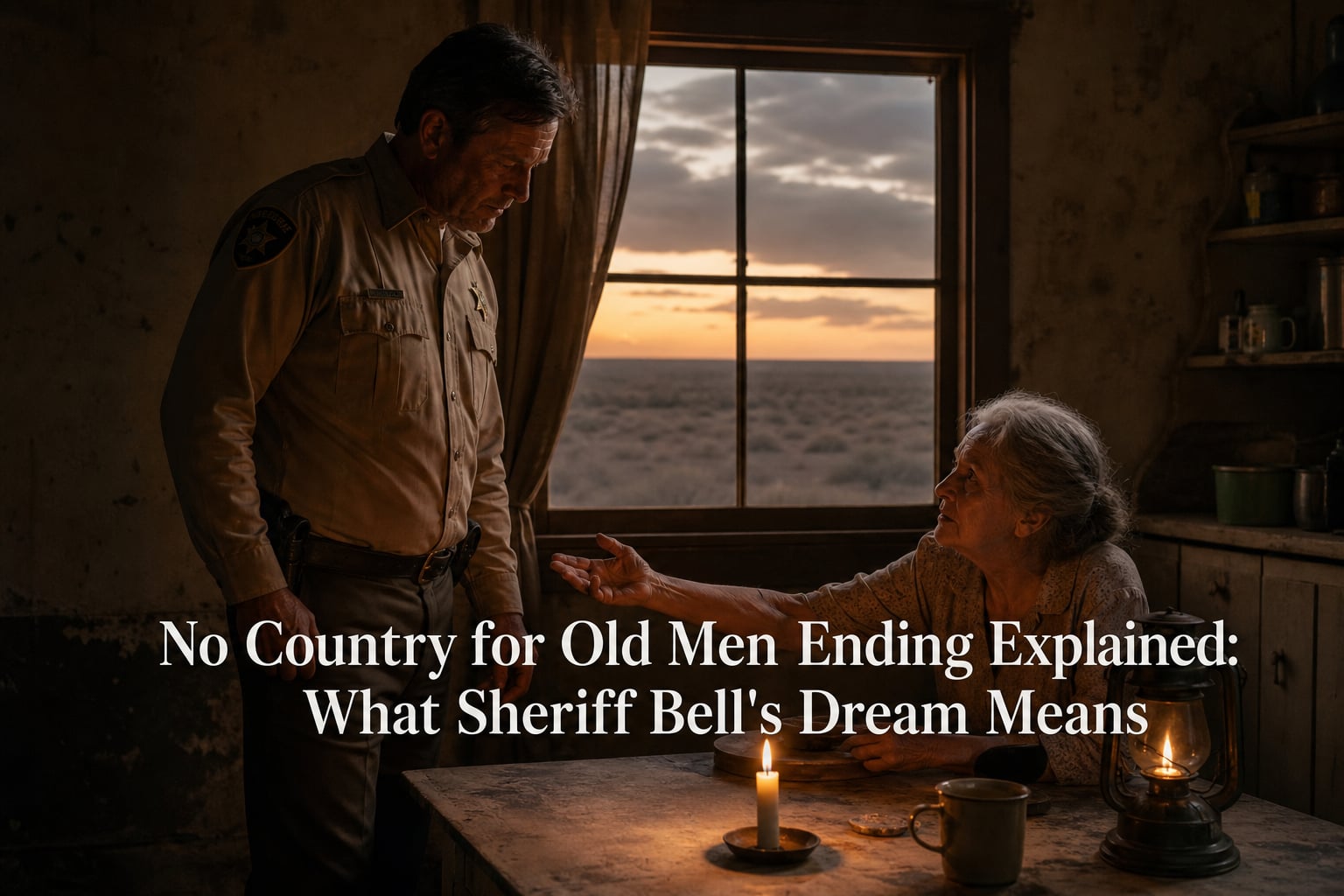
Then the narrative shifts to Sheriff Ed Tom Bell, who has quietly retired. He is sitting with his wife Loretta over breakfast when she tells him a dream she had about her father. This prompts Bell to share two of his own dreams, delivered in the now-famous monologue that closes the film:
“I had a dream. In the dream I had the same one as my father before me. I dreamed I was riding through the country, and I was riding through the country, and I came to a place, and it was dark, and I couldn’t see nothing, and I could hear my father and my uncle talking. They were talking about the fire. And pretty soon I could see the fire, and the sparks. I could see my uncle and father. They weren’t talking at all. They were sitting on a blanket, watching the fire. I wanted to get up and go to them, but I couldn’t move. Couldn’t move at all.”
That moment, the inability to reach his father, is the emotional and thematic heart of the No Country for Old Men ending explained in any meaningful way. The viewer hears the words, sees Loretta’s hand reach across the table, and then the screen goes black. There is no third-act rescue. There is no gunfight on the porch. There is only a sheriff’s confession and the sound of his wife’s breathing while she holds his hand.
This is also where the film differs most sharply from its genre. Westerns traditionally end with the sheriff riding off into a sunset he has earned. Thrillers traditionally end with a final twist or a clearly labeled villain getting his comeuppance. The Coen Brothers give us neither. They give us a man who has already retired and a wife who has already accepted his limits. The drama is over. What remains is the silence after the last shot was fired somewhere off-screen.
Sheriff Bell’s First Dream: The Lost Money
The first dream Bell recalls is set in his boyhood and is told to him by his uncle Ellis. In the dream, Bell’s father gives him some money to take in to his uncle while the younger men sit around a campfire. Bell falls asleep holding the money. His father and uncle talk about the fire while he is sleeping, and when he wakes, he discovers the money is gone.
The lost money in Bell’s first dream is not about currency. It represents moral values that his father and the older generation tried to pass on to him, a sense of right and wrong, of justice, of restraint. The fire represents the world around him, the cold and darkness that are closing in. Bell falls asleep and fails to protect what was entrusted to him. He wakes up to discover that the framework of values he was meant to carry into adulthood has slipped away without him noticing.
This dream haunted Bell for decades because it became his life’s defining failure. He became a sheriff, dedicated himself to law and order, and still the moral currency he was handed disappeared on his watch. When he tells this dream to Loretta, he is admitting to her and to himself that he has lived a long life only to wake up and find he has lost the very things he was supposed to guard.
There is also a more personal layer. The first dream embodies Bell’s lingering guilt over the death of Llewelyn Moss. Even though Moss made choices that put him on the path to his death, Bell feels a failure in protecting him. The money Bell lost in the dream is a stand-in for the lives he could not save despite his badge and his decades of service. That guilt does not diminish across the entire runtime of the film; it grows heavier.
When you understand this, you understand why Bell calls the first dream “a hard one to lose.” He is not talking about his father. He is talking about the life he tried to live and the things he could not preserve. The fire in that dream was the world burning around him while he slept, and the missing money was the time-honored rules he could not pass on to the next generation.
Sheriff Bell’s Second Dream: Fire in the Dark
The second dream is the one that ends the film and the one viewers most often ask about. In it, Bell is riding through the cold, dark countryside. His father is ahead of him on horseback, riding with a group. Bell cannot catch up. His father rides to a place where a fire is burning in the dark. His father and the older riders dismount, wrap themselves in blankets, and sit peacefully by the fire while the cold and darkness press in on all sides.
Bell tries to reach them, but he cannot move. He is held at a distance from the comfort and clarity his father represents. The fire is the safety and protection of the old world, the one Bell was raised in, where there were clear answers about right and wrong, where authority carried weight, and where the law could hold back the darkness. His father and his father’s generation have already reached that place. Bell is still out in the cold.
Dream interpretation here is rich because the second dream mirrors the first but inverts the emotional register. In the first dream, Bell loses something in the dark. In the second, he is searching for something he can never quite reach. Both dreams are about distance. Distance from the values he inherited, and distance from the men who modeled those values for him. By the time he tells this dream to Loretta, he has come to terms with that distance. He will not catch up. He will not reach the fire. That is the tragedy and the peace of the ending.
This moment, Bell sitting at the kitchen table, telling his wife he will not go further, accepting that he has done what he could, is what makes the No Country for Old Men ending not just explained but earned. The Coen Brothers let the film close on a confession that is not about the case, not about Chigurh, not about Moss. It is about a man facing the limits of his own strength.
There is also a generational echo in the second dream that I find personally devastating. Bell says his father passed through the fire ahead of him, and that he, Bell, is older now than his father ever was. That single line tells you everything about the weight Bell has been carrying. He has outlived not just his father, but the framework his father represented. When he tells Loretta about the dream, he is mourning a country that no longer exists and admitting he cannot restore it.
What the Ending of No Country for Old Men Means
Three overlapping ideas carry the thematic weight of the film. The first is fate versus free will, embodied most starkly in Anton Chigurh’s coin toss scenes. Chigurh believes that everything happens for a reason and that randomness hides an unseen order. He lets the coin decide whether someone lives or dies, then walks away satisfied either way. When he is asked by Carla Jean which outcome matters, the question rattles him, because his entire moral framework collapses if the answer is “neither.”
The second theme is the decline of moral certainty. Bell represents an older American archetype, the small-town sheriff who believes in honest work and the long arm of the law. The Texas-Mexico drug war of the early 1980s broke that framework in real life. Violence that came across the border did not respond to a badge. Evil that moved like Chigurh did not leave a trail a sheriff could follow. Bell did not fail because he was weak. The world changed underneath him.
The third theme is indifference. The Coen Brothers do not wrap their antagonist in a cathartic capture. Chigurh survives a car crash off-camera, smiles at a passing stranger, and disappears into ordinary life. The novel by Cormac McCarthy is unapologetic about this: in the book, the reader is told outright that Carla Jean is dead at the hands of Chigurh, that the money is never recovered, and that Moss dies in a roadside motel off-screen. The film adaptation preserves every one of those silences. The audience is forced to accept that the meaningful things happened where we could not see them.
Together these themes create the No Country for Old Men ending explained as a meditation on aging into a world you did not build and cannot fix. Bell is not a tragic hero. He is a witness who outlives the era that gave him purpose. The ending we get is the only honest ending, and it positions the entire film as something closer to classical tragedy than to modern genre cinema.
Some viewers find this frustrating. I used to count myself among them. After a few more rewatches, I came to understand that the frustration is itself part of the film’s argument. We live in an era of resolutions, of third-act twists, of stitched-together endings. The Coens ask you to sit with a feeling that is closer to grief than to closure, and that is the entire point.
Why the Coen Brothers Ended It This Way?
Joel and Ethan Coen have spoken about this film in interviews, and their reasoning is consistent with what the screenplay shows. They were deeply faithful to Cormac McCarthy’s novel, which itself closes with Bell’s two-dream monologue. The Coens understood that what makes the book hit hard is precisely what makes some viewers uncomfortable: it refuses to deliver satisfaction.
This decision runs counter to almost every convention of the Western and the modern thriller. We expect a final confrontation. We expect the hero to outdraw the villain, or at the very least to explain what happened in a courtroom scene. The Coens refuse both. They give us a long, quiet kitchen scene with two older people sitting over coffee, and they trust us to feel the weight of what is being said.
The choice to kill Llewelyn Moss off-screen is the most daring of those directorial decisions. Moss had been our entry point into the world of the film, the character whose choices drove the narrative momentum. To drop him without a funeral, without a scene, without even a corpse for us to mourn, was a deliberate rejection of audience expectations. The effect is vertigo. We have followed a man through three hundred miles of Texas and we do not even get to see how he dies. That decision tells us the universe of this film does not owe us a narrative.
Chigurh gets the same treatment. After one of the more chilling scenes in modern cinema, the coin flip with Carla Jean, we see him in the aftermath, walking away from a car crash with nothing more than a paper cut. He looks disheveled, almost confused. Then he buys a shirt at a convenience store and walks out into traffic, his fate left unresolved. The Coens have said in interviews that Chigurh represents an idea more than a man, and ideas do not resolve neatly.
There is also a craft argument for the ending that often gets overlooked. The film is a deliberate deconstruction of the Western genre. Where John Ford would have given us Monument Valley and a heroic silhouette, the Coens give us flat brown grasslands and a kitchen table. By stripping away the genre’s recognizable signifiers, they force us to read the ending as character study rather than as plot resolution. Bell’s dreams are the only climax the film allows itself, and that restraint is exactly the point.
What Does the Title ‘No Country for Old Men’ Mean?
The title is lifted directly from W.B. Yeats’ poem “Sailing to Byzantium,” first published in 1928. The full line from the poem reads: “That is no country for old men.” In the poem, Yeats laments the loss of his youthful vigor and turns to a mythical, eternal land where he might escape the decay of age. The Coens borrow the phrase and invert it. Their “old men” do not get to escape into Byzantium. They get a kitchen table, a confession, and a quiet acceptance that the world has moved on.
The title’s meaning is also literally realized in Sheriff Bell’s situation. The West Texas he patrolled in the 1960s and early 1980s is no longer the country his father knew. It is a country for Chigurh and for the men who operate the drug pipelines Bell can no longer effectively pursue. Bell is the old man, and he is being told, gently, by the universe itself that he no longer fits.
This connects directly to the second dream. The fire his father rides toward is the Byzantium Yeats imagined, a place of wisdom, rest, and clarity. Bell cannot get there because he is not finished yet. He still has to accept that the distance is permanent. That is the final word of the film, and it is the meaning of the title.
The Coen Brothers made this title choice deliberately, and it is reinforced by every visual and narrative choice in the film. The country Sheriff Bell knew has changed. The country Sheriff Bell’s father knew is gone. The country Sheriff Bell’s son will inherit is not a country at all, but a vague borderland where meaning is decided by coins and accident. There is no Byzantium for Bell, and there is no Yeatsian escape. There is only the fire in the dream that he cannot reach.
FAQs
What does Sheriff Bell’s dream mean at the end of No Country for Old Men?
Sheriff Bell’s dream means that he has come to accept he can no longer reach the values his father’s generation carried. The fire his father rides toward represents the safety of an older moral order that Bell cannot quite join, and his inability to move captures his final resignation that he has outlived the world he was built to protect.
What was Sheriff Bell’s dark secret?
Bell’s dark secret was his lingering guilt over the death of Llewelyn Moss. He blamed himself for not preventing Moss’s death despite knowing that Moss’s own choices set those events in motion, and this guilt is encoded in the lost-money imagery of his first dream.
What do Sheriff Bell’s dreams mean?
Bell’s two dreams both use the imagery of fire and the cold dark night. In the first, he loses money entrusted to him, which symbolizes the moral values the older generation tried to pass on. In the second, he rides through darkness trying to reach his father by a fire, which represents his acceptance that he cannot catch up to the men who came before him.
Why is Llewelyn killed off-screen?
Llewelyn is killed off-screen because the Coen Brothers wanted to deny the audience the conventional climax. By refusing to show his death, they underscore the film’s central idea that the universe does not owe the viewer a story, just as it does not owe Sheriff Bell a chance to set things right.
Does Chigurh kill Carla Jean?
The film never confirms Chigurh’s killing of Carla Jean visually, but Cormac McCarthy’s novel states outright that he killed her. The Coens preserve the ambiguity because their thesis is that meaningful events often happen off-screen, and the weight of the loss is carried by Sheriff Bell’s guilt, not by a scene of violence.
Conclusion
Sheriff Bell’s two dreams end No Country for Old Men not with a bang, but with a quiet kitchen confession. The fire his father rides toward is the safety of an older world Bell cannot enter. The money he lost as a boy is the moral inheritance he could not pass on. When I sit with the film now, I find that what lingers is not Chigurh’s coin toss or Moss’s death, but Loretta Bell reaching across the table for her husband’s hand. That small gesture is the real ending. Everything else is what Bell could not protect.