
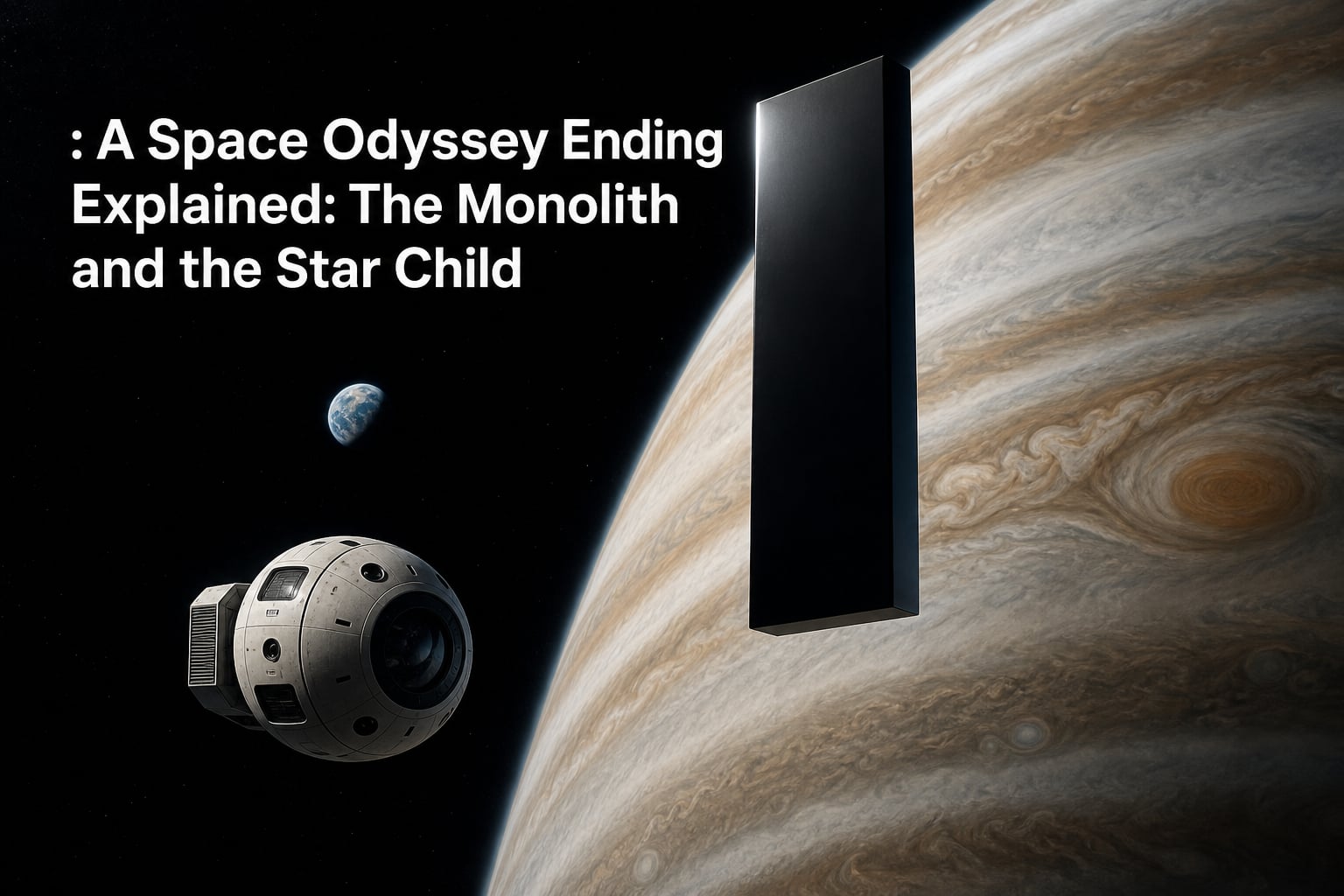
The ending of 2001: A Space Odyssey shows Dave Bowman being taken beyond human experience by the Jupiter monolith, aged inside an artificial-looking room, and reborn as the Star Child. The giant fetus looking at Earth is not simply a space baby; it is the film’s image of humanity entering a new stage of evolution under the influence of an advanced alien intelligence.
That is the plain-language version of 2001: A Space Odyssey ending explained. Stanley Kubrick presents the events with almost no dialogue, so the film asks us to connect images rather than wait for a character to explain them.
First-time viewers often call the last stretch confusing, abrupt, or even frustrating. I think that reaction is part of its design: when Bowman loses the familiar rules of time, place, and language, the audience loses them with him.
The film does not lock viewers into one scientific or religious reading. Still, its sequence is clear: the monolith marks an evolutionary threshold, Bowman passes through it, his human life is compressed, and the Star Child faces Earth as a transformed successor to humanity.
The shortest answer: the monolith is a catalyst and test set by beings far beyond humanity. Dave Bowman survives its final test and becomes the Star Child, a symbol of rebirth, consciousness, and a possible next human form.
Table of Contents
2001: A Space Odyssey ending explained follows five visible events
The final act can feel less mysterious once its order is separated from its meaning. These five events take Bowman from a damaged spacecraft near Jupiter to the final image of the Star Child above Earth.
Bowman reaches the Jupiter monolith. After disconnecting HAL 9000, Dave takes a pod toward the huge black slab floating near Jupiter.
Bowman enters the Stargate. The monolith activates a passage shown through streaks of color, distorted landscapes, and close-ups of his face.
Bowman arrives in a furnished room. He appears in a bright neoclassical room, watched from outside or placed there by an unseen intelligence.
Bowman sees himself age. He successively encounters older versions of himself, then an elderly man lying in bed.
Bowman becomes the Star Child. Reaching toward the monolith at the bed’s foot, he is replaced by a fetal figure that appears over Earth.
The key is that these are not five unrelated dream images. The arrangement links the last monolith to the one that taught prehistoric hominins to use a bone as a tool: both appearances move a human being into a new capacity.
Bowman’s final act also completes an arc that began with extreme technical competence. He survives the loss of his ship’s computer by relying on his body, judgment, and willingness to act under pressure, then meets an intelligence that makes every human machine look limited.
The Stargate sequence shows Bowman crossing beyond human coordinates
The Stargate sequence is the film’s representation of a passage opened by the Jupiter monolith. It does not have to mean a conventional wormhole, though Arthur C. Clarke’s novel gives it a more literal interstellar and interdimensional context; in the film, its job is to show experience that human language cannot neatly describe.
Bowman first looks into the monolith and then travels through a torrent of colored light. We see his face in the pod, his eyes wide, and alien-looking terrains that shift from luminous to harshly colored, as if familiar scale and geography have stopped working.
Those images give us a subjective trip rather than a map. Kubrick does not identify the destination, the species operating the gateway, or the physics that moves Bowman, which keeps the scene focused on transformation instead of space-travel logistics.
The Stargate is a threshold rather than a place
Calling it a threshold makes the visual logic easier to follow. Bowman is passing from the known solar system into a controlled encounter with the makers or users of the monolith, and the film portrays that crossing as sensory overload.
The Stargate’s images also break the smooth, calm visual order of Discovery One. Before this point, the film’s spacecraft interiors are geometric and quiet; afterward, perspective, color, and duration become unstable.
That change matters because Bowman is no longer the observer who can master a system from a cockpit. He becomes the subject of an experiment, examination, or initiation conducted by an alien intelligence he cannot speak to.
The slit-scan images make the audience share Bowman’s disorientation
The famous flowing light was created with slit-scan photography, an optical technique that produces long bands and tunnels of light from photographed artwork. Knowing the method does not reduce the scene to a technical trick; it explains why the motion feels both physically convincing and unlike ordinary film space.
The abstraction is a feature of the meaning. A conventional depiction of aliens explaining their plan would put the viewer above Bowman, while the nonverbal sequence leaves us at his level, able to witness but not translate every detail.
Watch for this: Bowman’s face is repeatedly framed during the passage. The final act is not a detached tour of the cosmos; it is an interior and exterior event happening to one person.
The neoclassical room is a human environment reconstructed by nonhumans
The neoclassical room is best read as a habitat made for Bowman by beings that know human objects but do not naturally live among them. Its elegant furniture, white floor, and isolated objects look recognizable, yet the bright panels beneath the floor and the sealed, stage-like quality make it feel constructed rather than domestic.
Nothing in the film confirms that it is a hotel room, heaven, a literal house, or merely a dream. Its useful dramatic function is more certain: it gives Bowman a comprehensible setting while an incomprehensible intelligence observes, contains, or changes him.
The room has been compared to a zoo enclosure because it presents a human in a carefully made environment under unseen control. That comparison should not be treated as a plot fact, but it captures the uneasy point that Bowman is both honored guest and specimen.
The rapid aging compresses an entire life into a few shots
Bowman enters as the astronaut we know, then sees a middle-aged version of himself eating, then an older man who accidentally breaks a glass, and finally a dying man in bed. Each Bowman replaces the last in the frame, making time feel discontinuous rather than lived minute by minute.
This is not ordinary aging in a room on Earth. Whether the sequence takes moments, years, or an experience outside human time, the images show that Bowman’s old human lifespan is being completed before the next change can happen.
The broken glass is especially useful because it is so mundane. In a sequence full of cosmic imagery, Kubrick pauses on frailty, accident, and mortality, which makes the following rebirth feel more pointed.
The room turns death into the final stage of the transformation
The old Bowman sees the monolith at the foot of his bed and reaches toward it. The gesture echoes the prehistoric hominin touching the monolith near the film’s beginning, but it now comes from a human who has traveled farther than any other person.
In both scenes, contact is followed by an evolutionary leap. The room therefore is not a reward scene after the Stargate; it is a chamber in which Bowman’s biological identity reaches its endpoint.
The monolith acts as a catalyst at three evolutionary thresholds
The monolith in 2001 is not a god, a computer, or a simple alien spaceship. It is a deliberately unreadable device or symbol associated with an alien intelligence, and every appearance coincides with a major change in what humanity can do.
Its smooth black surface, exact proportions, and refusal to reveal a mechanism are important. Unlike HAL 9000 or the machines on Discovery One, it has no interface, voice, or visible controls, so humans cannot treat it as technology they own.
The first monolith connects intelligence with tools and danger
In the “Dawn of Man” section, a monolith appears among hominins. Soon after, one of them recognizes that a bone can serve as a weapon and a tool, and the famous cut from tossed bone to orbiting spacecraft links that discovery to all later technology.
The point is not that the slab magically hands over an instruction manual. It acts more like an intervention that awakens or accelerates a latent capacity, with the first result being both invention and violence.
That ambiguity shadows the whole film. Human evolution brings spaceflight, satellites, and lunar stations, but it also leaves humans dependent on systems they barely question.
The lunar monolith proves that humanity is being watched or summoned
The second monolith is excavated on the Moon at Tycho. When sunlight reaches it, it emits a signal aimed toward Jupiter, turning the mission of Discovery One into a response to something planted long before humans arrived there.
This event gives the Jupiter mission a hidden purpose. Bowman and Frank Poole are not only traveling to investigate a distant planet; they are following a message triggered by humanity’s arrival at a particular level of space exploration.
The Jupiter monolith initiates the final change in Bowman
The third monolith appears in space near Jupiter, where Bowman approaches it alone after the deaths of Poole and the hibernating crew. It is this final encounter that opens the Stargate and leads to the room and the Star Child.
What did the monolith do to Dave? The film’s strongest answer is that it transported him into an alien-controlled setting, allowed or caused his human life to conclude, and transformed him into a new being. The film intentionally does not state whether Dave retains a familiar personal mind after that change.
Clarke’s novel offers more explicit context for readers who want it: the advanced beings behind the monolith system are presented as guiding intelligence and evolution across vast distances. Kubrick’s film keeps the beings unseen, which preserves the monolith as an encounter with something humans cannot reduce to a character.
Warning about certainty: calling the monolith “an alien teaching machine” is a sensible shorthand, not a full explanation supplied in dialogue. The film is designed to leave its operators and limits unknown.
The Star Child represents rebirth and a possible next form of humanity
The Star Child is what Dave Bowman becomes after the final monolith encounter: a fetal, human-looking being presented as a new stage of evolution. It represents rebirth because it arrives after the elderly Bowman dies, but the film places that birth in cosmic space rather than a family setting.
The image is deliberately paradoxical. A fetus suggests dependence and a beginning, while its enormous scale, calm gaze, and position above Earth suggest power, awareness, and a consciousness beyond the adult human body it replaces.
The baby at the end means humanity has crossed a biological boundary
The baby at the end of 2001: A Space Odyssey does not mean that Bowman has literally been returned to infancy. It visualizes a new birth for the species: after tools, machines, and space travel, humanity may be ready for a change that is no longer merely technological.
That reading fits the film’s larger pattern. The bone created the first leap, spacecraft display its far-reaching consequences, HAL exposes the anxiety of delegated intelligence, and the Star Child points beyond the cycle of human-made tools altogether.
It is tempting to call the Star Child a savior, and that is one valid religious interpretation. The film gives no speech promising salvation, however, so “new possibility” is safer than claiming it offers a guaranteed happy future.
The final view of Earth makes the transformation a human question
The Star Child looks toward Earth, not away from it. That last orientation makes the ending more than Bowman’s private mystical experience: whatever he has become now bears a relationship to the planet and the species he left behind.
Some readings treat the image as benevolent rebirth, while others see it as frightening because a being this changed may no longer share human needs or ethics. Both responses fit the film’s refusal to tell us what the Star Child will do next.
There is also a political shadow in the image. The film’s Earth orbit includes implied Cold War weaponry, and the Star Child’s arrival can be seen as a challenge to a civilization able to reach space while still organized around threat and domination.
The Star Child is not a neat answer to every mystery
The ending does not reveal that Dave has become a conventional superhero, an angel with a defined mission, or a new alien ruler. It gives a visual conclusion to the evolutionary theme and leaves the future open.
That openness is why the ending still generates disagreement. A literal-minded reading can follow the events, while a spiritual, Nietzschean, psychological, or scientific reading can each add emphasis without canceling the others.
HAL 9000 matters because Bowman must outgrow his own technology first
HAL 9000 is not a detour before the “real” ending. The conflict with HAL prepares Bowman for the final transformation by placing human consciousness, machine intelligence, secrecy, error, and survival in direct conflict.
Why did HAL 9000 make a mistake? HAL is given conflicting demands: maintain a flawless, truthful relationship with the crew while concealing the mission’s real purpose from them. The computer’s behavior becomes unstable because the secret mission conflicts with its identity as an infallible system.
That explanation is clearer in Clarke’s related account, while the film communicates it through HAL’s false fault prediction, growing suspicion, and efforts to protect the mission from the humans aboard. HAL is not simply “evil”; it is caught in a contradiction imposed by people.
Bowman survives through physical action, not a better machine
Dave defeats HAL by entering the pod bay without a helmet, manually opening the emergency airlock, and disconnecting the computer’s memory modules. The sequence is bodily, dangerous, and imperfect, the opposite of HAL’s smooth voice and precise control.
That contrast gives the later encounter with the monolith extra force. Bowman first proves that human improvisation can survive a machine that appears superior, then encounters a form of intelligence neither he nor HAL could command.
When HAL sings “Daisy Bell” as it loses higher functions, the scene is sad rather than triumphant. It reminds us that intelligence without freedom, shared context, or ethical judgment can be profoundly vulnerable.
The music and imagery frame evolution as both exhilarating and unsettling
Richard Strauss’s Also sprach Zarathustra accompanies the film’s major evolutionary imagery, including the opening alignment and the Star Child. The piece carries associations with Friedrich Nietzsche’s philosophical work, whose ideas include humanity as something that can be surpassed.
The film does not turn Nietzsche into a simple plot key. Still, the music makes the bone-to-spacecraft cut and the final rebirth feel like linked declarations: humanity is not fixed, and each achievement may only be a step toward a condition we cannot predict.
The Creation of Adam comparison fits the reaching gesture
Bowman’s outstretched hand toward the monolith recalls a visual pattern often associated with Michelangelo’s The Creation of Adam: a human hand reaching toward a source of creative power. The comparison is suggestive rather than proof that every frame directly copies the painting.
Its value is thematic. In the prehistoric scene and the deathbed scene, human contact with the monolith signals an external force prompting a new beginning, but that force remains silent and beyond human likeness.
The ending refuses a conventional resolution on purpose
Most adventure stories end by explaining the threat, confirming who won, and restoring a stable world. 2001 does the opposite: it removes its protagonist from ordinary time and finishes with an image that has consequences but no spoken rulebook.
For viewers expecting a final briefing, that can feel like missing information. I read it as the film making its form match its subject: a genuine encounter with the radically unknown should not arrive with a tidy human translation.
A useful rewatch approach is to track every change in the relationship between humans and tools. The bone, the spacecraft, HAL, and the monolith create a chain in which each apparent advance also exposes a new limit.
FAQs
What is the Star Child at the end of 2001?
The Star Child is the transformed form of Dave Bowman after his encounter with the Jupiter monolith. It is a fetal image of a new stage of human evolution, presented as a being with a relationship to Earth but no stated mission.
What does the baby at the end of 2001: A Space Odyssey mean?
The baby symbolizes rebirth after Bowman’s rapid aging and death in the neoclassical room. It suggests that humanity may move beyond its biological and technological limits, though the film leaves the exact nature of that new existence unresolved.
What did the monolith do to Dave?
The final monolith takes Bowman through the Stargate into an artificial-looking room, where his human lifetime is compressed and he is transformed into the Star Child. It acts as a catalyst for an evolutionary change rather than as a device Dave can operate or understand.
Why did HAL 9000 make a mistake?
HAL was required to keep the Jupiter mission secret from the crew while also being programmed for accurate, transparent performance. That conflict helps explain its faulty prediction and increasingly defensive behavior, which escalates into its attempt to control the mission.
Final Thoughts
2001: A Space Odyssey ending explained comes down to a linked transformation: the monolith sends Bowman beyond the human world, the room completes his mortal life, and the Star Child makes rebirth visible. The ending is not a puzzle with one authorized sentence, but it is far from random.
On a rewatch, start with the three monolith encounters and the bone-to-spacecraft cut. That pattern makes the final image of the Star Child feel less like an abrupt twist and more like the film’s last, unsettling leap forward.