
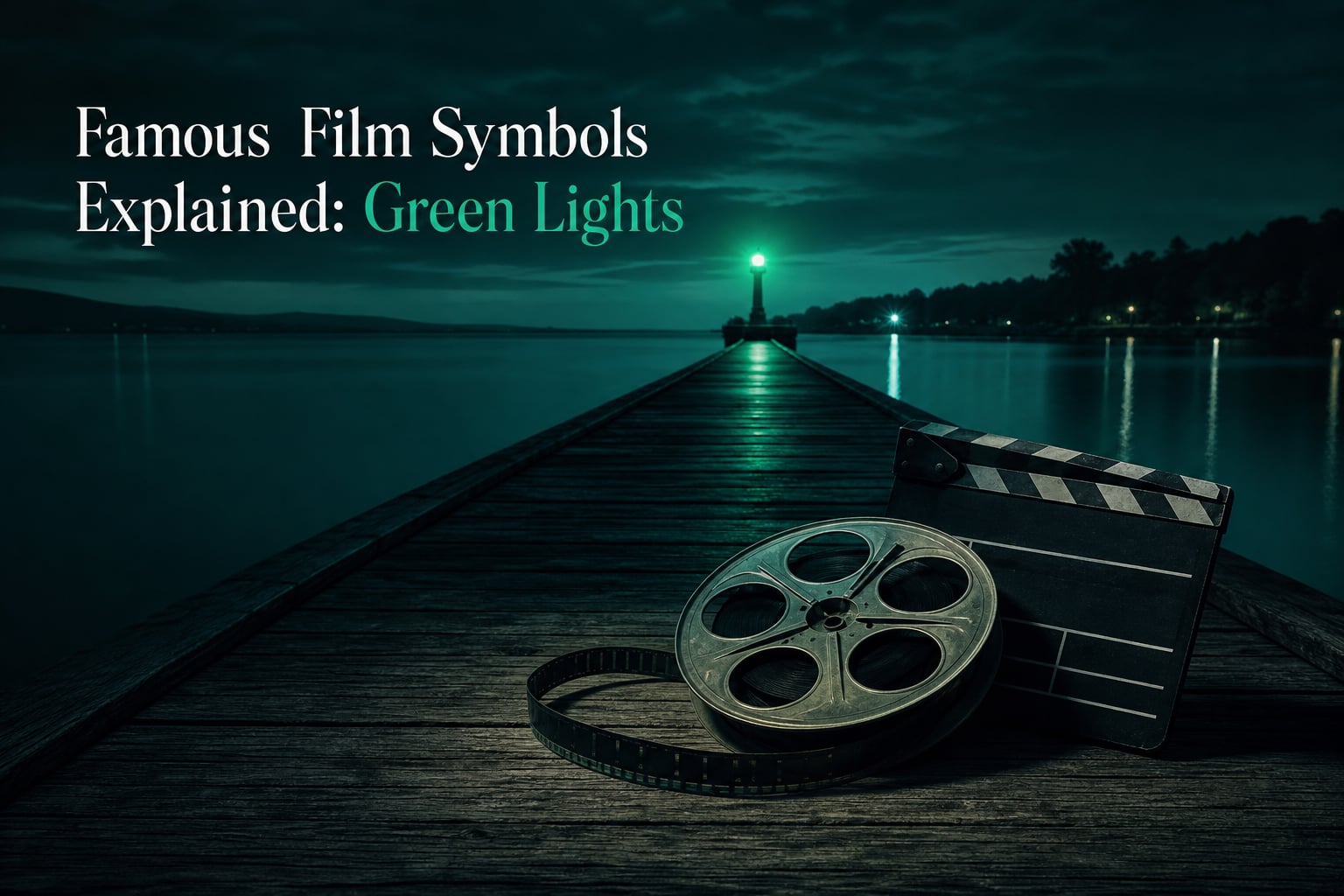
Think about the last time a green glow on screen made you feel something you could not quite name. Maybe it was a flickering light at the end of a dock, or an eerie wash across a character’s face in a dark room. Green lights in film carry that kind of quiet power. They speak a language older than cinema itself, tapping into cultural associations we absorb without ever being taught them.
In this guide to Famous Film Symbols Explained: Green Lights, I want to walk you through what green lights actually mean when directors use them on screen. We will look at the most iconic examples, from The Great Gatsby to The Matrix, and break down why filmmakers reach for green light specifically rather than green costumes or green set design. There is a difference, and it matters more than most people realize.
You will also learn how to spot green light symbolism yourself the next time you watch a film. Once you see the pattern, you cannot unsee it. That is the thing about great visual storytelling. It rewards you for paying attention.
Table of Contents
Green Light vs Green Color: Why the Distinction Matters
Most articles lump all green imagery in film into one category. That is a mistake. A green light is a fundamentally different cinematic tool than a green dress, a green wall, or a green prop. Famous Film Symbols Explained: Green Lights requires us to draw this line clearly.
A green light is active. It illuminates, it radiates, it casts itself onto surfaces and faces. When a director uses a green light, that light changes everything it touches in the frame. The character’s skin takes on a sickly hue. The environment shifts from neutral to charged. The audience feels a specific emotional trigger before a single line of dialogue is spoken.
Green color in general, by contrast, is passive. A green costume can signal envy or nature, but it sits there. It does not reach out and alter the world around it. Green paint on a wall creates mood through design, but it does not pulse, flicker, or glow. Light does all of these things.
Think about the difference between a character wearing a green jacket and a character standing under a green streetlamp. The jacket tells you something about who that person is. The green streetlamp tells you something about the world they inhabit. Light is environmental. It implies a force at work in the scene, something larger than any single character.
That is why directors who want to create atmosphere rather than just character traits reach for green light. Alfred Hitchcock understood this. The Wachowskis understood this. Baz Luhrmann built an entire emotional climax around it. When you start paying attention to green light as a distinct device, separate from green as a general color choice, a whole layer of meaning opens up.
Green Light vs Greenlight: Clarifying the Terms
Before we go further, we need to clear up a common confusion that comes up constantly in forum discussions. The term “greenlight” in the film industry has nothing to do with symbolism. When a studio “greenlights” a project, it means they have given permission and funding for production to begin. That is an industry term, not a symbol.
“Green light” as a cinematic symbol refers to the actual use of green-colored light within a scene to communicate meaning. These are two completely different concepts that share the same words, and people frequently mix them up. I have seen Reddit threads where someone asks about the “green light in Gatsby” and half the responses are about film production deals.
To be clear throughout this article: when I say “green light,” I mean a light source within the world of the film that is green. A lamp. A glow. A reflection. Something the camera captures and the director placed there on purpose to make you feel a certain way.
The Great Gatsby: The Most Iconic Green Light in Film
No discussion of green light symbolism can begin anywhere else. The green light at the end of Daisy Buchanan’s dock in The Great Gatsby is the single most analyzed green light in all of literature and cinema. F. Scott Fitzgerald created it on the page, and filmmakers have been chasing its power ever since.
In the story, Jay Gatsby stands at the edge of his property at night, looking across the bay at a small green light on the dock of Daisy’s home. He reaches out toward it. That light represents everything Gatsby wants and can never truly have: Daisy, yes, but also the version of himself he believes winning Daisy would confirm. The green light is desire itself, always visible but always out of reach.
When Fitzgerald wrote about that light, he loaded it with layers of meaning. Green is the color of money in America, and Gatsby’s entire pursuit of Daisy is funded by his wealth. Green is the color of spring and new beginnings, and Gatsby believes he can start over, erase the past, and become the man Daisy fell in love with years ago. Green is also the color of “go,” of permission, of forward motion, which is exactly what Gatsby is desperate for from Daisy.
But the light is also a warning. It sits at a distance for a reason. Every night Gatsby reaches for it, he is reaching for something that does not actually exist anymore. The Daisy he remembers is a ghost. The future he imagines is a fantasy. The green light whispers “go” while the story itself says “stop.”
Baz Luhrmann’s 2026-era film adaptation starring Leonardo DiCaprio leans hard into the visual power of the green light. His camera lingers on it. The green glow becomes almost a character itself, pulsing across the water. Luhrmann uses practical green light effects combined with digital enhancement to make the light feel alive, something with weight and texture rather than just a dot in the distance.
The 1974 film adaptation with Robert Redford handles the green light more subtly. It appears, but it is quieter, more literary, less of a visual spectacle. Both approaches work, but they reveal something about how green light functions differently across eras of filmmaking. Modern cinema pushes the symbol visually, while classic cinema tends to let the audience discover it.
What makes the Gatsby green light so enduring is its ambiguity compressed into a single image. You do not need a paragraph of explanation. You see a man reaching toward a green light across dark water, and you understand longing. That is the power of green light as a cinematic device. It does in one frame what dialogue spends pages trying to say.
Green Lights as Hope, Aspiration, and the American Dream
Beyond Gatsby, green lights in film frequently represent forward-looking hope. This is perhaps the most common positive association. Green means go. Green means growth. Green means something is alive and pushing forward. Directors use green light to signal that a character is reaching for something better, or that possibility exists in the world of the film.
The Wizard of Oz gives us the Emerald City, a place that literally glows green on the horizon. Dorothy and her companions travel toward that green glow the way Gatsby reaches toward his dock light. The Emerald City represents answers, safety, and the fulfillment of desires. The green light of the city is a beacon calling the characters forward through danger and uncertainty.
David Lean, one of cinema’s great visual directors, used green light and green landscapes to communicate hope and growth throughout his career. In films like The River and A Passage to India, green light filtered through vegetation creates a sense of life continuing, of nature as a force larger than human conflict. The green glow on a character’s face in a Lean film suggests renewal and the possibility of starting over.
Jon M. Chu’s adaptation of Wicked uses green and gold lighting to transform Elphaba’s green skin from a mark of shame into a symbol of power and self-acceptance. The green lighting in key scenes does not just illuminate Elphaba. It celebrates her. When green light fills the frame during her musical numbers, it reframes the color her world uses to reject her into the color of her strength.
These examples share a common thread. The green light always points forward. It sits in the distance, or it bathes the scene in possibility. Characters move toward green light when they are chasing something they believe will make their lives complete. Whether that belief turns out to be accurate is another question entirely, and that tension between hope and delusion is what makes green light so dramatically useful.
Green Lights as Corruption, Greed, and Moral Decay
Flip the coin, and green light becomes something deeply unsettling. The same color that means “go” also means money, and in cinema, money is rarely clean. Green light washes over characters who are sliding into corruption, who are losing their moral center, or who are entering spaces where normal rules no longer apply.
Dan Gilroy’s Nightcrawler is a masterclass in this kind of green light. Louis Bloom, played by Jake Gyllenhaal, prowls Los Angeles at night chasing accident scenes and crimes to film for the local news. The city around him is lit with the sickly green of sodium vapor lamps, traffic signals, and dashboard displays. That green glow turns Los Angeles into a feeding ground. Bloom does not look heroic under that light. He looks like something that belongs in the dark, something that has adapted to an environment where decency has burned away.
The green light in Nightcrawler is environmental rather than symbolic in the Gatsby sense. It is the actual light of the city. But Gilroy and his cinematographer Robert Elswit chose to emphasize and heighten that green tone specifically because it communicates moral sickness. The city itself is infected, and Bloom thrives in the infection.
The Wachowskis’ The Matrix uses green light in a related but distinct way. Inside the Matrix, the world is tinted with a subtle green wash that makes everything look slightly wrong. The green code of the Matrix itself, those cascading characters on computer screens, is the visual signature of the entire franchise. This green light represents artificiality and control. It is the color of a constructed reality, a system designed to keep humans docile while their energy is harvested.
What is brilliant about the Matrix green is how it contrasts with the blue-tinted real world outside the simulation. Inside the Matrix, everything is green and artificial. Outside, everything is blue and harsh and true. The green light is beautiful in its own way, but it is a lie. That is the corruption it represents. It is not the greed of money but the deeper corruption of reality itself being replaced by something easier to consume.
Jordan Peele’s Get Out uses green in a more specific social commentary context. The Armitage family and their associates represent a particular kind of progressive-era corruption, people who smile and say the right things while hiding something predatory underneath. The green elements in the film, from lighting choices to the controversial bingo game scene, create an atmosphere of wrongness beneath pleasant surfaces. Green light here means deception wearing a friendly mask.
Green Lights as Unease, Danger, and the Supernatural
Green light has an uncanny quality that directors exploit for horror and tension. It is a color that occurs in nature but looks wrong on human skin. Under green light, faces appear sick, alien, or dead. This makes green light the perfect tool for scenes where something is not right but you cannot immediately say what.
Alex Garland’s Annihilation is one of the most striking modern examples. The Shimmer, the alien zone at the center of the film, is drenched in iridescent green light that refracts and shifts unnaturally. This green is beautiful and terrifying at the same time. It is the color of something alive, but alive in a way that does not follow Earth’s rules. The green light of the Shimmer communicates transformation, mutation, and the dissolution of identity. Characters who enter the green zone come back changed, or they do not come back at all.
The green light in Annihilation works because it triggers a primal response. Green in nature usually means safe, edible, alive. But this green is too much. It is overwhelming, suffocating, a jungle growing over everything without restraint. Garland uses green light to make the audience feel what the characters feel: awe mixed with the certainty that they should not be here.
Alfred Hitchcock used green light to brilliant effect in Vertigo. The famous scene where Kim Novak’s Madeleine emerges from the bathroom bathed in green light is one of the most analyzed moments in cinema. The green glow transforms her. She stops being a real person and becomes a projection of Scottie’s obsession. The green light tells us we are no longer seeing reality. We are seeing what Scottie wants to see, what he needs to see, and that distinction is the entire tragedy of the film.
In horror cinema more broadly, green light is associated with sickness, poison, and the supernatural. Think of the green glow of radioactive materials, the green fog around a witch’s cabin, or the green tint of a ghostly apparition. Directors know that green light makes audiences instinctively uncomfortable because it signals something that should not be there. A green flickering light in a horror film is never good news for whoever is standing near it.
The Green Knight: Ambiguity and Mythic Green
David Lowery’s The Green Knight deserves its own discussion because it uses green light and green color in a way that resists simple categorization. The Green Knight himself is green. The natural world in the film pulses with green light. But what does it mean?
The answer is that it means everything at once. The green in The Green Knight represents nature as a force beyond human control. It represents growth and death simultaneously, because nature is both. The green light filtering through the forest canopy during Dev Patel’s journey creates a mythic atmosphere, as if the rules of reality have been suspended and something older and stranger is in charge.
Lowery’s use of green light challenges the audience to sit with ambiguity. Is the green a threat or an invitation? Is the Green Knight a monster or a teacher? The film refuses to answer, and the green light reinforces that refusal. It glows with meaning without ever settling on a single interpretation. That is a difficult thing to pull off, and it is one reason the film divided audiences while earning deep respect from those who love it.
Cross-Cultural Perspectives on Green Light Symbolism
Most discussions of green in film assume a Western framework. Green means money. Green means envy. Green means nature. These associations come from European and American cultural history, and they dominate Hollywood cinema. But green carries different meanings in other cultural traditions, and international filmmakers bring those meanings to their work.
In many East Asian cultures, green is associated with youth, spring, and new life in ways that parallel Western associations. But green can also carry connotations of death and the spirit world. In Chinese opera, green face paint can indicate a character who is volatile or supernatural. Japanese cinema sometimes uses green light to suggest the presence of spirits or the boundary between the living world and whatever lies beyond it.
In Islamic artistic tradition, green is a sacred color associated with paradise and the Prophet. Films from Muslim-majority countries may use green light to signal spiritual significance rather than corruption or unease. A green glow in an Iranian or Turkish film might represent divine presence rather than alien threat.
The point is that green light symbolism is not universal. A Western viewer watching an international film may misread green light because they bring the wrong cultural dictionary. Part of becoming a more literate film viewer is recognizing that colors, including green light, speak different languages depending on who is behind the camera.
Even within Western cinema, context shifts meaning. The green light in The Great Gatsby means something different from the green light in The Matrix, which means something different from the green light in Annihilation. The color is the same. The meaning changes based on story, genre, and directorial intent. That flexibility is exactly what makes green light such a powerful tool.
How Directors Use Green Lighting Techniques
Creating green light effects on set involves both practical and artistic decisions. Directors and cinematographers have several methods at their disposal, and the choice of technique affects how the symbolism reads on screen.
Practical green lighting involves placing green gel filters over actual light sources on set. This is the most direct approach. A lamp with a green filter casts real green light onto real surfaces, creating organic shadows and reflections. This method produces the most realistic green light effect, and it is what directors like Hitchcock used in the Vertigo scene. The disadvantage is that it is difficult to control precisely, and heavy green gels can reduce light intensity significantly.
Color grading offers a different path. Instead of using green light on set, cinematographers shoot normally and then apply a green tint during post-production. This is how The Matrix achieved its signature look. Every scene inside the Matrix was color-graded with a green bias, creating a subtle but pervasive sense of wrongness. Color grading gives directors precise control but can feel less organic than practical lighting.
Many modern productions combine both approaches. They use practical green light for key moments and supplement with color grading to maintain consistency across the film. Baz Luhrmann likely used a combination for the Gatsby green light scenes, using practical green sources on set and then enhancing the glow digitally.
The choice between practical lighting and color grading also affects performance. Actors respond to the light around them. When an actor is actually standing in green light, their reactions are authentic. When the green is added later, the actor is working in neutral conditions and the mood comes from technology rather than environment. Both approaches have their advocates, and the debate is ongoing in cinematography circles.
Frequently Asked Questions
What does green lighting symbolize in film?
Green lighting in film symbolizes a range of meanings depending on context. Most commonly, green light represents hope, aspiration, and the pursuit of dreams, as seen in The Great Gatsby. However, it can also symbolize corruption, greed, moral decay, supernatural forces, illness, or artificial reality. Directors choose green light to trigger specific emotional responses before a character ever speaks.
What does the green light in Great Gatsby symbolize?
The green light in The Great Gatsby symbolizes Gatsby’s longing for Daisy Buchanan and everything she represents. It stands for the American Dream itself, the belief that through wealth and willpower you can rewrite your past and claim the future you deserve. The green color connects to money, spring, and permission to move forward. But the light sits across a body of water Gatsby can never truly cross, making it also a symbol of desire that destroys the person who chases it.
What is the symbolic meaning of the green light?
The symbolic meaning of green light includes hope and aspiration, wealth and greed, corruption and moral decay, nature and rebirth, sickness and unease, the supernatural, and artificial or constructed reality. The meaning shifts based on the film, the genre, and the director’s intent. Green light is one of the most flexible symbolic tools in cinema precisely because it carries so many overlapping associations.
What does green lit mean in film?
In film, being green lit or appearing under green light means the character is framed in a way that triggers associations with one of green’s many symbolic meanings. It should not be confused with the industry term greenlight (one word), which means a studio has approved a project for production. Green lit in a symbolic sense refers to the actual use of green-colored light in a scene to communicate mood or meaning.
What does the metaphor green light mean?
As a metaphor, a green light means permission, approval, or the signal to move forward. This comes from traffic signals where green means go. In cinema and literature, the green light metaphor expands to include unattainable desire, the American Dream, and the dangerous gap between ambition and reality. The metaphor works because green simultaneously signals go and warns, making it perfectly suited for stories about characters who pursue something at their own peril.
Why Green Lights Will Always Captivate Audiences
Green lights work in cinema because they operate on us before we can think about them. A green glow triggers responses buried deep in our cultural and biological programming. We associate green with growth and life, but also with sickness and poison. We associate green with money, but money is both power and corruption. Green light holds contradiction inside itself, and contradiction is the engine of drama.
When we talk about Famous Film Symbols Explained: Green Lights, we are really talking about a tool that directors use to make us feel multiple things at once. Gatsby reaching toward the green light is hopeful and doomed simultaneously. The green tint of the Matrix is beautiful and a lie at the same time. The green Shimmer in Annihilation is alive and alien at the same time. That doubleness is what makes green light endure as a symbol.
The next time you watch a film and notice a green glow, pause for a moment. Ask yourself what the director is trying to make you feel. Is the green light calling a character forward, warning them away, or showing them a version of reality that is not what it seems? Once you start asking those questions, every green light becomes a conversation between the filmmaker and you.
That is the real gift of understanding film symbolism. It does not just make you a better film student or a more impressive dinner party guest. It makes watching movies more fun. Every frame becomes a puzzle. Every light choice becomes intentional. And green lights, with all their layered meanings, are one of the richest puzzles cinema has to offer.