
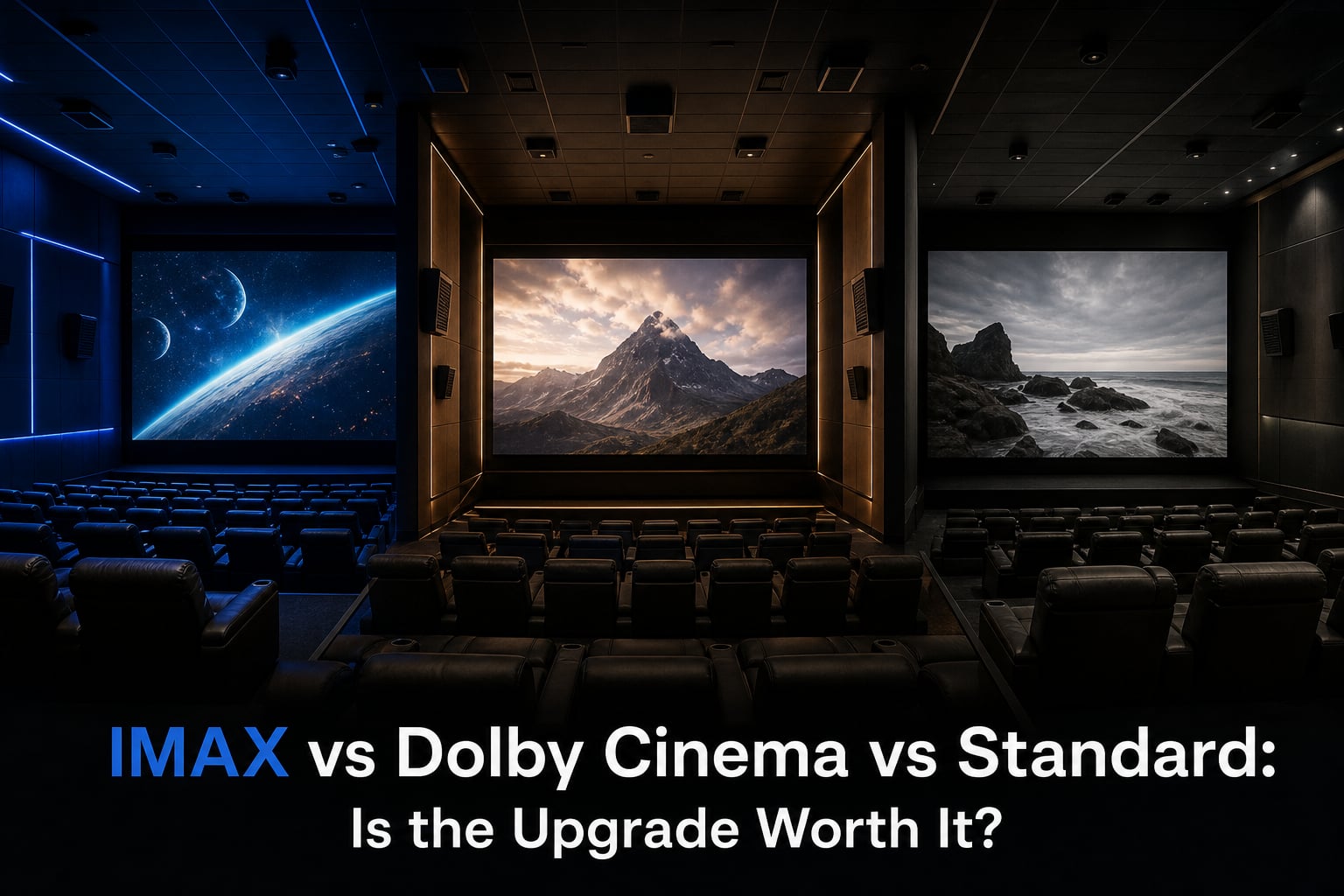
IMAX vs Dolby Cinema vs Standard comes down to what you want a theater to do best: IMAX makes a movie feel physically bigger, Dolby Cinema makes images and sound feel more precise, and Standard is the practical baseline for films that do not depend on either advantage.
If I had to make the fast call, I would choose IMAX for a movie made with expanded IMAX framing, Dolby Cinema for exceptional dark scenes and sound design, and Standard for a casual outing or a dialogue-first film. The auditorium matters as much as the format name, so a little checking before checkout prevents a disappointing “premium” screening.
That distinction matters because premium theaters do not all use the same equipment. A large IMAX Laser auditorium can deliver a very different result from an older Xenon IMAX room, while Dolby Cinema is designed around a more consistent Dolby Vision and Dolby Atmos package.
QUICK CHECK: Look at the exact showtime page, not only the theater brand. It may identify IMAX with Laser, 70mm, Dolby Cinema, or a standard digital auditorium; those details say more about the experience than a generic “premium” label.
Table of Contents
IMAX vs Dolby Cinema vs Standard: IMAX wins scale, Dolby wins precision, and Standard wins simplicity
The clearest IMAX vs Dolby Cinema vs Standard comparison is this: IMAX emphasizes a towering screen and, on the right release, more visible image area; Dolby Cinema emphasizes deep blacks, controlled highlights, rich color, and object-based audio; Standard presents the movie capably without the specialized screen, HDR, or immersive-audio package.
IMAX is best for maximum scale
Picture
Large-format projection and possible expanded 1.90:1 or 1.43:1 framing, depending on the movie and auditorium.
Sound
Powerful calibrated multichannel sound designed for the room.
Best fit
Filmed-for-IMAX action, space, nature, and spectacle-driven releases.
Dolby Cinema is best for HDR picture and spatial audio
Picture
Dolby Vision HDR presentation, commonly described as dual 4K projection, with strong contrast and color depth.
Sound
Dolby Atmos object-based audio with speakers around and above the audience.
Best fit
Dark, color-rich, music-driven, or finely mixed films where detail matters more than screen size.
Standard is best for a straightforward showing
Picture
Conventional digital projection, often 2K, with results that vary by theater upkeep and auditorium.
Sound
Traditional channel-based surround sound.
Best fit
Comedies, dramas, repeat viewings, and movies where the premium format adds little.
None of these labels promises the same seat comfort, screen condition, or projection quality at every location. Think of them as format families: Dolby Cinema is usually the most standardized package, IMAX has the widest range between venues, and Standard has the greatest auditorium-to-auditorium variation.
Standard theaters provide the useful baseline
Standard theaters provide the version most people mean when they say they are going to the movies: a conventional digital projector, a wide but not giant screen, and surround sound distributed through fixed channels. It can still be an excellent way to see a film, especially in a well-maintained room with a bright projector and a clean screen.
Many standard digital auditoriums use 2K projection, though theater chains and individual sites can vary. That does not mean the picture is automatically poor; it means Standard usually lacks the specialized contrast control of Dolby Vision and the large-format geometry associated with IMAX.
Standard sound is familiar rather than object-based
Conventional surround mixes assign effects to channels such as left, center, right, side, and rear. A good mix can create convincing movement, but it does not have the placement flexibility of Dolby Atmos, which can treat a sound as an object moving through the room.
The practical result is that dialogue and music remain clear in a good Standard room, while overhead motion and detailed environmental effects are less likely to feel as precisely placed. For a character drama or a comedy, that difference may not change your enjoyment at all.
Standard screens and seats vary the most
A Standard screen can range from modest to impressively wide, and seating can range from basic rocker chairs to recliners. The label alone does not tell you whether your row will be comfortable or whether the screen fills much of your view.
TIP: For a Standard showing, choose a seat near the horizontal center and roughly two-thirds of the way back if the room is long. This position usually gives a comfortable field of view and keeps dialogue anchored naturally to the screen.
Standard is sufficient when the movie is not advertised with expanded IMAX scenes, when you are seeing it mainly for the story, or when you already know your local standard auditorium is well cared for. It is not a lesser way to see every movie; it simply has fewer format-specific advantages to pay attention to.
IMAX offers screen scale and expanded framing
IMAX offers the most immediate visual difference: a screen built to dominate your field of view. Rather than only making the image brighter or more colorful, the format aims to make the movie feel larger through screen height, auditorium design, projection, and calibrated sound.
That scale is why IMAX often feels like the right choice for a rocket launch, a citywide chase, a giant creature, or a sweeping landscape. Its strongest advantage appears when the director and cinematographer composed scenes for the taller IMAX image.
IMAX framing can reveal more image, but only when the film includes it
Most wide-screen movies are shown in a very wide shape, often near 2.39:1. Some IMAX releases open selected scenes to 1.90:1, which makes the picture taller and can expose more action above and below the usual frame.
A small group of IMAX venues can present 1.43:1 material, the notably taller ratio associated with the largest IMAX presentations. That is not the default for every IMAX screening, and a movie must actually contain 1.43:1 footage for the room to show it.
“Filmed for IMAX” is meaningful but needs context. It may indicate IMAX cameras, IMAX-certified cameras, special framing, or work done to meet IMAX presentation standards; it does not by itself promise that every scene expands or that every theater can show the tallest version.
WATCH FOR: Do not assume an IMAX logo means 1.43:1. Check whether the film has expanded scenes and whether your specific auditorium supports the intended ratio; otherwise, you may still get a polished large-screen presentation, just not extra image height.
IMAX Laser, Xenon, and 70mm are different experiences
IMAX Laser is the version many moviegoers should seek out because laser projection can support stronger brightness, color, and contrast than older lamp-based systems. Some locations use a dual-laser setup, while others use a single laser projector, so “Laser” is helpful information but not a complete technical description.
Older IMAX Xenon systems use digital Xenon-lamp projection and are commonly associated with 2K resolution. They can still offer the large screen and IMAX sound profile, but viewers comparing a Xenon room with a Dolby Cinema auditorium often notice Dolby’s advantage in black level and fine contrast.
IMAX 70mm is a film-based large-format presentation available at relatively few locations. When a release and local venue support it, its appeal is the large film frame and distinctive analog presentation, not a guarantee that every viewer will prefer it over laser projection.
IMAX sound favors force and room-wide impact
IMAX theaters use a calibrated sound system built for their auditoriums. The goal is strong dynamics, clear dialogue, and effects that have real physical presence without simply turning everything into noise.
IMAX sound can be thrilling for engines, impacts, crowds, and score-heavy climaxes. Dolby Atmos generally has the edge for tracking individual sounds overhead or around the seating area, but IMAX can feel more commanding when the movie is built around sheer scale.
IMAX seating needs a more deliberate choice
Many IMAX rooms use stadium seating rather than the recliner-focused seating common in Dolby Cinema. The screen is so large that the very front rows can require more neck movement than a normal auditorium, even if they are technically close to the action.
A centered seat around the middle to back-middle of the auditorium is a safe choice for most IMAX screens. In a tall 1.43:1 venue, sitting a little farther back can make it easier to take in the whole frame without constantly scanning.
Dolby Cinema offers HDR contrast and Atmos placement
Dolby Cinema is designed as a coordinated premium format: Dolby Vision for the image, Dolby Atmos for sound, and reclining seats in many locations. Its identity is less about making the screen enormous and more about making every bright highlight, dark shadow, color transition, and sound placement feel intentional.
The format is often the safer recommendation when you know little about the IMAX auditorium near you. Dolby Cinema installations are built around a tighter technical package, while the IMAX name covers a broader mix of projection generations and screen sizes.
Dolby Vision makes contrast the headline feature
Dolby Vision HDR aims for brighter highlights alongside much deeper blacks than conventional projection. In practice, a night sky can look dark without swallowing detail, while a flashlight, neon sign, or reflected sun can stand apart from its surroundings instead of flattening into gray.
Dolby Cinema is commonly associated with dual 4K projection and 12-bit color capability. The important point for a viewer is not the spec list alone: it is the controlled contrast and color separation that help shadows, skin tones, animation, and digitally created worlds look more dimensional.
This makes Dolby Cinema especially convincing for films that spend time at night, use saturated color palettes, or switch rapidly between darkness and bright effects. Its screen is usually smaller than a major IMAX screen, so it trades some physical scale for image precision.
Dolby Atmos puts sound above and around you
Dolby Atmos is object-based audio, which means a mixer can describe a sound’s location and movement instead of assigning it only to a fixed channel. The theater’s speaker layout, including overhead speakers, maps those objects through the room.
That approach can make rain appear above the audience, a vehicle travel across the room, or an off-screen voice feel placed at a specific point rather than merely louder in a side speaker. Atmos does not improve a weak mix, but a carefully designed Atmos mix can add a level of spatial detail that Standard sound rarely matches.
Dolby recliners improve comfort but change the room feel
Dolby Cinema reclining seats can make a long movie much easier to settle into. They are a real part of the value proposition for viewers who dislike cramped rows or who are seeing an extended release.
There is a tradeoff: recliners occupy more space, so Dolby rooms can feel less like a packed event auditorium and more like a comfortable screening room. If you want a screen that seems to tower over the crowd, a major IMAX auditorium may still feel more special.
The formats differ most in picture, sound, screen, and comfort
Picture quality, sound, screen geometry, and seating explain the difference better than a single “best” label. IMAX vs Dolby Cinema vs Standard is not a contest with one permanent winner because each format gives priority to a different part of moviegoing.
Dolby Cinema usually delivers the strongest contrast, while IMAX delivers the largest visual field
Dolby Vision HDR is usually the answer when you care most about black levels, highlight detail, and color accuracy. IMAX Laser can look excellent too, particularly in a strong auditorium, but the defining IMAX benefit is the screen’s scale and possible expanded frame rather than HDR contrast alone.
Standard projection remains the baseline. It may look very good in a newer auditorium, but it is less likely to maintain the same separation in difficult dark scenes or the same level of bright-versus-dark punch.
Dolby Atmos usually delivers the most precise spatial sound, while IMAX delivers the bigger sonic hit
Dolby Atmos has an advantage when a mix uses overhead effects and subtle movement. It can create a more specific sense that sounds occupy positions in three-dimensional space.
IMAX sound is still highly immersive and may feel more forceful for a large action sequence. Standard surround sound handles the fundamentals well, but it has fewer speakers and less positional detail than a dedicated Atmos room.
IMAX has the best chance of showing more of the movie’s image
Only IMAX can be the right answer for a release that uses expanded IMAX aspect ratio footage. If a director framed a sequence to open to 1.90:1 or 1.43:1, Dolby Cinema and Standard theaters will generally present the wider cropped version instead.
For a movie with a conventional wide frame from start to finish, that IMAX-specific edge is reduced. At that point, Dolby’s contrast and Atmos can be the more noticeable upgrade.
Dolby Cinema usually has the comfort advantage, while Standard varies most
Dolby Cinema reclining seats are a predictable comfort benefit where offered. IMAX stadium seating is often very good for sightlines, but it may not recline, and Standard can be either basic or unexpectedly comfortable depending on the chain and recent renovations.
Comfort should not be dismissed as an afterthought. A format that looks amazing but leaves you shifting in your seat for a long runtime may not be the better choice for your evening.
Choose IMAX, Dolby Cinema, or Standard by the movie and venue
The best format is the one that matches what the film actually uses and what your local auditorium can show. Use this quick decision sequence rather than picking the same premium label every time.
Choose IMAX when the movie was made for expanded IMAX framing. Look for official notices that selected scenes open up, then confirm that your nearby IMAX is Laser or otherwise well regarded. Action movies, space stories, large-scale documentaries, and director-led spectacles are natural fits.
Choose Dolby Cinema when the movie depends on mood, darkness, color, or sound placement. Horror, science fiction, fantasy, animation, musicals, and visually dense dramas can gain a lot from Dolby Vision HDR and Dolby Atmos.
Choose Standard when the format is not doing extra work for the film. A comedy, modest drama, repeat viewing, or a movie you are fitting into a busy day can be just as satisfying in a good conventional auditorium.
For blockbuster movies in 2026, avoid assuming every title needs IMAX. A film advertised as filmed for IMAX is the strongest signal to investigate IMAX, while a release praised for its color grade, nighttime photography, or elaborate Atmos mix gives Dolby Cinema a strong case.
For an Avatar-style world-building movie, compare the local IMAX screen size against Dolby’s image quality and comfort. If the release includes expanded IMAX scenes, IMAX may be the more faithful framing choice; if not, Dolby’s HDR color depth and Atmos can make the fictional world look and sound exceptionally rich.
TIP: Read the movie’s technical notes and your theater’s auditorium description before choosing. “IMAX” describes both a premium brand and several projection setups, whereas Dolby Cinema names a more narrowly defined picture-and-sound package.
The upgrade is worth it when the format adds something the movie uses
Premium ticket value is strongest when you can name the benefit before buying: more image from expanded IMAX framing, better contrast from Dolby Vision, more spatial detail from Atmos, a much larger screen, or a more comfortable seat. If none of those changes matters for that release, Standard is usually the sensible value choice.
I would not pay extra merely for a premium logo. I would choose the upgrade for an event movie I care about, a film with exceptional visual or sound craft, or a long runtime where Dolby recliners make a material difference.
There is also a venue-quality test. A nearby Dolby Cinema is often a dependable all-around upgrade, while IMAX becomes especially compelling when it is IMAX Laser, has a genuinely large screen, and is showing a film designed to open up in its aspect ratio.
The best value comes from matching the format to your priority
Want to feel the movie’s physical scale? Pick IMAX, especially for expanded-frame material.
Want the cleanest dark scenes and most detailed sound placement? Pick Dolby Cinema.
Want a good presentation without format-specific extras? Pick a well-kept Standard auditorium.
That framework is more useful than declaring one format universally superior. The upgrade is a better use of your moviegoing budget when it serves the film and your preference, not when it simply has the loudest branding.
FAQs
Is Dolby Cinema better quality than IMAX?
Dolby Cinema usually has the edge in black levels, HDR contrast, color separation, and precise Dolby Atmos sound. IMAX can be the better choice when a movie uses expanded IMAX framing or when a large IMAX Laser screen creates more visual scale. The better format depends on the specific film and auditorium.
Which is best, Dolby Cinema or IMAX?
Dolby Cinema is best for viewers who prioritize Dolby Vision HDR, Dolby Atmos, and reclining seats. IMAX is best for films made with expanded IMAX aspect ratios and for viewers who want the largest possible image. Check the local IMAX projection type because IMAX Laser is a stronger pick than an older Xenon setup for many viewers.
Is IMAX Enhanced better than Dolby Vision?
IMAX Enhanced and Dolby Vision are not direct theater-format equivalents. IMAX Enhanced is a home-entertainment program associated with IMAX framing and certified playback, while Dolby Vision is an HDR picture system. In theaters, compare the specific IMAX auditorium and film framing with Dolby Cinema’s Dolby Vision presentation rather than treating the labels as the same technology.
Is Dolby Cinema worth the extra money?
Dolby Cinema is worth the premium when a movie benefits from deep blacks, vivid color, detailed Atmos sound, or reclining seats. It is especially appealing for dark, visually rich, or sound-focused films. For a casual movie or a film without a standout visual or audio presentation, a good Standard theater can be the better value.
Conclusion
Choose IMAX for expanded framing and giant-screen impact, Dolby Cinema for Dolby Vision contrast and Atmos detail, and Standard when the film does not call for a specialized format. Before you book, check the exact auditorium and presentation notes; that small step turns IMAX vs Dolby Cinema vs Standard from a guess into a choice that fits the movie.