
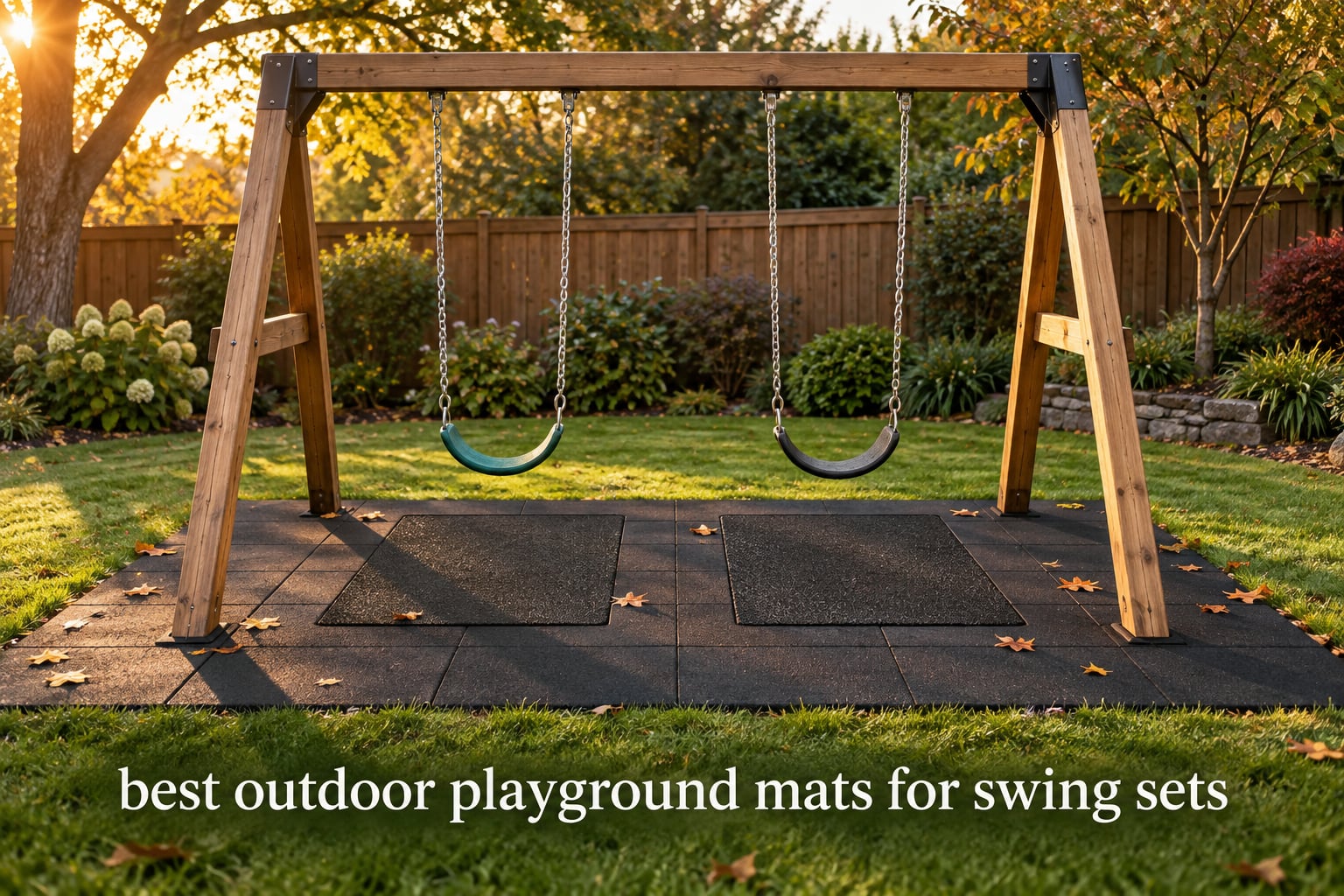
Most families buying a backyard swing set treat the surfacing underneath as an afterthought. That is the wrong order of priorities, because falls cause roughly 60% of all playset injuries and bare grass, dirt or concrete does almost nothing to soften the landing. The direct answer is simple: put a shock-absorbing rubber surface under and around the entire swing, and match its critical fall height to the height of your beam.
There are really only three product families to shop. Wear mats are single heavy rubber pads you drop under each swing bay or slide exit. Interlocking tiles build outward from a small patch into a full safety surface. Poured-in-place rubber is a crewed, on-site install that no pad here competes with. Everything in this roundup falls into the first two families, because those are what a homeowner can install in an afternoon without a contractor.
We compared 8 outdoor playground mats for swing sets across the full spread of thickness, material and coverage available to a homeowner in 2026, from 0.2-inch PVC pads to a 2.5-inch quad-bloc tile. If you are still choosing the equipment itself, start with our backyard swing set guide so you know your beam height before you size the mat.
Table of Contents
Top 3 Outdoor Playground Mats for Swing Sets in 2026

Playsafer 2-Pack 1 Inch Wear Mat
- 1 inch thick rubber
- 24 x 40 inches each
- 100 percent recycled rubber

Best Outdoor Playground Mats for Swing Sets (October 2026)
| Product | Specifications | Action |
|---|---|---|
| Playsafer 1 Inch Wear Mat 2 Pack |
|
Check Latest Price |
| Gorilla Playsets Rubber Mat 2 Pack |
|
Check Latest Price |
 KIDWISE 1.5 Inch Fanny Pads KIDWISE 1.5 Inch Fanny Pads |
|
Check Latest Price |
 Playsafer 2 Inch Commercial Mat Playsafer 2 Inch Commercial Mat |
|
Check Latest Price |
 MYOYAY 1 Inch Square Tiles 4 Pack MYOYAY 1 Inch Square Tiles 4 Pack |
|
Check Latest Price |
 JZHLLA Thin PVC Wear Mats 2 Pack JZHLLA Thin PVC Wear Mats 2 Pack |
|
Check Latest Price |
 IncStores 2.5 Inch Jamboree Tiles IncStores 2.5 Inch Jamboree Tiles |
|
Check Latest Price |
 Playsafer 1 Inch Interlocking Tile Playsafer 1 Inch Interlocking Tile |
|
Check Latest Price |
1. Playsafer 1 Inch Wear Mat – Best Overall Swing Set Mat
Playsafer Playground Safety Rubber Wearmat for Swingsets and Slides – 1″ Thick X 24″ W X 40″ L (2 Pack, Black)
1 inch thick
24 x 40 inches each
Set of 2
100 percent recycled rubber
Pros
- About 24 pounds each so they stay put without fasteners
- Stops mulch and soil being kicked out of the swing zone
- Good grip and traction for active play
- Beveled edges reduce trip hazards
- Usable indoors or outdoors
Cons
- 40 x 24 inches may not cover the whole worn area under a swing
- Some buyers report splitting along the bend line when carried
- Minority report small black fragments that do not biodegrade
This is the mat we keep coming back to because it solves the problem most people are actually trying to solve. You do not need a certified safety surface under a toddler bucket swing. You need something heavy enough to stop the swing chain from chewing a hole in your mulch and your lawn, and that is exactly what a 1-inch recycled rubber pad does.
The set ships as two 24 by 40 inch pads, which is enough to sit under one swing bay or one slide exit. At roughly 24 pounds each, they stay put on their own without glue, stakes or fasteners, which matters on a slope or in loose soil where adhesive would fail.
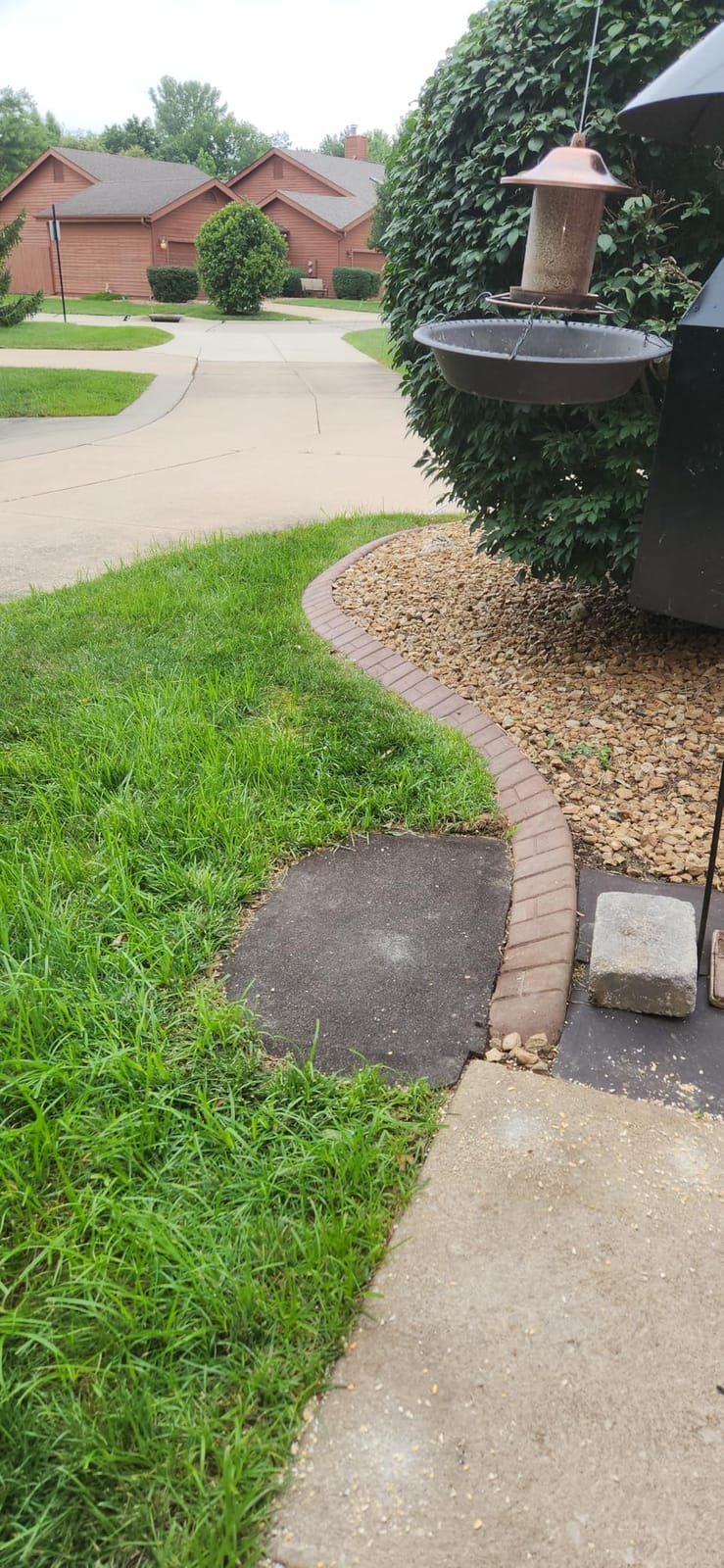
The rating distribution tells the real story here. 77% of the 576 reviews are five stars, and the praise concentrates on weight, grip and how well they hold position through a summer of kids dragging their feet.
What the mats are not is a critical fall height system. At 1 inch thick, they sit in the same protective band as the 4-foot-rated tiles in this roundup, so they cushion a toddler-level fall but they do not stand in for certified surfacing under a tall beam.
What makes this the mat most backyards actually need
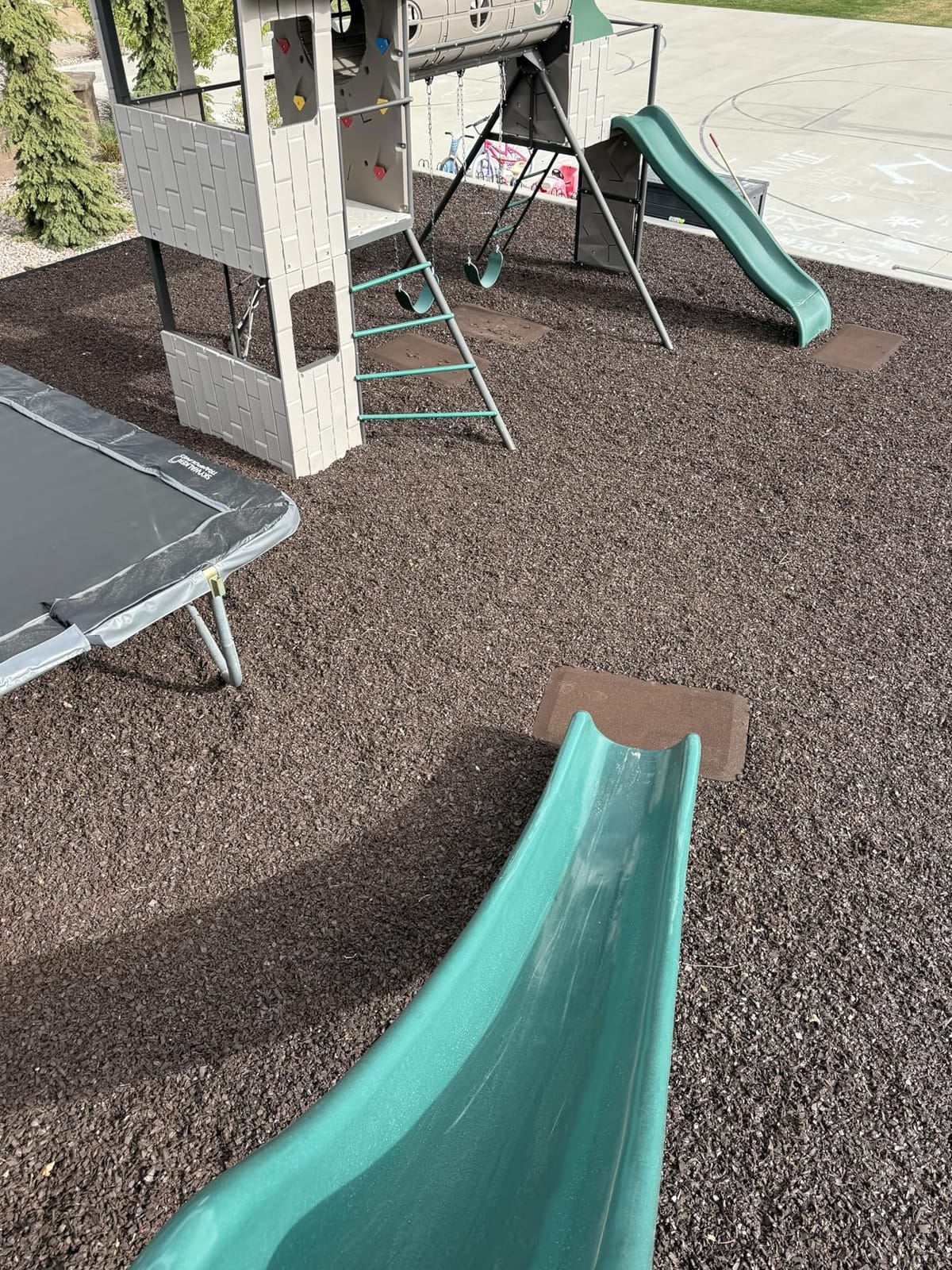
The strongest argument for this pad is that it addresses erosion, which is the problem almost every playset owner notices first. Mulch gets kicked out from under a swing, bare dirt appears, mud follows, and the area under the equipment gets worse every season until you do something about it.
A heavy rubber pad breaks that cycle. It also gives you a surface you can hose or wipe down, and the listing instructions simply call for a damp cloth. If your kids are under three, our toddler swing set picks pair naturally with a pad like this, because the equipment height and the mat thickness should match.
Where it falls short
The honest limitation is coverage. Two 24 by 40 inch pads do not cover a full use zone around a swing, and that is the single most common regret we found from owners of mats in general. If your swing beam is tall, this pad protects the wear zone, not the entire fall zone.
A second, smaller complaint is durability of the material itself. A minority of buyers say the pads can split along the bend line when carried, and a few report small black plastic fragments that do not biodegrade. It is worth inspecting a pad when it arrives rather than discovering the crack after a season of use.
2. Gorilla Playsets Rubber Mat – Top Rated Wear Mat
Gorilla Playsets 09-0012-PAIR-R Protective Rubber Mat For Swing Set of 2 Mats), Red
40 x 24 x 1 inches each
Set of 2
Rated 4.7 stars
1 year limited warranty
Pros
- Highest rating in the roundup at 4.7 stars from 494 reviews
- 86 percent of ratings at five stars
- Compatible with Gorilla Playsets equipment by simple placement
- Heavy rubber with no sharp edges
- Portable and easy to pick up when not in use
Cons
- Manufacturer states it is not part of a safety surfacing system
- Only 1 inch thick so it suits lower equipment
This is the highest-rated product we reviewed, and the margin is not subtle. 4.7 stars from 494 reviews with 86% of ratings landing at five stars puts it comfortably ahead of everything else on this list, and the consistency of that score is what convinced us to include it near the top.
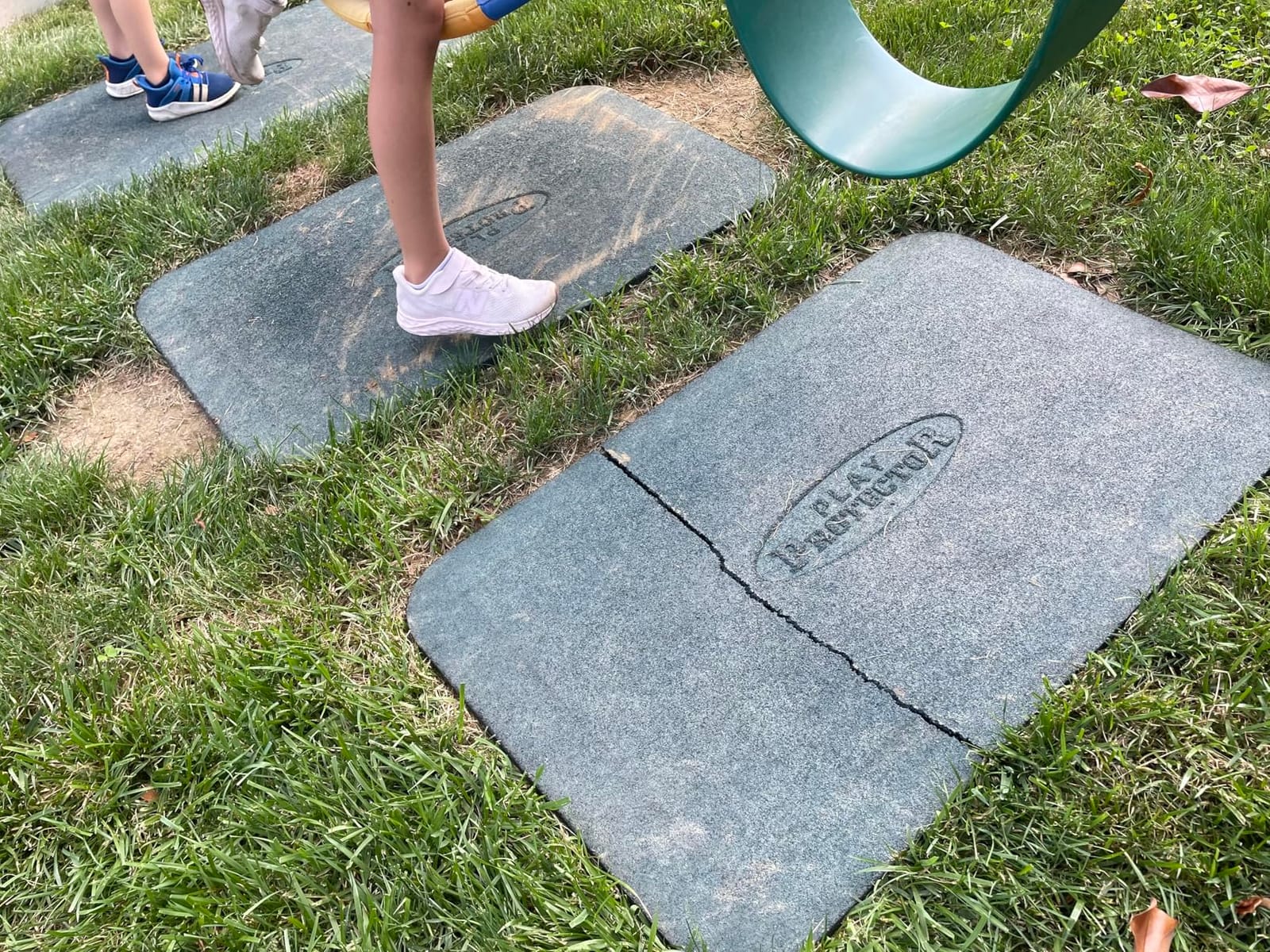
Physically it is a straightforward proposition: two rubber mats, each 40 by 24 by 1 inches, sized for a pair of swings or a slide run-out. Owners credit them with holding down lawn areas that were being torn up, and with being easy to lift out when you want to mow or reseed underneath.
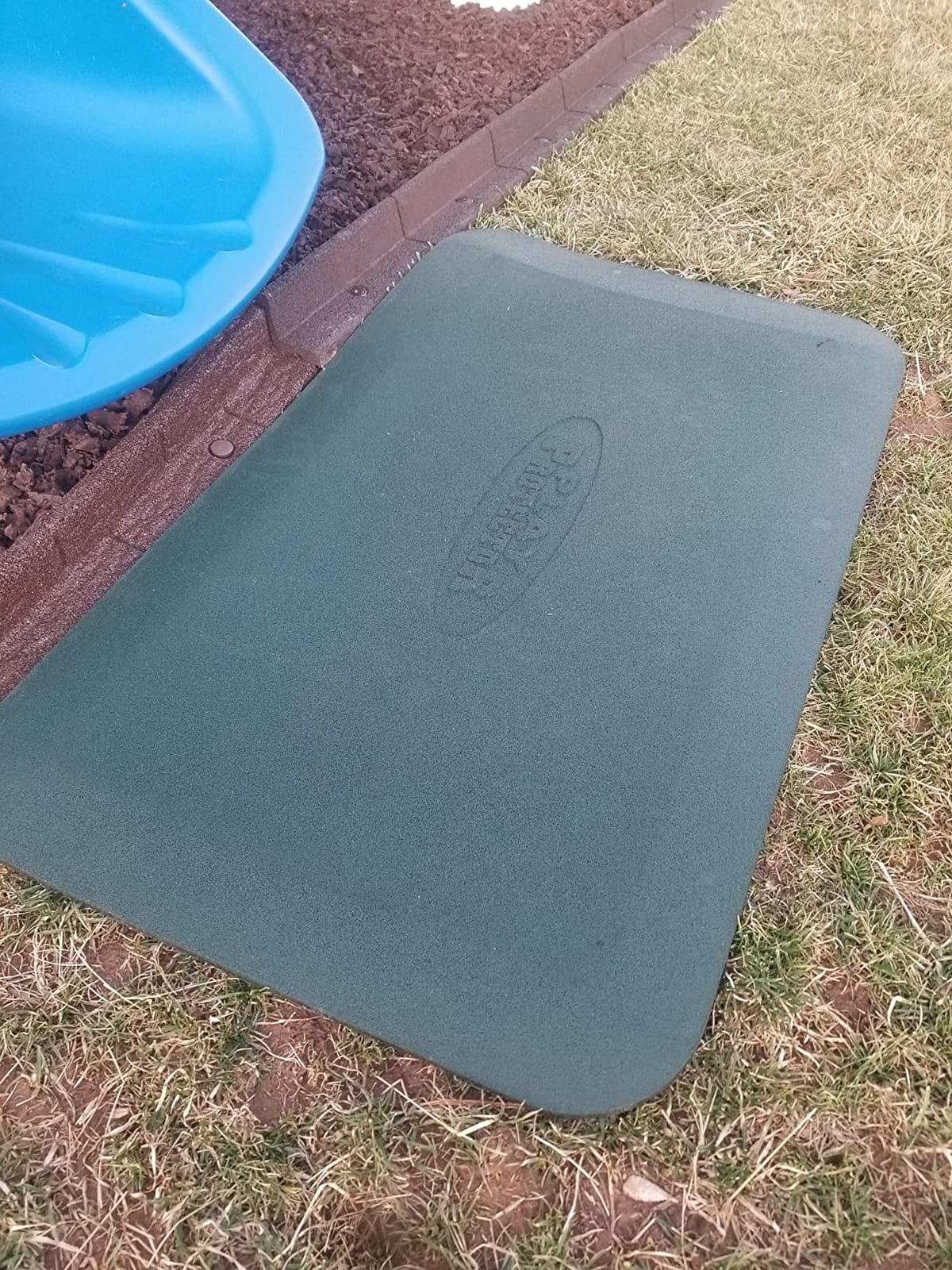
That last point is more useful than it sounds. Most rubber products in this category are a permanent commitment once laid. A pad you can pick up and move gives you the option to change the layout of your playset later without tearing anything out.
The rating split is unusually tight, with only 2% of ratings at one star. Satisfaction is not contested, and the recurring theme is simply that the rubber is thick, hard-wearing and does not have edges sharp enough to catch a falling child.
Who this pair works best for
If you already own a Gorilla Playsets structure, compatibility is the deciding factor. The mats are designed to sit where the equipment needs protection, and pairing them with a cedar frame from our cedar swing set roundup is the common setup we see described.
Two mats also map neatly onto a two-seat swing set, one per bay, or onto a swing plus a slide exit on a compact playset. They are the right shape for a small backyard where a full tile surface would not fit.
Where it falls short
Read the manufacturer statement carefully before you buy. The listing says plainly that this mat is not intended to be a component or portion of a safety surfacing system, which means it is a wear pad by design and should not be sold to yourself as certified fall protection.
At 1 inch, they also do the least for a tall swing beam of any product here. If your beam sits at 8 feet, you are buying erosion control and not shock absorption, and you should pair these with thicker material elsewhere in the fall zone.
3. KIDWISE 1.5 Inch Fanny Pads – Most Versatile for Deeper Cushioning
KIDWISE 1.5 Inch Fanny Pads – Green Rubber Safety Mats (Set of 2)
1.5 inch thick
38 x 23 inches each
70 pound set of 2
Recycled rubber
Pros
- Thickest drop-in wear pad here at 1.5 inches
- No curled edges so the full face stays flat
- Recycled rubber rated for ages 36 months to 12 years
- Set of 2 covers two swing bays or a slide run-out
- 4.7 stars with 81 percent five star ratings
Cons
- 70 pound listing weight makes them the hardest here to reposition
- Only one colour offered for this listing
- 30 day manufacturer defect coverage only
This is the pick for anyone who wants a thicker drop-in pad without moving to a full tile system. At 1.5 inches, the KIDWISE pads are half again as thick as the standard 1-inch wear mats, and that difference is immediately obvious to anyone who has laid down the thinner ones.
They are sold as a set of two at 38 by 23 inches each, which maps to two swing bays or to a slide landing area. The listing weight for the pair is 70 pounds, so plan your positioning before you unpack the box rather than after.
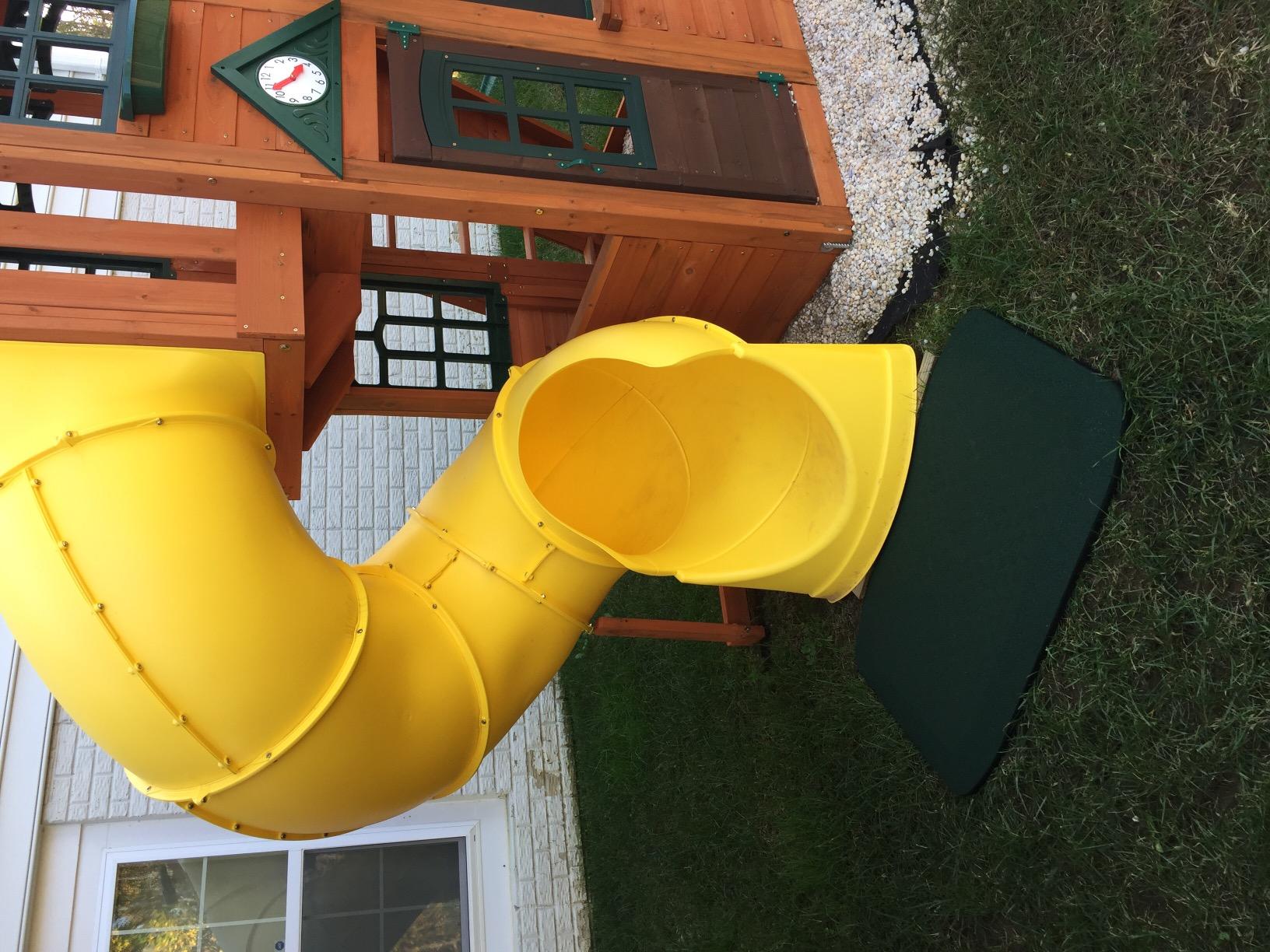
The edge design is the detail we would highlight. These are marketed as having no curl edges, and reviews confirm the full flat face stays down under a swing instead of lifting at the perimeter where a worn pad usually rocks.
Rated for ages 36 months to 12 years, these are the only pads in the roundup that carry an explicit age range on the listing. That does not make them certified safety surfacing, but it is a more useful guide than thickness alone when you are matching a pad to a toddler bucket swing.
Why the extra half inch matters
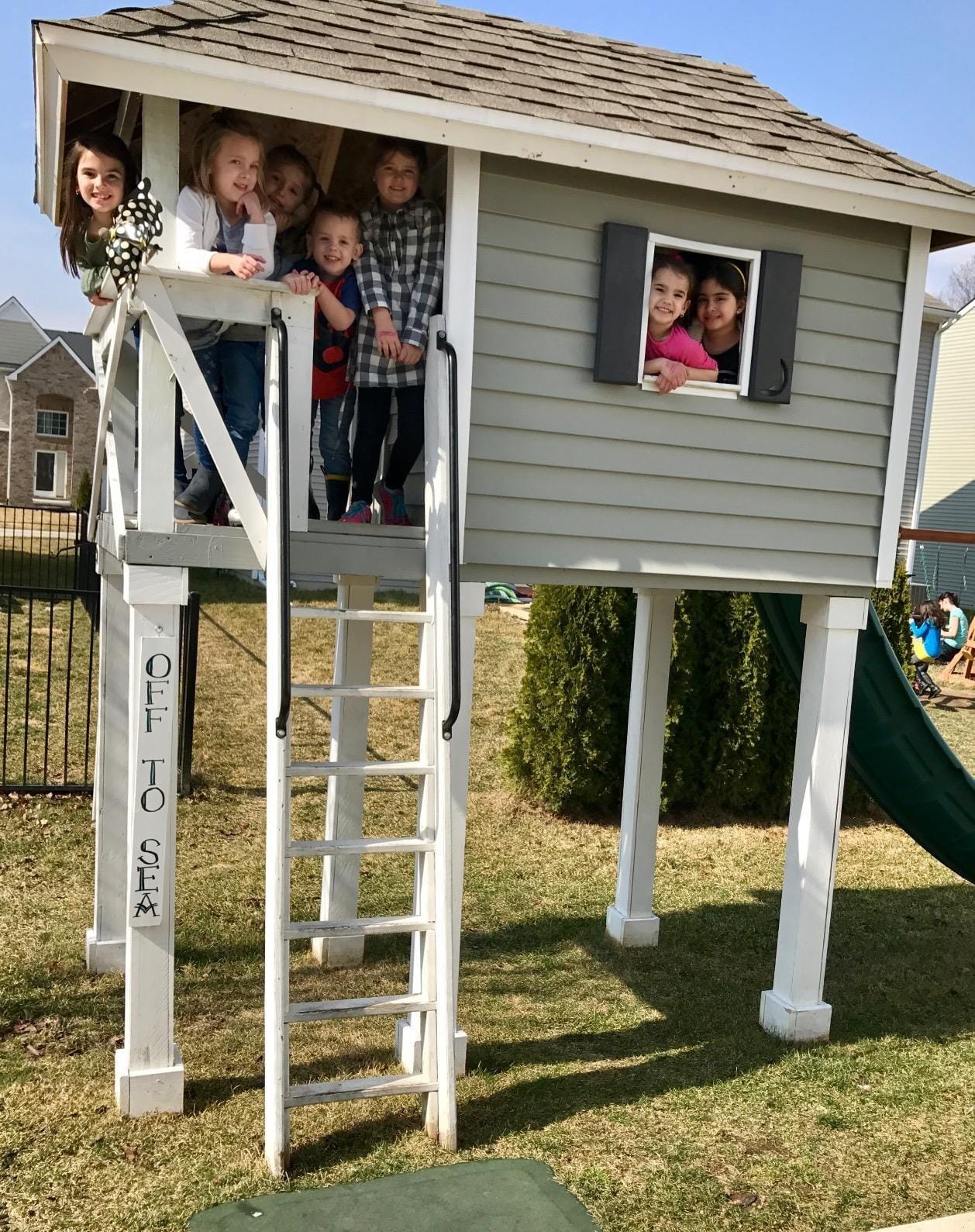
Cushioning scales with thickness in a way you can feel rather than measure. If your child is swinging lower and shorter falls are the realistic scenario, that extra half inch converts a hard landing into a noticeably softer one without changing the footprint of your play area.
They are also a good secondary mat for a taller playset, since you can place the thicker pads directly under the beam where falls are most likely while using a lighter tile system further out.
Where it falls short
Handling is the practical issue. A 70 pound set is genuinely awkward for one adult to reposition, and unlike the thinner pads you are not sliding these into place casually. Consider that before a single bad storm leaves them somewhere awkward.
Two smaller caveats: this listing offers a single colour only, which makes matching an existing play area harder, and the manufacturer defect window is 30 days. For a product expected to sit outside for years, that is thin coverage.
4. Playsafer 2 Inch Commercial Mat – Best for Large Playsets
Playsafer Heavy Duty Commercial Grade Rubber Playground Safety Mat – Playground Protection Mat for Swings and Slides – 54″ Long X 32″ Wide x 2″ Thick (Black)
2 inch thick
54 x 32 inches
90 pounds
Commercial grade
Pros
- Largest single pad here at 54 x 32 inches
- 2 inch commercial grade thickness gives the best shock absorption of any solid pad
- Very heavy so it stays put without fasteners
- Used by daycares and playgrounds to stop ground cover wearing away
- Hose off with water and mild soap
Cons
- Around 90 pounds needs two people to reposition
- One reviewer found the surface too hard for playground safety use
- Single mat only so it cannot cover a wide zone on its own
If you have the space and want one mat to cover a whole swing bay or slide exit, this is the one. At 54 by 32 inches it is the largest single pad we reviewed, and at 2 inches thick it delivers more shock absorption than any other solid pad in the roundup.
The trade is weight. The listing puts it at 90 pounds, and owners describe it as requiring two people to carry or reposition. That is not a flaw so much as a consequence of buying something heavy enough to stay put without fasteners.
Because the sample of reviews is small at 37, we weighted the specification sheet more heavily here than we did elsewhere. The stated thickness and dimensions are consistent, and the use cases described, daycares, playgrounds and high-traffic zones, match the class of product it is.
When a single large pad is the right call
One pad under one bay is far easier to place correctly than four small tiles that need a base and dowels. For a big playset where the wear zone is concentrated in one or two spots, covering those spots thoroughly with a thick single pad is a defensible strategy.
The maintenance story is simple too. The care instruction is to hose it off with water and mild soap, which suits a surface that collects dirt, leaves and spilled drink under a swing.
Where it falls short
One of the most useful reviews in the set comes from a buyer who found the surface very hard and questioned whether it belongs under a playground swing at all. That is a fair challenge, and it is the reason we did not rank this first despite the 2-inch thickness.
Thickness and hardness are not the same thing. A dense commercial pad can be thick and still feel firm underfoot, and at 54 by 32 inches you are also committing a large area to one piece of rubber that two people have to move if the layout changes.
5. MYOYAY 1 Inch Square Tiles – Best for Garage Gyms and Multi-Use Flooring
MYOYAY Rubber Flooring Tiles 4 Pack 20″ x 20″ x 1″ Non-Slip Flooring Mats Cover 11.12 Sq.FT Non-Slip Heavy-Duty Mats for Playground Indoor and Outdoor Gym Floor Sport Floor Backyard Play Area
20 x 20 x 1 inch tiles
4 pack covers 11.12 sq ft
Glue-down rubber
PVC free
Pros
- High density rubber with strong anti-slip and shock absorbing grip
- Absorbs water and sweat so it works in gyms and basements
- Thick pads also insulate under a hot tub
- Offered in red green and blue
- Lowest rated item here so it suits a tighter budget
Cons
- Not actually interlocking despite the name
- they are plain squares that need adhesive
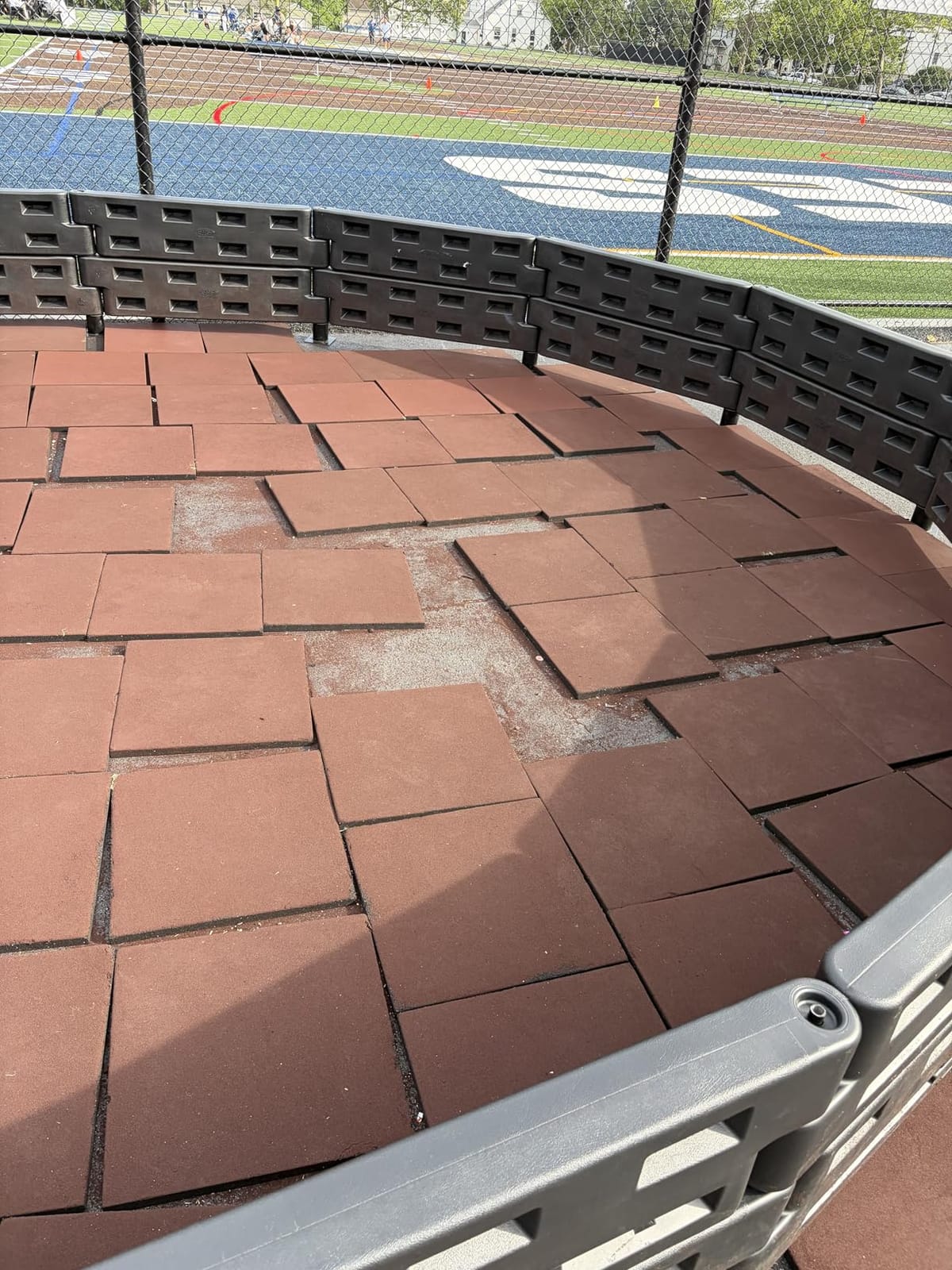
- School buyer reports tiles separating and children falling
- Colour varies from listing images
- 23 percent one star ratings
We are including this set because it is the most misunderstood product in the roundup, and the misunderstanding has safety consequences. The listing calls them interlocking tiles, but the reviews make clear they are plain squares with no interlocking edges, which means they have to be glued down.
That single fact changes the installation completely. There is no pin-and-click layout, no partial coverage, and no expanding a small patch into a larger surface later. You are committing to adhesive before the first tile goes down.
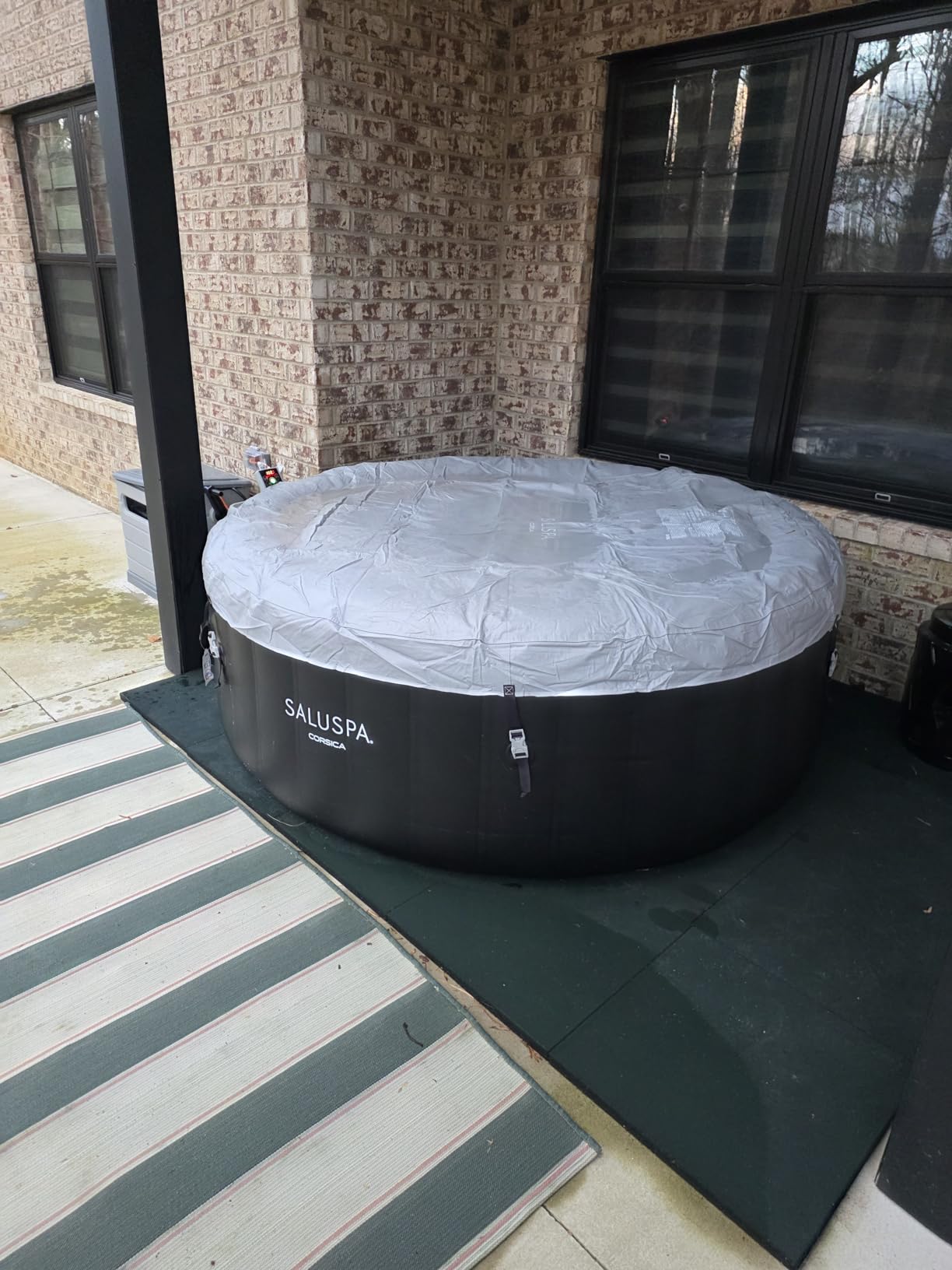
Where they do work is anywhere other than an unsupervised fall zone. At 1 inch thick with high-density rubber, they are a genuinely good surface for a garage gym, a basement, a game room, or under a hot tub where you want thermal insulation.
The 3.9 rating is the lowest in the roundup, and the rating distribution explains why: 65% five star against 23% one star. That is not a bad product with a bad batch. It is two different products living in one listing.
The case for them outside the swing zone
If you are building a playroom or a garage floor that doubles as a gym, the anti-slip and shock absorbing performance is exactly what you want, and the 11.12 square foot coverage per four-tile pack lets you buy in small increments.
They are also easy to wipe down with a damp cloth, which suits a playroom far better than it suits a wet outdoor zone.
The case against them under a swing
The most serious review describes a school installation where the mats did not stay together and children fell, with two broken arms reported. We are not going to soften that, because it is exactly the failure mode a wear surface cannot have.
Buyers also note that colour varies from the listing images, and that even glued tiles can shift at the seams over time. For a fall zone, choose a product with a real interlocking mechanism or a single-piece pad.
6. JZHLLA Thin PVC Wear Mats – Budget Pick for Blocking Wear
2-Pack Outdoor Playground Mats, 40″ L X 24″ W High-Density PVC Playground Protection Mats Rubber Wearmat with Double-Sided Anti-Slip Texture for Swings and Slides
40 x 24 inches each
0.2 inch thick
Set of 2
High density PVC
Pros
- Lightweight and easy to reposition compared with thick rubber pads
- Double-sided anti-slip texture helps the mat stay put
- Sturdy tear resistant slip resistant and wear resistant material
- Also usable on patios walkways and home gyms
Cons
- Roughly 0.2 inch thick offers much less cushioning than one to two inch pads
- PVC construction rather than the recycled rubber used by higher rated options
- Thinnest and least protective product we reviewed
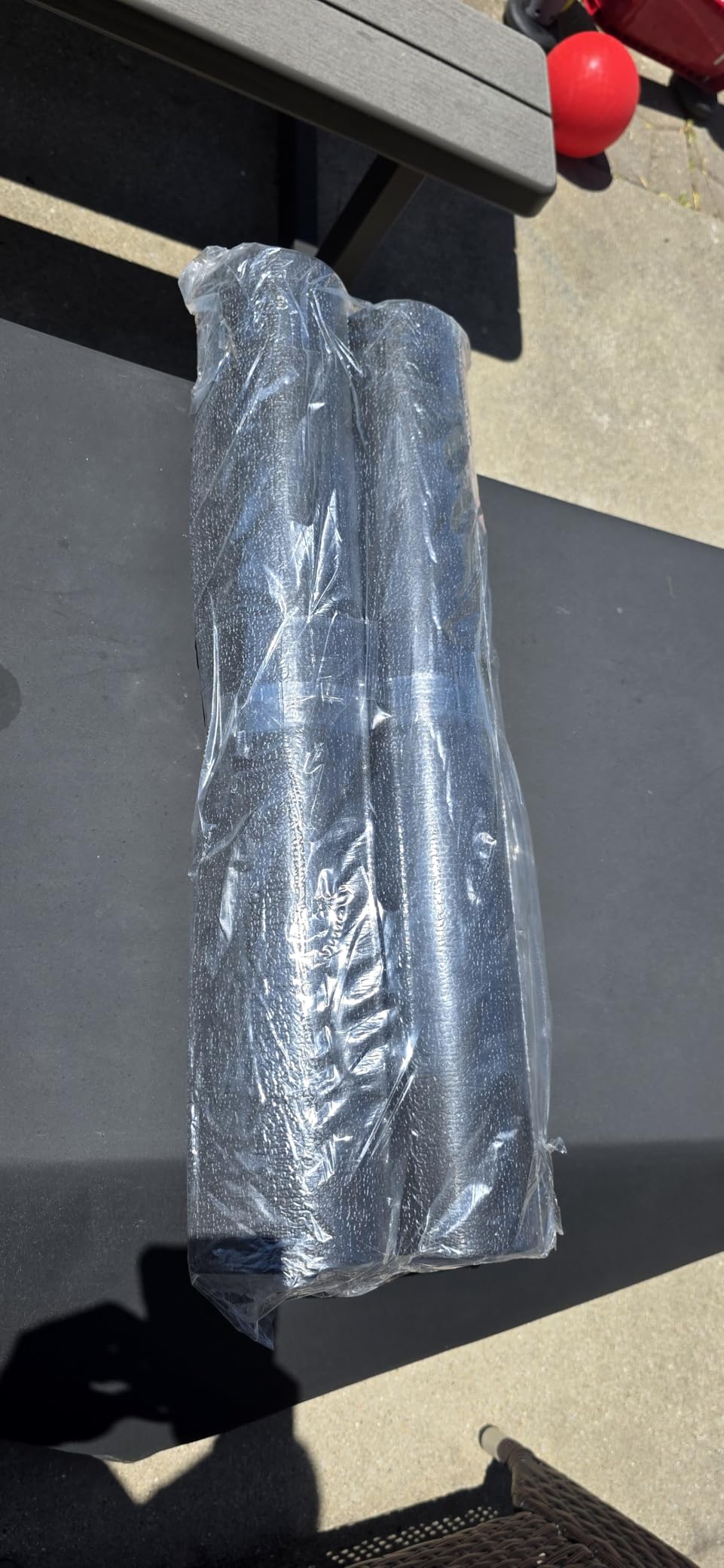
This is the cheapest way to stop a swing from kicking mulch out of its bay, and it is honest about not being much more than that. At roughly 0.2 inch, these are the thinnest products in the roundup by a wide margin.
The material is high-density PVC rather than the recycled rubber used by every higher-rated option here, and the double-sided anti-slip texture is there for grip and stability as much as for cushioning.
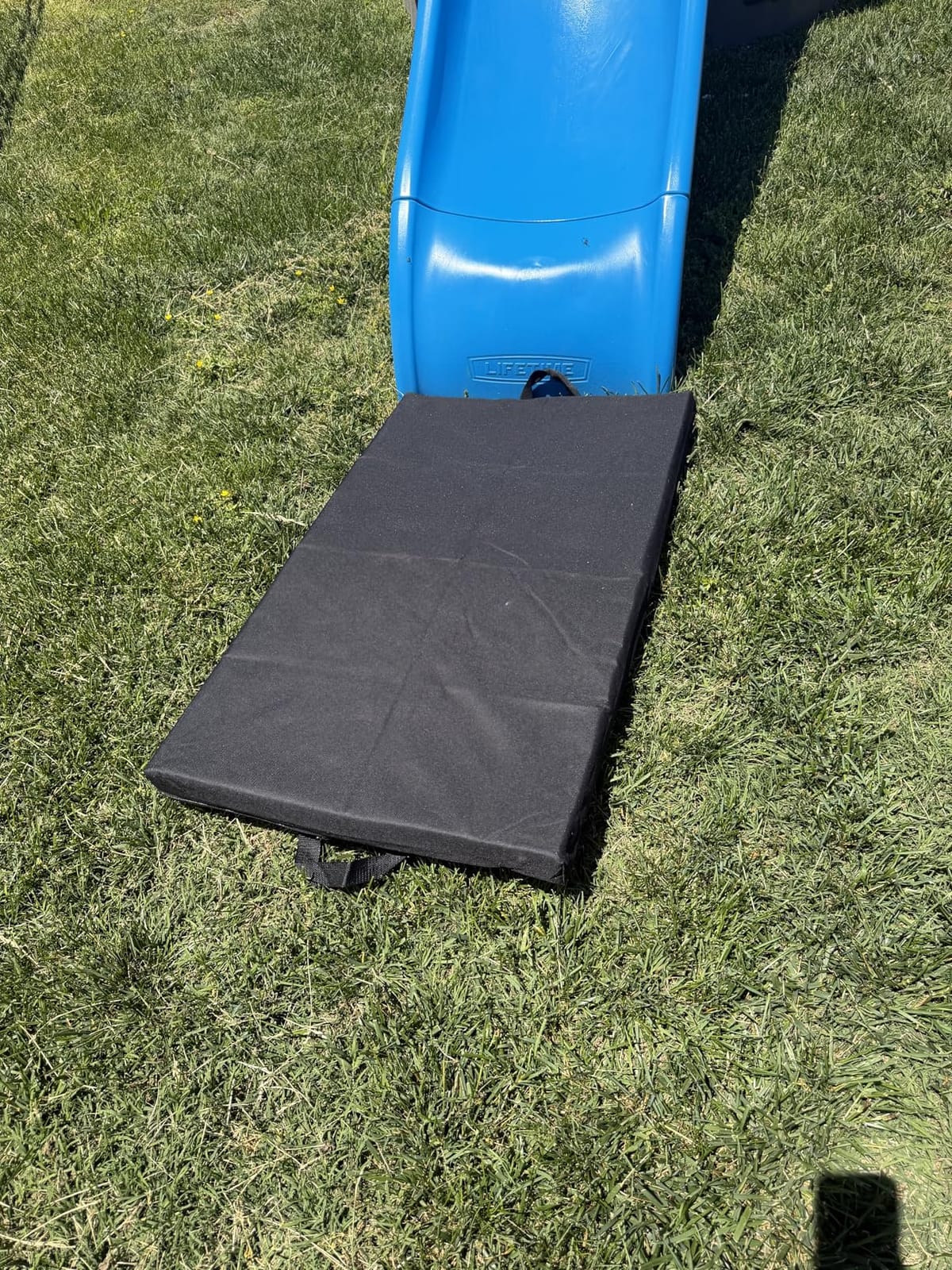
What that combination is actually good for is separation. Laid under a swing bay, they take the repeated scuffing and drag marks that destroy mulch, and they are light enough to move with one hand when you want to mow underneath.
They are also listed for patios, walkways, pathways and home gyms, which is a fair secondary use for a flat, textured, wipe-clean surface.
When a thin pad is genuinely enough
A toddler bucket swing with a low seat produces short falls. In that specific case a thin anti-slip barrier solves the erosion problem and you are not relying on the mat for impact absorption at all.
The double-sided texture is the detail we would point a buyer toward. It is the feature doing the work here, not the cushioning, and it is why these mats stay in position without fasteners.
Where it falls short
The word safety should not be applied to a 0.2-inch pad under a raised swing. There is no fall rating on the listing, no critical fall height, and no certification, and any buyer treating it as certified protective surfacing is misreading the product.
It is also PVC, not recycled rubber, which matters to families already asking about tire-derived materials. Buyers who are trying to avoid synthetic rubber near a toddler should note that this option does not answer that concern.
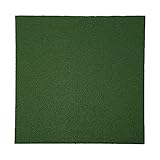
7. IncStores 2.5 Inch Jamboree Tiles – Best for Building a Full Surface
IncStores 2.5 Inch Thick Jamboree Rubber Interlocking Floor 2′ x 2′ Tiles | Heavy Duty Rubber Outdoor Tiles to Build Better Playgrounds at Homes, Schools, and Daycares | Green, 4 Tiles
2.5 inch thick
24 x 24 inch tiles
4 tiles cover 16 sq ft
Quad-bloc interlocking
Pros
- Thickest tile in the roundup at 2.5 inches
- Real quad-bloc interlocking system that keeps tiles joined
- Water drains through well and grip is good on sloped walkways
- Available as single tiles 4 tile sets and larger pallets
- Drainage and grip make it workable on sloped surfaces
Cons
- One buyer says the surface is about as hard as wood
- Not as soft or bouncy as lighter surfacing
- Very heavy and buyers report needing help to move quantities
This is the only true interlocking system in the roundup, and if your goal is to cover a whole fall zone rather than one bay, it is the product that gets you there. At 2.5 inches it is also the thickest tile we reviewed.
The quad-bloc design is what separates it from the product below, which claims interlocking edges it does not have. Owners here consistently report that the tiles actually join, and that multiple shipments matched in colour, which is not something you can say about every tile brand.
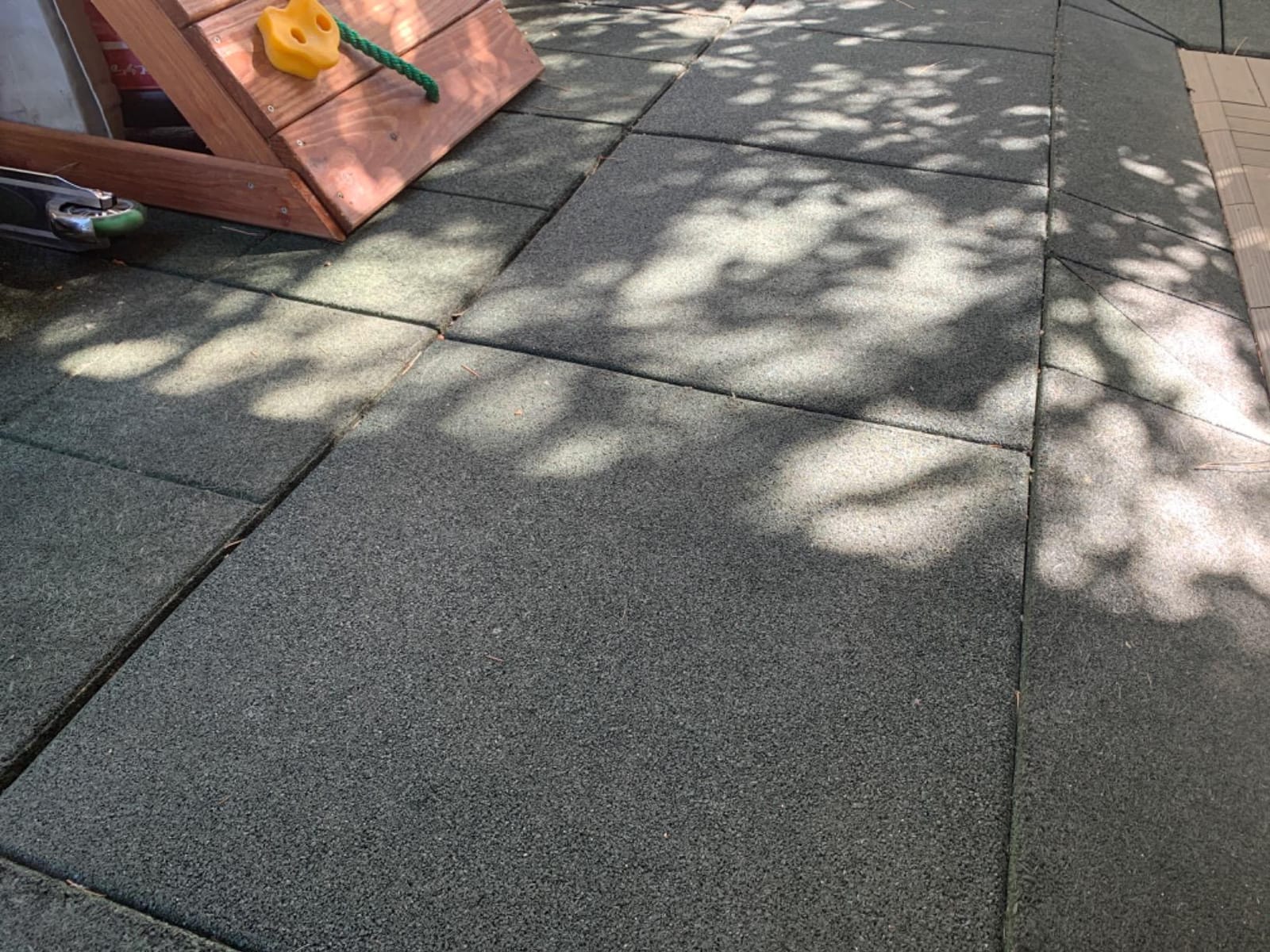
Drainage is the other practical strength. Water moves through the tile rather than pooling on top, and reviewers mention good traction on sloped walkways, which is a real problem on a yard with any incline.
The manufacturer listing states a 4 ft fall rating, which puts this tile in the same protective band as the thicker pads despite being 2.5 inches thick. That tells you something important about density versus depth, and we will come back to it below.
Why we recommend this for a full surface
Coverage is the reason. A wear pad protects a square under a swing and nothing else, but interlocking tiles let you start small, then extend outward as your needs or your budget allow without changing products.
For schools, daycares and shared community play areas, a continuous surface with no gaps is the safer design. A pad that can be kicked aside creates a hard edge right where a child is most likely to land.
Where it falls short
The most upvoted negative review disputes the advertised fall rating, describing the surface as nearly as hard as wood. We think that is a fair challenge to any stated rating on a 2.5-inch dense tile, and we would rather you know it before laying a whole patio of them.
Weight is the other issue. Buyers report needing a pallet delivery and neighbours to move quantities, so a small covered patch is realistic for a homeowner while a full swing zone requires planning the delivery and the labour.
8. Playsafer 1 Inch Interlocking Tile – Best Value for Small Coverages
Playsafer 1″ Rubber Interlocking Flooring Tiles for Playgrounds, Backyards, and Play Areas – 20″ X 20″ – UP to 4’ Fall Height Protection (Black, 1 Tile – 2.7 Sq. Ft.)
1 inch thick
20 x 20 inches
2.7 sq ft per tile
Single tile with dowels
Pros
- Sold as a single tile so you buy only the coverage you need
- Boxed underside for shock absorption and better traction
- Water permeable and needs no special care
- Dowels and adhesive included for glue-down fitting
- 3 year manufacturer warranty
Cons
- Over grass or dirt the maker recommends a 3 to 4 inch crushed stone base
- 1 inch gives less cushioning than the 2 and 2.5 inch mats
- Black only for this listing
This tile solves a problem the sets do not: how much do you actually need. It is sold as a single 20 by 20 inch tile covering 2.7 square feet, so you can buy four for a small swing bay instead of committing to a multi-tile pack and ending up with spare rubber you have to store.
At 1 inch it sits in the same protective band as the manufacturer lists for the 2.5-inch tile, which again underlines that depth alone does not determine cushioning. What differs is density and construction.
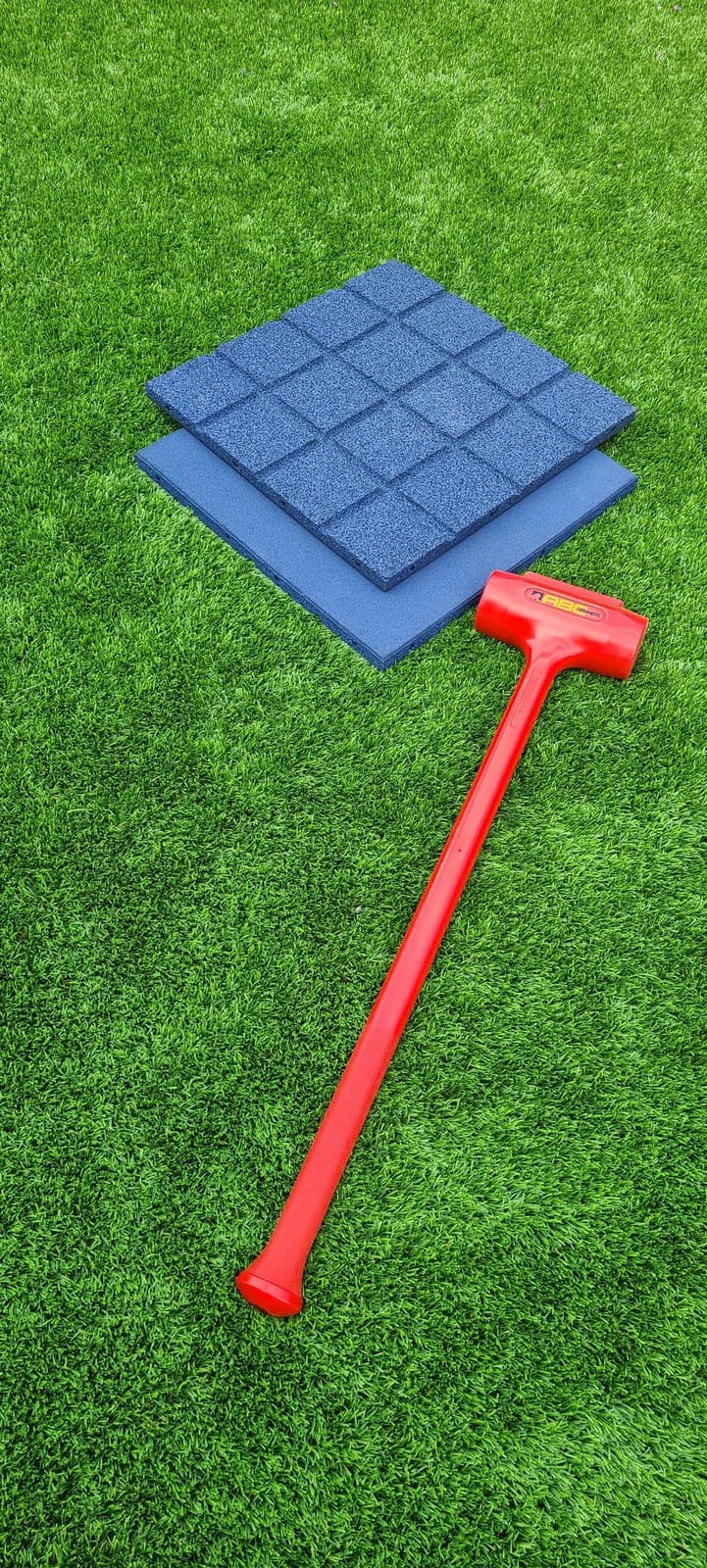
The installation hardware is the quiet strength. Adhesive and dowels are included in the box, so the tile system is a genuine glue-down assembly rather than loose squares, which is what separates it from the product in position five.
Water-permeable construction and a no-special-care requirement make these the lowest-friction option for a wet climate, where standing water on a sealed surface is the thing that causes problems.
Where the single-tile format wins
Small backyards. If you have a compact swing set and a limited patch of usable ground, buying tile by tile lets you cover exactly the wear zone and stop, instead of ordering a set sized for a much larger playset.
It is also the easiest product here to extend later. Add four more tiles next season in the same colour and material and the surface extends without any change of product or supplier.
Where it falls short
The base requirement is the dealbreaker for some people. The manufacturer recommends a 3 to 4 inch crushed stone base when installing over grass or dirt, and that is a real weekend of digging plus a pile of aggregate.
One inch also means this tile sits at the shallow end of the range here, so it does less for a tall beam than the KIDWISE pads or the 2.5-inch tiles. If you are covering a slide landing area as well, our backyard slide guide has the run-out dimensions to work from.
How to Measure Your Swing Set Use Zone in 2026
The use zone is the area a child can reach while swinging, and it is almost always larger than people expect. The Consumer Product Safety Commission publishes the sizing rules, and they differ depending on how many directions the swing moves.
For a single-axis swing, which is the standard backyard beam with two seats, the rule is twice the length of the suspending beam measured in front of and behind the swing, and the full length of the beam on each side. In practice, a two-seat swing with a 10 foot beam needs roughly 20 feet fore and aft and 10 feet to each side of the structure.
For a multi-axis swing, where a child can swing in any direction, the rule is 6 feet in all directions from the pivot point of the suspending member. This is the standard for bucket swings and gliders on a play structure.
Whatever the number, the surfacing has to cover the whole use zone. A 24 by 40 inch pad covers a wear area, not a use zone, and that gap is the single most common reason homeowners end up with a mat they think is enough and is not.
Wear Mat vs. Interlocking Tile vs. Poured Rubber
A wear mat is a single drop-in pad, usually 1 to 2 inches thick, sized to one swing bay or slide exit. It is the fastest and cheapest option and it does one job well, which is stopping ground cover from being destroyed. It is a wear control product first and a safety product second.
An interlocking tile builds outward from a small patch into a continuous surface. It costs more per square foot, it needs a prepared base in most installations, and it is the only option here that genuinely covers a full use zone rather than a wear zone.
Poured-in-place rubber is a different purchase entirely. It is a crewed, on-site install with a pigmented or coloured top surface, seamless with no seams or edges to trip on. It handles any fall height you throw at it, it needs a professional crew, and it is not something you install yourself in an afternoon.
Our rule of thumb: wear mats for a low beam or a slide exit, tiles for anything you want to grow into a real safety surface, and poured rubber when the area is large, the fall height is high, or you want a single seamless surface with no joints.
What Homeowners Regret About Mats They Already Own
The most consistent complaint we found across homeowner forums was not about the mats themselves but about coverage. Families bought two pads, installed them correctly under the swings, and only later realised the rest of the fall zone was still bare grass. Measure the use zone first.
The second complaint was movement. Loose-fill surfaces get kicked out of the swing zone into the rest of the yard and have to be redistributed constantly, which is the entire reason people buy a mat in the first place. Heavy pads stay put; light ones and unglued squares do not, and that is the difference between a mat and a tile.
Third, odour. A strong, persistent smell after installation and in warm weather comes up repeatedly in rubber surfacing threads, and it is the most common reason mulch and rubber get bagged out and replaced rather than kept.
Fourth, materials splitting or shedding. The 1-inch Playsafer pads in position one have buyers reporting splitting along the bend line and small black fragments over time. Inspect a pad when it arrives rather than discovering it in the spring.
Fifth, a firm surface mistaken for a soft one. Reviewers of both the 2-inch commercial pad and the 2.5-inch tile describe surfaces that feel closer to wood than to foam. Thickness and density are separate variables, and neither one alone tells you how a pad will feel underfoot.
How to Choose a Swing Set Mat That Lasts
Match the critical fall height to the beam, not to the mat. Critical fall height is the height from which a fall is greatly reduced in likelihood of serious injury, and every manufacturer in this roundup states one. A pad rated to 4 feet should sit under a swing where falls are 4 feet or less, and a taller beam needs thicker material under it.
Do not read thickness as cushioning. The 2.5-inch tile and the 1-inch tile carry the same stated fall rating in this roundup. Dense, heavy rubber feels firm even when it is thick, so ask the manufacturer for the tested rating rather than assuming from the gauge.
Decide what you can put the mat on. Loose-fill material cannot be installed over concrete, which is the surface many families already have. Solid rubber tiles and pads can be, so if your yard is already paved you are restricted to this product family from the start.
Plan the base if you are going with tiles. The Playsafer tile manufacturer recommends 3 to 4 inches of crushed stone over grass or dirt. Skip that and you are laying rubber on a surface that will settle unevenly and create a trip edge.
Think about drainage and growth. Water-permeable tile handles wet weather better than a sealed pad, and drainage-style mats let grass grow through the holes, which hides them over time but also hides edges you would want to see if they start to lift.
And be honest about material claims. EPDM and virgin rubber behave differently from tire-derived reclaim rubber, and the health question around recycled tire products comes up constantly in homeowner threads. If that is a concern for your family, ask the manufacturer directly rather than assuming from the word recycled. If the equipment is metal rather than cedar, our metal swing set picks change the fall height maths, so size the surfacing after you know the beam.
Frequently Asked Questions
What is the best flooring for an outdoor playset?
Rubber is the best flooring for an outdoor playset. Specifically, a shock-absorbing rubber surface with a critical fall height matched to your swing beam: a drop-in wear mat for a low beam or slide exit, interlocking rubber tiles for a continuous fall zone, or poured-in-place rubber for a large seamless surface. Bare grass, dirt, sand and concrete do not meet protective surfacing standards.
How high should a swing set be off the ground?
The height of your beam sets your requirement, not the other way around. Measure from the ground surface directly below the pivot point to the top of the beam, and buy surfacing whose stated critical fall height meets or exceeds that number. For a single-axis swing, the use zone is twice the beam length fore and aft and the beam length to each side.
What size mat do I need under my swing set?
A wear mat covering one swing bay is typically 24 by 40 inches, and that protects a wear zone rather than a full fall zone. For a single-axis swing with a 10 foot beam, plan on roughly 20 feet fore and aft and 10 feet to each side, which is where interlocking tiles become more appropriate than single pads.
Can rubber playground tiles be installed on concrete?
Yes, and this is a main advantage of solid rubber tile over loose-fill surfacing. Loose-fill materials such as rubber mulch, sand or wood chips cannot be installed over a hard surface at all. Solid rubber tiles and pads can be glued down onto concrete, though you lose the drainage advantage of a permeable surface if the concrete is crowned poorly.
Are there health concerns with rubber mulch?
Rubber surfacing made from recycled tires raises recurring questions among parents about tire-derived chemicals leaching over time, and it also produces a strong odour that persists after installation, especially in warm weather. Families avoiding recycled tire products should ask a manufacturer directly what the material is. EPDM and virgin rubber surfacing are made from different feedstocks.
Final Verdict on Swing Set Mats in 2026
After working through all 8 outdoor playground mats for swing sets, the Playsafer 1-inch 2-pack is the one we would put under a swing bay in most backyards. It has the largest review base here at 576 ratings, it stays put on its own weight, and it solves the erosion problem that motivates almost every purchase in this category.
If you want more cushioning under the beam itself, step up to the KIDWISE 1.5-inch pads. If you want a continuous surface across a whole fall zone, the IncStores 2.5-inch interlocking tiles are the only product here that genuinely grows with the job. And measure your use zone before anything arrives, because coverage is the mistake almost everybody makes once.