
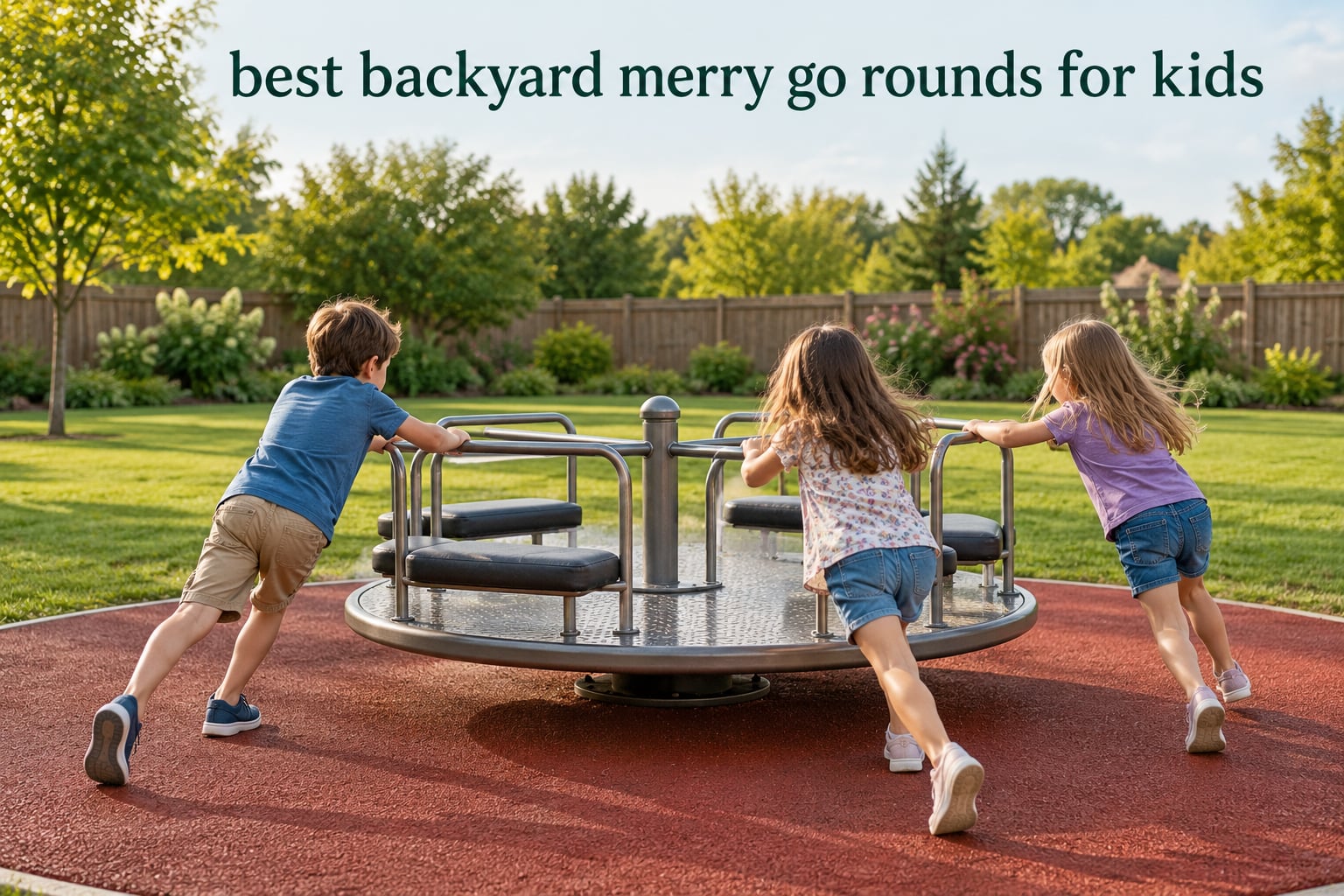
The best backyard merry go round for kids is not the steel carousel you remember from a schoolyard. For a family yard, it is a manual 360-degree spinning platform that children push themselves and ride until friction slows them down, and the whole experience fits inside a footprint smaller than a swing set. We spent weeks comparing ten of them so you can pick the right one for your space, your children’s ages, and the number of kids who will pile on at once.
There is a reason this page exists. Every page-one result we studied was a vendor category listing: retail grids on one end, institutional equipment catalogs quoting five-figure installs on the other, and nothing useful in the middle where a homeowner actually lives. No comparison tables, no honest conversation about how much yard space you need, no answers about whether one adult can build it on a Saturday.
So here is the ground truth. Merry-go-rounds still exist, they are safe when the ground around them is set up properly, and the home version of one costs a fraction of what a school district pays. What follows is a definition, ten reviews, and a buying guide built around the mistakes families make most often. If you are shopping alongside a wider backyard setup, our picks for pedal go karts for kids and electric go karts for kids cover the other classic piece of outdoor motor play.
Table of Contents
What Is a Backyard Merry-Go-Round?
A backyard merry-go-round is a rotating platform, typically round and ringed with rails or bars that act as handholds. Children run alongside it to push it into motion, hop on, and ride until friction brings it to a stop. It has no motor. The kids supply all of the power, which is exactly why it self-scales: a group of confident older children makes it spin fast, and two toddlers barely turn it.
No self-accelerating mechanism is the rule. The Consumer Product Safety Commission treats that as a hard requirement, not a preference, because a platform that speeds up on its own is how riders lose control of their own exit. Every unit in this roundup is hand-powered.
The naming causes more confusion than it should. A roundabout and a merry-go-round are the same product with different regional names. A carousel is the umbrella term that covers both the spinning platform and the carnival ride with horses, which is a different animal entirely. A spinner is a broader category covering anything that rotates. When a catalog says carousel and means a spinning disc, it means a merry-go-round.
One more term worth knowing: a merry-go-cycle is a pedal-powered or enclosed-pod merry-go-round, common in commercial catalogs. Nothing in this roundup falls into that family, because a pod-style cycle is institutional equipment rather than something you bolt into a suburban lawn.
Why do families chase this piece of equipment? The push-and-ride mechanic builds balance, core strength, and gross motor coordination, and the social mechanic of kids running alongside to spin it and hopping on is the real draw. It is one of the highest play-value items you can fit in a small footprint, provided you leave the surrounding space clear.
Top 3 Spinning Merry-Go-Rounds for Kids in 2026
Our overall winner leads on build quality and review volume, the best-value pick carries more riders than anything else near it, and the budget pick is the one most families start with. All three spin a full 360 degrees and all three are hand-powered.

Gym Dandy Spinning Teeter Totter TT-360
- Full 360 degree spin
- 300 lb heavy-duty frame
- Impact absorbing roller wheels
- 2 year limited warranty

Nova 4-Seat Swivel Teeter Totter
- Four seats
- 450 lb frame rating
- Adjustable 72 to 78.7 inch frame
- Handle bars and bump absorber

TP Toys Spiro Spin Teeter Totter
- Spins and bounces together
- Inflatable glide wheels
- Adult assist handle
- 35 kg per end
Best Backyard Merry Go Rounds for Kids (October 2026)
Every spinning platform in this roundup, side by side. Note the seat count and the length of the frame, because those two numbers decide how many children ride at once and how much clear space you need around the whole unit.
| Product | Specifications | Action |
|---|---|---|
| Gym Dandy Spinning Teeter Totter TT-360 |
|
Check Latest Price |
| Nova 4-Seat Swivel Teeter Totter |
|
Check Latest Price |
| TP Toys Spiro Spin Teeter Totter |
|
Check Latest Price |
 Costzon Swivel Teeter Totter Costzon Swivel Teeter Totter |
|
Check Latest Price |
 Iyoyo Spinning Seesaw with Safety Handle Iyoyo Spinning Seesaw with Safety Handle |
|
Check Latest Price |
 ZENY 360 Rotating Teeter Totter ZENY 360 Rotating Teeter Totter |
|
Check Latest Price |
 SUPER DEAL 4-Seat Rotating Seesaw SUPER DEAL 4-Seat Rotating Seesaw |
|
Check Latest Price |
 Outsunny 4-Seat Swivel Seesaw Outsunny 4-Seat Swivel Seesaw |
|
Check Latest Price |
 ZeathToits 360 Swivel Seesaw ZeathToits 360 Swivel Seesaw |
|
Check Latest Price |
 TAILERNRUYE 250 lb Rotating Seesaw TAILERNRUYE 250 lb Rotating Seesaw |
|
Check Latest Price |
1. Gym Dandy Spinning Teeter Totter TT-360 – Our Overall Pick
Gym Dandy Spinning Teeter Totter – 360-Degree Rotation Seesaw with Impact Absorbing Seats – Kids Backyard Playground Equipment, TT-360
Metal frame
360 degree rotation
101 x 38 x 45 inch
59.6 lb
300 lb frame rating
Pros
- Highest rated and most reviewed unit in the group
- Heavy-duty frame rated to carry 300 lb
- Impact absorbing roller wheels soften landings
- Two year limited warranty
- Weather resistant powder coat finish
Cons
- Bulky 101 inch footprint
- Heavy at 59.6 lb so it stays where you put it
- Only seats two children
The Gym Dandy TT-360 is the backyard merry-go-round we kept coming back to across this whole comparison. It is the highest-rated unit in the group at 4.7 out of 5 across 957 reviews, and that volume matters because so many cheap spinners are rated on a sample of thirty people. This one has been used by a lot of families, in real weather, for real seasons.
What you get is a two-in-one piece. The seesaw rocks up and down, and the whole deck rotates through a full 360 degrees, so a kid can spin in a circle, bounce, or trace a wide arc as the platform swings under them. That combination is what converts an ordinary seesaw into something that feels like a ride.

The construction is where this one separates itself. The frame is metal and carries a stated 300 lb rating, finished in a weather-resistant powder coat that resists corrosion and rust. Owners consistently point to how solidly it feels when a child puts real weight on one end, which is not something you can say about every spinner we looked at.
Two details earn their keep. First, the seats are elongated and softly cushioned rather than flat pads, so a child riding around the circle is more comfortable over a longer session. Second, roller wheels under the seats absorb the shock of each landing, which softens the repeated impact that makes plain metal seesaws harsh after ten minutes.
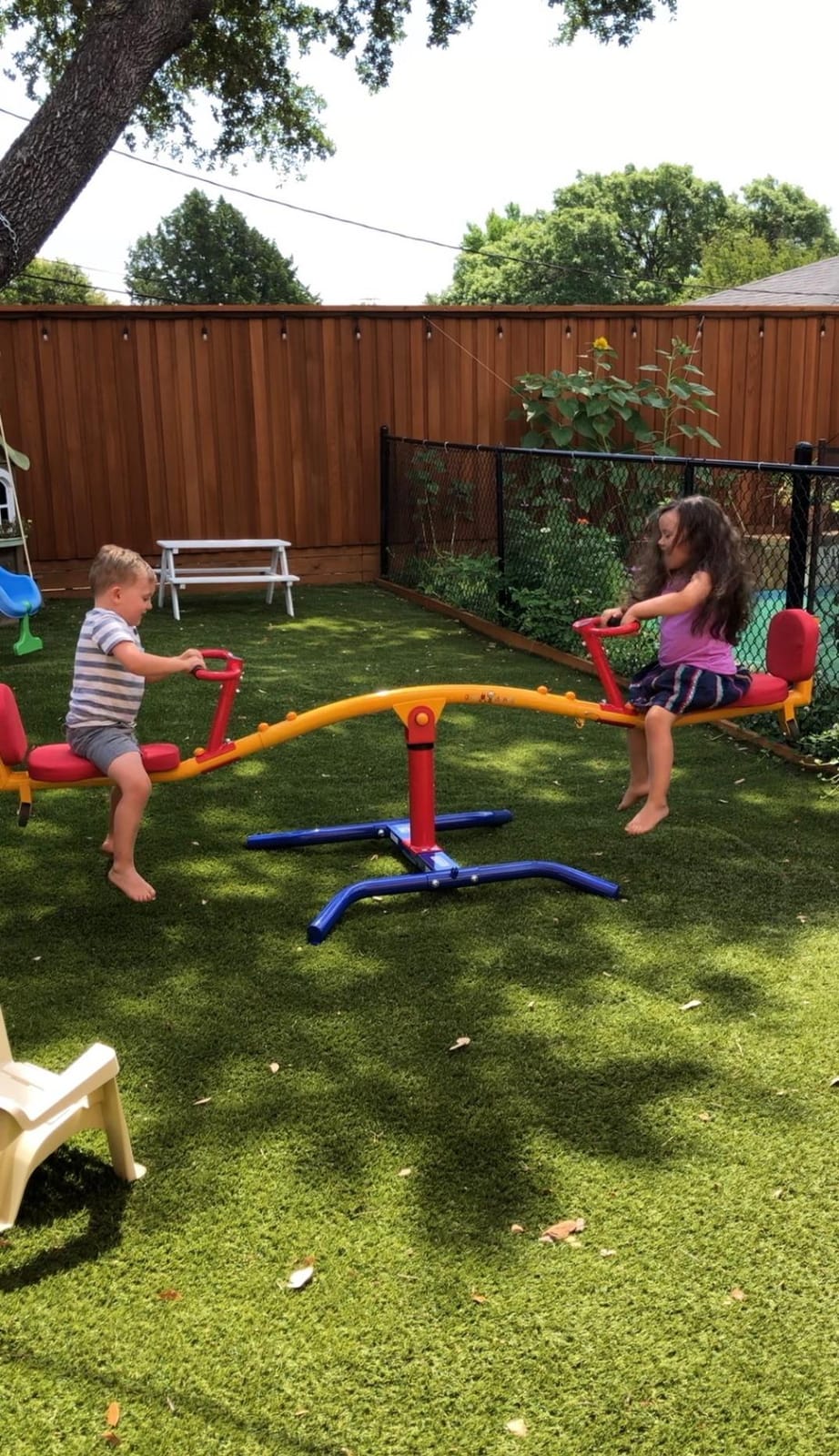
The ergonomic handlebars get rubber grips, which sounds minor until you consider what the top discussion thread in parent forums actually is: kids coming off a spinning platform because they cannot hold on properly. Grippy handles at a height a child can actually reach are not a luxury feature on this equipment, and the width of these bars is a genuine strength of this model.
One more practical touch: the urethane wheels under the seats let an adult slide a lowered seat sideways instead of dragging it. Urethane resists cracking under impact in a way lower-grade rubber does not, and being able to reposition a 59.6 pound piece of equipment without dragging it across the grass matters more than it sounds.
What You Should Know Before Buying
The footprint is the real consideration. At 101 x 38 x 45 inches, this is the longest frame in the roundup, and the swinging ends sweep an area wider than the frame itself. You are not buying a 101 inch object, you are buying a 101 inch object plus clearance on both ends, so measure your yard across the diagonal direction the swing travels, not just the length of the wall you want to use.
At 59.6 pounds, it also stays exactly where you put it. That is a genuine benefit for safety, because a spinning platform that a child can shove across the lawn is a spinning platform that can land somewhere you did not plan for, but it does mean you want the location right the first time.
Who It Suits and Who It Does Not
This one suits a family with two kids in the 3 to 12 range who want a build they will not have to replace in three summers, and it works particularly well if one child is big enough to need the 300 lb frame rating. The two-year limited warranty is a genuine quality signal in a category where many competitors offer 90 days.
It does not suit a large sibling group who want everyone riding at once, because two seats means two riders and everyone else is pushing. If your household routinely has four or more children of riding age in the yard at the same time, look at the four-seat options further down rather than watching three kids take turns.
2. Nova 4-Seat Swivel Teeter Totter – Best for Four Riders
Nova Microdermabrasion Kids Seesaw Swivel Teeter Totter Home Playground Equipment, 360 Degrees Rotating Safe, Outdoor Fun for Kids, Toddlers, Boys, Children (4 Seats)
Steel construction
Four seats
450 lb frame rating
75 x 39 x 39 inch
Ages 3 to 10
Pros
- Four seats let several children ride at once
- 450 lb frame carries 110 lb per child
- Frame adjusts between 72 and 78.7 inch
- Handle bars and bump absorber add safety
- Works indoors and outdoors
Cons
- Steel tubing can bend under hard spinning
- Cap pieces and end bolts loosen quickly
- Smaller than expected for the price
The Nova is the answer when capacity is your binding constraint. It carries four children on independent seats arranged around the center, rated at 450 lb total, which works out to 110 lb per child. For a family with three or four riders and a wide age spread, that is the difference between everyone playing and everyone taking turns.
Like the others, it spins 360 degrees while going up and down. A child at one of the outer seats traces a wide circle, and a pair of kids opposite each other can trade places. It is less of a spinning disc and more of a spinning seesaw, and that distinction matters if you want a group activity rather than a head-spinning ride.
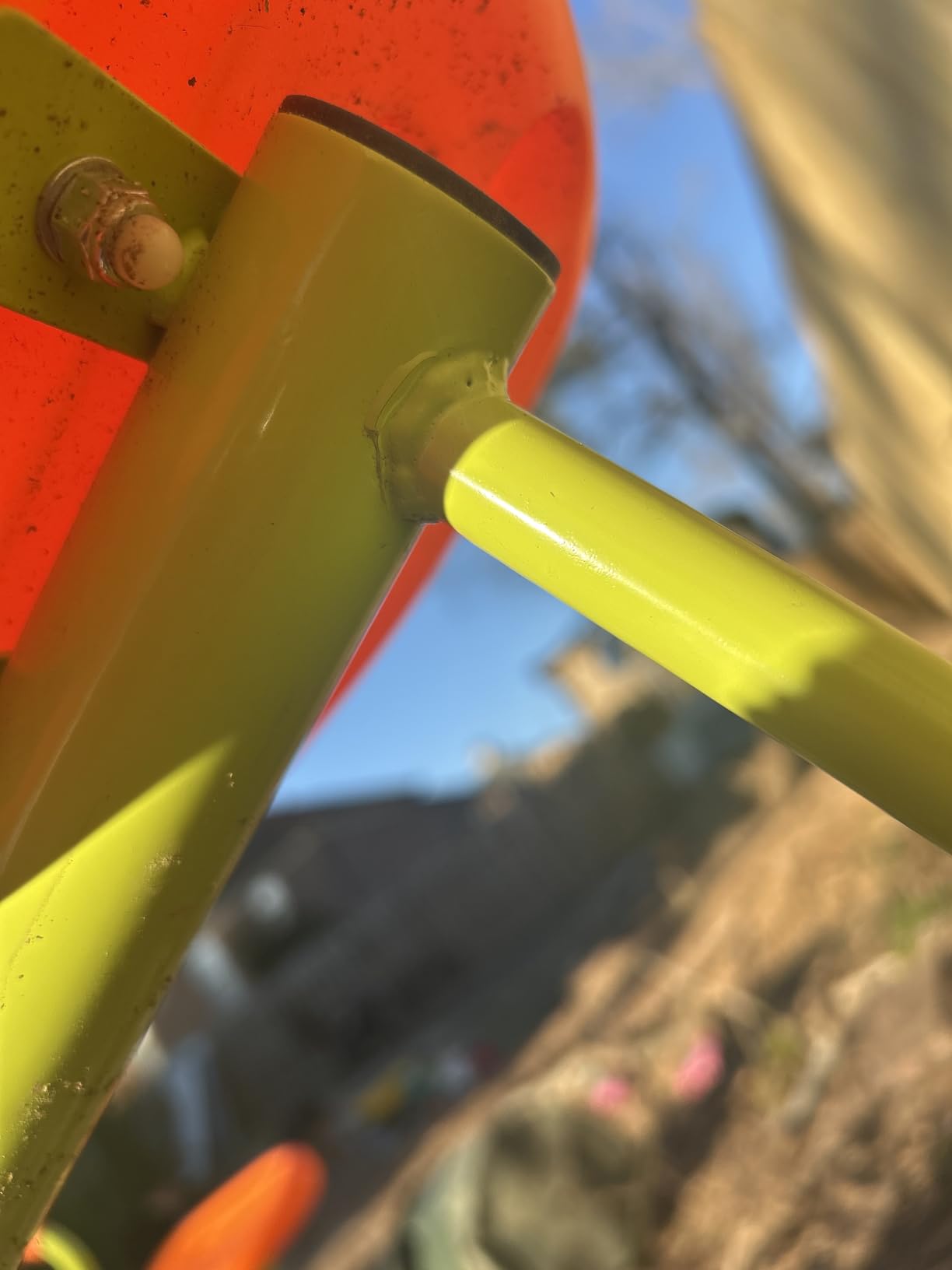
The frame adjusts from 72 to 78.7 inches, which is a genuinely useful feature rather than a gimmick. Longer legs give more ground clearance under the pivot, and a frame that can be lengthened as your children grow means one purchase covers the 3 to 10 year range the manufacturer rates it for.
Safety hardware is where this model puts its effort. The seats are large, elongated, and padded, each with a handle bar, and a reinforced bump absorber mechanism softens the landing at the bottom of each arc. Compared with a traditional park seesaw with a bare steel plank, the difference in how a child experiences it is immediate.
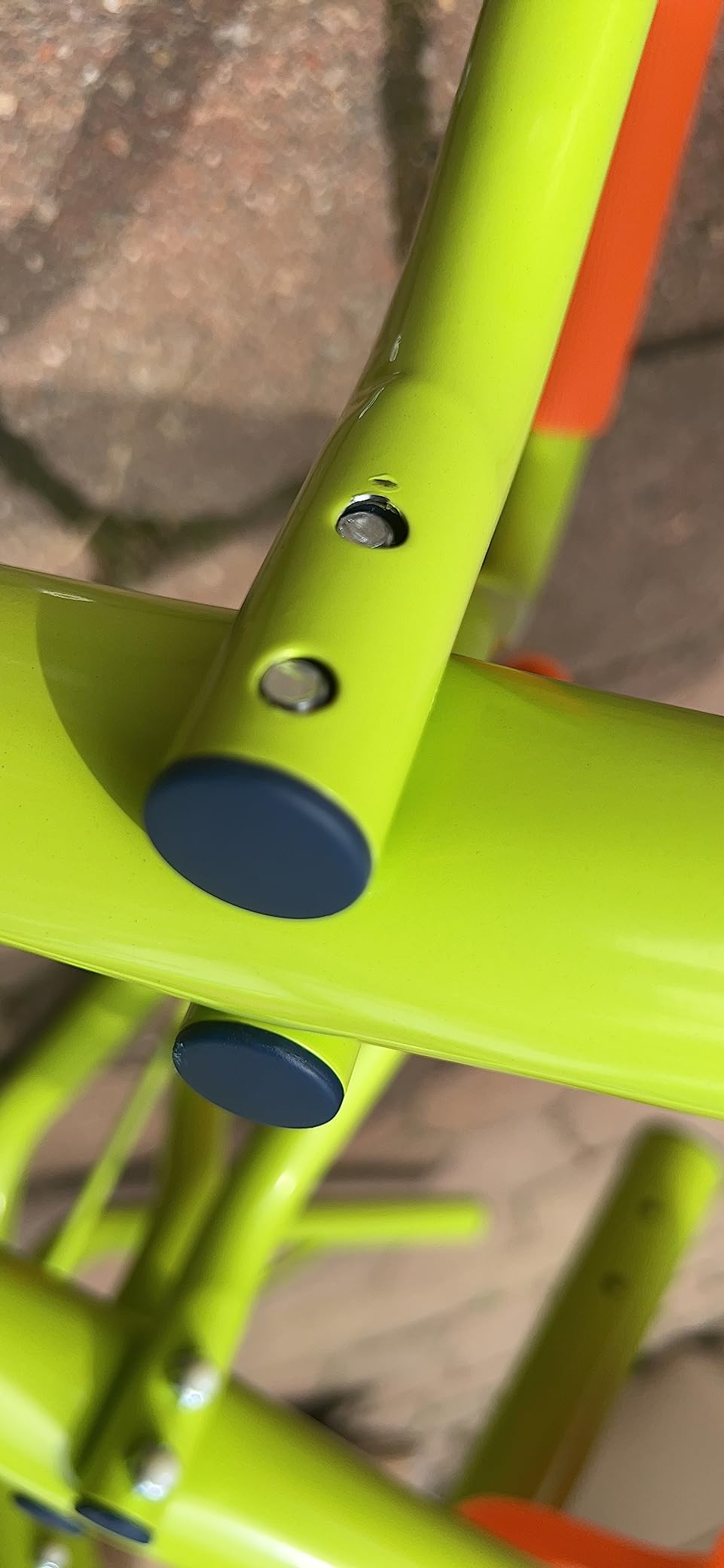
It also works indoors, which none of the outdoor-only listings here can claim. A garage or finished playroom with enough clear floor space gives you a rainy-day option, and for a family in a climate with a long wet season that is not a trivial benefit.
The honest weakness is durability under hard use. Reviewers repeatedly report steel tubing and seat support stands bending or snapping after months of energetic spinning, and cap pieces plus the bolts at the ends of the pipes loosening quickly. If your kids spin it aggressively every single day, expect to spend an afternoon tightening hardware periodically.
What You Should Know Before Buying
It holds up to four, and it is listed for ages 3 to 10, but the four-seat layout is not the same as four comfortable seats for four large children. The 110 lb per child figure is a frame rating, and real weight distribution across four moving seats stresses the joints more than a static rating suggests.
At 75 x 39 x 39 inches, this sits in the middle of the size range rather than at either extreme. That makes it a good fit for a normal suburban yard, but the spinning arc means you still want several feet of clear space on every side before you set it down.
Who It Suits and Who It Does Not
Choose the Nova if your main problem is that everyone wants a turn. Four riders at once turns a contested piece of equipment into a shared one, and the padded seats with handle bars help younger children hold on while an older sibling spins hard.
Skip it if durability under abuse is your top priority or if you have a tight yard where a four-seat frame leaves no room for the kids running around the perimeter. The loosening-bolt pattern in reviews is a maintenance commitment, not a defect, but it is a commitment.
3. TP Toys Spiro Spin Teeter Totter – The One Parents Regret Buying Wrong Size Of
TP Toys Spiro Spin Teeter Totter – Bounces and Spins 360 Degrees, Blue/Green
Foam and steel
74.41 x 24.8 x 39.37 inch
8.8 kg
Ages 3 to 8
35 kg per end
Pros
- Bounces and spins at the same time
- Inflatable wheels create a gliding floating ride
- Adult assist handle guides younger riders
- Wheels lift off the ground so it will not scuff grass or decking
- Smooth and quiet once assembled
Cons
- Plastic seat and swivel parts can crack
- Bolts loosen and need frequent tightening
- Inflatable ball wheels can arrive defective
- Seat comfort is criticised by older children
- 90 day warranty only
The TP Toys Spiro Spin does something the others do not: it spins and bounces together in a way that feels like gliding. The wheels under the seat are inflatable balls, and as they compress and rebound, the ride floats rather than clunks. Parents describe the sensation as unlike a standard spinning seesaw, and kids notice immediately which one is the fun one.
It is rated for ages 3 to 8 and supports up to 35 kg at each end. That per-end figure is worth holding onto when you are comparing it against the two-rider models, because it tells you the pivot is built for a full load at each side rather than a single child.
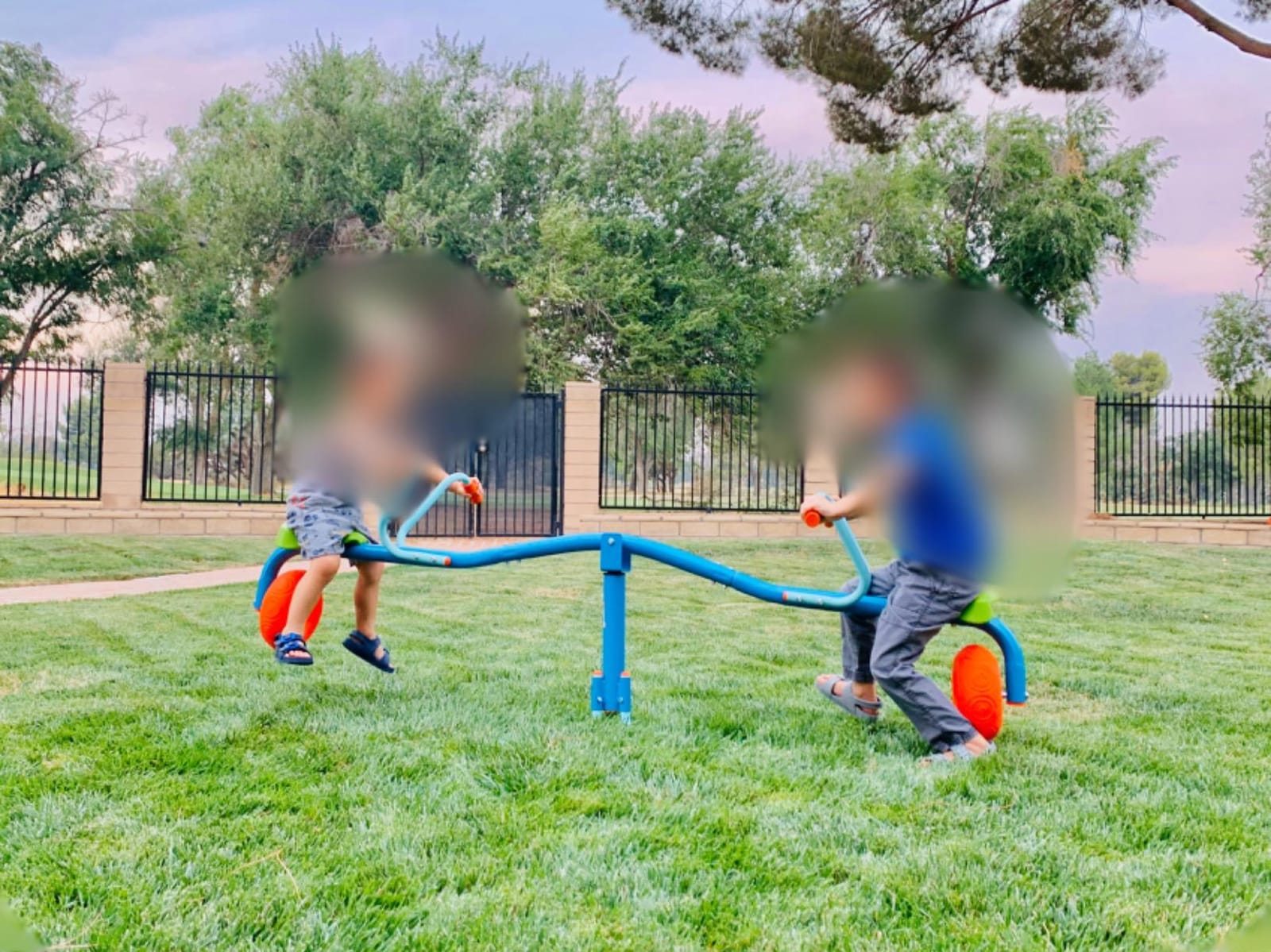
The adult assist handle is the feature that changes the age range in practice. A parent or grandparent can put a hand on it and guide the spin and bounce for a child who is not yet confident enough to generate speed alone, which effectively extends the useful life of the toy downward into the toddler years.
There is also a lawn consideration that sounds trivial and is not. The wheels lift off the ground when the unit rests, so the frame does not scuff grass or wear decking the way a fixed-leg design does. On a small urban yard or a rooftop terrace, that keeps the footprint visually and physically lighter.

Once assembled, the rotation is smooth and quiet. That silence matters more than it sounds, because steel spinners on a residential street can carry sound further than you expect, and a quiet mechanism is one of the few things parents say makes a spinning toy usable before dinner rather than on a weekend only.
The complaint cluster is build durability, and it centers on the plastic connectors and the central bearing. Reviews also flag bolts loosening within weeks, inflatable wheels arriving with lost air, and a supplied pump that can break. At a 90 day warranty, this is the shortest coverage in the group, and it is the main reason we did not place it higher.
What You Should Know Before Buying
Expect a hands-on maintenance schedule. Because the ride is partly air-filled and partly bolted together, a monthly ten-minute check of tire pressure and bolt torque is realistic if you want it to stay smooth. Owners who report cracking in the plastic swivel parts generally describe it happening after several months of daily use.
Also plan for the age ceiling. At ages 3 to 8 with a 35 kg per end limit, older children tend to outgrow the comfort of the seat before they outgrow the capacity, and several reviews specifically note seat comfort complaints from bigger kids. If your children are already past eight, this is not the model.
Who It Suits and Who It Does Not
The Spiro Spin suits a household with a mix of toddlers and early-elementary children, and especially a family that wants an adult to be able to help start the ride. The assist handle plus the quiet smooth rotation make it a strong indoor-outdoor option for a family with limited yard space and a limited tolerance for noise.
It is the wrong choice for a family planning to hand it down to a child who will be riding in a few years, and it is the wrong choice if a 90 day warranty does not meet your bar. The ride quality is genuinely the most distinctive here; the durability story is genuinely the weakest.
4. Costzon Swivel Teeter Totter – Best Fit for a Small Yard
Costzon Teeter Totter Seesaw for Kids Outdoor, Preschool Swivel Seesaw Playground Equipment, 360 Degree Rotation, Indoor Outdoor Play Equipment for Toddlers, Suitable for Home, Backyard Gift Christmas
Carbon steel, PP, TRP
72 x 11 x 34 inch
13 lb
Ages 3 and up
66 lb per seat
Pros
- Rotates a full 360 degrees while rocking
- Soft EVA foam handles give small hands a secure grip
- Stopper legs reduce shock for smoother landings
- Powder coated carbon steel frame resists rust
- Light at 13 lb so it moves between play areas
Cons
- Two-seat layout limits how many children ride
- 66 lb per seat is modest for older children
- Triangular base needs level ground to stay stable
The Costzon is the one to buy when the yard is the constraint. At 72 x 11 x 34 inches and 13 pounds, it is among the most compact and the lightest of the units in this roundup, and that combination changes what you can do with a small or unusually shaped outdoor space. It is a spinner you can move to whichever patch of lawn is level.
The motion is a true 360 degree rotation combined with the usual up-and-down rocking, so it simulates a merry-go-around for a two-rider group. At 66 lb per seat, it is built for the younger half of the riding range rather than for a household with a twelve-year-old and a five-year-old sharing.
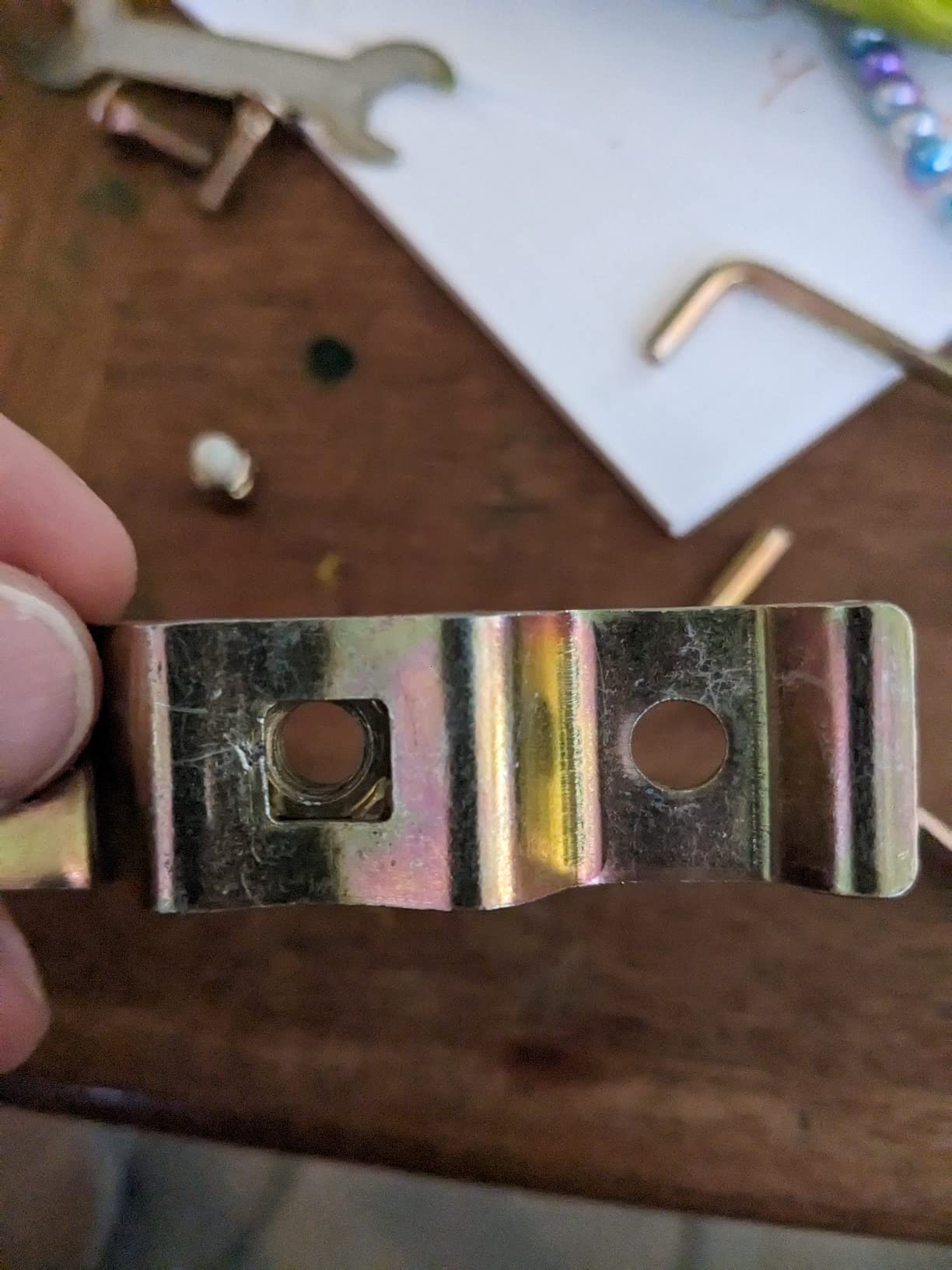
Two details make it feel well designed for small children. The handles are wrapped in soft EVA foam, which is the difference between a child holding on confidently and a child sliding off, and given that grip is the single most discussed issue in parent discussion about this equipment, that is worth real weight in a comparison.
The other is the stopper legs. Where a basic seesaw slams the frame into the ground at the bottom of each arc, the stoppers reduce that shock, which is kinder to both the child’s landing and the joint in the middle of the frame over time.
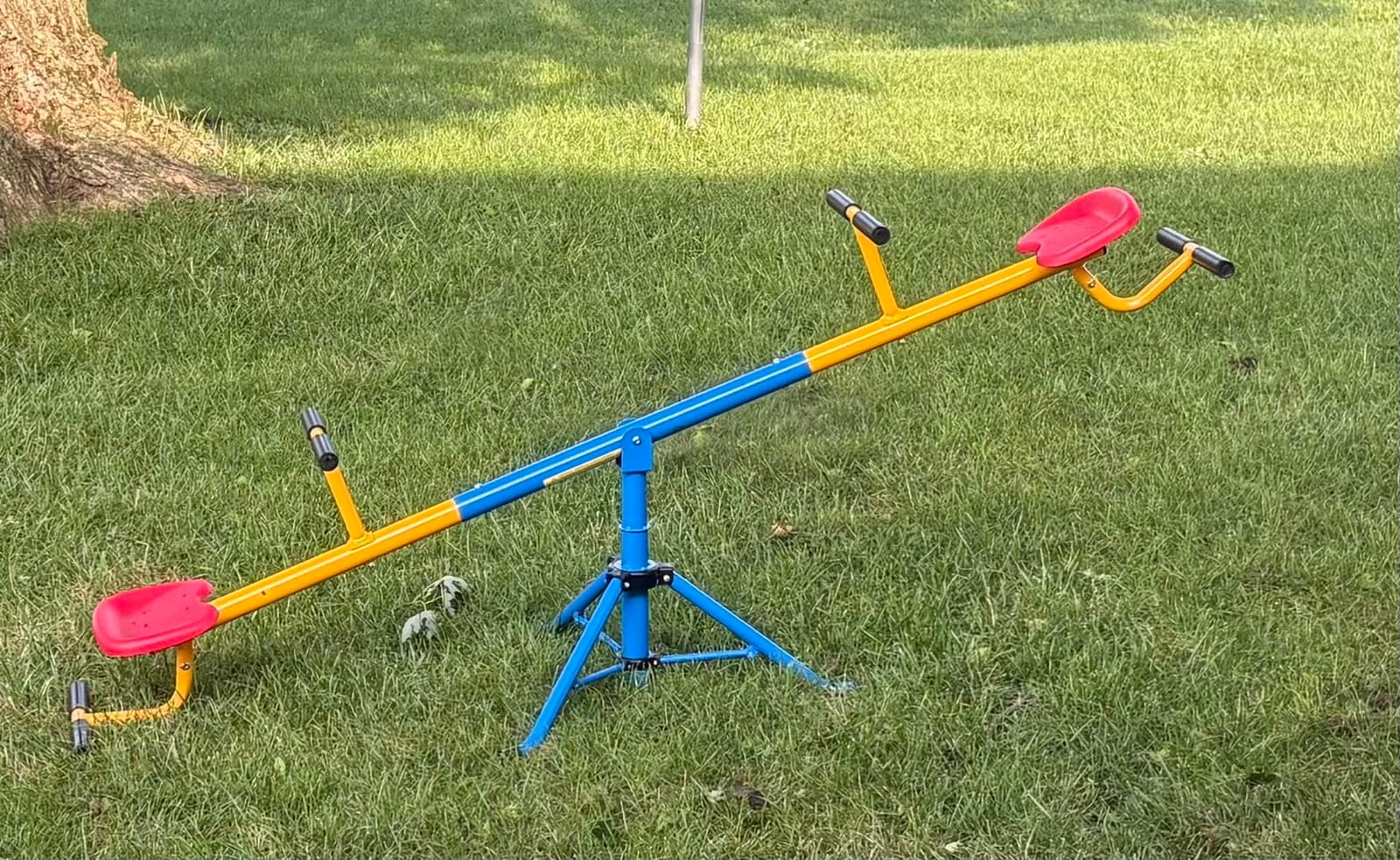
The frame is powder-coated carbon steel with plastic and TRP components, described as rustproof, and the frame is stable when set up properly. The tripod base is a genuine advantage for footprint: it does not need the wide A-frame legs that make some two-seaters sprawl.
Two things to keep in mind. The 66 lb per seat rating is modest, so a bigger child outgrowing it is a matter of when, not if. And a triangular base needs level ground, which in a yard with any slope means the platform can rock rather than sit flat, no matter how well the unit itself is built.
What You Should Know Before Buying
Measure your flat space honestly before this one. A 13 pound frame is easy to place, but a 72 inch long spinner with children running around the outside to start it needs clear ground beyond the frame itself. The running space, not the equipment, is usually what makes a yard feel too small.
Also decide early whether the 66 lb per seat rating fits your children. If both riders are under about fifty pounds you are comfortably inside the rating, and this is a good buy. If one rider is a large ten-year-old, look at the models rated at 99 lb or 100 lb per seat instead.
Who It Suits and Who It Does Not
This suits families in compact urban yards, apartments with a patio or balcony, and anyone whose lawn is not perfectly level. The light weight and foam grips and among the most portable options, which matters for daycares, grandparents’ gardens, and playrooms.
It does not suit large sibling groups, and it does not suit a slope. If your only usable space tilts more than a couple of degrees, a stoppered two-seater will feel unstable in a way that puts the wobble in the hands of a small child rather than the frame.
5. Iyoyo Spinning Seesaw with Safety Handle – Best for Toddlers and Older Kids Together
Iyoyo Teeter Totter Seesaw for Kids Children Ages 3-7, 360° Spinning Seesaw Outdoor Playground Toys, Rotating Teeter Totter with Safety Handle, Sturdy Steel Backyard Playset Gift for Boys Girls
Metal frame
70.9 x 26 x 27.56 inch
17 lb
Ages 3 to 12
100 lb plus capacity
Pros
- Powder coated steel tubes hold 100 lb plus without flexing
- Triangular safety handle and wide anti-tip base keep it steady
- All assembly tools are included
- Weather resistant coating resists rust and UV
- Quick setup
Cons
- Compact 75 inch length favours younger children
- Stopper can pinch fingers from behind the seat
- Over-tightening the bolts makes the spin rough
The Iyoyo spans the widest age range of any two-rider model here. The manufacturer rates it from 36 months to 12 years and puts the frame at 100 lb plus, which makes it the natural pick for a household with a three-year-old and an eleven-year-old who will both want on it this weekend.
The safety engineering is more visible on this model than most. A triangular safety handle sits at the centre for an adult to steady the unit, and the wide anti-tip base keeps the platform from tipping when a child puts weight on one end. Reviewers specifically describe it as solid and not tippy, which is the standard most two-seat spinners fail.
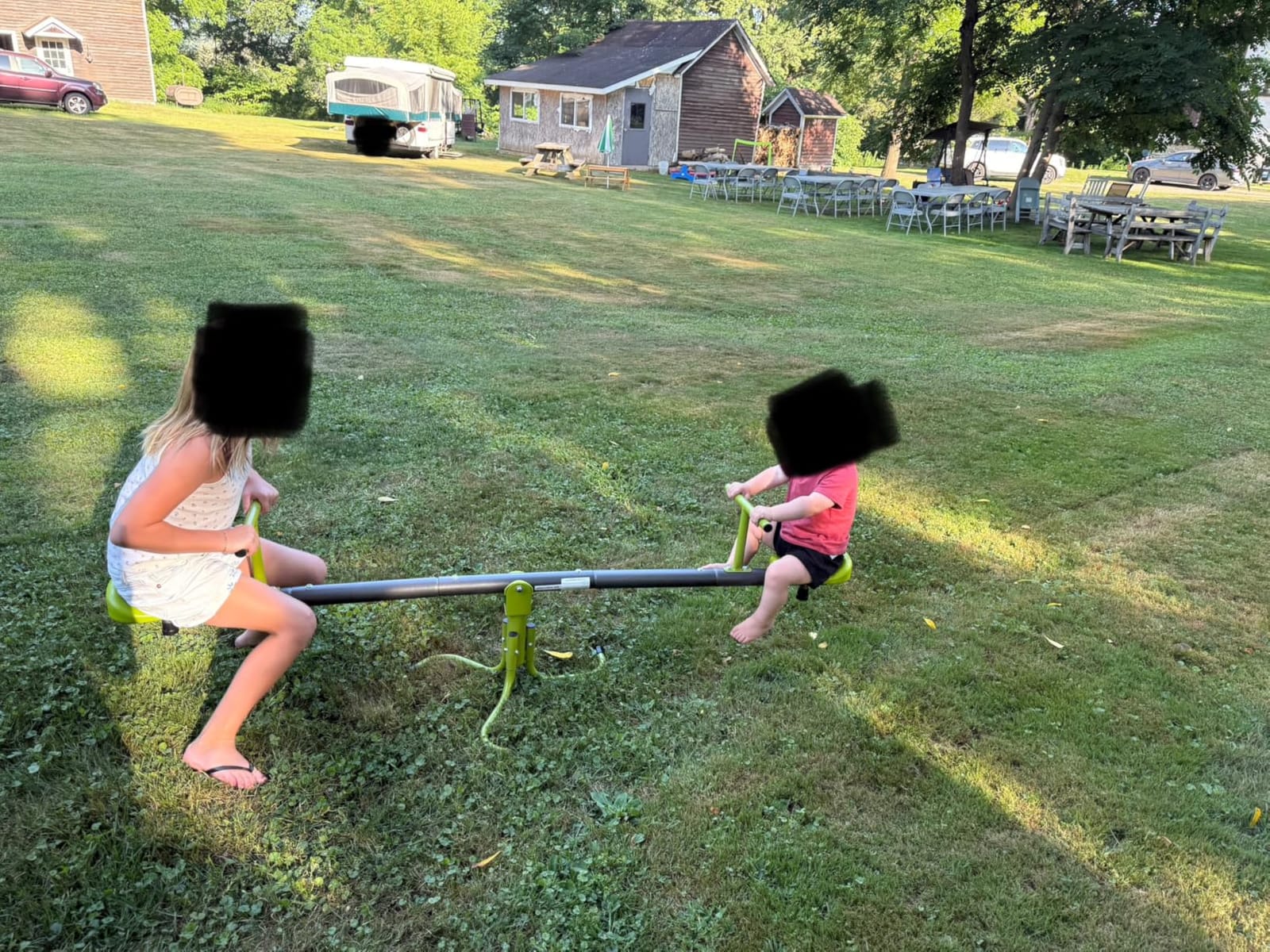
Assembly is where it scores well for a first-time buyer. All the tools needed are included, and owners report quick setup without needing to source a socket set or a second adult. For a family that has never built playground equipment, that removes the single most common reason a boxed toy stays unassembled in the garage.
The coating is described as weather resistant against both rust and UV fading, which matters for a toy that will sit through at least one full summer in full sun without any treatment. The 360 degree spin and bounce combination is the usual mode, and the triangular handle at the centre doubles as a grip point for a child reaching across.
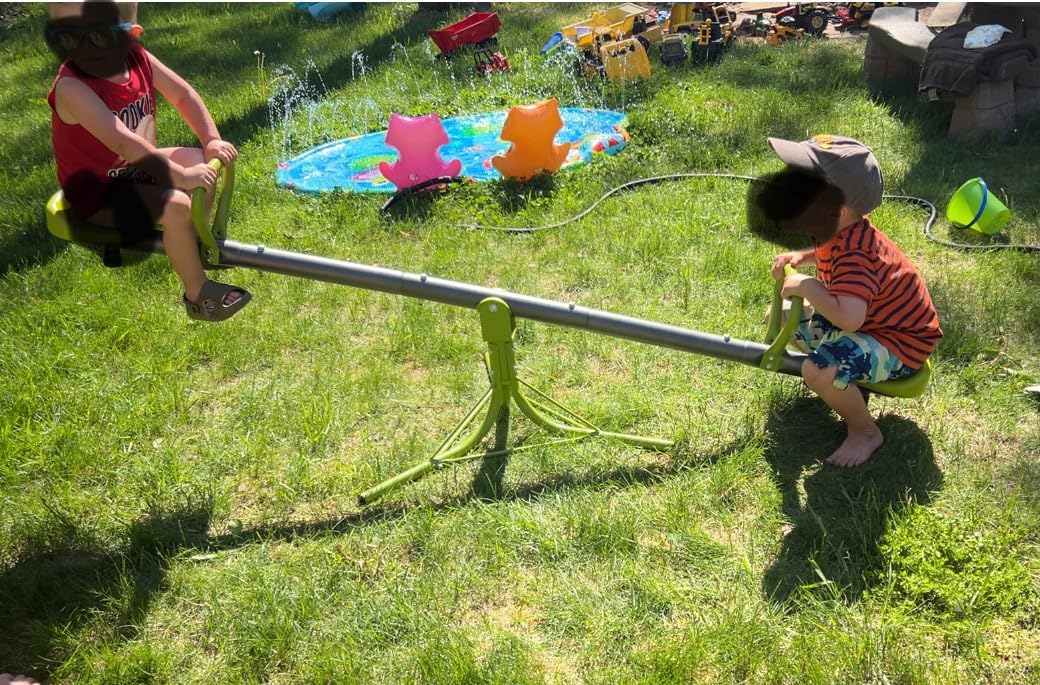
Two honest drawbacks come from reviews. The frame is 75 inches long with a 14 inch base height, which is a compact size that suits younger children better than big kids, so the 12-year rating reflects capacity more than comfort for older riders. And the stopper under the seats can pinch fingers if a child grips the back of the seat, which is worth mentioning to a younger sibling.
There is also a build tip: over-tightening the bolts makes the spin less smooth. Tighten to firm rather than to maximum, then nudge the rotation by hand and adjust until it moves freely. That single step is the difference between a smooth glide and a stiff, jerky ride.
What You Should Know Before Buying
The 17 pound weight sits in the middle of this group, so it is heavy enough to stay put and light enough to reposition with two people. The 70.9 inch length is shorter than several rivals, which is a real advantage in a small yard, and the 14 inch base height keeps the pivot low and stable.
Plan for two riders only. The single long beam means the same child on one end or the other, so a household with three or more riding-age children will want a four-seat frame, and a household with one child will find the safety handle and the anti-tip base doing most of the work of keeping a solo rider upright.
Who It Suits and Who It Does Not
Choose the Iyoyo for a mixed-age pair, for a first build, or for anyone who wants adult hands-on control over how fast the platform turns. The safety handle, the low stable base, and the included tools make it the most forgiving of the two-rider options.
Pass on it if your children are tall and heavy, or if you expect rough play with a younger child grabbing at the seat from behind. The capacity is there for older children; the ergonomics are not.
6. ZENY 360 Rotating Teeter Totter – Best for Growing Children
ZENY 360° Rotating Teeter Totter Seesaw for Kids
Plastic and steel
75.59 x 39.4 x 23.6 inch
13.5 lb
36 months to 10 years
99 lb per seat
Pros
- Adjustable frame pole extends from 71.65 to 75.59 inch
- 99 lb per seat across a powder coated steel frame
- Rubber stoppers under the seats absorb impact
- Non-slip rubber hand grips
- Light enough for children to move around the yard
Cons
- Light build feels flimsy for heavier children
- Orange handle cushion wears and comes off
- Assembly takes about 30 minutes
- Younger children can slip off while it spins
The ZENY’s distinguishing feature is an adjustable frame pole that extends from 71.65 to 75.59 inches. That is a small number on a spec sheet and a meaningful one in a family that plans to keep the same unit for years, because the frame can grow with the children rather than being outgrown all at once at age seven.
Each seat supports up to 99 lb on a powder-coated steel frame, and the 360 degree rotation works alongside the usual seesaw arc. The molded plastic seats have rubber stoppers underneath that reduce impact, and the hand grips are non-slip rubber rather than bare metal.
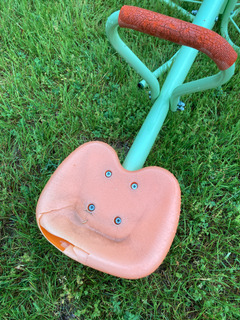
At 13.5 pounds, it is light enough that children can push it around the yard themselves, which is a small quality-of-life win for a parent who is not minded to carry equipment across a lawn every time the play area moves. Combined with the compact 75.59 x 39.4 x 23.6 inch footprint, it is well suited to a modest yard.
The most common theme in reviews is the quality gap between the listed capacity and the felt build. Owners like the spin and the adjustability, and the same owners describe it as lighter and less sturdy than advertised. If your child weighs anywhere near 99 lb, the rating is theoretical; somewhere in the middle of that range, it is real.
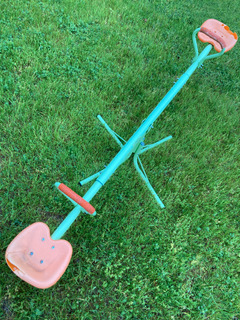
Two smaller complaints are worth flagging. The orange handle cushion wears and comes off relatively quickly, and younger children can slip off while the platform is spinning, which means the model needs closer supervision with a toddler rather than a school-age child. Assembly is described in reviews as straightforward but around 30 minutes.
One sizing note from the data: the feature list recommends ages 3 to 6 while the manufacturer listing runs from 36 months to 10 years. The broader range holds for the capacity, but the comfort and control realistically sit at the younger end of it.
What You Should Know Before Buying
Measure for the sweep, not the frame. A 75 inch spinning platform with a child running around the outside to start it needs clear ground well beyond the frame ends, and a rotating platform in a corner of a yard will get stopped by the fence sooner than by anything else.
Check the level of your ground as well. This is a light frame on a spring-and-pivot style base, and while it is far steadier than a bare plank seesaw, a sloped patch of lawn will still pull the rotation out of true and make the ride feel unpredictable for a small rider.
Who It Suits and Who It Does Not
Pick the ZENY if your kids are on the younger side of the recommended range, if you like the idea of an adjustable frame, and if being able to move the equipment yourself matters to you. It is a reasonable first spinning platform for a family with one or two children aged three to eight.
Look elsewhere if the heaviest rider is close to 100 lb, or if a loose-feeling frame would bother you. A sturdier build with a longer warranty will serve you better if the unit is going to be used daily by older children.
7. SUPER DEAL 4-Seat Rotating Seesaw – Best When Every Child Rides Alone
SUPER DEAL Teeter Totter Kids Seesaw, Outdoor Playground Equipment 360 Degrees Rotate All Steel Extendable Tubes for Toddlers Children Backyard, Green and Orange, 4 Seat
Iron frame with plastic seats
75 x 39.475 x 39 inch
Ages 3 to 9
450 lb total, 120 lb per child
Pros
- Four independent seats
- one spring per child
- Each child rides at their own comfort level
- Powder coated metal frame rated for outdoor use
- Foam handles
- plastic seats and rubber padded stoppers
- Reinforced bump absorber reduces impact
Cons
- Highest dissatisfaction rate in this group at 10 percent one-star
- Iron frame and plastic seats less durable than all-steel builds
- Four-seat footprint needs more clearance than a two-seat spinner
The SUPER DEAL solves the problem nobody else does quite so well: children of very different sizes wanting to ride at the same time. Each of the four seats runs on its own independent spring, so a small child at one end is not fighting a large child at the other. That is a genuine design advantage in a mixed-age household.
Capacity is rated at 450 lb total, or 120 lb per child, which is the highest per-child figure among the four-seat models in this roundup. The frame adjusts from 72 to 78.7 inches, and the manufacturer rates it for ages 3 to 9.
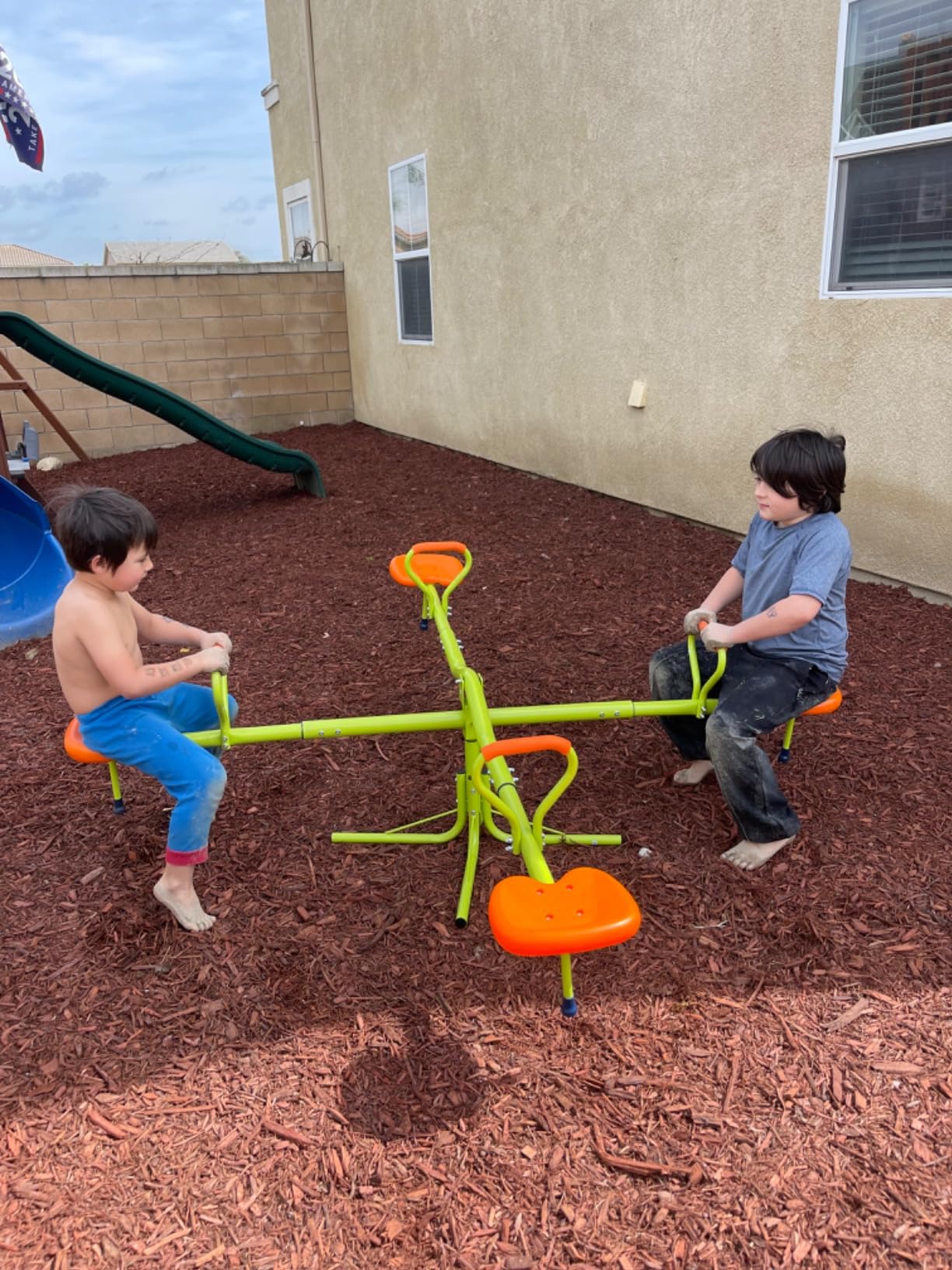
Comfort details are consistent across the frame. Foam handles, plastic seating, and rubber padded stoppers cover the contact points, and a reinforced bump absorber mechanism reduces the shock at the bottom of each arc compared with a conventional park seesaw. For a child who is new to this kind of equipment, that soft landing is the difference between trying again and asking to stop.
The powder-coated metal frame is described as weather resistant for continual outdoor use, and the frame adjustment range means you can add clearance as the kids grow. It is rated for both indoor and outdoor use, which gives you a garage option in wet months.
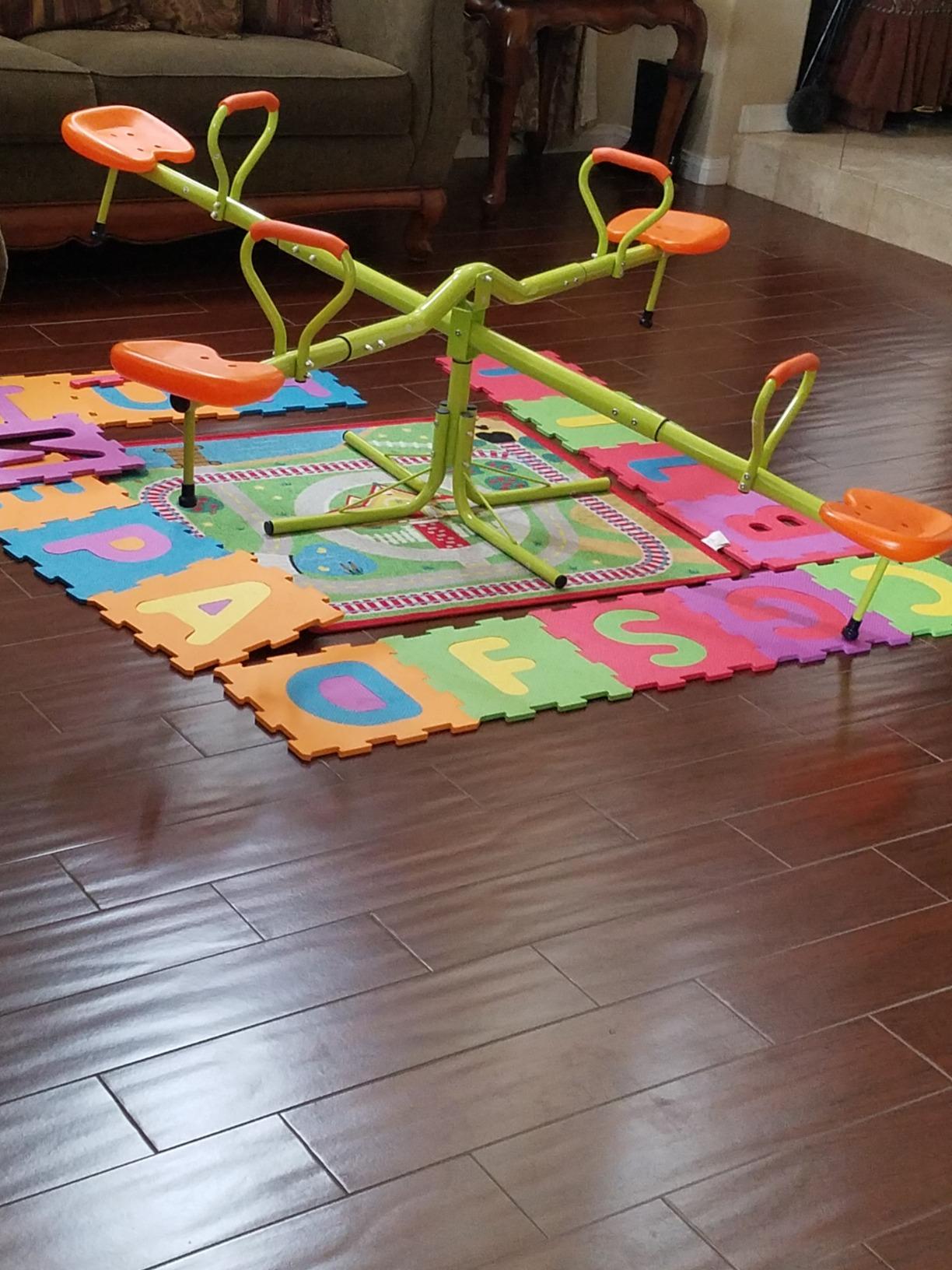
Being straight with you about the weak point: this model carries 10 percent one-star ratings, the highest dissatisfaction rate in the group. The main drivers are assembly stiffness and plastic seat durability, and the iron frame with plastic seats is less durable than the all-steel builds in this roundup.
The 39 inch width across a four-seat layout is not much wider than a two-seater, but the spinning arc means the four riders sweep a circle considerably wider than the frame. Plan your clear space around the perimeter, not just the physical dimensions of the metal.
What You Should Know Before Buying
The one-spring-per-child layout is the reason to choose this over another four-seater. When a heavy and a light child share a single pivot, the light child ends up airborne more than they chose. Independent springs remove that problem entirely, which is why this design still appears in school and therapy-adjacent settings.
Budget for a hardware check. Reviews flag assembly stiffness and loosening as recurring themes, and the plastic seats are the component most likely to show age first. Tightening bolts and checking the spring mounts a couple of times a season is a sensible routine regardless of model.
Who It Suits and Who It Does Not
This suits a family with a wide age spread and only one unit, and a household that regularly has four riding-age children in the yard together. It also suits a mixed group of riders where one child is noticeably heavier than the rest.
It is the wrong pick for a yard with limited clear space, and the wrong pick for a family that wants a long-lived unit with no maintenance. The independent spring design is worth real money, and you pay for it in build materials.
8. Outsunny 4-Seat Swivel Seesaw – Best for Cooperative Play
Outsunny Kids Seesaw Swivel Teeter Totter with 360° Spinning, 4-Seat
Metal and polypropylene
71.75 x 71.75 x 19 inch
22 lb
Four riders
88 lb per seat
Pros
- Seats four children for social and cooperative play
- Heavy duty steel pipe construction
- Easy-grip handlebar for a secure hold
- Compact square footprint that stays stable when balanced
Cons
- Square footprint needs a fairly large play area
- 88 lb per seat is lower than many competing frames
- Assembly required before use
The Outsunny differs from the other four-seaters in one way that changes the footprint math. Instead of a long beam with seats in a row, it is a square 71.75 by 71.75 inch platform with four seats around the centre, and the whole deck rotates. Balanced, it holds four children and stays stable.
Because it is a square rather than a beam, the spinning effect is shared equally. All four children move through the same circle at the same radius, which makes it a genuinely cooperative piece of equipment. A group of four can hold the handlebars and rotate together, and it works well for a group of friends rather than a set of siblings.
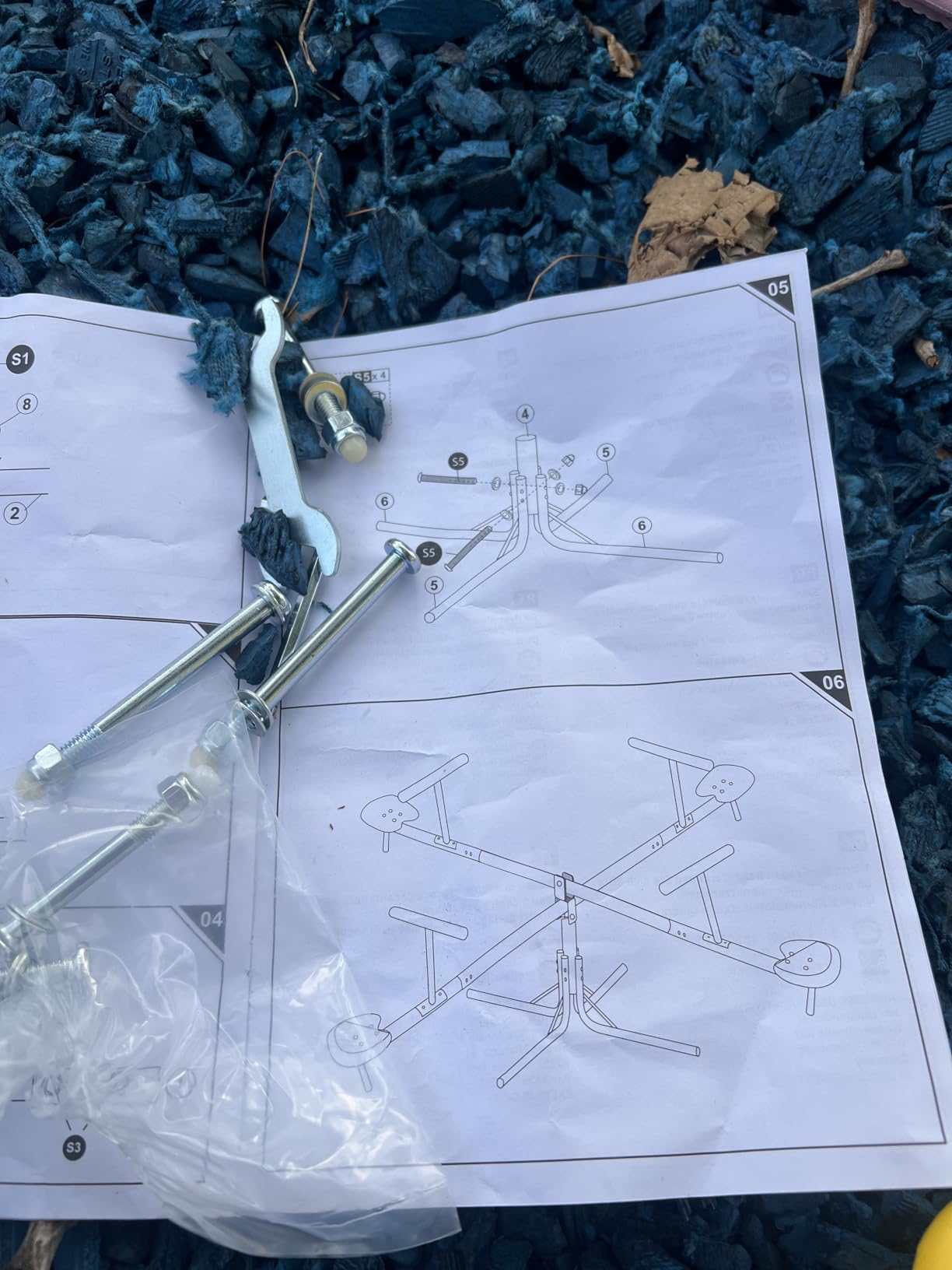
The frame is heavy duty steel pipe with polypropylene components, and the seats come with an easy-grip handlebar each. Seats measure 9.25 by 7.75 inches, sized for younger riders, and the manufacturer certifies the unit for ages 3 to 12 while recommending 3 to 8.
At 22 pounds, it sits in the middle of the weight range for this roundup, heavy enough to stay in position and light enough for two adults to reposition. It is 19 inches high when fully balanced, which is a low profile that makes getting on and off easier for small children than a tall beam.
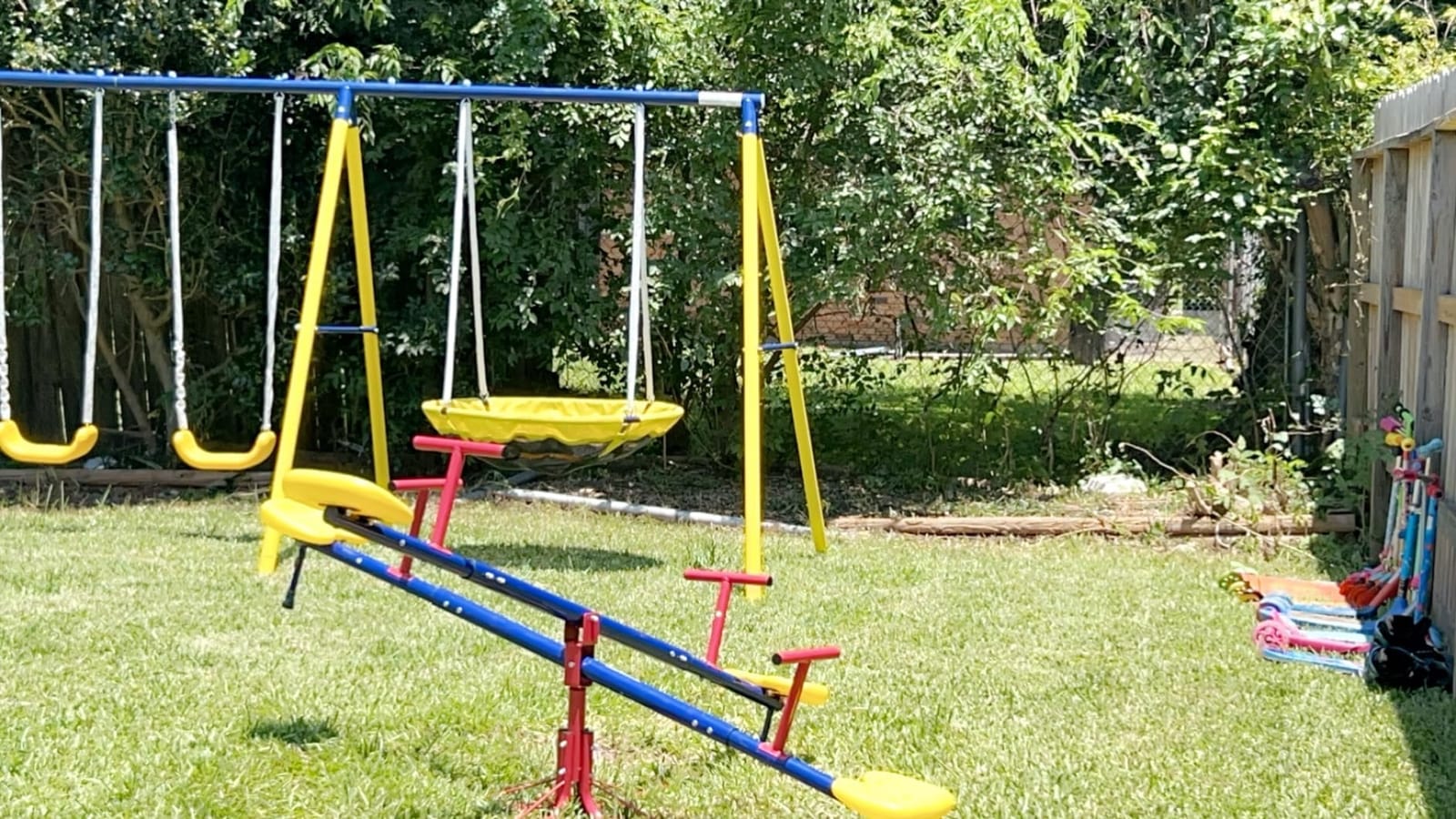
Two limitations are clear. The square 71.75 inch footprint needs a fairly large play area, and once you add the running space children use to spin it, this is the most space-hungry of the four-seat options. The 88 lb per seat rating is also below the 99 and 100 lb figures on some two-riders.
Assembly is required before use, which is worth stating plainly rather than discovering. It is not a zero-assembly product, and budget an afternoon the first time.
What You Should Know Before Buying
The rating is based on 133 reviews, a smaller sample than most of the models here, so treat the 4.2 score as a reasonable signal rather than a settled one. Buyers like the four-seat social layout and the steel pipe frame, with occasional comments about the amount of floor space it consumes.
Check your clearance honestly. A square spinner that needs a roughly 72 inch square of level ground plus running room on all four sides is a significant commitment to one section of a yard, and it competes directly with a swing set for the same space.
Who It Suits and Who It Does Not
This is the pick for a group of roughly the same age, especially a group of friends or cousins, because four children of similar size can share the rotation evenly. It also suits a family that wants a low-profile platform where small children can mount and dismount easily.
It does not suit a small yard, and it is not the right frame if your riders are large. For a tight space or a wide age spread, the four-seat beam models or the higher-capacity two-riders are a better match.
9. ZeathToits 360 Swivel Seesaw – Best for Ages 2 to 5
ZeathToits Seesaw -Teeter Totter for Kids Ages 3-8 – with 360° Swivel
Metal frame
190 cm long with 35.5 cm base height
15 lb
Ages 3 to 8
100 lb capacity
Pros
- Lead-free hot-dip galvanized zinc coating inside and out
- Three-stage reinforced frame resists bending and tilting
- Triangular handles sized for small hands
- Lightweight and quick to assemble
- 360 degree swivel combines bouncing and spinning
Cons
- Height range tops out around 65 cm for taller children
- Manufacturer age recommendation conflicts with the listing
- Outdoor-only listing despite weather-resistant claims
The ZeathToits is the one we would put in front of a two-year-old, and it gets there through coating and frame geometry rather than through size. The steel tubing carries a lead-free hot-dip galvanized zinc coating inside and out, which is a corrosion protection method normally associated with commercial playground equipment rather than a consumer spinning seesaw.
The three-stage reinforced frame is designed to resist bending and tilting under daily use, and it supports up to 100 lb. At 4.5 out of 5 across 105 reviews, it scores well, though the review base is small enough that you should read it as a strong signal rather than a settled verdict.
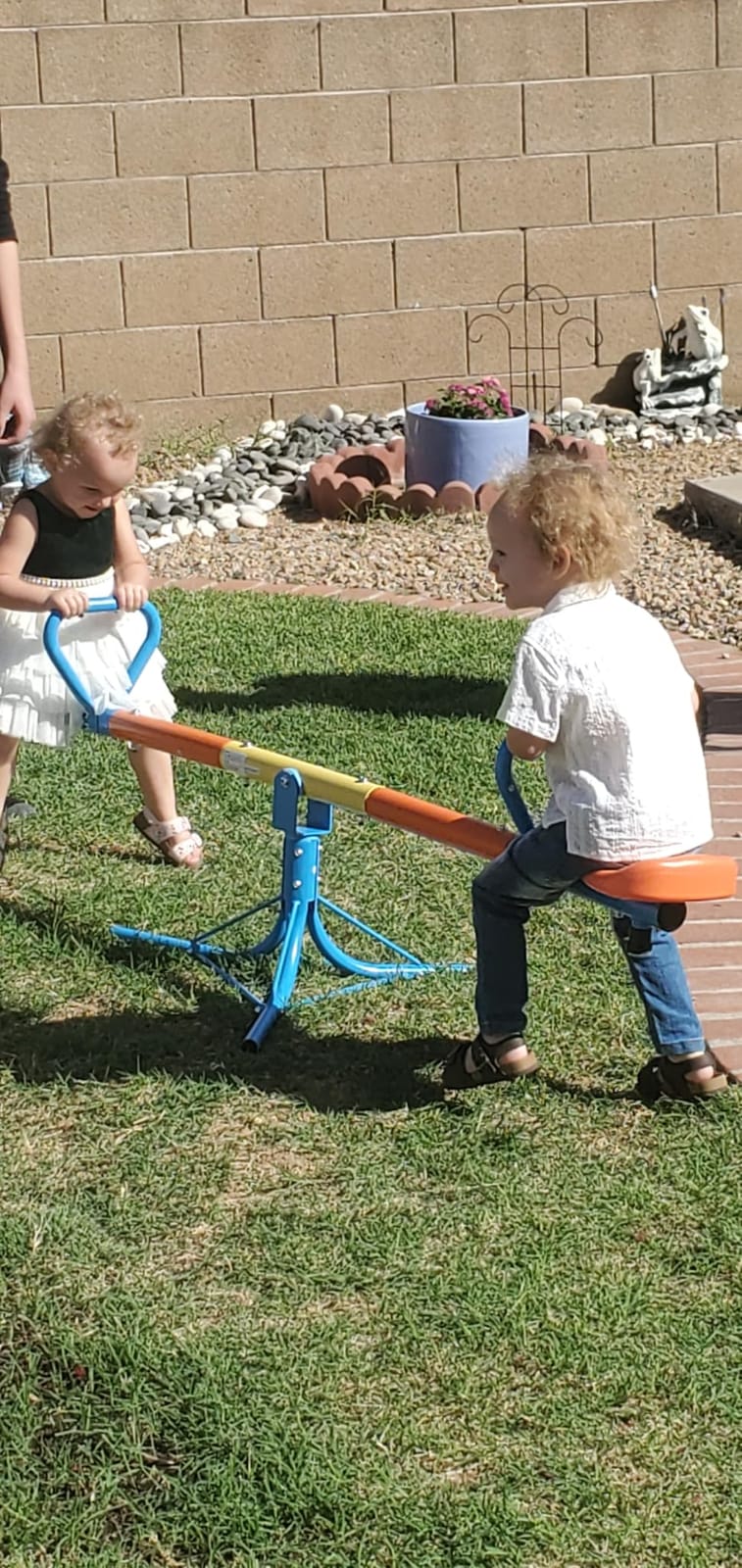
The handles are triangular and sized for the hands of toddlers aged 2 to 5, which addresses the grip problem at its source. A child who can close their hand around a handle is a child who stays on the platform, and staying on is the single most important thing a parent can ask of this equipment.
It is also light, at a listed 15 pounds, and quick to assemble. Those two facts together make it the easiest unit here to move between a playroom, a garage, and a patio, and easy movement matters because the best place to put a spinning platform is wherever the kids actually are that afternoon.
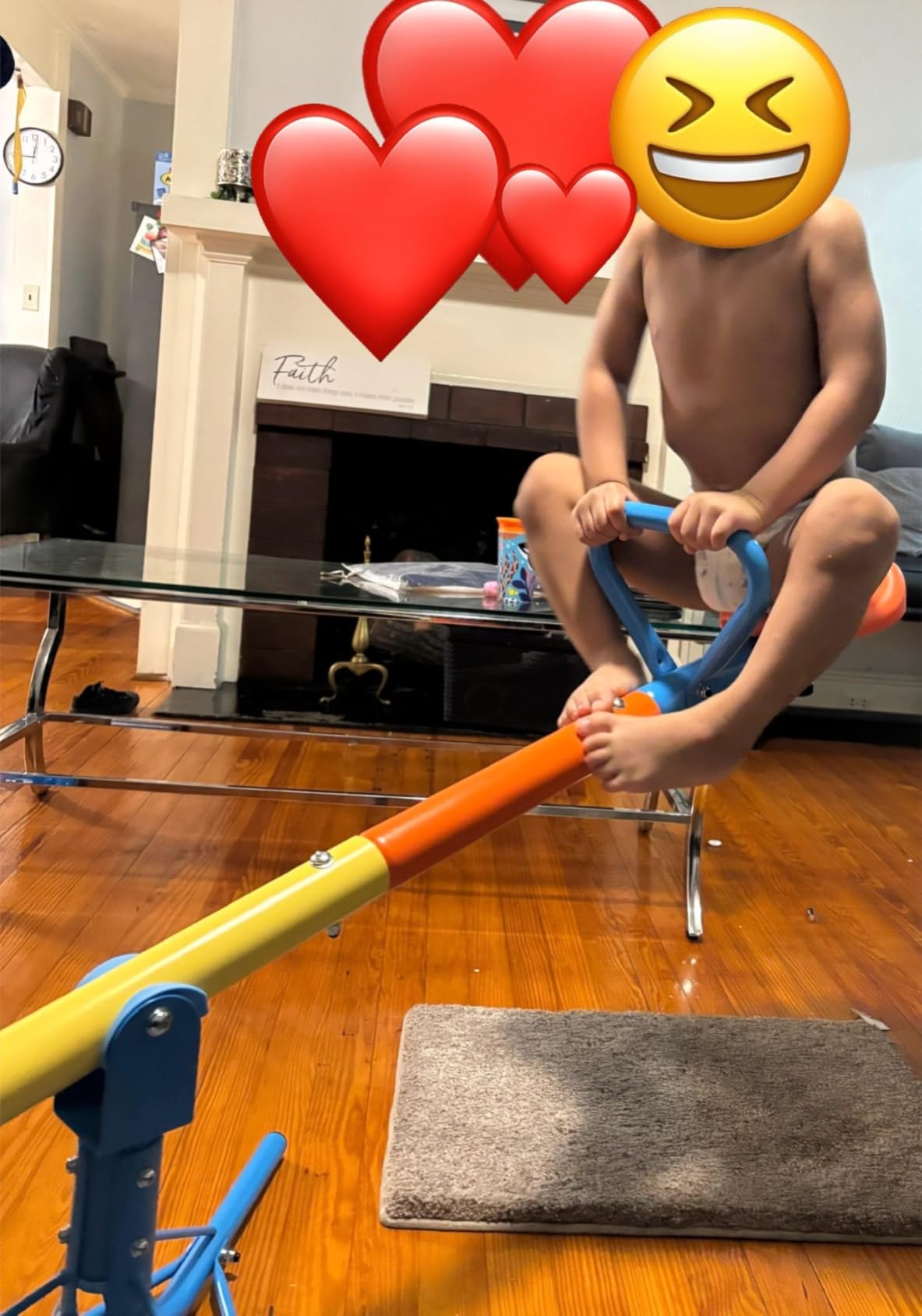
There is a data inconsistency worth telling you about. The listing presents ages 3 to 8 while the manufacturer’s own recommended age is 5 to 10 years, and the feature set explicitly targets toddlers 2 to 5. Whichever number you look at, the frame height and handle sizing point clearly at the younger end.
The height range also tops out at about 65 cm, which limits the fit for taller children. And the listing is outdoor-only despite the weather-resistant coating claims, so treat it as a yard toy rather than a spare-room spinner.
What You Should Know Before Buying
Surface matters more here than with the larger four-seat models because the whole point is a small child on a light frame. On a level patch of packed ground or a rubber mat, the galvanized frame behaves predictably; on a slope or a very soft lawn, the base can settle unevenly and the rotation will wander.
Because the coating is galvanized rather than painted, you do not need to touch it up annually the way you would with a powder-coated frame that has been scratched. That is a real long-term advantage for a toy that will be left outside year after year.
Who It Suits and Who It Does Not
Choose the ZeathToits for the youngest riders in your household, for a family that moves equipment between spaces, and for anyone who wants genuine corrosion protection at the lower end of the size range. The handle sizing is the best in the group for a two or three-year-old.
Skip it once children get tall, since the 65 cm maximum height is a hard stop, and skip it if you need an indoor option. For a wider age range in the same footprint, the Iyoyo and the ZENY both extend further.
10. TAILERNRUYE 250 lb Rotating Seesaw – Best for a Balcony or Patio
TAILERNRUYE Seesaw for Kids Outdoor, Heavy Duty 250LB 360° Rotating Seesaw Outdoor Teeter Totter with Sit and Spin Design for Backyard Park & Balcony Ideal Outdoor Toys for Kids Ages 3 4 5 6 7 8
Metal frame
68.5 inch frame
About 13.3 lb
250 lb capacity
Ages 3 to 8
Pros
- Heavy-duty frame rated for 250 lb
- Rust resistant coating on high-strength steel tubing
- Cushion structure shaped to body mechanics
- Smooth triangular handles give a secure grip
- Compact enough for a balcony
- patio or living room
Cons
- Runs smaller and lighter than the listing images suggest
- Supplied bolts are too short to connect the tubes
- Lowest average rating in the group
The TAILERNRUYE is the smallest footprint spinner in the roundup, and at 68.5 inches long it is the reason we included a unit this light. If you have a balcony, a patio, or a living room floor rather than a lawn, this is one of very few spinning platforms that will physically fit the space you have.
On paper the capacity is the most generous in the group, with a heavy-duty frame rated to 250 lb. Seat height adjusts from 5.12 to 26 inches, with a sitting height range of 21.6 to 28.4 inches, and the manufacturer recommends ages 3 to 8 with a broader 24 month to 10 year range.
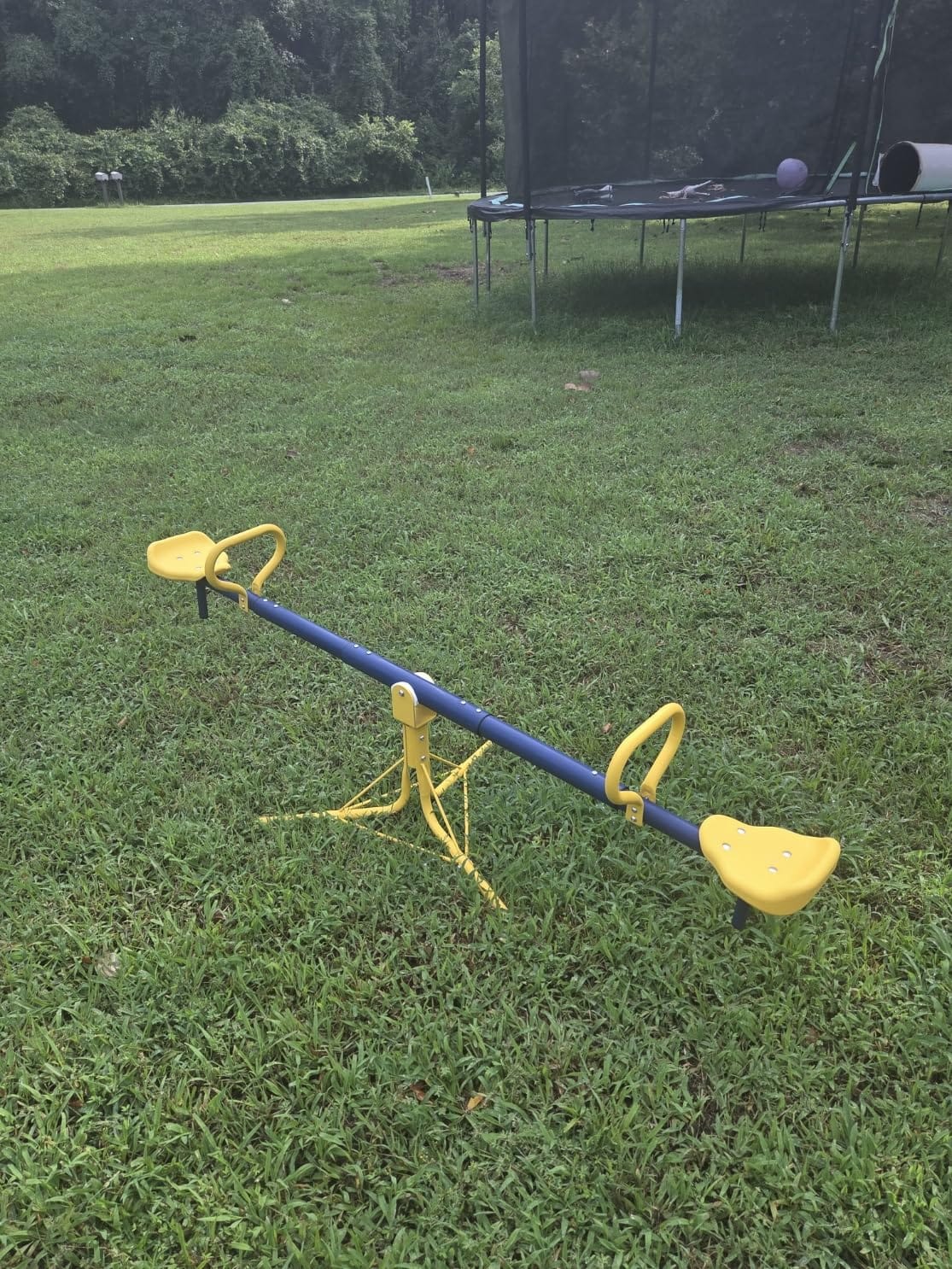
The ride is a free 360 degree rotation combined with the up-and-down motion, and it is hand-powered, which is what makes it appropriate for a residential deck. The cushion structure is shaped to body mechanics rather than being a flat plate, and the triangular handles are smooth and easy to grip.
You can place it on a balcony, in a backyard, on flat grass, in a garage, or in a living room according to the manufacturer, and at roughly 13.3 pounds it is the easiest unit here to carry between them. For an urban household without a yard, that flexibility is the entire value proposition.
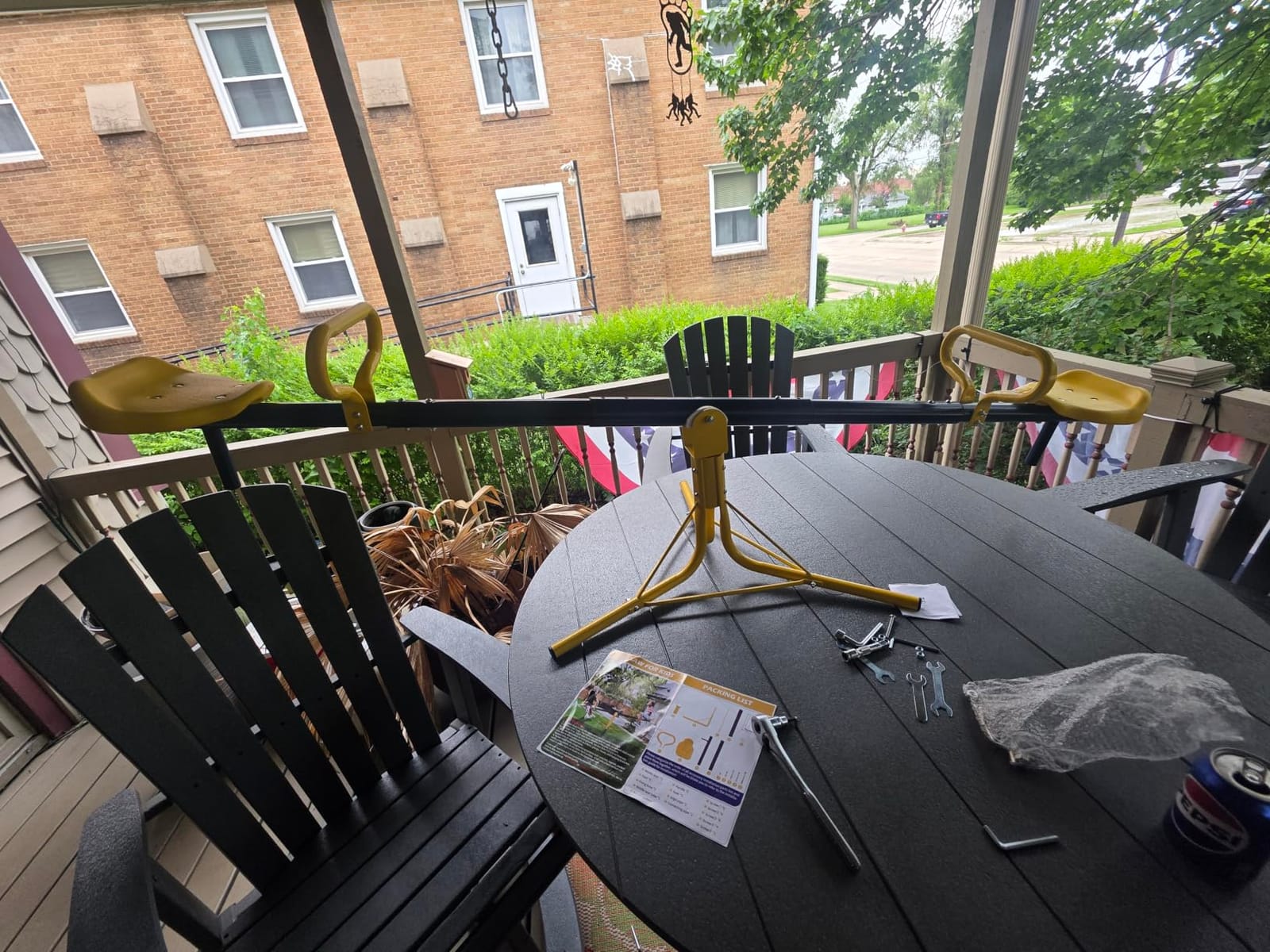
Now the honest part, because this model scored 4.0 out of 5 across 110 reviews, the lowest average in the group with 10 percent one-star feedback. A recurring thread says the seesaw runs smaller and lighter than the product photos imply, and at 68.5 inches that is an understandable disappointment if you are picturing a full-size platform.
There is also a practical hardware note. Some owners report that the four supplied bolts are too short to connect the tubes and need replacing before assembly. Budget ten minutes and a socket wrench, and check the hardware before you start rather than after you are halfway built.
What You Should Know Before Buying
Load the real dimensions, not the photographs. The listing carries both an 80 x 20 x 15 inch item measurement and a 68.5 inch frame length, and the two do not describe the same thing. If you are fitting this onto a balcony, measure the frame length and the swing arc, not the box.
Balcony use also raises a question that has nothing to do with the product: whether the surface is rated for a child pushing a rotating frame with lateral force on it. A lightweight spinner is gentler on a deck than a heavy steel unit, but nothing compensates for a surface that was not designed for active play.
Who It Suits and Who It Does Not
Choose this for a household with no lawn, a small patio, or a playroom, and for parents who want one toy that moves between inside and outside easily. The 250 lb rating also gives it the most headroom for a heavier rider of anything in this roundup.
Pass if you want a substantial backyard merry-go-round that feels like a ride, or if you want a long warranty behind it. The rating and review profile are the weakest here, and the hardware complaint is specific enough that you will likely replace bolts on day one.
How Much Yard Space Do You Actually Need?
Total clear diameter equals the platform footprint plus 12 feet. That is the rule that decides whether a spinner works in your yard, and it is the single most repeated fact in every vendor guide we read, yet almost none of them say it in plain English for a homeowner.
Here is how it works. The use zone extends 6 feet in every direction beyond the edge of the equipment, because children run around the outside of a merry-go-round to spin it. A unit with a footprint of about 6 feet across therefore needs roughly 18 feet of clear circle. An 8 foot commercial platform needs about 20 feet across.
Map that onto this roundup. The narrowest models here sit at about 72 inches, or 6 feet, so budget roughly 18 feet of clear circle around them. The widest, at about 101 inches or 8.4 feet, needs closer to 20 feet. The square four-seat layouts need the corners cleared too, not just the edges.
Then clear the zone of everything. Benches, borders, planters, the edge of a deck, a downspout, another piece of playset. A merry-go-round is unusual among backyard equipment because children enter and exit it while it is moving, and they approach it at a run. Anything hard in that ring is a collision waiting to happen.
Finally, the ground has to be level and stable across the entire circle, not just under the frame. A platform on a slope will not rotate evenly, and uneven support is what makes a spinning seat feel like it is about to tip.
Bearing-Mounted, Spring-Mounted or Pedal-Powered?
These are the three mechanics you will meet in a catalog, and the difference determines how the equipment feels and how much maintenance it needs. Every product in this roundup is hand-powered, which means none of them use a motor, and none of them have a self-accelerating mechanism.
Bearing-mounted platforms run on a central bearing assembly and are what you find on commercial school equipment. They spin faster and smoother, they handle a genuine load, and they need periodic lubrication and inspection of the bearing hardware. That smoothness is excellent for older children and heavier riders.
Spring-mounted platforms use a spring or a per-seat suspension instead. They move slower, with a bouncing motion, and they need far less ongoing attention. That is the family of equipment in this roundup, and the bouncing is precisely why children tend to stay on them longer.
Pedal-powered merry-go-cycles and enclosed pod models sit at the commercial end. The children drive the rotation themselves, which is a different kind of play entirely, and the equipment is sized and anchored for institutional use. For a lawn, the honest answer is that these are not the right shape of purchase.
One design feature appears across the models here and is worth calling out: an adult assist handle. It lets a grown-up start and control the rotation for a child who is not yet able to generate speed, and it is the cheapest way to extend the usable age range of a hand-powered platform by a year or more.
Safety Standards: ASTM F1487, CPSC and ADA
ASTM F1487 is the US playground safety standard for public play equipment, and the number parents most often search for. The relevant rule for merry-go-rounds is the use zone: 6 feet of clearance in all directions beyond the equipment, which is the source of the plus 12 feet rule above.
The Consumer Product Safety Commission treats merry-go-rounds as appropriate for ages 2 to 5 and ages 5 to 12, with closer supervision for younger children, and does not recommend them under age 2. The commission also requires that there be no self-accelerating mechanism, which is why every unit here is hand-powered.
Peripheral speed is the other thing to understand. The speed at the outside edge of a spinning platform increases with the radius, which is why a small platform spun hard by big children can put a lot of force on a small child’s grip. This is the technical reason the handhold problem matters so much.
So here is the behavioral rule that matters more than any equipment feature: children do not jump on or off while the platform is moving. That single habit accounts for most injuries associated with merry-go-rounds, and it is a behaviour rather than a defect. No product rating protects a child from a friend jumping at them.
Two more checks worth making. Make sure handholds are at a height your youngest child can actually grip, because parents consistently report children coming off the platform when the rails are too low or too far apart, and inspect for entrapment openings where a body part could get caught. The Americans with Disabilities Act comes in through the term ground-level play component, which is why a flush-deck unit is more accessible than a raised platform.
Assembly, Anchoring and What Goes Underneath
Can one adult build these? For the models in this roundup, mostly yes, and the honest range is 30 minutes to an afternoon depending on how many people help. The models that ship with all assembly tools included save the most time, and the four-seat frames take longest simply because there are more joints to assemble.
Do you need a concrete pad? For residential spinning platforms in this category, level ground is the requirement rather than a poured foundation. What that means practically is a level, firm patch of ground that does not sink when a child steps on it, and it means checking the ground across the whole circle rather than under the frame alone.
What goes underneath is the part most guides skip. The entire use zone needs protective surfacing rated to the fall height, and loose fill migrates outward under a merry-go-round faster than under most other equipment, because children run around the perimeter in a circle and push the material away from the platform as they go.
That migration is why rubber mulch or poured rubber surfacing is a better fit here than loose gravel or sand. Loose fill will still work if you commit to maintaining depth, raking it back toward the centre regularly, and checking it after rain, but it will fall below minimum depth sooner than on a swing set.
Finally, do not put the spinner on soft lawn and expect it to sit level. A frame that settles unevenly turns a smooth rotation into a wobble, and a wobble at the platform edge is the thing a small child notices first.
How to Inspect a Used Merry-Go-Round
Secondhand demand in this category is real, and there is no good guide to it, so here is a short inspection routine. Stand it up and push the platform by hand. It should rotate smoothly through a full circle with no dead spots, grinding, or a point where the frame visibly flexes.
Check the frame at the pivot and at every weld. Look for rust pitting rather than surface rust, because a pitted frame at a joint is a fatigue risk. On coated steel, scrape a small spot: if the coating underneath has corroded, the protection has already failed.
Try the handholds. Push hard on each one, then check that the height suits the child who will ride. A unit with bent rails or cracked plastic seats should not be ridden no matter how appealing the deal looks, and cracked plastic at a swivel joint is the most common failure we saw in the reviews of new units too.
Turn it over. Look for missing bolts, stripped hardware, and any part that has been improvised with a substitute screw. Check that the warranty paperwork and the original manual are present, and ask the seller how many children rode it and how often.
Replacing the bolts and adding a fresh coat of lubricant on the bearing are quick jobs, and they will tell you within a week whether the mechanism is sound.
DIY Wooden Merry-Go-Round: What Parents Build at Home
DIY wooden merry-go-round videos rank on this search, and we understand the appeal. A homebuilt platform can be sized exactly to your yard, built from materials at a hardware store, and designed around the ages of your children in a way a packaged product cannot.
The mechanic is simple: a round deck, a fixed central post or bearing, a frame that holds the centre above ground, and rails or bars around the perimeter. The bearing is the piece that decides whether it works, and a proper bearing is the item most likely to be substituted badly in a homemade build.
Use case for the DIY route is narrower than most people expect. A homebuilt unit has no ASTM F1487 certification, no stated load rating, and no warranty, so you are the safety system. That is manageable with an adult supervising and a carefully built platform, and it is not manageable if the deck is thin plywood over a loose post.
If you build it, build the use zone properly anyway: 6 feet of clear space in every direction, level ground across the whole circle, and protective surfacing underneath. The clearance rule is not a commercial formality. It is the reason a homebuilt merry-go-round does not end with a collision against a fence.
Frequently Asked Questions
What is the ideal age for merry-go-round use?
Merry-go-rounds are generally suited to ages 2 to 5 and ages 5 to 12, with closer adult supervision for the younger band. The CPSC does not recommend them for children under 2. In practice, the limiting factor is grip: if a child cannot hold the handholds securely, they will slide off while the platform moves. Choose a model with handholds sized for your youngest rider, and expect to move up to a four-seat or higher-capacity frame as children grow.
How safe are merry-go-rounds?
Merry-go-rounds are safe when the ground around them is set up correctly. The single most important rule is behavioral: children do not jump on or off while the platform is moving, and that habit causes most injuries rather than any equipment defect. Leave 6 feet of clear space in every direction, keep the zone free of benches and borders, provide protective surfacing rated to the fall height, and check handhold height for your youngest child. Supervise younger riders closely.
How much clearance space do you need around a merry go round?
Total clear diameter equals the platform footprint plus 12 feet, because the use zone extends 6 feet in every direction beyond the equipment edge. A 6 foot spinner therefore needs roughly 18 feet of clear circle, and an 8 foot commercial unit needs about 20 feet. Keep the entire zone free of benches, planters, decks, and adjacent play equipment, and make sure the ground is level across the whole circle, not just under the frame.
What are other names for a merry-go-round?
A roundabout and a merry-go-round are the same product with different regional names. Carousel is the umbrella term covering both a spinning platform and the carnival ride with horses, which is a different type of equipment. A spinner is a broader category that includes anything rotating, and a merry-go-cycle refers to a pedal-powered or enclosed pod version found mainly in commercial catalogs. A name alone does not tell you what a product is, so check for a rotating platform with handholds.
How much does a backyard merry-go-round cost?
Backyard spinning platforms split into a wide range. Small plastic and steel spinners for toddlers sit at the low end, four-seat steel frames sit in the middle, and pedal-powered merry-go-cycles plus commercial bearing-mounted spinners sit far higher, with institutional catalog pricing reaching well into five figures for large units. For a home yard, the useful comparison is capacity and coating rather than size: a galvanized or powder-coated frame with a stated load rating will outlast a bare painted frame at a fraction of the commercial price.
The Verdict: Which Backyard Merry-Go-Round Should You Buy?
The Gym Dandy Spinning Teeter Totter TT-360 is our pick for the best backyard merry go round for kids in 2026. It carries the highest rating in the group on the largest review base, its metal frame is rated to 300 lb, the cushioned seats and roller wheels make a soft landing, and the two-year warranty is the longest we found.
If more than two children need to ride at once, take the Nova four-seat model for 110 lb per child, or the SUPER DEAL if your children are different sizes and independent springs matter. For a very small yard, the Costzon fits the least ground of anything we reviewed.
Whatever you choose, measure the circle before you buy. Platform footprint plus 12 feet of clear space, level ground, surfacing underneath, and one rule for the kids: nobody jumps on or off while it is moving.