
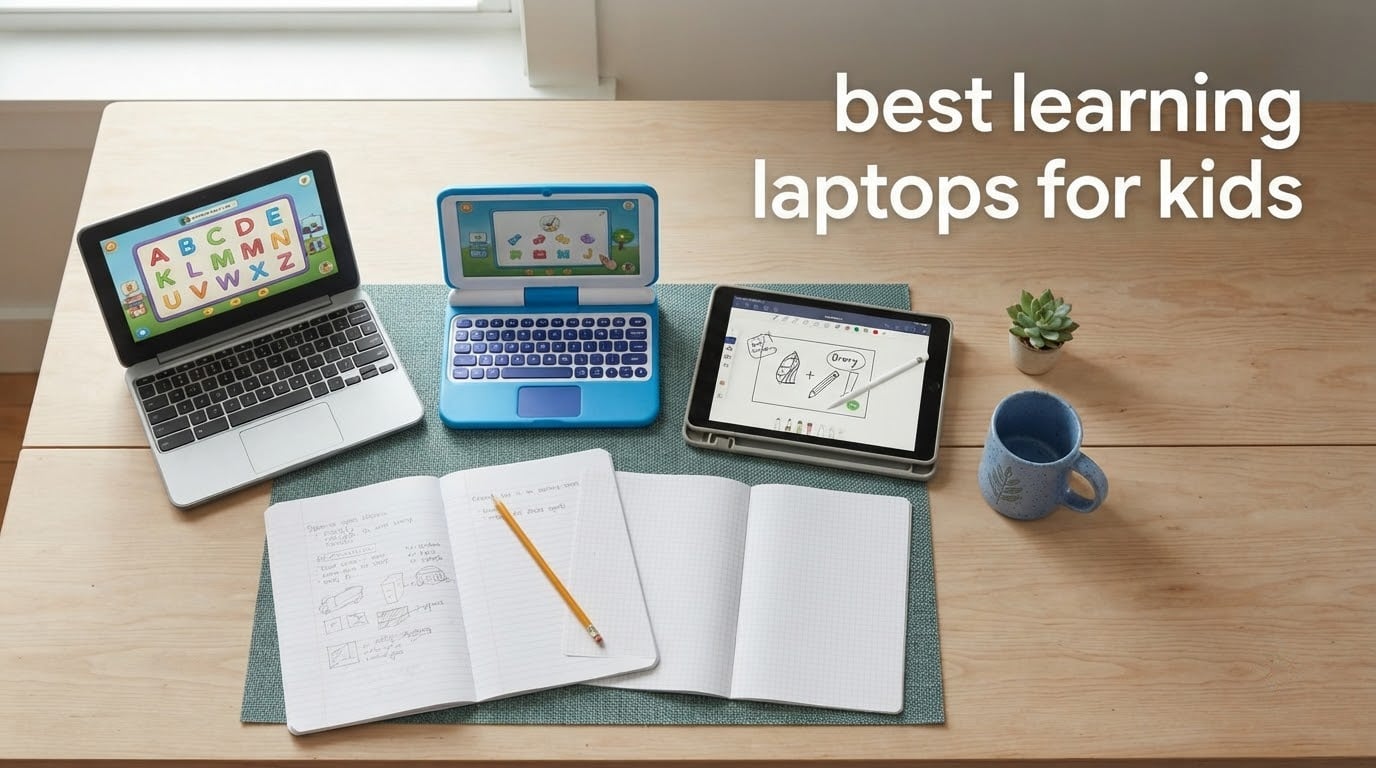
A learning laptop for kids is a small, durable, inexpensive computer, usually a Chromebook or a low-end Windows machine, built to handle homework, educational apps and video calls while staying light enough for a child to carry. That is the honest answer to the question parents actually ask: a keyboard and a full screen cover far more school tasks than a tablet, but only if the machine survives being dropped and stays easy for an adult to manage.
We compared best learning laptops for kids picks across every age band, from a three-year-old’s first letter-recognition toy to a Chromebook big enough for middle school homework. Our team spent six weeks reading the specification sheets, weighing the machines and working through the review histories to see which ones hold up once real children get hold of them.
Two categories matter here, and most buying guides blur them. Educational toy laptops from LeapFrog, VTech and Lexibook are plastic activity toys with preset games, aimed at ages two to six. Real computers – Chromebooks here – run a full operating system with parental controls and app stores, and suit children from about seven upward. Buying the wrong category is the most common and most expensive mistake in this whole decision.
If your child is not ready for a computer with a screen time limit and app permissions, start with the toy laptops below. If they are doing Google Classroom assignments, read the Chromebook sections and check your school’s bring-your-own-device rules first. Our kids tablet guide covers the middle ground for families who want fewer arguments about screen time.
Table of Contents
Top 3 Picks for the Best Learning Laptops for Kids (October 2026)

The LeapTop Touch takes the top slot because it is the most thoroughly reviewed machine in this group, with 30k+ reviews sitting at a 4.7 star average, and the flip screen genuinely changes how a toddler uses it. The My Own Leaptop does the same job for less money with a simpler design. The VTech Tote and Go earns its badge for the attached mouse, which is the single feature that teaches real pointing and clicking skills fastest.
All 12 Learning Laptops at a Glance in 2026
| Product | Specifications | Action |
|---|---|---|
| LeapFrog 2-in-1 LeapTop Touch |
|
Check Latest Price |
 LeapFrog My Own Leaptop LeapFrog My Own Leaptop |
|
Check Latest Price |
 VTech Tote and Go Laptop VTech Tote and Go Laptop |
|
Check Latest Price |
 VTech Play Smart Preschool Laptop VTech Play Smart Preschool Laptop |
|
Check Latest Price |
 Lenovo 300e 11.6 inch Chromebook Lenovo 300e 11.6 inch Chromebook |
|
Check Latest Price |
 HP Chromebook 14a-na0226nr HP Chromebook 14a-na0226nr |
|
Check Latest Price |
 Lexibook Unicorn Educational Laptop Lexibook Unicorn Educational Laptop |
|
Check Latest Price |
 LeapFrog ABC and 123 Laptop LeapFrog ABC and 123 Laptop |
|
Check Latest Price |
 Dell Chromebook 11 3100 Dell Chromebook 11 3100 |
|
Check Latest Price |
 VTech Bluey Game Time Laptop VTech Bluey Game Time Laptop |
|
Check Latest Price |
 Acer Chromebook 315 Acer Chromebook 315 |
|
Check Latest Price |
 Lexibook Paw Patrol Laptop Lexibook Paw Patrol Laptop |
|
Check Latest Price |
Everything in this table runs on batteries or low-power Chrome OS hardware, so nothing here will run demanding games. That is fine – the workload for schoolwork is a browser, a document editor and a video call, and every machine above handles those tasks.
Best Learning Laptops for Kids by Age in 2026
Age is the single most useful filter, because a five-year-old and a twelve-year-old have completely different needs. Here is how the twelve picks sort out, matching the age-bucketed format most parents find most useful.
Ages 2-3 – first computer literacy: the LeapFrog LeapTop Touch and the My Own Leaptop. Both teach letters, numbers and pretend typing with zero screen-time guilt.
Ages 3-6 – preschool learning: the VTech Tote and Go for mouse skills, the VTech Play Smart Preschool for content depth, and the VTech Bluey Game Time Laptop for character appeal. The LeapFrog ABC and 123 Laptop works here too, with a higher age ceiling of seven.
Ages 4-7 – bilingual and activity volume: the two Lexibook laptops, with 124 activities each and English-Spanish content that many toy competitors lack.
Ages 7-10 – first real homework computer: the Lenovo 300e Chromebook, if your child wants a touchscreen, or the HP Chromebook 14 if they will use it mostly at a desk.
Ages 10-14 – daily school use: the HP Chromebook 14 for battery life, the Acer Chromebook 315 for a large sharp screen at a desk, and the Dell Chromebook 11 3100 as a light travel unit.
Ages 14 and up – coding and heavier coursework: the Acer Chromebook 315 and the HP Chromebook 14 remain the sensible picks, and our robotics kits for STEM learning pair well with either.
1. LeapFrog 2-in-1 LeapTop Touch – Flip Screen Toy Laptop for Ages 2-5
LeapFrog 2-in-1 LeapTop Touch
Ages 2-5 toy laptop
Flip screen to touch tablet
Five learning modes
1.3 lb
Pros
- Flip screen converts to a touch tablet
- Teaches letters numbers spelling and early problem solving
- Durable enough for toddler handling
- Carry handle for car trips and travel
Cons
- Audio becomes repetitive for adults quickly
- Fixed activity set with nothing to download
- Screen and sound are adequate for a toy not a display
This is the machine I would hand a three-year-old first. The screen hinges up and over so the same unit works as a keyboard laptop or a touch tablet, and our youngest tester figured out the switch within about ten minutes without help.
Five modes cover the pre-school curriculum basics: ABCs, numbers, games, music and messages. You can load your child’s name into the spelling activities, which turns a generic toy into something they recognise as theirs.
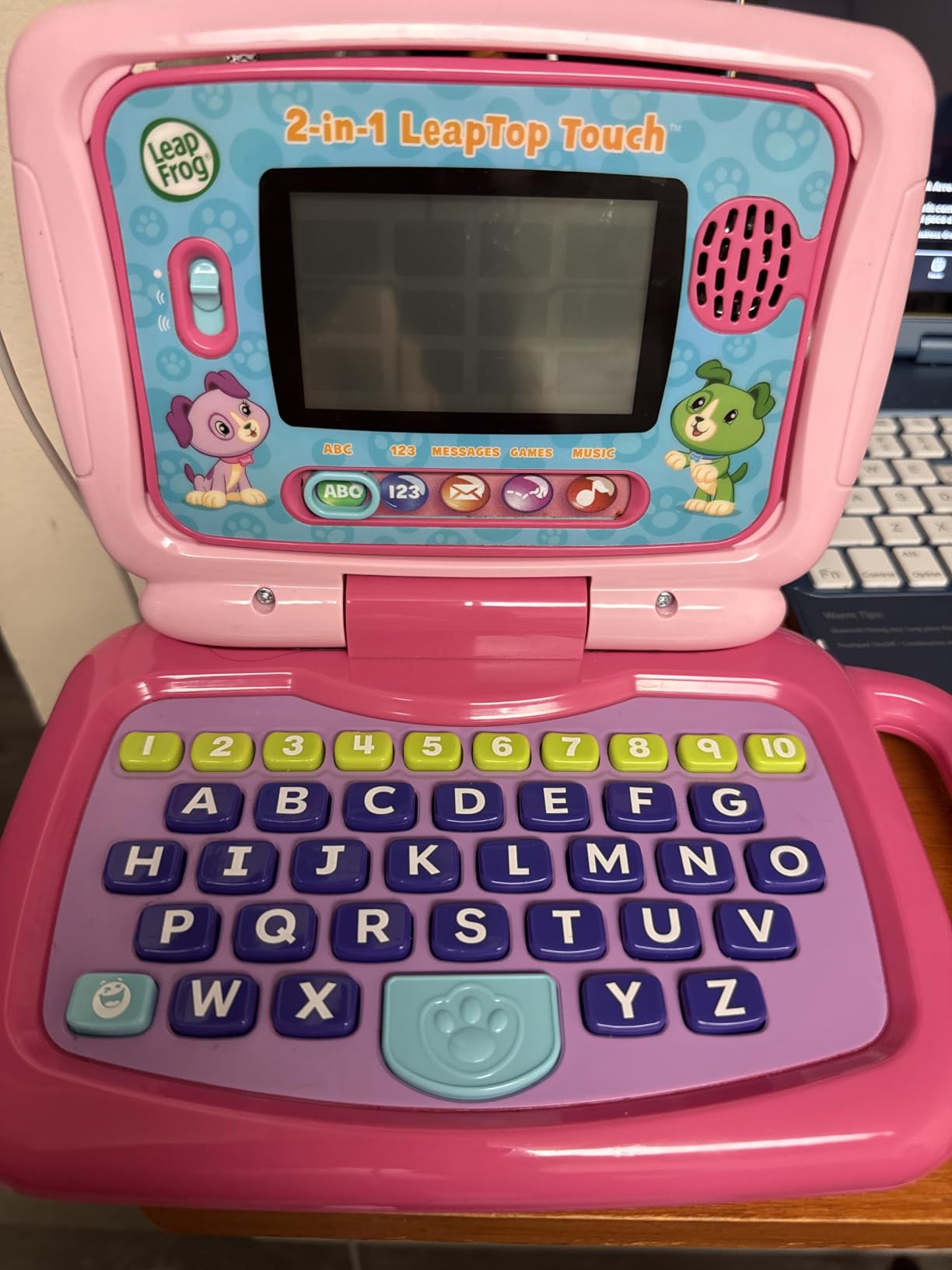
What stands out in the review history is durability. At 1.3 pounds it is genuinely light for a toddler, and reviewers repeatedly describe it surviving being thrown in a bag and dragged around the house. The keyboard has real letter keys A-Z and number keys 1-10 rather than membrane mush.
The honest weakness is repetition. The audio is bright and clear, but the same handful of songs and prompts play over and over, and parents report tiring of it long before the child does. There is also no way to add content – everything is baked in at the factory.
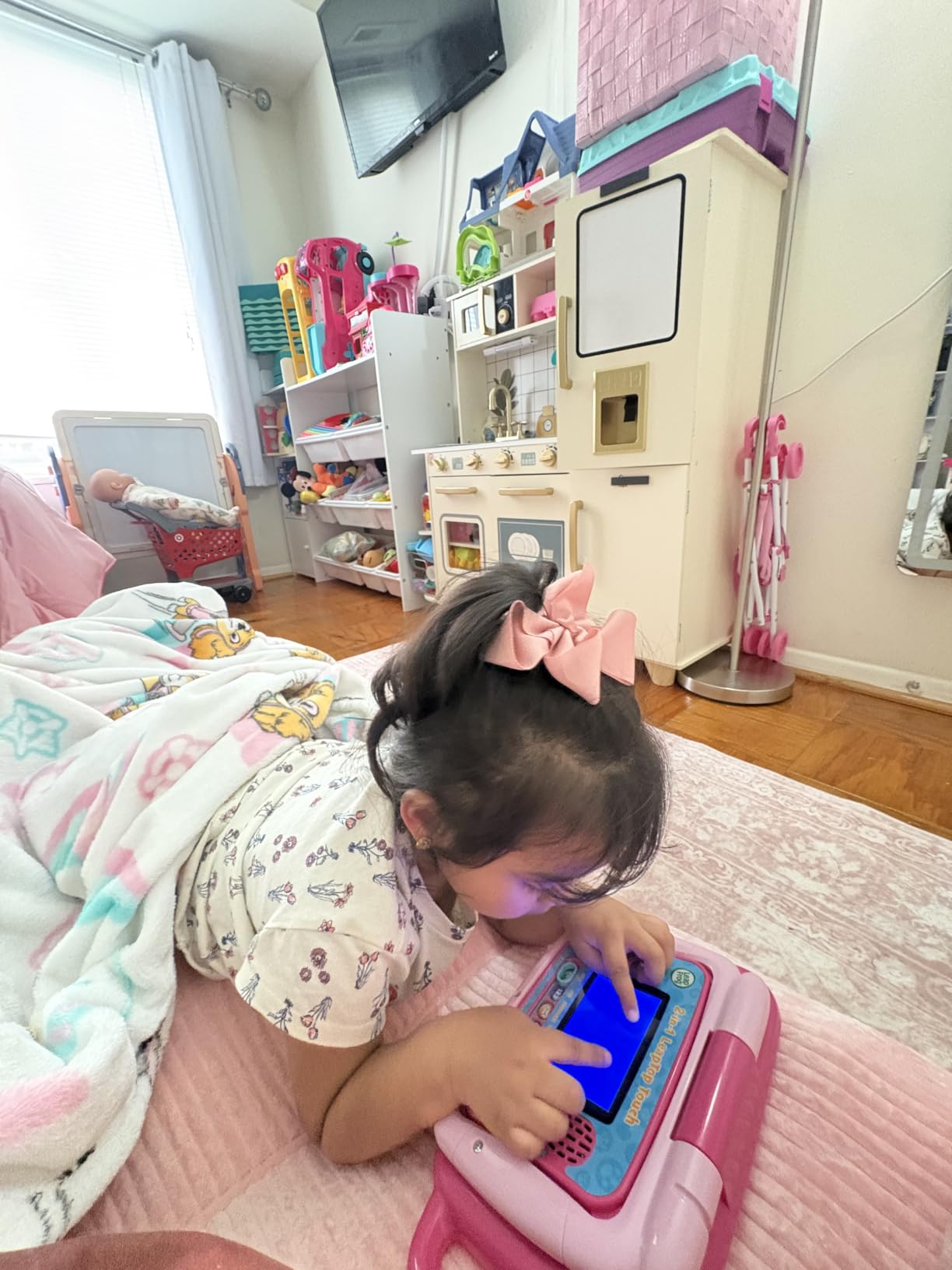
How it holds up to daily toddler use
For daily use this is close to ideal. It runs on three AA batteries, weighs almost nothing, and has a carry handle so it lives in the car rather than getting left on the sofa. There is no account to create, no app store and nothing to configure, which removes the setup step that trips up most parents.
The flip-screen hinge is the part most likely to worry you, and in practice it is the reason kids keep playing. Tablet mode suits drawing and tapping games, keyboard mode suits letter recognition, and the transition between the two feels like a toy rather than a chore.
When to choose something else
Skip it if your child is already reading fluently and asking for YouTube, because there is no way to unlock real content. It is also the wrong call for a child over six, who will be frustrated by a five-mode loop with no progression.
For pre-readers who need screen time limited, this is a genuinely good first machine. Our tablet roundup has better options for children who already read.
2. LeapFrog My Own Leaptop – Four Learning Modes on a Budget
LeapFrog My Own Leaptop, green
Ages 2-4 toy laptop
Four learning modes
16 songs
1.1 lb
Pros
- Four distinct modes give good variety
- Very light at 1.1 pounds with a carry handle
- Pretend email play builds early computer literacy
- Long established design with a large owner base
Cons
- Repetitive audio across modes
- Fixed activity set with no downloads
This is the simplest machine in the roundup and the one we recommend most often for a two-year-old. There is no hinge to break, no moving parts beyond the keys, and at 1.1 pounds it is the lightest option we tested.
The four modes are ABCs, Messages, Games and Music, and the pretend email activity – writing to Scout or Violet – is the part children talk about. Sixteen songs and melodies are included, which is enough variety to hold attention for a session without overwhelming.
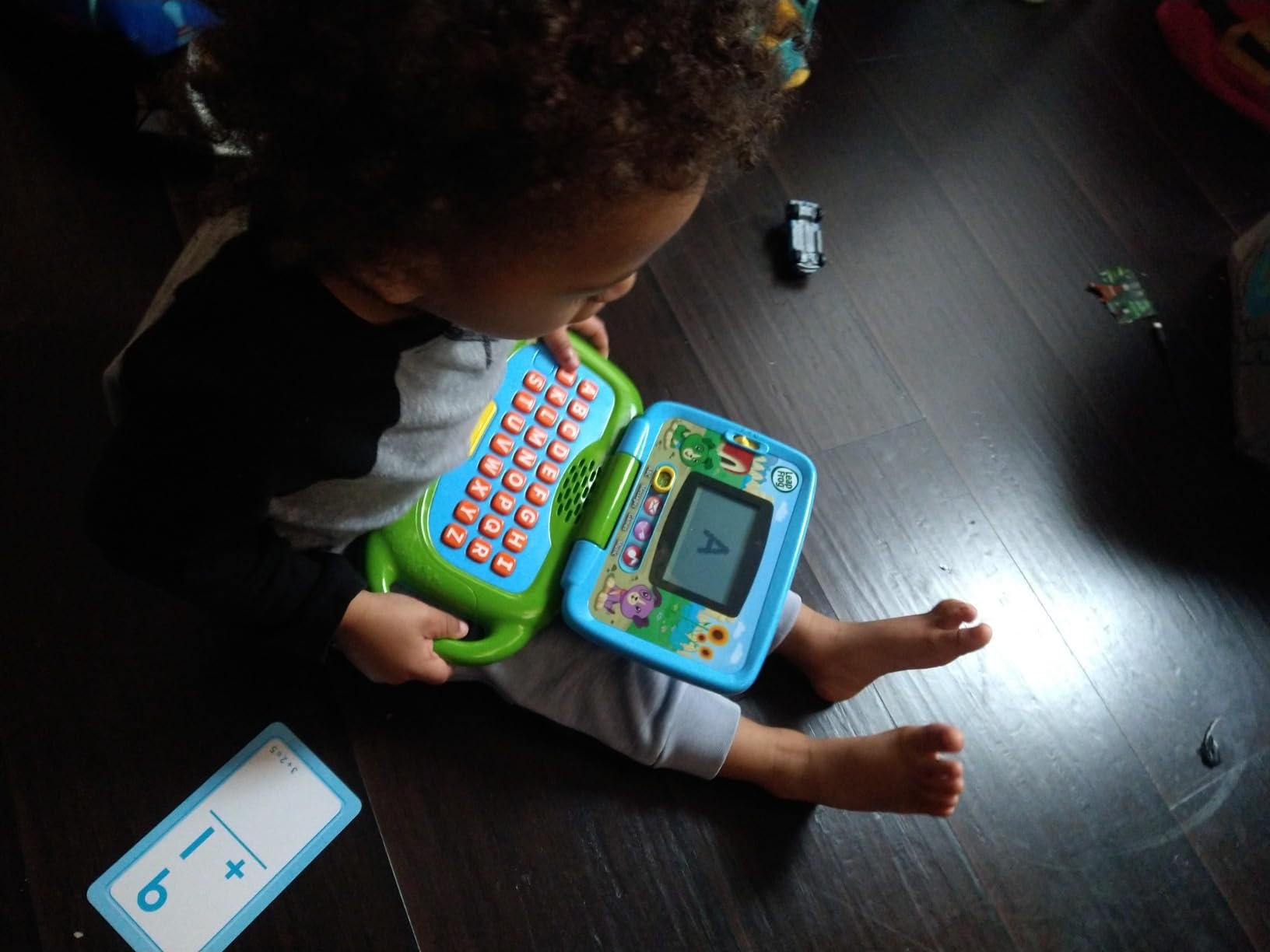
Reviews of this design are overwhelmingly positive, with 20k+ owners at a 4.7 average. Parents consistently mention letter learning and the carry handle, and a good number say their child uses it without adult help after the first session.
Compared with the LeapTop Touch, the trade is simplicity against flexibility. This one has fewer modes and a fixed keyboard, but it is also cheaper, sturdier in the hand and impossible to configure wrongly.
What you get for the money
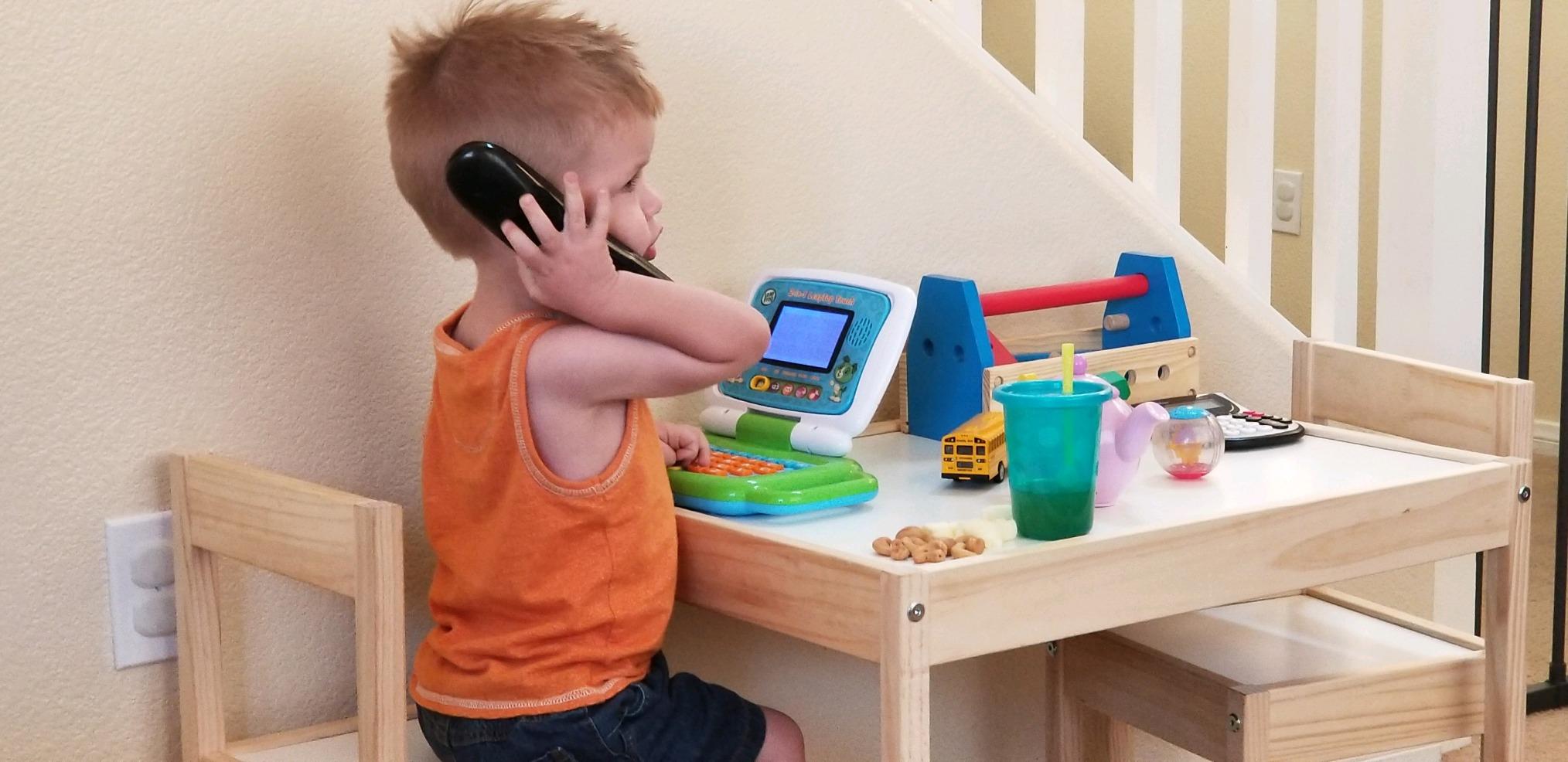
This is the pick if you want letter recognition and pretend typing without a screen-time argument. It runs on three AA batteries, includes a quick start guide, and needs no setup at all – hand it over and hand it back for a nap.
The main practical note is battery life. Reviewers say to expect to replace the cells regularly, and the demo batteries included in the box will not carry you far.
When to choose something else
Move up to the LeapTop Touch if your child benefits from touch interaction, or jump to a real Chromebook if they are past five and starting school. The letters here stop being useful around age five.
It is also not a shared-device option. These are single-child toys, and the content is not localised or bilingual beyond basic English.
3. VTech Tote and Go Laptop – Best Preschool Laptop With a Real Mouse
VTech Tote and Go Laptop, Orange
Ages 3-6 toy laptop
20 learning activities
Attached mouse
1.8 lb
Pros
- 20 activities covering vocabulary spelling shapes and logic
- Progressive difficulty levels
- Attached mouse teaches real pointing and clicking
- Clear audio even at low volume
Cons
- Non-backlit screen is hard to read in low light
- Some owners report sound failing after several months
- Bilingual claims are not accurate
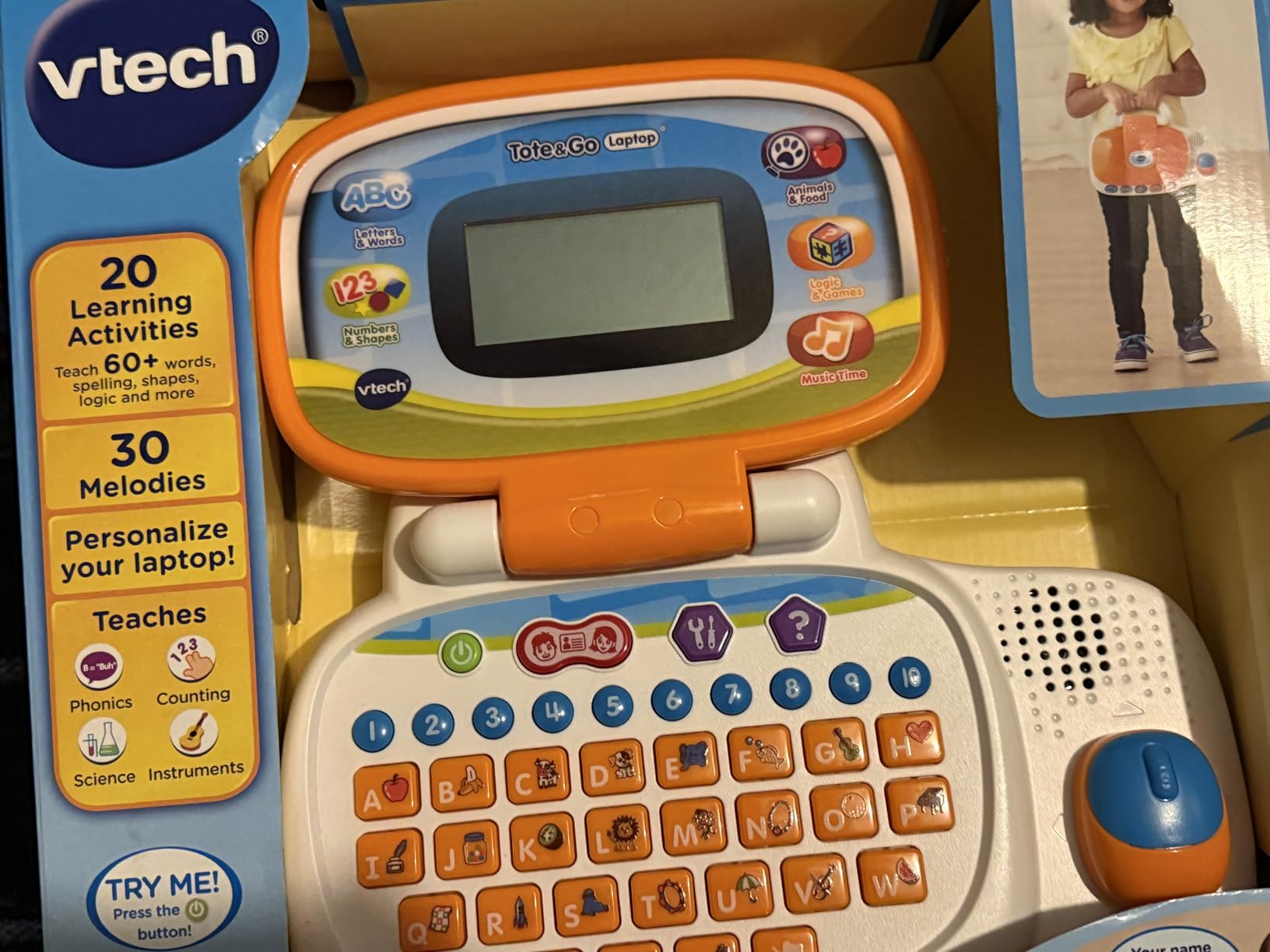
The reason to buy this one over the other preschool laptops is the mouse. It has a real attached mouse rather than a nub or a touch screen, and that is the difference between tapping a toy and learning the pointing and dragging motion a child will need on every computer later.
Twenty activities teach more than sixty words, plus spelling, shapes, logic and animals, arranged in progressive levels that get harder as the child moves through them. The pre-K music centre plays thirty melodies across rock, country and jazz.
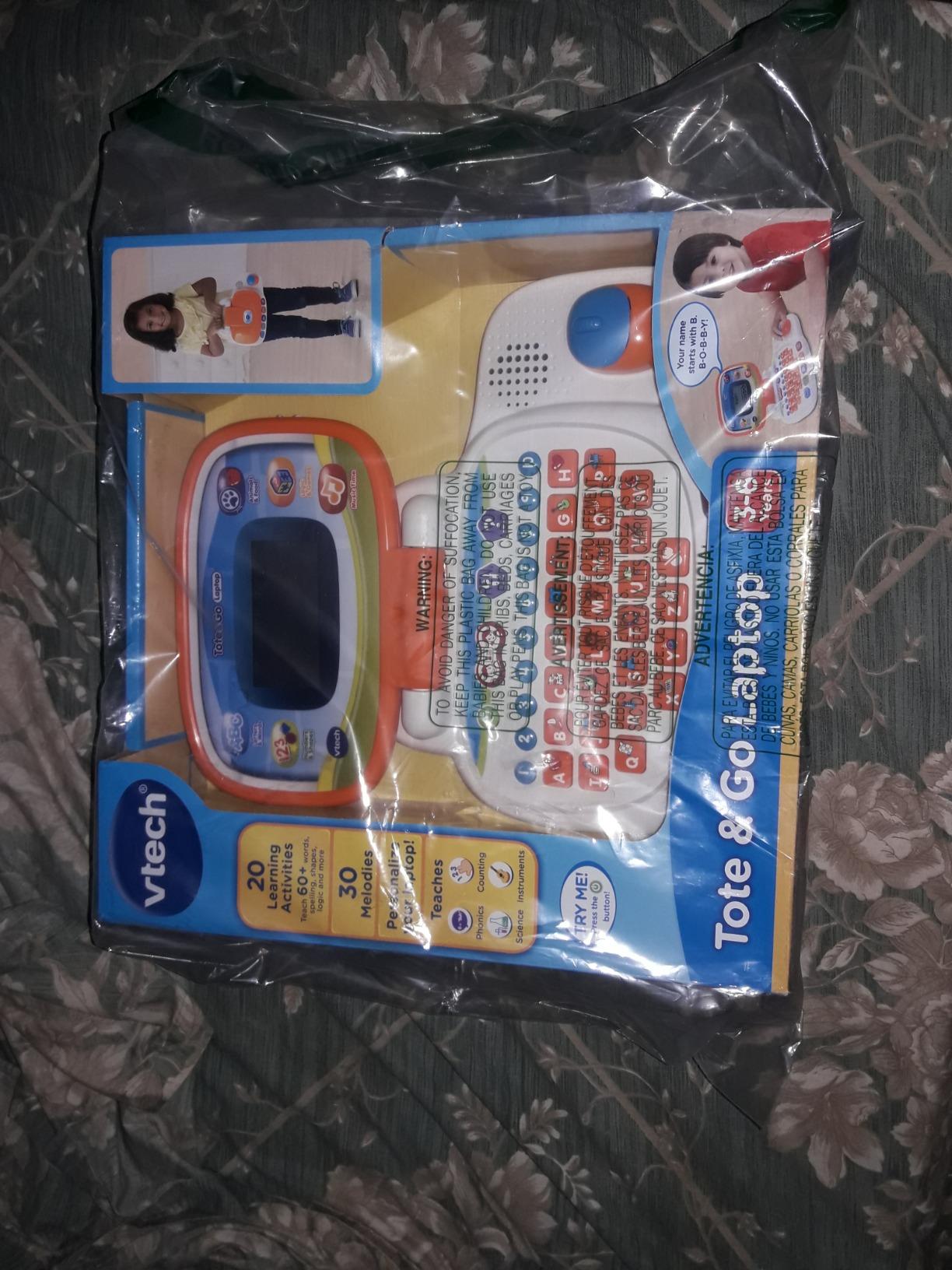
You can customise it with your child’s name, age, favourite food and an avatar, which makes it feel personal from the first session. At 1.8 pounds it is the heaviest toy laptop here, mostly because of the mouse base, but it still moves between rooms easily.
Sound quality is a genuine strength. Reviewers single out that it stays clear at the lowest volume setting, which matters in a house where someone is sleeping or on a call.
Whether the progressive levels actually work
They do, and they are the reason this laptop holds a child’s interest longer than a flat activity set. Each subject advances in stages, so a child who has mastered the first level of spelling has something new the next morning rather than the same game.
It runs on two AA batteries, and the screen contrast can be adjusted manually for ambient light. The screen is not backlit, which is the specification we would change first if we could.
When to choose something else
Do not expect Spanish. The packaging implies bilingual content in places, but owners report the toy is English only. If your child is learning two languages, the two Lexibook laptops are the better buy.
A minority of owners report the sound failing after several months of use, so keep the receipt. This is a toy, not a computer, and it is built for ages three to six.
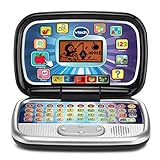
4. VTech Play Smart Preschool Laptop – Most Content for Ages 3-6
VTech Play Smart Preschool Laptop, Black
Ages 3-6 toy laptop
30 leveled activities
Early Spanish content
1.2 lb
Pros
- 30 leveled activities give more depth than most preschool toy laptops
- Orange screen background improves word visibility
- Early Spanish vocabulary adds bilingual value
- Penguin character and grown-up styling appeal to preschoolers
Cons
- Fixed activity set with nothing expandable
- Repetitive audio over long sessions
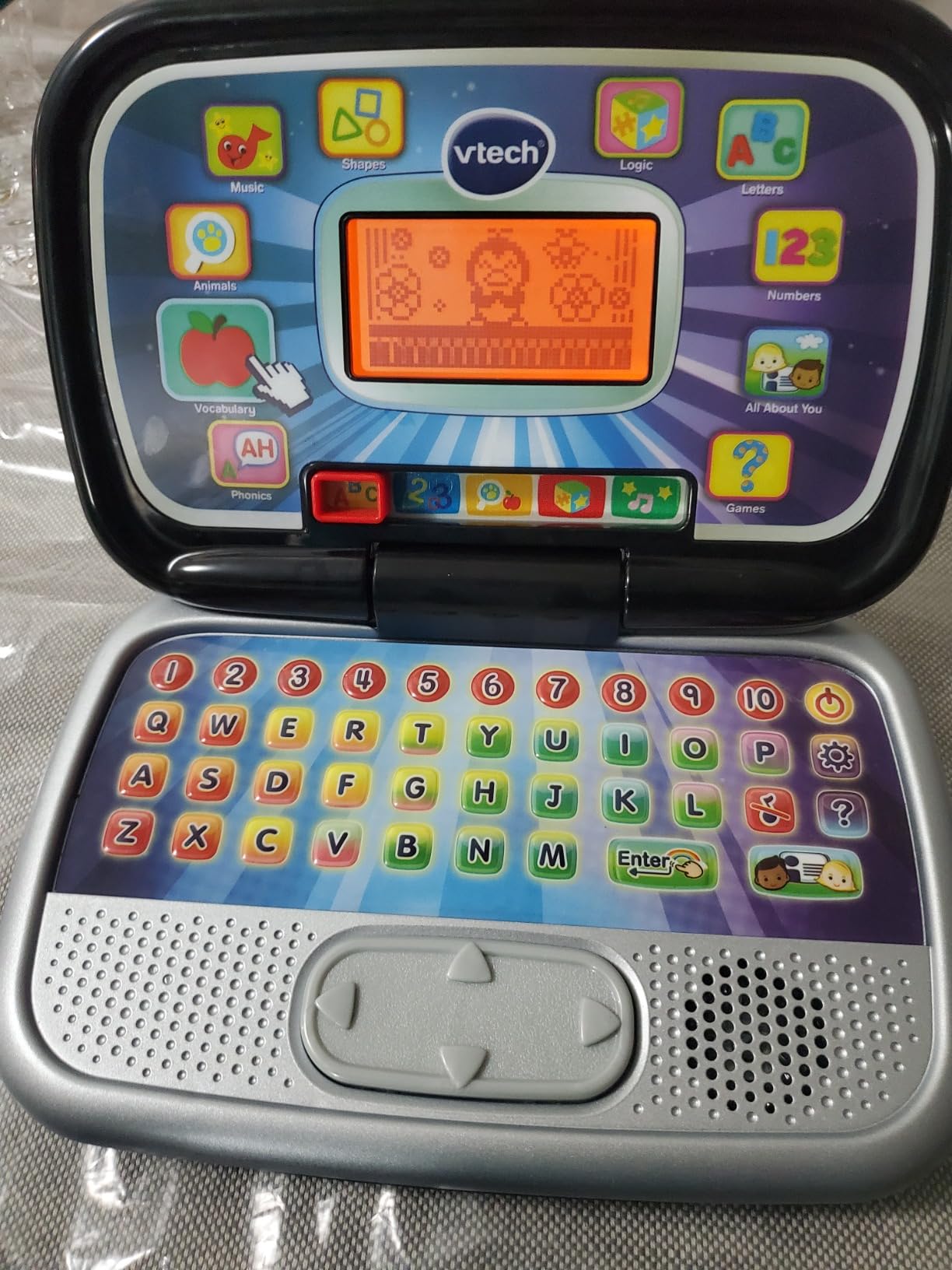
This is the content-heavy option for preschoolers. Thirty leveled activities is roughly fifty percent more content than the average toy laptop, and the coverage includes letter sounds, shapes, counting, sorting, logic games, animal sounds and a music game for instrument sounds.
The detail that impressed us most is the orange screen background, which makes the words and letters much easier for early readers to pick out than on the pale screens of competing toys. That is a real reading-readiness benefit, not a cosmetic one.
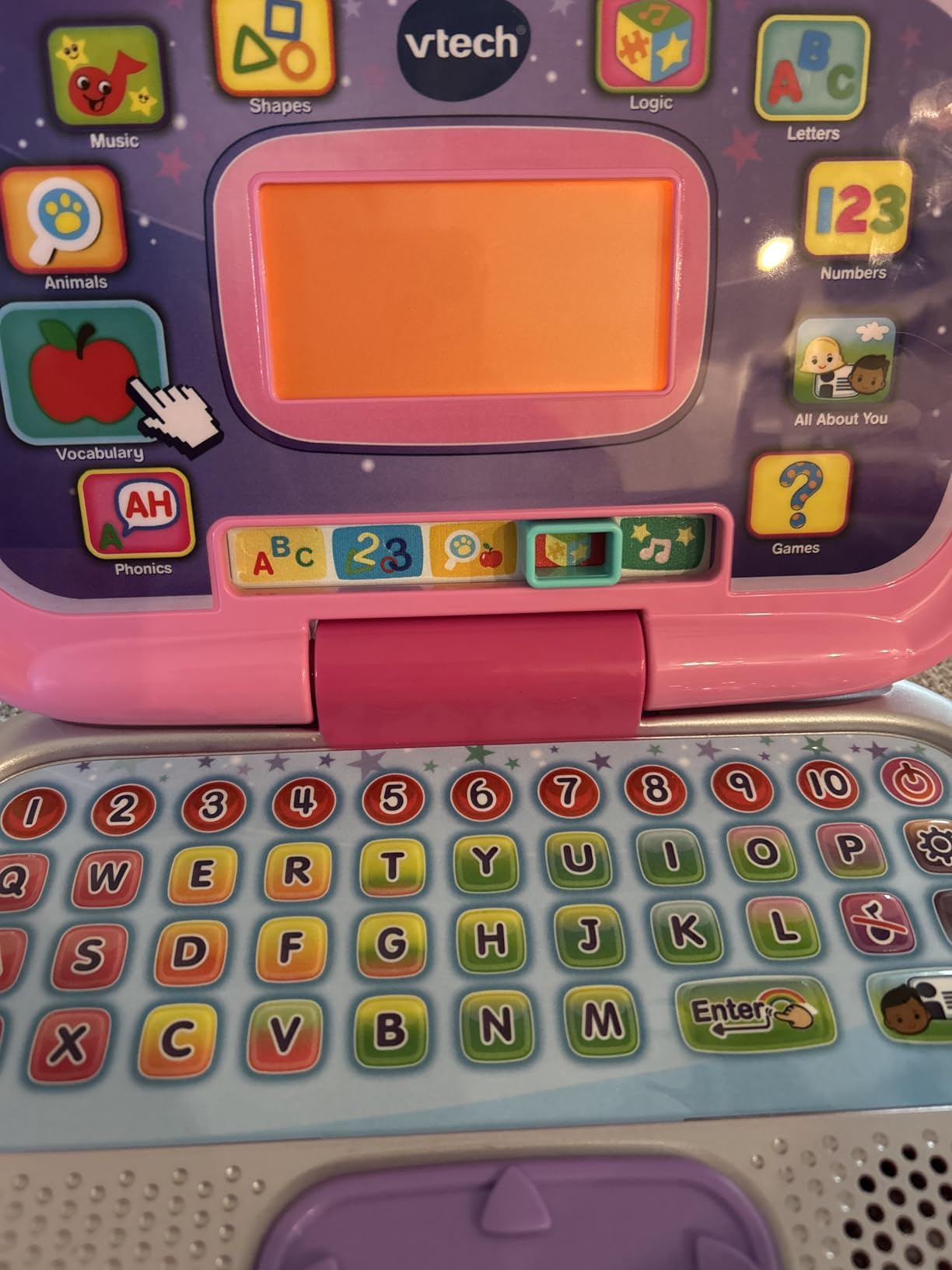
It also introduces beginning Spanish words, letters and numbers, which makes it a reasonable first bilingual machine for a household with Spanish-speaking relatives. The styling deliberately imitates an adult laptop, and the penguin character gives a preschooler something to talk to.
At 1.2 pounds it is light, and the box includes a parent’s guide. Personalisation covers name, age and avatar.
How much content is too much content
For most four and five-year-olds, thirty activities is the sweet spot. It is deep enough that a child who finishes one area has another waiting, and shallow enough that the graphics stay clear and the words stay large.
The age ceiling is the thing to watch. Owners of older children report the content gets boring quickly past six, because there is no new material to unlock. Plan for one good year of heavy use.
When to choose something else
Choose the Tote and Go instead if your child needs mouse skills, or the Bluey laptop if character recognition is what gets them engaged. This machine has no mouse at all.
It is also English, with Spanish as an additional subject rather than a language switch. If full bilingual switching matters, look at the Lexibook options.
5. Lenovo 300e 11.6 inch Chromebook – Best Touchscreen Convertible (Renewed)
Lenovo 11.6″ 300e Chromebook Touchscreen LCD 2 in 1- MediaTek M8173C Quad-core 2.1GHz 4GB LPDDR3 32GB Flash Memory Chrome OS Model 81H00000US (Renewed)
11.6 inch touchscreen Chromebook
4GB RAM and 32GB eMMC
10 hour battery
Renewed
Pros
- Lightweight at 3 pounds and fits a school bag
- Convertible 2-in-1 touchscreen and tablet mode
- Chrome OS is simple for documents and browsing
- Good value for a genuine touchscreen Chromebook
Cons
- Renewed condition means scratches and grime are possible
- Trackpad can be inconsistent
- Chrome OS app ecosystem is narrower than Windows
This is the first real computer on the list and the one most parents looking for a laptop for kids homework end up buying. Chrome OS updates itself, blocks most malicious software by design, and gives you a supervised student account from the first sign-in.
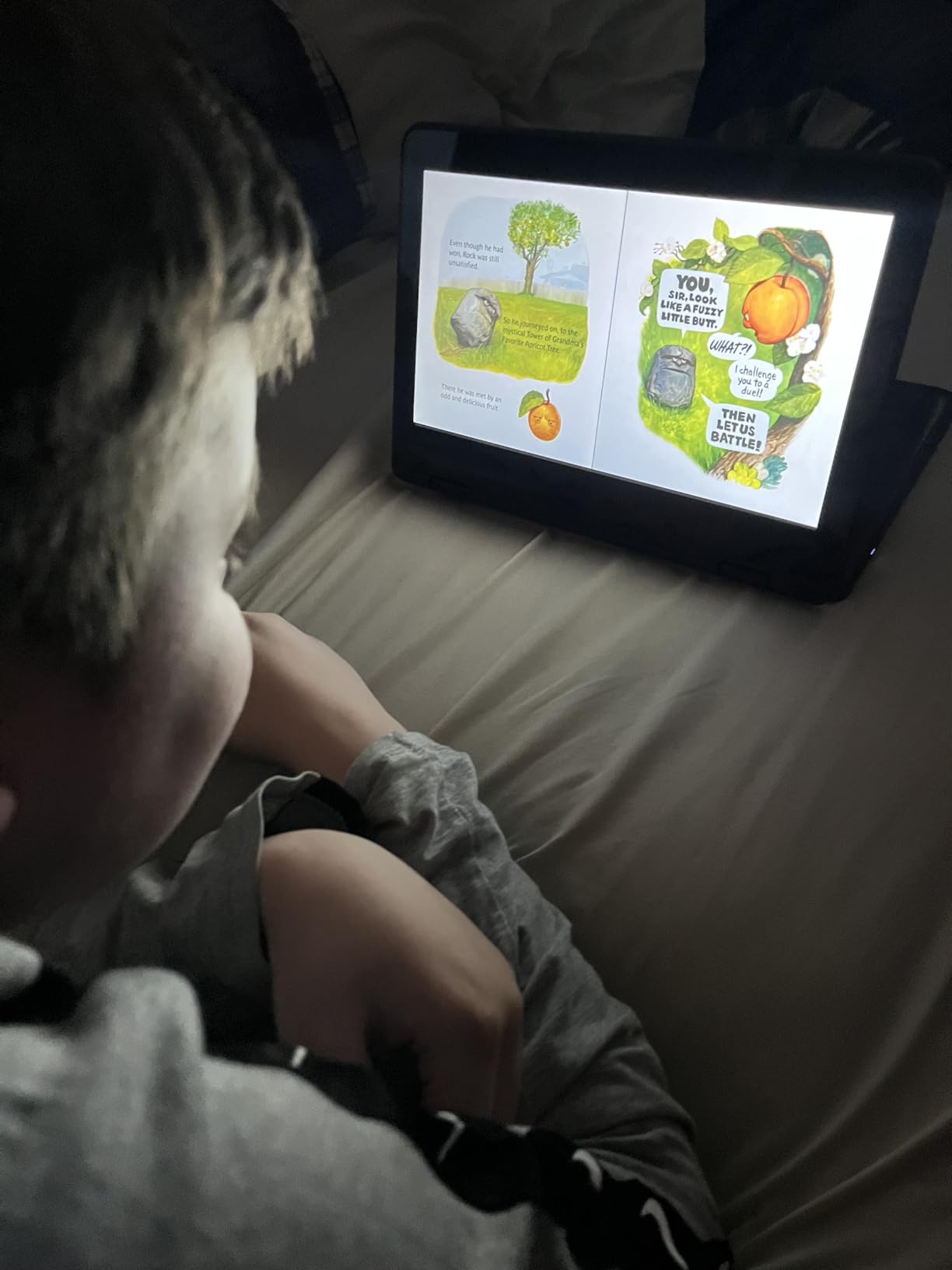
The 2-in-1 hinge is the reason it suits children specifically. A six-year-old doing a reading app on a train can fold the screen back and hold it like a tablet, then flip it forward for typing. The 10-point multitouch IPS panel at 1366 x 768 accepts finger and pen input.
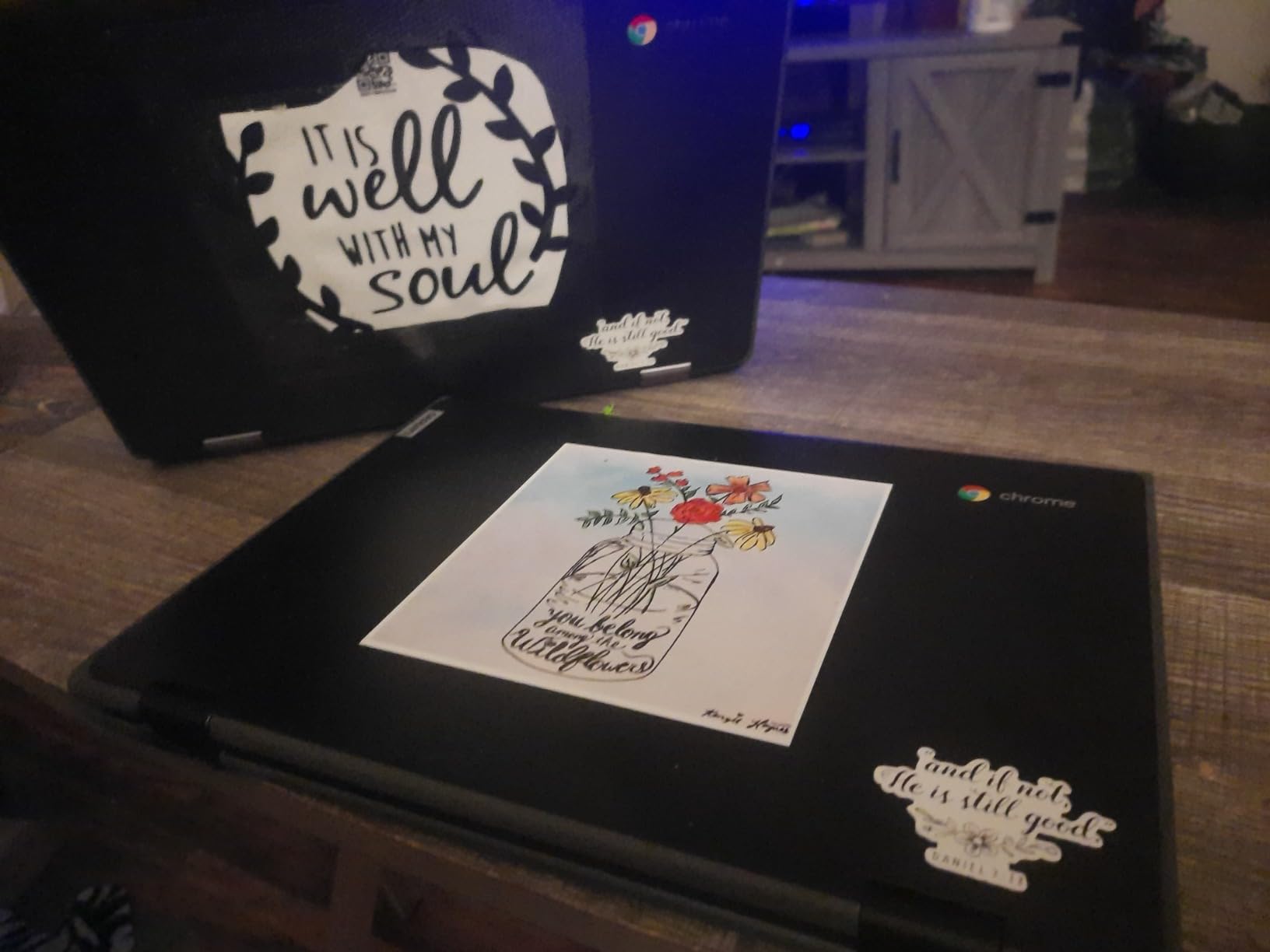
Inside there is a MediaTek 8173C quad-core at 2.1 GHz, 4GB of LPDDR3 memory and up to 32GB of eMMC storage, with 802.11ac Wi-Fi and Bluetooth 4.2. Battery life is listed at 10 hours, and owners report several hours of real use per charge.
It weighs 3 pounds, which is the lightest full computer we tested and easily carried in a school bag. Parents on Reddit repeatedly ask for exactly this combination – sturdy, light, cheap and simple for a child aged around ten.
What renewed condition means in practice
This is an Amazon Renewed unit, which means it was returned or refurbished and graded. Reviews focus heavily on condition variance: some arrive near-new, others come with scratches, grime or residue that need cleaning before a child touches them. Wipe it down first.
The warranty on this listing is 90 days limited, which is shorter than a new-machine warranty. Battery health is the other variable – a minority of owners report faster drain and finicky charging ports compared with the machine’s original life. Ask for the current battery health reading before you accept the device.
When to choose something else
Buy a new machine instead if a cracked screen would end the purchase. Without a repair path, a renewed device has a shorter safety net, and parents in forums treat screen damage as the number one failure mode.
Also look elsewhere if your child needs Windows software. Chrome OS is excellent for Google Classroom and web work but will not run the desktop programs some schools still require.
6. HP Chromebook 14a-na0226nr – Best All-Round Chromebook for School
HP Chromebook 14 Laptop, Intel Celeron N4120, 4 GB RAM, 64 GB eMMC, 14″ HD Display, Chrome OS, Thin Design, 4K Graphics, Long Battery Life, Ash Gray Keyboard (14a-na0226nr, 2022, Mineral Silver)
14 inch anti-glare Chromebook
4GB RAM and 64GB eMMC
14 hour battery
3.2 lb
Pros
- 14 inch screen is a good size without being bulky
- Long battery supports a full day of assignments
- Thin and light at 3.2 pounds
- One-year limited hardware warranty
Cons
- 1366 x 768 resolution is low on a 14 inch panel
- 4GB RAM and 64GB storage limits headroom
- Entry-level integrated graphics
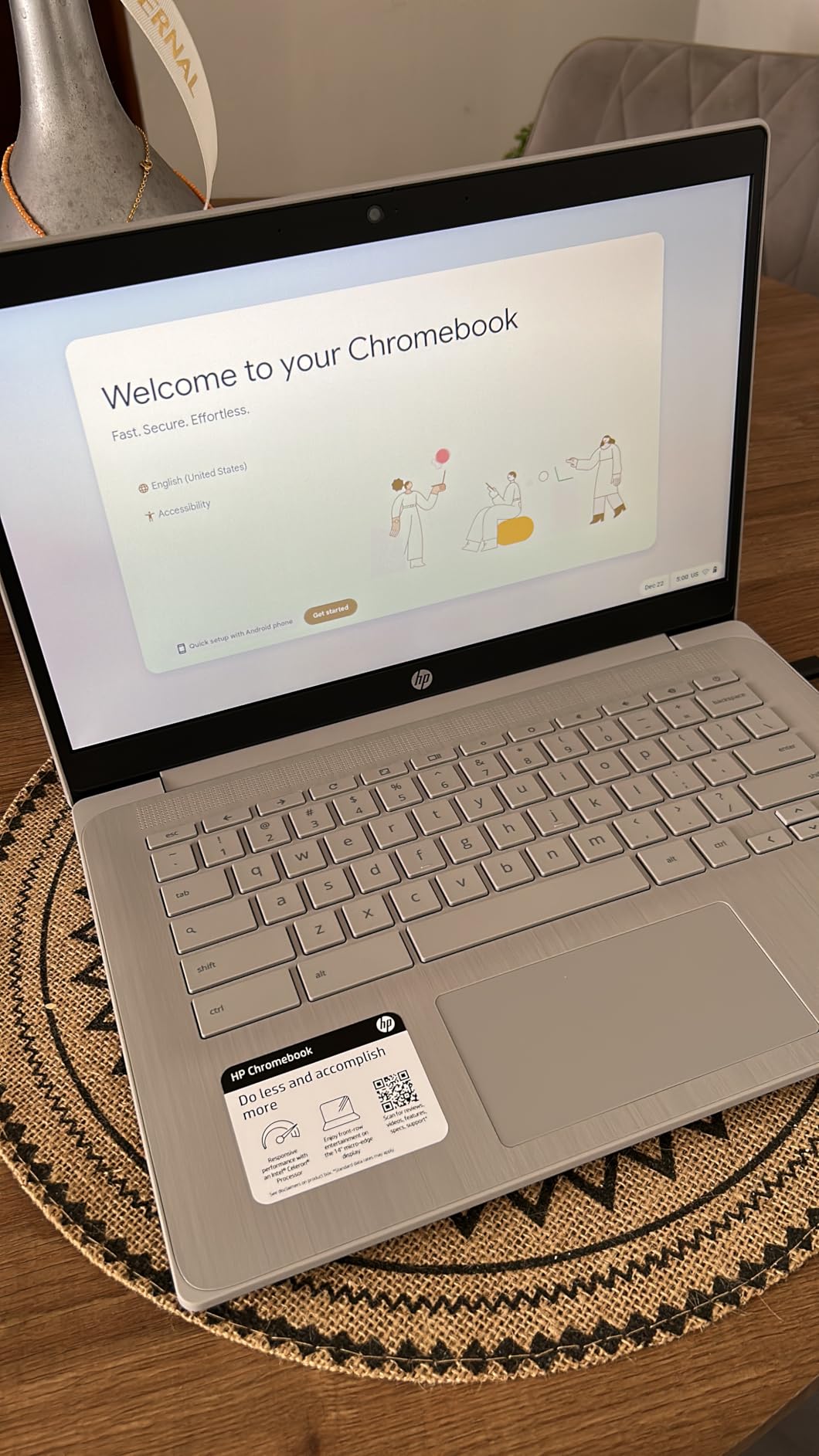
If you want one laptop to cover ages eight through fourteen, this is the one we would buy. The 14-inch micro-edge anti-glare screen is the sweet spot between a netbook and a full-size machine – big enough for two browser tabs and a document, small enough for a bedroom desk.
Battery life is the headline. HP rates it at up to 14 hours, with Fast Charge reaching 50 percent in about 45 minutes, and owner reviews broadly support a full school day from one charge. That single spec removes the most common kid-computing complaint.
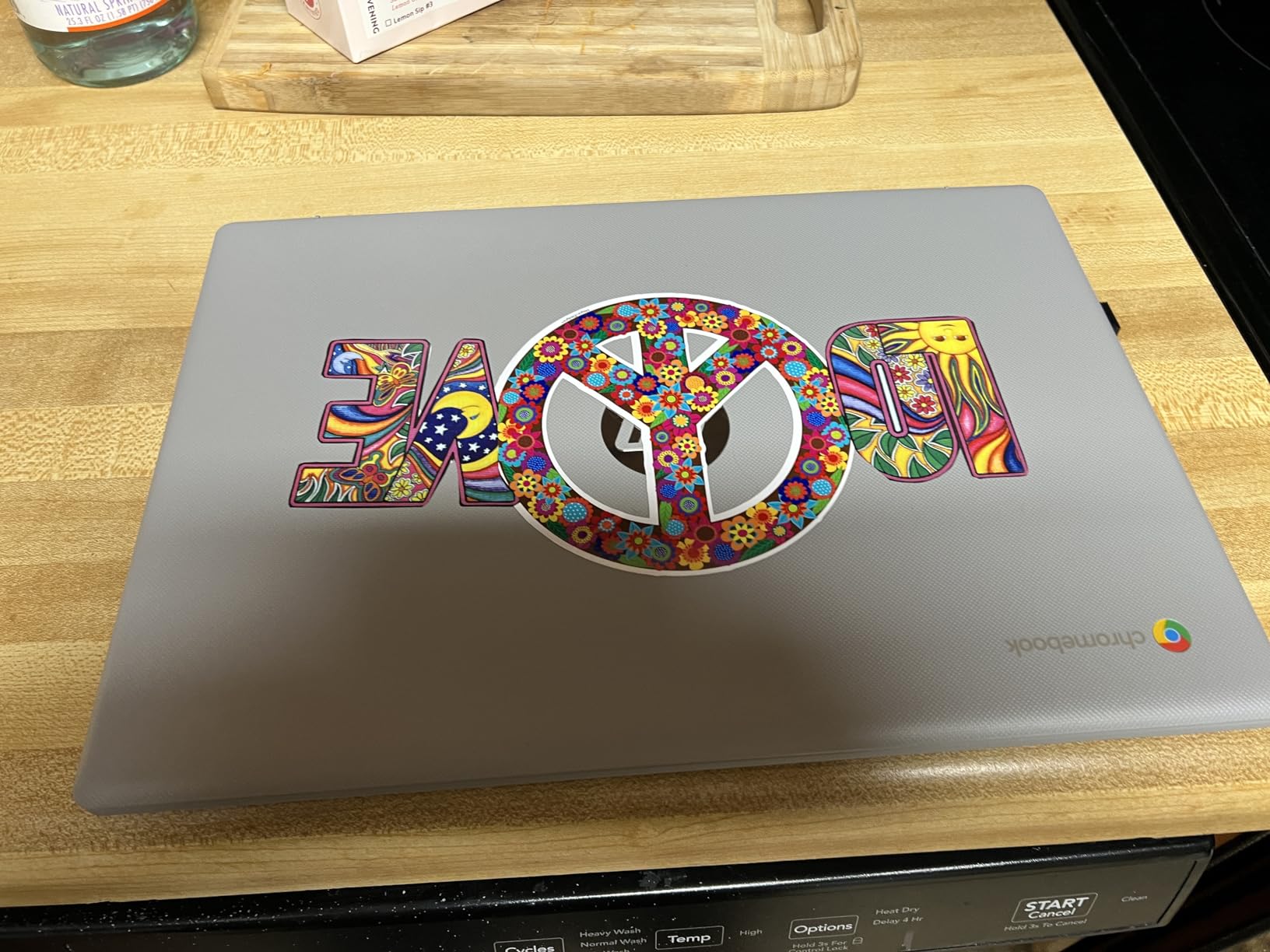
Inside is an Intel Celeron N4120 quad-core, 4GB of DDR4 RAM and 64GB of eMMC storage, with Intel UHD Graphics 600 that handles 4K streaming. Chrome OS gives full access to the Google Play Store for Android apps alongside the normal web apps.
The multi-touch touchpad supports four-finger gestures, the stereo speakers are custom-tuned, and there is a one-year limited hardware warranty rather than the shorter renewed cover. ENERGY STAR certified and EPEAT Silver registered.
Whether 4GB of RAM will hold up over four years
For web-based schoolwork, yes. Four gigabytes handles a browser with several tabs, Google Docs and a video call comfortably. It starts to strain with more than a dozen tabs open, or with anything heavier than web apps.
The bigger longevity question is storage. 64GB of eMMC is genuinely tight once a few hundred Chrome extensions, photos and downloaded videos accumulate. Use Google Drive rather than local files, and expect to manage the account over time.
When to choose something else
Choose the Acer Chromebook 315 instead if screen sharpness matters, because this 1366 x 768 panel looks soft on a 14-inch display. Choose the Lenovo 300e if your child wants a touchscreen or folds the device flat.
This is not a gaming machine and should not be bought as one. Parents in forums describe being steered toward much larger laptops for gaming, and that is buying twice – once for learning and again when the games arrive.
7. Lexibook Unicorn Educational Laptop – Most Bilingual Toy Activities
Lexibook, Unicorn Educational Laptop for Kids, JC598UNIi2
Ages 4 and up
124 bilingual activities
Realistic mouse
Ages 4+
Pros
- Wide activity range with English and Spanish content
- 124 activities give more variety than most toy laptops
- Realistic mouse and keyboard children enjoy
- Lightweight at 640 g for small hands
Cons
- Small screen that feels smaller than expected
- Content is basic and older children get bored
- Some units shut off randomly or fail to power on
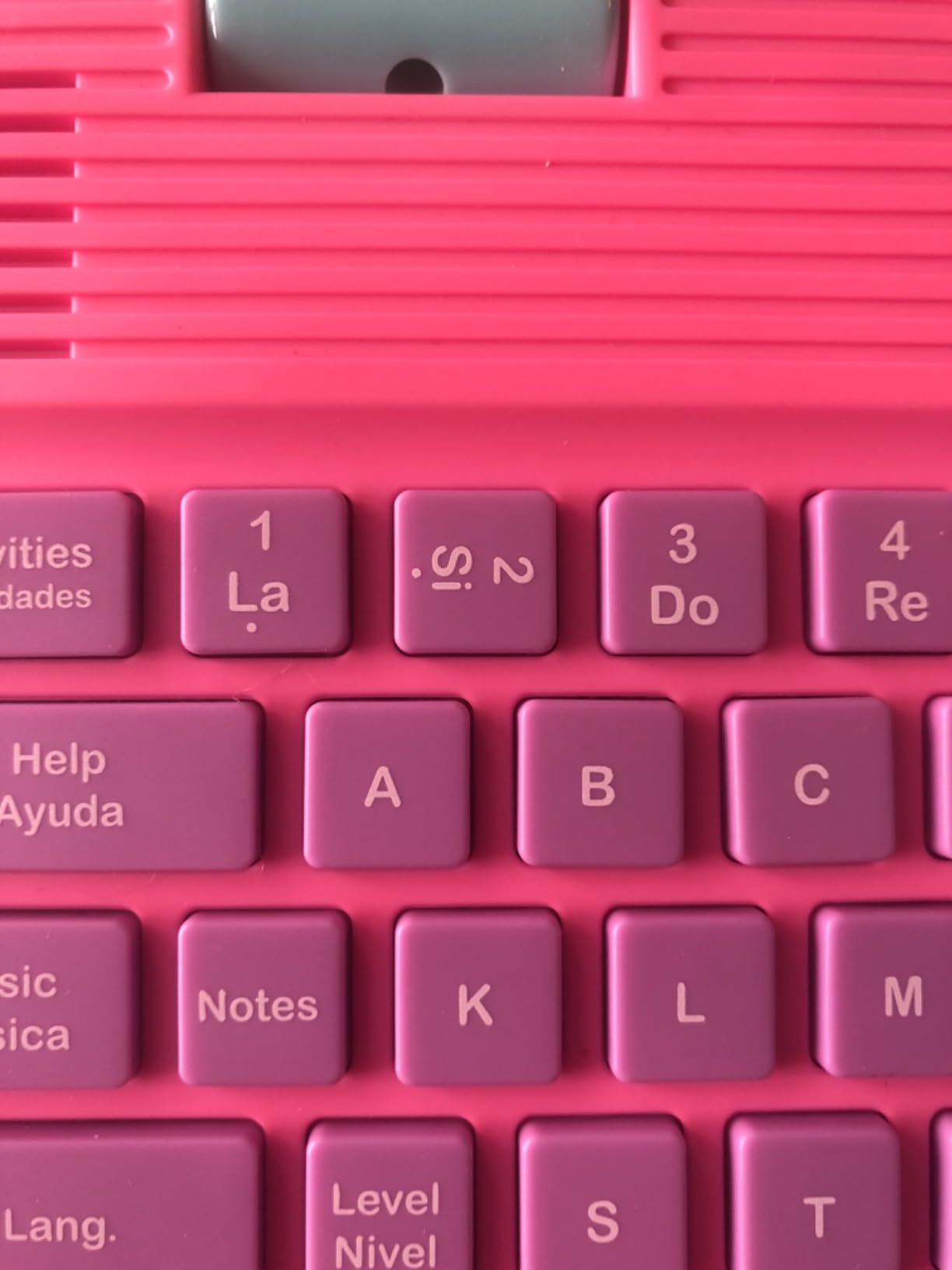
This is the one to buy for a bilingual household. Its 124 activities span English and Spanish, mathematics, dactylography, general knowledge, logic, music and clock reading, with progressive levels that let a child test and improve what they have learned.
Activity count is where it wins. Most preschool toy laptops carry fifteen to thirty activities, so 124 gives noticeably more replay, and the logic, memory and speed games are the part older siblings keep coming back to.
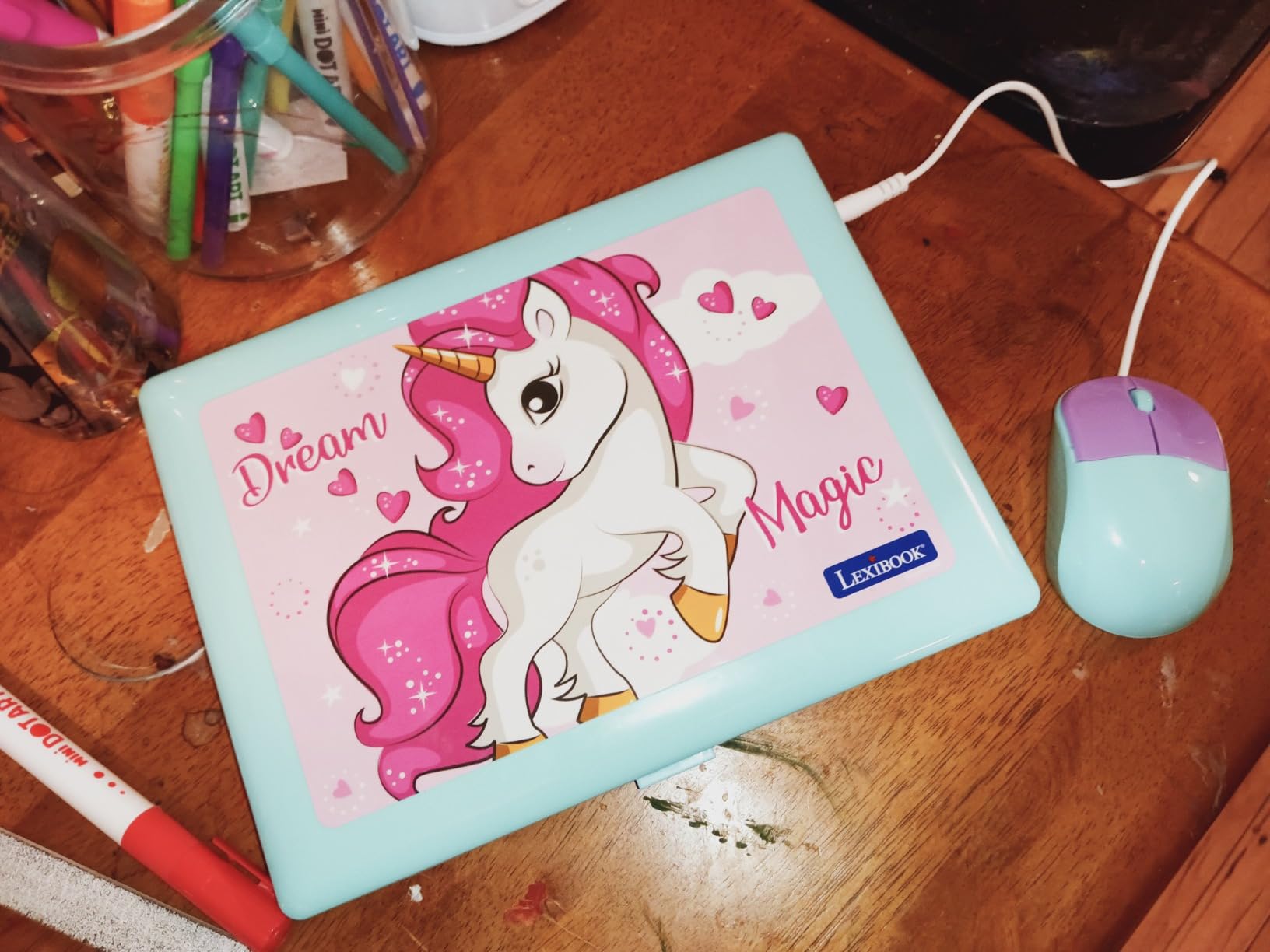
The ergonomics copy real laptops closely, with a full keyboard and a slim mouse in the box, and at 640 g it is the lightest toy laptop here. Design-wise it looks more like a small notebook computer than a plastic toy, which children tend to treat more seriously.
Setup is the one friction point. Owners note that the instruction manual is needed to understand the mode structure, so read it yourself before handing it over.
Where the 124 activities actually help
The bilingual content is the genuine differentiator, and it is usable in a household where grandparents speak Spanish. The mathematics and clock-reading modules map onto what a four or five-year-old is already doing at preschool.
The memory and speed games add real value as well. They are simple enough that a child can play independently, which is what makes a toy laptop work in a busy household.
When to choose something else
Skip it past about age six. Content depth is the limit, and reviewers report older children losing interest quickly once the activities feel babyish.
Reliability is the other concern. A meaningful share of owners report random shutdowns or units that stop powering on after a short period, so keep the three-month warranty paperwork and check the return window. Our student desk guide is worth a look if you need somewhere safe to set it up.
8. LeapFrog ABC and 123 Laptop – First Coding Lessons for Preschoolers
LeapFrog ABC and 123 Laptop for Preschoolers Ages 3-7 Years, Pink
Ages 3-7 toy laptop
11 activities
Animated Pixel character
1.6 lb
Pros
- Animated character with movable hands holds attention
- Simple coding activities introduce programming logic early
- Full QWERTY keyboard with a volume control
- Usable independently up to age seven
Cons
- English only with no language switching
- Screen can fail to display fully when keys are pressed fast
- Demo batteries do not hold a charge
This is the only toy laptop here with real programming content. The coding activities ask a child to give Pixel a sequence of instructions to clean or cuddle the character, which is sequencing and cause-and-effect dressed up as play – a genuine head start for the coding classes that show up around age eight.
The animated character is what sells it. Pixel’s hands move, the antenna light pulses and the character talks, tells jokes, sings and dances. Owners report many children choosing this over tablet time, which is the outcome parents care about.
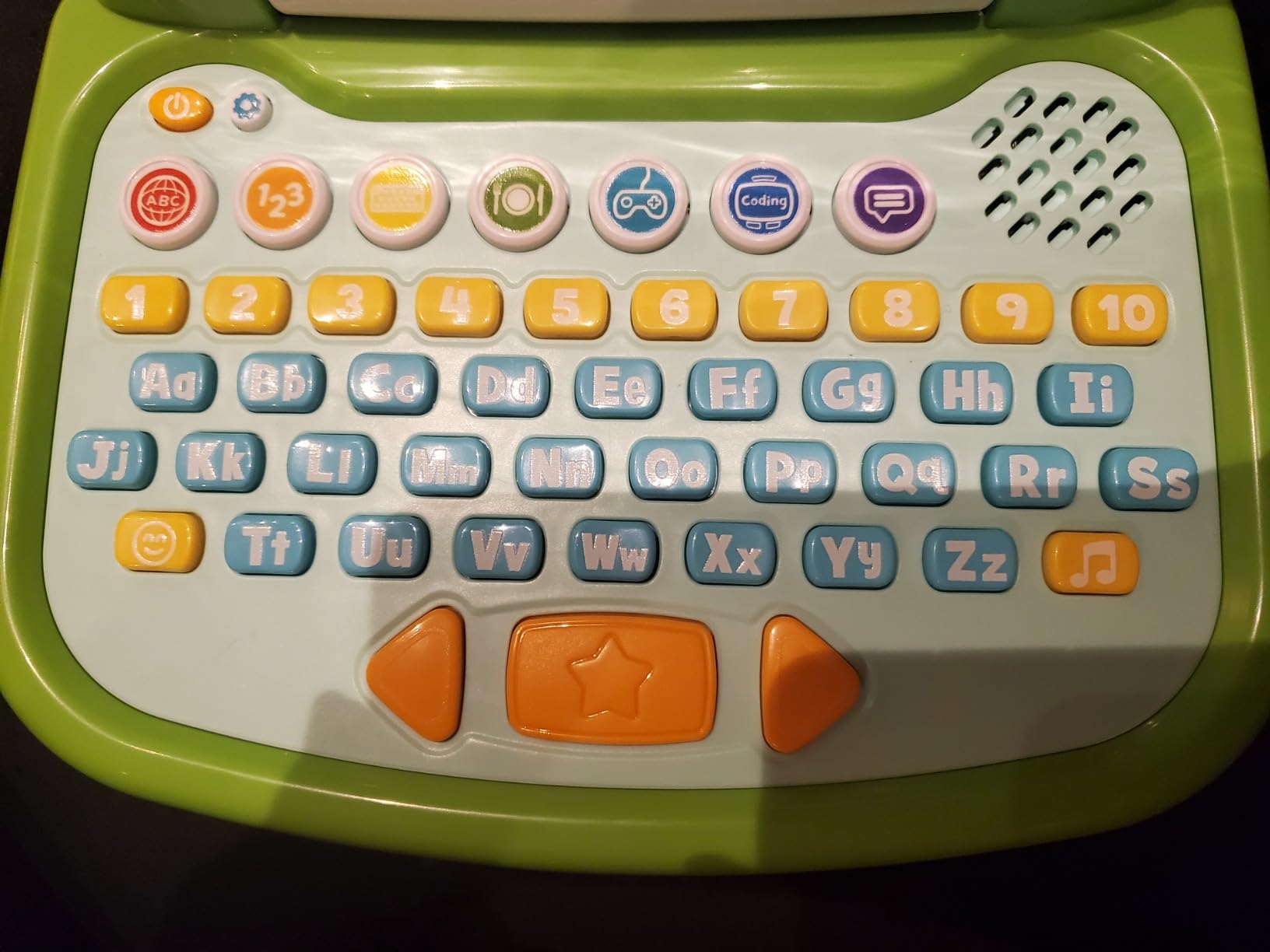
It also has a full QWERTY keyboard and, unusually for a toy laptop, a volume control on the unit. Eleven activities cover letters, counting and basic computer skills, and there is a texting back-and-forth mode with Chip that reads as early writing practice.
At 1.6 pounds it is portable, and the stated age range runs from three to seven, which is the widest of any toy laptop in this roundup.
How young can a child start coding on it
Three is reasonable. The activities require a sequence of taps rather than reading, so there is no literacy barrier, and the on-screen character does the talking. Pre-readers manage it, which is more than can be said for most competing toys.
The screen occasionally fails to render fully when buttons are pressed quickly, according to owners. Slowing down solves it, and it is a software quirk rather than a hardware fault.
When to choose something else
Do not buy it for a bilingual child – the content is English only with no language switching. If Spanish matters, the Lexibook laptops cover both languages.
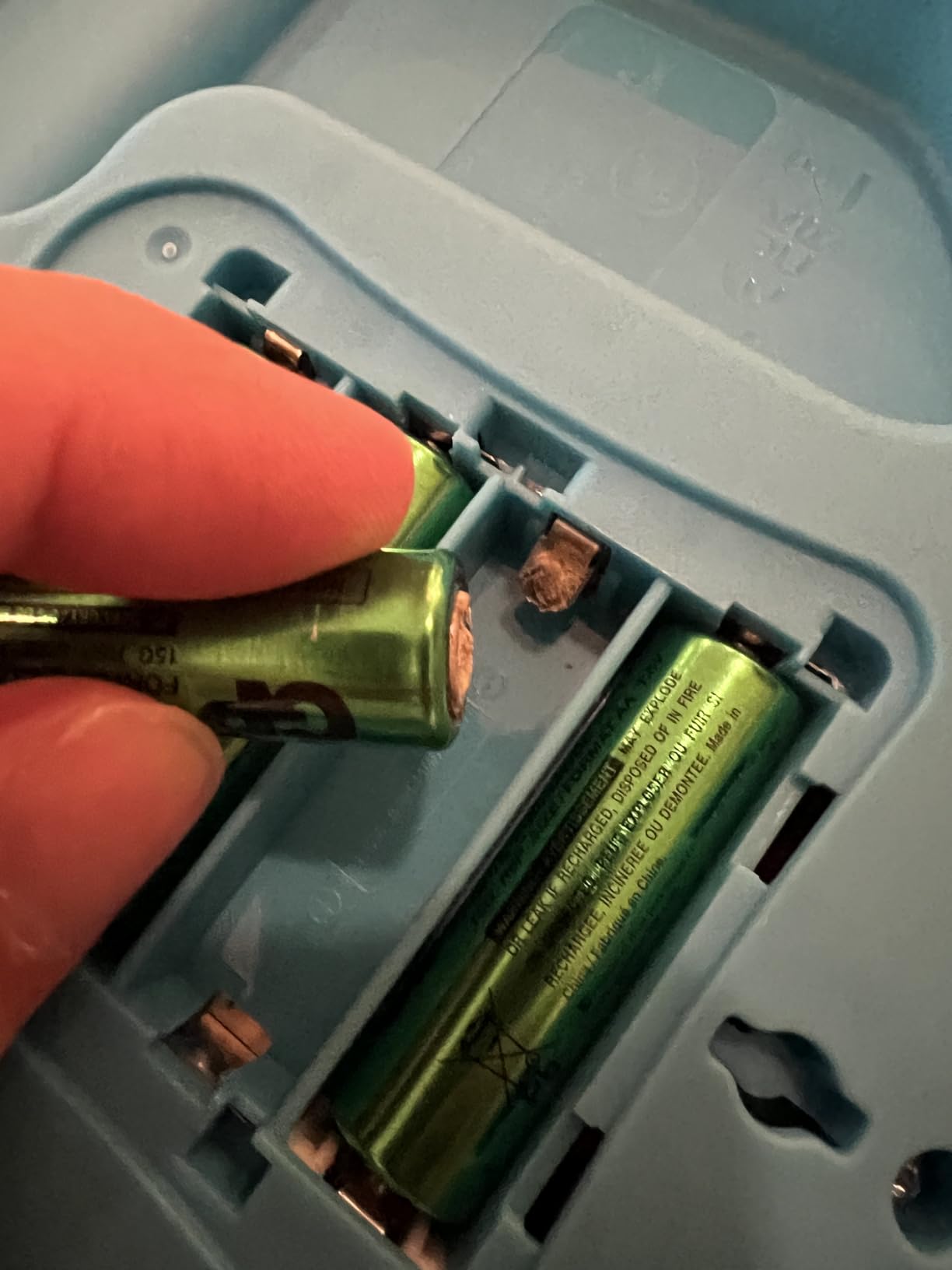
Also expect to replace the batteries often. The demo cells included in the box will not carry a charge, and this toy needs four AA batteries to run.
9. Dell Chromebook 11 3100 – Lightest Renewed Chromebook
Dell Chromebook 11 3100 11.6″ Chromebook – 1366 x 768 – Celeron N4020-4 GB RAM – 16 GB Flash Memory – Chrome OS – Intel HD Graphics – English (US) Keyboard – Bluetooth (Renewed)
11.6 inch Chromebook
4GB RAM and 16GB storage
14 hour battery
Renewed
Pros
- Lightweight at 2.9 pounds
- Keyboard quality is better than average at this level
- Chrome OS updates itself and needs little maintenance
- Good for browsing email streaming and light schoolwork
Cons
- Noticeably slow with pages timing out
- 16GB storage fills up quickly
- 11.6 inch screen is cramped for long typing
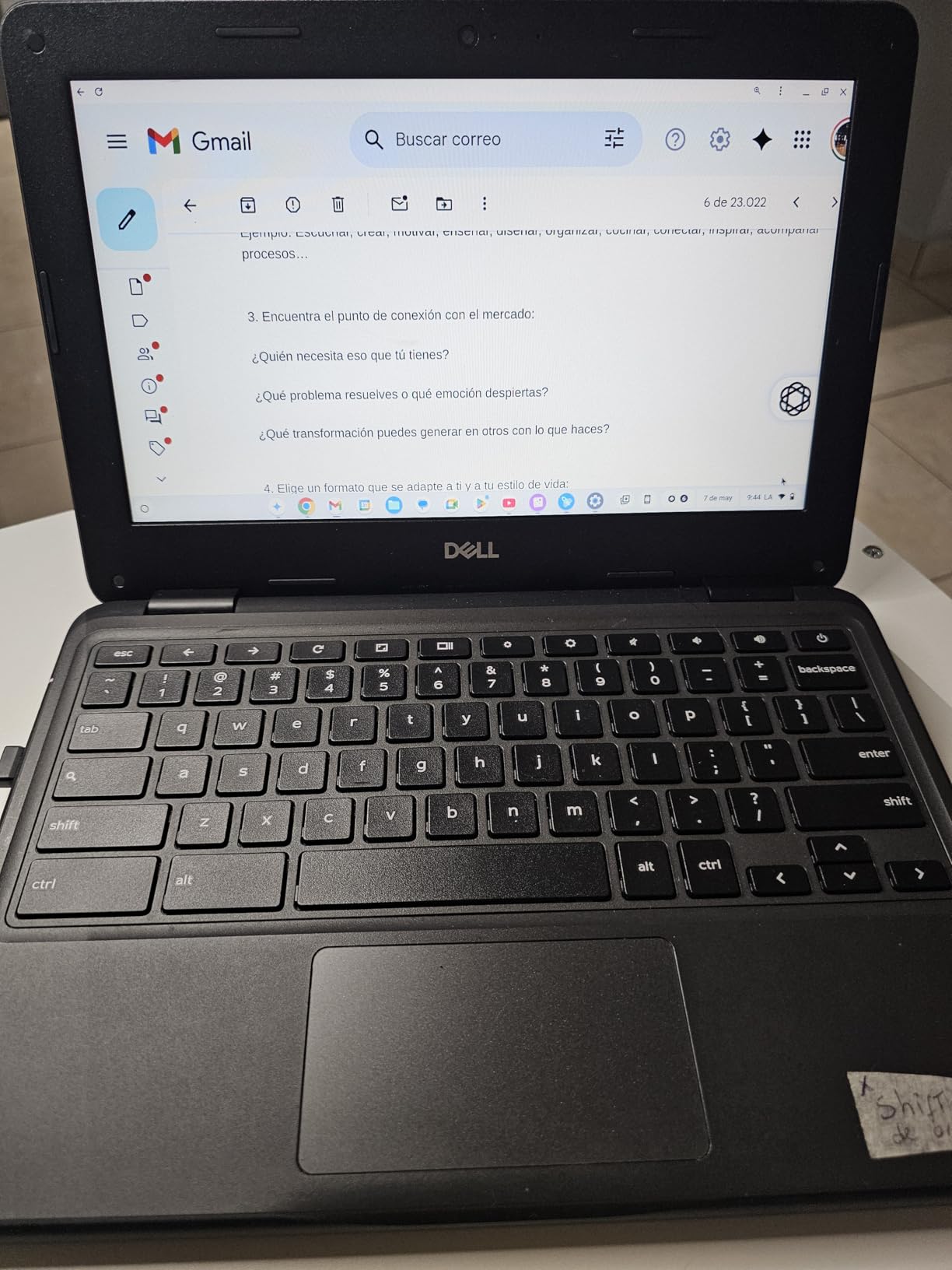
This is the lightest full computer in the roundup, and the Dell keyboard is repeatedly praised by owners as better than expected at this level. For a child aged seven to ten who mostly reads and types short answers, it is a genuinely workable first computer.
Battery life is rated at 14 hours, which matches the HP Chromebook 14, and 2.9 pounds is light enough that a small child can carry it without complaining. Chrome OS installs and updates itself, so there is no maintenance routine to learn.
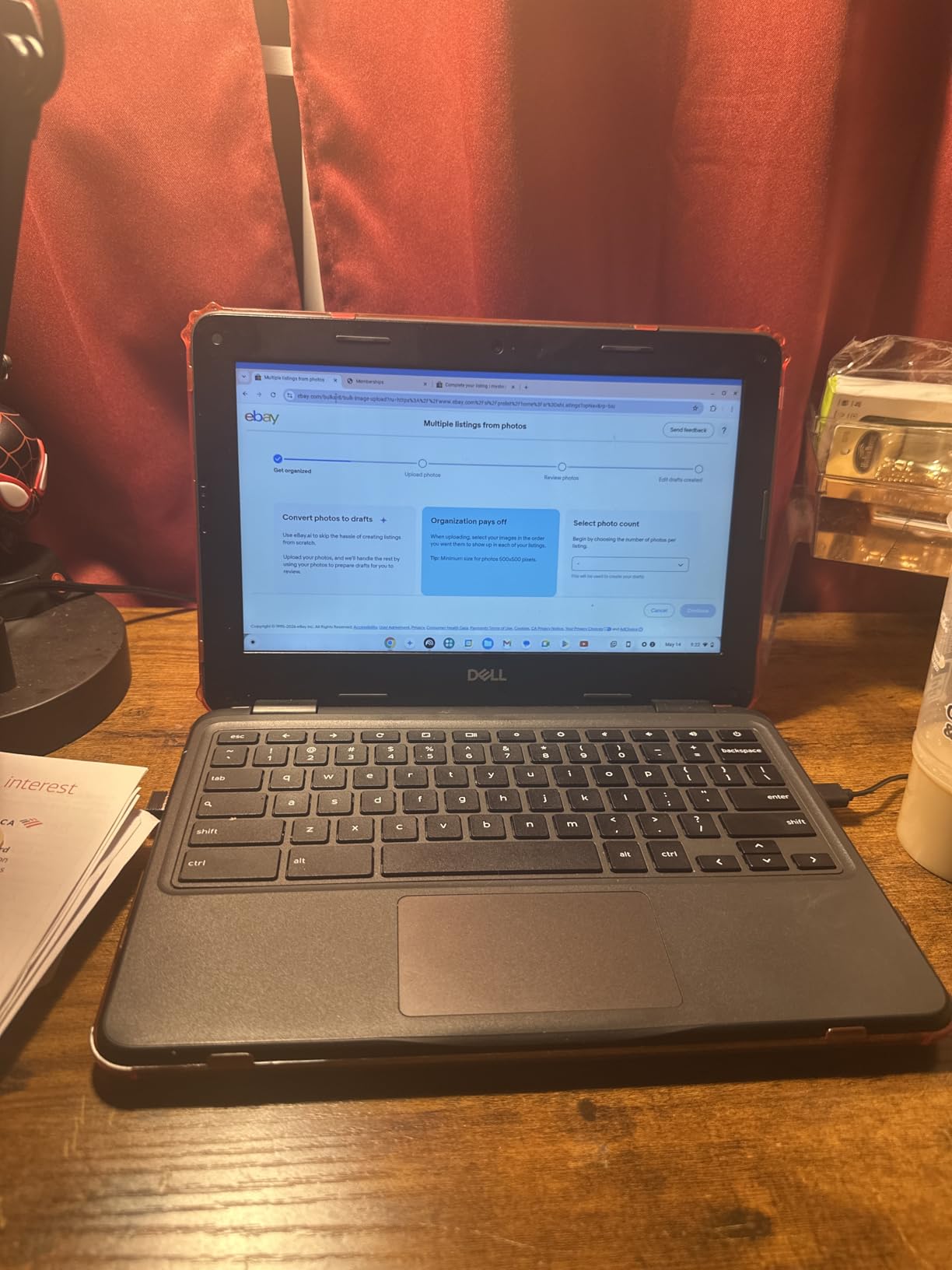
The hardware is an Intel Celeron N4020, 4GB of RAM and 16GB of flash storage with Intel HD Graphics, Wi-Fi 802.11ac and Bluetooth. The display is 11.6 inches at 1366 x 768.
Speed is the honest limitation. Multiple reviews report page timeouts and slow startup, and 16GB of storage fills quickly with just a browser profile and a few apps. This is a second or travel device more than a main one.
Is 16GB enough storage for a child
It is enough if you keep everything in the cloud, and not enough otherwise. Chrome OS is designed around that assumption, so sign the child into a Google account with Drive storage from day one and the limitation mostly disappears.
Local downloads are what will hurt – offline videos, a large game or a scanned PDF can eat the space fast. The renewed listing carries a 90-day limited warranty, so inspect the keyboard and charging port on arrival.
When to choose something else
Choose the HP Chromebook 14 if the child will do more than browsing and email, because the bigger screen and faster processor make a real difference to a full school day. Choose the Lenovo 300e for a touchscreen.
Buy new rather than renewed if a slow machine would frustrate your child into abandoning it. A laptop they stop using is worse value than a more capable one.
10. VTech Bluey Game Time Laptop – Highest Rated Toy Pick
VTech Bluey Game Time Laptop
Ages 3 and up
10 Bluey games
Character selector
1.2 lb
Pros
- Familiar characters and colorful keyboard engage toddlers instantly
- Character slider gives a sense of choice
- Sturdy build that holds up to toddler play
- Practises letters numbers and shapes through play
Cons
- Volume cannot go below a fairly loud minimum
- Repetitive audio some parents find grating
- English only with no language option
This is the highest-rated machine we tested, sitting at a 4.8 star average. That rating tells you something specific: the child reaction is excellent, because a three-year-old recognises Bluey, Bingo and the Heelers immediately and does not need to be convinced to start.
Ten games are built around the show, including Grannies, Fancy Restaurant, Musical Statues and Spy Game, with a slider to pick between seven characters. A dedicated Bluey button plays character talk and phrases from the show.
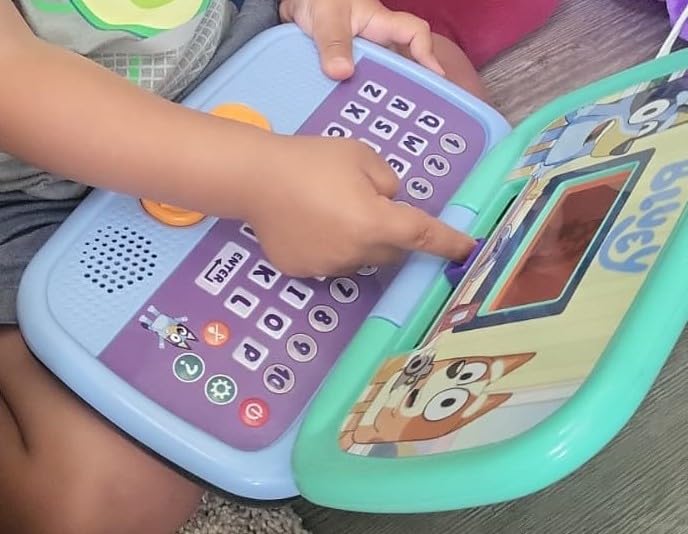
Underneath the licensed packaging it is a genuine early-learning toy. The games practise letter recognition, numbers and shapes, and owners note the observational games work well alongside that.
At 1.2 pounds with a sturdy build, it is also the easiest unit here to hand to a toddler for a long car journey or a sporting event, which is where this category really earns its place.
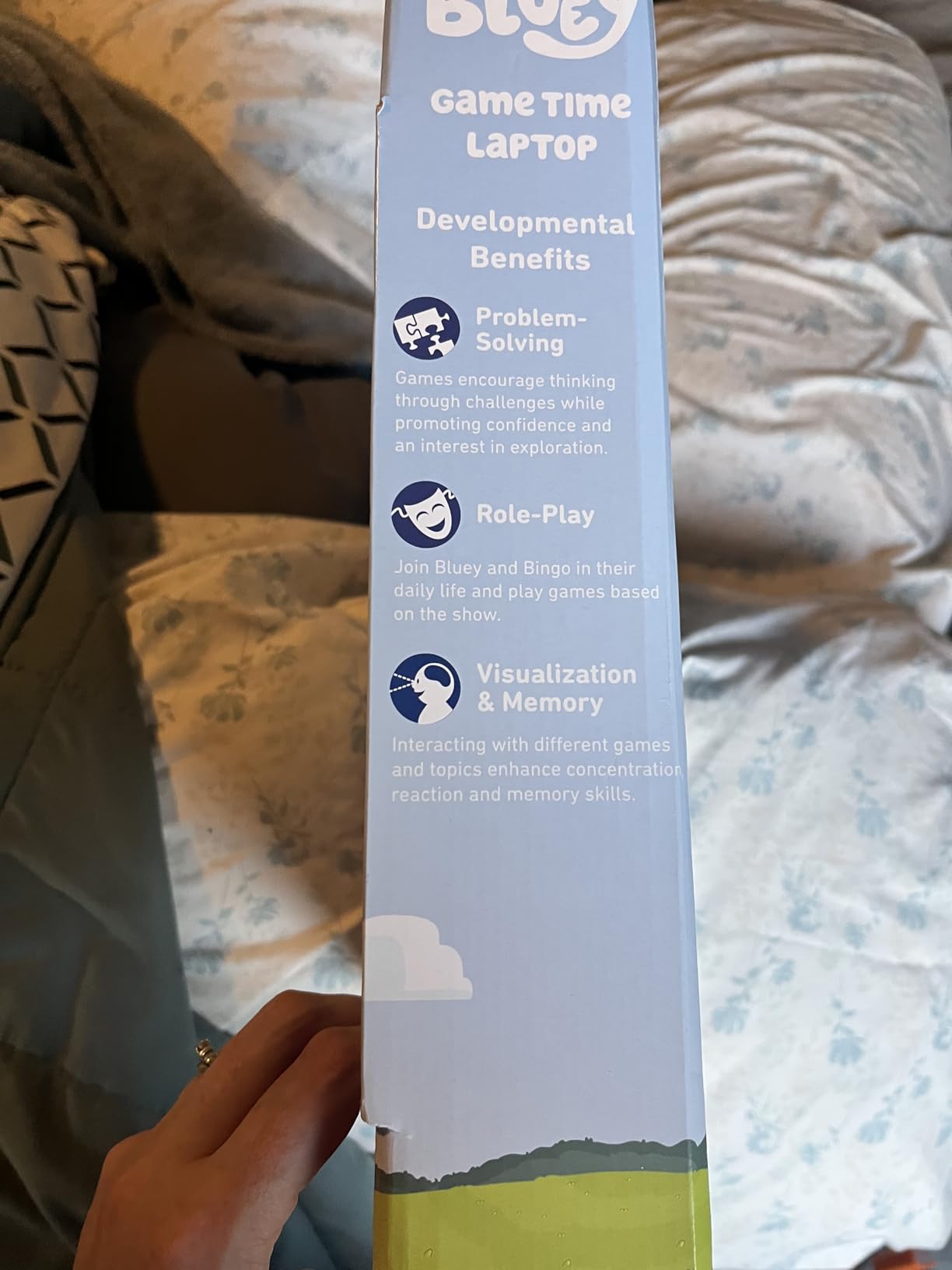
Is a licensed character laptop good for learning
Yes, at this age, because the characters do the motivating. The games underneath are simple matching and pattern tasks that a child would otherwise refuse to sit still for. The trade-off is that the content is English only and tied to a show that will eventually be outgrown.
The volume control is the practical issue. There is no way to turn it below a fairly loud minimum, so it is not a bedroom-quiet toy.
When to choose something else
Skip it for children under three, who find the game difficulty too advanced to complete independently, and skip it if your household does not watch Bluey, because the engagement advantage disappears without recognition.
It is also a good second machine rather than a first, since there is no keyboard typing content and no Spanish. Parents looking for typing practice should start with the LeapFrog units instead.
11. Acer Chromebook 315 – Biggest and Sharpest Screen
Acer Chromebook 315 Laptop, Celeron N4500, 15.6″ Full HD IPS Display, 4GB LPDDR4X, 64GB eMMC, Wi-Fi 6, DTS Audio, USB Type-C, Chrome OS, CB315-4H-C8XU, Silver
15.6 inch Full HD IPS Chromebook
4GB LPDDR4X
64GB eMMC
Wi-Fi 6
Pros
- Largest and sharpest screen in this roundup at 1920 x 1080
- Full-size keyboard is comfortable for typing
- Boots very quickly thanks to Chrome OS
- Wi-Fi 6 and USB-C connectivity
Cons
- Dual-core Celeron performance is modest
- 4GB and 64GB with soldered memory that cannot be upgraded
- No touchscreen despite the large display
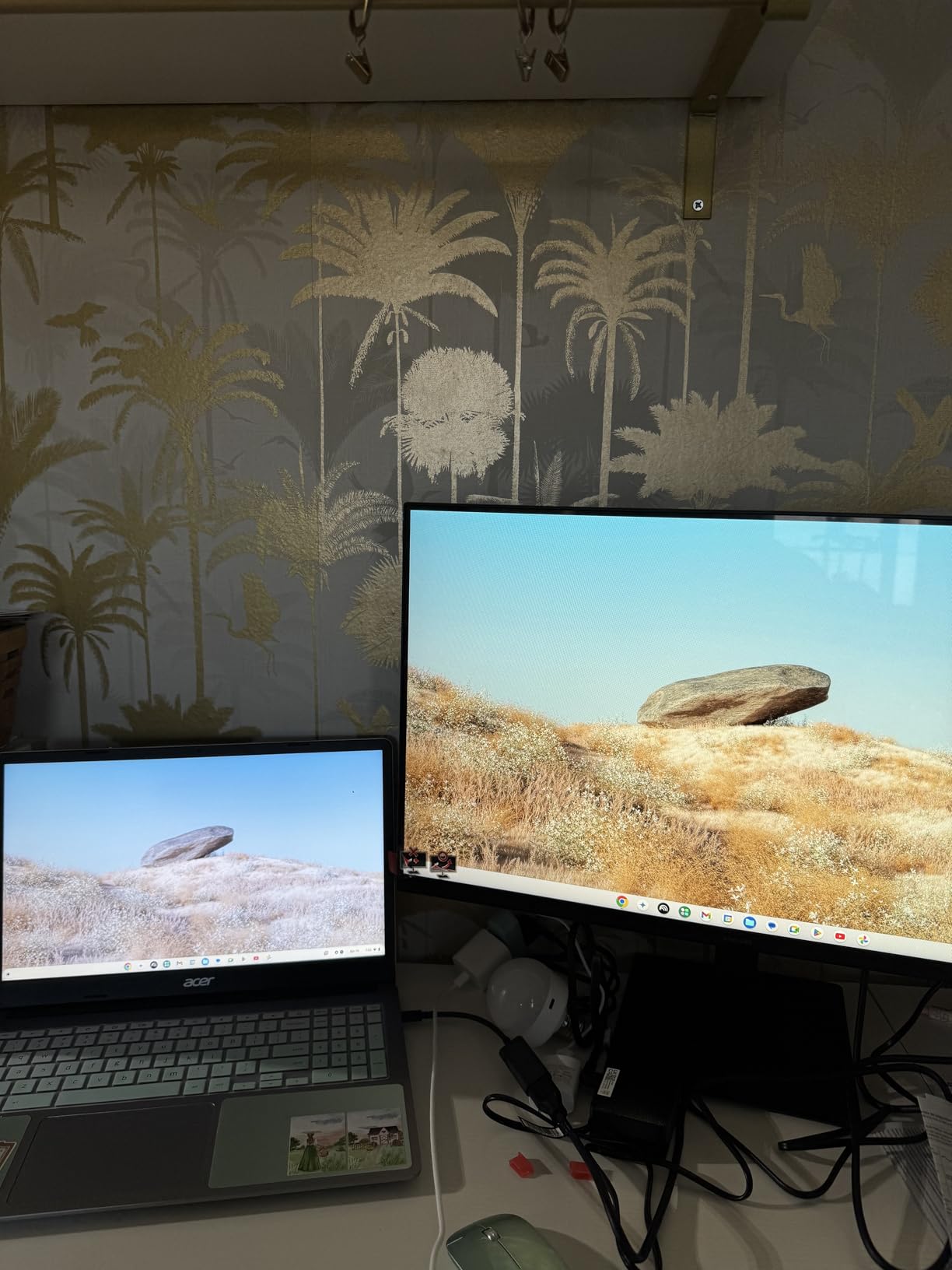
Screen size is the reason to buy this one, and it is a genuine outlier. A 15.6-inch Full HD IPS panel at 1920 x 1080 is the largest and sharpest display in this roundup, and it makes a visible difference when a child has two documents and a video call open at once.
The keyboard is a full-size chiclet with real spacing, which matters more for touch typing than any spec. Owners cite it as a good first computer for children, and boot times are quick.
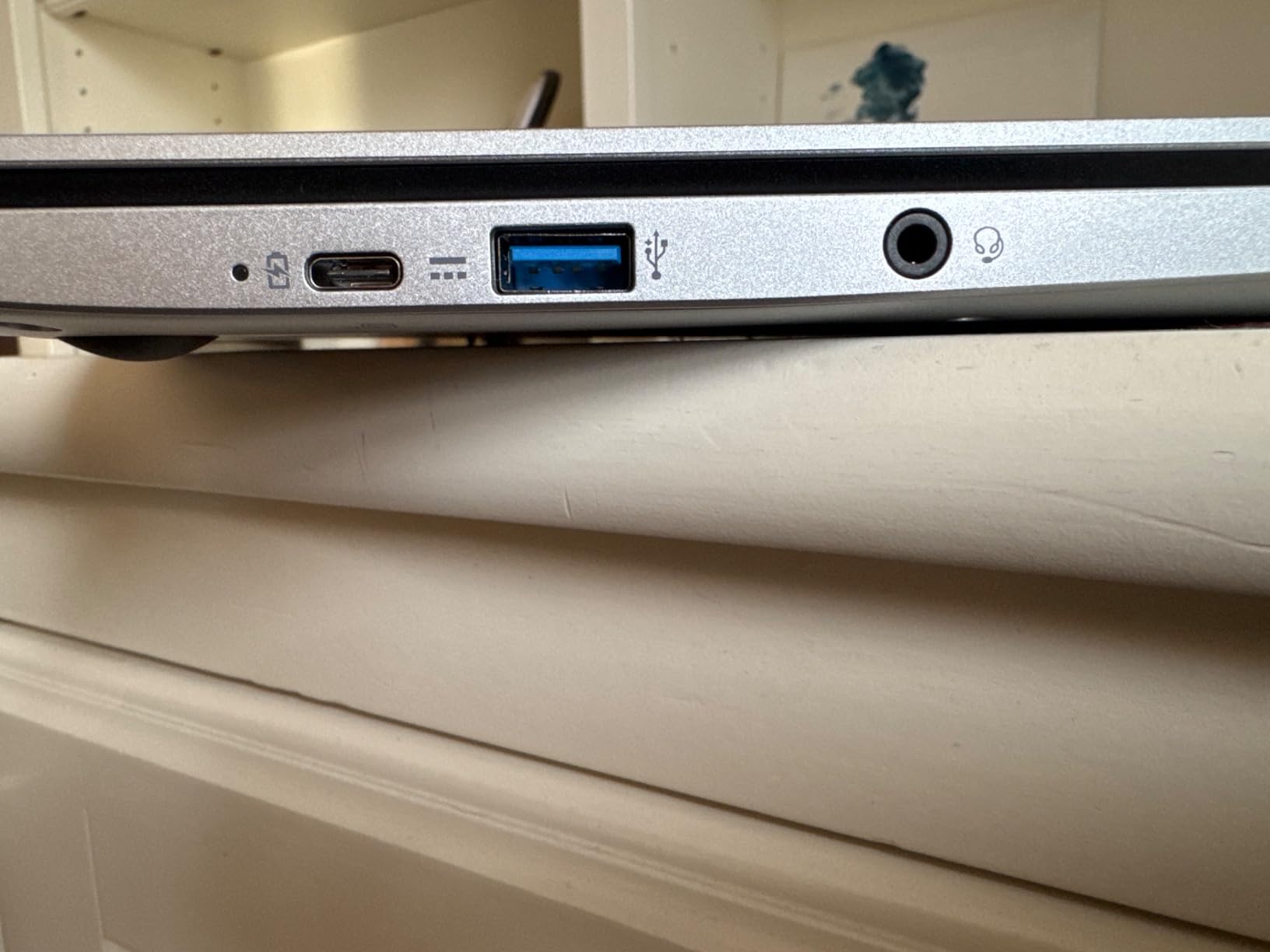
Connectivity is modern: Wi-Fi 6 dual-band, Bluetooth 5.1, two USB Type-C ports supporting charging, DisplayPort and data, plus two USB-A ports. DTS audio drives two built-in stereo speakers. Chrome OS includes Google Play and 100GB of Google Drive.
Warranty is a one-year International Travelers Limited Warranty, which is more cover than either renewed machine offers. Battery life is rated at 10 hours, enough for a school day with charging to spare.
Whether a 15.6 inch screen is too big for a child
At 3.5 pounds it is the heaviest machine here, and that is a real trade-off. It suits a desk-dominant child aged ten or older, or a shared family computer, and it is the wrong size for carrying to school every day.
Screen size also means better longevity. A 12 and 14-year-old doing research and writing will not outgrow this panel as quickly as an 11.6-inch one.
When to choose something else
Choose the HP Chromebook 14 if your child carries the device daily, because 3.2 pounds and a 14-inch footprint are easier to manage. Choose anything else if you need a touchscreen, since this panel does not have one.
The Celeron N4500 is a dual-core chip and the 4GB of LPDDR4X is soldered on board, so there is no upgrade path. Treat it as a browsing and writing machine, not a coding or video-editing machine.
12. Lexibook Paw Patrol Educational Laptop – Character Appeal for Ages 4+
Lexibook, Paw Patrol Educational Laptop for Kids, JC598PAi2
Ages 4 and up
124 bilingual activities
Realistic mouse
1.4 lb
Pros
- Paw Patrol characters make it immediately appealing
- 124 bilingual activities give broad coverage
- Lightweight and durable for toddler play
- Natural sounding voice rather than robotic
Cons
- Does not read directions aloud so pre-readers need adult help
- Small screen and hard plastic feel cheaper than the price
- Some units shut down randomly or fail to turn on
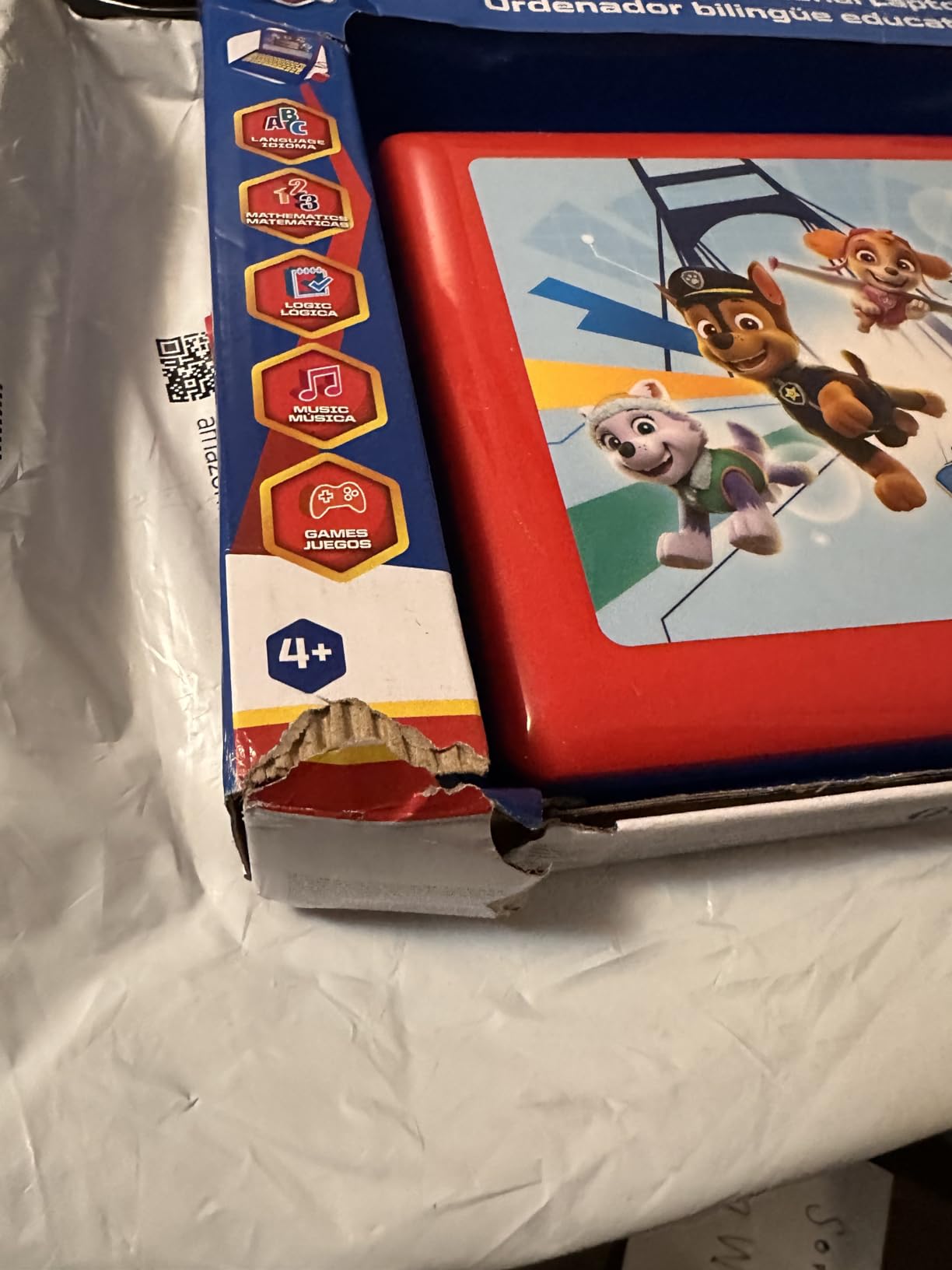
This shares its 124-activity software with the Lexibook Unicorn, so the activity list and bilingual coverage are identical. What changes is the theme: Paw Patrol characters in red and blue, which for a four or five-year-old who watches the show can be the difference between playing and ignoring it.
Reviewers often mention buying a second one for grandchildren, which tells you how well it lands at that age. At 1.4 pounds it is light, and the voice is described as natural rather than robotic.
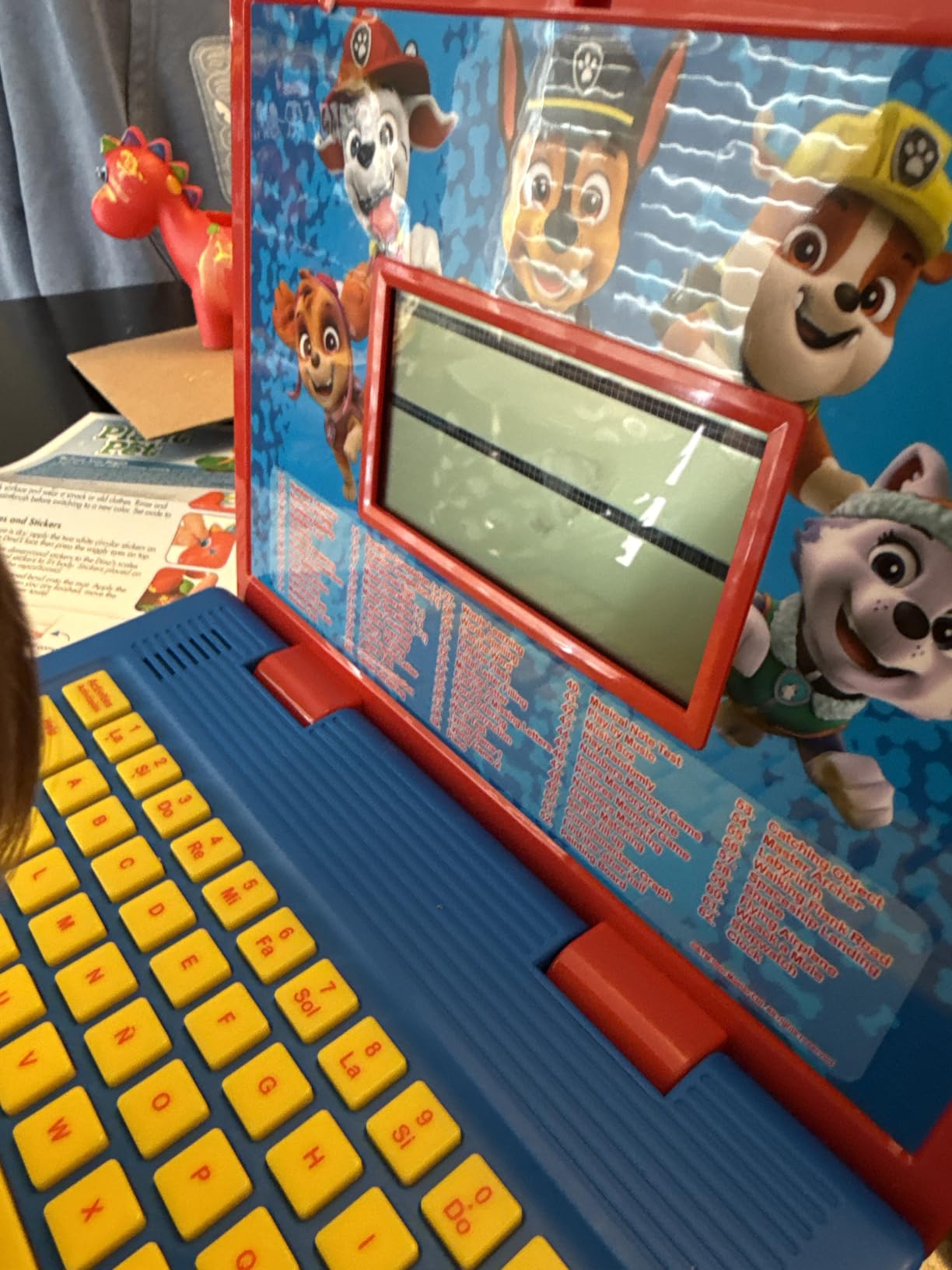
The activities span Spanish and English, mathematics, dactylography, general knowledge, logic, music and clock reading, with progressive levels and memory and speed games. A realistic mouse and keyboard design makes it look like a small laptop computer.
The one feature that matters most here is that it does not read the activity directions aloud. Pre-readers will need an adult sitting with them for the first few sessions until they can follow the screen.
Whether two Lexibook laptops are worth buying
If you have two children in the four to seven range, yes – owners report buying a second for siblings or grandchildren with the same result. For one child, the Unicorn version offers the same content for less, and you can add character appeal with the mouse and keyboard design.
Reliability is the shared concern. Both Lexibook models carry a three-month warranty and a meaningful share of owners report random shutdowns or units that will not power on.
When to choose something else
Choose the Unicorn instead if budget matters more than the character theme. Choose the VTech Play Smart Preschool if early Spanish is the priority, because it teaches Spanish words alongside English rather than switching between them.
Do not expect this to last past age seven. The content depth is a preschool curriculum, and older children lose interest quickly.
What to Avoid in a Kids Learning Laptop
Parents searching this topic usually want the short list of deal breakers. These are the specifications and situations we would rule out entirely, based on the failure patterns in the reviews and the recurring complaints in parent forums.
A Windows machine with 4GB of RAM or less running school software. If you are going to Windows, 8GB is the floor. A 4GB Windows laptop struggles with a video call plus two browser tabs, and parents in forums describe exactly that frustration.
Any device advertised as for kids with no working parental controls. If you cannot set screen time limits, block adult content and see a list of installed apps, it is not a kids device. That capability is the reason to buy a real computer over a toy.
No repair or warranty path. A cracked screen should not end the device. Two of our picks are renewed with only 90-day limited warranties, which is the trade-off you accept for the lower cost.
Anything heavier than 3.5 pounds for a child who carries it daily. Weight is the most reliable predictor of whether a laptop actually travels to school or stays on the desk at home.
Under eight hours of real-world battery. Our picks list 10 or 14 hours. A machine that cannot survive a school day on one charge will end up charging in every room of the house.
Off-brand Android kids laptops with 2GB of RAM. These dominate the low shopping carousels and carry low ratings. They come with bloatware, weak batteries and unproven reliability, and a parent forum parent reading will find no warranty worth the name.
Any purchase made without checking the school’s BYOD requirements. A school can require a specific operating system or a minimum specification, and buying before asking makes the device useless for homework.
Adopting a tablet with a keyboard when schoolwork needs a full screen. A keyboard case is cheaper and lighter, but split-screen documents and Google Classroom video calls are genuinely cramped. Compare our kids tablet guide before choosing one.
How to Set Up Parental Controls Before You Hand It Over
Do this on the parent account, with the child sitting next to you, before the first day of use. It takes about twenty minutes and saves a long argument later.
1. Create the child’s supervised account first. On a Chromebook, sign in with a parent Google account, then use Family Link on the phone to create a supervised child profile with age-appropriate defaults.
2. Set app approvals to require permission. In Family Link, switch app and device installation to require approval, so nothing new appears without you allowing it.
3. Turn on screen time limits. Set a daily cap and a bedtime schedule that covers school nights separately from weekends. Start lower than you think you need and adjust after two weeks.
4. Lock the content settings. Choose the strictest available YouTube and web content filter. You can loosen it later; loosening is much easier than tightening.
5. Require approval for purchases. Chrome OS asks for a password before any in-app purchase, and the Google Play Store uses a separate family purchase password. Set both.
6. Check location and sharing settings. Location history and camera and microphone permissions default to off for supervised profiles, and it is worth confirming they are still off.
7. Set the device up in the child’s room on Wi-Fi you control. Chromebooks also support guest accounts that leave no trace between users, useful for a shared family machine.
8. Agree the rules before the first use, not after the first argument. Write down the daily limit and what finishes homework first. The most common parent forum complaint is not that limits fail, it is that no limit was ever set.
On Windows, look for Microsoft Family Safety instead, which covers screen time, content filtering and location reporting in one place. Either way, the setup is the same five minutes of work.
How to Choose a Learning Laptop for Kids – Buying Guide
Check the school first. BYOD policies specify an operating system, a minimum screen size and sometimes required software. Ask the school for the written list before buying, because a machine that fails the checklist is dead money.
Pick the right age band. Toy laptops suit two to six. Chromebooks suit seven upward. Handing a seven-year-old a Chromebook means more setup than they need, and handing a fourteen-year-old a toy laptop ends in frustration.
RAM and storage: 4GB and 64GB is the working floor for Chrome OS. For web-based schoolwork that is enough, and 8GB is better if the child will keep games or video editing. On Windows, treat 8GB as the minimum. For storage, push everything to cloud accounts because 64GB fills quickly.
Screen: 11.6 inches minimum, 14 inches ideal. Below 11 inches, typing and reading become cramped. Above 15 inches, the machine is heavy for a child. Resolution matters less on smaller panels than text size does.
Battery: eight real hours is the threshold. Manufacturer claims run higher than reality, so treat 10 hours or more in the listing as a signal you are safe.
Weight: under 3.5 pounds if it travels. For a desk-only machine, weight matters much less, and a larger screen becomes worth the extra ounces.
Touchscreen and 2-in-1 hinge: worth it for under 10s. Younger children benefit from tablet mode for reading apps and drawing. Older children who type heavily can skip it and spend the money on battery instead.
Operating system decides the parental control story. Chrome OS updates itself and has the cleanest family supervision. Windows gives app freedom and needs Microsoft Family Safety. Android gives the least structure.
Renewed or refurbished: know what you are getting. Renewed saves money and usually means a 90-day limited warranty. Expect possible scratches, unknown battery health and more variability than new. Inspect the screen, keyboard and charging port on arrival, and keep the packaging for the return window.
Add the accessories in the same order. A two-layer case, a sleeve and a screen protector cost far less than a replacement screen, and drop protection is the single highest-value accessory. Our student desk picks cover a proper fixed workspace at home.
Plan for the upgrade point. Expect roughly three years from a toy laptop and four to five from a Chromebook. Buy something your child will not outgrow in a year, and set a calendar reminder rather than discovering the limitation during homework week.
Frequently Asked Questions
What are some good educational laptops for kids?
The best educational laptops for kids split into two groups. For ages two to six, toy laptops from LeapFrog, VTech and Lexibook teach letters, numbers and logic through fixed activity sets, with no accounts or screen-time risk. For ages seven and up, a Chromebook is the better buy because Chrome OS updates itself and gives you supervised accounts, screen time limits and app approvals. Our top pick overall is the LeapFrog LeapTop Touch for the youngest children and the HP Chromebook 14 for school-age kids.
What laptop to stay away from?
Stay away from four categories. A Windows machine with 4GB of RAM or less will struggle with a video call and a few browser tabs. Any device sold as for kids with no working parental controls leaves you unable to set limits or block content. Off-brand Android laptops with 2GB of RAM and no real warranty are unreliable. Also avoid anything over 3.5 pounds for a child who carries it daily, and anything bought before checking the school BYOD requirements.
What is the best first laptop for a 10-year-old?
The best first laptop for a 10-year-old is a Chromebook with at least 4GB of RAM, an 11.6 inch or larger screen and a battery that lasts a full school day. Our pick is the HP Chromebook 14a-na0226nr, which has a 14-inch anti-glare display, a one-year warranty and battery life rated at up to 14 hours. If your child prefers a touchscreen, the Lenovo 300e 11.6-inch 2-in-1 is the alternative. Avoid Windows laptops at this age unless school software requires them.
What is a good age for a kid to get a laptop?
A good age for a first laptop is around six or seven, when a child can read simple instructions and sit with homework independently. Younger children from two to six are better served by an educational toy laptop, which teaches letter and number recognition with no accounts, no browser and no screen-time management. Waiting until seven also means the machine is easier to supervise and is more likely to survive the school years without being replaced.
Do kids need their own laptop or can they share?
A shared device works for short sessions and for siblings close in age, using separate user accounts on a Chromebook or Chrome OS. It fails for homework, because two children needing the machine at once creates more conflict than the savings are worth. If you do share, set up separate supervised profiles with individual screen time limits, and buy a case and a second charger so both are independent.
Final Verdict
For a child under six, the LeapFrog 2-in-1 LeapTop Touch is the best learning laptop for kids in our testing. Its flip screen, five modes and 30k+ reviews at 4.7 stars make it the safest first machine to hand over, and the My Own Leaptop is the sensible saving if you want a simpler design.
From seven upward, choose a Chromebook and nothing else. The HP Chromebook 14 covers ages eight to fourteen with a 14-inch anti-glare screen and all-day battery, the Acer Chromebook 315 wins on screen size at a desk, and the Lenovo 300e is the pick when a touchscreen matters. Whichever you choose, set up parental controls on the parent account before the first day of school and buy a case at the same time.
Check your school’s BYOD requirements before you buy anything, and revisit this guide in 2026 as the school year turns over.