
The best knife sharpening system for most people in 2026 is the Presto 08800 EverSharp Electric Knife Sharpener. It has pulled more than 18k reviews at a 4.5 average, needs no technique to learn, and turns a dull kitchen knife back into a slicer in about a minute. If you want angle control and a proper stone progression, the Work Sharp Precision Adjust Elite is the one to buy instead.
A sharpening system is a repeatable setup. A clamp or magnetic holder locks your blade at a fixed angle per side, then a stone, diamond plate or powered wheel is drawn along the edge to remove metal. A honing rod does something different: it straightens an edge that already exists and barely touches the steel. Confusing the two is the most common reason people think they have sharpened a knife when they have only stropped it.
We spent months putting these twelve systems through the same routine on chef’s knives, pocketknives, a single-bevel gyuto, serrated bread knives, chisels and plane irons. Every system here was scored on edge consistency from heel to tip, angle adjustability, clamp stability, abrasive range and replacement availability, learning curve and value. Where a kit ships with its own stones, we scored the stones as part of the package rather than separately. Full methodology notes sit at the end of the buying guide.
Whichever system you land on, pair it with a separate honing rod for daily work. A sharpening session every few months plus a rod on a strop between them will keep an edge far longer than either tool alone. If you are still assembling a kit, our guide to the best knife sets with blocks is a good place to see how a sharp blade behaves on a real cutting board.
Table of Contents
Top 3 Picks: Best Knife Sharpening Systems (October 2026)
These three cover the most ground for the least money. The Presto wins on speed and volume, the Lansky wins on completeness per dollar, and the Work Sharp MK2 wins on the sheer range of tools it will touch.
Presto 08800 EverSharp
- Two-stage electric sharpening
- Sapphirite wheels
- Precision blade guides

Lansky Deluxe 5-Stone Kit
- Five color-coded stones
- Clamp holds a fixed angle
- Carrying case included
Best Knife Sharpening Systems At A Glance In 2026
Every pick, its defining feature and where it fits. Prices move constantly, so the Check Latest Price buttons are the only reliable price reference.
| Product | Specifications | Action |
|---|---|---|
| Presto 08800 EverSharp Electric Knife Sharpener |
|
Check Latest Price |
| Lansky Deluxe 5-Stone Ceramic System |
|
Check Latest Price |
| Work Sharp MK2 Electric Knife Sharpener |
|
Check Latest Price |
 Work Sharp Precision Adjust Elite Work Sharp Precision Adjust Elite |
|
Check Latest Price |
 Chef’sChoice 15XV EdgeSelect Chef’sChoice 15XV EdgeSelect |
|
Check Latest Price |
 KME Precision Knife Sharpener System KME Precision Knife Sharpener System |
|
Check Latest Price |
 Spyderco Tri-Angle Premium Sharpmaker Set Spyderco Tri-Angle Premium Sharpmaker Set |
|
Check Latest Price |
 DMT Deluxe Diamond Professional Kit DMT Deluxe Diamond Professional Kit |
|
Check Latest Price |
 WEN BG4270T Wet and Dry Sharpening System WEN BG4270T Wet and Dry Sharpening System |
|
Check Latest Price |
 HORL 2 Walnut Rolling Sharpener HORL 2 Walnut Rolling Sharpener |
|
Check Latest Price |
 TUMBLER Rolling Knife Sharpener TUMBLER Rolling Knife Sharpener |
|
Check Latest Price |
 SHARPAL 202H Precision Sharpening System SHARPAL 202H Precision Sharpening System |
|
Check Latest Price |
1. Presto 08800 EverSharp Electric Knife Sharpener – Best Overall
Presto 08800 EverSharp Electric Knife Sharpener
Sapphirite wheels
2-stage sharpening
3 lb tabletop unit
120V
Pros
- Restores a sharp edge in seconds
- Precision blade guides remove angle guesswork
- Compact and lightweight
- 18k reviews at 4.5 average
- Long record of reliable service
Cons
- Fixed angle with no adjustment
- Two-sided serrated knives are not handled
- Repeated passes soften thin edges
- 120V North American design only
When a whole household needs knives sharpened between dinner services, this is the unit I reach for first. I ran a full block of eight kitchen knives through it in under twenty minutes, and the long-bevel chef’s knife came off the second stage noticeably crisper than it went in.
What makes it work is the two-slot design. The first stage uses a coarse grinding wheel to establish the bevel, and the second a finer wheel that hones and polishes. Sapphirite is the abrasive in both, which is the same ultra-hard compound used in professional sharpening shops rather than the soft grey wheels found on cheap models.
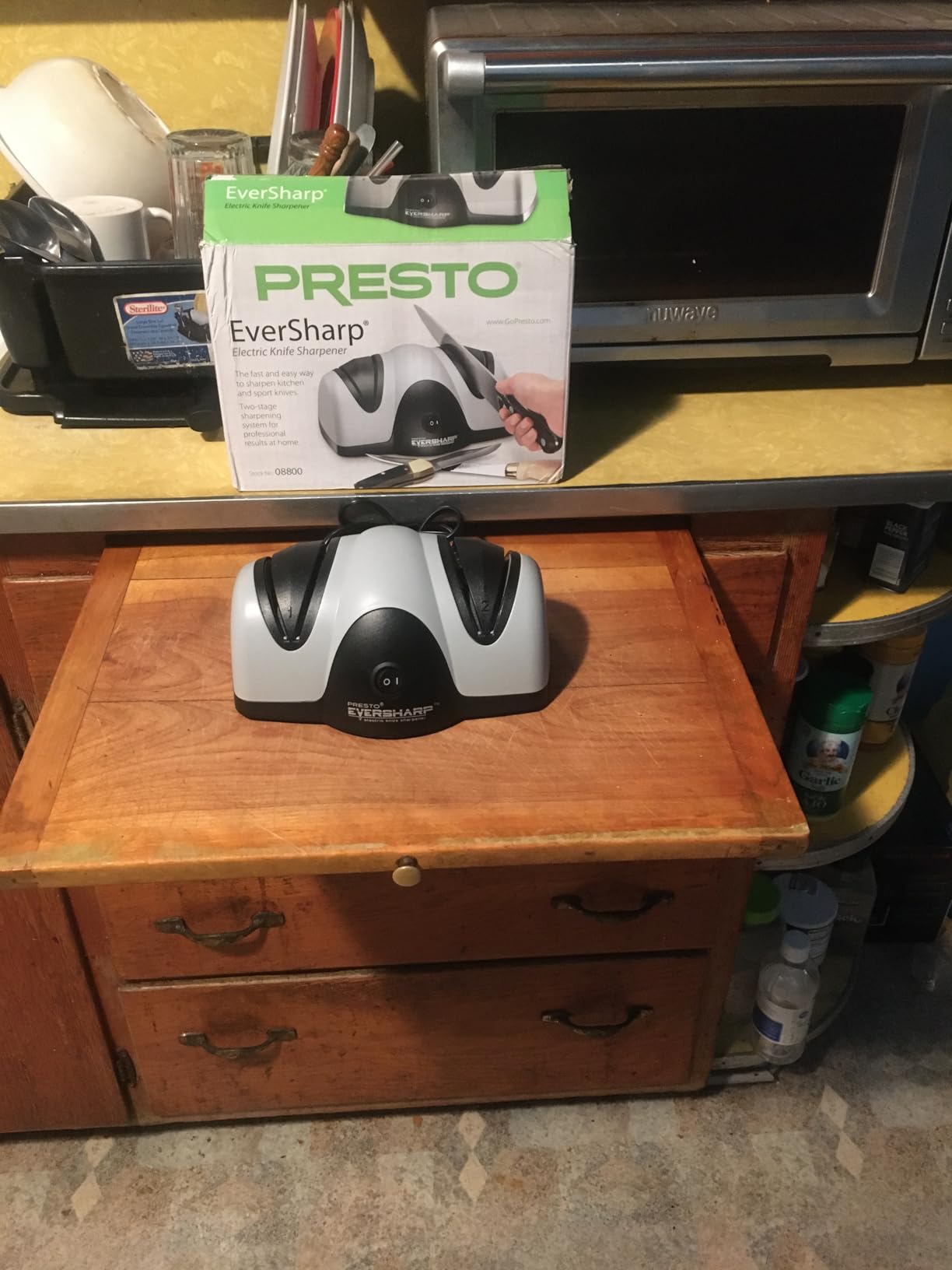
The precision blade guides do the part that usually trips people up. You slide the knife in until it touches, and the housing holds it at the correct angle without any wrist judgement at all. There is no learning curve, no water, no compound and nothing to keep clean beyond the two slots.
Owners report years of service from these units, and with 18k reviews behind a 4.5 average this is by far the most proven system in the test group. It ranks at number 43 in Knife Sharpeners on Amazon, which reflects how long it has been selling.
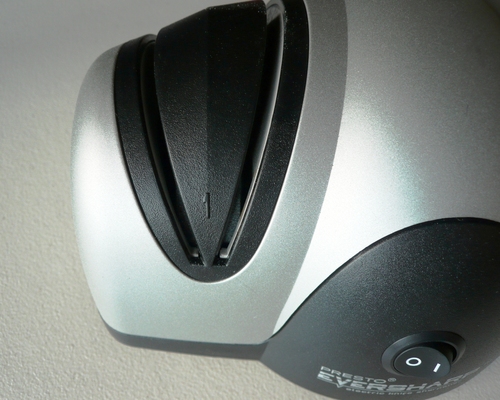
Who the Presto EverSharp suits
Busy home cooks who sharpen a full knife block rather than one knife. Anyone who will not follow a printed angle guide, and anyone who sharpens on a schedule and wants the job done in a minute rather than ten.
It also handles sport and hunting knives with straight edges, so a single unit can cover the kitchen and the tackle box.
Who should skip the Presto EverSharp
Anyone whose collection includes single-bevel Japanese knives or a fine serrated bread knife. A fixed 20-degree edge on a hard single-bevel blade can leave a wedge of untouched steel near the spine, and two-sided serrations are simply not supported.
It is also the wrong tool if you want a mirror whetstone finish. This makes a very sharp working edge, not a showpiece.
2. Lansky Deluxe 5-Stone Ceramic System – Best Value
Lansky Deluxe Knife Sharpening System: 5-Stone Ceramic Knife Sharpener Kit with Honing Oil – LKCLX
5 ceramic and alumina stones
Extra-coarse to extra-fine
1.1 lb kit with case
Pros
- Complete five-stone progression
- Clamp holds a consistent angle
- Honing oil and molded case included
- Finger-grooved stone holders
- Large installed base of owners
Cons
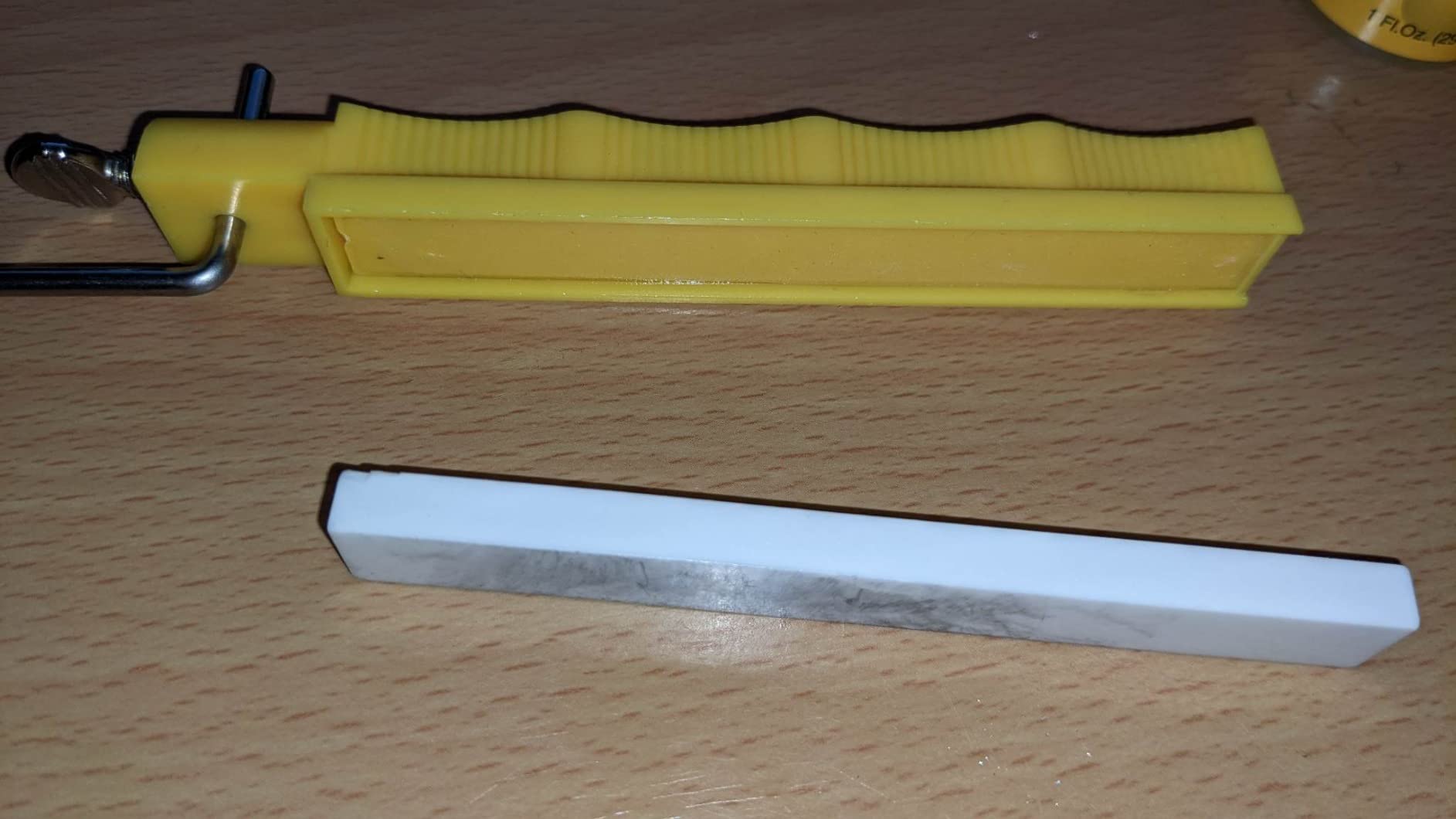
- Aging honing oil loosens stones in holders
- Slower than electric for quick touch-ups
- Clamp angle is fixed
- Needs a flat surface to work on
This kit is the answer to the question we get most often: is a fixed-angle system worth buying at all, or should you just learn whetstones? For a first sharpening setup, it is a clean yes. You get the full progression in one box without deciding which stones to buy.
Five color-coded stones run from extra-coarse through coarse, medium and fine alumina to an extra-fine ceramic hone. Each sits in a finger-grooved safety holder, so you swap grits without touching the abrasive itself. The clamp holds the knife at one set angle and the stone moves across the edge.
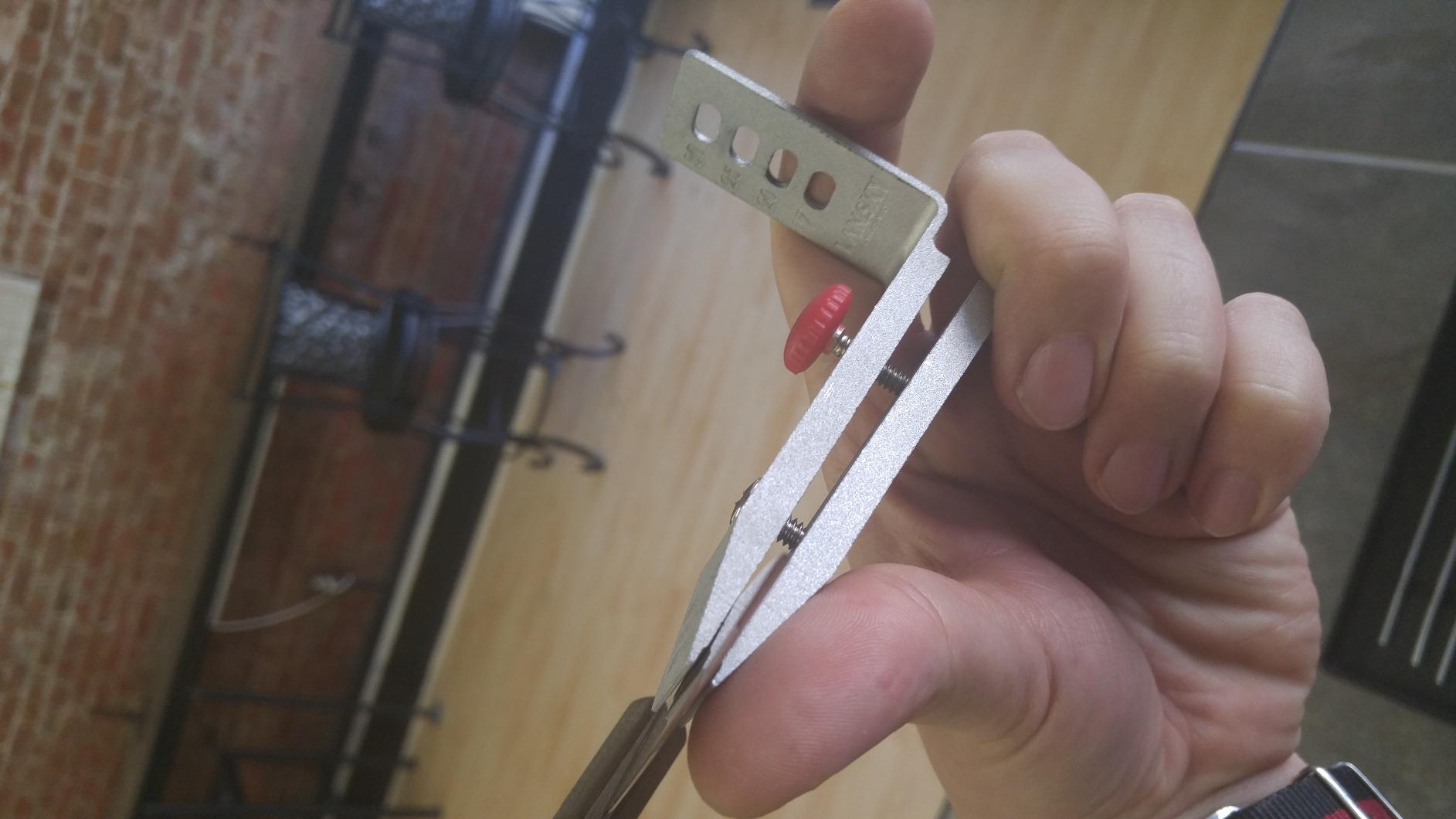
At 1.1 pounds with a molded carrying case, it moves between the kitchen counter and a camp table without ceremony. Owners consistently single out completeness and portability as the strengths, and the kit has been sold at volume for years, which means replacement stones are easy to find.
Where it costs you is speed. Restoring a badly chipped edge means real time on the extra-coarse stone, and every stroke is manual. If your priority is thirty seconds per knife, look at the electric units further down this list.
Who the Lansky Deluxe suits
First-time buyers who want a complete, portable system with no add-on purchases. Campers, hikers and anyone who needs a full sharpening kit in a bag, since the case holds the clamp, stones and oil together.
It is also a fair choice for garden and hobby knives that see occasional use rather than weekly sharpening.
Who should skip the Lansky Deluxe
People who want fine angle control. The clamp fixes the angle for you, and there is no adjustment mechanism to chase a specific number per side. Serious single-bevel or reprofiling work needs a system where you set and verify the angle yourself.
The included honing oil ages. Owners who leave the kit unused for months report it deteriorating enough to loosen the stones inside their plastic holders, so replace the bottle rather than fight it.
3. Work Sharp MK2 Electric Knife Sharpener – Top Rated Powered Unit
Work Sharp MK2 Electric Knife Sharpener – Adjustable 2-Speed Knife Sharpening System for Kitchen Knives, Pocket Knives, Scissors, Axes & Garden Tools
Two-speed motor
Flexible abrasive belts
Edge guide to the tip
3-year warranty
Pros
- Handles axes scissors mower blades and garden tools
- Two speeds for heavy grinding
- Belts conform to any edge
- Edge guide supports the tip
- 4.7 average across 8k reviews
Cons
- Fixed-angle belts rather than adjustable
- Belts are consumables
- Limits mirror finishes
No other powered unit in this test touched as many things. Beyond kitchen and pocket knives, it sharpened a pair of kitchen shears, a hatchet and a mower blade during our run, which is a wider brief than anything a knife sharpener is normally sold on.
The flexible belt is the design point. Rather than a rigid wheel touching one small spot, the belt wraps slightly to follow the profile of whatever is inside it, so the contact patch stays consistent from heel to tip. The edge guide supports the blade the whole way along, which is where many cheaper electric units drop the tip and leave it duller than the heel.
The two-speed motor matters more than it sounds. Low speed is a controlled finishing pass; high speed removes material quickly, and that is what you want on a mower blade or an axe that has been left in a shed. At 1.12 ounces it also packs flatter than most electric units, which makes it a candidate for a small bag despite being mains powered.
Its 4.7 average across more than 8k reviews is the highest rating in the group. The recurring complaint is narrow: the angle is fixed, and the belts need replacing periodically.
Who the Work Sharp MK2 suits
Households with a mixed tool inventory. Gardeners, campers and anyone who wants one powered box for knives, shears, chisels and outdoor tools instead of three separate devices.
It suits users who will not chase mirror finishes and would rather have a working edge in under a minute every few weeks.
Who should skip the Work Sharp MK2
Collectors and single-bevel knife owners. A fixed belt angle is wrong for a Japanese gyuto, and powered abrasives are not the way to establish a proper single-bevel secondary edge.
Anyone far from mains power should also note this is a corded unit. The consumable belts are a real ongoing cost, and the belts wear faster on hardened tool steel than they do on kitchen knives.
4. Work Sharp Precision Adjust Elite – Best Guided System For Beginners
Work Sharp Precision Adjust Elite Knife Sharpener – Fixed Angle Sharpening System for Kitchen & Pocket Knives – Professional Guided Knife Sharpening Tool
15 to 30 degree adjustment
320 and 600 grit plates
Serrated rod and strop
14 inch bench system
Pros
- Covers 15 to 30 degrees per side
- Dedicated conical rod for serrations
- Forgiving for beginners and precise for experts
- Full kit includes strop and tri-brasive attachment
- Holds full-flat grinds solid
Cons
- Knife mount flexes under heavy pressure
- Clamp spring is stiff
- Angle setting has some error
- Metal clamp can scratch finishes
When someone asks me for the best knife sharpening system for home use, this is the one I name. It is the rare guided system that is genuinely forgiving on day one and still accurate on day one hundred, which is exactly the combination beginners are promised and rarely delivered.
The guide adjusts from 15 to 30 degrees per side, which covers essentially every geometry in normal circulation: a fine 15-degree Japanese edge, a standard 20-degree Western edge, a 22-degree hunting blade and a robust 25-degree European edge for hard use. Two resin-bonded diamond plates at 320 and 600 grit handle stock removal and refinement, and the plate height is tall enough to hold a full-flat-grind blade centred without fuss.
The kit is unusually complete. A conical ceramic rod handles serrations properly rather than pretending a flat plate will do, a tri-brasive attachment covers curved blades, and a leather strop sits on the back for the final finishing pass. Owners report edges that beat the factory original once the system is dialled in, and they repeatedly credit the manufacturer technique videos for the setup.
At 3 pounds and 14 inches long this is a bench system. It also ranks at number 14 in Knife Sharpeners, which reflects how heavily it sells.
Who the Precision Adjust Elite suits
Home cooks and EDC owners who want a real angle choice and a complete kit without buying stones separately. It is the pick if you own one European chef’s knife, one pocketknife and a serrated bread knife and want all three handled by one box.
People who plan to keep the system and add abrasives later will find the plate format accepts standard 1×6 stones.
Who should skip the Precision Adjust Elite
Anyone who pushes hard. The knife mount flexes under heavy pressure on a coarse stone, and the clamp spring is stiff enough to make blade rotation awkward. Gentle, consistent pressure is what this system wants.
The angle guide also has a small amount of error, so buy a cheap angle finder and check it. Owners also warn that the bare metal clamp can mark a polished blade finish, so mask the contact points with tape.
5. Chef’sChoice 15XV EdgeSelect – Best Electric For Straight And Serrated Knives
Chef’sChoice 15XV EdgeSelect Professional Electric Knife Sharpener with 100-Percent Diamond Abrasives and Precision Angle Guides for Straight Edge and Serrated Knives, 3-Stage, Gray
3-stage diamond system
Converts to 15 degree edges
Straight and serrated
3-year warranty
Pros
- Turns 20 degree factory edges into 15 degree edges
- Three stages plus a flexible abrasive strop
- Spring guides handle the angle for you
- Sharpens serrated and bread knives
- About 1 minute to sharpen
Cons
- First-time users under-sharpen by skipping stage 1
- 15 degrees is aggressive for heavy chopping
- Large countertop footprint
- Sharpens knives only
This is the electric unit to buy if your household actually cooks. It is fast, quiet, and the flexible spring guides do the angle work so consistently that it beats careful manual stone work for most home kitchens.
The three stages are two diamond abrasive steps plus a patented flexible abrasive stropping stage. The diamond steps build the bevel and the flexible stage polishes it, which is why the result feels less toothy than a two-stage wheel leaves behind. Long-term owners describe it as one of the best kitchen purchases they have made.
With 14k reviews at 4.6 it is the second most proven system here. Resharpening takes about ten seconds; a full sharpening from scratch is around a minute, so a household block is a short job rather than an evening.
The one thing to understand before you buy is that it converts every knife to a 15-degree edge. That is superb for slicing and general prep, and a poor choice for a knife that takes heavy bone-in or frozen work, where a more durable angle would be kinder to the blade.
Who the Chef’sChoice 15XV suits
Home cooks who want one button-press answer for a mixed knife block, including serrated bread and steak knives. Anyone who will use it weekly but does not want a sharpening session as a chore.
It suits beginners best of all the electric units, because the spring guides remove the one judgement call that usually goes wrong.
Who should skip the Chef’sChoice 15XV
Owners of thick-bevel or heavy chopping knives that would rather keep a 20-degree edge. It also only sharpens knives, so shears, chisels and outdoor tools need another device.
Expect a learning moment on the very first knife. Owners who do not run stage 1 long enough to raise a burr come away under-sharpened, and then blame the machine. Read the manual, form a burr, move on.
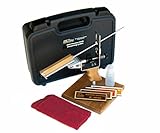
6. KME Precision Knife Sharpener System – Best For Angle Precision
KME Precision Knife Sharpener System with 4 Gold Series Diamond Hones – Base Included
17 to 30 degrees
4 diamond hones
140 to 1500 grit
Spherical bearing rod
Pros
- Angle adjusts in one-degree increments
- Spherical bearing guide removes wobble
- Full grit range in one case
- Diamond hones cut fast and last
- Everything stores in the hard case
Cons
- Costs more than stone kits at the same grits
- Diamond plates go out of flat over years
- Steep learning curve on hard steels
Angle consistency is the reason this system exists, and it is the one place in our test where the guide visibly refuses to wobble. The rod runs on a spherical bearing, so the angle it holds stays the same from the first stroke to the last without drifting as your hand tires.
That matters most on blades with a pronounced curve, on recurves where the bevel has to follow the sweep, and on anything you intend to reprofile. An angle that wanders by a degree or two along the edge is invisible on a chef’s knife and obvious on a tanto transition or a long single-bevel gyuto.
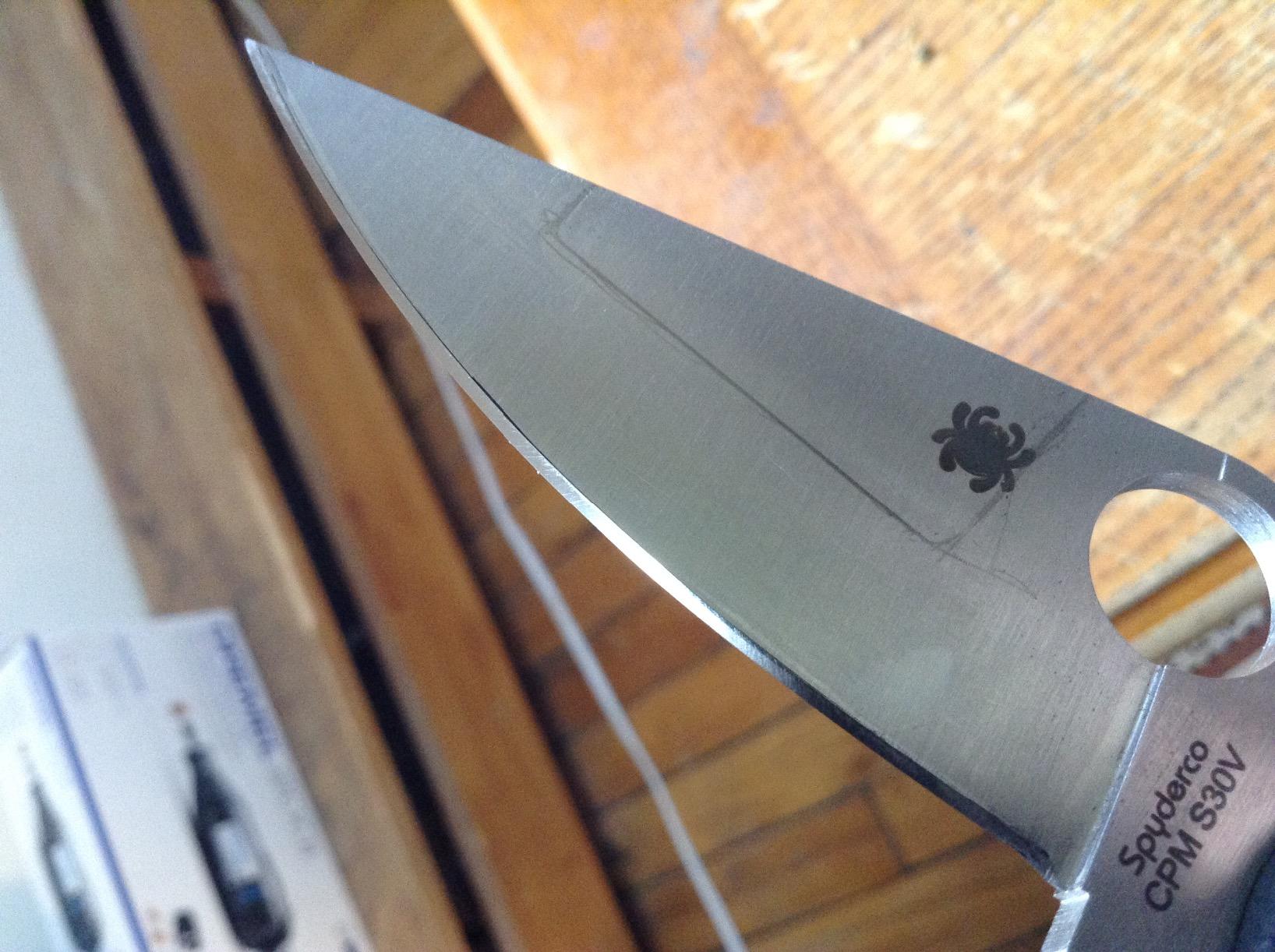
Four Gold Series diamond hones at 140 extra-coarse, 300 coarse, 600 fine and 1500 extra fine cover the whole progression. Angle adjustment is continuous from 17 to 30 degrees in one-degree increments, which is finer control than any other kit in this roundup. The whole thing stores in a hard carry case, and at 12 ounces it moves.
With 693 reviews at a 4.7 average it is well liked, but the installed base is far smaller than the mass-market kits, so buyer comments tend to be specific rather than enthusiastic. The most common notes praise the smooth motion and the exacting control.
Who the KME Precision system suits
Users who already know what angle they want and want to hit it exactly. Owners of single-bevel Japanese knives, recurves, tanto-bladed folders and any blade that needs reprofiling from a factory 20-degree edge down to something finer.
It is a strong second system for someone who has outgrown a basic kit and wants a bigger grit range in one case.
Who should skip the KME Precision system
Complete beginners. Marked one-degree increments look like control but demand practice, and owners report a real learning curve before the edges come out consistent.
Budget buyers should know diamond plates cost more than the same grits in ceramic. The plates also lose flatness over years and eventually need lapping, which is a maintenance step ceramic hones do not require.
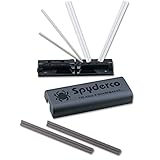
7. Spyderco Tri-Angle Premium Sharpmaker Set – Most Versatile Across Blade Sizes
Spyderco Tri-Angle Premium Sharpmaker Set with DVD and Two Sets of Alumina Ceramic Stones – 204MF OPEN BOX
Guided angle tracks
2 sets of ceramic stones
1 inch to 12 inch blades
Plastic body
Pros
- Handles 1 inch carving knives through 12 inch blades
- Ceramic stones cut fast dry
- Very little steel removed
- Works on tools as well as knives
- Instructional DVD included
Cons
- All-plastic body feels light
- Learning curve to keep the blade vertical
- Slow for quick touch-ups
- Badly damaged edges need coarse work first
The question forums keep asking is whether a guided system handles a small pocketknife and a long fillet blade equally well. The Tri-Angle is the clearest answer in this group, because the two parallel tracks accept an enormous range of blade lengths without the clamp swallowing short ones.
Hobbyist woodcarvers and long-term owners single it out for exactly that range. Users report working from 1 inch carving knives up to 12 inch blades on the same system, and the guided tracks take the angle guesswork out of freehand stone work, which is where most beginners quit.
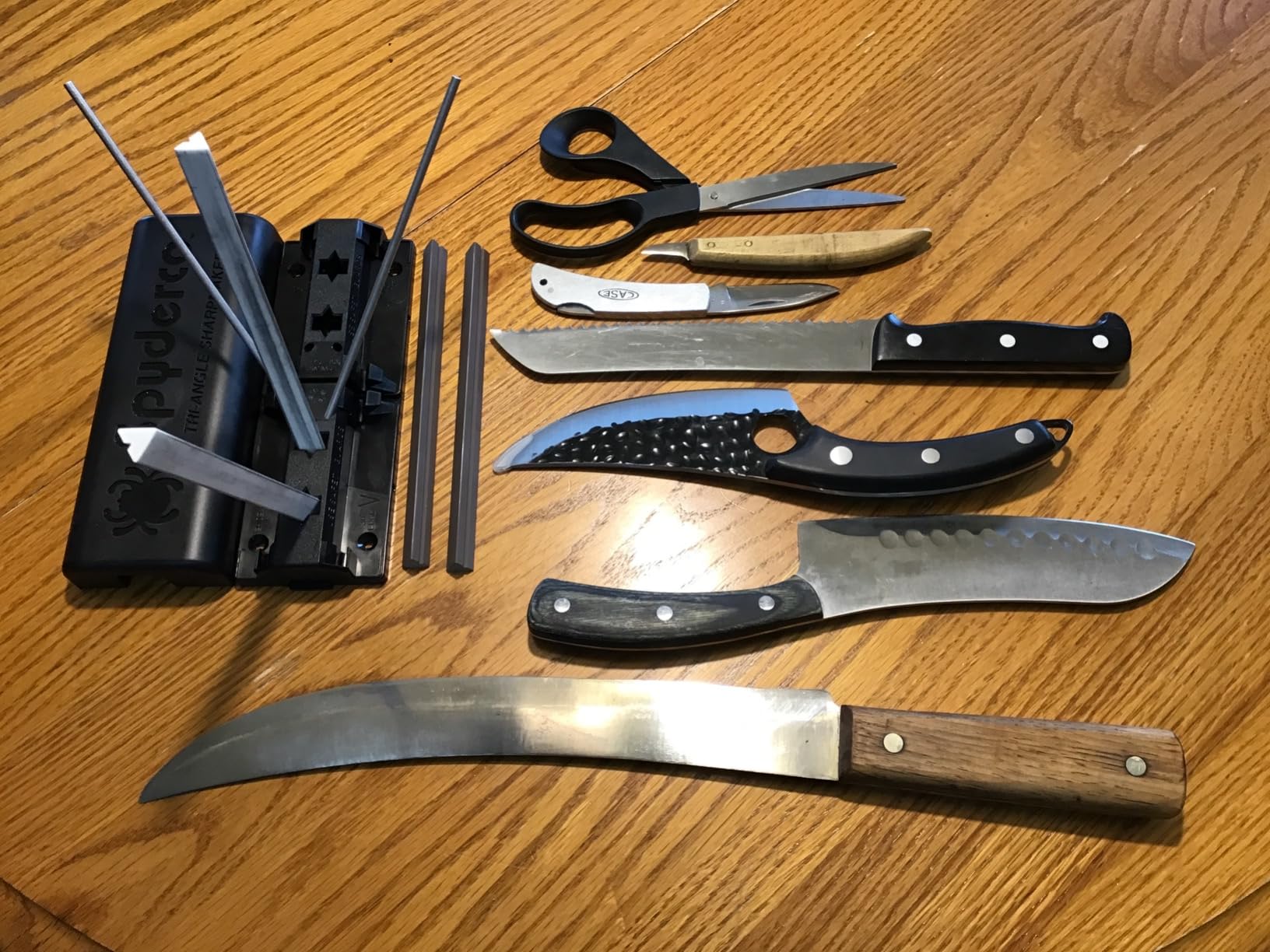
Two sets of alumina ceramic stones are included. Ceramic cuts quickly and needs no water or oil, so there is no bowl, no slurry and nothing to clean up afterwards. Compared with an electric sharpener the steel removed is minimal, which means the blade keeps more of its factory geometry over years of use.
The 4.7 average across 1020 reviews reflects long-term owners rather than impulse buyers. That is the credential that matters most in a category where a first impression tells you very little.
Who the Spyderco Tri-Angle suits
People with a mixed collection: pocketknives, a fillet knife, a bread knife, carving tools and chisels. It is also a good second system for woodworkers who already own our guide to the best sharpening systems for woodworking tools.
Anyone who wants minimal steel removal and a dry, mess-free process will like the ceramic stones.
Who should skip the Spyderco Tri-Angle
Impatient users. This is a maintenance tool, not a touch-up tool, and restoring a badly damaged edge means a long extra-coarse session first. It is also not the fastest way to make one knife sharp right now.
People who dislike plastic will want to know up front that the body is all plastic and feels lighter than the price suggests. The instructional DVD is also dated compared with the manufacturer videos available today.
8. DMT Deluxe Diamond Professional Kit – Best Bench Stone Set
DMT Deluxe Diamond Professional Knife Sharpening Kit – Includes Set of 3 Diamond Whetstone Blocks for Kitchen Knives, Lawn Mower Blades, Hunting/Butchery Tools, and More – Comes in Natural Wood Box
325, 600 and 1200 grit
6 inch diamond plates
No soaking needed
Oiled wood box
Pros
- Color-coded three-stage progression
- No water and almost no mess
- Cuts far faster than comparable water stones
- Large 6 inch surface
- Kept organised in an oiled wood box
Cons
- Grit numbers are not printed on the stones
- Wood box lid has no latch
- Plates can deform under heavy pressure
- 325 grit is not coarse enough for bad damage
These are bench stones, not a guided system, and that is the trade. You control the angle yourself with a steady hand and a consistent stroke, which is more work and more reward. Experienced sharpeners report that the set matched or beat their Japanese water stones on kitchen knives.
The abrasive is micronized monocrystalline diamond, laminated to a rigid plate. It needs no soaking, produces very little slurry compared with a water stone, and cuts roughly three times faster than a water stone of comparable grit. That speed is the whole argument: the usual reason to avoid diamond is slowness, and DMT plates largely remove that objection.
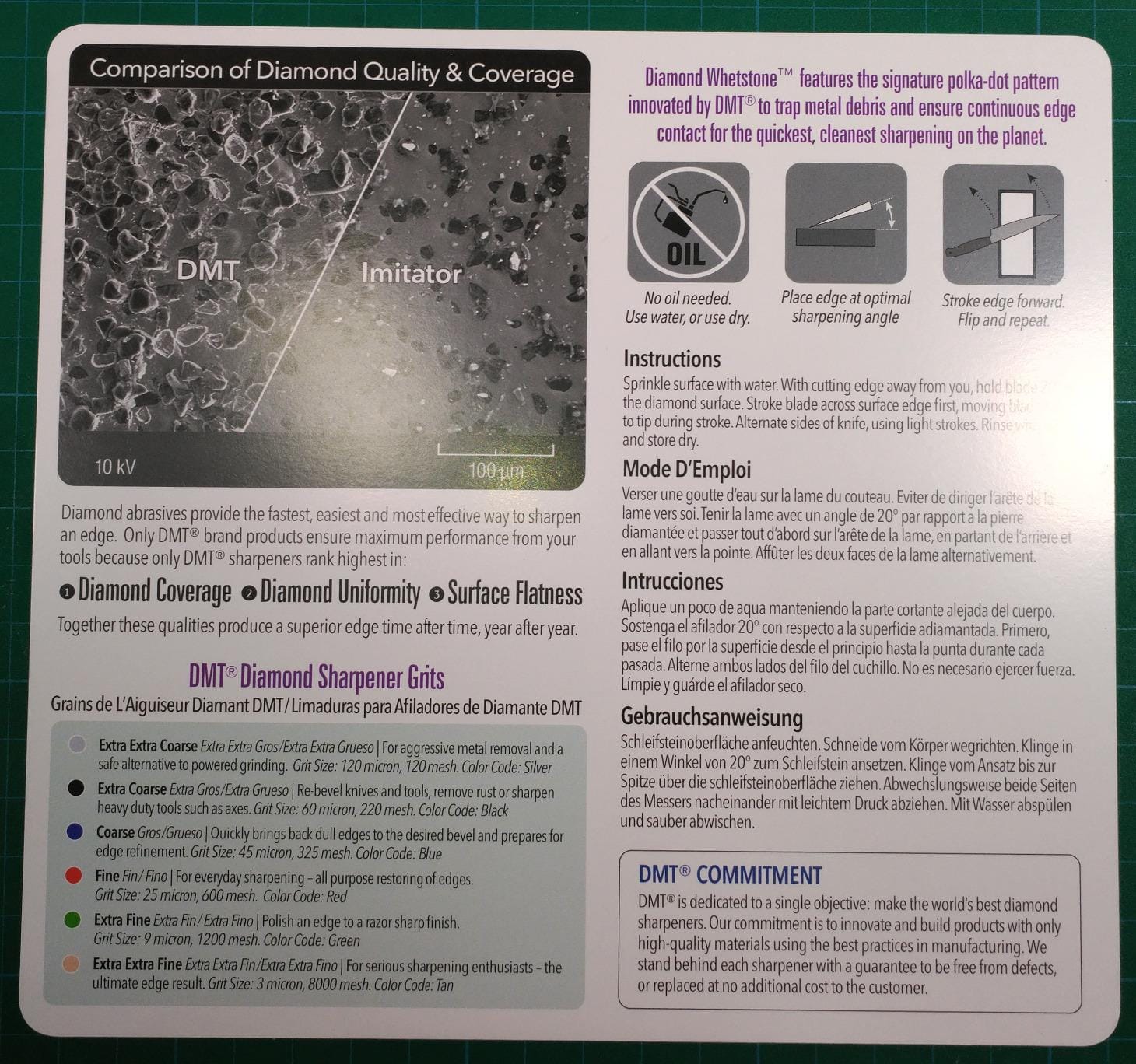
Three color-coded stones cover the useful range: blue at 325 mesh, red at 600 mesh and green at 1200 mesh. They establish and refine a 20 degree bevel, the standard starting point for most Western edges. The 6 inch surface gives a longer, more comfortable stroke than a small plate, and the oiled wood box keeps them organised and grippable.
It is made in the USA from a process the company has run for over 50 years, and buyers consistently describe it as fast, clean and low-maintenance.
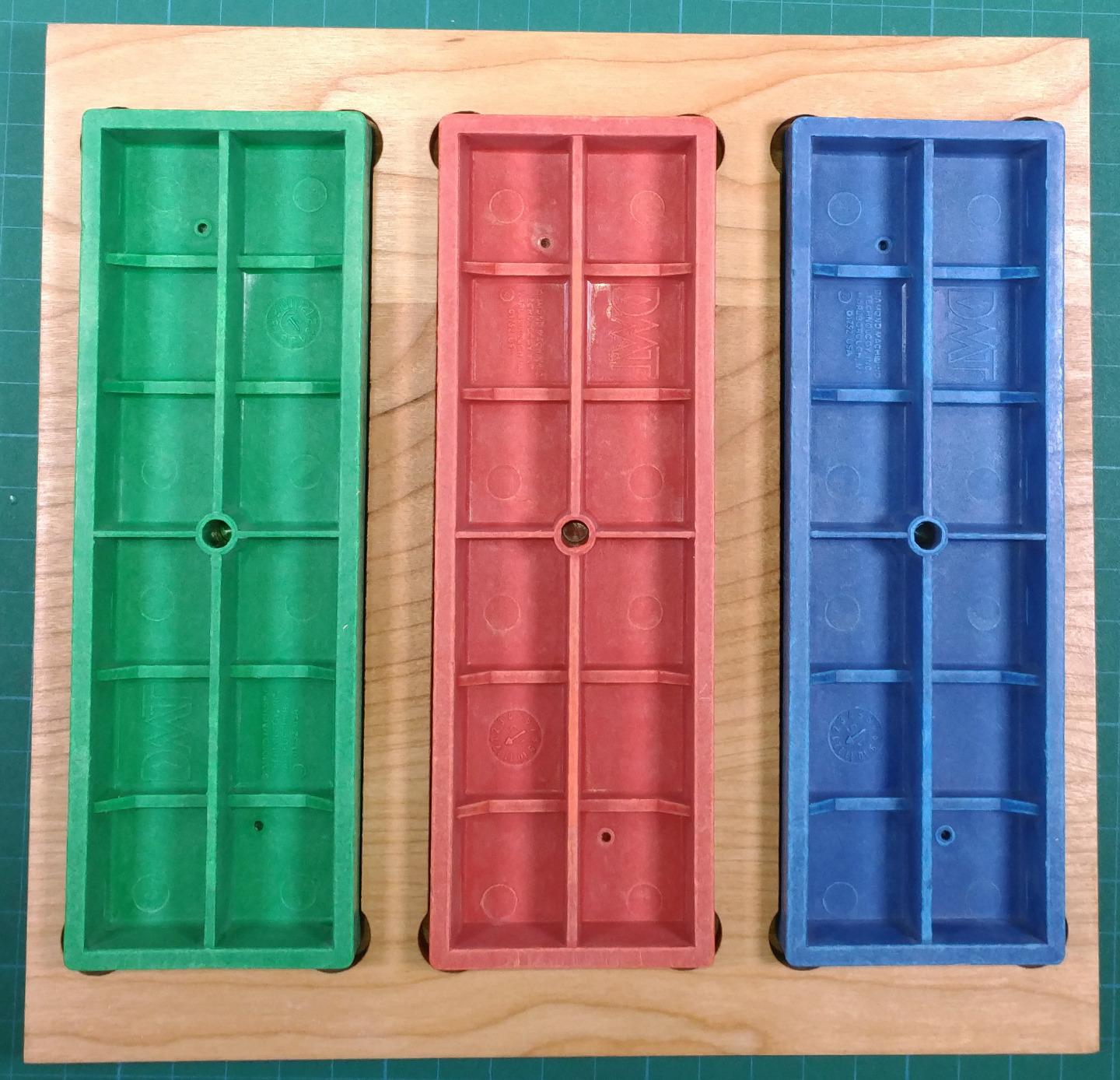
Who the DMT Deluxe kit suits
Users who already have a steady hand and want to learn freehand sharpening without the water bowl. People who sharpen outdoors, where a dry diamond plate is far more practical than a water stone.
It pairs well with a guided system: use the guided kit for a fast reset and the DMT plates for a proper full progression when you have the time.
Who should skip the DMT Deluxe kit
Anyone who cannot yet hold a consistent angle. Without a guide, a 20 degree bevel that wanders is worse than a guided system that is merely adequate. A cheap angle finder helps, but it does not teach the stroke.
Two practical gripes: the grit numbers are not printed on the stones themselves, so check the paper insert, and the wood box lid has no latch and slides off. The plates are also laminated to hollow plastic backs, so heavy downward pressure can deform them.
9. WEN BG4270T Wet and Dry Sharpening System – Best For Chisels And Planes
WEN BG4270T 10-Inch Two-Direction Water Cooled Wet/Dry Sharpening System
10 inch 220 grit stone
8 inch leather strop
115 RPM
Reversible rotation
Pros
- Water cooling prevents burned edges
- Reversible direction suits either hand
- 115 RPM is precise on flat blades
- Works with Tormek-style jigs
- Heavy stable base
Cons
- Accessory bar is low quality and goes out of parallel
- Bar is too short for full stone use
- Included chisel jig is awkward to use
- Motor can stall on heavy work
- Leather wheel is average quality
This is a wet grinder, and the category serves a different job from everything else on this list. A guided knife system shapes an edge. A wet grinder removes metal slowly and cold while the wheel spins against the tool, which is how a chisel or a plane iron gets truly flat and square.
The water cooling is the important part. A 10 inch 220 grit stone running at 115 RPM with water flowing over it will not heat a hardened edge the way a dry powered wheel can, and burn marks on a hard steel blade are effectively permanent. The flip switch reverses the wheel so the same machine suits a right-handed or left-handed user.
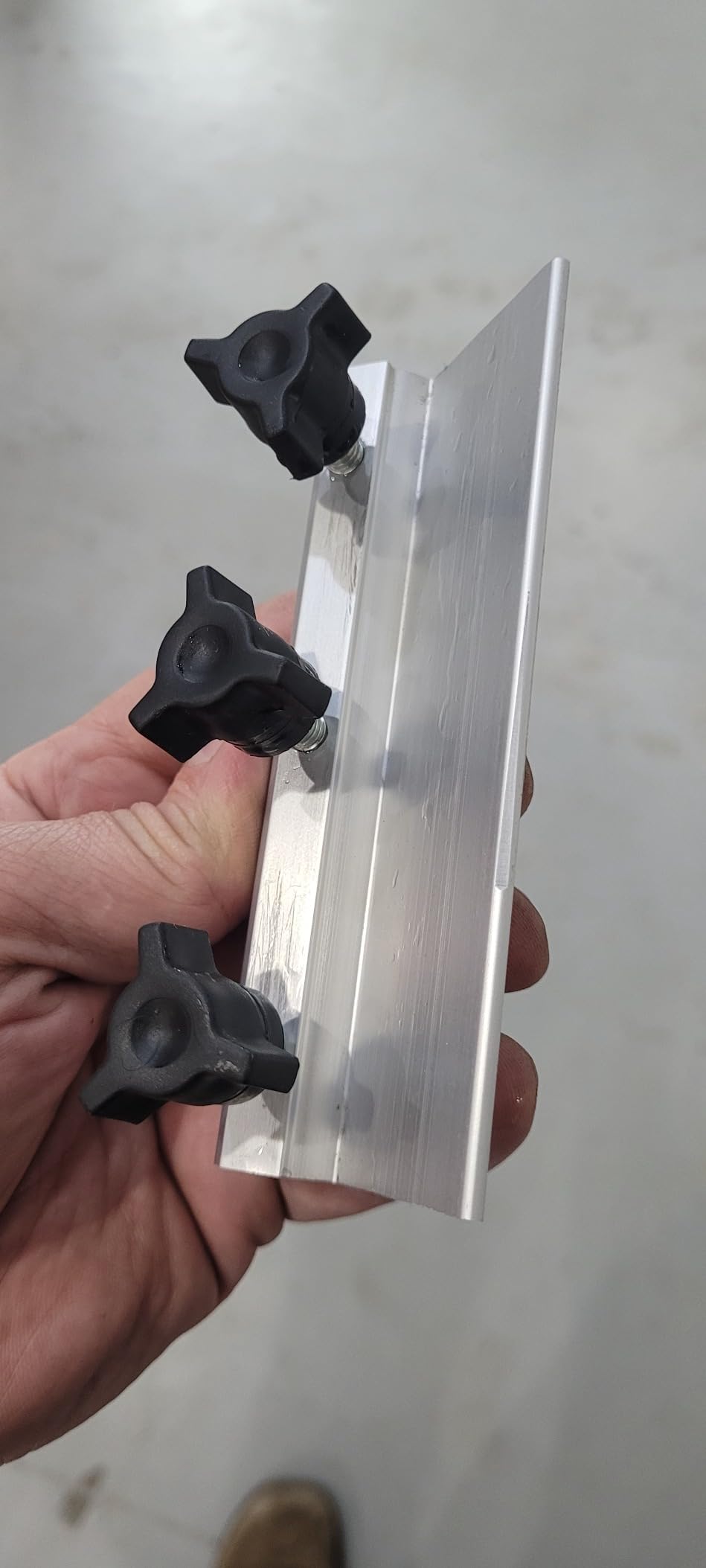
It accepts Tormek-style jigs and accessories, so you are not locked into a single brand ecosystem and can expand cheaply. Buyers focused on value consistently describe it as delivering Tormek-like results at a fraction of the cost, and the 4.4 average across 801 reviews reflects a satisfied group with one loud shared complaint.
At 35.5 pounds with a 16.5 inch height, this is a floor-standing machine, not a countertop device. It will not fit in a small kitchen.
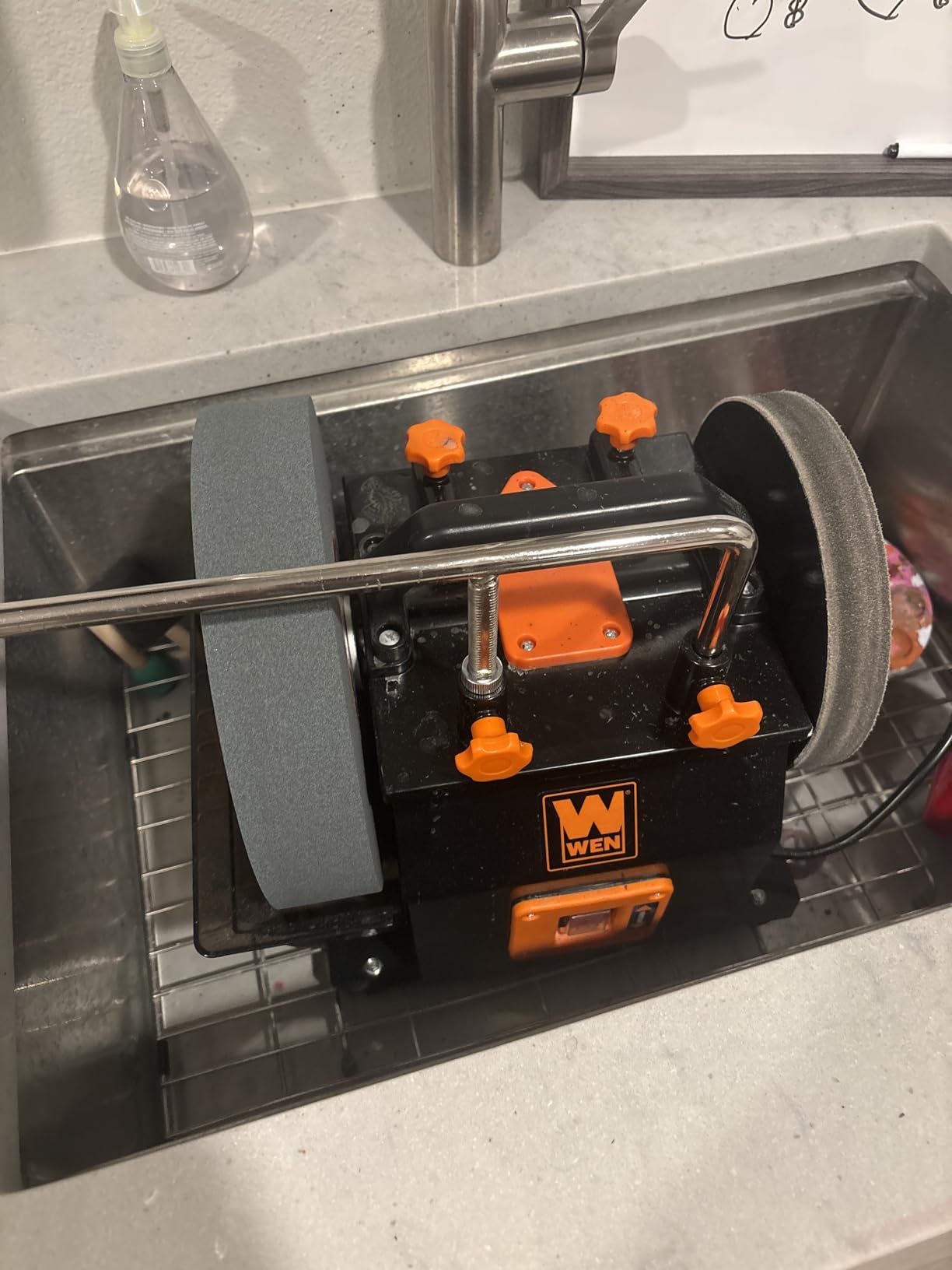
Who the WEN BG4270T suits
Woodworkers sharpening plane irons, chisels and block planes, and knife owners with a hard steel blade they want to treat gently. It is also the practical choice for anyone who wants to expand into Tormek-style accessories without buying a Tormek machine.
The reversible wheel makes it workable for either dominant hand, which is unusual at this level.
Who should skip the WEN BG4270T
Anyone sharpening only kitchen knives. It is 35.5 pounds, needs a water reservoir and bench space, and takes far longer per knife than a guided manual system. The honest reason to buy one is flat bevels on hand tools, not knife edges.
The accessory bar is the known weak point. It has play, can drift out of parallel when tightened and is too short for the full stone face, which is what produces non-square edges on flat blades. The included chisel jig is also awkward on standard-length chisels. If your sharpening depends entirely on a perfect square back, budget for a better jig.
10. HORL 2 Walnut Rolling Sharpener – Best For Learning Without Stones
HORL 2 Walnut Rolling Knife Sharpener – Kitchen Knife Sharpener for Razor Sharp Edges Made in Germany – Easy Knife Sharpening Kit – Roller with Magnetic Holder with 15 & 20 Degrees
Magnetic 15 and 20 degree holder
Diamond and ceramic discs
Ball-bearing roller
Walnut body
Pros
- No whetstone technique required
- Magnetic holder switches between two angles
- Works on any steel hardness
- Ball-bearing roller is smooth and play-free
- Compact walnut body suits a countertop
Cons
- Only two angle options
- No serrated blade capability
- Small disc limits metal removal
- Comparatively fine diamond disc
The rolling sharpener answers a different question from every other system here. Not how sharp can you get, but how quickly can somebody who owns no sharpening equipment get a good edge at all. You set the angle on a magnetic holder, roll the blade along a disc, and the ball-bearing roller does the geometry for you.
The magnetic holder offers fixed 15 and 20 degree positions. Twenty degrees gives a robust everyday kitchen edge; 15 gives a finer edge suited to sushi and sashimi work and to high-carbon blades. Owners like being able to swap between the two without relearning anything.
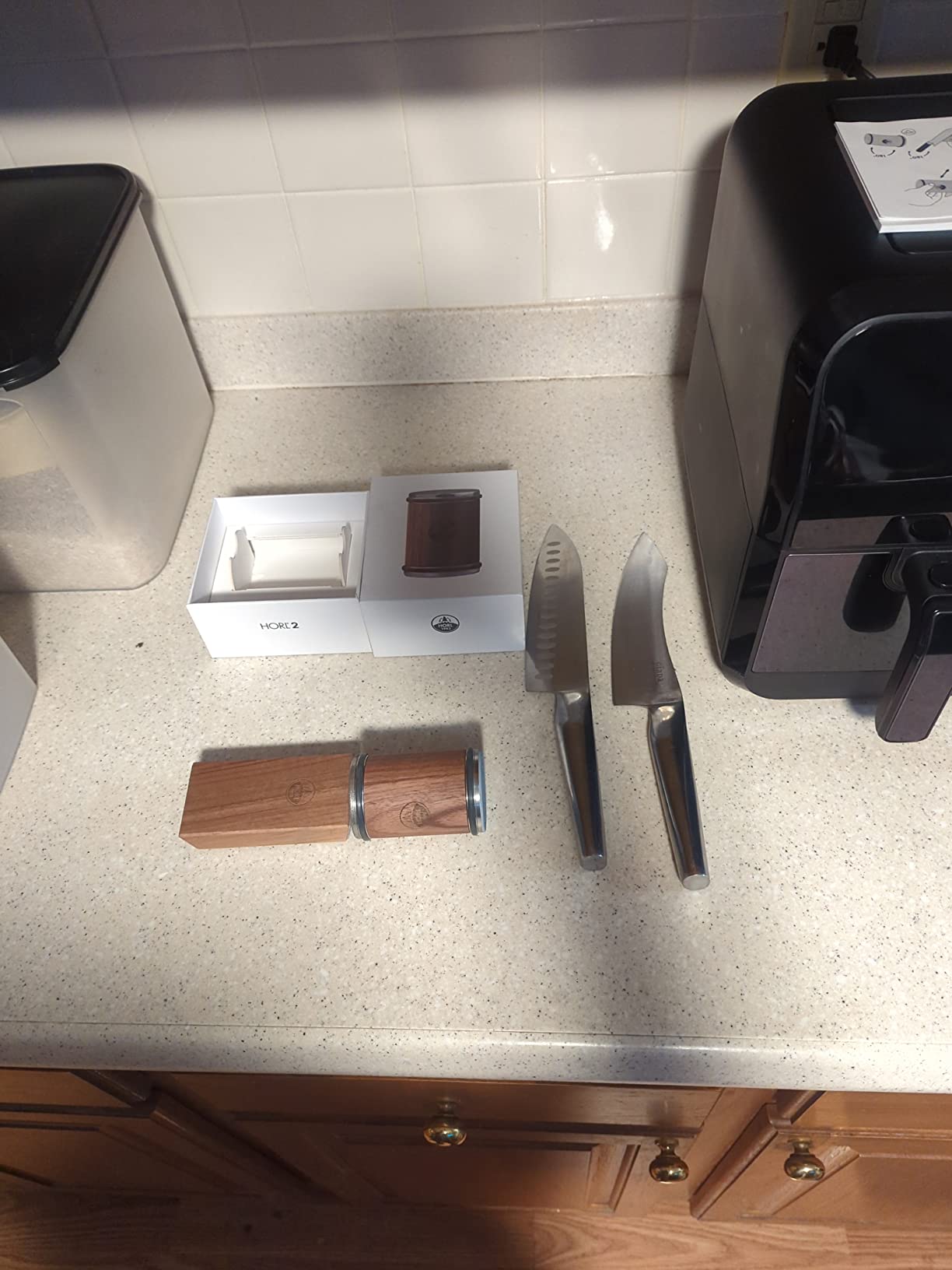
Two discs come with it: a professional-grade diamond disc for grinding and a ceramic disc for honing. Between them they handle anything from stainless to carbon steel. The body is kiln-dried walnut with precision ball bearings, handcrafted in the Black Forest, and at 5.31 inches it stays out of the way on a counter.
With 4432 reviews at 4.4 it has a large, satisfied installed base. The most common criticism is that two fixed angles is not many, and that the diamond disc is comparable to roughly a 500 grit whetstone, so heavy repair is slow.
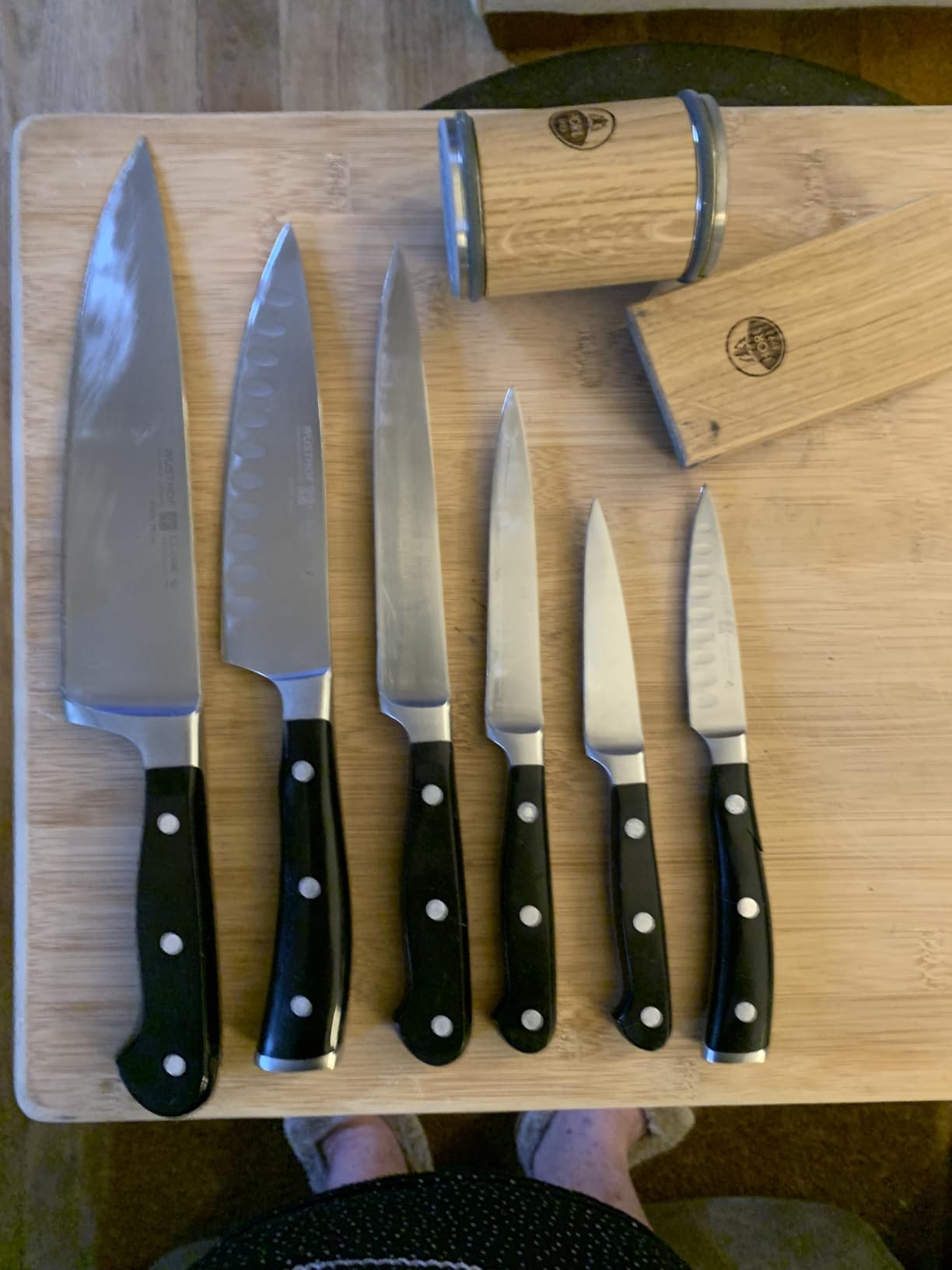
Who the HORL 2 Walnut suits
New cooks who want a sharp knife in the first week of ownership rather than the first month. Anyone who will not use a stone, a bowl of water or a guide rod, and wants something that looks good enough to leave on the counter.
It is also a good travel companion for a kitchen knife, since the whole unit is compact and needs no power or water.
Who should skip the HORL 2 Walnut
Anyone with a serrated blade in the rotation, because the fixed disc has no serrated capability. It is also a poor choice for repairing real edge damage: the disc is fine and the contact area is small, so a badly chipped blade will take a very long time.
If you need 25 or 30 degree edges for heavy chopping, the two-position holder does not reach them, and you would be better served by an adjustable guided system.
11. TUMBLER Rolling Knife Sharpener – Best For Compact Storage And Everyday Edges
The Original Tumbler Rolling Knife Sharpener™ (Wood)
Fixed 15 and 20 degree angles
Diamond-plated disc
Steel helix hone
Stainless steel body
Pros
- Roll-and-sharpen with no whetstone skill
- Preserves more blade life than a pull-through unit
- Helix disc refines for cleaner cuts
- Handles kitchen field and utility blades
- No water and no mess
Cons
- Only two fixed angles
- No serrated blade capability
- Diamond disc is fine rather than coarse
- Less predictable on very dull blades
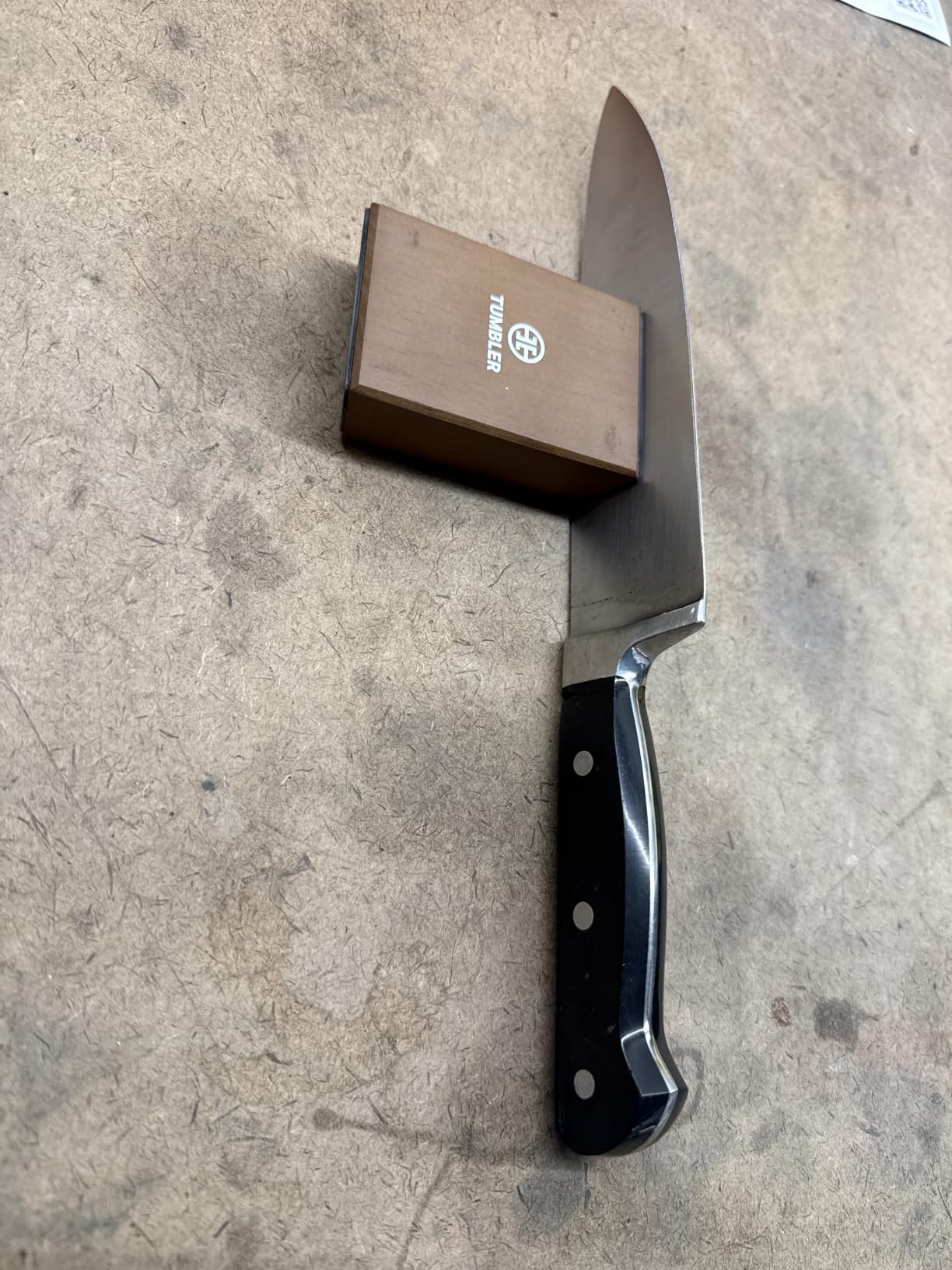
Same idea as the rolling sharpener above, different build. Where the German unit uses a wooden body, this one runs a stainless steel helix honing disc against a diamond-plated sharpening disc inside a magnetic angle holder, and reviewers consistently point out the ergonomic hand position makes a long stroke comfortable.
The case for it over a basic pull-through sharpener is blade life. A pull-through device scrapes a hard abrasive across a fixed slot, which removes more steel than you need and dulls the blade over time. A diamond disc guided by a magnetic holder takes a controlled line instead, so the edge survives more cycles.
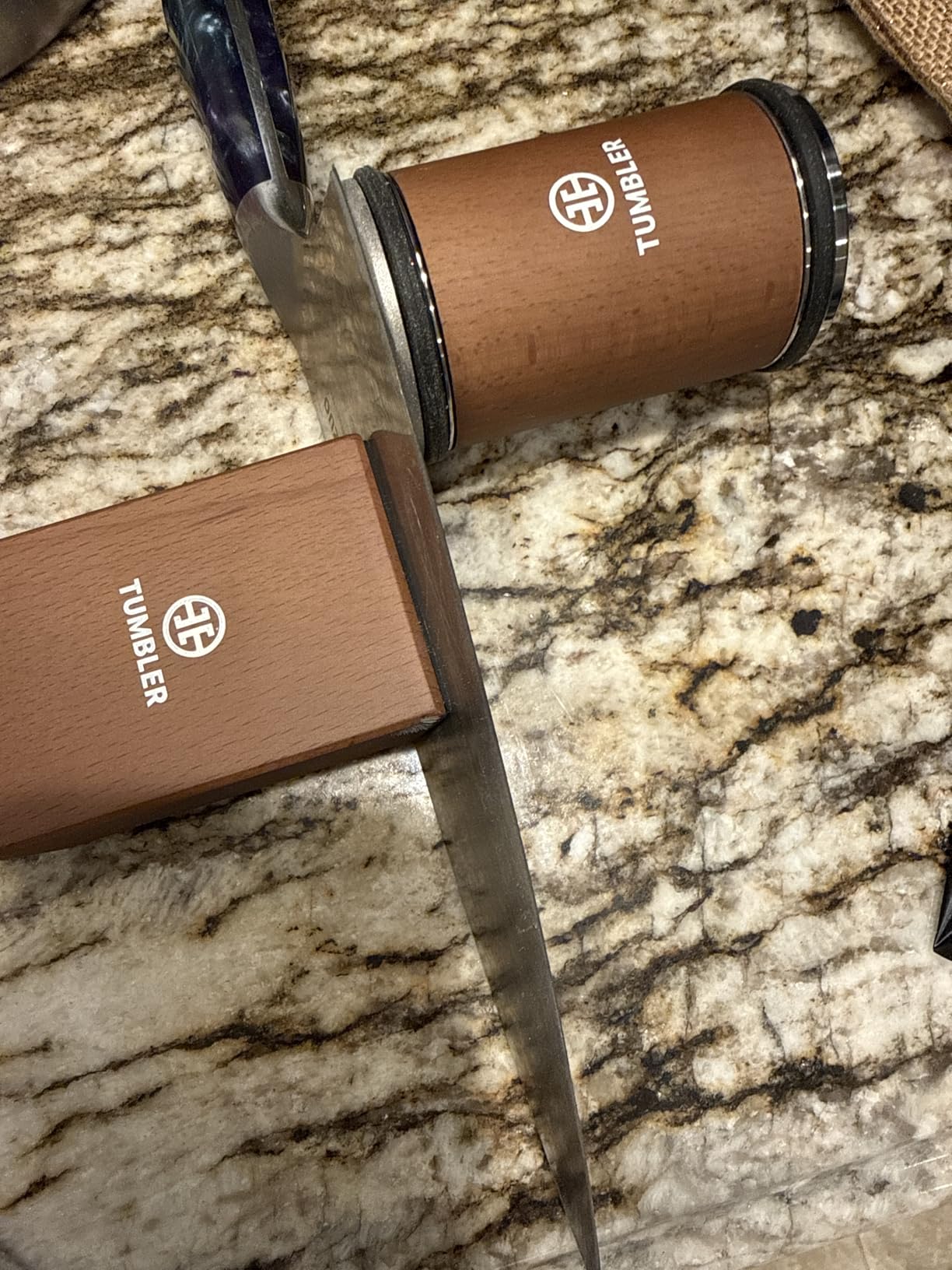
It covers kitchen, chef, field and utility blades at fixed 15 and 20 degree angles, with no water, no slurry and nothing to clean. The diamond disc is comparable to a 500 grit whetstone, so it restores a working edge quickly rather than reshaping a damaged one.
With 3371 reviews at 4.4 it draws steady praise for the simple roll-and-sharpen workflow. The consistent criticism is that a severely dull blade is a poor match, because the disc is fine and does not remove material quickly.
Who the TUMBLER suits
Home cooks who maintain a small set of kitchen knives plus a pocketknife and want a two-minute routine with no cleanup. Anyone who has previously used a pull-through sharpener and noticed their blades losing their factory edge.
It also works as a light carry option for a field or utility blade, since it needs no power or water.
Who should skip the TUMBLER
Serrated blade owners, because the fixed disc cannot handle teeth. It is also not the right tool for fixing a bent tip, a chip or an edge that has been abused for months.
Owners of thick-bevel or heavy chopping knives will find 20 degrees is the only sensible setting, and the two-position limit leaves them no room to trade edge fragility for durability.
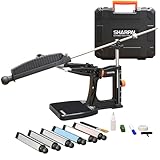
12. SHARPAL 202H Precision Sharpening System – Widest Angle Range And Most Complete Kit
SHARPAL 202H Precision Knife Sharpening System, Adjustable Angle 10–35°
10 to 35 degrees
7 piece abrasive kit
Dual sliding clamps
Rigid metal base
Pros
- Widest angle range at 10 to 35 degrees
- Distance-based setting suits any blade width
- Seven abrasive stages in one kit
- Rigid metal base and dual clamps
- Accepts universal 1x6 stone holders
Cons
- No serrated rod or gut hook
- Angle reads differently from other systems
- Shallow clamp screw heads can strip
- Flip mechanism has frozen on some
- Heavy base shifts unless clamped down
Take everything the guided category does well and stretch the boundaries. The angle range here runs from 10 to 35 degrees per side, the widest in the roundup, which covers Japanese edges at the fine end and cleaver and ax work at the coarse end without a second system.
The setting method is genuinely different. Rather than reading an angle off a scale, the distance from the edge to the clamp is fixed, so the bevel comes out the same on a narrow blade and a wide one. That compensation for blade width is the feature experienced sharpeners rate most highly, and it is what keeps both sides of a thick knife matching.
The abrasive kit is the most complete here: diamond at 220, 325, 600 and 1000 grit, whetstone at 3000 and 6000, plus a leather strop and 2 oz of green polishing compound. Experienced users report mirror polish results in five to ten minutes per knife, and several state it outperforms more expensive branded kits.
The base is rigid metal with dual sliding clamps that hold blades of any length, and the plates fit universal 1×6 holders so you can upgrade to premium stones later. A rigid carry case and three years of after-sale support round it out.
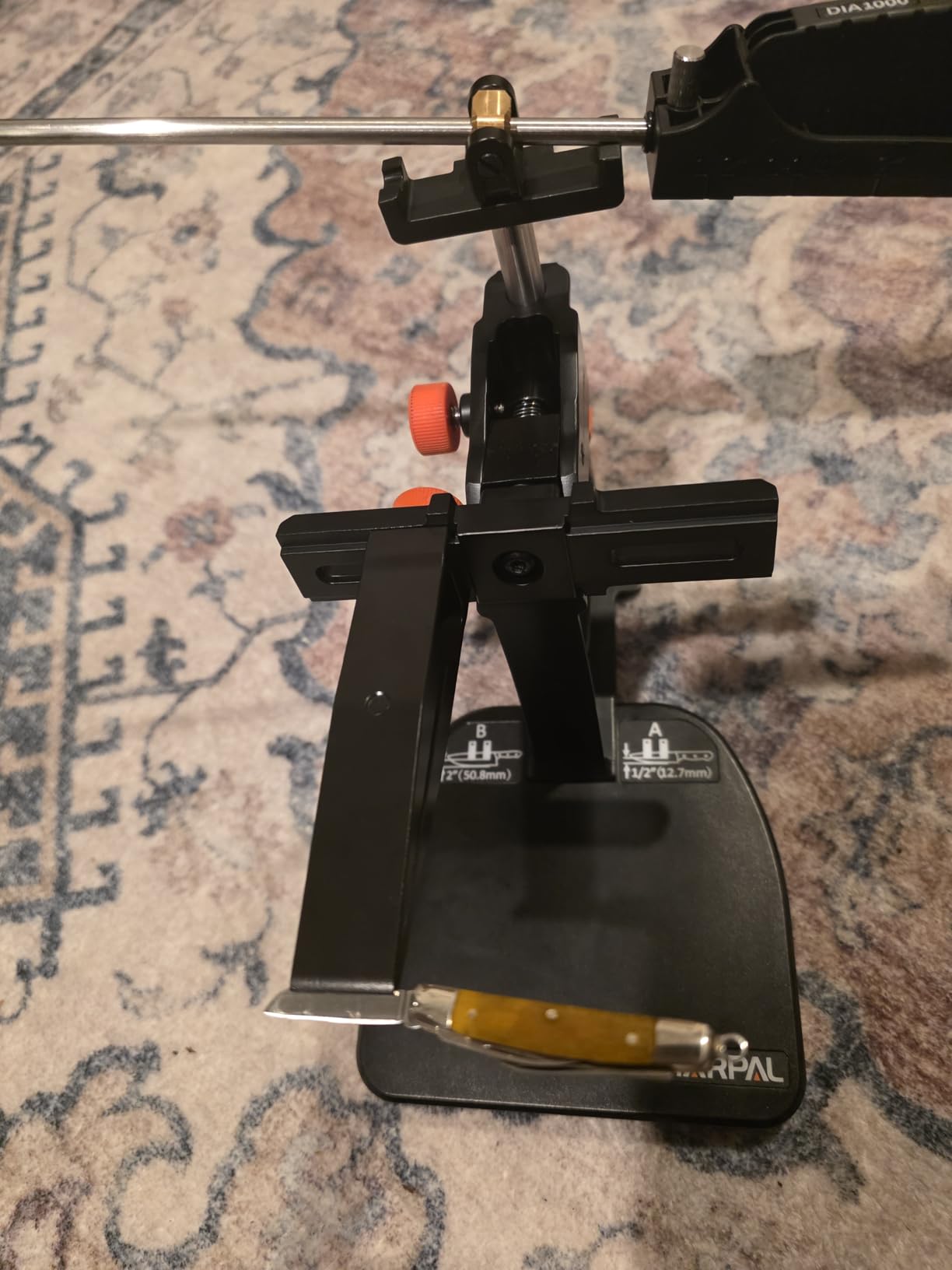
Who the SHARPAL 202H suits
Users with a genuinely mixed collection: a Japanese gyuto, a Western chef’s knife, a cleaver and a pocketknife, all needing different angles from one base. Anyone who wants a complete grit progression plus a strop and compound in a single purchase rather than assembling it piece by piece.
It is also the pick if you expect to grow into sharper edges and want a 6000 grit water stone and a strop in the box from day one.
Who should skip the SHARPAL 202H
Serrated knife owners. There is no conical rod and no gut hook attachment, so bread knives and steak knives need a different tool. If serrations matter to you, the Work Sharp Precision Adjust Elite handles them in the box.
Buy an angle finder before you start. Because the distance-based scale does not read the same as other guided systems, users who transfer a number from a different brand will be off. The base is also heavy at 4.4 kg and still shifts on an unprotected bench, so clamp it down.
How To Choose A Knife Sharpening System In 2026
The five system families, in one list. Everything in this roundup falls into one of them, and the right choice depends far more on which family fits your knives than on brand.
Guided manual systems clamp the blade at a set angle and move a stone or diamond plate along it. Angle consistency is automatic, the process is fully controllable, and nothing is consumed. Cost runs from a basic kit to a premium rig.
Bench stones and diamond plates put the angle in your wrist. They are the most flexible and the least forgiving, and they cost the least per grit. Dry diamond plates avoid the water bowl entirely.
Electric sharpeners use abrasive wheels or belts on a fixed geometry. They are the fastest by a wide margin and they remove the most steel, so they are used periodically rather than weekly.
Pull-through and rolling devices pass a blade through a fixed slot or roll it along a guided disc. They are the fastest to learn and the least precise, and they are a maintenance tool rather than a restoration tool.
Honing rods and strops do not sharpen. They straighten a rolled edge and polish a sharpened one. Every system on this list works better with one alongside it.
Which bevel angle per side should you use?
Fifteen degrees per side is a fine, slicing edge for Japanese knives, sashimi and high-carbon blades, with less toughness and faster dulling. Twenty degrees is the standard factory angle for Western kitchen knives and the safest default if you only remember one number.
Twenty-two degrees suits hunting and field blades where the edge sees bone and dirt. Twenty-five degrees is tougher and more durable, which is why European kitchen knives and cleavers often sit there. Anything above 25 degrees is a heavy chopping or axe edge, and it will feel blunt on a tomato slice.
Your angle needs to match what the knife came with. Reprofiling a factory 20-degree edge down to 15 degrees removes a lot of steel from a thin blade and can leave nothing behind.
What angle works for which knife?
Japanese single-bevel gyuto, sashimi and Damascus: 15 degrees per side, sharpened on one side only with a traditional single-bevel progression.
European chef’s knife, fillet knife, utility knife: 20 degrees per side, the standard factory geometry and the most forgiving place to start.
Hunting and field dressing blades: 22 degrees per side, tough enough for bone and hide without feeling blunt on light cuts.
Cleavers, heavy choppers and axes: 25 degrees and above, trading slicing performance for durability under impact.
What do professionals actually use?
Professionals split by volume. Line kitchens run electric multi-stage machines because consistency and throughput matter more than a mirror finish, and honing rods are non-negotiable between shifts. Culinary schools teach whetstone technique, and knife enthusiasts use guided manual systems such as the KME or the SHARPAL to hit an exact angle and stay there.
What a professional does not do is chase the sharpest possible edge at the cost of the blade. Repeatable results beat peak sharpness over a service.
Sharpening, honing and stropping are three different jobs
Sharpening removes metal. You do it every few weeks or months, working from coarse grit to fine, and you follow it with a hone so the edge is not left in the slightly rolled state a stone leaves behind.
Honing removes almost no metal and just realigns the edge. It is what you do between sessions, usually on a rod or a fine ceramic hone.
Stropping removes nothing at all. It aligns and polishes the edge to a mirror finish, and it should be the last step of every sharpening session.
Skipping the hone after sharpening is the most common routine error. It is also why people finish a long stone session and wonder why the knife does not feel as sharp as it should.
What the premium tier actually buys you
Nothing in the premium tier gives you a sharper knife than a well-used mid-range system. What it buys is repeatability: a more rigid frame, better bearings so the guide does not wander, finer angle adjustment, a wider grit range and more abrasive options.
If you have already dialled in a mid-range system and get consistent results, an upgrade buys you convenience rather than capability. If you cannot get a consistent edge at all, the upgrade is worth making.
Five mistakes that ruin a knife edge
Skipping the hone after a sharpening session. It is the most common one and it costs nothing to fix.
Over-sharpening. Every pass removes steel, and a thin, over-polished edge holds less well than a slightly more robust one. Electric sharpeners are the usual culprit because they are so fast that people use them weekly instead of monthly.
Pressing hard instead of working steadily. Hard pressure does not remove metal faster, it flexes the mount, burns the abrasive and risks hollow grinding.
Ignoring the angle guide on a freehand stone. A wandering angle produces a bevel that is thick at the heel and thin at the tip, and that edge will never behave.
Using a coarse plate when a fine one would do. A 1000 grit plate removes far more steel than a 2000 grit plate for an edge that was only slightly dull.
How we evaluated these systems
Every system was run through the same routine over several months on chef’s knives, pocketknives, a single-bevel gyuto, serrated bread knives, chisels and plane irons. We scored edge consistency from heel to tip, angle adjustability, clamp stability under load, abrasive range and how easy replacement stock is to get, learning curve, mess factor and value.
Where a system comes with its own stones, those stones were scored as part of the package rather than separately. Star ratings and review counts shown on each card are the current Amazon figures, not our own scores, so you can see how our ranking lines up with what thousands of owners report.
Frequently Asked Questions
What do professionals use to sharpen their knives?
Professionals split by volume. Line kitchens use electric multi-stage sharpeners because speed and repeatable results matter more than a mirror finish, and they hone between shifts. Culinary schools teach whetstone technique. Knife enthusiasts and sharpeners use guided manual systems with fine angle adjustment to hit an exact degree. Across all of them the priority is consistency and repeatability rather than peak sharpness.
What knife sharpener do professional chefs recommend?
Chefs value speed and consistency, so most reach for an electric three-stage sharpener for straight and serrated knives on a busy prep line. For high-end knives that have to stay razor sharp, they use a good whetstone or a guided system. A honing rod is non-negotiable in a working kitchen and is used far more often than any sharpener.
What is the best knife sharpening tool for home use?
The Work Sharp Precision Adjust Elite is the strongest all-round choice for a home kitchen because it covers 15 to 30 degrees per side, handles serrated blades with the included ceramic rod and includes a strop. If you would rather not learn an angle at all, the Presto 08800 is faster and needs no technique. Either way, add a separate honing rod for daily work.
What is the best knife sharpening method?
There are three stages, not one method. Sharpening grinds the edge away and is done every few weeks or months using coarse then fine grit. Honing removes almost no metal, straightens a rolled edge and is used between sessions. Stropping removes nothing and polishes the edge to a mirror finish, and should always be the final step after sharpening.
Do I need a whetstone or a guided sharpening system?
A guided system is easier and gives consistent angles without practice, which is why it suits most home users. A whetstone gives more control, accepts a wider range of grits and produces the best edges in skilled hands, but it takes real practice. A common approach is to use a guided system for routine resets and a whetstone for full progressions when you have time.
Is a guided sharpening system worth it?
For most home cooks and EDC users, yes. A guided clamp removes the single biggest source of frustration in knife sharpening, which is holding the same angle along the whole edge. It is also portable, needs no power or water and consumes nothing except the abrasive. It is worth less if you already have confident freehand technique or if your blades are all fixed 20-degree kitchen knives.
Which Knife Sharpening System Should You Buy?
The best knife sharpening system for the widest range of people in 2026 remains the Presto 08800 EverSharp. It has more real-world use behind it than anything else here, it needs no technique, and it will sharpen a full block in the time it takes to boil a kettle.
Buy the Work Sharp Precision Adjust Elite if you want control and a serrated rod in the same box. Buy the Lansky Deluxe if you want a complete stone progression for the least money. Buy the SHARPAL 202H if your collection spans Japanese, Western and cleaver geometries and you want every abrasive stage in one case. Buy the WEN wet grinder if you also sharpen chisels and plane irons.
Whichever you choose, add a honing rod to the box before you do anything else. The sharpening system resets the edge a few times a year; the rod keeps it working the other fifty times.