
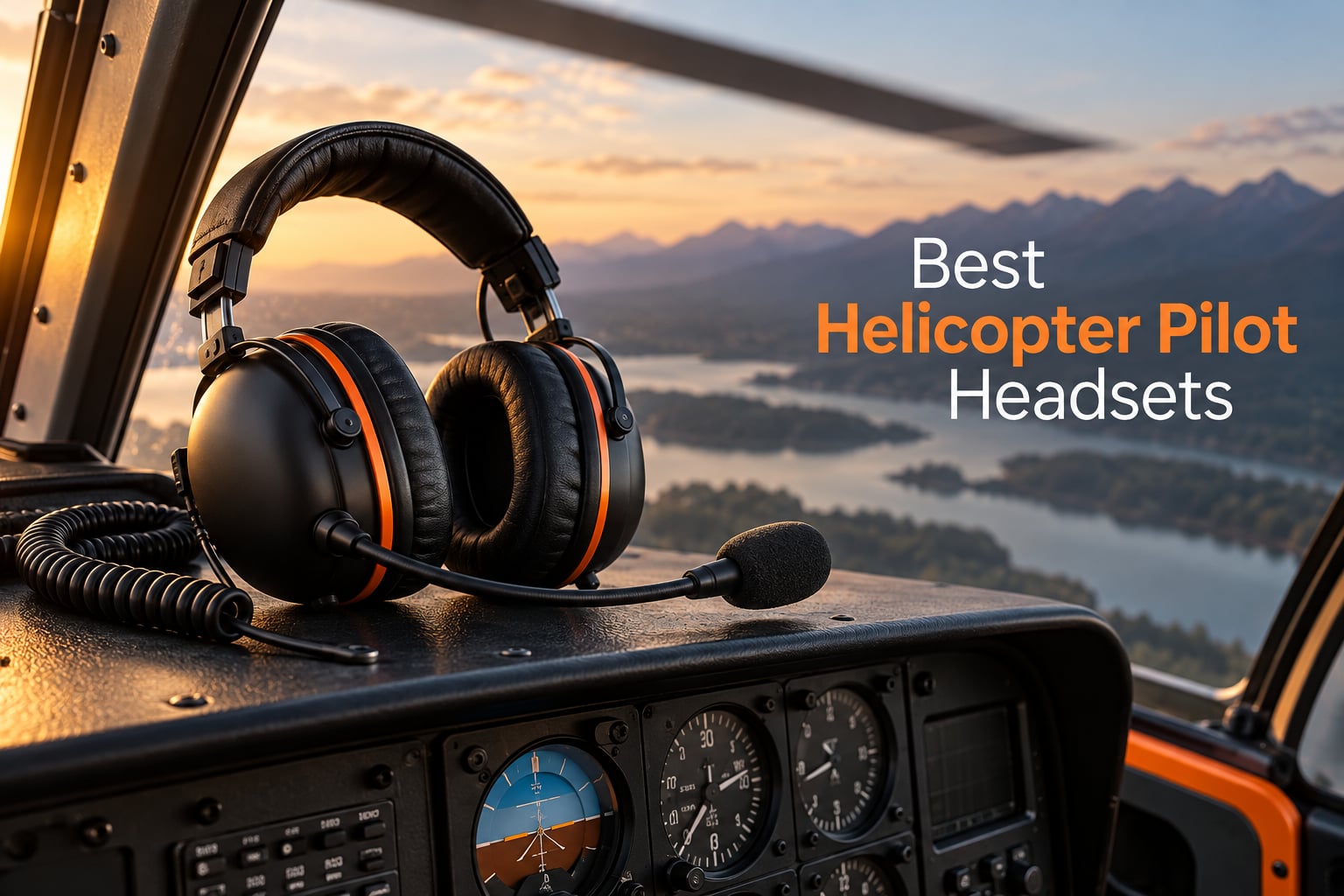
Short answer: the David Clark H10-13H is the best helicopter pilot headset for most people, because it is built for rotorcraft, arrives with the U-174/U military plug in the box, weighs 6.56 ounces on your head, and needs no batteries at all. If you want active noise reduction on long turbine sectors, the Bose A30 in the U174 version is the comfort benchmark, and if you are a student or renter, the KORE H1 is the smartest money.
That is the whole problem with buying a headset for a helicopter. Almost every aviation headset roundup online is really a fixed-wing list, where nearly everything ships with dual GA plugs. Put one of those in an R44, an AS350, or a Bell 206 and the connector is simply wrong. The cable exists to carry microphone and headphone audio plus, on active models, battery power, and a helicopter intercom is wired for the military-style U-174/U plug.
We went through 13 aircraft headset categories to find the six units that come factory-configured for rotorcraft, then weighed them against the criteria that actually decide the purchase: plug type, how much of the rotor signature they remove, weight over a three-hour sector, ear-seal comfort, and microphone behaviour when the turbine is at flight idle. Every product below has a real rotorcraft plug, so nothing here needs an adapter to work in a helicopter.
One quick note before you start: if you also keep timepiece or other cockpit gear, our pilot watch roundup covers the same buy-once philosophy. And if you are still building hours in a sim, our gaming headset picks are the wrong tool for the job, because neither end of a Bluetooth headset will key a helicopter intercom.
Table of Contents
Top 3 Picks for Helicopter Pilots in 2026

All Six Helicopter Headsets at a Glance in 2026
Every headset in this table is wired for a U-174/U rotorcraft panel. The two active noise-reduction models are the Zulu 4 Heli and the Bose A30, and the passive designs handle rotor noise on ear-seal sealing alone.
| Product | Specifications | Action |
|---|---|---|
| David Clark H10-13H |
|
Check Latest Price |
 KORE H1 KORE H1 |
|
Check Latest Price |
 LIGHTSPEED Zulu 4 Heli U-174 LIGHTSPEED Zulu 4 Heli U-174 |
|
Check Latest Price |
 Rugged Air RA620R Rugged Air RA620R |
|
Check Latest Price |
 David Clark H10-36 David Clark H10-36 |
|
Check Latest Price |
| Bose A30 U174 |
|
Check Latest Price |
1. David Clark H10-13H – Best Helicopter Pilot Headset Overall
David Clark H10-13H Headset (for helicopters)
Weight: 6.56 oz
Plug: U-174/U rotorcraft
Gel ear seals
20 Hz to 20 kHz
Pros
- Excellent noise reduction in helicopter cockpits
- Very light at 6.56 ounces
- Gel ear seals stay comfortable on long sectors
- Retractable cable with remote volume control
- Proven durable build
Cons
- M-7A mic may need an M-87 or DC87 for low-impedance intercoms
- Premium cost for a passive design
- Mic boom housing may need modification for some setups
The H10-13H is the unit I keep coming back to, and the reason is boring in the best possible way. It is a passive design, so there is no battery, no charging, no ANR circuit to fail, and nothing to configure before a 6 a.m. departure. You plug it in, set the volume, and fly.
At 6.56 ounces it is the lightest headset in this roundup by a wide margin, and that number matters more in a helicopter than in a single. You carry head weight for the entire sector while the machine vibrates through the seat and the head pad presses the crown of your skull. Subtract 8 ounces and the difference shows up as less neck tension at the end of a long turbine leg.
Noise reduction here is entirely a sealing exercise. The gel ear seals mould to your head and hold the cabin down, which is why owners flying turbine and piston rotorcraft rate the attenuation so highly. There is no electronic cancellation of low-frequency rotor beat, so on a light piston helicopter you will still hear the blade passing frequency underneath your radio calls, just far enough down that it stops being fatiguing.
The one real compatibility trap is the microphone. The M-7A electret mic is a high-impedance unit, and a few helicopter intercoms are wired low-impedance. If your airframe runs a low-impedance intercom, you need the M-87 or DC87 microphone instead, and the boom housing can need modification to accept it. Confirm your intercom type before you commit.
Is the passive design loud enough for turbine operations?
For most flying, yes. A good passive seal handles the mid and high range of a turbine cabin very well, and rotor blade-pass tone is a low-frequency problem that passive attenuation only partly touches. Pilots who move up from piston trainers into turbine machines usually do it for the ANR, not the plugs.
The trade is simplicity. There is no ANR whistle to chase, no battery to die at altitude, and no electronics warming up in the cold. In cold offshore and mountain flying, that reliability is worth real money.
What should you check before buying this model?
Confirm the microphone impedance against your intercom, because that is the only thing that can make an otherwise perfect headset dead in the water. Then decide whether you want a second, cheaper set for check-out flights in aircraft you do not own.
If you fly both rotorcraft and fixed-wing, this headset will not cover both without an adapter, since the U-174/U plug is single-ended. Keep that in mind before committing to a one-headset plan.
2. KORE H1 – Budget Pick Helicopter Headset
KORE AVIATION H1 Helicopter Pilot Headset – Passive Noise Reduction, Noise Canceling Microphone, Mono, Gel Ear Seal, Adjustable Headband, AUX Port, U-174 Plug & Free Headset Bag
NRR: 24 dB
Plug: U-174 NATO
Gel ear seals
5-year warranty
Pros
- 24 dB NRR blocks rotor and turbine noise
- Coiled U-174 cord with 3.5mm AUX input
- Electret noise-canceling microphone on a 360 degree flex boom
- Five-year manufacturer warranty
- Carry bag included
Cons
- Mono audio only with no stereo for music
- No Bluetooth or active noise reduction
- Clamp pressure can feel tight out of the box
The KORE H1 answers the question a lot of student and renter pilots ask, which is whether a headset has to cost as much as a used car to work in a helicopter. It does not, and this one has a published 24 dB noise reduction rating, a U-174 NATO plug, and a five-year manufacturer warranty behind it.
The gel ear seals are the surprise. On a passive headset at this level you often get thin foam that goes sweaty after an hour, but the silicone gel here moulds and stays workable through a full training block. The adjustable headband spreads clamping force across a wider area, which is exactly what you want when you are doing pattern work and landing practice in a cabin twin.
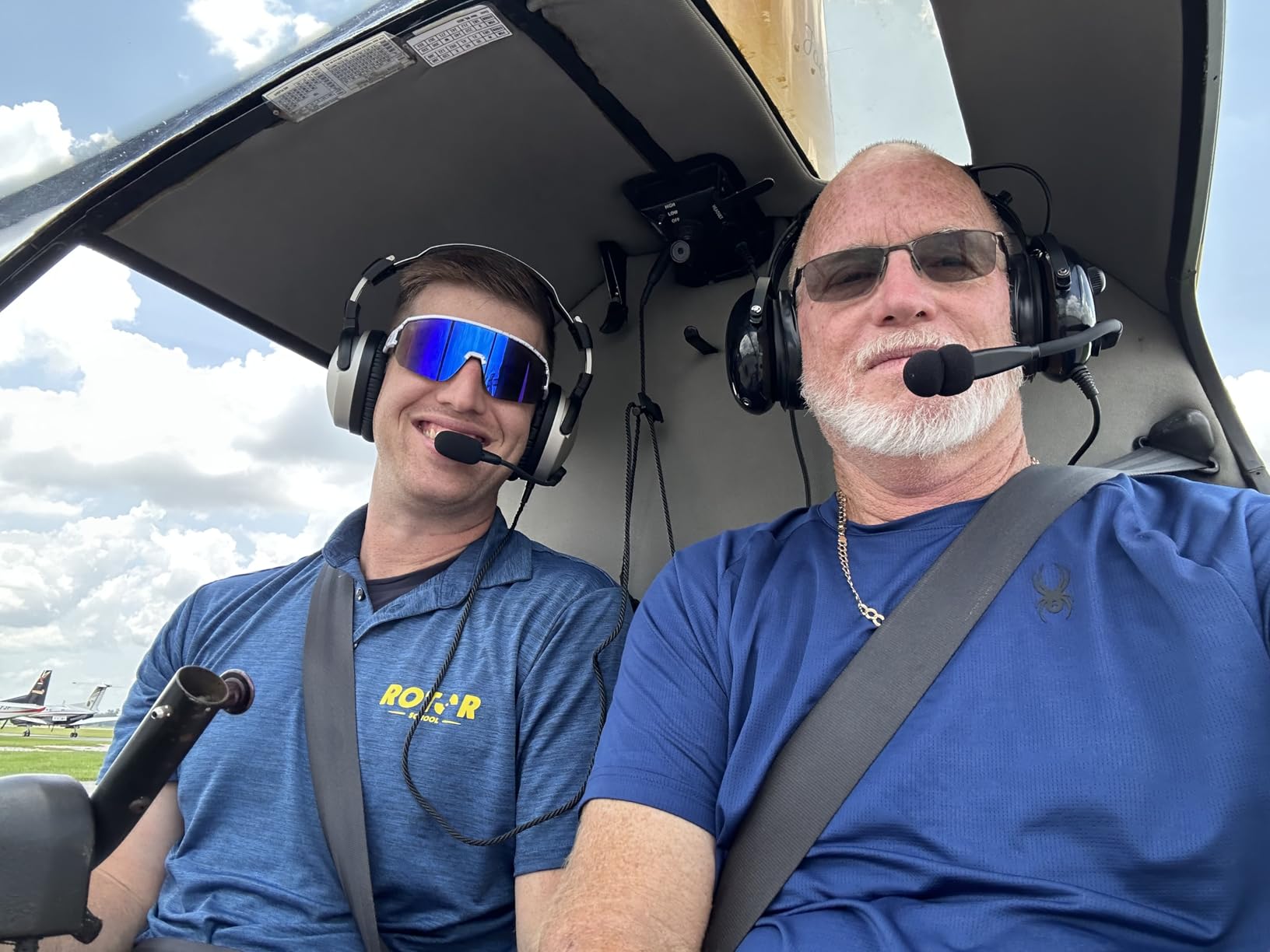
Two details make this more useful in a helicopter than a generic budget headset. The 3.5mm AUX input on the earcup lets you pipe ForeFlight or another aviation app into the headset, which matters in a helicopter because audio-only GPS units are common. And the coiled cord keeps the plug end reachable from the pilot seat without a long loop across the door post.
The microphone is an electret noise-cancelling unit on a full 360-degree flex boom, which is the right architecture for a noisy cabin. It is not a hot-mic design, so if your intercom is wired push-to-talk you will want to check the hot-mic configuration before your first flight with it.
Where does the H1 fall short on a turbine machine?
Passive attenuation only, so the rotor signature stays audible under the intercom in a turbine helicopter, and mono audio means no stereo music on the ground. There is no Bluetooth and no electronic cancellation, which also means nothing to fail.
Owners also report that the clamping force can feel high straight out of the box. Give the headband a few days of wear and it settles into a workable spread.
Is this the right first helicopter headset?
Yes, for students, renters, flight schools, and anyone building hours in an R44-class cabin twin. The five-year warranty also makes it a sensible share between an instructor and a student.
A few rotary-wing panels need a U-93A to U-174 adapter, so have your aircraft or club confirm the panel connector before your first hop. Everything else about the package is ready to fly.
3. LIGHTSPEED Zulu 4 Heli U-174 – Best for Active Noise Reduction
LIGHTSPEED Zulu 4 ANR Aviation Headset – with Dual Bluetooth and FrameFit™ Ear Seals (Heli U-174)
ANR with dual Bluetooth
Weight: 14.9 oz
Plug: Heli U-174
7-year warranty
Pros
- Active noise reduction with adjustable modes
- Dual Bluetooth connects two devices at once
- FrameFit seals fit glasses and sunglasses
- 7-year limited warranty
- Stainless steel and magnesium build
Cons
- Heaviest set in this roundup at 14.9 ounces
- Only 4 published ratings so long-term reliability is unproven
- 295 ohm impedance can need an intercom compatibility check
This is the Zulu 4 built for helicopters, with the Heli U-174 plug fitted at the factory rather than a GA dual-plug end. That single detail is the reason it appears here, because the fixed-wing version of the same headset simply will not mate with your intercom.
Active noise reduction is where a turbine helicopter earns its keep. The electronic cancellation attacks the low-frequency cabin drone that rotor blade-pass and turbine whine produce, which is precisely the band that passive foam cannot touch. Adjustable modes let you back the cancellation off if it starts sounding artificial in your particular airframe.
At 14.9 ounces it is by far the heaviest set in this roundup. The low-profile stainless-steel headband follows the curve of your head to spread that weight, but if you are used to the H10-13H, the difference is obvious within the first sector.
FrameFit ear seals use tapered foam, which matters more in helicopters than the spec sheet suggests. Emergency medical, offshore, and law enforcement rotorcraft crews often wear sunglasses, and a conventional seal presses temple arms into the side of your head until the pressure becomes the distraction. The Dual Aperture Disc microphone is designed to cut up to 90 percent of background noise from Bluetooth transmissions, so your phone audio stays intelligible over the intercom.
What do you give up for the ANR and Bluetooth?
Weight, mostly. Fourteen point nine ounces carried for three hours is a real neck load, and the impedance figure of 295 ohm is worth verifying against your intercom before a paid sector.
The review base is also thin. With only four published ratings, the long-term reliability picture is not yet proven, and the ratings themselves are sharply split. The seven-year warranty is the strongest in this roundup and covers that risk better than anything else here.
Who should buy this one?
Pilots who fly turbine aircraft, run long sectors, wear glasses, and want their phone audio inside the headset. If your flying is mostly low-hour piston rotorcraft, a lighter passive set will serve you better.
Keep the app-based recording and playback in mind if you debrief solo, since it is a genuine advantage for mountain and offshore work.
4. Rugged Air RA620R – Budget Helicopter Headset With a Military U174 Plug
Rugged Air RA620R Rubber Coated Helicopter Headset featuring Military Grade U174 Plug with Full Flex Boom Microphone, 3.5mm Input Jack for Music / MP3 Players
Plug: military grade U174
Full flex boom
3.5mm music jack
Rubber coated
Pros
- Military-grade U174 plug for rotorcraft panels
- Full flex boom microphone
- Individual volume knobs per earcup
- Rubber-coated shell handles rough handling
- 3.5mm input jack for music players
Cons
- Only 2 published ratings so long-term reliability is unproven
- Limited published specifications
- No active noise reduction listed
The RA620R solves the most basic helicopter problem for the least money: it arrives with a military-grade U174 plug on a coiled cord, so it connects to a rotorcraft panel without an adapter. For a club aircraft, a student, or a backcountry pilot who treats gear roughly, that is a short and honest proposition.
The rubber-coated construction is the feature to notice. Helicopter headsets get thrown in footwells, dragged through tall grass, and dropped on gravel ramps, and a coated shell tolerates that abuse better than a painted plastic cup. The stainless steel listed in the build spec supports that reading.
Individual volume knobs on each earcup are a nice touch, because helicopter intercom panels vary so much between machines that being able to trim each side separately saves an argument with yourself every time you swap aircraft. The full flex boom microphone holds its position well, and the 3.5mm input jack gives you a music connection on the ground.
What do the two ratings actually prove?
Very little, and it is worth being straight about that. A perfect score from two reviews tells you the people who received it were happy, not that the unit will still be sealed properly after two hundred rotor hours.
Published specifications are thin on this one, with no weight, NRR, or warranty figure listed. If you are deciding between this and the KORE H1, the documented numbers on the H1 make it the easier purchase to justify.
Who should put this in the bag?
Backcountry and utility pilots who fly a lot of unimproved strips, club members sharing one headset, and anyone who wants a spare for a foreign aircraft where a broken set would ground them.
It is not the choice for a turbine professional who needs active noise reduction over long sectors. Buy it as a backup, not as your only headset.
5. David Clark H10-36 – Best Helmet-Compatible Helicopter Headset
David Clark H10-36 Helicopter Headset
Plug: U-174/U
5-foot coil cord
Active noise cancellation
On-ear cups
Pros
- On-ear cups sit under most flight helmet ear cups
- Five-foot coil cord clears the yoke and door frame
- Active noise cancellation in a helicopter-specific design
- Ergonomic shape for extended wear
- Backed by the David Clark name
Cons
- Only 3 published ratings so the review base is tiny
- On-ear cups leak more ambient noise than over-ear designs
- Weight and noise rating are not published
Most helicopter pilots fly a helmet, and a helmet changes the headset decision more than any other single variable. The H10-36 uses an on-ear cup rather than a large over-ear can, which is the geometry that works with the ear pockets cut into a flight helmet.
An over-ear cup placed under a helmet is a fight. It compresses the helmet liner, the seal loses its shape, and clamping force goes up because the headband is now fighting two layers. On-ear cups avoid that entirely, which is why this model exists and why it has stayed in the David Clark catalogue for years.
The five-foot coiled cord is the other helicopter-specific decision. It reaches from the head to the panel without a slack loop hanging across the cyclic or the door post, which is both a safety improvement and a comfort one on a hover.
This model also carries active noise cancellation, which is unusual for an on-ear design, and the manufacturer describes the fit as ergonomic for extended wear. That combination, low weight and on-ear geometry, is exactly what emergency medical and law enforcement crews tend to end up with.
How much noise leaks past an on-ear seal?
More than an over-ear cup, and it is the honest trade you make for helmet compatibility. On-ear designs depend more heavily on a tight headband to seal, so clamping force tends to be higher over a long sector.
If you fly open-face or without a helmet at all, an over-ear passive or ANR set will quiet the cabin better. Buy this model because of the helmet, not despite it.
Is there enough evidence to recommend it?
Thin. Three published ratings is a very small sample, and none of the feedback describes actual use in detail. The design logic is sound and the brand is proven, but treat the rating as encouraging rather than conclusive.
Ask your dealer or club to confirm the U-174/U lead exits your specific airframe, and check whether the noise rating is published for your configuration before you commit to a long-sector plan.
6. Bose A30 U174 – Best for Bluetooth and Certification
Bose A30 Bluetooth Aviation Headset – Lightweight Comfortable Design, Adjustable ANR and Noise Cancelling Microphone, [U174] – Black
Three ANR modes
Bluetooth 4.2
2x AA batteries
1-year warranty
Pros
- Three selectable ANR modes for different rotor environments
- Clamping force 20 percent lower than the A20
- Tool-free side-swappable mic and down cable
- Bluetooth with audio prioritization for EFB audio
- FAA TSO and EASA E/TSO-C139a certified
Cons
- Several pilots report a loud thumping resonance in one cup
- Sound described as dry and bright next to the A20
- Intermittent down-cable connection reports
- One-year warranty is the shortest here
The A30 in the U174 configuration is the certified option. It carries FAA TSO and EASA E/TSO-C139a approval and passed 145 endurance tests, and for operators whose flying is governed by an approved equipment list, that paperwork is the whole argument.
Three selectable modes of active noise cancellation is the feature that matters in a helicopter. You can tune the cancellation for a closed cabin, a hover, and a doors-off or open-cabin run rather than living with a single setting, which is exactly the variability rotorcraft operations produce.
Comfort is the A30’s strongest suit. The manufacturer rates clamping force 20 percent below the A20, and the soft ear seals plus light touch controls make it easy to run all day. The down cable and microphone swap sides with no tools, so if your flying has you flying left seat this week and right seat next, the headset follows you.
Bluetooth 4.2 with audio prioritization lets you keep phone and electronic flight bag audio in the headset and choose whether it mutes or mixes with intercom audio. In helicopters that is genuinely useful, because a moving map cue through the earcup beats a tablet on the console.
Now the honest part. Several helicopter pilots using this model report a loud thumping resonance in one earcup, and others describe the sound as dry and unnaturally bright next to the A20, with noise cancellation criticized in doors-off operations. There are also reports of intermittent down-cable connections and a control module that feels less robust than the A20’s. At 3.6 across 17 reviews, this is a polarizing unit, and the one-year warranty is the shortest in this roundup.
Is the Bose A30 worth it for a helicopter pilot?
If certification, Bluetooth prioritisation, and the lowest clamping force in this list are priorities, yes. If you are flying a piston rotorcraft most of the time, a lighter passive set will do the same job for less money and with nothing to charge.
Make sure you take the U174 version. The same headset also comes in XLR 5-pin, dual plug, and LEMO 6-pin, and ordering the wrong connector is the single most common purchase mistake pilots make.
What about the older A20?
Owners who dislike the A30’s tuning frequently recommend staying with the A20, which needs an adapter to reach a U-174 panel. That is a workable arrangement for a pilot who flies mostly fixed-wing and drops into a helicopter occasionally.
If helicopters are your primary platform, buy the U174 A30 rather than running an adapter, since adapter cables are a common source of static and intermittent audio.
Helicopter Headset Buying Guide: What Actually Matters
Start with noise, because that is the reason a helicopter cockpit is different from almost anything else you will fly. A helicopter is the loudest cockpit most pilots ever occupy. Rotor blade-pass tone sits low, turbine whine and exhaust harmonics sit in the mid range, and the airframe itself contributes structure-borne vibration that no ear seal addresses.
ANR or passive: which one do you need?
Active noise reduction generates an anti-noise signal at low frequencies and cancels rotor beat and turbine drone. Passive noise reduction relies entirely on the ear seal and foam or gel. In a piston helicopter flying local, a good passive headset such as the H10-13H or the KORE H1 is genuinely enough, and it is more reliable because there is no battery.
Move into turbine aircraft, over-water sectors, or long cross-country and the calculus flips. There, active noise reduction earns its cost, and the Zulu 4 Heli and Bose A30 are the two options in this roundup. Active models run on two AA batteries, so carry spares, and check the auto shut-off behaviour before your first night sector.
One caution on the noise reduction rating. NRR is measured in a laboratory against a standard, and a 24 dB figure is not 24 dB of rotor cancellation. Use NRR to compare two headsets of similar design, not to compare a passive set against an active one.
Weight and clamping force
Weight is a comfort decision in a helicopter because you wear it for the whole sector. The H10-13H at 6.56 ounces is the lightest option here and the most comfortable over a three-hour turbine leg. The Zulu 4 at 14.9 ounces needs a good headband to justify itself, and the manufacturer does design one.
Clamping force matters as much as weight, and it is a two-way street. Too loose and the seal leaks noise. Too tight and you get a headache by hour two, especially with a helmet. If you wear glasses, look for tapered or shaped ear seals, because temple arms and ear cups do not get along.
Microphone, ear seals and power
Almost every pilot in a helicopter wants a boom microphone rather than a throat mic, because a throat mic is really an open-face helmet solution and the boom gives far better intelligibility over intercom. Electret noise-cancelling microphones are the norm, and a hot-mic or push-to-talk intercom changes what you need from the mic element, so confirm your panel type.
Ear seals are where comfort lives. Gel compresses and stays workable, foam is cheaper and gets warm, and both are consumable items you will replace over the life of a headset. Buy a spare set with the headset if your dealer offers it.
Bluetooth cannot key a helicopter intercom. It is a convenience layer for music, phone, and navigation apps only, which is worth remembering if you are tempted by a consumer headset with active noise cancellation. For audio-only GPS and moving map work, a 3.5mm auxiliary input is more useful than Bluetooth pairing.
Warranty and support
Warranty length is a reasonable proxy for how a manufacturer expects the headset to be treated. The Zulu 4 Heli carries seven years, the KORE H1 carries five, the Bose A30 carries one. Where a warranty is short, buy from a dealer who will handle a failure directly rather than mail the unit away.
Helicopter Plug Guide: Check Your Airframe Before You Buy
This is the part that ruins helicopter headset purchases, so check it before anything else. The plug is not a detail, and every unit in this roundup already has the correct rotorcraft connector fitted.
- U-174/U (NATO): the military-style rotorcraft plug used across most helicopters, including the H10-13H, H10-36, KORE H1, RA620R, Zulu 4 Heli, and the U174 Bose A30. This is the default for helicopter intercoms.
- U-93A to U-174 adapter: some rotary-wing panels use a U-93A receptacle, which needs a short adapter cable. Confirm your panel before a solo flight in a club aircraft.
- Dual GA (PJ-13) plugs: the fixed-wing standard, which is why almost every general-aviation headset you will read about online will not connect to a helicopter without an adapter.
- LEMO 6-pin: panel-powered units that draw battery power from the aircraft, so no batteries are required at all.
- Airbus 5-pin XLR: found in some Airbus and other modern rotorcraft intercom installations.
There is a second plug problem that catches experienced pilots: a certified check-out may be flown in an aircraft you do not own. If your instructor or a club CFI flies a different machine with a different connector, keep a cheap second headset and an adapter kit, because a headset swap is far better than a grounding delay before a solo check ride.
Adapter cables are also a reported source of static and intermittent audio in helicopters, so if you can buy the right plug from the start, do that instead.
Frequently Asked Questions
What is the best headset for helicopter pilots?
For most pilots the David Clark H10-13H is the best helicopter pilot headset: it weighs 6.56 ounces, arrives with the U-174/U rotorcraft plug fitted, uses comfortable gel ear seals, and needs no batteries. Pilots flying turbine aircraft or long sectors often prefer an active model instead, where the LIGHTSPEED Zulu 4 Heli and the Bose A30 U174 lead.
What plug does my helicopter headset need?
Most helicopter intercoms use the military-style U-174/U plug, sometimes called the NATO plug. Some rotary-wing panels use a U-93A receptacle, which needs a short adapter. The dual GA or PJ-13 plugs found on most fixed-wing headsets will not connect directly. Always confirm the panel connector on your specific airframe before buying.
Which aviation headset has the best noise cancelling?
It depends on the airframe. For turbine helicopters the active models, the LIGHTSPEED Zulu 4 Heli and the Bose A30, cut the low-frequency rotor and turbine drone that passive designs cannot touch. The Bose A30 also lets you select between three noise cancellation modes, which helps in doors-off or open-cabin work. In a piston helicopter a good passive seal is often enough.
Do I need active noise reduction for a helicopter?
For a piston rotorcraft flying locally, a quality passive headset such as the David Clark H10-13H or the KORE H1 is generally sufficient and completely reliable, because there is no battery to fail. For turbine aircraft, over-water work, or long cross-country sectors, active noise reduction earns its cost by cancelling the low-frequency drone that ear seals alone cannot remove.
Can I use a Bluetooth or consumer headset for flying?
No, not for communication. A helicopter intercom is a wired system, so the headset needs a wired plug, an electret microphone element, and compatible impedance. Bluetooth is useful only for a second audio layer such as music, phone calls, or navigation app alerts, which is why aviation headsets like the Bose A30 and the Zulu 4 Heli add it as an extra rather than a replacement.
Are David Clark headsets good for helicopters?
Yes, and the brand has a long track record as the default choice for rotorcraft. In this roundup the H10-13H is a lightweight passive headset with gel ear seals and a U-174/U plug, while the H10-36 uses on-ear cups that sit correctly under a flight helmet and includes active noise cancellation. The main caveat with the H10-13H is microphone impedance, since the M-7A mic may need an M-87 or DC87 on a low-impedance intercom.
Final Verdict: Which Helicopter Headset Should You Buy
The best helicopter pilot headsets are the six that arrive with a real U-174/U rotorcraft plug, and the David Clark H10-13H wins this roundup because it is the lightest option, needs no battery, and is rated 4.9 across 33 reviews from pilots flying helicopters with it. Students, renters, and low-hour piston operators get the most out of the KORE H1 at a fraction of the cost, with a documented 24 dB rating and a five-year warranty.
If you fly turbine aircraft, buy active noise reduction: the LIGHTSPEED Zulu 4 Heli for the seven-year warranty, Bluetooth, and glasses-friendly seals, or the Bose A30 U174 for certification, three ANR modes, and the lowest clamping force available. The H10-36 is the right call if you fly a helmet, and the Rugged Air RA620R makes sense as a spare in a bag.
Before you order, confirm the connector on your airframe and the microphone impedance on your intercom. Those two checks take five minutes and prevent the two failures that ruin helicopter headset purchases. If you are still deciding, our pilot gear roundups cover the rest of the cockpit kit built to last.