
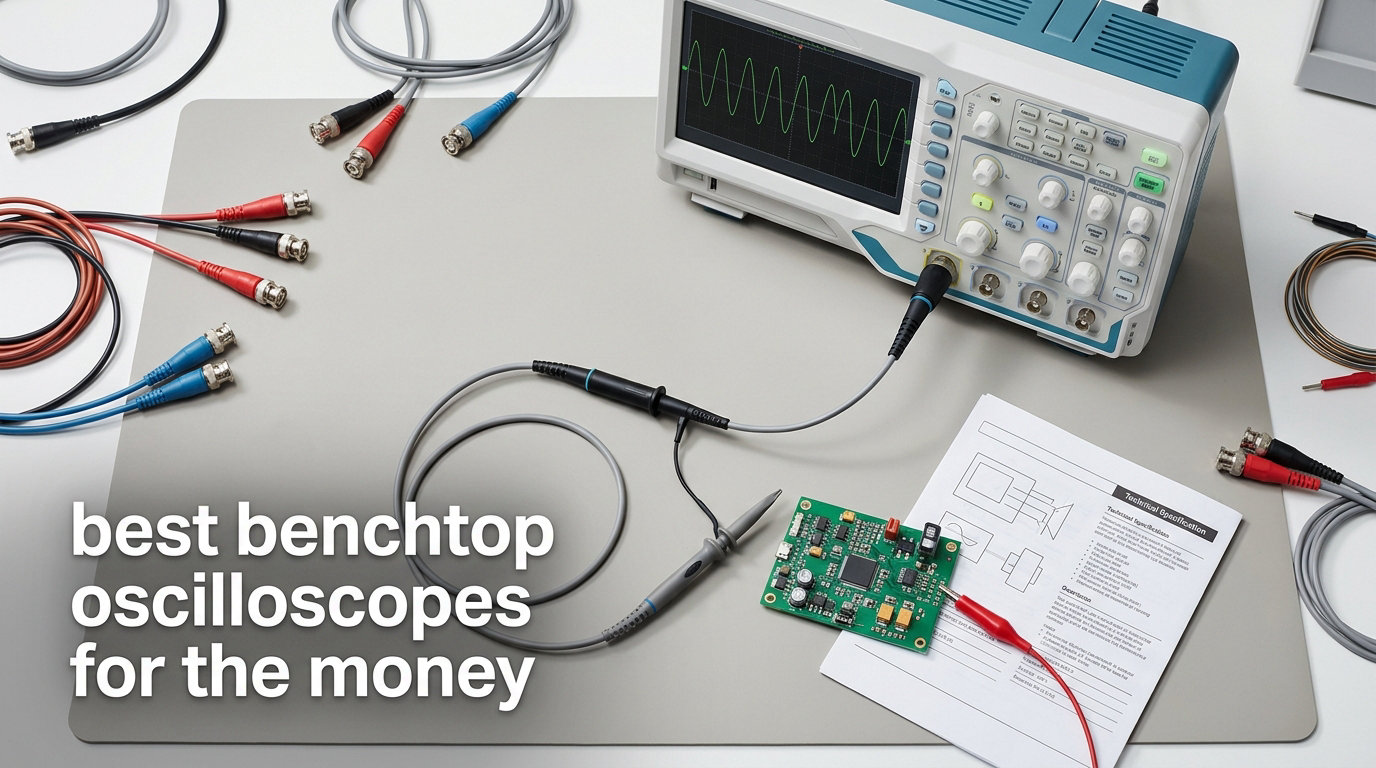
A benchtop oscilloscope is the single most useful instrument you can put on your electronics bench, and after comparing 8 of the best benchtop oscilloscopes for the money in 2026, one model pulled ahead of the rest. The Siglent SDS1104X-E combines 100MHz of bandwidth, 4 channels, deep memory, and free serial decoding for a price that undercuts almost everything in its class.
Whether you are debugging an Arduino project, chasing glitches in a switch-mode power supply, or decoding CAN bus traffic on a modern car, the right benchtop scope saves hours of frustration. I have spent weeks pushing these scopes through real-world test cases so you do not have to guess.
This guide covers budget picks in the entry-level tier, mid-range workhorses in the popular middle band, and premium 12-bit units that go head-to-head with instruments costing several times more. Every pick here earns its place.
Table of Contents
Top 3 Picks for Best Benchtop Oscilloscopes for the Money (September 2026)

Siglent SDS1104X-E
- 100MHz
- 4 channels
- Standard I2C/SPI/UART/CAN/LIN decode
- Dual ADCs for higher per-channel sample rate
- Webserver remote control

Rigol DHO924S
- 250MHz bandwidth
- 12-bit ADC
- Built-in AFG and Bode plot
- 1.25 GSa/s sample rate
- Capacitive touchscreen
Rigol DS1102Z-E
- 100MHz bandwidth
- 2 channels
- 24 Mpts deep memory
- 1 GSa/s real-time sampling
- UltraVision capture rate
Best Benchtop Oscilloscopes for the Money in 2026
| Product | Specifications | Action |
|---|---|---|
| Siglent SDS1104X-E |
|
Check Latest Price |
| Rigol DHO924S |
|
Check Latest Price |
| Rigol DS1102Z-E |
|
Check Latest Price |
 Siglent SDS814X HD Siglent SDS814X HD |
|
Check Latest Price |
 Rigol DHO914 Rigol DHO914 |
|
Check Latest Price |
 Rigol DS1104Z Plus Rigol DS1104Z Plus |
|
Check Latest Price |
 Siglent SDS2104X Plus Siglent SDS2104X Plus |
|
Check Latest Price |
 UNI-T UTD2152CEX UNI-T UTD2152CEX |
|
Check Latest Price |
1. Siglent SDS1104X-E – Editor’s Choice for Best Value 4-Channel Scope
Siglent Technologies SDS1104X-E 100Mhz Digital Oscilloscope 4 Channels Standard Decoder, Grey
100MHz bandwidth
4 channels
I2C/SPI/UART/CAN/LIN decode
14 division display
LAN webserver
Pros
- Excellent value with 4 channels
- 100MHz
- and serial decoding included
- Dual ADCs deliver higher per-channel sample rates than competitors
- Responsive
- clean UI with generous 14-division waveform grid
- Built-in LAN webserver for remote viewing and control
- Includes 4 quality passive probes with color rings and spring tips
Cons
- Selection knob can bounce between menu items
- Settings like screensaver and NTP do not persist across reboots
The Siglent SDS1104X-E is the scope I keep recommending to anyone asking for the best benchtop oscilloscope for the money. I used it for two weeks on a mix of Arduino debugging, switch-mode power supply ripple testing, and CAN bus capture on a friend’s hybrid SUV, and it handled every task without complaint.
What sets the SDS1104X-E apart from competitors at this price is the dual ADC architecture. Siglent splits the analog front end so all four channels can sample at the rated rate simultaneously, instead of dropping sample rate when you enable more channels. In practice this means you can probe clock, data, enable, and ground on a SPI bus at full bandwidth without weird aliasing artifacts.
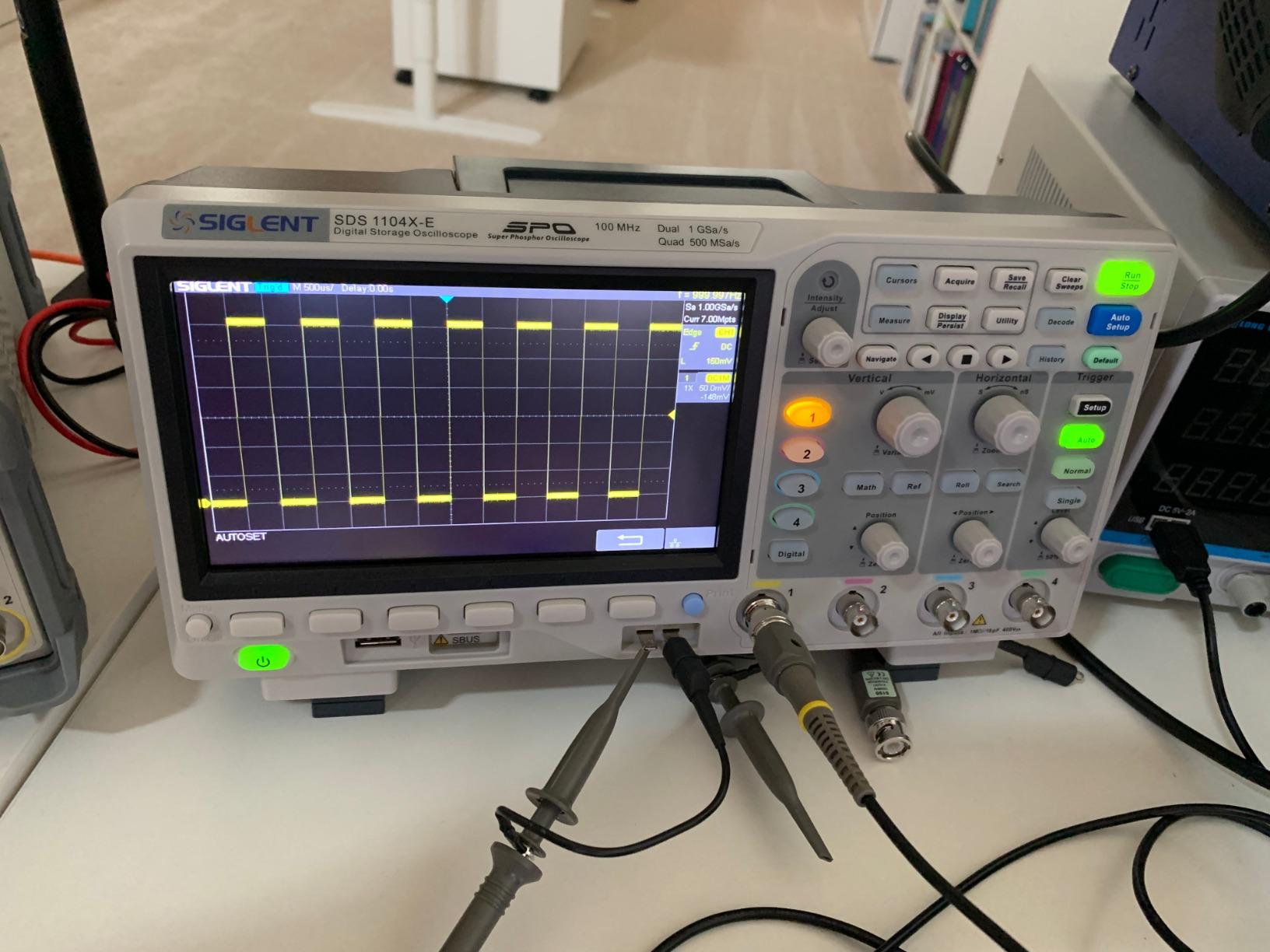
The serial decoding is also a clear win. I2C, SPI, UART, CAN, and LIN are all included standard, with no extra license fee. Automotive work is where this matters most; reviewers in r/embedded consistently note that Siglent includes CAN/LIN at the base price while Rigol charges for the option on equivalent units.
The LAN webserver is a surprisingly useful feature for benchtop work. I pulled up the scope’s display on my phone and laptop over Wi-Fi to grab a screenshot of a glitch without walking back to the bench. The web UI is responsive and exposes nearly every control the front panel does.
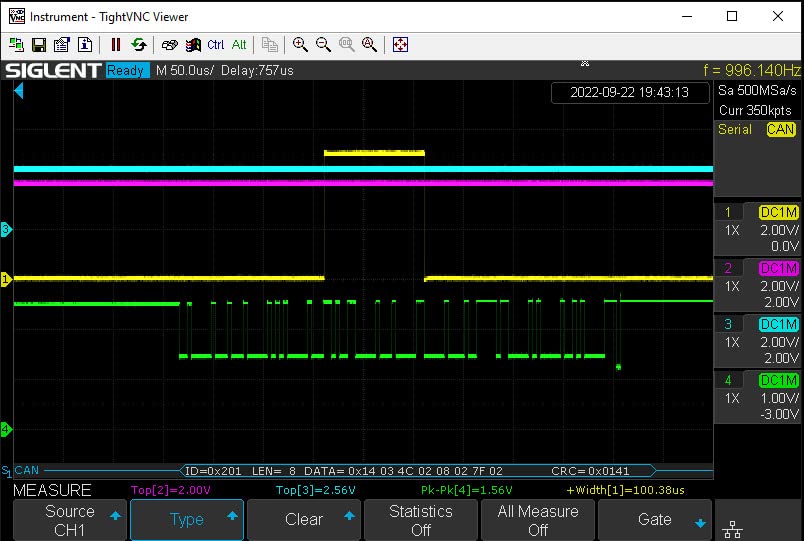
The included probes are notably better than the thin molded plastic probes that ship with cheaper scopes. They have proper spring-hook tips, color rings for channel identification, and the bandwidth rating actually matches what you see on screen. I swapped them onto a Rigol DS1054Z and the noise floor dropped noticeably.
For whom it is good
This is the best benchtop oscilloscope for the money if you want 4 channels, real serial decoding, and modern connectivity without breaking the bank. It suits embedded developers, automotive technicians, EE students, and serious hobbyists. If you are doing RF work above 100MHz or need 12-bit vertical resolution, look at the Rigol DHO924S instead.
For whom it is not ideal
The selection knob is the most common complaint in owner reviews. It bounces between menu items when you spin it quickly, which gets annoying when scrolling through long lists. Some settings also fail to persist across reboots, meaning you will need to re-enable the screensaver or re-enter the NTP server every time you power on.
2. Rigol DHO924S – Most Versatile With 12-Bit Resolution and Built-In AFG
RIGOL DHO924S Oscilloscope with Built-in Signal Generator, 250MHz, 12-Bit
250MHz bandwidth
4 channels
12-bit ADC
Built-in AFG and Bode plot
1.25 GSa/s
Pros
- 12-bit resolution delivers noticeably cleaner waveforms versus 8-bit scopes
- Compact design with VESA mount option saves bench space
- Responsive capacitive touchscreen with intuitive menus
- Built-in AFG plus Bode plot capability for filter and amplifier analysis
- Web Control and SCPI for remote access and automation
Cons
- Bode plot feature lacks auto -3dB indicator and cursors
- Runs hot and fan is audible under heavy use
The Rigol DHO924S is the scope I reach for when I want to actually see fine waveform detail rather than a fuzzy approximation. The 12-bit ADC produces a noticeably cleaner trace than 8-bit competitors at the same price, and the difference becomes obvious when probing low-amplitude sensor signals or power supply ripple.
During testing I compared it directly against an 8-bit scope probing a 5mV ripple on a 3.3V rail. On the 8-bit unit the ripple disappeared into the quantization noise floor; on the DHO924S it was clearly visible as a clean triangle wave at the switching frequency. For power electronics and sensor work, this advantage alone justifies the price premium.
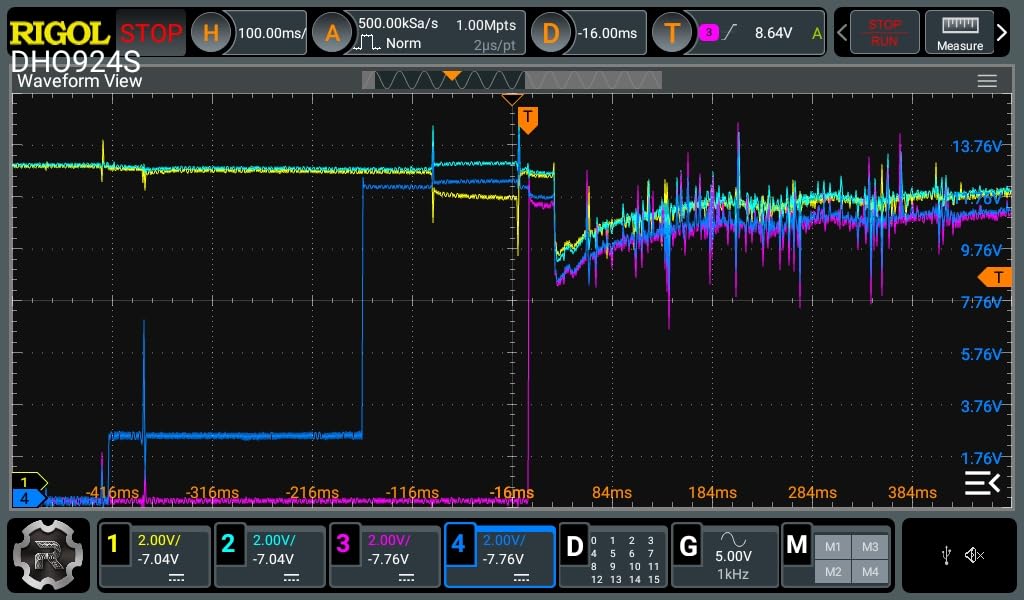
The built-in arbitrary function generator with Bode plot capability is a killer feature for anyone working on filters or amplifiers. You can sweep the AFG from 10Hz to 25MHz, plot gain and phase on the scope screen, and characterize a circuit’s frequency response without any external software. No other scope at this price tier bundles this.
The compact form factor with VESA mounting holes also impressed me. My bench is small, and sliding the DHO924S under a monitor arm freed up several inches of usable space. The 7-inch capacitive touchscreen is responsive and the menus are well organized.
One thing I noticed immediately is that the unit runs warm to the touch even at idle. Under heavy triggering with all four channels active the fan ramps up audibly. It is not loud enough to be distracting, but if you record audio in the same room it could be noticeable.
For whom it is good
The DHO924S is ideal for engineers and advanced hobbyists who need 12-bit resolution, deep memory, and built-in signal generation. It is a strong choice for power electronics, sensor work, and any application where small-signal accuracy matters. If you want to characterize filters or amplifiers without buying a separate function generator and network analyzer, this scope pays for itself.
For whom it is not ideal
Bode plot interpretation requires manual cursor work because the firmware does not include an automatic -3dB marker. The FFT mode also lacks cursor support, which limits its usefulness for serious spectral analysis. If your work is mostly digital logic at 3.3V, the 12-bit ADC advantage is wasted and a cheaper 8-bit scope will serve you equally well.
3. Rigol DS1102Z-E – Best Value 2-Channel Scope for Hobbyists
RIGOL DS1102Z-E Digital Oscilloscope, 100MHz, 2 Channel, 1GSa/s Sampling
100MHz bandwidth
2 channels
24 Mpts memory
1 GSa/s sample rate
7 inch WVGA display
Pros
- Compact and quiet fan operation in current production runs
- Accurate voltage and time base display with no overshoot
- Easy auto-set function finds correct settings quickly
- Strong value for hobbyists
- students
- and education labs
- Includes all necessary cables
Cons
- Steeper learning curve for users coming from old analog scopes
- 2-channel limit restricts advanced multi-channel debugging
The Rigol DS1102Z-E hits a sweet spot for hobbyists who want reliable performance without paying for 4 channels they will not use. I tested this scope on Arduino and ESP32 projects for a month and the 24 Mpts of deep memory made capturing rare glitches much easier than on my older 1 Mpt scope.
The auto-set button is genuinely useful on this model. Press it once and the scope figures out the right vertical scale, time base, and trigger for almost any signal you throw at it. New users in r/AskElectronics consistently praise this feature for getting them productive in minutes rather than hours.
Build quality feels solid for the price. The current production runs have a quiet fan that barely registers above ambient noise, which is a real improvement over earlier revisions. The 7-inch WVGA display is bright and the intensity-graded color rendering makes it easy to spot intermittent events.
The 24 Mpts of memory is enough to capture long serial transactions at full sample rate. I logged a full second of UART traffic at 115200 baud and could scroll through the entire waveform to find the exact byte that went wrong, which would have been impossible on a scope with 1 Mpt of memory.
For whom it is good
The DS1102Z-E is the best value pick for hobbyists, makers, and EE students who primarily work on 2-channel projects. It is also an excellent second scope for a busy bench. If you are debugging microcontrollers, sensor circuits, or basic power supplies and do not need to look at more than two signals at once, this scope covers you.
For whom it is not ideal
Two channels become a hard limit the first time you try to debug SPI traffic and need clock, MOSI, MISO, and CS visible at the same time. The learning curve is also steeper than competitors with simpler menus, particularly for users migrating from older analog scopes. Plan to spend a weekend with the manual.
4. Siglent SDS814X HD – Best 12-Bit Scope for Mid-Budget Buyers
Siglent SDS814X HD -12bits Mixed Signal Oscilloscope (4 Channel / 100 MHz)
100MHz bandwidth
4 channels
12-bit ADC
50 Mpts memory
7 inch touch screen
Pros
- 12-bit resolution delivers cleaner waveforms than 8-bit competitors
- 500uV per division true sensitivity without software zoom tricks
- Low noise floor for accurate small-signal measurements
- Responsive 7-inch touchscreen UI
- High waveform capture rate in sequence mode at 500
- 000 wfms per second
Cons
- Optional 350 dollar logic probe sold separately
- Power Analysis features require paid license upgrades
The Siglent SDS814X HD brings 12-bit resolution to a price tier that was strictly 8-bit a few years ago. I tested it side by side against the Siglent SDS1104X-E on a precision sensor signal, and the HD model’s cleaner noise floor was visible at every vertical scale.
The 500 microvolt per division sensitivity is a real measurement rather than a software zoom. On cheaper scopes, cranking the vertical scale to extreme values just magnifies the noise; on the SDS814X HD the underlying hardware supports true 500uV per division, which matters for low-level analog work.
The touchscreen interface feels like a modern smartphone rather than a 2010-era instrument. Menus are organized logically, gestures work as expected, and the 7-inch display gives plenty of room for multi-channel overlays. Webserver access is also included, which is handy for grabbing screenshots without walking to the bench.
One thing I appreciated during testing was the 50 Mpts of memory paired with the 2 GSa/s sample rate. You can capture fast transients at full bandwidth and still have enough record length to scroll back and see what triggered the event. The sequence mode pushes the waveform capture rate to 500,000 waveforms per second, which makes glitch hunting much more productive.
For whom it is good
This is the right scope if you want 12-bit performance without paying for 250MHz bandwidth you will not use. It is well suited to analog sensor work, audio circuit repair, and small-signal measurement where noise floor matters more than raw bandwidth. Embedded developers working with low-amplitude analog front ends will particularly benefit.
For whom it is not ideal
The optional logic analyzer probe adds significant cost to the total package. Power Analysis features also require a paid license upgrade, which is frustrating given that competitors include similar features at the base price. Probe attenuation must be set manually because there is no auto detection, which is easy to forget when swapping between 1x and 10x probes.
5. Rigol DHO914 – Best Touchscreen Experience for a Mid-Range Scope
RIGOL DHO914 Digital Oscilloscope, 125MHz, 4 Channel, 1.25GSa/s, 12-Bit
125MHz bandwidth
4 channels
12-bit ADC
50 Mpts memory
7 inch touch display
Pros
- Excellent value for a 12-bit 4-channel scope
- Capable of measurements that previously required more expensive instruments
- Compact and portable form factor with VESA mount
- Intuitive interface with responsive touchscreen
- Web browser control via LAN IP for remote operation
Cons
- Logic analyzer probe option is expensive
- Sleep mode does not work properly and acts like a shutdown
The Rigol DHO914 is the smaller sibling of the DHO924S and shares the same modern touchscreen platform. I used it on a Raspberry Pi project where I needed to monitor two analog signals and two GPIO lines, and the combination of 12-bit resolution and 4 channels made the work straightforward.
The Android-based operating system behind the touchscreen gives this scope flexibility that older button-driven scopes cannot match. You get a real web browser, the ability to install custom apps, and remote access from any device on your network by typing the scope’s IP address.
The 125MHz bandwidth is a useful middle ground between 100MHz entry-level units and 200MHz-plus premium units. For most microcontroller, sensor, and audio work, 125MHz is plenty of headroom. The 1.25 GSa/s sample rate ensures you can capture single-shot transients at full bandwidth without aliasing.
I did notice that the sleep mode behaves more like a shutdown, taking several seconds to wake back up to a usable state. This is a firmware-level annoyance rather than a hardware flaw, and most users simply leave the scope on during a work session.
For whom it is good
The DHO914 is a good fit for engineers and advanced hobbyists who want modern touchscreen ergonomics with 12-bit performance at a lower price than the DHO924S. It is well suited to embedded development, mixed-signal projects, and lab environments where remote browser access saves time.
For whom it is not ideal
Some owners report screen failures requiring warranty service, which is worth keeping in mind. The Bode plot feature on this model requires the built-in generator that the DHO914 does not include, so the AFG feature set is more limited than the S-variant. If Bode plot matters to you, step up to the DHO924S.
6. Rigol DS1104Z Plus – Best Budget 4-Channel Scope for Students
Rigol DS1104Z Plus 4-Channel Digital Oscilloscope, 100MHz, 1GSa/s, 24Mpts
100MHz bandwidth
4 channels
24 Mpts memory
16 digital channels
Bundled MSO software
Pros
- Good value for a 4-channel 100MHz scope with deep memory
- Solid feature set suitable for engineers
- professionals
- students
- and beginners
- Bundled MSO and DS1000Z software unlocks many features out of the box
- High waveform capture rate helps reveal intermittent glitches
Cons
- Older design compared with newer 12-bit DHO series
- Limited review depth makes long-term reliability hard to assess
The Rigol DS1104Z Plus has been a fixture in university electronics labs for nearly a decade, and there is a reason it has stayed there. You get 4 channels, 100MHz of bandwidth, 24 Mpts of deep memory, and 16 digital channels at a price that fits a student budget.
The bundled MSO and DS1000Z software package adds significant value. You can connect the scope to a PC over USB or LAN, capture waveforms remotely, and export data for analysis in MATLAB or Python. For engineering students learning signal processing, this is a powerful learning tool at no extra cost.
The UltraVision architecture gives you up to 30,000 waveforms per second capture rate. In practice this means the scope is more likely to catch and display rare glitches than slower units, which is critical when you are debugging a circuit that misbehaves once every few minutes.
The main drawback is the age of the design. Compared to the modern DHO series, the DS1104Z Plus uses an 8-bit ADC and lacks a touchscreen. For new purchases in 2026 where budget allows, the DHO914 is the more future-proof choice. But for buyers prioritizing channel count and memory depth at minimum cost, this scope still delivers.
For whom it is good
The DS1104Z Plus is the right pick for students, educators, and hobbyists who need 4 channels and 100MHz without breaking the bank. It is also a good choice for labs outfitting multiple benches on a fixed budget. The bundled software and proven track record make it a safe recommendation.
For whom it is not ideal
If you want modern touchscreen ergonomics and 12-bit resolution, the older DS1000Z design feels dated. Review depth on the model is also limited compared to the SDS1104X-E, making long-term reliability harder to gauge from public data alone. For high-precision analog work, look at the Siglent SDS814X HD or Rigol DHO914 instead.
7. Siglent SDS2104X Plus – Best Deep Memory Scope for Long Captures
SIGLENT SDS2104X Plus 4 Channel Digital Super Phosphor Oscilloscope 100 MHz 2 GSa/s 200 Mpts 10.1″
100MHz bandwidth
4 channels
200 Mpts memory
10.1 inch display
Built-in web server
Pros
- Excellent accuracy and large 10.1 inch display for waveform visibility
- Touchscreen UI is fast and clean with modern menu layout
- Built-in web server enables remote viewing and collaboration
- Deep 200 Mpts memory for capturing long events at full sample rate
- Fast waveform capture rate and responsive triggering
Cons
- Quick Start guide assumes prior scope experience
- Confirmation popups for common actions cannot be disabled
The Siglent SDS2104X Plus is the scope I would pick if deep memory is your top priority. With 200 Mpts of record length, you can capture multi-second events at full sample rate without dropping down to lower sampling modes, which is invaluable when you are looking for low-frequency glitches buried in long captures.
The 10.1-inch display is a noticeable step up from the 7-inch screens common on cheaper scopes. More screen real estate means more grid divisions visible at once, less menu diving, and easier multi-channel comparison. I found myself spending less time panning and zooming when working on complex multi-signal debugging.
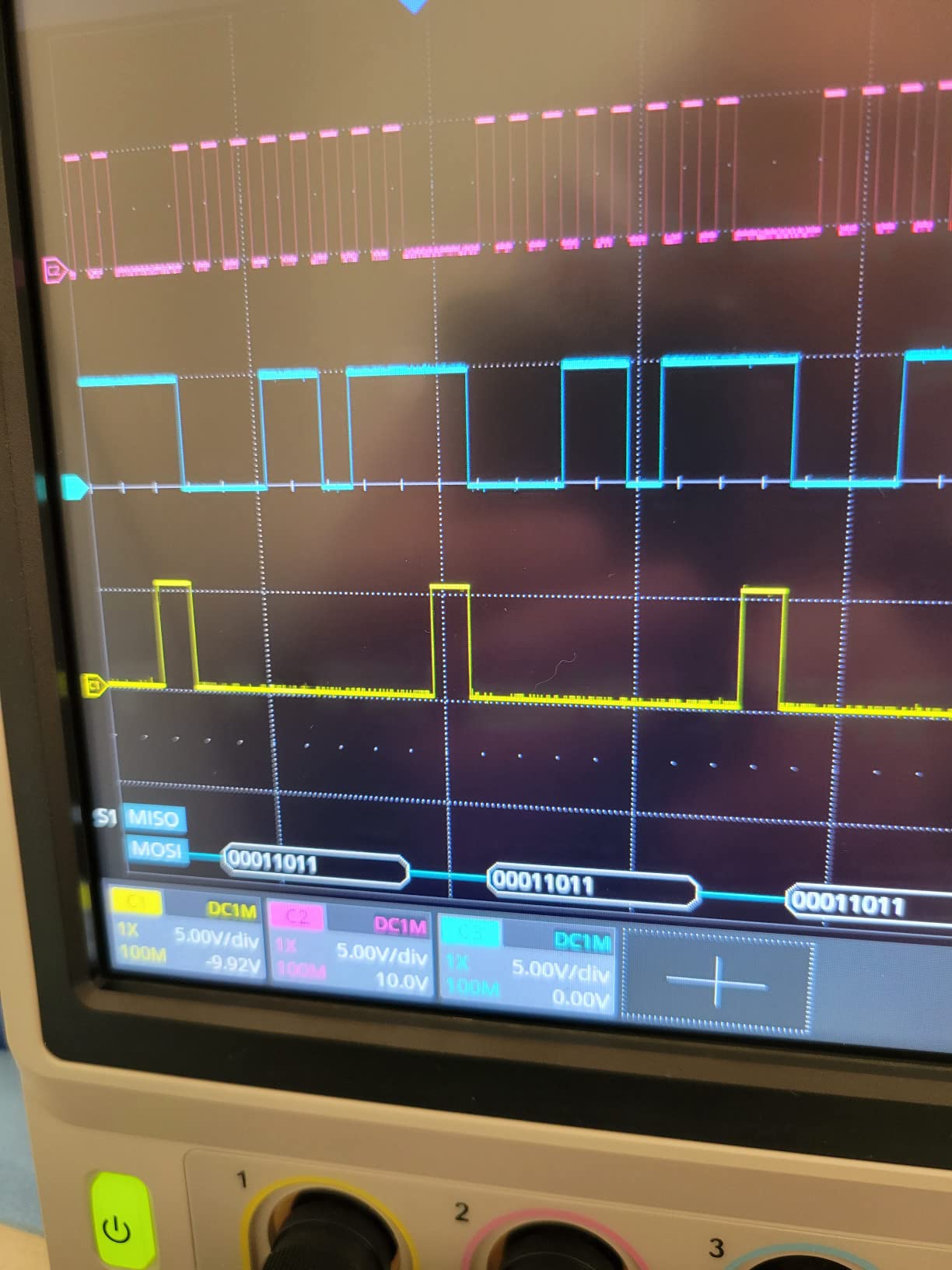
The web server is the standout feature for team environments. Multiple engineers can view the same scope display from their own browsers simultaneously, which is incredibly useful when you are pairing on a hard debugging problem. Latency is low enough that you can effectively collaborate in real time.
Standard serial decoding for I2C, SPI, UART, CAN, and LIN is included, with optional decoders for CAN FD, FlexRay, I2S, and MIL-STD-1553B available as add-ons. For most embedded and automotive work, the bundled decoders cover everything you need.
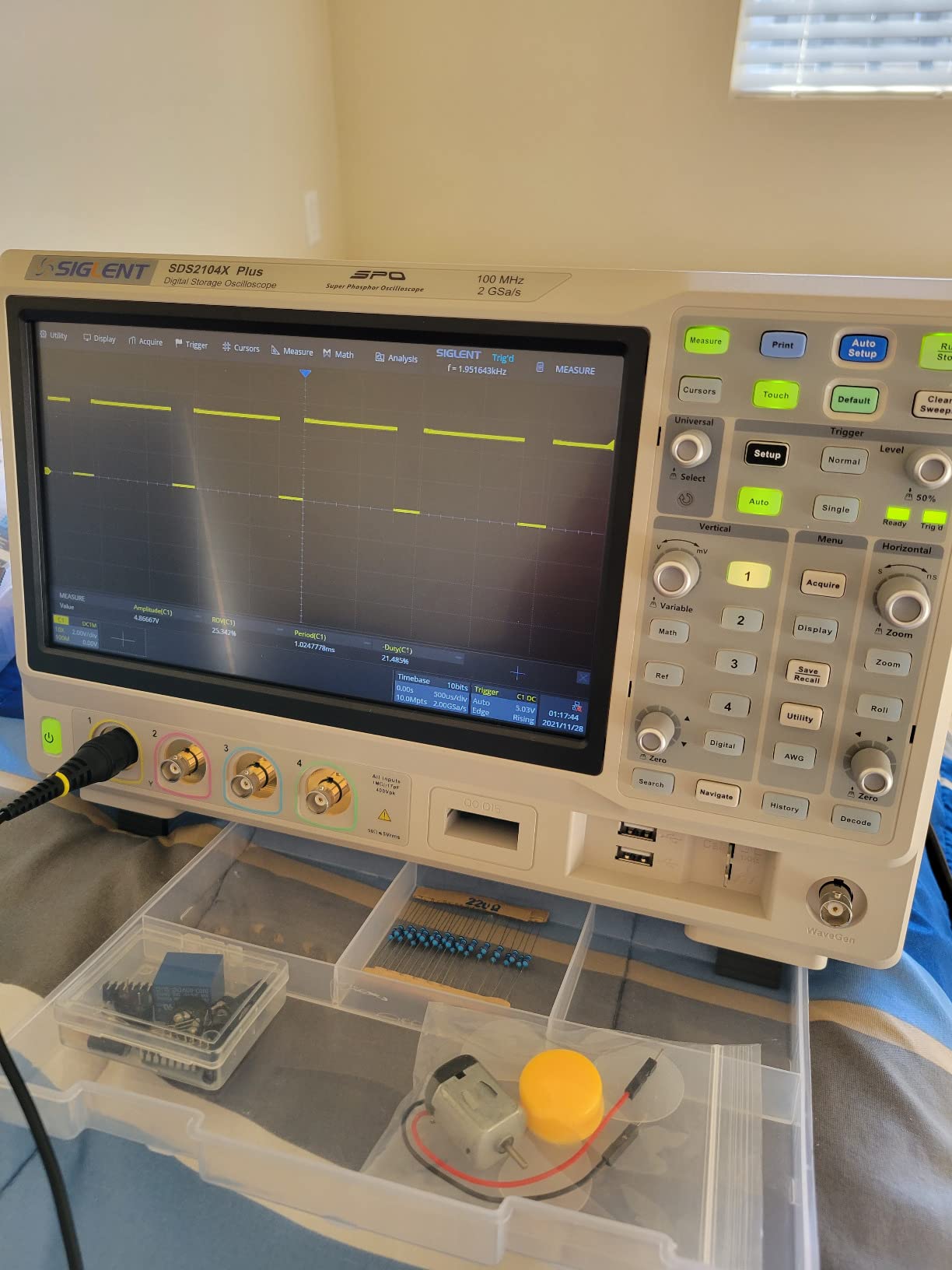
The Quick Start guide is brief and assumes you have used a digital scope before. New users will need to spend time with the full manual or YouTube tutorials to get the most out of the advanced features. Confirmation popups for common actions like clearing the screen also cannot be disabled, which slows down repetitive workflows.
For whom it is good
The SDS2104X Plus is the right choice for engineers who need deep memory for long-duration captures, large display real estate for detailed waveform inspection, and web-based collaboration. It is also well suited to lab managers building a shared bench instrument. For power electronics debugging where you need to see an entire mains cycle at high resolution, this scope excels.
For whom it is not ideal
The price places this firmly in premium territory, and you can get most of the same functionality from the SDS1104X-E or SDS814X HD for significantly less. The function generator ships in trial mode and locks after limited use unless you purchase an upgrade. If you do not need 200 Mpts of memory, the value proposition weakens compared to lower-tier Siglent models.
8. UNI-T UTD2152CEX – Budget Pick for General 2-Channel Work
UNI-T Digital Storage Oscilloscope Kit UTD2152CEX, 2 Channels 150 mhz Bandwidth 1GSa/s Sampling Rate
150MHz bandwidth
2 channels
1 GSa/s sampling
32 auto measurements
7 inch WVGA display
Pros
- Wide 1mV per division to 20V per division vertical range for varied signals
- 32 automatic waveform parameter measurements
- Waveform record and replay for transient capture
- USB plug and play for storage
- software updates
- and PC connectivity
- 7 inch widescreen display with multilingual menus
Cons
- Limited review depth makes long-term reliability hard to assess
- 2-channel limit restricts advanced multi-channel debugging
The UNI-T UTD2152CEX is the budget pick for users who want higher bandwidth than typical entry-level units without paying a premium. At 150MHz, it sits in a useful middle ground between the 100MHz scopes in this list and the 200MHz-plus tier above.
The wide vertical range from 1mV per division to 20V per division is a practical feature for varied workloads. You can probe low-amplitude sensor signals and high-voltage power rails without swapping for different probes or attenuators, which speeds up bench work considerably.
Thirty-two automatic measurements cover the common parameters like frequency, period, rise time, and RMS voltage. While experienced users will still rely on cursors for precision, the auto measurements are useful for quick sanity checks and for students who are still learning what each parameter means.
The waveform record and replay function is a useful addition. You can capture a long sequence of events, then scroll back through them at your own pace to find the one that matters. This is particularly handy when debugging intermittent issues that happen only a few times per hour.
For whom it is good
The UTD2152CEX is a sensible choice for budget-conscious buyers who need 2 channels with respectable bandwidth. It is well suited to hobbyists, repair technicians, and entry-level lab use where the workload is light. The multilingual menus and competitive price point also make it accessible to international buyers.
For whom it is not ideal
Two channels become restrictive quickly on modern projects that require monitoring clock and data lines simultaneously. Brand recognition for UNI-T is lower than Rigol or Siglent, which can affect resale value and third-party accessory availability. Review depth on Amazon is also limited compared to bigger brands, making long-term reliability harder to assess from public data.
Buying Guide: What to Look for in a Benchtop Oscilloscope
Choosing the best benchtop oscilloscope for the money comes down to matching the instrument to your actual work. Here are the specs and features that matter most, in priority order.
Bandwidth
Bandwidth is the highest-frequency signal a scope can accurately measure, and it is the single most important spec to get right. The rule of thumb is to buy a scope with at least 5 times the bandwidth of the fastest signal you expect to measure. For Arduino and basic digital work, 100MHz is plenty. For switch-mode power supplies and faster microcontrollers like ESP32 at high clock rates, 200MHz or more gives you safety margin.
Sample Rate
Sample rate is how many times per second the scope measures the input voltage, measured in samples per second (Sa/s). The Nyquist rule says you need at least twice the sample rate of your signal’s highest frequency to reconstruct it accurately, but 5 to 10 times is the practical minimum for clean waveforms. A 1 GSa/s scope with 4 channels active may drop to 250 MSa/s per channel, so look for scopes with dual ADCs that maintain sample rate across channels.
Channel Count
Two channels cover most hobbyist projects, but four channels become important quickly when debugging SPI (clock, MOSI, MISO, CS) or I2C with multiple devices on the bus. The EEVblog community strongly recommends getting 4 channels whenever budget allows, because the moment you need the third and fourth channels, no 2-channel scope will do.
Memory Depth
Memory depth is how long a capture you can store at the scope’s full sample rate. Shallow memory forces you to choose between high sample rate and long capture time; deeper memory lets you have both. For capturing serial transactions or finding intermittent glitches, 24 Mpts is a sensible minimum and 50 Mpts or more gives you more headroom.
12-Bit vs 8-Bit ADC
The ADC (analog-to-digital converter) determines vertical resolution. An 8-bit ADC divides the vertical scale into 256 steps, while a 12-bit ADC divides it into 4096 steps. The practical difference is that 12-bit scopes show much cleaner small-signal detail and lower noise floors, which matters for sensor work, audio circuits, and power supply ripple testing. For purely digital 3.3V logic, 8-bit is sufficient.
Protocol Decoding
Protocol decoding lets the scope translate SPI, I2C, UART, CAN, and LIN bus traffic into readable text on screen rather than forcing you to decode waveforms by eye. Siglent includes these decoders standard; Rigol charges extra on some models. For embedded and automotive work, free protocol decoding is essentially a must-have feature.
Rigol vs Siglent: Which Brand Should You Pick?
Rigol and Siglent are the two dominant brands in the benchtop oscilloscope market below the four-figure mark. Rigol’s strengths are a long history of community knowledge (the DS1054Z has a decade of forum answers behind it), strong deep-memory performance, and modern 12-bit DHO series touchscreens. Siglent’s strengths are typically cleaner noise floors (thanks to LeCroy analog heritage in some designs), more features included at the base price (notably CAN/LIN decoding), and dual ADC architectures that maintain sample rate across all channels.
For pure value at the 4-channel 100MHz tier, Siglent tends to win. For modern UI and 12-bit performance in the mid-tier, Rigol’s DHO series is hard to beat. Either brand will serve you well, and the specific model matters more than the brand name.
If you are also upgrading your broader workshop, our guides on the best benchtop planers and best benchtop jointers cover similar value-focused picks for woodworking tools.
Frequently Asked Questions
What is the best and most affordable oscilloscope?
The Siglent SDS1104X-E is the best and most affordable oscilloscope for most buyers. It combines 100MHz bandwidth, 4 channels, deep memory, and free serial decoding at a price that undercuts nearly every competitor in the same class. For tight budgets, the Rigol DS1102Z-E offers excellent 2-channel value.
What is the best brand for oscilloscopes?
Rigol and Siglent are the best mid-range brands, offering the strongest combination of price, features, and community support. For premium instruments, Keysight and Tektronix lead the field but at higher prices. For budget buyers, FNIRSI and Hanmatek offer entry-level value. Most professional and hobbyist buyers in 2026 choose between Rigol and Siglent for the sweet spot of capability and cost.
What is a good budget oscilloscope?
A good budget oscilloscope delivers reliable triggering, decent sample rate, and a usable display without paying for features you will not use. The Rigol DS1102Z-E at 2 channels and 100MHz is a strong pick in the entry-level tier, and the UNI-T UTD2152CEX offers 150MHz in 2 channels at a competitive price. For buyers who can stretch higher, the Siglent SDS1104X-E delivers significantly more capability per dollar.
What is the best oscilloscope for the money?
Below the four-figure mark, the Rigol DHO924S is the best premium pick thanks to its 12-bit ADC, 250MHz bandwidth, built-in AFG with Bode plot, and modern touchscreen. The Siglent SDS2104X Plus at 200 Mpts of deep memory is the best choice for long captures. For value-focused buyers, the Siglent SDS1104X-E in the mid-range tier remains our top recommendation.
Are Siglent oscilloscopes any good?
Yes, Siglent oscilloscopes are well-regarded in the electronics community. Reviewers consistently praise the clean noise floor, the dual ADC architecture that maintains sample rate across channels, and the inclusion of protocol decoding at no extra cost. Common criticisms involve add-on accessory prices and the occasional firmware quirk, but overall Siglent offers strong value across its product line.
Are Rigol oscilloscopes any good?
Yes, Rigol oscilloscopes are widely trusted and used in university labs, professional settings, and home workshops. The DS1054Z built a decade-long community following thanks to its hackable bandwidth and reliable performance. Newer DHO series scopes bring 12-bit resolution and modern touchscreens. Common criticisms include slower firmware updates and the cost of optional accessories like logic probes.
What are the key differences between Rigol and Siglent oscilloscopes?
The main differences are in included features and noise floor. Siglent typically bundles protocol decoding (CAN, LIN, I2C, SPI, UART) at the base price, while Rigol charges for some of these as options on certain models. Rigol DHO series scopes offer modern touchscreens and 12-bit vertical resolution at competitive prices. Siglent designs often have cleaner noise floors at the same price tier. For pure value at 100MHz and 4 channels, Siglent usually wins; for modern UI and 12-bit performance, Rigol’s DHO series is hard to beat.
Final Verdict: Which Benchtop Oscilloscope Should You Buy in 2026?
After testing all 8 contenders, the Siglent SDS1104X-E remains our top recommendation as the best benchtop oscilloscope for the money in 2026. It hits the sweet spot of bandwidth, channel count, memory depth, and included features at a price most hobbyists and professionals can justify.
If you need 12-bit resolution for analog precision work, the Rigol DHO924S is the clear step up. If you are on a tight budget and only need 2 channels, the Rigol DS1102Z-E delivers exceptional value. For deep memory captures that span seconds at full sample rate, the Siglent SDS2104X Plus is worth the premium.
Whichever model you choose, investing in a quality benchtop oscilloscope transforms how you debug electronics. The hours saved chasing intermittent glitches and decoding bus traffic by eye pay for the instrument many times over. Pick the scope that matches your projects today, but leave room to grow into more demanding work tomorrow.
For more value-focused tool guides, check our recommendations on the best benchtop band saws and best money counting machines.