
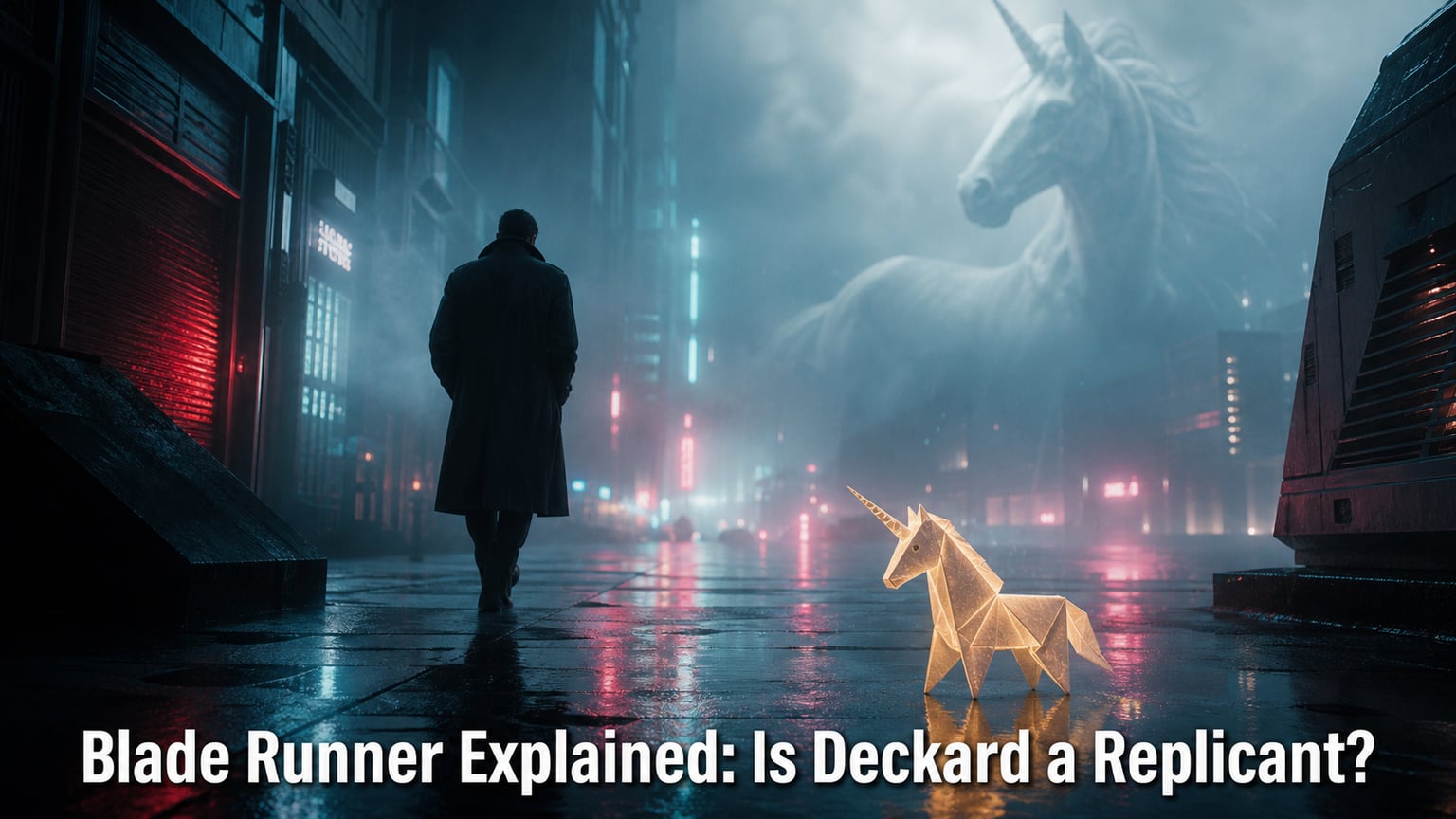
Few questions in cinema history have sparked as much debate as this one: is Deckard a replicant in Blade Runner? For over four decades, fans have dissected every frame of Ridley Scott’s 1982 neo-noir masterpiece, hunting for clues about Rick Deckard’s true nature. The answer, according to the director himself, is yes. Deckard is a replicant.
But the beauty of Blade Runner has never been in the answer alone. It lives in the evidence scattered throughout the film, the conflicting opinions of the people who made it, and the philosophical weight of what that answer means. Whether you are watching the Theatrical Cut for the first time or revisiting the Final Cut for the tenth, the question changes how you see every scene.
In this breakdown, we will walk through every major piece of evidence, from the famous unicorn dream to Gaff’s origami clue. We will cover what Ridley Scott and Harrison Ford have said, how Blade Runner 2049 handles the question, and why this debate matters far beyond simple film trivia. If you have ever wanted a clear, thorough answer to whether Deckard is a replicant, this is where that journey ends.
Table of Contents
Is Deckard a Replicant?
Yes, Deckard is a replicant. Director Ridley Scott has stated this definitively on multiple occasions, and Harrison Ford finally agreed during a 2023 interview after decades of pushing back against the idea. The weight of the film evidence supports their position.
Scott reportedly told Ford during filming that Deckard was a replicant, though Ford resisted the interpretation for years. He felt the audience needed a human anchor in the story. By 2026, Ford publicly conceded that Scott had been right all along.
The evidence builds throughout the film in layers. Some clues are visual, like the brief flash of red in Deckard’s eyes. Others are structural, like the way the narrative mirrors the replicant experience. And one piece of evidence, the origami unicorn, ties the entire argument together in a single, quiet moment.
The Unicorn Dream Sequence
The unicorn dream is the single most discussed piece of evidence in the Deckard replicant debate. In the Director’s Cut and Final Cut of the film, Deckard falls asleep at his piano and experiences a brief, dreamlike vision of a unicorn running through a forest.
On its own, the dream seems like a stylistic flourish. But its meaning becomes devastating when you understand how replicants work in the Blade Runner universe. Replicants do not have real childhood memories. Instead, the Tyrell Corporation implants them with fabricated memories to provide emotional stability.
This is explicitly shown when Deckard confronts Rachael about her nature. He describes her childhood memories in detail, proving they are not real. They were implanted. The Tyrell Corporation’s own motto, “More human than human,” takes on a darker meaning here.
If Deckard’s unicorn dream is an implanted memory, then someone else placed it in his mind. And if someone else placed it there, Deckard is a replicant. The dream is not his own. It is a manufactured experience, just like Rachael’s memories of her childhood.
This scene does not appear in the original Theatrical Cut. That version of the film, released in 1982, included studio-mandated voiceovers and a happy ending but omitted the unicorn dream entirely. Without it, the replicant theory loses its strongest pillar. This is why the debate raged so fiercely before the Director’s Cut arrived in 1992.
Gaff’s Origami Unicorn: The Smoking Gun
If the unicorn dream is the setup, Gaff’s origami unicorn is the payoff. Near the end of the film, as Deckard flees with Rachael, he finds a small origami unicorn on the floor outside his apartment. He picks it up, looks at it, and the implication hits like a freight train.
Gaff, the mysterious police officer played by Edward James Olmos, has been following Deckard throughout the film. He leaves origami figures at various points as a calling card. But the unicorn is different. It means Gaff knows about Deckard’s unicorn dream.
How could Gaff possibly know what Deckard dreams about? There is only one explanation that fits the film’s internal logic: Gaff has access to Deckard’s implanted memories. This means the dream was implanted by someone connected to Gaff, or Gaff himself was involved in Deckard’s creation.
This has led to one of the most compelling fan theories in the Blade Runner community: that Deckard has Gaff’s memories. Some fans on Reddit and sci-fi forums argue that Gaff was the original template or handler for Deckard’s persona. The origami unicorn is Gaff’s way of telling Deckard that he knows exactly what he is.
Gaff’s final line in the film reinforces this reading. He says of Rachael, “It’s too bad she won’t live, but then again, who does?” The line works as a farewell, but it also carries a chilling subtext. Gaff is telling Deckard that his own time is limited too, because Deckard, like Rachael, is a replicant with a finite lifespan.
Physical Evidence: Red Eyes and Superhuman Endurance
The unicorn dream and origami clue are narrative evidence. But Blade Runner also plants visual breadcrumbs that most viewers miss on first viewing. The most striking is the red eye glow.
Throughout the film, replicants are shown with a brief, reflective red glow in their eyes during certain shots. This is most noticeable with Roy Batty and Rachael. In one scene, after Deckard kisses Rachael, his eyes briefly flash the same red glow. It happens for just a frame or two, but it is there.
Ridley Scott has confirmed this was intentional. The eye glow is a visual signature of replicant biology, a side effect of their artificial construction. If Deckard’s eyes glow red, the visual language of the film is telling us he shares the same nature as the beings he hunts.
Then there is the question of endurance. Deckard takes a brutal beating from Leon, one of the Nexus-6 replicants. Leon is shown to have superhuman strength, capable of crushing bone and tossing a grown man like a ragdoll. Deckard survives this encounter and continues fighting throughout the film.
Reddit users frequently point out that a normal human would not walk away from the punishment Deckard absorbs. His survival suggests either extreme luck or a body built to withstand damage. Given the film’s themes, the second reading feels far more intentional.
There is also the “sixth replicant” mystery. Early in the film, Bryant tells Deckard that six replicants escaped from an off-world colony. Three were killed, and he needs Deckard to hunt down the remaining ones. But only four replicants are ever shown. Fans have long speculated that Deckard himself was the missing sixth replicant, though the production explanation is simpler: a line of dialogue was cut for time.
The Voight-Kampff Test and Its Implications
The Voight-Kampff test is the empathy-based interrogation tool that blade runners use to identify replicants. It measures involuntary physical responses, like pupil dilation and heart rate, to emotionally provocative questions. The theory is that replicants lack genuine empathy and will respond differently than humans.
Deckard administers the test to Rachael in one of the film’s most famous scenes. He asks her increasingly disturbing questions while watching her pupil responses. The test takes over a hundred questions before he can identify her as a replicant, far longer than the usual twenty to thirty. Tyrell engineered Rachael with implanted memories so thorough that she nearly passes as human.
Here is the detail most viewers miss: nobody ever tests Deckard. He spends the entire film administering the Voight-Kampff test to others, but no one ever turns the machine on him. This absence is conspicuous. If the film wanted us to be certain Deckard was human, one quick test scene would have settled it permanently.
The deeper philosophical point is that the Voight-Kampff test itself is flawed. It assumes empathy is a biological trait unique to humans. But Roy Batty demonstrates profound empathy in the film’s final act, sparing Deckard’s life and grieving for Pris. If a Nexus-6 replicant can show more mercy than the human hunting him, what does the test actually prove?
Roy Batty’s Rooftop Mercy: Tears in Rain
The rooftop confrontation between Deckard and Roy Batty is one of the most powerful scenes in science fiction cinema. After a brutal chase across the rooftops, Deckard loses his grip and begins to fall. Roy, the replicant Deckard was sent to kill, reaches down and pulls him to safety with one hand.
Roy does not save Deckard out of self-interest. He is dying, his four-year lifespan running out. He saves Deckard because he chooses to. In that moment, Roy displays more compassion than any human character in the film.
Then comes the “tears in rain” monologue. Roy sits on the rooftop as rain falls around him and delivers his final words: “I’ve seen things you people wouldn’t believe. Attack ships on fire off the shoulder of Orion. I watched C-beams glitter in the dark near the Tannhauser Gate. All those moments will be lost in time, like tears in rain. Time to die.”
Rutger Hauer, who played Roy, reportedly wrote or heavily revised this speech himself. He cut pages of scripted dialogue down to its essential core. The result is a eulogy for experiences that will vanish entirely because no one else shares them. Roy’s memories, real or implanted, are dying with him.
This scene deepens the Deckard replicant question in two ways. First, Roy’s capacity for mercy undermines the entire premise that replicants are less than human. Second, if Roy’s memories die with him, so will Deckard’s. The origami unicorn on the floor means that someone else has access to Deckard’s inner life, but that does not make his experiences any less real or any less his own.
Different Film Cuts: How the Answer Changes
One reason the Deckard replicant debate persisted for so long is that different versions of the film tell different stories. There are seven known cuts of Blade Runner, but three matter most for this discussion.
The Theatrical Cut from 1982 includes a cheerful ending where Deckard and Rachael escape together into a sunlit countryside. It also features Harrison Ford’s voiceover narration, which was added by the studio against Ridley Scott’s wishes. Crucially, this version omits the unicorn dream entirely. Without that scene, the replicant theory loses its strongest evidence, and the film plays more like a straightforward noir detective story.
The Director’s Cut, released in 1992, restores the unicorn dream and removes the voiceover. It also eliminates the happy ending, replacing it with the ambiguous elevator doors closing. This version makes the replicant theory almost inescapable. The unicorn dream and Gaff’s origami create a logical chain that points to only one conclusion.
The Final Cut, released in 2007, is Ridley Scott’s definitive version. It refines the Director’s Cut with cleaned-up effects and minor corrections. Scott has said this is the version he always wanted audiences to see. In the Final Cut, the Deckard replicant reading is not just supported. It is the intended interpretation.
Understanding which cut you are watching is essential to understanding the debate. Someone who only saw the Theatrical Cut might genuinely believe Deckard is human and have the film text to support it. Someone watching the Final Cut would struggle to argue otherwise.
Blade Runner 2049: Does It Confirm the Theory?
When Blade Runner 2049 arrived in 2017, fans hoped for a definitive answer. Denis Villeneuve’s sequel brings Harrison Ford back as an older Deckard, living in isolation in a radioactive Las Vegas. The film is rich with callbacks to the original, but does it confirm that Deckard is a replicant?
The answer is complicated. Blade Runner 2049 never explicitly states that Deckard is a replicant. Instead, it deepens the ambiguity in ways that feel intentional. Deckard has aged, which would be impossible for a standard Nexus-6 with a four-year lifespan. Unless he is a new model, or unless his lifespan was extended, his aging suggests he might be human after all.
But the film also introduces a stunning possibility: Deckard and Rachael had a child together. This child, a daughter named Ana Stelline, was born naturally. Replicants are not supposed to be able to reproduce. If Deckard and Rachael conceived a child, it means both of them may have been experimental models designed by Eldon Tyrell himself.
Jared Leto’s character, Niander Wallace, explicitly references this when he shows Deckard a holographic recreation of Rachael. Wallace wants to unlock the secret of replicant reproduction, and he believes Deckard holds the key. The implication is that Tyrell created both Rachael and Deckard as part of an experiment in replicant fertility.
Villeneuve has said in interviews that he deliberately chose not to resolve the question. He felt the ambiguity was part of what made Blade Runner great, and removing it would diminish the film’s power. Blade Runner 2049 adds fuel to both sides of the debate without picking one.
As for whether Deckard’s daughter is a replicant: Ana Stelline is presented as human, born naturally from two replicant parents. This makes her something entirely new, a bridge between human and artificial that the Blade Runner universe has never seen before.
The Philip K. Dick Novel: Do Androids Dream of Electric Sheep?
Blade Runner is loosely based on Philip K. Dick’s 1968 novel, Do Androids Dream of Electric Sheep? The novel and the film diverge significantly in tone and plot, and they also differ on the Deckard question.
In the novel, Rick Deckard is unambiguously human. He is a bounty hunter who experiences a crisis of conscience about killing androids, but his humanity is never in question. Dick never hints that Deckard might be an android. The entire philosophical tension comes from Deckard’s growing empathy for the beings he is paid to kill.
Philip K. Dick did not live to see the completed film, but he reportedly approved of what he saw during production. The replicant theory was Ridley Scott’s creation, not Dick’s. This means the central debate of Blade Runner is an invention of the film adaptation, layered on top of a story that originally had no such ambiguity.
This context matters because it shows that the question “is Deckard a replicant” is specifically a film question, not a novel question. The two works are exploring different themes. The novel asks whether empathy can bridge the gap between human and machine. The film asks whether that gap exists at all.
Why the Deckard Replicant Debate Matters: Philosophical Implications
The question of whether Deckard is a replicant is not just film trivia. It cuts to the heart of what Blade Runner is actually about. The entire film is a meditation on what it means to be human, and the answer changes depending on whether the protagonist is one of us or one of them.
If Deckard is human, the film is about a man learning to see replicants as people. His arc is one of expanding empathy, moving from cold detachment to genuine feeling. Roy Batty becomes the emotional center because he represents the humanity that Deckard slowly recognizes.
If Deckard is a replicant, the film becomes something more radical. It is about a being who does not know what he is, hunting others of his kind on behalf of humans who created him as a tool. The title “blade runner” becomes a description of oppression. Deckard is a weapon pointed at his own people.
Ridley Scott’s reading is the more philosophically provocative one. A replicant Deckard turns the entire story into a trap, a system where created beings enforce obedience on other created beings for the benefit of their makers. It echoes real-world questions about power, identity, and self-determination.
There is also a Descartes connection that some film scholars have noted. Rene Descartes famously argued that the only thing he could be certain of was his own existence: “I think, therefore I am.” But Blade Runner complicates this. Deckard thinks, feels, loves, and dreams. If those experiences are real to him, does it matter whether they were manufactured? The film suggests it does not.
FAQs
Was Deckard a human or a replicant?
Deckard is a replicant. Director Ridley Scott confirmed this interpretation, and Harrison Ford agreed in 2023. The film’s strongest evidence includes the unicorn dream sequence, Gaff’s origami unicorn, the red eye glow, and the fact that Deckard’s memories appear to be implanted.
Does 2049 confirm Deckard is a replicant?
Blade Runner 2049 does not explicitly confirm Deckard’s replicant status. Director Denis Villeneuve deliberately preserved the ambiguity. However, the film suggests that Deckard and Rachael were experimental replicants designed by Tyrell to test reproducing naturally, which adds weight to the replicant theory.
Is Deckard’s daughter a replicant?
Deckard’s daughter, Ana Stelline, is not a replicant in the traditional sense. She was born naturally from two replicant parents, making her a unique being that bridges the gap between human and artificial. She is considered human, but her existence represents something entirely new in the Blade Runner universe.
Did Deckard know Rachel was a replicant?
Deckard did not initially know Rachael was a replicant. When he administers the Voight-Kampff test to her, it takes over a hundred questions to identify her. Tyrell designed Rachael with such thorough implanted memories that she did not even know her own nature. Deckard reveals this to her later in the film.
What does the unicorn dream mean in Blade Runner?
The unicorn dream suggests that Deckard has implanted memories, which is a hallmark of replicants in the Blade Runner universe. The dream gains significance when Gaff leaves an origami unicorn outside Deckard’s apartment, proving that someone else knows about the dream. This means the dream was programmed into Deckard, confirming he is a replicant.
Why does Roy save Deckard?
Roy Batty saves Deckard on the rooftop as an act of pure mercy and empathy. Despite being hunted by Deckard, Roy demonstrates more compassion than any human character in the film. This act reinforces the film’s central theme that replicants can be more humane than humans, and it echoes the Tyrell Corporation motto: More human than human.
Conclusion
So, is Deckard a replicant? The evidence points to yes, and both the director and the lead actor have confirmed it. The unicorn dream, Gaff’s origami, the red eye glow, the unexplained physical endurance, and the conspicuous absence of anyone testing Deckard all converge on the same answer.
But the real power of Blade Runner is that the question matters less than what it forces us to confront. If Deckard can love, grieve, question his purpose, and dream of unicorns, the line between human and replicant dissolves. The film asks us to consider whether that line was ever real to begin with.
Next time you watch Blade Runner, look for the clues yourself. Watch Deckard’s eyes in the Rachael scene. Track Gaff’s origami throughout the film. Sit with Roy Batty’s final words on the rooftop and let them land. The question “is Deckard a replicant” is not just about solving a mystery. It is about understanding why the mystery exists in the first place, and what it tells us about empathy, identity, and what we choose to call human.