
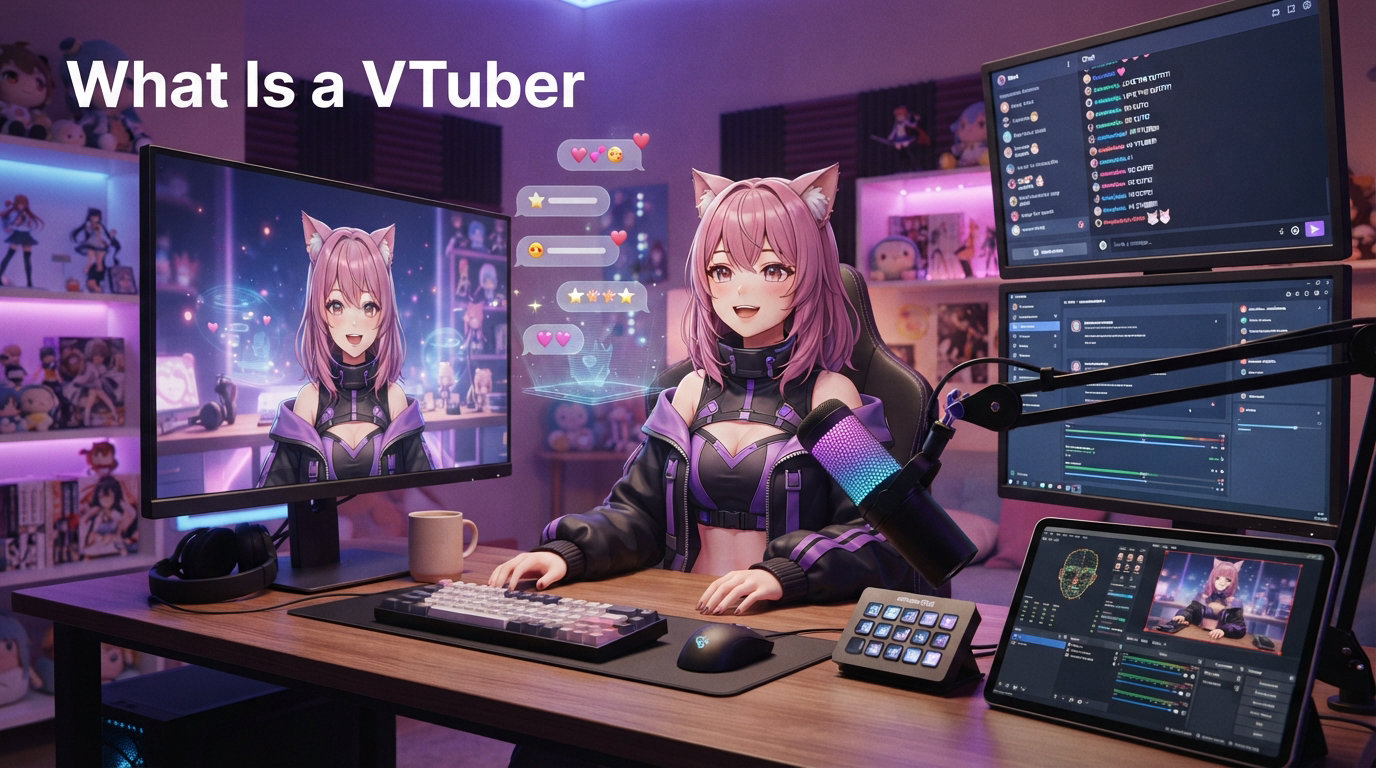
A VTuber (short for Virtual YouTuber) is a real person who streams and creates content online using a digital avatar instead of showing their real face. That avatar, usually styled like an anime character, is animated in real time through motion capture and facial tracking software. I have spent the last year watching VTubers, talking to indie creators, and digging into how the medium works, and I want to share what I learned in plain language.
The question “what is a VTuber” matters because this corner of the internet has grown into a multi-billion dollar global industry. VTubers now top music charts, sell out virtual concerts, and pull more concurrent viewers than most traditional cable channels. If you have ever wondered why someone would stream as a cartoon character, or how the technology actually works, this guide will walk you through everything.
Before we walk through the technology and the culture, here is the one-sentence answer up front: a VTuber is a real human who performs online as a digital character, combining the intimacy of live streaming with the creativity of anime-style performance. Keep that definition in mind as we break down each piece in detail.
Table of Contents
What Is a VTuber? The Short Answer
A VTuber is a content creator who performs online through an animated avatar controlled by real-time motion capture. The person behind the avatar is a real human. They speak with their real voice, react with their real emotions, and run their own channel. The only difference from a traditional streamer is the digital mask on top.
The term VTuber started on YouTube in Japanese online culture, where it described any online entertainer using a virtual avatar. Today the label covers creators on YouTube, Twitch, Bilibili, and several other platforms. Most VTubers use anime-style 2D or 3D characters, though the style can range from realistic humans to mascot animals to abstract fantasy beings.
If you only remember one thing from this guide, remember this: behind every VTuber avatar is a real person with a real personality, real skills, and a real community. The avatar is a creative lens, not a replacement for the human behind it.
How Does a VTuber Actually Work? The Technology Behind the Avatar
A VTuber streams through software that tracks their face and voice, then drives a digital character on screen in real time. The viewer sees only the avatar moving, blinking, and talking, even though a real person is sitting in front of a camera somewhere in the world. This is what makes VTubing different from regular animation or voice acting. Every reaction happens live.
The basic pipeline is simple. A camera captures the creator’s face. Tracking software reads key points like the eyes, mouth, and eyebrows. That data feeds into a rigged avatar model. The avatar renders on screen, mirroring every movement within a fraction of a second. The creator’s voice is captured separately by a microphone and layered on top.
Motion Capture and Facial Tracking
Most VTubers use a standard webcam or a dedicated face-tracking camera to capture their expressions. Software like VTube Studio, Live2D Cubism, or Animaze reads dozens of points on the face and translates them into avatar movements. When the creator smiles, the avatar smiles. When they tilt their head, the avatar tilts too. Eye tracking, mouth shapes, and even small eyebrow raises get mirrored on the digital character within milliseconds.
For full-body tracking, some VTubers add extra hardware. They might use an iPhone mounted above them with a tracking app, a Vive tracker strapped to their waist, or full-body moc suits. This is more common among 3D VTubers who perform choreographed dances or virtual concerts. Most indie creators stick with face and upper-body tracking, which is enough for talking, gaming, and casual streams.
Voice adds the final layer. Most VTubers use a regular USB condenser microphone, and some add a real-time voice changer for comedic effect or character consistency. Audio is mixed in OBS or a similar streaming tool, then sent out to viewers along with the rendered avatar.
Live2D vs 3D Models
Live2D is the most common technology behind 2D VTuber avatars. It uses a flat illustration that is rigged with multiple layers, so the software can rotate the head, blink the eyes, and bounce the hair without redrawing anything. Live2D models look like 2D anime art, but they move in three dimensions on the X and Y axes. They are cheaper to commission, easier to run on a normal computer, and very expressive for talking content.
3D VTuber models, on the other hand, are built in software like VRChat, Unity, or Blender. They can rotate fully in 3D space, support full-body tracking, and are the standard for concerts and large-scale agency productions. The trade-off is cost. A custom 3D model often runs higher than a 2D one, and the creator needs a more powerful PC to render it smoothly during streams.
A Brief History of VTubers: From Kizuna AI to Global Phenomenon
VTubing as we know it started in 2016 when a Japanese creator named Kizuna AI uploaded her first videos to YouTube. She introduced herself as the world’s first Virtual YouTuber, performed comedy skits, and played games with her chat. Her channel exploded in Japan and across Asia, and she became the template every agency would later copy.
Within a few years, dedicated agencies began signing and training VTubers in groups. Cover Corp launched Hololive Production and grew it into a global entertainment brand. ANYCOLOR followed with Nijisanji. Western agencies like VShojo built their own rosters of independent talent. By 2026, major VTubers like Hololive English’s Gawr Gura and Takanashi Kiara had crossed 2 million subscribers each, and the format had spread to every major streaming platform.
The growth has not slowed. Virtual concerts, voice-actor crossovers, manga collaborations, and brand partnerships now define the top of the industry. New indie VTubers also launch every week, many starting with little more than a webcam and a $50 Live2D model. The format has become a permanent fixture of online entertainment.
2D vs 3D VTuber Avatars: Key Differences
2D VTuber avatars are flat illustrations animated through Live2D rigging, while 3D VTuber avatars are full three-dimensional models rendered in real time. Both styles can be expressive and engaging. The right choice depends on your content style, budget, and the kind of motion you want to perform.
- Cost: Live2D models typically run from $50 for a basic commission to over $1,000 for high-end artwork. 3D models often start around $500 and climb into the thousands for custom rigs.
- Hardware needs: 2D avatars run smoothly on most modern laptops. 3D avatars usually need a dedicated gaming PC with a strong GPU.
- Movement range: 2D Live2D models handle head tilts, eye darts, and facial expressions beautifully. 3D models add full body rotation, walking, and dance.
- Best use cases: 2D suits talking streams, gameplay, and casual chatting. 3D fits virtual concerts, choreographed events, and VRChat worlds.
Many creators start with 2D and upgrade to 3D later as their audience grows. The technology keeps getting cheaper, and free base models make it possible to test the waters before spending serious money. There is no wrong choice. The best avatar is the one that fits your personality and the experience you want to give your viewers.
Where VTubers Stream: Popular Platforms and Agencies
VTubers stream on every major platform, but YouTube and Twitch dominate the space. YouTube is the home base for most Japanese and international agencies because of its reliable monetization, VOD archive, and recommendation algorithm. Twitch hosts a growing community of English-speaking VTubers, particularly those focused on gaming and Just Chatting streams. Bilibili remains huge in China, and smaller scenes exist on Twitter Spaces, TikTok Live, and niche platforms.
Behind the scenes, agencies play a major role. The biggest names to know are:
- Hololive Production (Cover Corp): Home to Hololive, Holostars, and Hololive EN. Known for high production value, concert events, and global reach.
- Nijisanji (ANYCOLOR): One of the largest rosters in the world, with dozens of JP, EN, ID, and KR branches.
- VShojo: A Western-focused agency that markets itself on creative freedom and creator ownership.
- Independent VTubers: The majority of the scene. These creators handle their own branding, art, and streaming setup.
Agency VTubers typically get training, production support, and a salary, while indies keep full control and keep more of their revenue. Neither path is better. It depends on what kind of creator you want to be. Many successful VTubers stay independent their entire careers, while others find agency support valuable for big projects like concerts and brand campaigns.
Why People Become VTubers: Anonymity, Creative Freedom, and Community
People become VTubers for privacy, performance comfort, and creative expression. A digital avatar lets creators separate their public persona from their offline life in a way that no other streaming format offers. Some VTubers I have spoken with said the avatar gave them the courage to start at all, because they did not want to put their real face on camera.
Stage fright is a bigger reason than most people expect. Performing in front of a live audience is hard, even through a screen. The avatar acts as a kind of armor that absorbs some of the pressure. Several creators have shared that they would never have started streaming if they had to use a facecam. The character gives them permission to take up space and be loud in ways they would not feel safe doing otherwise.
There is also a deep creative layer. Designing an avatar is its own art form. Creators work with illustrators, riggers, and modelers to bring a character to life, and that character becomes an extension of their personality. Some VTubers run multiple characters, each with a different voice and style, almost like a one-person theater troupe.
Finally, community culture is a huge draw. VTuber audiences tend to be loyal, deeply engaged, and quick to defend their favorite creators. Inside jokes, lore videos, fan art, and clip culture form around every channel. The result is something that feels closer to a fandom than a typical subscriber base. That sense of belonging pulls both viewers and creators back into streams every week.
What Do VTubers Do? Common Content Types
VTubers stream the same kinds of content traditional streamers do, but with a digital character on screen. Gaming is the biggest category, including horror playthroughs, RPGs, FPS titles, and indie gems. Music is another pillar. Many VTubers perform original songs, host karaoke streams, and release cover albums that chart on Spotify and Billboard Japan.
Other popular formats include:
- Talk shows and chatting: The Just Chatting format works perfectly with VTuber avatars because the visual focus is the character itself.
- ASMR and roleplay: The avatar removes the real-face barrier, making voice-led content more immersive.
- Educational content: Language learning, history breakdowns, and tech explainers all have VTuber presenters.
- Virtual concerts: Hololive and Nijisanji regularly host arena-scale virtual events with full 3D choreography.
The format is flexible. Almost any content that works on a regular stream works just as well through a VTuber avatar. Some creators even blend categories, switching between gaming, singing, and chatting within a single marathon stream.
How Much Does It Cost to Become a VTuber?
Starting as a VTuber can cost anywhere from $0 to several thousand dollars, depending on how custom you want your setup to be. At the lowest end, you can download a free Live2D base model, use VTube Studio for free, and stream with a webcam you probably already own. That gets you on every platform tonight.
A more typical indie setup includes a custom Live2D model from an artist, a decent face-tracking webcam, and possibly a basic green screen or lighting kit. Most creators land somewhere in this range for their first year. Premium VTubers with full 3D models, custom rigs, and full-body tracking can spend well into the five-figure range on their avatar alone.
Software is usually the cheap part. VTube Studio, Live2D Cubism, and most rigging tools have free or low-cost tiers. The big variable is the artist commission, and prices depend heavily on the illustrator’s reputation and queue position. My advice: start with a small budget, prove the concept, and upgrade the model when you know streaming is something you want to commit to.
Frequently Asked Questions About VTubers
What is the point of a VTuber?
The point of a VTuber is to let real creators perform online through a digital avatar, which gives them privacy, creative freedom, and a unique brand. Many people become VTubers because they want to stream without showing their face, build a fictional character, or connect with fans who love anime-style content. The avatar becomes a creative outlet and a stage for music, gaming, and conversation.
Do VTubers ever face reveal?
Some VTubers do face reveal, but most choose to keep their identity private. Face reveals are sometimes used for milestones like hitting a subscriber goal, graduating from an agency, or launching a new project. Many creators, however, prefer to keep their offline identity separate from their channel. There is no rule either way, and fans generally respect whichever choice a VTuber makes.
Do VTubers make money?
Yes, VTubers can make money through ad revenue, sponsorships, donations, merchandise, music royalties, and concert ticket sales. Top agency VTubers earn full-time salaries plus bonuses. Independent VTubers rely more on Super Chat, memberships, and brand deals. Income varies widely, but successful VTubers can absolutely make a living from their channel.
How much do VTuber models cost?
VTuber models range from free to several thousand dollars. Basic Live2D commissions start around $50 to $200 for newer artists. Mid-range models from established illustrators run $300 to $1,000. Premium Live2D rigs and full 3D models often cost $1,000 to $5,000 or more. Many indie VTubers start with a cheaper model and upgrade as their channel grows.
Final Thoughts on What Is a VTuber
Now you know what a VTuber is, how the technology works, and why millions of people around the world tune in every week. VTubing is one of the most creative corners of live streaming, blending art, performance, and real-time animation into something that feels like nothing else online.
If you are curious about watching more, pick a creator whose art style catches your eye, drop into one of their streams, and say hello in chat. If you are thinking about becoming a VTuber yourself, start small with a free model and a webcam, then build from there. The community is welcoming, the tools are accessible, and the only limit is the character you want to bring to life.