
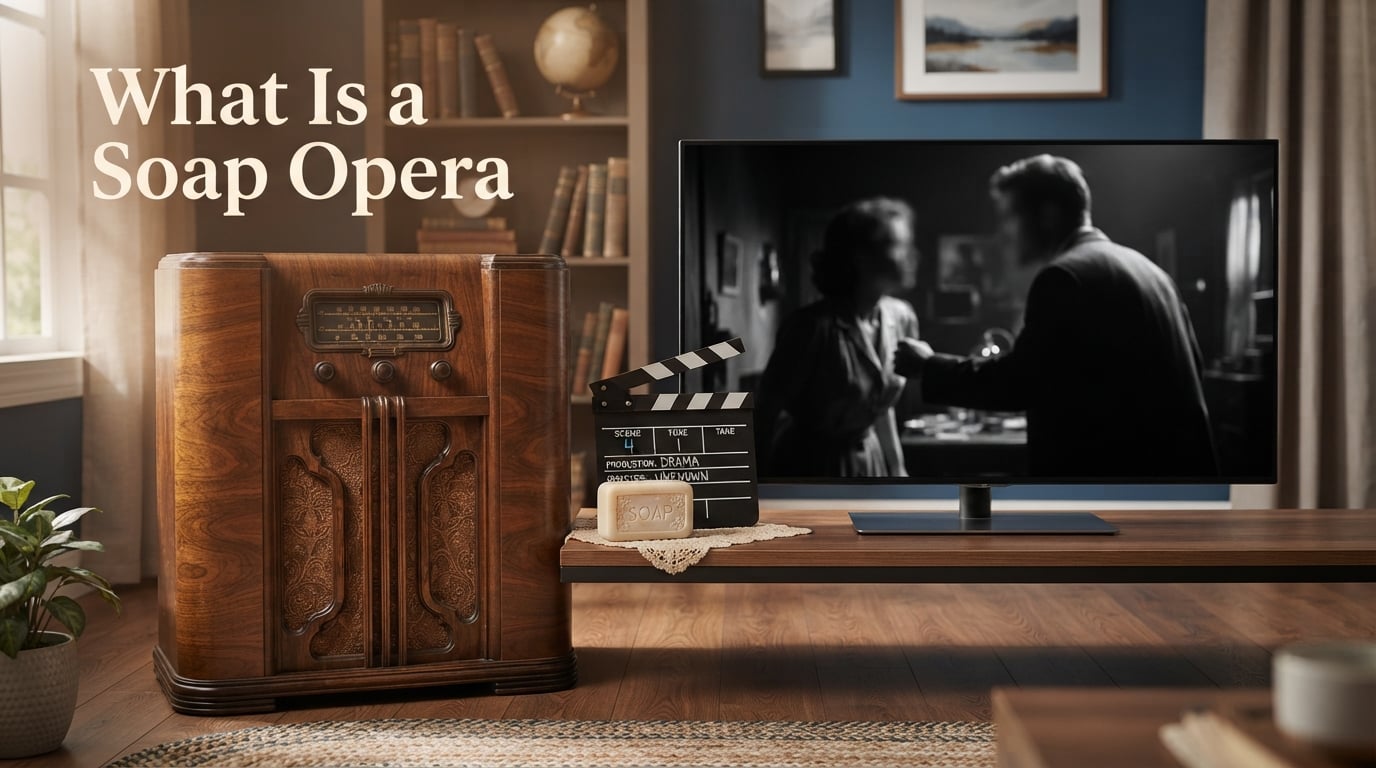
A soap opera is a serialized radio or television drama characterized by ongoing storylines, emotional melodrama, ensemble casts, and a focus on personal relationships over action. The name comes from early sponsors, household-product manufacturers like Procter & Gamble, who funded the first programs in the 1930s.
If you have ever wondered what is a soap opera and why the genre has survived for nearly a century, you are not alone. Fans on communities like Reddit’s r/SoapOperas and r/television frequently debate the definition, and many people are surprised to learn that some of their favorite streaming dramas carry soap opera DNA.
In this guide, our team breaks down the soap opera definition, traces the genre from its 1930s radio roots through its golden age on daytime television, and examines how serialized storytelling has evolved in the streaming era. We also address the questions real viewers ask, including whether shows like Grey’s Anatomy count and why the classic daytime format has declined.
Whether you grew up watching storylines with a parent or grandparent, are researching television history, or simply want to understand a term that gets thrown around a lot in pop culture, this article covers everything you need to know.
By the end, you will understand the origins of soap operas, their defining characteristics, how they shaped the modern television landscape, and where the format is heading next.
Table of Contents
What Is a Soap Opera? Definition and Etymology
A soap opera, also known as a daytime drama or continuous serial, is a long-running broadcast program that tells interconnected stories across many episodes or even decades. Unlike a limited series or procedural drama, a soap opera never truly wraps up its narrative. Instead, storylines overlap, characters return, and conflicts evolve indefinitely.
The official soap opera definition centers on several hallmarks: a permanent or semi-permanent ensemble cast, continuing storylines that carry from one episode to the next, an emphasis on emotional and interpersonal drama, and a serialized structure that rewards daily or weekly viewing. Britannica describes the format as having a slower-than-life pace, a sentimental or melodramatic tone, and dialogue-driven storytelling rather than action-driven plots.
The question of why soap operas are called soap operas has a surprisingly literal answer. In the early 1930s, companies that manufactured household cleaning products, primarily soap and detergents, began sponsoring serialized daytime radio programs. Procter & Gamble, Colgate-Palmolive, and Lever Brothers were the most prominent backers. These companies targeted the primary daytime radio audience at the time: housewives managing households.
The word “soap” refers directly to those cleaning-product sponsors. The word “opera” was added somewhat tongue-in-cheek, borrowing from the grand, emotional scale of operatic performance. The melodramatic storylines involving romance, betrayal, family secrets, and scandal felt oversized and theatrical, much like a traditional opera.
The term “daytime drama” emerged as a more dignified alternative, and it is the label most industry professionals prefer. However, “soap opera” remains the term most people recognize, and it has expanded beyond daytime television to describe any long-form serialized drama with a heavy emphasis on relationships and ongoing character conflict.
It is worth noting that in everyday conversation, people sometimes use “soap opera” dismissively to describe something overly dramatic or exaggerated. But the genre itself has a rich history, sophisticated storytelling conventions, and a cultural footprint that extends far beyond the stereotypes.
The History of Soap Operas: From Radio to Television
The history of soap operas begins on the radio, not the television screen. In 1930, a writer and former actress named Irna Phillips created what is widely considered the first soap opera, a program called Painted Dreams, which aired on Chicago radio station WGN. The show focused on an Irish-American widow and her daughter, exploring their daily struggles with romance, family obligations, and moral dilemmas.
Irna Phillips is arguably the most influential figure in soap opera history. She went on to create or co-create several landmark serialized dramas, including The Guiding Light (later shortened to Guiding Light), As the World Turns, and Another World. Her storytelling philosophy, which prioritized character psychology and moral conflict over action and spectacle, became the blueprint for the entire genre.
By the mid-1930s, serialized daytime radio dramas had become a broadcasting phenomenon. Dozens of shows filled the daytime airwaves, each sponsored by a household-products company aiming to reach the predominantly female audience at home during the day. Programs like Ma Perkins, The Romance of Helen Trent, and Stella Dallas attracted millions of loyal listeners who tuned in every single day.
The sponsor-funded model was the backbone of this era. Procter & Gamble did not just buy ad time. The company actually produced many of the shows through its own subsidiary, giving it direct creative input. This arrangement was so profitable that Procter & Gamble continued producing soap operas well into the television age, and the company’s involvement lasted until the early 2000s.
World War II temporarily disrupted broadcasting schedules, but serialized dramas proved resilient. The format offered comfort and continuity during uncertain times, and audiences grew even more attached to their favorite characters and families. Shows addressed wartime concerns subtly, weaving patriotism and social change into their ongoing narratives.
The origins of soap operas as a distinctly American format cannot be overstated. While serialized storytelling existed in other forms of literature and theater, the daily broadcast serial created specifically for a commercial radio audience was a uniquely American innovation. It established the production model, narrative conventions, and audience expectations that would define the genre for decades.
As television emerged in the late 1940s, the serialized drama faced a critical transition. Radio audiences were shrinking, and advertisers wanted visual programming. Some producers doubted that the intimate, dialogue-heavy format would translate to a visual medium. They were spectacularly wrong.
Key Characteristics That Define a Soap Opera
Understanding the key characteristics of a soap opera helps distinguish the genre from other types of serialized television. Forum discussions on Reddit reveal genuine confusion about what qualifies as a soap opera versus a standard drama, and the line can be blurry. However, several defining traits set the format apart.
The following characteristics are what make a soap opera a soap opera:
- Serialized, continuous narrative: Storylines carry over from episode to episode without clean resolution. A plot that begins in one episode may not conclude for weeks or months, and new conflicts emerge before old ones fade.
- Permanent ensemble cast: Soap operas revolve around a core group of characters who appear across hundreds or thousands of episodes. Even when actors are recast, the characters themselves persist for decades.
- Emotional melodrama: The genre prioritizes personal relationships, romantic entanglements, family conflicts, betrayal, and moral dilemmas. High-stakes emotional moments are the engine of the story.
- Cliffhanger endings: Episodes frequently end on unresolved moments to keep viewers coming back. The classic Friday cliffhanger became a cultural ritual for daytime audiences.
- Dialogue-driven storytelling: Rather than relying on action sequences or visual spectacle, soap operas advance their plots through conversation, confrontation, and confession. Characters talk through their problems, schemes, and secrets at length.
- Slower narrative pace: Compared to primetime dramas, soap operas unfold at a deliberate pace. This allows for deep character development but can test the patience of viewers accustomed to faster storytelling.
- Multiple interwoven storylines: Several plot threads run simultaneously, often involving different character groups. This structure keeps every episode feeling fresh even within a decades-old framework.
- Recasting and character longevity: Characters can be played by multiple actors over the years. The character, not the performer, is the constant.
These characteristics also explain the difference between a soap opera and a regular TV show. A standard procedural drama like a police show typically resolves its central conflict within a single episode. A sitcom follows a comedic format with self-contained stories. A soap opera, by contrast, prioritizes long-term character development and open-ended storytelling over episodic resolution.
This distinction matters more than ever in the streaming era, when serialized storytelling has become the norm across prestige television. Many of today’s most acclaimed dramas borrow heavily from soap opera conventions, even if they would never use the label.
The Evolution of Soap Operas on Television
The transition from radio to television was the most significant turning point in soap opera history. The first television soap opera is generally credited to these early experiments in the late 1940s, but the format truly took off in the 1950s.
Guiding Light made the leap from radio to television in 1952, becoming the first major serialized drama to successfully bridge both mediums. The show had begun on NBC Radio in 1937 and continued simulcasting on both radio and television until the radio version ended in 1956. Guiding Light then ran on television until 2009, making it the longest-running scripted television program in history at 72 years across both media.
Through the 1950s and 1960s, daytime television became the natural home for serialized drama. Shows like Search for Tomorrow (1953), The Edge of Night (1956), and As the World Turns (1956) established the visual conventions audiences still recognize today. The introduction of color broadcasting in the 1960s added visual richness to what had been intimate, black-and-white storytelling.
The half-hour format dominated the early television era, but by the 1970s, many shows expanded to a full hour. This allowed for more complex storylines, larger casts, and the kind of multi-thread narrative depth that became the genre’s signature. The expansion reflected growing audiences and increasing advertiser investment.
Production values also evolved significantly. Early television soap operas were often performed live, with minimal sets and frequent technical hiccups. As the medium matured, shows adopted multi-camera setups, more sophisticated lighting, and location filming. Yet the core remained the same: character-driven drama told across hundreds of episodes.
The daytime schedule itself became an institution. For decades, the afternoon hours from roughly noon to four o’clock were dominated by serialized dramas on the major broadcast networks. This scheduling created a daily ritual for millions of viewers, and it built the deep audience loyalty that defined the genre’s golden age.
The Golden Era and the 1970s Social Revolution
The period from the late 1960s through the 1980s is widely considered the golden era of American soap operas. Audiences were massive, cultural influence was enormous, and the genre took creative risks that pushed the boundaries of what daytime television could address.
The 1970s brought a social revolution to soap operas that changed the format forever. Shows began tackling controversial topics that mainstream television had previously avoided. Abortion, interracial marriage, addiction, mental illness, and later the HIV/AIDS crisis all found their way into serialized storylines. This willingness to confront real-world issues gave the genre new relevance and attracted a broader, more diverse audience.
General Hospital became a cultural phenomenon in the late 1970s and early 1980s, largely due to the supercouple pairing of Luke Spencer and Laura Webber. Their 1981 wedding drew an estimated 30 million viewers, making it one of the most-watched events in daytime television history. The show’s blend of adventure, romance, and high-stakes melodrama redefined what a soap opera could be.
Other landmark shows of the era included Days of Our Lives, which built a devoted following through its multi-generational family sagas, and All My Children, created by Agnes Nixon, which became known for its socially conscious storytelling. All My Children was among the first daytime dramas to seriously address topics like war protest, sexual identity, and medical ethics.
The golden era also saw the rise of prime-time soap operas. Shows like Dallas (1978), Dynasty (1981), and Knots Landing (1979) brought serialized melodrama to evening audiences with bigger budgets, glamorous settings, and celebrity casts. Dallas in particular became a global sensation, and the 1980 “Who Shot J.R.?” cliffhanger remains one of the most famous moments in television history.
Prime-time soaps proved that the serialized, relationship-driven format could succeed outside the daytime slot. They attracted male viewers who might never have tuned in to a traditional daytime drama, and they demonstrated that the genre’s storytelling tools were powerful enough to compete with any format on television.
Agnes Nixon deserves special recognition alongside Irna Phillips as a foundational figure. Nixon created both All My Children and One Life to Live, and she championed the idea that soap operas should reflect the diversity and complexity of real American life. Her influence shaped the genre’s most socially ambitious era.
The Streaming Era: How Soap Operas Survive Today
The story of soap operas in the 21st century is one of decline and transformation. Traditional daytime soap operas have seen their numbers dwindle dramatically. In 2026, only a handful of daytime serials remain on American broadcast television, including General Hospital, The Bold and the Beautiful, The Young and the Restless, and Days of Our Lives.
Several factors drove this decline. Changing workforce demographics meant fewer people were home during daytime hours. The rise of cable television, talk shows, and reality programming fragmented the daytime audience. Budget pressures led networks to replace expensive scripted dramas with cheaper alternatives. Between 2000 and 2015, more than a dozen long-running soap operas were cancelled, including Guiding Light, As the World Turns, All My Children, and One Life to Live.
But the soap opera did not die. It evolved. The streaming era has absorbed the genre’s DNA and redistributed it across platforms in new forms.
Streaming services have embraced serialized storytelling with an enthusiasm that would have been unthinkable two decades ago. Shows on Netflix, Hulu, Amazon Prime, and other platforms routinely use the continuing-storyline model, ensemble casts, cliffhanger endings, and relationship-driven melodrama that soap operas pioneered. The difference is that modern streaming dramas rarely use the soap opera label, preferring terms like prestige drama or limited series.
However, many acclaimed streaming and primetime shows function as soap operas in everything but name. Grey’s Anatomy, for example, has run for over two decades with continuing storylines, a rotating ensemble cast, romantic entanglements, and cliffhanger finales. The same could be argued for shows like This Is Us, Succession, Yellowstone, and Outer Banks. These programs employ the core mechanics of the soap opera format wrapped in higher production values and contemporary sensibilities.
The streaming era has also globalized the soap opera audience. Telenovelas, the Latin American variant of the serialized drama, have found massive international reach through streaming platforms. Shows from Mexico, Colombia, Brazil, and other countries now reach viewers worldwide. Unlike American daytime soaps, which run indefinitely, telenovelas typically tell a complete story over a set number of episodes, usually between 100 and 200.
Beyond Latin America, other regions have their own rich soap opera traditions. British soap operas like Coronation Street (running since 1960) and EastEnders remain cultural institutions. Australian shows like Neighbours and Home and Away have international fanbases. Korean dramas, Turkish dizis, and Indian serials all draw from the same serialized, melodramatic roots that define the genre globally.
The biggest change streaming has brought is the binge-watching model, which has altered the cliffhanger culture that soap operas traditionally relied on. Instead of waiting a day or a week for resolution, modern viewers consume entire seasons at once. Some fans on forums like Reddit express nostalgia for the anticipation that weekly cliffhangers created, noting that instant gratification has changed the emotional rhythm of serialized drama.
Still, the core appeal of the soap opera endures. Audiences continue to crave ongoing character relationships, emotional stakes, and stories that unfold over time. The format has simply found new vehicles and new platforms to deliver what it always has.
Cultural Impact: Why Soap Operas Still Matter
The cultural impact of soap operas extends far beyond entertainment ratings. The genre pioneered serialized storytelling on broadcast media, establishing the narrative architecture that virtually all modern prestige television relies on. Every show that tells a continuing story across multiple episodes owes a debt to the format that Irna Phillips and her successors built.
Soap operas also broke ground on social issues long before prime-time programming dared to. Topics like abortion, HIV/AIDS, sexual assault, and addiction reached mass audiences through daytime drama storylines, often humanizing issues that mainstream media treated as taboo. For many viewers, these storylines were their first exposure to complex social topics presented with empathy and nuance.
The generational connection fostered by soap operas is perhaps their most enduring legacy. Millions of people grew up watching these shows with parents or grandparents, creating shared cultural touchstones that spanned age groups. That ritual of daily viewing built communities and created bonds that streaming-era viewers, consuming content alone on individual devices, often find themselves missing.
Frequently Asked Questions About Soap Operas
Is Grey’s Anatomy considered a soap opera?
Grey’s Anatomy is not a traditional daytime soap opera, but it functions as one in many ways. It features continuing storylines, a rotating ensemble cast, romantic entanglements, and cliffhanger finales across more than 20 seasons. Most critics classify it as a primetime medical drama with strong soap opera elements rather than a soap opera in the classic daytime sense.
What is the difference between a soap opera and a regular TV show?
A soap opera features continuous, open-ended storylines that never fully resolve, a permanent ensemble cast, and a focus on interpersonal melodrama. A regular TV show, such as a procedural drama or sitcom, typically resolves its main conflict within a single episode and resets for the next one. Soap operas prioritize long-term character development over episodic closure.
Do soap operas still exist?
Yes, soap operas still exist in 2026. Four daytime soap operas remain on American broadcast television: General Hospital, The Bold and the Beautiful, The Young and the Restless, and Days of Our Lives. Additionally, the serialized storytelling format has been absorbed by streaming platforms, and international soap operas like British and Latin American shows continue to thrive.
What is the difference between a soap opera and a sitcom?
A soap opera is a serialized drama with ongoing storylines, emotional conflict, and cliffhanger endings designed to keep viewers returning daily or weekly. A sitcom is a comedic format with self-contained episodes that typically resolve their storyline within 30 minutes. Sitcoms focus on humor and recurring scenarios, while soap operas focus on sustained dramatic tension and character relationships.
What soap opera ran for 72 years?
Guiding Light holds the record as the longest-running scripted television program in history. It began on NBC Radio in 1937, transitioned to CBS Television in 1952, and aired its final episode in 2009. Across both radio and television, the show ran for a combined 72 years, making it an unparalleled milestone in broadcasting history.
Why did soap operas go away?
Traditional daytime soap operas declined due to several factors: changing workforce demographics that reduced the daytime audience, the rise of cable and streaming competition, the popularity of cheaper talk and reality shows, and network budget cuts. More than a dozen long-running soaps were cancelled between 2000 and 2015. However, the format survived by evolving into the serialized dramas found on modern streaming platforms.
What is the oldest soap opera still running today?
The oldest American soap opera still producing new episodes is General Hospital, which premiered on ABC on April 1, 1963. It has aired continuously for over 60 years. Globally, the British soap opera Coronation Street has been on the air since December 1960, making it one of the longest-running television programs of any kind in the world.
The Enduring Legacy of the Soap Opera
Understanding what is a soap opera means recognizing that the genre is far more than a punchline about exaggerated drama. It is one of the oldest and most influential formats in broadcasting history, with roots stretching back to 1930s radio and a legacy that continues to shape how stories are told on screen today.
From Irna Phillips’ pioneering work on Painted Dreams to the social-issue storylines of the 1970s to the serialized dramas dominating streaming platforms in 2026, the soap opera has continuously adapted to new technologies, audiences, and cultural moments. Its core promise, ongoing stories about characters you grow to care about over time, remains as compelling now as it was nearly a century ago.
If you want to explore the genre further, start with a classic like General Hospital or a modern serialized drama that carries soap opera DNA. You might be surprised by how quickly you get hooked on the continuing storyline.