
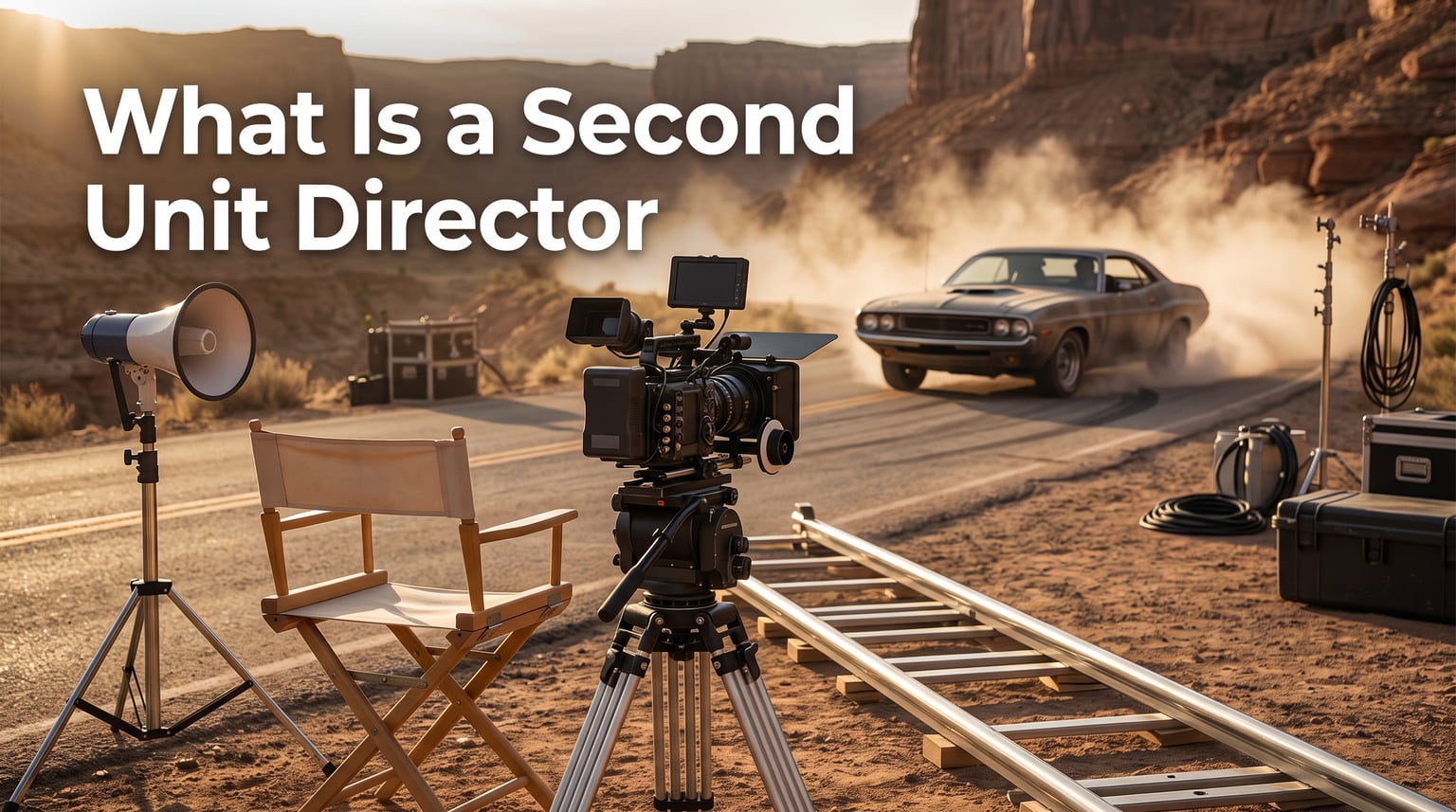
Quick Answer: What Is a Second Unit Director?
A second unit director leads a separate film crew that shoots supplementary footage, including stunts, action sequences, establishing shots, B-roll, cutaways, and inserts, while the main director focuses on principal actors and dialogue scenes. They operate independently on a parallel production schedule during principal photography.
I remember the first time I watched a Bond car chase and wondered how a single director could possibly capture every angle of every stunt.
The truth is that the main director almost never does. A second unit director is the filmmaker who runs that second crew, often shooting the explosive sequences you remember from the trailers. In 2026, with bigger budgets and tighter schedules than ever, this role has become more important than most filmgoers realize.
This guide breaks down what a second unit director does, how they differ from assistant directors, and why the role has launched some of the biggest directing careers in Hollywood.
Table of Contents
What Is a Second Unit Director?
A second unit director is a director who runs a discrete camera crew separate from the main or first unit, filming footage that supplements the principal photography of a film or television show.
The role exists because productions cannot afford to run one single crew and shoot everything back-to-back. While the main director works with the principal cast on the scripted scenes, a second unit shoots everything else in parallel, including action, stunts, B-roll, and pickup shots. The second unit may even be on a completely different continent on the same day.
Think of the second unit as a fully functional mini-production with its own director of photography, gaffer, grips, and cast. The second unit director is the creative head of that team, responsible for making sure the footage matches the look, blocking, and tone of the main production.
Where the term comes from
The word “unit” in film production refers to a complete, self-contained shooting crew with its own director.
The first unit, sometimes called the main unit, is the principal crew led by the film’s credited director. The second unit is the first and most common additional crew. Productions can spin up a third unit, fourth unit, or even more, depending on the scale of the shoot.
Why Productions Need a Second Unit Director
Productions hire a second unit director because shooting a feature film on a single crew would take far too long and cost far too much.
On a typical 50-day shooting schedule for a studio feature, the main unit can rarely afford to leave set. Every minute spent capturing background plates, empty hallway push-ins, or driving shots is a minute the A-list cast is sitting in their trailer burning through the day’s budget.
By sending a second unit out the door with a smaller cast and crew, productions run two shoots at once. Christopher Nolan famously avoids this strategy and shoots every frame himself, which is part of why his blockbusters like Inception and Oppenheimer require such long schedules. Most other major directors lean heavily on second unit work to stay on budget.
What Does a Second Unit Director Actually Shoot?
Second unit directors shoot the footage that supports the main story without featuring the principal cast in close-up dialogue scenes.
The list of what ends up on a second unit call sheet is longer than most people expect. Here is what typically ends up in front of that second camera.
- Stunts and action sequences: Car chases, fight scenes, explosions, falls, and pyrotechnics almost always get handed to the second unit. Insurance and production safety make it easier to isolate risk on a smaller crew.
- Establishing shots: Wide shots of cities, buildings, and landscapes that set up a location. Aerial photography from helicopters or drones is common here.
- B-roll and cutaways: Detail shots of hands dialing a phone, a car door opening, food being plated, or rain streaking a window. These are the inserts editors use to make scenes feel lived-in.
- Crowd scenes and background action: Big crowds in stadiums, marches, or street scenes are often too complex to shoot with the main unit.
- Vehicle work: Anything involving moving vehicles, from motorcycles to jets, is heavily delegated to second unit directors who specialize in rigging cars for camera.
- Pickup shots: After the main unit wraps, editors flag small continuity gaps, and the second unit comes back to grab inserts that fill those gaps.
The combined running time of this footage can rival the main unit on a modern action film. When you watch a John Wick chase, the practical car work and the close-up gun work often come from two completely different crews shooting on different days.
Second Unit Director vs Assistant Director
The second unit director and the assistant director serve completely different functions on a film set, even though both hold “director” in their title.
An assistant director (AD) is an organizational and logistical role. The first AD runs the set itself, calls the shots, manages the schedule, keeps the day on time, and ensures the production hits its daily page count. A 1st AD does not make creative decisions about blocking, performance, or coverage. They run the train.
A second unit director, by contrast, is a creative directing role. They choose where to put the camera, how to block the action, and what to shoot. They answer to the main director on aesthetic questions but have full autonomy on their own set.
A quick comparison makes the difference clear.
- Assistant Director (1st AD): Manages schedule, runs the set, calls roll and cut, tracks daily progress. No creative authority over the look.
- Second Unit Director: Directs a parallel crew, makes creative and blocking decisions for B-roll, stunts, and establishing shots, reports to the main director.
- Second Assistant Director (2nd AD): Handles paperwork, calls background performers, and keeps the production office running. Often confused with the 2nd unit role but is purely administrative.
The biggest mistake I see in industry forums is people conflating “2nd unit” with “2nd AD.” Two completely different jobs, and two completely different career ladders.
How a Second Unit Director Works With the Main Director
The second unit director operates as a creative extension of the main director, not as a separate voice on the film.
Before any second unit shoot, the main director typically prepares a storyboard, shot list, and reference materials for the sequences being delegated. The second unit director treats that prep as the creative bible and matches it shot-for-shot. They are given a specific look, a specific tone, and a specific set of coverage to deliver.
On the day, the main director often watches the second unit monitor via live video feed, calls corrections through a walkie, or simply trusts the second unit director to execute. Trust is the currency of the role. Once the main director hands over a sequence, they rarely get to revisit the footage themselves until the editing room.
Industry veterans we have spoken with emphasize that the best second unit directors obsess over continuity. The action has to feel like it lives in the same film as the dialogue scenes, even if it was shot on a different continent six months apart.
“Style mismatch is the biggest problem you can introduce. The audience should never feel a gear shift when the film cuts from main unit action to second unit action.”
Industry insight pulled from r/Filmmakers discussions and assemble.com interviews.
The Nolan exception
Christopher Nolan is the most famous modern director who chooses not to use a second unit for action.
His preference is to shoot everything himself, no matter how complex the sequence. The practical car flip in Tenet was filmed with Nolan himself calling the shots on the camera car. Productions that hire Nolan accept the longer schedule and bigger budget because they want a single vision across every frame.
It is a respected approach, but it is the exception, not the rule. The vast majority of action blockbusters rely on second unit directors to carry at least some of the load.
Famous Second Unit Directors Who Became Major Directors
The second unit director role is one of the most reliable launchpads for a feature directing career in modern Hollywood.
The clearest example is the John Wick franchise. Chad Stahelski and David Leitch worked as second unit directors and stunt coordinators on films like The Matrix sequels, 300, and Sherlock Holmes before co-directing John Wick in 2014. Leitch went on to direct Deadpool 2, Hobbs & Shaw, and The Fall Guy. Stahelski has run the John Wick franchise solo ever since.
Sam Hargrave, who served as second unit director on Avengers: Infinity War and Avengers: Endgame, used that experience to land the directing job on Extraction and Extraction 2 with Chris Hemsworth. JJ Perry, a longtime stunt coordinator turned second unit director, made his feature directorial debut with Day Shift starring Jamie Foxx.
The pattern repeats year after year. Producers trust second unit directors because they have already proven they can deliver footage on time, on budget, and on vision. That is a tough bar to clear, and it is why the role is so often a stepping stone.
How to Become a Second Unit Director
Becoming a second unit director typically takes a decade or more of working on set in adjacent roles.
The most common career path I have seen looks something like this.
- Start as a production assistant, grip, or electric. Learning how a film set runs at the ground level is non-negotiable. Most working second unit directors spent their early years hauling cables and wrangling cables.
- Move into the stunt or camera department. Many second unit directors come up through stunts. Stunt coordinators understand blocking, action choreography, and practical effects in ways that mirror directing.
- Second or third unit small shoots. Your first second unit gigs will be tiny: insert cars, simple pickups, background plate work. Build a reel from these.
- Build a portfolio of second unit work. Editors need to see you can deliver footage that matches a feature film’s tone. A strong reel gets you into the room for bigger jobs.
- Get into the Directors Guild of America (DGA). Most studio second unit directing requires DGA membership, which has its own qualification track.
- Network aggressively with first-time main directors. The pattern for breaking through is to direct second unit for a director who eventually gets a feature, then asks you to come along as a partner.
There is no film school requirement, but the best second unit directors know how to read a script, draw a storyboard, talk to a DP about lenses, and lead a crew without alienating them. Those are skills most people pick up over years on real sets.
Second Unit Director Salary
Second unit director pay scales dramatically with budget, location, and the prestige of the production.
On smaller independent films, a second unit director might earn a flat weekly rate in the low five figures. On studio features and tentpole productions, the role can command low to mid six figures per film. DGA-negotiated rates provide the floor, but the top-end second unit directors often negotiate above scale based on their track record and the size of the crew they manage.
Directors who move up to A-list status, like the John Wick alumni, can earn well into seven figures per picture once they graduate to full directing duties. The second unit role is the financial and creative pipeline into that bracket.
The In-Camera vs VFX Decision
Second unit directors often sit at the center of one of the most important creative choices a modern production makes: shoot it in camera or finish it in VFX.
Shooting something in camera, like a real car flip, a real explosion, or a real helicopter stunt, costs more upfront but saves the post-production team weeks of work. VFX finishes are cheaper on the day but require heavy investment in post and risk the visual continuity if the lighting or framing drifts.
The second unit director typically makes the practical recommendation: what is safe to shoot, what the budget can absorb, and what the schedule allows. A great second unit director finds the right balance and protects the main director from having to make that call on every single shot.
Second Unit in TV vs Feature Films
The role plays differently on episodic television than it does on features.
TV productions often run second unit practically every day of a season, shooting establishing shots, driving B-roll, and any scenes that do not require the regular cast. Because TV schedules are so tight (sometimes 8 days per episode), the second unit director is essentially responsible for a large chunk of every finished cut.
Feature films are more like burst operations: second units work intensely for a few weeks and then shut down, while TV second units can run for five or six months at a stretch. The skills transfer, but the daily rhythm is different.
Frequently Asked Questions About Second Unit Directors
How much do second unit directors make?
Second unit director pay varies by budget and production size. On smaller indies they earn a flat weekly rate in the low five figures. On major studio features the role commands low to mid six figures per film, with top-tier directors earning more once they negotiate above DGA scale.
What is the difference between assistant director and second unit director?
An assistant director (1st AD) handles scheduling, set operations, and logistics without creative authority over the look of the film. A second unit director is a creative directing role that runs a separate crew shooting stunts, B-roll, and establishing shots, making the blocking and coverage decisions for that footage.
How to become a 2nd unit director?
Most second unit directors start in the stunt or camera department, take small second unit jobs to build a reel, qualify for DGA membership, and network with first-time feature directors who can bring them on as creative partners. Plan on at least a decade of set experience before you are trusted with major second unit work.
What does 2nd unit director mean?
A 2nd unit director is the filmmaker in charge of a separate film crew that shoots supplementary footage, including stunts, action sequences, establishing shots, B-roll, cutaways, and inserts, while the main director focuses on principal actors and dialogue scenes during principal photography.
Final Thoughts on the Second Unit Director Role
A second unit director is the unsung creative force behind most of the action, atmosphere, and texture that audiences remember from a feature film.
The role asks a lot: long days, parallel productions, strict visual fidelity to someone else’s vision, and the discipline to deliver footage that disappears into the larger film. For directors who love the craft and want to break in, it is one of the best proving grounds available.
In 2026, with studios leaning harder on parallel production than ever, the second unit director is more than a stepping stone. It is one of the most important jobs on set, and one of the most reliable paths to a feature directing career.