
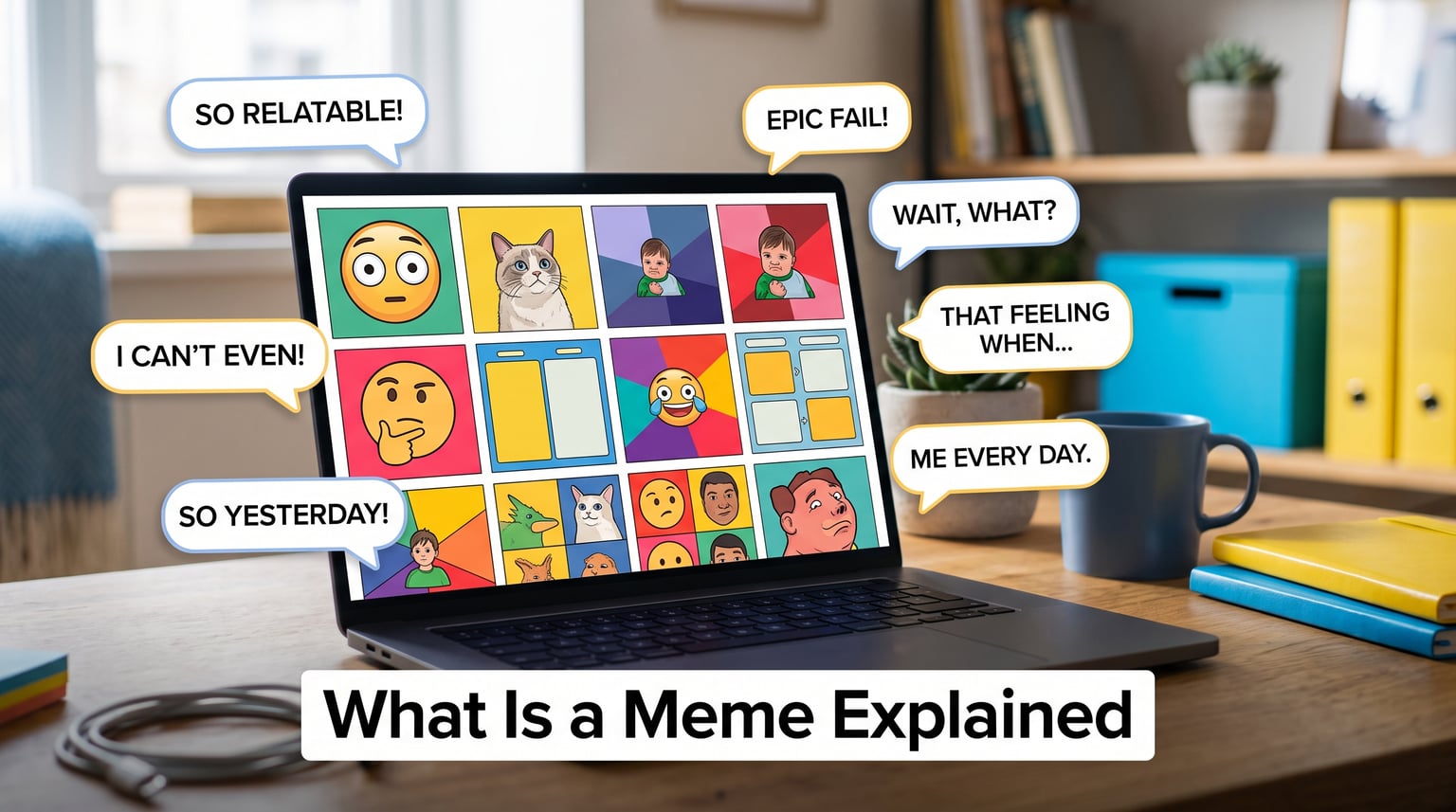
A meme is a piece of cultural content — typically a humorous image, video, phrase, or sound clip — that spreads rapidly across the internet through sharing, copying, and modification. The word gets used constantly on social media, but its meaning runs a lot deeper than most people realize when they first encounter it.
If you’ve ever shared a funny picture, forwarded an inside joke to a friend, or replied with a reaction GIF, you’ve already participated in meme culture without necessarily knowing it. What makes something a meme rather than just a funny post? That question has a surprisingly rich answer.
With what is a meme explained as our focus here, I want to go beyond the surface level. I’ll cover where the word actually came from (the answer involves a 1976 biology book), how internet memes evolved from email-chain curiosities into a dominant form of communication, and what specific ingredients make something catch on and spread.
Table of Contents
What Is a Meme, Explained
A meme is any piece of content — an image, video, text, GIF, or sound clip — that takes on a shared cultural meaning and spreads from person to person through imitation and variation. The definition sounds simple, but the word “variation” is doing the heavy lifting.
Unlike a regular joke that stays fixed in its original form, a meme is built to be remixed. Someone takes an existing template — say, a photo of a man glancing at a passing woman while his girlfriend looks on disapprovingly — and swaps in their own labels to make it fit their situation, community, or opinion.
Think of a meme as a joke skeleton. The structure stays recognizable while the specific content changes with whoever is using it. That template quality is what separates a meme from a one-time funny post that nobody carries forward.
How Memes Differ from Regular Jokes
Regular jokes have a setup and punchline that work (or don’t) on their own. Memes depend on shared cultural context — what’s sometimes called “in-group signaling.” If you recognize the template and its cultural history, you find it funny. If you don’t, you’re left confused.
This is partly why memes can feel alienating to people who aren’t constantly online. Discussions on Reddit’s r/EnglishLearning and r/ExplainLikeImFive regularly show that most people first experienced memes before they understood what they were as a concept. You absorb the knowledge by being immersed in the culture, not by being given a formal definition.
At its core, a meme is an idea with a shape that makes it easy to spread and adapt — and that spreading is what gives it cultural power.
Where Did the Word “Meme” Come From?
The word “meme” was coined in 1976 by evolutionary biologist Richard Dawkins in his book The Selfish Gene. He needed a term to describe how cultural ideas spread through societies in a way that mirrors how genes spread through biological populations.
He derived it from the ancient Greek word mimema, which means “something imitated” or “imitated thing.” He shortened it to “meme” specifically to make it rhyme with “gene” — intentionally drawing a parallel between cultural and biological replication.
In Dawkins’ original framework, a meme could be almost anything: a catchy tune, a religious idea, a fashion trend, a phrase, or a set of instructions. The defining characteristic was that memes are self-replicating units of culture — they copy themselves by passing from one mind to another, mutating slightly with each transfer.
From Academic Theory to Internet Slang
For most of the late 20th century, “memetics” — the formal study of memes — remained a niche academic concept. Researchers debated whether cultural ideas truly evolved in the same way genes do, and the term stayed mostly in scholarly circles.
The internet changed all of that. When people started sharing funny images and videos in the early 2000s, they needed a word for what they were doing. “Meme” fit perfectly — these were cultural units that replicated, mutated, and either thrived or died based on how well they resonated with other people.
The meaning didn’t actually change. An internet meme is still a self-replicating cultural unit. The internet just gave it a distribution system that made the whole process visible, measurable, and dramatically faster than anything Dawkins could have anticipated in 1976.
A Brief History of Internet Memes
Internet memes didn’t appear overnight. They evolved gradually as online communities grew and new platforms emerged, with each generation of technology creating new formats and pushing distribution speeds higher.
The Early Days (1990s–Early 2000s)
Most researchers trace the first viral internet meme back to 1996, when a looping animation called “Dancing Baby” (also known as “Baby Cha-Cha”) spread through email chains. It was a 3D render of an infant doing a cha-cha dance, and people forwarded it simply because it was strange and funny — a perfect early example of content spreading through pure imitation.
“Godwin’s Law” — the observation that any online argument eventually leads to someone invoking Hitler — spread around the same time as a text-based meme. It showed early on that the format wasn’t limited to images or video; a simple shareable idea could function as a meme just as well.
The Image Macro Era (2000s)
By the mid-2000s, the image macro format had taken hold across forums and early social platforms. An image macro is a photo overlaid with bold white text — the “Impact” font with a black outline became so standard that it now feels like the classic meme aesthetic to anyone who grew up online.
“LOLcats” — funny photos of cats with captions written in broken English — became a genuine cultural moment around 2007. The site “I Can Has Cheezburger?” launched to host them and attracted millions of visitors, proving that meme communities could sustain entire websites on their own.
Rage Comics followed shortly after — hand-drawn stick figures with exaggerated expressions used to illustrate relatable everyday frustrations. They pioneered the multi-panel storytelling format that still appears in meme content today, and they introduced the idea that anyone could make a meme, not just people with design skills.
The Social Media Explosion (2010s)
When Facebook, Twitter, Tumblr, Instagram, and later TikTok scaled up, memes found their true distribution network. Sharing became effortless, and a template could travel from obscure forum post to mainstream cultural reference within a matter of hours.
“Distracted Boyfriend” became one of the most studied memes of 2017 — a stock photo that spawned thousands of variations and eventually attracted academic papers analyzing its spread patterns. The “Bernie Sanders mittens” image in 2021 showed how a candid news photograph could instantly transform into meme raw material across every platform simultaneously.
The Current Era
By 2026, memes had expanded far beyond static images. Video memes, audio clips, AI-generated parody content, and highly niche absurdist formats dominate feeds alongside the classic image macro. The lifecycle has accelerated dramatically — what took weeks to spread in 2010 can go viral and become overexposed within 48 hours today.
The Reddit ELI5 community captured the lifecycle well: “A meme is any idea, thought, or behavior — they are introduced, they evolve, and eventually they die.” That three-part arc now happens faster than ever before, but the pattern hasn’t changed since the Dancing Baby days.
The Main Types of Internet Memes
Memes come in several distinct formats, and understanding the categories makes it easier to recognize them across different platforms and communities.
Image Macros
This is what most people picture when they think of a meme — a photo, often of a recognizable person, animal, or object, with text added above and below it. Classic examples include “Drake Approving/Disapproving,” “Woman Yelling at Cat,” “Distracted Boyfriend,” and “Disaster Girl.”
The template is the essential ingredient. Once a community understands what a particular template represents culturally, they can remix it to comment on almost anything. The image stays constant; the meaning shifts entirely with whoever is using it and what labels they apply.
GIF Memes
A GIF (Graphics Interchange Format) is a short looping animation, and many reaction GIFs have become memes in their own right. Platforms like Giphy and Tenor have built entire libraries around GIF reactions — nodding enthusiastically, dramatically walking away, doing a slow double take.
An important distinction: not all GIFs are memes, but many memes use the GIF format. A GIF becomes a meme when it develops a shared cultural meaning and people reuse it in specific contexts to signal a specific reaction. A weather service animation is a GIF; a looping clip of a confused-looking dog that gets sent whenever someone is baffled by workplace emails is a meme.
Video Memes
TikTok accelerated the rise of the video meme format significantly. “Challenges” — like the Ice Bucket Challenge or the Mannequin Challenge — are video memes under a different name. So are “trends,” which are audio snippets or visual frameworks that thousands of creators replicate with their own take.
The split-screen “Expectation vs. Reality” format, the lip-sync video set to a specific sound bite, and the “POV” storytelling structure are all video meme templates that have generated millions of individual iterations. The template provides the container; the creator fills it with their own content.
Text Memes
Not all memes are visual. Text-based formats have existed as long as the internet itself. “Copypasta” — blocks of text copied and pasted into conversation threads, often absurdist or out-of-context — is a classic text meme format. So are specific phrases that carry shared cultural weight: “I’m in this photo and I don’t like it,” “OK Boomer,” or “that’s not how any of this works.”
These verbal memes spread through conversation and comment sections rather than through image sharing, but they follow the same pattern: a recognizable format that people reuse in new contexts to signal shared understanding.
Audio Memes
One of the fastest-growing formats, audio memes are short sound clips — lifted from movies, TV shows, songs, or viral moments — that creators use as a soundtrack for their own visual story. When the same audio clip appears across thousands of videos with completely different visual contexts, it has become an audio meme.
This format is particularly important on TikTok, where the algorithm surfaces popular audio and encourages others to use it. The audio is the meme template; the video is the variation. A single sound bite can generate hundreds of thousands of individual responses before the next one takes over.
What Makes Something a Meme? The Core Ingredients
Not everything funny on the internet becomes a meme. There are specific qualities that give content the potential to spread, adapt, and survive long enough to build shared cultural meaning.
Relatability
The most successful memes tap into experiences that feel universal — the specific exhaustion of a Monday morning, the awkwardness of a meeting that could have been an email, the way a task expands to fill all available time. When someone sees a meme and thinks “this is exactly my life,” they share it immediately.
A University of Oslo study found relatability to be the single strongest predictor of meme spread among social media users — stronger than humor alone. A meme that makes you feel “seen” motivates sharing in a way that pure comedy doesn’t always achieve. The emotional recognition triggers the action.
Remixability
A strong meme template is flexible enough to be adapted across countless different contexts. The “Drake meme” works equally well for food preferences, political opinions, niche hobby arguments, and software debates. That adaptability is what separates a durable template from a one-off joke that doesn’t travel beyond its original context.
When a meme crosses subculture lines — when gaming communities, music fans, sports followers, and corporate social media accounts all use the same template in the same week — it’s working on multiple levels at once. That crossover reach is usually the sign of a genuinely strong format.
Timing and Cultural Context
Memes are extraordinarily time-sensitive. A reference that lands perfectly in one cultural moment can feel dated within weeks. This is why memes are often described as having a “lifecycle” — they’re born, they peak, they become overused, and they either fade out or get repurposed ironically by people who are aware they’re referencing something past its prime.
Getting the timing right matters as much as the format itself. A meme made two weeks after a cultural moment feels like a response; the same meme made two months later feels like a relic. Speed is part of the skill in meme culture.
In-Group Signaling
Memes function as cultural shorthand. Using the right meme at the right moment signals that you belong to a specific community, that you’re “very online,” or that you share a particular set of references with the person you’re communicating with. This social bonding function is a significant part of why memes matter beyond just being funny.
This is also why explaining a meme kills the humor. The joke relies on shared context, not on the mechanics being decoded explicitly. Once you dissect it, the in-group element disappears — and the meme stops working as social currency. It’s one of the reasons meme explanations feel awkward even when they’re accurate.
Memes in 2026: What’s Trending Now
Meme culture in 2026 looks quite different from the classic image macro era. The formats have multiplied, the platforms have diversified, and the pace of creation and expiration has accelerated to a point that would have been hard to predict even five years ago.
AI-generated content and meta-humor — AI tools have made it possible to generate meme images, captions, and videos at scale. This has produced a wave of AI-generated parody content and a strong streak of memes that comment on AI itself, using obviously artificial aesthetics or AI-generated awkwardness as the punchline. The irony is baked in.
Audio-first formats — Short-form video platforms have pushed audio memes to the front. A meme often starts as a sound clip that spreads through TikTok or Instagram Reels, with creators using the same audio to tell completely different visual stories. The audio is the template; the video is the variation. This inverts the classic image macro model where the visual was primary.
Faster lifecycles and hyper-niche communities — Communities on Discord, niche subreddits, and specialized corners of TikTok produce highly specific memes that the broader internet never encounters — and many of those communities prefer it that way. The niche-ness becomes part of the identity. When a meme breaks into mainstream awareness, the original community has often already moved on to the next format.
Frequently Asked Questions About Memes
What is a meme and how does it work?
A meme is a piece of cultural content — usually an image, video, sound, or phrase — that spreads through sharing, copying, and variation. It works by providing a recognizable template that people can adapt to their own context. Someone encounters a meme format, reshapes it to fit their situation, shares it, and others repeat the process — each adding their own twist while keeping the core structure recognizable. The cycle of imitation and variation is what defines it as a meme rather than just a piece of content.
What is another word for meme?
The closest alternatives are ‘viral content,’ ‘internet joke,’ or ‘cultural unit.’ In academic contexts, the term ‘replicator’ (from Dawkins’ memetics framework) is sometimes used. In casual speech, people say ‘post,’ ‘reaction image,’ or ‘joke’ — though none of these fully capture what makes a meme distinct, which is the template-and-variation structure that allows it to spread and adapt across communities.
What’s the difference between a meme and a GIF?
A GIF is a file format — a short looping animation. A meme is a concept — a piece of content with shared cultural meaning that spreads through imitation and variation. The two overlap frequently: many memes use the GIF format, and many popular GIFs are memes. But not all GIFs are memes (a weather radar loop is a GIF but not a meme), and not all memes are GIFs (image macros with still photos are memes but not GIFs). The key difference is cultural meaning and reuse pattern, not the technical format.
What does a meme look like?
The most recognizable meme format is an image macro: a photo with bold white Impact-font text placed above and below it. But memes also appear as short video clips, looping GIFs, blocks of copied text known as copypasta, audio sound bites used across multiple videos, and even verbal phrases that spread through conversation. The visual appearance varies widely — what makes something a meme is the shared cultural meaning and the pattern of being copied and adapted, not any specific visual style.
Putting It All Together
Understanding what is a meme explained in its full context means recognizing both the original academic concept Richard Dawkins described in 1976 and the living, evolving form that internet culture has built over the past three decades. The two aren’t contradictions — they’re the same idea, just separated by fifty years and a global distribution network.
A meme is a self-replicating unit of cultural information — most commonly a humorous image, video, sound, or phrase — that spreads through imitation and variation across communities and platforms. The word came from The Selfish Gene, derived from the Greek mimema (meaning “imitated thing”), and the internet didn’t invent memes. It just gave them a better environment to move faster and reach further than anything that came before.
What separates a meme from just another funny post? Remixability, relatability, and cultural timing. A meme is a template that invites adaptation — not a fixed joke, but a living format that different communities make their own, over and over, until something new takes its place.