
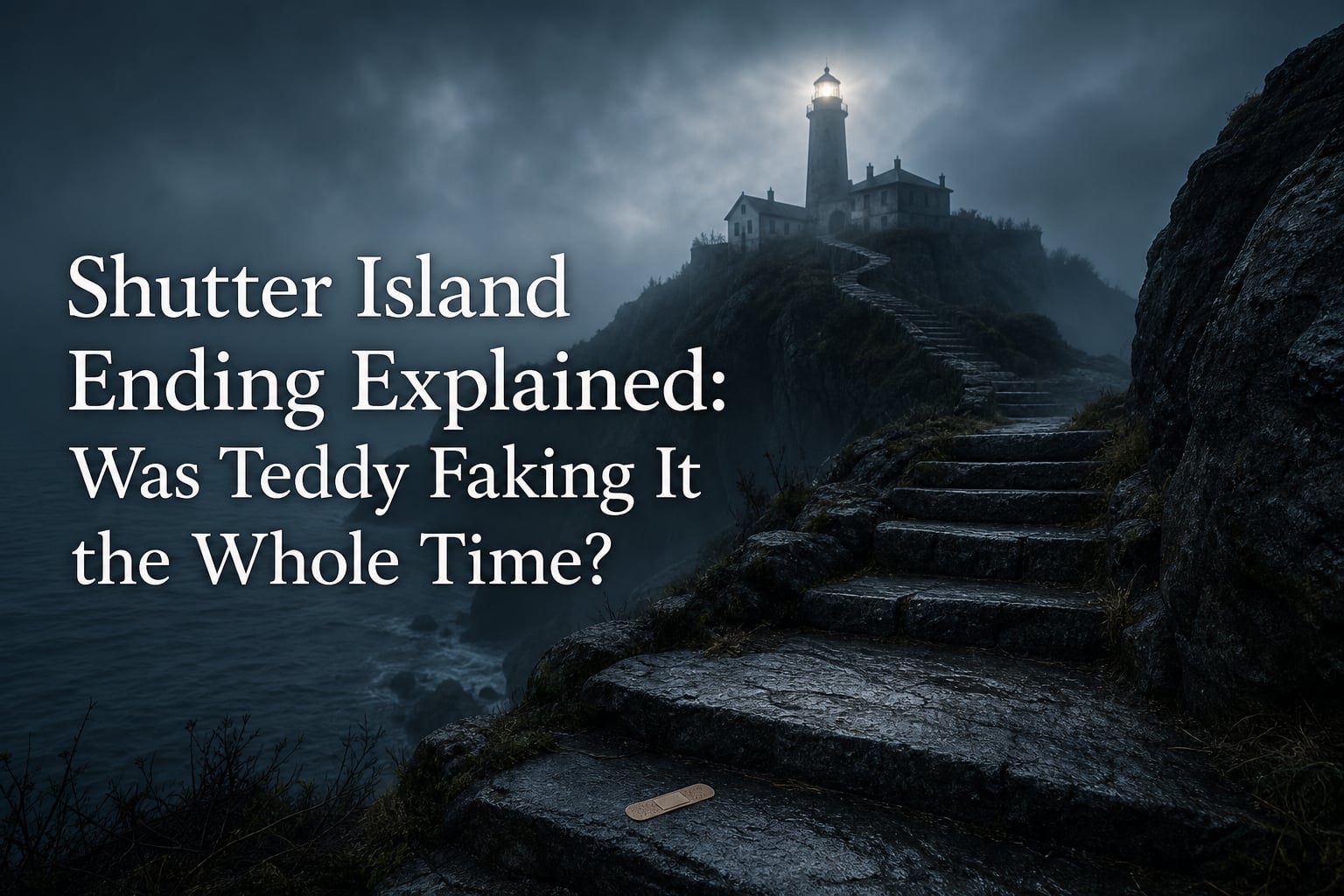
Shutter Island ending explained in plain language: U.S. Marshal Teddy Daniels is not who he thinks he is. He is Andrew Laeddis, a patient at Ashecliffe Hospital for the criminally insane who murdered his wife and created the Teddy persona to survive his own guilt.
The ending is famous for one reason. It refuses to give viewers a clean answer. Did Andrew relapse into his delusion, or did he fake the relapse to choose a lobotomy and escape his unbearable memories? I have watched the film four times, read Dennis Lehane’s novel twice, and spent weeks combing through Reddit threads and director interviews. Here is the full breakdown.
Table of Contents
What Is the Shutter Island Ending Really About?
The ending reveals that the entire investigation was a roleplay experiment designed by Dr. John Cawley to bring Andrew Laeddis back to sanity. Andrew, posing as Teddy Daniels, was the 67th patient to be the subject of this treatment. He was the most dangerous, and this was his last chance before a lobotomy.
During the experiment, Andrew constructed an elaborate conspiracy involving missing patients, mind control, and a mysterious Warden. None of it was real. The missing patient Rachel Solando was a fiction. The conspiracy at the lighthouse was a fiction. His partner Chuck Aule was actually Dr. Lester Sheehan, the attending physician assigned to play along.
When Andrew arrives at the lighthouse at the end of the film, Dr. Cawley gently tells him the truth. Andrew cries. He remembers everything. He remembers drowning his three children after his wife Dolores killed them. He remembers shooting Dolores in the back. He created Teddy Daniels to become the hero who would catch the killer, instead of the killer himself.
A Quick Plot Summary Before the Twist
The film opens in 1954. Federal Marshal Teddy Daniels and his new partner Chuck Aule arrive at Ashecliffe Hospital, a remote institution for the criminally insane off the Massachusetts coast. They are investigating the disappearance of Rachel Solando, a patient who murdered all four of her children.
Teddy has his own reasons for taking the case. He believes the hospital is conducting illegal experiments on patients, possibly funded by the government. He is looking for the truth about a place called Block C, which he suspects houses mind control experiments on former Nazi scientists.
Teddy is also haunted by the death of his wife. Two years earlier, Dolores Daniels died in a fire at their apartment building. Teddy has flash-freeze memories, vertigo, and intense migraines that he treats with codeine. He carries a newspaper clipping about the fire in his pocket.
Throughout the investigation, Teddy finds coded notes, hidden caves, and eerie clues that seem to point toward a massive conspiracy. He meets Naehring, a deaf patient who writes cryptic warnings. He visits Block C and finds what looks like experimental equipment. The deeper he digs, the more certain he becomes that the doctors are hiding something terrible.
None of it is what it appears to be. The clues were planted by Dr. Cawley and Dr. Sheehan as part of the roleplay, designed to lead Andrew’s mind back to the truth he had buried.
The Andrew Laeddis Identity Reveal Explained
Andrew Laeddis is Patient 67. He was a U.S. Marshal himself before his breakdown, which is why his Teddy Daniels persona borrows so heavily from his real professional life. As Andrew, he was sent to Ashecliffe after killing his wife Dolores Chanal in 1952.
His crime is the heart of the film. Andrew discovered that Dolores had drowned their three young children in the lake behind their home while he was at work. She suffered from severe depression. When he returned home and found the bodies, he went to their apartment, loaded a gun, waited for her, and shot her five times in the back as she fled.
The trauma broke him. He could not live with what he had done or with the grief of losing his children. So his mind constructed Teddy Daniels, a fictional marshal who had lost his wife in a fire, not a lake. In Teddy’s version of events, his wife died tragically but Andrew was not responsible. Teddy is investigating a different hospital. Teddy is hunting monsters, not becoming one.
The name Laeddis itself is a clue. An anagram of the name is “Edward Daniels,” the name Teddy uses. The doctors embedded this hint deliberately into the roleplay to help Andrew recognize his own delusion when he was ready.
Dr. Cawley explains this directly in the lighthouse scene. Andrew’s delusion was so strong that it took two years of treatment, multiple attempts at therapy, and finally this elaborate roleplay to crack it. He even nicknamed the experiment “the Shutter Island experiment,” after Teddy’s own framing of his situation.
The Lighthouse Confrontation and the Famous Final Question
The lighthouse scene is the emotional climax of the film. Andrew walks up the steps expecting to find the Warden, a monster running illegal experiments. Instead he finds Dr. Cawley, Dr. Sheehan, and the truth.
Cawley tells Andrew that he has been a patient the whole time. He walks through the evidence. The missing patient Rachel Solando was invented by Andrew’s mind as a mirror of his own guilt. His wife did not die in a fire. The “fire” was the trauma of losing his children. Dolores had bipolar disorder, and the doctors had treated her for years before the tragedy.
Andrew weeps. He remembers. He is Andrew Laeddis. He killed his wife.
Then Cawley asks him a question that did not appear in Lehane’s original novel: “Which would be worse, Teddy? To live as a monster, or to die as a good man?”
This single line reframes everything. It is the question that haunts the rest of the film and divides fans to this day.
Was Teddy Faking It the Whole Time at the End?
This is the question that keeps viewers coming back. The film ends the morning after the lighthouse confrontation. Andrew sits on the steps outside the hospital. Dr. Sheehan approaches him, calls him Andrew, and asks how he is feeling.
Andrew looks up and says, “We go home.” Then, in what looks like a deliberate regression, he calls himself Teddy again, references his dead wife by her false name, and tells Dr. Sheehan they should leave the island.
There are two main interpretations of this final moment.
The Andrew Relapsed Interpretation
The first reading is that Andrew’s recovery was real but temporary. The roleplay worked, but the trauma was too deep. After one night of sleep, Andrew’s mind slipped back into the safer Teddy persona because the truth was too painful to live with. The doctors had warned this might happen. He had previously “relapsed” multiple times during treatment.
Under this interpretation, Andrew could not sustain sanity. The doctors exchange a quiet look at the end because they have failed. Andrew will now be lobotomized, not as punishment, but because he is too dangerous to leave untreated and too broken to cure.
The Andrew Chose the Lobotomy Interpretation
The second reading is the one Martin Scorsese has suggested in interviews. Andrew recognized that he could not live with what he had done. He consciously chose to retreat into the Teddy persona, knowing that relapse would trigger the lobotomy. To live as a monster is to live as Andrew Laeddis, the man who shot his wife in the back. To die as a good man is to die as Teddy Daniels, the marshal who came to Shutter Island to find the truth.
In this reading, the line “which would be worse” is not a question. It is Andrew’s answer to himself. He would rather die with a clean identity than live with the memory of what he did.
There is a powerful visual clue supporting this reading. Throughout the film, Andrew wears a small bandage on his forehead. He only removes it at the very end, when he calls himself Teddy again. For fans who believe he chose the lobotomy, the bandage is symbolic. He wipes away the truth because he has decided to walk back into delusion.
How Does the Book Ending Differ From the Movie?
Dennis Lehane’s novel, published in 2003, ends much more ambiguously than the film suggests. The book does not include the famous “live as a monster or die as a good man” line. That was added by screenwriter Laeta Kalogridis.
In Lehane’s version, Andrew sits on the hospital steps. Dr. Sheehan calls him Teddy. Andrew responds with “Teddy who?” It is the only line of the book that suggests relapse. Lehane has said in interviews that he intentionally left the answer open, and that he has his own interpretation but will not share it.
The film leans slightly more toward the relapse interpretation through staging and music, but Scorsese has publicly stated that he believes Andrew chose the lobotomy. This is why fans continue to debate it two decades after the novel was published.
There are other smaller differences between the book and the movie. The book’s Andrew is more violent and the doctors are more worried about him throughout. The film softens his danger slightly while keeping the core psychological horror intact.
What Has Scorsese and Lehane Said About the Ending?
Martin Scorsese has addressed the ending in several interviews. He has said that he believes Andrew made a conscious choice to regress, because the truth was too heavy to bear. He also said that he left visual clues in the final scenes for viewers who wanted to find them, including the bandage and the framing of the shot.
Dennis Lehane has been more careful. He has said that he wrote the book so that readers would have to choose for themselves. He has confirmed that the “live as a monster or die as a good man” line was not in his novel, and that he respects the choice to add it because it gives viewers something to argue about.
On Reddit, fans have pointed to other clues scattered throughout the film. The number 67 appears on a doctor’s badge. The name Rachel Solando is an anagram of “Dolores Chanal.” Chuck Aule’s name hides “Lester Sheehan” when you rearrange the letters. These hidden breadcrumbs have kept Shutter Island one of the most rewatched psychological thrillers of the last 20 years.
There has never been a sequel, and Lehane has said there will never be one. He has called the story complete and refused offers from producers who wanted to continue Andrew’s story.
Why Shutter Island Still Resonates in 2026
Shutter Island is one of the few psychological thrillers whose ending gets sharper the more you think about it. The film was released in 2010, but every few years a new wave of viewers rediscovers it and brings fresh arguments to the same question.
What makes the ending work is that it is not really about a detective story. It is about grief, guilt, and the limits of what a person can survive. Andrew’s Teddy persona is the only thing keeping him functional. The doctors are not villains. They are trying to give him back his real life. The tragedy is that his real life is unbearable.
If you have not rewatched the film recently, 2026 is a good year to do it. Notice the bandage. Notice the anagrams. Notice how the doctors never break character until Andrew is ready. The clues are everywhere, and they only work if you know the ending first.
Frequently Asked Questions
Was Teddy Daniels faking it the whole time?
It depends on how you read the ending. Some viewers believe Andrew Laeddis consciously chose to relapse into the Teddy persona to escape his guilt, knowing relapse meant lobotomy. Others believe the relapse was involuntary and his mind could not sustain the truth. Martin Scorsese has said he filmed it as a conscious choice. Dennis Lehane says the answer is deliberately left to the reader.
What really happened at the end of Shutter Island?
Andrew Laeddis, posing as Teddy Daniels, walks to the lighthouse expecting to expose a conspiracy. He finds Dr. Cawley instead, who tells him the truth: he is Patient 67, he killed his wife Dolores after she drowned their three children, and the entire investigation was a roleplay experiment to bring him back to sanity.
How is the book ending different from the movie?
Dennis Lehane’s 2003 novel ends with Andrew saying u0022Teddy who?u0022 and does not include the line u0022which would be worse, to live as a monster or to die as a good man.u0022 That line was added by screenwriter Laeta Kalogridis for the 2010 film. The film is slightly more suggestive of relapse than the book.
What does u0022live as a monster or die as a good manu0022 mean?
It is the question Dr. Cawley asks Andrew at the lighthouse. To live as a monster is to live as Andrew Laeddis, a man who shot his wife. To die as a good man is to die as Teddy Daniels, the marshal who came to Shutter Island to find the truth. The line is the key to the entire ending.
Final Thoughts on the Shutter Island Ending
The Shutter Island ending explained in one sentence: Teddy Daniels was Andrew Laeddis, a man whose grief broke his mind. The deeper question is whether he broke himself a second time on purpose.
If you want a definitive answer, the film will not give you one. That is the point. Watch it again, look for the bandage, and decide for yourself whether Teddy chose to be a monster or a good man.