
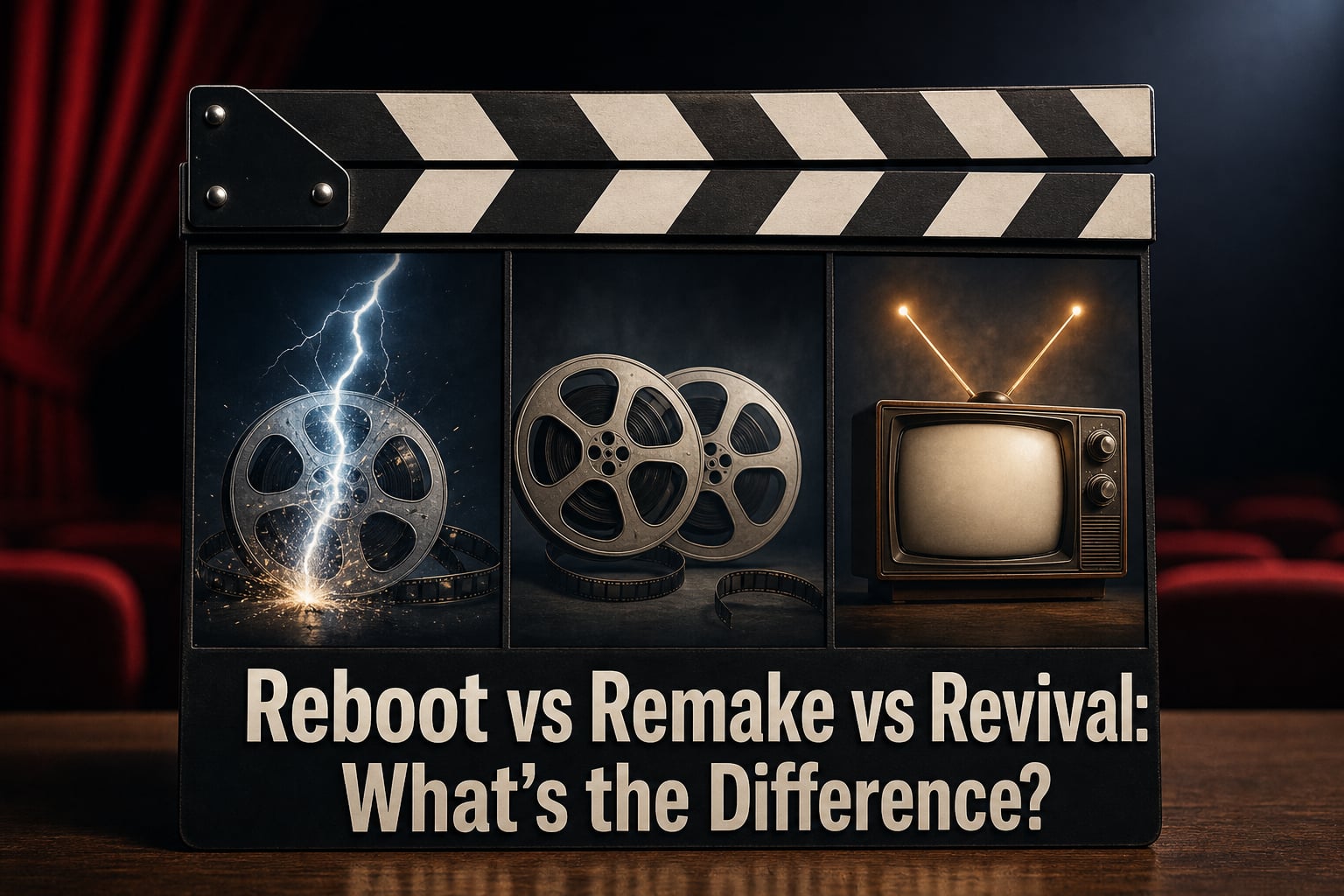
If you have ever argued about whether a new Jurassic World film counts as a reboot, a sequel, or a remake, you are not alone. The terms reboot, remake, and revival get used interchangeably all the time, but they actually describe three distinct ways a film, show, or game series comes back to life. I have spent enough weekends watching these announcements roll in to know that even die-hard fans mix them up.
This guide cuts through the confusion. You will get clear definitions, real-world examples from movies, TV, and gaming, and a side-by-side look at how studios decide which label to use. By the end, you will know exactly what separates a reboot from a remake from a revival, and why Hollywood keeps inventing new sub-categories like the “soft reboot” and the “legacy sequel”.
Table of Contents
Reboot vs Remake vs Revival at a Glance
Here is the short version you can take to the next argument. A reboot is a fresh start that wipes out most of what came before. A remake retells the same story with a new cast and modern production. A revival continues an existing series, often years later, with the same characters. The Reddit thread that inspired half the internet to look this up puts it best: “A Revival is a continuation. A Reboot is a complete fresh start.”
Keep that one-liner in mind and the rest of this article will reinforce it with detail, examples, and a few edge cases where the lines genuinely blur.
What Is a Reboot?
A reboot is a brand-new start for an established franchise that throws out most of the old continuity. The new version keeps the core brand (the character names, the logo, the general concept) but tells a different story with a new cast, new tone, and often a new timeline. Anything that came before is treated as either non-canon or loosely referenced.
The best way to recognize a reboot is to ask one question: would someone need to have seen the originals to follow this? If the answer is no, you are probably looking at a reboot.
Examples of Reboots
- Batman (1989) and Batman Begins (2005) — both wiped the slate clean after the previous film series, ignoring everything that came before.
- Casino Royale (2006) — restarted James Bond with a new actor and a grittier tone after the Pierce Brosnan era ended.
- Godzilla (2014) — the Legendary MonsterVerse treated the 1998 Godzilla as if it never happened.
- Daredevil (2024) — a hard reboot of the Netflix series, with a new actor playing Matt Murdock and no continuity from the original run.
What Is a Remake?
A remake retells the same story as an earlier work, usually with a modern cast, updated effects, and a refreshed script. The plot beats, the character names, and the setting typically stay close to the source. You are watching a new production of the same tale rather than a new tale in the same universe.
Remakes are most common in horror and in movies where the original is older or hard to find. Studios often pitch them as honoring a classic while making it accessible to new viewers.
Examples of Remakes
- Psycho (1998) — Gus Van Sant recreated Alfred Hitchcock’s original shot-for-shot with Vince Vaughn in the lead.
- The Departed (2006) — Martin Scorsese’s version of the Hong Kong film Infernal Affairs, same structure, completely new setting and cast.
- Dawn of the Dead (2004) — Zack Snyder kept the mall-zombie premise of George Romero’s 1978 film and rebuilt everything else.
- A Star Is Born — remade four times (1937, 1954, 1976, 2018) with different leads, same basic story.
Notice that remakes usually keep the title and the central premise. They feel familiar even if you have never seen the original.
What Is a Revival?
A revival picks a finished series back up and continues its story, often years or even decades later. Same characters, often the original cast, and usually an acknowledgment that the old canon happened. Think of it as the show itself pressing “play” again after the credits rolled on the finale.
The key tell of a revival is that the previous run still matters. Characters reference past events, and returning cast members often anchor the new story.
Examples of Revivals
- And Just Like That… — a continuation of Sex and the City with Sarah Jessica Parker and other returning cast members.
- Fuller House — Netflix picked up Full House with the original Tanner family back together in the same San Francisco house.
- Twin Peaks: The Return (2017) — David Lynch brought back many original cast members 25 years after the original series ended.
- Will & Grace — the 2017 comeback picked up the original characters’ lives without retconning the finale.
What Is a Soft Reboot vs Hard Reboot?
Not every reboot starts completely from scratch, and that is where the soft reboot comes in. A soft reboot keeps loose continuity with the old series while introducing new characters, a new tone, or a new status quo. New viewers can usually jump in without homework, but returning fans get nods, cameos, and references.
A hard reboot, by contrast, drops the previous continuity entirely. It is a clean break that expects you to treat the old stories as separate fiction.
Examples of Soft Reboots
- Jurassic World (2015) — the original trilogy still happened in the background, but the focus shifted to new characters and a new park.
- Star Trek (2009) — Leonard Nimoy appeared as Spock to bridge the old timeline with the new Kelvin timeline, but the new cast carried the story.
- The Force Awakens (2015) — kept the Star Wars saga broadly intact while introducing Rey, Finn, and Kylo Ren as the new leads.
Examples of Hard Reboots
- Daredevil (2024) — a new actor, a new status quo, and no direct continuation of the Netflix series.
- Batman v Superman (2016) — Man of Steel led into a new Batman who was unrelated to the Dark Knight trilogy.
- Doom (2016) — id Software built the game as a clean break from Doom 3’s tone and continuity.
You will also hear the term gritty reboot used for hard reboots that lean into a darker, more realistic tone. Christopher Nolan’s Batman trilogy and Casino Royale are classic examples of the gritty reboot trend.
How a Sequel Fits Into This Picture
A sequel is the most straightforward term of the bunch. It continues the original story directly, with the same characters, the same continuity, and the same world. If a movie ends on a cliffhanger and the next one picks up right after, that is a sequel.
The confusion usually shows up with two newer sub-categories: the legacy sequel and the rebootquel. A legacy sequel brings back original cast members years later while introducing a new generation of characters. Think Star Wars: The Force Awakens or Indiana Jones and the Dial of Destiny. A rebootquel starts as a soft reboot but keeps enough familiar structure to feel like a direct follow-up, which is basically what most modern franchise films aim to be.
Why Do Studios Use These Different Terms?
Once you know the definitions, the marketing logic behind them becomes obvious. A “remake” signals that the original was great and the new version will respect it, which helps sell tickets to fans of the source material. A “reboot” signals a fresh start, which invites curious new viewers who never watched the original. A “revival” signals nostalgia and rewards long-time fans with the original cast.
Studios also pick the label that makes the new project sound like the most exciting thing it can be. A failed 2017 series sounds more appealing as a “reimagining”. A direct sequel that flopped can be quietly soft-rebooted in the next entry. The terminology is part of how Hollywood manages brand equity, and that is why you sometimes see the same project pitched three different ways during development.
Reboot vs Remake vs Revival: Side-by-Side Comparison
Here is a quick reference table for the three main terms, plus sequel for context.
| Term | Continuity | Cast | Story | Example |
|---|---|---|---|---|
| Reboot | Usually discarded | New cast | New story in the same brand | Batman Begins (2005) |
| Remake | Re-tells original | New cast | Same core plot, modern production | Dawn of the Dead (2004) |
| Revival | Continues original | Often original cast | Picks up where it left off | And Just Like That… |
| Sequel | Direct continuation | Same cast | Next chapter in the story | The Empire Strikes Back |
Where the Lines Blur
In practice, very few projects fit a single label cleanly. A soft reboot can feel like a sequel. A remake can introduce so much new material it reads like a reboot. A revival can drop so much original cast it feels like a fresh start. The category that gets used most often in marketing is whichever one sounds best for that specific announcement.
That is also why you see studios and press switching labels mid-cycle. A project announced as a sequel gets reshaped into a soft reboot after creative changes, and then marketed as a “return to form” once filming wraps. The terms are useful, but they are guidelines, not rules.
Frequently Asked Questions
What’s the difference between reboot, remake, and revival?
A reboot starts fresh with new continuity and usually a new cast. A remake retells the same story with a modern production and new actors. A revival continues an existing series with the same characters, often bringing the original cast back.
Is a remake the same as a reboot?
No. A remake retells the same story with new cast and production, while a reboot discards the previous continuity and tells a different story in the same franchise. The Departed is a remake of Infernal Affairs. Batman Begins is a reboot of the Batman franchise.
Can a reboot be a remake?
A reboot can borrow heavily from the original story while still discarding continuity, which puts it close to a remake. Most films sit somewhere on the spectrum between a clean reboot and a faithful remake rather than fitting either label perfectly.
What is a soft reboot?
A soft reboot keeps loose continuity with the previous series while introducing new characters, a new status quo, or a new tone. Jurassic World and the 2009 Star Trek film are classic examples. A hard reboot, by contrast, wipes the slate clean with no continuity references at all.
Final Verdict on Reboot vs Remake vs Revival
Once you strip away the marketing language, the reboot vs remake vs revival question comes down to one thing: how much of the original survives into the new project. Reboot discards most of it, remake reuses the core story, and revival continues the original story directly. Everything else, from soft reboots to gritty reboots to legacy sequels, is just a flavor in between.
Next time you see a familiar title pop up with a new cast, run it through this quick check. Does the old story still count? Then it is a revival. Is the old story being told again from scratch? That is a remake. Is the old story being quietly replaced? You are looking at a reboot. Hollywood will keep inventing new labels, but the underlying definitions hold up.