
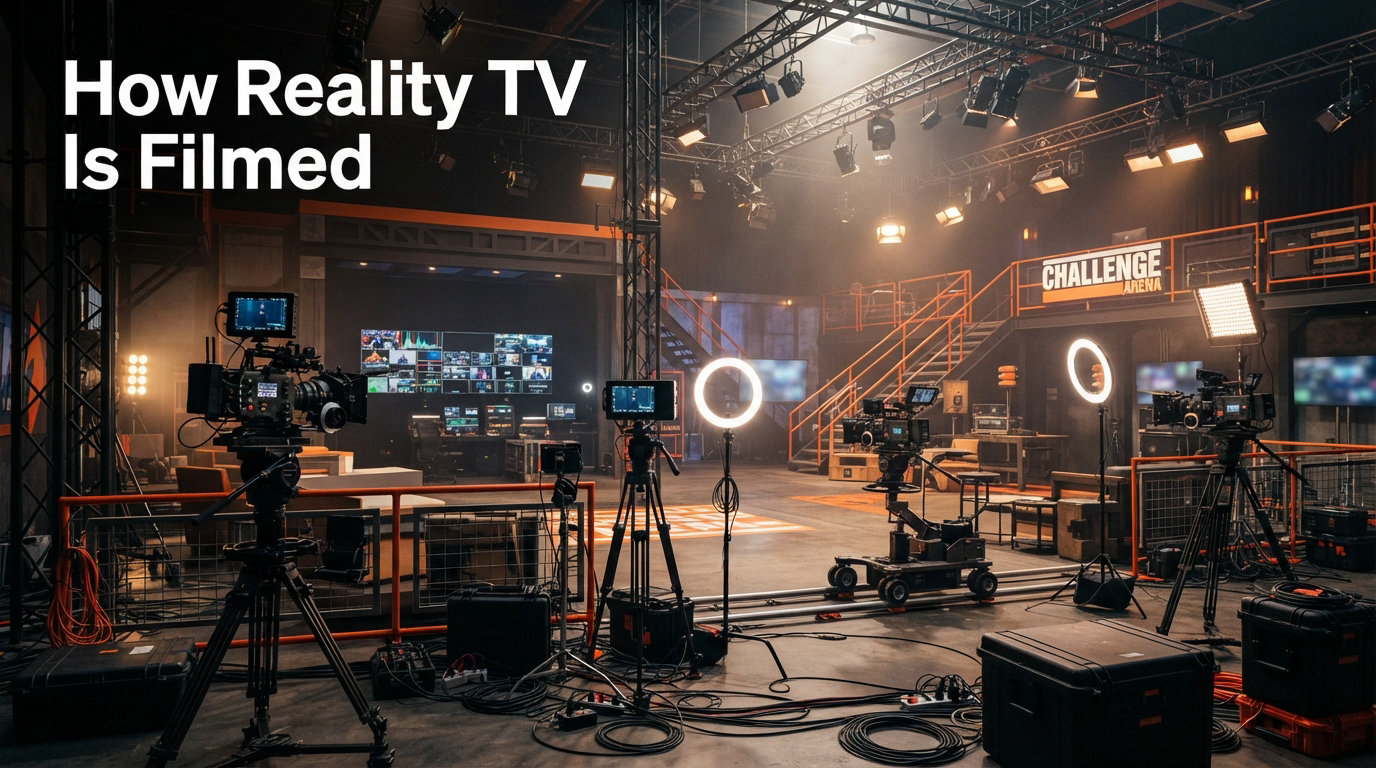
I’ve spent years pulling back the curtain on how reality TV is filmed, and the answer surprises most people. Reality shows use multiple camera crews to capture between 14 and 20 hours of raw footage per episode, which editors then compress into 42 minutes of story-driven television. The result is part documentary, part performance, and part engineered narrative that blends real reactions with carefully shaped scenes.
In this guide, I’ll walk you through the entire production process from the cameras on set to the final cut in the edit bay. You’ll learn the equipment crews use, the role producers play behind the scenes, how confessionals are filmed, and the editing tricks that turn ordinary moments into must-watch drama. By the end, you’ll never watch a reality show the same way again.
Table of Contents
What Is Reality TV and How Is It Filmed
Reality TV is filmed using a documentary-style approach where multiple camera operators follow real people through structured situations, capturing unscripted reactions and interactions. Unlike scripted shows with actors and written dialogue, reality productions rely on real participants, real conversations, and real emotions shaped by producers who guide scenes toward compelling moments.
The filming process typically involves a crew of 15 to 40 people per shoot, depending on the show’s scale. Camera operators work in pairs or teams, often using handheld cameras that allow them to move quickly between locations. Producers wear earpieces connected to the director, giving real-time notes on what to film and when to push for more drama.
Most reality shows film 14 to 20 hours of footage for every single episode that airs. That ratio means producers and editors have an enormous amount of material to work with. They pick the most interesting moments, build narrative arcs, and shape the story to keep viewers coming back week after week.
Basic Camera Setup and Equipment Used
Reality TV cameras are typically professional cinema cameras, mirrorless systems, or high-end DSLR bodies paired with zoom lenses that let operators capture action from a distance. The most common models on reality sets include Sony FX6 and FX3 cameras, Canon C300 Mark III bodies, and Blackmagic Pocket 4K units for run-and-gun shooting.
Each camera operator usually carries two camera bodies during a shoot. The primary camera captures the main action while a secondary body serves as backup or shoots a slightly different angle. Lenses range from wide 17mm to long 70-200mm zooms, allowing operators to cover everything from group conversations to close-up reaction shots without moving position.
Camera crews work with monopods or shoulder rigs rather than tripods because reality situations move fast. A handheld rig gives operators mobility to follow participants through doorways, around corners, and into tight spaces. Wireless video transmitters feed live footage back to producers watching on monitors, so the director can call out which angles to prioritize in the moment.
Sound equipment travels with every camera rig. Each operator carries a wireless lavalier microphone kit and a boom pole for capturing clean dialogue. I’ll cover the audio setup in more detail later in this guide.
The Role of Producers in Reality TV Production
Producers are the hidden storytellers who shape every reality show from casting through the final edit. They don’t just observe. They actively guide scenes, prompt conversations, and engineer situations that produce compelling television. Without producers, most reality footage would feel like scattered home video instead of focused drama.
The main producer roles include the showrunner, executive producer, supervising producer, story producer, and field producer. Each tier has different responsibilities, but they all share one goal: turning raw footage into watchable episodes.
Story producers craft the narrative arc of each episode before filming begins. They write outlines called beats, which describe the key scenes, conflicts, and emotional moments the crew should aim to capture. Think of beats as a flexible skeleton that guides filming without dictating exact dialogue or actions.
Field producers work directly on set with contestants or participants. They ask questions during conversations to push for stronger reactions, suggest activities that generate conflict, and keep the action moving. If you’ve ever watched a scene where someone seems oddly calm right before an explosion of emotion, a field producer likely just asked a pointed question to set that up.
Executive producers oversee the entire series and handle network relationships, casting decisions, and final approval of edits. The showrunner runs day-to-day operations and makes the final call on creative choices during production.
Reality TV Crew Roles and Hierarchy
A typical reality TV crew includes camera operators, sound technicians, field producers, story producers, production assistants, a director, and a showrunner. The crew size depends on the show’s format, but a mid-budget reality series often runs with 25 to 40 people on set during filming days.
The hierarchy typically flows from the showrunner at the top, followed by executive producers and supervising producers. Below them are story producers who plan episodes, then field producers who work directly with cast members. Camera operators, sound mixers, and production assistants form the on-the-ground execution layer.
Camera operators often specialize in either A-camera or B-camera positions. A-camera operators focus on the primary action, while B-camera operators capture cutaways, reaction shots, and establishing footage. Both report to the director of photography, who ensures visual consistency across the shoot.
Production assistants handle the logistics that keep filming moving. They coordinate transportation, manage meal breaks, wrangle talent between locations, and run equipment between camera teams. Many reality TV careers start in the PA role before moving into producing or camera work.
Sound recordists or sound mixers operate separately from camera crews but travel with every shooting unit. They monitor wireless audio levels, manage lavalier mic placement, and operate boom microphones for higher-quality dialogue capture.
A Day on a Reality TV Set
A typical reality TV filming day starts around 6:00 AM and runs until 10:00 PM or later, with breaks for meals and short resets. Cast members often wake up earlier for hair, makeup, and wardrobe before cameras roll. The crew works longer hours because they need to set up equipment, scout locations, and review footage between shoots.
Mornings usually begin with producers gathering for a production meeting. They review the day’s beats, confirm locations, and discuss which storylines need advancement. Camera teams receive assignments and head to their first positions before talent arrives on set.
The bulk of the day involves filming scheduled activities, group interactions, and one-on-one conversations that producers engineer for narrative value. Lunch breaks double as planning sessions where producers adjust the afternoon schedule based on what they’ve captured so far.
Late afternoon often includes confessional filming sessions. Cast members rotate through a dedicated interview room where they speak directly to the camera about their thoughts, reactions, and feelings. These confessional segments get woven into the episode during editing.
Evening shoots capture dinners, social interactions, and dramatic confrontations when emotions run high after long days. Producers sometimes schedule high-stakes scenes late in the day when cast members are tired and more likely to react authentically.
Confessionals and Interview Filming Techniques
Confessionals are filmed in a dedicated interview room with controlled lighting, a single camera setup, and a producer asking questions off-camera. Cast members sit in a chair facing the lens, often against a dark or neutral backdrop, and speak directly to the audience through the camera.
The classic confessional setup uses a ring light or softbox key light, a backdrop light for separation, and sometimes a small monitor showing the producer live so the participant feels like they’re talking to a person instead of a lens. Producers feed questions through an earpiece worn by the on-camera talent or ask them directly from behind the camera.
Most confessionals require multiple takes to capture the right emotion. If a cast member delivers a flat answer, the producer asks the question again with a different framing. Sometimes they shoot 5 to 10 versions of the same response before getting one with the perfect mix of vulnerability, anger, or humor.
OTF interviews, or on-the-fly interviews, happen spontaneously during filming when producers catch a strong moment. The camera operator quickly frames the talent, and the producer asks a question on the spot. These interviews feel rawer and more emotional than scripted confessionals.
Franken-biting is an editing technique where producers combine audio from one confessional with video from another to create a response that never actually happened in real time. If a cast member said something powerful on day 3 and something else interesting on day 7, editors can splice them together to make it look like an immediate reaction.
The Editing Process and How Stories Are Built
Reality TV editing happens in post-production facilities over several weeks, with editors combing through hundreds of hours of footage to build each episode. A typical 42-minute episode requires 14 to 20 hours of raw footage, which means editors watch roughly 20 hours of video for every hour that airs.
Editors work under the supervision of story producers who provide outlines and assembly cuts. The process starts with a paper edit, where producers review transcripts and logs to identify the strongest moments. Then assistant editors organize footage into searchable bins so editors can quickly pull clips by topic, cast member, or scene.
Editors build episodes scene by scene, starting with the strongest narrative hook to grab viewers in the first two minutes. They layer in B-roll, cutaway shots, and confessionals to add context and emotion. Music cues play a huge role in shaping the tone of each scene. A tense score turns a friendly dinner into a dramatic confrontation.
The assembly cut comes first, then rough cuts, then fine cuts as editors refine the pacing and structure. Supervising producers review each version and provide notes. The showrunner usually has final approval on the locked cut that goes to the network.
Color grading and audio mixing happen in the final stages. Colorists adjust the look to feel cinematic, while sound mixers balance dialogue, ambient noise, and music to create the polished final product viewers see on screen.
Sound and Audio Recording in Reality TV
Reality TV sound relies on wireless lavalier microphones clipped to cast members’ clothing, combined with boom microphones operated by sound mixers. Lav mics capture consistent dialogue as cast members move around, while boom mics record higher-quality audio during important conversations and confessionals.
Most casts wear two lavalier mics at all times: a primary wireless system and a backup on a different frequency. The backup protects against interference, battery failure, or accidental disconnection. Sound mixers monitor levels from a portable mixer worn on a belt or carried in a sound bag.
Boom operators use shotgun microphones on long poles to capture clean dialogue from above the action. They position themselves just outside the camera frame to record speech without appearing in the shot. During group scenes, booms swing between speakers to capture each person clearly.
Ambient sound gets recorded separately using stereo field recorders. This wild sound gives editors flexibility to fill gaps, smooth transitions, and create atmosphere during post-production. Without it, scenes would feel sterile and disconnected.
Authenticity vs Staging in Reality TV
Reality TV exists on a spectrum between fully authentic moments and carefully engineered situations. The cast members are real, their emotions are real, and the events genuinely happen. But producers shape which events occur, when they occur, and how they get edited together to tell a story.
Sob stories on reality shows are usually based on real experiences but get dramatized through editing, music, and selective confessional placement. If a contestant shares a difficult childhood during casting, producers might prompt them to discuss it again during a high-emotion week, then pair that confessional with footage of them losing a challenge to create maximum impact.
Producer plants, or fake cast members planted to create conflict, are rare in modern reality TV. Most networks have strict policies against this practice. Producers can suggest activities, ask leading questions, and engineer situations, but they rarely insert fake personalities into the cast.
Scripted dialogue is uncommon on most reality shows, but producers do coach contestants on what topics to discuss. If a cast member keeps avoiding a juicy storyline, a producer might pull them aside and say, “Hey, you should really talk to so-and-so about how you feel about the alliance.” The conversation is unscripted, but the direction comes from the producer.
Editing shapes reality more than most viewers realize. Hours of boring footage get cut. Moments that fit the story get highlighted. Reactions get paired with events that may have happened days apart. The result is something that feels real but is carefully constructed to maximize entertainment value.
Different Reality TV Genres and Their Production Approaches
Competition shows like Survivor, The Amazing Race, and Big Brother require massive crews, remote locations, and elaborate challenge setups. Producers must coordinate logistics for dozens of contestants across multiple filming locations while maintaining constant camera coverage.
Lifestyle and home renovation shows like Queer Eye or Property Brothers follow smaller crews with a single host or small team. These productions feel more intimate because the camera work is often one-on-one, with less group drama and more personal transformation storytelling.
Dating shows like Love Is Blind or The Bachelor use hybrid formats that combine competition structure with heavy confessional filming. Producers rely heavily on participant interviews because the storylines depend on emotional reactions and inner thoughts.
Docuseries and documentary-style reality like Tiger King or The Last Dance use observational filming with minimal producer intervention. These productions often run for months with the same small crew, building trust with subjects who gradually open up on camera.
Frequently Asked Questions About Reality TV Filming
How much of reality TV is actually real?
About 60 to 80 percent of what you see on screen reflects real events, real emotions, and real conversations. The remaining 20 to 40 percent comes from producer guidance, editing choices, music cues, and scene staging. Cast members are genuine people with genuine reactions, but producers shape which moments get filmed and how those moments get assembled into the final episode.
How staged are reality TV shows?
Most reality shows are partially staged through producer prompts, planned activities, and cast coaching rather than scripted dialogue. Producers suggest topics of conversation, schedule events that generate conflict, and engineer situations that produce strong reactions. The dialogue itself is usually unscripted, but the situations that prompt that dialogue are often carefully constructed by the production team.
Do participants in reality shows get paid?
Yes, reality TV participants receive compensation that varies widely based on the show, their role, and how long they stay on. Contestants on competition shows might earn a small daily stipend plus prize money if they win. Lead cast members on docuseries can earn tens of thousands of dollars per episode, while background participants often receive modest appearance fees and travel coverage.
What is the fakest reality show?
Dating shows and competition shows tend to feature the most producer manipulation because their formats depend on manufactured conflict and emotional stakes. Shows like The Bachelor, Love Island, and similar formats rely heavily on engineered situations, leading questions, and strategic editing. Documentary-style docuseries tend to feel more authentic because they use observational filming with less producer intervention.
Final Thoughts on How Reality TV Is Filmed
Understanding how reality TV is filmed changes the way you watch it. The cameras, crews, producers, and editors all work together to turn real people and real moments into carefully shaped stories that entertain millions of viewers. Nothing you see is completely fake, but almost nothing is completely unfiltered either.
Next time you watch your favorite reality show in 2026, pay attention to the confessionals, the music cues, and the way producers set up confrontations. You’ll start to see the machinery behind the magic. That’s not a reason to stop watching. It’s a reason to appreciate how skilled these production teams really are.