
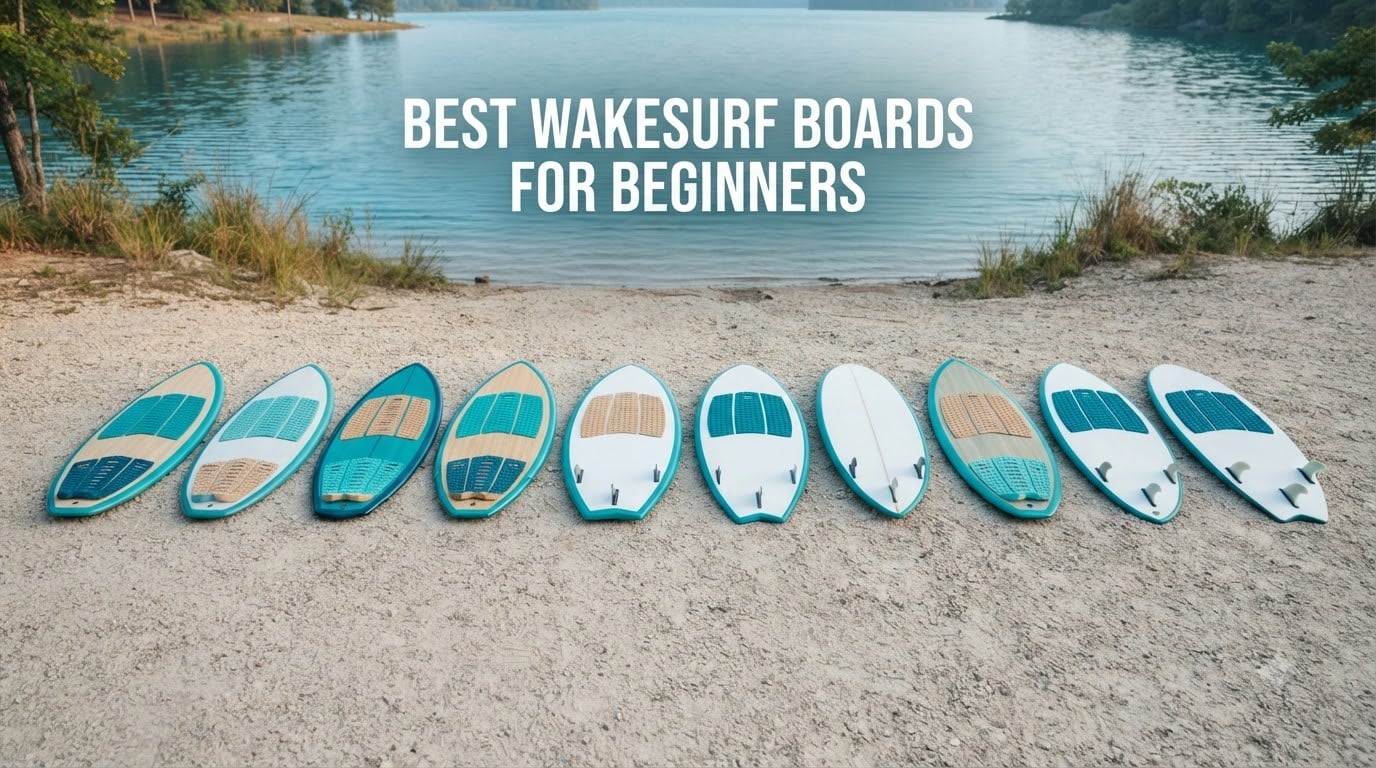
The hardest part of learning wakesurfing is not riding the wake. It is the deep-water start, where you hold the handle with the rope loose, wait for the boat to accelerate, and then try to stand up on a wave that is moving away from you. Get a board that is too small and you will pearl the nose, fall, and repeat that until you decide it is not for you.
That is why board choice matters more than anything else in your first season. A longer, higher-volume surf-style or hybrid shape with a full deck pad gives you the flotation to get up on the first few tries. Search for the best wakesurf boards for beginners and you will see the same three qualifiers repeated everywhere: your rider weight, your boat’s wake size, and whether you want a soft top or a hard deck.
The advice that shows up again and again on r/wakesurf is simple. Bigger boards are better for new riders, and a board that is slightly too large is far kinder than one that is slightly too small. Owners on that forum describe the Hyperlite Broadcast as a great beginner board that covers a wide range of riders, and a MasterCraft TeamTalk poster who owns both a Broadcast and a CWB Ride writes that literally anyone can ride them.
How we picked: we compared ten boards across four things a beginner actually feels, namely board length and volume, deck construction and grip, fin setup, and stated rider weight capacity. We weighted review volume heavily, because a board with two reviews is a guess. This list is updated for 2026 and reflects current-model listings.
Table of Contents
Top 3 Picks: Best Wakesurf Boards for Beginners (October 2026)
These are the boards we would put a first-time rider on, ordered by how much we trust them as a starting point. Every entry lists the real dimensions, the deck build and the rider range each maker claims, so you can match one to your own weight before you read a single review.

Connelly Ride 67 Inch
- Surf style outline
- Compression molded with EPS core
- Three 1.75 inch tail fins
- Rope included in the box
Hyperlite Broadcast 5 ft 4 in
- Biolite 3 foam core
- Layered fiberglass
- Mid tail for carving
- Removable fins

Airhead EVA Padded Board
- Compression molded fiberglass
- Dual hook grooves
- EVA pad with kick tail
- Multiple sizes
Quick Overview: Every Board Side by Side
Before the individual write-ups, here is the whole lineup in one place. Length and width are the maker’s published dimensions, so you can check whether a board fits your weight and your dock ladder.
| Product | Specifications | Action |
|---|---|---|
| Connelly Ride Wakesurf Board |
|
Check Latest Price |
| Airhead Wakesurf Board EVA Pad |
|
Check Latest Price |
| Hyperlite Broadcast 5 ft 4 in |
|
Check Latest Price |
 Airhead PFISH Skim Board Airhead PFISH Skim Board |
|
Check Latest Price |
 Hyperlite Gromcast Kids Board Hyperlite Gromcast Kids Board |
|
Check Latest Price |
 Doomswell Hydro 4 ft 8 in Hybrid Doomswell Hydro 4 ft 8 in Hybrid |
|
Check Latest Price |
 Connelly Ride 5 ft 2 in Package Connelly Ride 5 ft 2 in Package |
|
Check Latest Price |
 Liquid Force Rocket 5 ft 4 in Liquid Force Rocket 5 ft 4 in |
|
Check Latest Price |
 System Mondo Wakesurf Board System Mondo Wakesurf Board |
|
Check Latest Price |
 ZUP 4 ft 11 in Wakesurf Board ZUP 4 ft 11 in Wakesurf Board |
|
Check Latest Price |
1. Connelly Ride 67 Inch Wakesurf Board – Best Overall for Beginners
CWB Connelly Ride Wakesurf Board Package, Proline Surf Rope , 62″
67 in L x 23 in W x 1.75 in thick
Compression molded plastic
5 lb board weight
Three 1.75 in tail fins
1 year manufacturer warranty
Pros
- Surf style outline makes traction and turning predictable
- Compression molded build with CNC diamond cut EVA pad
- Double edge rail and three tail fins track straight
- Rope included so you can get on the water straight away
- Highest review count in the lineup
Cons
- Large 5 ft class footprint is awkward to carry and store
- Plastic build feels less damped than a foam core board
This is the board we keep coming back to, and the reason is the review count rather than the spec sheet. Ninety-nine owners have posted feedback on it, which is more real-world data than anything else in this list. Buyers consistently describe an easy, predictable surf-style ride with solid traction from the EVA pad.
The outline is the story here. A surf style shape with a double edge rail gives you a wide, flat platform that planes early and holds an edge without snapping back at you. For a first-timer, that predictability is worth more than any performance feature.
The CNC diamond cut EVA pad with a kick tail is the other detail worth knowing about. The pattern gives your back foot something to hook into when you are riding at a slight angle, and the kick tail gives you a defined edge when you want to pivot out of a carve.
At 67 inches by 23 inches and 1.75 inches thick, it is a full-size surf-style board, so it is not a toy for a 90 lb kid. It is a board for a rider who is standing up on a regular wake with a normal adult frame. Budget for the walk from the car to the dock, because that footprint is the real cost of a big surf shape.
What tells me it suits a first ride
Three 1.75 inch tail fins in a thruster-style spread keep the board tracking through the flat water before you even get to the wave, which is exactly where new riders lose patience. A board that wanders while you are waiting for the wake is a board that makes people give up.
Compression molded plastic also means there is nothing to break. If you are new to the sport and expect to fall on a deck a few times, that kind of forgiveness matters more than a lighter epoxy layup.
Where it falls short
Reviewers do note that plastic feels less damped than a foam-core board. Landings feel harder and there is less flex under your feet, so if you progress quickly you may outgrow the feel before you outgrow the length.
The other drawback is physical rather than technical. The board weighs 5 lb, but at 67 inches long it is awkward to carry up a dock ladder solo. If your boat launch involves a ladder, that is a real friction point every single session.
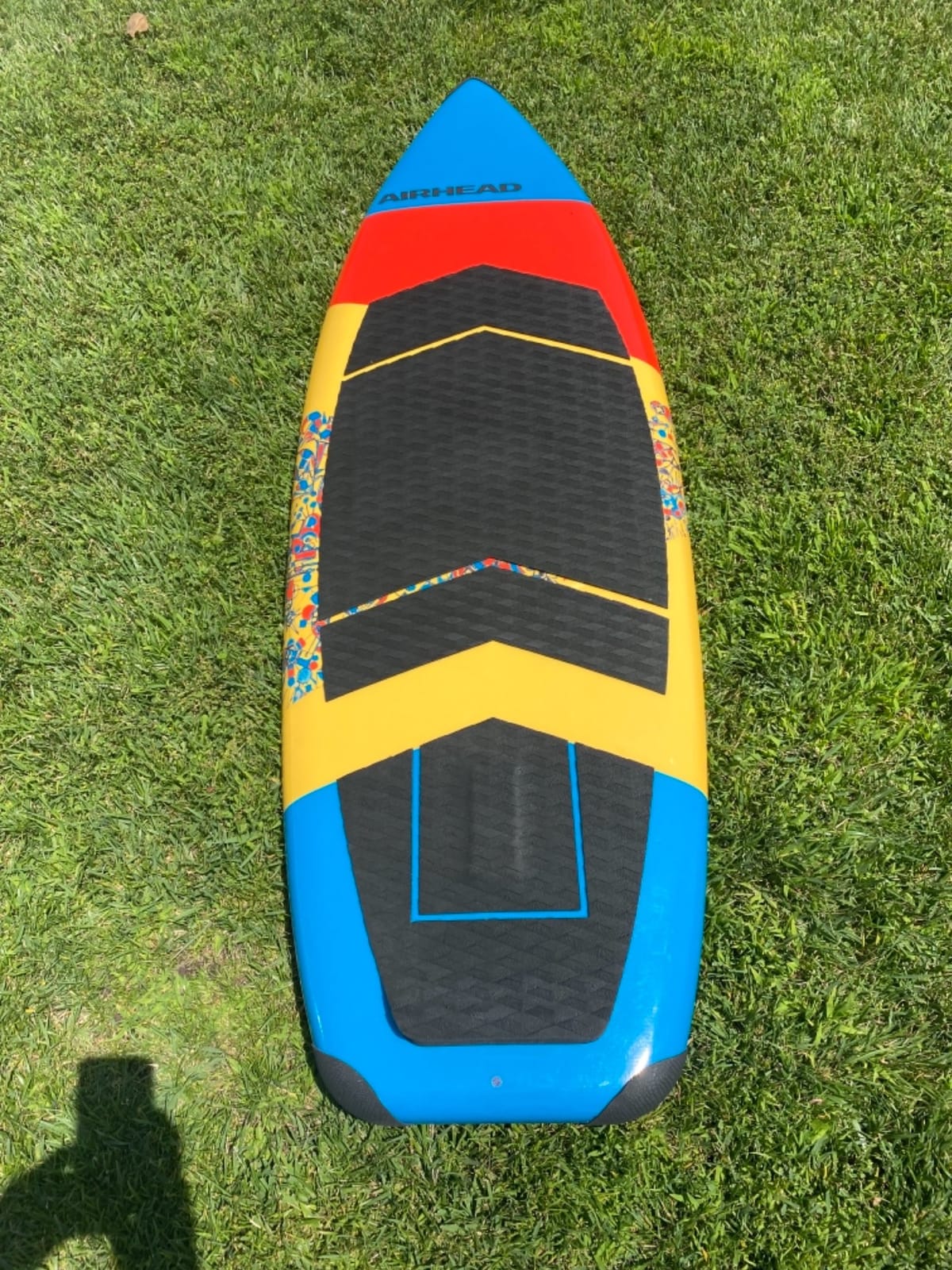
2. Airhead Wakesurf Board with EVA Pad – Best Value
Airhead Bonzai Surf-Style Wakesurf Board
63 in L x 20.5 in W
Compression molded fiberglass
4.49 kg listed weight
Three profiled fins in recessed boxes
Suitable for beginner and intermediate
Pros
- Classic forgiving outline that beginners stand on quickly
- EVA pad with molded kick tail for grip and balance
- Dual hook grooves catch the wake for smoother takeoffs
- Fins remove for extra maneuverability later
- Multiple sizes and graphic styles
Cons
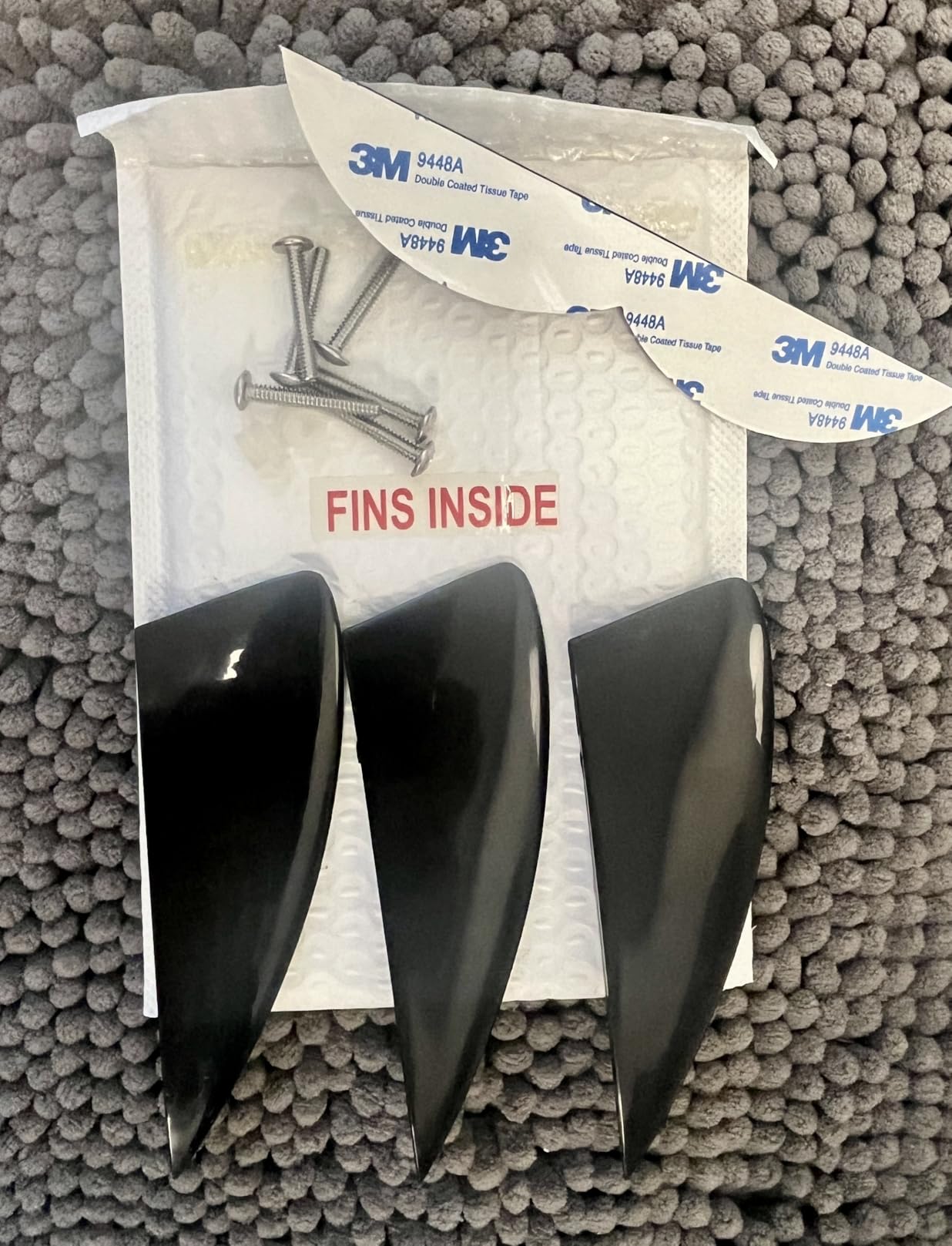
- Several buyers report fins or fin hardware missing from the box
- Fin mounting holes on some units do not line up
- Thin construction draws criticism for flex and durability
This is the teaching board story we hear most often. Owners describe it as easy to ride and durable over years of use, and it has been a long-standing fixture on lesson docks for exactly that reason. Seventy-four reviews is the second-largest feedback base here.
The classic outline is the reason. It is a fairly plain, symmetrical shape with a 2.5 inch pin-shaped rocker, which is a short, flat curve from nose to tail. Low rocker like this means the board does not try to climb out of the water, so it stays put while you find your feet.
Dual hook grooves running along the base give the board something to grab as the boat accelerates. On a beginner-friendly board that is a subtle feature, but it is the difference between catching the wave on the second try and the fifth.
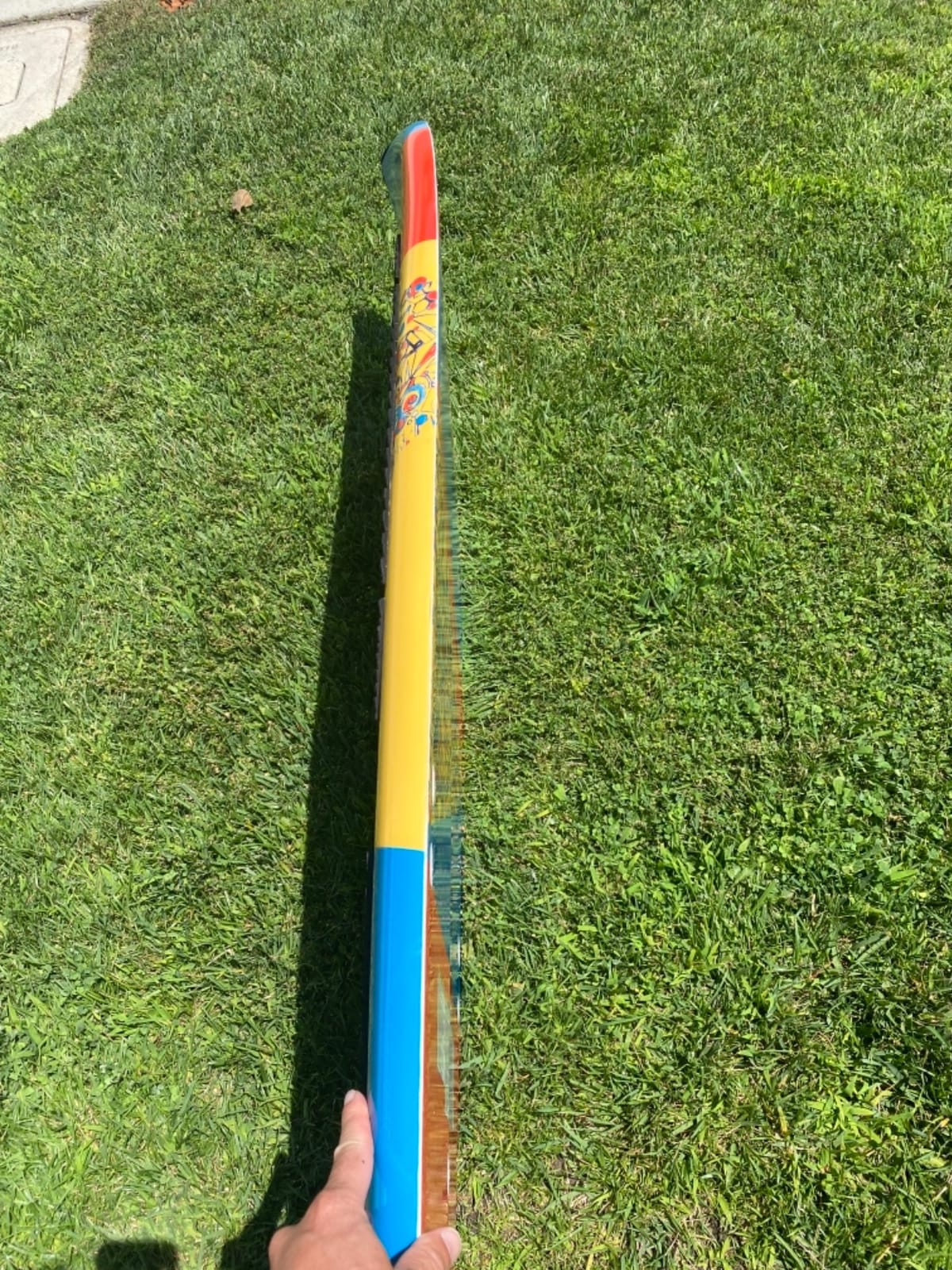
Multiple sizes are available under the same listing, which is genuinely useful if your family is sharing one boat. A 58 inch, a 55 inch, a 60 inch and a 49 inch all show as variants, so you can size up for the adult and keep something shorter for a smaller rider.
The EVA pad with a molded kick tail is standard on this board and it does its job. Grip is the least glamorous part of learning wakesurfing and the part that quietly ends sessions when it fails.
What to check before you ride
Open the box at the dock, not at home. The single most repeated complaint across these reviews is incomplete fin hardware on arrival, and fins you cannot fit means a board that will not track. A few spare screws and a screwdriver solve it in five minutes.
Also confirm the fin holes line up with the screws included. A few buyers found mounting holes that did not match the hardware, which is a five-minute fix with the right screws and a wasted morning without them.
Where it falls short
The thin compression-molded build draws fair criticism for flex and long-term durability. If you are a heavier rider or you plan to keep the board for a decade of family use, a foam-core layup will outlast it.
Its 20.5 inch width is narrower than the Connelly Ride’s 23 inches, so it feels quicker and slightly less locked in on a big wake. For a first board that is a fair trade, but if your boat throws a steep surf wake you may feel that narrower platform.
3. Hyperlite Broadcast 5 ft 4 in – Best All-Rounder
Hyperlite Broadcast Wakesurfer – Wakesurf Board Endorsed By Shaun Murray – Great for All Wake Surfers, from Beginners to Intermediate Riders – 5ft 4in
5 ft 4 in length
Biolite 3 foam core between fiberglass laminates
Rolled edge rail
Mid tail with rocker line
Listed as intermediate skill
Pros
- Blurs the line between beginner stable and advanced capable
- Rolled rail feels smooth and forgiving underfoot
- Mid tail makes carving and direction changes easy
- Fins remove quickly when you want more challenge
- Layered fiberglass and Biolite 3 core age well
Cons
- Heavier than carbon alternatives when carrying to the dock
- Some riders prefer to size down for faster turns
The Broadcast is the board the wider wakesurf community names most often when beginners ask what to buy, and it is the only board here that a MasterCraft TeamTalk owner describes as one he and his whole family can ride. It is listed as intermediate, but owners consistently report it getting new riders up on the first try.
Construction is where the money goes. Layered top and bottom fiberglass laminates overlap around the rail for strength, with a Biolite 3 proprietary foam core bonded between them. That is a proper surf build, not a plastic shell.
The rolled edge rail is the part that matters for a beginner. A rolled rail is a smooth, rounded edge instead of a hard corner. When you land slightly off-axis, the rounded edge does not catch your weight and throw you. That is the whole reason it feels forgiving.
A mid-tail profile with a rocker line gives you a tail that is neither a sharp point nor a full square, which is the sweet spot for carving and for making small direction changes while you are still finding your balance.
Why it suits a wide range of riders
At 5 ft 4 in, the Broadcast is long enough to plane early and generate glide, but short enough to pivot when you want to slow down. That balance is why owners say it covers a wide range of rider sizes, and why it is our pick for anyone who is not sure whether they will end up carving or just cruising.
Removable fins are the feature that extends its life. Start with all three in for stability, and once you are linking turns confidently, pull the centre fin. The board loosens up noticeably and starts behaving like the intermediate board it is listed as.
Where it falls short
The board weighs 5 kg, which is heavier than carbon-fibre alternatives at the same length. If your launch is a long walk or a steep dock ladder, that weight is the thing you will notice first.
Experienced riders do say they outgrow it and size down for faster, more responsive turns. That is a good problem, but it means this is often a two-season board rather than a forever board.
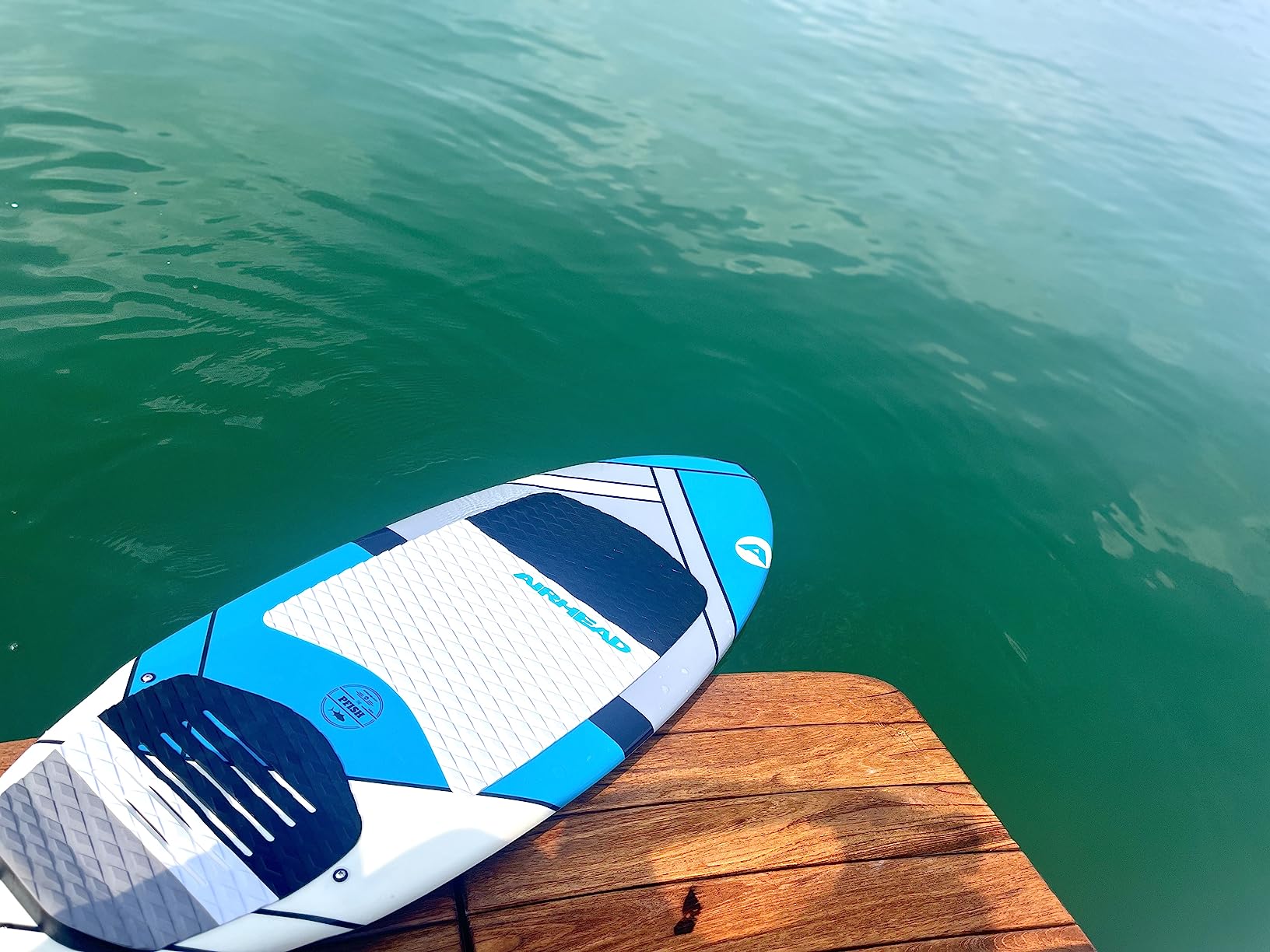
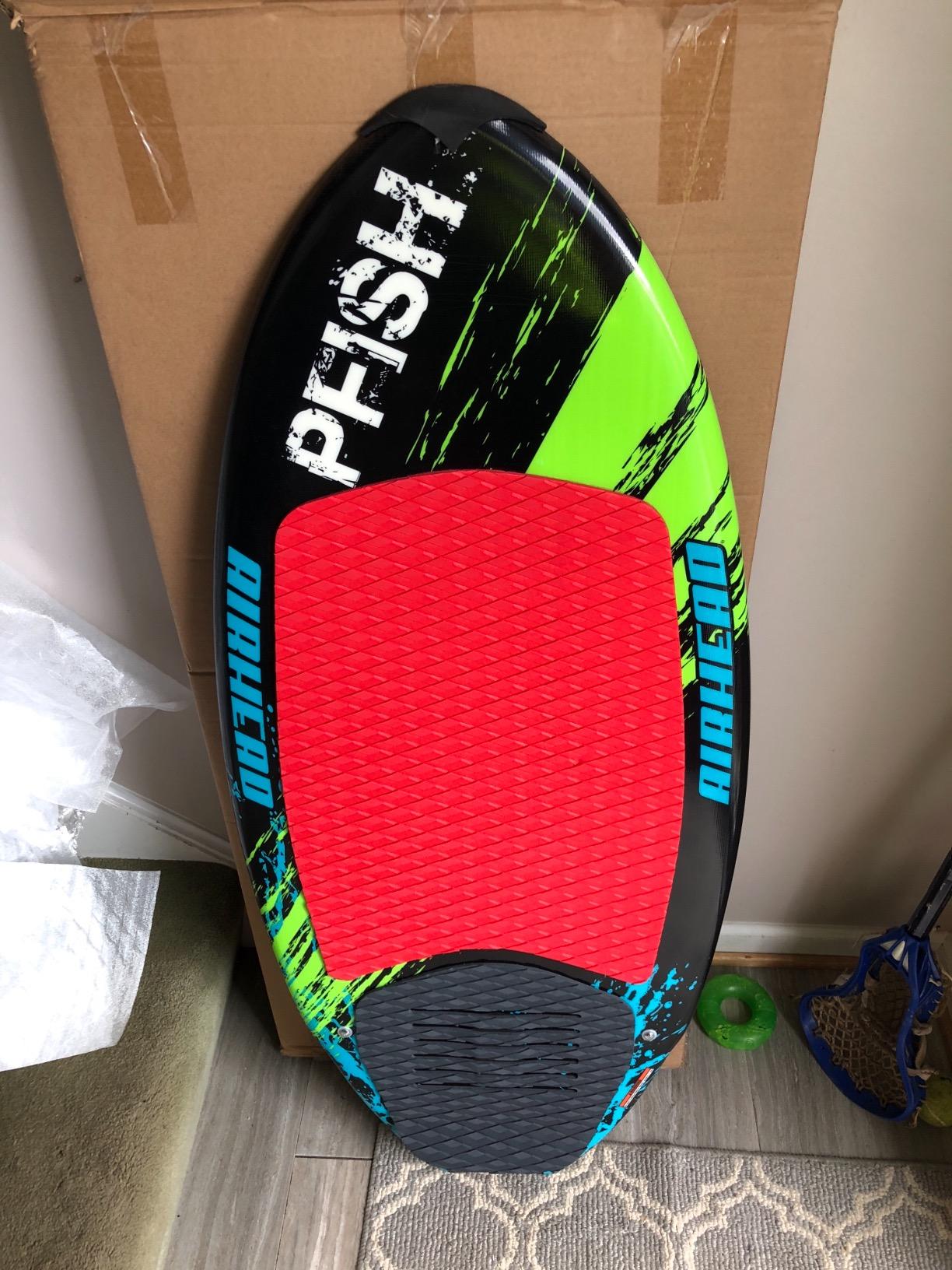
4. Airhead PFISH 49 Inch Skim Board – Best for Smaller Riders
Airhead PFISH Wakesurf Board, Skim Style, multi
49 in L x 21 in W x 0.88 in thick
8.1 lb listed weight
Fiberglass with grooved EVA deck
Two fins for directional control
Rated up to 175 lb
Pros
- Full fish shape and fish tail make the glide easy to pick up
- Extra thick grooved EVA deck gives excellent foothold
- Compact 49 in footprint is easier to carry and paddle than long boards
- Stable enough for advanced riders to catch air
Cons
- 175 lb maximum weight rules out bigger adults
- Skim outline is less stable than a wide surf style board
- Thin 0.88 in profile gives less padding on hard falls
This is the only board in the lineup with a published rider limit, and that limit is the single most useful number on this page. The PFISH is rated for riders up to 175 lb, so you can rule it in or out in one second.
The full fish shape with a fish tail is the most forgiving glide setup on this list. Fish outlines have extra width through the middle and a swallow tail that keeps the board from catching, which is why reviewers say it is easy to pick up and hold a line.
The extra thick grooved EVA deck with a big kicker gives you a defined foothold. On a board this thin, that deck is doing more work than usual, and owners call out the grip as a highlight.
At 8.1 lb and 49 inches, this is the easiest board here to carry down a dock ladder and to paddle out with when you are also holding a handle. That practicality matters more than most spec sheets admit.
When a skim shape makes sense
A 49 inch skim board is the right call if you are under 175 lb and your boat throws a clean, moderate wake. Skim-style boards sit low in the water and generate less push, which keeps you close to the face of the wake instead of riding up and over it.
That is also why the same board frustrates heavier riders. Low volume means less of your weight is held up by the board, and the trim becomes less stable the moment you are heavier than the foam was designed for.
Where it falls short
The 0.88 inch profile is thin, and reviewers note it offers less cushion on hard falls. If your learning curve involves a lot of dropping onto the board in shallow water, a thicker deck feels kinder over the first few sessions.
The skim outline is also less forgiving than a wide surf-style board for a very heavy beginner. One Facebook wakesurf group post described a 150 lb beginner struggling on a big-rocker surf board, and the same logic works in reverse here. Pair this board with a moderate wake, not a steep one.
5. Hyperlite Gromcast – Best Wakesurf Board for Kids
Hyperlite Gromcast Wakesurfer – Kids Wakesurf Board Shaped by Scott Bouchard – Great Board for Beginners & Ideal for Young Riders – 3ft 9in – Pink Check
51.5 in L x 23.88 in W
10.5 lb listed weight
Biolite 3 core in layered fiberglass
Polypropylene construction
Wide stability oriented platform
Pros
- Sized and weighted so kids can carry and control it themselves
- Wide stable platform makes standing up easier
- Layered fiberglass built to survive junior club use
- Bold graphic colors young riders actually like
Cons
- Not sized for adult riders
- Heavier than typical adult boards for its length
Kids fail on wakesurf boards for a boring reason. The board is either too long to control or too thin to stand on, and the child spends the session paddling instead of riding. The Gromcast is dimensioned specifically to avoid both.
It is 51.5 inches long and 23.88 inches wide. That width is the number that matters. Nearly 24 inches of standing surface on a 51 inch board gives a young rider their feet side by side without hanging over the rails.
The build is the same family as the adult Hyperlite boards, with a Biolite 3 foam core wrapped in layered fiberglass where the laminates overlap around the rail. Parents reviewing it highlight durability through junior-club use, which is the only durability test that matters for a kids board.
The one tradeoff parents raise is weight. At 10.5 lb it is heavier than a typical adult board of that length, and a small child carrying it out to the launch will feel that after a long summer day.
When to move a kid up
Most kids are ready for a full-size board once they can stand up consistently without a spotter holding the handle. Until then, a wider platform like this one gives them more room to be clumsy, which is the fastest route to confidence.
If your child is confidently riding and wants to carve rather than cruise, step up to a surf-style board rather than going longer on the same wide platform. Length past a certain point costs you control, not capability.
Where it falls short
It is not an adult board, and no amount of determination changes that. A 175 lb parent trying to stand on a 51 inch platform will spend more time falling than riding.
The 10.5 lb weight is worth thinking about if your launch point is far from the water. Children are usually the ones hauling the board, and a board that is heavy for a nine year old is heavy every single session.
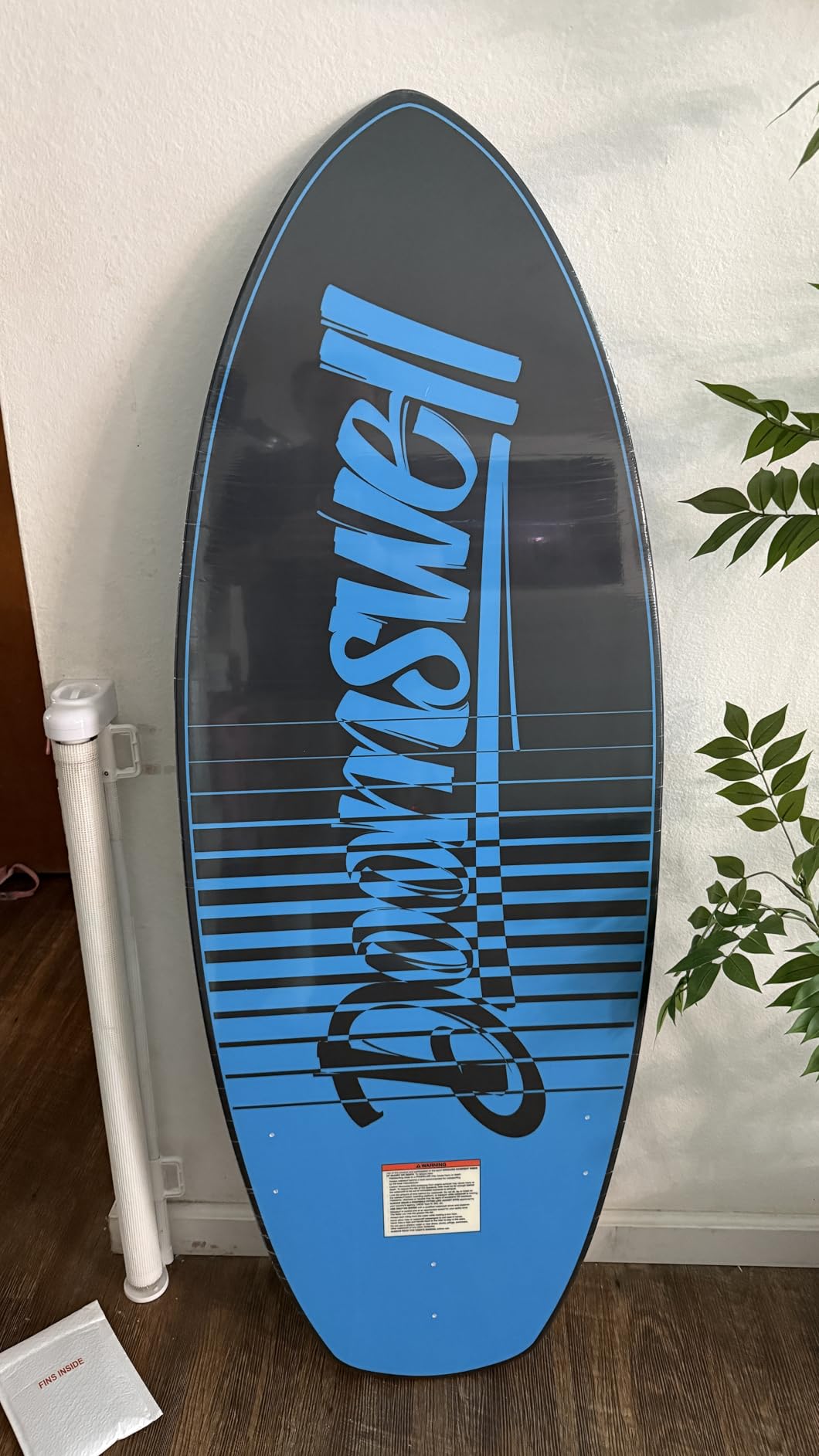
6. Doomswell Hydro 4 ft 8 in Hybrid – Best for Bigger Riders
Doomswell Hydro 4’8″ Wakesurf Board – Lite, High-Performance Hybrid with 3-Fin Option, Compression Molded – Wakeboard for Men & Women, Great for Beginners & Advanced Riders. (Blue)
4 ft 8 in length
9.2 lb listed weight
Compression molded polyurethane
Three screw in fins configurable as tri twin or single
Rated up to 220 lb
90 day warranty
Pros
- Low volume shape pops up quickly which shortens the learning curve
- Lightest board in the lineup at 9.2 lb
- Fin setup reconfigures as the rider progresses
- Covers riders up to 220 lb
- Highest average rating here at 4.8 out of 5
Cons
- Low volume gives less initial stability than a full length surf board
- Short 4 ft 8 in length can feel twitchy on flat water
- Only a 90 day warranty
The Hydro has the highest average rating in this lineup at 4.8 out of 5, with 85 percent of reviews at five stars. That sample is small at eleven reviews, so treat the star score as encouraging rather than conclusive, but the direction of the feedback is consistent.
What the reviews praise is the pop-up. This is a deliberately low-volume design built for a fast planing response, which means the board rises to the surface with less effort than a high-volume surf shape. Owners describe the learning curve as shorter because of it.
The 220 lb rating is what makes this the pick here for a heavier rider. It is the second-highest capacity among the boards we looked at, and unlike boards with no published limit you can buy it knowing it is built for your weight.
Three screw-in fins ship in the box and can be configured as a tri, twin or single setup. That is a genuine advantage over boards with a fixed fin arrangement, because the board can grow with you rather than forcing a change of board.
When low volume is the right call
Low volume works in your favour if you are above 180 lb and riding a boat with a steeper, more powerful wake. Extra displacement is what pushes your weight down and makes a long surf board feel slow and heavy.
It also works well if your biggest problem is not standing up but stopping. A board that planes quickly gives you less resistance to slide across the face of the wake when you are still learning to control speed.
Where it falls short
Low volume means less initial stability, and several reviewers mention a short adjustment period while you get used to it. If you are a light rider who is nervous on the water, a high-volume surf board is a gentler place to start.
At 4 ft 8 in the board can feel twitchy on flat water, which is where you spend the first seconds of every start waiting for the wake to build. Beginners who dread that waiting period do better on something longer.
The 90 day warranty is also by far the shortest in this list. Register the board carefully and inspect it early, because you have a narrow window on manufacturing problems.
7. Connelly Ride 5 ft 2 in Package – Best All-in-One
Connelly Ride Wakesurf Board, 5’2″ Package with Rope Included
5 ft 2 in length
Fiberglass with EPS foam core
Full EVA top deck pad
Three 1.75 in skater fins
Rope included in the package
Pros
- Package includes the rope so you can ride immediately
- Full EVA top deck pad gives strong grip on first attempts
- EPS foam core adds buoyancy and damped landings
- Cruiser shape is stable and predictable
Cons
- Very small review base so long term durability is unproven
- No published weight limit for larger riders
- Skater fins hold less bite than thruster setups
The reason this board is here is the rope in the box. A genuine beginner has two shopping lists before their first session, the board and the handle with line, and this package removes the second one. Five reviews, all strongly positive, specifically praise the included rope.
The cruiser design is tuned for easy, stable riding rather than performance. Compression construction around an EPS foam core gives you buoyancy and a damped landing, which is exactly what you want on a board that will be jumped on rather than ridden gracefully.
A full EVA top deck pad covers the standing area, so there is no bare board under your back foot. Reviewers consistently call out deck grip as the feature that keeps sessions going longer than planned.
At 5 ft 2 in, this is a slightly smaller footprint than the Connelly Ride at position one. That makes it easier to carry and better suited to a rider who does not need maximum planing area.
What to know before you commit
Only five reviews exist for this listing, which is not enough history to judge how the deck pad wears over several seasons. The spec sheet is good, but you are buying on the design rather than on owner data.
There is also no published weight capacity. With a 5 ft 2 in cruiser shape and an EPS core it should suit most adult riders, but you are not getting a number to check against, unlike the PFISH or the Doomswell.
Where it falls short
The three 1.75 inch skater fins hold less bite than a thruster setup, and that difference shows up on a smaller wake. If your boat throws a modest wake, you may drift sideways through the turn more than you would like.
Because the review base is so thin, long-term durability is simply unproven. If you expect the board to last a decade of family use, the foam-core boards with deeper review histories are the safer bet.
8. Liquid Force Rocket 5 ft 4 in – Widest Weight Capacity
Liquid Force Rocket Wakesurfer with Handle and Rope, Red, 5’4″
67.5 in L x 22.75 in W x 1.24 in thick
17.5 lb listed weight
Winged swallow tail
Compression formed polyurethane foam core
Rated up to 250 lb
Pros
- Fuller outline and winged swallow tail add real stability
- Single to double concave hull delivers an effortless glide
- Highest stated capacity here at 250 lb
- Includes wide padded handle and 24 foot mainline
Cons
- At 17.5 lb it is by far the heaviest board here
- Almost no owner feedback so ride quality is largely untested
The 250 lb capacity is the headline number, and it is the highest stated limit among the boards we compared. If you are a heavy rider and you have been disappointed by boards with no published rating, this is the one to check first.
The shape supports that claim. A winged swallow tail with a fuller outline gives you more usable surface and more stability than a narrow pointed tail, and a single-to-double concave hull helps the board glide into the wave rather than bulldozing through it.
It also comes with a wide padded handle and 24 feet of mainline with two takeoff sections, so this is a genuine all-in-one package like the Connelly at position seven.
I want to be straight about the evidence here. Two reviews, both five stars, is not a track record. The rating is real but statistically meaningless, and this pick rests on the spec sheet rather than on owner reports.
Who this capacity suits
Riders between roughly 190 and 250 lb have the fewest comfortable options in this category. Most beginner boards are sized for a 175 lb ceiling, which leaves heavier riders dealing with boards that were never designed to hold their weight.
The wider outline and concave hull here are both stability features, so the capacity is not just a printed number on a box. The construction matches the claim.
Where it falls short
At 17.5 lb this is the heaviest board in the group by a wide margin. Carrying it up a dock ladder, or walking it across a boat deck to a swim platform, is a genuine problem rather than a minor complaint.
With almost no owner feedback, you are taking a spec-sheet bet. If you can, test-ride a similar Liquid Force shape on a rental board before committing to this specific model.
9. System Mondo Wakesurf Board – Best Buoyancy
System Mondo 5’2″ Wakesurf Board
Fiberglass construction with DuraFloat core
Thruster fin design
Full EVA deck padding
Board and fins included
3 year warranty
Pros
- Thruster layout gives beginners predictable control and response
- DuraFloat core maximizes buoyancy so the board planes early
- Full EVA padding covers the whole deck for secure footing
- Longest warranty here at 3 years
- Board and fins included in the box
Cons
- Only one review so there is no owner feedback on ride quality
- Listed as intermediate skill level though the wide shape suits new riders
- Title and size field disagree so actual length is unclear
This one needs a caveat up front. There is a single review on this listing, so the five-star rating tells you almost nothing. What we are buying here is the design, and the DuraFloat core is the reason it made the list.
Buoyancy is the number one factor in whether you get up on the first few tries. A high-float core means the board pushes you to the surface with less effort, which shortens the trial-and-error loop that makes beginners quit.
The thruster fin design gives predictable control and response rather than loose surf feel. For a rider who wants the board to go where they point it, that is a sensible default.
Full EVA padding across the deck means there is no bare fiberglass anywhere you stand, and a 3 year warranty is the longest in this lineup by a distance.
Why buoyancy matters more than shape
Every deep-water start asks the same question, which is whether the board will rise with you on it. More buoyancy means a shorter, shallower start, and a shallow start is far easier to learn than a deep one.
This is the same principle that makes a soft top feel safe, except it comes from core volume rather than foam thickness. If you have struggled to get up on a board before, buoyancy is the specification to prioritise.
Where it falls short
The listing is inconsistent. The title says 5 ft 2 in while the size field says 5 ft 7 in, so the actual length is unclear and you cannot safely size it against your weight without checking with the manufacturer.
It is also listed as an intermediate skill level even though the wide shape suits new riders. With one review, there is no owner consensus to override the stated level, so treat it as a capable board rather than a beginner-safe one.
10. ZUP 4 ft 11 in Wakesurf Board – Widest Deck
ZUP 4’11” WAKESURF Wakeboard with EVA Foam Grip Pad, Kneeboard, Wakeskate, Water Sports and Surf Board for Beginner and Intermediate Riders, Hornet
59 in x 26.25 in footprint
14.1 lb listed weight
Rolled edge profile
Dual concave base with simple rocker
Tri fin construction
7/8 in tail kick
Pros
- Widest board here at 26.25 in giving the most stable platform
- Rolled edges reduce rail bite which is kind to new riders
- Dual concave base and simple rocker make the board predictable
- EVA deck pad and 7/8 in tail kick deliver grip and comfort
Cons
- No tow rope or handle included despite the listing title
- Heaviest board in the group at 14.1 lb
- Lowest rated here at 3.2 out of 5 with several one star reviews
We include this board because the width is genuinely the widest in the group at 26.25 inches, and for someone terrified of falling off, a wide platform is a legitimate reason to choose a board over a cheaper-looking alternative.
Rolled edges are the meaningful feature. A rolled edge has no sharp corner to catch your weight when you land off-axis, so it reduces rail bite, which is the leading cause of unexpected falls on a narrow board.
The dual concave base with a simple rocker line keeps the ride predictable, and the tri-fin setup handles varied wave shapes without a lot of tuning. The 7/8 inch tail kick gives you a defined edge for pivoting.
Now the part you need to weigh. This is the lowest rated product here at 3.2 out of 5, with four reviews including several one-star ratings. The standout complaint is that the listing implies a rope-and-handle bundle and buyers received the board alone.
When the wide deck earns its place
If you are an adult beginner who weighs close to the low end of each board’s range, standing on 26.25 inches of deck with your feet apart is a much calmer first experience than balancing on a narrow tail.
It also works well behind a small wake. A wider board generates more glide and needs less push to get moving, so it is forgiving on a boat that does not throw a steep surf wake.
Where it falls short
At 14.1 lb it is the heaviest board in the lineup, and for a smaller rider that is a serious handling problem. Do not expect a child to carry this board to the launch comfortably.
The missing rope is the deal breaker to plan around. Budget for a handle and mainline separately, and check the box contents before you leave for the lake rather than at the ramp.
How to Choose a Wakesurf Board: Surf, Skim or Hybrid
Three questions decide almost everything: what do you weigh, how big is your boat’s wake, and how likely are you to hit the deck with the board. Here is how each one narrows the field.
Start with rider weight, not length
Rider weight is the only number you cannot argue with. Length is a proxy for volume, and volume is what keeps you on top of the water. A rough rule that matches most of the boards above: a rider around 100 lb fits a board near 5 feet, a rider around 150 lb fits a board in the 5 ft 2 in to 5 ft 4 in range, and a rider above 200 lb needs to look at boards with a published 220 lb or higher capacity.
Where a maker publishes a maximum rider weight, believe it over the length. The PFISH is 49 inches long and still stops at 175 lb, and the Liquid Force Rocket is 5 ft 4 in and carries 250 lb. Length alone would not tell you either of those things.
If you are between two sizes, step up. Bigger boards genuinely do give a better experience at beginner level, as people on r/BeginnerSurfers keep pointing out, and the extra forgiveness costs you nothing for the first season.
Surf style, skim style or hybrid
Surf style boards are longer, have more rocker and more planing area. They generate speed and glide, which makes them stable and forgiving on a big wake, and they are the default choice for a first board.
Skim style boards are short and flat with minimal rocker, like the PFISH at 49 inches. They hold less of a footprint and ride lower in the water, which keeps you close to the face of the wake. They suit lighter riders and moderate wakes, and they are a harder first step if you have no surf background.
Hybrid boards sit between the two, and many of them use a configurable fin setup to act as either. The Doomswell Hydro ships three screw-in fins that can be arranged as a tri, twin or single, which is the clearest example of that flexibility here.
The community consensus is that do-it-all hybrid or surf shapes are the safe default for a novice. One r/wakesurf poster put it plainly about the Phantom, calling it a general purpose surf-style board where you cannot go wrong.
Soft top or hard deck
A soft top has a foam core and a full flexible deck, so a dropped board does not dent your boat deck or your feet. It is the right call for kids, for anyone learning on a shallow wake, and for anyone who shares a boat with people still falling off.
A hard deck with a foam core or epoxy layup is faster and more responsive, and it is where most boards here sit. The trade is that falls onto the deck sting more and hard landings feel harder.
Forum complaints about soft tops tend to be about feel rather than safety. Riders describe some soft boards as feeling slightly unstable because the flex moves underfoot. That is a real trade, but it is usually worth it for a first season.
Fins, rocker and the deep-water start
Rocker is the nose-to-tail curve. Flat or pin-shaped rocker keeps the board down while you wait for the wake, which makes starts easier. Deep or split rocker helps the nose ride over chop but makes pearling, or nose-diving, more likely on a deep-water start.
Fin count changes tracking. A thruster setup of three fins holds an edge best and is the most forgiving. A single fin glides looser and is easier to slide for tricks. More fins means more hold, fewer means more looseness, and a beginner wants hold.
Leash connection and handle type matter too. Some boards here include a handle and mainline in the box, which saves you a separate purchase, and some do not. Confirm the box contents before you drive to the lake.
Should you rent before you buy?
Renting first is the default advice across every forum thread on this topic. Most people say you can rent a board at almost any surf location, and renting lets you find out whether you like riding the wake before you commit to a board you will have to carry around for years.
Buy when you know your wake size and your weight range, and when you are riding consistently enough that a rental board is limiting you. You have clearly progressed enough to buy when you can link two turns and want to start shaping the line rather than just survive the wave.
If you are training on land first to build balance before you ever touch a wake, our picks for the best balance boards for rehab are built around the same stability logic.
Flat-water practice works just as well on a paddle board, and our guide to the best inflatable paddle boards for beginners covers the wider deck sizes that help you find your footing before you add a wake.
If your local water is a calm lake rather than a river or an open sea, the best inflatable paddle boards for lakes roundup is the closer match for practising your balance on glassy water.
Frequently Asked Questions
What size wakesurf board is best for a beginner?
For most adult beginners, a surf-style board in the 5 ft to 5 ft 4 in range is the right starting point. Use rider weight as the real sizing input rather than length alone: a rider near 100 lb fits a board around 5 feet, a rider near 150 lb fits 5 ft 2 in to 5 ft 4 in, and riders above 200 lb should look for boards with a published 220 lb or higher capacity. If you are between two sizes, step up, because more volume makes the deep-water start and getting up on the wave easier.
Is wakesurfing hard for beginners?
The hard part is the deep-water start, not riding the wake. You hold the handle with the rope loose, wait for the boat to accelerate, and then try to stand as the wave builds. A longer, higher-volume surf-style or hybrid board with a full deck pad shortens that learning curve because the board rises to the surface with less effort. Most beginners are riding the wake within a handful of sessions on a stable board.
What size softboard should I get?
Size a soft top the same way you would a hard deck, by rider weight, and choose the wider and longer end of the range. Soft tops suit kids, riders sharing a boat with beginners, and anyone learning on a shallow wake because a dropped board will not dent a deck or sting a shin. Expect slightly less edge hold than a hard board because the foam deck flexes, which is a fair trade for a first season.
Should I rent or buy a wakesurf board?
Rent first if you are unsure. Forums consistently treat renting as step one, and board rental is widely available at surf locations. Renting tells you how your boat’s wake feels before you commit to a board you will carry for years. Buy when you know your rider weight and wake size, and when you can link two turns and want to shape the line rather than simply survive the wave.
Are wakesurf boards hard to learn on compared with wakeboards?
Wakesurfing is generally easier to pick up than wakeboarding because you are not attached to a rope during the start. The trade is that you must hold your balance with a handle in one hand and clip in only once the board is in the wave. A stable surf-style or hybrid board gets most people upright faster than an entry wakeboard, which is why beginner-friendly boards matter so much for the first season.
Final Verdict: Which Beginner Wakesurf Board Should You Buy
The Connelly Ride 67 inch board is the safest single answer for a first board, because it has the deepest review history here, a genuinely surf-style predictable outline and a rope in the box. If you are lighter than 175 lb and want something easier to carry, the Airhead board at position two does the same job with a lighter footprint.
Match the board to the rider, not the brand. Kids belong on the Gromcast, riders under 175 lb who want a compact skim shape belong on the PFISH, and anyone over 200 lb should look at the Doomswell Hydro or the Liquid Force Rocket for their published capacity.
Whichever one you land on, step up in size if you are torn between two. Our picks for the best wakesurf boards for beginners in 2026 all share the same priority, getting you upright on a wave quickly enough that you come back for the next session.