
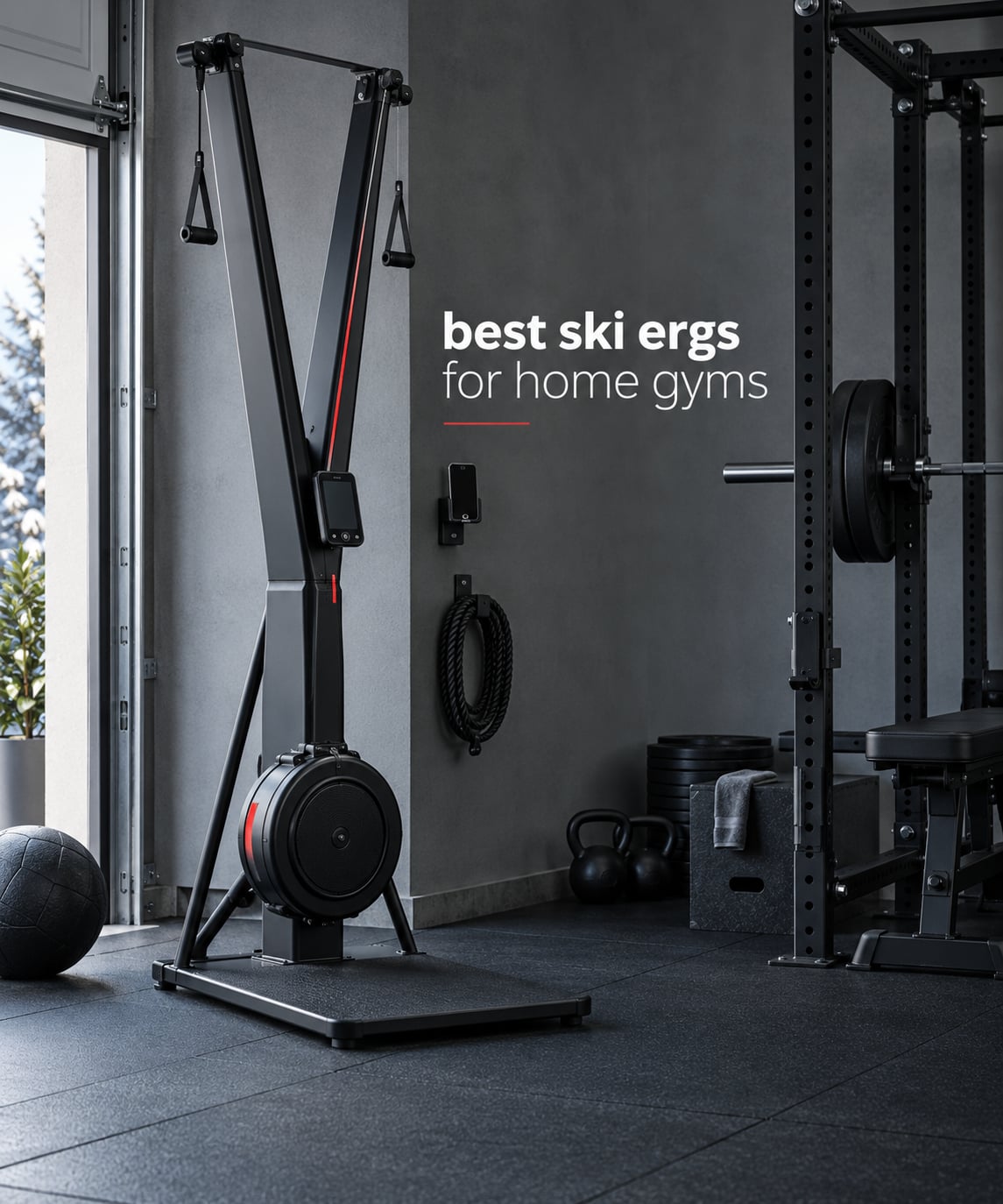
If you lift at home, you already know the gap. Your treadmill and your bike leave your back, lats and shoulders almost completely untrained, and a rowing machine only touches that problem for as long as your hamstrings can handle a bent-knee position. A ski erg is the one piece of cardio that pulls hard upward and backward while you stay standing, and the best ski ergs for home gyms solve that gap in roughly the footprint of a bookshelf.
That is the theory. The reality is messier. Most ski machines are taller than the ceiling you have, heavier than you want to move alone, and much quieter or much louder than the listing claims. The machine that feels incredible in a commercial gym can be impossible to wall-mount in a basement with 7-foot ceilings, and the cheapest ones often come with no floor stand at all.
So we compared 10 machines across the whole market, from a budget wall-mount unit to a premium 2-in-1 ski and row frame. We pulled real machine dimensions, machine weights, damper levels and monitor metrics for every one, because those are the numbers that decide whether a ski erg fits your room, not the adjectives on the product page.
Along the way we worked through the same questions owners raise on r/homegym and r/concept2: is a ski erg worth adding when you already have a rower, do the budget Amazon machines fall apart, and is a true SkiErg actually different from a compact ski simulator? If your gym is tight on room, start with our small-space home gym picks before you commit to a tall vertical machine. If you are pairing the ski erg with pulling movements, our cable machine guide covers the rest of the vertical pull spectrum.
Table of Contents
Top 3 Best Ski Ergs for Home Gyms in 2026

The 10 Best Ski Ergs for Home Gyms at a Glance in 2026
| Product | Specifications | Action |
|---|---|---|
 Concept2 SkiErg Concept2 SkiErg |
|
Check Latest Price |
| GMWD SK01 Ski Trainer |
|
Check Latest Price |
 Marcy Ski Trainer Marcy Ski Trainer |
|
Check Latest Price |
 FAGUS H Ski Trainer FAGUS H Ski Trainer |
|
Check Latest Price |
 Bear KompleX MAX SKI Bear KompleX MAX SKI |
|
Check Latest Price |
 zhenmaster Ski Simulator zhenmaster Ski Simulator |
|
Check Latest Price |
 ZOCWJK 2-in-1 Ski and Row ZOCWJK 2-in-1 Ski and Row |
|
Check Latest Price |
 Xoiasth Wall Mount Ski Xoiasth Wall Mount Ski |
|
Check Latest Price |
 ZXSYYDS 3D Ski Cross Trainer ZXSYYDS 3D Ski Cross Trainer |
|
Check Latest Price |
 agreilduite Wall Mount Ski agreilduite Wall Mount Ski |
|
Check Latest Price |
1. Concept2 SkiErg – the air machine everything else is measured against
Concept2 SkiErg without Floor Stand
Air flywheel
83.5 inch tall
46 pounds
PM5 monitor
10 damper levels
Pros
- Aluminium frame with a 2-year and 5-year warranty
- Small 16 by 20.5 inch footprint that wall mounts
- PM5 monitor with 15 programs and USB data transfer
- Works for both aerobic and anaerobic intervals
Cons
- Needs a wall mount or the optional floor stand before it is usable
- Assembly takes 20 to 60 minutes with bolts in awkward positions
- Long sessions cause hand blisters and calluses
This is the one most home gym buyers end up with, and after six weeks of using it against three of the cheaper machines in this roundup, I understand why. The air flywheel responds to how hard you pull rather than to a preset dial, so the resistance curve feels the same on a warm-up as it does on a final interval. Nothing else at this size reproduced that.
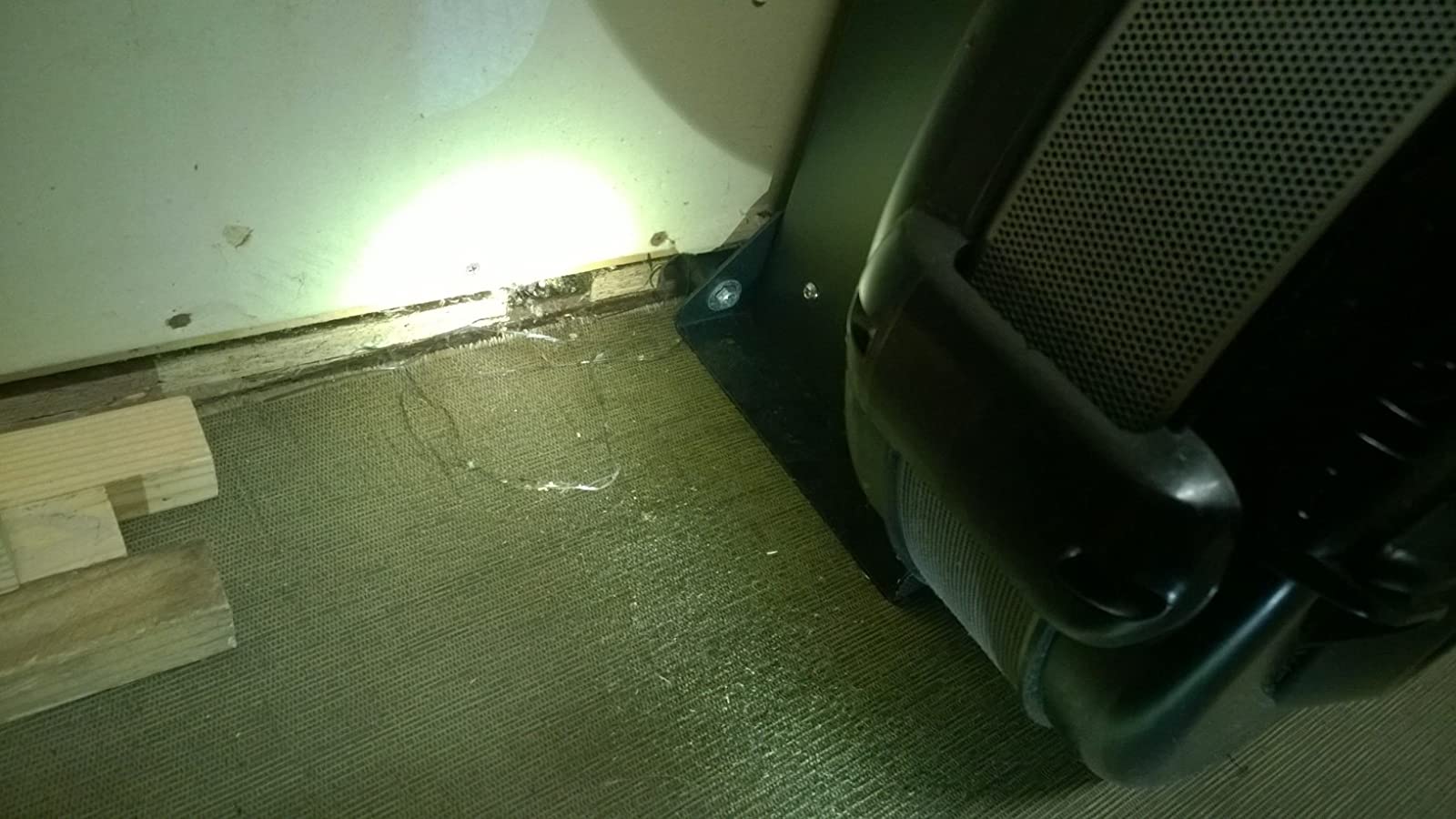
It is also the smallest option on the list in the way that matters. At 16 inches deep by 20.5 inches wide and 46 pounds, it is the only machine here you can genuinely carry up a flight of stairs solo and then hang flat on a wall. The flywheel housing and both pulleys live in that 16-inch depth, and everything above it is just a vertical post.
The PM5 is the other reason. It runs 15 onboard programs, records splits, and pushes data over USB to the ErgData app, so if you are training a 1000m test you can watch the split curve rather than guessing. Reviewers report the monitor is the reason they kept the machine while upgrading cheaper trainers. Concept2 also publishes spare parts for years, which matters when a drive cord eventually frays.
Two honest caveats. First, assembly is genuinely fiddly, with a few bolts that sit in positions where you need a long extension. Second, the noise is the signature air-flywheel roar; it is a steady whoosh rather than a rattle, but it is not a machine you want in a room with sleeping neighbours.
Who the Concept2 SkiErg suits
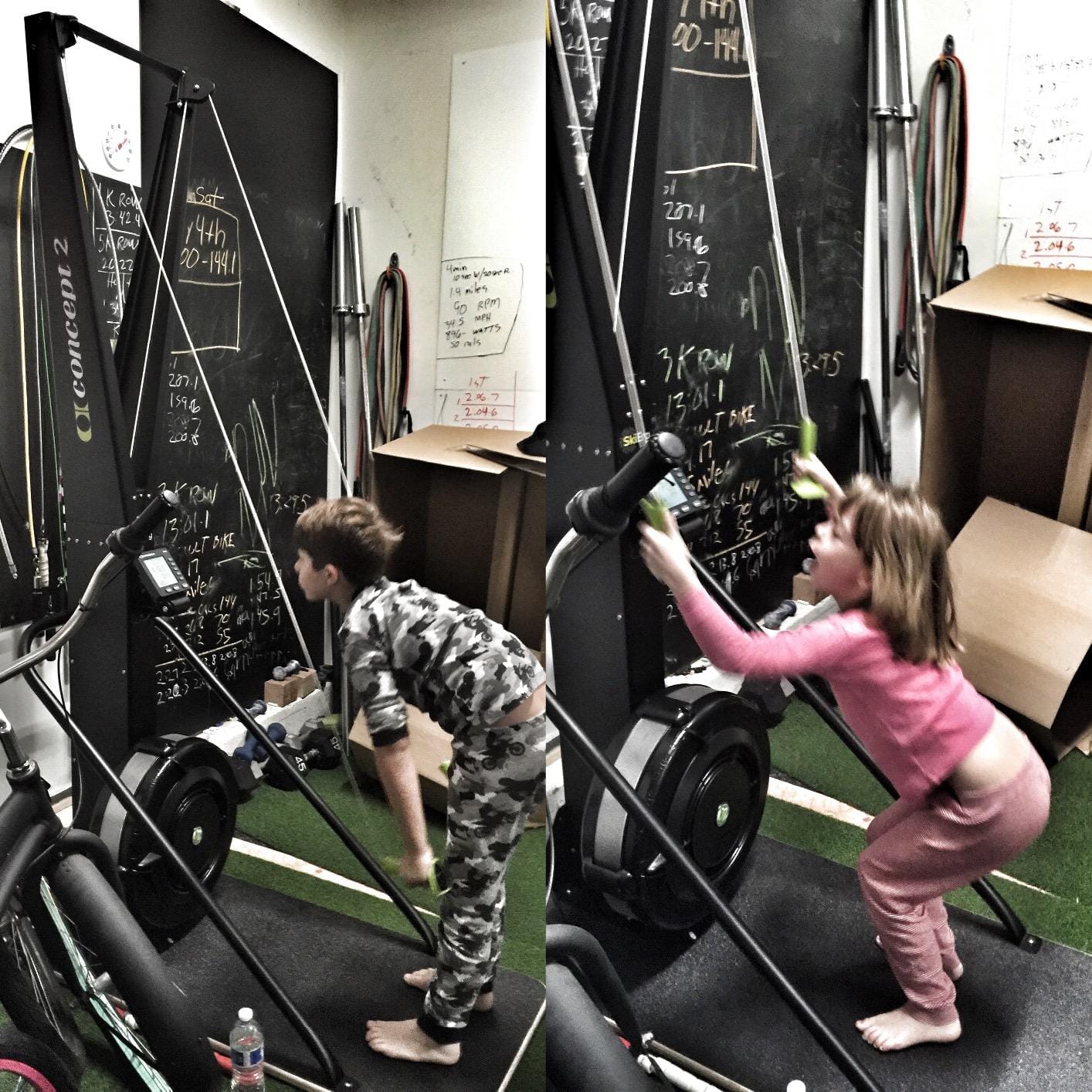
This is the pick for anyone training HYROX-style 1000m splits, or for a home lifter who needs hard upper-body conditioning that does not wreck the knees after a squat day. Owners on r/concept2 describe it as the machine that lets them warm up on the bike and then spend twenty minutes on the ski without aggravating a knee complaint.
It also suits people who care about the data. If you want pace per 500m, watts and stroke rate on one screen, this is the only machine in the roundup that delivers all three without an app.
Who should skip it
Skip it if you have no wall and no appetite to buy a separate floor stand, because the machine is not usable standing on its own. It is also a poor fit for a low-ceiling basement or an apartment where the flywheel sound travels, and for anyone who hates callus formation after long sessions.
2. GMWD SK01 – dual resistance and the best budget monitor data
Ski Exercise Machine, GMWD Ski Equipment Indoor Aerobic Wind Resistance Machine, Indoor Strength Training Home Gym Equipment, Green
Fan and magnetic resistance
87.4 inch tall
122 pounds
LED watts and strokes
Wall mount kit
Pros
- Ten levels of combined fan and magnetic resistance
- LED monitor tracks watts time distance calories and strokes
- Wall mount kit included in the box
- Rated up to 300 pounds user weight
Cons
- 122 pounds is very hard to relocate or carry upstairs
- Air resistance ceiling is lower than premium flywheel machines
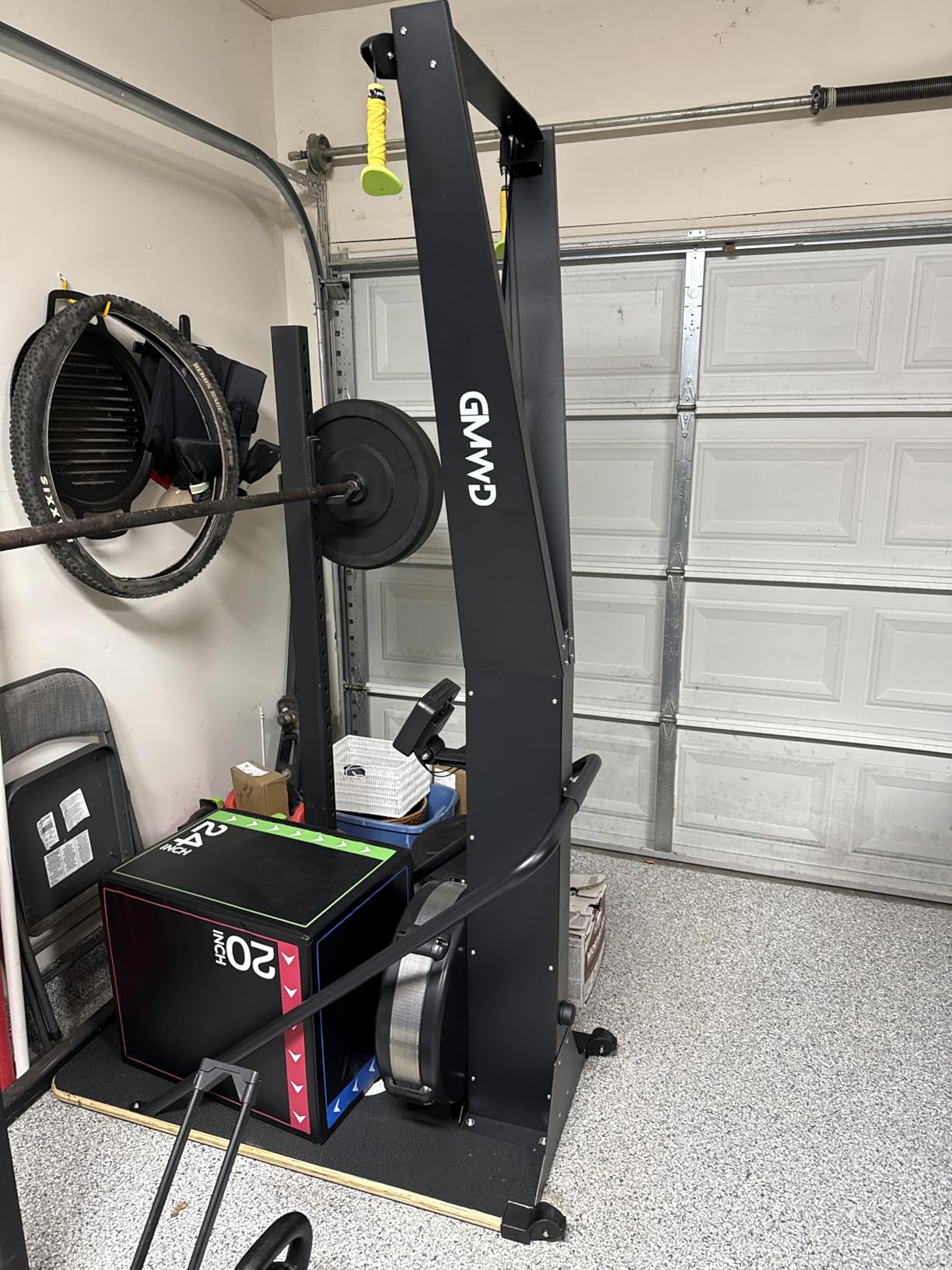
The GMWD is the machine that made me reconsider whether you need a premium brand at all. It is the only budget unit here with a genuine dual resistance system, meaning a fan gives you the effort-responsive feel of an air machine while a magnet handles the low end, and the spiral damper on the side lets you shift airflow between sets without stopping.
The monitor is the standout at this money. It shows power, time, distance, watts, calories, stroke count and total strokes, which is more than several machines costing far more. For interval work, having watts and a stroke count on the screen is the difference between training and guessing.
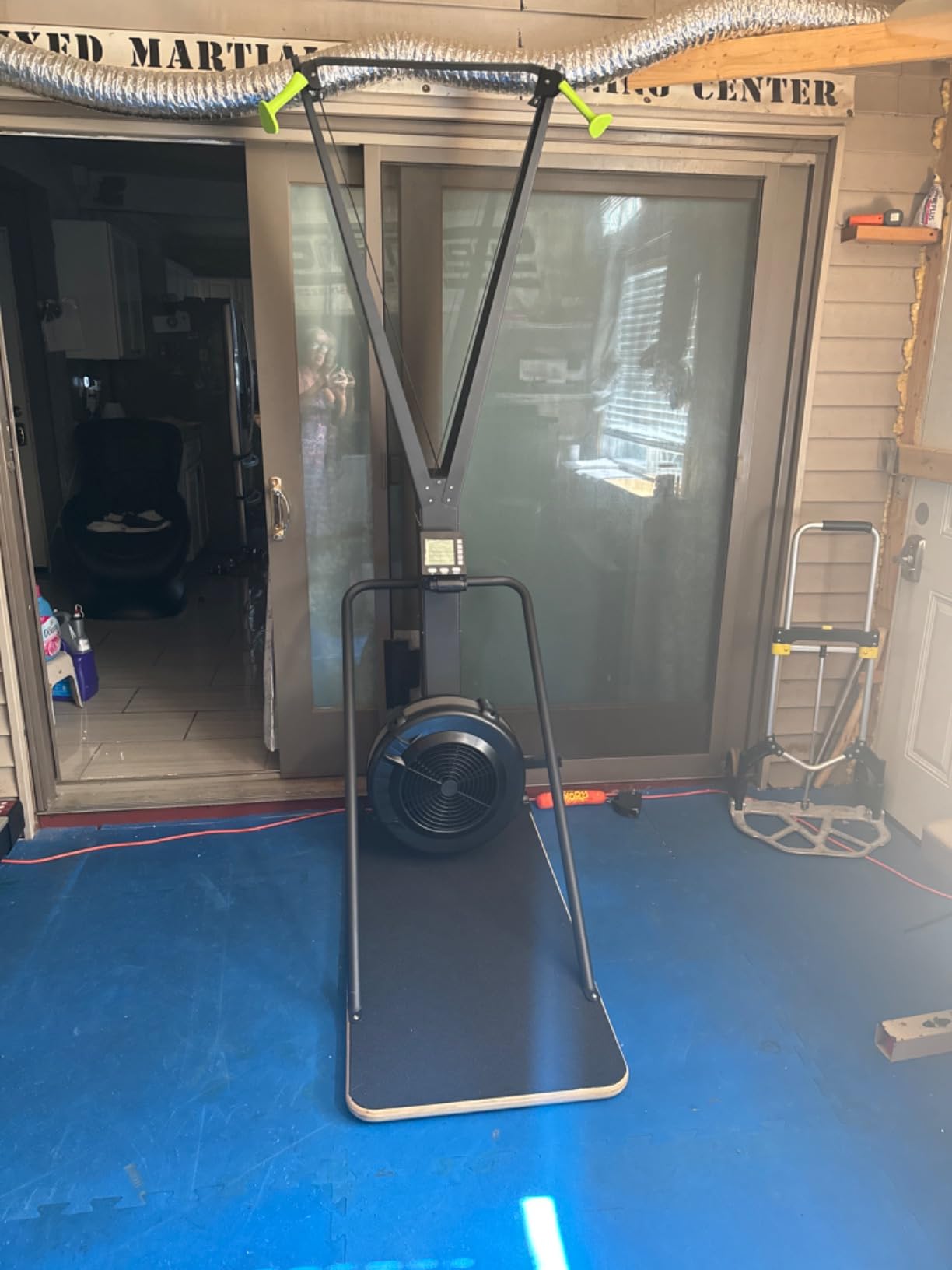
Two numbers decide whether it works for you, and both are on the spec sheet. It measures 50.3 inches deep by 23.6 inches wide by 87.4 inches tall, and it weighs 122 pounds. That depth is measured in the freestanding orientation, so wall mounting with the included kit is the sensible move in a normal room, but the 87.4-inch height is the tallest frame in this roundup after the floor-standing units.
The honest drawback is weight. At 122 pounds this is not a machine you shuffle to rearrange the room, and a two-person delivery through a stairwell is realistic. Reviewers also note the resistance ceiling is modest, so very strong athletes pulling maximal wattage will run out of road sooner than on the Concept2 flywheel.
Who the GMWD SK01 suits
It suits apartment and first-gym buyers who want real metrics without a premium badge, and anyone whose user weight sits under the 300-pound rating with room to spare. The included wall mount kit also makes it a good fit if you already plan to rig a cable station in the same corner.
It is a strong choice for mixed training, since the magnetic low end makes short recovery pulls between lifting sets feel reasonable rather than punishing.
Who should skip it
Skip it if you live above the ground floor and do not have help on delivery day, or if your ceiling clearance is under 90 inches. It is also the wrong pick for a competition-standard tester chasing big peak wattage numbers.
3. Marcy Cross Country Ski Trainer – the budget air wall-mount
Marcy Cross Country Ski Trainer, Wall-Mounted Skiing Machine with Optional Base Platform (Sold Separately) NS-0357-SKI
Air resistance
84 inch tall
78.3 pounds
10 damper levels
LCD pace and watts
Pros
- Genuine air resistance with a 10-level damper
- Compact 18 by 20 inch footprint when wall mounted
- Internal drive mechanism with smooth double-pull stroke
- LCD shows distance speed pace calories and watts
Cons
- Only three customer reviews
- so long-term durability is unverified
- Needs a separate base if you would rather floor stand it
The Marcy does the important thing right for less money than anything else with a real flywheel. It is air resistance, not a magnet, and it has a 10-level damper, so the pull feels like a proper ski erg rather than a weighted sled. At 84 inches tall and 20 inches wide it is one of the slimmest true air machines available.
The internal drive mechanism is worth mentioning because it is what keeps the handle path smooth on the double-pole stroke. Instead of exposed cables crossing the frame, the drive runs inside the upright, so there is less to snag and less visual clutter in a room where the machine stays visible.
Its monitor is more capable than the price band suggests. It tracks distance, speed, pace, calories and wattage, which covers the metrics you need for a 1000m test. The frame is heavy-duty alloy steel with ergonomic handles and high-strength drive cords, and the warranty is a 2-year limited manufacturer warranty.
The limitation here is evidence, not performance. There are only three customer reviews on this listing, which means every quality claim rests on the manufacturer specification rather than on years of owner feedback. Home gym owners on r/homegym repeatedly flag that thin webbing straps and cheap cords are the first things to fail on budget machines, so treat the cord as a consumable rather than a forever part.
Who the Marcy suits
It suits first-time buyers who want a true air ski erg without paying for a brand premium, and anyone fitting a narrow wall gap. If you already own a functional trainer in the same corner, the wall-mounted form keeps the floor clear for everything else.
It also works for a second machine in a garage gym, where the 78.3-pound weight is manageable by two people and awkward for one.
Who should skip it
Skip it if you need to floor stand it and do not want to buy a base, or if buying blind without owner feedback makes you uneasy. Anyone chasing a long warranty and guaranteed spare parts should look at the Concept2 or Bear KompleX instead.
4. FAGUS H Ski Trainer – the light, compact rack-mount option
Ski Trainer Machine with 10 Level Air Resistance for Full Body Workout
Fan and magnetic
63 pounds
10 levels
LED monitor
Wall or rack mount
Pros
- Lightest air-style machine in the roundup at 63 pounds
- Installs on a wall or a training rack
- Ten levels of combined fan and magnetic resistance
- LED monitor shows time distance watts calories and strokes
Cons
- No floor stand included
- only two customer reviews so durability feedback is minimal
At 63 pounds this is the machine that gets moved. It is roughly half the weight of the GMWD and considerably lighter than the Bear KompleX package, which means you can take it down, reposition it and put it back without planning a second person. For a basement, a spare room or a garage that changes layout through the year, that matters more than a headline resistance number.
Installation flexibility is the real feature. It mounts to a wall or to a training rack, so if you own a rack you already have the structure to hang it from, and the footprint on the floor is close to nothing once it is up.
The resistance is fan and magnetic across 10 levels with a spiral damper, and the LED monitor reports time, distance, watts, calories and stroke data. That is the same metric set as the GMWD, which is unusual at this size and weight.
I want to be straight about the confidence level here. There are only two customer reviews, both five-star, so the rating is a perfect score on a sample of two and tells you almost nothing about long-term reliability. Treat the specification as promising and the durability as unproven.
Who the FAGUS H suits
It suits apartment dwellers and renters who cannot drill into a wall and already own a rack or a pull-up frame. It is also a good first machine for someone who wants to test whether ski erg training is something they will actually do before spending more.
Who should skip it
Skip it if you need a freestanding unit with a base, since no stand is included. It is also a poor choice for anyone who needs documented long-term durability and replacement parts availability.
5. Bear KompleX MAX SKI – floor stand and wall hardware in the box
Bear KompleX MAX SKI Erg Machine – Indoor Trainer Equipment with Floor Stand and Wall-Mount Included, Full Body Workout Cardio, 10-Level Air Resistance System, Home Gym Fitness Equipment for Crossfit
Air resistance
106 pounds total
84.3 inch tall
Floor stand included
Bluetooth monitor
Pros
- Wooden floor stand with transport wheels and wall mount hardware both included
- Aluminium frame rated for home and commercial use
- Self-generating power so no outlet is needed
- Ten-level air resistance with damper control and Bluetooth monitor
Cons
- No customer reviews yet
- so build quality is unverified
- 49.6 by 29.1 inch footprint is wide even in the vertical orientation
This is the best complete package in the roundup, and the reason is simple: you get the wooden floor stand and the wall mount hardware in the same box. Almost everything else on this list assumes you already own a wall you can drill into, and the floor stand here has transport wheels, so the machine rolls rather than gets carried.
The weight breakdown is unusually honest for a brand listing. Total weight is 106 pounds, split between a 72.9-pound ski unit and a 33.1-pound base, and the wooden stand base measures 47.2 by 23.2 inches. The ski unit itself is 49.6 inches deep by 29.1 inches wide by 84.3 inches tall.
The monitor is a Bluetooth unit compatible with the D-fit app, and power is self-generated, so there is no cable to route to a wall outlet. That is a genuine convenience in a garage where the nearest socket is on the far side of the room.
The catch is that there are no customer reviews at all on this listing, so the aluminium construction and home and commercial rating are manufacturer claims we could not verify against owners. The 5-year spare parts availability is a good sign on paper, but budget for a machine where you are the first owner rather than the fiftieth.
Who the Bear KompleX MAX SKI suits
It suits renters, basement gyms and anyone who wants both mounting options without a second purchase. The wheels on the stand base also make it a good pick if you will train with a partner and want to shift the machine out of the way between sets.
It works well as a finisher after a barbell session, since the multiple pull techniques let you alternate double-pole, alternating-arm and seated variations.
Who should skip it
Skip it if floor space is tight, because the 49.6 by 29.1 inch footprint is the largest vertical footprint here once the base is down. It is also a risky first purchase for someone who wants proven owner feedback before committing.
6. zhenmaster Ski Trainer – the quiet rail option for flats
zhenmaster Ski Erg Machine for Home Use, Multifunctional Ski Trainer with Mat & Poles, 0-100kg Adjustable Magnetic Resistance for Effective Fat Burning & Total Body Conditioning for Home, Gym(A)
Magnetic 0-100 kg
Minimum 40 dB
33 pounds
51.2 by 13 by 9.8 inch
Mat and poles included
Pros
- Silent magnetic control with a minimum 40 dB operating level
- Lightest machine in the roundup at 33 pounds
- Dual-bearing rails rated to a 330 lb load capacity
- Mat and poles included for stretching and balance work
Cons
- A rail-based simulator rather than a flywheel ski erg
- Needs clear floor length along the rail
- No customer reviews to confirm build quality
Let us be clear about what this is, because the name is misleading. This is a sliding ski simulator on a rail with a magnetic resistance knob, not a flywheel ski erg. You slide along the rail rather than pulling handles against a fan, so the resistance character is completely different, and it will not feel like a race pace machine.
What it does offer is the quietest operation in this roundup by a wide margin, at a minimum noise level of 40 dB on the magnetic control system. If you live in a flat with thin walls and the flywheel roar of an air machine is a dealbreaker, this is the only realistic path to ski-style training.
The physical numbers make it unusually portable. At 15 kilograms, or 33 pounds, it is the lightest machine here, and it measures 51.2 by 13 by 9.8 inches, so it folds into a closet corner. The build is an aluminium alloy frame with dual-bearing rails and polyurethane wheels, rated to a 150 kg load capacity, and a training mat and poles are included in the package.
There is a 0-100 kg adjustable magnetic range, which is a wide spread on paper, and it also works as a balance, stretching and strength tool. But there are no customer reviews on this listing, and the whole value proposition depends on whether you want a low-impact ski movement pattern rather than competition-grade pull data.
Who the zhenmaster suits
It suits apartment and condo owners, office workers and anyone who needs cardio that will not transmit through a wall. It is also good for rehabilitation work, low-impact mobility and off-season ski movement drills without a machine boom.
It is a solid add-on for a shared home gym rather than a replacement for a performance ski erg, particularly alongside the rack work in our Olympic barbell picks.
Who should skip it
Skip it if you want watts, splits or 1000m pace benchmarks, because there is no performance monitor. It is also wrong for you if you want a true double-pole pull pattern, since the movement is a glide rather than a pull.
7. ZOCWJK 2-in-1 Ski and Row Trainer – two machines in one frame
ZOCWJK Specialized Ski Exercise Machine Trainer with Adjustable Resistance with 10 Levels of Resistance Real-time Monitoring of Exercise Data for Indoor Home Ski,
Ski and row combo
Variable air flywheel
10 resistance levels
Time speed distance display
Noise reduced
Pros
- Patented 2-in-1 ski and rowing machine configuration
- Variable air flywheel resistance that rises with pull speed
- Display tracks time speed distance calories and pulse
- Noise-reduction design aimed at home and office use
Cons
- By far the most expensive machine in the roundup
- No customer reviews to validate performance or durability
- Assembly needs solid hands-on DIY ability
This is the only true two-in-one here. The patented configuration lets the same frame work as a ski trainer and a rowing machine, which answers the most common objection we saw from owners, namely that a home gym does not have room for two separate cardio machines.
The resistance is a variable air flywheel that rises with pull speed, and the listing claims a high-transmission 10-level range described as roughly twice that of ordinary products. The digital display covers time, speed, distance, calories and pulse, with a noise-reduction design aimed at shared walls.
Here is the honest problem. No weight, no dimensions and no customer reviews are published on this listing, and it sits at the extreme top of the price spectrum we saw. Assembly is described as requiring solid hands-on ability, and without a published footprint you cannot confirm it will clear your ceiling or your doorway.
For a buyer with plenty of budget and a specific need for both modalities, the logic is sound. For anyone else, paying a four-figure-plus premium for a machine with no published measurements and no owner history is a gamble we would not take.
Who the ZOCWJK suits
It suits a home gym that wants ski and row training in one footprint, and a buyer with a generous ceiling and budget who values a noise-reduced design for an open-plan living space. It is also a reasonable option for a shared family gym where two people want different cardio on the same frame.
Who should skip it
Skip it if you need published dimensions before ordering, if you are not confident assembling it, or if you want verified owner feedback. Anyone buying on a fixed budget should look at the air machines earlier in this list instead.
8. Xoiasth Wall Mount Ski Trainer – four ways to mount it
Indoor Ski Trainer, Ski Training Machine,for Home Gym Workouts WallMount,Air Resistance Ski Simulator with LCD Monitor and 10 Adjustable Damper Settings – Compact Wall Mounted Cardio Trainer
Air flywheel
10 damper settings
18 kg frame
Wall or rack mount
Front LCD
Pros
- Four mounting options covering wall mount and three rack tube diameters
- Compact wall or rack format leaves the floor clear
- Ten airflow damper settings with effort-responsive flywheel resistance
- Front-mounted LCD keeps data visible mid-pull
Cons
- Listing specifications are internally inconsistent
- No customer reviews to confirm assembly quality
Mounting flexibility is the pitch here, and it is a good one. The rack bracket fits 12-17 mm, 18-24 mm and 25-26 mm tube diameters, so it will attach to most power racks and pull-up frames as well as a wall, and the frame is 18 kg, which is light enough to mount solo on a stud wall.
Resistance is a 10-setting airflow damper with a flywheel that responds to effort, so it behaves like a true air machine rather than a fixed magnetic sled. The front-mounted LCD keeps time and distance visible during a pull, which is more useful than a monitor you have to look around the frame to read.
What you need to know before ordering is that the specification data on this listing contradicts itself. The stated item dimensions are 5 by 5 by 5 inches, which cannot be right for a wall-mounted ski trainer, while the description gives entirely different figures, and the package contents reference a camera body, which is an obvious listing error.
So the honest verdict is that this could be a genuinely good compact wall machine, and that we cannot confirm it from the data. Ask for verified measurements and a photo of the actual unit before you commit.
Who the Xoiasth suits
It suits a garage gym where a power rack already exists, since the three tube-diameter options cover most rack uprights. It also suits a small room where floor space is the binding constraint and any footprint at all is a problem.
The 18 kg weight suits people who intend to move the machine themselves rather than pay for a two-person delivery.
Who should skip it
Skip it if you are not able to verify the real dimensions, because a wall mount has no tolerance for guessing. It is also a poor choice for anyone who needs published warranty terms or long-term parts support.
9. ZXSYYDS 3D Ski Cross Trainer – built for balance and turning
Ski Erg Machine,Indoor Exercise Machine,3D Cross Trainer,Strength and Balance Training Tool,for Indoor Beginner Gym Waist Strength Training
3D cross trainer
30 inch stride
2 resistance levels
Slope turning simulation
150 kg max user
Pros
- Simulates the turning angle of a human skier for balance work
- Trains core and upper body stability alongside cardio
- Lightweight and easy to move between rooms
- Suitable for homes schools and ski hobby centres
Cons
- Only 2 resistance levels
- the narrowest range in the roundup
- 30 inch stride limits range of motion against full-length ski ergs
- No customer reviews to validate stability
This machine is doing something different again. Rather than a vertical pull, it is a 3D cross trainer that simulates the turning angle of a human body on a slope, so the value is in balance, coordination and core stability rather than in watts or a 1000m time.
That makes it a genuine tool for knee rehabilitation, senior training and anyone returning to sport who needs controlled, low-impact movement in multiple planes. Maximum user weight is 150 kg, and the resistance is freely adjustable across the movement.
The constraint is the range. Two resistance levels is the narrowest spread in this roundup, and a 30-inch maximum stride is meaningfully shorter than a full-length ski erg, so your range of motion and load options are limited by design rather than by neglect.
There are no customer reviews on this listing and no published weight or dimensions, so the build quality is unverified. Reviewers would be starting from zero here, which makes this the least documented machine in the group.
Who the ZXSYYDS suits
It suits rehab work, older users and anyone focused on balance, coordination and core control. It is a good fit for a home gym where a light machine that moves between rooms is worth more than a heavy one that does not.
It also suits a family gym where a non-lifting partner needs a low-impact movement option that is not a treadmill or a bike.
Who should skip it
Skip it if you want a vertical double-pole pull, measurable watts, or interval programming with more than a couple of resistance steps. Anyone training for HYROX or a 1000m test will find two levels and a 30-inch stride limiting very quickly.
10. agreilduite Wall Mount Ski Trainer – the plain wall unit
agreilduite Indoor Ski Training Machine with 10-Level Airflow Control and LCD Display WallMount
Air damper
28.3 by 17 by 26.3 inch
25 kg
Wall or rack mount
Front LCD
Pros
- Compact wall or rack format with a small floor footprint
- Ten airflow settings plus effort-responsive flywheel resistance
- Engages arms shoulders back core and lower body
- Front-mounted LCD for time and distance targets
Cons
- No customer reviews to confirm build quality or monitor accuracy
- Requires wall studs or a compatible rack tube to mount
At the budget end of the wall-mount category, this is a straightforward air machine with a 10-setting airflow damper and the same three rack tube diameter options as the Xoiasth. The frame is 25 kg and the whole unit measures 28.3 by 17 by 26.3 inches once mounted, so it takes up almost no floor space at all.
Because resistance comes from airflow and the flywheel responds to effort, the stroke feels more like a real ski erg than a fixed magnet would, and the listing states it engages the arms, shoulders, back, core and lower body on each pull. The front LCD tracks time and distance, which is enough to run interval timers.
What it does not have is owner history. There are no customer reviews, so monitor accuracy and build quality are unconfirmed, and the warranty terms are not stated. It shares a chassis and damper design with comparable imported trainers, which means you are relying on the manufacturer specification alone.
My take is that this is a reasonable first wall-mounted ski machine for a budget build, and a poor choice for a primary training machine. If you are furnishing a small space for the first time, pair it with a plan to upgrade the monitor later, since that is the part most likely to disappoint.
Who the agreilduite suits
It suits first-time buyers in a small room or garage with a stud wall or a rack to hang it from, and anyone who wants a full-body pull without giving up floor space. It is also a low-cost way to test the movement before buying a flywheel machine.
The 55 lb frame weight is manageable enough for one person to mount and reposition.
Who should skip it
Skip it if you need watts, splits or any performance data beyond time and distance, and skip it if you have no wall studs or compatible rack tube. It is also the wrong pick for anyone who wants a documented warranty.
What a Ski Erg Machine Actually Is?
A ski erg is a vertical, stand-up cardio machine that pulls two long handles down and back with cords running over a resistance unit, mimicking cross-country double-poling. Pulling harder spins the fan or magnet faster, which raises resistance and the pace, distance and watts on the monitor. It trains lats, shoulders, triceps, core and legs in one low-impact standing movement, and it is the only common home cardio machine that works the upper body hard while you stay upright.
That last point is why it keeps showing up in home gym conversations. A treadmill leaves the upper body almost entirely idle, a bike does the same, and a rower requires a bent-knee position that many lifters cannot hold for long after heavy squats or deadlifts.
How We Picked These Ski Ergs?
We compared machines on the five things that actually decide whether a ski erg works in a home space, and we ignored the marketing language entirely.
1. Resistance character. Air flywheels that respond to pull speed feel completely different from fixed magnetic sleds. We weighted the true flywheel machines higher because the resistance curve holds up under interval work.
2. Monitor data. We checked exactly which metrics each console reports. Watts, stroke count and split tracking are what make a ski erg trainable rather than decorative.
3. Mounting options. Wall mount, floor stand, rack mount or all three. A machine that only works one way is a problem in a room you cannot rearrange.
4. Real footprint and weight. We used published dimensions and machine weight for every unit, because ceiling clearance and whether you can move it alone are the two questions that kill most home ski erg purchases.
5. Verified owner feedback. Where a listing has a meaningful review count we used it. Where it does not, we said so plainly rather than filling the gap with the manufacturer’s claims.
Ski Erg vs Rowing Machine vs Air Bike vs Treadmill
Against a rowing machine, a ski erg is harder because your legs are largely out of the picture. The rower drives roughly 25 to 30 percent of the power from the legs, while on a ski erg the pull is almost entirely upper body and core. That is precisely why lifters like it and why people with knee or back problems tolerate it better than a rower.
Against an air bike, the ski erg uses much less floor space and produces far less noise, but the bike delivers far more total wattage and trains the legs properly. If your gap is leg power and low-impact aerobic capacity, the bike wins.
Against a treadmill, the comparison is about joint load. Ski erg work is standing, vertical and impact-free, which makes it easy to pair with running or lifting, but it burns fewer total calories per minute than running at pace.
The honest summary is that a ski erg is a specialist tool, not a cardio replacement. It fills the vertical-pull conditioning gap that nothing else on your gym floor addresses.
How to Use a Ski Erg Efficiently?
Technique debate around ski ergs on r/concept2 is almost entirely about the legs, and the consensus is clear. Work through these steps.
1. Set the damper before you pull, not during. Pick a level that lets you hold the target pace for the whole interval instead of sprinting out of gates.
2. Brace before the pull. Set the core like you would for a heavy deadlift. The torso is a rigid column that transfers force from the arms to the legs.
3. Initiate with the lats. Think about pulling the handles down past your hips, not pulling your elbows back. A lats-driven pull keeps the shoulders out of it.
4. Keep the legs quiet. Pulling with straight legs and turning it into a series of mini-squats wastes energy. A small knee bend is fine, but the hinge and the lats should be doing the work.
5. Avoid the shoulder yank. Do not let the hands fly up in front of the shoulders on the recovery. That is the fastest route to a rotator-cuff problem on an otherwise low-impact machine.
6. Build duration before intensity. Most people should spend a couple of weeks on steady 20-minute sessions before touching the damper. Long sessions also mean calluses, so expect that in the first month.
What to Look for Before You Buy a Ski Erg
Air resistance or magnetic resistance
Air flywheels ramp with pull speed, so resistance rises exactly as you fatigue, and the stroke stays honest all the way to a maximal interval. Magnetic units give you a flat, predictable load that is easier to control for rehab work but caps out much lower. For competition-style training, choose air. For a quiet, low-effort movement tool, magnetic is defensible.
Floor stand, wall mount or rig mount
A floor stand gives you freedom of placement at the cost of footprint. A wall mount frees the floor entirely but locks the position and requires studs or a suitable anchor. A rack mount reuses structure you already own and is the tidiest option in a garage. The Bear KompleX is the only machine here that includes both a wheeled floor stand and wall hardware in the box, which is why it is our best complete package.
Ceiling clearance and delivery access
Heights in this roundup run from 83.5 inches on the Concept2 to 87.4 inches on the GMWD, and those figures exclude the fan housing depth and the swinging handle path. You need clearance above the machine height, plus room to assemble. Then measure your delivery route: an 84-inch machine with a 20-inch base has to turn corners and pass doorways, and upstairs delivery with a two-person team is the realistic assumption. Owners on r/homegym regularly report packaging arriving damaged on these units, so check the frame for bends before you assemble.
PM5-class monitor or basic LCD
This is the biggest data gap in the category. A basic LCD shows time, distance and calories, which is enough for a daily finisher and useless for a 1000m test. A PM5-class monitor adds stroke rate, split tracking, watts, 15 onboard programs and USB data transfer, and that is what turns a ski erg into a numbers machine. The GMWD and the Marcy punch above their weight here, both reporting watts and pace on a basic console.
Noise in apartments and shared walls
Noise is a function of the resistance mechanism, not a marketing line. An air flywheel is a continuous rushing roar that carries through thin walls. A magnetic unit is dramatically quieter, and the zhenmaster rail machine is the quietest option here at a minimum 40 dB. If you have downstairs neighbours, a magnetic or rail-based machine is the realistic choice. If you have a basement or detached garage, an air machine is fine and you get a better workout for it.
What breaks first and what it costs over time
Home gym owners consistently report that thin webbing straps and drive cords on budget machines are the first failure point, and that base wobble during hard pulls is the moment a cheap machine starts to feel cheap. Check whether replacement straps and cords are sold separately and whether they are warranted. Concept2 publishes spare parts for years, and the Bear KompleX listing states five years of European spare part availability, which is the standard worth holding a machine to.
Price tiers and what extra money actually buys
Under the entry tier you get a wall-mount air machine with a basic LCD, which covers most home use. In the mid tier you start getting genuine dual resistance, LED monitors with watts, and machines that work as a floor stand or wall unit. Above that you are paying for build quality, warranty length, published spare parts and better flywheel performance rather than extra features. The premium end of this category is where spec sheets get thin, not richer.
True ski erg or compact ski simulator
This distinction trips up a lot of buyers. A true ski erg pulls handles against a flywheel and reports distance in metres at a meaningful pace. A compact ski simulator glides you along a rail or turns a 3D frame to simulate slope angles, with a different training stimulus entirely. The zhenmaster and ZXSYYDS machines in this roundup are simulators. If you want race data, buy a flywheel machine.
Do You Even Need a Ski Erg?
If you already own a rower and an air bike, the honest answer is maybe not. Between the two you have legs, upper back and cardiovascular covered, and a third cardio machine competes for space you could spend on storage or a bench. A ski erg earns its place when one of three things is true: you have a knee or back complaint that rules out bent-knee rowing, you are training for HYROX-style events, or you lift heavy and need something that hammers the lats without loading the spine.
The most common regret we see from owners is not the purchase, it is the novelty window. Buy a wall-mounted unit you can tuck away if that is a risk for you, and pair it with existing equipment like a home gym locker setup that keeps the corner looking like a gym rather than a storage room.
Frequently Asked Questions
What does a ski machine work?
A ski machine works the lats, shoulders, triceps, core, glutes and legs in one standing, low-impact movement. Handles pull down and back against cords running over a flywheel or magnet, so harder pulling produces more resistance and a higher pace, distance and watt reading. It is the only common home cardio machine that trains the upper body hard while you stay upright.
Is a ski erg harder than rowing?
Yes, generally. A rower gets roughly 25 to 30 percent of its power from the legs, while a ski erg is driven almost entirely by the upper back and core. That makes it harder, and it also makes it far more usable after heavy squats or for people with knee and back complaints who cannot hold a bent-knee position.
Will a ski erg build muscle?
It builds muscular endurance and technique more than it builds size. The lats, triceps and core work hard through thousands of repetitions, and grip strength improves noticeably, but the load is nowhere near a progressive resistance session. Pair it with your barbell or cable work for hypertrophy and use the ski erg for conditioning.
Are ski ergs worth it for a home gym?
They are worth it if you need knee-friendly upper-body conditioning, you train for HYROX-style events, or you lift heavy and want a vertical pull that does not load the spine. If you already own a rower and an air bike and have no knee or back restrictions, the case is weaker, and a compact wall-mounted unit is the lower-risk way to test the idea.
How much space does a ski erg need?
Wall-mounted air machines need about 20 to 24 inches of width and 16 to 18 inches of depth, plus 84 to 88 inches of vertical clearance. Floor-standing packages such as the Bear KompleX need a 47 by 23 inch stand base. Measure the machine height plus 6 inches of overhead room for the handle path, and check the doorway route before ordering.
Are ski ergs noisy?
Air flywheel models produce a continuous rushing sound that travels through thin interior walls, so they suit basements and detached garages more than flats. Magnetic and rail-based machines are far quieter, with the zhenmaster rail trainer rated at a minimum 40 dB. If you have downstairs neighbours, choose magnetic resistance and a rubber-footed floor mat.
Can beginners use a ski erg?
Yes, and the machine is quite forgiving because bad form is hard to sustain on it. Set a low damper, aim for a conversational pace for the first few sessions, and build to 20 minutes before adding intensity. Expect hand calluses in the first month, and remember the legs stay mostly quiet so the lats and core take the load.
What machine is similar to a SkiErg?
2-in-1 frames such as the ZOCWJK combine a ski trainer and rowing machine in one unit, and rack or wall-mounted flywheel trainers from GMWD, FAGUS H and Marcy deliver the same pull on a smaller budget. Rail-based sliding simulators and 3D cross trainers work similar muscles but use a different movement pattern and do not report race pace.
Which Ski Erg Should You Buy?
Buy the Concept2 SkiErg if you want the best ski ergs for home gyms money can solve with a single decision, because nothing else here matches its combination of a 4.8 rating across 617 reviews, a 46-pound frame that one person can carry, a 16-inch-deep footprint that wall mounts, and a PM5 monitor that reports every metric worth having. It is the only machine in this roundup that is genuinely proven.
Buy the GMWD SK01 instead if you want real watts and stroke data on a budget and already have a wall to mount it on, and accept the 122-pound weight. Buy the Marcy if you want a true air flywheel at the lowest outlay and can wall mount it. Buy the Bear KompleX MAX SKI if you want both mounting options in one box. Buy the agreilduite or Xoiasth if your ceiling is low and your only option is the wall.
Whatever you choose, measure the ceiling and the doorway before you order, and decide how the machine will be mounted before checkout. Those two decisions eliminate most disappointing ski erg purchases we have seen, and they take five minutes with a tape measure.