
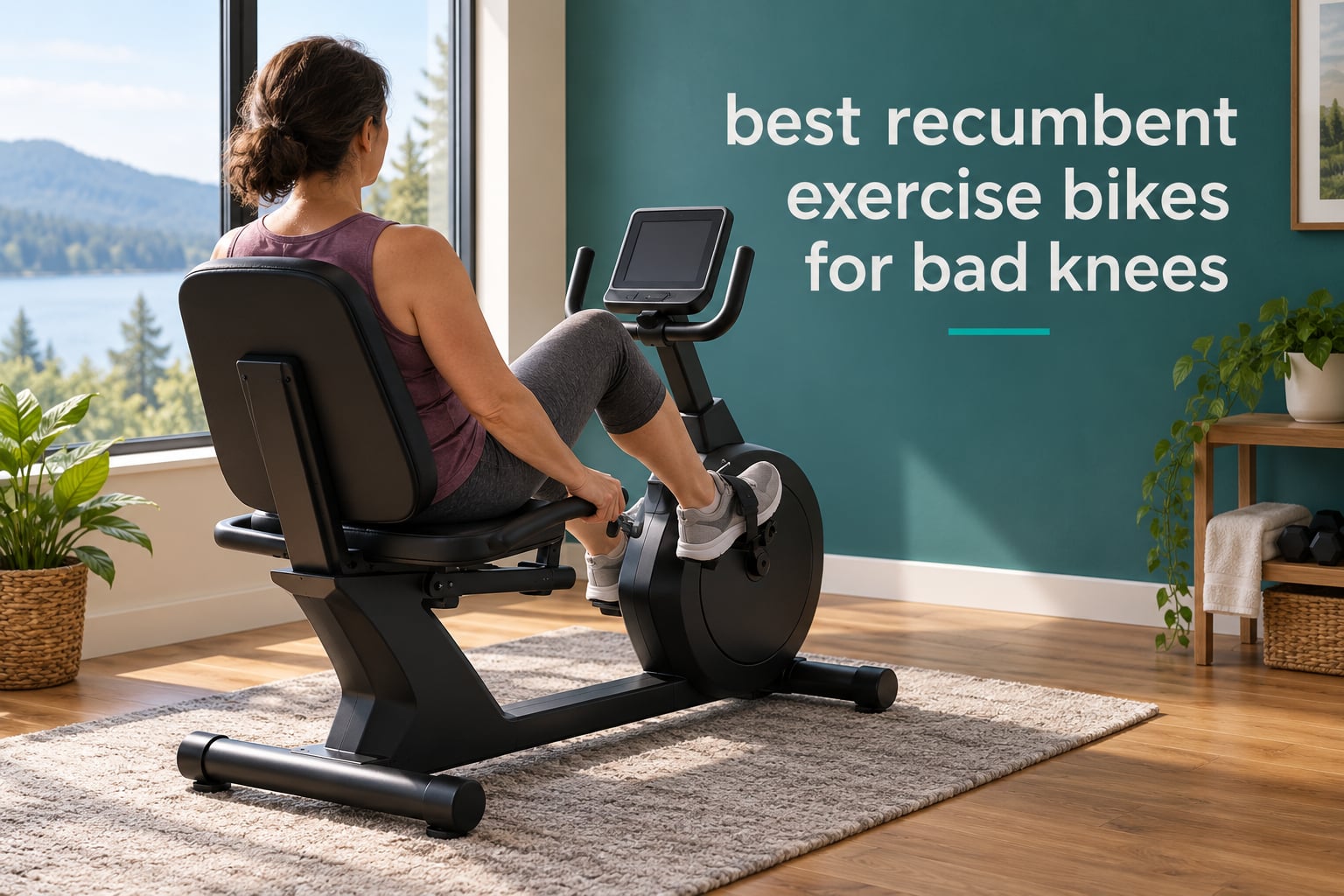
A recumbent exercise bike is the lowest-impact cardio machine you can buy when your knees hurt, because you sit back against a padded seat and backrest with the pedals in front of you instead of underneath you. That supported position takes body weight off the knee joint and keeps your leg close to a neutral range of motion through every pedal stroke, which is why physical therapists hand out recumbent prescriptions for osteoarthritis, post-injury recovery, and total knee replacement rehab as a matter routine.
That is the honest answer to the first question people ask: yes, recumbent bikes are good for bad knees, and they are the machine most clinicians reach for when weight-bearing cardio is off the table. What they cannot do is fix a bad setup. A saddle that sits too low or too far forward will manufacture exactly the knee pain you are trying to avoid, which is the single most common complaint we found in owner reviews and cycling forums.
For this 2026 roundup we compared eight recumbent bikes on the things that actually decide whether a machine is kind to a sore knee: step-through height, seat adjustability and inseam range, resistance type and level count, max user capacity against frame weight, and console readability in a dim room. We pulled the specifications, the owner pros and cons, and the rating and review volume for each one, then ranked them against the knee-pain use case rather than against a spec sheet.
One note before you read on: this is buying guidance, not medical advice. If you are recovering from surgery, have acute pain, or have been told to limit load, clear it with your doctor or physical therapist before you pedal.
Table of Contents
Top 3 Best Recumbent Exercise Bikes for Bad Knees (October 2026)

Sunny Smart Recumbent Bike
- 16 magnetic levels
- Belt drive
- 300 lb capacity
- Inseam 27.2-35.8 inch

VANSWE 380 LB Recumbent
- 380 lb capacity
- 16 magnetic levels
- Backlit monitor
- 5 ft 1 to 6 ft 1 fit

MERACH MR-S08 Recumbent
- Compact 4.3 by 2.1 foot print
- 8 magnetic levels
- App tracking
- 30-60 minute assembly
All 8 Recumbent Bikes Compared in 2026
If you want the short version before the detail, here is where each bike lands.
Sunny Health & Fitness Smart Recumbent Bike – best all-round pick, 16 levels and the widest owner history here.
VANSWE Recumbent Bike – best value, a 380 lb frame and a backlit monitor at a mid-tier price.
MERACH MR-S08 – best budget option and the smallest footprint on the list.
XVGVSV 400 LB Recumbent – best for heavier riders who need frame headroom.
Niceday RC88 – best for knee rehab, a heavy 84 lb frame that does not rock at effort.
Schwinn 230 Recumbent – best warranty, 10 years on the frame and 13 built-in programs.
Marcy NS-716R – best for small spaces, 41 lb and easy to carry between rooms.
Sunny Health & Fitness Arm Exerciser Bike – best for upper-body work alongside knee recovery.
| Product | Specifications | Action |
|---|---|---|
| Sunny Health & Fitness Smart Recumbent Bike |
|
Check Latest Price |
| VANSWE 380 LB Recumbent Bike |
|
Check Latest Price |
| MERACH MR-S08 Recumbent Bike |
|
Check Latest Price |
 XVGVSV 400 LB Heavy-Duty Recumbent XVGVSV 400 LB Heavy-Duty Recumbent |
|
Check Latest Price |
 Niceday RC88 Recumbent Bike Niceday RC88 Recumbent Bike |
|
Check Latest Price |
 Schwinn 230 Recumbent Bike Schwinn 230 Recumbent Bike |
|
Check Latest Price |
 Marcy NS-716R Recumbent Bike Marcy NS-716R Recumbent Bike |
|
Check Latest Price |
 Sunny Arm Exerciser Recumbent Bike Sunny Arm Exerciser Recumbent Bike |
|
Check Latest Price |
1. Sunny Health & Fitness Smart Recumbent Bike – Best All-Round for Bad Knees
Sunny Health & Fitness Smart Recumbent Bike with Resistance Bands
16 magnetic levels
Belt drive
300 lb capacity
Inseam 27.2-35.8 inch
Pros
- Widest owner history in this roundup at 8417 ratings
- 16 levels give a long progression runway
- Flip-up handle and cushioned seat make mounting easy
- Full-motion resistance bands add upper-body work
Cons
- Display runs on batteries rather than a cord
- App features need a phone or tablet
- Seat is firm on long sessions
Out of the eight we ranked, this Sunny has the deepest owner history at 8417 ratings averaging 4.5, and that volume matters for a knee-friendly recommendation. When a product has thousands of owners logging how their joints felt after months of use, the pattern is easier to trust than a spec sheet. The recurring notes are quiet belt-drive running, a wide cushioned seat with a padded backrest, and an easy on and off design that older riders single out by name.
Fit is where the knee story is decided. The listed inseam range runs 27.2 to 35.8 inch, which covers a lot of riders, and the seat slides along its rail rather than popping up and down like an upright bike. That horizontal rail is the reason recumbents are easier on arthritic joints: the leg extends forward instead of dropping down, so the knee bends in a shorter, shallower arc.
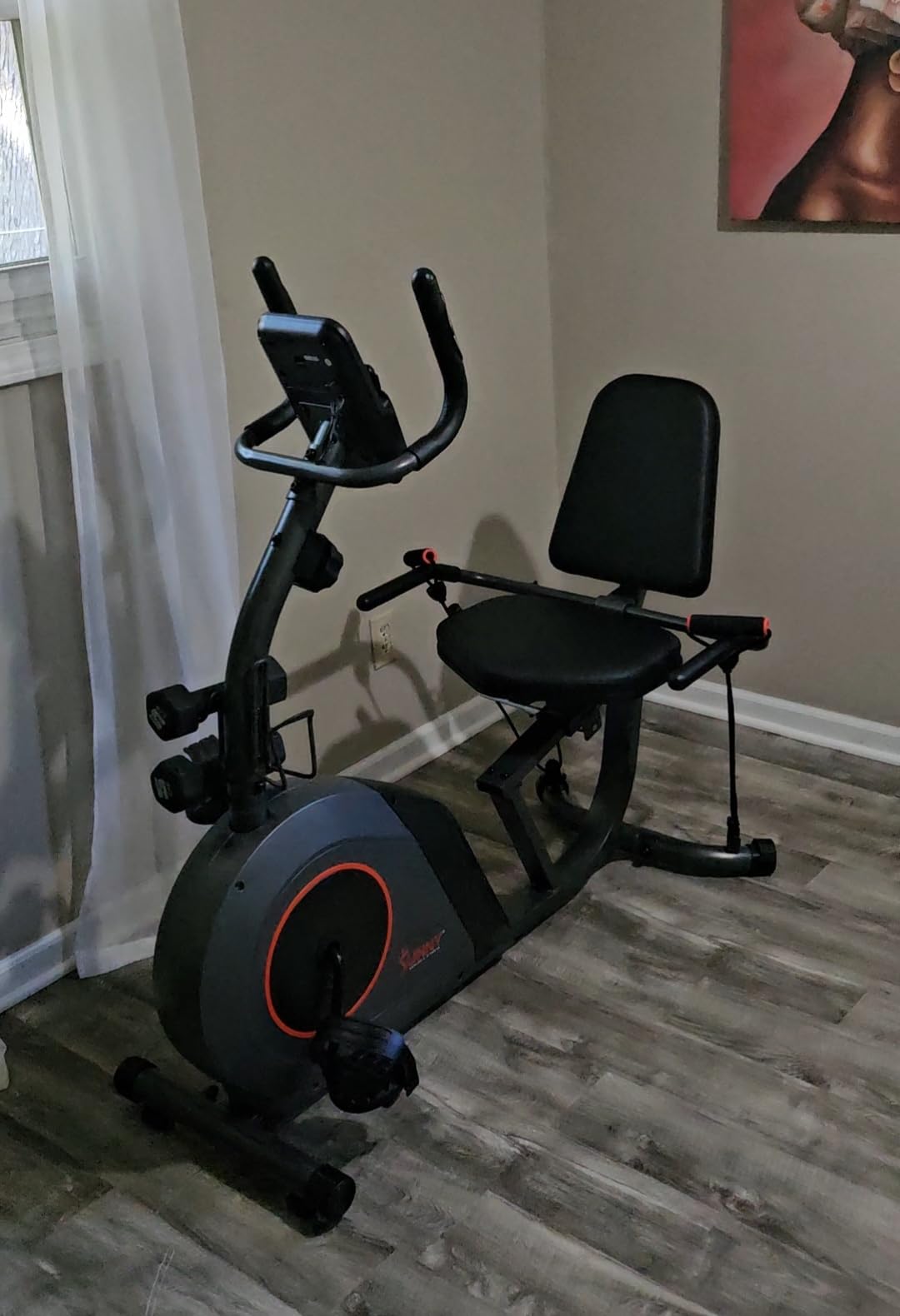
Sixteen levels of magnetic resistance is the part that matters most if your knee is mid-rehab rather than merely achy. You can start at a level that feels almost too easy and still have somewhere to go after eight weeks without swapping the machine. Resistance changes electronically, so nothing in the drivetrain wears while you climb through the range.
The frame is alloy steel with a 300 lb user limit, and the whole unit weighs 29 kg, which is one of the lighter bikes here. At 46.1 inch deep by 25.6 inch wide, it takes up less floor than most of the recumbents we tested specs for, which helps if your exercise spot doubles as a hallway. Transport is not built in on this model, so plan how you will shift it.
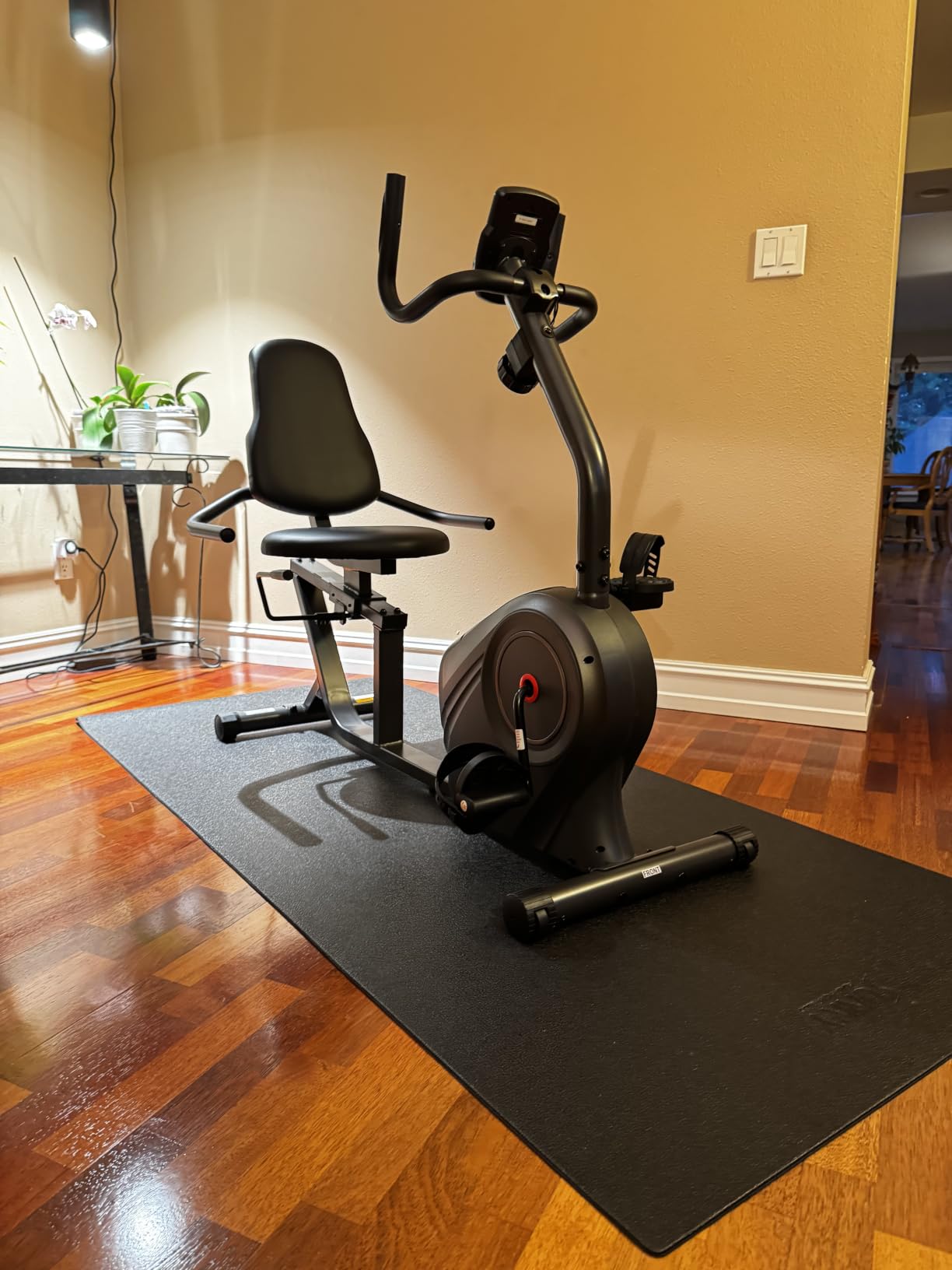
What knee riders will notice day one
Owners most often mention the seat and the step-over rather than the electronics. The step-over height on this frame sits lower than a standard upright bike, and the side handle flips up so you can push off and swing a leg over without twisting through a painful arc. The included full-motion exercise bands are a small touch that matters if your upper body is deconditioned from time off your feet.
Fit range is the one real constraint. If your inseam sits above 35.8 inch, your leg will be cramped at full extension, and a cramped leg is a knee that complains. Measure standing from floor to crotch in socks before you commit. If you want to compare recumbent fit against the upright category, our guide to the best exercise bikes for bad knees breaks the two seat geometries down side by side.
Where it falls short
The console runs on batteries rather than a mains cord, which is tidy in a living room but means the readout can dim mid-session. The free SunnyFit app carries 1000 or more workouts and 10000 or more scenic tours, and the app will not do much for you without a phone or tablet nearby. The seat padding is comfortable for a 30 minute session but a foam cover is a common later addition for longer rides.
2. VANSWE Recumbent Bike – Best Value Heavy-Duty Frame
VANSWE Recumbent Exercise Bike for Home Seniors with 380 LB Weight Capacity
380 lb capacity
16 magnetic levels
Backlit LED monitor
5 ft 1 to 6 ft 1 fit
Pros
- 380 lb frame gives real headroom
- Step-through frame for easy mounting
- Backlit monitor readable in a dim room
- 80% pre-assembled
- Transport wheels included
Cons
- Console accuracy is inconsistent
- Heart rate readings vary
- No cup holder
This is the bike we would put in front of a rider who is heavier than most of the category is built for. The stated capacity is 380 lb on a carbon steel frame, and it holds that rating across 4103 owner reviews at 4.5. Plenty of riders tell us they stopped worrying about whether the frame would flex when they pushed harder.
The step-through frame is the detail that gets past limited mobility. Instead of swinging a leg over a top tube, you walk into the seat from the side, which is a much smaller ask on a knee that will not bend deeply or a hip that will not rotate. If mounting and dismounting is your biggest worry, this is the criterion to sort on first.
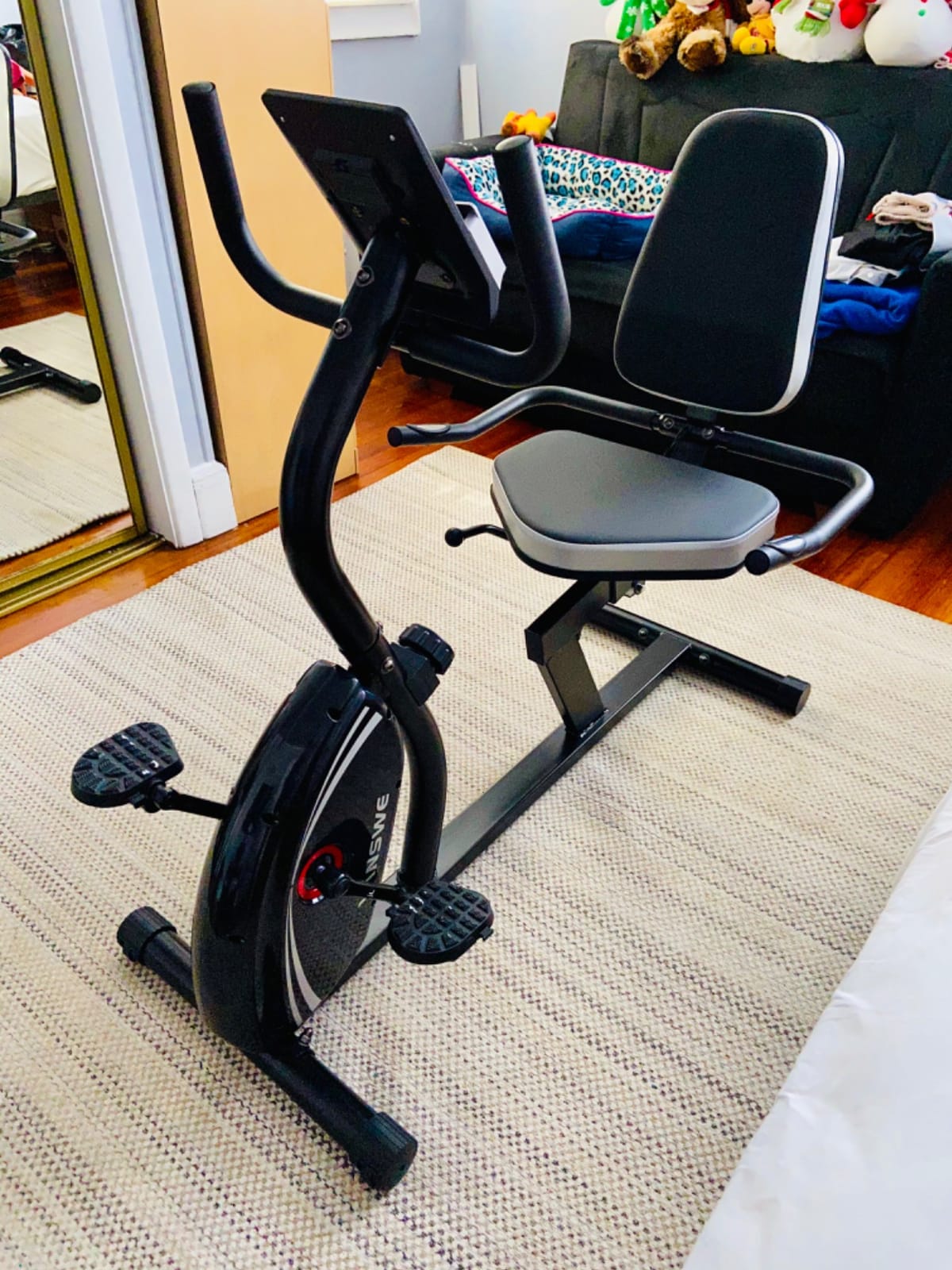
Fit runs from 5 ft 1 to 6 ft 1 through an infinite slider seat, so you set your leg length by sliding rather than hunting for a numbered hole. A backlit LED monitor is a genuine upgrade over the plain LCDs that dominate this price band, and the Bluetooth links to Kinomap and Zwift for anyone who wants a mapped ride from a reclined position.
Resistance is 16 magnetic levels and owners describe the drive as nearly silent, which matters more than the spec sheet suggests if you ride early in the morning or share a wall with a sleeping household. The unit arrives 80% assembled, so setup is short, and transport wheels are fitted so you can roll it aside when the room is needed for something else.
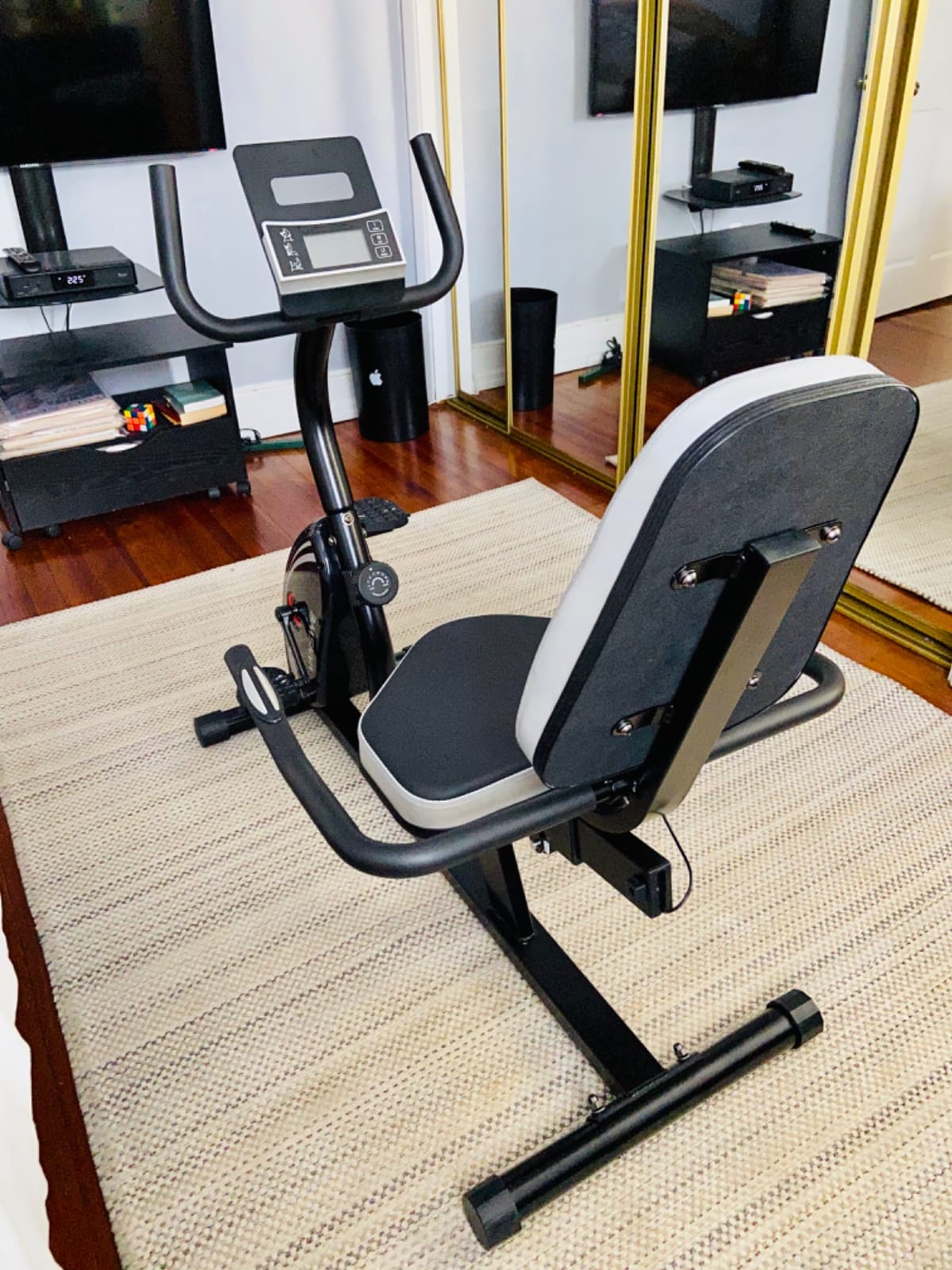
What this frame solves for heavier riders
Frame weight is the honest reason capacity is not a vanity number. A bike that claims 380 lb but weighs 53 lb is telling you something real about the tubing underneath. Heavier riders and higher-effort riders get a planted pedal stroke rather than a machine that rocks under load, and that stability is what lets you concentrate on your knee position instead of on the bike.
Riders taller than 6 ft 2 may find the 5 ft 1 to 6 ft 1 fit range tight at the top end. Measure before buying, and if you are at the ceiling of the range, look at a model with a longer inseam spec.
What you give up
The console is the weak point. Owners report the speed and distance readouts as basic and sometimes inaccurate, and the hand-grip heart rate sensors vary in reliability, so do not plan your training blocks around them. App support to Kinomap and Zwift is present but limited, and there is no cup holder, which you will notice on a 40 minute session.
3. MERACH MR-S08 Recumbent Bike – Best Budget Pick for Small Rooms
MERACH Recumbent Exercise Bikes for Home with Smart Bluetooth Equipment Exercise Bikes App,LCD,Heart Rate Handle Stationary Bikes for Home, Magnetic Recumbent Exercise Bike for Seniors Gym S08/S23
8 magnetic levels
Belt drive
Compact 4.3 by 2.1 foot
Bottle cage
Pros
- Compact footprint suits apartments
- Quiet smooth magnetic resistance
- Assembly takes 30-60 minutes with tools included
- Well suited to gentle knee rehab
Cons
- Only 8 resistance levels
- Display is not backlit
- Seat bolts may need periodic tightening
Among the eight recumbents here, this is the most frequently named as good value, and at 2123 reviews it has enough owner history to be more than a spec-sheet entry. Owners call the magnetic drive quiet and smooth, and repeatedly point out that smoothness is what lets them stay on the bike for 30 minutes instead of bailing after 10.
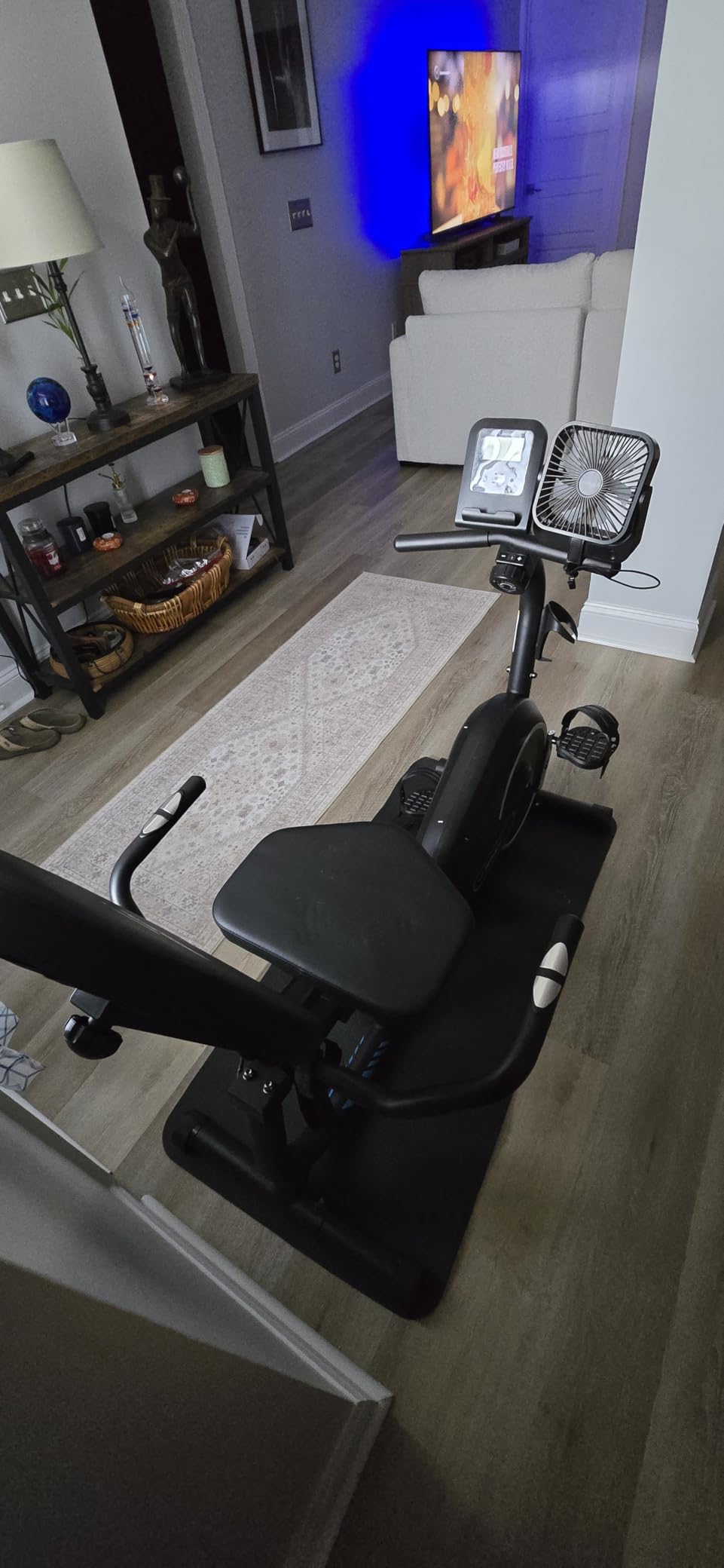
The footprint is the reason it earns a place on this list at all. The listed floor area is about 4.3 by 2.1 feet, so it fits a bedroom, a condo corner, or a garage office without taking the room hostage. The seat adjusts and the backrest supports your lower back, which is the whole ergonomic premise of a recumbent.
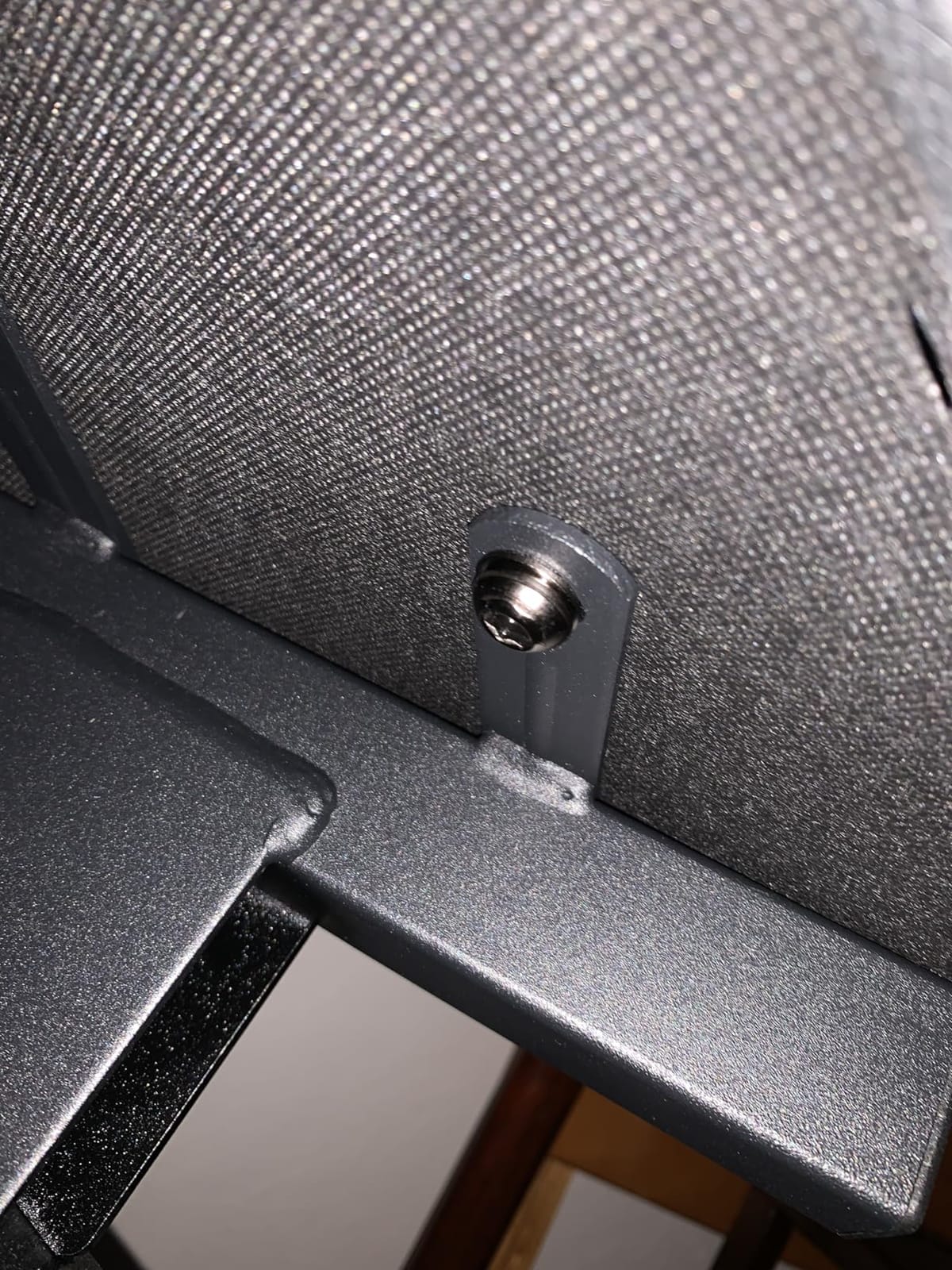
Assembly is the other reason it lands here. Owners report 30 to 60 minutes with the included tools, which is at the better end for this category and matters if you are recovering from something and would rather not spend a Saturday on hex keys. The MERACH app handles workout tracking and adds a gamified element that makes low-intensity sessions easier to finish.
Recommended height is 5 ft 3 to 6 ft 2, and the extended seated leg length runs 29.53 to 37.01 inch, so measure against that range. The unit weighs 57 lb, which is manageable for one person rolling it out of a doorway but not a one-person job up a flight of stairs.
Who this suits best
Anyone doing the boring, unglamorous work of rebuilding knee tolerance. Eight resistance levels is plenty when the goal is 10 to 20 minutes of easy pedalling several times a week, and the quiet belt drive means a household can be asleep while you ride. For post-TKR users working through early protocol stages, quiet and simple usually beats feature-rich.
If you can handle the space trade, this is also the bike to consider in a rental or a room you may leave in a year. The construction holds up for the price, and the bottle cage plus heart rate tracking cover the basics. Readers who want a dedicated low-impact machine for an older relative can also see our picks for the best recumbent bikes for seniors.
What you give up
Eight resistance levels is the ceiling, and it is the honest limit. Once your knee can handle more, there is nowhere to go without a new bike, so plan this as a rehab tool rather than a long-term training machine. The display is not backlit, which is a nuisance in an evening garage, and some owners report tightening the seat bolts again after a few months. App syncing occasionally drops a recorded workout.
4. XVGVSV 400 LB Heavy-Duty Recumbent – Best for Bigger Bodies
Recumbent Exercise Bike for Home, Recumbent Stationary Bikes for Seniors
400 lb capacity
16 magnetic levels
No power needed
LCD with pulse sensors
Pros
- 400 lb rated capacity
- 16 magnetic levels
- Pedal-powered so no batteries or outlet
- 85% pre-assembled in about 30 minutes
Cons
- Wider 45 inch footprint than most
- Brand is less established than the majors
This bike carries the highest owner rating in our group at 4.6 across 1804 reviews, and the reason is a single number: a 400 lb rated capacity on a 66 lb frame. If you have been filtered out of the recumbent category by weight limits before, that is the spec that ends the filtering.
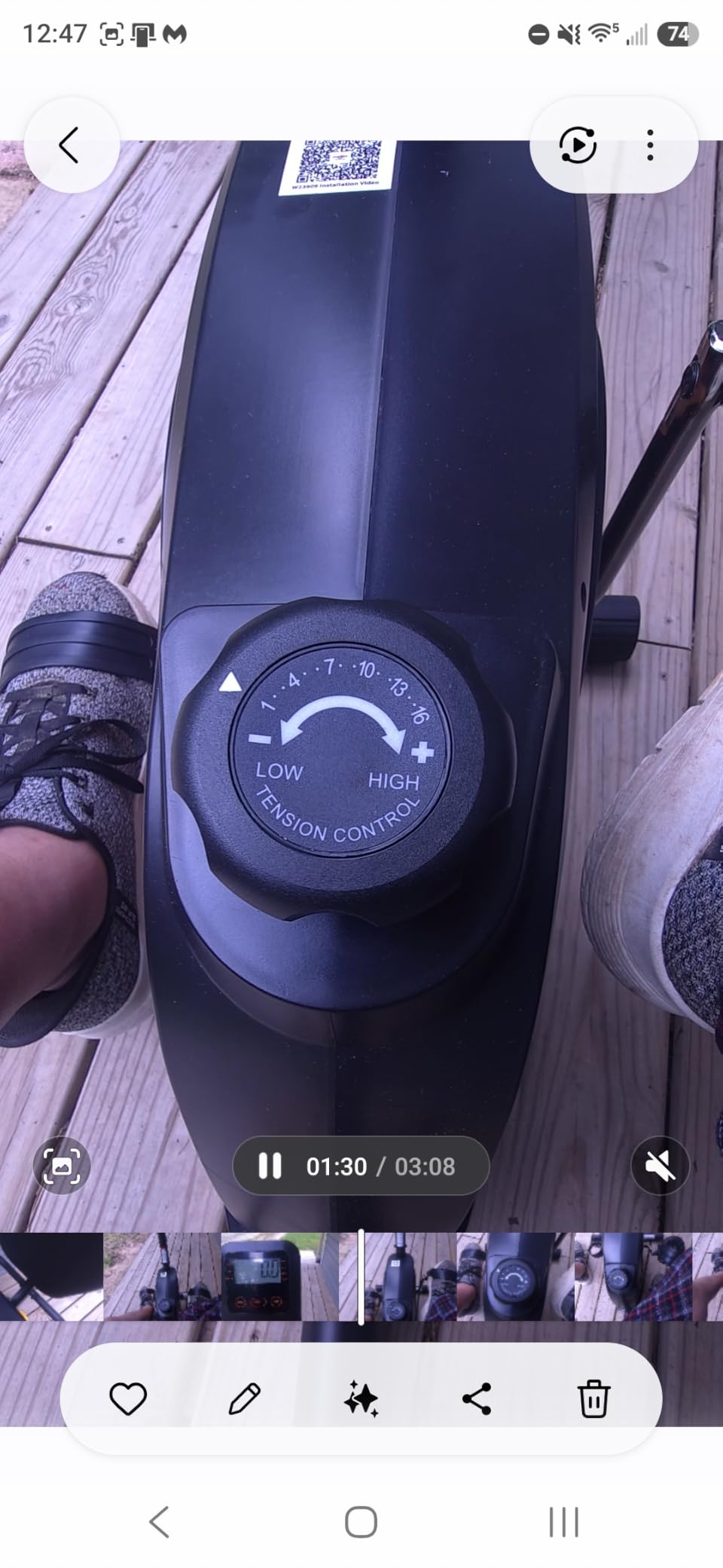
It is also completely self-powered. The resistance is generated magnetically from the pedal stroke, so there are no batteries to replace and no outlet to reach, which removes two of the small annoyances that make people put a bike in a corner and never use it again. The listed drive is magnetic rather than belt, and the operation is quiet enough that owners describe it as a whisper in a shared room.
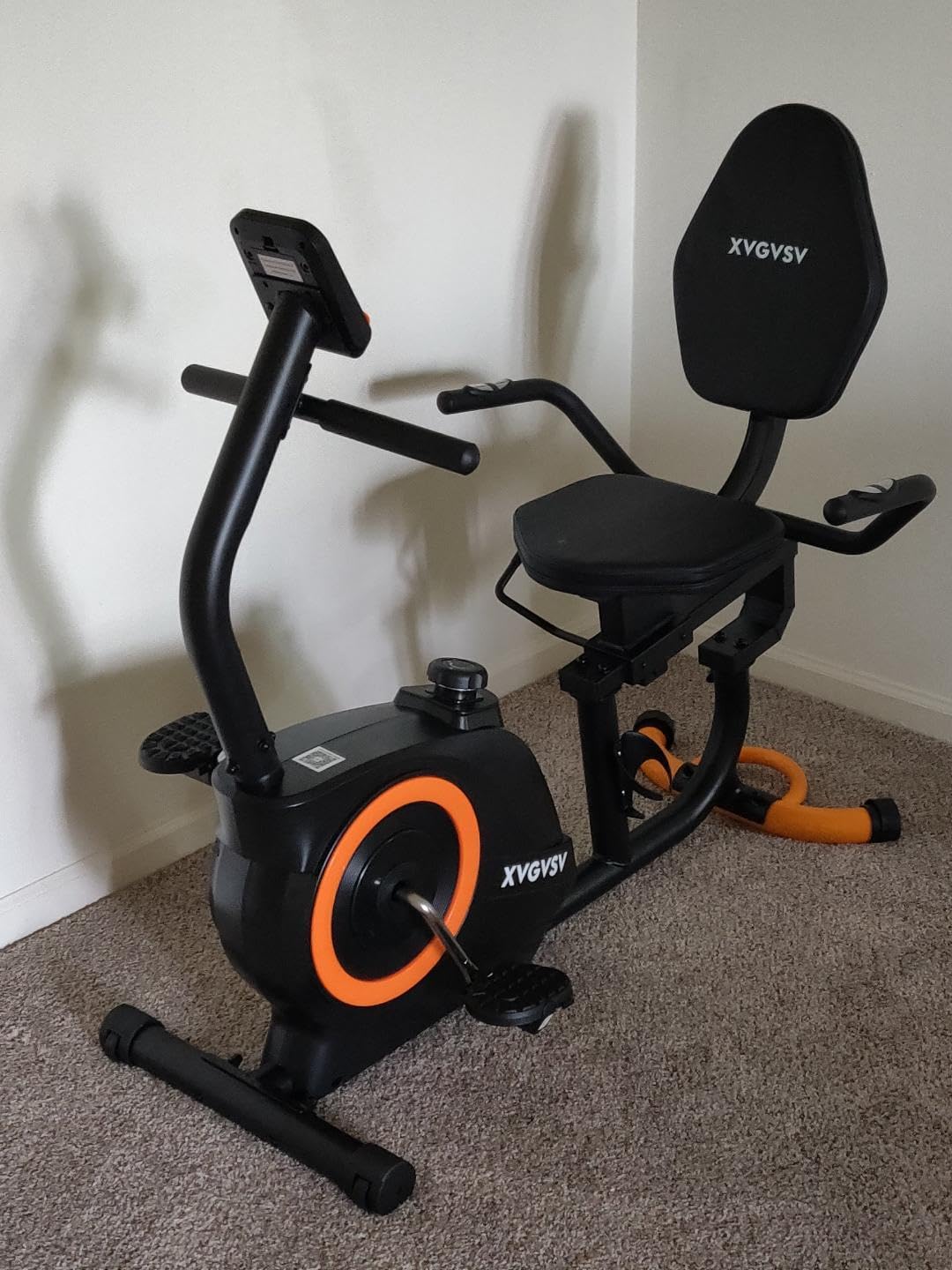
Setup is one of the better cases here. The frame arrives 85% pre-assembled and owners put the remaining work at about 30 minutes, which matters when the person assembling it is the same person with the knee problem. Adjustable footstraps, an adjustable seat, a water bottle holder, and transport wheels round out a practical package.
Sixteen resistance levels give a wide rehab-to-fitness runway, and the LCD display with pulse sensors covers the standard metrics. The padded seat and ergonomic backrest are what you are spending 30 minutes a day in, so comfort is not a secondary concern here.
What the 400 lb figure actually buys you
Weight capacity is really a proxy for frame tube gauge and joint hardware. A bike rated at 400 lb and weighing 66 lb has enough material in the main triangle and crank to resist the torsional flex that makes cheaper machines feel nervous at high effort. That stability is what lets a heavy rider hold a proper cadence rather than mashing intermittent strokes that spike knee load.
For knee rehab specifically, stability also means you can pedal hands-off for brief stretches and rolling stretches without the frame shifting under you, which is a common exercise in early physical therapy protocol.
Trade-offs to know about
The width is the catch. At 45 inch across, this is the widest footprint in the roundup, so measure the room before you fall for the capacity. The brand is also newer than Schwinn, Marcy, or Sunny, which historically means thinner replacement parts support, so it is worth asking what the warranty covers before you commit. Everything else here is straight.
5. Niceday RC88 Recumbent Bike – Best for Structured Knee Rehab
Niceday Recumbent Exercise Bike for Home Stationary Bike with APP Training
15 lb flywheel
400 lb capacity
84 lb frame
Up to 6 ft 3 fit
Pros
- Heavy 84 lb frame stays planted at effort
- 400 lb capacity
- 15 lb flywheel gives a smooth quiet stroke
- Kinomap and Zwift support
- Tablet holder included
Cons
- Display is not backlit
- Resistance tops out at moderate levels
- 84 lb is hard to move upstairs
- App needs a paid subscription after the trial
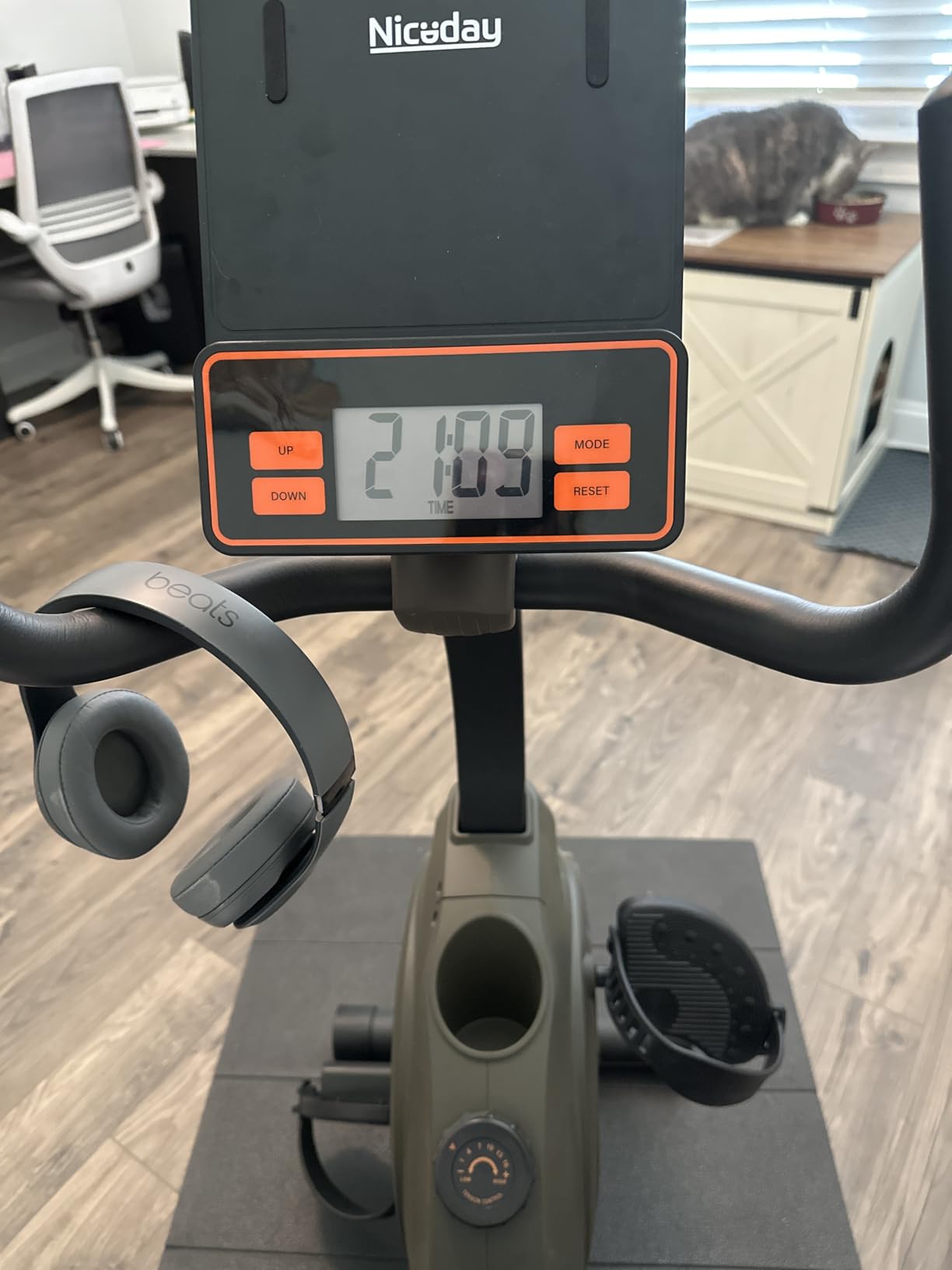
This is the one we would put in a room shared by two people of different sizes, and the reason is the fit range. The listed height goes up to 6 ft 3 on a low step-through frame, and the seat adjustment is designed for shared use, so one bike does not have to be repositioned every time someone else gets on it.
The 15 lb flywheel is the spec that most affects how a knee feels. A heavier flywheel stores energy through the stroke and delivers it smoothly on the way around, which reduces the sharp peak-and-release effort pattern that makes joints complain. Owners describe the ride as smooth and quiet, and the 16 levels of progressive resistance give you a long ramp from rehab to general conditioning.
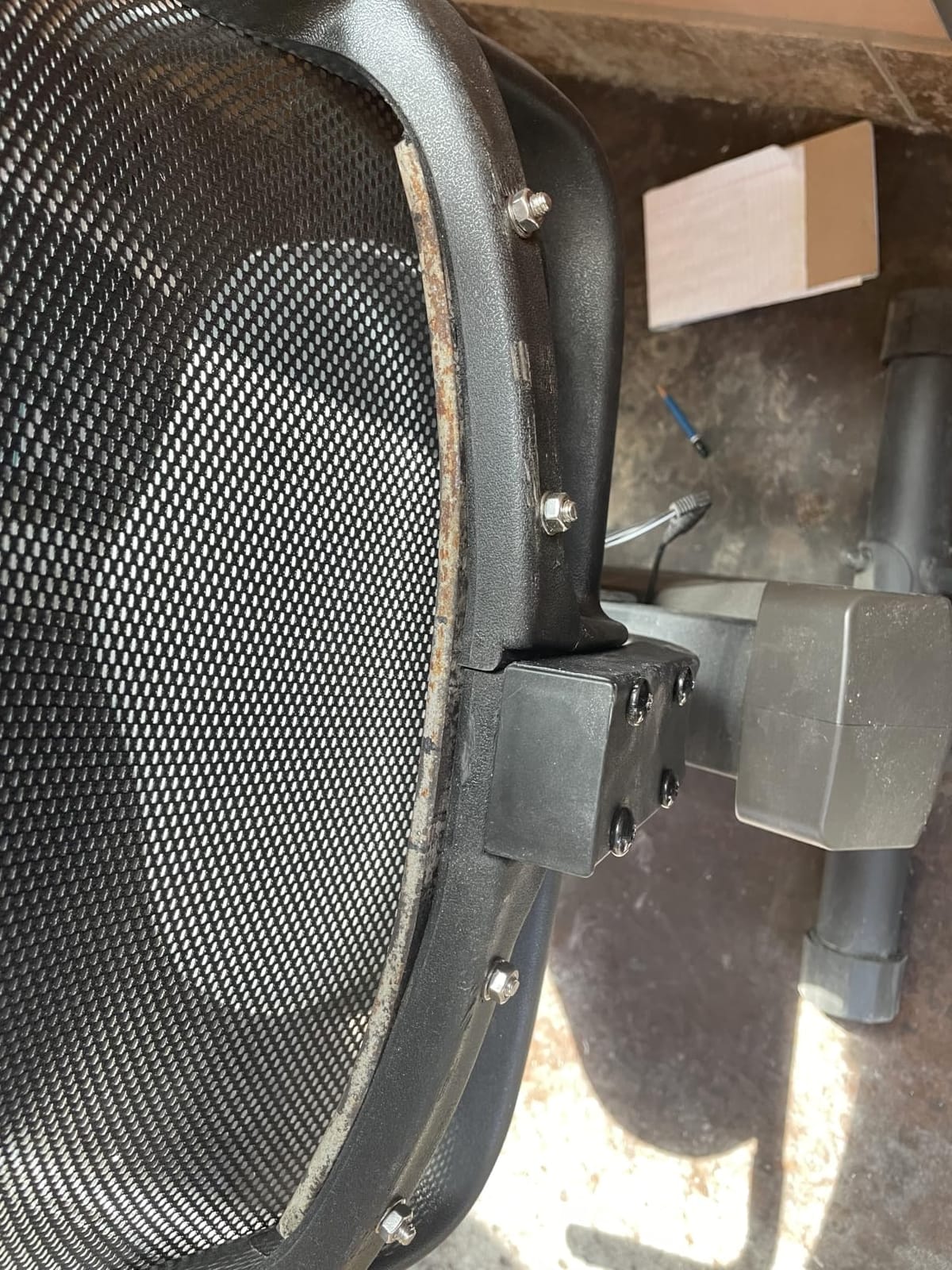
At 84 lb this is the heaviest bike in the roundup, and that is a feature when the question is stability. The alloy steel frame does not rock at high effort, which matters if your goal is cardiac work rather than a gentle warm-up spin. The high-density seat and breathable mesh backrest also hold up better over longer sessions than a thin foam pad.
Assembly is 90% pre-assembled with clear instructions, and the low step-through design keeps mounting easy. Bluetooth covers Kinomap and Zwift, and a tablet holder is fitted, so if your physical therapist hands you a guided protocol video you can follow it from the seat.
Why therapists lean on this style of bike
Early knee rehabilitation is mostly about range of motion and circulation, not load. A smooth, quiet, low-step bike lets someone pedal for 10 to 15 minutes at a very low resistance through a comfortable arc, several times a day, which is a low-irritation way to move a joint. Riders on knee replacement forums consistently describe recumbent pedalling as the warm-up their physical therapist built into the program.
Resistance progression is where you outgrow this bike. Owners note the top end tops out at moderate effort, so it is a superb rehab and steady-state machine and a poor interval-training machine. Plan on buying a different tool if your goal is high-intensity work.
Practical drawbacks
The display is not backlit, monitor instructions are reported as confusing, and the app moves to a paid subscription after the trial period. The 84 lb weight is a genuine problem if the bike lives upstairs, since transport wheels only help on a flat floor. The seat can also use extra cushioning for rides past 45 minutes.
6. Schwinn 230 Recumbent Bike – Best Warranty and Program Variety
Schwinn Fitness 230 Recumbent Bike
10-year frame warranty
16 magnetic levels
13 workout programs
5.5 inch LCD
Pros
- 10-year frame warranty is the strongest here
- 13 built-in workout programs
- Bluetooth with Zwift and Explore the World
- Vented contoured seat
- Transport wheels fitted
Cons
- 64 inch length is the biggest footprint here
- Seat is hard plastic
- Power cord plugs in at the front
- Assembly around the seat brackets is fiddly
Schwinn is the most established name on this list, and the warranty is the headline: 10 years on the frame, 2 years on parts, 1 year on electronics, and 90 days on labor. For a machine that will sit in a garage and take abuse for a decade, that coverage is worth real money.
The ride itself is built around a high-inertia perimeter-weighted flywheel, which is the same physics reason the Niceday above feels smooth. Sixteen levels of magnetic resistance, 13 built-in workout programs on a 5.5 inch LCD, and Bluetooth that works with Zwift and the Explore the World route library give you more structured options than any other bike here, which matters if you are following a set program rather than pedalling by feel.
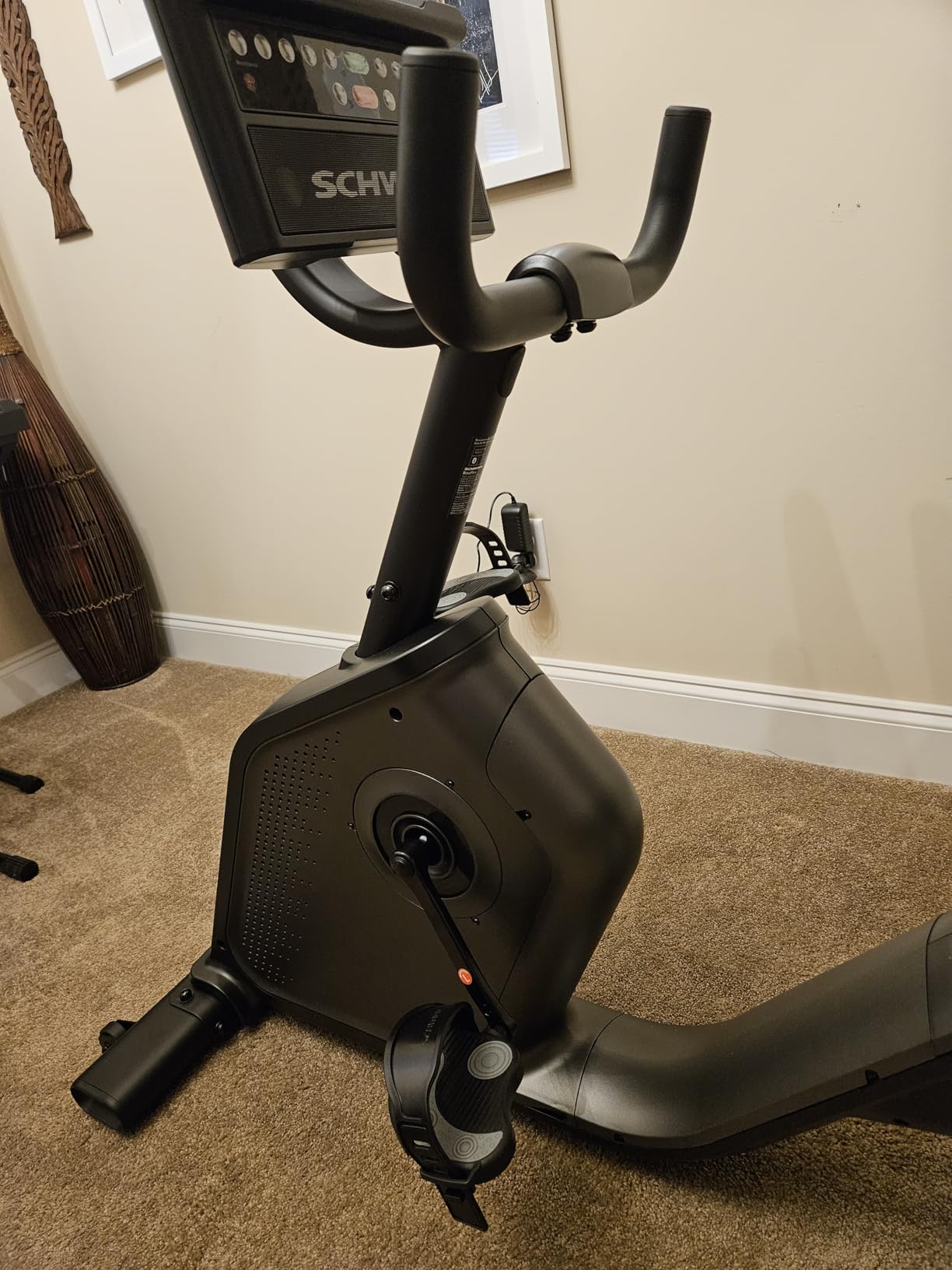
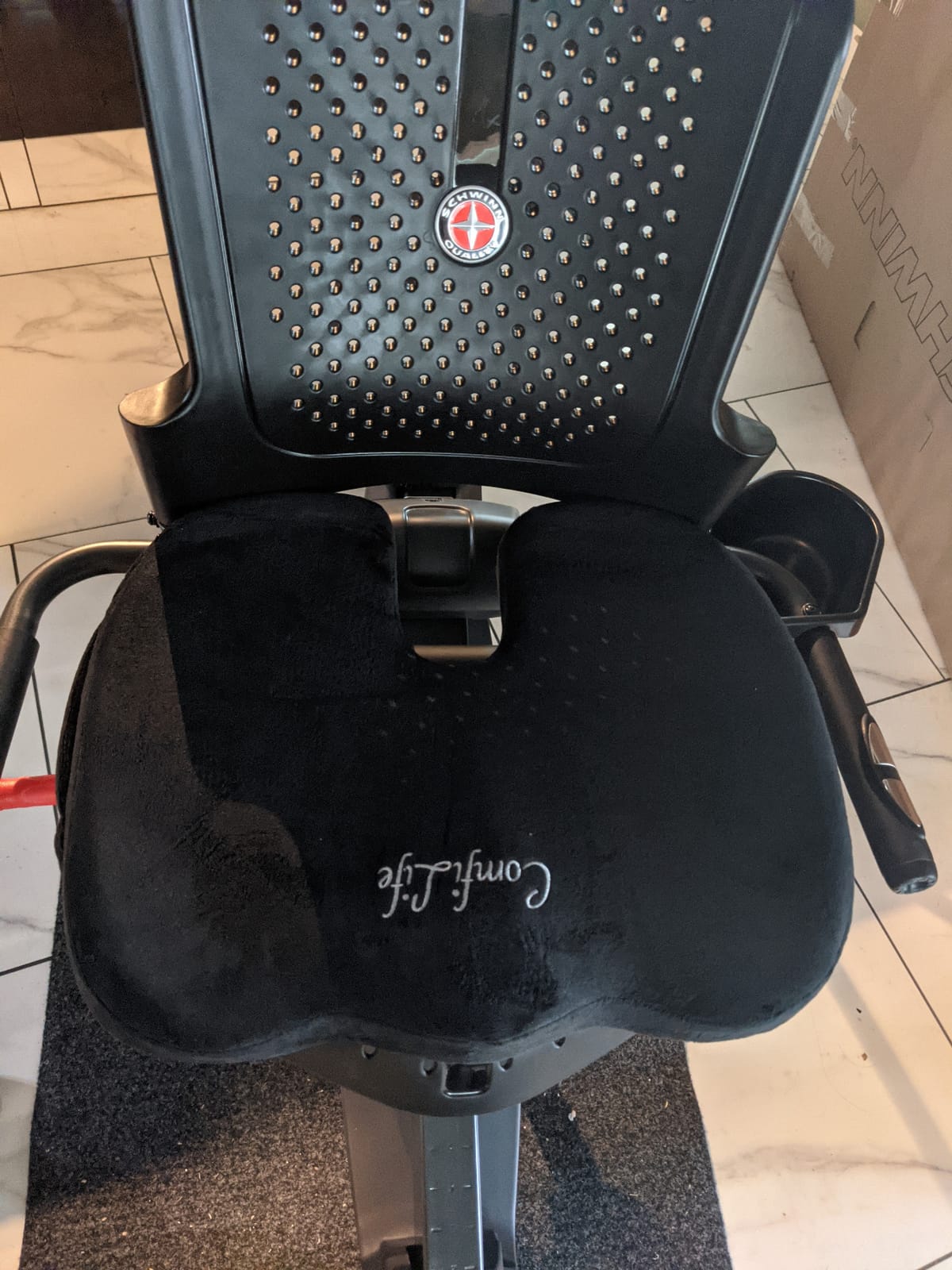
The vented contoured seat back is a good match for longer sessions because it does not trap as much heat as a solid pad, and the weighted strapped pedals keep your feet planted, which removes one of the common sources of knee twist. Fitted height range is 54 to 78 inch, so it covers a wide spread of riders.
Two practical things to plan around. The listed length is 64 inch, the longest in this roundup, so it wants a wall or a corner of its own. And the power cord plugs in at the front of the frame, which owners flag as a trip hazard and which is a real consideration if children or a walking aid share the space.
Where the Schwinn earns its place
Program variety is the underrated feature. Thirteen preset workouts plus route syncing means a knee-rehab rider can stay on a low, steady cadence program for weeks without the boredom that ends adherence, then shift up as range improves. The frame warranty also means the thing you buy is the thing you keep, which matters when the purchase is being funded from a recovery budget.
It is also the safest brand bet here for parts. A twenty-plus year name with a long-running model has replacement seats, pedals, and consoles still in circulation, and that is not nothing when a component wears out in year three.
What reviewers complain about
The seat is hard plastic, and a large share of owners add a cushion as their first accessory. The display is not backlit, hand-grip heart rate accuracy varies, and some owners report Bluetooth dropouts. Assembly around the seat brackets is the fiddly part and is the most repeated assembly complaint in the reviews, so budget an evening rather than a coffee break.
7. Marcy NS-716R Recumbent Bike – Best for Tight Spaces
Marcy Magnetic Recumbent Bike with Adjustable Resistance and Transport Wheels NS-716R, 11.00 x 22.00 x 31.00″
31 inch deep footprint
41 lb weight
8 magnetic levels
Fully adjustable seat
Pros
- Smallest footprint in this roundup
- Light enough to carry between rooms
- Transport wheels included
- Fully adjustable seat and foam handlebars
Cons
- Only 8 resistance levels
- May not suit taller riders
- Frame feels light at high intensity
- Console is basic
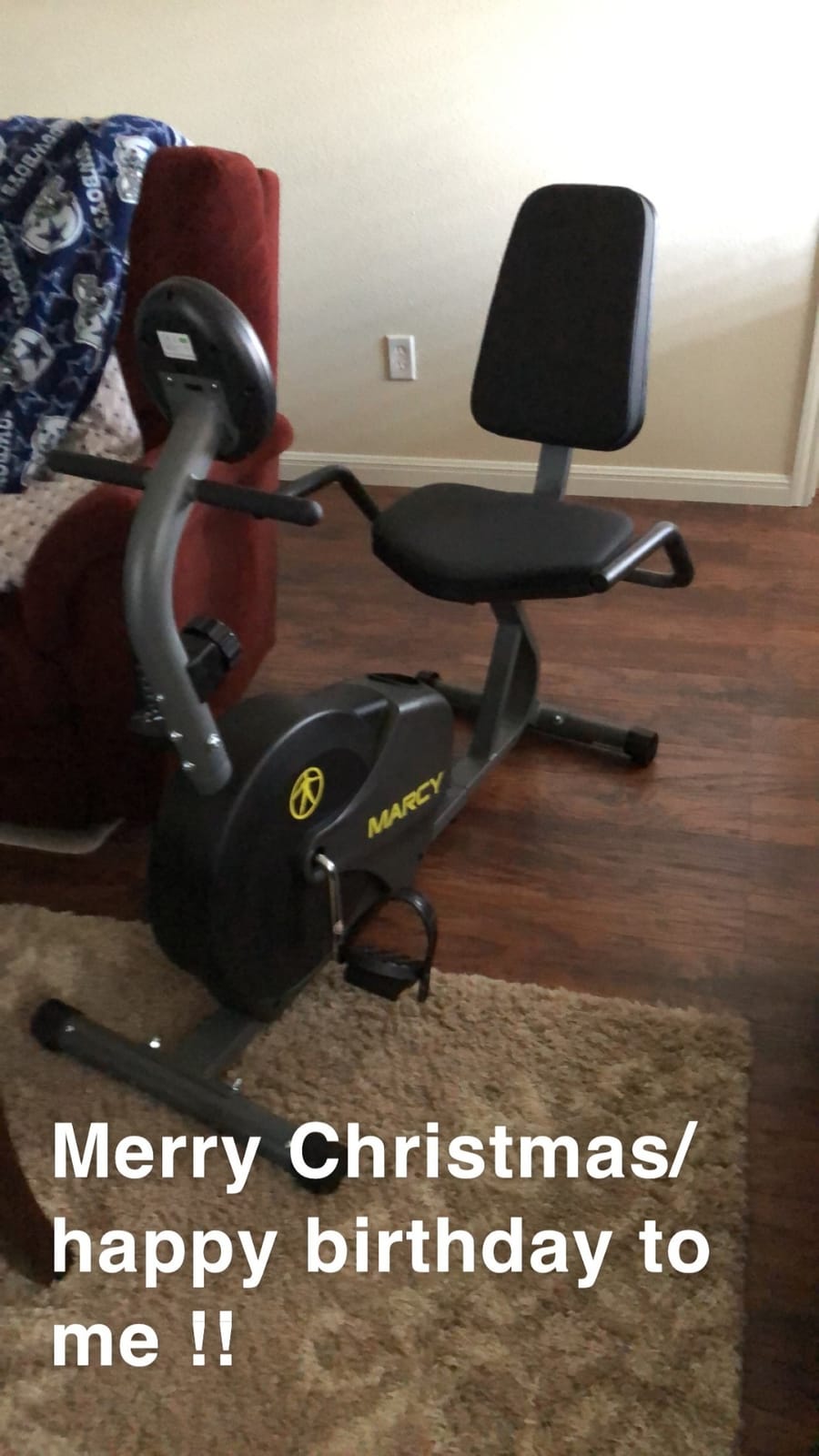
Everything else on this list is 45 to 64 inches long. This one is listed at 31 inch deep by 11 inch wide, which makes it the machine to buy when the exercise space is a spare room you also use for storage, or a studio apartment where floor area is the binding constraint.
It is also the easiest to move. At 41 lb it is the lightest bike here, and owners mention rolling it out of the way on the transport wheels whenever the room is needed. For a senior who rides in short blocks at several points through the day, being able to move the bike rather than commit to a permanent 5 foot rectangle is a real practical win.
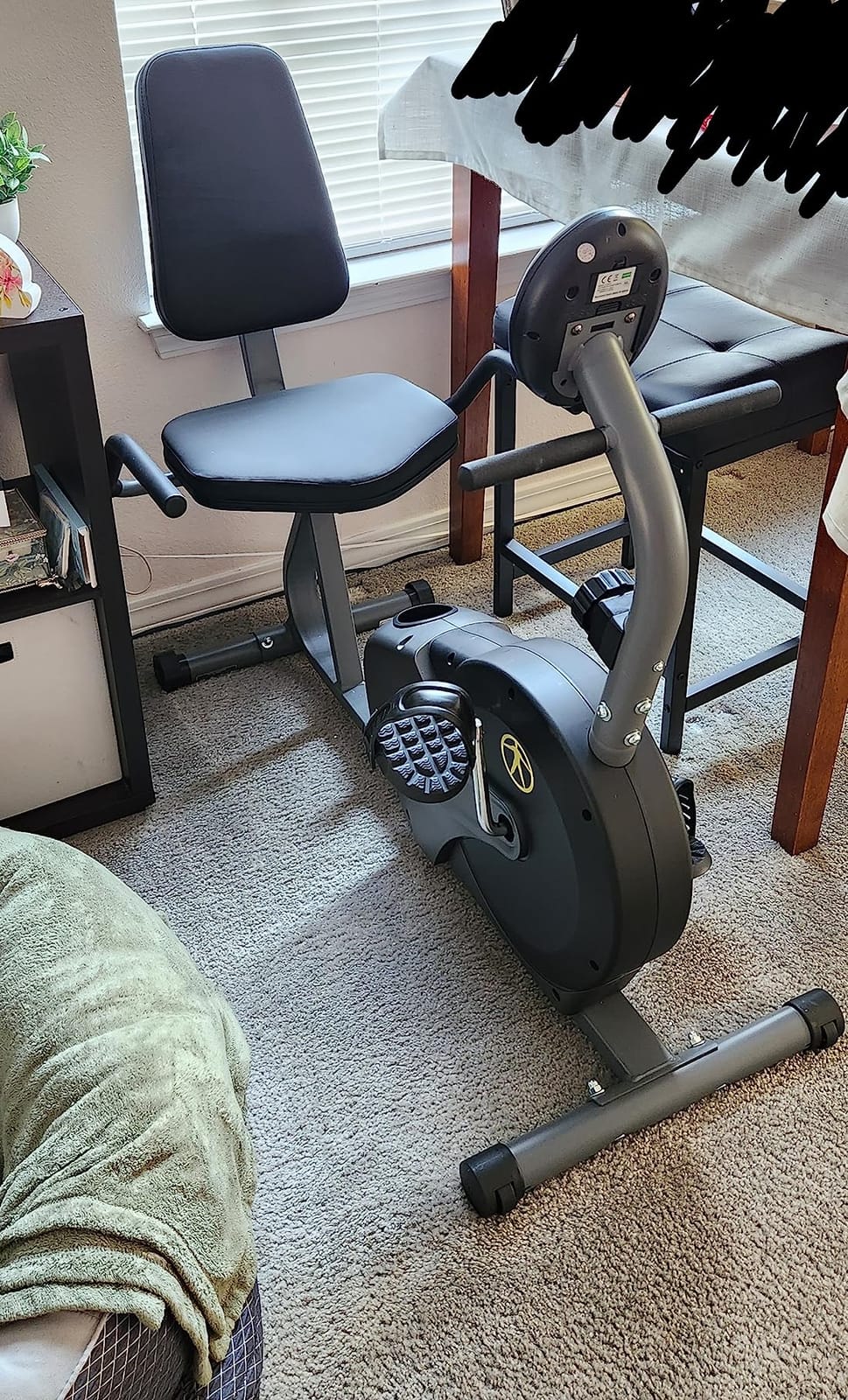
The basics are covered: a fully adjustable seat, foam-covered handlebars that are kind to sensitive hands, and an LCD tracking panel showing speed, distance, time, and calories. Eight preset magnetic resistance levels with a tension knob give you enough range for daily low-impact work and a gentle warm-up before physical therapy exercises.
Alloy steel construction keeps it from feeling flimsy for the kind of steady, moderate effort this bike is designed for, and the 300 lb capacity covers most riders. It is a straightforward machine that does one job well rather than a connected fitness platform.
Why a small footprint changes compliance
The quietest reason to buy a compact bike is that you will actually keep using it. Owners of bulky machines report the footprint becoming the reason the bike ends up in the garage with a sheet over it. If the bike fits where you can see it, you will sit down on it on a bad day, and on a bad day is exactly when your knee needs low-impact movement.
It also suits a second-home or holiday rental setup where nothing can be permanently installed.
The compromises are real
Eight resistance levels is the lowest ceiling in the group alongside the MERACH, and the small seat and frame may not suit taller riders, so check the fit before buying. Owners also note the frame feels less planted at high intensity, which is expected from a 41 lb frame and not a fault so much as a limit. The console is basic with no connectivity, so track your own workouts if your protocol calls for it.
8. Sunny Health & Fitness Arm Exerciser Recumbent – Best for Upper-Body Rehab
Sunny Health & Fitness Smart Recumbent Bike with Hand Cycle
Moving arm exerciser
8 magnetic levels
265 lb capacity
3-year frame warranty
Pros
- Moving arm handles add upper-body work
- Micro-adjustable arm resistance
- Free SunnyFit app
- Foldable handlebars for storage
- Long inseam range up to 39.4 inch
Cons
- 265 lb capacity is the lowest here
- Only 8 resistance levels
- Display is not backlit
- Arm handles can feel awkward
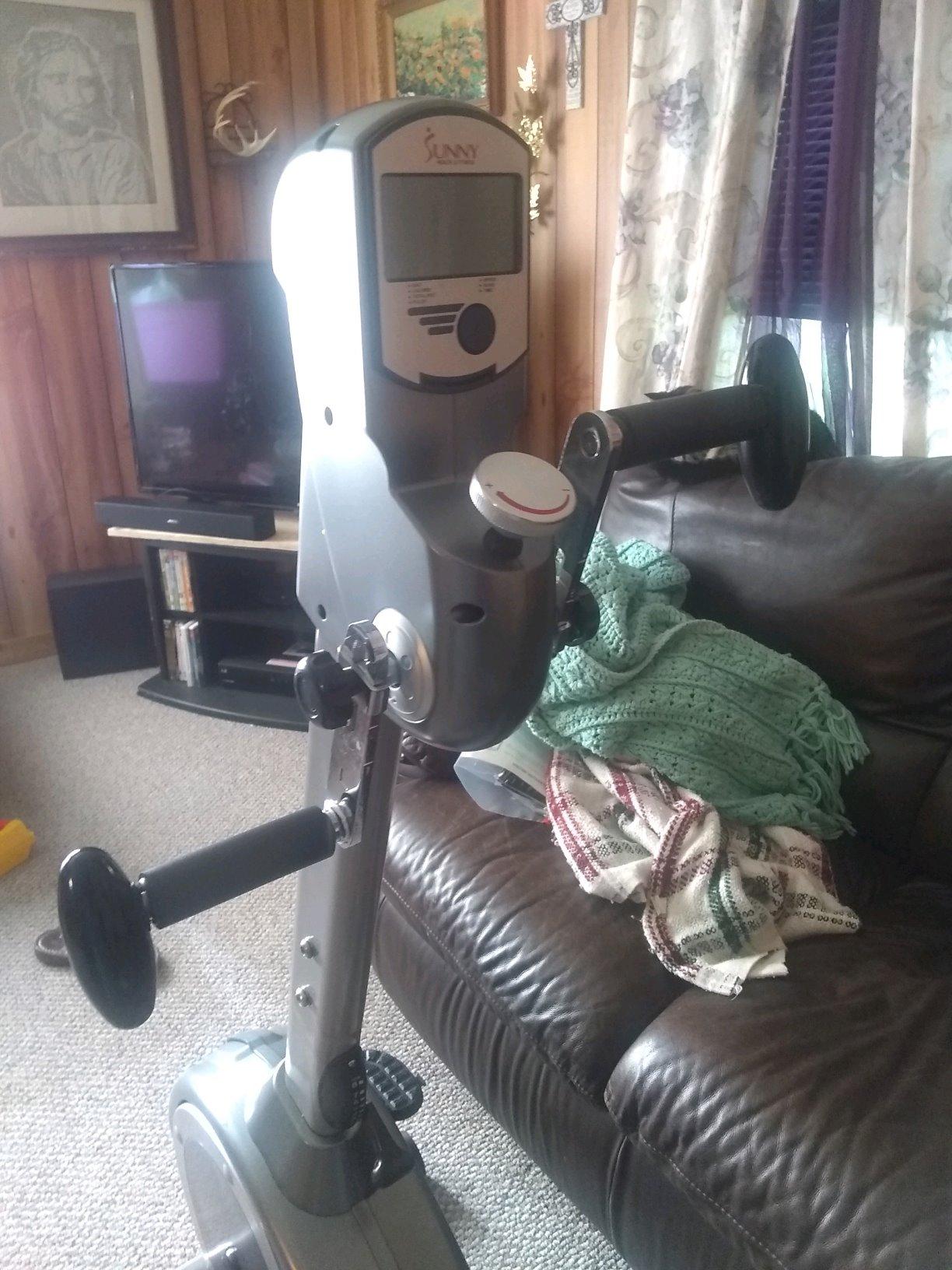
This is the specialty pick. Instead of fixed handlebars, it has moving arm exercisers that can be synchronized with the pedals or moved independently, which turns a lower-body-only machine into a full-body trainer. For someone whose knee is out for a few months and whose upper body has deconditioned to match, that is not a gimmick.
Arm resistance is micro-adjustable, so you can add upper-body load without touching the leg resistance, and the whole thing stays in a low-impact range. The 5.5 inch-by-26.4 inch footprint is moderate, and the foldable handlebars cut the storage problem down. The free SunnyFit app adds guided workouts on top.
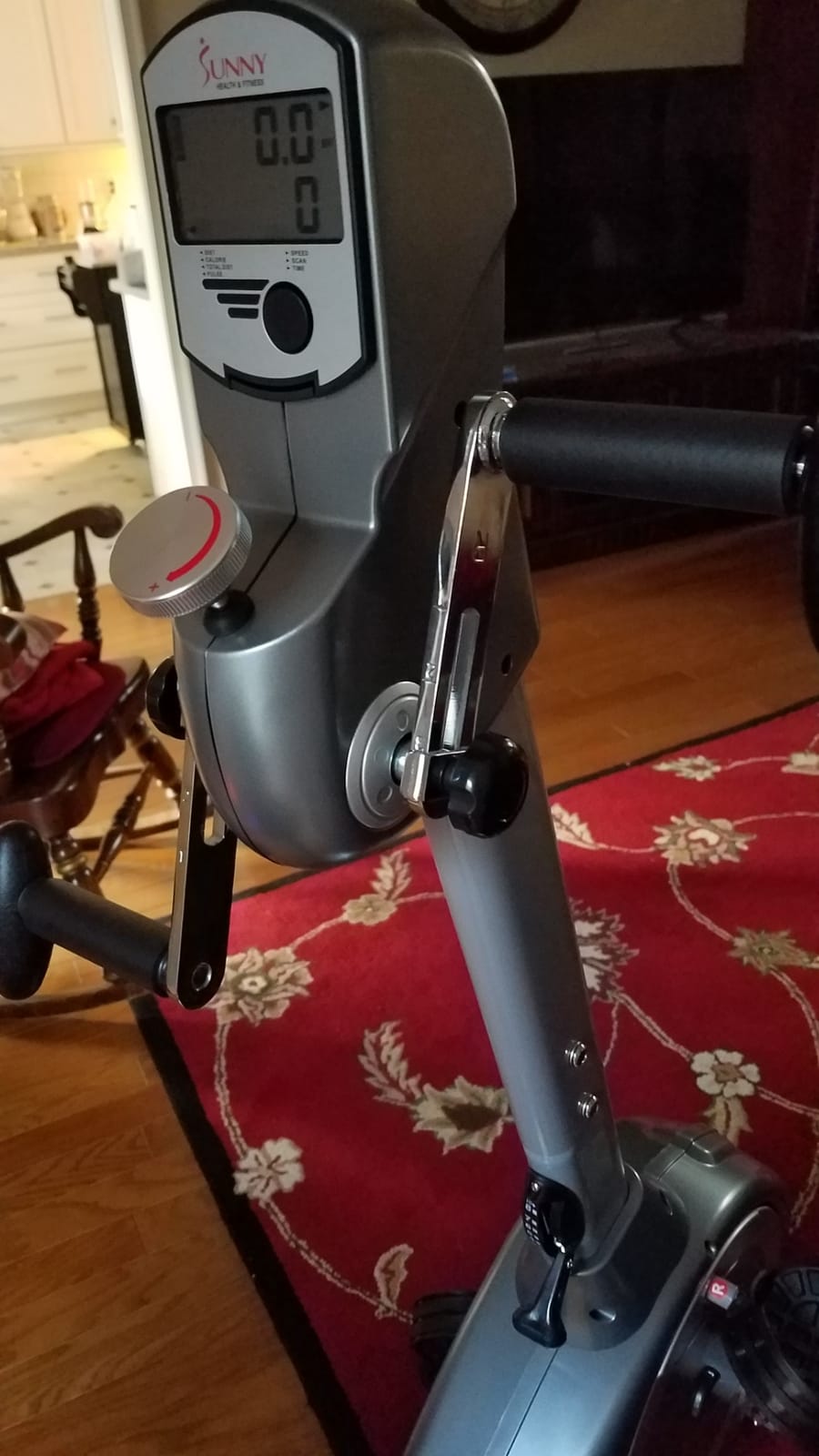
Fit is a genuine strength here. The listed inseam range runs 31.1 to 39.4 inch, the longest upper reach of the eight we ranked, so taller riders are better served here than on several other models. The adjustable frame and padded seat get you close to a dialed-in position, which is where the knee benefit starts.
The warranty is 3 years on the structural frame and 180 days on other parts, which sits between the budget names and the Schwinn. On paper that is reasonable for a machine with a mechanical arm attachment adding moving parts beyond the drivetrain.
When upper-body work is the missing piece
Cardiac rehab and post-surgical programs rarely ask you to do nothing with your arms while your knee heals. Pushing and pulling handlebars keeps the upper back, shoulders, and chest working at a low joint cost, and it raises perceived effort so a short low-resistance session still feels like exercise. If your physical therapist has you pairing cycling with upper-body work, this is the bike that supports both in one machine.
It also works as a self-paced alternative to a desk bike, where the small moving arms give you something to do besides pedal.
Limitations worth weighing
The 265 lb capacity is the lowest in the roundup, and if you are near or above that number this one is not the right frame. Eight resistance levels is a small ramp, the display is not backlit, and some owners report the arm handles as awkward to start with while others find them ideal, so expect a short adjustment period. A few users have also reported pedalling resistance that feels heavier than expected even at level one.
How to Choose a Recumbent Bike With Bad Knees?
Seven criteria decide whether a recumbent bike will work for a painful knee. Rank them in this order and the wrong purchase gets very unlikely.
1. Step-through height and how you get on. This is the most important spec for bad knees and the one most listings bury. A step-through frame lets you approach the seat from the side instead of swinging a leg over a top tube, which removes a deep hip and knee bend from every session. Riders with a hip replacement, a recent knee surgery, or simply no confidence in a one-legged step-over should treat this as a pass or fail line rather than a nice to have.
2. Seat adjustability and inseam range. A recumbent seat slides horizontally along a rail, and the range matters more than the mechanism. Check the published inseam or seated leg length against your own measurement. Too short and your knee is folded tight at full extension, which loads the joint. Too long and your hip is opened up past its comfortable range. Both ends of the range are where knee pain on a recumbent actually comes from.
3. Resistance type and level count. Magnetic resistance is quieter, needs no lubrication, and changes without a cable stretch, so it is the better choice for a home in a shared space. Friction resistance with a physical knob is cheaper but noisier and wears over time. On level count, 8 levels is enough for rehab and gentle daily work, while 16 levels is what lets you keep the same machine for two years of progressive conditioning. Buying for the endpoint rather than the start is the smarter call if your knee is improving.
4. Max user capacity against frame weight. These two numbers only make sense together. A 400 lb rating on a 66 lb frame is a heavier frame than a 300 lb rating on a 29 kg frame, and that extra material is what stops the bike rocking when you push hard. Every bike here is rated between 265 lb and 400 lb, so weight is often the real gate. Pick a frame with at least 15% headroom above your body weight rather than the maximum number on the box.
5. Seat and backrest. You will spend 30 to 45 minutes sitting in this, so the seat is a medical-adjacent purchase, not a comfort upgrade. Look for a contoured seat with a padded or vented backrest that supports your lumbar curve, and a backrest that adjusts rather than being fixed. Many owners add a foam seat cover within a year, which is fine, but a bike that needs one from day one is telling you something.
6. Console and connectivity. A backlit display is the single most useful feature for long-term adherence, because you will ride in a dim room at some point. Heart rate sensors are a bonus, but the grip sensors on cheaper bikes are often inaccurate, so do not make a training decision from them alone. Bluetooth and app support are genuinely useful for a low-intensity rider because a mapped virtual ride makes 40 minutes of easy pedalling far easier to finish.
7. Assembly, footprint, and warranty. Assembly is one of the most repeated complaints in the reviews we read, and it is worth more thought than it gets. Bikes that arrive 80% to 90% pre-assembled save an evening and a sore knee. Measure the floor space too, since the eight bikes here span 31 to 64 inches in length. On warranty, 10 years on the frame is the bar; 2 to 3 years is normal at mid-range; below 2 years and you should expect to replace parts yourself. If you are still deciding on a machine, our picks for the best exercise bikes for home cardio cover the connected options in more detail.
How to Ride a Recumbent Bike Without Aggravating Your Knees
Yes, riding a recumbent bike can cause knee pain, and it is almost always the fit rather than the machine. The recumbent removes load from the knee, but a badly set seat concentrates it in exactly the wrong place. Here is the setup sequence we would use.
Set the seat length first, not the height. On a recumbent you adjust how far forward you sit, not how high. Slide the seat until your leg is nearly straight with the pedal at the farthest point, then back off slightly so there is a small bend in the knee, roughly 20 to 30 degrees. You should never reach full lockout, because an extended knee transfers load to a closed joint chain, and you should never be folded tight, because that compresses the knee through a short arc.
Anchor the feet. Use the pedal straps or toe cages every session rather than occasionally. A foot that slips off the pedal mid-stroke twists the knee under load, and that rotational moment is a common source of the behind-the-kneecap pain riders describe. Adjust the straps so they hold without cutting circulation.
Warm up before you load. Start with 3 to 5 minutes of near-zero resistance and a light cadence. This is standard in physical therapy programming and it circulates synovial fluid through the joint, which is what makes the following minutes feel easier. Skipping the warm-up and jumping to a working resistance is the most common way people feel worse after their first ride and quit.
Build duration before intensity. For a genuinely sore knee, start at 10 minutes and add 2 to 3 minutes every few sessions until you reach 20 to 30. Most protocols land at three to five sessions a week. Only start raising resistance once a comfortable 20 minute session feels easy, and raise it in single steps rather than jumps.
Pair it with strength work. Cycling builds cardiovascular fitness and range of motion, but it will not correct the quadriceps weakness that drives a lot of knee pain in the first place. Straight leg raises, seated knee extensions, and a short hip routine two or three times a week address the muscle side. This is also the honest answer to the biggest drawback of the machine, which we cover next.
Who Should Skip a Recumbent Bike
A recumbent bike is not the right tool in four situations, and being upfront about this is more useful than another list of pros.
First, if your goal is a genuine core and upper-body workout, a recumbent is weak. Riders report that the core is far less engaged in a supported seated position and that the bike cannot be ridden out of the saddle, so there is no standing sprint option. Pair it with strength work rather than expecting it to build everything.
Second, if you are in the acute phase of an injury or un-cleared after surgery, hold off until your clinician approves loaded pedalling. Third, if balance or transfer safety is the issue, note that a low seat still requires lowering yourself and standing up from a seated position, and some people need a firm high surface to push off from. Fourth, if you are above the bike’s stated capacity, the frame is the failure point, and that is not a risk worth taking with a joint you are trying to protect.
Riders also describe the machines as feeling too easy, which is a real perception issue. A recumbent at a low resistance can absolutely raise your heart rate, but the seated position removes the effort cues that tell you you are working, so use a heart rate monitor or a cadence target rather than the feel of it.
Recumbent vs Elliptical vs Treadmill for Bad Knees
For bad knees, the recumbent bike beats an elliptical on one specific point: support. You are seated and your back is braced, so there is no standing balance demand and no repeated rising onto the toes that loads the knee through a full range. That is why physical therapists prescribe it, and it is the direct answer to which machine suits bad knees best.
An elliptical still keeps the foot on the pedal through the whole stroke and can be a good option if you want standing variety, but for limited mobility the moving arms and the standing frame are disadvantages. We cover the best options in our guide to the best ellipticals for bad knees if you want the head-to-head.
A treadmill is the one to be most careful with. Walking loads the knee through impact rather than through range of motion, and while gentle walking is excellent for many arthritic knees, if your pain is worse on impact a recumbent is the safer starting point. For joint-friendly general cardio, the recumbent wins; for bone density and weight-bearing work that your clinician has cleared you for, walking wins. Many people end up doing both, which is the best answer for most people with arthritic knees.
Our wider guides on the best exercise bikes for bad knees and the best exercise bikes for home cardio cover the upright and air-bike alternatives if a recumbent does not suit you, and our picks for the best recumbent trikes for seniors are worth a look if you want to ride outdoors rather than in a room.
Frequently Asked Questions
Are recumbent bikes good for people with bad knees?
Yes. A recumbent bike is generally the lowest-impact exercise bike available because you sit back against a padded backrest with the pedals in front of you, so body weight is carried by the seat rather than pressing down through the pedals. That keeps the knee in a comfortable range and makes it a standard recommendation for osteoarthritis, post-injury recovery, and total knee replacement rehab.
Can riding a recumbent bike cause knee pain?
It can, and it is almost always a setup problem rather than the machine. A seat set too short folds the knee through a tight arc, and a seat set too long pushes the leg to full lockout, which loads the closed joint chain. Leave a small bend of roughly 20 to 30 degrees at the bottom of the stroke, use the pedal straps, and increase duration before resistance.
What are the downsides of using a recumbent bike?
The core is engaged far less in a supported seated position, and the bike cannot be ridden out of the saddle, so it builds less strength than an upright or air bike. Recumbents are also long, between 31 and 64 inches across this roundup, and take up floor space. Entry and exit still require sitting down and standing up, and budget models have fewer resistance levels.
What is the best exercise machine if you have bad knees?
For most people, a recumbent bike. It provides cardio work with no balance demand and no impact through the knee joint. An elliptical is a good second choice if you want standing variety, and gentle walking is often better than both if your pain is not made worse by impact. If you are recovering from surgery, confirm the choice with your physical therapist first.
What type of exercise bike is best for arthritic knees?
A recumbent, and specifically one with a step-through frame and a wide seat adjustment range. Step-through mounting removes a deep hip and knee bend every time you get on, and a wide seat range lets you set a shallow, comfortable pedal arc. Among the eight we ranked, the Sunny, VANSWE, and Niceday cover the fit range best for arthritic knees.
Which is better for arthritic knees, walking or cycling?
It depends on whether impact aggravates your pain. Walking is weight-bearing and excellent for bone density, circulation, and general health, and many people with mild arthritis feel better after a walk. If stepping and impact make your knee hurt, recumbent cycling wins because it builds cardiovascular fitness with far less joint load. Many people combine both.
How long should I ride a recumbent bike with bad knees?
Start at about 10 minutes and add 2 to 3 minutes every few sessions until you reach 20 to 30 minutes, three to five days a week. Warm up for 3 to 5 minutes at near-zero resistance before anything harder. Only begin adding resistance once a 20 minute session at a comfortable level feels easy, and raise it in single steps rather than jumps.
Final Word
The best recumbent exercise bikes for bad knees are not the ones with the longest feature list, they are the ones you can mount easily and dial in so your knee moves through a shallow, comfortable arc. Our pick for most people is the Sunny Health & Fitness Smart Recumbent Bike, with 16 levels of magnetic resistance, a cushioned adjustable seat, and the deepest owner history in the group at 8417 ratings.
If you need more frame than 300 lb, the VANSWE at 380 lb is the stronger buy, the XVGVSV goes to 400 lb, and the Niceday adds a 15 lb flywheel for the smoothest stroke of the eight. The Marcy wins on floor space and the Sunny arm exerciser wins if your upper body needs work too. Whichever you pick, set the seat before your first ride, start at 10 minutes, and check with your clinician before beginning if you are recovering from anything.