
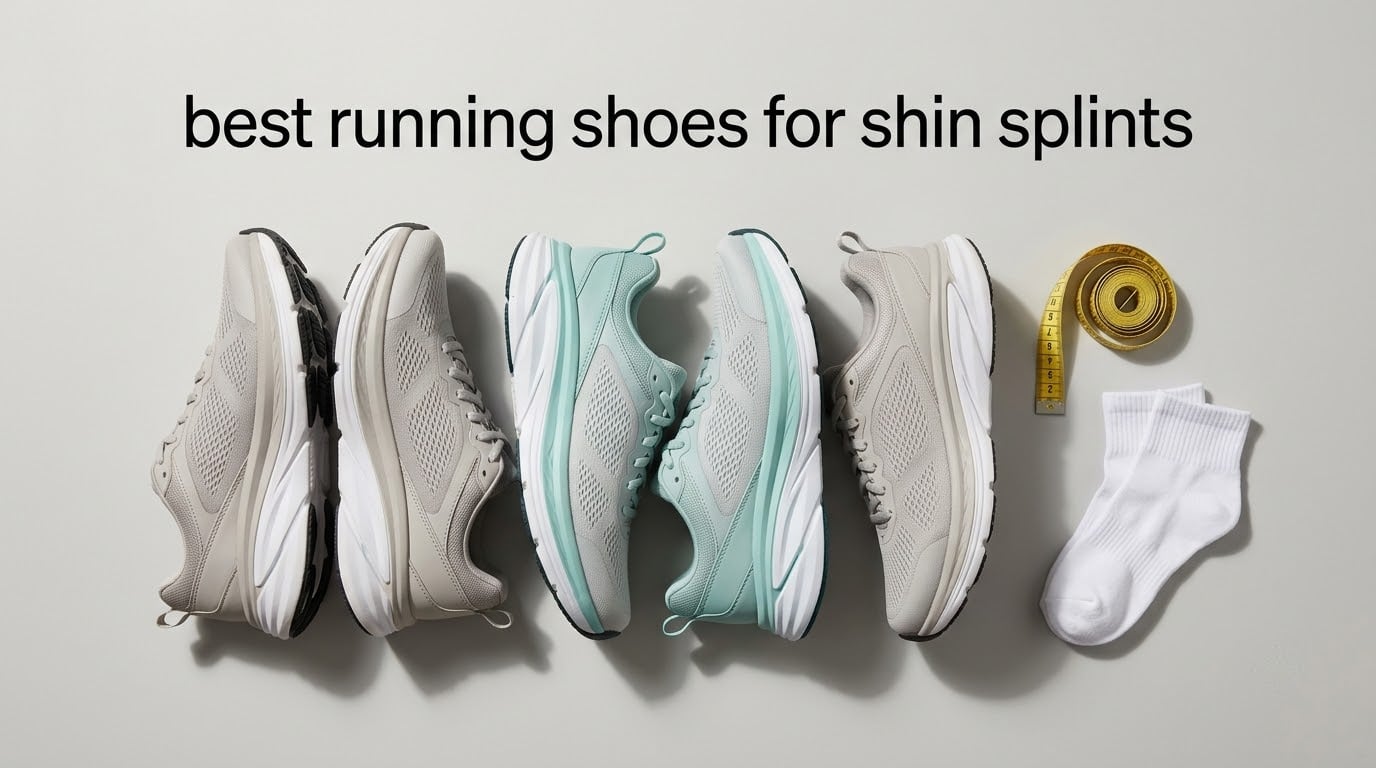
If you are searching for the best running shoes for shin splints, the honest answer comes in two halves. The best running shoes for shin splints are high-stack cushioned daily trainers with a wide planted base, a moderate heel-to-toe drop and enough guidance underfoot to stop the foot and ankle twisting on every landing. But no shoe fixes medial tibial stress syndrome, or MTSS, because the injury usually starts with a training load that climbed faster than the bone and the calf could absorb. Shoes manage the load. Load management and strength work resolve it.
That distinction matters because the shin-splint search results are crowded with runners who bought a second pair, then a third, and felt no different. In the r/beginnerrunning and r/RunningShoeGeeks threads that surface for this query, the most repeated line is almost word for word the same: the shoe helps, but strengthening the lower leg and managing mileage is what actually works. A few runners report the opposite too, that shin pain started the week they moved into a heavily cushioned model, which is the clearest possible argument against chasing softness alone.
What follows is a spec-driven shortlist. Every shoe here was chosen on measurements you can verify rather than on a vibe: midsole stack and foam type, heel-to-toe drop, weight, base width, guidance hardware and available widths. Twelve models, ranked, with the reasoning shown. Updated for 2026, and every pick on the list is a current-generation or still-current road trainer, not a discontinued leftover.
One quick note before you start reading. This is footwear guidance, not medical advice. If your shin pain is pinpoint rather than diffuse, wakes you at night, gets worse as you warm up, or has not improved after two weeks of reduced volume, stop reading and book a sports physiotherapist or podiatrist. Bone stress injuries do not negotiate.
Table of Contents
Top 3 Picks for the Best Running Shoes for Shin Splints (October 2026)

New Balance Fresh Foam Arishi V4
- Fresh Foam midsole
- 6mm heel-to-toe drop
- 9.5 oz per shoe
- Breathable mesh upper

Skechers Max Cushioning Endeavour
- Ultra Light max-cushioning midsole
- Natural Rocker Technology
- Air-Cooled Goga Mat insole
- Engineered mesh upper

Nike Revolution 8
- Lightweight road construction
- Breathable upper
- Durable rubber outsole
- Everyday training and walking
All 12 Shoes Side by Side in 2026
The table below is the fastest way to see where each shoe sits. Scan the cushioning column first, then the drop, then the guidance hardware. Prices move constantly, so use the check buttons rather than any figure you might remember.
| Product | Specifications | Action |
|---|---|---|
| New Balance Men’s Fresh Foam Arishi V4 |
|
Check Latest Price |
 New Balance Men’s Fresh Foam 520 v9 New Balance Men’s Fresh Foam 520 v9 |
|
Check Latest Price |
| Nike Men’s Revolution 8 Road Running Shoes |
|
Check Latest Price |
| Skechers Women’s Max Cushioning Endeavour |
|
Check Latest Price |
 Under Armour Men’s Charged+ Assert 11 Under Armour Men’s Charged+ Assert 11 |
|
Check Latest Price |
 ASICS Men’s NOVABLAST 5 ASICS Men’s NOVABLAST 5 |
|
Check Latest Price |
 ASICS Men’s Gel-Nimbus 27 ASICS Men’s Gel-Nimbus 27 |
|
Check Latest Price |
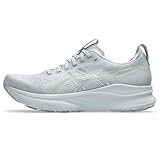 ASICS Men’s Gel-Kayano 32 ASICS Men’s Gel-Kayano 32 |
|
Check Latest Price |
 Brooks Men’s Adrenaline GTS 25 Brooks Men’s Adrenaline GTS 25 |
|
Check Latest Price |
 Brooks Men’s Glycerin 22 Brooks Men’s Glycerin 22 |
|
Check Latest Price |
 Brooks Women’s Ghost Max 3 Brooks Women’s Ghost Max 3 |
|
Check Latest Price |
 New Balance Men’s Fresh Foam X 860 V14 New Balance Men’s Fresh Foam X 860 V14 |
|
Check Latest Price |
What to Look for in a Shoe for Shin Splints
Here is the short version of the criteria, and the numbers matter more than the marketing language. Running produces a ground reaction force of roughly two and a half to three times your bodyweight at each landing, repeated around 1,500 times per mile. Shin splints happen when the tibia and the periosteum around it cannot dissipate that repeated load. A shoe changes the equation in four measurable ways.
1. Heel stack of 35mm or more. Stack height is the millimetres of foam under the heel. More foam does not automatically mean less shin pain, but a taller stack gives the impact a longer, softer deceleration path before it reaches the bone. Anything at or above 35mm is in the useful range for a symptomatic runner; below about 30mm you are closer to a racing flat.
2. A wide, planted base. A broad platform in both the heel and the forefoot lets the foot land and roll without the ankle collapsing inward. Modern guidance systems do this without the heavy, clunky feel of legacy motion-control posts, which matters because runners who did not need a correction shoe sometimes reported shin pain starting after switching into one.
3. A heel-to-toe drop between 8mm and 12mm. Drop is the millimetre difference between the heel and the forefoot. A higher drop lets the ankle and calf work at a shallower angle, which takes load off the tibialis posterior and the lower-leg stabilisers. The catch is transition: going from a 10mm shoe to a 4mm one overnight is itself a common trigger, so treat a drop change as a four-week project.
4. A daily trainer, not a carbon-plated racer. Race shoes are built for speed at the cost of ground feel and often durability. A shin that is already irritated does not need a propulsion plate. Daily trainers give you the thickest foam and the most forgiving ride per pound.
5. Torsional rigidity you can feel. Twist the shoe in your hands like a dishcloth. If it folds easily in the forefoot, the platform will not stay planted under load. A stiffer midsole or a defined midfoot structure resists the twisting that drives tibial stress.
6. Rocker geometry that helps you roll off the heel. An upturned heel and forefoot, such as the GlideRoll Rocker on the Ghost Max 3 or the Natural Rocker on the Skechers Endeavour, reduces the braking force the ankle has to absorb. It is a quiet helper rather than a headline feature.
7. A fit that does not pinch. Cramped toe boxes and narrow tapers come up constantly in reviews and forums, and a foot that is squeezed in the midfoot cannot pronate or supinate the way it should. If a model runs narrow, size up or go up a width rather than fighting it.
8. A replacement window you plan for. Cushioning and support both decay with mileage. Most brands and testers put replacement somewhere between 300 and 500 miles for a daily trainer, and the general community consensus is that a shoe which has been run past that point stops absorbing what it absorbed on day one. Track your mileage, because a worn shoe is an expensive placebo.
One structural point that deserves its own paragraph, because almost nobody on the results page covers it. Pain along the inner edge of the shin is the medial pattern, and it responds best to drop, stability and load control. Pain on the outer edge or up the front of the shin points to the tibialis anterior, the muscle that lifts the foot, and it responds differently: a lower drop and a rockered forefoot that lets the foot roll off without the shin muscles working overtime. If your pain is up front rather than inside, weight the forefoot and rocker criteria more heavily than the stability ones. Our stability running shoe guide goes deeper on the medial pattern.
How to Match Your Foot Strike and Gait to One Shoe
Forum threads on this topic tend to spiral into thirty shoe names with no conclusion. Here is the decision rule instead, in the order it actually matters: your foot strike, then your pronation, then your arch, then everything else.
Heel striker with neutral gait: start with a moderate-to-high drop daily trainer. The New Balance 520 v9 at 10mm drop or the Brooks Glycerin 22 both fit that profile, and the Glycerin has the broadest platform in this group.
Heel striker who feels the shin on the outside edge: you are probably overworking the tibialis anterior. A rockered, lower-drop option such as the Skechers Max Cushioning Endeavour takes some of that rolling work off you.
Overpronator or flat foot: you need guidance hardware, not just foam. The Brooks Adrenaline GTS 25, the ASICS Gel-Kayano 32 and the New Balance 860 v14 all have real medial support built in.
High arch and supination: you need a shoe that lets the foot sit down and absorb rather than one that tips it inward. The Glycerin 22 has documented reports of clearing recurring MTSS in supinators, and the New Balance 860 v14 gives you the widest fit range on the list.
Wide foot or bunion sensitivity: skip anything with a pronounced midfoot taper. The Brooks Ghost Max 3 and the New Balance 860 v14 both carry wide and extra-wide options. For more width options in general, our cushioned shoe roundup compares several roomy lasts.
Heavy runner or a lot of time on your feet: a genuinely thick, stable midsole beats a featherweight trainer. The ASICS Gel-Nimbus 27 and the Brooks Adrenaline GTS 25 both have a planted feel that heavier runners rate highly. Sizing guidance for wider builds is in our men’s running shoe guide.
1. New Balance Fresh Foam Arishi V4 – Best Overall Cushioning Per Pound
New Balance Men’s Fresh Foam Arishi V4 Running Shoe
Fresh Foam midsole
6mm heel-to-toe drop
9.5 oz per shoe
Breathable mesh with suede and knit accents
Pros
- Soft Fresh Foam midsole that absorbs road impact
- Lightweight at 9.5 oz per shoe
- Breathable mesh upper
- Durable rubber outsole
- No-sew overlays add midfoot structure
Cons
- 6mm drop is low for a heel striker
- No-sew construction gives up some long-term structure
This is the shoe I keep coming back to for people who are new to shin trouble. The Fresh Foam midsole does the absorbing quietly, and at 9.5 oz per shoe the swing weight stays low enough that fatigue does not push you into a heavy landing pattern partway through a run.
It sits in the top ten of men’s road running shoes by category rank, and 67 percent of its ratings are five stars with a further 13 percent at four, which is a unusually consistent comfort profile for a shoe this light. That consistency is the point. A shoe that feels identical on mile two and mile eight is easier to adapt to while you are also managing volume.
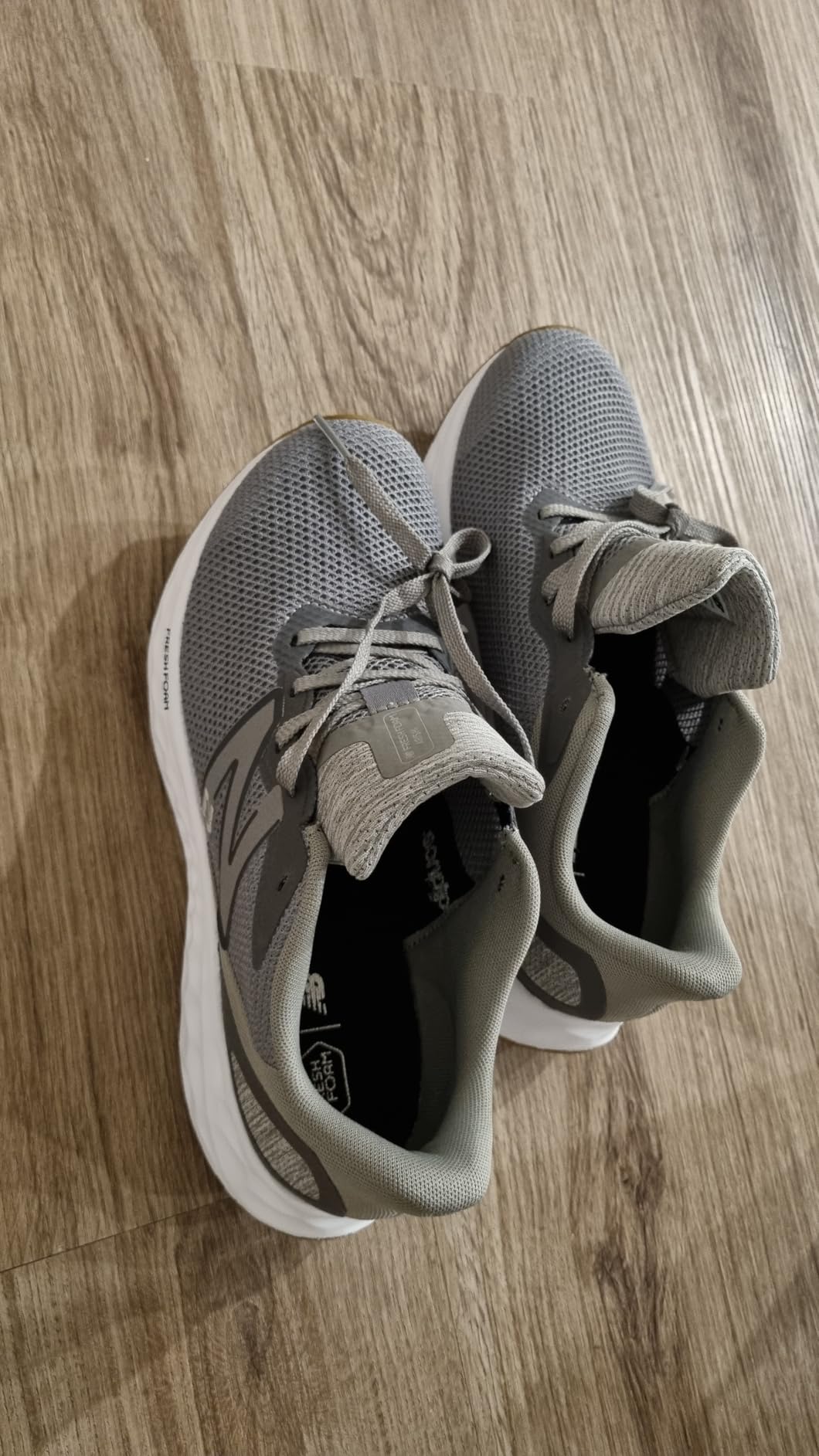
The 6mm drop is the one thing I want to flag hard. Compared with the 8 to 12mm band most load-management advice favours, 6mm puts more of the work on the tibialis anterior and the calf. For a midfoot or forefoot striker that is fine, and arguably good. For a confirmed heel striker with medial pain, it is not the first pick I would hand out.
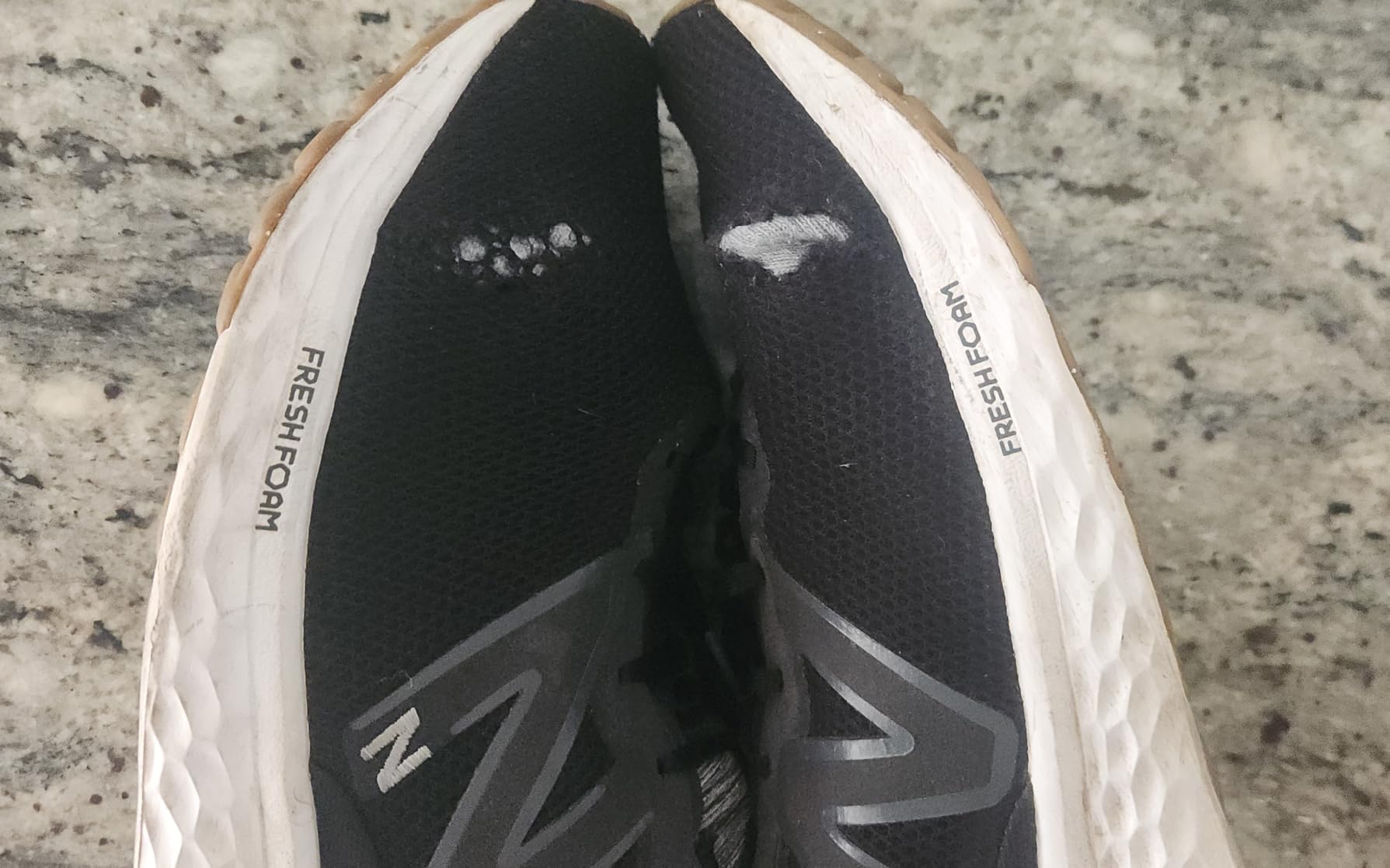
The no-sew construction keeps the weight down and the upper flexible, and the overlays still give midfoot structure. The trade is durability of the upper itself; buyers who run rough mileage note that stitched builds hold shape longer. If you want a lower drop but more midsole, look at the NovaBlast 5 further down. If you want a higher drop at the same brand and similar weight, the 520 v9 is the sibling to compare.
Who this suits
Beginners and returners who built shin trouble by ramping mileage too fast, midfoot and forefoot strikers, and anyone who wants a protective daily trainer without a heavy, overbuilt feel. The 6mm drop also means less calf and Achilles strain than a traditional 10mm trainer if that is your other niggle.
It is equally good as a walking shoe, which matters more than people expect. A lot of shin-splint recovery happens on feet rather than on runs, and this is a shoe you can wear for eight hours without thinking about it.
Who should skip it
Skip it if you are a hard heel striker with medial shin pain. In that case your single most useful adjustment is more drop, not less, and you should look at the 520 v9 or the Glycerin 22 instead.
Also skip it if you run serious mileage on rough routes and care about upper longevity. The no-sew build is the first thing to go, and it will not be the midsole that fails first.
2. New Balance Fresh Foam 520 v9 – Best for Everyday Miles on a Heel-Strike Budget
New Balance Men’s Fresh Foam 520 V9 Running Shoe Black/Black
Fresh Foam midsole
10mm heel-to-toe drop
260.8 g per shoe
Neutral everyday support
Pros
- Soft Fresh Foam cushioning absorbs impact cleanly
- Very light at 260.8 g
- Neutral support suits a wide range of gaits
- Traditional lace-up fit is easy to adjust
Cons
- 10mm drop is a big change if you are moving up from a flatter shoe
- Neutral support offers no correction for overpronators
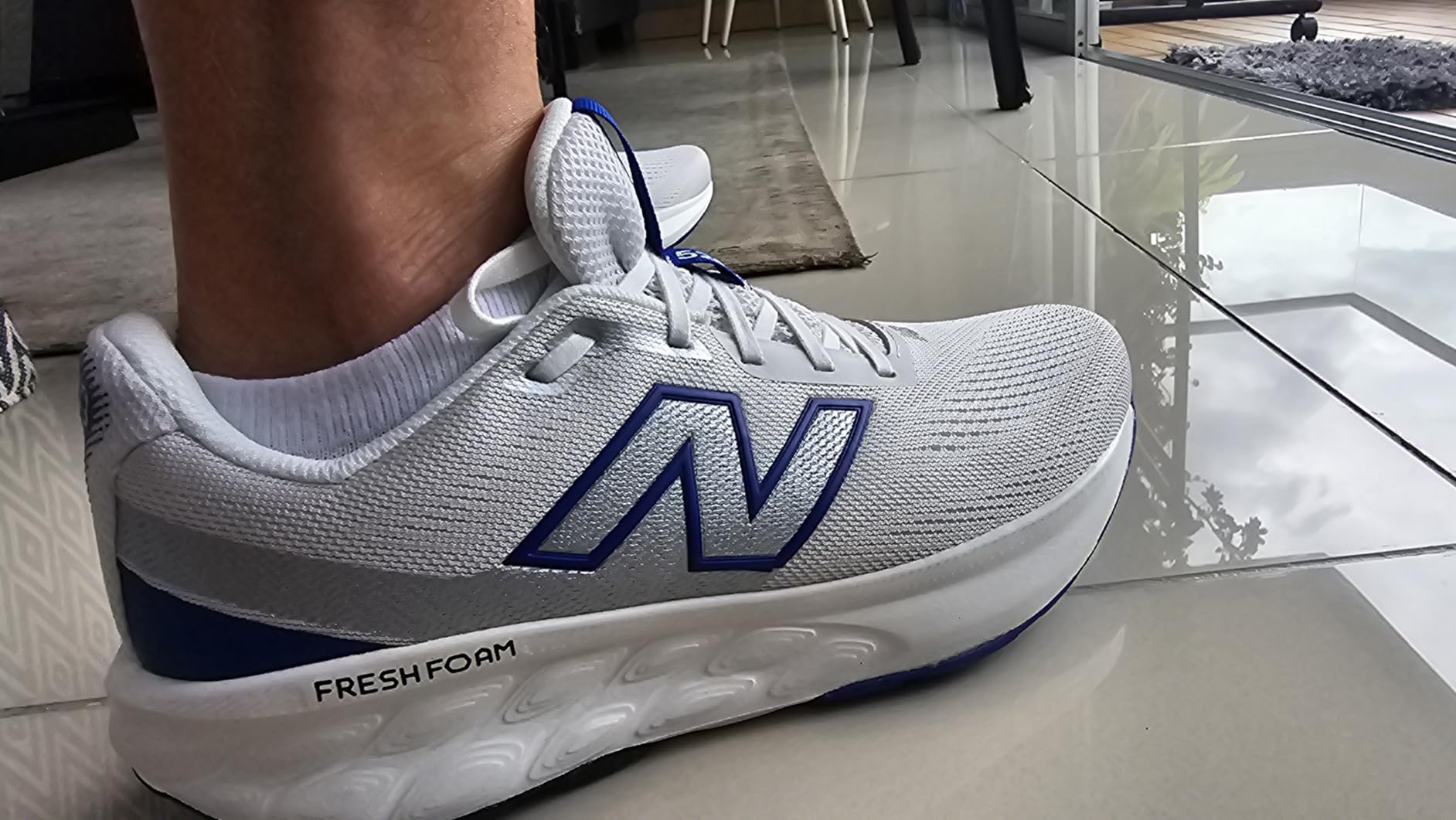
The 520 v9 is the current generation of one of the most-recommended everyday trainers on the market. For shin splints specifically, the 10mm heel-to-toe drop is the headline: it keeps the ankle plantar-flexed enough at contact that the calf and tibialis posterior carry less of the landing.
At 260.8 grams per shoe it is genuinely light, which matters more than most buyers expect. Every extra ounce is mass your lower leg has to swing and decelerate 1,500 times a mile. Reviewers rate it at 4.4 stars across more than 3,600 ratings, with 73 percent at five stars and 12 percent at four.
The breathable engineered mesh upper and simple lace closure make it an easy shoe to adjust. If your shin trouble comes with a wider foot or a high instep, the conventional lacing gives you room to make fine changes rather than fighting a fixed sleeve.
It is designed explicitly for all-day wear as much as for running, and that dual purpose is genuinely useful during a flare-up, when the total load on your tibia includes standing hours, not just mileage. Our caveat is the mirror image of the Arishi: 10mm is on the high side, so if you are moving from a 4 to 6mm minimalist trainer, treat this as a gradual change rather than a swap.
Who this suits
Heel strikers with medial shin pain who need more drop rather than more foam. It also suits anyone who runs on hard pavement, works on their feet, or is returning to running after a layoff and wants a familiar, forgiving profile.
Neutral runners who are not overpronating will find the support level honest. You get cushioning without a correction structure trying to change how your foot rolls.
Who should skip it
If you overpronate or have genuinely flat feet, neutral support will not give you the guidance that keeps the ankle from collapsing. Look at the Adrenaline GTS 25, the Gel-Kayano 32 or the 860 v14 for built-in stability.
Skip it too if you have been running in a low-drop minimalist shoe. The jump to 10mm shifts load toward the Achilles, so build up to it over several weeks.
3. Nike Revolution 8 – Most Versatile All-Rounder for Everyday Training
Nike Men’s Revolution 8 Road Running Shoes, Black/Red Orbit-University Red, 12
Lightweight road construction
Breathable upper
Durable rubber outsole
Suited to training and walking
Pros
- Very light and comfortable for everyday wear
- Durable tread with regular use
- Good breathability
- Works for running and casual wear
Cons
- Runs narrow with a pronounced midfoot taper
- Several buyers recommend sizing up half a size
The Revolution 8 does one thing simply: it is a cheap, light, durable trainer for people who put a lot of miles on their feet without thinking about it. Seventy-four percent of its ratings are five stars, and the most common theme in reviews is that it gets worn far beyond a single purpose.
For shin splints, the case is about total load rather than running specifics. If you are a beginner whose shin pain came from doubling your mileage, the cheapest intervention is not a premium shoe; it is a comfortable one you will actually wear for the walking and standing parts of your day too.
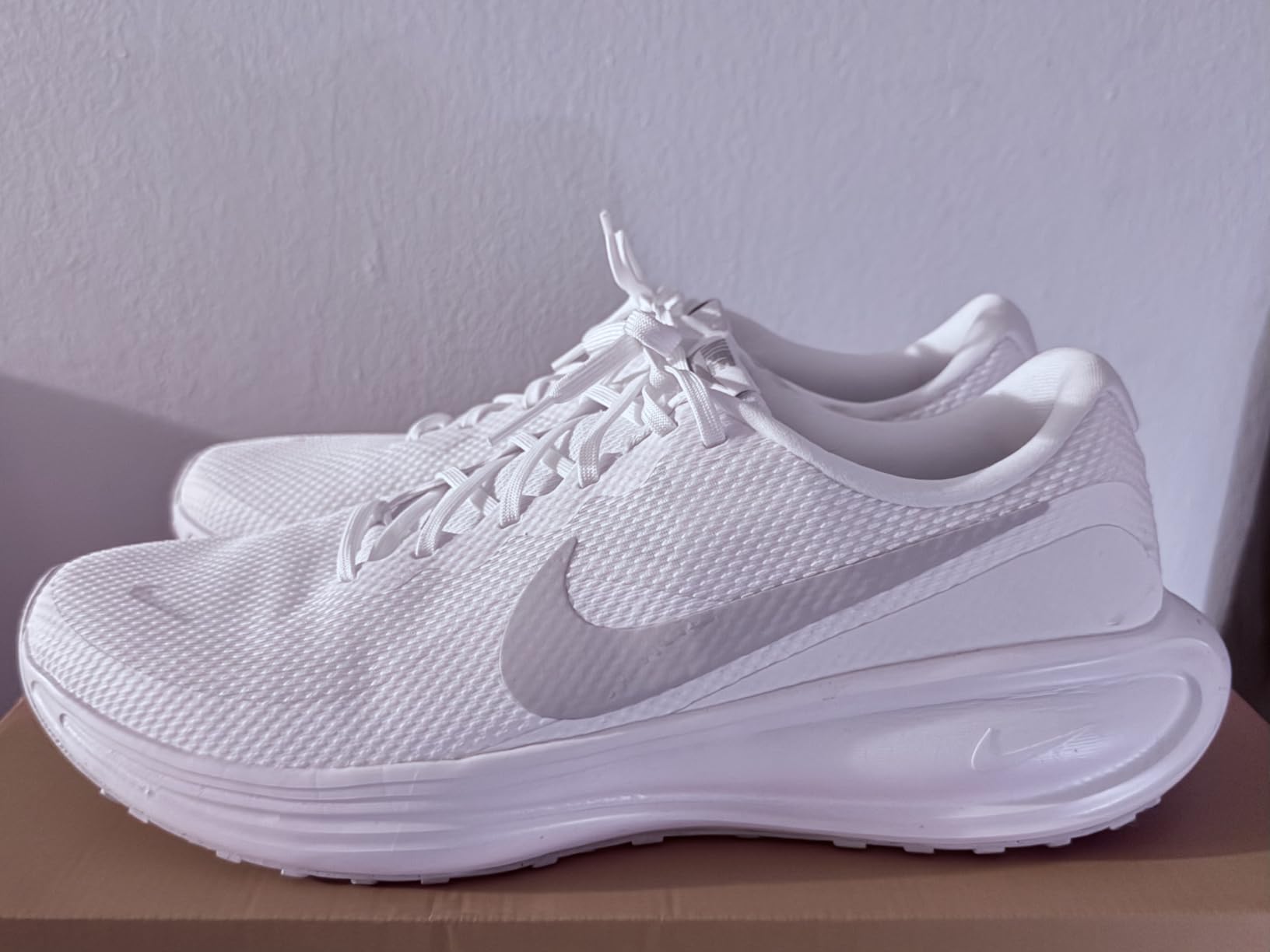
It is not a max-cushion shoe. The midsole is modest, and the stack is nowhere near the 35mm threshold we use as a guide for a symptomatic runner. If your pain is already established, you probably want something with more foam under the heel.
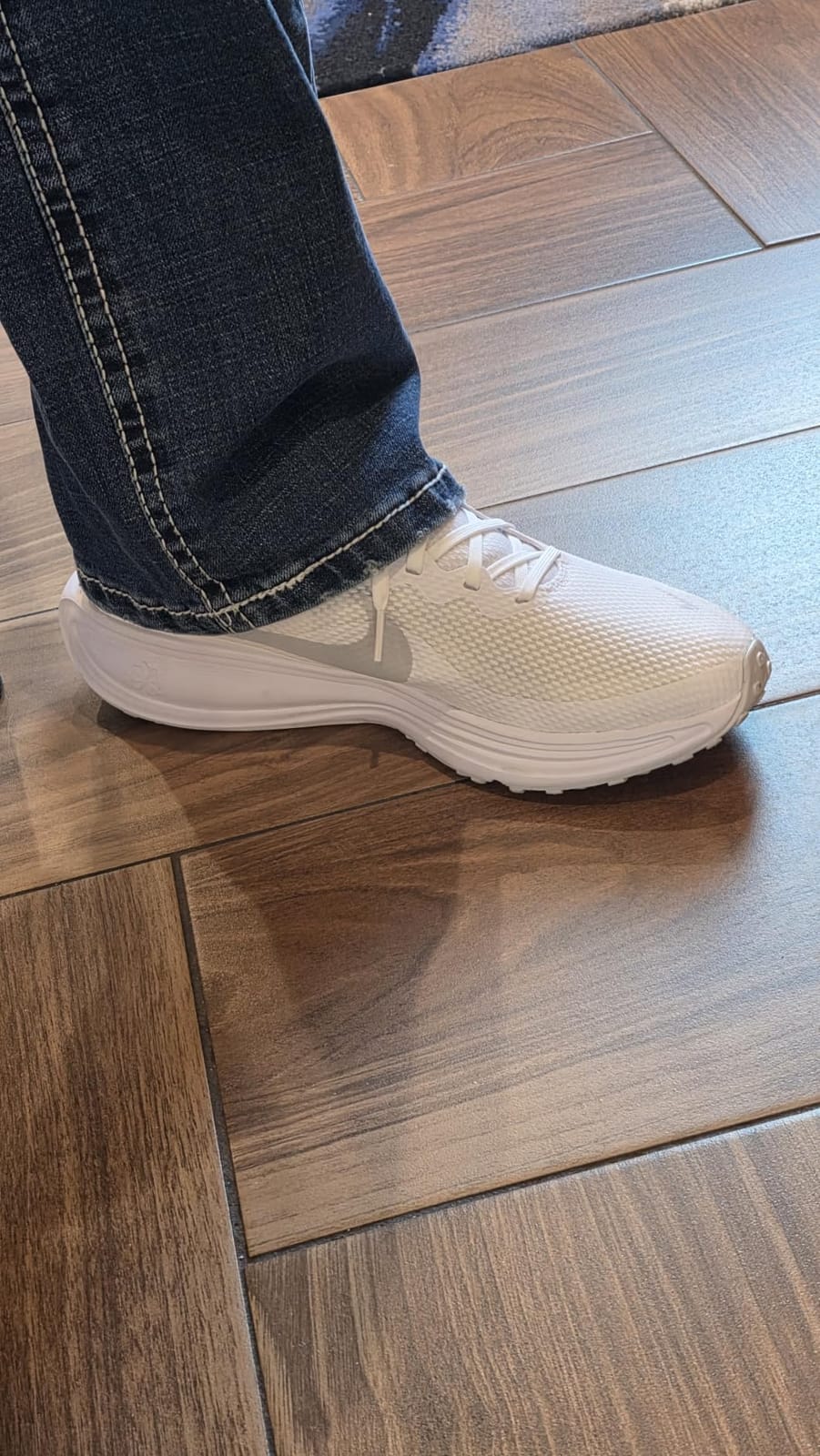
The fit is the real issue to plan for. A pronounced taper through the midfoot is the most common complaint, and multiple buyers recommend going up half a size. A narrow midfoot keeps the foot from moving naturally, which is exactly what you do not want while a tibial bone is irritated. Order both sizes if you can, or measure your feet in the evening.
Who this suits
Beginners, high-mileage walkers, and runners building a base who want a shoe they can wear everywhere. It also works well as a gym and cross-training shoe during a rehab block, where comfort over long sessions matters more than speed.
If cost is the deciding factor and you are only mildly symptomatic, this is a defensible place to start before spending more.
Who should skip it
Skip it if you are already diagnosed with MTSS. The cushioning is not the right tool for established bone stress, and a narrow taper works against you. In that case, go up a size and move to a cushioned model such as the 520 v9 or the Skechers Endeavour.
Also skip it if you run a narrow midfoot or have a bunion history. Taper is not a preference at this stage, it is a problem.
4. Skechers Max Cushioning Endeavour – Best Value Cushioning for Walking and Standing
Skechers Women’s Max Cushioning Endeavour Canova Sneaker, Red/Multi, 9.5
Ultra Light max-cushioning midsole
Natural Rocker Technology
Air-Cooled Goga Mat insole
Medium width
Pros
- Very soft max-cushioning midsole that absorbs impact
- Natural rocker smooths heel-to-toe transitions
- Breathable engineered mesh upper
- Machine washable and vegan
Cons
- Medium width only
- Softer ride gives less lateral control on uneven ground
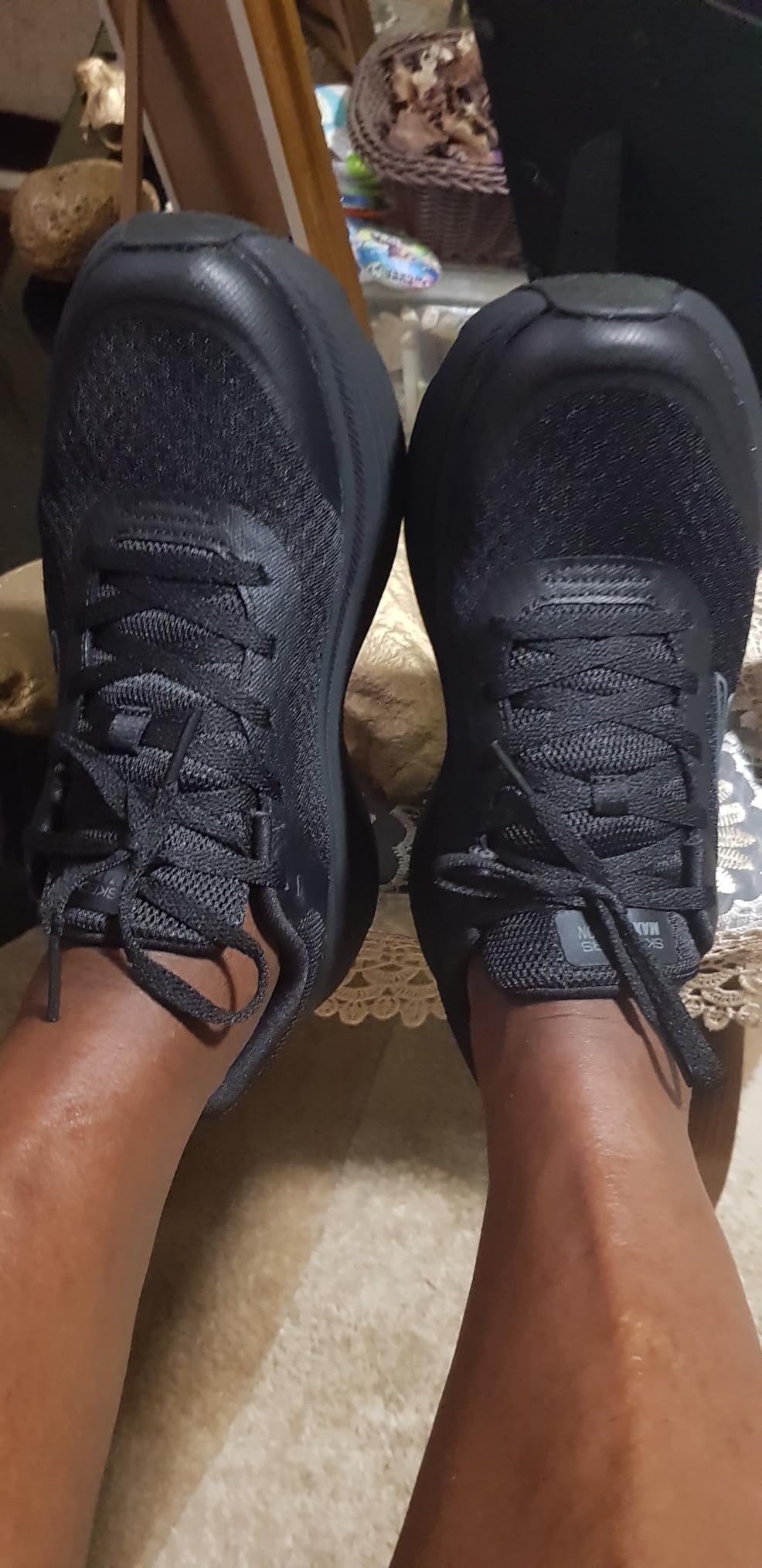
If your shin pain is aggravated by standing, this is the shoe to look at. The Ultra Light max-cushioning midsole puts a thick, soft layer between you and the floor, and 79 percent of its ratings are five stars with a further 10 percent at four. Buyers consistently describe it as plush and comfortable for all-day wear.
The Natural Rocker Technology is doing quiet work for the shin here. An upturned heel and forefoot means less braking for the ankle to absorb at contact, which takes strain off the tibialis anterior and the calf. That is the mechanism most relevant if your pain is on the front or outer edge of the shin rather than the inside.
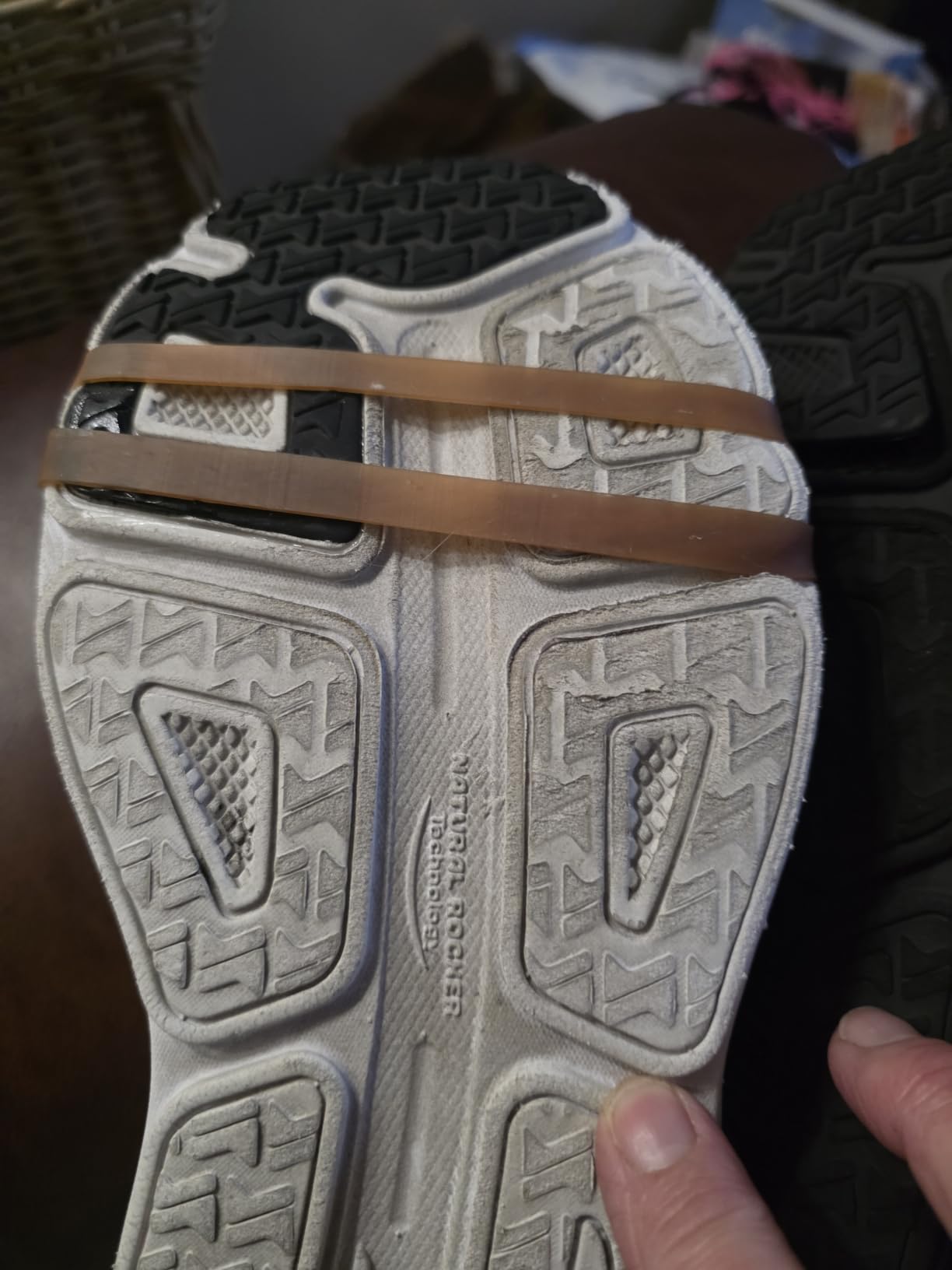
The Air-Cooled Goga Mat insole adds a second cushioning layer under the heel, which is the area that takes the most load on concrete. Combined with the mesh upper and synthetic overlays, the whole shoe is built for ventilation as much as for shock absorption, and that matters when your shins are tender enough that heat makes them feel worse.
Two practical details. It is machine washable, which genuinely matters for a shoe you wear daily, and it is made with 100 percent vegan materials. On the other hand, the width is medium only, so if you have a genuinely wide foot this is not the shoe, and no amount of sizing up will widen the platform.
Who this suits
Runners whose shin pain flares with standing and walking rather than with running itself. The rocker and the thick heel make it a strong option for anterior shin symptoms, where a lower, rolled-forward profile suits the tibialis anterior better than a high-drop trainer.
It is also the easiest shoe here to keep clean, which is an underrated virtue when you are wearing one pair for everything.
Who should skip it
Skip it if you need a wide platform. Medium width is the only width, and for a foot that overpronates, a wider base is often the more important lever than foam thickness.
Also skip it for trail or technical ground. The soft, high-cushion platform is not designed to handle uneven surfaces, and the rocker that helps on pavement can feel unstable on roots and rocks.
5. Under Armour Charged+ Assert 11 – Budget Pick for Heel Support and All-Day Softness
Under Armour Men’s Charged+ Assert 11, 002 Black, 14
Charged+ midsole cushioning
10.2 oz per shoe
Flex-groove rubber outsole
Neutral cushioning
Pros
- Very soft springy Charged+ cushioning
- Excellent heel support without a max-stability feel
- Lightweight build for long days on foot
- Wide toe profile with no pinching
Cons
- Fit runs tight in both width and length
- Mesh upper soaks through in heavy rain
This one carries the highest average rating in the group at 4.6 stars, and the reason shows up constantly in reviews: people call it one of the most comfortable walking and running shoes in its class, with structural support that feels better than shoes costing considerably more.
The Charged+ midsole is described as soft and springy, and the leather overlays over the athletic mesh give genuine midfoot structure rather than the flimsy kind. For a shin that is irritated, the combination of a planted heel and a light 10.2 oz weight is a good balance, and eighty percent of ratings are five stars.
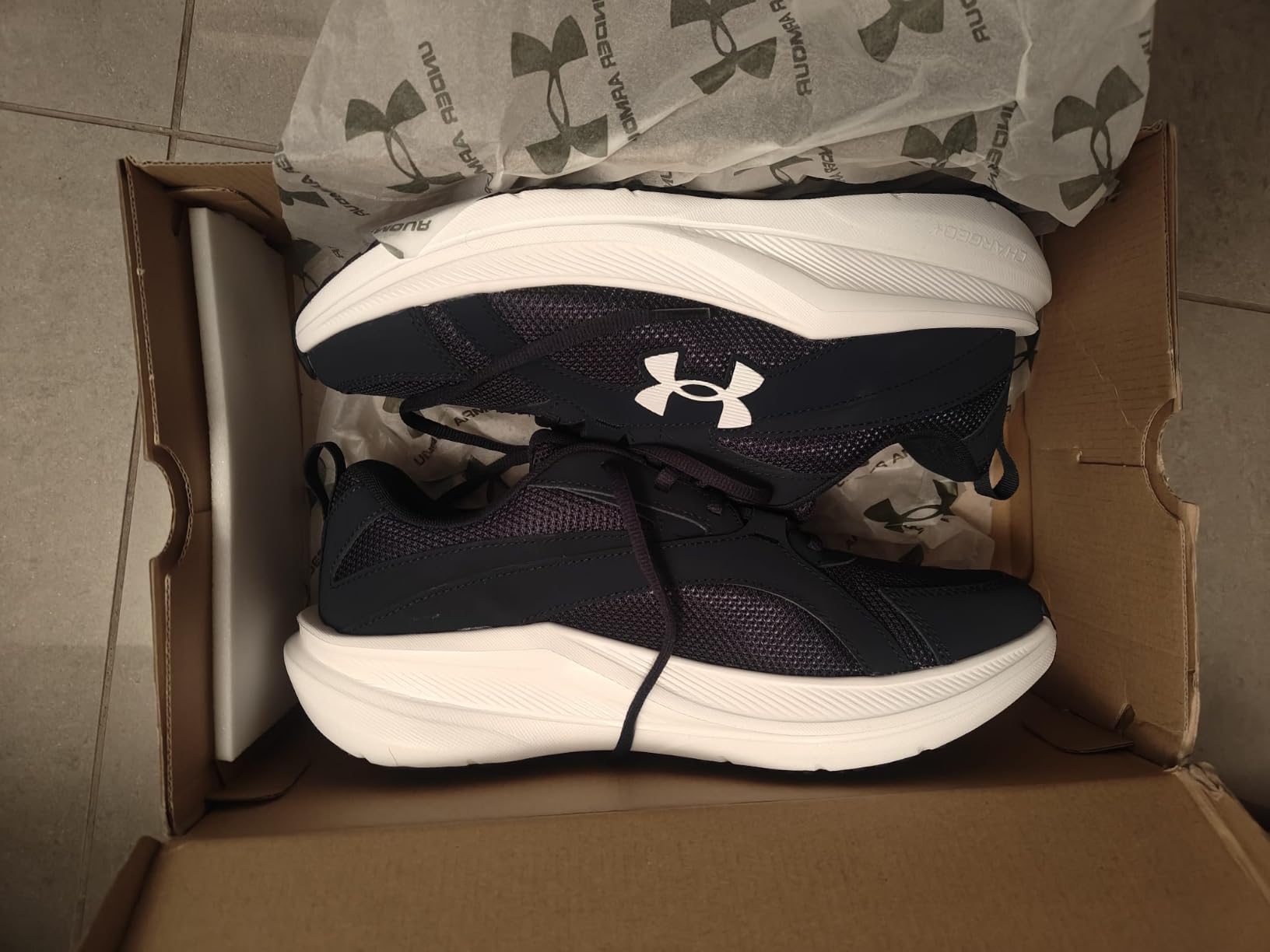
The outsole has flex grooves placed strategically to help toe-off, which reduces the work the forefoot has to do late in the stride. Small detail, real effect on a tired lower leg.
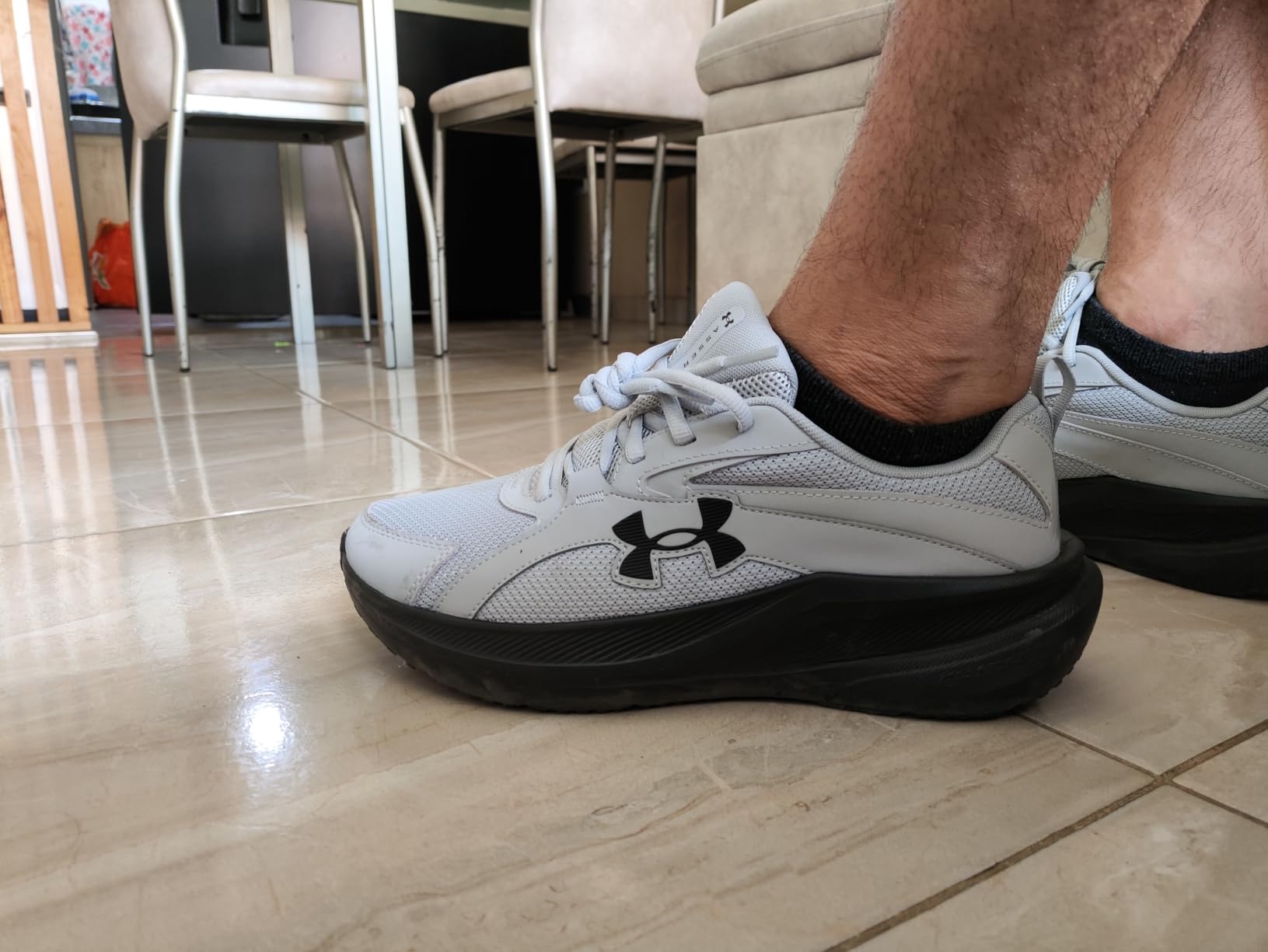
The one thing to plan around is the fit, and it is the opposite of the Skechers problem: this runs tight in both width and length, and some buyers swap the insole to solve it. That suggests a snug heel lockdown, which is exactly what you want, but you should not expect roomy forefoot space. The upper also contains at least 30 percent recycled content, and the mesh does not love heavy rain.
Who this suits
Runners who need real heel support and lockdown but find traditional stability shoes heavy and clumsy. The Assert 11 delivers support without the max-stability feel, and it works as well for walking as for running, which suits a lot of our readers who are in a rehab block.
Heavy runners also do well here, because the heel support does not depend on a light build. If you spend a lot of time on concrete, the combination of heel hold and soft midsole is the right shape.
Who should skip it
Skip it if you have a narrow foot or need a roomy toe box. A tight last is not adjustable, and a cramped forefoot works against natural foot movement in exactly the way you do not want during shin recovery.
Skip it in wet climates if you care about wet feet. The mesh upper is performance-first and shows that in heavy rain.
6. ASICS NOVABLAST 5 – Best for a Propulsive, Bouncy Ride
ASICS Men’s NOVABLAST 5 Running Shoes, 10, Black/Carrier Grey
FF BLAST MAX cushioning
Trampoline-inspired outsole
Tongue wing construction
Reflective details
Pros
- FF BLAST MAX delivers a lightweight energetic ride
- Trampoline outsole gives a responsive bounce
- Tongue wing keeps the tongue secure
- Reflective details aid low-light visibility
Cons
- Runs large so sizing down may be needed
- Energetic ride is not a soft low-drop recovery feel
The NovaBlast 5 is the enthusiast trainer in this group, and 81 percent of its ratings are five stars. ASICS built it around FF BLAST MAX cushioning and a trampoline-inspired outsole, and the effect is a genuinely energetic, bouncy ride rather than a flat, damped one.
For shin splints, the bounce is a feature with a caveat. A responsive return can help keep your stride quick and light without heavy recruitment of the shin muscles, but the shoe is propulsive by design. If your shin is currently angry, an energetic platform that encourages you to run harder is not always what you want.
The tongue wing construction adds stretch at the tongue so it stays put on the run. That is a bigger deal than it sounds: a sliding tongue shifts the fit forward and you end up with more pressure across the top of your foot and instep after a few miles.
Reflective details help if you are running at low light, and at least 75 percent of the main upper material is recycled. The technical note is that it runs large, so more than one buyer sizes down. Check carefully, because a shoe that is too long will let your heel slide, and heel slide is its own small source of lower-leg irritation.
Who this suits
Runners who have recovered well from shin pain and want a shoe that makes easy miles feel good. If you are back to normal volume and your shin is quiet, this is a strong daily trainer that will not flatten out under you.
It also suits anyone who dislikes flat, dead trainers and prefers a shoe that still feels alive at mile six. The outsole is built for real road mileage rather than a short life.
Who should skip it
Skip it while you are actively symptomatic. The propulsive character encourages a faster, more bouncy gait, and the foam is tuned for energy return rather than maximum damping. If you want maximum absorption, the Gel-Nimbus 27 is the better pairing from the same brand.
Also skip it if you are between sizes and hate guessing, because it runs large and the sizing runs against you.
7. ASICS Gel-Nimbus 27 – Best for Arch Support and Soft Landings
ASICS Men’s Gel-Nimbus 27 Running Shoe, 11.5, Indigo Fog/Denim Blue
PureGEL rearfoot cushioning
FF BLAST PLUS ECO midsole
OrthoLite X-55 sockliner
Solution-dyed sockliner
Pros
- Incredibly soft cushioning with supportive landings
- Generous toe box for long days
- Arch support that reduces plantar pain for many wearers
- Outsole durability holds up well on pavement
Cons
- Bulkier silhouette than sleeker trainers
- One outsole unit reportedly came unglued at the toe
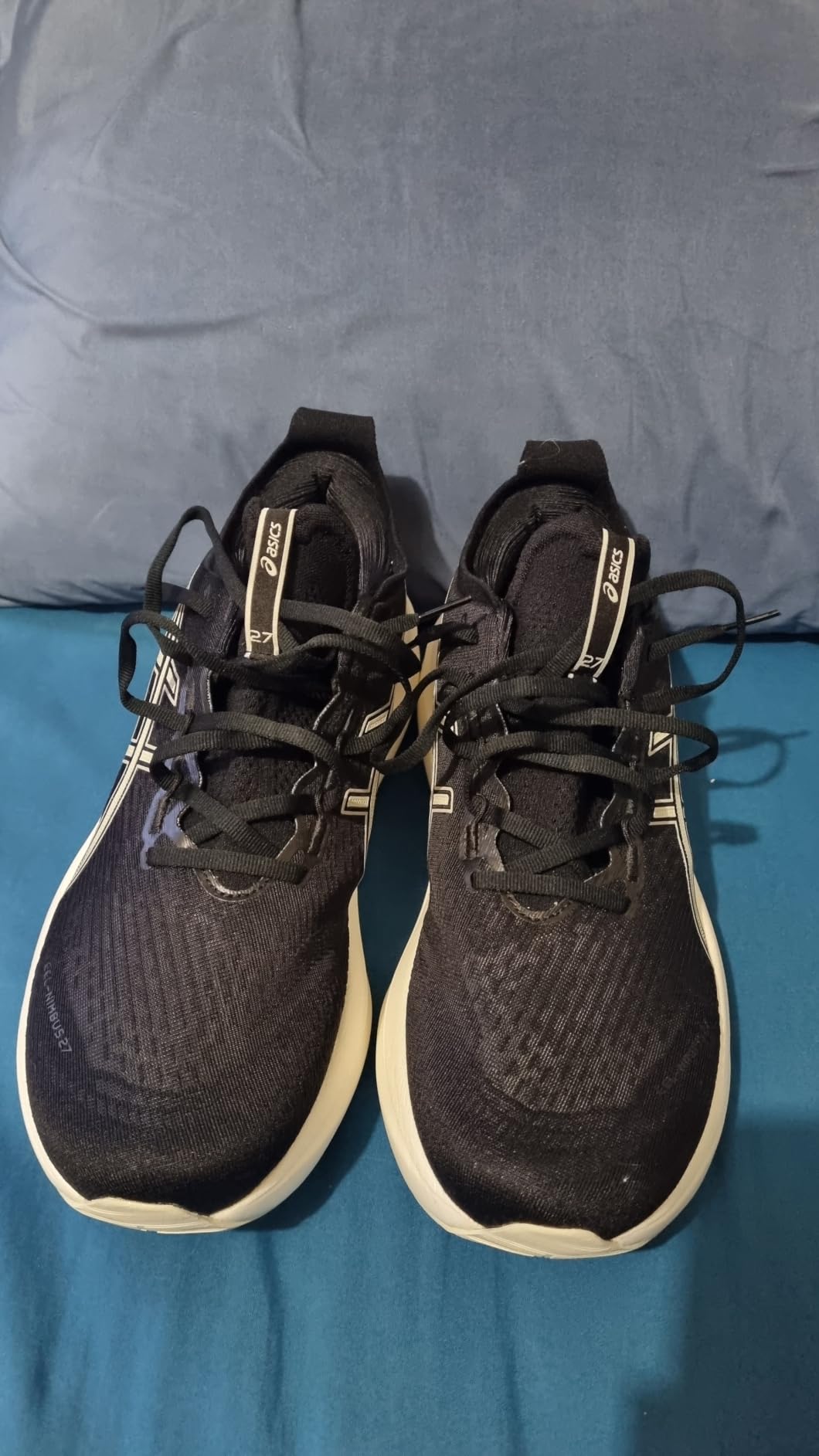
The Gel-Nimbus 27 is the shoe on this list with the most direct owner reports of arch and shin symptom relief. Eighty percent of its ratings are five stars, and many buyers are long-time owners describing it as their best-ever pair, citing softness, toe room and outsole durability for walking mileage.
The cushioning stack is the point here. PureGEL in the rearfoot gives a soft landing, FF BLAST PLUS ECO in the midsole adds a responsive layer, and the OrthoLite X-55 sockliner improves step-in comfort. When your shin pain comes with plantar symptoms in the same person, which is a common overlap, this combination covers more ground than a neutral foam-only trainer.
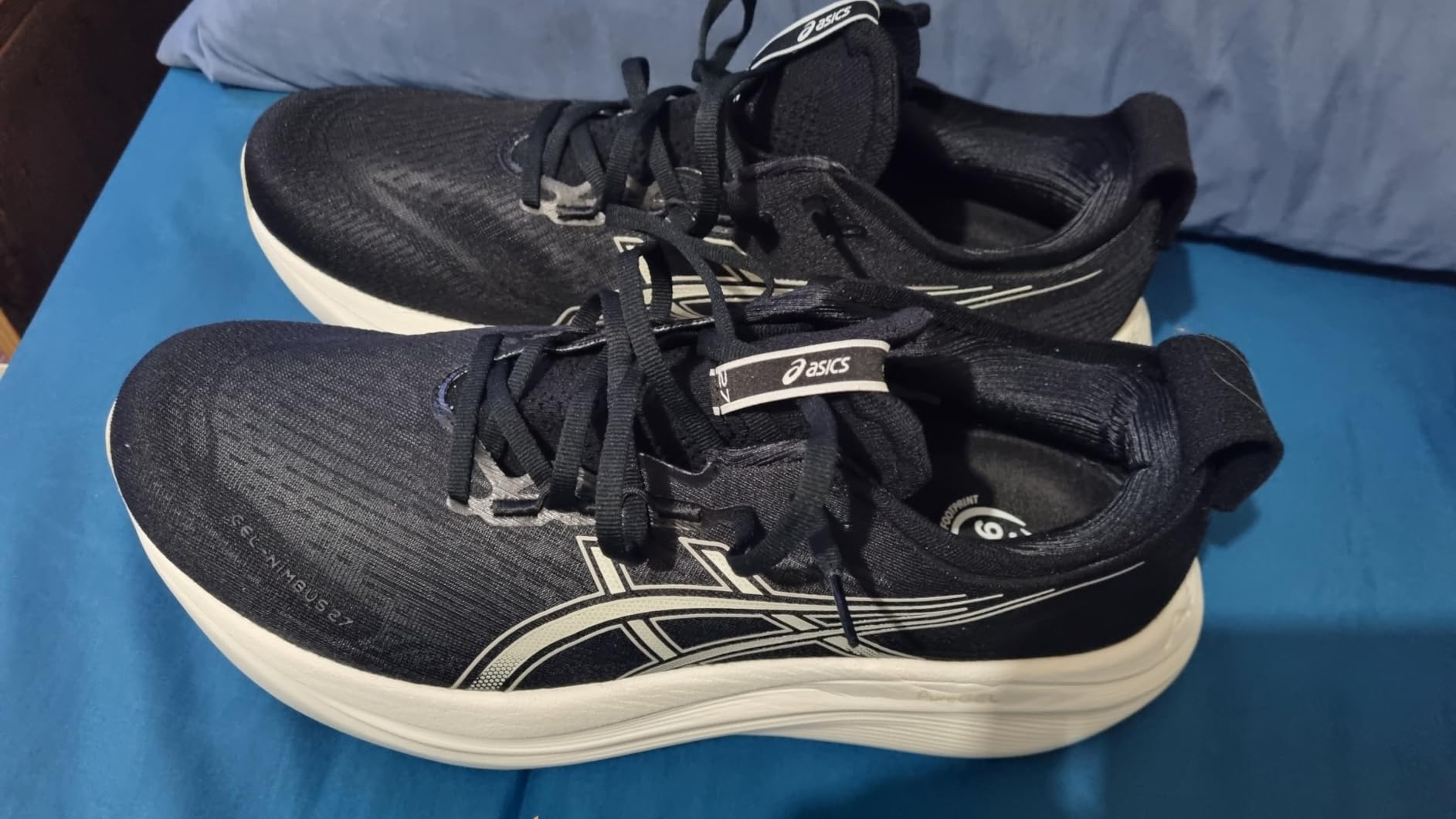
Footwear material facts worth knowing: the sockliner is solution dyed, which cuts water usage by about a third and carbon emissions by roughly 45 percent, and the FF BLAST PLUS ECO foam is made with around 24 percent bio-based content. Neither of those changes how the shoe feels, but they tell you the construction is a current-generation one rather than a carried-over last.
The honest negatives are shape and the occasional build issue. The silhouette is bulkier than sleeker trainers, and one buyer reported an outsole unit coming unglued at the toe after extended use. That is a single isolated report, not a pattern, but it is the kind of thing worth checking when your pair arrives.
Who this suits
Runners with shin pain alongside arch or plantar problems, and anyone who values a soft landing above energy return. The generous toe box is a real advantage for long days and for anyone who has spent time in a narrow trainer while treating shin pain.
It is also a strong walking shoe. For people whose tibial load comes mostly from standing, the cushioning and toe room do more good than a stability structure would.
Who should skip it
Skip it if you care about weight or like a low profile. It is the heaviest-looking shoe here, and if swing weight bothers you, the Arishi V4 or the 520 v9 will feel livelier.
Skip it if you overpronate significantly and want real guidance. This is a cushioned neutral platform, and the fix for that is the Gel-Kayano 32 rather than more Gel in this one.
8. ASICS Gel-Kayano 32 – Best for Overpronation and Flat Feet
ASICS Men’s Gel-Kayano 32 Running Shoes, 9.5, Piedmont Grey/Gravel
4D GUIDANCE SYSTEM stability pod
Rearfoot PureGEL cushioning
FF BLAST PLUS midsole
OrthoLite X-55 sockliner
Pros
- 4D GUIDANCE SYSTEM adapts under load for dependable stability
- Rearfoot PureGEL is about 65% softer than standard GEL
- FF BLAST PLUS blends plush cushioning with responsive toe-off
- Knit heel pull tab makes it easy on and off
Cons
- Heavier and less nimble than neutral trainers
- Stability build can feel over-built for a neutral gait
This is the pick for the runner whose ankle rolls inward on landing, and the reason is the 4D GUIDANCE SYSTEM. Rather than a rigid post, it is a dynamic pod that responds under excessive load, which is the modern replacement for the motion-control shoes that gave stability a bad name in the 2010s.
That distinction is not academic. Several runners in our forum research described getting shin pain after switching into correction shoes they did not need. The 4D system is closer to a nudge than a cast, so you get a planted landing without an unfamiliar, heavy feel. Buyers describe it as dependable stability that stays comfortable for the whole run.
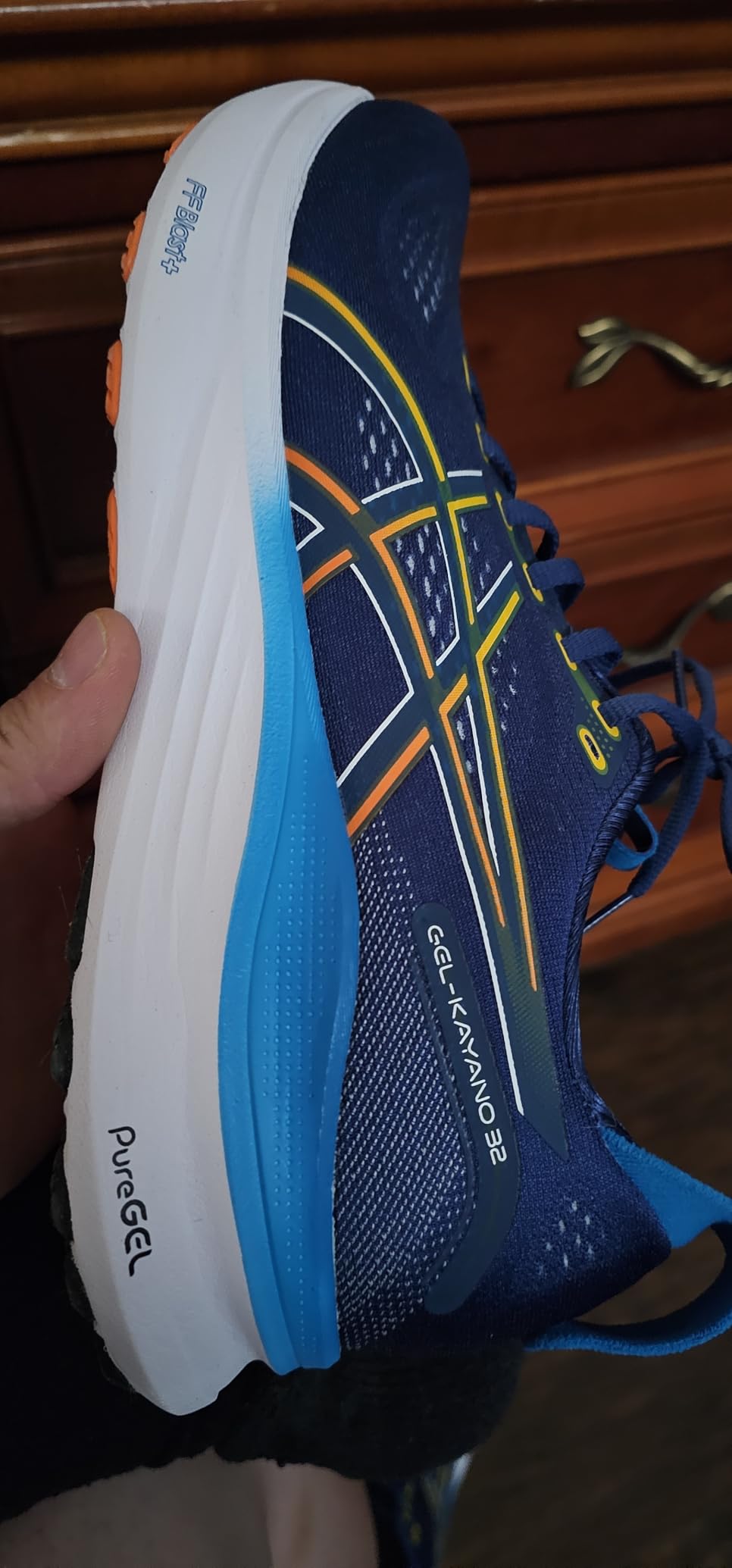
The rearfoot PureGEL is roughly 65 percent softer than standard GEL, according to the manufacturer, and FF BLAST PLUS handles the forefoot with a more responsive foam. That split is well matched to shin symptoms: soft at the heel where impact peaks, livelier under the toes so you do not sink into a flat, groundless ride.
The engineered mesh upper reduces the need for extra overlays, keeping weight and pressure points down, and the knit heel pull tab is a small quality-of-life touch when your shins are tender. The plain trade is weight: this is heavier and less nimble than a neutral trainer, and you feel that if you are used to something featherweight.
Who this suits
Overpronators and flat-footed runners, including anyone dealing with flat feet and shin splints at the same time. The adaptive pod handles the load without feeling like a rigid correction device, and the softer rearfoot GEL absorbs the impact that pronation tends to amplify.
Heavier runners also do well here because the stability does not depend on being light. For a heavier runner, an ankle that collapses inward sends more load down the inside of the tibia, and this is the direct answer to that.
Who should skip it
Skip it if you have a neutral gait and like a lively, light shoe. You will carry extra mass for a feature you do not use, and the build is deliberately less nimble than a neutral trainer.
Skip it if you want the lowest possible drop feel. The stack profile here is a conventional trainer rather than a rolled-forward platform, so if your pain is at the front of the shin, pair this logic with the Skechers Endeavour instead.
9. Brooks Adrenaline GTS 25 – Best for Walking, Standing and GuideRails Support
Brooks Men’s Adrenaline GTS 25
GuideRails holistic support
DNA Loft v3 cushioning
Flat-knit collar
APMA Seal of Acceptance
Pros
- GuideRails keeps excess foot movement in check
- DNA Loft v3 is soft yet stable
- Breathable engineered mesh with secure fit
- One buyer limited by shin splints reports no shin pain on 5K runs
Cons
- Runs small so several buyers went up half a size
- Limited wide-width colour options
- Inner heel can rub on runs beyond 10 km
The Adrenaline GTS 25 has the single most relevant piece of owner feedback in this whole roundup: a buyer limited by shin splints reports no shin pain during or after 5K runs in it. Seventy-nine percent of its ratings are five stars, and owners broadly describe a stable, cushioned ride that eases shin, knee and plantar symptoms.
The mechanism is GuideRails, Brooks’ holistic support system. It supports the body in its natural motion path while keeping excess movement in check, which is a softer intervention than a medial post. Pair it with the nitrogen-infused DNA Loft v3 midsole and you get a shoe that is soft without being vague.
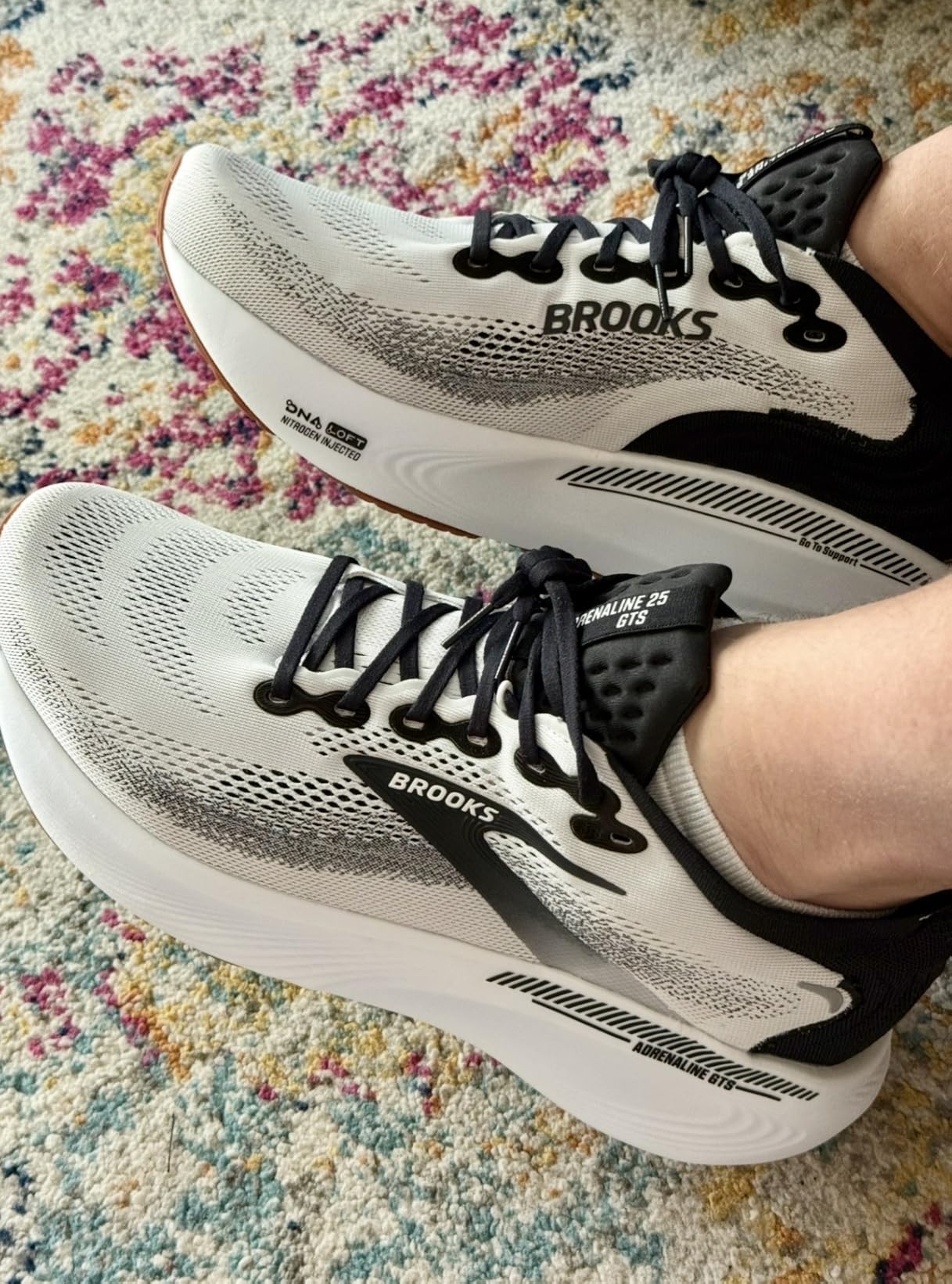
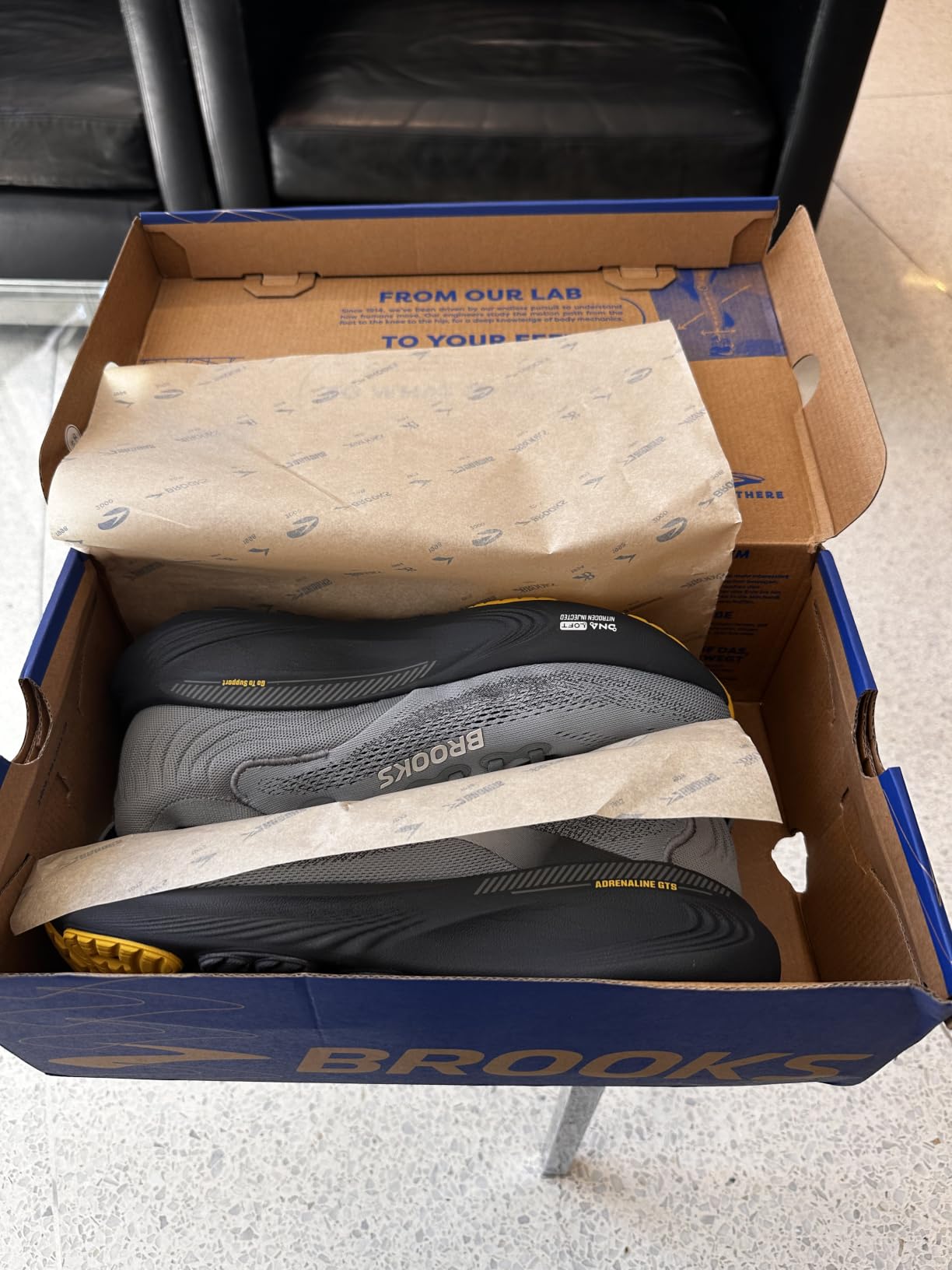
Two credentials worth knowing. It is a certified PDAC A5500 diabetic shoe and carries the APMA Seal of Acceptance, which are marks that the internal testing and construction met external standards. A shoe like that doubles as a walking shoe, which is a large part of why the owner reports for this model skew so positive.
There are three real caveats. It runs small, and several buyers went up half a size. Wide-width colour options are limited to plain black and white, which is annoying if you want something less obvious at a clinic or physio. And the inner heel can rub on runs beyond 10 km for some wearers, so if your shins are already tender, test it on a longer run before committing.
Who this suits
Runners whose shin pain is tied to how much their foot moves at contact, and anyone whose total daily load includes a lot of walking and standing. It also suits people with a history of plantar or knee symptoms, since owners report those easing alongside the shin.
Brooks is also the natural fit if you already like the brand’s fit. If you have worn Brooks and know a size, this is an easy, familiar choice, which matters when you are dealing with pain and do not want a new variable.
Who should skip it
Skip it if you need a fashionable wide width. The wide options exist but the colours are limited to black and white, and that is a dealbreaker for some buyers.
Skip it if long runs are the point and you rub easily at the heel collar. Under 10 km it is well regarded; beyond that, the inner heel can become the problem you were trying to avoid.
10. Brooks Glycerin 22 – Best for High Arches and Medial Shin Symptoms
Brooks Men’s Glycerin 22 Neutral Running Shoe – Orange/Nightlife/White – 11 Medium
DNA Tuned dual-size cell midsole
Maximum cushioning
Broad stable platform
APMA Seal of Acceptance
Pros
- A supinator with high arches reports this cleared recurring MTSS within a week
- Plush heel landings with a responsive toe-off
- Broad platform feels stable at double-digit mileage
- Double jacquard knit upper is breathable
Cons
- Toe box is snug and narrow for some wearers
- Not the strongest choice for pure distance running
The Glycerin 22 carries the second-highest rating in the group at 4.6, with eighty-one percent of ratings at five stars. More interesting than the score is the specific owner report: a verified buyer with high arches who supinates says the shoe cleared recurring medial tibial stress syndrome and calf pain within a week.
That makes this the counterpart to the Kayano. If your foot rolls inward, you want guidance. If it rolls outward, you want a platform wide and soft enough to let the foot sit down and absorb, which is exactly what the broad, stable platform here is for.
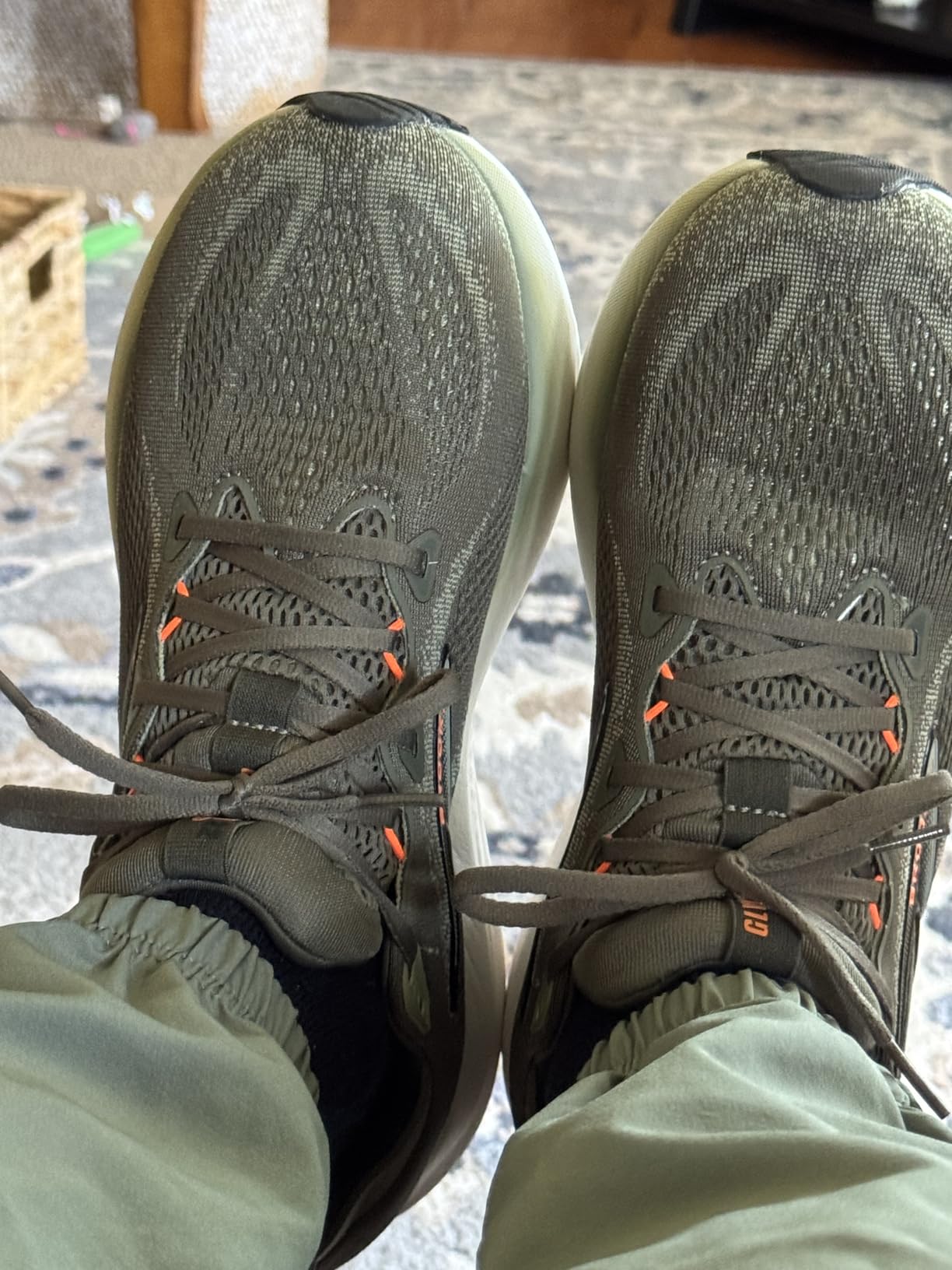
The DNA Tuned midsole blends dual-size cells, with larger cells in the heel for soft landings and smaller cells in the forefoot for a responsive toe-off. That split is the technical reason it suits shin symptoms: maximum cushioning where impact peaks, energy return where you push off.
The double jacquard knit upper is engineered to be flexible and accommodating and it holds its shape over distance, and the padded heel collar keeps the foot locked in without rubbing, which is worth noting in a list full of heel-rub complaints. It is also a certified PDAC A5500 diabetic shoe with the APMA Seal of Acceptance.
Who this suits
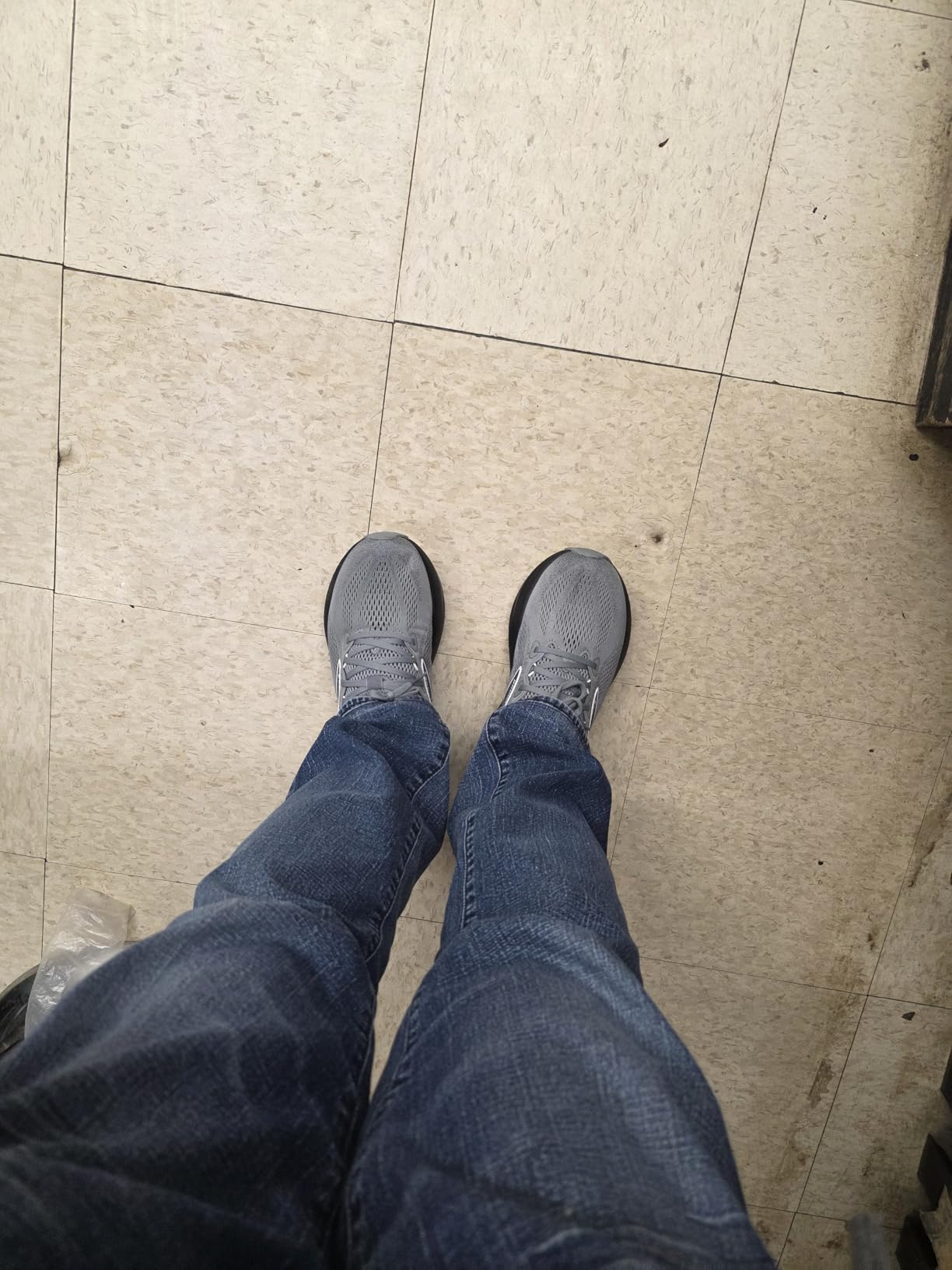
High-arched supinators, runners with high arches who get medial shin pain, and anyone whose shins hurt on long pavement runs. If you also have mild plantar pain, the generous heel cushioning tends to help that too.
It is a genuine daily trainer for double-digit mileage, not a speed shoe, and buyers describe the outsole grip as durable. If you want one shoe to do most of your week, this is a strong candidate.
Who should skip it
Skip it if you are a toe-first striker chasing race pace. It is built for maximum cushioning and daily miles, and lighter trainers will feel far livelier at faster paces.
Skip it if you have a wide foot or a roomy toe box requirement. The snug toe box is the most common fit complaint, and some buyers needed a size up. If width is the issue, the Ghost Max 3 or the 860 v14 are the better answers.
11. Brooks Ghost Max 3 – Best for Wide Feet and Pressure Relief
Brooks Women’s Ghost Max 3 Neutral Running & Walking Shoe – Black/Black/Ebony – 9.5 Medium
High-stack DNA Loft v3 cushioning
Wide base with raised sidewalls
GlideRoll Rocker geometry
Linear last construction
Pros
- High-stack cushioning reduces underfoot pressure
- Wide base and raised sidewalls give a very stable ride
- Roomy toe box suits bunion-prone and XX Wide feet
- Works for running and long walking days
Cons
- Runs small so several buyers needed to size up
- Cushioning is softer and less supportive than some max-cushion rivals
- XX Wide colour selection is limited
The Ghost Max 3 is the pressure-relief specialist in this list. Brooks describes a high stack of nitrogen-infused DNA Loft v3 cushioning that reduces underfoot pressure and lowers injury risk, and the buyers we saw repeatedly mention the wide base and the roomy toe box as the reason their feet stop complaining.
Sixty-nine percent of its ratings are five stars, which is the lowest share in this group, and the reason is mostly fit rather than ride. Several buyers needed to size up, and a minority found the cushioning softer and less supportive than rival max-cushion shoes. Our read is that the shoe is doing exactly what it is designed to do, and the rating is being docked for expectations.
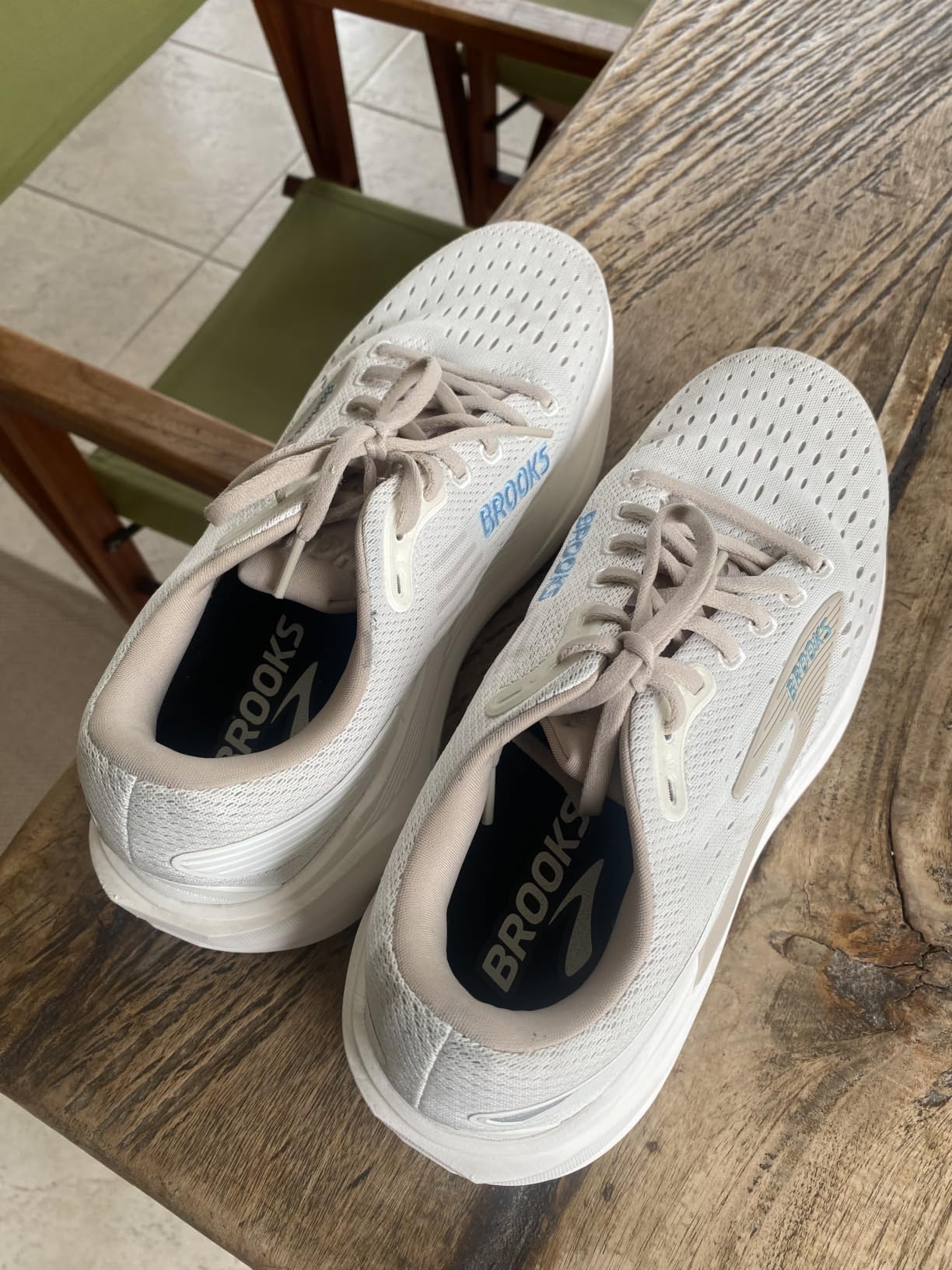
The geometry is worth understanding. Raised sidewalls add bending stiffness, the wide base provides built-in stability, and the linear last construction adds volume to suit a range of foot shapes and to accommodate orthotics. If you use insoles, that last construction is a real practical advantage over shoes built on a standard last.
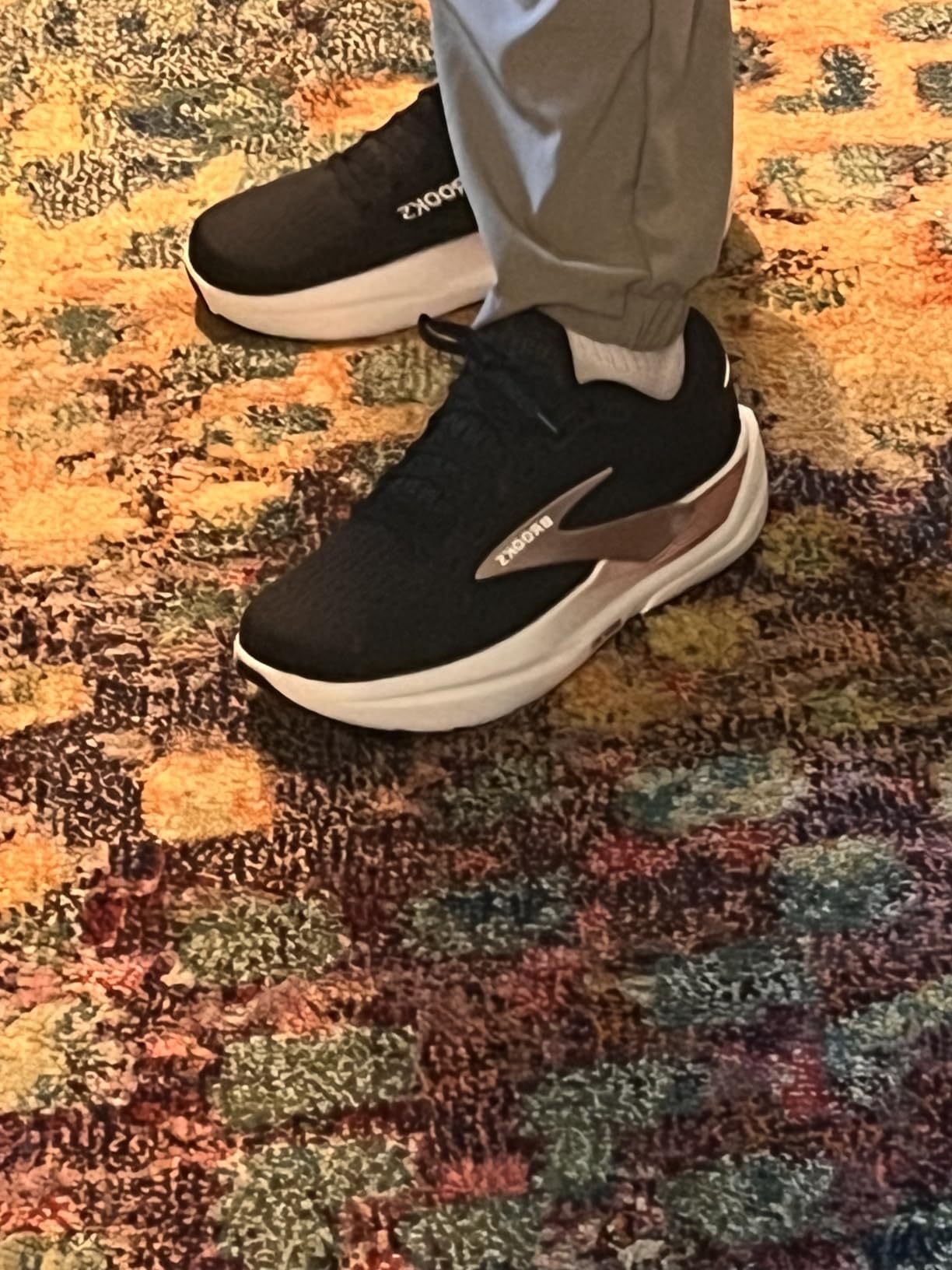
The low offset and GlideRoll Rocker work together to smooth the heel-to-toe transition, so the ankle has less braking to absorb. Like the Skechers Endeavour, this is why the Ghost Max 3 is a strong option when the pain is at the front of the shin. It is also a certified PDAC A5500 diabetic shoe, carbon neutral certified, and carries the APMA Seal of Acceptance.
Who this suits
Wide-footed runners, bunion-prone feet, and anyone who uses orthotics. It is the easiest shoe here to fit if you have spent years squeezing into narrow trainers, and XX Wide is the version to look at first.
It also suits runners whose total load is mostly walking. Long walking days on hard floors are exactly the use case a high-stack, wide-base, rocker-loaded design serves best, and buyers confirm it works for both running and walking.
Who should skip it
Skip it if you need a very supportive, firm platform. The foam is tuned for pressure relief and softness, so if your foot needs active guidance rather than passive comfort, the Adrenaline GTS 25 is a better match.
Skip it if you are impatient about sizing. It runs small, and the XX Wide colour selection is limited to two options, so the specific width and colour you want may not line up.
12. New Balance Fresh Foam X 860 v14 – Best for Overpronation With the Widest Fit Range
New Balance Men’s Fresh Foam X 860 V14 Running Shoe, Slate Grey/Dream State/Ginger Lemon, 10 M
Fresh Foam X midsole
Built-in durable medial support
Narrow through X-Wide fits
Durable rubber outsole
Pros
- Fresh Foam X gives a heavily cushioned ride
- Built-in medial stability suits overpronators and eases knee and hip pain
- Available from narrow to X-Wide
- Good heel cushioning for plantar fasciitis discomfort
Cons
- Can feel roomy or over-cushioned coming from a lighter trainer
- Toe box can pinch the pinky toe in wider sizes
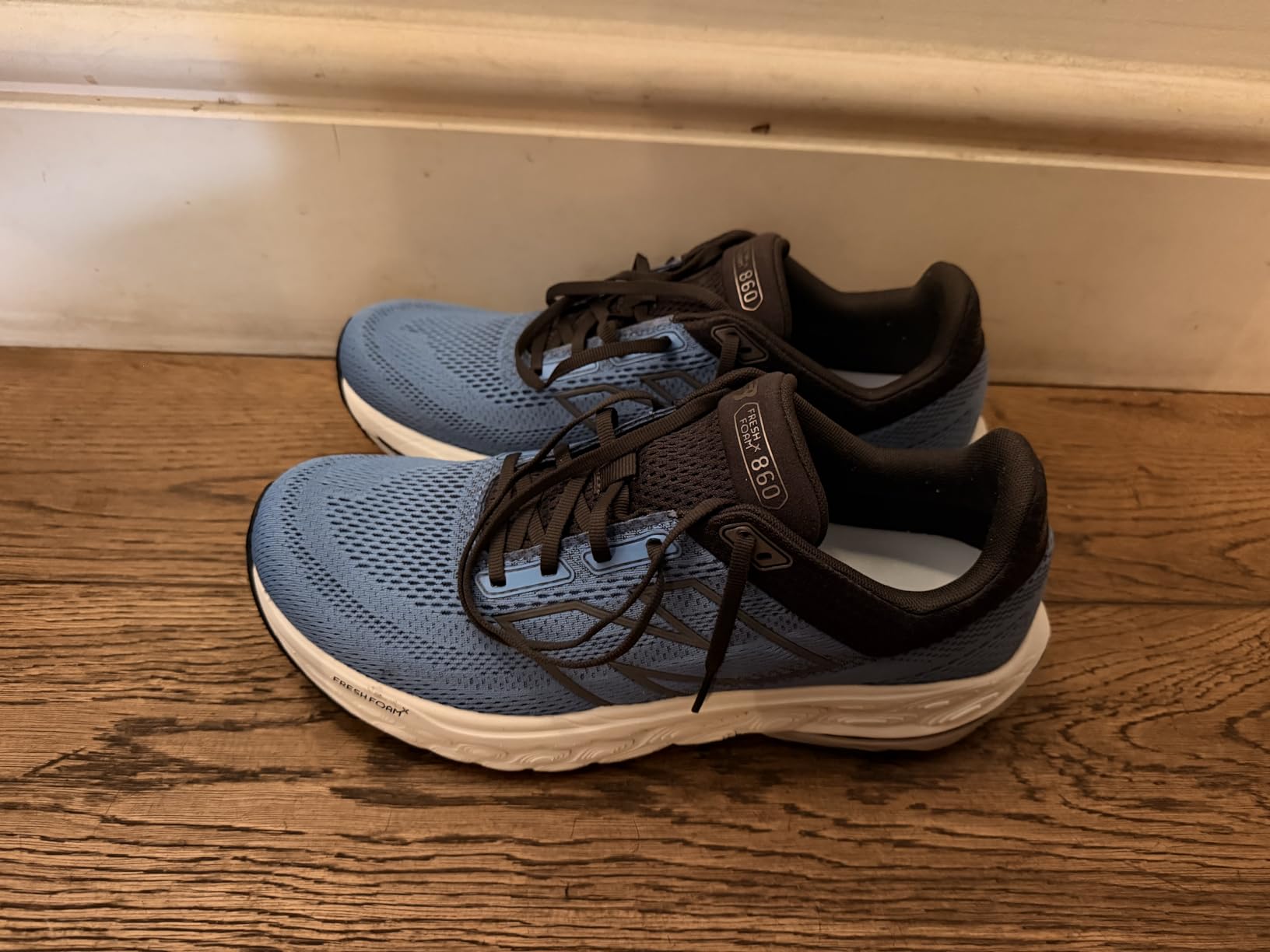
The 860 v14 is the fit-first recommendation. It comes in narrow, standard, wide and X-Wide, and no other shoe on this list offers that range. If you have spent years negotiating with a brand that only makes one width, that alone can be the reason your feet stop hurting.
Seventy-six percent of its ratings are five stars, and the recurring theme is the combination of real stability and plush cushioning. The built-in durable medial support is aimed squarely at overpronators, and reviewers report it easing knee and hip pain as well as the foot, which is a common pattern in runners whose whole lower body is rotating inward.
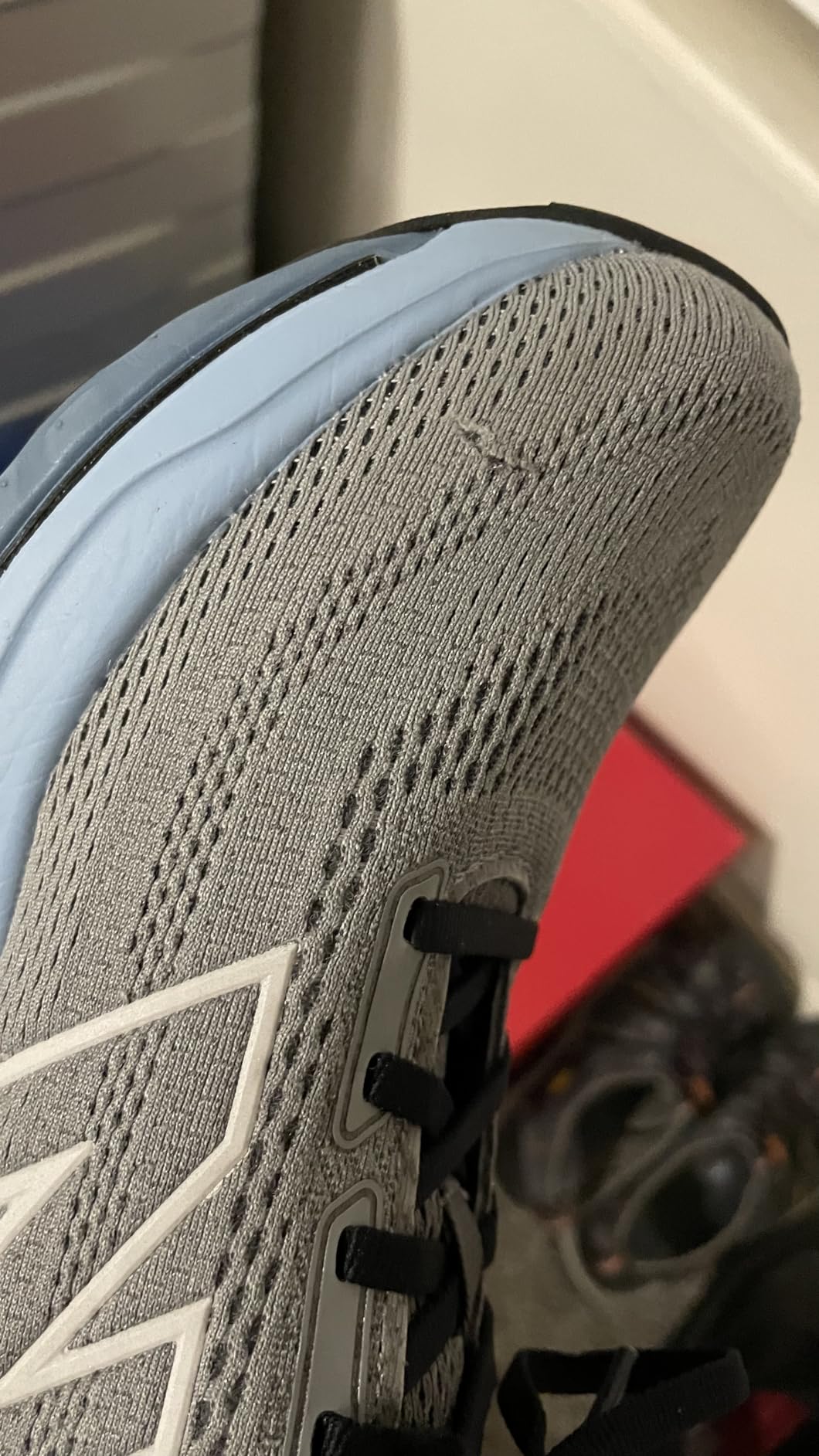
The Fresh Foam X midsole is New Balance’s heavily cushioned foam, and the heel cushioning specifically gets praise from people with plantar fasciitis and heel spur discomfort. If your shin pain and your plantar pain arrived together, this is one shoe that covers both without you needing a second purchase.
Two honest warnings. Coming from a lighter trainer, reviewers describe it as roomy or over-cushioned, so there is a real adjustment period before the platform feels right. And in the wider sizes, some buyers report the toe box pinching the pinky toe, which is the one place the fit range fails to deliver.
Who this suits
Overpronators who also need a specific width, and runners with shin symptoms alongside plantar fasciitis or heel discomfort. If you are unsure whether you overpronate but know your feet are achy and your knees take a battering, the durable medial support here is a reasonable default.
It is also the safest buy in this roundup for fit uncertainty, because you can go up or down a width without changing models. That is worth more than a marginal foam preference when your foot is the problem.
Who should skip it
Skip it if you like a grounded, responsive feel. This is a heavily cushioned build, and runners coming from a lighter trainer often find the first few runs floaty rather than plush.
Skip it if you are in a wide size with a high instep and sensitive fifth toe. Check the wider sizes carefully, because the toe box pinch is the most specific complaint in the reviews.
Shoes Are Not the Whole Fix
Here is the part most roundups on this topic skip. The most endorsed sentence across every runner forum we looked at is that no shoe fixes shin splints, and the reasoning is straightforward once you understand the mechanism. MTSS is a load problem before it is a footwear problem. The bone and the periosteum around it were asked to adapt to a training load that arrived faster than the tissue could remodel.
A shoe changes three variables: how much of the ground reaction force reaches the tibia, how much the foot and ankle roll and twist on landing, and how much extra mass your lower leg has to swing. It does not change your cadence, your training history, your calf strength or your recovery.
Cap your weekly mileage growth at about 10 percent. This is the single most repeated number in coaching circles and it is the first thing to fix. If your shin started hurting the week you doubled your distance, going back to the previous volume for two weeks costs you almost nothing and resolves a surprising number of cases.
Do calf raises, heel walks and slow heel drops. Every thread we read contained some version of this advice, usually paired with a specific shoe. Slow eccentric heel drops load the tibialis posterior and the soleus, which is the muscle group absorbing the landing. Two sets of fifteen, three times a week, is the version most physios hand out.
Strengthen above the knee. Hip weakness pushes the femur out of alignment, which cascades into extra rotation at the knee and ankle and more load on the shin. Trail runners with flat feet in our research reported relief from relaxing the shin and driving from the hip flexors, which is a form fix rather than a gear fix.
Change drops gradually. This is the quiet trap. A runner with medial pain moves from a 10mm shoe to a 4mm trainer for variety, and two weeks later the shin is worse. Treat drop as a training variable, not a purchase decision, and give any change three to four weeks.
Cross-train while it settles. Swimming, cycling and elliptical work keep your cardiovascular fitness without repeating the impact. It is the practical way to hold your fitness through a two-week cutback instead of going from 30 miles a week to zero.
Fit Notes for Wide Feet, Women Runners and Heavier Runners
If you have wide feet, buy the width, not the size. The commonest forum question on this topic is whether to size up, and the answer is usually that sizing up lengthens the shoe without widening the platform. On this list, the 860 v14 offers the full narrow-to-X-Wide range and the Ghost Max 3 comes in XX Wide with a roomy toe box, while the Skechers Endeavour and the Nike Revolution 8 are medium or narrower.
Women’s-specific fit and prevalence. Women report shin splints at higher rates than men, and it is rarely a shoe shape problem on its own. Recurring shin pain in women is frequently linked to low energy availability, the condition known as RED-S, or Relative Energy Deficiency in Sport, where under-fuelling affects bone density. If your shin pain keeps coming back regardless of what you run in, ask your doctor about vitamin D, calcium and bone health screening. That is a real gap in the advice most of these roundups give you.
Heavier runners. Weight and shin pain correlate because ground reaction force scales with bodyweight. The practical adjustments are a genuinely thick midsole, a wide base, and a shoe with real stability rather than a light neutral trainer. The Adrenaline GTS 25, the Gel-Kayano 32 and the 860 v14 are the three most defensible choices in that category here.
Walking and standing. If your tibial load comes from a job on your feet rather than from running, buy a walking-first shoe. The Skechers Endeavour and the Ghost Max 3 both work well, and the Adrenaline GTS 25 is explicitly built for runners and walkers. Our overpronation roundup covers the stability case in more depth if your foot rolls inward.
When Shin Pain Is Not Shin Splints
Shin splints are diffuse. That is the diagnostic clue. A dull, achy band two to three centimetres wide along the inner edge of the shin, which appears early in a run and settles with rest, is the typical presentation.
A tibial stress reaction or stress fracture feels different. The pain is more localised and more sharply defined, often over a specific point on the bone. It commonly gets worse as you warm up rather than better, it can wake you at night, and it persists into the days after a run. A tibial stress reaction is an earlier stage of the same bone-remodelling problem, and it is managed differently.
Other things get mistaken for shin splints. Chronic exertional compartment syndrome produces pain with tightness in the calf that resolves when you stop, along with numbness or tingling. Popliteal tendinopathy presents as pain behind the knee. Peroneal tendinopathy and nerve entrapment can both produce anterior shin pain. Plantar fasciitis can travel up into the calf and shin in some people.
Go and see someone, rather than buying another pair of shoes, if you have pinpoint bone pain, night pain, pain that worsens during the run, swelling, numbness, or no improvement after two weeks of reduced volume. The most common frustration in the forums is cycling through shoes while the underlying problem was never footwear. Our additional guides on trail shoes and long-distance cushioning cover the surface-mix and mileage cases.
How We Picked and What We Left Out
Every shoe here was filtered on measurements, not on brand reputation. The first pass required a cushioned midsole rather than a racing flat. The second pass required a stated drop or a clearly rockered geometry, because a shoe with neither gives you no lever. The third pass looked for guidance hardware if the model claimed stability, and for available width if the reviews repeatedly mentioned fit problems.
That is also why certain famous names are missing. Carbon-plated racers were excluded by design: they are built for speed, they are deliberately thin underfoot, and a bone that is already irritated does not benefit from a propulsion plate. Zero-drop and minimalist shoes were excluded for the same reason runners report pain after switching into them, which is a recurring pattern in the forum data. A flat drop of 0 to 4mm puts the ankle in a position that maximises tibial loading, which is the opposite of what most symptomatic runners need.
We also left out trail shoes. Rocker geometry and wide bases help on uneven ground, but trail outsoles and lugs change the loading pattern in ways that need their own testing, and mixing them into a shin-splint list without that context is how roundups end up contradicting themselves.
Our biggest limitation is the honest one: review data describes how shoes behave in general, not how they will behave on your particular tibial bone and training history. If your shin pain has lasted through two pairs already, the most likely explanation is a load or strength problem rather than a footwear gap.
Frequently Asked Questions
Do running shoes affect shin splints?
They affect the load, not the cause. Cushioning reduces the ground reaction force reaching the tibia at each strike, and a wide planted base with stability hardware limits how much the foot and ankle roll. But shin splints start when training load outpaces what bone and calf can adapt to, so a shoe helps at the margins while load management and calf and hip strength work do the real recovery.
Can you fix shin splints by running?
No. Running through shin splints does not fix them and can push a tibial stress reaction into a stress fracture. The approach runners use successfully is a graded return: cut weekly volume first, cross-train on low-impact work, rebuild slowly, and reintroduce running in small blocks. If pain persists beyond two weeks at reduced volume, see a sports physiotherapist or podiatrist rather than trying to run it out.
Do shin splints mean weak calves?
Not necessarily, but calf and lower-leg strength is usually part of the answer. Shin splints are primarily a bone-stress overload, and the tibialis posterior, soleus and calf absorb landing forces repeatedly. Slow eccentric heel drops, heel walks and calf raises two or three times a week are the standard strengthening work, alongside hip strengthening so the femur stops driving rotation down the chain.
What gets mistaken for shin splints?
A tibial stress reaction or stress fracture is the most common and most important misdiagnosis, and it presents as more localised, pinpoint pain that worsens as you warm up, may wake you at night and persists between runs. Chronic exertional compartment syndrome, popliteal tendinopathy, peroneal tendinopathy and nerve entrapment can all produce shin-area pain too. Diffuse aching along the inner edge that eases with rest is the pattern that actually fits shin splints.
What heel drop is best for shin splints?
Between 8mm and 12mm is the range most load-management advice favours, because a higher drop lets the ankle land at a shallower angle and takes load off the tibialis posterior and the calf. The critical part is the transition: moving from a 10mm shoe to a 4mm trainer over a few weeks is itself a common trigger, so change drop gradually over three to four weeks and never in the middle of a flare-up.
What vitamin deficiency causes shin splints?
There is no single vitamin that directly causes shin splints, but low energy availability and poor bone health are strongly associated with recurrent tibial stress injury. Vitamin D and calcium status matter for bone remodeling, and runners with recurring shin pain, particularly women, are often advised to have both checked along with bone density. Persistent pain that returns no matter what shoe you run in deserves that screening rather than another purchase.
Bottom Line on the Best Running Shoes for Shin Splints in 2026
The best running shoes for shin splints share four measurable traits: a heel stack around 35mm or more, a wide planted base, a heel-to-toe drop in the 8 to 12mm range, and a daily-trainer build rather than a racing flat. Our Editor’s Choice, the New Balance Fresh Foam Arishi V4, gets there at 9.5 oz with a 6mm drop, which makes it the strongest option for midfoot and forefoot strikers and for anyone who wants protection without weight. Heel strikers with medial pain should start higher on drop with the New Balance 520 v9 at 10mm or the Brooks Glycerin 22, and overpronators should go to the Brooks Adrenaline GTS 25, the ASICS Gel-Kayano 32 or the New Balance 860 v14.
What no shoe on this list will do is fix a training load that climbed too fast. Cap weekly growth near 10 percent, do your heel drops and calf raises, and treat any drop change as a four-week project. That is the part that works, and it is free.