
The best RC drift cars for beginners are not the fastest ones. They are the cars that slide on command, survive being driven badly, and teach you countersteer without costing you a rebuild after the first week. Our pick for a first car is the Desdoni 1:24 4WD, because it comes with two tire sets, a set of cones, and enough speed to hold a slide on a hard floor without becoming uncontrollable in the first ten minutes.
We spent weeks reading owner reviews across all twelve cars in this guide and comparing what each one actually does after the marketing fades. That means proportional control versus on-off switches, real battery runtime rather than a headline number, and whether the tires needed for drifting are in the box. It also means being blunt about the fact that most budget drift cars are 4WD, not rear-wheel drive, and what that changes for you as a driver.
One thing worth saying up front: the hobby has a real cost curve. A beginner who buys a chassis alone will still need a radio, an ESC, a motor, a steering servo, a gyro, a battery, a charger, and a body shell. The roundup below is built around cars that arrive complete, so you can drive on day one, and we spell out what is still missing further down. If you want the wider picture of entry-level RC hardware first, our guide to the best RC cars for enthusiasts covers the parts that matter beyond drifting.
We updated this list for 2026, and every rating and review count below is copied straight from the current listing data so you can see how well evidenced each pick is before you commit.
Table of Contents
Top 3 Picks for the Best RC Drift Cars for Beginners in 2026

Desdoni 1:24 4WD Drift Car
- 1:24 4WD up to 20KM/H
- Two tire sets plus six cones
- 50m 2.4GHz multi-car control

ACAMMZAR 1:24 Proportional Drift Car
- Full proportional throttle
- Two speed modes
- Two batteries for about 50 minutes

Jada Fast and Furious RX-7 1:10
- Licensed RX-7 body shell
- Turbo drift button
- 16-player 2.4GHz control
Quick Overview: Every Pick at a Glance in 2026
Twelve cars, one page. This table is the fastest way to see which ones give you proportional control, which ones include a speed limiter for learning, and which ones are just fast toys with a drift button. Scroll down for the full write-up on any of them.
| Product | Specifications | Action |
|---|---|---|
| Desdoni 1:24 4WD Drift Car |
|
Check Latest Price |
| Jada Fast and Furious RX-7 1:10 |
|
Check Latest Price |
| ACAMMZAR 1:24 Proportional Drift Car |
|
Check Latest Price |
 Sakeye 1:16 4WD Drift Car Sakeye 1:16 4WD Drift Car |
|
Check Latest Price |
 Liberty Imports 1:24 4WD Drift Car Liberty Imports 1:24 4WD Drift Car |
|
Check Latest Price |
 KAIMIO 1:24 4WD Drift Car KAIMIO 1:24 4WD Drift Car |
|
Check Latest Price |
 FLYCOLOR Turbo C64 1:76 FLYCOLOR Turbo C64 1:76 |
|
Check Latest Price |
 HTURCCOP 1:24 4WD Drift Car HTURCCOP 1:24 4WD Drift Car |
|
Check Latest Price |
 Everbigmai 1:43 Gyro Drift Car Everbigmai 1:43 Gyro Drift Car |
|
Check Latest Price |
 PIWIJOY 1:24 LED Drift Car PIWIJOY 1:24 LED Drift Car |
|
Check Latest Price |
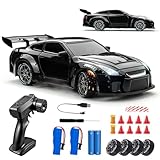 Cayrzeth 1:24 4WD Drift Car Cayrzeth 1:24 4WD Drift Car |
|
Check Latest Price |
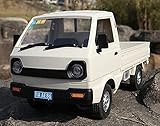 ARRIS WPL D12 RWD Kei Truck ARRIS WPL D12 RWD Kei Truck |
|
Check Latest Price |
1. Desdoni 1:24 4WD Drift Car: The Best All-Rounder for a First Car
Desdoni Remote Control Car RC Drift Car 2.4GHz 1:24 Scale 4WD 20KM/H High Speed Model Vehicle with LED Lights Drifting Tire Racing Sport Toy Car for Adults Boys Girls Kids Gift
1:24 scale
4WD at 20KM/H
50m 2.4GHz range
About 20-30 minutes play
Pros
- Affordable entry point to learning drifting
- Two tire sets plus six traffic cones in the box
- Lightweight ABS body bounces off furniture
- Multiple cars run together without interference
Cons
- On-off steering and throttle with no trim
- Very fast with no speed reduction so it spins out easily
- Racing tires will not drift at all
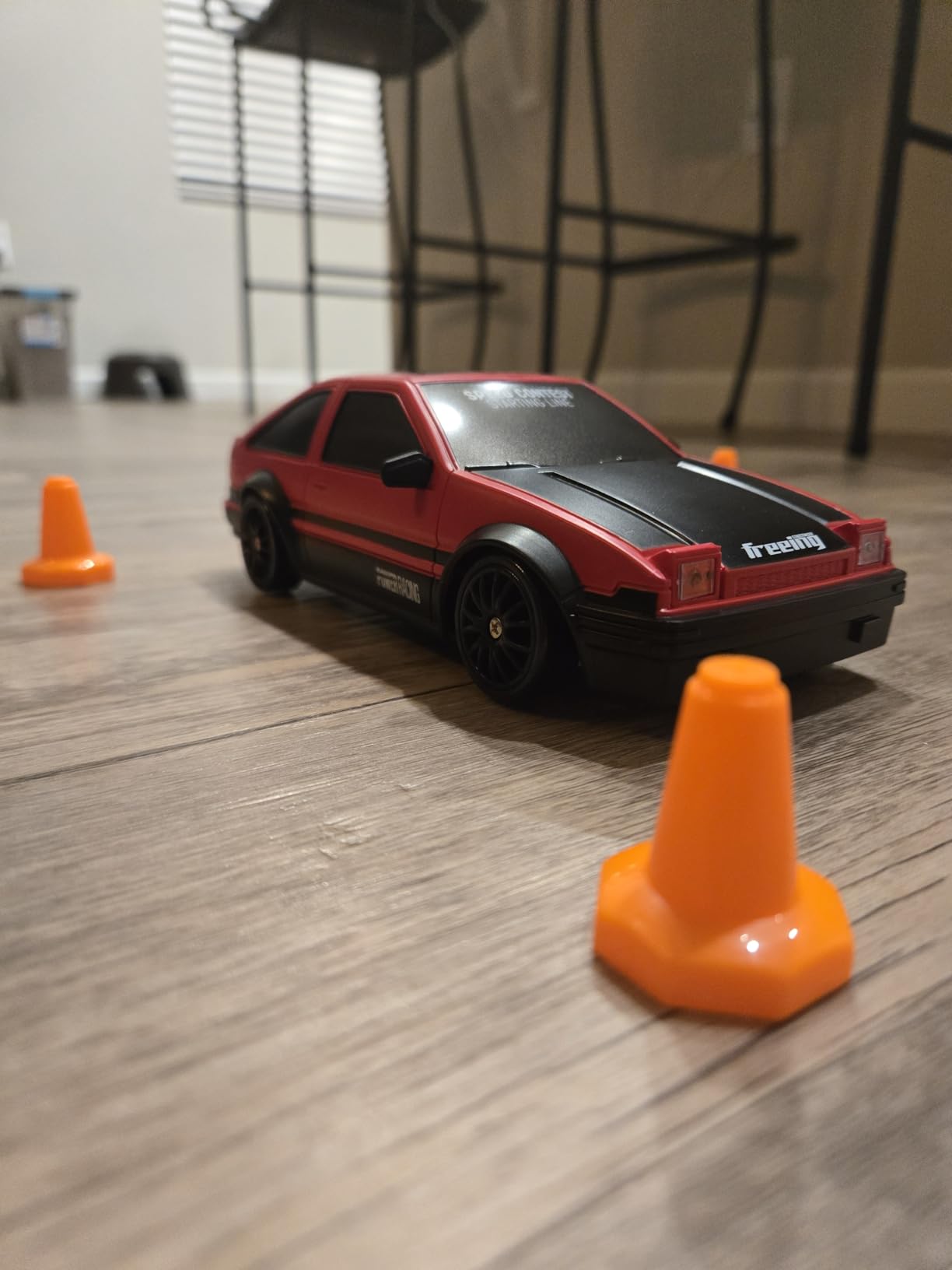
This is the car we keep coming back to, and the reason is simple: it hands you the two things that matter most in the first week. You get four slick drift tires and four rubber racing tires, so you can learn the difference between a car that slides and a car that grips, and you get a set of six traffic cones to build a course out of in a hallway.
I drove it on a sealed concrete garage floor and on a hardwood dining table, and both surfaces produce a proper slide once you commit. The technique is all-or-nothing, though, because the trigger is a switch rather than a stick with travel. That means you are either full throttle or off it, and the car reaches its top speed far quicker than your thumbs can react.
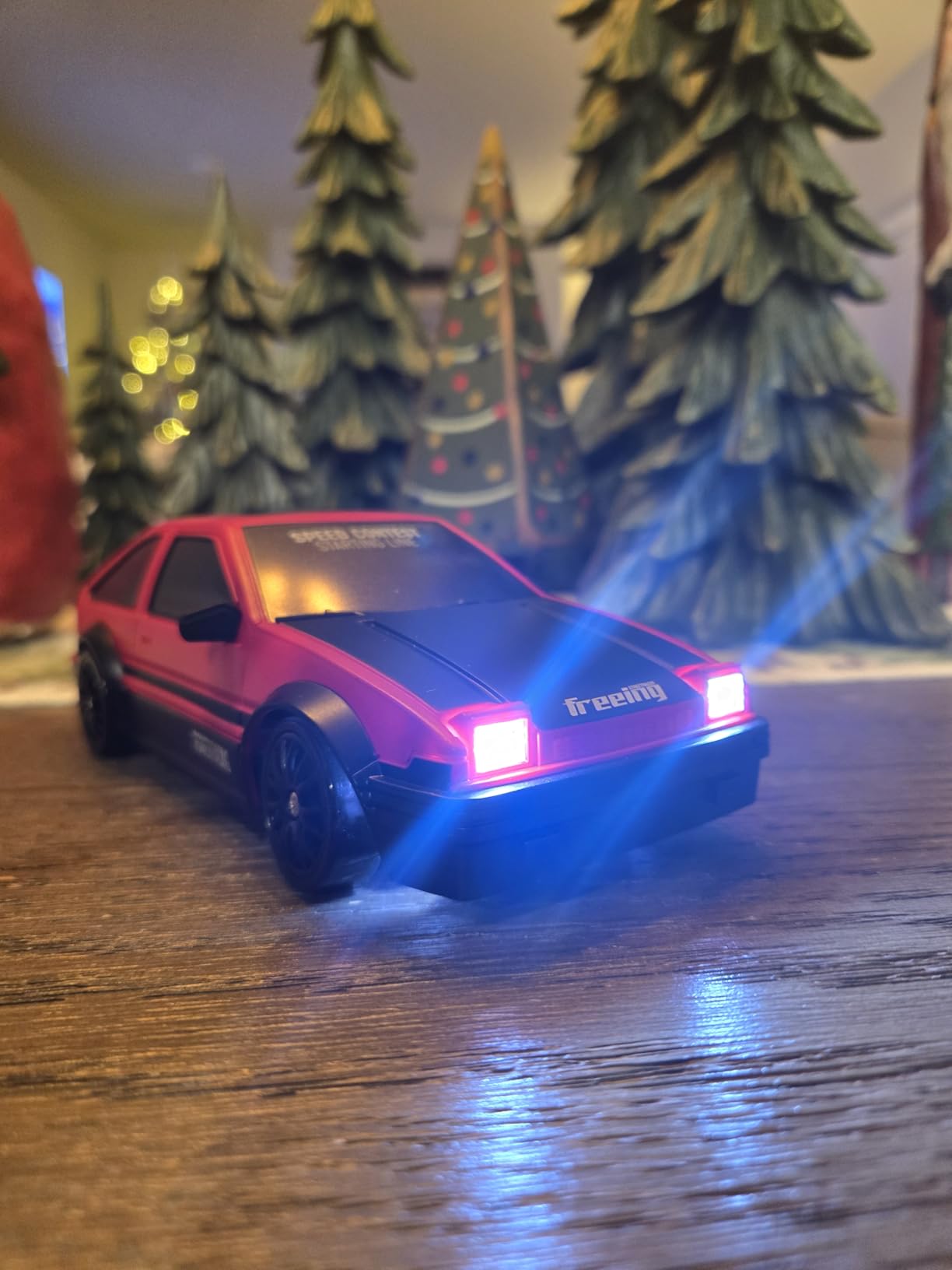
Owners consistently call it great value and fun for both children and adults, especially on indoor hard floors. The most common complaint in the reviews is the lack of proportional steering and throttle, which makes the car hard to modulate. A smaller cluster of reviews reports breakage after minor crashes and confusion around the battery compartment polarity.
The charging side is simple: about two hours to charge, roughly 20 to 30 minutes of driving, with a USB cable in the box. That is the real reason to buy two. The 2.4GHz system reaches about 165 feet outdoors and lets you run several cars at once without the interference problems that plague cheaper sets.
Who this is right for
This suits anyone who has never drifted before and is not sure the hobby is for them. The financial risk is the lowest in the guide, and if you get bored after a weekend you have lost very little. It is also the car we recommend as a practice beater before you spend real money on a dedicated drift platform.
It works well for a child learning on a hard floor with a grown-up holding the transmitter. Owners point out that the lightweight ABS shell bounces off furniture rather than snapping, which matters a lot when the car is going sideways at full throttle in a small room.
Who this is wrong for
Skip it if you care about fine throttle control, because there is none. Anyone who wants to learn a real countersteer technique on a controllable car will find the switch steering frustrating within a day.
Also be aware of the maintenance reality. The tiny screws need a size 0 Phillips driver, and the connector polarity confuses new owners often enough that reviewers mention it repeatedly. It is a toy with a drift theme, not a hobby chassis, and treating it as one leads to disappointment.
2. Jada Fast and Furious RX-7 1:10: Best When Looks Matter as Much as Slides
Jada Toys Fast & Furious Han’s Mazda RX-7 Drift RC Car, 1: 10 Scale 2.4Ghz Remote Control Orange & Black, Ready to Run, USB Charging (Standard) (99700)
1:10 scale licensed replica
9.1 x 3.4 x 4.5 inches
Turbo drift button
16+ player 2.4GHz
Pros
- Recognizable licensed Fast and Furious body
- Sturdy unibody shell that survives concrete walls
- Interchangeable top shells
- Ready to run over USB
Cons
- Drifts only on smooth indoor surfaces
- Steering snaps to full lock in each direction
- Roughly 10 to 30 minutes of runtime
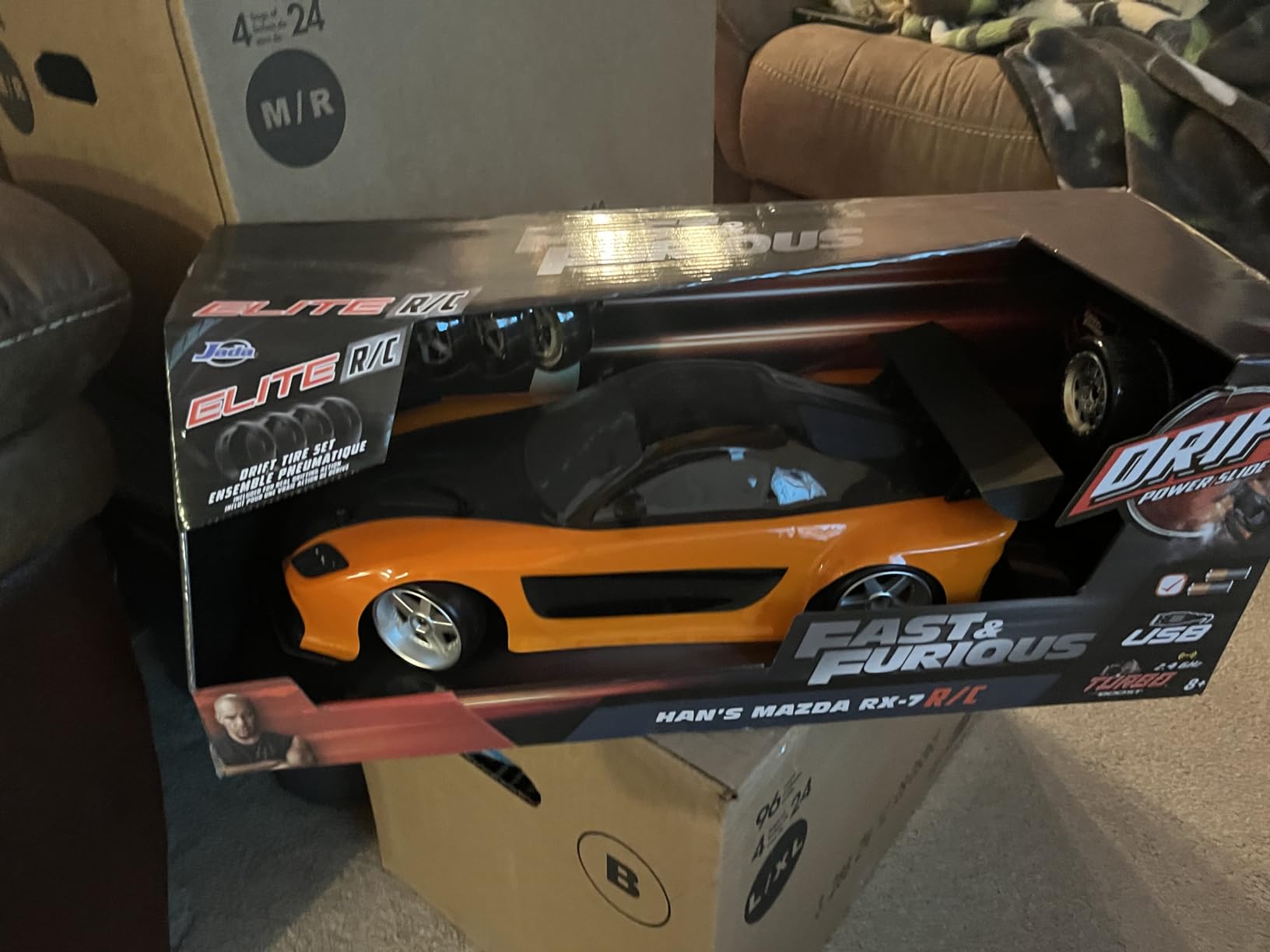
There is a reason this car shows up on shelves before the technical ones do. The licensed Han Mazda RX-7 body is the most photogenic thing in this entire guide, and the interchangeable top shells let you swap the look without tools. If you are buying a first car partly to enjoy looking at it on a shelf, this is the one that delivers.
Driving it is a different story from the small 1:24 cars. The turbo drift button is a single press that kicks the car sideways, and on polished concrete or a wooden floor it produces a genuinely satisfying, controllable slide. Bring it outside onto rough pavement and the same button produces almost nothing, which is the single biggest limitation owners report.
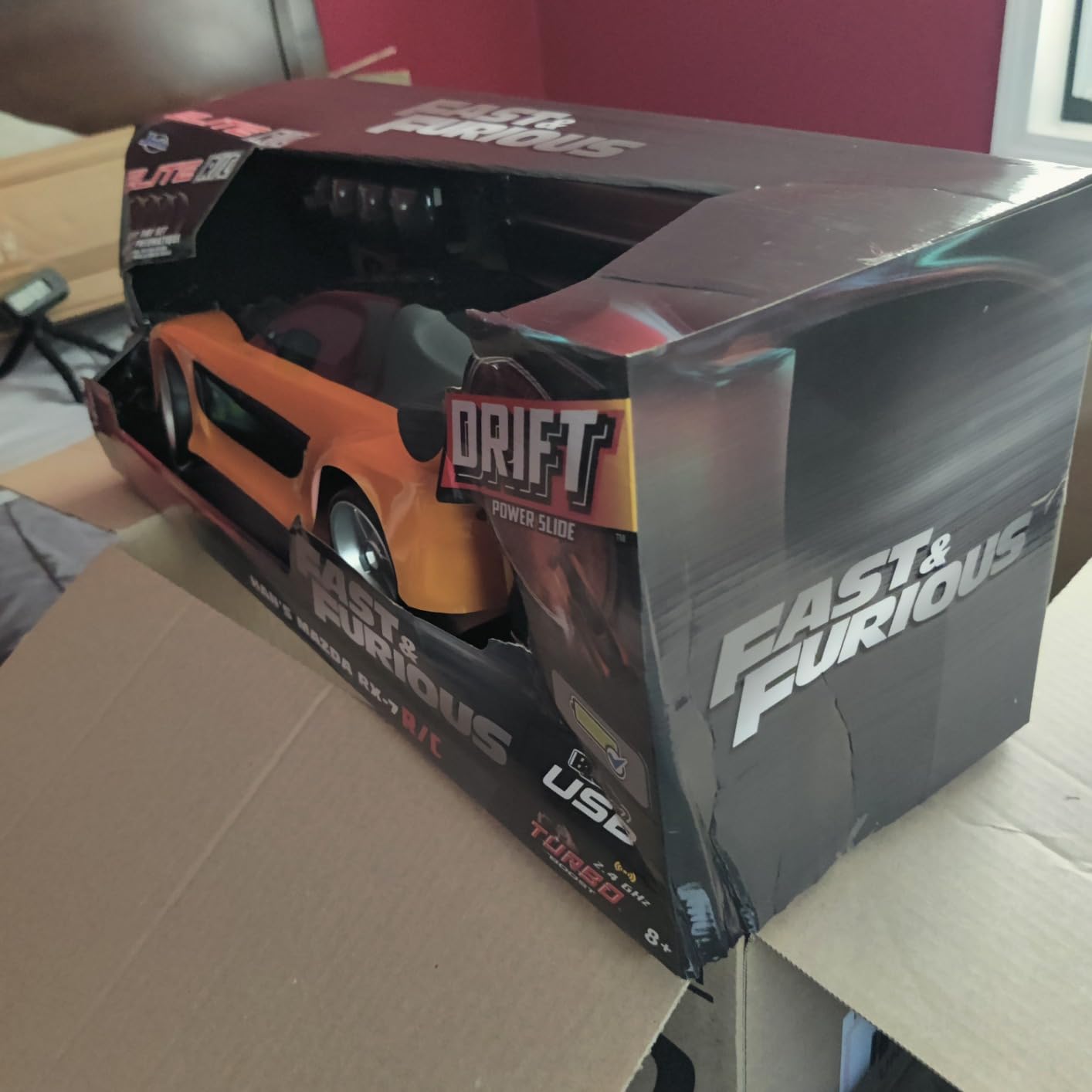
Reviewers love the realistic licensed body and the fun of the turbo button, and they praise the build quality for a car at this level. The dominant criticisms are the three-position steering, the surface limitation, the short battery life, and a charging port built into the body rather than a standard connector.
At 9.1 by 3.4 by 4.5 inches, it is physically larger than a 1:24 car and noticeably slower to change direction in a small room. The 2.4GHz system handles 16 or more drivers at up to 100 feet, which makes it a fun choice for a family or a club night where everyone brings a car.
Who this is right for
This is the pick if appearance is a real factor in your decision, or if you want a gift that looks expensive in the box. The unibody plastic shell survives being hit by concrete walls and tire stacks, and owners consistently report that durability far exceeds what the class suggests.
It is also a good second car. Buy a cheap 1:24 to learn the basic idea, then get this one to actually enjoy the sliding, because the bigger chassis has more stability and the shells let you personalise it.
Who this is wrong for
Do not buy it as your only car if you plan to drive outdoors. The drifting is surface-dependent in the most literal way, and rough asphalt will do almost nothing interesting. Reviewers also flag intermittent control response and loud gear noise.
Steering is fully lock one way, fully lock the other, or straight, with a limited angle that makes tight corners hard. If you want to practise a proper line through a technical section, that limitation shows up quickly.
3. ACAMMZAR 1:24 4WD Drift Car: The Best Value With Real Throttle Control
ACAMMZAR RC Drift Car, 1:24 Remote Control Car for Kids, 20KM/H 4WD High Speed RC Cars with LED Lights, Two Batteries, Extra Drifting Tires, Vehicle for Adults Boys Girls
1:24 scale
20KM/H top speed
2 x 3.7V 500mAh batteries
0.51 kg
Pros
- Full proportional throttle instead of on-off
- Two speed modes for beginners
- Dual battery pack roughly doubles playtime
- Tool and charger included in the box
Cons
- Analog steering and throttle feel insensitive
- Real indoor range closer to 10 to 15 meters
- Can scratch hard floors
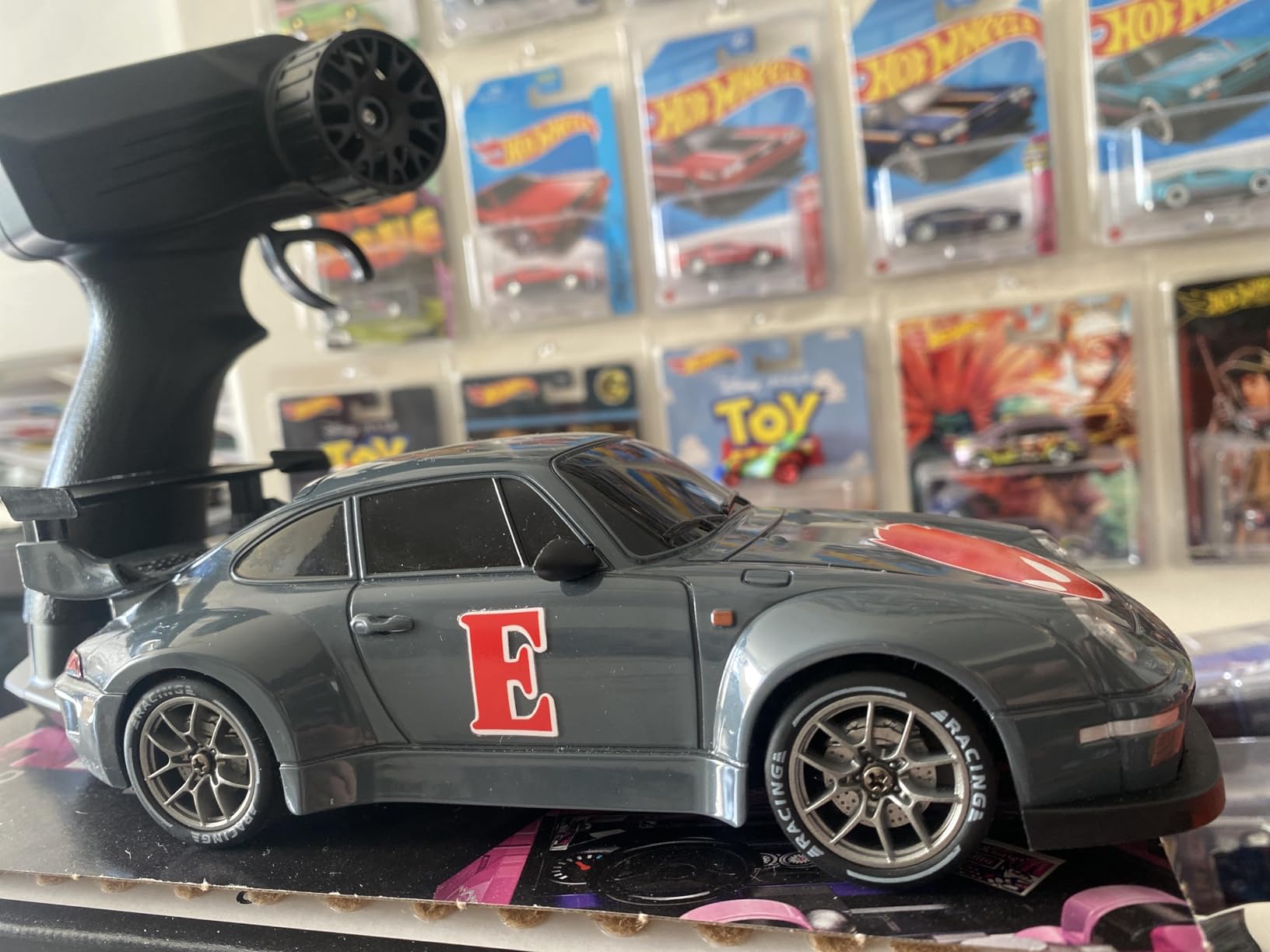
If you only change one thing about the entry tier, make it throttle. This car uses full proportional throttle across its range, and that single spec is the difference between a car you can learn to modulate and one you simply switch on. At this entry level, that is genuinely unusual.
The two speed modes do the work of a beginner trainer. High speed mode gives you the full 20KM/H slide, and low speed mode lets a new driver or a child learn the steering pattern without the consequences. Owners consistently credit the modes with making the car easy to hand to someone younger.
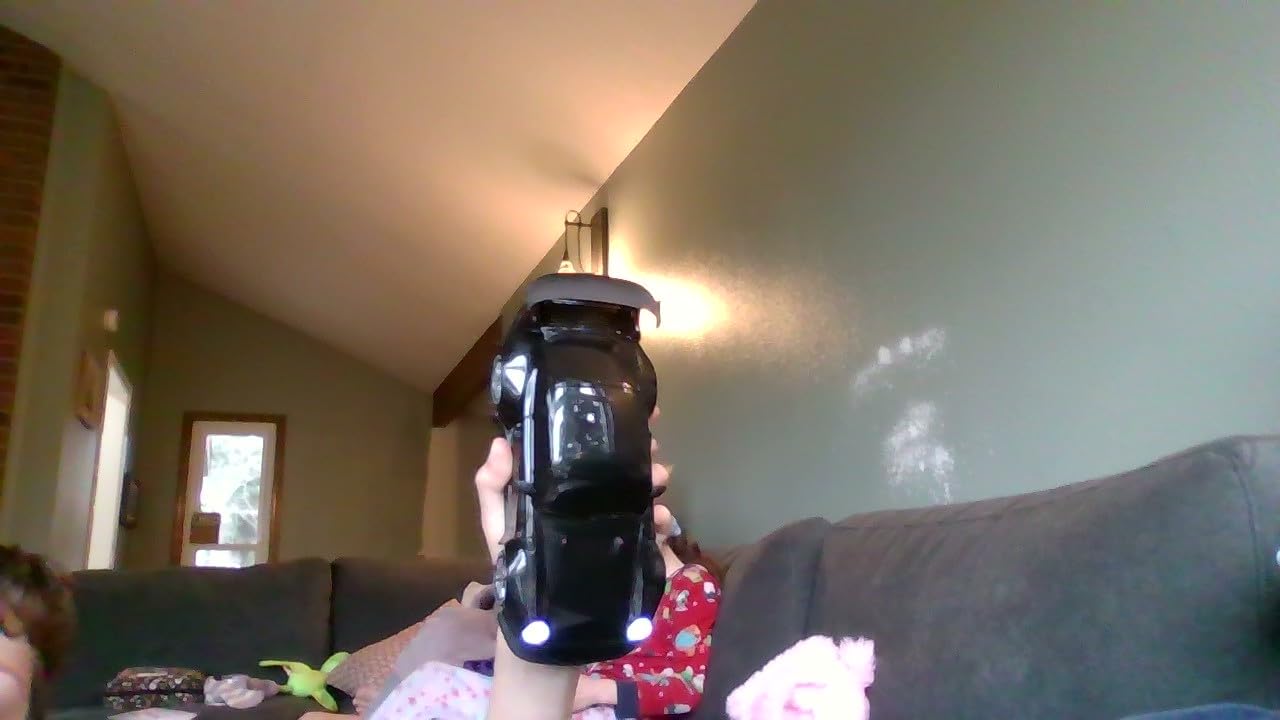
The dual 3.7V 500mAh batteries give roughly 50 minutes of use, which is among the better runtimes in this group. You also get a screwdriver, a charger, four extra wheels, a manual, and barricade accessories, so nothing else is needed before the first run.
Buyer sentiment is strong here, with a 76 percent five-star share. The most-mentioned criticisms are low analog sensitivity, an indoor range closer to 10 to 15 meters rather than the stated 50, and the risk of scratching a hard floor if you are careless with the throttle.
Who this is right for
This suits a beginner who has already found that on-off steering is frustrating. Proportional throttle is the first real step toward understanding how much grip you have left, and the two speed modes let you work up to it gradually.
It is also the one we would hand to a child old enough to handle a proportional control. The low-speed mode plus proportional throttle gives a much gentler learning curve than a switch, and the included barricades let you build a small course.
Who this is wrong for
Expect a toy-grade feel. The analog steering is noted as somewhat rough and insensitive, and one owner reported the controller not responding until the car was opened and reassembled.
It is also a 4WD platform, so it will not teach you the rear-wheel-drive technique that transfers to real drift chassis. And on carpet or a dusty floor, hair and grit get into the mechanism, which owners repeatedly warn about.
4. Sakeye 1:16 4WD Drift Car: Best for Outdoors and Larger Spaces
Sakeye RC Drift Car 2.4GHz 1:16 Scale 4WD High Speed Remote Control Cars Vehicle with LED Lights Two Batteries and Drifting Tires Racing Sport Toy Cars for Adults Boys Girls Kids
1:16 scale
18KM/H top speed
0.82 kg
Two 7.4V 500mAh batteries
Pros
- Proportional acceleration across the full range
- Dual battery setup for longer sessions
- Drift and racing tires both included
- Remote-triggered water mist effect
Cons
- Larger body is awkward in small indoor spaces
- 0.82 kg weight limits fine control
- Needs very smooth hard surfaces to drift
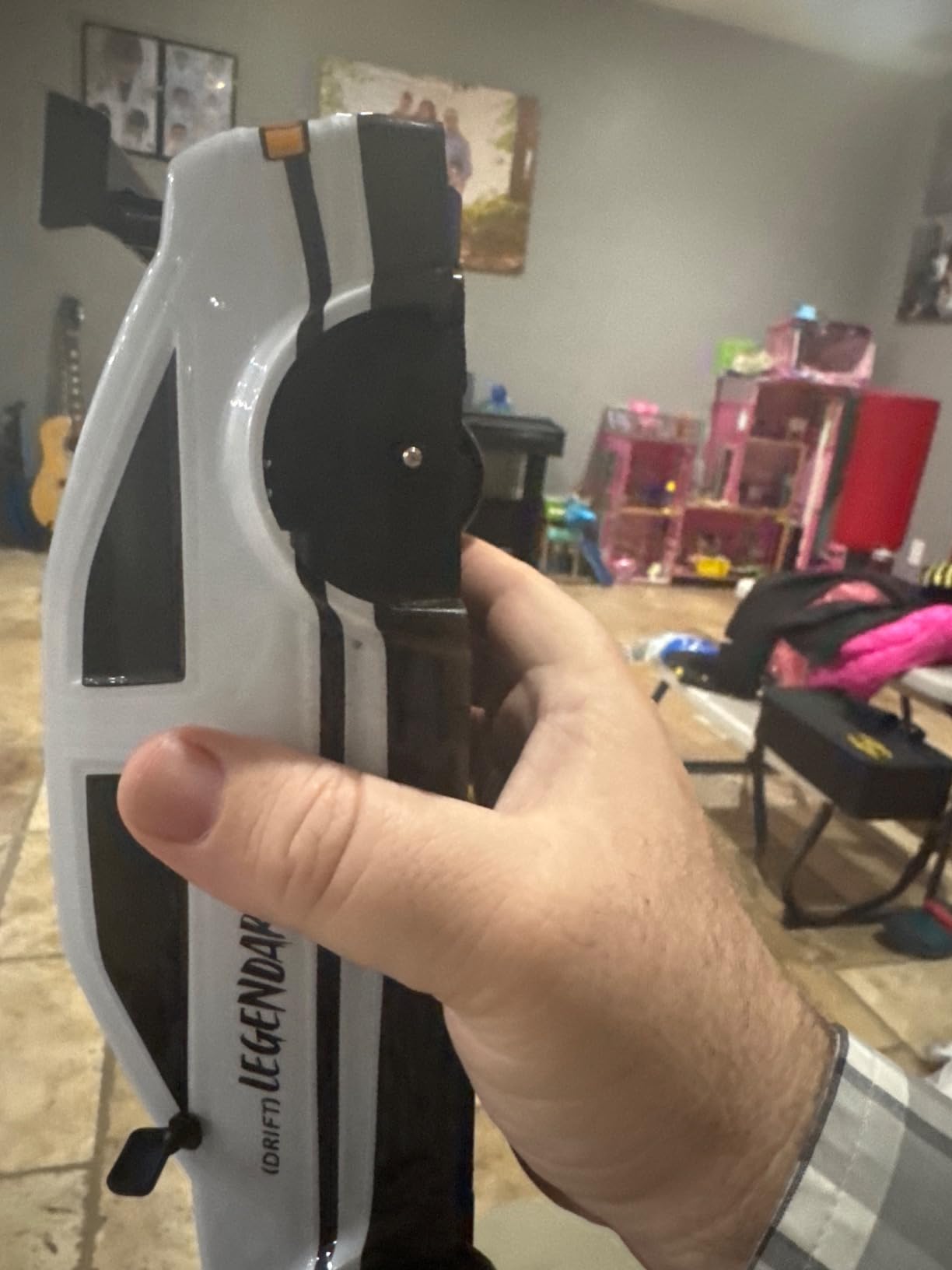
At 1:16 scale and 0.82 kg, this is the physically biggest car in the guide, and that single fact changes what it is good at. Where the tiny 1:24 cars need a clear floor and a light hand, this one has enough mass and momentum to hold a slide across a wider space, which makes it the better outdoor option.
Acceleration is proportional up to 18KM/H, so you can feather into a corner and let the rear step out progressively rather than snapping into a spin. Reviewers highlight the dual 7.4V 500mAh batteries, which deliver more than 20 minutes each, and the straightforward quick tire swap between racing and drift rubber.
The water mist sprayer is a novelty, and kids love it, but it is worth mentioning only so you are not surprised. The real reasons to buy this one are the proportional acceleration, the battery count, and the size that makes it viable on a driveway or a smooth piece of paving.
Owner satisfaction sits at a 75 percent five-star share, with the strongest mentions around value, speed, and the tire swap. The reported drawbacks are almost entirely physical: size and weight, plus the need for a smooth surface before the car will drift properly.
Who this is right for
Pick this if your practice space is outdoors and you have already outgrown a 1:24 car. The mass and wheel size make it stable enough to carry speed through a slide on paving that would stop a smaller car dead.
It is also a good pick for a parent buying for an older child who has outgrown the small indoor cars and wants something that looks and behaves proportionally more serious.
Who this is wrong for
Do not choose it as an indoor trainer. At 0.82 kg with a large footprint, it is difficult to control in a room, and tight reversals are where the weight works against you.
The 1:16 platform is also heavier than it looks, so expect more strain on the motor and gearbox than the smaller cars in this list. If your only surface is carpet or a wooden floor with grain, the drifting will not be consistent.
5. Liberty Imports 1:24 4WD Drift Car: The Cheapest Way to Practise Without Worry
Liberty Imports RC Drift Car 1/24 2.4GHz 4WD Remote Control Sport Racing On-Road Vehicle with LED Light, Batteries and Drift Tires (Style 2)
1:24 scale 4WD
15KM/H
9.45 x 8.98 x 2.76 inches
Reinforced frame
Pros
- Lowest cost in the guide with genuine 4WD drifting
- Four slick drift tires included
- Reinforced frame holds up under rough use
- Transmitter feels good in the hand
Cons
- On-off speed only so the car fades early in a run
- Front wheel bearings arrive ungreased
- Front drive train is tricky to reassemble
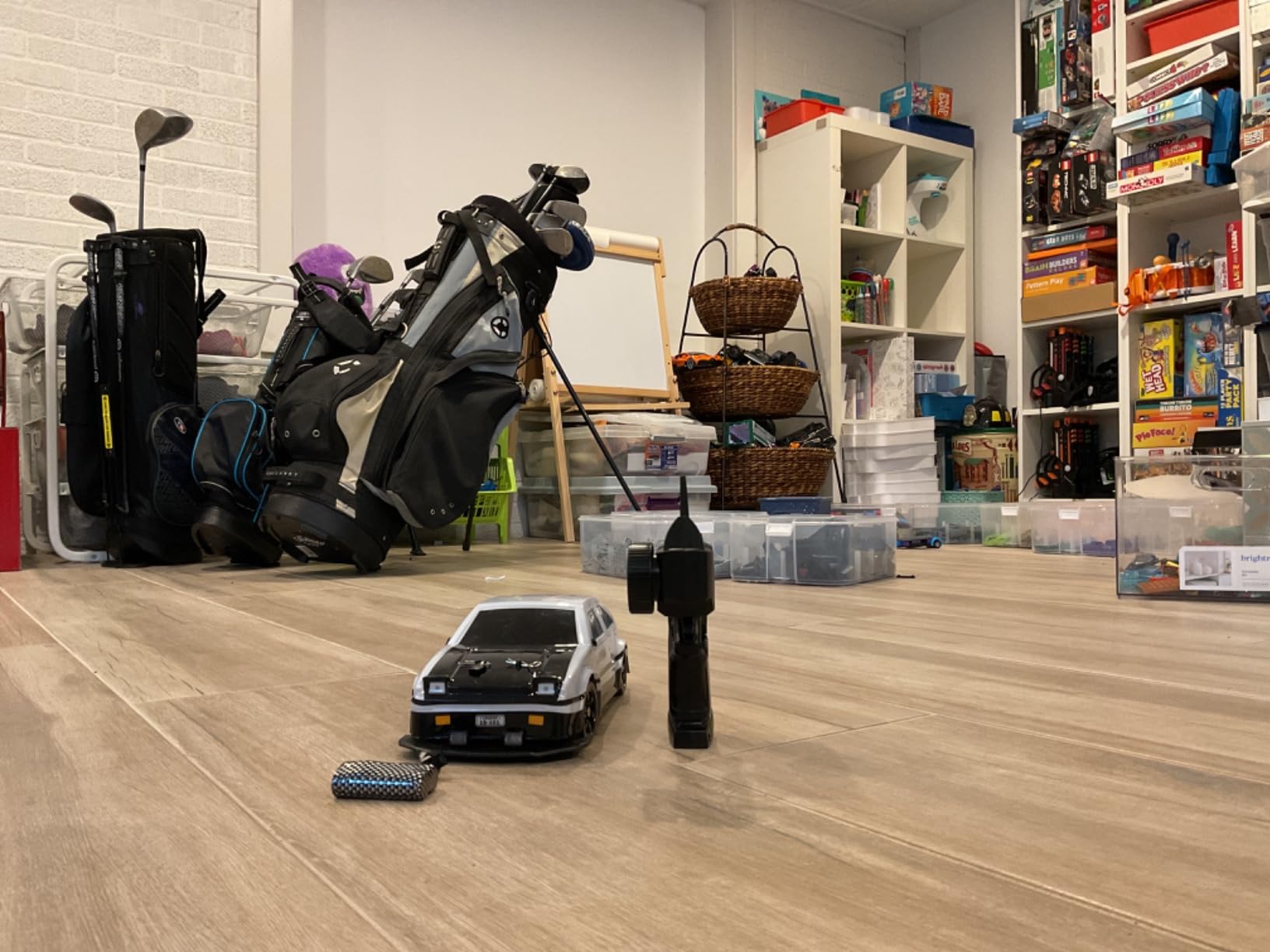
This is the car we recommend for deliberate practice. It is the cheapest thing in the guide, it takes real abuse without falling apart, and owners report that it survives repeated rough handling by children. Learning to slide on something you do not mind crashing is a much better way to start than learning on a car you care about.
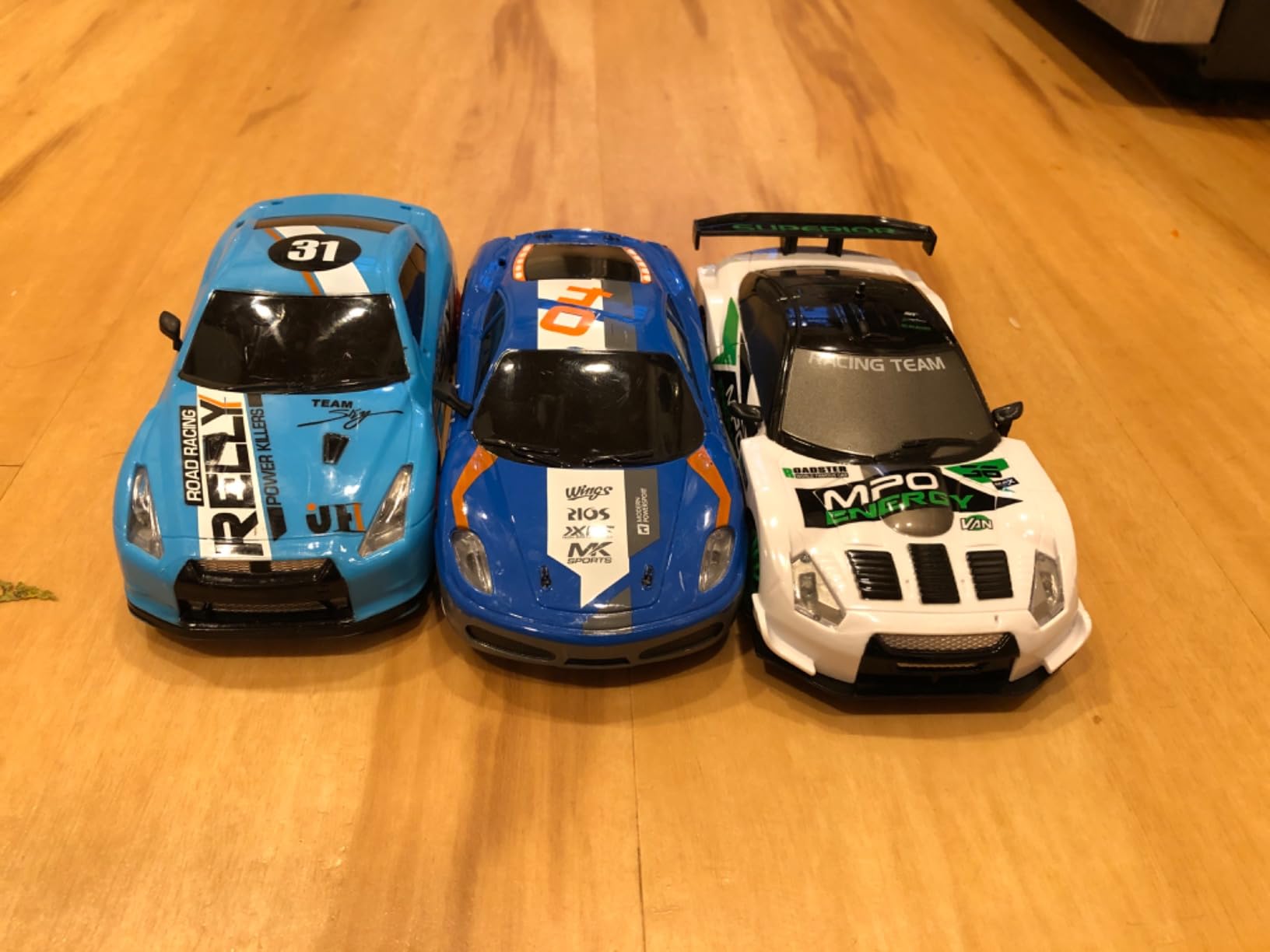
Drifting is genuine here rather than a button press. It runs at 15KM/H in 4WD, and the 2.4GHz system supports multiple cars on one frequency without interference. The four racing tires and four slick drift tires both come in the box, along with a transmitter, six cones, a charging cable, and a manual.
The maintenance theme that runs through the reviews is the front wheel drive. Bearings arrive ungreased, which owners say leads to grinding and wheel drag, and the front drive train is awkward to reassemble after you open the chassis. A small tube of grease fixes the first problem in about five minutes.
Other recurring notes are the on-off speed control, which makes the car fade and die early in a longer run, a motor that is quite loud, and the front drive only being partly 4WD, which limits how far the car will hold a slide.
Who this is right for
This is the value pick for anyone who wants to practise before committing to a real drift chassis. The 2.4GHz transmitter feels good in the hand, and the reinforced frame means a wall does not end your session.
It is also the sensible choice for a child, because the combination of a low top speed and a durable frame means the car survives the learning curve that destroys the cheaper plastic models.
Who this is wrong for
Not for anyone who cares about precise throttle control. On-off speed means you are managing the car with bursts rather than a smooth trigger, and the car starts fading partway through a run.
Budget an afternoon of maintenance before you first drive it. The ungreased front bearings and the awkward front drive reassembly are real, and no spare screws come in the box for the wheels.
6. KAIMIO 1:24 4WD Drift Car: The Fastest Entry-Level Car Here
KAIMIO 1:24 Scale RC Drift Car 4WD 2.4GHz 30KM/H High Speed Racing Sport Toy Car with LED Lights, Racing and Drift Wheels(02-Blue)
1:24 scale 4WD
Up to 30KM/H
8.3 x 4 x 2.5 inches
LED and underglow
Pros
- Highest top speed in the guide
- Drifts well once you adapt to the throttle
- Remote comes pre-bound so pairing is instant
- LED headlights and underglow
Cons
- Switch-style steering rather than a proportional wheel
- Nonstandard battery cannot be swapped
- About 10 minutes of runtime per pack
At up to 30KM/H, this is the fastest car we tested in the entry tier, and speed is the point. If you already have a car and want to practise linked transitions and long fast sweeps rather than tight indoor corners, the extra pace gives you room to build confidence with throttle control.
The chassis is shared across multiple body styles and colours, so the platform is well supported and parts tend to be interchangeable. The remote arrives pre-bound to the car, which removes the pairing step that catches some beginners out with cheaper sets.
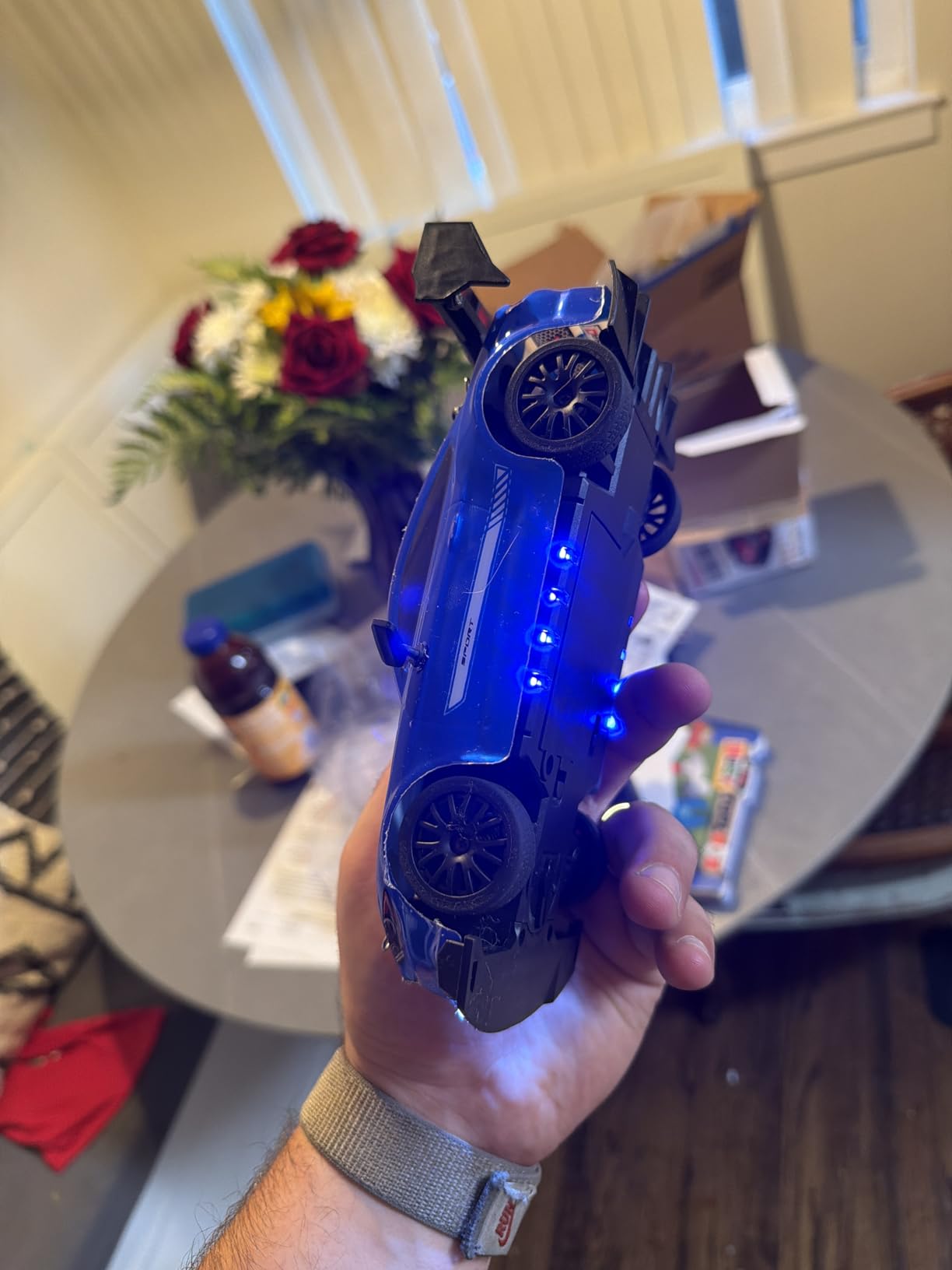
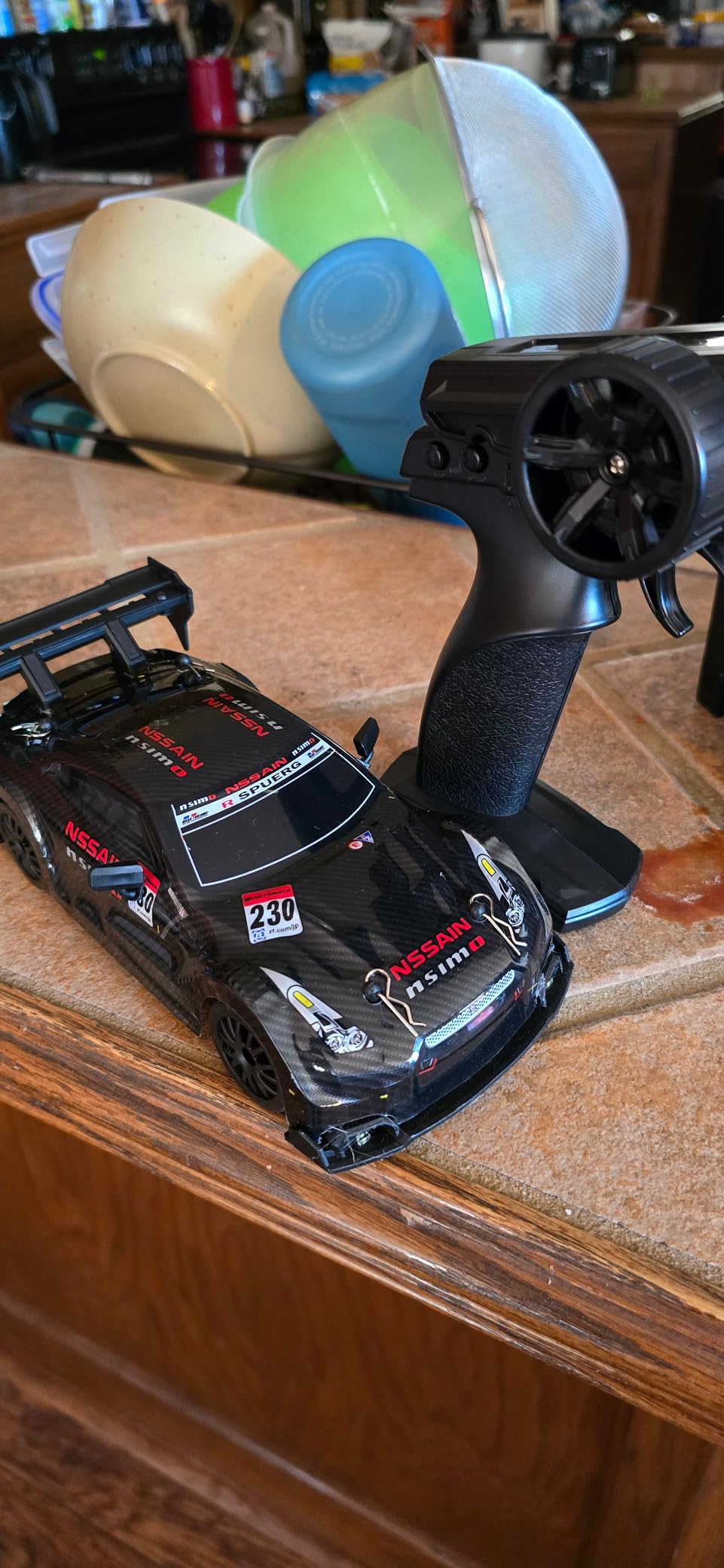
Owners consistently praise the speed, the lighting, and the interchangeable tire sets, with a 70 percent five-star share. The KAIMIO drifts well once the driver adapts to the throttle, and the high-toughness PVC shell with ABS body and rounded edges survives bumps and minor crashes.
The limitation everyone reports is steering. It is switch-style rather than a potentiometer, so it is full lock in one direction or the other with no fine adjustment. The included battery is also nonstandard, so you cannot simply drop in ordinary cells when it dies.
Who this is right for
This suits a beginner with outdoor space who wants the extra speed to practise flowing lines. Thirty kilometres per hour is fast enough to feel like a real car without pushing into the territory where a 1:10 hobby chassis would be needed.
The lighting is genuinely good for evening sessions, with headlights, taillights, and underglow all working. For a first car that will be shown off as much as driven, that matters.
Who this is wrong for
It is a poor indoor trainer. Combined with the switch steering, a car that fast in a hallway is a furniture hazard and a frustration rather than a teacher.
Roughly 10 minutes of runtime per pack is short, and the proprietary battery format means replacement packs are an extra cost. Controls can also feel jerky, and a small number of owners reported a reversed throttle unit out of the box.
7. FLYCOLOR Turbo Racing C64 1:76: The Best Car for a Cardboard Table Track
FLYCOLOR Turbo Racing C64 1:76 RC Drift Car, Full Proportional RTR (Blue)
1:76 Hot Wheels sized
Full proportional 4-channel SVC remote
55mAh battery up to 30 minutes
Pros
- True full proportional steering and throttle
- Working headlights and brake lights plus chassis LED
- Two extra shells for painting
- Sized perfectly for a tabletop circuit
Cons
- Very high cost for the size class
- Gyro needs careful tuning and drifts out of alignment
- Modest top speed
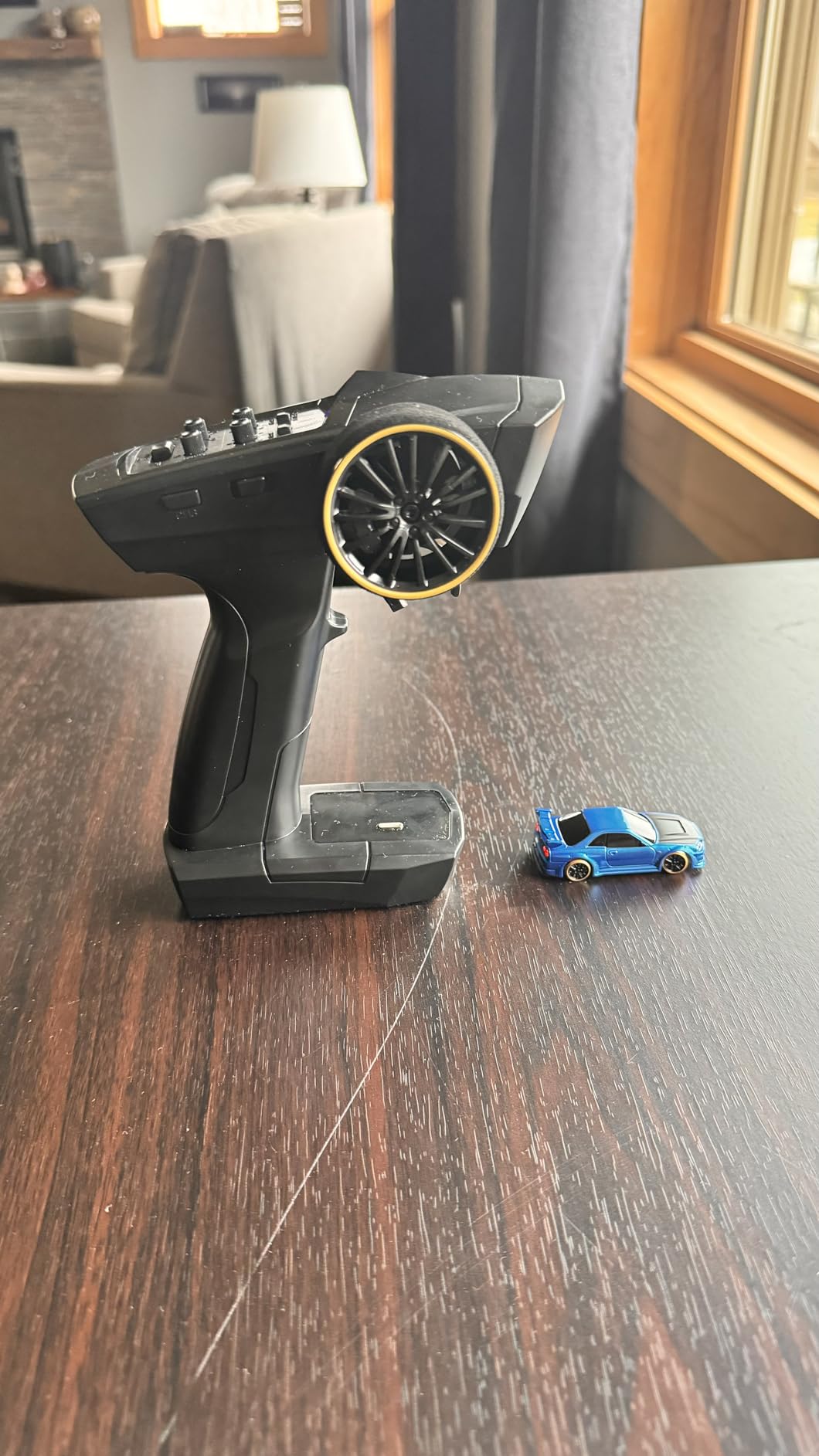
This is the odd one out in the guide, and that is exactly why it earns a place. At 1:76 scale it is roughly Hot Wheels sized, and it is the only car here with true full proportional control on a four-channel SVC remote plus gyro stabilisation. You can build a circuit out of cardboard on a dining table and run laps properly.
The electronics are the draw. Working brake taillights that illuminate when you brake, a spotlight-style headlight with dual flash, chassis LEDs on a separate channel, and an upgraded throttle curve where the first 50 percent of the trigger is gentle and the second half is strong. That curve is a genuinely useful teaching tool for learning throttle modulation.
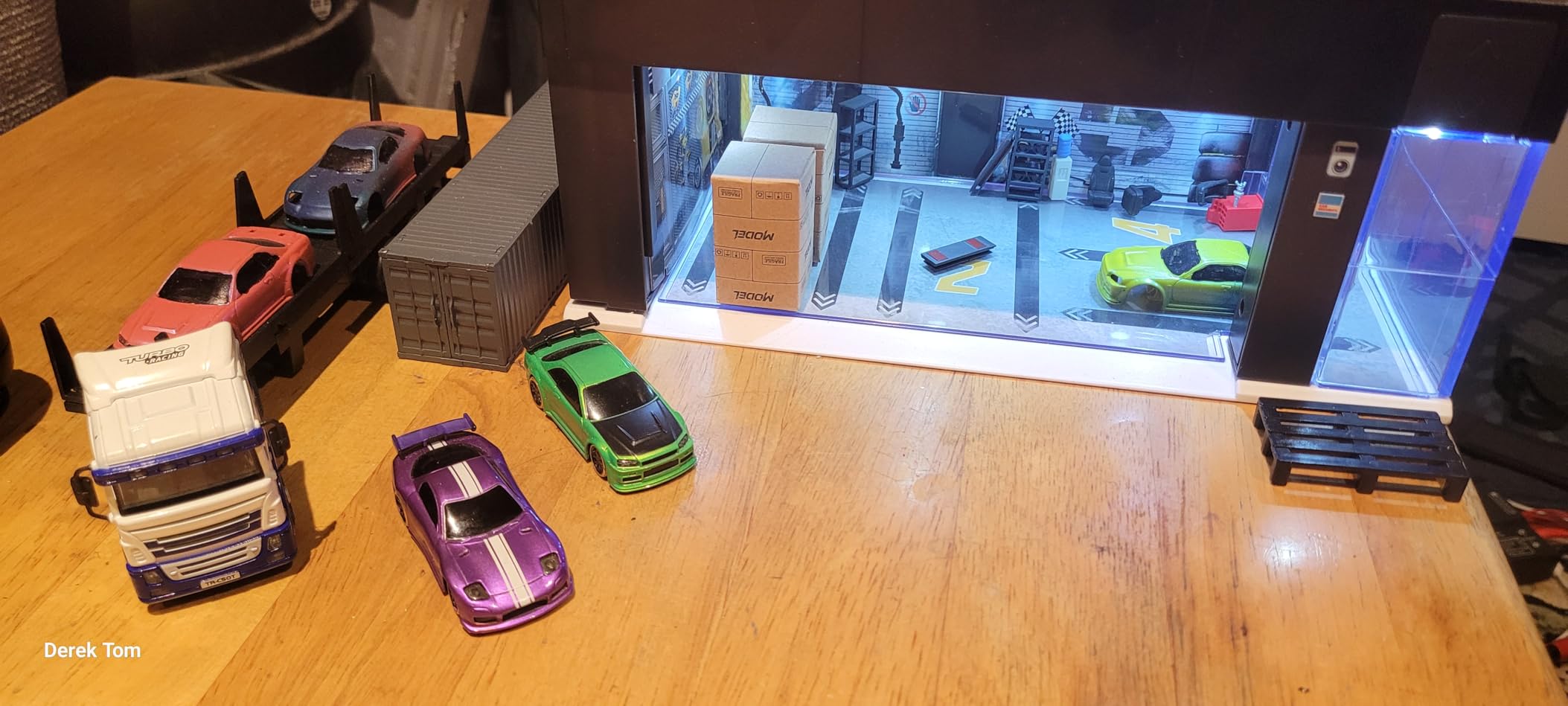
Two interchangeable DIY shells come in the box along with a steel screwdriver and a Type-C cable, so you can paint a spare and run a different body. Charging takes about 40 minutes and the 55mAh battery gives up to 30 minutes of runtime.
This is the lowest-rated car in the guide at 4.2 with a 68 percent five-star share and the highest one-star share of the set. Enthusiasts love the proportional control, lighting, and collectible shells. Recurring themes are that it is overpriced for a toy of this size, needs a lot of practice at that scale, and that the gyro tuning and battery reliability are inconsistent.
Who this is right for
Pick this if your available space is a table rather than a floor or a yard. Nothing else in the guide gives you a proper circuit on a small surface, and the two-stage throttle curve makes it a good trainer for a patient beginner.
It is also the only car here with a gyro you can actually adjust, which mirrors the technique used on full-size drift chassis. Learning on a 1:76 car is a low-stakes way to understand what a gyro does before spending on a bigger platform.
Who this is wrong for
Buyers describe it as overpriced for the size class, and the review data backs that up. If you have floor space, a 1:24 car gives you more car for the money and a larger driving surface to work with.
The gyro needs careful tuning and one owner reported it losing calibration after a few days, on a replacement as well. It also lacks reverse, and using the remote’s own battery slot drains the controller batteries, which is an odd design choice.
8. HTURCCOP 1:24 4WD Drift Car: The Longest Runtime for Indoor Sessions
HTURCCOP RC Drift Car 2.4GHz 1:24 Scale 4WD High Speed Remote Control Cars Vehicle with LED Lights Two Batteries and Drifting Tires Racing Sport Toy Cars for Adults Boys Girls Kids
1:24 scale 4WD
8.27 inches long
Dual 1000mAh battery pack
Over 60 minutes runtime
Pros
- Longest runtime in the guide at over 60 minutes
- Drifts easily on kitchen floors and low-pile carpet
- Two speed modes for younger drivers
- Nylon body survives crashes and rolls
Cons
- Top speed falls short of the listing claim
- All-or-nothing steering and throttle
- Undrivable if the two tire types get mixed
If your practice sessions are indoors and you hate recharging, this is the one to look at. The dual battery pack totals 1000mAh and gives more than 60 minutes of runtime, which is the best in this guide by a wide margin. That changes the shape of practice: you can learn a full routine in one sitting.
Owners report that it drifts easily on kitchen floors and low-pile carpet, which is a wider range of surfaces than most of the 1:24 cars manage. The two speed modes let a younger driver run it gently while an adult gets sharper drifts from the same car.
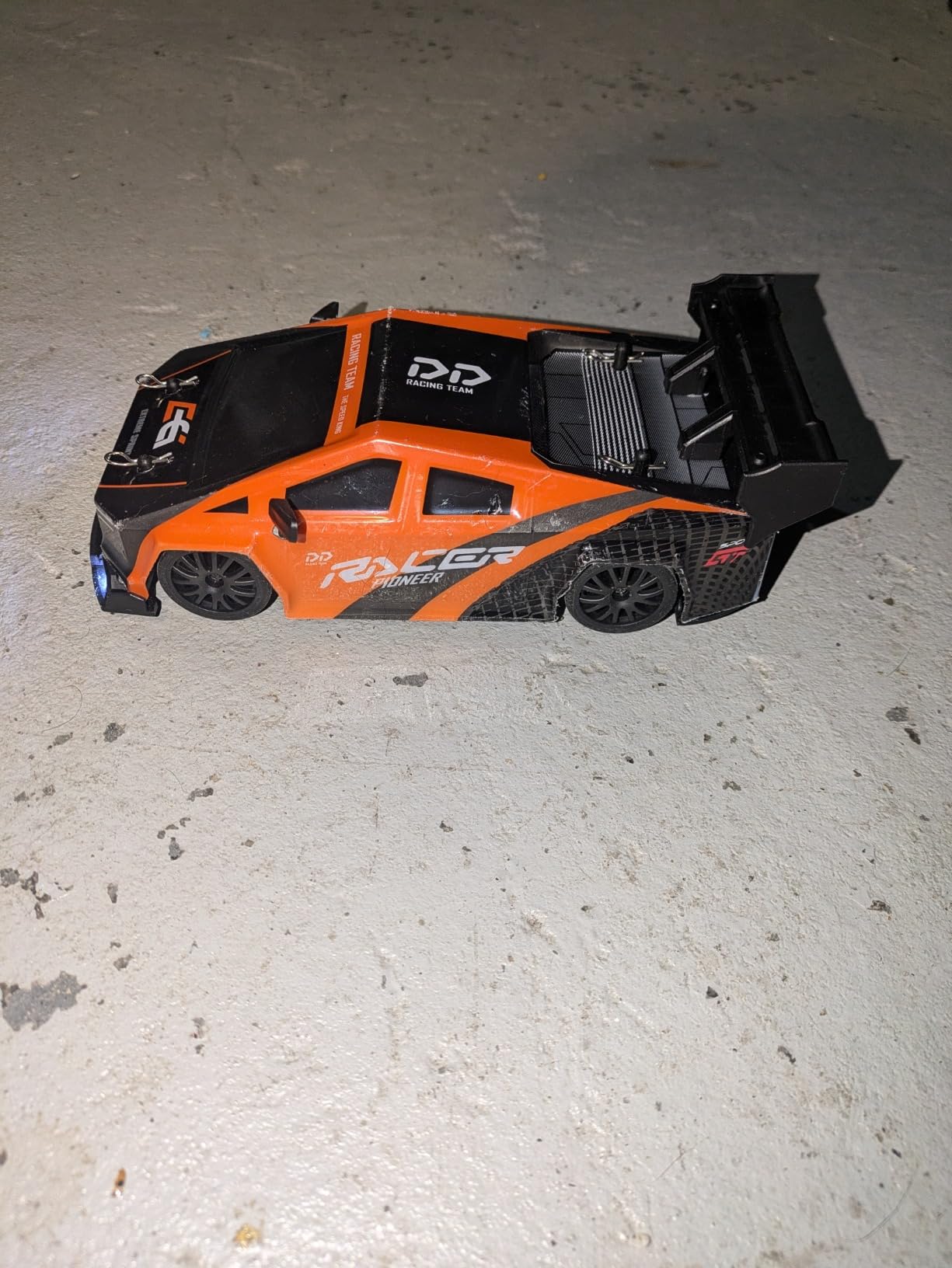
The body is high-toughness PVC and nylon, and reviewers note that crashes and rolls survive intact. The bright headlights are useful for finding the car in a dim room, which is more practical than it sounds when you are chasing a car under a sofa.
On the other side, this has the weakest rating among the well-reviewed cars here at 4.2, with a 65 percent five-star share and a 13 percent three-star share. Buyers like the battery life, the two speed settings, and how easy it is to learn on. Complaints center on the lack of proportional control, mixed-tire handling, and a top speed that does not match the marketing.
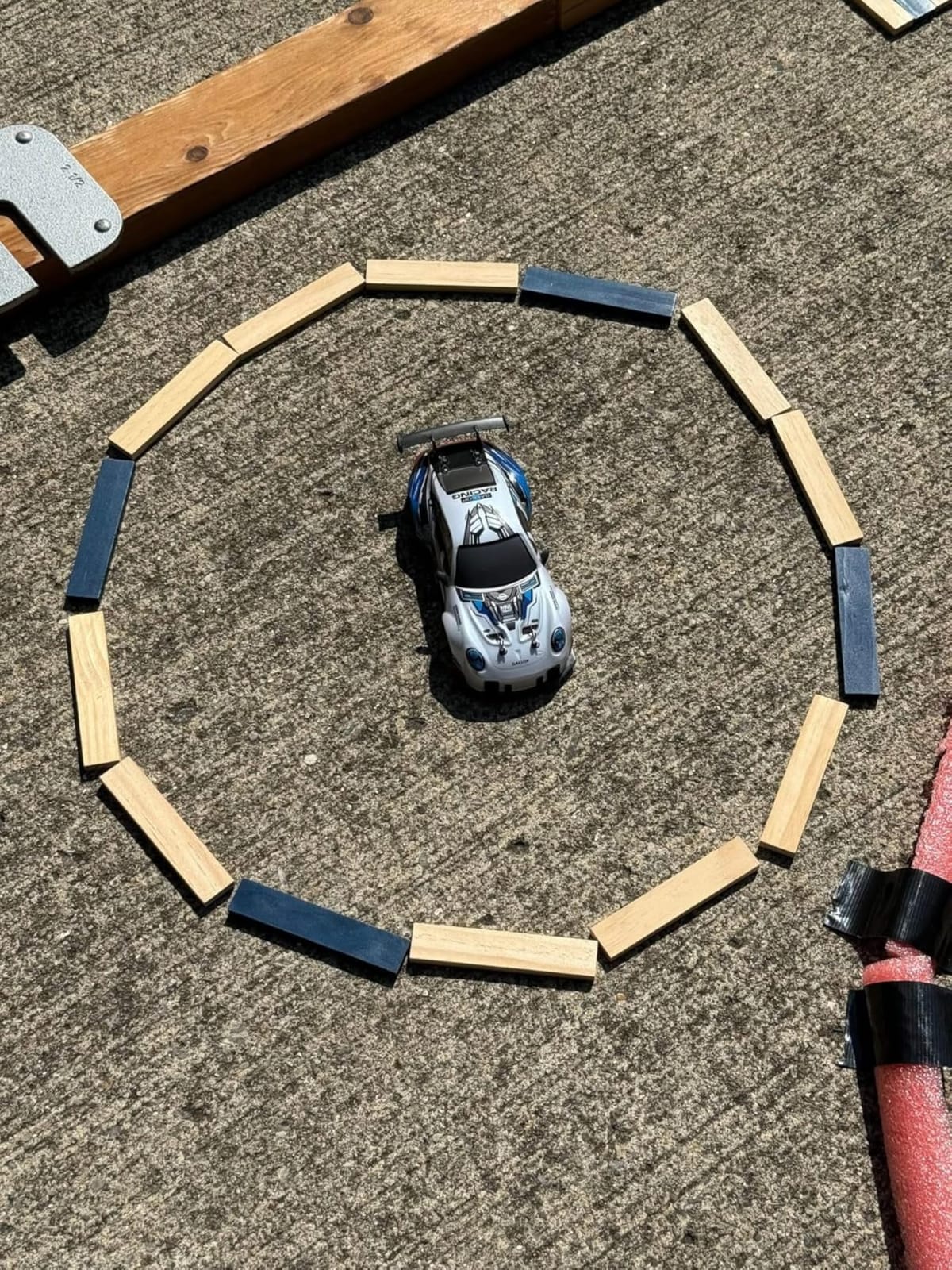
Who this is right for
This suits a beginner who wants long indoor practice sessions and does not want to spend the evening charging batteries. The runtime means you can work on one skill for an hour without a break.
It is a good shared car for a household with kids at different ages, because the speed modes let the youngest driver run it without the older ones begging for the faster setting.
Who this is wrong for
Do not buy it expecting the speed in the listing. Reviewers are consistent that it is not particularly fast, and if you want to practise fast transitions this is the wrong tool.
The lack of proportional steering is the deeper problem, and the mixed-tire warning is a real practical trap. Hobby builders also note that the wheel axles use screws rather than standard metric nuts, which they replace as a matter of course.
9. Everbigmai 1:43 Gyro Drift Car: The Most Capable Trainer in the Guide
RC Drift car, 1/43 Mini Rc Drift car with Gyroscope, 2.4GHz Full Proportional Remote control Cars, 4WD High Speed Racing with Lights, Racing Tires, Model Cars Gift for Adults, Kids, Boys, Girls
1:43 scale 4WD
Up to 15KM/H
Built-in gyroscope
4.3 x 1.7 x 1.8 inches
Pros
- Hobby-grade internals with bearings and bi-metal gears
- Full proportional control plus an adjustable gyro on the transmitter
- Speed limit modes at 20 50 and 100 percent
- Packaged in a foam-cut box that doubles as storage
Cons
- Only runs on smooth hard floors or very low-pile carpet
- Pet hair wraps the drivetrain and requires opening the car
- Not rear-wheel drive so the drift feel is less authentic
This is the most sophisticated beginner car in the guide. It is the only one with a built-in gyroscope you can adjust from the transmitter, full proportional steering and throttle, and 20, 50, and 100 percent speed limit modes. That combination makes it the closest thing here to a proper drift trainer.
Understand what the speed limit modes do. They cap the top speed at a fraction of the full 15KM/H, so a complete beginner can practise the steering and timing of a slide at 20 percent power, then raise it as control improves. No other car in this list has a trainer feature this close to a real drift practice mode.
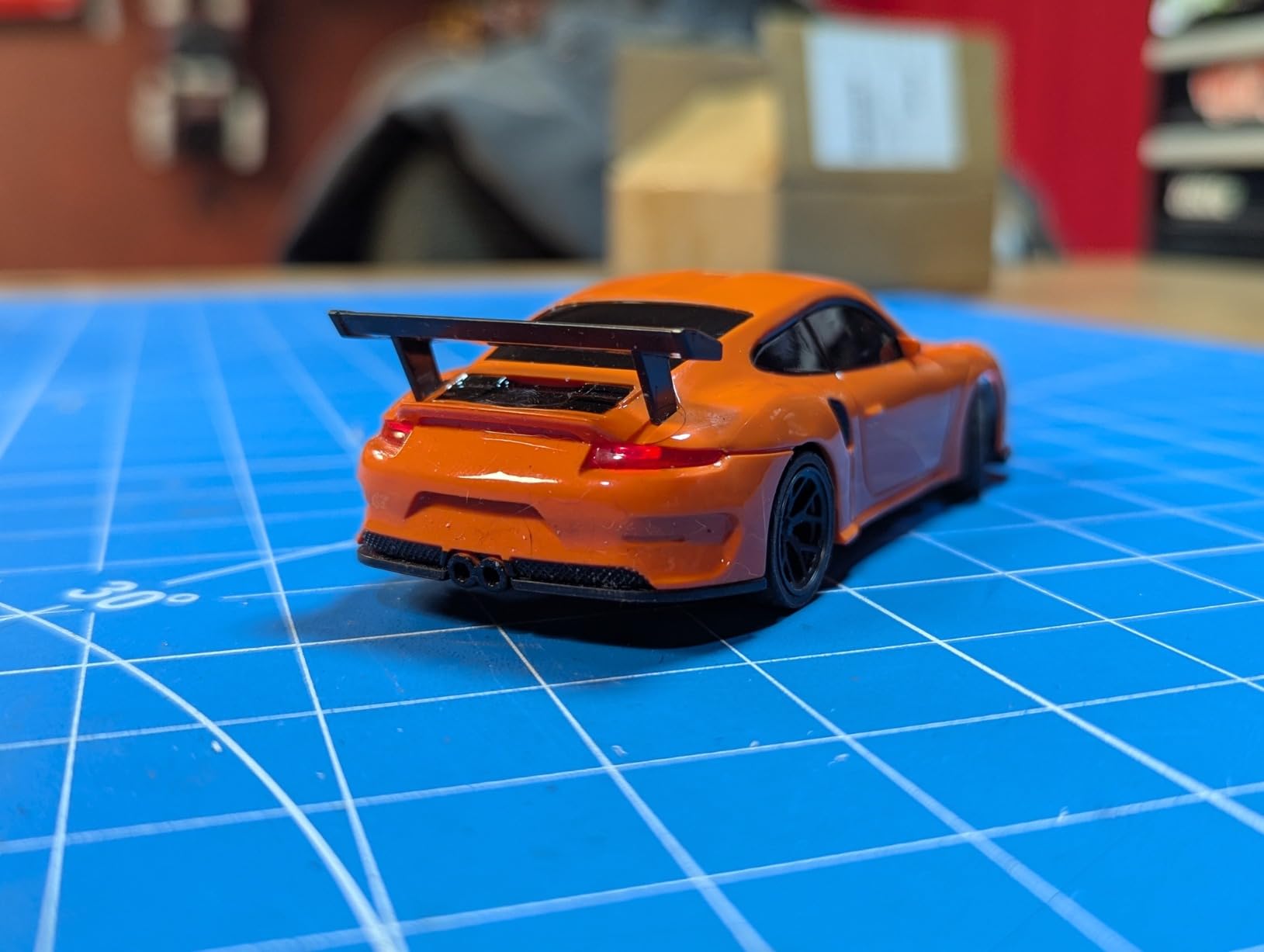
The internals are unusual for a micro car. Reviewers report bearings, bi-metal gears, and spring suspension, which is a hobby-grade spec sheet at this size. The TRIM button on the transmitter corrects a pulling drift line, which saves a beginner from tearing the whole setup apart chasing a straight-line problem.
It packs into a foam-cut box that doubles as storage, and at 4.3 by 1.7 by 1.8 inches it runs in a school gym or on a coffee table. The 2.4GHz system supports multiple cars with Type-C fast charging, and simulated headlights and brake lights are fitted.
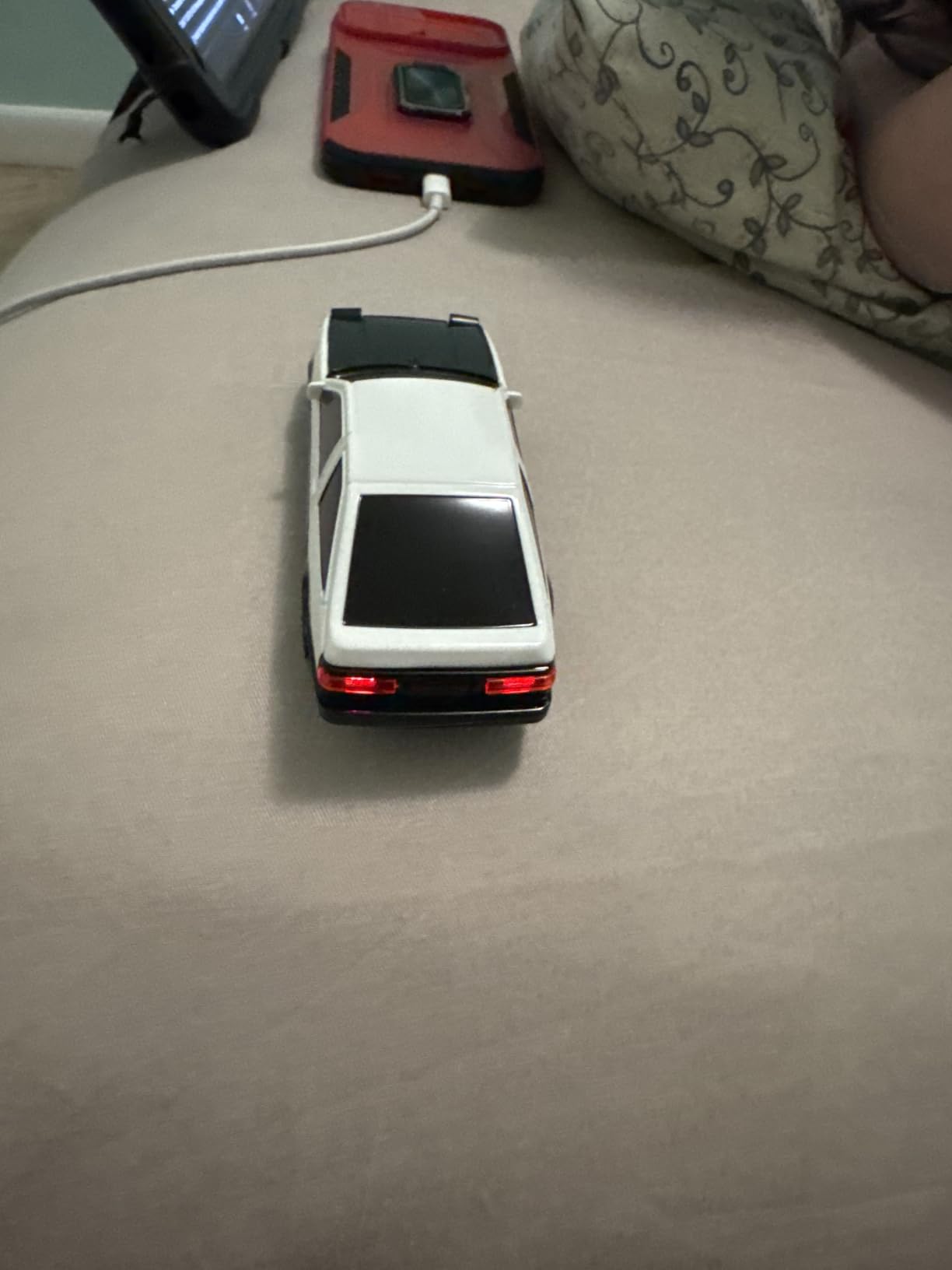
Who this is right for
This is our pick for a beginner who wants to learn the actual technique rather than just have fun. The gyro, the proportional control, and the three speed limits are the closest match to how a real drift chassis is set up, and you can learn the concepts on a small car before committing to a large one.
It is also good for adults, because the scale and the foam packaging make it easy to keep on a desk and run a short session at work rather than a long evening session.
Who this is wrong for
It is indoor-only in practice. Owners are clear that normal carpet and any outdoor surface cause problems, because pet hair and carpet fibers wrap around the drivetrain and force you to open the car for cleaning.
Reassembly matters too, because gears and wheels must realigned correctly or the car will not move at all. It is 4WD rather than rear-wheel drive, so purists find the feel less authentic, and one owner reported the gyro losing calibration after four days on a replacement car as well.
10. PIWIJOY 1:24 LED Drift Car: The Best for Night Sessions and Display
PIWIJOY RC Drift Car, 1:24 Scale Remote Control Vehicle with LED Lights,Drifting Tires&Two Batteries, Racing Sports Toy Idea Gift for Adults Boys Girls and Kids (Lake Blue)
1:24 scale 4WD
20KM/H top speed
7.87 x 3.54 x 2.2 inches
Dual batteries for 50+ minutes
Pros
- Tri-zone LED lighting with underglow
- Quick-swap dual battery for 50+ minutes
- Quick-release tire change between setups
- Adjustable sensitivity remote
- Track barriers included
Cons
- Newer listing with a smaller review base
- Highest one-star share in the guide at 9 percent
- Not a true rear-wheel-drive drift platform
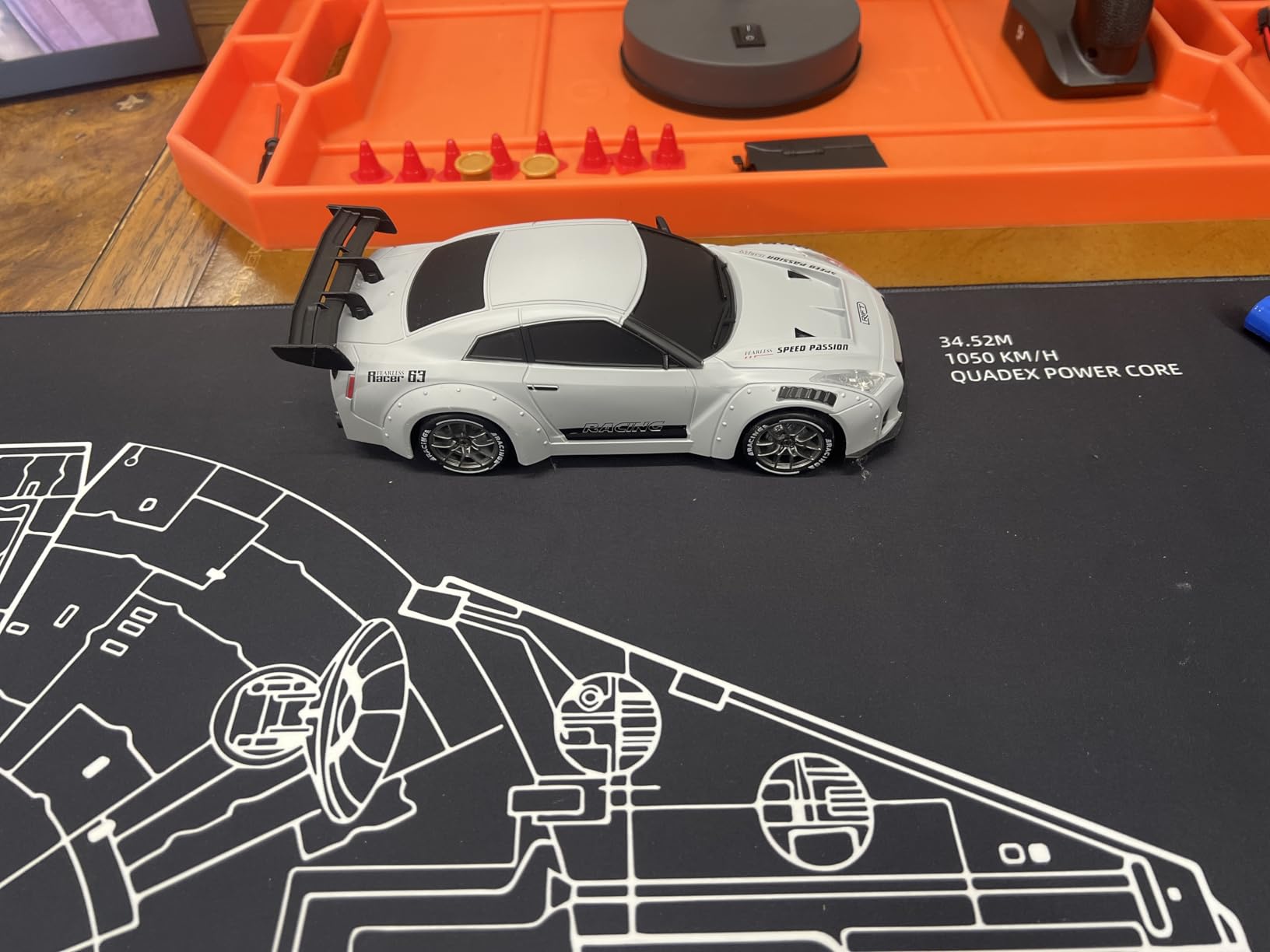
The lighting is the reason to notice this one. Headlights, taillights, and underbody glow on a car that is usually sliding sideways in a dim room is genuinely fun, and it makes the car easy to track when it runs under furniture. For a night session on a patio or in a garage, it is a real practical advantage.
Underneath the styling, the spec list is sensible. Twenty kilometres per hour in 4WD, a quick-release swap between drift and racing tires, a modular quick-swap battery compartment giving 50 or more minutes, and an ergonomic remote with adjustable sensitivity rather than a fixed trigger.
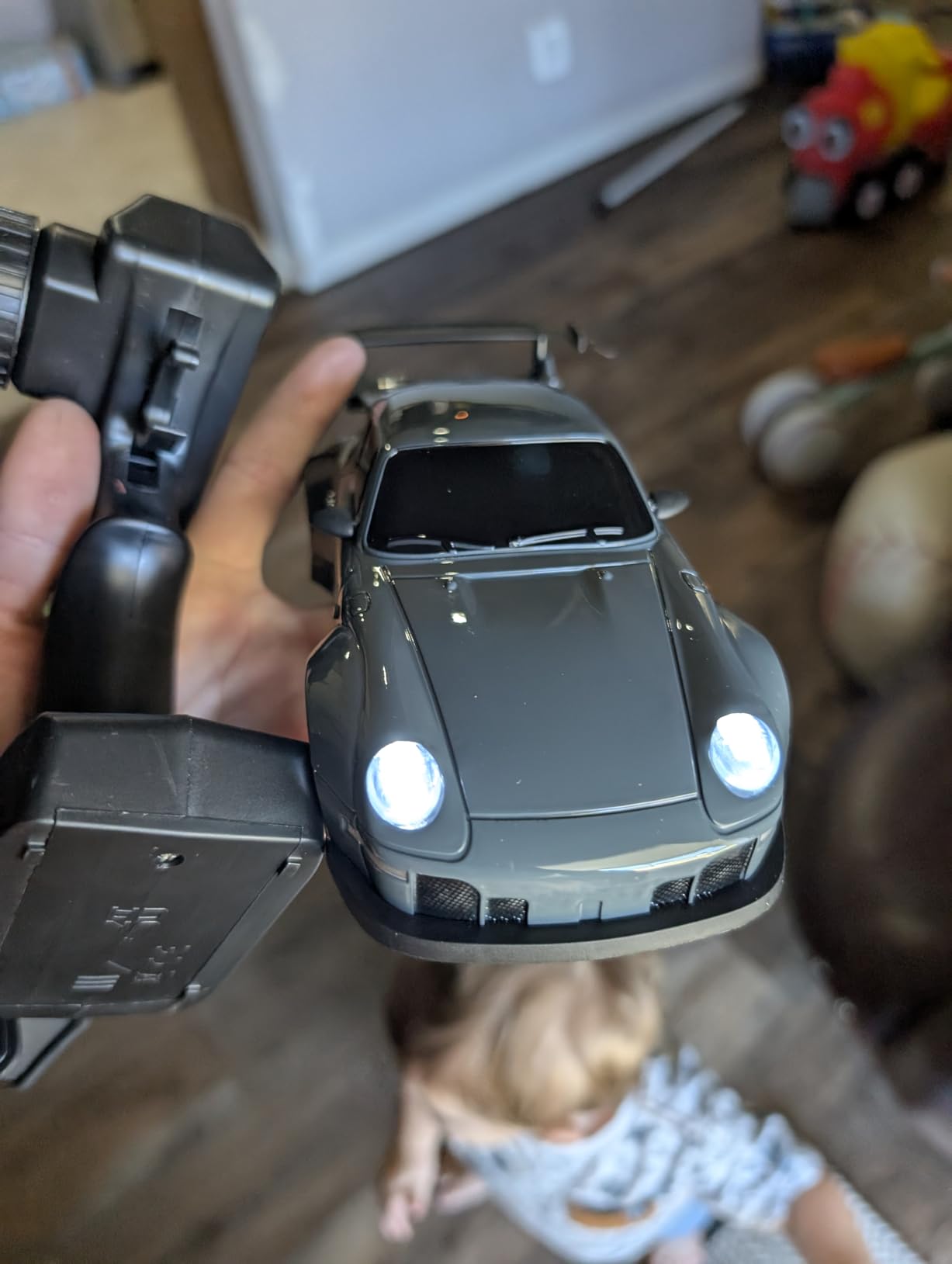
Track barriers are included, so you can build a small course out of the box, and the shell is FCC and CE certified for ages six and up. The dynamic torque distribution is a nice touch that keeps the car planted when it is not sliding.
Where this listing is weaker is evidence. At 216 reviews and a 4.3 average with a 72 percent five-star share, it has a smaller review base than the established models, and its 9 percent one-star share is the highest in this group, pointing to some build consistency complaints in early feedback.
Who this is right for
Choose this if you plan to drive at night or want a car that looks impressive on a shelf. The underglow and tri-zone lighting are the most-mentioned positives in the reviews, and the dual quick-swap battery means less downtime than most cars in this class.
The adjustable sensitivity remote is also a genuine step up from the fixed on-off controllers used by most of the cheaper cars here, and the included barriers are useful for a child who wants a course rather than open floor.
Who this is wrong for
Be cautious if you want a proven platform. The listing is newer, the review base is thinner, and the one-star share suggests some units have quality issues that the cheaper, more established models do not show.
It is also 4WD rather than rear-wheel drive, so it will not teach the technique that carries over to a track. Like its 1:24 rivals, it needs a smooth hard floor to drift well.
11. Cayrzeth 1:24 4WD Drift Car: The Most Complete Starter Package
Cayrzeth 1/24 4WD RC Drift Car, 2.4GHz 20KM/H High Speed Remote Control Racing Car with Drifting Tires, Gift for Kids Adults
1:24 scale 4WD
20KM/H
0.57 kg
Two 3.7V 500mAh batteries
Pros
- Full-range linear throttle for smooth acceleration
- Dual battery pack gives about 50 minutes
- Quick-release drift and racing tire swap
- Two speed modes for different skill levels
- Shock-absorbing chassis and impact-resistant battery housing
Cons
- Only two body colour options
- Manufacturer age guidance of 0-2 years is unrealistic for an RC car
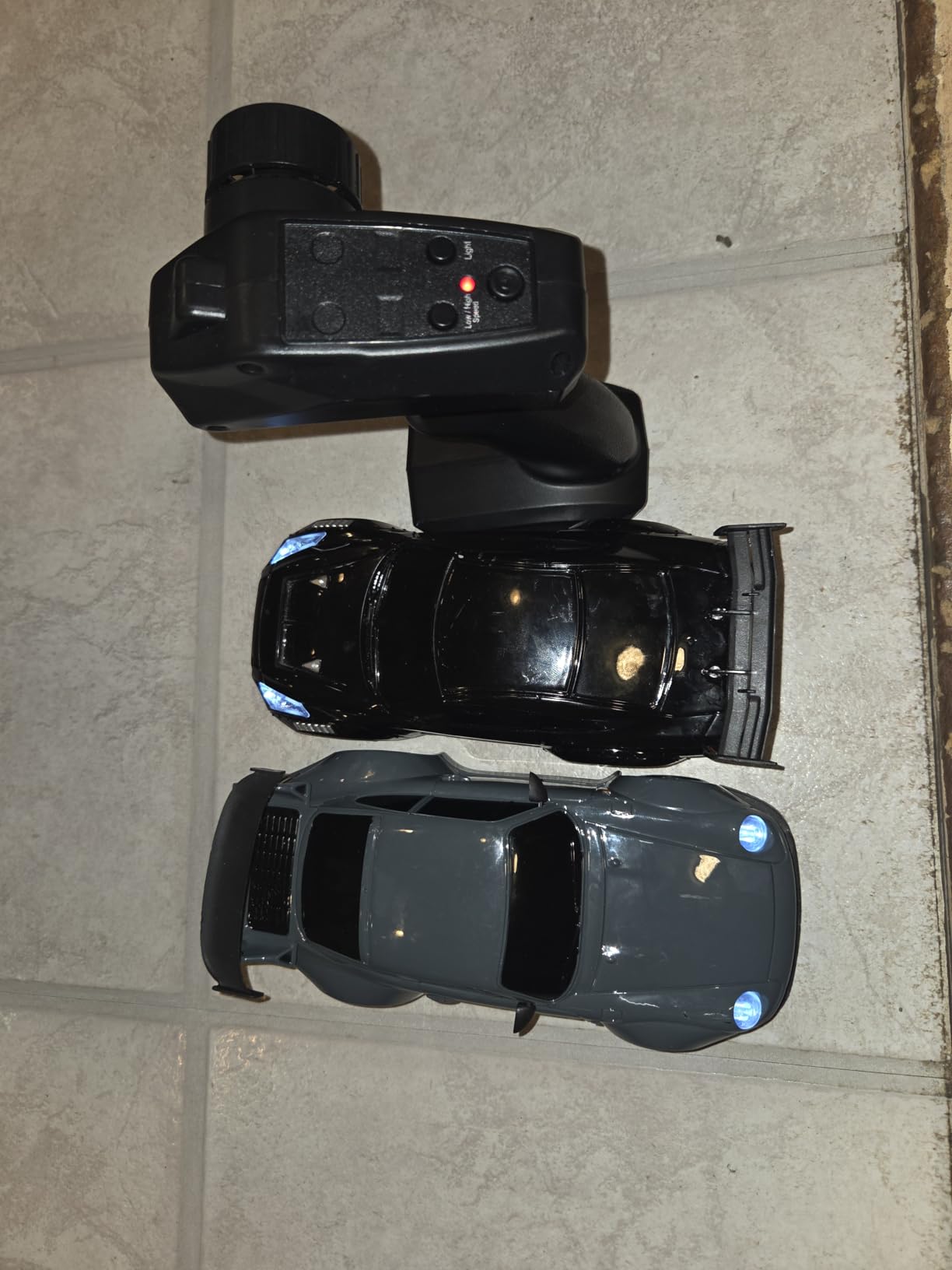
This is the tidiest starter package in the guide. Nothing is missing, nothing is proprietary-looking, and the box includes the batteries, the tire sets, and a chassis designed to take the hits a beginner will deliver. If you want one product and a clear afternoon, this is the least friction option.
The full-range linear throttle is the feature that separates it from most of the 1:24 cars here. Four-wheel drive with differential coordination supports stable drifting, and you can lift off the trigger mid-slide without the car dying, which is the single most useful thing a new driver can learn.
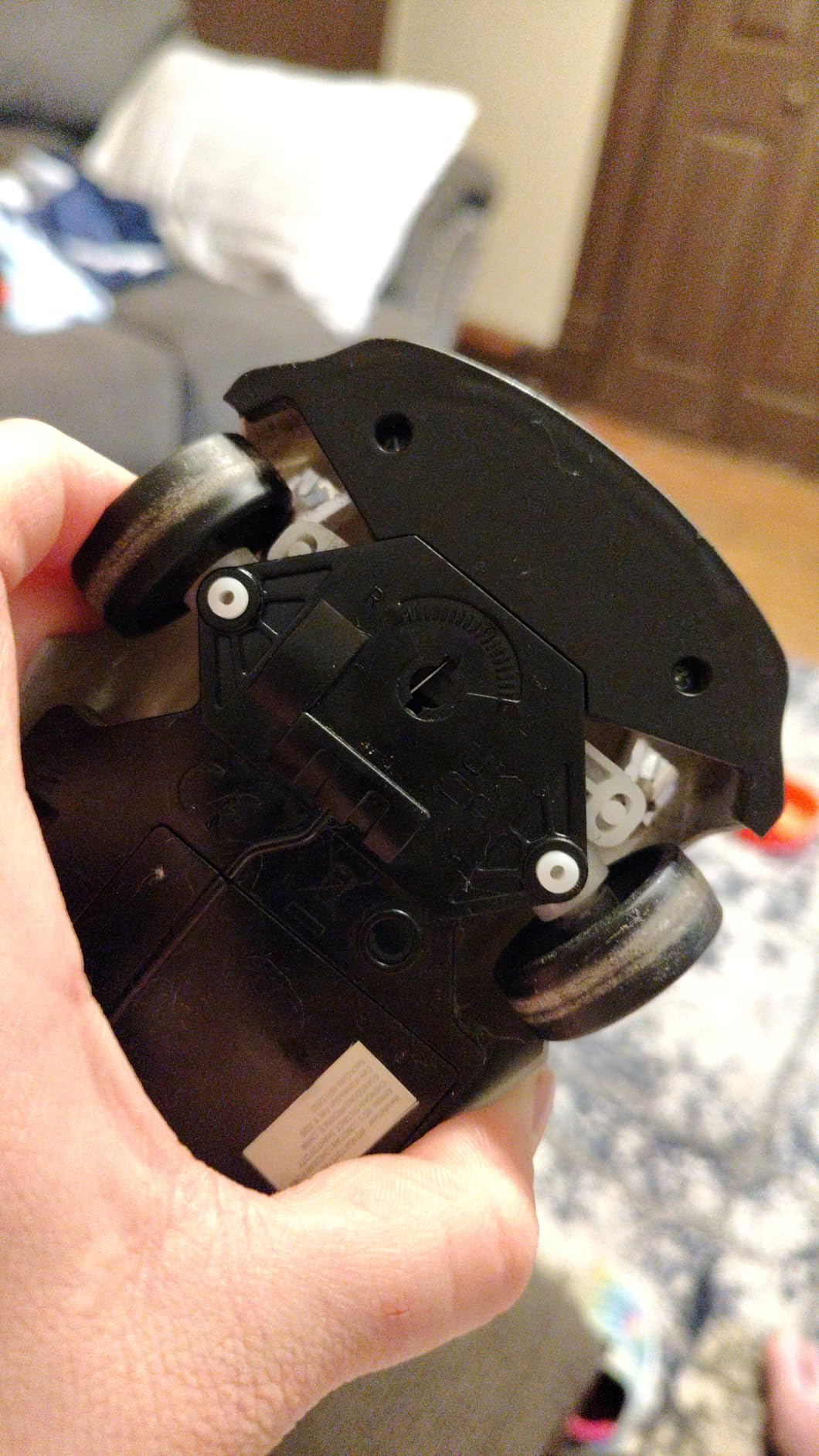
The dual-mode tire system is straightforward: four drift tires for smooth indoor surfaces such as wood or tile, four racing tires for outdoor terrain, and a quick-release design so the change takes seconds. The two 3.7V 500mAh batteries give roughly 25 minutes each for 50 minutes total, and the modular compartment makes swaps quick.
Owner satisfaction is high at a 4.5 average across 211 reviews. Buyers point to the anti-interference remote that allows multiple cars to run at once, and to the shock-absorbing chassis with its impact-resistant battery housing protecting the internals from impacts.
Who this is right for
This suits anyone who wants a complete beginner setup with no extra purchases and no proprietary battery format. The linear throttle makes it easier to learn progressive throttle control than most cars at this level.
It is also a good pick if you want to practise outdoors on a driveway as well as indoors, because both tire sets are included and the quick-release design means you are not hunting for a screwdriver.
Who this is wrong for
Do not expect much variety. It comes in only two body colours, so if you care about personalisation it is a limited platform.
Also note the listed manufacturer age guidance of 0 to 2 years, which is clearly a data error rather than a real recommendation. The 0.57 kg weight and plastic body make it a decent family car, but it is not a hobby chassis and will not take the modifications a real drift platform would.
12. ARRIS WPL D12 RWD Kei Truck: The One With a Real Upgrade Path
ARRIS WPL D12 1/10 RC Kei Truck RWD with 260 Brushed Motor RTR
Rear-wheel drive
1/10 class JDM kei truck
1170 g
15 x 8 x 8 inches
Pros
- The only rear-wheel-drive car here and the layout that teaches real drift technique
- Excellent value for hobby-grade quality
- No low-speed motor or ESC whine
- Adjustable camber and inclination on all four wheels
Cons
- Included battery is cheap with an awkward plug
- Factory radio is tiny with a stiff steering wheel
- Closer to 1/16 than true 1/10 scale
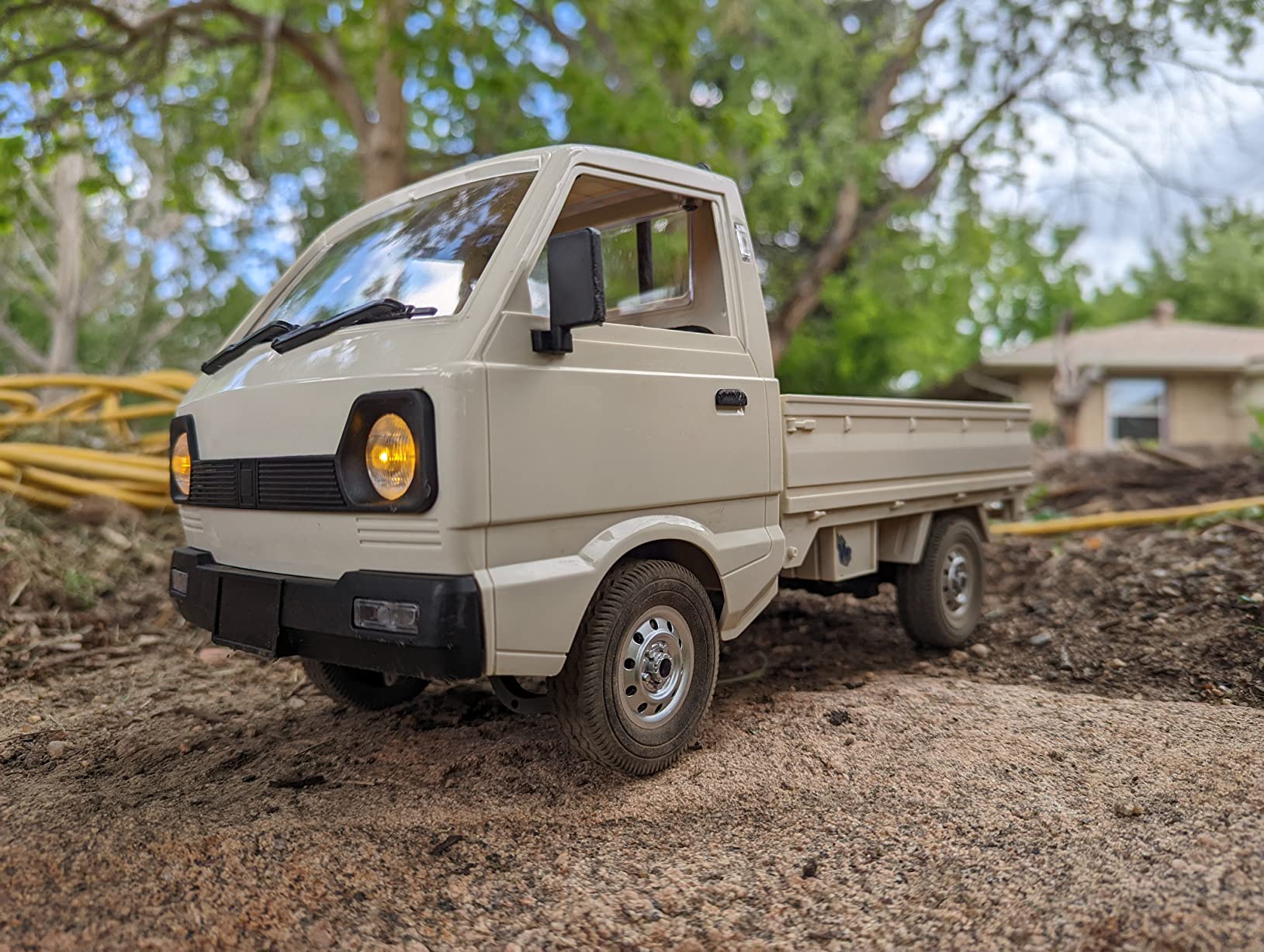
This is the only rear-wheel-drive car in the guide, and that single fact changes what the hobby can become. Every other pick here is 4WD, which is easier to drive and teaches a technique that does not transfer to a real drift chassis. The ARRIS D12 puts power at the back, where the weight transfer happens when the car slides.
It also has the highest rating in the guide at 4.6 across 253 reviews, and the reasons are concrete. Owners praise the absence of low-speed motor and ESC whine, which makes it pleasant indoors, and the good low-speed control and whineless braking that comes with it. The active braking is a real asset when you are learning to hold an angle.
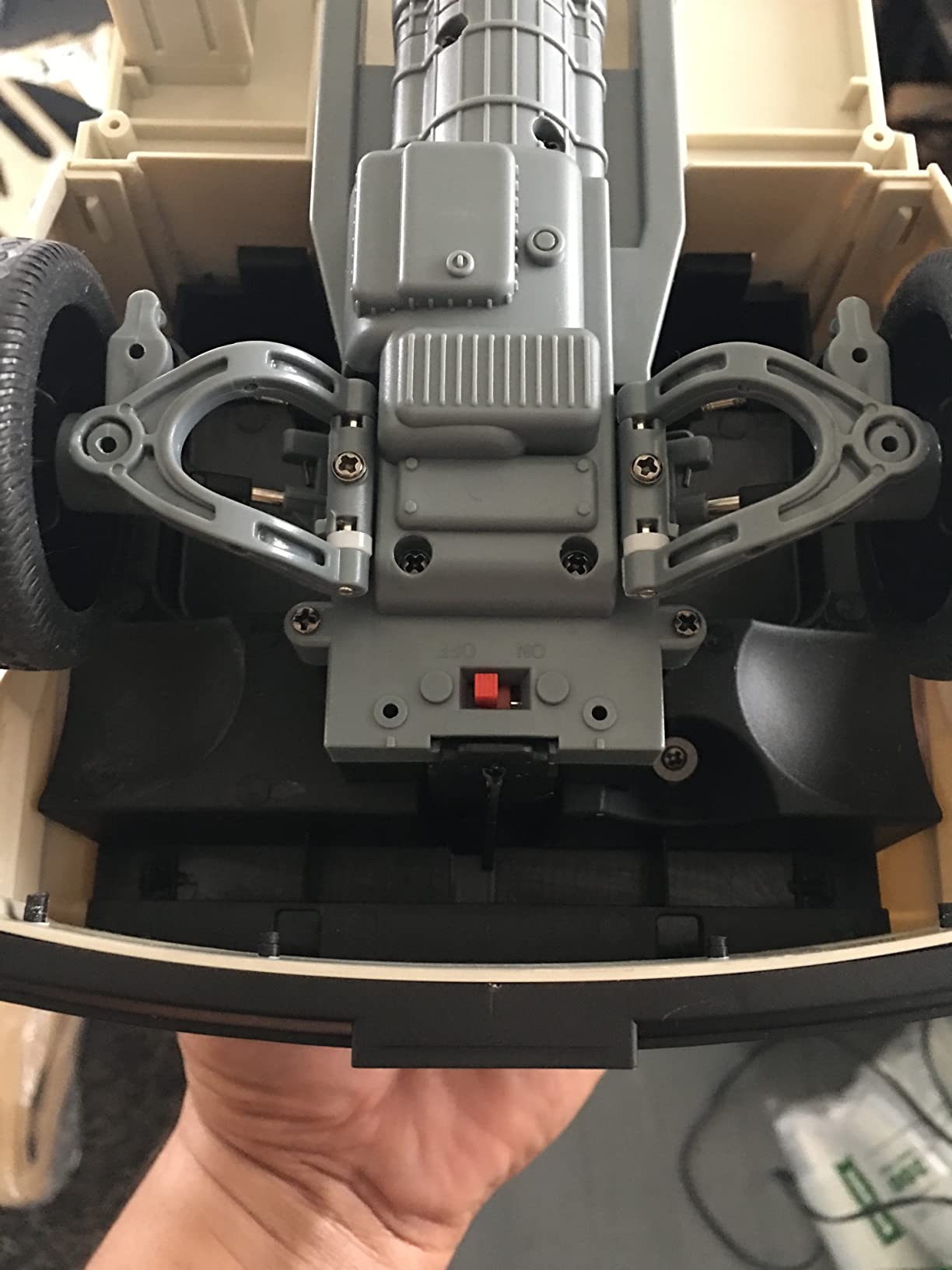
The suspension is unusual and worth understanding. A front double-fork single arm lets you adjust both inclination and camber angle on the front and rear wheels independently, with large-angle steering available. The rear uses makeshift leaf springs and the front uses piano wire as a torsion bar, and the solid axles have good cornering capability.
Scale details are a genuine strength: pop-off mirrors, light buckets, and an ESC and receiver combo with headers for the lights. Reviewers also note a strong aftermarket community, so parts and modifications are easy to find as you progress.
Who this is right for
This suits a beginner who already drives RC, or who wants to avoid buying a 4WD toy and then buying a proper drift car later. Rear-wheel drive with adjustable camber and inclination is a real hobby platform with a real upgrade path, and the JDM kei truck styling gives you something worth building.
It is also the best indoor car here for a reason unrelated to drifting. The lack of motor whine means you can drive it in a flat without the noise that makes small 1:24 cars tiring after twenty minutes.
Who this is wrong for
Budget for upgrades before your first session. The included battery is cheap with a cumbersome plug, its connector sits awkwardly underneath the car, and the supplied radio is tiny with a stiff steering wheel spring and poor feel. Most owners recommend replacing the radio, and one reviewer noted the expo is dialed in and cannot be changed.
It is also not true 1/10 scale, being closer to 1/16, and at 1170 g it is heavy. The solid axles limit load capacity, and there are reports of the front wheel breaking on impact.
RWD vs AWD: Why Rear-Wheel Drive Wins for Beginners
Rear-wheel drive wins for beginners who want to learn drifting properly, because it is the layout that forces you to use countersteer. AWD is easier to drive casually, but it lets you carry speed through a corner on grip, so you never have to learn the technique that real drifting is built on. Only the ARRIS D12 in this guide is RWD, and it is the one we would grow into.
Rear-wheel drive: power goes to the back wheels, so throttle breaks the rear loose and the front wheels keep steering authority. The car rotates, you countersteer into the slide, and the technique is identical to a full-size car.
All-wheel drive: all four wheels are driven, so the car resists rotating and stays planted. That is genuinely easier for a total beginner and fine for a first hour of fun, but it means the car will not teach you the one skill the hobby exists to develop.
There is a fair argument for the other side, and enthusiasts are split on it. AWD is more forgiving on a surface with poor grip, and a 4WD micro car will happily slide across low-pile carpet where a rear-wheel-drive chassis would simply stop. If your only practice space is soft and short, AWD is the honest answer.
Can a beginner drift an AWD RC car? Yes, technically, and every car in this guide except the ARRIS can do it. What you will be doing is closer to a controlled powerslide, and you will not develop the throttle-and-countersteer coordination that carries over when you eventually move to a proper drift chassis.
Kit vs Ready-to-Run: Which Should You Buy First?
Buy a ready-to-run car first. Every car in this guide is RTR, meaning the radio, motor, ESC, and servo are already installed, so you can drive within an hour of opening the box. A kit gives you a chassis and nothing else, and finishing one requires buying electronics, a radio, a battery, a charger, and a body separately.
The real cost difference is not the chassis. It is the parts list. A kit needs a radio system, a motor, an ESC, a steering servo, a LiPo battery, a battery charger, and a body shell before it moves. The chassis is often the cheapest component in the build, which surprises people who planned to spend on the kit alone.
What you gain with a kit is maintenance skill. One forum account of hand-building a first car puts it well: you learn the platform intimately, and when something breaks you can diagnose it yourself. That is a real argument, and it is why builders who already own crawlers tend to enjoy kit builds.
What you give up is driving time. A first-time buyer who builds a kit often spends a weekend assembling it before the first run, and that weekend is where a lot of hobby interest quietly ends. For that reason we would learn on a complete car, then buy a kit later as a deliberate second project.
One more practical note for anyone buying ready-to-run at this level: check the age guidance on the listing. Several cars in this guide are listed for ages zero to two or three to ten, which is not a realistic recommendation for anything with a steering wheel and a throttle trigger.
What You Have to Buy Besides the Car
Nothing. That is the point of an RTR, and it is why this guide is built entirely around complete cars. But it is worth knowing what you would be missing if you bought a bare chassis, because this is the most common surprise for new hobbyists and it is documented in nearly every beginner thread on the r/rcdrift forum.
Radio system: the transmitter and receiver pair. Every car here includes one. A cheap 2.4GHz toy radio works, but upgrading to a pistol-grip or wheel radio is the single most worthwhile upgrade later.
Steering gyro: a small device that applies automatic steering corrections so the car tracks straight while sliding. You do not need one on a 4WD toy, and the Everbigmai and FLYCOLOR cars here have a built-in adjustable one. On a real rear-wheel-drive chassis it is close to mandatory.
LiPo battery and charger: hobby-grade cars run on LiPo packs, and you need a balance charger that matches the cell count. The cars in this guide use built-in rechargeable packs with USB or Type-C charging, which removes this line item entirely at the cost of runtime and upgradability.
Body shell and wheels: hobby chassis ship bare. A shell is cosmetic but it changes weight distribution, and wheel offset is the single most important setup value on a drift car because it controls how much the rear wheel tucks under.
Tools and consumables: hex drivers, a soldering iron for motor and ESC work, wheel glue, and shock oil for damping changes. Our guide to RC telemetry systems for beginners covers the electronics side in more depth if you are going down the hobby route.
The practical takeaway is that a complete RTR car from this guide removes seven line items from your first purchase. If you are comparing a cheap RTR against a bare chassis on price alone, you are not comparing the same thing.
Brushed vs Brushless: What a First Car Actually Needs
Your first car does not need brushless. Every car in this guide runs brushed or entry-level electronics, and for learning to slide on a smooth floor the difference is invisible to a beginner. Brushless matters when you want more speed, more runtime, and less maintenance, and that is a second-car upgrade rather than a first-car requirement.
The ARRIS D12 is the informative case here. It ships with a 260 brushed motor, and owners at 4.6 rating still rate it as excellent value. What they complain about is not the motor but the supplied battery and the factory radio, which is the same conclusion most hobbyists reach about brushed RTR packages.
Where brushed costs you is durability under load. A brushed motor wears commutators, and a beginner who crashes the car repeatedly or runs it at full throttle on rough pavement will reach that limit sooner than on a brushless setup.
Motor KV is the number that matters when you do upgrade. Higher KV means more speed and less torque, and drift chassis generally want a lower-KV motor with a larger pinion to keep the car controllable while sliding.
Where to Practice: Surfaces That Work and Ones to Avoid
Smooth sealed concrete is the best surface for a first RC drift car, because it is flat, hard, and low enough in grip to let the rear step out with modest throttle. A smooth hardwood floor works nearly as well. Everything else is a compromise you will feel in the first five minutes.
Sealed concrete or polished garage floor: the reference surface. Low grip, perfectly flat, and large enough to build a course. Check for oil patches first, because a slick spot mid-corner ends a session quickly.
Smooth hardwood or laminate: excellent indoors, and the surface most of these cars are designed for. Grain and seams catch the small wheels on cheaper models, so test a full lap first.
Very low-pile carpet: workable, and the HTURCCOP reviews specifically mention drifting on it. Higher pile catches the drivetrain, and pet hair wrapping around the gears is a recurring complaint on the micro cars.
Coarse asphalt: grippy and uneven. Most budget 4WD cars simply will not break traction here, and the bigger ones will skip rather than slide.
Table tops and desks: only worth it with a very small car and a purpose-built circuit. The FLYCOLOR 1:76 is the one in this guide designed for it.
Avoid rough brick, gravel, grass, and anything wet, and be careful with new sealed floors. Several owners report scratching hardwood when a car slides into it with speed, so if the floor is valuable, start slowly and stay on a mat.
On outdoor public surfaces, check local rules and keep clear of roads, footpaths, and anywhere children are playing. Drift practice involves a car moving sideways under power, which is a genuine hazard to people, not just to furniture.
Your First 10 Driving Sessions: A Skill Progression Roadmap
Sessions one to three are about the surface, not the car. Find your smoothest floor, set up the cones or barriers, and drive slowly with the drift tires fitted. Learn where the car slides and how long it takes to settle.
Sessions four to six are throttle modulation. Pick one corner, commit to it, and vary how much trigger you use. Watch the rear step out and catch it. If you cannot control the slide at low speed, speed will not help.
Sessions seven to eight introduce countersteer. When the rear comes around, steer into the slide rather than away from it. On the ARRIS D12 this is the moment the car starts to feel like a car rather than a toy.
Sessions nine and ten are linking. Two slides joined by a short straight section is the first real drift technique, and it needs more space than beginners expect. Start wide and short before you try a long sweeper.
The advice that comes up most often in the r/rcdrift threads is worth repeating here: buy a cheap car and practise on it before committing to an expensive chassis. Nothing in the hobby hurts less than a car you are willing to crash repeatedly, and the skill you build transfers to any car you own later.
If you enjoy the first three sessions, that is enough signal to move up a tier. If you do not, you have lost very little and you still own a car that works.
Models to Skip and Their Current Replacements
Do not buy an outdated drift model new, even when a listing looks new. Two chassis come up repeatedly in the Driftworks forum and r/rcdrift threads as being past their moment, and the advice applies to anything listed without recent production.
Yokomo YD-2Z: a thread on r/rcdrift describes it as old and largely superseded a couple of years ago, noting it still drives fine but is not worth buying new. For a beginner, the RD2.0 is the current model in that family.
MST MS-01D: a well-known Driftworks reply calls it unbelievably adjustable out of the box and easy to drift, and the same community later flags the lineage as dated. Great advice on a chassis that is no longer the one to start on.
The pattern matters more than the two names. When a forum recommends a chassis enthusiastically but does not say how old it is, check whether the model is still in production and whether parts support has moved on. Abandoned model lines are a real risk in this hobby, and a cheap discontinued chassis is a trap rather than a bargain.
Our general rule for this guide is that a car should have current reviews, a supported platform, and replacement parts that are easy to find. Every pick above clears that bar on the data available to us in 2026.
Frequently Asked Questions
What is the best RC drift car for beginners?
The Desdoni 1:24 4WD is the best all-round first car because it includes two tire sets, six traffic cones, and a 2.4GHz remote, so you can start building a course immediately. If you want real throttle control, step up to the ACAMMZAR 1:24, which has full proportional throttle and two speed modes for learning.
Do I need a gyro for RC drifting?
Not on a 4WD toy car, because it will slide without one. You do need one on a rear-wheel-drive drift chassis, where it applies small automatic steering corrections so the car tracks straight while sideways. The Everbigmai 1:43 and FLYCOLOR 1:76 in this guide have built-in adjustable gyros, which is a good way to learn what one does before buying a larger car.
Is a kit or RTR better for a first drift car?
A ready-to-run car is better for a first car because it arrives with radio, motor, ESC, and servo fitted, so you can drive within an hour. A bare kit chassis needs a radio, motor, ESC, servo, battery, charger, and body shell before it moves, and finishing one is the most common reason beginners lose interest in the hobby.
Can a beginner drift an AWD RC car?
Yes, and eleven of the twelve cars here are 4WD, so it is the realistic starting point. AWD is more forgiving and slides on softer surfaces, but it lets you carry speed on grip, so you do not learn countersteer. The ARRIS WPL D12 is the only rear-wheel-drive option here and the one to grow into.
What surface is best for learning RC drifting?
Smooth sealed concrete is best, with smooth hardwood a close second. Both are flat, hard, and low in grip, so the rear steps out with modest throttle. Very low-pile carpet works but catches small wheels and traps pet hair in the drivetrain. Coarse asphalt is too grippy for most budget cars to slide on.
Final Verdict: The Best RC Drift Cars for Beginners in 2026
Start with the Desdoni 1:24 4WD if you want the cheapest credible taste and a car that will not break when you crash it. Move to the ACAMMZAR 1:24 the moment on-off steering frustrates you, because proportional throttle is the first real step toward controlling a slide. If your space is a table rather than a floor, the Everbigmai 1:43 with its adjustable gyro and three speed limits is the smartest trainer in the guide.
Then, when you are ready for a proper platform, go rear-wheel drive with the ARRIS WPL D12. Budget for a better radio and a better battery before your first session, and plan to practise on your cheap car until countersteer feels natural.
For the wider hobby once you are past the first month, our beginner RC plane guide covers a very different kind of first build, and it makes an interesting comparison on how much patience each side of the hobby demands.
Check the current details on any of these before you order, and get on a smooth floor with the drift tires fitted. The whole hobby starts with one slide and a pair of cones.