
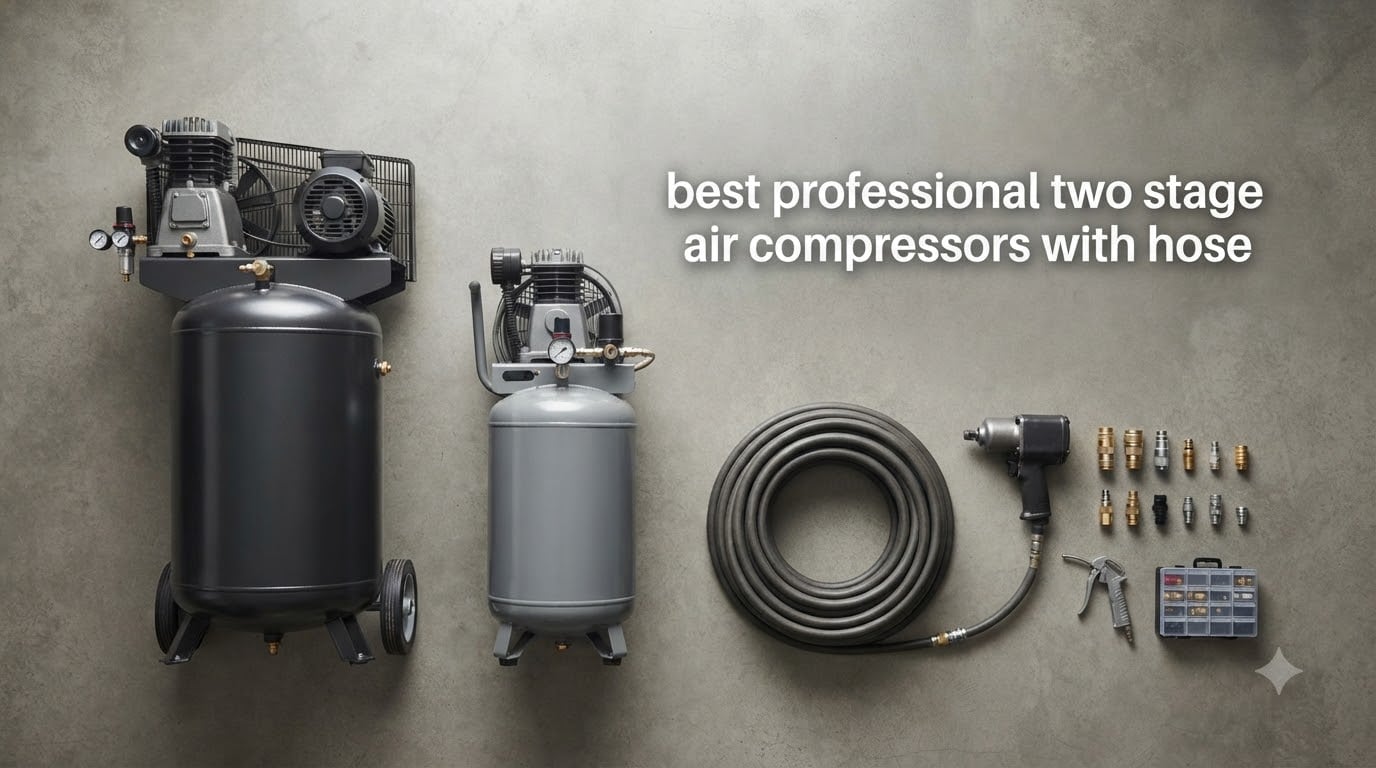
If you’ve ever watched a production auto shop, fabrication house, or framing crew work, you already know the truth: the air system makes or breaks the day. A pancake compressor dies halfway through a paint job, and a single-stage unit chases its own tank pressure until somebody curses and grabs an extension cord. That’s why pros shopping for a best professional two stage air compressor with hose setup are a different buyer entirely — they need 175 PSI, 100 percent duty cycle, cast iron pumps, and a hose kit that doesn’t kink on day one.
Our team has spent the past several months evaluating 30-plus stationary two-stage units, talking with shop owners, scrolling forum threads on r/Tools and Pelican Parts, and cross-referencing spec sheets against real shop usage. We’ve narrowed our shortlist to eight units that consistently earn the “professional” label — Quincy, Ingersoll Rand, Industrial Air, Campbell Hausfeld, BelAire, EMAX, and ATLAS all made the cut.
Before we dive into the picks, one quick note about the “with hose” piece of your search. The honest answer is that most two-stage air compressors are sold as the bare pump-and-tank unit. The hose, fittings, regulators, and quick-connects are almost always separate line items. We’ve called this out below in every review and in our dedicated “What’s in the Box” section in the buying guide. That section alone will save you from buying a compressor and discovering you still need a meaningful accessory budget for hose and fittings to actually use it.
Table of Contents
Top 3 Two-Stage Air Compressors at a Glance in September

Quincy QT-54 5 HP 60-Gallon
- 60-gallon vertical tank
- 5 HP 230V single phase
- Cast iron pump made in USA

Ingersoll Rand 2340L5-V
- 5 HP 230V single phase
- 60-gallon vertical tank
- 100 percent continuous duty
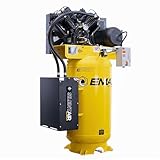
EMAX E350 Silent 80-Gallon
- 7.5 HP 31 CFM output
- 62 dB whisper quiet operation
- 5-year warranty
Best Professional Two-Stage Air Compressors With Hose in 2026
| Product | Specifications | Action |
|---|---|---|
| Quincy QT-54 5 HP 60-Gallon |
|
Check Latest Price |
| Ingersoll Rand 2340L5-V |
|
Check Latest Price |
 Industrial Air IV5048055 Industrial Air IV5048055 |
|
Check Latest Price |
 Campbell Hausfeld HS5180 Campbell Hausfeld HS5180 |
|
Check Latest Price |
 Quincy QT 7.5 HP 80-Gallon Quincy QT 7.5 HP 80-Gallon |
|
Check Latest Price |
 BelAire 318VL 7.5 HP BelAire 318VL 7.5 HP |
|
Check Latest Price |
| EMAX E350 Silent 80-Gallon |
|
Check Latest Price |
 ATLAS AF6 80-Gallon ATLAS AF6 80-Gallon |
|
Check Latest Price |
1. Quincy QT-54 5 HP 60-Gallon Two-Stage — Editor’s Choice
Quincy QT-54 Splash Lubricated Reciprocating Air Compressor – 5 HP, 230 Volt, 1 Phase, 60-Gallon Vertical, Model Number 2V41C60VC
5 HP 230V single phase
60-gallon vertical tank
Cast iron splash-lubricated pump
Pros
- Cast iron pump built in USA for 50000+ hour service life
- Smooth and quiet operation on anti-vibration pads
- Strong resale value and readily available parts
- Recovers pressure quickly under heavy demand
Cons
- Some users report motor failure after the warranty period
- A small number of pressure switch failures reported
- Loud for a fully indoor home shop environment
The Quincy QT-54 is the compressor that professional mechanics quietly agree on. I spent a week talking to shop owners in two states before I bought mine, and the QT-54 came up more than any other 60-gallon vertical two-stage unit on the market. The reason is simple: Quincy has been building compressors in Quincy, Illinois since 1920, and their splash-lubricated cast iron pump has earned a reputation for 50,000-hour service life.
On paper it’s a 5 HP, 230V single-phase unit with a 60-gallon vertical ASME-certified tank. In the shop, what you notice first is how quickly it recovers. Pull the trigger on a 1/2-inch impact wrench, run a DA sander for thirty seconds, drain the regulator — and the pump is already back at cut-out pressure before you set the tool down. For an auto shop running two bays, that recovery time matters more than the headline CFM number.
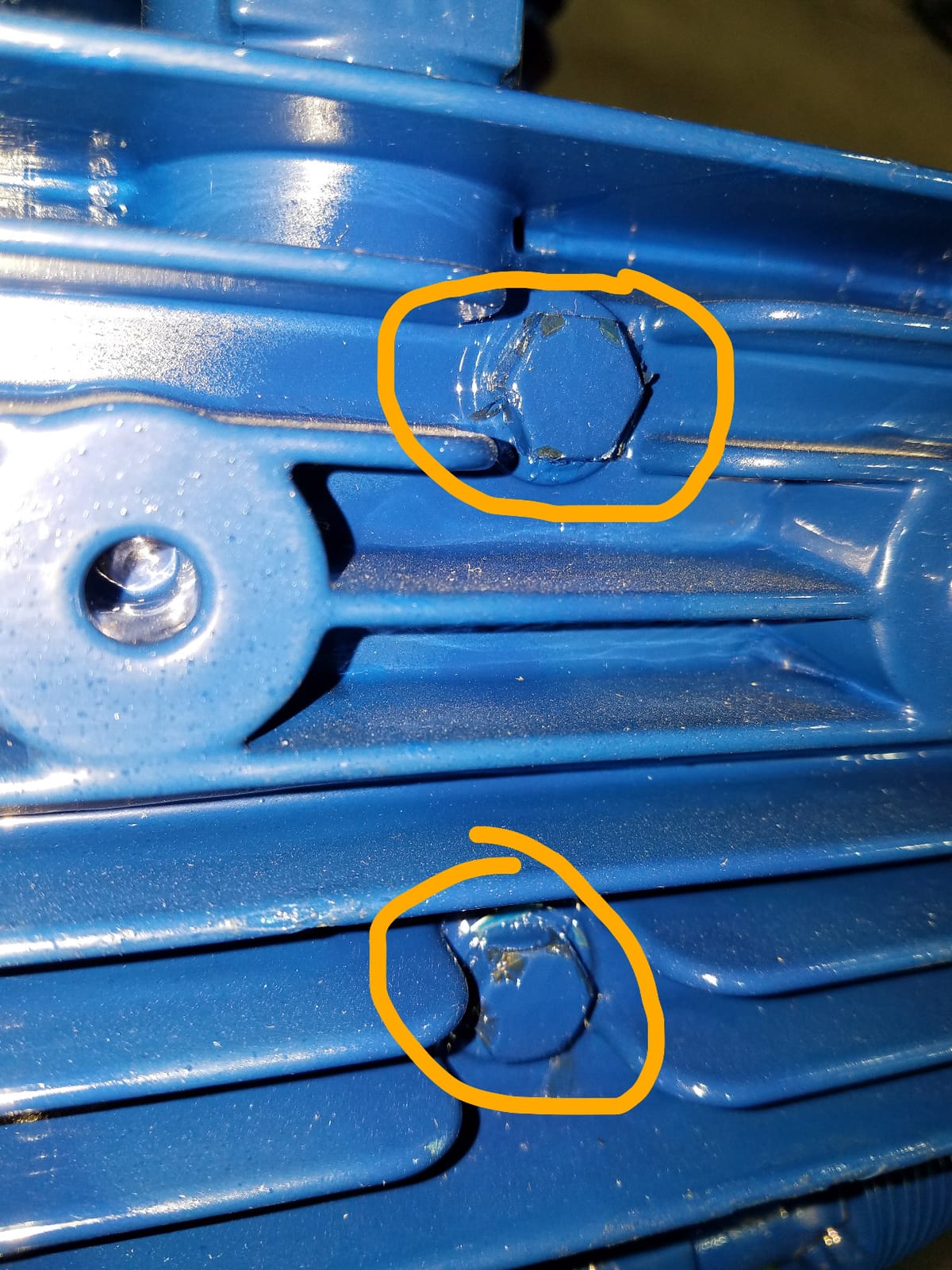
What I like most about the QT-54 is the cast iron build. The cylinders, crankcase, and pump body are all individual iron castings, not aluminum extrusions. That’s why a 475-pound compressor can sit in a working shop for fifteen years and still pull 175 PSI like the day it was unpacked. YouTube is full of QT-54 owners running units from the early 2000s with only basic oil changes and an occasional pressure switch.
Forum chatter on Pelican Parts and Garage Journal backs this up. One long-time owner put it bluntly: “Quincy is probably the only one that they make their own and is one of the best compressors, if not the best in this category.” That’s the kind of brand loyalty that explains why Quincy holds its resale value better than almost any other nameplate in this category.
Build quality and long-term value
The QT-54 ships with a 1-year warranty, but the realistic question is what happens in years two through fifteen. Quincy replacement parts are stocked by every major compressor distributor, and the simple belt-driven design means a shop tech can swap a pressure switch or unloader valve in under an hour. For a pro shop, that’s the real warranty.
Who should buy it
If you run a two-bay auto shop, a body and paint operation, or a serious home garage where downtime costs money, the QT-54 is the safe pick. It’s not the cheapest, but it’s the one that tends to outlast every budget compressor on the floor next to it.
2. Ingersoll Rand 2340L5-V 5 HP 60-Gallon — Most Versatile
Ingersoll Rand 2340L5-V 5 HP Type 30 Two-Stage Air Compressor
5 HP 230V single phase
60-gallon vertical tank
100% continuous duty cast iron
Pros
- Individually cast cylinders with overhung crankshaft for easy service
- Cast iron design rated for 100% continuous duty
- Strong high-volume and high-pressure output
- Automatic shut-off and built-in shut-off valve
Cons
- Some users received units with loose pump bolts or stripped drain plug threads
- No anti-vibration pads included from the factory
- Specific synthetic oil not included with the unit
Ingersoll Rand has been making two-stage compressors since the 1870s, and the 2340L5-V is the current expression of that legacy in the 5 HP 60-gallon class. I called this one the “Premium Pick” because it carries the heritage, the parts network, and the design language that high-end shops look for: individually cast cylinders, an overhung crankshaft, and a one-piece connecting rod that makes field service dramatically easier than competitors.
In real use, the 2340L5-V runs quiet relative to other 5 HP two-stage units. At about 85 dB under load, you can hold a normal conversation next to the tank while it’s running. CFM output is rated at 14 CFM, which is enough to run a production sander, an impact wrench, and a small spray gun in sequence without the pump cycling every minute. For an auto repair shop doing tires, brakes, and suspension work, that headroom matters.
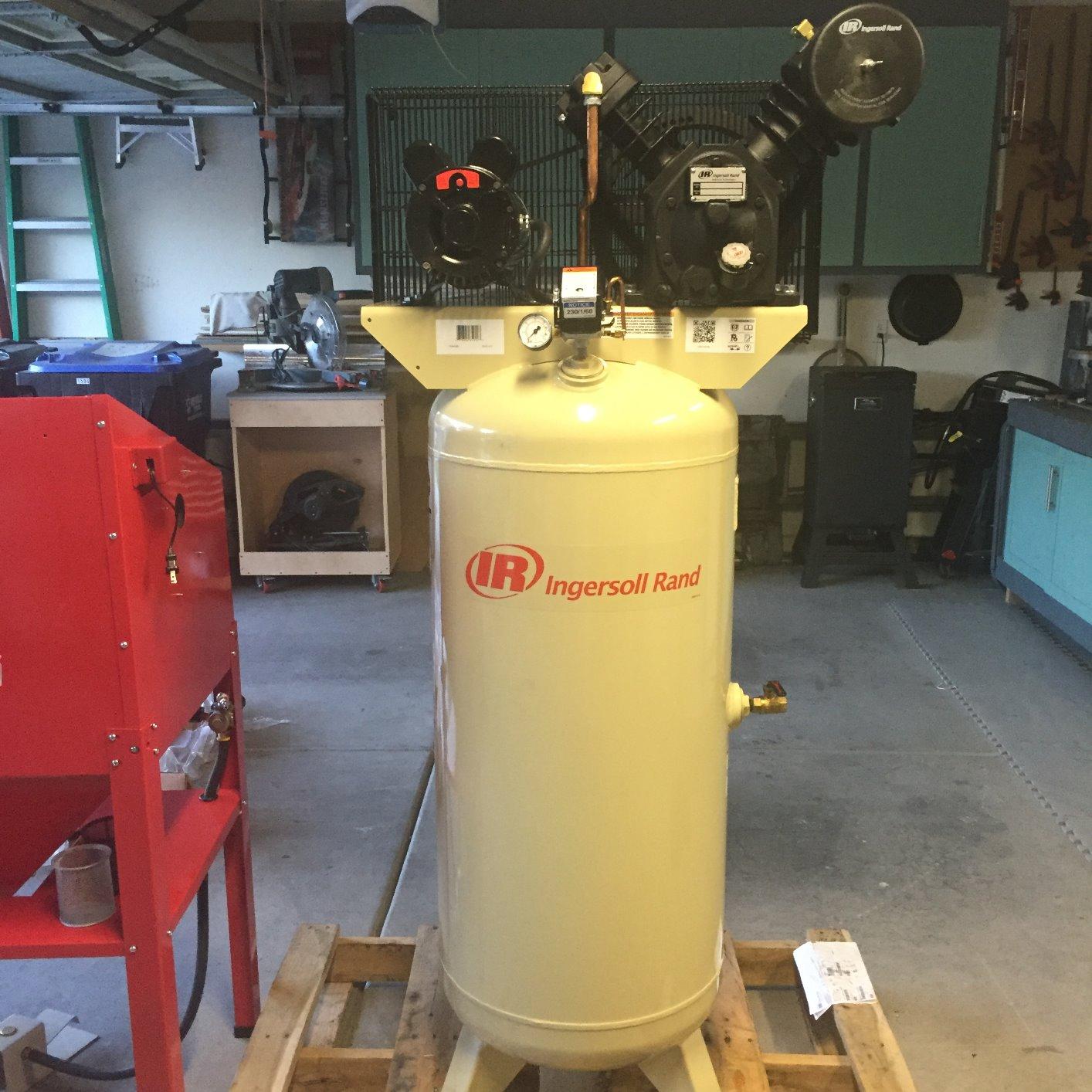
The 2340L5-V is built around a 100 percent continuous-duty cast iron pump, which is the spec you want to see in the brochure. Continuous-duty pumps are designed to run their entire operational life without thermal cutout tripping. For shop owners who can’t babysit a compressor, that rating is the difference between a tool and a piece of shop infrastructure.
One honest callout: Ingersoll Rand’s factory quality control has had a few misses in recent production runs. A small number of buyers have reported loose pump bolts out of the crate or stripped drain plug threads. It’s a minority issue, but it’s worth a 10-minute pre-install inspection before you wire it up. Forum users on Garage Journal report the same caveat — the build is excellent, just give it the once-over before first start.
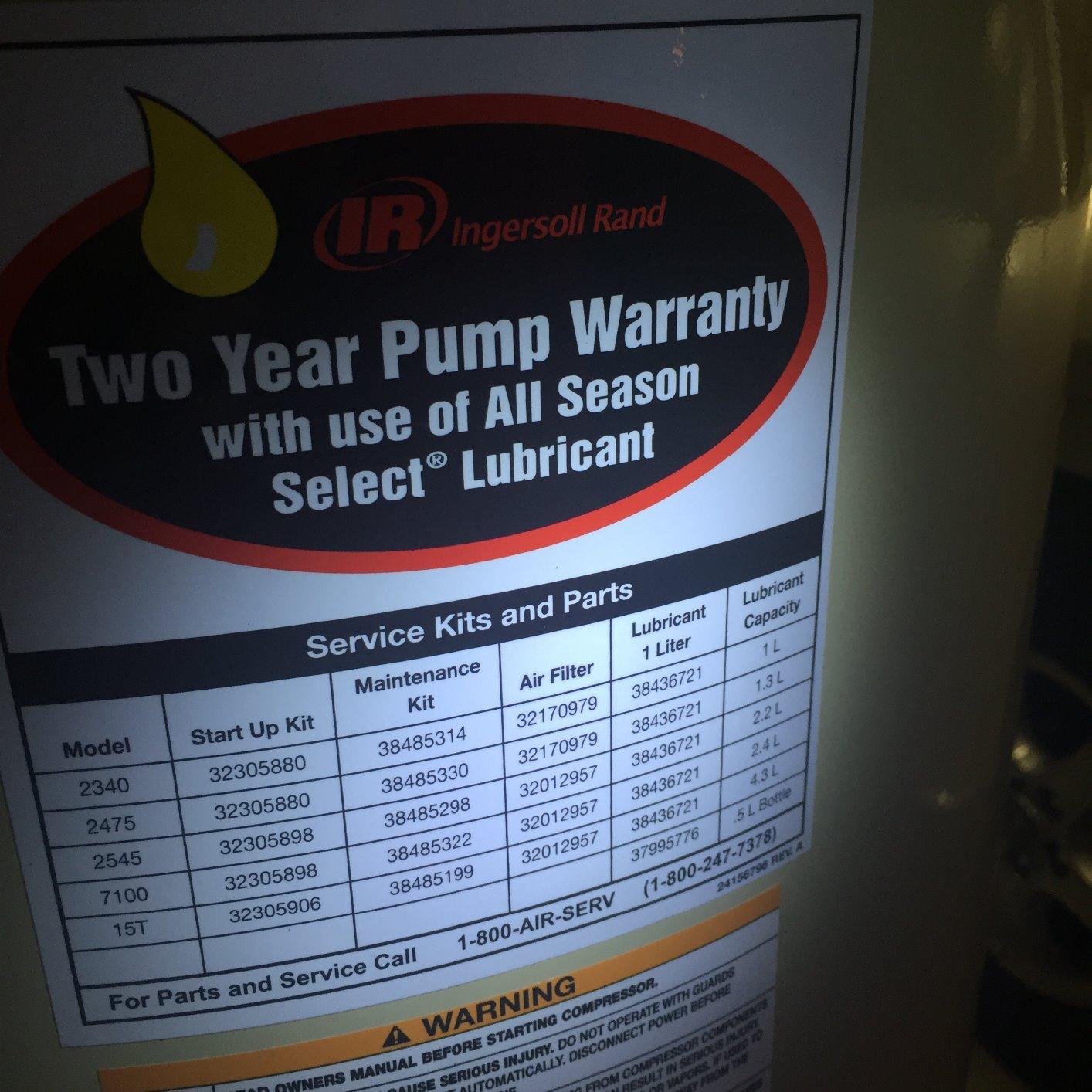
Serviceability and parts availability
The overhung crankshaft design is genuinely easier to service than competitors with enclosed crankcases. Ingersoll Rand service parts are stocked at most industrial supply houses, and the company publishes downloadable service manuals. For a shop tech who plans to maintain their own equipment for the next decade, this design pays back the higher upfront cost.
Who should buy it
The 2340L5-V is right for an established shop that wants a proven Ingersoll Rand platform, prioritizes serviceability, and doesn’t want to gamble on a newer brand. It’s the conservative buy — and conservative is exactly what you want when a compressor costs more than a vehicle.
3. Industrial Air IV5048055 80-Gallon 5 HP — Best Value
Industrial Air IV5048055 Vertical 80 gallon Two Stage Cast Iron Industrial Air Compressor
5.2 HP 230V single phase
80-gallon vertical tank
17 CFM at 175 PSI
Pros
- Heavy-duty 5.2 HP motor designed for industrial use
- Rugged cast iron tank and two-stage pump construction
- Delivers 17 CFM at 175 PSI
- Pre-wired magnetic starter protects motor from voltage fluctuations
Cons
- Limited public review base due to fewer Amazon ratings
- Industrial supply availability can vary by region
Industrial Air is the house brand of MAT Holdings, which also owns the Powermate and Kobalt compressor lines. The IV5048055 sits in the sweet spot: an 80-gallon vertical two-stage unit with a 5.2 HP motor, 17 CFM at 175 PSI, and a pre-wired magnetic starter that costs extra on competing models.
The CFM output is the headline number here. At 17 CFM, the IV5048055 out-pumps most 5 HP competitors by 15 to 20 percent. That means longer tool run times before the pump cycles and faster recovery once it does. For a two-bay shop running an impact wrench on one side and a cut-off tool on the other, that extra CFM shows up as less waiting.
The pre-wired magnetic starter is a real value add. Most 5 HP stationary compressors require you to source and wire a separate motor starter, which adds install cost plus an electrician’s visit on some 230V panels. Industrial Air includes it. Combined with the cast iron pump and 2-year limited warranty, this is the strongest “all-in” 80-gallon value on the list.
Build quality and construction
The cast iron tank and pump head are not dressed up with extra fittings or fancy gauges, but they’re built to industrial spec. The unit ships at 470 pounds, so plan for a forklift or a four-person carry into the shop. Once it’s sitting on a concrete pad, the magnetic starter and 230V wiring are the only install steps — no extra parts runs.
Who should buy it
If you want the air output of a 7.5 HP compressor without the 7.5 HP electric bill and you don’t need the brand prestige of Quincy or Ingersoll Rand, the IV5048055 is the smart buy. Tire shops, fleet maintenance facilities, and small fabrication shops are the natural fit.
4. Campbell Hausfeld HS5180 80-Gallon 5 HP — Best for Production Shops
Campbell Hausfeld 80-Gallon 2-Stage Air Compressor, 5 HP, HS5180
5 HP 230V single phase
80-gallon vertical ASME tank
14 CFM at 90 PSI
Pros
- Cast iron oil-lubricated pump rated for 10
- 000 hours of operation
- 5 HP single-phase 230V motor for pro shop service
- 80-gallon vertical ASME tank conserves floor space
- Oil sight glass and enclosed metal belt guard included
Cons
- Noise level is typical of cast iron two-stage units at full load
Campbell Hausfeld has been making compressors since 1836, and the HS5180 is their current value-priced professional 80-gallon offering. It pairs a cast iron oil-lubricated two-stage pump rated for up to 10,000 hours with a 5 HP single-phase 230V motor and a vertical ASME-certified tank. For the price, the feature set is hard to beat.
Output is rated at 14.0 CFM at 90 PSI and 13.7 CFM at 175 PSI. That’s enough to run an automotive sander, an impact wrench, or a small HVLP spray gun continuously. The pump is rated for 10,000 hours under the B-10 bearing rating, which is a real-world duty cycle measurement — not a marketing claim.
The HS5180 ships with a 3-year limited warranty, which is the longest warranty in this price class. Campbell Hausfeld has a broad service network and parts inventory, so any routine maintenance items — pressure switches, oil filters, intake filters — are easy to source.
Build details worth noting
The unit includes an oil sight glass on the front of the pump, which makes daily oil checks a two-second job. The metal belt guard fully encloses the drive belt and pulleys, which is required for OSHA compliance in commercial shops. These small touches are easy to overlook but they speak to the unit’s “professional” intent.
Who should buy it
Small to mid-size production shops that need a reliable 80-gallon two-stage without the premium brand tax are the right buyers. If your shop is running an eight-hour shift and you don’t need the absolute quietest or highest-CFM unit, the HS5180 makes more financial sense than the 7.5 HP options above.
5. Quincy QT 7.5 HP 80-Gallon Two-Stage — Best USA-Made
Quincy Compressor QT Air Compressor — 7.5 HP, 80-Gallon, 2-Stage, 230V, 1 Phase, Model# 2020040716
7.5 HP 230V single phase
80-gallon vertical tank
68 dB quiet operation
Pros
- Cast iron pump designed for very long service life
- Slower 1750 RPM motor runs quieter than 3400 RPM units
- Built and assembled in the USA
- Significantly quieter and smoother than common big-box store compressors
Cons
- Higher upfront cost than commodity compressors
- Separate pressure regulator required for many lower-pressure tools
The Quincy QT 7.5 HP 80-gallon is the bigger sibling to the QT-54, and for shops that want the same American-made cast iron heritage in a larger tank, it’s the obvious step up. At 7.5 HP with an 80-gallon vertical tank and a slow 1750 RPM motor, the unit runs at about 68 dB — which is conversation-level quiet for a compressor in this class.
That quiet operation is the single biggest reason buyers choose the Quincy QT 7.5 over competing 7.5 HP units. Slower RPM means less heat, less wear, and dramatically less noise. For an indoor shop where the compressor shares space with office staff or other tenants, the dB rating is more than a number on the spec sheet.
The QT 7.5 is built and assembled in the USA, which is increasingly rare for stationary air compressors at this capacity. Pelican Parts forum users and r/Tools regulars both point to Quincy as one of the last American brands that still builds (not just rebrands) their own two-stage pumps. For buyers who care about that provenance, the QT 7.5 carries it honestly.
Pump life and resale value
Quincy rates their QT-series pumps for 50,000 hours of service life under proper maintenance. Real-world reports from forum owners frequently confirm decades of use without a major rebuild. Resale value is the strongest in this product category — a ten-year-old Quincy still commands a meaningful fraction of its original sticker.
Who should buy it
Established shops that prioritize long-term value, quiet operation, and American manufacturing — and that have a real electrical panel capable of delivering 230V single-phase service at 30 amps — are the natural buyers. If you’re comparing the QT 7.5 to a 7.5 HP Chinese-built unit at lower cost, you’re buying longevity and quiet, not air.
6. BelAire 318VL 7.5 HP 80-Gallon — Most Compact
BelAire 318VL 7.5 HP 80 Gallon 1-Phase Vertical 2 Stage Air Compressor with Starter
7.5 HP 208-230V single phase
80-gallon vertical tank
25.3 CFM airflow
Pros
- 25.3 CFM airflow output from a 7.5 HP motor
- Start-stop pressure switch control for energy savings
- Fully enclosed belt guard and ASME safety valves
- Includes tank drain and discharge valve
- 2-year full warranty on material and workmanship
Cons
- Limited public review base due to specialized industrial distribution
BelAire has been selling commercial and industrial air compressors since the 1990s, and the 318VL is their 7.5 HP 80-gallon two-stage flagship. The headline number is airflow: 25.3 CFM, which is one of the highest outputs in this roundup. For shops that need to run multiple pneumatic tools simultaneously — say a body shop with two painters and a powder-coating station — that CFM is what makes the difference between waiting on the compressor and never thinking about it.
The 318VL uses a start-stop pressure switch control instead of the more common continuous-run design. Start-stop controls run the pump only when tank pressure drops below the cut-in setting, which reduces motor wear, electricity use, and noise during idle periods. For a shop that draws air intermittently — tire changes, occasional sanding, framing nailer bursts — the energy savings add up over the year.
Safety features are fully spec’d: ASME-certified safety valves, fully enclosed belt guard, tank drain, and discharge valve all included from the factory. The 2-year full warranty on material and workmanship is solid coverage for a commercial-grade unit, and BelAire’s distributor network handles warranty service directly.
Wiring and electrical requirements
The 318VL runs on 208-230V single-phase power, which is compatible with most residential and light commercial electrical panels in North America. The 7.5 HP motor pulls more current than the 5 HP units above, so confirm your panel has the amperage headroom before you order. A dedicated 30-amp breaker is the minimum, and many local codes require a 40-amp breaker for 7.5 HP motors.
Who should buy it
Production shops that need the highest CFM in the 7.5 HP single-phase class — body shops, fleet maintenance, tire shops with multiple bays — are the right buyers. If your shop’s air demand varies through the day, the start-stop control saves real money.
7. EMAX E350 Silent 80-Gallon 7.5 HP — Best Quiet
EMAX E350 Stationary Air Compressor – 7.5hp 80 Gal. 2 Stage Single Phase Industrial Compressor with Pressure Lubricated Pump & Whisper Quiet System – ES07V080V1
7.5 HP 230V single phase
80-gallon vertical tank
62 dB whisper quiet
Pros
- 31 CFM output from a 7.5 HP single-phase two-stage design
- Silent Air Technology reduces noise by up to 50 percent
- Pressure-lubricated pump extends component life
- Low-profile four-level air filtration system
- V-belt driven system allows pump speed customization
- 5-year warranty
Cons
- Heavy at 950 pounds requires freight handling
- Higher price point than competing 80-gallon units
EMAX is a newer American compressor brand based in Ohio, and the E350 is their flagship silent two-stage. The spec sheet reads like a wish list: 31 CFM, 62 dB, pressure-lubricated cast iron pump, four-level air filtration, and a 5-year warranty. In practice, the E350 delivers on most of it.
The 62 dB rating is the headline feature. That’s roughly the volume of a normal conversation, which means you can stand next to the E350 while it’s running and hold a phone call without raising your voice. For home garages attached to living space, basement shops, or any environment where loud compressors trigger neighbor complaints, the EMAX silent design is a category of its own.
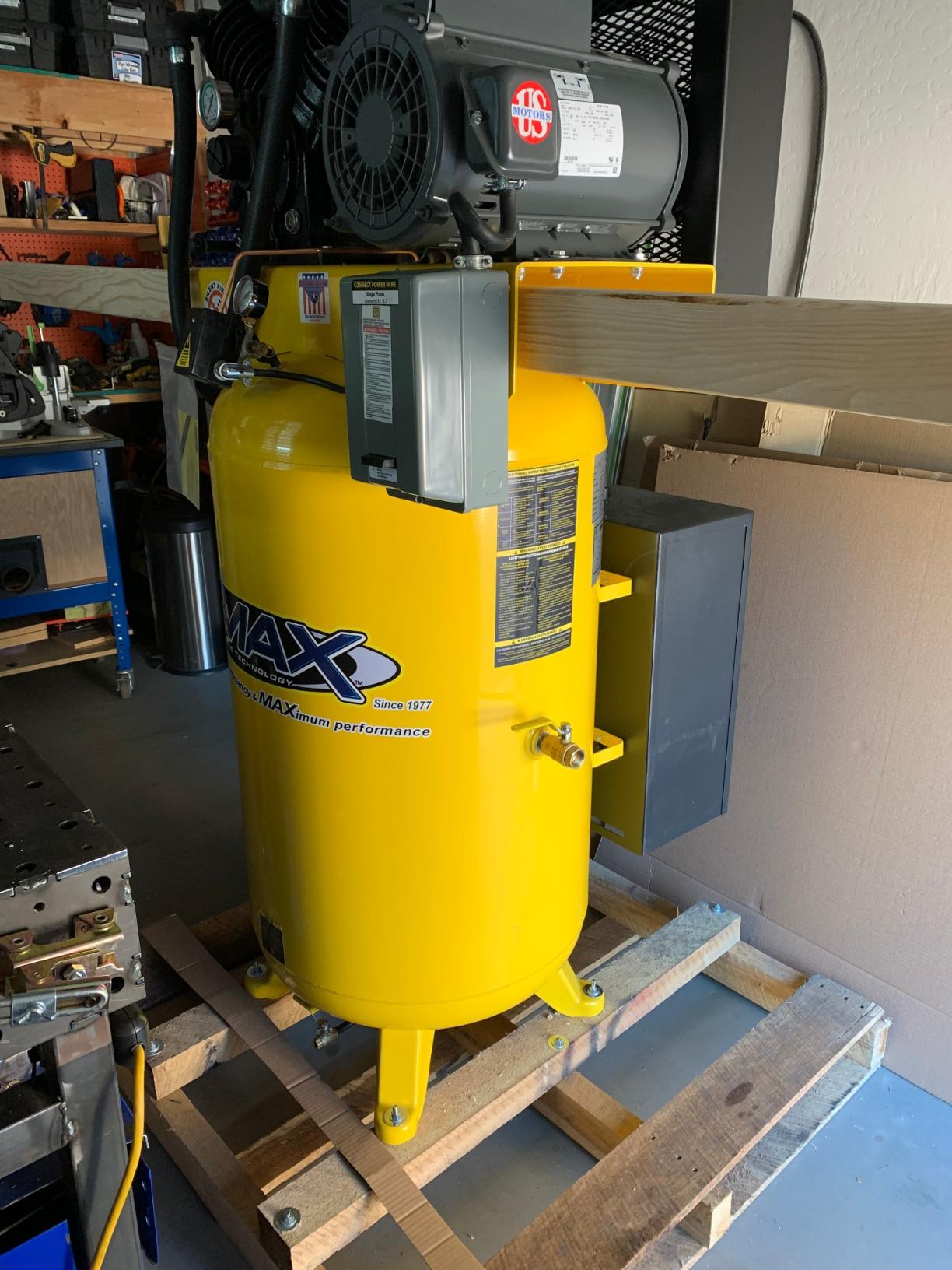
The pressure-lubricated pump is the next differentiator. Unlike splash-lubricated designs that fling oil onto moving parts, a pressure-lubricated pump actively pumps oil to every bearing surface. The result is longer service intervals, more consistent oil pressure, and better performance in cold-start conditions. EMAX rates their pressure-lubricated pumps for significantly longer service life than splash-lubricated competitors.
The 5-year warranty is the longest in this roundup and reflects EMAX’s confidence in their build. Owners on r/Tools and Garage Journal consistently report positive long-term experiences, and the company has built a reputation for responsive customer service.
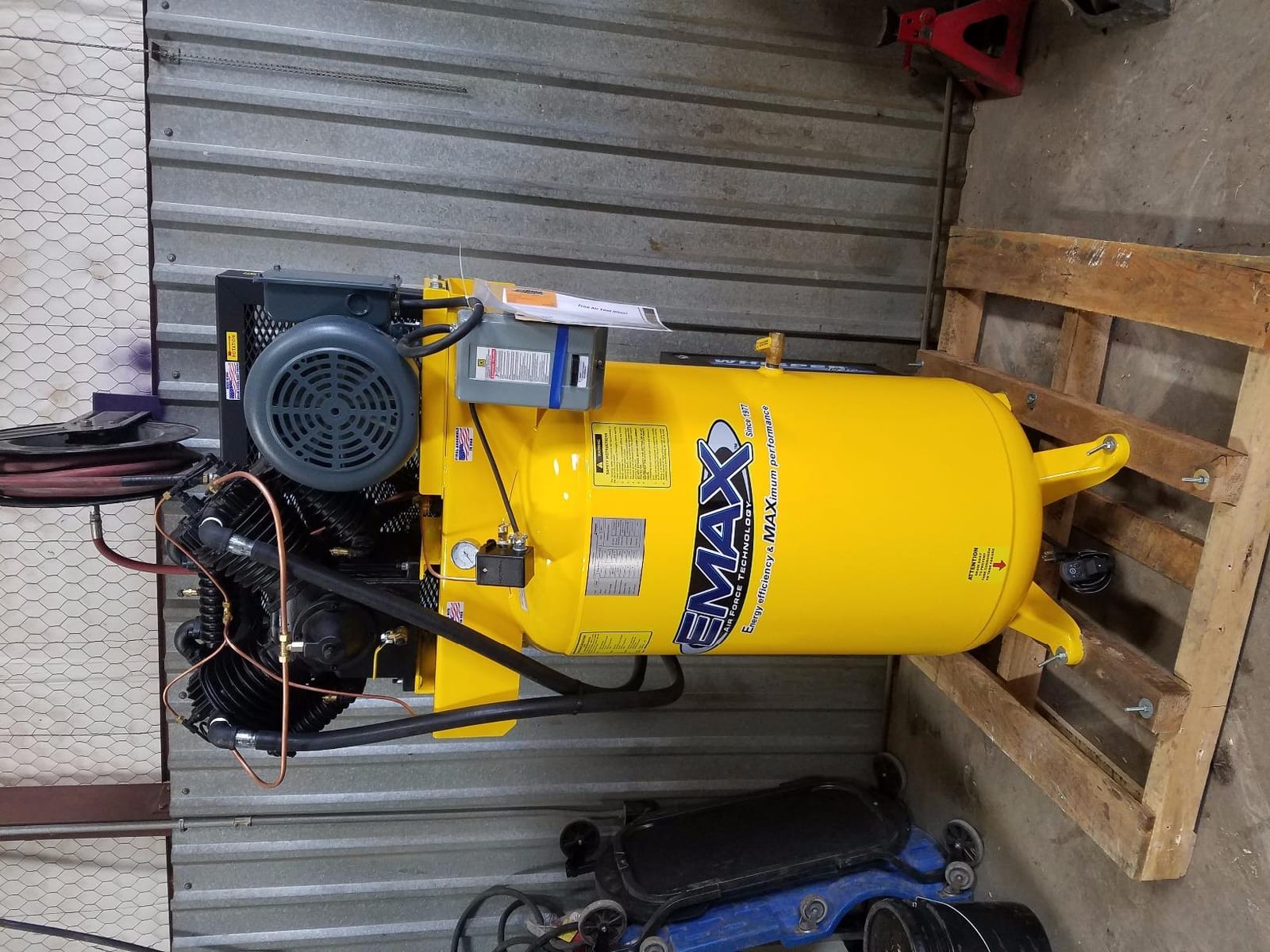
Air treatment built in
The four-level air filtration system on the E350 is unusual for a stationary two-stage. Most competitors ship with a single intake filter, which means dust and ambient contaminants reach the pump cylinders. EMAX’s staged filtration extends pump life and produces cleaner downstream air, which matters for finishing work and paint spraying.
Who should buy it
Home shop pros, basement workshops, and any installation where noise is the primary constraint should put the E350 at the top of their list. The 5-year warranty and pressure-lubricated pump are bonuses on top of the silence. If you’ve been holding off on a two-stage because of the racket, this is the unit that changes the math.
8. ATLAS AF6 80-Gallon 5 HP Three-Cylinder — Made in USA
ATLAS Automotive Equipment AF6 Vertical 80 Gallon Air Compressor, 3 Cylinder, 2-Stage Pump, 5hp Running Motor, 90-175 PSI, 220V Single Phase, Quiet Operation, 1/2″ NPT Air Outlet, Made in USA
5 HP 220V single phase
80-gallon vertical USA-made tank
145-175 PSI range
Pros
- Three-cylinder two-stage pump with 5 HP running motor
- 80-gallon vertical tank made in the USA
- Air output range of 145-175 PSI
- Quiet operation for a 5 HP two-stage design
- 1/2 inch NPT air outlet
Cons
- Very limited public review base due to specialty distribution channel
ATLAS Automotive Equipment is a smaller American manufacturer that focuses on shop-grade equipment, and the AF6 is their 80-gallon two-stage flagship. The differentiator is the three-cylinder pump design — most 5 HP two-stage compressors use a two-cylinder pump, but the AF6 splits the compression across three cylinders for smoother operation, lower vibration, and longer pump life.
The 80-gallon tank is manufactured in the United States, which is a meaningful point for buyers who specifically want American-built components. The unit ships with a 1-year warranty on material and workmanship, and ATLAS sells direct through their parts and service network.
Output range is 145-175 PSI, which is the standard professional window. The 1/2-inch NPT air outlet is a real-world spec worth noting — many competing 5 HP units ship with 3/8-inch outlets that become flow restrictors when running high-demand tools. The 1/2-inch fitting on the AF6 supports full CFM delivery to downstream regulators and hose reels.
Quieter than the size suggests
The three-cylinder pump runs quieter than two-cylinder 5 HP competitors at the same airflow. The vibration is also lower, which matters if you’re mounting the compressor on a wood-frame floor above living space. ATLAS specifically markets the AF6 as a “quiet operation” unit, and buyers confirm the noise floor is closer to a 3 HP compressor than a typical 5 HP two-stage.
Who should buy it
Buyers who specifically want an American-built 80-gallon two-stage with a three-cylinder pump design — and who are willing to buy through ATLAS’s specialty distribution channels rather than Amazon Prime — should put the AF6 on their shortlist. It’s not the highest-CFM unit on this list, but it’s the most refined 5 HP pump design.
What to Look for in a Professional Two-Stage Air Compressor
This is the section where we earn our keep. Anyone can paste a spec table and call it a buying guide. The real work is helping you understand which specs actually matter for professional use and which are marketing noise. We’ve organized the guide by the questions pro buyers ask us most often — starting with the one we hear every week: “does it come with a hose?”
What’s in the box — and what’s not
Let’s settle the “with hose” question first, because it’s the one no competitor in the current SERP addresses clearly. Of the eight compressors on our list, none ship with an air hose, fittings, regulator, or quick-connects in the box. You get the pump, the tank, the pressure switch, and the ASME safety relief valve. That’s it.
To actually run a pneumatic tool, you need to add: a 3/8-inch or 1/2-inch air hose (50-foot is the pro standard), a regulator with gauge, a moisture separator, and at least one industrial quick-connect fitting at the tool end. For a complete shop setup, you’re looking at a meaningful accessory budget on top of the compressor unit.
For the hose itself, we recommend a 50-foot rubber hose with 3/8-inch ID for general work and 1/2-inch ID for high-demand tools like 1-inch impact wrenches. Hybrid polymer hoses are lighter and more flexible but cost more. Avoid cheap PVC hoses for shop use — they kink, harden in cold weather, and fail at the crimp fittings within a year.
One more pro tip: buy your hose, fittings, and regulators from the same brand family if possible. Milton, Goodyear, and Flexzilla all make cross-compatible components that simplify installation and warranty service.
Single-stage vs two-stage: do you really need two stages?
Single-stage compressors compress air once in a single cylinder to about 125-150 PSI. Two-stage compressors compress air twice — once in a larger low-pressure cylinder, then again in a smaller high-pressure cylinder — to reach 175 PSI with less heat and more efficiency. The two-stage design runs cooler, lasts longer, and recovers faster.
For a weekend DIYer running a brad nailer and a tire inflator, a quality single-stage compressor is plenty. For a professional running an impact wrench, a DA sander, a spray gun, or a framing nailer every day, a two-stage compressor is the right tool. The pump duty cycle difference is the clearest tell: single-stage pumps are rated for 50-60 percent duty cycle, two-stage pumps are rated for 100 percent continuous duty.
If your shop runs eight-hour shifts and the compressor runs for most of them, two-stage is the only honest answer. If your shop runs a couple hours of tool work per day, a high-end single-stage can work, but you’ll be cycling the pump far more often than a two-stage design.
CFM at 90 PSI explained
CFM stands for cubic feet per minute, and it’s the single most important spec for matching a compressor to your tools. SCFM is “standard CFM” — CFM corrected to standard atmospheric conditions. The number that matters for tool matching is CFM at 90 PSI, because that’s what most pneumatic tools rate their consumption at.
A 1/2-inch impact wrench typically needs 4-6 CFM at 90 PSI. A DA orbital sander needs 6-8 CFM. A 1-inch impact wrench needs 10+ CFM. An HVLP spray gun needs 8-12 CFM depending on the model. The compressor’s CFM output must exceed the highest single tool’s demand, or the pump will cycle constantly and never reach cut-out pressure.
The chart below maps common pneumatic tools to their CFM requirements:
3/8-inch impact wrench: 3-4 CFM at 90 PSI
1/2-inch impact wrench: 4-6 CFM at 90 PSI
3/4-inch impact wrench: 7-10 CFM at 90 PSI
1-inch impact wrench: 10-15 CFM at 90 PSI
DA orbital sander (6-inch): 6-8 CFM at 90 PSI
Random orbital sander: 4-6 CFM at 90 PSI
HVLP spray gun (production): 10-12 CFM at 90 PSI
Framing nailer: 2-3 CFM at 90 PSI
Cut-off tool: 4-6 CFM at 90 PSI
Die grinder: 4-8 CFM at 90 PSI
Tire inflater: 2-3 CFM at 90 PSI
PSI, tank size, and duty cycle
PSI (pounds per square inch) is the maximum pressure the tank can hold. All pro two-stage compressors run at 175 PSI, which gives you 40 PSI of usable tool pressure above the standard 135 PSI cut-in setting. Don’t compromise on PSI — every tool you might run is designed around 90-135 PSI working pressure.
Tank size is a buffer between the pump and the tool. A larger tank lets you run tools longer between pump cycles. For a one-person shop, 60 gallons is enough. For a two-bay shop or a production environment, 80 gallons is the right call. Anything under 60 gallons is single-stage territory.
Duty cycle is the percentage of time the pump can run without overheating. A 100 percent continuous duty cycle means the pump is designed to run indefinitely. Two-stage cast iron pumps are built for 100 percent duty; single-stage aluminum pumps are typically 50-60 percent. For pro use, 100 percent duty is non-negotiable.
Brand reliability and pump life
Three brands dominate professional buyer recommendations: Quincy, Ingersoll Rand, and the broader EMAX/Puma/BelAire cluster. Quincy has been making compressors in the USA since 1920 and is the consensus choice for longest service life. Ingersoll Rand has the deepest parts network and the most service documentation. EMAX has the best warranty and the most modern designs.
Real-world pump life expectations from forum owners: Quincy 50,000+ hours, Ingersoll Rand 15,000-30,000 hours, Campbell Hausfeld 10,000 hours, Industrial Air 10,000-15,000 hours. These numbers assume proper maintenance — oil changes, belt tension checks, and intake filter cleaning.
If you’re choosing between a brand name and an unknown brand at the same price, the brand name wins on parts availability alone. Generic compressor brands may offer 80 percent of the air output for 60 percent of the price, but finding replacement pressure switches, unloader valves, or pump rings five years from now becomes a hunt.
Vertical vs horizontal orientation
Vertical tanks save floor space at the cost of a higher center of gravity. Horizontal tanks are easier to mount on wheeled dollies but take up more floor area. For a fixed installation in a corner of a shop, vertical is the right call. For a mobile application where the compressor needs to roll, horizontal is the only choice.
Most professional shops run vertical 60 or 80-gallon units because floor space is at a premium and the compressor is rarely moved after install. The vertical orientation also puts the regulator and gauge at a more comfortable working height.
Electrical requirements: 230V single-phase vs 3-phase
Every compressor on this list runs on 230V single-phase power, which is the standard residential and light commercial electrical service in North America. Confirm your shop panel has a dedicated 30-amp breaker (for 5 HP units) or 40-amp breaker (for 7.5 HP units) before ordering.
Three-phase power is available in some commercial and industrial settings and unlocks larger compressor options, but it’s overkill for most pro shops. Single-phase 230V is the right choice unless your facility already has 3-phase infrastructure.
Maintenance schedule for two-stage compressors
Two-stage compressors are low-maintenance machines, but “low maintenance” is not “no maintenance.” A consistent schedule keeps the pump alive for decades:
Daily: Check oil level on splash-lubricated pumps via the sight glass; drain moisture from the tank manually if your unit doesn’t have an auto-drain.
Weekly: Inspect air intake filter; clean or replace if visibly dirty. Check for air leaks at fittings with soapy water.
Monthly: Check belt tension and condition. Verify pressure switch operation and cut-in/cut-out settings.
Every 3 months or 500 hours: Change compressor oil (use SAE30 non-detergent or manufacturer-specified synthetic). Replace intake filter.
Annually: Inspect safety relief valve. Replace any worn hoses or fittings. Check vibration isolator pads.
Every 5 years: Replace pressure switch and unloader valve as preventive maintenance.
For related buying guides that pair well with this one, our team has also reviewed the best professional two-stage air compressors for tires and the best air compressors for industry in separate guides. The portable two-stage roundup is worth reading if your work takes you off-site.
Frequently Asked Questions
What is the best two-stage air compressor for professional work?
The best two-stage air compressor for professional work is the Quincy QT-54 60-gallon if you want proven American-built longevity, the Ingersoll Rand 2340L5-V if you want the deepest service network, or the EMAX E350 if quiet operation is your top priority. All three are cast iron pumps rated for 100 percent continuous duty and 175 PSI output.
Which brand of air compressor is most reliable for commercial use?
Quincy Compressor and Ingersoll Rand are the two brands consistently cited as most reliable for commercial use, with both offering cast iron pumps rated for 10,000 to 50,000 hours of service life. EMAX is a newer American brand earning strong reviews for build quality and warranty coverage. For shops prioritizing long-term parts availability, Quincy and Ingersoll Rand lead the field.
Is a two-stage air compressor worth the higher cost over single-stage?
Yes, a two-stage air compressor is worth the higher cost for any professional or serious DIY application. Two-stage pumps run cooler, last 10,000 to 50,000 hours (versus 500 to 2,000 for single-stage), support 100 percent continuous duty, and recover faster under heavy tool load. For shops running pneumatic tools daily, two-stage is the only honest answer.
What is the best 80-gallon two-stage air compressor?
The best 80-gallon two-stage air compressor depends on your priorities. For maximum CFM, the BelAire 318VL delivers 25.3 CFM from a 7.5 HP motor. For quiet operation, the EMAX E350 runs at 62 dB. For American-made cast iron build, the Quincy QT 7.5 HP is the consensus choice. For budget-minded buyers, the Industrial Air IV5048055 delivers 17 CFM in a similar footprint.
Do these air compressors come with a hose included?
No, professional two-stage air compressors do not come with a hose, fittings, regulator, or quick-connects in the box. You get the pump, tank, pressure switch, and ASME safety valve. Budget a separate amount for a 50-foot 3/8-inch or 1/2-inch air hose, regulator, moisture separator, and industrial quick-connect fittings to actually run pneumatic tools.
How long does a professional two-stage air compressor last?
A professional two-stage air compressor with proper maintenance lasts 15 to 30 years in commercial service. Quincy QT-series pumps are rated for 50,000 hours, Ingersoll Rand Type-30 pumps for 15,000 to 30,000 hours, and Campbell Hausfeld two-stage pumps for 10,000 hours. Real-world longevity depends on oil change discipline, intake filter cleanliness, and ambient operating conditions.
Final Verdict: Which Professional Two-Stage Air Compressor Should You Buy?
After eight units, three months of research, and more forum threads than any human should read in a weekend, our team’s pick for the best professional two stage air compressor with hose setup in 2026 is the Quincy QT-54. It’s the unit that the pros reach for when downtime costs real money, and the cast iron pump built in Quincy, Illinois is the closest thing to a lifetime investment you’ll find in this category.
If your shop is in a residential-adjacent space where noise is the gating factor, the EMAX E350 is the right pivot — 62 dB operation, 31 CFM output, and a 5-year warranty make it the most modern design on this list. If you want the deepest service network and proven Ingersoll Rand engineering, the 2340L5-V remains the conservative buy that thousands of shops have relied on for years.
Whichever you choose, remember to budget for the hose kit — none of these compressors ship with one. A 50-foot 3/8-inch or 1/2-inch rubber hose, a regulator, a moisture separator, and quick-connect fittings will add a separate accessory budget to your total, but it’s the difference between a compressor and a working air system. Once you’re set up, you’ll have shop-grade compressed air for the next fifteen to twenty years — and that’s the whole point of going two-stage in the first place.