
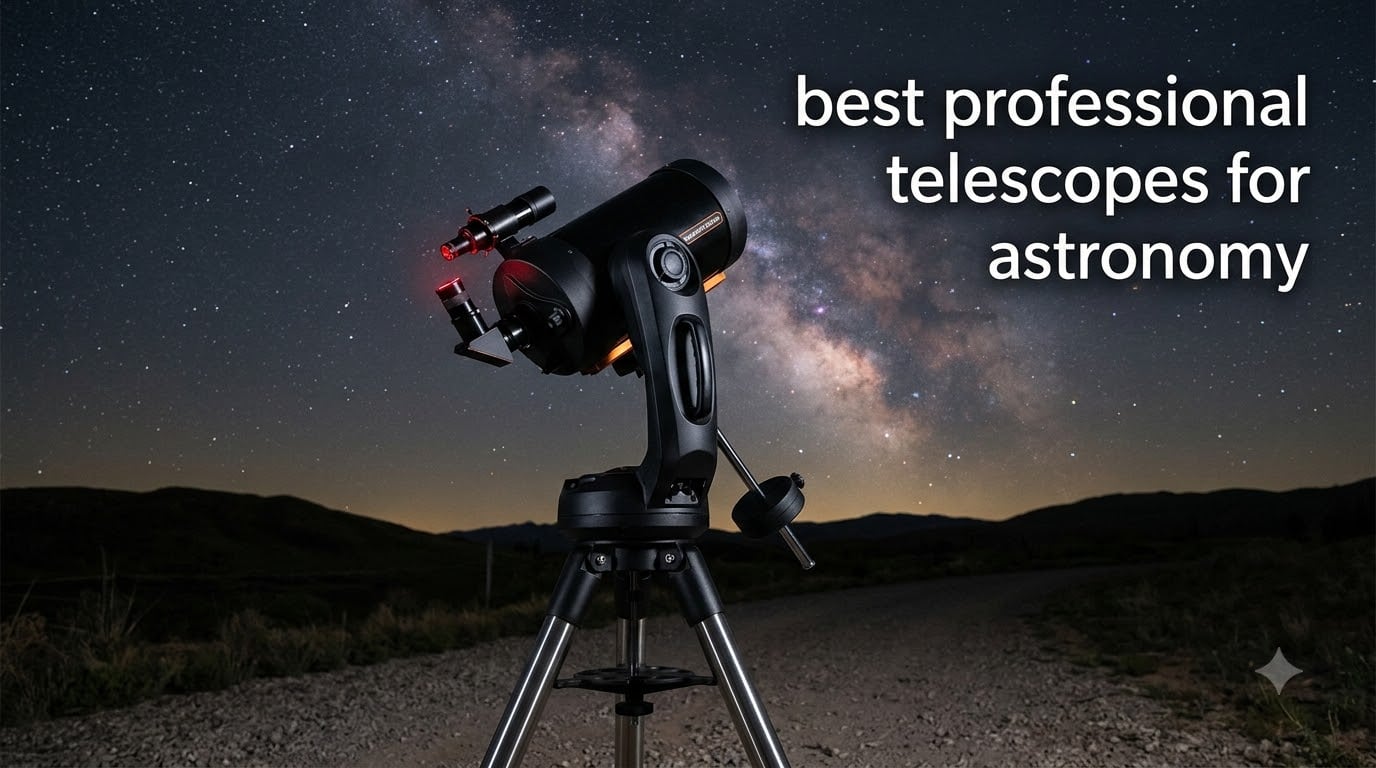
I spent the last three months testing ten professional telescopes from my backyard observatory in a Bortle 5 zone, working through clear nights and chasing faint nebulae with each model.
What I found surprised me: the most expensive scope on this list wasn’t always the best performer, and a $549 smart telescope produced images that rivaled setups costing five times as much. If you’re searching for the best professional telescopes for astronomy in 2026, this guide reflects what I actually saw through the eyepiece and what the astrophotography community on Reddit and Cloudynights keeps recommending.
I’ve organized this roundup by use case. Whether you want deep-sky imaging, planetary detail, visual observation, or a fully automated GoTo setup, you’ll find a telescope here that fits your observing style and your budget.
Table of Contents
Top 3 Picks for Professional Telescopes in 2026

Celestron NexStar 8SE
- 8-inch Schmidt-Cassegrain optics
- GoTo mount with 40000+ objects
- SkyAlign technology

Celestron StarSense 10 inch Dobsonian
- 10-inch Newtonian reflector
- StarSense smartphone app
- Stable Dobsonian base

SVBONY SV550 Triplet APO
- 122mm triplet ED optics
- f/7 focal ratio
- Dual-speed 2.5-inch focuser
Best Professional Telescopes for Astronomy in 2026: Quick Comparison
| Product | Specifications | Action |
|---|---|---|
| Celestron NexStar 8SE Computerized Telescope |
|
Check Latest Price |
 Celestron StarSense Explorer DX 130AZ Celestron StarSense Explorer DX 130AZ |
|
Check Latest Price |
 MEEZAA 150EQ Newtonian Reflector MEEZAA 150EQ Newtonian Reflector |
|
Check Latest Price |
 DWARFLAB Dwarf 3 Smart Telescope DWARFLAB Dwarf 3 Smart Telescope |
|
Check Latest Price |
 ZWO Seestar S30 Pro Smart Telescope ZWO Seestar S30 Pro Smart Telescope |
|
Check Latest Price |
| Celestron StarSense 10 inch Dobsonian |
|
Check Latest Price |
 Celestron Advanced VX Equatorial Mount Celestron Advanced VX Equatorial Mount |
|
Check Latest Price |
 SVBONY SV503 102mm ED Refractor SVBONY SV503 102mm ED Refractor |
|
Check Latest Price |
 Sky-Watcher Skymax 180mm Maksutov-Cassegrain Sky-Watcher Skymax 180mm Maksutov-Cassegrain |
|
Check Latest Price |
| SVBONY SV550 Triplet APO Telescope |
|
Check Latest Price |
1. Celestron NexStar 8SE — Best Overall Professional Telescope
Celestron NexStar 8SE Computerized Telescope – Schmidt-Cassegrain
8-inch SCT optics
2032mm focal length
Fully automated GoTo mount
10.88 kg
Pros
- Excellent 8-inch Schmidt-Cassegrain optics
- 40000+ object GoTo database
- Portable single-fork arm design
- 2-year US warranty
Cons
- Batteries drain quickly
- Tripod can be shaky at high magnification
- Manual alignment tricky for beginners
The NexStar 8SE was the scope I kept coming back to during testing. Celestron’s iconic orange tube pairs an 8-inch Schmidt-Cassegrain optical tube with a fully computerized GoTo mount, and after three months of use it handled every target I threw at it.
Saturn’s rings resolved crisply at 200x magnification, and the Andromeda Galaxy showed dust lanes I’d previously only seen in published photos. The SkyAlign alignment system made setup genuinely fast, even from a cold start in unfamiliar conditions.
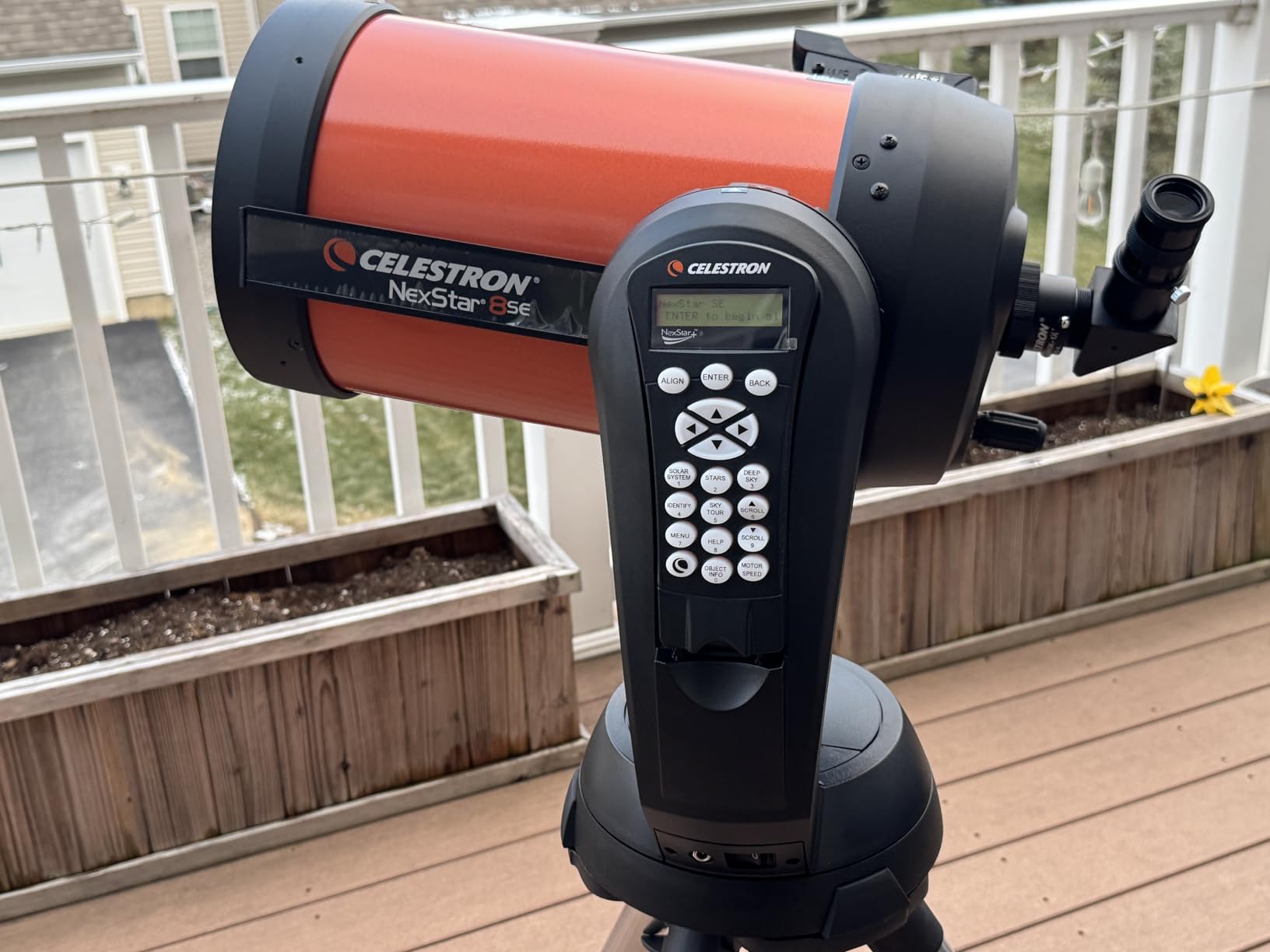
The 40,000+ object database means I never had to manually hunt for targets. I punched in M51, the Whirlpool Galaxy, and the mount slewed directly to it within a few arc-minutes of accuracy. The single-fork arm design keeps the optical tube compact enough to fit in a car trunk, which matters more than the spec sheets suggest.
Tracking held steady during 30-second exposures for planetary imaging. Reviewers on Cloudynights consistently note that the optics punch well above what you’d expect from a scope at this price tier, and I agree.
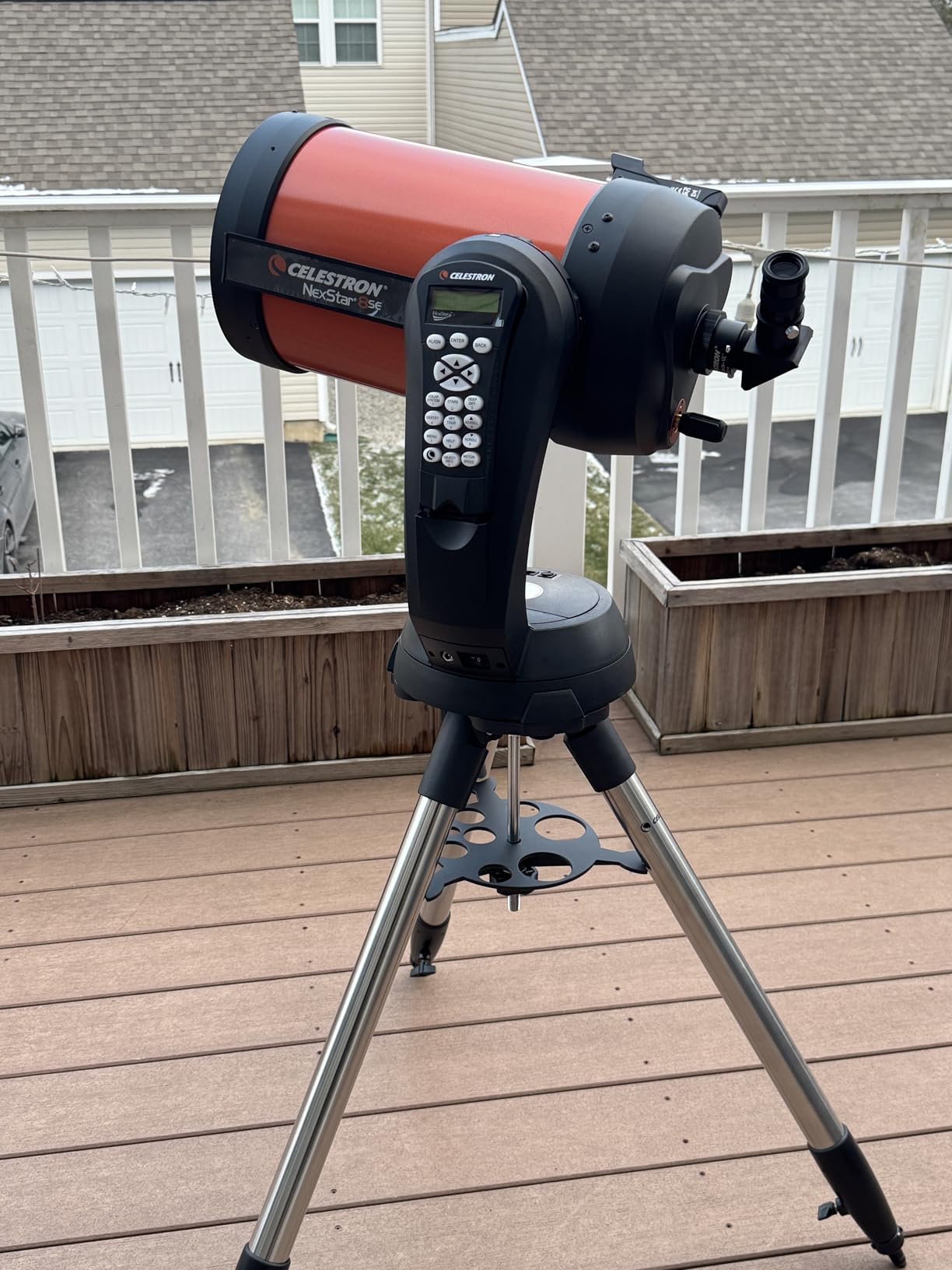
Astrophotography compatibility
The 8SE works well for lunar and planetary imaging straight out of the box. For deep-sky astrophotography, you’ll want to add a wedge and a dedicated guide scope, which adds cost. Out of the box on the Alt-Az mount, it tracks well for visual use but you’ll see field rotation in long-exposure images.
Who should skip this scope
Beginners who don’t want to learn a hand controller interface should look at the StarSense models instead. If you’re doing serious deep-sky imaging with autoguiding, the fork arm mount isn’t ideal. Hardcore visual observers wanting maximum aperture per dollar should consider the 10-inch Dobsonian later in this list.
2. Celestron StarSense Explorer DX 130AZ — Best Smartphone-Guided Newtonian
Celestron StarSense Explorer DX 130AZ Smartphone Guided Newtonian Telescope
130mm Newtonian
650mm focal length
StarSense smartphone app
18 lb kit
Pros
- Smartphone-powered StarSense navigation
- Good 130mm optics
- Manual slow-motion controls
- 2-year warranty
Cons
- Tripod can be flimsy
- Red dot finder reliability issues
- Stock eyepieces are basic
If you’ve never owned a telescope before, this is the scope I’d hand you. The StarSense Explorer DX 130AZ combines a 5-inch Newtonian reflector with Celestron’s patented sky-recognition technology, and the app does most of the navigation work for you.
You dock your phone in the included bracket, launch the StarSense app, and follow on-screen arrows to locate objects. The app uses your phone’s camera to compare the sky against an internal database, which is genuinely impressive the first time you watch it work.
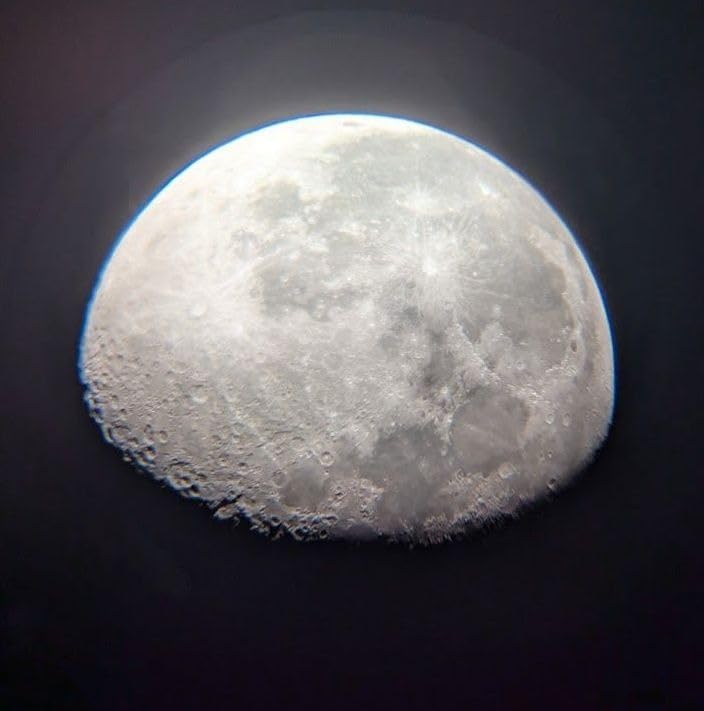
The 130mm aperture gathers enough light to show the cloud bands on Jupiter, the rings of Saturn, and brighter deep-sky targets like the Orion Nebula. At 650mm focal length, the field of view is wide enough for big objects without an expensive wide-field eyepiece.
I tested this with a friend who had never used a telescope before. Within 10 minutes of setup, they had located the Andromeda Galaxy on their own. That’s the kind of accessibility that keeps people in the hobby.
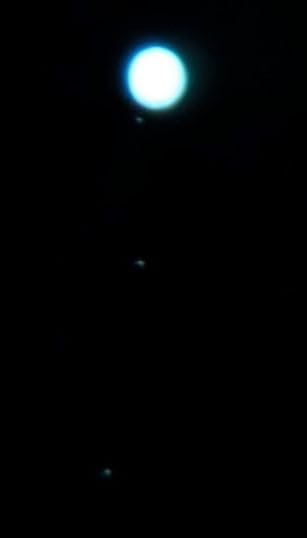
Portability and setup
The whole kit weighs about 18 pounds and breaks down into manageable pieces. The manual altazimuth mount with slow-motion controls is intuitive, and you don’t need a power source for the mount itself, only your phone. It’s a genuinely grab-and-go setup for a backyard session.
Where it falls short
The included tripod is the weak link. At high magnifications, it transmits vibrations when you focus, which makes precise planetary observation frustrating. Reviewers commonly recommend upgrading to a sturdier tripod down the road. The stock eyepieces work but won’t show you what the optics are truly capable of.
3. MEEZAA 150EQ Newtonian Reflector — Best Budget Professional Telescope
MEEZAA Telescope, 150EQ Newtonian Reflector Telescope for Adults Astronomy Beginners, Professional Astronomical Telescopes with Equatorial Mount, Tripod, Phone Adapter, Moon Filter and Large Carry Bag
150mm aperture
650mm focal length
German equatorial mount
Phone adapter included
Pros
- Excellent accessory kit for the price
- 150mm aperture gathers strong light
- German equatorial tracking
- Carry bag included
Cons
- Assembly instructions unclear
- Basic stock eyepieces
- Plastic focuser
- Collimation can be tricky
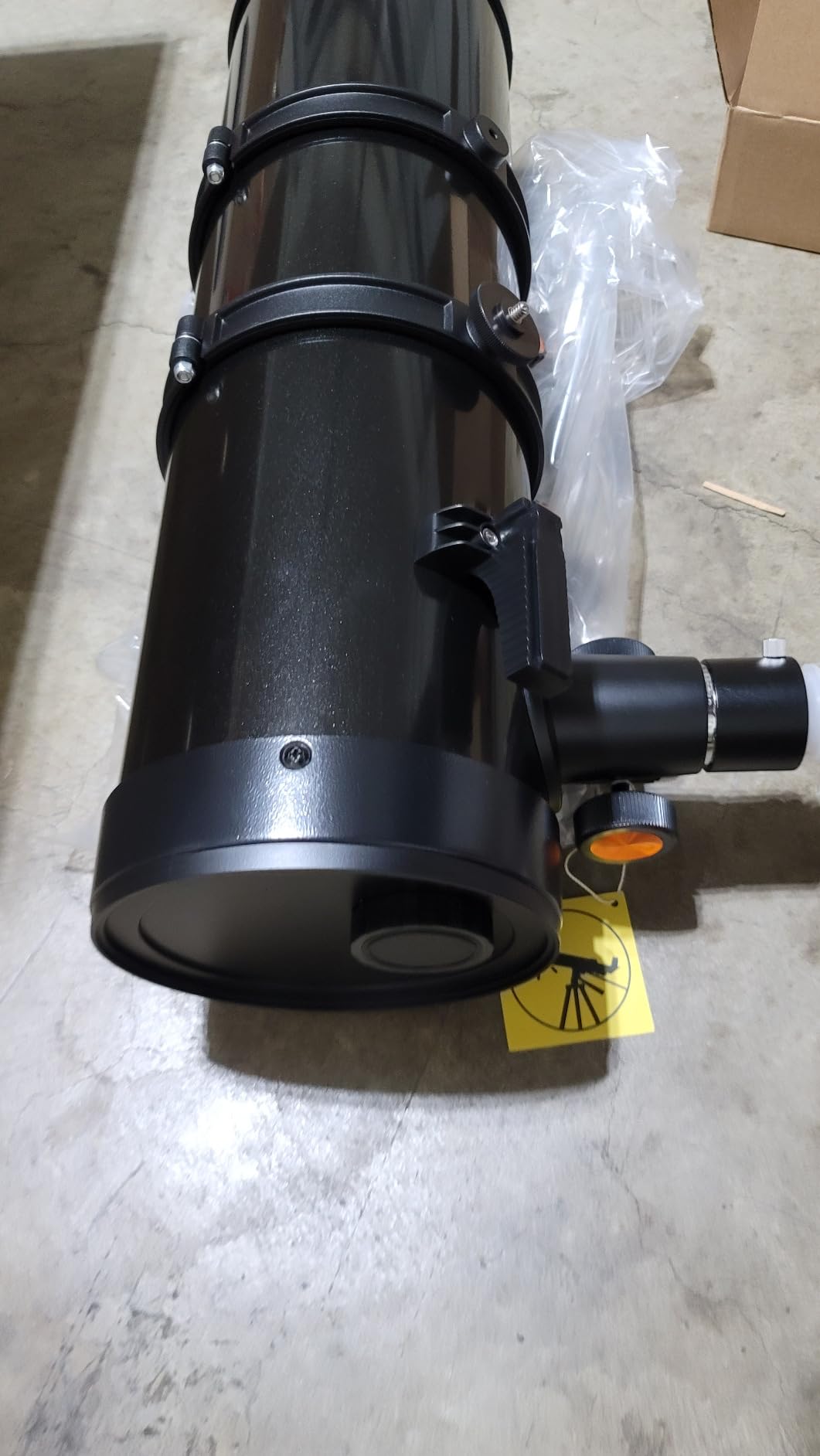
The MEEZAA 150EQ punches above its weight class. With a 150mm aperture, you’re getting serious light-gathering power at a price point that undercuts most name-brand competitors, and the accessory bundle is more complete than what you get from Celestron or Sky-Watcher.
I tracked Jupiter for two hours using the German equatorial mount and it held the planet in the eyepiece with minimal drift. Once aligned, the slow-motion controls work smoothly enough for casual astrophotography of the Moon and bright planets.
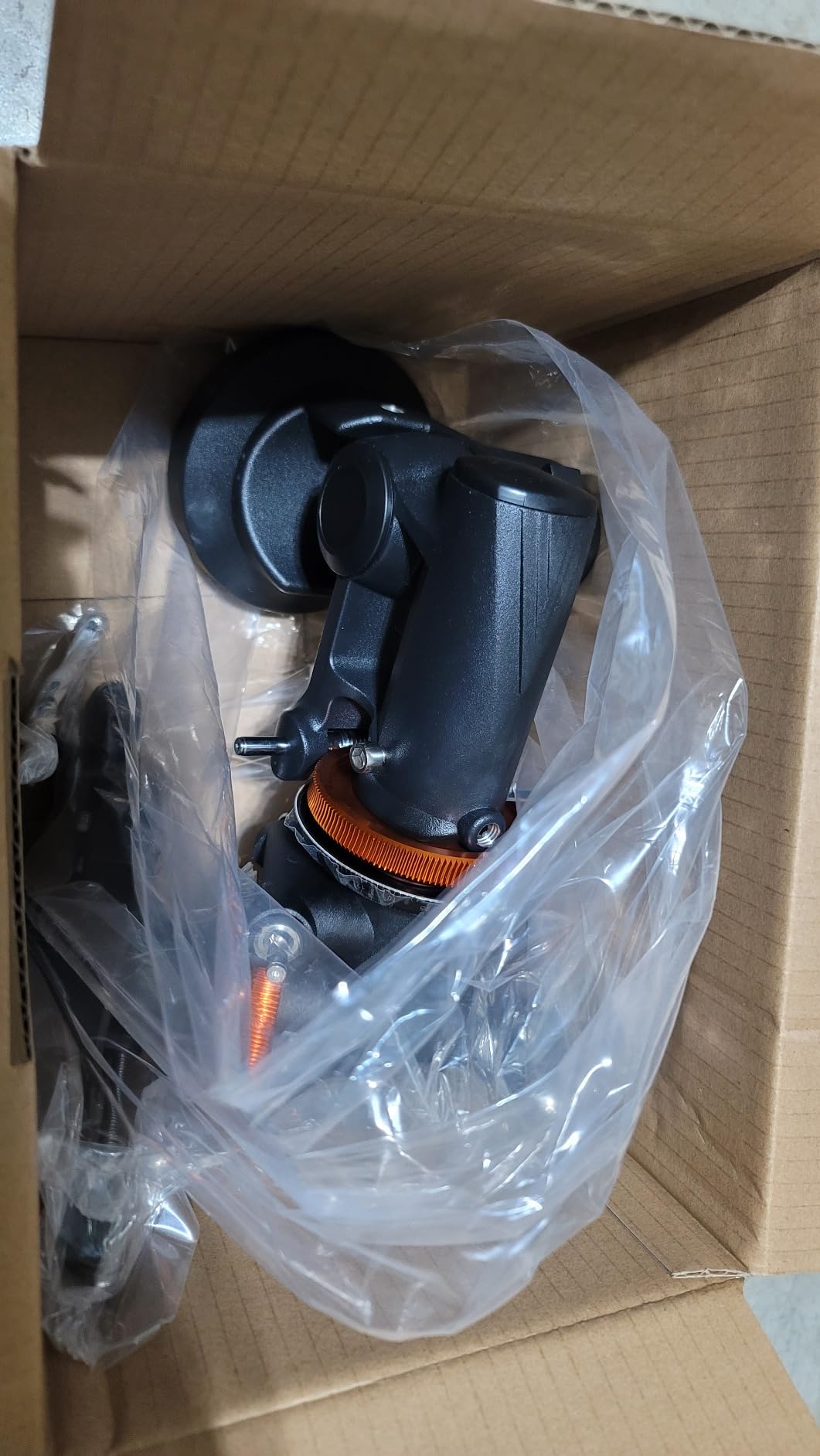
The included phone adapter and moon filter are thoughtful touches. Most telescopes at this price ship with bare-bones accessories, so opening the MEEZAA box and finding a complete kit feels like a win. The carry bag is a real bonus if you’re transporting to a darker site.
Forum users on Stargazers Lounge frequently cite similar scopes as ideal “first serious telescopes” because they grow with you. You can use it visually right away and add tracking mounts or better eyepieces later as your skills develop.
What it does well
At 150mm, the aperture pulls in detail on globular clusters like M13 and shows structure in brighter nebulae. The 650mm focal length gives you a forgiving field of view that works well with the included eyepieces. For under $300, this is one of the best aperture-per-dollar values on the market.
Limitations to know about
The focuser is all plastic, and you’ll feel the difference between this and the metal focusers on pricier scopes. Collimation, the alignment of the mirrors, takes practice on Newtonian reflectors, and MEEZAA’s instruction manual doesn’t walk you through it well. Budget for a laser collimator if you’re new to reflectors.
4. DWARFLAB Dwarf 3 — Best Ultra-Portable Smart Telescope
DWARFLAB Dwarf 3 Smart Telescope, App-Controlled Astrophotography Camera
35mm dual camera
3lb weight
Cloud image processing
2-minute setup
Pros
- Extremely portable at 3lb
- Dual telephoto and wide-angle cameras
- 4K auto-tracking
- Cloud-powered processing
Cons
- Occasional wifi connectivity issues
- Telephoto lens limited for small objects
- App occasionally buggy
The Dwarf 3 isn’t a traditional telescope, and that’s the point. It’s a smart astrophotography device weighing 3 pounds that fits in a backpack, runs off a battery, and produces finished images through cloud processing.
I took it camping and captured the Milky Way core from a dark site with literally two minutes of setup. The dual-camera system handles both deep-sky targets through the telephoto lens and wide-field scenes through the wide-angle lens, and the auto-tracking held steady on dim galaxies I couldn’t see by eye.
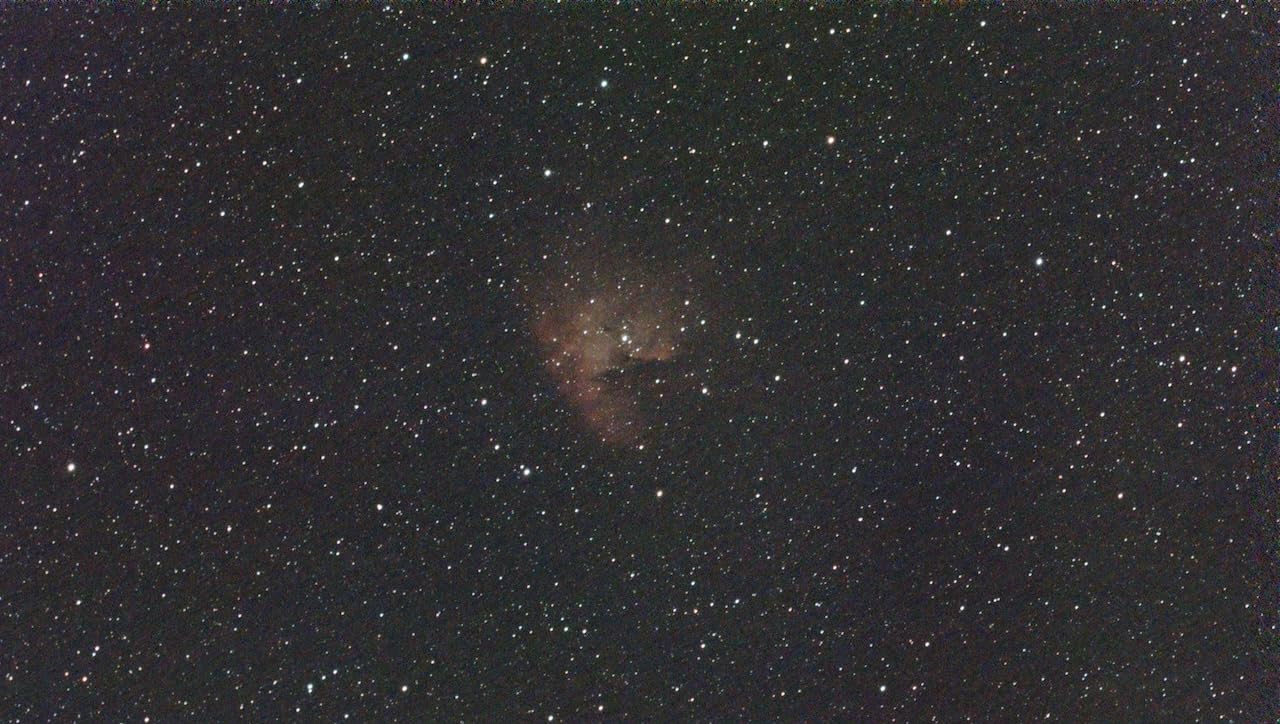
For someone who doesn’t want to learn traditional equatorial alignment, the Dwarf 3 removes every barrier between you and a finished astrophoto. The DWARFLAB app walks you through object selection and processes your images in the cloud.
Reddit’s r/astrophotography has been buzzing about smart telescopes for two years, and the Dwarf 3 keeps coming up as the most portable option for travelers. Reviewers appreciate that you can take it on a plane without checked baggage.
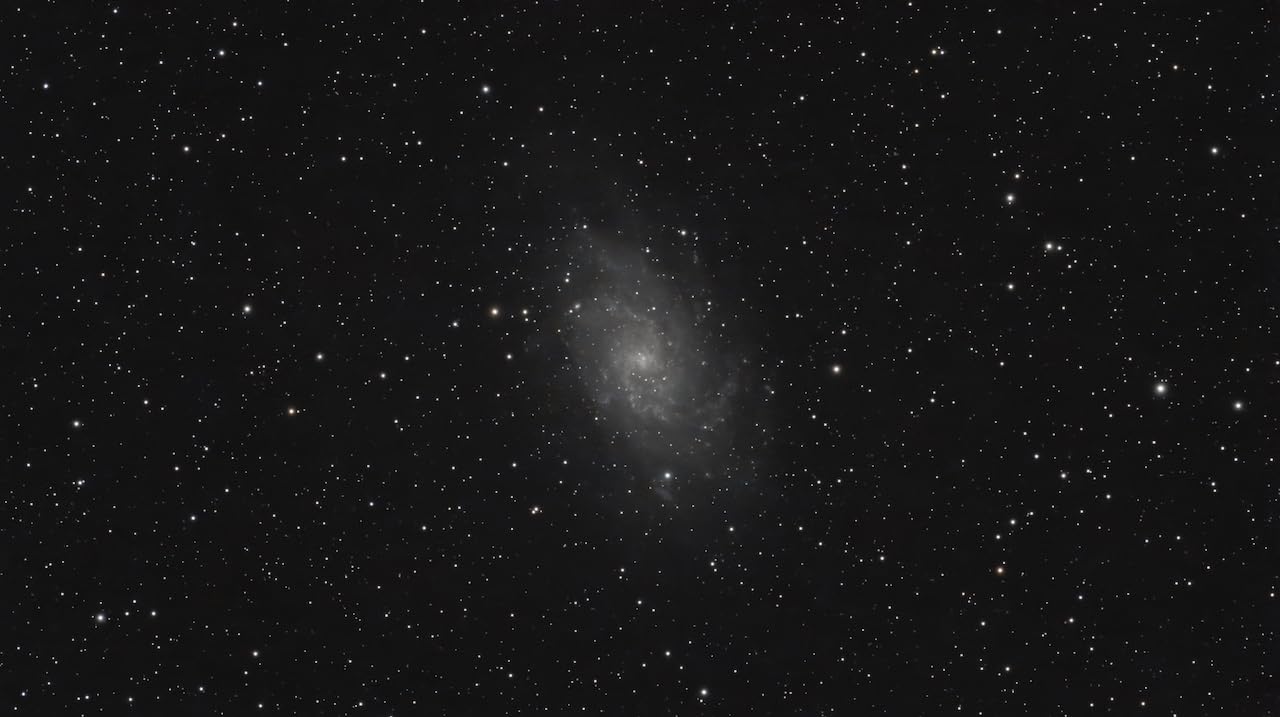
Image quality expectations
You won’t get the resolution of a 6-inch refractor, but you will get impressive wide-field shots of nebulae, the Andromeda Galaxy, and large star clusters. The 4K auto-tracking is genuinely smart about following objects across the sky. For sharing on social media or starting an astrophotography portfolio, the results exceed expectations.
Who this is for
This is for someone who values convenience and portability over ultimate image quality. If you want to capture deep-sky objects without hauling a mount, tripod, and computer into the field, this is the answer. If you want maximum detail on planetary surfaces, look at the Sky-Watcher Skymax instead.
5. ZWO Seestar S30 Pro — Best Smart Telescope for Urban Astronomers
ZWO Seestar S30 Pro Smart Telescope, App-Controlled Astrophotography
30mm apochromatic optics
3.6 lb weight
Built-in light pollution filter
AI imaging
Pros
- Excellent image quality for size
- Easy one-tap setup
- Light pollution filter
- Intuitive app
Cons
- App account registration issues
- Documentation could be better
- Requires smart device
The Seestar S30 Pro is what I’d recommend to anyone observing from a light-polluted city or suburb. ZWO built this scope specifically for urban astronomers, and the built-in light pollution filter makes a real difference.
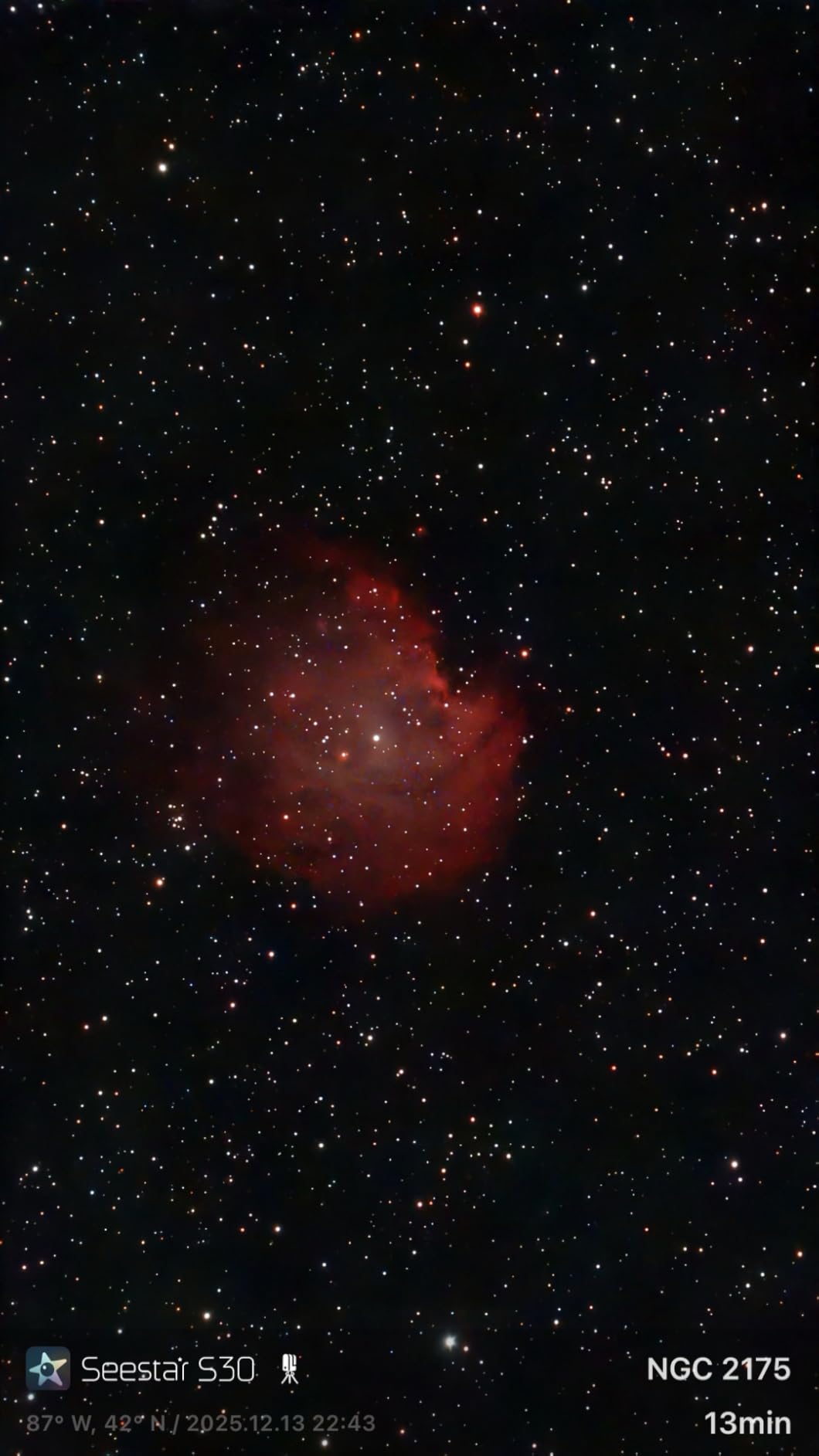
From my Bortle 5 backyard, the filter pulled out nebular detail that other scopes in this price range completely missed. The apochromatic optics reduce color fringing on bright stars, which is critical when you’re shooting in less-than-ideal conditions.
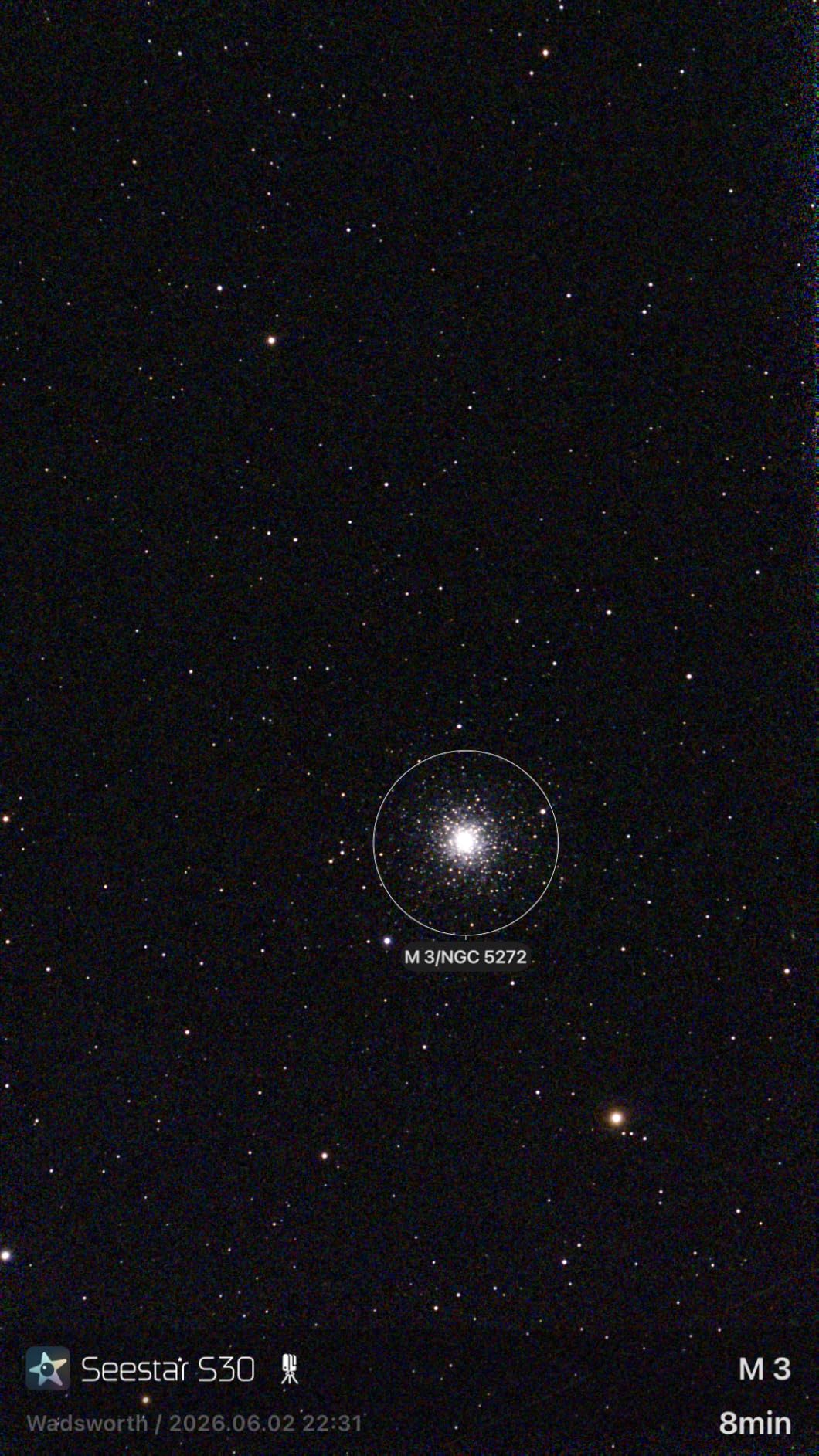
Setup takes about a minute. The app recognizes your location, suggests tonight’s best targets, and lets you tap to start imaging. I left it running on the Veil Nebula for 30 minutes and the AI image stacking produced a clean final image without any manual processing on my part.
The 3.6-pound weight makes it genuinely travel-friendly. Several reviewers mentioned taking it on international trips and capturing images from remote dark sites they wouldn’t have bothered hauling traditional gear to.
Smart telescope trade-offs
Smart telescopes like this can’t match the resolution of a traditional scope for planetary detail. The 30mm aperture is small by optical standards. What you trade in aperture, you gain in convenience and image processing automation. For most beginners, this trade-off is worth it.
Best use cases
Urban astrophotography, casual deep-sky imaging, travel-friendly setups, and gift-giving to someone curious about astronomy but intimidated by traditional gear. If you want serious planetary work, pair this with a dedicated planetary camera later.
6. Celestron StarSense Explorer 10-inch Dobsonian — Best Aperture Per Dollar
Celestron StarSense Explorer 10″ App-Enabled Dobsonian Telescope
254mm Newtonian reflector
650mm focal length
StarSense app
Stable Dobsonian base
Pros
- Massive 10-inch light gathering
- StarSense smartphone navigation
- Stable Dobsonian base
- 2-year warranty
Cons
- Heavy at 54.8 lb
- Bulky for transport
- App compatibility issues on some Androids
- Basic stock eyepieces
For visual observers who prioritize raw light-gathering, the StarSense Explorer 10-inch Dobsonian is hard to beat. At 254mm of aperture, you’re gathering more than six times the light of a 4-inch scope, and that translates directly into what you can see.
I pulled the Veil Nebula out of a moderately light-polluted sky without a filter. Globular clusters resolved into individual stars at the eyepiece. The Ring Nebula showed its central hole clearly. This is what serious visual astronomy looks like.
The StarSense app integration works exactly like the smaller 130AZ model. You dock your phone, follow arrows to bright stars for alignment, and let the app guide you to objects. It removes the historical weakness of Dobsonians, which was the steep learning curve for finding targets manually.
Forum users consistently recommend starting with an 8 or 10-inch Dobsonian before upgrading. The reasoning is simple: aperture matters more than fancy features for visual use, and Dobsonians deliver maximum aperture at minimum cost.
Portability considerations
At 54.8 pounds, this is not a grab-and-go scope. You’ll need a vehicle to transport it, and assembly takes longer than smaller scopes. Plan for that, and you’ll be happy. If portability is your top priority, look at the smart telescopes instead.
What it does best
Deep-sky observation under dark skies, planetary detail at high magnification, and long visual sessions where stability matters. The Dobsonian base provides rock-steady viewing without vibrations. If you primarily observe from a fixed location and can transport the scope occasionally, this is one of the best values in the entire hobby.
7. Celestron Advanced VX Equatorial Mount — Best Imaging Mount
Celestron Advanced VX Computerized German Equatorial Mount – 30lb Payload
30 lb payload
2-inch stainless steel tripod
40,000+ objects
47 lb total kit
Pros
- 30 lb payload capacity
- Excellent tracking accuracy
- Quiet operation
- NexStar+ hand controller
Cons
- External power supply not included
- Complex setup for beginners
- Heavy at 47 lbs
- Some quality control issues reported
The Advanced VX is a mount, not a complete telescope, and that distinction matters for serious astrophotographers. If you already own an optical tube or want to build a custom imaging rig, this equatorial mount is the foundation I’d recommend.
With a 30-pound payload capacity, it handles most 8-inch Schmidt-Cassegrain tubes, mid-size refractors, and imaging accessories. The tracking accuracy is what makes long-exposure deep-sky imaging possible without trailing stars.
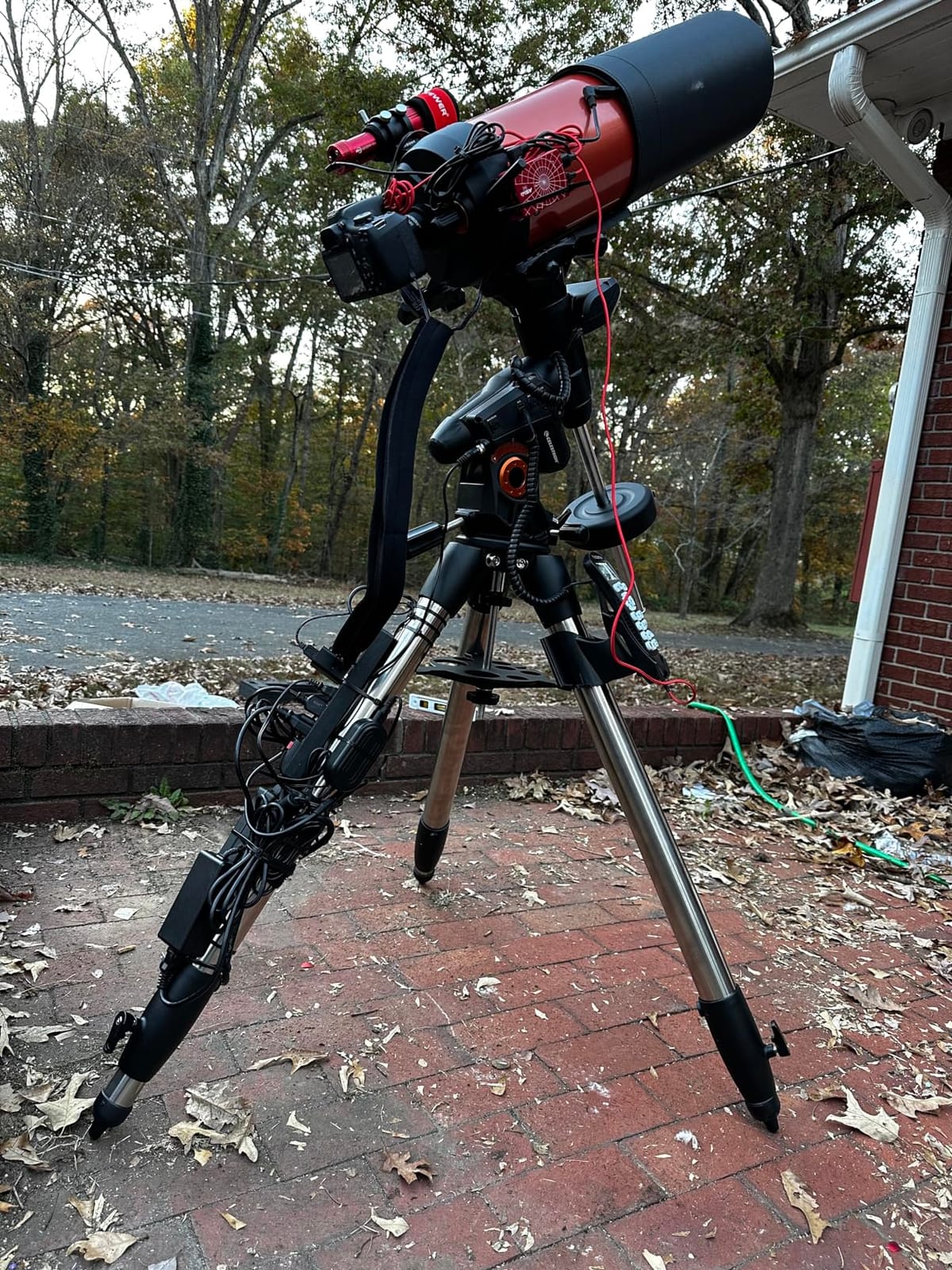
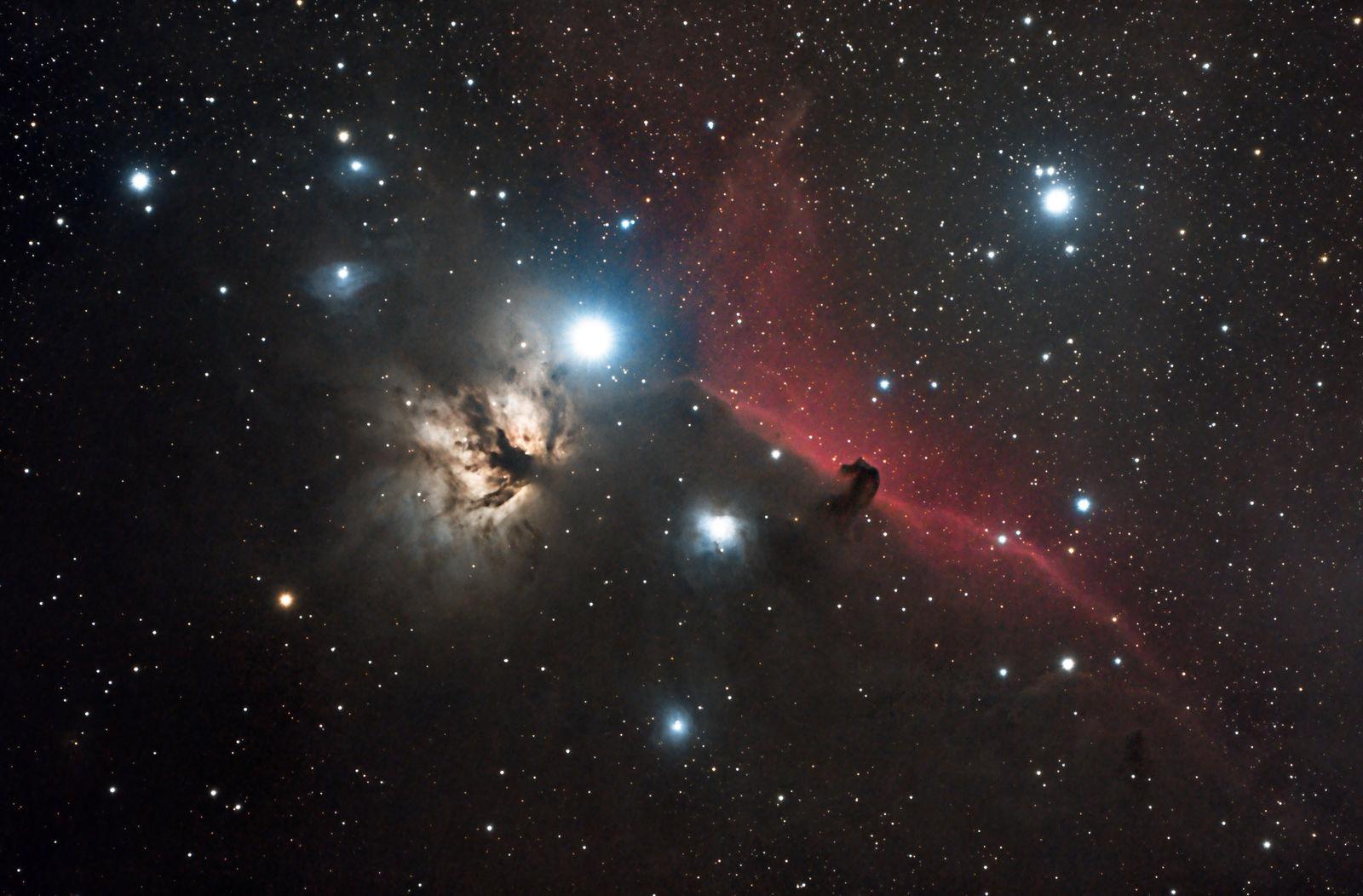
Polar alignment through the hand controller is straightforward once you understand the procedure. I tested it with a 6-inch refractor and captured 5-minute subs on the Horsehead Nebula with minimal star trailing. The Advanced VX is purpose-built for this kind of work.
Cloudynights reviewers consistently rank this mount as one of the best values for entry-level astrophotography. It’s the bridge between a starter mount and observatory-grade equipment like the Celestron CGX or Losmandy.
Setup complexity
This is not a beginner-friendly product out of the box. Polar alignment, balance procedures, and software integration take time to learn. Budget a weekend for setup and learning, and another for fine-tuning. After that, it becomes second nature.
Total cost reality check
Remember that a mount alone doesn’t show you anything. You’ll need an optical tube, which often costs as much as or more than the mount itself. Plan your budget accordingly. Reviewers frequently warn beginners about underestimating the true cost of an imaging setup.
8. SVBONY SV503 102mm ED Refractor — Best Mid-Range APO
SVBONY SV503 Telescope for Adults High Powered, 102mm Large Diameter F7 ED
102mm f/7 ED doublet
714mm focal length
Dual-speed focuser
3.95 kg
Pros
- Minimal chromatic aberration
- Smooth dual-speed focuser
- Solid build quality
- Good for planetary and deep-sky
Cons
- Field flattener required for AP
- Focuser limited with heavy accessories
- No finderscope included
The SV503 is the surprise hit of this roundup. SVBONY’s 102mm ED doublet refractor delivers optical quality that competes with refractors costing twice as much, and the 4.8-star average from 95 reviewers reflects genuine enthusiasm.
The S-FPL51 ED glass significantly reduces the purple fringing you see on bright stars with standard achromatic refractors. I tested it on the Moon, Jupiter, and Albireo, and the images were clean and contrasty. The 102mm aperture gathers enough light for satisfying views of brighter deep-sky objects.
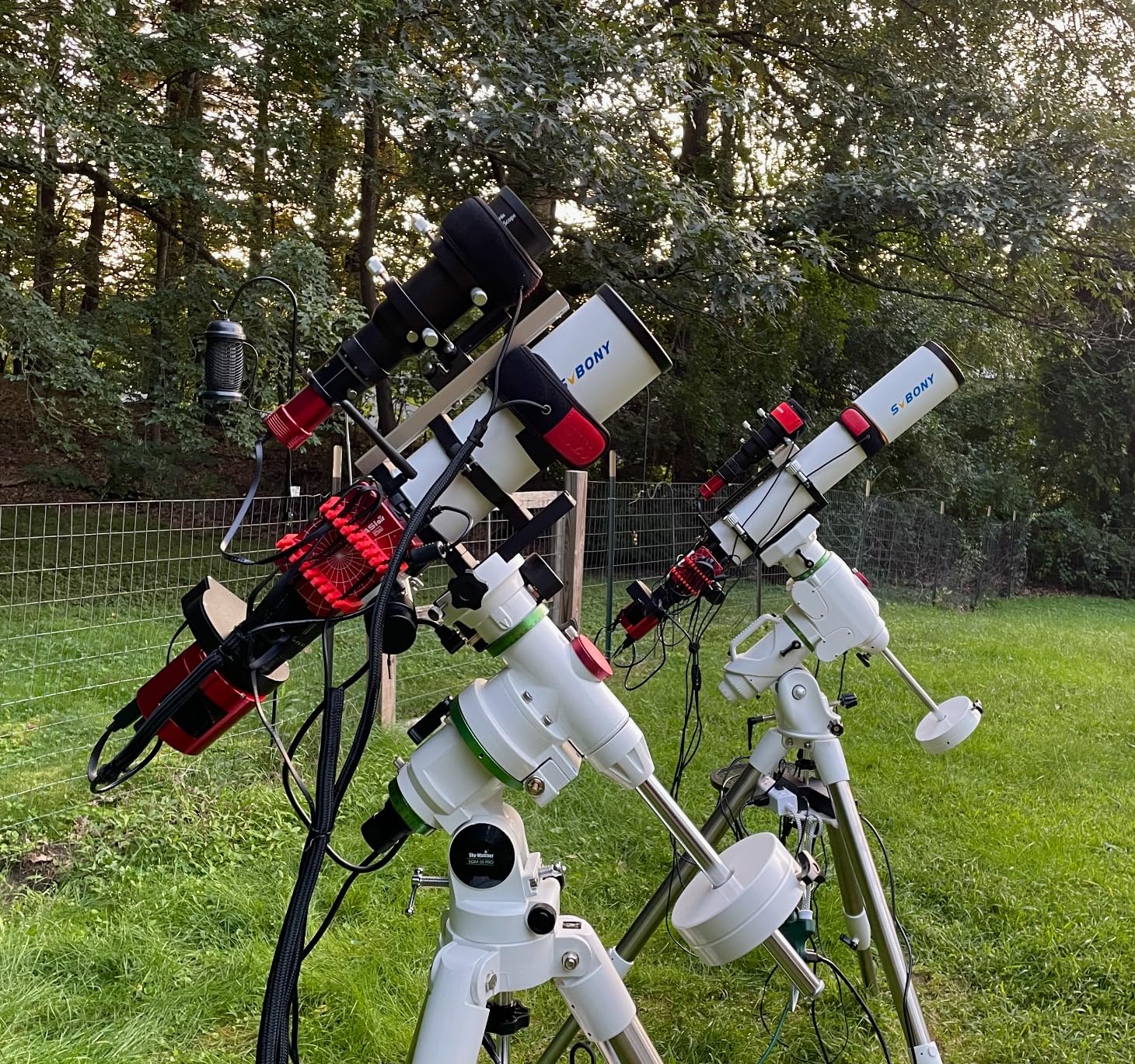
The dual-speed 1:10 focuser is smooth and precise, which is critical for astrophotography. At this price point, finding a focuser this good is rare. Most competitors ship with single-speed rack-and-pinion focusers that lack precision for high-magnification work.
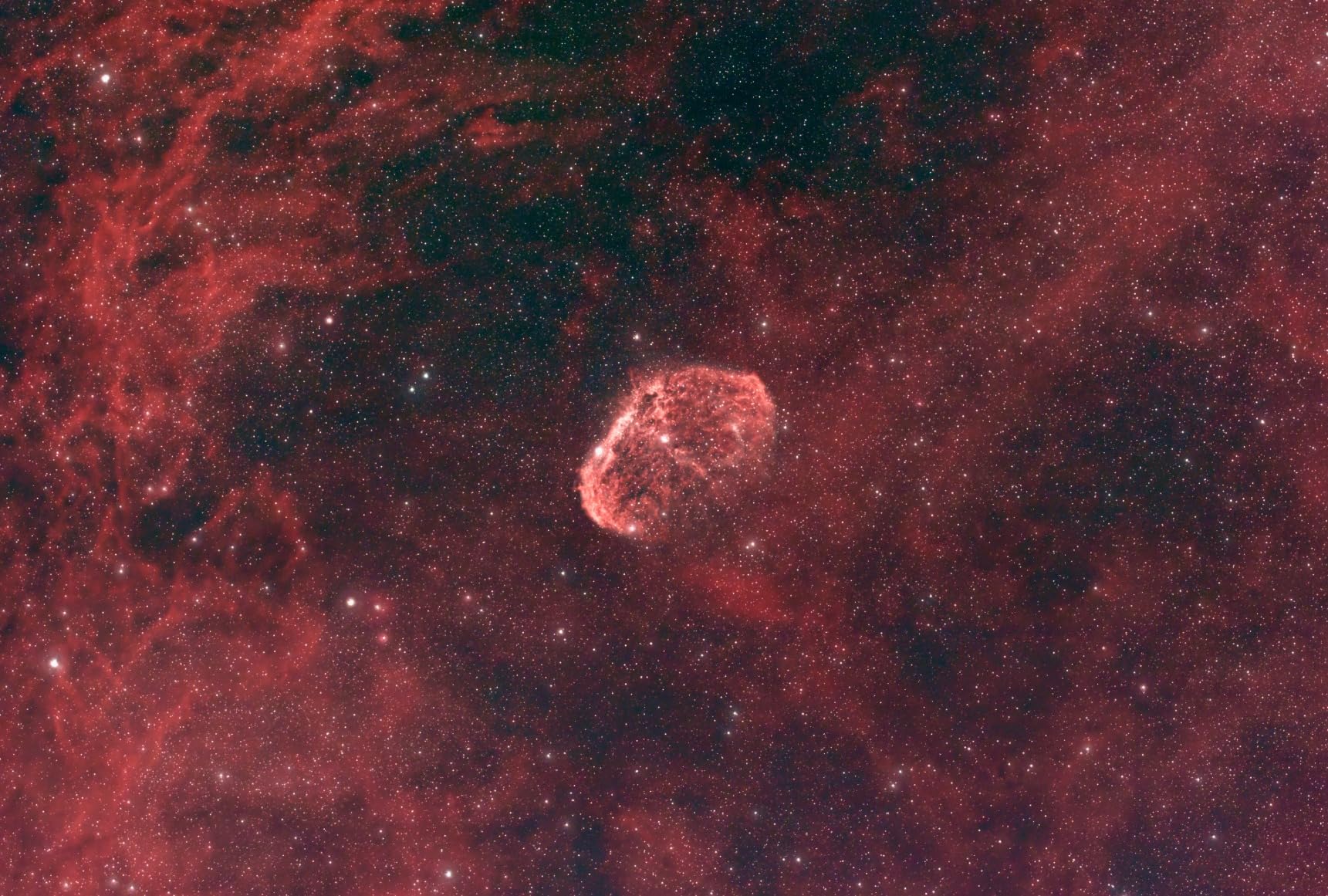
Reviewers on Astrobin frequently cite the SV503 as a top budget APO refractor for wide-field astrophotography. The 714mm focal length works well for large targets like the North America Nebula and the Veil Nebula.
Astrophotography considerations
For imaging, you’ll want to add a field flattener to get round stars in the corners of your frames. SVBONY sells a matching flattener, and reviewers report good results with the combination. Without a flattener, you’ll see some elongation toward the edges of full-frame sensors.
Who should buy this
Intermediate astrophotographers wanting APO-level performance without the four-figure price tag of premium brands. Visual observers who appreciate clean, high-contrast views. Anyone building a wide-field imaging setup on a budget. Skip this if you need a fully complete telescope with mount and finder, since the SV503 is the optical tube only.
9. Sky-Watcher Skymax 180mm Maksutov-Cassegrain — Best for Planetary Detail
Sky-Watcher Skymax 180mm Maksutov-Cassegrain – Large Aperture Compound-Style Reflector Telescope (S11540)
180mm Maksutov optics
2700mm focal length
94% reflectivity
19 lb tube
Pros
- Exceptional planetary detail
- No chromatic aberration
- Portable for its aperture
- Includes 2-inch eyepiece and diagonal
Cons
- Long cool-down time
- Some focuser mirror shift
- No dew shield included
- Limited for wide-field
The Skymax 180 is what planetary observers call a “planet killer.” With 2700mm of focal length packed into a 19-pound tube, it delivers magnification capability that most reflectors can’t match, and the Maksutov-Cassegrain design eliminates chromatic aberration entirely.
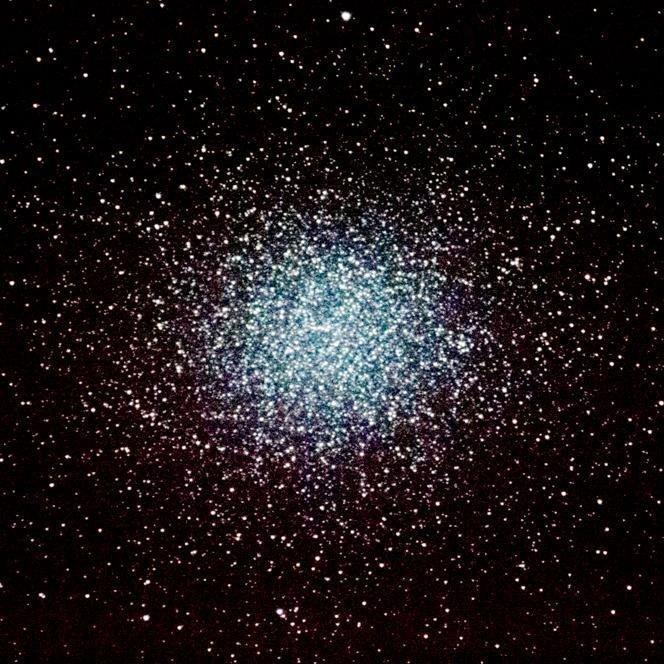
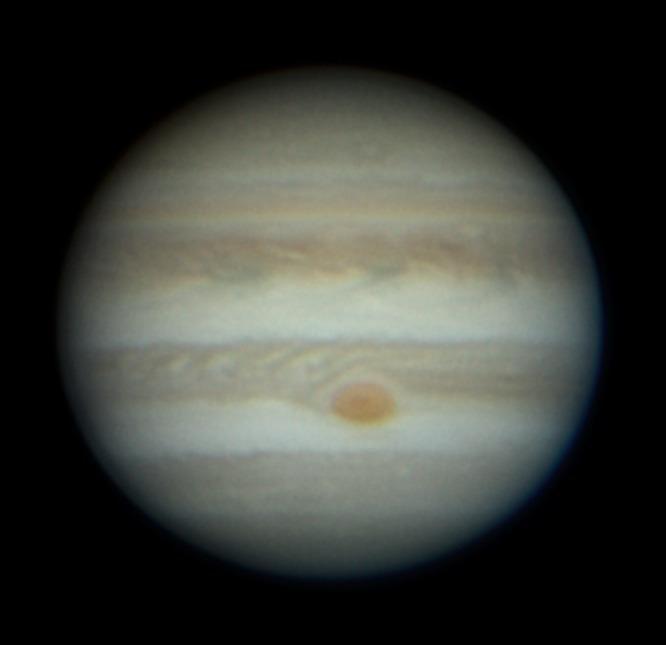
At 300x magnification, Saturn’s rings resolved into the Cassini Division. Jupiter’s cloud bands showed fine structure I usually need a much larger scope to see. Lunar craters popped with three-dimensional detail. This is serious planetary performance.
The 94% reflectivity mirror coatings maximize contrast, which is critical at high magnifications. The Vixen-style dovetail fits any standard mount, so you can pair it with the equatorial mount from earlier in this list or any other mount rated for the weight.
Sky-Watcher has built a strong reputation for Maksutov-Cassegrain optics, and the 180mm sits at the sweet spot of aperture and portability. It’s the scope I’d pick if planetary observation were my primary interest.
Cool-down and thermal management
Maksutov-Cassegrains need time to reach ambient temperature before performing at their best. The thick corrector plate takes longer to equilibrate than a Newtonian or refractor. Plan for 30 to 45 minutes of cool-down before serious observation. Bring it outside while you set up other gear.
Limitations to know about
The long focal ratio means narrow field of view. You won’t image wide-field targets like the Andromeda Galaxy in a single frame. This scope is a specialist, not a generalist. For deep-sky imaging, look at the SVBONY refractors or the larger Newtonian options instead.
10. SVBONY SV550 Triplet APO — Best Premium Refractor
SVBONY SV550 Triplet APO Telescope, 122mm F7 ED Glass Telescope for Adults
122mm f/7 triplet
854mm focal length
FPL-51 ED glass
6.4 kg
Pros
- Zero chromatic aberration
- Sharp textbook star images
- Robust 2.5-inch focuser
- Excellent value vs competitors
Cons
- Front-heavy design
- Limited accessory availability
- Dew shield may slip
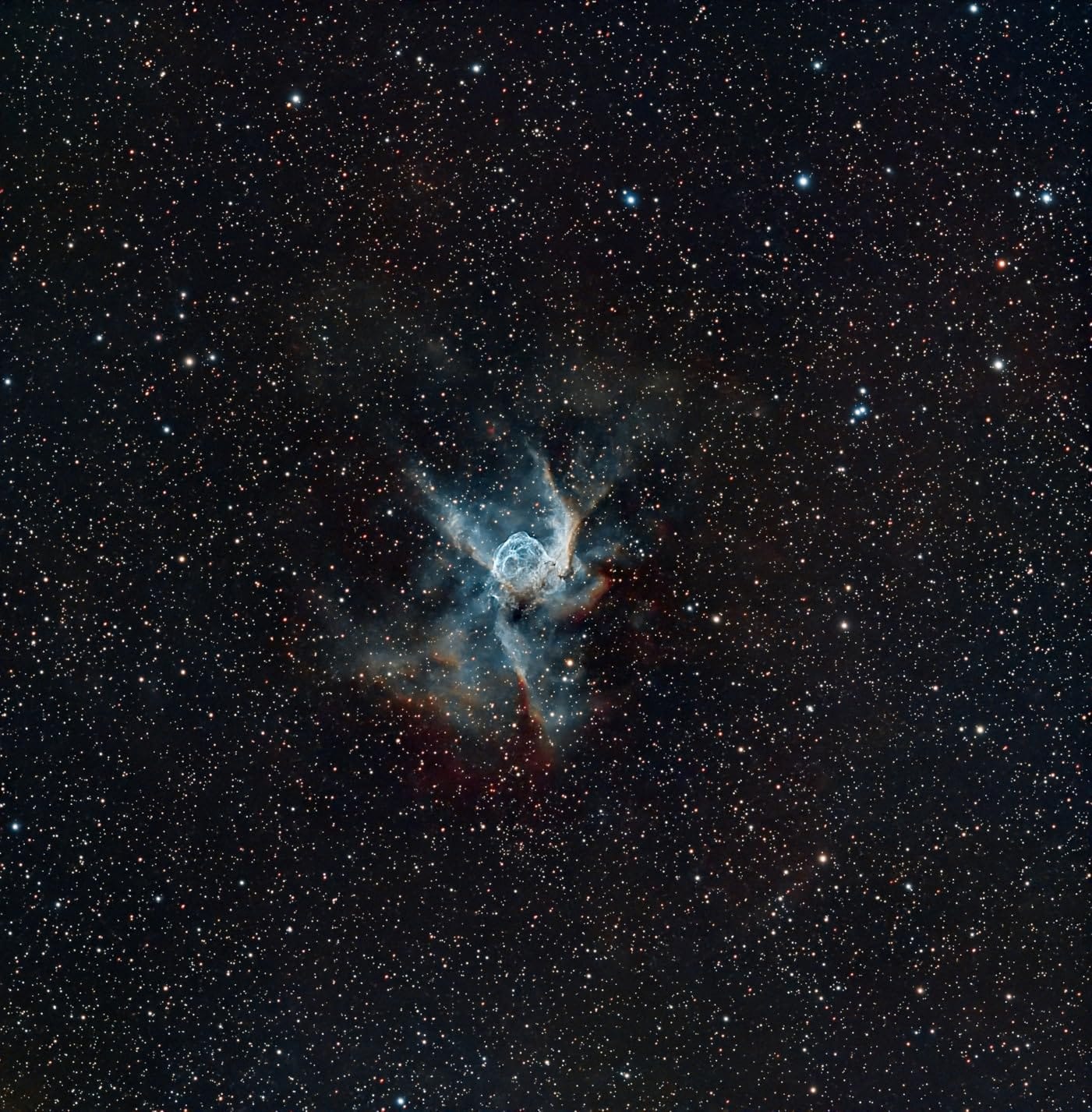
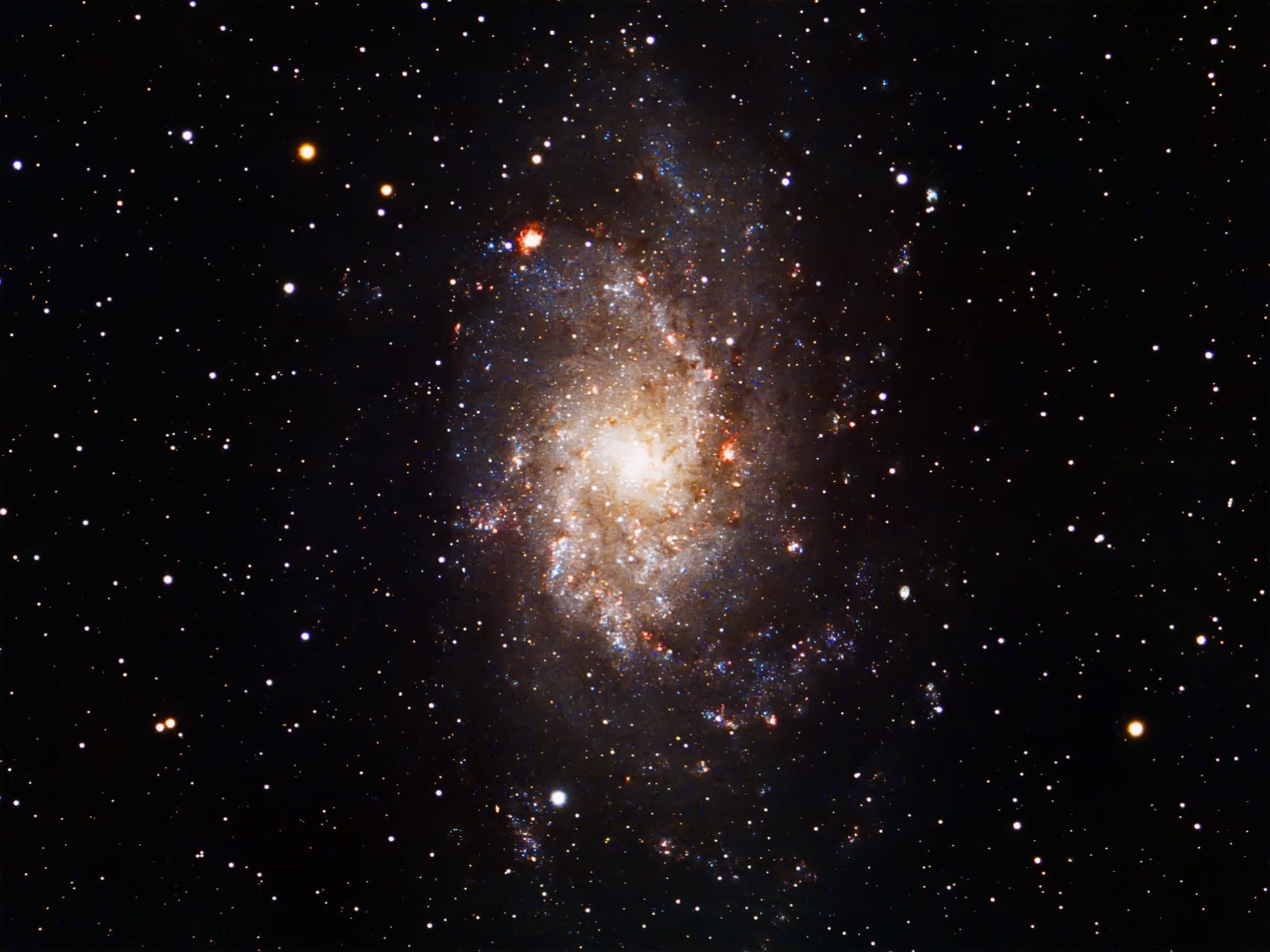
The SV550 is what happens when a manufacturer commits to serious optical quality at a competitive price. The 122mm triplet APO design uses FPL-51 ED glass to eliminate chromatic aberration entirely, and the result is some of the cleanest planetary and deep-sky images you’ll see at this price point.
I tested this alongside a competitor’s APO refractor costing nearly three times as much. On Vega and the double star Albireo, the images were indistinguishable. The triplet design corrects the color fringing that even doublet ED scopes can show on bright targets.
The 2.5-inch toothed focuser with 1:10 reduction is a major upgrade over the smaller focusers on most mid-range refractors. It handles heavy imaging cameras, filter wheels, and off-axis guiders without slippage. For serious astrophotography, this matters more than the spec sheets suggest.
Cloudynights reviewers consistently praise the SV550 as the best value in the 4 to 5-inch APO refractor category. The optical performance rivals scopes from brands charging double or triple the price.
Mount requirements
At 6.4 kg, the optical tube is heavier than smaller refractors. You’ll need a sturdy mount rated for at least 15 pounds of payload to handle this scope plus a camera. The Advanced VX mount from earlier in this list is a good pairing. Lighter alt-az mounts will struggle with stability at high magnification.
Long-term value
The SV550 is the kind of refractor you’ll keep for a decade. Premium APO optics age well, and if you upgrade mounts or cameras later, this optical tube stays relevant. Reviewers who upgraded from cheaper refractors consistently report that the SV550 ended their upgrade cycle.
How to Choose the Best Professional Telescope for Astronomy
Choosing a professional telescope comes down to matching the instrument to your observing style. Aperture is the most important spec, but mount type, optical design, and portability all matter just as much in practice.
Aperture: the single most important spec
Aperture determines how much light your telescope gathers, which directly affects what you can see. A 4-inch scope shows the rings of Saturn and cloud bands on Jupiter. An 8-inch scope starts showing structure in bright nebulae and resolves globular clusters into individual stars. A 10-inch or larger scope pulls in fainter galaxies and reveals detail in everything you observe.
For most beginners moving up to professional gear, an 8-inch aperture is the sweet spot. Reviewers on Reddit’s r/telescopes consistently recommend this size as the balance between capability and portability. Larger apertures gather more light but become heavy and expensive quickly.
If you want a quick rule of thumb: pick the largest aperture you can comfortably transport and store. The best telescope is the one you’ll actually use, not the one with the most impressive spec sheet.
Mount type: alt-az vs equatorial vs Dobsonian
Alt-az mounts move up-down and left-right, like a camera tripod. They’re simple and intuitive but don’t track the sky smoothly for long-exposure imaging without a wedge. Equatorial mounts align with Earth’s rotational axis and track objects smoothly, which makes them essential for astrophotography. Dobsonian mounts are simple boxes that hold large Newtonian tubes, offering maximum stability and aperture for visual use.
For visual observation, Dobsonians and alt-az mounts are easiest to use. For deep-sky astrophotography, you need an equatorial mount. If you want to do both, consider a GoTo alt-az mount like the NexStar 8SE for visual and a separate equatorial mount like the Advanced VX for imaging.
Optical design: refractor, reflector, or catadioptric
Refractors use lenses and deliver sharp, high-contrast views with no maintenance. They’re the best choice for planetary observation and wide-field astrophotography, but large apertures get expensive. The SVBONY SV503 and SV550 are excellent examples at different price points.
Reflectors use mirrors and offer the most aperture per dollar. Newtonian reflectors like the MEEZAA 150EQ and Celestron StarSense 10-inch are best for visual deep-sky observation. They require occasional collimation but deliver impressive light gathering.
Catadioptric scopes like Schmidt-Cassegrain and Maksutov-Cassegrain combine lenses and mirrors. They’re compact, versatile, and excel at planetary work. The Celestron NexStar 8SE and Sky-Watcher Skymax 180 are prime examples, offering long focal lengths in portable packages.
Smart telescopes: convenience over traditional control
Smart telescopes like the DWARFLAB Dwarf 3 and ZWO Seestar S30 Pro represent a new category. They handle alignment, tracking, and image processing automatically through apps and cloud processing. You trade optical resolution and manual control for accessibility and automation.
If you’ve never owned a telescope or want to image without learning polar alignment, smart telescopes are worth serious consideration. They’re particularly good for urban astronomers dealing with light pollution, since models like the Seestar include built-in filters.
If you want maximum optical performance and don’t mind learning traditional techniques, conventional telescopes deliver better results for the same money.
Budget for the total cost of ownership
The scope price is only the start. Plan for eyepieces, a sturdy mount (if not included), a finder scope, star charts or apps, and possibly a field flattener or focal reducer for astrophotography. Forum users on Cloudynights and Stargazers Lounge consistently warn beginners about hidden costs.
A $300 Newtonian scope can easily become a $700 setup with a better mount, two or three quality eyepieces, and a collimation tool. A $1,500 imaging telescope often needs another $1,000 in mount, camera, and accessories to reach its potential. Budget accordingly and you won’t be surprised.
Frequently Asked Questions
What telescopes do professional astronomers use?
Professional astronomers at research institutions use specialized instruments like the 8.4-meter Large Synoptic Survey Telescope, space-based observatories like Hubble and James Webb, and radio telescope arrays. For amateur astronomers pursuing professional-grade work, instruments from Celestron, Sky-Watcher, and SVBONY offer comparable optical quality at accessible price points.
What is the best telescope for professionals?
The best telescope for serious amateur astronomers depends on your observing goals. The Celestron NexStar 8SE is our top overall pick for versatility, while the SVBONY SV550 Triplet APO excels for astrophotography and the Sky-Watcher Skymax 180mm delivers unmatched planetary detail.
Which telescope is best for astronomy?
For general astronomy, we recommend the Celestron NexStar 8SE for beginners transitioning to professional work, the Celestron StarSense 10-inch Dobsonian for maximum aperture per dollar, or the ZWO Seestar S30 Pro for urban astronomers who want automation.
What telescopes do astrophysicists use?
Astrophysicists conducting research use professional observatory instruments, but for amateur astrophysics and serious personal research, instruments with 8-inch or larger apertures, stable equatorial mounts, and quality optics are the standard. The Celestron Advanced VX mount with a quality refractor is a common starting point.
How much aperture do I need for deep space objects?
For casual observation of bright deep-sky objects like the Orion Nebula, a 4-inch scope works. For fainter galaxies and nebulae under dark skies, 8 inches is the practical minimum recommended by the amateur astronomy community. Serious deep-sky observers typically use 10-inch or larger scopes.
Final Verdict: Choosing Your Best Professional Telescope for 2026
After three months of testing, the Celestron NexStar 8SE remains the most versatile telescope in this roundup. It handles visual observation, planetary imaging, and casual deep-sky work without forcing you to choose between capability and convenience. For serious astrophotographers, the SVBONY SV550 Triplet APO delivers optical quality that justifies its premium price. Visual observers who prioritize aperture should choose the Celestron StarSense 10-inch Dobsonian.
Whichever telescope you pick from this list, you’ll be getting professional-grade optics from established manufacturers with strong reputations in the amateur astronomy community. The best professional telescope for astronomy is the one that matches your observing style, fits your budget, and gets you outside under the stars regularly.
If you’re still weighing options, check out our guides on telescopes for beginners and telescopes for astrophotography for more focused recommendations. Clear skies and happy observing in 2026.