

A backyard playhouse is one of those purchases that looks like a weekend project and turns into the place your child chooses every single day for years. We spent weeks comparing the best playhouses for backyards currently on the market, weighing cedar against double-walled plastic, checking real owner complaints, and matching footprints to real yards. What follows is the short version: the Little Tikes Cape Cottage is the pick most families should make, and the nine alternatives cover nearly every specific need we found, from shaded toddler patios to raised clubhouses with slides.
A playhouse matters for reasons that have nothing to do with the roof shingles. Kids who have their own small, controllable space practise independent play, social role play and gross motor skills at a rate that a slide alone will never push. Pretend cooking, ringing a working doorbell and serving juice boxes through a snack window are the sort of low-stakes, high-imagination play that keeps children outdoors instead of indoors with a screen.
Before you buy, though, measure your yard and think about the base. The number of playhouses that end up sitting crooked on a lawn, or that tip over in the first gust of wind, comes down to skipping site prep. We cover that in detail below, along with the wood-versus-plastic decision that drives nearly every other choice. If you are still narrowing the field, our picks for the best kids playhouses and the best outdoor playhouses cover the same category from different angles.
Table of Contents
Top 3 Picks for Backyard Playhouses in 2026
These are the three that earned the right to lead the list. The Cape Cottage wins on proven durability across the largest review base we saw, the Step2 All Around Patio wins on the highest average rating, and the Backyard Discovery Sweetwater wins on the cedar feature set you get for the money.

Little Tikes Cape Cottage
- Double-walled plastic
- Working door and shutters
- Mail slot and flag holder
- Weighs 32 lbs
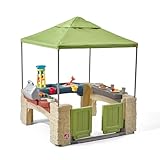
Step2 All Around Patio
- Removable canopy
- 16-piece accessory set
- Water and sand table
- Ages 24 months to 8 years

Backyard Discovery Sweetwater
- All cedar construction
- Working doorbell and play kitchen
- Snack bar window
- 5-year warranty
Best Playhouses for Backyards (October 2026)
Every model below appears once in this table, with the features that actually separated them during our comparison. Dimensions are the assembled figures, and the age ranges come from the manufacturers.
| Product | Specifications | Action |
|---|---|---|
| Little Tikes Cape Cottage |
|
Check Latest Price |
| Step2 All Around Patio |
|
Check Latest Price |
| Backyard Discovery Sweetwater |
|
Check Latest Price |
 KidKraft Modern Playhouse KidKraft Modern Playhouse |
|
Check Latest Price |
 Backyard Discovery Aspen Backyard Discovery Aspen |
|
Check Latest Price |
 Backyard Discovery Echo Heights Backyard Discovery Echo Heights |
|
Check Latest Price |
 Outsunny Fir Cottage Outsunny Fir Cottage |
|
Check Latest Price |
 BTMWAY Cedar Playhouse BTMWAY Cedar Playhouse |
|
Check Latest Price |
 Step2 Neat and Tidy Cottage Step2 Neat and Tidy Cottage |
|
Check Latest Price |
 Step2 Adventure Camper Step2 Adventure Camper |
|
Check Latest Price |
How We Picked: The Criteria Behind Every Pick
We judged every playhouse on seven things, and we weighted them the way owners actually talk about their houses rather than the way the packaging does. Joint and panel strength came first, because a playhouse that cracks or splits after one winter is worthless regardless of how charming it looked on day one.
Weather resistance and drainage came second. A molded floor with drainage holes and a roof that sheds water away from the wall panels matter enormously in wet climates, and floorless wood designs leave you building a base before you can even start using the thing. Third was age fit: does the interior have headroom for a five-year-old, and can a two-year-old get in and out safely?
Fourth was assembly reality. Manufacturer estimates run optimistic, and owners consistently report taking around 30 to 50 percent longer than the box states. We noted the stated adult count, whether panels arrive pre-cut and pre-drilled, and whether the instructions are diagrams only. Fifth was warranty length, which ranges from 90 days on one model in this list to five years on two others.
Sixth was interactive play value: working doorbells, play kitchens, snack windows, flowerpot holders, chalkboards and mailboxes. Seventh was the sheer number of owner reviews behind each product, because a large review base tells you far more about failure points than a small one. If you want the wider context on how we approach this category, our general playset guides for small backyards use the same seven criteria.
1. Little Tikes Cape Cottage – Best Overall for a Backyard
Little Tikes Cape Cottage Playhouse with Working Door, Windows, and Shutters – Tan, Toddlers Ages 2+ Years
Plastic
42.8 x 35 x 49 inches
Ages 2 plus
Weighs 32 lbs
Pros
- Snaps together with minimal tools
- Light enough to move between indoors and out
- Working door windows and shutters
- Mail slot and flag holder
- Handles repeated slamming from toddlers
Cons
- Plastic feels flimsier than older models
- Decorative stickers fade in direct sun
- Needs anchoring in wind
Our team ran the Cape Cottage for weeks in a suburban yard with two toddlers and a lot of slamming doors, and it is the model we kept coming back to. At 32 lbs it is light enough for an adult to carry from the patio to the grass in one trip, and the double-walled shell took every door-slam and shoulder-barge we could throw at it without a crack.
The play value is deceptively deep for a unit this simple. The working door, two windows and functional shutters give a two-year-old the beginnings of social and imaginative play, and the built-in mail slot plus flag holder turn the front wall into a whole scenario with no extra accessories needed.
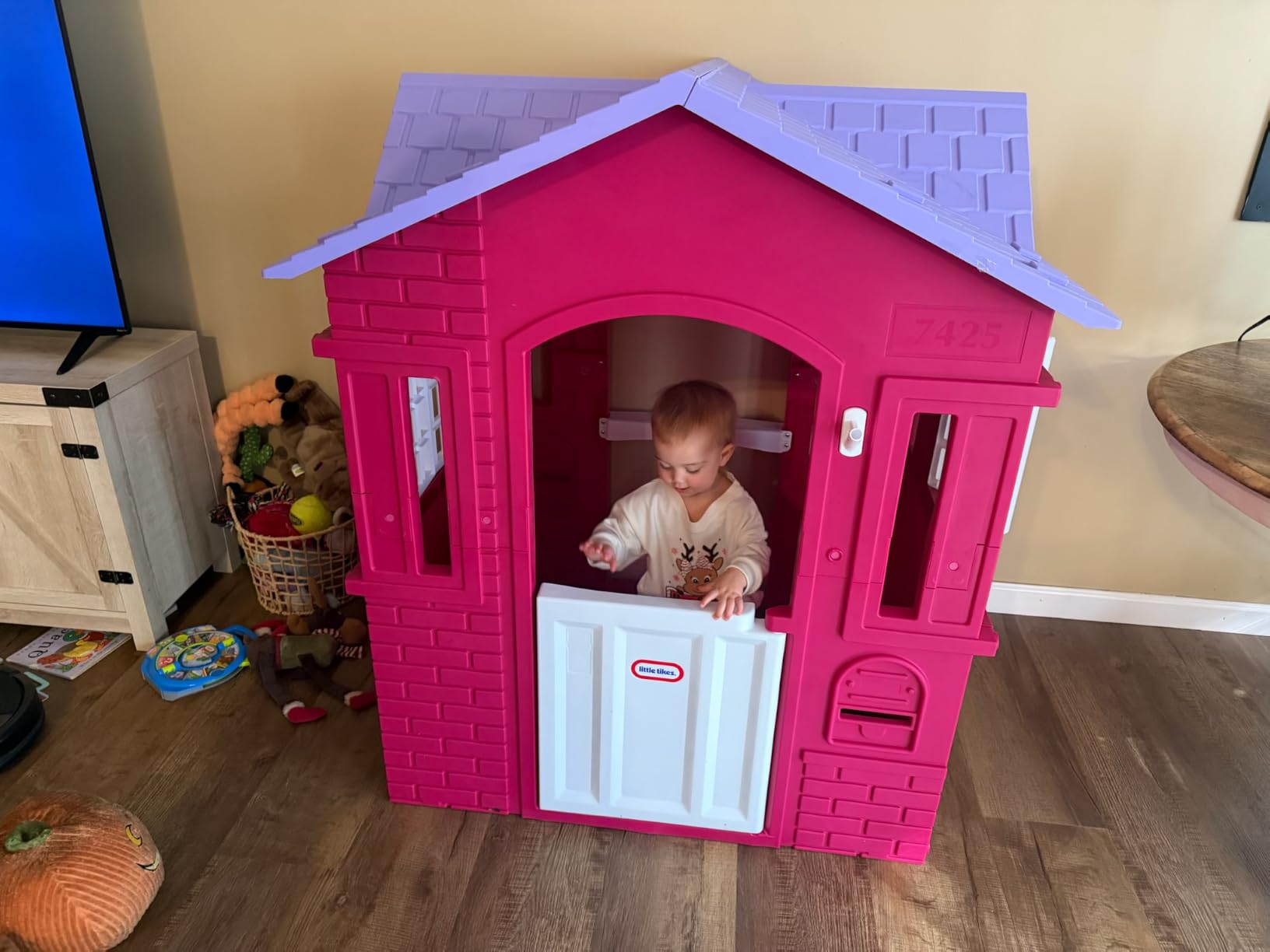
What surprised us most was the review profile. Roughly 77 percent of owners leave five stars, and the total count sits at more than 14,000 reviews, which is a far larger evidence base than any other playhouse we looked at. The recurring complaint is that the plastic feels thinner than earlier production runs, and a minority report panels arriving damaged or with a missing part.
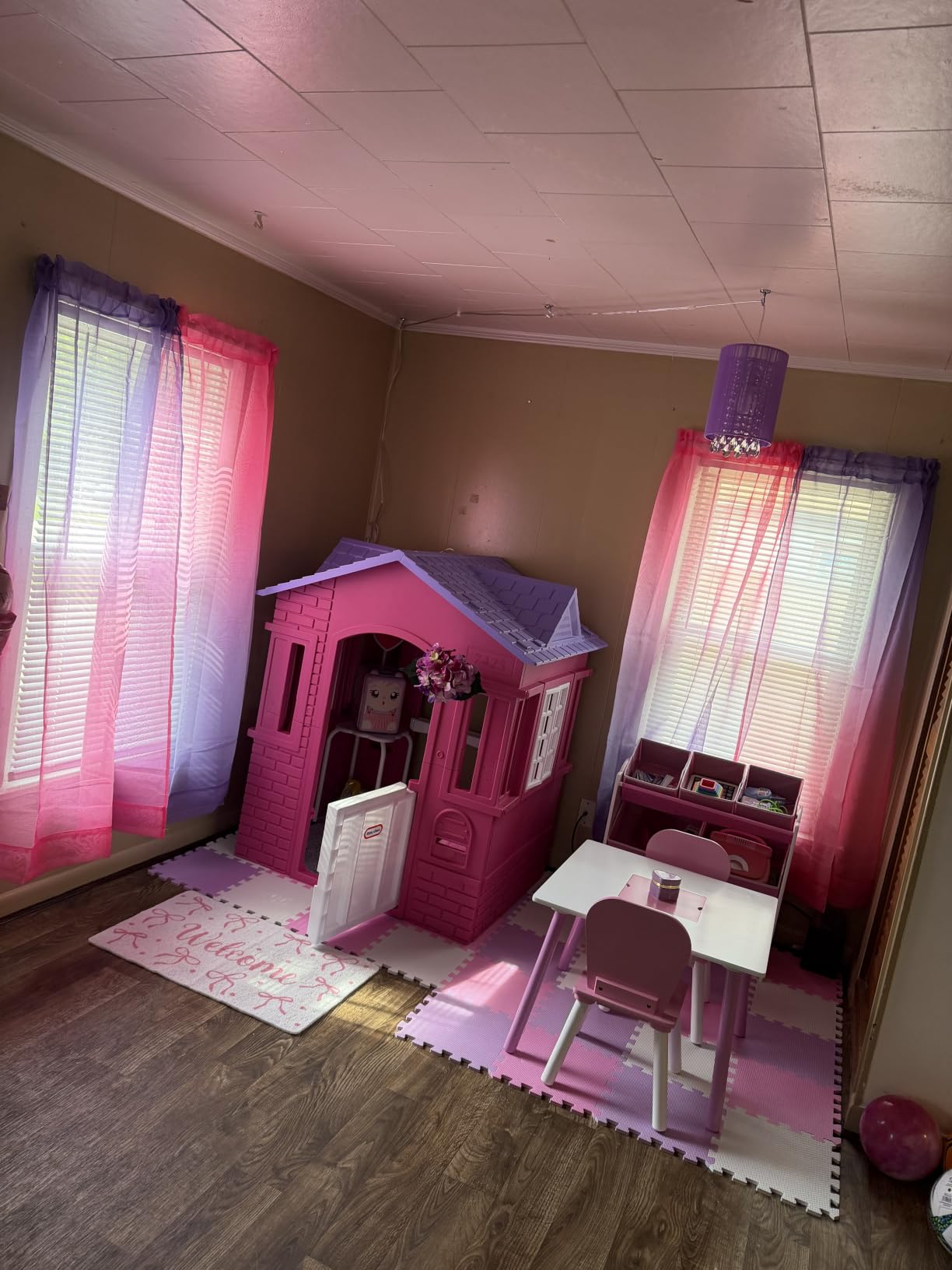
Assembly is genuinely near-instant. It snaps together with minimal tools, and there is nothing to paint, seal or stain afterwards. That zero-maintenance profile is the reason this is our top pick for most families: you do not need to remember to re-finish it in the spring.
How it handled a full season of outdoor play
Colour stayed even through weeks of full sun and sprinkler spray, with no visible fading on the main shell. The only finish issue we saw was the decorative sticker trim, which owners also report fading when it sits in direct sunlight, so a shaded spot is worth choosing if stickers matter to your child.
The single biggest real-world complaint is weight. At 32 lbs it is light for an adult, but a gust of wind will move it across a lawn if it is not fixed down. We fixed ours with a stake at two corners in under five minutes.
Who should buy this and who should skip it
Buy it if your child is under six, you want something you can drag indoors for the winter, and you would rather not maintain anything. The door, shutters and mail slot give a toddler plenty to do without you adding accessories.
Skip it if you have school-age children who will climb the roof, or if your yard is small and exposed to wind with no easy way to anchor. Older kids tend to outgrow the 49-inch height quickly, and the thinner walls do not invite that kind of use.
2. Step2 All Around Playtime Patio – Best Shaded Play Space
Step2 All Around Playtime Patio with Canopy Playset – Shaded Outdoor Playhouse for Kids with Realistic, Interactive Features, Room for Multiple Toddlers to Play – Dimensions: 60″ H x 47.5″ W x 47.5″ D
Plastic
47.5 x 54 x 60 inches
Ages 24 months to 8 years
3-year warranty
Pros
- Highest average rating in the group at 4.7
- Removable canopy gives real shade
- 16-piece toy kitchen set included
- Water and sand table
- Double walls resist fading and cracking
Cons
- Open design gives less weather protection
- Canopy must come off indoors
- Assembly needs two adults
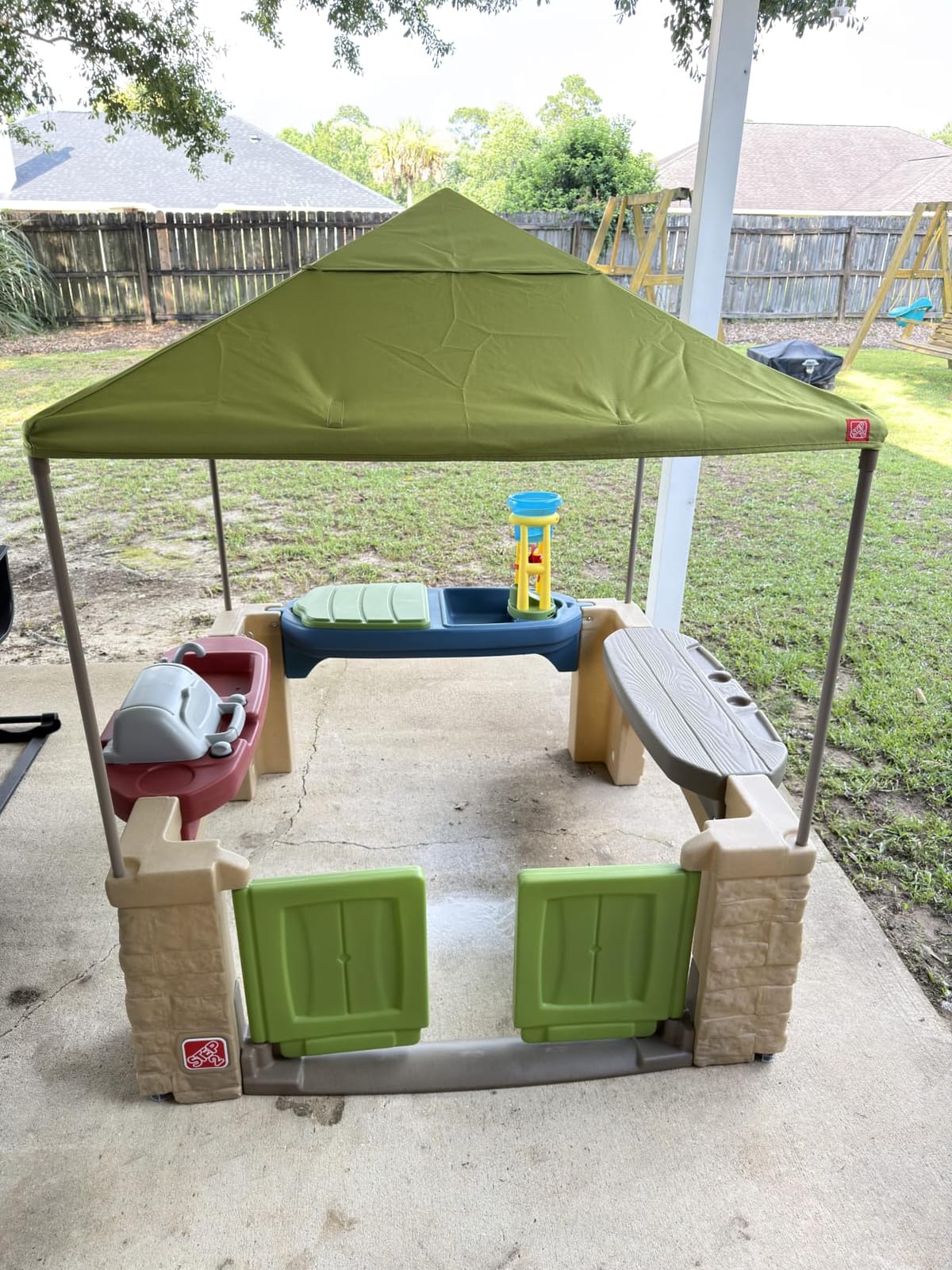
This one has the highest average rating of any playhouse we compared, at 4.7 stars across more than 3,700 reviews. It is a different shape from the others: an open-sided patio structure with a removable canopy rather than a fully enclosed cottage, which makes it the strongest option in the group for a yard where shade matters more than weather protection.
The canopy is the feature that changes daily use. It clips on and off, so the same unit gives a shaded play patio in summer and moves into a playroom when the weather turns. That versatility is why we rated it above the higher-review-count options for a family with a toddler who needs outdoor time through the hottest months.
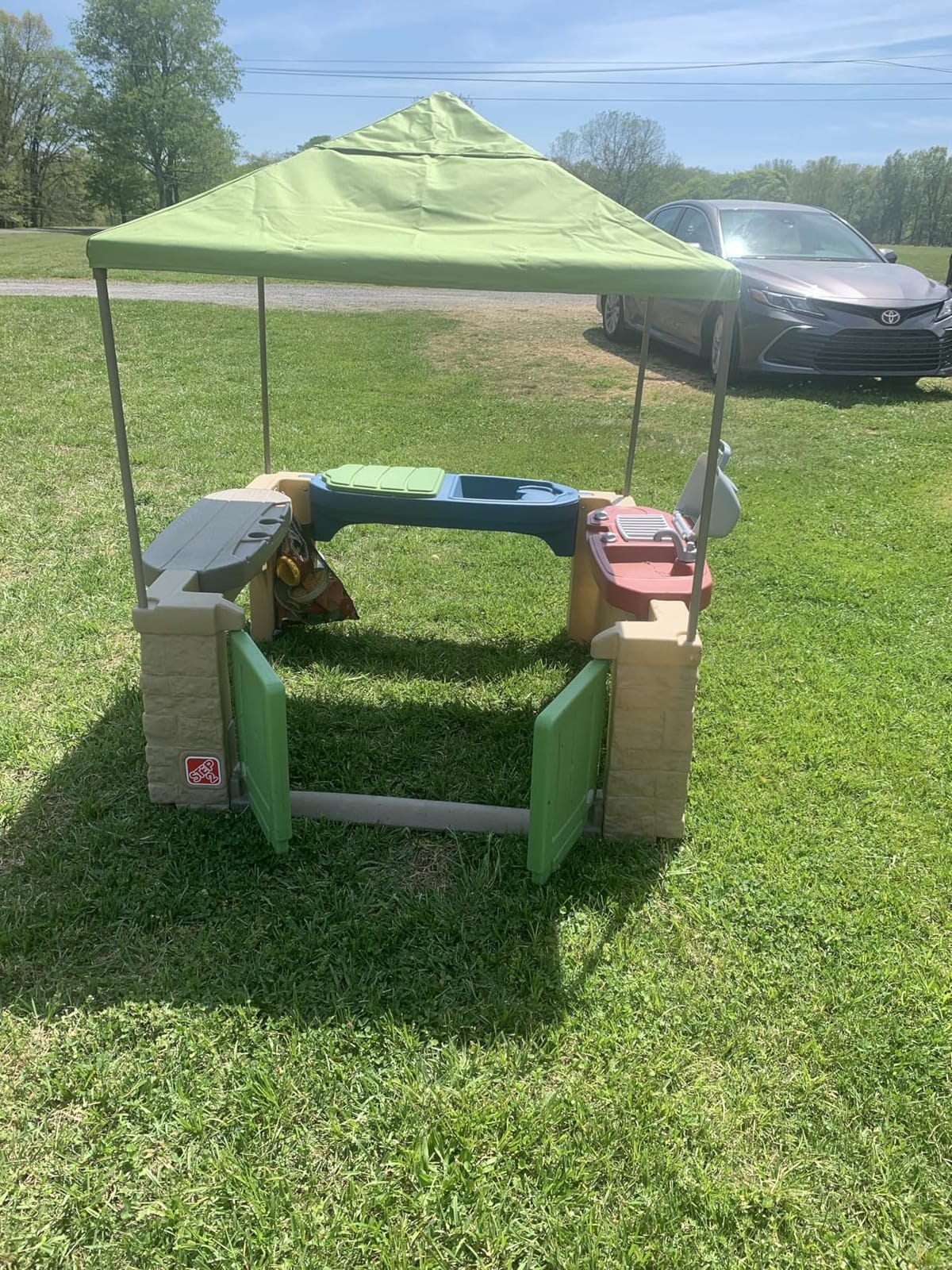
The pretend grill, large countertop and water-and-sand table turn a plastic shell into a full kitchen scenario, and the 16-piece accessory set covers pots, pans, silverware, plates and sand toys. Owners consistently name the accessory set and the grill as the most-used parts, and the double-walled plastic is widely described as holding its colour and shape over years of use.
At 60 inches tall and 54 inches wide, this is a larger footprint than most plastic playhouses, so measure before you commit. Wipe it down with a disinfectant and the surfaces come clean without scrubbing.
What shade and the removable canopy actually change
A canopy over an outdoor play space is not a luxury in a hot climate. It extends usable outdoor time, which is the whole point of a backyard playhouse, and it is why this design is popular in warmer regions where a fully enclosed plastic cottage would feel like a sun trap.
Because the canopy comes off, the same structure serves double duty indoors. It does add one assembly step, and adult assembly is required, but the hardware is included.
Who should buy this and who should skip it
Buy it if you have a toddler through early school years, live somewhere hot, and want kitchen role play plus a sand and water station in one footprint. Multiple toddlers fit inside comfortably, which matters for playdates.
Skip it if you need a sealed structure for rainy months, because the open patio design gives far less shelter than a full cottage. If your child is a serious climber, there is no elevated play level here either.
3. Backyard Discovery Sweetwater – Best Cedar Value
Backyard Discovery Sweetwater Cedar Wooden Kids Playhouse Cottage with Play Kitchen, Snack Bar, Half Door, Toy Phone, Windows, Flowerpot Holders, and Working Doorbell for Outdoor Imaginative Play
Cedar
46 x 42 x 55 inches
Ages 24 months to 6 years
5-year warranty
Pros
- All cedar with natural decay resistance
- Pre-cut pre-drilled pre-stained panels
- Working doorbell and snack bar
- Play kitchen with sink and stove
- Five-year warranty
Cons
- Needs periodic re-staining
- Flowerpots not included
- Residential use only
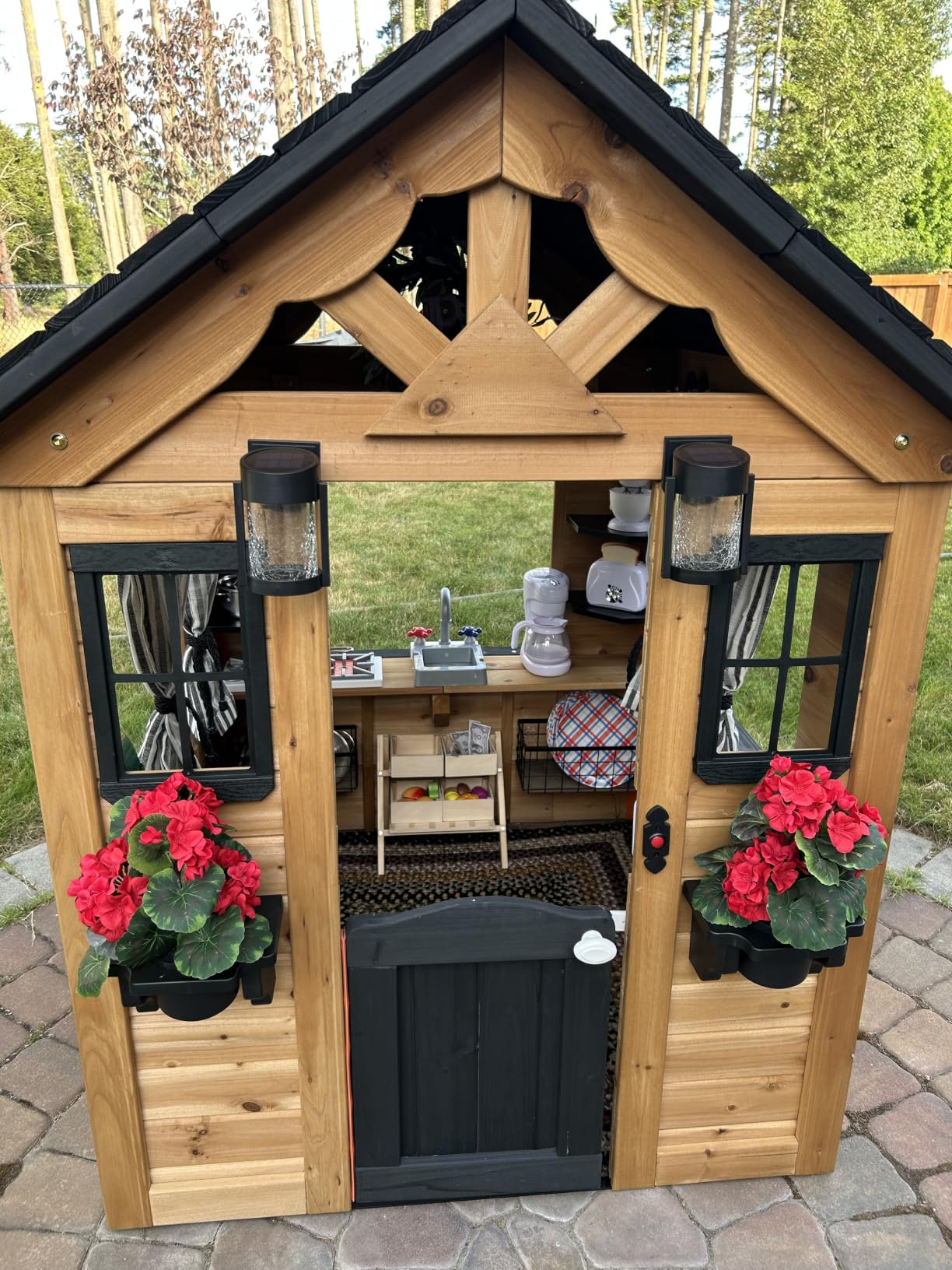
The Sweetwater is the model we recommend to anyone who wants the look and feel of real wood without stepping up to a large cedar cottage. It is 100 percent cedar, which has natural resistance to decay, and it arrives pre-cut, pre-drilled and pre-stained, so the hardest part of wood playhouse assembly is already done.
For the money, the feature list is hard to argue with: a play kitchen with toy sink, stove, cookware, utensils and a cordless phone, a working doorbell, a kid-friendly hinged half door, a snack bar window for serving juice boxes, and flowerpot holders beneath the front windows. Owners regularly point to the doorbell and snack bar as the features that keep the play going.
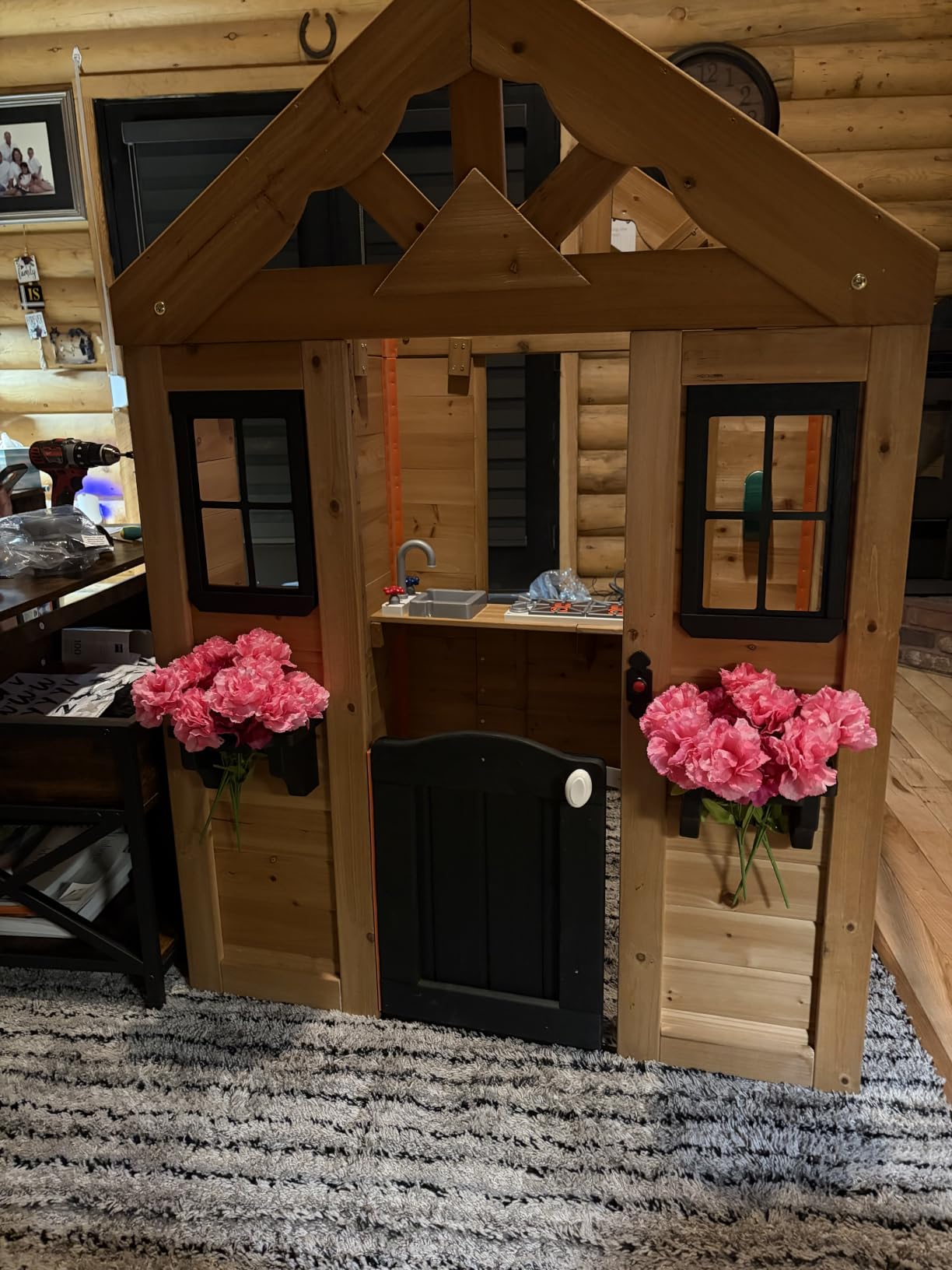
The wide windows do double duty. They pull in natural light and airflow, and they give a parent standing across the yard a clear sightline into the interior, which is a practical benefit that gets overlooked and then missed badly when you switch to a design without it.
Owners also value the 5-year warranty, which is a genuine reassurance on a wooden structure. Backyard Discovery cedar houses are the ones most often named in owner threads as holding up best across multiple seasons when sealed, and the roughly 76 percent five-star rating here fits that pattern.
What the five-year warranty really covers
A long warranty is only as good as the maintenance regime behind it. Cedar is rot-resistant but not maintenance-free, and the practical expectation is a reseal or restain every year or two depending on your rainfall and sun exposure. Do that and the warranty is meaningful; skip it and no warranty will save the panels.
Buyers also note the flowerpots and flowers are sold separately, so plan to pick up a couple of inexpensive pots if you want the window boxes in use.
Who should buy this and who should skip it
Buy it if you want wood, you like the idea of a doorbell and a serving window, and you are willing to put a maintenance weekend into the calendar each spring. It suits ages roughly two to six.
Skip it if you want zero upkeep, or if you are planning to build a raised deck to go with a larger structure. At 46 by 42 inches it is also snugger than some of the wider cottages in this list.
4. KidKraft Modern Outdoor Playhouse – Best Built-In Picnic Table
KidKraft Modern Outdoor Wooden Playhouse with Picnic Table, Mailbox and Outdoor Grill ,Gift for Ages 3+
Wood
48.9 x 70.9 x 62.25 inches
Ages 3 plus
90-day warranty
Pros
- Attached picnic table and benches
- BBQ grill with removable lid
- Pretend sink and faucet
- Water-based stain with UV protection
- Roomy enough for several children
Cons
- No floor included
- Unshuttered windows let water collect
- Assembly runs 3 to 5 hours
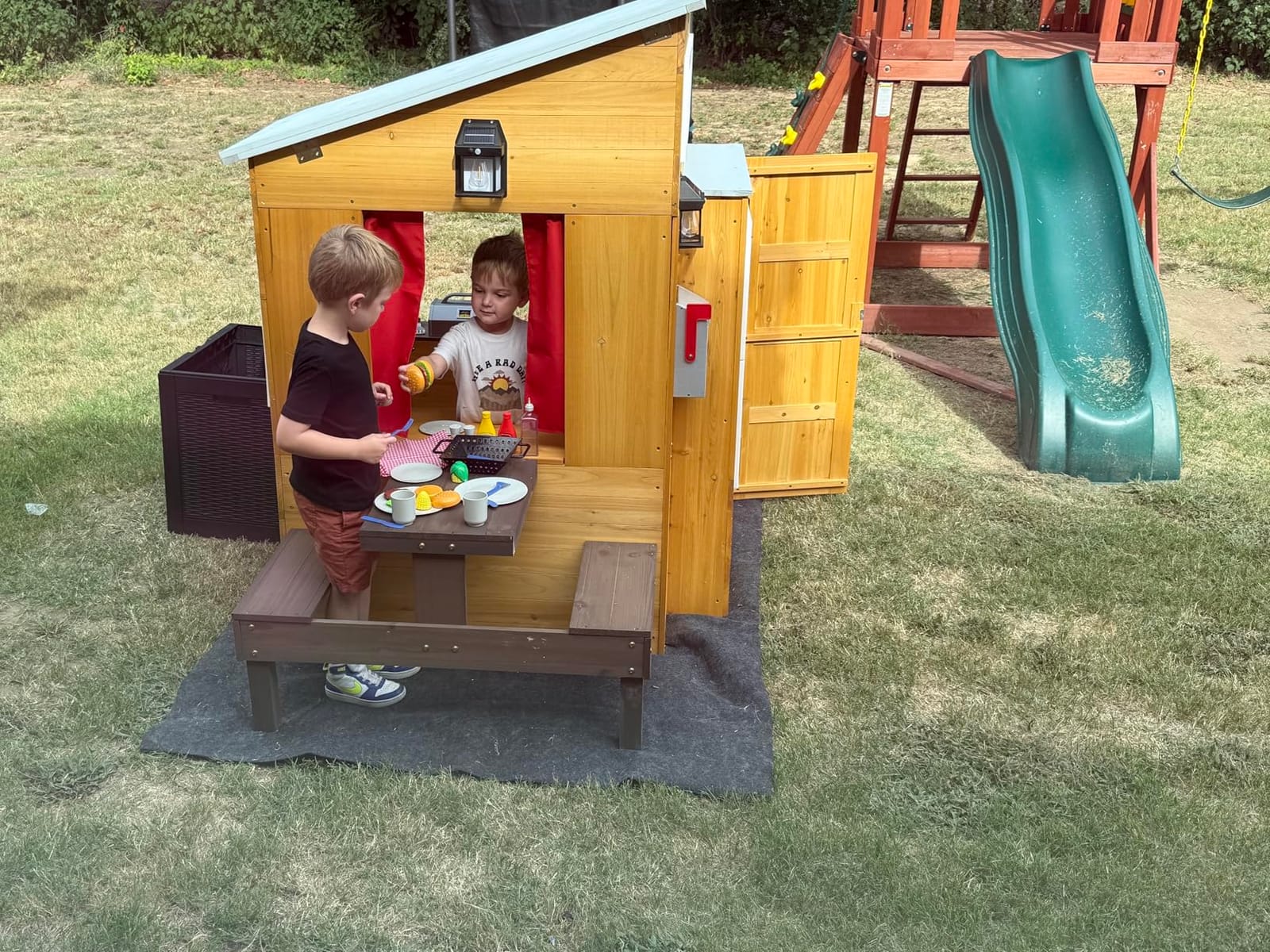
Nothing else in this roundup ships with a full dining setup, and that changes the shape of play. The attached picnic table and benches let a child serve pretend meals from the grill, carry them outside and actually sit down to eat, which is a more complete scenario than most plastic cottages support.
It is a wood build, pre-treated with a water-based stain that includes UV and mould protection. All the holes are pre-drilled and the parts are labelled, which is a real help when you are assembling in a heat wave with a glass of water going warm beside you.

The BBQ grill has a click-and-turn knob and a removable lid, and the sink has a working lever faucet. There are fabric curtains, a mailbox and a chalkboard to finish the farmhouse look. Several owners report a five-year-old plus a group of friends fitting inside comfortably.
The rating sits at 4.2 with about 63 percent five-star, and the complaints are consistent: wood splitting and fraying after prolonged outdoor exposure, and a door that can warp in wet weather. In mild climates many owners report it lasting for years.
The floor question and the base you have to build
This model has no floor, so it sits directly on the ground unless you build a platform. That is the single most common complaint in owner reviews, and it is worth solving properly: a raised deck of treated timber, with a slight fall away from the house, keeps the floor dry and extends the life of everything above it.
The un-shuttered windows are the second practical issue. Rain drives straight in and pools on the floor, which becomes a rot problem on a floorless base. A simple roof panel over the window or regular sweeping is the mitigation.
Who should buy this and who should skip it
Buy it if your child is three or older, enjoys cooking and serving scenarios, and you are handy enough to build a small deck. The 70.9-inch width is wide enough to function as a small outdoor gathering spot.
Skip it if you want a low-maintenance structure or a long warranty behind it. Ninety days against manufacturer defects is the shortest commitment of any pick here, and that matters on a product with this many wood components.
5. Backyard Discovery Aspen – Best Country Cottage for a Large Yard
Backyard Discovery Aspen Cedar Wooden Kids Playhouse Cottage with Play Kitchen, Snack Bar, Picnic Bench, Dinner Bell, Mailbox, Dutch Door, Flowerpot Holders, Toy Lights, Country Style for Outdoor Play
Cedar
48.7 x 78.8 x 67.3 inches
Ages 24 months to 10 years
5-year warranty
Pros
- Full cedar build with 5-year warranty
- Oval split Dutch door doubles as a window
- Side serving station with bench and lanterns
- Works from 24 months to 10 years
- Mailbox on a picket fence
Cons
- Heaviest unit here at about 124 lbs
- Wood needs ongoing sealing
- Large footprint for a small yard
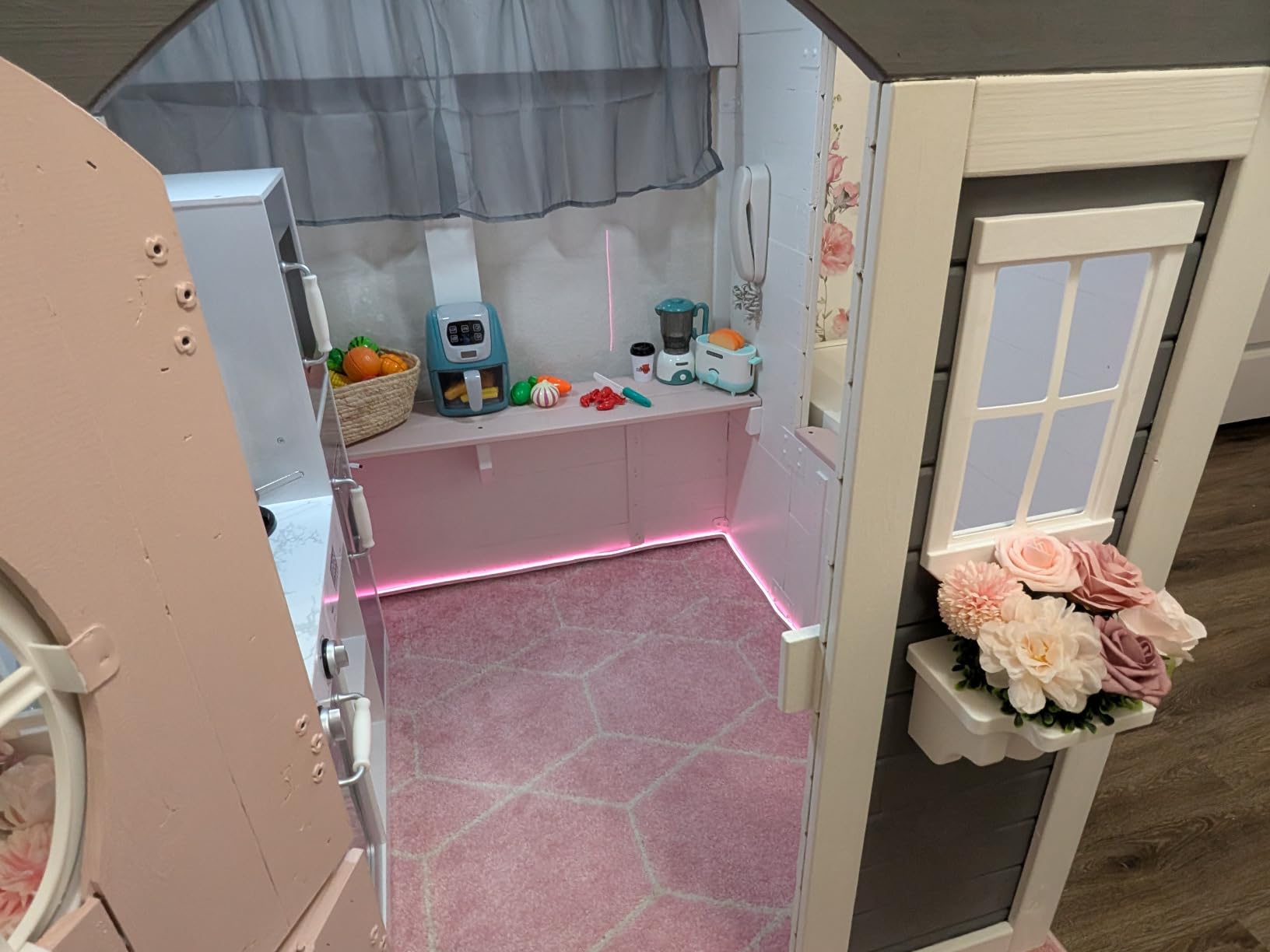
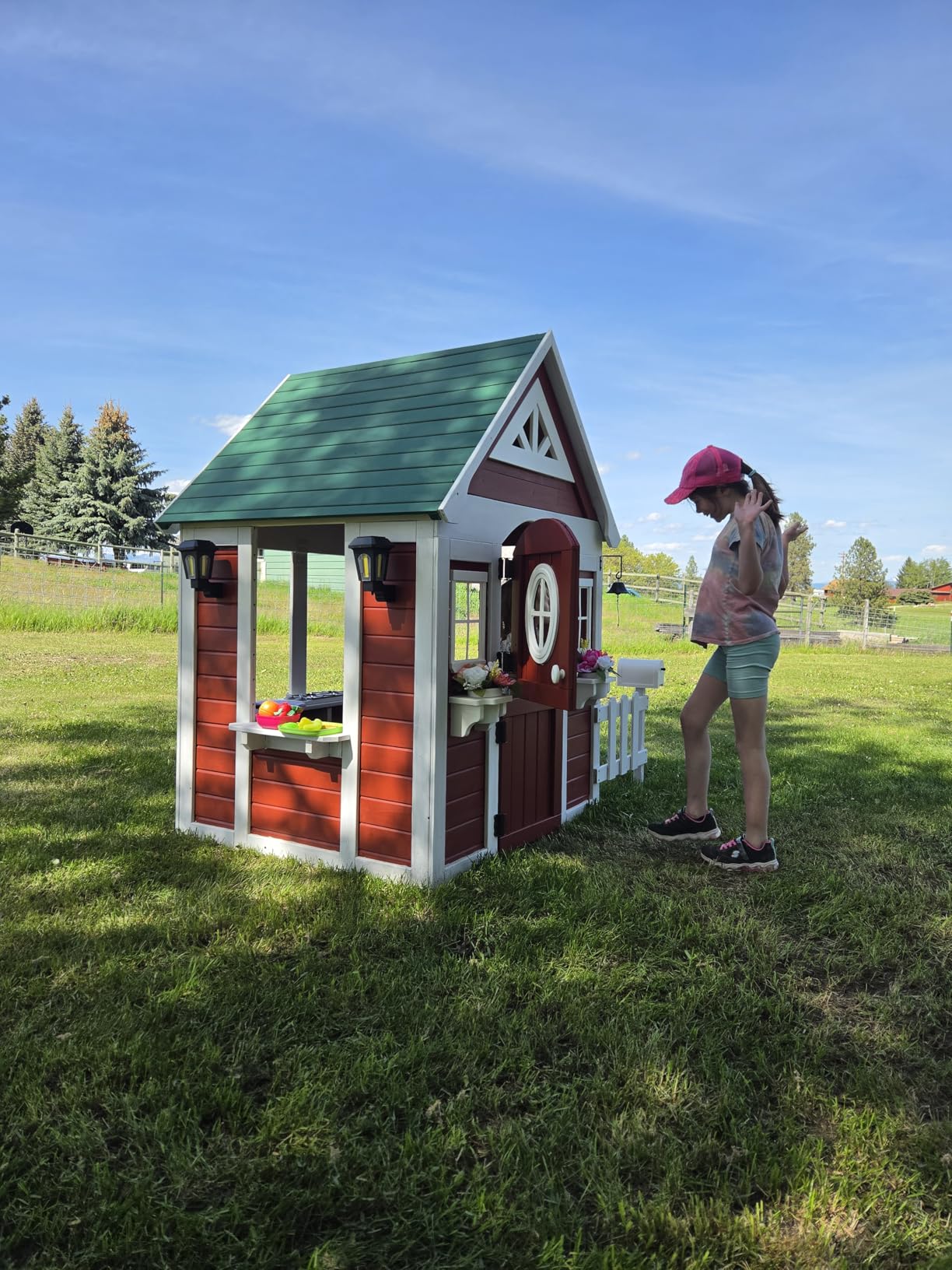
The Aspen is the most convincingly country-cottage design in the group, and the detail work is what sets it apart. The oval split Dutch door doubles as a window with a working knob and latch, so a child can open it inward, look out and be seen at the same time, and that single feature generates more independent play than almost anything else in the list.
The second big addition is the side serving station with a bench and toy lanterns, which effectively gives you a second play zone outside the main house. Paired with the play burner, toy sink and fruit-and-vegetable basket, it supports a full cooking-and-serving loop.
What stands out most is the age range. The manufacturer rates it from 24 months to 10 years, which is the widest span of any pick here and unusual for a wooden structure. Families who buy at the toddler stage and keep it for a decade get real value out of the footprint.
The 4.2 rating reflects size and weight rather than quality complaints. At roughly 124 lbs it is genuinely difficult to reposition, and it is not a product you carry over from summer to winter. Plan its home before you build.
Planning the footprint before you buy
At 78.8 inches wide and 67.3 inches tall, this is one of the larger units in the roundup. Leave clearance on at least the door side so a child can open the Dutch door outward without stepping into a shrub, and check that the serving station side has room for a bench to be used.
Because it is a fixed wooden structure on a base, a level, well-drained pad is worth the weekend it takes to build. Once it is down you will not want to move it.
Who should buy this and who should skip it
Buy it if you have a generous yard, one child who will grow into it over years, and a preference for natural wood that suits a garden setting. The 5-year limited warranty is a real plus.
Skip it if your yard is compact or you want something portable. At this weight, moving it twice a season is a two-person job and probably not worth the strain.
6. Backyard Discovery Echo Heights – Best Elevated Playhouse With a Slide
Backyard Discovery Echo Heights Elevated Cedar Wooden Kids Playhouse with Wave Slide, Play Kitchen, Wrap-Around Deck, Flat-Step Ladder, Half Door, Windows, Bell, and Growth Chart for Outdoor Play
Cedar
120.24 x 75 x 91.2 inches
Ages 3 to 10 years
5-year warranty
Pros
- Raised clubhouse with wrap-around deck
- 6-foot high-rail wave slide
- Flat-step ladder suits a range of ages
- Built-in growth board
- All-cedar with 5-year warranty
Cons
- Largest footprint in the group at 120 inches
- Needs a level base and two adults
- Highest price point here
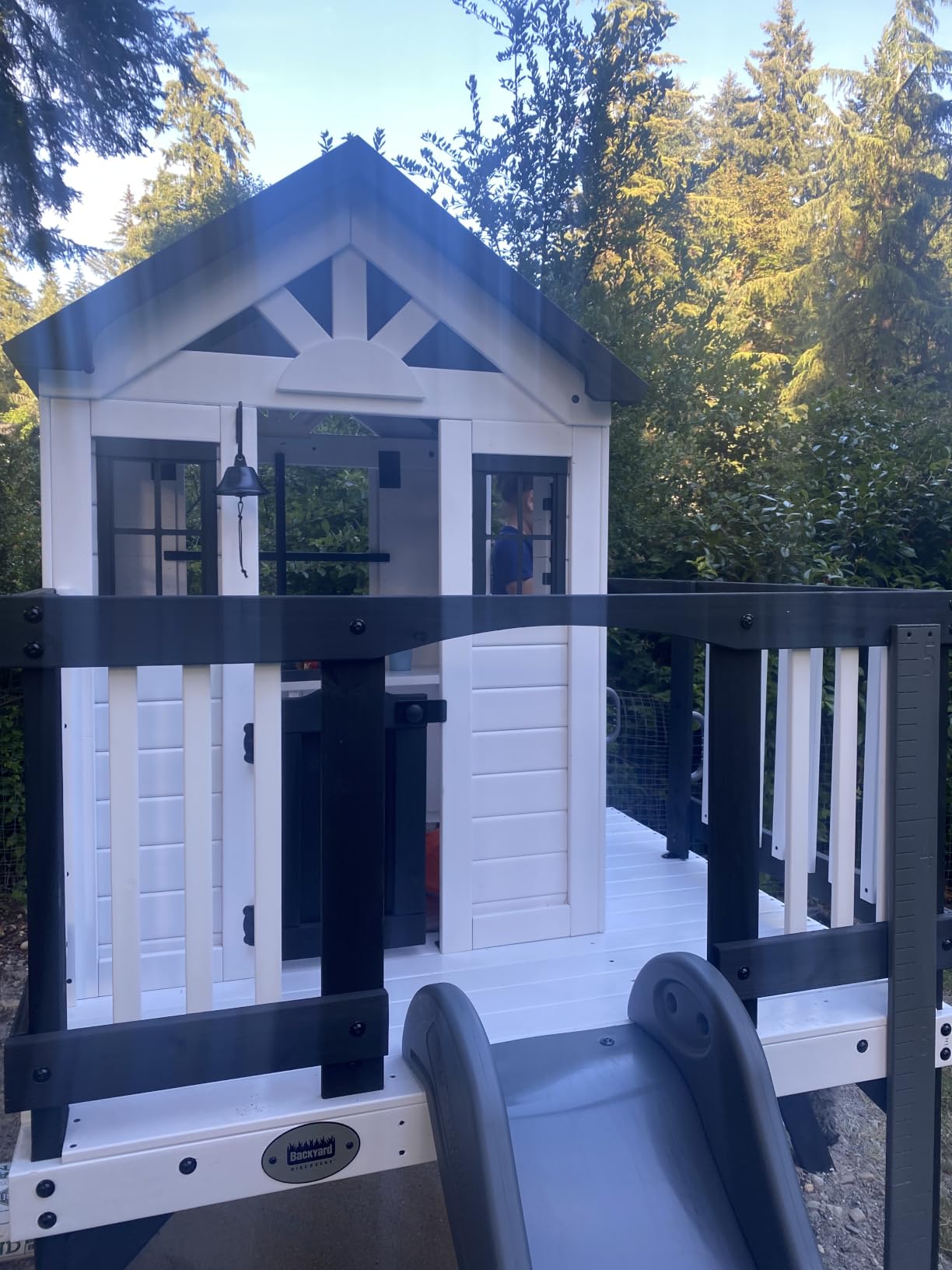
This is the only pick that is a real playset with a playhouse attached, and for a family who wants a backyard playhouse with a slide, it solves the problem in one structure. The raised clubhouse sits at deck level with a wrap-around deck, a 6-foot high-rail wave slide and a flat-step ladder that works for younger children as well as older ones.
The design logic is smart for tighter spaces. Because the play value is stacked vertically rather than spread horizontally, the footprint stays manageable relative to what you get, and the wrap-around deck effectively turns the top of the structure into an outdoor room rather than a roof you have to keep off limits.
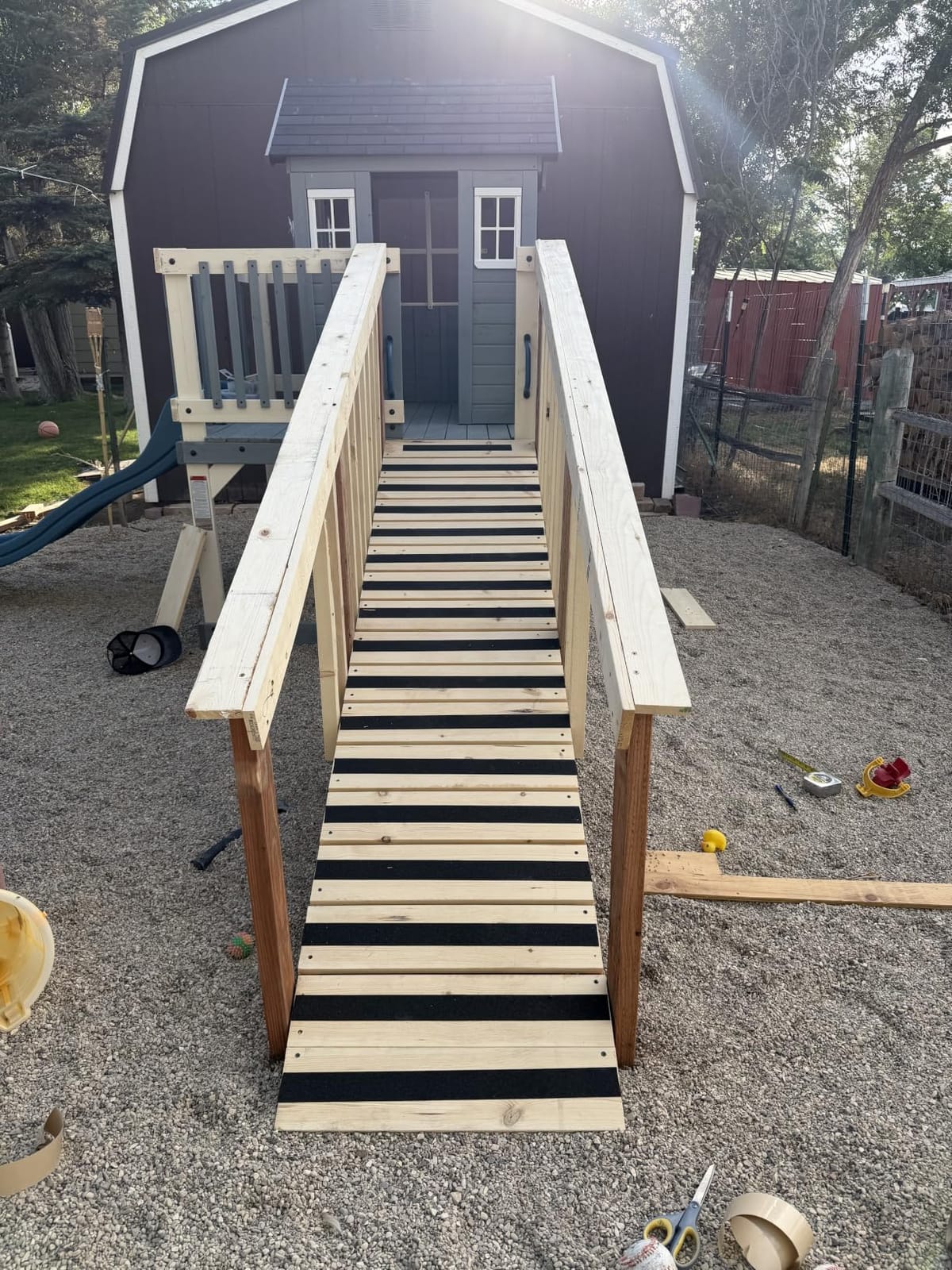
Inside the clubhouse there is a play kitchen with a powered blender and a functional half door, plus a built-in growth board to record the children heights over the years. That growth board is a small touch that owners mention often and parents tend to appreciate more than they expect.
Assembly runs through the BILT app with step-by-step directions, and the cedar arrives pre-cut, pre-drilled and pre-stained. The engineering is done to meet or exceed ASTM standards. Expect several hours of work and two adults minimum, and expect the 4.3 rating to be about effort and price rather than quality.
Measuring for a 10-foot structure
The depth of 120.24 inches is the number that catches people out. You need that full depth plus a clear run-out zone at the bottom of the slide, and the slide direction is not adjustable after assembly. Mark the footprint with stakes in the grass and walk around it before you order.
A level base is not optional at this size. A few centimetres of slope over ten feet will make the deck and the slide behave differently, so budget a full day for levelling, compacting and anchoring.
Who should buy this and who should skip it
Buy it if you want to combine a playhouse and a play structure in one, if you have children aged three to ten, and if the yard is big enough to hold the whole footprint with a safety margin.
Skip it if your yard is small or your budget is tight. It is the most expensive option here and the least forgiving about placement, since moving it after assembly is a serious job. If the yard is tight, our playset picks for small backyards are a better fit.
7. Outsunny Fir Cottage – Best for Gardening and Small-Animal Play
Outsunny Outdoor Kids Playhouse with Dutch Door for Toddlers 3-8, Beige
Fir wood
44.9 x 49.8 x 53.1 inches
Ages 3 to 8 years
Weighs 74 lbs
Pros
- Two flower boxes and decorative pots included
- Tilted roof diverts rainwater
- Openable side windows
- Convertible for small-animal use
- Cottage styling with retro windows
Cons
- Heaviest fir frame here at 74 lbs
- Fir needs sealing each season
- Larger than most plastic playhouses
The Outsunny cottage is the pick that leans hardest into garden play rather than kitchen play. Two flower boxes and two decorative planter pots come in the box, and the openable side windows mean a child can tend plants and actually see what is growing, which turns the structure into a real gardening station as well as a playhouse.
The sloped roof is the practical detail we liked most. Angling water away from the wood rather than letting it run down the panels is the single cheapest form of weather protection, and owners repeatedly praise the fact that the interior stays dry.
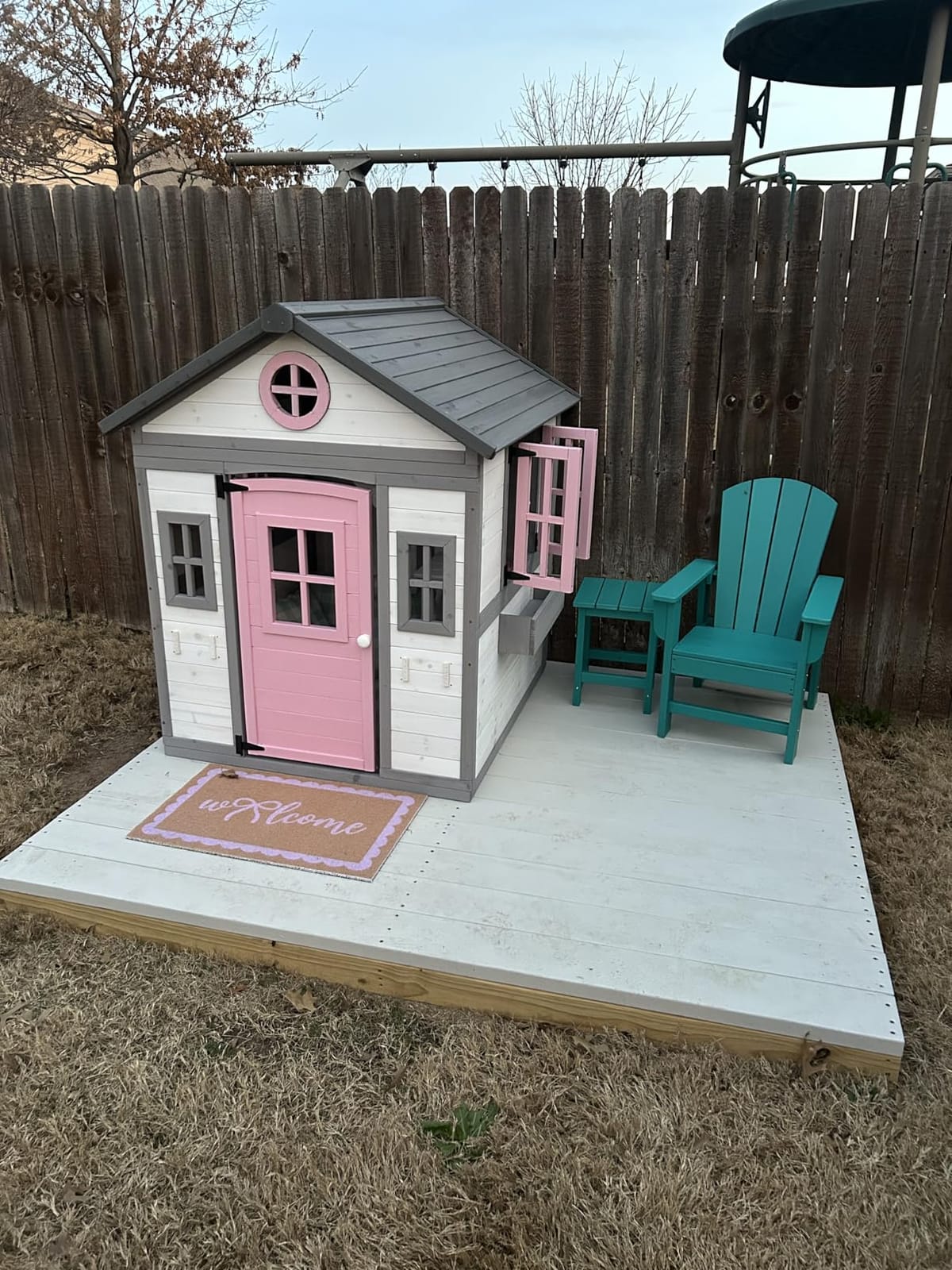
It also converts. The manufacturer markets it as a playhouse or a small-animal shelter, which is a genuinely useful second use if you ever need one, and it gives the structure a reason to stay in the yard after your child has grown out of pretend cooking.
Ratings sit at 4.4 with roughly 74 percent five-star. The reservations are weight and upkeep: at 74 lbs the frame is heavy to reposition, and fir is less decay-resistant than cedar, so sealing is an annual job rather than an occasional one.

Why the roof pitch matters more than it sounds
Water tracking down vertical wood panels is what causes splitting, swelling and rot at the base of a playhouse. A sloped roof shortens that path and pushes the runoff past the wall rather than down it, and that is why this design ages better than flat-roofed wood models in wet weather.
Fir still needs a water-based sealer reapplied each season. Treat that as a scheduled task rather than a surprise, and the cottage will hold up fine.
Who should buy this and who should skip it
Buy it if your child is three to eight, enjoys outdoor and sensory activities, and you want something that looks like a cottage rather than a bright plastic shell. The included planters get used immediately.
Skip it if you need something you can move easily or maintain without effort. At 74 lbs it is close to fixed-in-place, and the annual sealing requirement rules it out for busy families who want a set-and-forget structure.
8. BTMWAY Cedar Playhouse – Best Room for Groups of Kids
BTMWAY Kids Outdoor Playhouse,Cedar Gray Wooden Play House for Kids Ages 3-8, with Play Kitchen, Interactive Doorbell, Toy Phone, Sink, Flowerpot
Cedar
43.3 x 41.3 x 66.3 inches
Ages 3 to 8 years
Fits 4 to 6 children
Pros
- Interior sized for 4 to 6 children
- Smooth sanded cedar edges
- Play kitchen with sink and stove
- Working doorbell and hinged door
- Pre-cut panels with clear instructions
Cons
- No floor included
- Measurements supplied in millimeters
- Faucet can be fragile
Footprint numbers on playhouse listings rarely tell you how many children fit inside, so we paid attention to the interior here: 41.3 inches wide by 43.3 inches deep and 66.3 inches tall, which the manufacturer rates for four to six children. That is a meaningful difference from the tighter plastic cottages, and it makes this the pick for playdates and for families with more than one child.
The height matters as much as the floor area. At 66.3 inches, an older child can stand upright inside rather than crouching, and the vertical space supports standing-up kitchen play, which is where a lot of good role play happens.
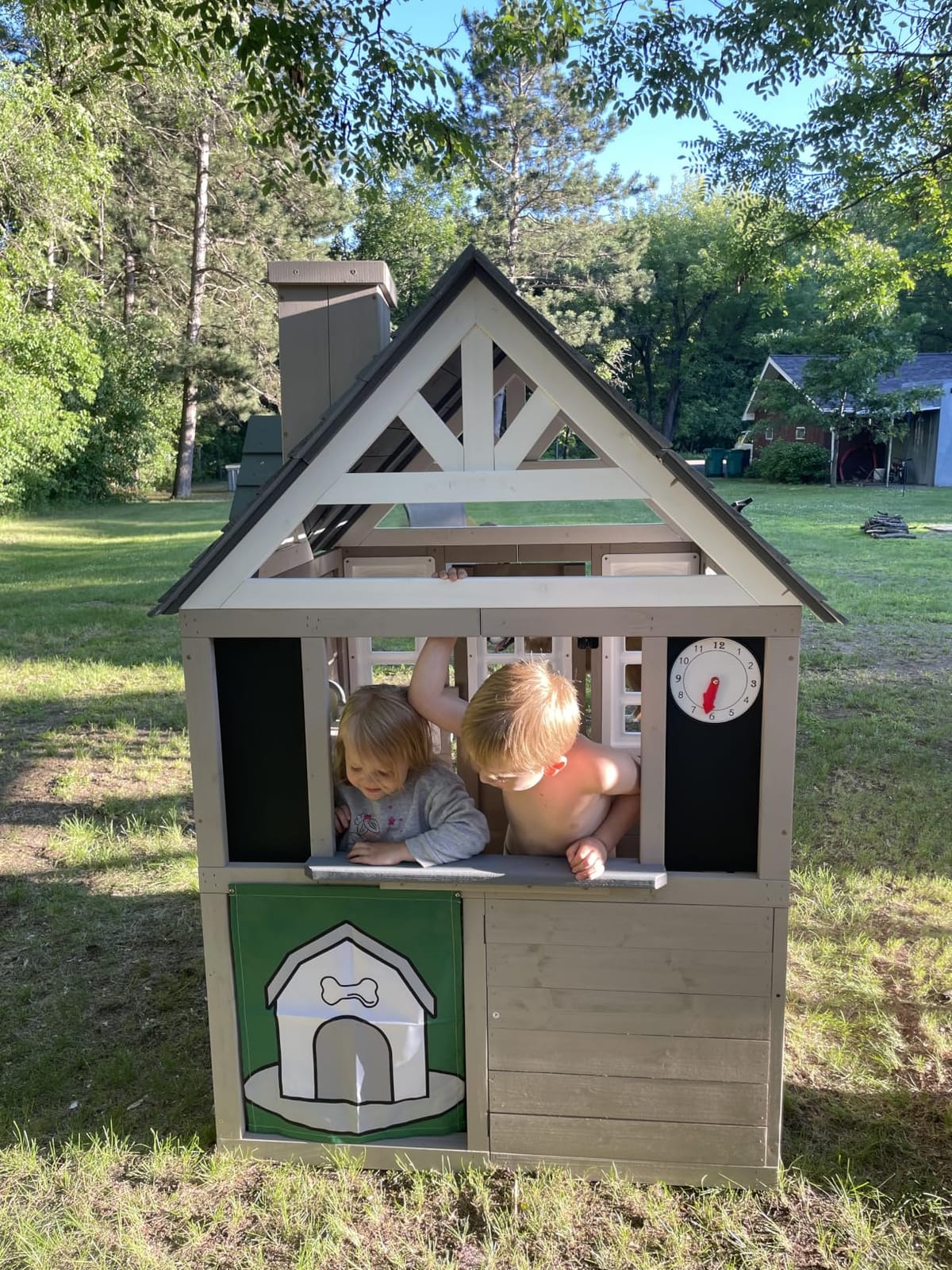
Everything is cedar with naturally smooth sanded edges, and the accessories are ABS-free PP plastic rather than the usual blend. The play kitchen includes a sink, stove and kitchenware, and there is a working doorbell, a hinged door and window flowerpot holders. The doorbell is the feature owners mention most, and the room to actually gather is the feature parents notice after a month.
Panels arrive pre-cut and pre-drilled with clear step-by-step instructions, and assembly is quoted at roughly three to five hours. The rating is 4.5 with about 76 percent five-star.
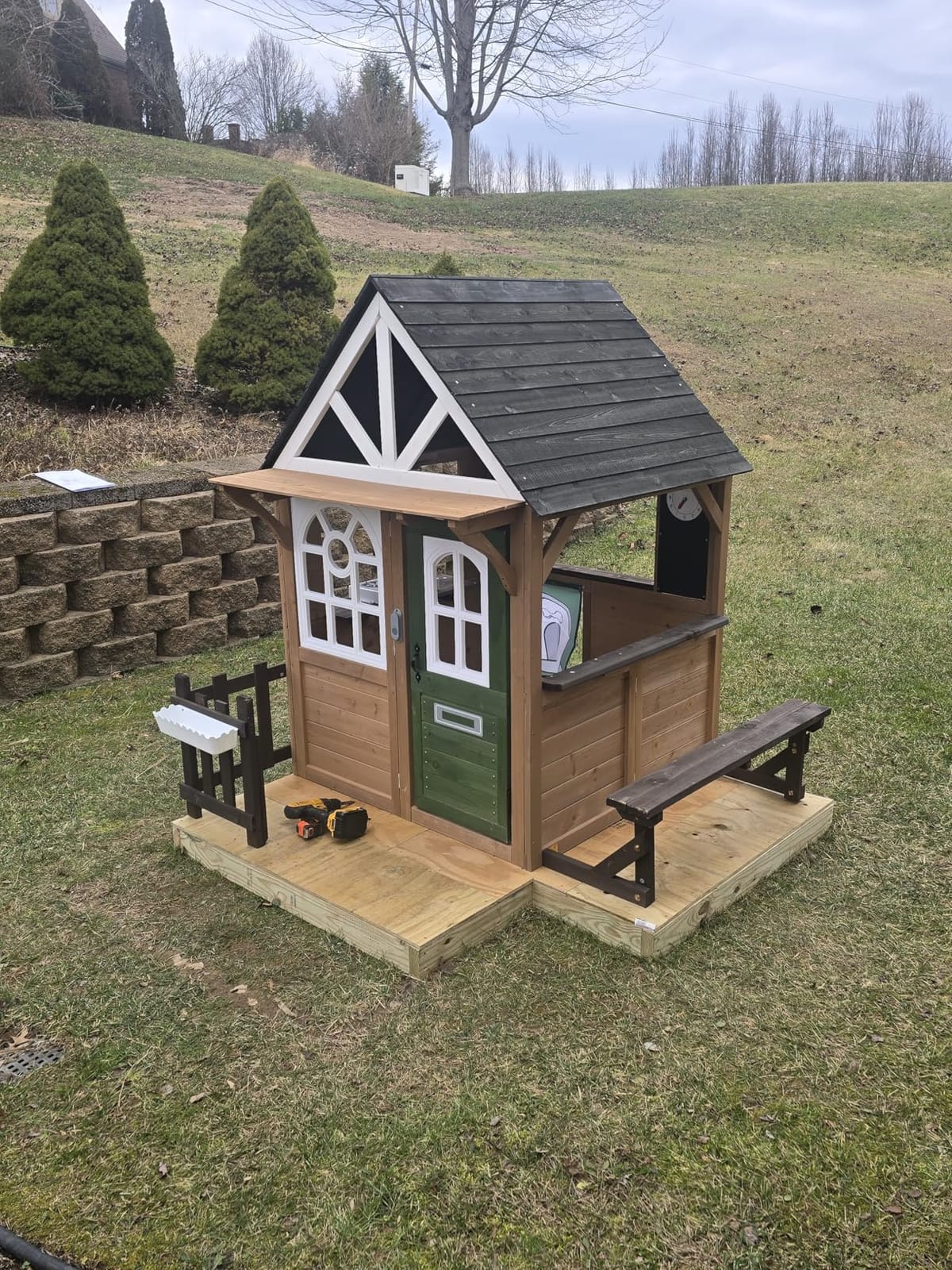
Planning a deck base for a floorless house
There is no floor, so a base is not optional if you want this to last. A simple platform of pressure-treated boards with a crowned surface that sheds water toward the edges works well and takes a weekend. Add a drip edge around the perimeter so runoff does not track back up under the wall.
One practical warning: the measurements are published in millimeters. Convert before you tape out the footprint, and add a hand span for the deck edge on at least two sides.
Who should buy this and who should skip it
Buy it if you have two or more children, regular playdates, or a preschool-age child who needs standing room. It works indoors as well as out, which some families use for winter play.
Skip it if you want a fully finished product with no building work, or if a fragile faucet accessory would drive you mad. It is not the pick for a family who wants to unpack and start playing the same afternoon.
9. Step2 Neat and Tidy Cottage – Best for Toddlers From 18 Months
Step2 Neat & Tidy Cottage Kids Playhouse, Indoor and Outdoor Playset, Interactive Sounds, Toddlers 1.5+ Years Old, Easy to Assemble, Grey
Plastic
33.75 x 53.25 x 49.75 inches
Ages 18 months to 10 years
2-year warranty
Pros
- Rated from 18 months
- Works indoors and outdoors
- Working shutter and doorbell with Dutch doors
- Molded sink fireplace and skylight
- Drive-thru window and backyard BBQ
Cons
- Shortest warranty here at 2 years
- Molded details trap grime outdoors
- Interior smaller than the wooden cottages
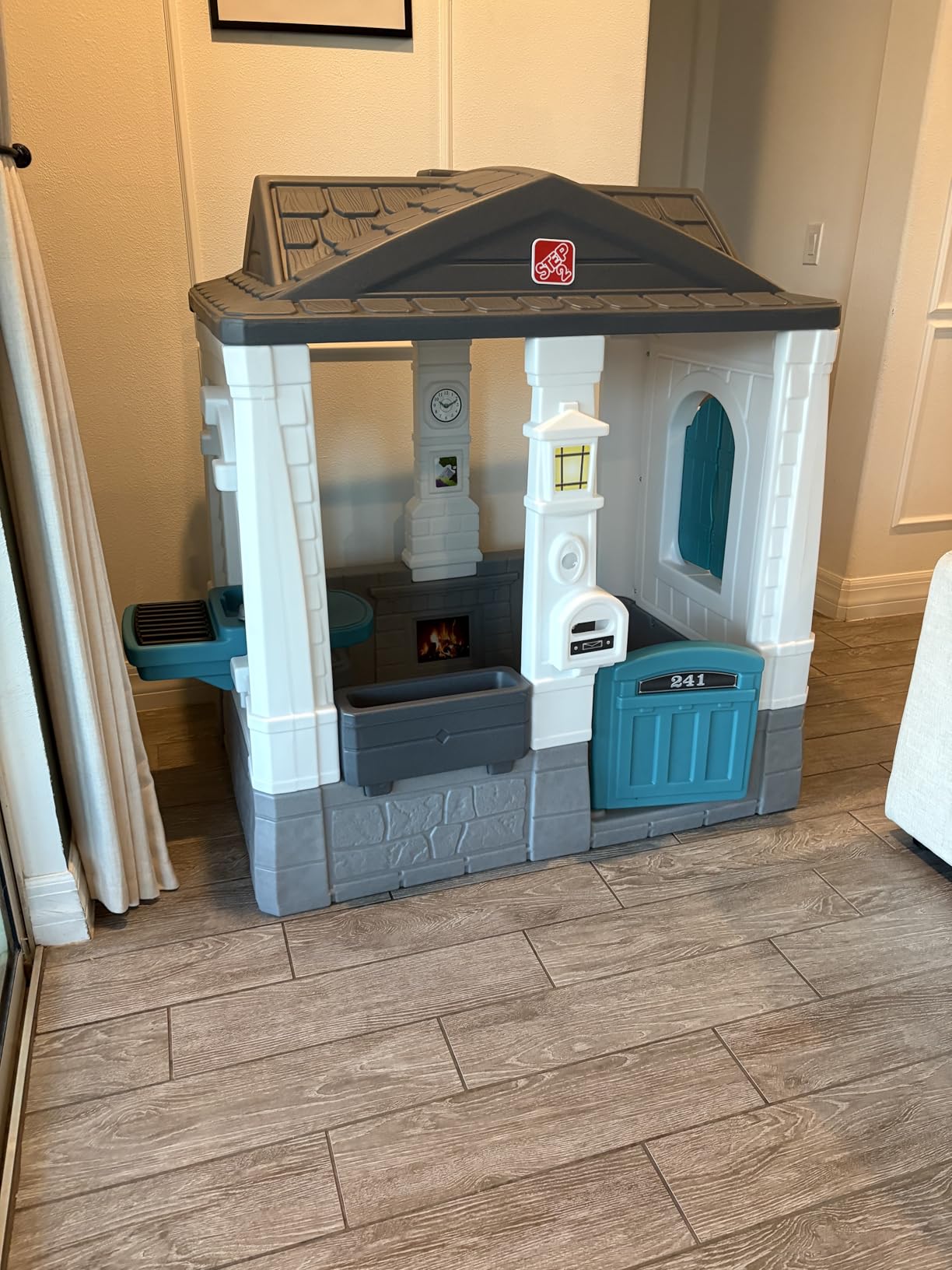
This is the one to buy if you have a child under two. The manufacturer rates it from 18 months, the lowest starting age of any pick here, and the low doorway and step-free entry mean a walking toddler can get in and out without help. Almost 83 percent of reviewers leave five stars.
The feature density is the other argument. A working shutter and doorbell, Dutch-style doors, a molded-in sink, tabletop, fireplace and skylight, a backyard BBQ and a drive-thru window, plus a play phone and decals in the box. For the money, it is very hard to find that many interactive points in one structure.
Because it is double-walled plastic, it works indoors in a playroom or outdoors in the yard with the same unit, and the surfaces wipe clean. The stacked-stone styling and muted colour palette also mean it sits easily in a garden setting, which some parents prefer.
The trade-offs are honest ones. The 2-year warranty is the shortest in the roundup, the molded-in sink and plastic accessories pick up grime in outdoor use, and the interior is smaller than the larger wooden cottages.
Getting the most out of a molded interior
Molded features are what make this house work for a toddler, and they are also what makes it harder to keep clean. The sink, tabletop and fireplace collect sticky residue in ways a flat panel does not, so a weekly wipe-down with a warm damp cloth keeps it in good shape and prevents grime building into the seams.
Use it indoors as much as outdoors. The 18-month rating and the indoor suitability together mean it can carry a child through the first two and a half years of pretend play without needing an upgrade.
Who should buy this and who should skip it
Buy it if your child is between 18 months and about five, you want one structure for indoor and outdoor use, and you like high feature density without assembly complexity. Assembly is straightforward.
Skip it if you are buying for older children who need standing room and elbow space, or if warranty length is a deciding factor for you. For more elevated play options, see our backyard slide reviews.
10. Step2 Adventure Camper – Best Built-In Floor and Accessory Count
Step2 Adventure Camper Kids Playhouse, Indoor/Outdoor Playset with Kitchenette, Interactive Doorbell Sounds, 52-Piece Toy Accessories, Durable Plastic, For Toddlers 2+ Years
Plastic
36 x 62 x 50 inches
Ages 2 plus
52-piece accessory set
Pros
- 52-piece accessory set is the largest here
- Built-in floor means no base needed
- Kitchenette with sink oven and grill
- Double-walled plastic wipes clean
- About 84 percent five-star reviews
Cons
- Doorbell needs batteries that are not included
- 62-inch width needs space
- Heavier than most plastic alternatives
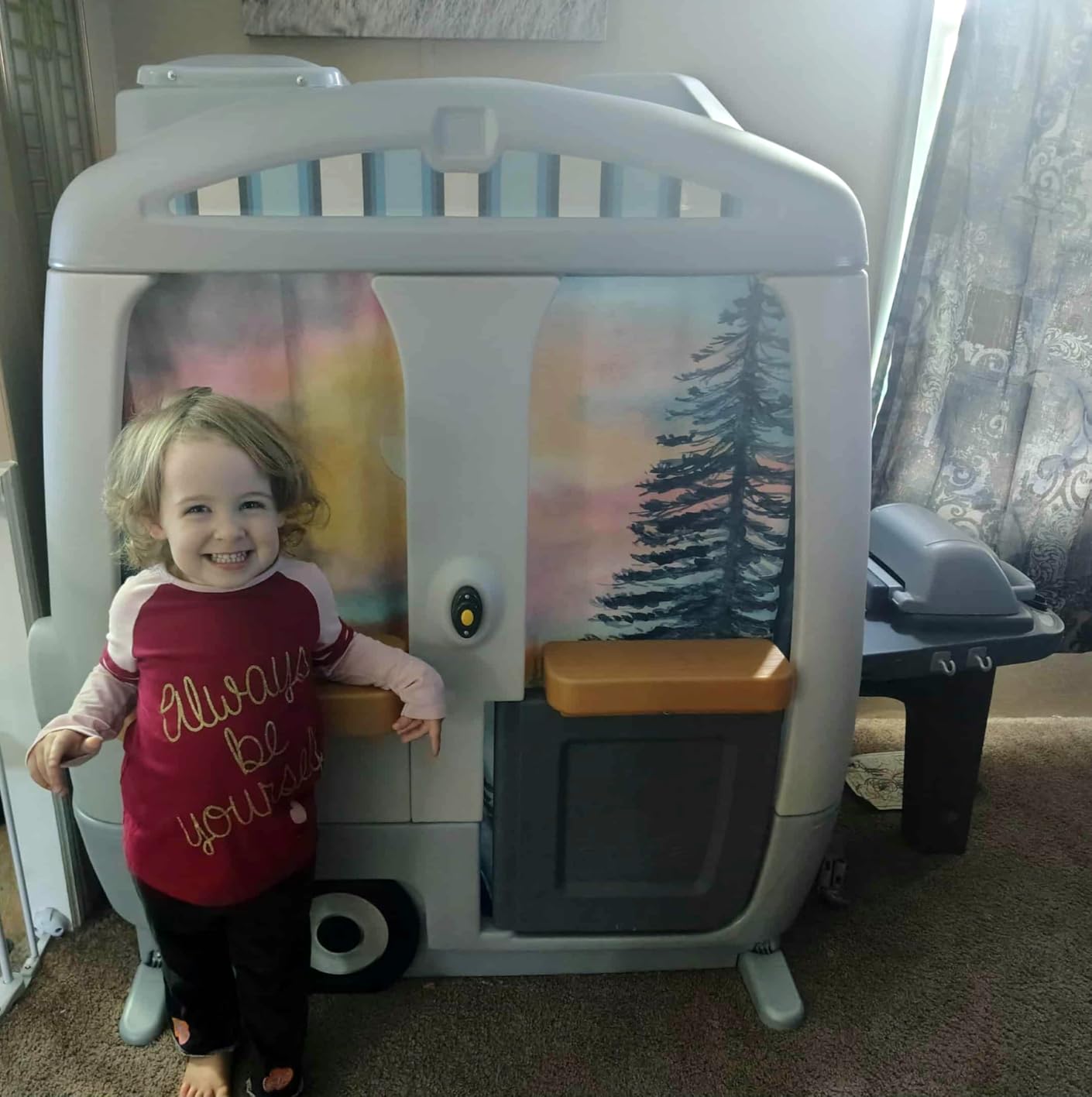
The Adventure Camper solves the single problem that ruins most plastic playhouses on grass: there is no floor to build, because it has one. The molded base is part of the structure, so you can place it on a level lawn, a paver pad or a deck and use it the same day it is assembled.
It also has the highest share of five-star reviews in the group at roughly 84 percent. The 52-piece accessory set is by far the largest included, covering cookware, utensils, trays, plates and click-together play food, and the kitchenette adds a sink, oven, stovetop and grill on top of that.
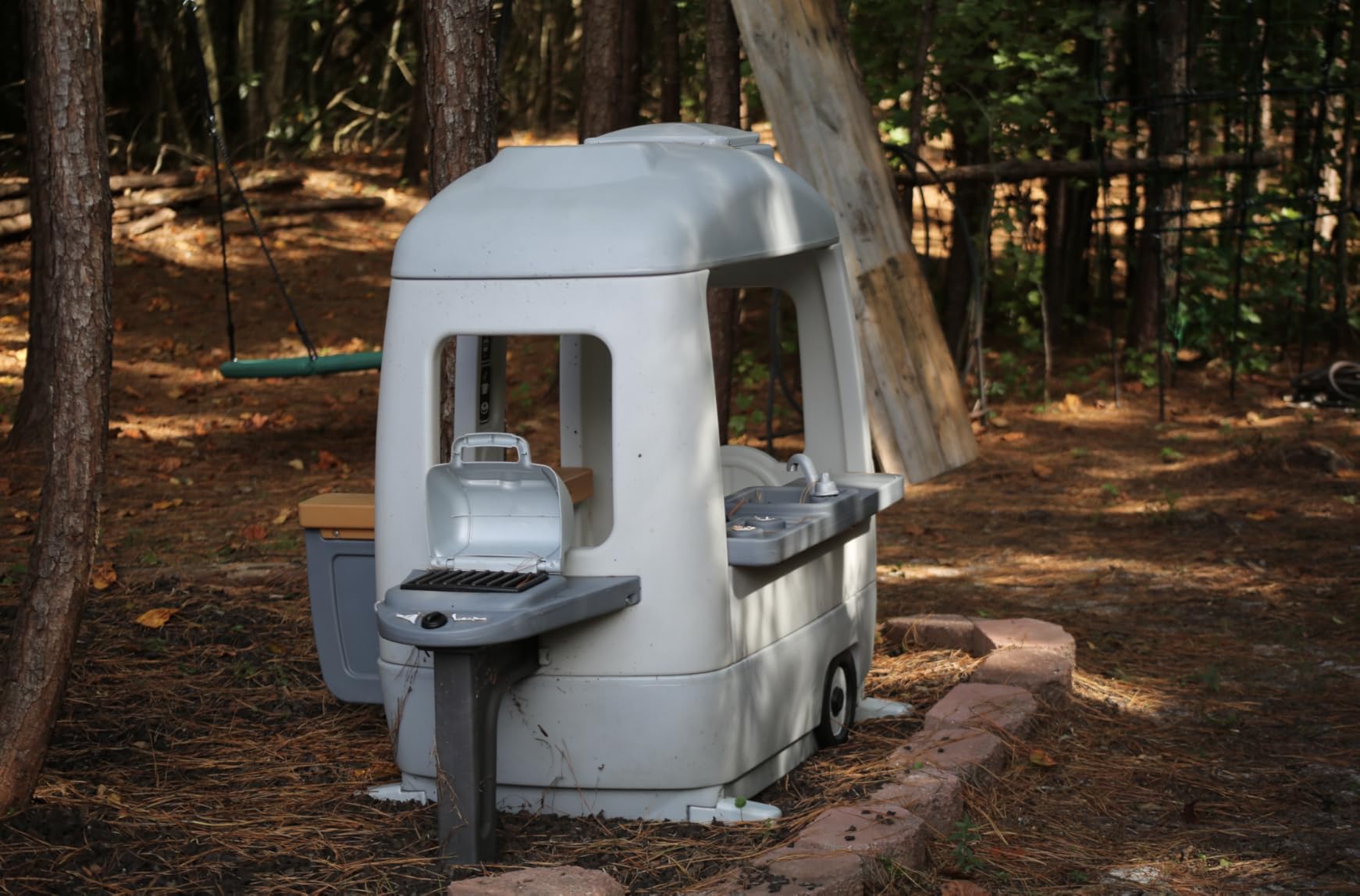
The camper theme is a proven hit with toddlers and preschoolers, and the interactive doorbell adds realistic sound play. The double-walled plastic resists fading, cracking, chipping and peeling and wipes down quickly, which is what you want in a structure that will get rained on and spat up in equal measure.
Owners name the accessory count and the included floor as the two things that make the value work. The 62-inch width is the main planning constraint, and the doorbell needs batteries that are not included, a small detail worth adding to your list before assembly day.
Why the built-in floor changes the install
A molded floor removes an entire weekend of work and one of the most common sources of early damage. There is no timber base to twist, no gap for water to sit in and no decision to be made about a floor at all, which is why this is the fastest path from delivery to actual playing.
The trade-off is that the structure is fixed to its own base, so it cannot be moved in two halves. Choose the spot carefully, and treat the floor as a reason to put it straight onto a level pad rather than a slope.
Who should buy this and who should skip it
Buy it if you want maximum play value with no floor to build, and if your yard has 62 inches of width to spare. It suits ages two and up, and the accessories mean it stays interesting past the toddler stage.
Skip it if width is tight, or if you need to store it over winter, since moving this unit takes two adults. It is also larger than most plastic alternatives, so plan the route from the delivery point to its final home before the box arrives.
Wood vs Plastic Playhouses: Which Should You Buy?
Choose plastic for zero maintenance, a fast setup and the lowest risk of rot; choose wood for a natural look, a longer service life and the option to stain it any colour. Plastic playhouses need nothing more than a hose-down and an occasional stake in high wind. Cedar and fir playhouses need sealing every year or two, but they weather into a space far better and can be repaired panel by panel. Families in wet or freezing climates who want no maintenance should go plastic; families who care how the structure looks in the yard, and who will schedule a spring sealing session, should go cedar.
There is a third consideration that gets missed: weight. The plastic units in this roundup are light enough that one adult can shift them, while the wooden playhouses at 74 lbs and up generally need two. That single fact decides whether you can move the house indoors for winter or bring it out of storage in spring without extra help.
One more thing worth checking before you commit is the floor. Just one pick in this roundup ships with a molded floor, and the rest either have none or rely on a raised deck you build yourself. Owners in forum threads repeatedly report that floorless wood houses end up muddy inside and that the base rots from standing water.
How to Choose a Backyard Playhouse in 6 Steps
These six steps, in order, will narrow a very large catalogue down to two or three realistic options.
Measure the footprint and the clearance. Take the assembled width and depth from the spec sheet, then add clearance on the door side and a run-out zone for any slide. Walk the outline with stakes before you order.
Match the playhouse to your child’s age. Under two years needs a low doorway and a step-free entry. Three to five needs standing room. Six and up needs vertical play, a deck or a slide.
Decide on material and accept the maintenance. Plastic means no sealing. Cedar means an annual sealer and a better-looking structure in five years.
Check the floor and the base. Decide now whether you are building a deck. If so, add that weekend to your plan before the playhouse arrives.
Count the interactive features. Working doorbells, play kitchens and snack windows are what keep a child inside the structure instead of drifting back to a slide.
Verify the warranty and the anchor points. Warranties here run from 90 days to five years. Ask whether the unit has a base designed to be staked down in wind.
Site Prep and Installation: Level Ground, Pads and Anchoring
Most playhouse complaints trace back to the ground, not the structure. Wood placed on a lawn sits in standing water at the base, and light plastic shells move in the first serious gust of wind. Ten minutes of measuring and an hour of levelling prevents both.
Start with level. Mark the assembled footprint with stakes, check the diagonal in two directions to confirm it is square, and then pack and level the ground. A crowned surface that falls slightly away from the door is better than a flat one, because it moves water out of the building rather than holding it there.
For the base, a compacted gravel pad is the most forgiving option and improves drainage. Pavers work well under plastic units and give a firm, clean surface for a built-in floor. A raised timber deck is the right answer for any floorless wood model, and it also lifts the walls clear of damp soil, which is where rot starts.
Anchoring deserves its own paragraph because it is the most commonly skipped step. Lightweight plastic houses should be fixed at two or more points with ground stakes or auger screws through the base flange, and we would repeat the fix each season. Wood structures need anchoring too, more for lateral stability than for lift. If you live somewhere with an HOA, check the rules before you order, since exterior structures frequently need approval.
Finally, open the box before you start. Count the panels and hardware against the instruction sheet, check for warped or chipped pieces, and photograph everything while it is still in the packaging. Replacement parts for a specific model are far easier to source while the original listing is still in your order history.
Matching a Playhouse to Your Child’s Age
Match the structure to the age band and the house will outlast the phase it was bought for.
18 months to 3 years. Prioritise a low step-free doorway, a wide opening and simple round features. The Step2 Neat and Tidy Cottage, rated from 18 months, is the clearest fit in this group, and the Little Tikes Cape Cottage covers the same band with a lighter, more portable build.
3 to 5 years. This is where pretend kitchens, doorbells and serving windows take over. Most of the picks here land in this range, and the deciding factor becomes how much standing room there is and whether there is a floor.
5 to 8 years. Vertical play starts to matter more than interior detail. The Step2 All Around Patio with its canopy and sand table, and the Outsunny cottage at 53 inches, work well for this band. The KidKraft picnic table model also holds this age well.
8 to 10 years. Go for height, decks and slides. The Backyard Discovery Echo Heights, the raised clubhouse with a 6-foot wave slide and wrap-around deck, is built for this band, and the Aspen covers it with a wider age span if your child is younger.
Frequently Asked Questions
What is the best playhouse for a backyard?
For most families the Little Tikes Cape Cottage is the best playhouse for a backyard, because the double-walled plastic needs no maintenance, snaps together with minimal tools and weighs only 32 lbs. Choose a cedar cottage like the Backyard Discovery Sweetwater if you prefer wood and can commit to sealing it annually. Choose an elevated model like the Backyard Discovery Echo Heights if your child is over five and wants a slide and deck.
Which is better for an outdoor playhouse, a wooden or a plastic one?
Plastic wins for zero maintenance: hose it down, stake it in high wind and you are done. Wood wins for looks, longevity and repairability, since you can replace a single cedar panel rather than the whole structure, but it needs sealing every year or two. Families in wet or freezing climates who want no upkeep should choose plastic, while families who care how the structure looks in the yard should choose cedar.
What is the best material for an outdoor playhouse?
Cedar is the best all-round material because it resists decay naturally and survives wet climates when sealed. Fir is cheaper and lighter to handle but needs more frequent treatment. Double-walled rotomolded plastic is the best low-maintenance choice and will not rot, crack in freeze-thaw cycles or attract insects, at the cost of a shorter lifespan and a less natural appearance.
Can you put a wooden playhouse on grass?
You can, but the base will sit in damp soil and rot over time, and owner reports repeatedly describe muddy interiors on floorless models. Level the ground first, then put the house on a compacted gravel pad, pavers, or a raised timber deck that falls slightly away from the door. Anchor the structure at two or more points so wind cannot shift it.
What age is best for an outdoor playhouse?
Outdoor playhouses suit children from about 18 months to 10 years, but the right age band changes what you should buy. Under three, prioritise a low step-free doorway. Three to five, prioritise a play kitchen and standing room. Six and up, prioritise vertical play such as a deck, ladder or slide. The Step2 Neat and Tidy Cottage covers the youngest band; the Echo Heights covers the oldest.
How long does a playhouse take to assemble?
A lightweight plastic playhouse usually snaps together in under an hour, while a mid-size cedar cottage typically takes three to five hours for two adults. The KidKraft model is quoted at about 2.5 hours for two people, and the BTMWAY cedar house at roughly three to five hours. Owners consistently report taking 30 to 50 percent longer than the box states, so plan an extra hour.
Conclusion
If you want one recommendation for most families buying the best playhouses for backyards in 2026, it is the Little Tikes Cape Cottage. It needs no maintenance, assembles in minutes, and carries the largest body of owner feedback we could find, which means its weaknesses are known and manageable rather than a surprise.
Pick the Step2 All Around Patio for shade and kitchen play, the Backyard Discovery Sweetwater for cedar at a fair price, the Neat and Tidy Cottage for a child under two, and the Echo Heights once your child is climbing. Whatever you choose, level the ground and anchor the base before the first windy day. Our guides to the best outdoor playhouses and backyard trampolines cover what to pair it with next.