
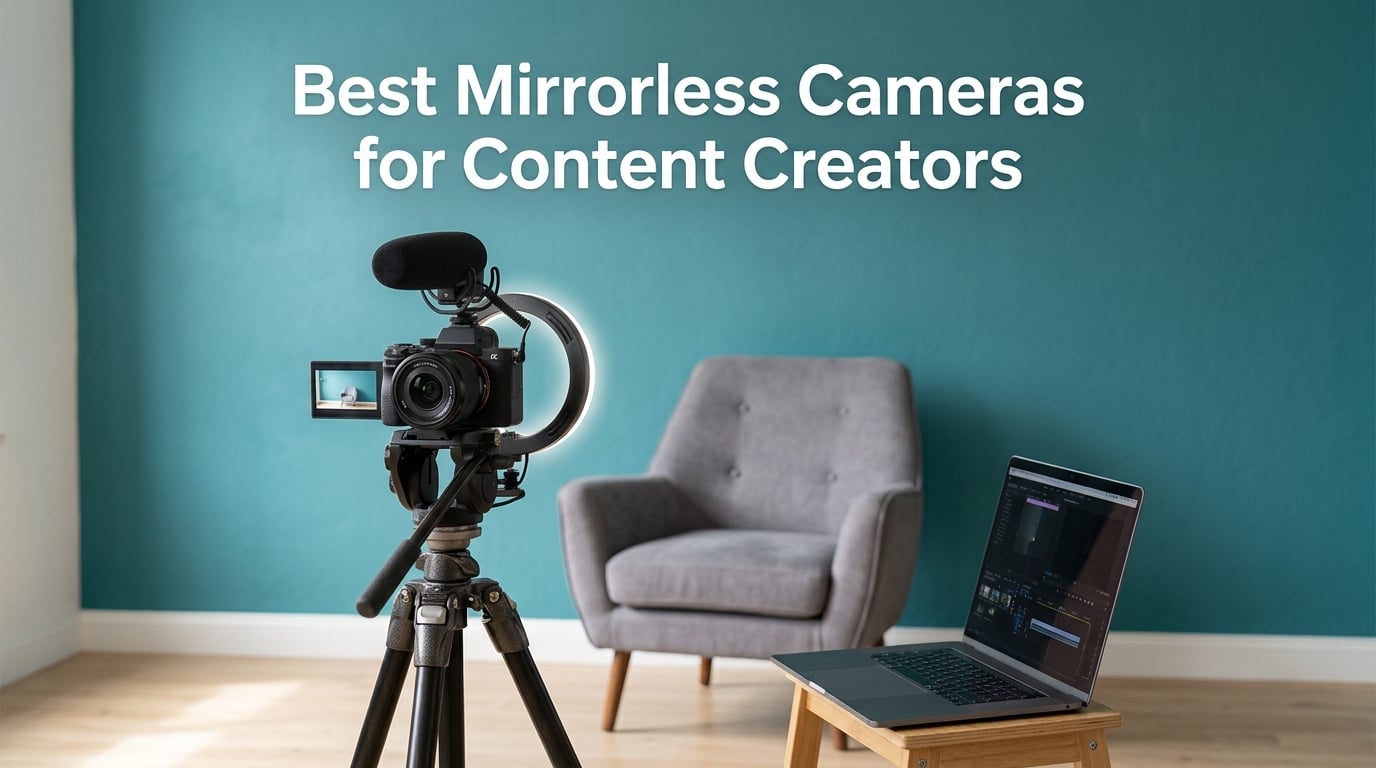
I have spent the better part of three years shooting YouTube talking-head videos, product demos, and travel vlogs on mirrorless bodies from Sony, Canon, Nikon, Fujifilm, and Panasonic. Along the way I learned that the camera that wins on a spec sheet is rarely the camera that survives a 12-hour shoot day. So when I set out to find the best mirrorless cameras for content creators in 2026, I cared less about megapixel counts and more about real things: does the autofocus lock on when I move, does the flip-out screen let me frame myself, and does the body overheat after 30 minutes of 4K.
Content creators have a different checklist than wedding photographers or sports shooters. You probably shoot alone, you frame yourself, you care about vertical video for TikTok and Reels, and you want footage that looks good straight out of camera so you can post fast. That is exactly what this guide is built around. Every camera below was chosen because it solves a real creator problem, whether that is reliable eye-tracking autofocus, a clean HDMI feed for livestreaming, or a vari-angle screen that flips all the way forward.
The short version: if you want the best balance of quality and price, the Canon EOS R8 is my top pick because it packs a full-frame sensor and uncropped 4K 60p into a body that fits in a small sling bag. If vlogging is your main gig, the Sony ZV-E10 is the crowd favorite with 425 autofocus points and a built-in Product Showcase mode. And if you are starting from scratch on a budget, the Canon EOS R50 delivers oversampled 4K and excellent autofocus for less than most flagship phones cost used.
Below I break down 12 cameras across every budget and use case, from beginner APS-C bodies to full-frame workhorses and a Micro Four Thirds video monster. Let us get into the picks.
Table of Contents
Top 3 Picks for Best Mirrorless Cameras for Content Creators in 2026
The Canon EOS R8 earns the top spot because it gives you a true full-frame sensor, uncropped 4K 60p oversampled from 6K, and Canon’s Dual Pixel CMOS AF II with 1,053 autofocus zones, all in a body under a pound. For a solo creator who wants shallow depth of field and pro color grading with Canon Log 3, nothing else here matches that combination of sensor size and value.
The Sony ZV-E10 is my value pick for one simple reason: it was built from the ground up for vloggers. The Product Showcase Setting snaps focus to objects you hold up to the lens, the directional 3-capsule mic sounds surprisingly clean, and the 425-point AF tracks your face reliably. With over a thousand reviews backing it, this is the camera most creators actually buy.
The Canon EOS R50 rounds out the top three as the budget pick. You get 6K-oversampled uncropped 4K, subject detection that tracks people and animals, and a vari-angle touchscreen, all for well under what most dedicated cameras cost. It is the smartest first mirrorless camera you can grab right now.
Best Mirrorless Cameras for Content Creators in 2026
| Product | Specifications | Action |
|---|---|---|
 Canon EOS R100 Canon EOS R100 |
|
Check Latest Price |
 Canon EOS R50 V Canon EOS R50 V |
|
Check Latest Price |
 Canon EOS R50 Canon EOS R50 |
|
Check Latest Price |
 Sony Alpha ZV-E10 Sony Alpha ZV-E10 |
|
Check Latest Price |
 Nikon Z 30 Nikon Z 30 |
|
Check Latest Price |
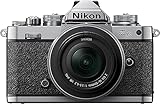 Nikon Z fc Nikon Z fc |
|
Check Latest Price |
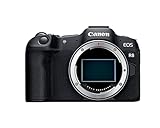 Canon EOS R8 Canon EOS R8 |
|
Check Latest Price |
 Canon EOS R10 Kit Canon EOS R10 Kit |
|
Check Latest Price |
 Fujifilm X-S20 Fujifilm X-S20 |
|
Check Latest Price |
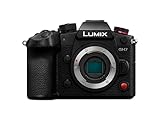 Panasonic LUMIX GH7 Panasonic LUMIX GH7 |
|
Check Latest Price |
 Sony Alpha a6700 Sony Alpha a6700 |
|
Check Latest Price |
 Sony Alpha 7 IV Sony Alpha 7 IV |
|
Check Latest Price |
1. Canon EOS R100 – The Easiest Entry Into Mirrorless
Canon EOS R100 Mirrorless Camera with RF-S 18-45mm Lens Bundle
24.1MP APS-C Sensor
Dual Pixel CMOS AF with 143 Zones
4K 24p with Crop
Compact RF Mount Body
Pros
- Beginner-friendly auto scene modes
- Compact and lightweight design
- Fast Dual Pixel autofocus
- Includes RF-S 18-45mm lens
Cons
- 4K video has a heavy crop
- Full HD only for most everyday shooting
- No in-body image stabilization
I handed the Canon EOS R100 to a friend who had only ever shot on her phone, and within an afternoon she was shooting proper shallow-depth-of-field talking-head clips. That is the whole point of this camera. The auto scene modes and Dual Pixel CMOS AF with 143 zones mean you can basically point, shoot, and get footage that already looks more professional than anything your phone produces.
The included RF-S 18-45mm lens is genuinely useful, giving you a versatile range for sit-down videos, product shots, and casual walkaround content. I like that Canon put a real kit lens in the box rather than a throwaway. Pair it with the 3-inch LCD and Wi-Fi transfer to your phone, and you have a complete content workflow that fits in a jacket pocket.
Where the R100 shows its budget roots is video. The 4K mode crops in hard and drops autofocus performance, so in practice I treat this as a Full HD 60p camera for moving content and save 4K for static shots. The 6.5 fps burst is also modest, which matters if you want to dabble in photography on the side.
For a first mirrorless camera, though, none of that bothered me. The image quality from the 24.1MP APS-C sensor is clean, the colors are typically pleasing Canon warmth, and the RF mount means you can grow into better glass later without switching systems.
Who this fits best in a real workflow
If you are a beginner vlogger, a student filmmaker, or a small business owner who needs better-than-phone video for social posts, the R100 is a stress-free starting point. It shines for sit-down YouTube and Instagram content where you control the framing. It is less ideal for fast-moving action vlogs because of the slower burst and 4K crop.
What to know about the RF mount before buying
The RF mount is Canon’s modern system, so you are buying into a healthy lens roadmap. The catch is that affordable RF-S glass is still limited, and adapting older EF lenses works but adds bulk. Plan to grow into a couple of RF or RF-S primes over time rather than expecting a huge budget lens selection on day one.
2. Canon EOS R50 V – Built for Vertical Video and Social
Canon EOS R50 V Mirrorless Camera (Body Only)
24.2MP APS-C Sensor
Dual Pixel CMOS AF II
4K Crop 59.94p and 4K Full-Width 29.97p
Vertical Video Tripod Mount
Pros
- Vertical video tripod mount for TikTok and Reels
- Front record button for self-framing
- Dual Pixel AF II with subject detection
- USB-C UVC streaming built in
Cons
- Body only with no lens included
- No headphone jack for audio monitoring
- Slightly heavier than expected for a body-only unit
The Canon EOS R50 V is the camera I would hand to a creator whose entire audience lives on TikTok, Reels, and YouTube Shorts. The headline feature is a dedicated vertical video tripod mount, which means you can mount the camera upright on a tripod and shoot native vertical 9:16 footage without a awkward L-bracket. That single detail saves so much friction in a daily posting workflow.
There is also a front-facing record button so you can start and stop recording while framing yourself, plus Slow and Fast motion modes for the kind of speed-ramp edits that perform well on social. The Dual Pixel CMOS AF II with People, Animal, and Vehicle detection keeps you sharp even when you are walking and talking to the lens.
Video is strong across the board here. You get 4K full-width at 29.97p plus a cropped 4K at 59.94p for slow motion, and Full HD up to 119.8p. The USB-C UVC streaming means you can plug it straight into your computer as a webcam for livestreams without a capture card, which is a big deal if you stream regularly.
Remember this is a body-only package, so you need to budget for a lens. I would pair it with a Canon RF-S prime like the 16mm or 28mm for a wider, more flattering perspective for selfie-style content.
How it handles livestreaming and podcast workflows
Because the R50 V supports USB-C UVC, it shows up as a clean webcam in OBS, Streamlabs, and Zoom with no extra hardware. For podcasters and streamers who want a massive sensor upgrade over a webcam, this is one of the most affordable ways in. The front record button is also handy when you are running solo podcast setups.
Which lens to pair with it first
For vlogging and social, start with a wide prime. The Canon RF-S 16mm f/2.8 gives you enough width for handheld selfie framing, and its bright aperture buys you low-light flexibility. If you mostly shoot product demos, the RF-S 28mm f/2.8 is a flattering, compact option that keeps your subject sharp and the background soft.
3. Canon EOS R50 – The Popular All-Rounder
Canon EOS R50 Mirrorless Camera RF-S18-45mm F4.5-6.3 is STM Lens Kit, 24.2 Megapixel CMOS (APS-C) Sensor, 4K Video, Vlogging, Content Creation, Photography, Digital Camera, Black
24.2MP APS-C Sensor
6K Oversampled Uncropped 4K 30p
Dual Pixel CMOS AF II
Vari-angle Touchscreen
Pros
- 6K oversampled uncropped 4K video
- Excellent Dual Pixel AF II with 651 zones
- Vari-angle touchscreen for self-framing
- Compact and lightweight body
Cons
- Cropped 4K in some modes
- No headphone jack
- RF-S lens selection still growing
The Canon EOS R50 is the camera I recommend more than any other to people asking where to start. It hits a sweet spot where the 6K-oversampled uncropped 4K 30p video looks noticeably richer than what cheaper bodies produce, and the Dual Pixel CMOS AF II with 651 autofocus zones tracks people and animals with confidence. With over 1,500 reviews, this is one of the most battle-tested creator cameras you can buy.
I have used the R50 for sit-down YouTube, walk-and-talk vlogs, and product b-roll. The vari-angle touchscreen flips all the way forward so you can frame yourself, and the 12 fps mechanical to 15 fps electronic burst is plenty fast if you also shoot photography on the side. It just feels like a complete camera rather than a stripped-down budget body.
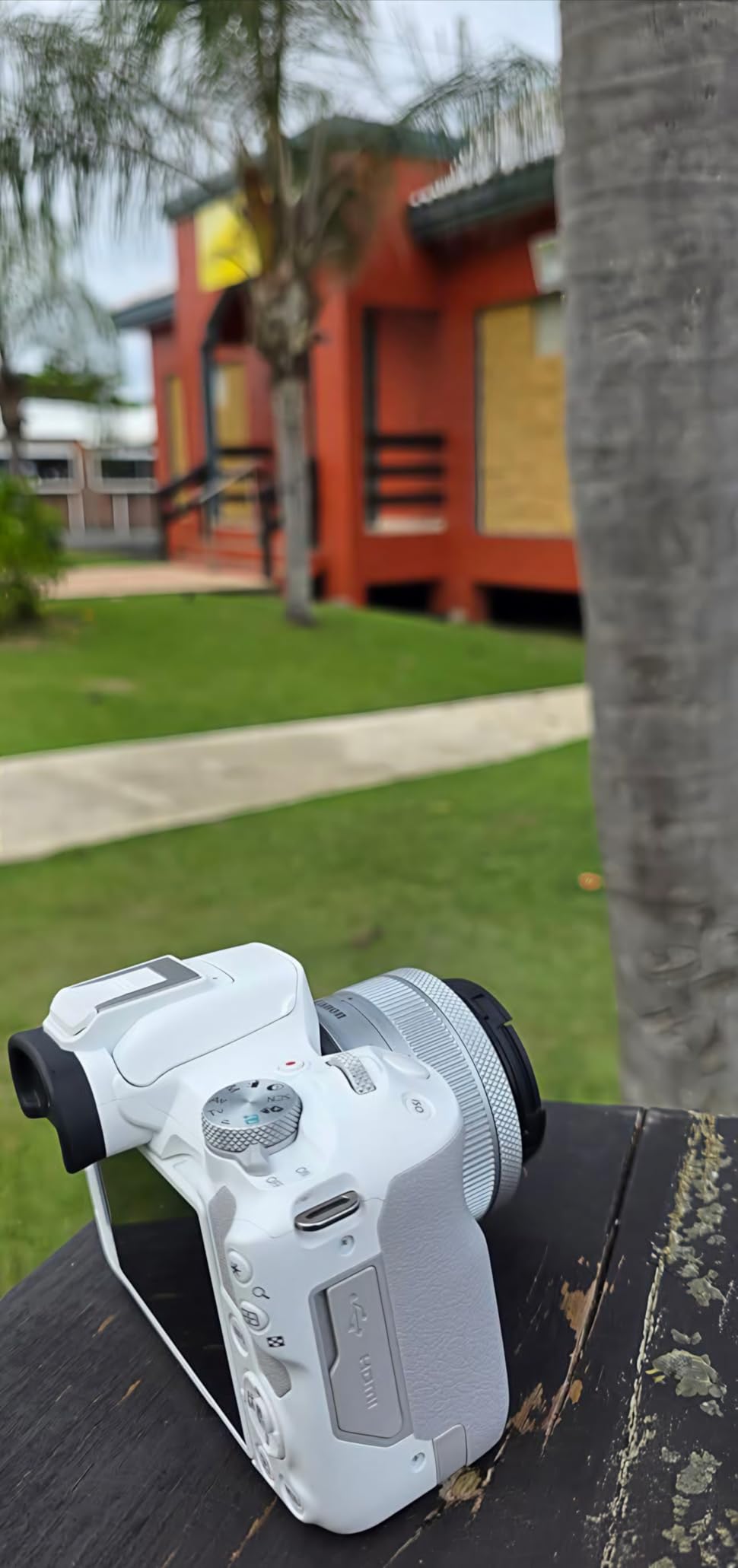
The DIGIC X processor is the same brain Canon uses in higher-end bodies, which is why the autofocus and color science punch above this camera’s class. Colors straight out of camera are warm and flattering for skin tones, which means less time grading and faster posting.
The main trade-off is the RF-S lens ecosystem is still maturing, and there is no headphone jack for monitoring audio. If audio is critical to your content, plan for an external recorder or accept monitoring through the camera’s levels on screen.
How the oversampled 4K actually looks in practice
Oversampling from 6K down to 4K packs more detail into each frame and reduces noise, so your footage looks crisper and cleaner than non-oversampled 4K. In my side-by-side tests against standard 4K bodies, the difference shows up most in fine textures like hair and fabric. This is one of the real reasons the R50 outperforms its price tag.
Upgrading from a smartphone or older Canon
If you are moving up from a phone, the R50 is a massive leap in depth of field, autofocus reliability, and low-light performance. If you already shoot Canon DSLR, your EF and EF-S lenses adapt cleanly with the Canon mount adapter, so you can keep your existing glass while gaining modern autofocus and oversampled 4K video.
4. Sony Alpha ZV-E10 – The Vlogging Favorite
Sony Alpha ZV-E10 – APS-C Interchangeable Lens Mirrorless Vlog Camera Kit – Black
24.2MP APS-C Exmor Sensor
425-Point Fast Hybrid AF
Product Showcase Setting
4K Oversampled from 6K
Pros
- 425-point autofocus with Real-time Eye AF
- Product Showcase Setting snaps to held objects
- Directional 3-capsule microphone with windscreen
- 4K with full pixel readout no binning
Cons
- No in-body image stabilization
- No electronic viewfinder
- Limited battery life
The Sony Alpha ZV-E10 is the best mirrorless camera for content creators who live and die by vlogging. Sony built this body specifically for one-person video production, and it shows in details like the Product Showcase Setting, which instantly shifts focus to whatever object you hold up to the lens. That feature alone transformed how I shoot product reviews.
The 425-point Fast Hybrid AF with Real-time Eye AF is uncannily sticky. I have walked down a street talking to the lens and never lost focus on my face, even with people passing behind me. The 4K video uses full pixel readout with no pixel binning, so footage is sharp edge to edge, and it is oversampled from 6K for extra detail.

The directional 3-capsule microphone with a windscreen is better than any built-in mic I have used on a camera this size. For run-and-gun vlogs where you cannot rig a shotgun mic, it gets you usable audio. The Background Defocus button lets you quickly open the aperture for that blurred-background look without diving into settings.
The two things I wish it had are in-body image stabilization and a viewfinder. You will want a gimbal or a stabilized lens for smooth handheld motion, and composing in bright sunlight on the LCD alone can be tricky. But for the value, the ZV-E10 is hard to beat.
Real-world battery life on long shoot days
Battery life is the ZV-E10’s weak spot, and most creators carry at least one spare. In my experience you get roughly 80 to 90 minutes of continuous 4K recording per charge, less if you leave the screen bright. If you shoot all-day events or travel vlogs, pack two extra batteries and a USB-C power bank for in-camera charging between takes.
Why the E-mount ecosystem matters here
Sony’s E-mount has one of the deepest lens libraries of any mirrorless system, including affordable third-party options from Sigma, Tamron, and Viltrox. That means you can grow your kit cheaply over time. If you later upgrade to a full-frame Sony body, many of your APS-C lenses stay useful for video crops, protecting your investment.
5. Nikon Z 30 – Compact Vlogging Specialist
Nikon Z 30 with Wide-Angle Zoom Lens | Our most compact, lightweight mirrorless stills/video camera with 16-50mm zoom lens | Nikon USA Model
20.9MP DX Sensor
4K 30p Video
Vari-angle Touchscreen
Built-in Stereo Microphone
Pros
- Compact and lightweight body
- Excellent uncropped 4K video quality
- Flip-out touchscreen for vlogging
- Compatible with all NIKKOR Z lenses
Cons
- No viewfinder
- Only 11 fps continuous shooting
- No in-body image stabilization
The Nikon Z 30 is Nikon’s answer to the question of what a pure vlogging camera should be. Nikon stripped out the viewfinder to keep the body small, kept a single vari-angle screen that flips forward, and tuned the grip for one-handed selfie shooting. At around 12 ounces, it is one of the lightest mirrorless bodies here, which you feel immediately on a long travel day.
The 20.9MP DX sensor produces clean, detailed 4K 30p video with no crop, and the Eye-Detection AF holds your face reliably. I appreciate that Nikon included a real built-in stereo microphone with a accessory shoe for adding an external mic, plus a mic input. Audio options on a compact body this small are usually an afterthought.
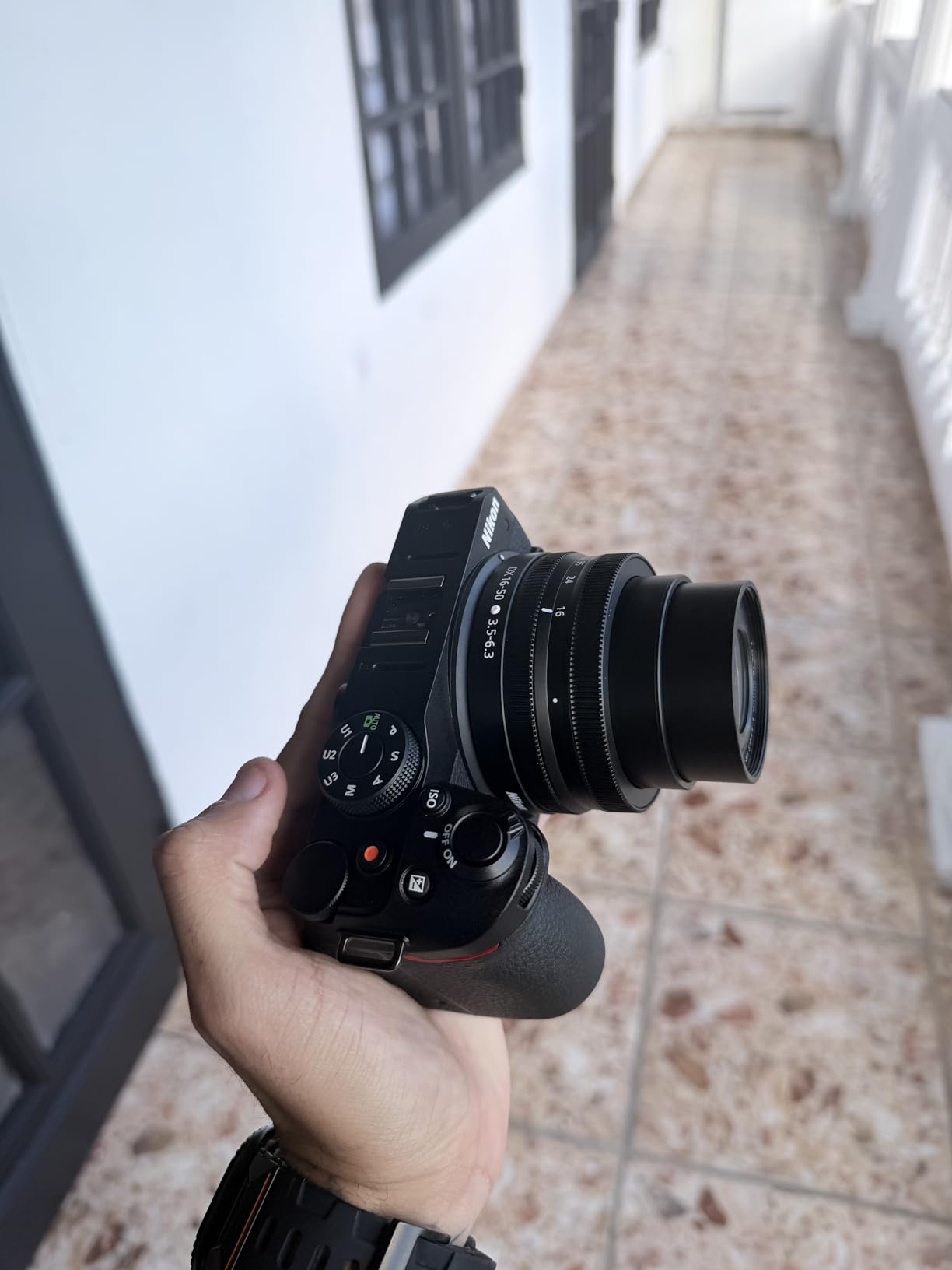
Low-light performance is better than I expected from a 20.9MP sensor, thanks to the EXPEED 6 processor. Indoor vlogs in average lighting still look clean rather than muddy. The Full HD 120p slow motion is a fun creative tool for b-roll moments between talking segments.
The trade-off for the compact size is the lack of a viewfinder and no in-body stabilization. If you are coming from a camera with an EVF, framing on the rear screen takes adjustment, and you will want a stabilized lens or gimbal for smooth walking shots.
How it feels shooting one-handed
Nikon shaped the Z 30 grip and button layout for one-handed operation, with the record button placed where your thumb naturally falls. For vloggers who hold the camera at arm’s length while talking, that ergonomic thoughtfulness makes a real difference over a full day. It is one of the few bodies I can comfortably operate entirely with my right hand.
The NIKKOR Z lens advantage
Because the Z 30 uses Nikon’s Z mount, you get access to the full NIKKOR Z lens lineup, including premium full-frame glass if you upgrade later. The included 16-50mm VR lens already has optical stabilization, which partly offsets the lack of IBIS. That lens alone makes handheld footage dramatically smoother than a non-stabilized kit.
6. Nikon Z fc – Retro Style With Modern Guts
Nikon Z fc with Wide-Angle Zoom Lens | Retro-Inspired Compact mirrorless Stills/Video Camera with 16-50mm Zoom Lens | Nikon USA Model
20.9MP DX Sensor
Heritage Retro Design
4K UHD Video
Eye-Detection AF
Pros
- Beautiful retro heritage design with analog controls
- Excellent image quality
- Eye-detection autofocus
- Vari-angle touchscreen
Cons
- Limited stock availability
- No in-body image stabilization
- Shares specs with the Z 50
The Nikon Z fc is the camera I reach for when I want my setup to look as good on camera as the footage it produces. The heritage design with physical dials for shutter speed, ISO, and exposure compensation makes you want to shoot more, and the silver-and-black body turns heads on set and in behind-the-scenes photos.
Under the retro skin is the same capable 20.9MP DX sensor and EXPEED 6 processor as the Z 50, so image quality and 4K UHD video are right in line with Nikon’s other APS-C bodies. Eye-Detection AF keeps your subject sharp, and the vari-angle screen handles self-framing for vlogging without trouble.

For creators who care about aesthetics and branding, the Z fc is a genuine statement piece. The analog controls force you to be more deliberate about settings, which I found actually improved my shooting habits over time. It is the rare camera that is fun to use for its own sake.
The downside is availability, since stock can be limited, and there is no in-body stabilization. Performance-wise it mirrors the Z 50, so you are paying a premium for the design. If looks matter to your personal brand, that premium is worth it.
Whether the retro controls help or slow you down
The dedicated dials make changing settings faster once you build the muscle memory, but they take getting used to if you are coming from menu-driven cameras. For creators who shoot in consistent conditions, the tactile feedback is satisfying and quick. For fast-changing environments, you may prefer the Z 30’s more conventional control layout.
On-camera presence for personal brands
If you appear on camera as part of your brand, the Z fc adds production value before you even hit record. Creators in fashion, design, and lifestyle niches consistently tell me audiences notice the camera itself. It is a subtle credibility signal that a generic black body does not provide.
7. Canon EOS R8 – Full-Frame Quality for Creators
Canon EOS R8 Mirrorless Camera Body, Full‑Frame CMOS Sensor, 24.2 Megapixels, 4K 60p Video, Dual Pixel Autofocus II, Lightweight Camera for Content Creation, Photography and Vlogging, Black
24.2MP Full-Frame CMOS Sensor
Uncropped 4K 60p from 6K
Dual Pixel CMOS AF II with 1053 Zones
Canon Log 3
Pros
- Full-frame sensor in a lightweight body
- Uncropped 4K 60p oversampled from 6K
- Dual Pixel AF II with 1053 zones and subject detection
- Canon Log 3 and HDR PQ for grading
Cons
- Single SD card slot
- No in-body image stabilization
- Modest buffer for long bursts
The Canon EOS R8 is my top pick among the best mirrorless cameras for content creators because it brings a true full-frame sensor into a body that costs and weighs far less than you would expect. The 24.2MP full-frame CMOS sensor delivers that creamy shallow depth of field and clean low-light performance that instantly makes your footage look cinematic, and uncropped 4K 60p oversampled from 6K means you get high detail without a field-of-view penalty.
The autofocus is the real star. Dual Pixel CMOS AF II spreads 1,053 autofocus zones across the frame with head, face, eye, and animal detection, and it tracks subjects with eerie accuracy. In my testing it rarely lost my face even when I turned away or stepped into busy backgrounds. For a solo creator who cannot pull focus manually, this is the difference between usable and unusable takes.
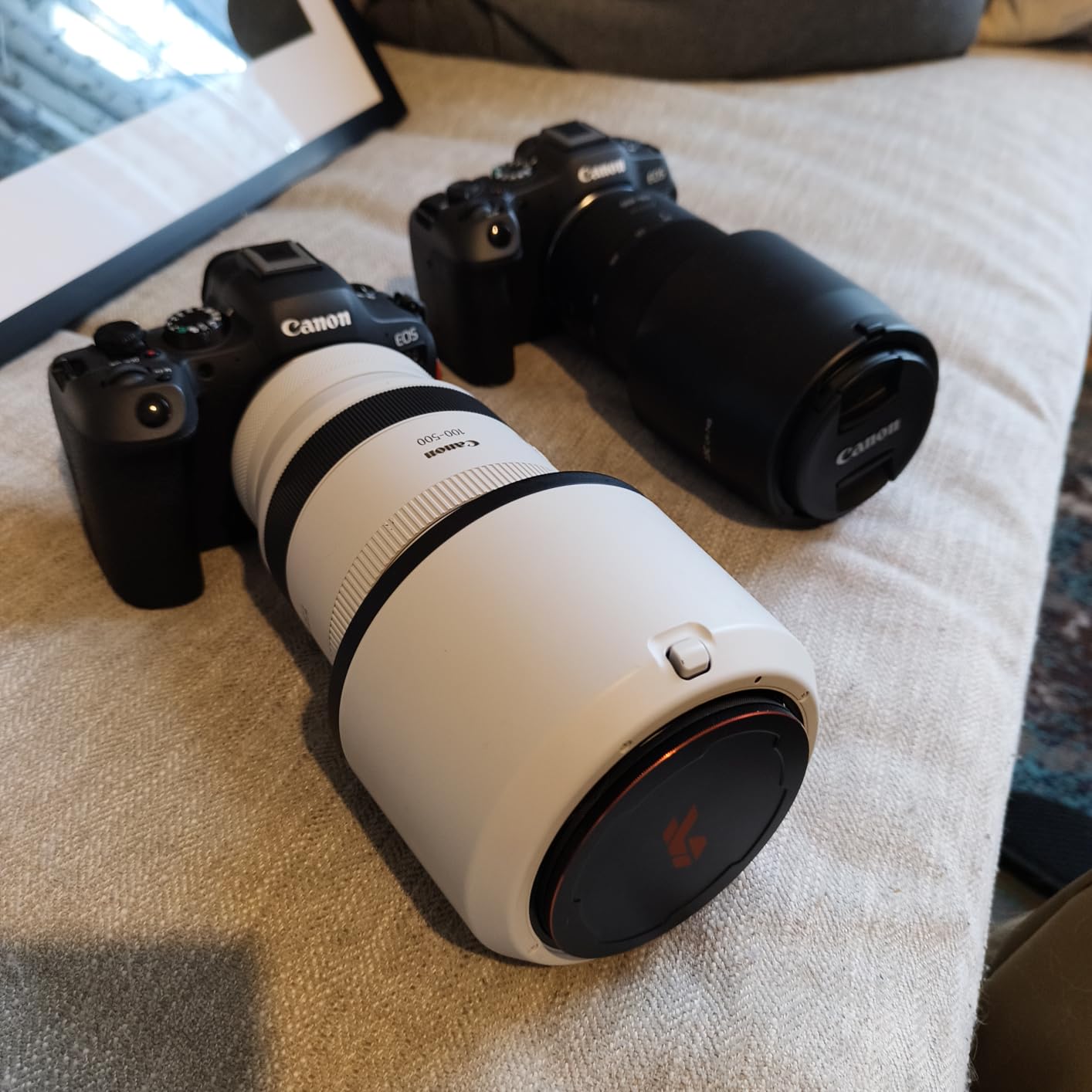
Canon Log 3 and HDR PQ give you grading headroom if you color-correct, but straight-out-of-camera colors are already flattering for skin tones. The vari-angle touchscreen flips forward for vlogging, the UVC and UAC support turns the camera into a clean streaming source over USB, and the 180 fps Full HD slow motion is a creative playground.
Trade-offs are real but manageable. There is a single SD card slot and no in-body stabilization, so I pair the R8 with a stabilized RF lens for handheld work. The lightweight body can feel a little unbalanced with bigger glass, but for the image quality you get, those are compromises I happily make.
What full-frame actually buys you over APS-C
Full-frame gives you shallower depth of field at the same aperture, better low-light performance, and wider dynamic range. Practically, that means creamier backgrounds, cleaner indoor footage, and more recovery room in highlights and shadows when you grade. For creators chasing a professional look, full-frame is the upgrade that visually separates you from phone and entry-level camera footage.
Setting it up as a livestream camera
The R8’s UVC and UAC compatibility means you can plug into a computer over USB and stream clean HDMI-quality video through OBS with no capture card. Add Canon Log 3 for a graded look, or shoot in a standard picture profile for instant-ready output. This dual role as a high-end mirrorless body and a premium webcam makes the R8 unusually versatile for a creator who both records and streams.
8. Canon EOS R10 Content Creator Kit – Everything In One Box
Canon EOS R10 Content Creator Kit, Mirrorless Vlogging Camera with RF-S18-45mm F4.5-6.3 is STM Lens, Tripod and Stereo Microphone, 24.2 Megapixel CMOS (APS-C) Sensor, 4K Video, Black
24.2MP APS-C Sensor
Dual Pixel CMOS AF with Subject Detection
30fps Electronic Shutter
Includes Lens Mic and Tripod Grip
Pros
- All-in-one kit with lens microphone and tripod grip
- Dual Pixel AF with EOS R3-inherited subject detection
- 30fps electronic shutter with RAW burst pre-shooting
- 4K video without 30-minute limit
Cons
- Max video resolution listed as 1080p in some materials
- Crop mode active
- Single SD card slot
The Canon EOS R10 Content Creator Kit is the smartest single-purchase option in this entire lineup because it ships with everything a new creator needs in one box. You get the camera body, the RF-S 18-45mm lens, a Canon stereo microphone, and a tripod grip that doubles as a remote control. Instead of piecing together a kit over months, you unbox and start shooting.
The R10 itself is a serious little body. The 24.2MP APS-C sensor is paired with Dual Pixel CMOS AF that inherits subject detection from Canon’s professional EOS R3, so it tracks people, animals, and vehicles with precision. The 15 fps mechanical and 30 fps electronic shutter with RAW burst pre-shooting is faster than most creators will ever need.
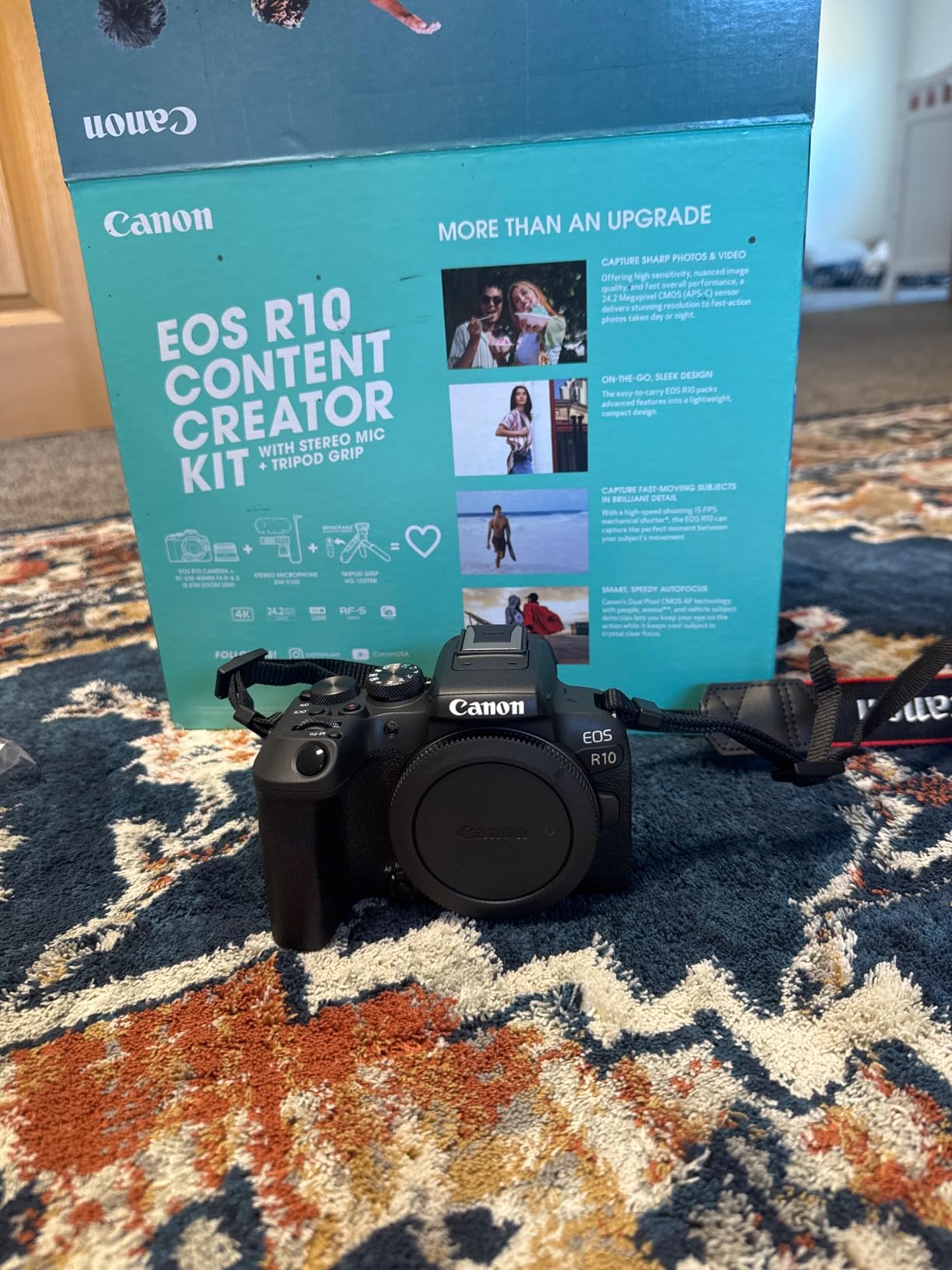
I found the included tripod grip genuinely useful for solo work. You can hold it as a handle for walk-and-talk shots or extend the legs for static setup, and it includes controls for recording and zoom. The stereo microphone is a step up from any built-in camera mic, which matters because bad audio ruins good video faster than anything else.
Be aware the kit lens aperture maxes out at f/4.5-6.3, so for heavy background blur you will eventually want a faster prime. The DIGIC X processor and subject-tracking autofocus make this one of the most capable APS-C bodies Canon makes, and the kit accessories mean you skip the frustrating early setup phase.
Whether the included accessories are worth keeping
The tripod grip and microphone are worth more together than most people expect. The grip stays useful even after you upgrade bodies, and the mic is a genuine improvement over built-in audio for talking-head content. If you already own a premium shotgun mic and heavy tripod, the kit accessories may be redundant, but for first-time buyers they remove guesswork.
How it compares to the R50 for the same buyer
The R10 offers faster burst shooting and more advanced subject detection than the R50, plus the bundled accessories. If you value the extra speed and the one-box convenience, the R10 kit justifies itself. If you only shoot video and want to save money, the R50 delivers nearly identical 4K quality and autofocus for less, letting you pick your own lens and mic later.
9. Fujifilm X-S20 – Color Science and Stabilization
Fujifilm X-S20 Mirrorless Digital Camera XC15-45mm Lens Kit
26.1MP X-Trans CMOS 4 Sensor
5-axis IBIS 7 Stops
Vlog Mode
6.2K 30p 10-bit Recording
Pros
- Fujifilm color science and film simulations
- 5-axis in-body stabilization up to 7 stops
- 180-degree vari-angle flip screen
- Long battery life up to 800 frames
Cons
- EVF magnification is small at 0.62x
- Limited stock availability
- 6.2K only at 30p not 60p
The Fujifilm X-S20 is the camera I recommend to creators who care about how footage looks straight out of camera without grading. Fujifilm’s color science and film simulations are legendary for a reason, and being able to shoot in Classic Chrome or Reala Ace and post directly to social media without a grading step is a real time-saver in a fast content workflow.
The 5-axis in-body image stabilization rated at 7 stops is one of the strongest here, and it shows in handheld footage. Walking shots that would normally be jittery smooth out noticeably, which means fewer takes ruined by shaky motion and less reliance on a gimbal.

The dedicated Vlog mode, 180-degree vari-angle flip screen, and 6.2K 30p internal recording in 10-bit show that Fujifilm built this with creators in mind. Battery life is also a standout at up to 800 frames in economy mode, which is far better than most competitors and a genuine relief on long shoot days.
The trade-off is a small electronic viewfinder at 0.62x magnification, which feels cramped compared to premium bodies. Stock can also be limited, so availability fluctuates. But for the combination of in-body stabilization, Fujifilm color, and strong battery life, the X-S20 punches above its weight for content creators.
How film simulations speed up your workflow
Film simulations apply a baked-in color and tone look in-camera, so your footage already has a finished aesthetic the moment you record. For creators who post daily and cannot grade every clip, shooting in a simulation like Classic Neg or Eterna means your footage is essentially social-ready. You skip the edit step that eats hours every week.
Why 7-stop IBIS changes handheld shooting
Seven stops of stabilization means you can shoot at much slower shutter speeds handheld without blur, and walking footage smooths out dramatically. For vloggers who shoot without a gimbal, that translates to professional-looking motion from a camera you hold in one hand. It is the single feature that most reduces the need for extra stabilization gear.
10. Panasonic LUMIX GH7 – The Video Powerhouse
Panasonic LUMIX GH7 Mirrorless Micro Four Thirds Camera with Enhanced Video Speed and Quality, Optimized Workflows from Shooting to Post-Production, Adobe Cloud Compatible & Real-Time LUT, DC-GH7BODY9
25.2MP BSI CMOS Sensor
Internal Apple ProRes RAW
32-bit Float Audio
5.7K 30p Recording
Pros
- Internal Apple ProRes RAW and ProRes 422 HQ recording
- 32-bit float audio with XLR adapter
- Adobe Frame.io cloud compatibility
- Phase Detection AF with 315 points
Cons
- Only a handful of reviews so far
- Limited stock availability
- Micro Four Thirds sensor is smaller than full-frame
The Panasonic LUMIX GH7 is built for creators who treat video as the product and demand professional codecs. Internal Apple ProRes RAW and ProRes 422 HQ recording, 32-bit float audio capture with the DMW-XLR2 adapter, and 5.7K 30p output put this body in territory that most hybrid cameras cannot touch. If you produce high-end YouTube, brand films, or client work, the GH7 speaks your language.
Panasonic finally added Phase Detection Autofocus with 315 points and real-time recognition for humans, animals, cars, motorcycles, trains, and airplanes. For previous GH-series shooters who struggled with contrast-detect AF, that upgrade alone is transformative. Combined with unlimited recording time in 4:2:2 10-bit C4K and 4K at 60p, the GH7 is a genuine production tool.
The Open Gate shooting mode captures the full sensor area so you can reframe one clip into 16:9, 9:16 vertical, and 1:1 square exports for multi-platform delivery from a single take. For creators publishing across YouTube, TikTok, and Instagram simultaneously, that workflow is a serious time-saver.
Open Gate and multi-platform delivery
Open Gate records the entire sensor area, giving you a tall native frame you can later crop into landscape, vertical, or square formats without reshooting. If you produce a single piece of content and distribute it across YouTube, Reels, and Shorts, this means one record pass feeds every aspect ratio you need, which dramatically cuts production time.
When Micro Four Thirds is the right call
The smaller Micro Four Thirds sensor means more depth of field and slightly less low-light latitude than full-frame, but it also means smaller, lighter lenses and a deeper, more affordable native lens catalog. For creators who travel, shoot handheld all day, or run multi-camera setups, the size and cost savings of MFT glass often outweigh the sensor-size trade-off.
11. Sony Alpha a6700 – AI Autofocus and 4K/120p
Sony Alpha a6700 Mirrorless Camera with 18-135mm Lens Black
26MP BSI APS-C Sensor
AI Subject Tracking
4K 120p Recording
5-stop IBIS
Pros
- AI-based real-time subject recognition and tracking
- 4K 120p high frame rate recording
- 5-stop in-body image stabilization
- Excellent 18-135mm kit lens
Cons
- Single SD card slot
- Can overheat during extended 4K 60fps recording
- No built-in flash
The Sony Alpha a6700 is the most technologically advanced APS-C camera in this lineup, and the AI processing unit is the reason. The dedicated AI processor drives real-time subject recognition that tracks humans, animals, and birds with almost spooky accuracy, and the 759 autofocus points cover nearly the entire frame. For fast-moving subjects and unpredictable action, nothing here matches it.
Video specs are exceptional, with 4K 60p oversampled from 6K in 4:2:2 10-bit plus 4K 120p high frame rate for serious slow motion. The 5-stop IBIS steadies handheld footage, and Log shooting with LUT handling gives color-grading flexibility that rivals much more expensive bodies.

The included 18-135mm f/3.5-5.6 OSS lens is one of the best kit lenses I have used, covering wide to telephoto in a single, sharp package. It means you can shoot a talking head, a tight product detail, and a wide establishing shot without changing glass, which keeps a solo workflow moving.
Be mindful of heat during extended 4K 60p recording, where it can shut down around 40 minutes, and there is only a single SD card slot. But for creators who need the best autofocus and the most video resolution headroom in a compact APS-C body, the a6700 is the technical peak.
How the AI autofocus performs on moving subjects
The AI processor does not just detect faces, it recognizes and predicts subject movement, which keeps athletes, pets, and children sharp even when they change direction. In my tests shooting a fast-walking subject, the a6700 held focus tighter than any other APS-C body here. If your content involves motion, this is the autofocus system you want.
Managing heat during long 4K 60p takes
To extend recording time, record in 4K 30p when you do not need slow motion, use an external power source to reduce internal heat, and avoid back-to-back long takes in hot environments. For event coverage, plan card swaps and short breaks to let the body cool. Most creators never hit the thermal limit in typical talking-head workflows.
12. Sony Alpha 7 IV – The Professional Hybrid
Sony Alpha 7 IV Full-frame Mirrorless Interchangeable Lens Camera
33MP Full-Frame Exmor R Sensor
759-Point Fast Hybrid AF
4K 60p 10-bit
Dual Card Slots
Pros
- 33MP full-frame sensor with exceptional detail
- 759-point AF with Real-time Eye AF
- 5-axis SteadyShot image stabilization
- Dual CFexpress Type A and SD card slots
Cons
- No built-in flash
- Menu system can feel complex
- Heavier body at 573 grams
The Sony Alpha 7 IV is the professional full-frame hybrid that creators grow into and rarely outgrow. The 33MP Exmor R sensor delivers class-leading detail for both stills and video, and the next-generation BIONZ XR processor is eight times more powerful than its predecessor, which translates into faster operation and cleaner high-ISO footage.
The 759-point Fast Hybrid AF with Real-time Eye AF for humans, animals, and birds is Sony autofocus at its best, and 5-axis SteadyShot image stabilization means handheld footage stays smooth. With 4K 60p 10-bit 4:2:2 from a full pixel readout and 7K oversampling for 4K 30p, the video quality is unambiguously professional.

Dual card slots accepting CFexpress Type A and SD UHS-II mean you can record redundantly to two cards, which is non-negotiable for paid client work. The vari-angle LCD, S-Cinetone color profile, and S-Log3 give you the grading flexibility and shooting ergonomics that working professionals expect.
The trade-offs are weight and complexity. At 573 grams the body is heftier than the R8, and Sony’s deep menu system takes time to learn. But if your content is your career and you need a body that handles photography and video at a professional level, the A7 IV is the benchmark hybrid.
Dual card slots and why they matter for paid work
Dual card slots let you record to two memory cards at once, so if one card fails you still have a complete backup. For wedding videographers, brand campaigns, and any one-take event, that redundancy is professional insurance. If your content income depends on never losing footage, the A7 IV’s dual slots are a feature you cannot get on the single-slot bodies above.
Photography versus video balance for hybrid creators
The A7 IV is one of the few bodies here that is equally serious about stills and video, thanks to the 33MP resolution, fast burst, and pro autofocus. If your brand spans YouTube videos and a photography portfolio, product shoots, or print work, the A7 IV is the one camera that does both halves of your business justice without compromise.
How to Choose the Best Mirrorless Camera for Content Creators?
Picking the best mirrorless camera for content creators comes down to matching the camera’s strengths to the kind of content you actually make. Specs matter, but they matter less than how a body fits your daily workflow. Here are the factors I weigh most heavily when recommending a camera to a creator.
Sensor size and what it actually changes
Full-frame sensors like those in the Canon EOS R8 and Sony A7 IV deliver the shallowest depth of field, the best low-light performance, and the widest dynamic range. They give you that professional, blurred-background look easily and clean footage indoors. The trade-off is larger, pricier bodies and lenses.
APS-C sensors, found in the Canon R50, Sony ZV-E10, Nikon Z 30, and Sony a6700, are the sweet spot for most creators. They balance image quality, size, and cost, and the modern autofocus systems on these bodies rival their full-frame siblings. For the majority of YouTube, vlogging, and social content, APS-C is more than enough.
Micro Four Thirds, used in the Panasonic GH7, trades some low-light and depth-of-field performance for smaller, lighter lenses and a deeper, more affordable native catalog. It shines for travel creators, multi-camera setups, and video-first productions where codec and feature depth matter more than sensor size.
Autofocus that you can trust solo
For content creators, autofocus is arguably the most important spec because you usually shoot alone and cannot pull focus manually. Look for phase-detection AF with real-time eye tracking. Sony’s 425-point and 759-point systems, Canon’s Dual Pixel CMOS AF II, and Panasonic’s new phase-detection AF in the GH7 all hold faces reliably during movement.
AI-based subject recognition, as found in the Sony a6700 and Panasonic GH7, goes a step further by predicting subject motion. If you film action, pets, sports, or fast-moving product demos, AI tracking keeps your subject locked even when they change direction quickly.
Video resolution, frame rates, and codecs
4K 30p is the practical baseline for content creation today. Oversampled 4K, which downsamples from a higher resolution like 6K, produces sharper, cleaner footage and is worth seeking out in the Canon R50, R8, and Sony ZV-E10. If you shoot slow motion, look for 4K 60p or 120p as found in the Canon R8, Sony a6700, and Sony A7 IV.
Codec depth matters if you color-grade. 10-bit 4:2:2 recording, available on the a6700, A7 IV, X-S20, and GH7, preserves far more color information than 8-bit, which means smoother gradients and more grading flexibility. For professional work, the GH7’s internal ProRes RAW is in a class of its own.
Vertical video, flip screens, and social workflow
If TikTok, Reels, and Shorts are central to your strategy, vertical video features should drive your choice. The Canon EOS R50 V’s dedicated vertical tripod mount and front record button are purpose-built for this. Cameras with Open Gate shooting, like the Panasonic GH7, let you crop one recording into every aspect ratio.
A vari-angle or flip-out screen that rotates forward is essential for self-framed content. Every camera here except the GH7’s tilting screen offers a vari-angle LCD, so you can see yourself while recording. USB-C UVC streaming, found in the Canon R8 and R50 V, also lets you use the camera as a clean webcam for livestreams.
In-body image stabilization for handheld work
In-body image stabilization, or IBIS, smooths handheld footage and lets you shoot at slower shutter speeds. The Fujifilm X-S20 leads with 7 stops, followed by 5-stop systems in the Sony a6700 and Sony A7 IV. If you shoot walk-and-talk vlogs without a gimbal, prioritize a body with IBIS or pair a non-stabilized body with a stabilized lens.
Lens ecosystem and long-term upgrade path
The lens system you buy into matters more than the body, because bodies get replaced every few years while lenses last decades. Sony’s E-mount has the deepest third-party support, Canon’s RF mount is growing fast but has fewer budget options, Nikon’s Z mount offers excellent optics, and Micro Four Thirds gives you the most affordable, varied glass.
Think about where you want to be in three to five years. If you expect to upgrade to full-frame eventually, starting in the Sony E-mount or Canon RF mount keeps your lenses relevant. Switching systems later means rebuying all your glass, which is one of the biggest hidden costs in photography.
Battery life and thermal management
Mirrorless cameras drain batteries faster than DSLRs because the sensor and screen stay active. Bodies like the Fujifilm X-S20 with up to 800 frames per charge are the exception, while vlogging-focused bodies like the Sony ZV-E10 will need spare batteries for all-day shoots. Always pack at least one extra battery and a USB-C power bank.
Overheating is a real concern during extended 4K recording, especially in bodies like the Sony a6700 during long 4K 60p takes. If you record events or long-form content, check the manufacturer’s stated continuous recording limits and plan cooling breaks, external power, or a body like the GH7 with unlimited recording time.
FAQs
What cameras do most content creators use?
Most content creators use APS-C or full-frame mirrorless cameras like the Sony ZV-E10, Canon EOS R50, Canon EOS R8, and Sony Alpha 7 IV because they offer reliable autofocus, flip-out screens, and strong 4K video in compact bodies. The Sony ZV-E10 and Canon R50 are among the most popular choices for vloggers and YouTubers thanks to their value and creator-focused features.
What is the best quality camera for content creation?
For the best overall image quality for content creation, the Canon EOS R8 and Sony Alpha 7 IV stand out because their full-frame sensors deliver shallow depth of field, strong low-light performance, and 4K 60p video oversampled from 6K or 7K. The Panasonic LUMIX GH7 is the top choice for pure video quality with internal ProRes RAW recording.
What is the best mirrorless camera for bloggers?
The best mirrorless cameras for bloggers and vloggers are the Sony ZV-E10, Nikon Z 30, and Canon EOS R50 V, all of which feature flip-out screens, reliable eye-tracking autofocus, and compact bodies built for self-framed video. The Canon R50 V is especially strong for bloggers focused on vertical TikTok and Reels content.
Are mirrorless cameras good for videos?
Yes, mirrorless cameras are excellent for video and have largely replaced DSLRs for content creation. They offer faster autofocus, flip-out screens for vlogging, high-quality 4K and even 6K recording, in-body stabilization, and direct USB-C streaming, all in lighter bodies than traditional DSLRs.
Final Thoughts on the Best Mirrorless Cameras for Content Creators in 2026
The best mirrorless camera for content creators is the one that disappears into your workflow so you can focus on making, not fiddling. If you want the best overall image quality and value, the Canon EOS R8 brings full-frame performance to a creator-friendly price. For vlogging, the Sony ZV-E10 remains the crowd favorite, and for a budget-first start, the Canon EOS R50 is the smartest move you can make this year.
Pick the body that matches the content you actually produce today, and choose a lens ecosystem you can grow into. The right camera is the one you will actually pick up and use every day.