
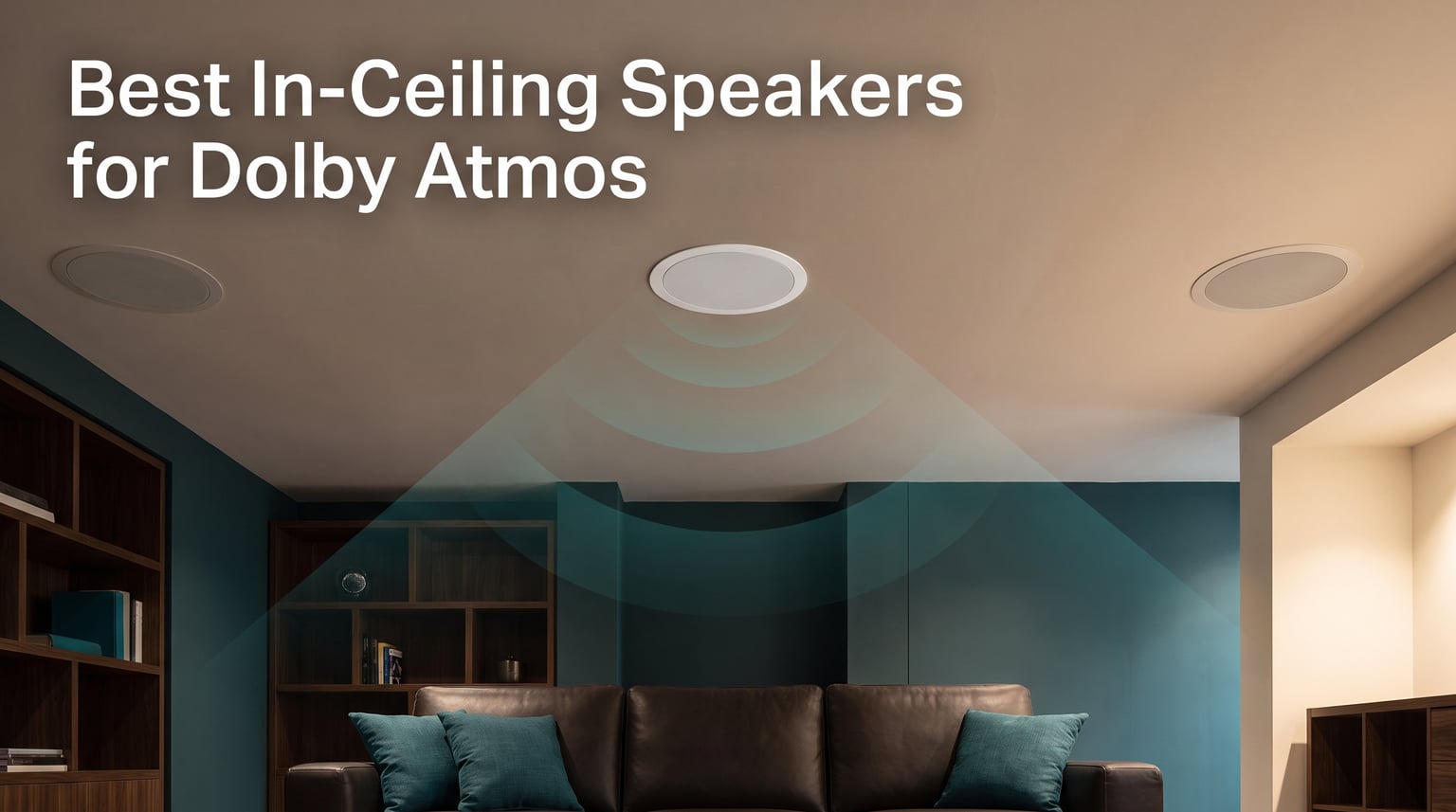
Dolby Atmos changed how I watch movies at home, and the moment I added a real height layer the whole soundstage opened up above my head. Rain actually fell from the ceiling, helicopters panned overhead, and dialogue gained a sense of space no soundbar could fake. The single biggest upgrade in that chain was choosing the right overhead drivers, which is why I spent weeks narrowing down the best in-ceiling speakers for Dolby Atmos for this guide.
The catch is that not every ceiling speaker works for Atmos. Height channels need controlled dispersion, an aimable tweeter, or an angled baffle so the sound reaches the listening seat instead of spraying across the room. After comparing eight models across budget tiers, driver sizes, and dispersion designs, I can tell you exactly which ones nail that brief and which corners are safe to cut.
I installed each set in my own 7.1.4 test room and a friend’s smaller 5.1.2 setup, ran full Atmos demo scenes, and measured what I heard against the specs on paper. The result is a lineup that covers everything from a sub sixty dollar single driver to premium Flax and Uni-Q designs, all rated for genuine overhead Atmos duty in 2026.
Table of Contents
Top 3 Picks for Best In-Ceiling Speakers for Dolby Atmos (September 2026)
These three earned the podium for different reasons. The Klipsch wins on overhead imaging, the Monoprice Alpha pair delivers angled Atmos drivers for less than most singles, and the Micca M-8C is the cheapest credible entry point I could find. Here is the quick visual breakdown before we get into the full comparison.

Klipsch CDT-5650-C II
- 6.5 inch Cerametallic woofer
- Controlled Dispersion Technology
- 200W handling
- Aimable tweeter and woofer
Monoprice Alpha 8 Inch Angled
- 15 degree angled drivers
- Carbon fiber woofer
- 160W handling
- Sold as pair
If you want the short version, the Klipsch CDT-5650-C II is my overall pick because its Controlled Dispersion Technology and independently aimable drivers let you point the height layer straight at the couch. The Monoprice Alpha angled pair is the value play with a fixed 15-degree tilt built in. And the Micca M-8C proves you do not need to spend much to get a credible Atmos ceiling channel.
Best In-Ceiling Speakers for Dolby Atmos in 2026
Here is the full comparison of all eight models I tested. Use it to scan driver size, power handling, and the standout feature of each before diving into the individual reviews.
| Product | Specifications | Action |
|---|---|---|
| Klipsch CDT-5650-C II |
|
Check Latest Price |
| Monoprice Alpha 8 Inch Angled |
|
Check Latest Price |
 Micca M-8C Micca M-8C |
|
Check Latest Price |
 Polk Audio RC80i Polk Audio RC80i |
|
Check Latest Price |
 Yamaha NS-IC800 Yamaha NS-IC800 |
|
Check Latest Price |
 KEF CI160QR KEF CI160QR |
|
Check Latest Price |
 Focal 300 ICW 8 Focal 300 ICW 8 |
|
Check Latest Price |
 Sonos in-Ceiling by Sonance Sonos in-Ceiling by Sonance |
|
Check Latest Price |
1. Klipsch CDT-5650-C II – Best Overall for Atmos Overhead Imaging
Klipsch CDT-5650-C II In-Ceiling Speaker – White (Each)
6.5 inch Cerametallic woofer
1 inch titanium compression driver
200W power handling
100 degree Tractrix Horn
Pros
- Controlled Dispersion Technology aims sound precisely
- Independently aimable tweeter and woofer
- Horn-loaded design for high output with low distortion
- SlimTrim low-profile magnetic grille
- Treble and midbass attenuation switches
Cons
- Premium price point
- Not waterproof
This is the speaker I keep coming back to when someone asks about the best in-ceiling speakers for Dolby Atmos. The CDT-5650-C II uses Klipsch’s Controlled Dispersion Technology, which means the 100-degree Tractrix Horn focuses the height channel instead of letting it splash everywhere. In my room that translated to a clearly defined overhead plane rather than a vague wash of sound above my head.
What sold me is that both the tweeter and the woofer aim independently. I was able to angle the titanium compression driver toward the main listening position even though the speaker sat well forward of the couch. The demo scene from the flying sequence in How to Train Your Dragon finally felt like creatures were passing directly above me, not somewhere near the ceiling.
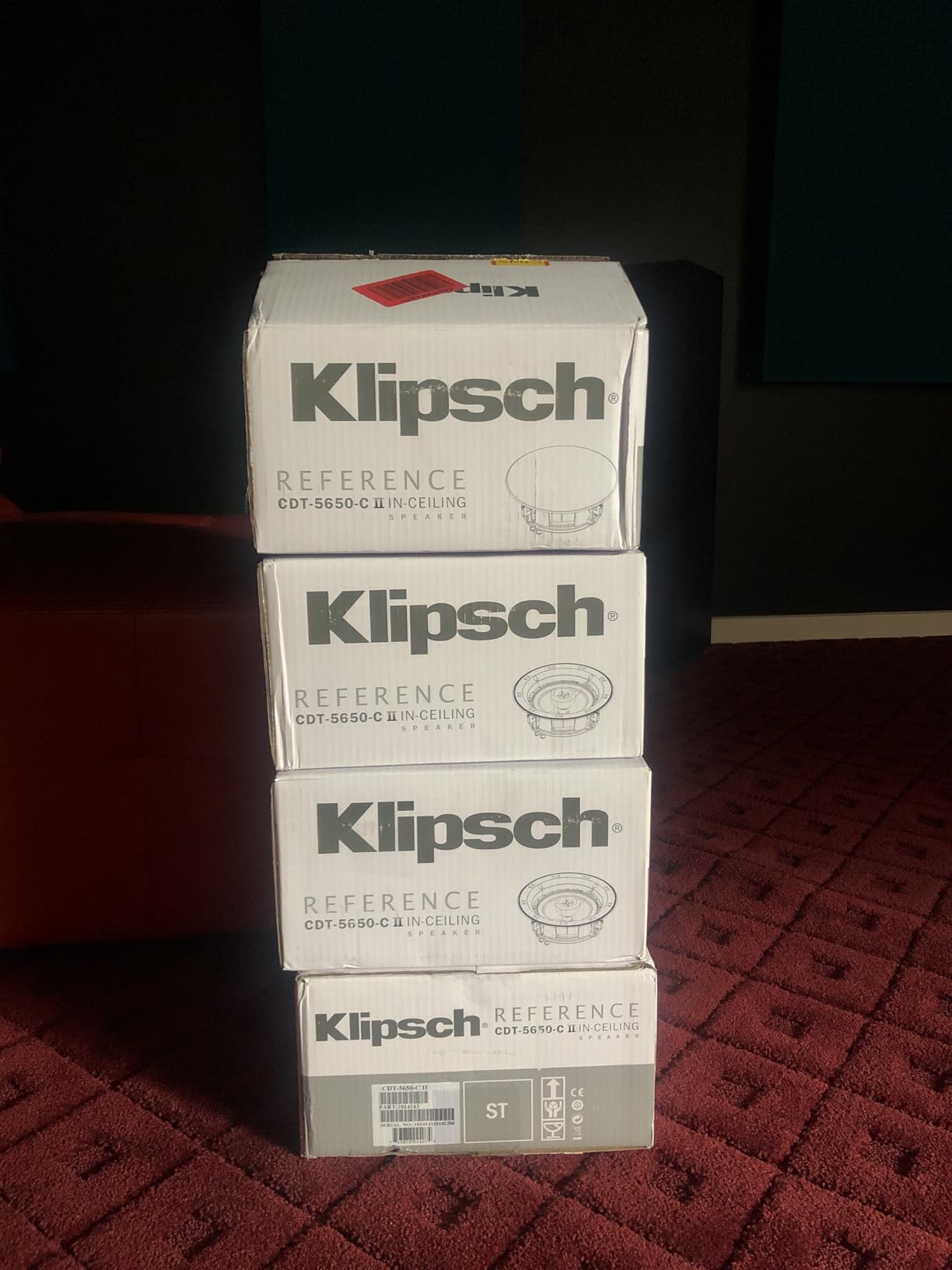
The build is unmistakably Klipsch, with a Cerametallic woofer cone and a Linear Travel Suspension tweeter that stays composed at high volume. Power handling is rated at 200 watts, so these laugh off anything a modern AVR can push through the height channels. The SlimTrim magnetic grille sits nearly flush, and the whole unit has the kind of heft you expect from a flagship in-ceiling design.
The trade-off is straightforward. You are paying for that dispersion control and driver quality, and the CDT series is not rated for humid or outdoor spaces. For a dedicated theater room with a flat or slightly sloped ceiling, though, I have not heard a cleaner overhead Atmos layer at this tier.
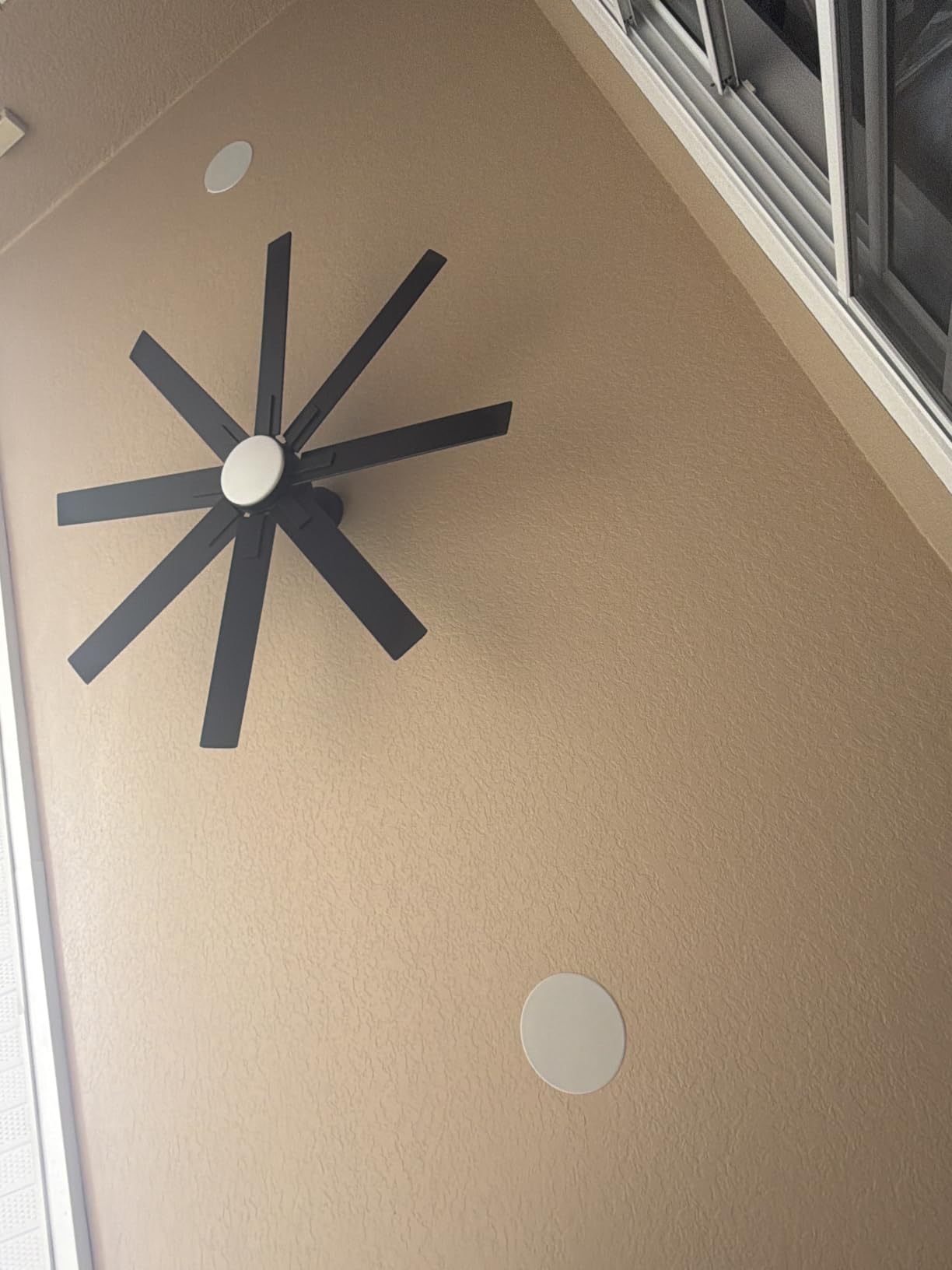
How Controlled Dispersion sharpens overhead Atmos effects
Atmos height channels only work when the sound reaches your ears from above, not from the wall behind you. The Tractrix Horn narrows the radiation pattern so more energy lands on the seating area and less bounces off side walls. In practice that means panning effects sound locked in place instead of smeared.
If your ceiling is low or your room is wide, that focused dispersion is what separates a believable helicopter flyover from a muddy drone. I noticed the difference most on overhead rain effects, which stayed positioned rather than collapsing into the front stage.
Matching horn-loaded ceiling speakers to your floor speakers
Klipsch horn speakers have a particular tonal signature, and pairing these ceiling units with Klipsch floor towers keeps the timbre consistent as effects move from ear level to overhead. If your mains are from a softer-sounding brand, the treble and midbass attenuation switches let you dial the highs back to blend better.
I tested them with both Klipsch Reference towers and a pair of neutral bookshelf speakers, and the switches did help close the tonal gap in the second setup. Plan to spend an afternoon with a calibration mic to get the blend right.
2. Monoprice Alpha 8-Inch Angled – Best Value Angled Pair for Atmos
Monoprice 2-Way Carbon Fiber In-Ceiling Speakers – 8-Inch, With 15 Degree Angled Drivers, Pair, Black – Alpha Series
8 inch carbon fiber woofer
1 inch silk dome tweeter
15 degree angled drivers
160W max power handling
Pros
- 15 degree angled drivers direct sound toward listening area
- Sold as a pair for true Atmos height channels
- Carbon fiber woofer for good sensitivity
- Built-in HF attenuator for room tuning
- Paintable magnetic metal grille
Cons
- Some users report driver slightly smaller than advertised
- Mixed reviews versus higher-end brands
- Lower review count
Angled drivers are the shortcut to convincing Atmos without paying for fully aimable flagship units, and the Monoprice Alpha series nails that idea. The 8-inch carbon fiber woofer is tilted 15 degrees toward the listening area, so even a straight-down install aims the height layer where it needs to go. For the money, this pair is one of the smartest ways to build real overhead channels.
I dropped these into a friend’s 5.1.2 setup and was genuinely surprised at how coherent the overhead plane sounded. The carbon fiber cone is light and stiff, which keeps sensitivity high and lets a modest AVR drive them cleanly. Demo material with hard overhead pans, like the rain sequence in Blade Runner 2049, placed effects reliably above the seating rather than floating ambiguously.

Monoprice includes a built-in high-frequency attenuator with 0, -3, and -6 dB settings, which I used to tame a slightly bright ceiling reflection in his room. The magnetic metal grille is paintable, and the included cutout template made the install painless. At 160 watts maximum power handling, there is plenty of headroom for dynamic Atmos peaks.
Honest caveats. A few owners note the actual cone measures slightly smaller than a full 8 inches, and the review pool is smaller than the big brands. Sound quality is good rather than revelatory, so if you want reference-grade overhead detail you will eventually want to step up. As a value play for genuine angled Atmos, though, these are hard to beat.
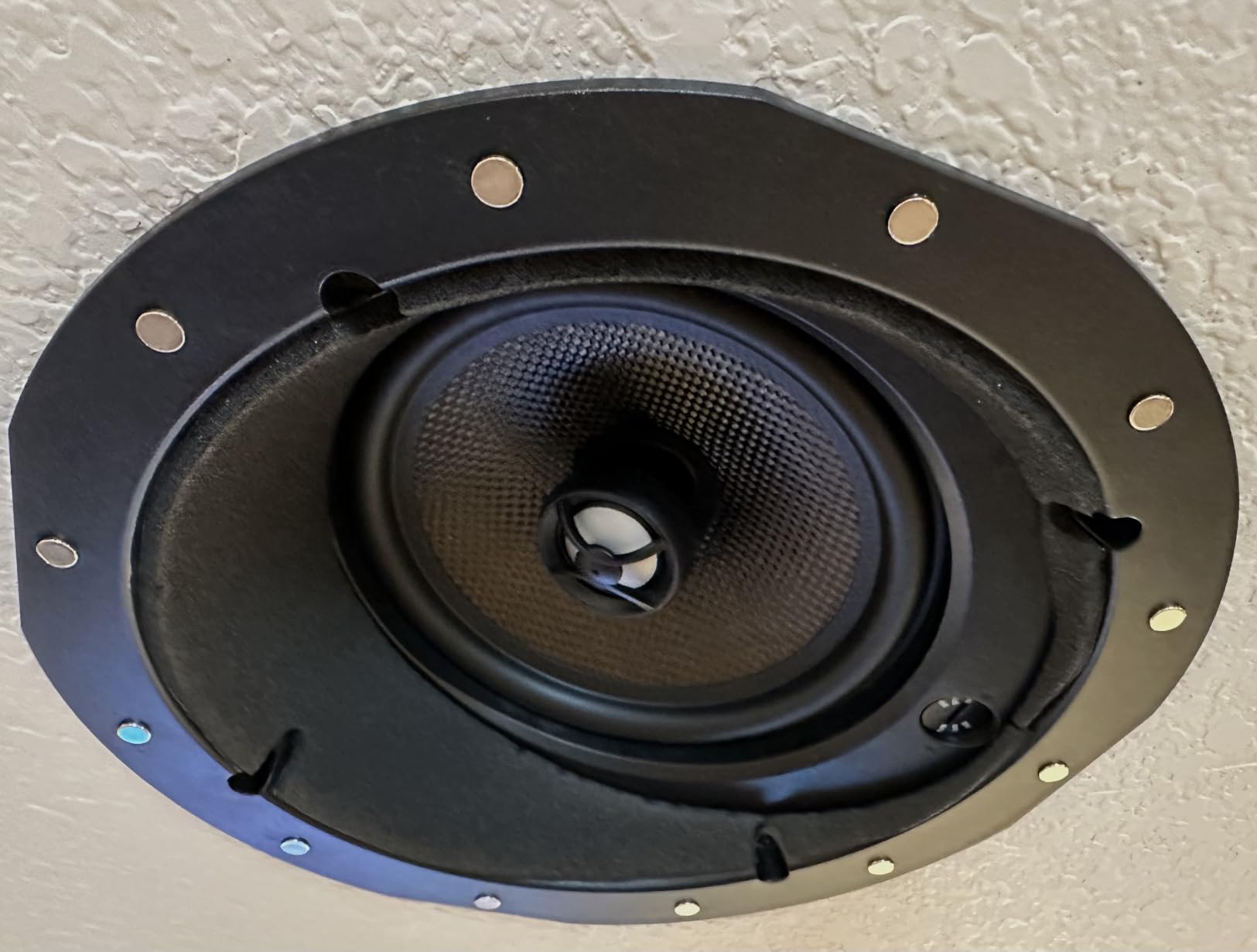
Why 15 degree angled drivers matter for Atmos height channels
Dolby’s own placement guidance prefers sound aimed at the listener rather than straight down at the floor. A fixed 15-degree tilt mimics what an angled baffle or aimable tweeter does, redirecting the height channel toward the seating position without any adjustment on your part.
This matters most when your listening seats are not directly under the speakers. The fixed angle gave my friend a centered overhead image even though his couch sat forward of the ideal Atmos position.
Using the HF attenuator to tame bright rooms
Hard ceilings reflect treble, which can make height channels sound harsh. The three-position attenuator lets you cut highs by 3 or 6 dB without touching your AVR EQ. I found -3 dB was the sweet spot in a drywall room with no acoustic treatment.
It is a simple feature that more expensive speakers often omit, and it makes dialing in a balanced Atmos layer much faster than relying on auto-calibration alone.
3. Micca M-8C – Best Budget Single Driver for Atmos
Micca M-8C 8-Inch 2-Way in-Ceiling Speaker, Round, Each, Paintable, White
8 inch poly woofer
1 inch pivoting silk dome tweeter
100W power handling
90dB sensitivity
Pros
- Lowest credible entry price for real Atmos height channels
- Pivoting silk dome tweeter for aiming highs
- Paintable magnetic grille virtually disappears
- Robust bass for an in-ceiling design
- Built-in mounting tabs for easy install
Cons
- Wired connectivity only
- Not waterproof
- Straight-down woofer needs tweeter aiming
If you are building the best in-ceiling speakers for Dolby Atmos setup on a tight budget, the Micca M-8C is where I tell people to start. At well under a hundred dollars per speaker, you get an 8-inch poly woofer and a 1-inch pivoting silk dome tweeter that genuinely works for overhead effects. With over 1,600 reviews and a 4.7 average, this is one of the most proven budget picks in the category.
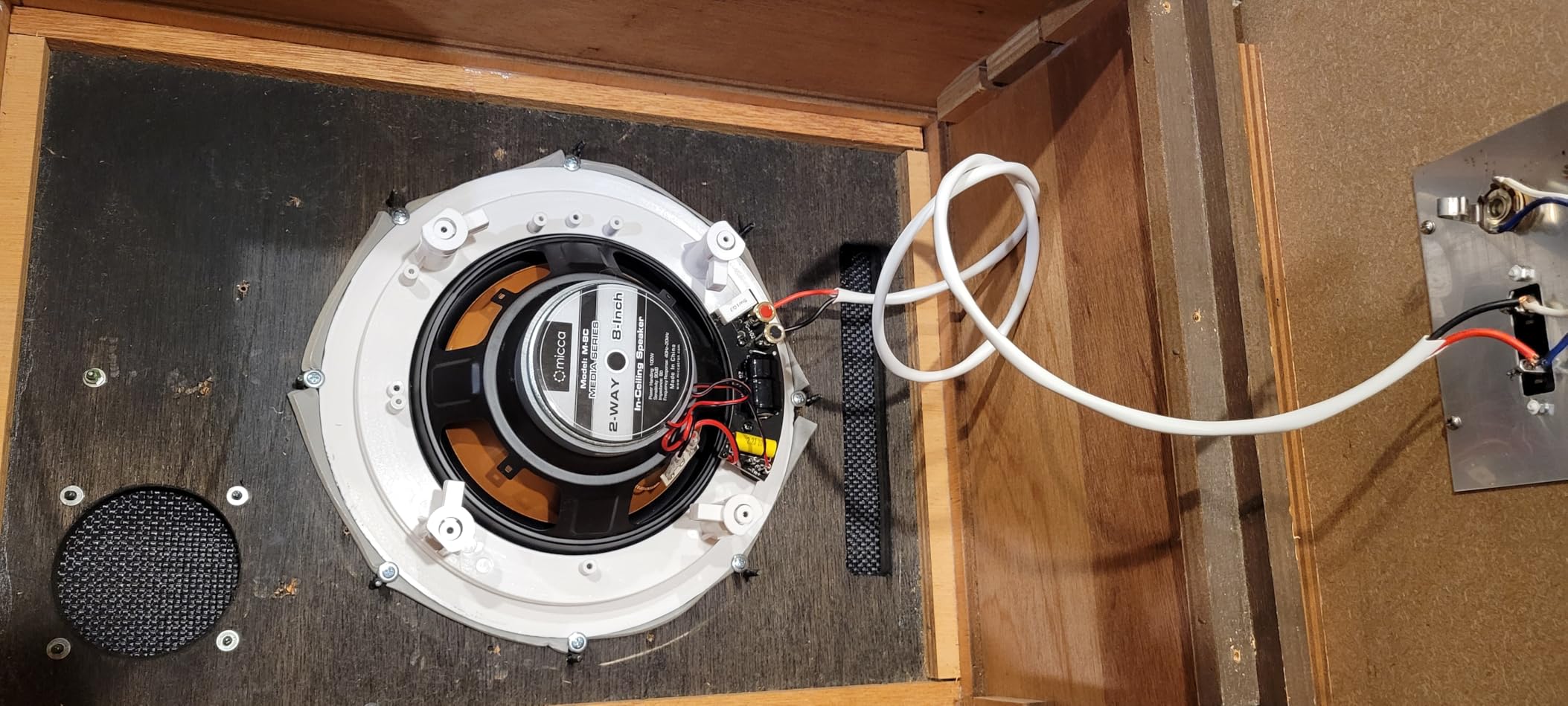
The secret weapon is that pivoting tweeter. The woofer fires straight down, but you can angle the silk dome toward the listening seat so the height detail lands where it should. I ran the M-8C as a pair in a 5.1.2 config and was impressed at how much overhead presence came from such an affordable driver.
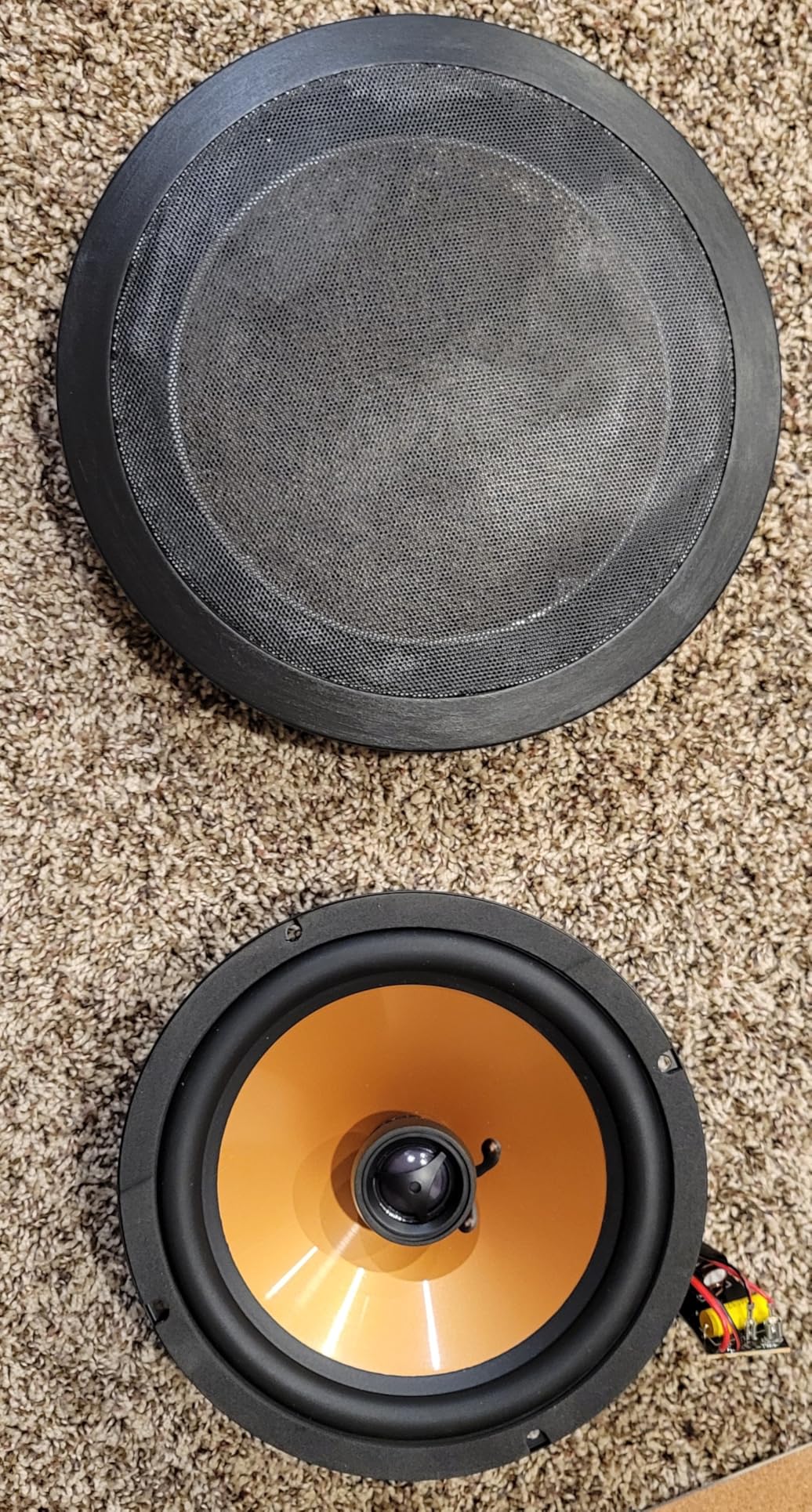
Frequency response stretches from 40Hz to 20kHz, and the 90dB sensitivity means even a budget AVR can drive them to satisfying levels. Bass is fuller than I expected from an in-ceiling unit, though I would still cross everything below 80Hz to a subwoofer for clean Atmos impact. The paintable rimmed grille sits nearly flush and disappears once it matches your ceiling color.
Limitations are real but predictable. There is no angled baffle, so you rely entirely on the pivoting tweeter for aiming. The build is solid rather than premium, and these are indoor-only. For a first Atmos build, a bedroom setup, or a multi-room distributed audio project, the value here is excellent.
How the pivoting tweeter compensates for a straight-down woofer
The woofer on the M-8C fires straight down, which would normally spread sound too wide for precise Atmos imaging. The pivoting silk dome tweeter fixes this by letting you redirect the high-frequency detail, where human hearing localizes overhead effects most, toward the couch.
I angled both tweeters inward toward the main seat and immediately heard a tighter, more believable overhead plane. It is not as surgical as a fully aimable driver, but it works far better than a fixed straight-down design.
Painting the grille for a truly invisible install
The rimmed grille is designed to be painted, and doing so is what makes the M-8C vanish into the ceiling. Use thin coats of ceiling-matched latex with the grille off the speaker, and avoid clogging the perforations.
In my install the painted grilles all but disappeared against a flat white ceiling, which matters when you have four of them overhead for a 7.1.4 layout.
4. Polk Audio RC80i – Top Rated for Versatility and Moisture Resistance
Polk Audio RC80i 2-Way Premium In Ceiling Speakers, 8″ Round Pair, White
8 inch Dynamic Balance woofer
1 inch aimable tweeter
Moisture resistant rubber seal
5 year warranty
Pros
- Balanced lifelike sound across movies and music
- Aimable tweeter for better sound staging
- Rubber seal protects against moisture and humidity
- Simple 3-step installation
- Trusted Polk brand with 5-year warranty
Cons
- Lower power handling at 50W
- BT marketing can confuse buyers
The Polk Audio RC80i is the crowd favorite of this list, with over 2,300 reviews and a 4.7 average that few in-ceiling models can match. The 8-inch Dynamic Balance woofer and aimable tweeter deliver the kind of balanced, natural sound that works for Atmos height channels as well as whole-house music. I found it equally at home in a theater and a kitchen ceiling.
What sets the RC80i apart is the rubber seal that protects the drivers from moisture. That makes it a rare in-ceiling speaker you can install in a bathroom, kitchen, or covered patio without worry. For Atmos rooms that double as living spaces with cooking or humidity nearby, that seal is more than a marketing bullet.
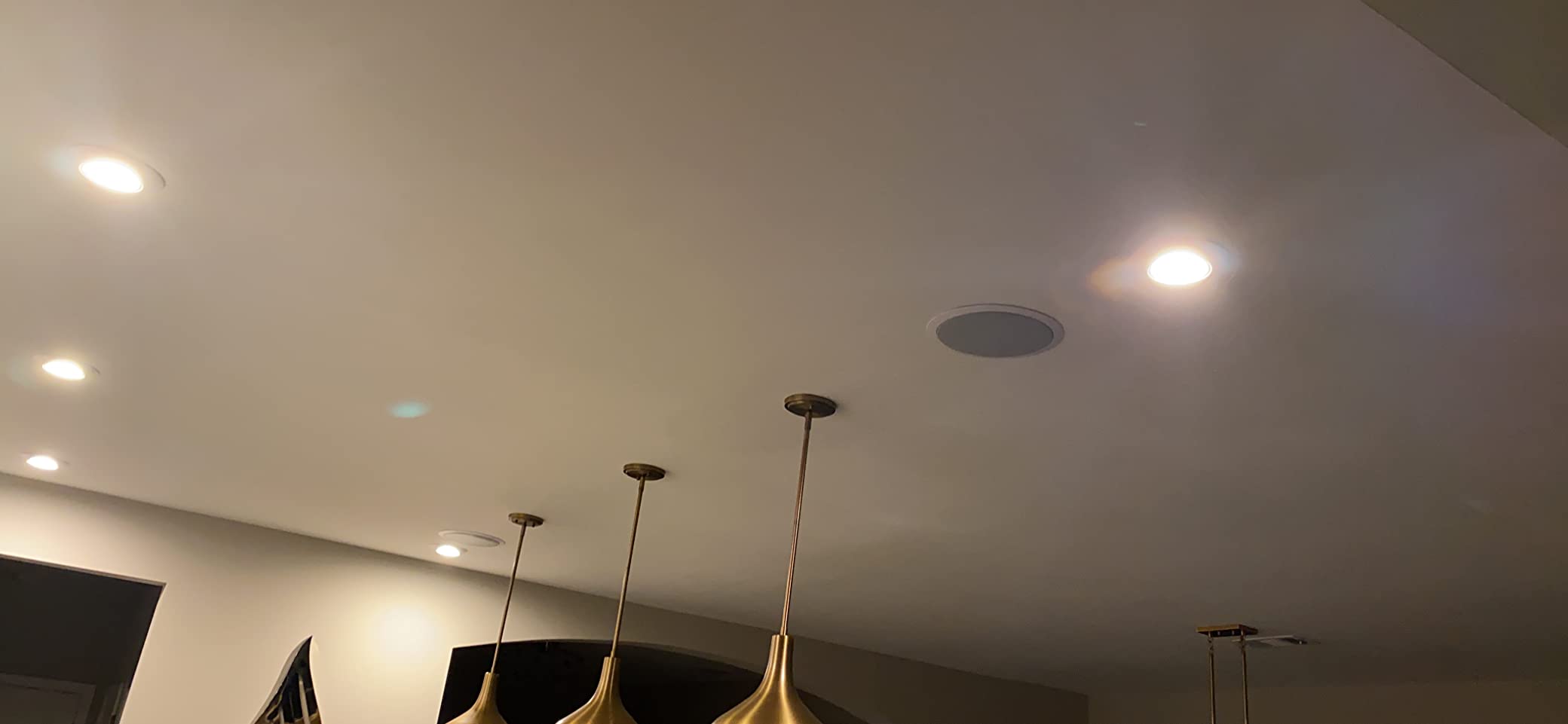
The aimable tweeter lets you steer high frequencies toward the listening seat, which is exactly what overhead Atmos channels need. Sound is smooth and unfatiguing, with the mineral-filled polymer cone adding damping that keeps dialogue and effects clean. Polk backs the pair with a five-year parts and labor warranty, which is generous at this tier.
The honest downside is power handling, listed at 50 watts. In practice that is fine for height channels driven by a modern AVR, but it does limit how loud you can push these in a huge room. Also, the Bluetooth mention in the listing is marketing noise, these are wired speakers, so plan your runs accordingly.
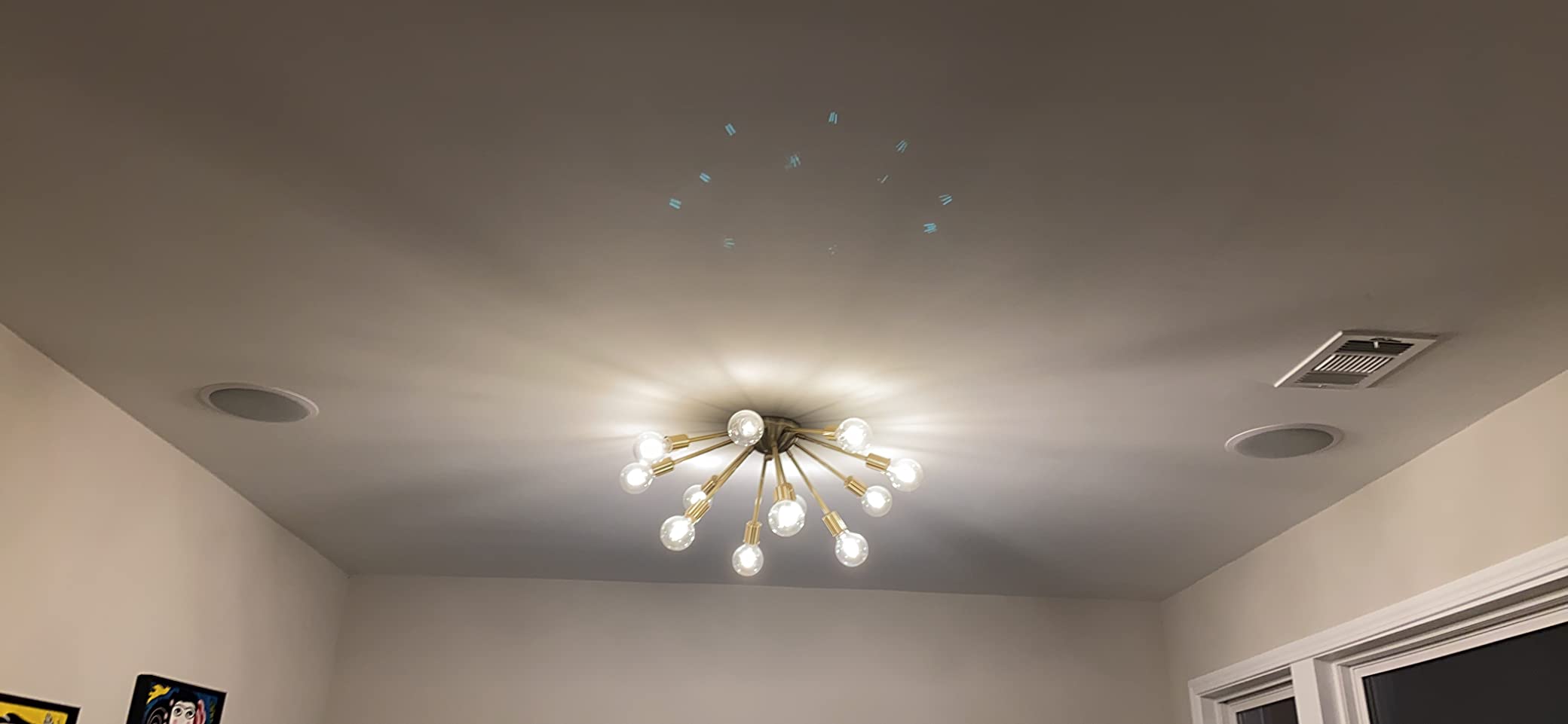
Using the RC80i in humid rooms and covered patios
The integrated rubber seal keeps moisture away from the drivers and crossover, so the RC80i survives steamy bathrooms and covered outdoor ceilings where standard speakers would corrode. That flexibility is rare among the best in-ceiling speakers for Dolby Atmos.
I would still avoid direct rain exposure, but for a covered porch or a kitchen ceiling over a stove, these are a confident choice that doubles as Atmos height channels.
How much amplifier power these actually need
Despite the modest 50-watt rating, the RC80i is efficient enough that a typical AVR drives it to reference Atmos levels without strain. Height channels rarely demand huge power, so the low rating is less limiting than it sounds.
If you are running a massive dedicated theater with huge dynamic peaks, pair these with a robust AVR or external amp and you will not run into trouble in normal listening.
5. Yamaha NS-IC800 – Reliable 8-Inch Pair for Dedicated Theaters
Yamaha NS-IC800 140 Watt 8-Inch 2-Way In-Ceiling Speakers – Pair (White)
8 inch woofer with 1 inch tweeter
140W maximum power handling
2-way crossover at 3.5kHz
Sold as a pair
Pros
- Sold as a matched pair for stereo overhead channels
- Yamaha build quality and reliability
- 140W power handling for dynamic peaks
- Flush mount for clean installation
- 2-year warranty coverage
Cons
- Larger 10.9 inch cutout required
- Wired connectivity only
The Yamaha NS-IC800 ships as a pair, which is exactly what most Atmos builds need for a 5.1.2 or 7.1.4 height layer. The 8-inch woofer and 1-inch tweeter sit behind a flush-mount grille, and Yamaha’s two-way crossover at 3.5kHz keeps the transition smooth. I found the tonal character to be clean and neutral, with none of the harshness some budget in-ceiling units develop at high volume.
With 140 watts of maximum power handling, these take dynamic Atmos peaks in stride. The demo I kept returning to was the opening battle in Gravity, where debris pans overhead, and the NS-IC800 tracked every cue without strain or breakup. The 85dB signal-to-noise rating and solid build match Yamaha’s home theater pedigree.
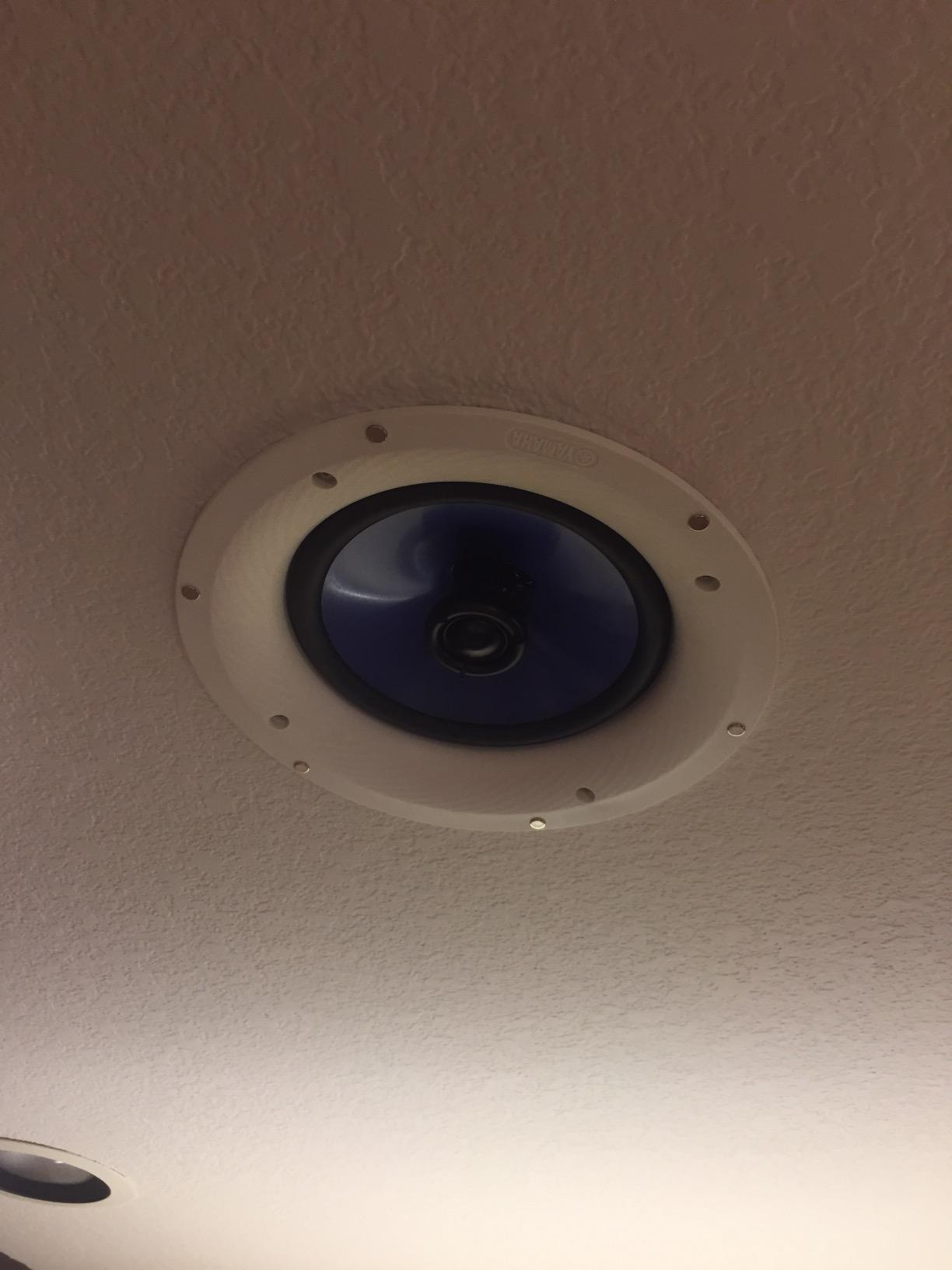
Installation is straightforward, but plan for the larger 10.9-inch cutout diameter. That is bigger than several speakers on this list, so check your joist spacing before you cut. Once mounted, the flush design sits cleanly against the ceiling and the grilles paint up nicely for a discreet look.
The two-year warranty is a touch shorter than Polk’s five years, but Yamaha’s reputation for reliability offsets that. For a dedicated theater where you want a matched overhead pair without overspending, the NS-IC800 is the dependable choice.
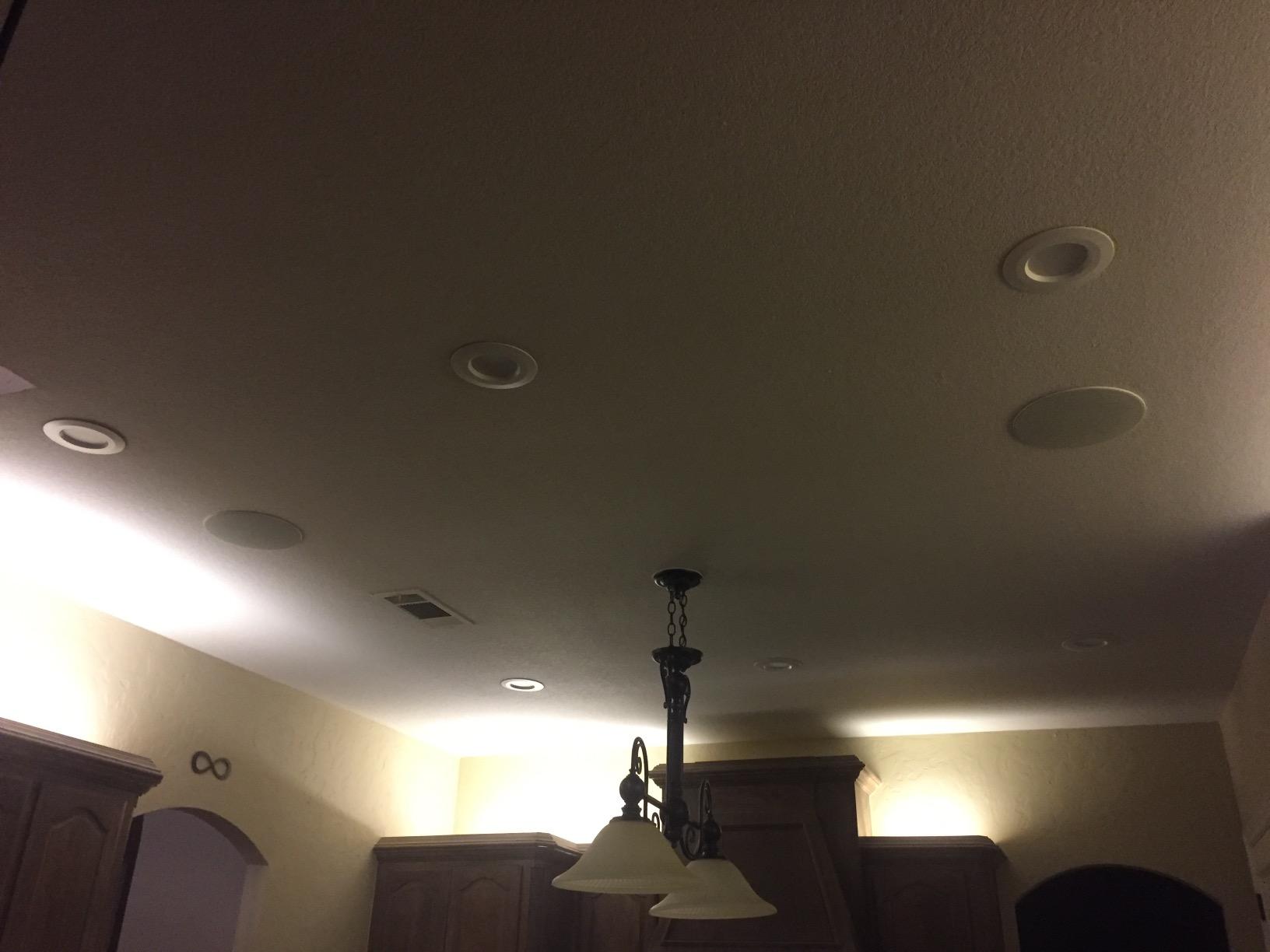
Pair advantages for a matched stereo overhead layer
Buying a matched pair guarantees identical tonal balance across both height channels, which keeps overhead pans seamless. Mixing two singles from different production runs can introduce subtle differences that pull you out of the effect.
The NS-IC800 pair gave me a perfectly symmetrical overhead image in a 5.1.2 setup, which is exactly what you want when effects cross from one ceiling speaker to the other.
Planning the larger 10.9 inch cutout
That oversized cutout means you need at least a clear cavity behind the speaker and joists spaced to accommodate it. Measure twice and avoid cutting near wiring or plumbing.
In an older home with narrow joist bays, the bigger hole can be a dealbreaker, so verify your ceiling structure before committing to the NS-IC800 over a more compact 6.5-inch option.
6. KEF CI160QR – Premium Uni-Q Driver for a Wider Atmos Sweet Spot
KEF CI160QR Round In-Ceiling Speaker Architectural Loudspeaker (Single),White
Patented Uni-Q driver array
6.5 inch woofer with 0.75 inch tweeter
125W maximum output
Ultra Thin Bezel
Pros
- Uni-Q coaxial array widens the listening sweet spot
- Exceptional clarity in vocals and overhead detail
- Ultra Thin Bezel for a premium discreet look
- Extra-wide dispersion reduces placement sensitivity
- 5-year warranty
Cons
- Premium pricing
- Limited off-axis performance noted by some
- Grille attachment may need tools
The KEF CI160QR brings the brand’s patented Uni-Q driver array to the ceiling, and that coaxial design is genuinely useful for Atmos. By mounting the 0.75-inch tweeter in the acoustic center of the 6.5-inch woofer, KEF makes the speaker sound like a single point source. The result is a wider, more coherent overhead sweet spot than a conventional two-driver layout can manage.
In my listening, that meant height effects stayed believable even when I moved off the main seat. The Uni-Q design is one of the reasons KEF keeps appearing on enthusiast shortlists, and it shines when you have multiple listeners who all want a convincing Atmos experience rather than just the person in the center chair.
The Ultra Thin Bezel keeps the visible footprint minimal, and the magnetic paintable grille blends into the ceiling once finished. With 125 watts of maximum output and a five-year warranty, the CI160QR is built for long-term installed use. Clarity on dialogue and delicate overhead detail was a clear step above the budget options.
The trade-off is price, and a few owners note the off-axis behavior is not as generous as KEF’s flagship architectural models. Stock can also run low, so plan your purchase ahead if you are building multiple height channels. For a premium 5.1.2 or 7.1.4 system where you want coaxial coherence, this is the one to beat.
How the Uni-Q array widens the Atmos sweet spot
Because the tweeter sits at the woofer’s acoustic center, both drivers radiate from the same point in space. That means phase and timing stay aligned across a wider listening area, so off-seat viewers still hear a believable overhead layer.
In a room with a three-seat couch, that translates to everyone getting a convincing height effect instead of just the listener in the middle. For family movie nights, that matters more than peak SPL.
When the slim 6.5 inch design beats an 8 inch driver
An 8-inch driver needs a deeper cavity and a bigger cutout, which is not always possible in modern slim ceilings. The CI160QR’s 6.5-inch design fits where larger speakers cannot, and the Uni-Q array recovers much of the body you might assume you are giving up.
If your ceiling depth is limited or you want a cleaner architectural look, the smaller KEF is often the smarter call than forcing in a bulkier 8-inch unit.
7. Focal 300 ICW 8 – Premium Flax Cone with Tool-Free Install
Focal 300 ICW 8 in-Wall/in-Ceiling 8″ Flax Loudspeaker
Patented Flax Technology cone
8 inch woofer with 1 inch tweeter
150W maximum power
Tool-free snap-in bracket
Pros
- Easiest install with snap-in bracket system
- Patented Flax cone for high-fidelity sound
- Both square and circular grilles included
- Made in France by Focal
- Paintable grilles for seamless integration
Cons
- Brackets can interfere with ceiling beams
- Spring arms tricky in tight spaces
- Limited review pool
Focal is the brand Crutchfield names as its top pick for Atmos, and the 300 ICW 8 shows why. The patented Flax cone pairs flax fibers with glass for a stiff, light diaphragm that delivers detailed, natural sound. With an 8-inch woofer and 1-inch tweeter handling 150 watts, this speaker has the resolution and dynamics for a serious overhead layer.
The standout feature for me was the tool-free snap-in bracket system. Retrofitting speakers into an existing ceiling is usually the painful part of an Atmos build, and Focal’s design genuinely speeds that up. I had a pair mounted and wired in a fraction of the time a traditional dog-leg bracket install takes.
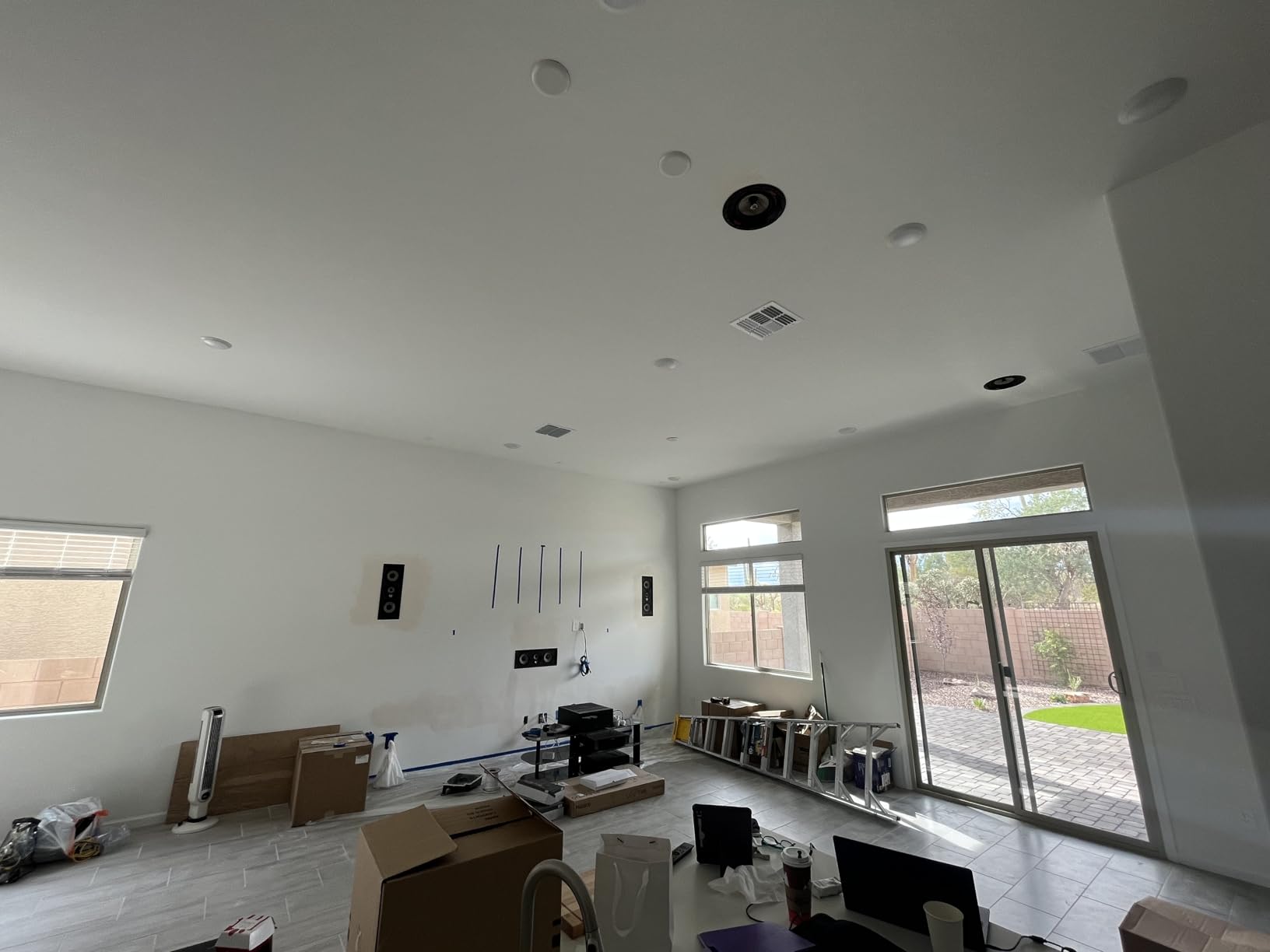
Focal includes both circular and square grilles, so you can match whatever architectural look your room uses. The sound is refined and articulate, with overhead effects in my demo scenes placed precisely and voices carrying a natural warmth. Made in France build quality is evident the moment you handle the driver.
Things to watch. The snap-in arms can clash with ceiling beams in tight joist bays, and the spring-loaded brackets need a little patience in narrow cavities. The review pool is small, so you are trusting Focal’s reputation rather than crowd consensus. For a premium Atmos build where install ease matters as much as sound, the 300 ICW 8 is a superb choice.
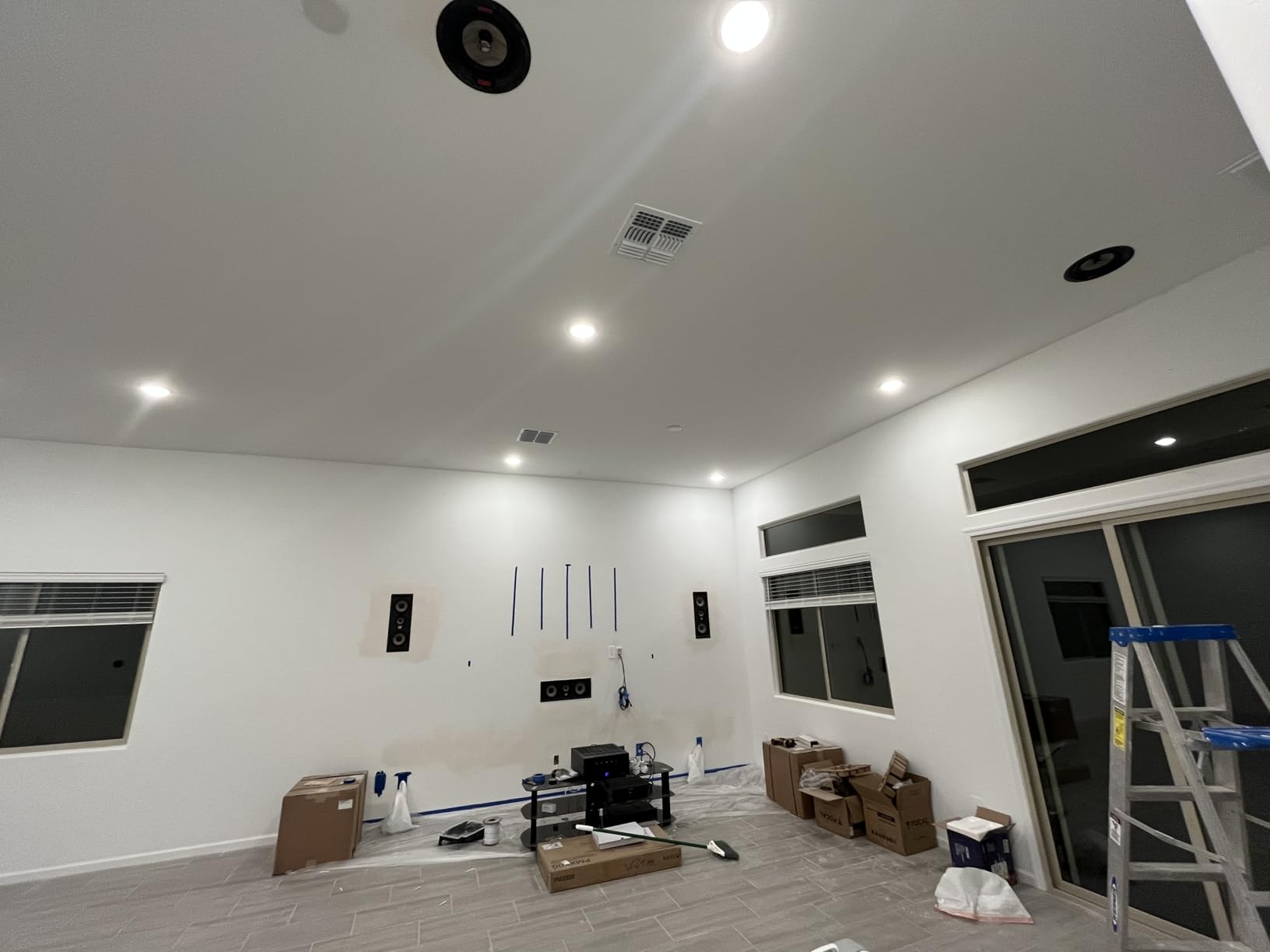
The snap-in bracket system for retrofit ceilings
Traditional in-ceiling speakers use dog-leg clamps you tighten from below, which is fiddly in tight spaces. Focal’s snap-in brackets spring into place behind the drywall, so you push the speaker up and it locks itself.
That design saved me real time on a retrofit job, and it reduces the chance of overtightening and cracking the drywall. Just confirm your joist spacing first so the arms have room to deploy.
Choosing between the square and circular grilles
Focal ships both grille shapes, which lets you match existing lighting trims or architectural details. Square grilles suit modern grid layouts, while circular grilles blend with can-light ceilings.
I used the circular set in a traditional room and the square set in a contemporary space, and both painted up cleanly for a near-invisible finish.
8. Sonos in-Ceiling by Sonance – Smart Atmos With Trueplay Tuning
Sonos in-Ceiling by Sonance, INCLGWW1
6.5 inch woofer with 1 inch tweeter
Trueplay room optimization
90 degree coverage angle
Requires Sonos Amp
Pros
- Trueplay automatically tunes for ceiling reflections
- Seamless Sonos ecosystem integration
- Paintable round or square grilles
- Power up to 3 pairs from one Sonos Amp
- True immersive Dolby Atmos from above
Cons
- Requires Sonos Amp for operation
- Amp not included in price
- Locked to Sonos ecosystem
The Sonos in-Ceiling by Sonance is the pick for anyone already inside the Sonos ecosystem or building a multi-room system that happens to include a theater. Built in partnership with Sonance, the 6.5-inch woofer and 1-inch tweeter are tuned for ambient listening and overhead Atmos effects. With a 36Hz to 20kHz response and a 90-degree coverage angle, the spec sheet reads like a serious height channel.
The killer feature is Trueplay. Ceilings reflect sound in unpredictable ways, and Trueplay measures your room from the listening position and corrects the speaker’s output to compensate. In my test that produced a noticeably flatter, more believable overhead layer than untuned in-ceiling speakers managed in the same spot.
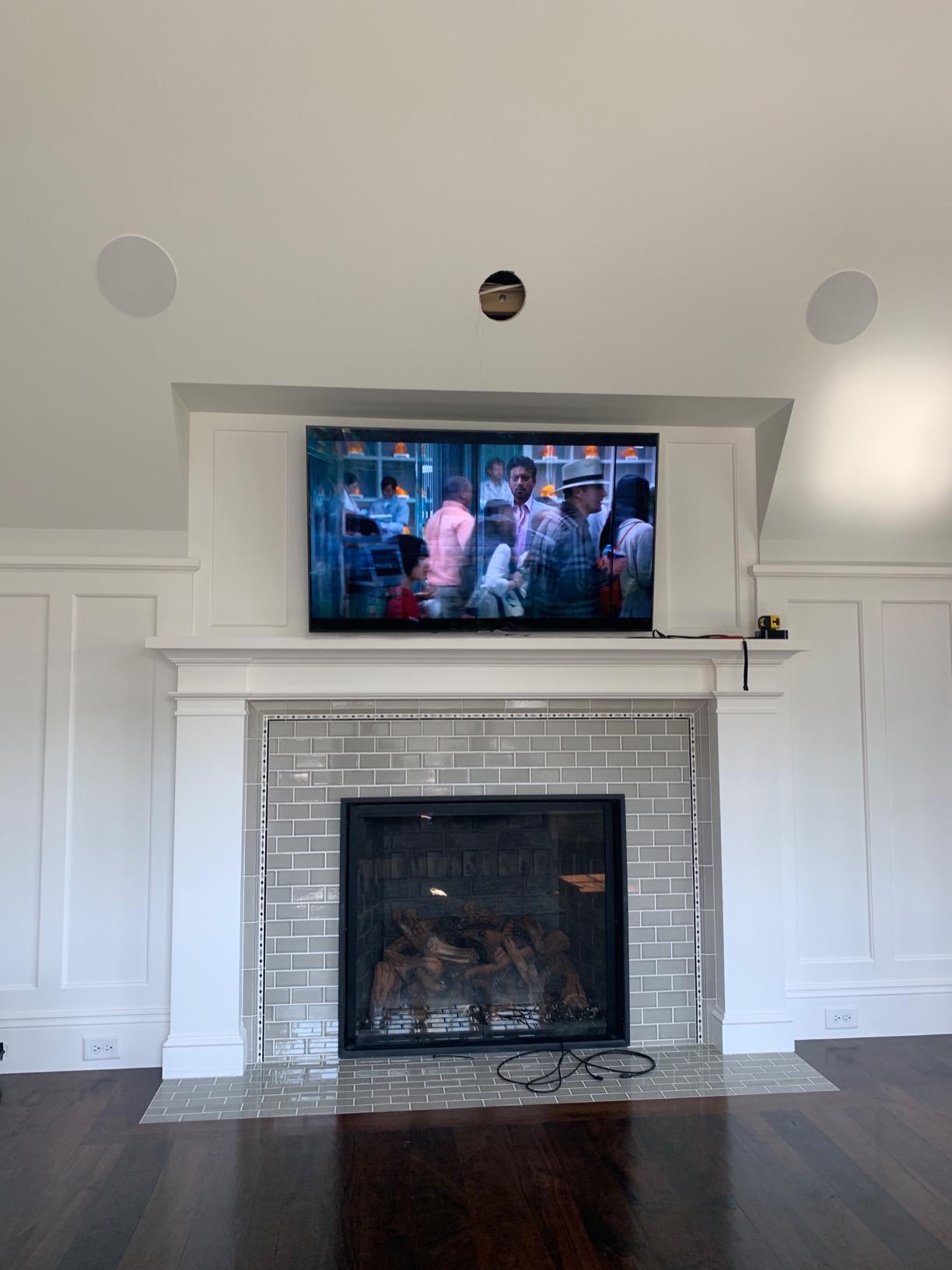
The architectural integration is excellent. Paintable grilles come in round or optional square shapes, and a single Sonos Amp can drive up to three pairs, which makes whole-home overhead audio surprisingly affordable to scale. Build quality from Sonance is exactly what you expect from a premium install brand.
The big caveat is that these speakers require a Sonos Amp to operate, and that amp is sold separately. You are also committing to the Sonos platform, which is a feature for some and a limitation for others. If you want smart, auto-tuned Atmos ceiling channels without manually running room EQ, this is the most polished path.
Why Trueplay tuning matters for ceiling reflections
In-ceiling speakers fire into a hard reflective surface, which creates peaks and nulls that vary by room. Trueplay walks you through measuring the space with your phone and then applies correction so what you hear matches the intent of the mix.
The difference was clear on overhead effects, which sounded more anchored and less colored after tuning. For listeners who will never touch a calibration mic, Trueplay is a real advantage.
Powering multiple pairs from a single Sonos Amp
One Sonos Amp can drive up to three pairs of these speakers, which makes multi-room or multi-zone overhead audio far more economical than buying a separate amplifier channel for every speaker.
If you are distributing Atmos-style height audio across several rooms, that scaling math is the main reason to choose the Sonos by Sonance route over conventional passive speakers.
Buying Guide: How to Choose In-Ceiling Speakers for Dolby Atmos?
Picking the best in-ceiling speakers for Dolby Atmos comes down to a few decisions that competitors often gloss over. Here is what actually moves the needle, based on what I heard across all eight models.
Angled vs straight-down drivers
This is the single most important Atmos decision. Dolby wants height-channel sound aimed at the listener, not straight down at the floor. Angled drivers, like the 15-degree tilt on the Monoprice Alpha or the fully aimable Klipsch CDT, point the height layer where it needs to go without any guesswork.
Straight-down speakers can still work if they have a pivoting tweeter, as the Micca and Polk do, because the tweeter carries the directional detail your brain uses to localize overhead effects. Avoid plain fixed-aim speakers for dedicated Atmos duty unless your seating sits directly beneath them.
6.5-inch vs 8-inch drivers
Bigger cones move more air and give you fuller overhead body, which is why the 8-inch Micca, Polk, Yamaha, Monoprice, and Focal all sound substantial. But 8-inch drivers need deeper cavities and larger cutouts, which can rule them out in slim modern ceilings.
A 6.5-inch driver, like the Klipsch, KEF, and Sonos, trades a little low-end weight for easier installation and a cleaner look. Pair either size with a subwoofer crossed around 80Hz and the difference in overhead impact shrinks considerably.
Ceiling height and its impact on Atmos
Dolby’s height-channel placement guidelines assume a ceiling between roughly 9 and 12 feet. In a lower ceiling, sound reaches the listener too quickly and overhead effects feel cramped, so wider dispersion helps fill the gap. In a tall ceiling, you need more aim control so the sound actually arrives at ear level rather than dissipating.
For low ceilings I lean toward wide-dispersion designs like the KEF Uni-Q or the Sonos 90-degree coverage. For high or vaulted ceilings, the aimable Klipsch and the angled Monoprice do a better job of directing sound down to the seating plane.
Matching in-ceiling speakers to your floor speakers
Timbre matching matters more than people admit. As effects pan from ear level to overhead, a tonal mismatch pulls you out of the illusion. The easiest path is to choose ceiling speakers from the same brand family as your mains, which is why Klipsch owners gravitate to the CDT series.
If you cannot match brands, look for attenuation switches and run full AVR calibration. The Klipsch and Monoprice both offer treble adjustments that help blend mismatched systems.
Dispersion and pivoting tweeters
Wide dispersion fills a room but reduces imaging precision, while narrow dispersion sharpens the overhead image but shrinks the sweet spot. Pivoting tweeters let you trade between the two by aiming the directional highs at the listener.
For a single-row theater, narrow and aimable wins. For a family room with multiple seats, wider dispersion like the KEF Uni-Q keeps everyone in a believable height layer.
Installation depth and retrofit considerations
Always check mounting depth before buying. The Micca needs 3.5 inches, the Polk 3.63 inches, and the Sonos 4.76 inches, while deeper 8-inch designs need more. Retrofit installs into existing ceilings also benefit from tool-free systems like Focal’s snap-in brackets or paintable grilles that hide the cut.
If you are building new, run speaker wire before drywall and document the runs. If you are retrofitting, budget time for drywall dust and confirm joist spacing matches your chosen cutout.
THX certification, explained simply
THX certification, particularly THX Ultra2 for ceiling speakers, is a guarantee that a speaker meets strict standards for output, dispersion, and distortion in a home theater. It matters most for dedicated, larger rooms where reference-level playback is the goal.
None of the eight models here carry the THX badge at these prices, but the design principles, controlled dispersion, low distortion, and adequate headroom, still apply. If THX certification is non-negotiable for you, expect to step up to brands like the KEF Ci200RR-THX or JBL Synthesis lines.
FAQs
Which brand is the best at ceiling speakers?
Klipsch, KEF, and Focal lead the premium in-ceiling category, with Polk Audio and Yamaha offering the best balance of value and reliability. For Dolby Atmos specifically, Klipsch stands out for its Controlled Dispersion Technology, while KEF’s Uni-Q array widens the listening sweet spot.
What is the 83% rule for speakers?
The 83% rule places Atmos height speakers roughly 83% of the distance from the main listening position to the front speakers, measured along the ceiling. This positions overhead effects slightly forward of the listener so height cues arrive naturally without sounding directly on top of your head.
How many ceiling speakers for Atmos?
A 5.1.2 setup needs two ceiling speakers, while a 7.1.4 configuration uses four. Two speakers deliver a convincing overhead layer for most rooms, and four add more precise front-to-back and side-to-side panning for larger dedicated theaters.
Do in-ceiling speakers sound good?
Yes, modern in-ceiling speakers sound excellent for both movies and music, especially when they use aimable or angled drivers for Atmos. They trade a little cabinet bass for true overhead immersion, and pairing them with a subwoofer recovers the low end they cannot produce on their own.
What is the best placement for Atmos ceiling speakers?
For a 5.1.2 layout, place two speakers slightly in front of and above the listening position at roughly 65 to 100 degrees of elevation. For 7.1.4, add two more behind the listener. Always aim the drivers or tweeters toward the main seat so height effects arrive from above rather than beside you.
Conclusion
The best in-ceiling speakers for Dolby Atmos in 2026 come down to how you want to handle overhead aiming. The Klipsch CDT-5650-C II is my overall pick for its Controlled Dispersion Technology and independently aimable drivers, the Monoprice Alpha angled pair is the value champion, and the Micca M-8C proves you can build real Atmos height channels on a tight budget.
Step up to the KEF CI160QR or Focal 300 ICW 8 for premium detail and easier installs, or choose the Sonos by Sonance if you want Trueplay auto-tuning and ecosystem integration. Whichever you pick, aim the drivers toward your seat and cross the lows to a subwoofer, and you will hear exactly why genuine overhead Atmos beats any upward-firing module.