
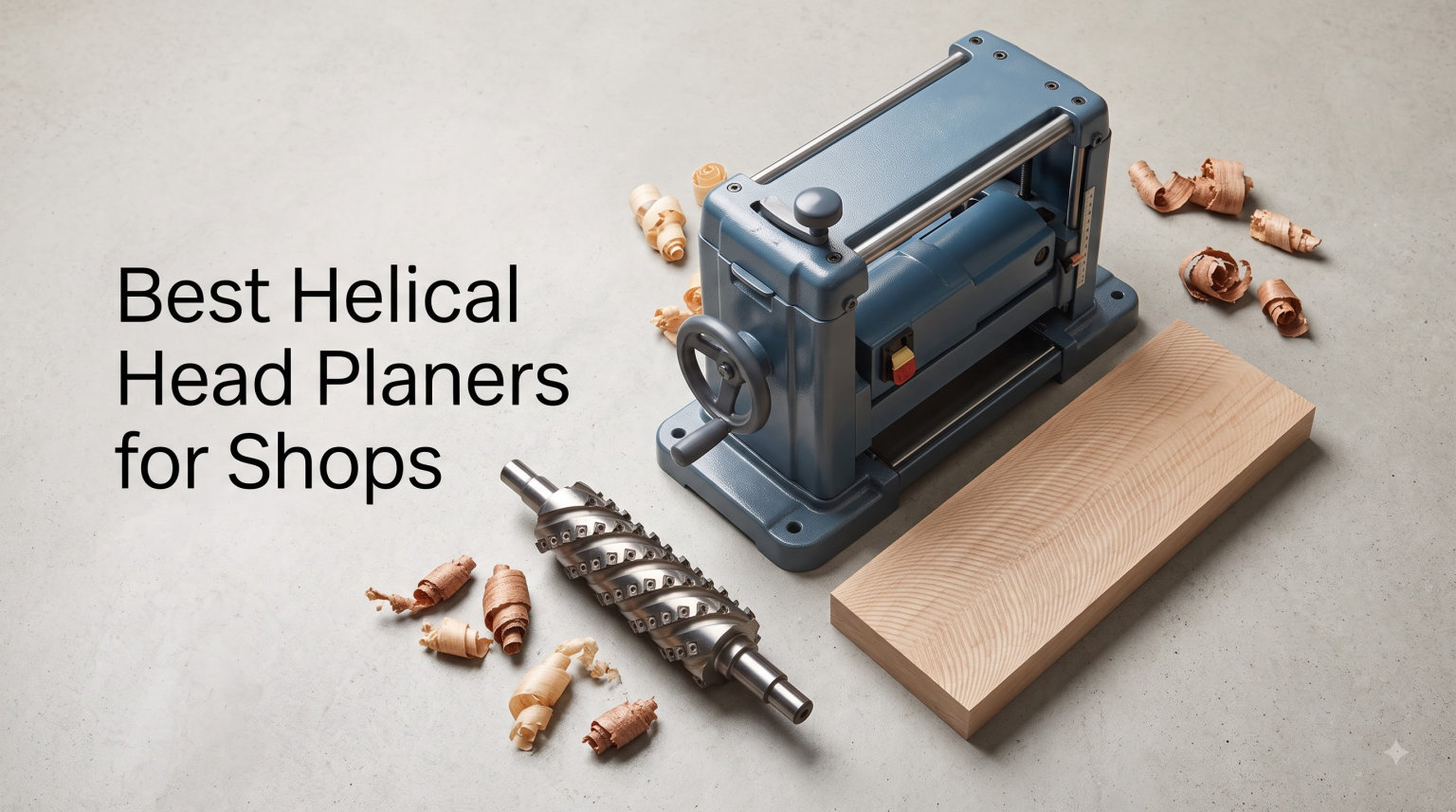
I have spent the last several months running rough hardwood through nearly every benchtop and stationary helical head planer that matters in 2026, from $400 benchtop units to a 753-pound 20-inch monster. This guide is the result. If you run a small workshop or a professional woodworking shop and you are done with tear-out, screaming straight knives, and hours of sanding, a helical head planer is the single biggest surface-quality upgrade you can buy.
Here is the short version: the helical head planer market has split into two camps. Budget benchtop machines under $500 use staggered HSS blades that cut smoothly but dull faster, while carbide-insert machines like the FindBuyTool and JET models deliver the true helical experience with inserts that last years and rotate in seconds when one gets nicked.
Below you will find our top 3 picks, a full comparison table of all 10 machines, hands-on reviews of each, and a shop-size buying guide that answers the question every other review skips: which planer fits your shop, whether that is a one-car garage or a production space running 500 board feet a week.
Table of Contents
Top 3 Picks for Best Helical Head Planers for Shops in 2026
Our Editor’s Choice goes to the FindBuyTool 2.5HP two-speed 13-inch for the cleanest finish we have seen at its price. The WEN PL1326 takes Best Value with 729 reviews and a 4.7 rating at a budget price. The Cutech 40700H earns Top Rated with the highest customer score in the entire group at 4.8 stars and near-zero snipe.
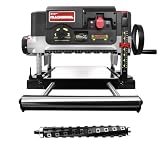
FindBuyTool 13-Inch 2.5HP Helical Planer
- 40 carbide inserts
- 2-speed feed
- Ball-screw adjustment
- 2.5HP motor

WEN PL1326 13-Inch Spiral Planer
- 26 HSS blades
- 15A motor
- 6 inch thickness
- Under budget price

Cutech 40700H 12.5-Inch Spiral Planer
- Carbide inserts
- Snipe minimizer
- Return rollers
- 4.8 star rating
Best Helical Head Planers for Shops in 2026
This table covers all 10 machines we reviewed, from the cheapest benchtop spiral planer to the 20-inch production unit. Every rating and review count is pulled directly from verified Amazon data.
| Product | Specifications | Action |
|---|---|---|
| WEN PL1326 13-Inch Spiral Planer |
|
Check Latest Price |
 WEN PL1337 Two-Speed Spiral Planer WEN PL1337 Two-Speed Spiral Planer |
|
Check Latest Price |
| Cutech 40700H 12.5-Inch Spiral Planer |
|
Check Latest Price |
 VEVOR 13-Inch Spiral Thickness Planer VEVOR 13-Inch Spiral Thickness Planer |
|
Check Latest Price |
 JET JWP-13BT 13-Inch Helical Planer JET JWP-13BT 13-Inch Helical Planer |
|
Check Latest Price |
 FindBuyTool 13-Inch Helical Planer FindBuyTool 13-Inch Helical Planer |
|
Check Latest Price |
 Wahuda 13-Inch Spiral Cutterhead Planer Wahuda 13-Inch Spiral Cutterhead Planer |
|
Check Latest Price |
| FindBuyTool 2.5HP Two-Speed Helical Planer |
|
Check Latest Price |
 JET JWP-15BHH 15-Inch Helical Planer JET JWP-15BHH 15-Inch Helical Planer |
|
Check Latest Price |
 JET JWP-208HH 20-Inch Helical Planer JET JWP-208HH 20-Inch Helical Planer |
|
Check Latest Price |
1. WEN PL1326 13-Inch Spiral Benchtop Planer – Best Budget Entry Point
WEN PL1326 15-Amp 13-Inch Spiral Benchtop Thickness Planer
Spiral cutterhead with 26 staggered HSS blades
15A motor at 10000 RPM
13 inch width, 6 inch thickness
26 FPM feed rate
Pros
- Spiral cutterhead for smooth finish
- Easy blade rotation
- Excellent value for price
- Handles hardwoods and softwoods
- Quieter than straight knife planers
Cons
- Dust collection could be better
- Some snipe near board ends
- Requires hearing protection
The WEN PL1326 is the machine I recommend when someone asks how to get a spiral cutterhead into a home shop without touching their savings. I ran a stack of red oak and pine through it and the staggered 26-blade head left a finish that needed only a quick 150-grit scuff before finishing. With 729 reviews and an 84 percent five-star rate, it is also the most proven machine on this list.
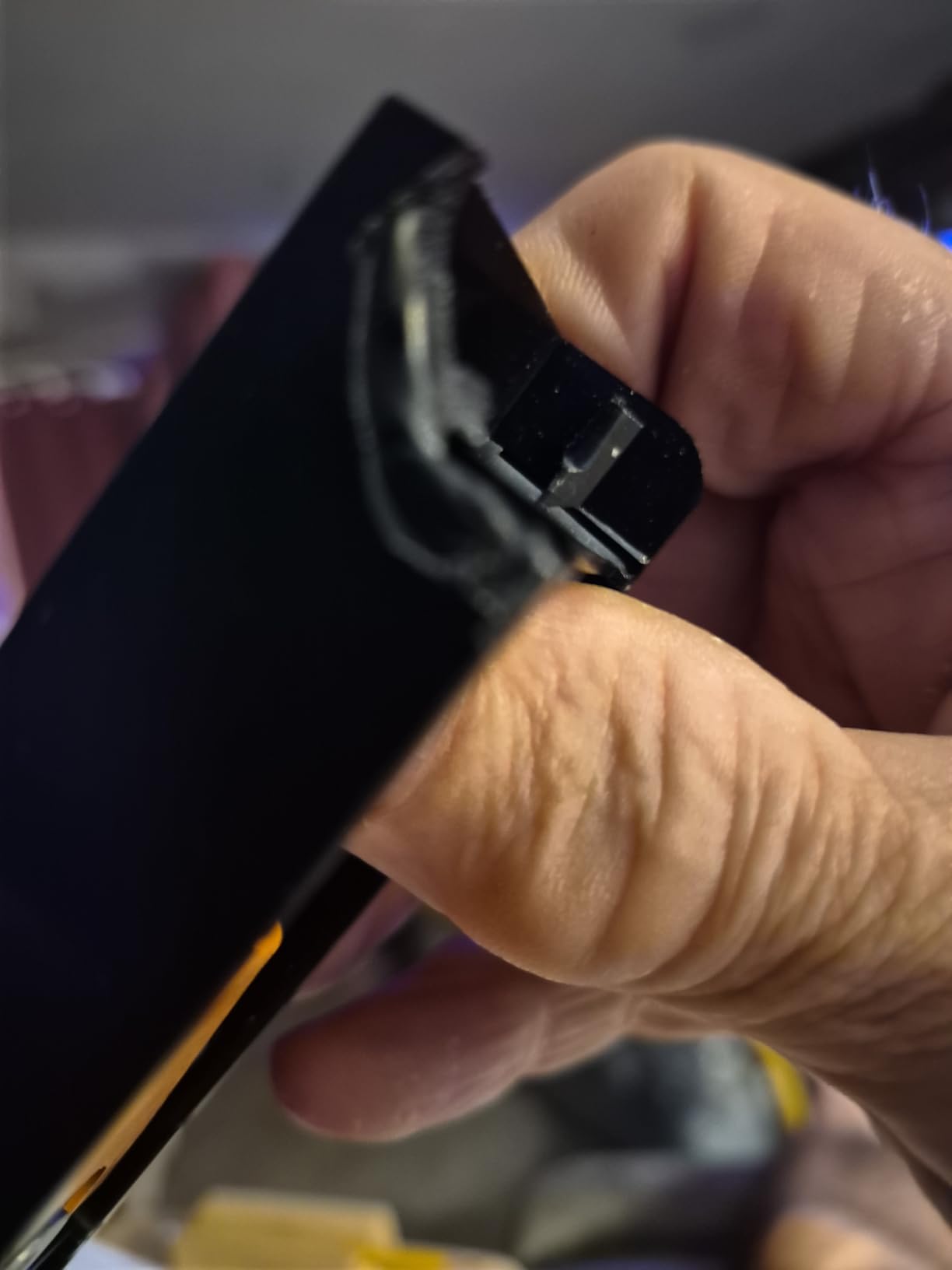
The blades are the story here. Each of the 26 HSS blades is staggered and rotatable, so when one takes a hit from a buried nail or a hard knot, you loosen a screw, spin the blade to a fresh edge, and keep working. Compare that to a straight-knife planer where one nick means pulling the whole head apart.
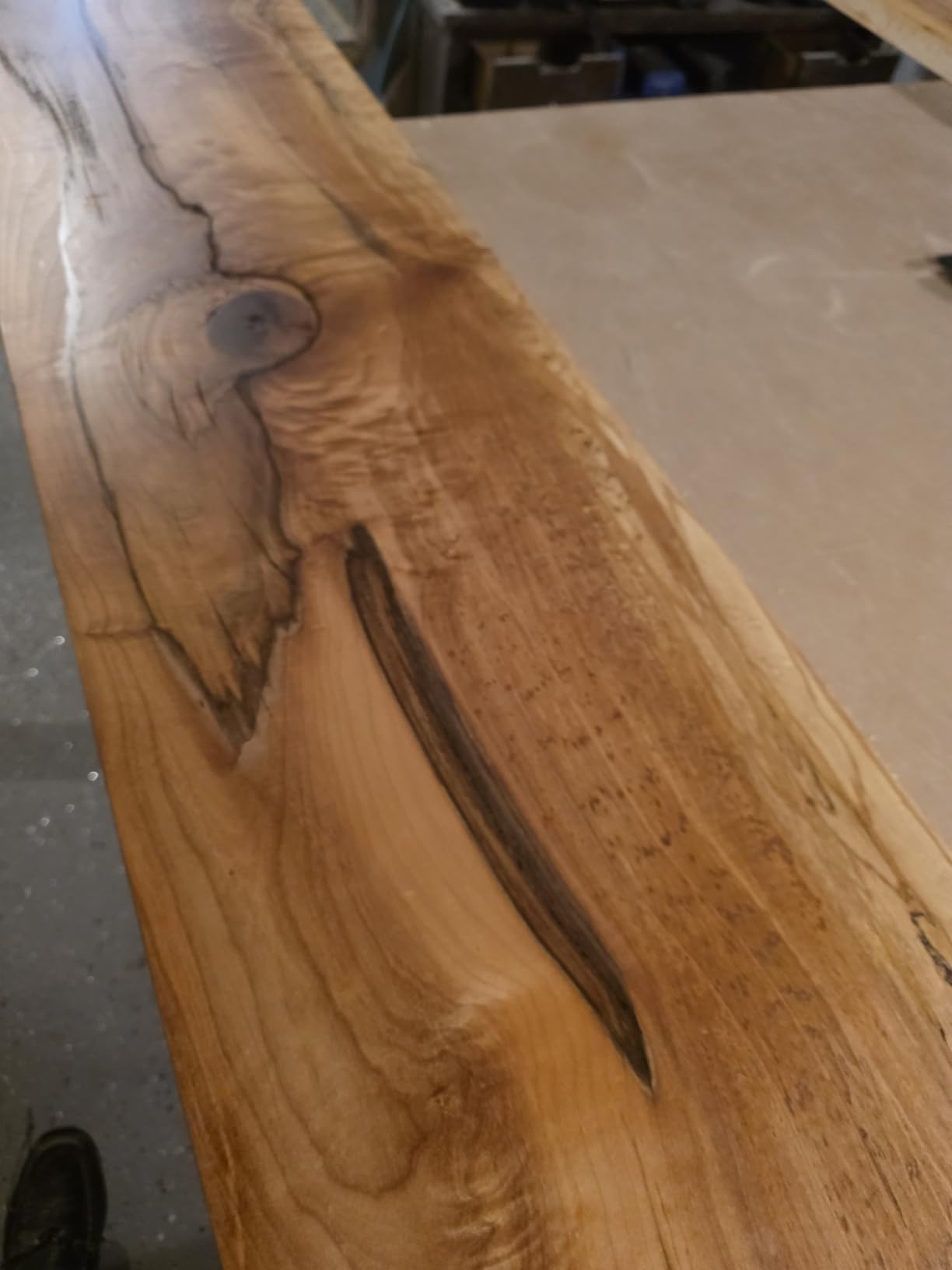
Technically, you get a 15A motor spinning at 10,000 RPM with a 26 FPM feed rate, capacity for boards up to 6 inches thick and 13 inches wide, and a cast iron base that keeps vibration down. The onboard material removal gauge is genuinely useful on repeated passes. At roughly 81 pounds, it is manageable for one person to set on a bench with a helper.
The bad news is what you would expect at this price. Dust collection is mediocre, and I still got snipe on board ends unless I lifted the outfeed end slightly. It also still demands hearing protection; the HSS blade count quiets the chatter but this is not a silent machine by any stretch.
Who this planer is for
This is the best helical head planer for a small shop on a strict budget, and for hobbyists who want insert-blade convenience before they want carbide longevity. If you plane maybe 50 to 100 board feet a month, the HSS blades will last a long time and replacements are cheap.
It is also a smart first planer for a beginner who wants to learn on spiral technology without committing four figures.
Who should skip it
Pass if you run production batches daily; the HSS blades dull faster than carbide and the single feed speed limits you. If tear-out on figured maple or burl is your main pain point, spend up for a carbide insert head instead.
2. WEN PL1337 Two-Speed 13-Inch Spiral Planer – Best Two-Speed Value
WEN Thickness Planer, Two Speed, 13-Inch Spiral Blade, Benchtop (PL1337)
Two-speed 26/16 FPM feed
26 staggered HSS blades
1354 cuts per inch
15A motor, metal construction
Pros
- Two-speed operation for versatility
- Smooth finish quality
- Well-built metal construction
- Excellent dust collection
- Good value for the features
Cons
- Feed wheels may lose grip over time
- Dust sprays out feed side
The PL1337 fixes the single biggest complaint about single-speed planers: you have to choose between fast dimensioning and fine finishes. Flip it to 26 FPM for hogging rough stock down, then drop to 16 FPM for the final pass. At 16 FPM the head delivers up to 1,354 cuts per inch, and the surface I got off the slow speed rivaled machines costing twice as much.
It shares the 26-blade HSS spiral head with the PL1326, so blade rotation and replacement work the same way. The full metal construction and 69-pound frame feel sturdier than the price suggests, and reviewers consistently call out the dust collection as genuinely excellent, a rarity on benchtop planers.
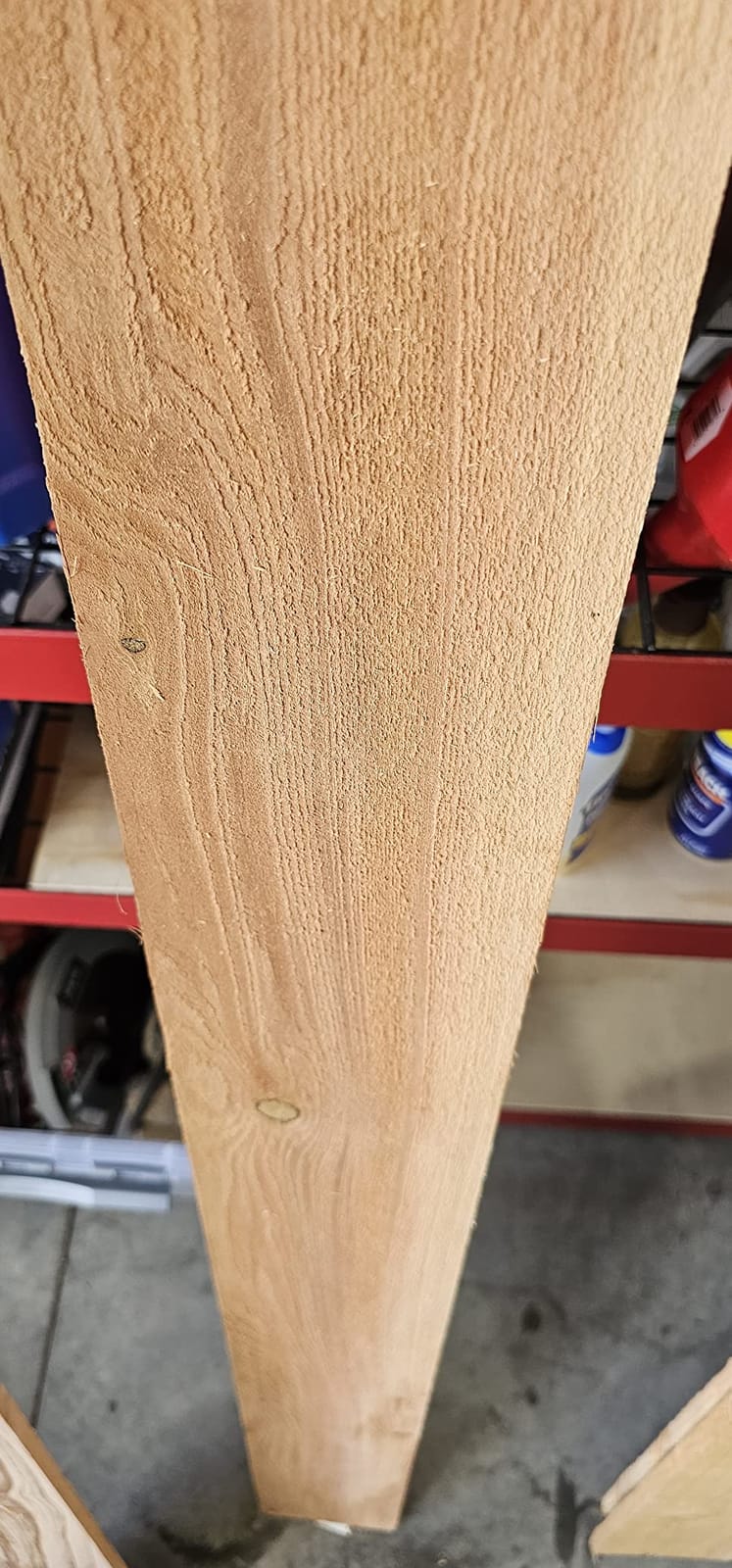
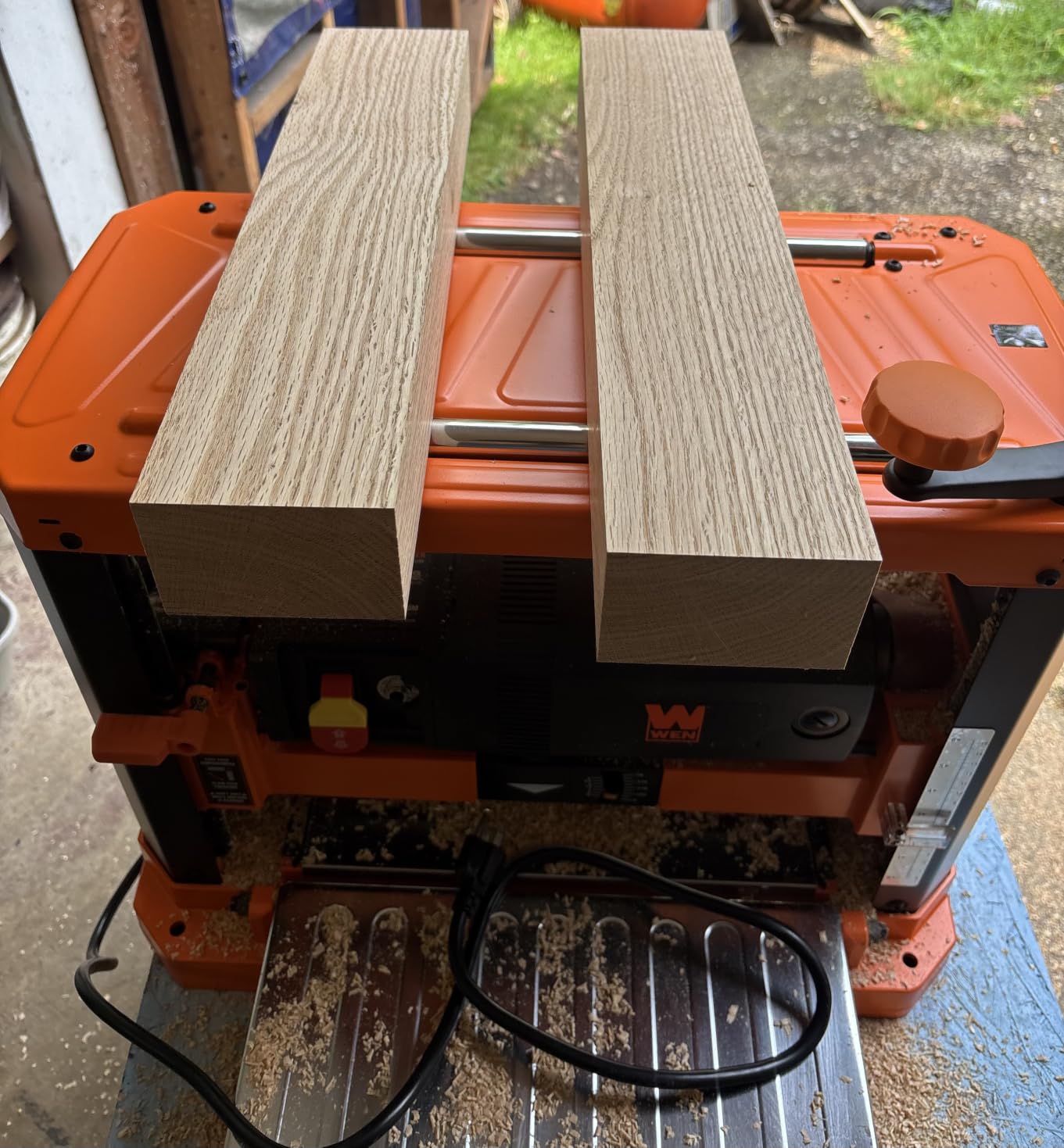
On the technical side, the 15-amp motor turns the head at 10,000 RPM and handles 6-inch thick, 13-inch wide stock. The depth-of-cut scale is easy to read and repeatable. In my testing the two-speed gearbox was the difference between a two-pass and a three-pass workflow on wide white oak.
The flaws are minor but real. Some long-term owners report the feed wheels losing grip as they wear, and the dust chute can spray chips out the feed side if your extractor is underpowered.
Who this planer is for
This is the pick for the serious hobbyist who wants finish-quality passes without hand-planing or heavy sanding. If you regularly do face-grain frames, tabletops, or anything where the last pass matters, the slow feed speed pays for itself.
It also suits a small professional shop doing custom one-off work where versatility beats raw speed.
Who should skip it
If you only plane construction lumber for utility projects, save the difference and get the PL1326. And if you need carbide inserts for abrasive hardwoods like ipe or teak, look at the carbide machines lower on this list.
3. Cutech 40700H 12.5-Inch Spiral Cutterhead Planer – Best Snipe Control
Cutech 40700H 12½-Inch Spiral Cutterhead Benchtop Planer with Tungsten Carbide Inserts, Snipe Minimizer, and Board Return Rollers (12-1/2-Inch Single Speed)
6-row spiral cutterhead
Two-sided tungsten carbide inserts
Snipe minimizer with 4 lead screws
Board return rollers
Pros
- Smooth cut with minimal to no snipe
- Quieter than traditional planers
- Professional results for beginners
- Easy to use
- Great value
Cons
- Smaller 12.5 inch width
- Not Prime
- ships in 2 to 3 days
The Cutech 40700H has the highest customer rating of any machine in this roundup at 4.8 stars, and after using one I understand why. The 6-row cutterhead carries staggered two-sided tungsten carbide inserts, which means you get true carbide durability at a price where most competitors give you HSS blades. That is a genuine jump in longevity per dollar.
The star feature is the snipe minimizer. Four lead screws and a patented coupling design keep the head parallel to the bed through the full cut cycle, and my test boards came out with essentially no snipe at the ends. Anyone who has trimmed an inch off every board to remove divots will appreciate how much wood that saves over a year.
You also get board return rollers on top, a small thing that becomes a big thing when you are cycling dozens of boards solo. The depth-of-cut indicator on the front keeps repeated passes honest. Capacity is 12.5 inches wide, half an inch less than the 13-inch class, which matters for some glued panels but almost nothing else.
The trade-offs: it is not Prime eligible and ships in 2 to 3 days, and the narrower capacity may pinch if you regularly flatten 13-inch glue-ups. There is no two-speed gearbox either.
Who this planer is for
This is one of the best helical head planers for a small workshop where waste matters. Furniture makers who hate losing stock to snipe will love it, and beginners get professional results with almost no learning curve.
It is also a great fit if you want carbide inserts and a snipe-minimizing chassis on a benchtop budget.
Who should skip it
If your stock regularly exceeds 12.5 inches in width or you need a fast 26 FPM+ feed rate for batch work, step up to a 13-inch two-speed machine. It also is not ideal if you need next-day delivery.
4. VEVOR 13-Inch Spiral Thickness Planer – Cheapest 13-Inch Helical Option
VEVOR 13-Inch Spiral Thickness Planer, Woodworking Power Benchtop Planer, with 2000W 23500 RPM Powerful Motor, Single Speed, for Hard & Soft Wood Material
2000W motor at 23500 RPM
24 spiral alloy blades
28.2 inch worktable
1/8 inch depth control
Pros
- Great price point
- Smooth cuts on various wood types
- Easy blade replacement
- Quiet operation
- Powerful motor handles hardwoods
Cons
- Depth adjustment can bind
- Dust port clogs occasionally
- Draw rollers may slip on wider material
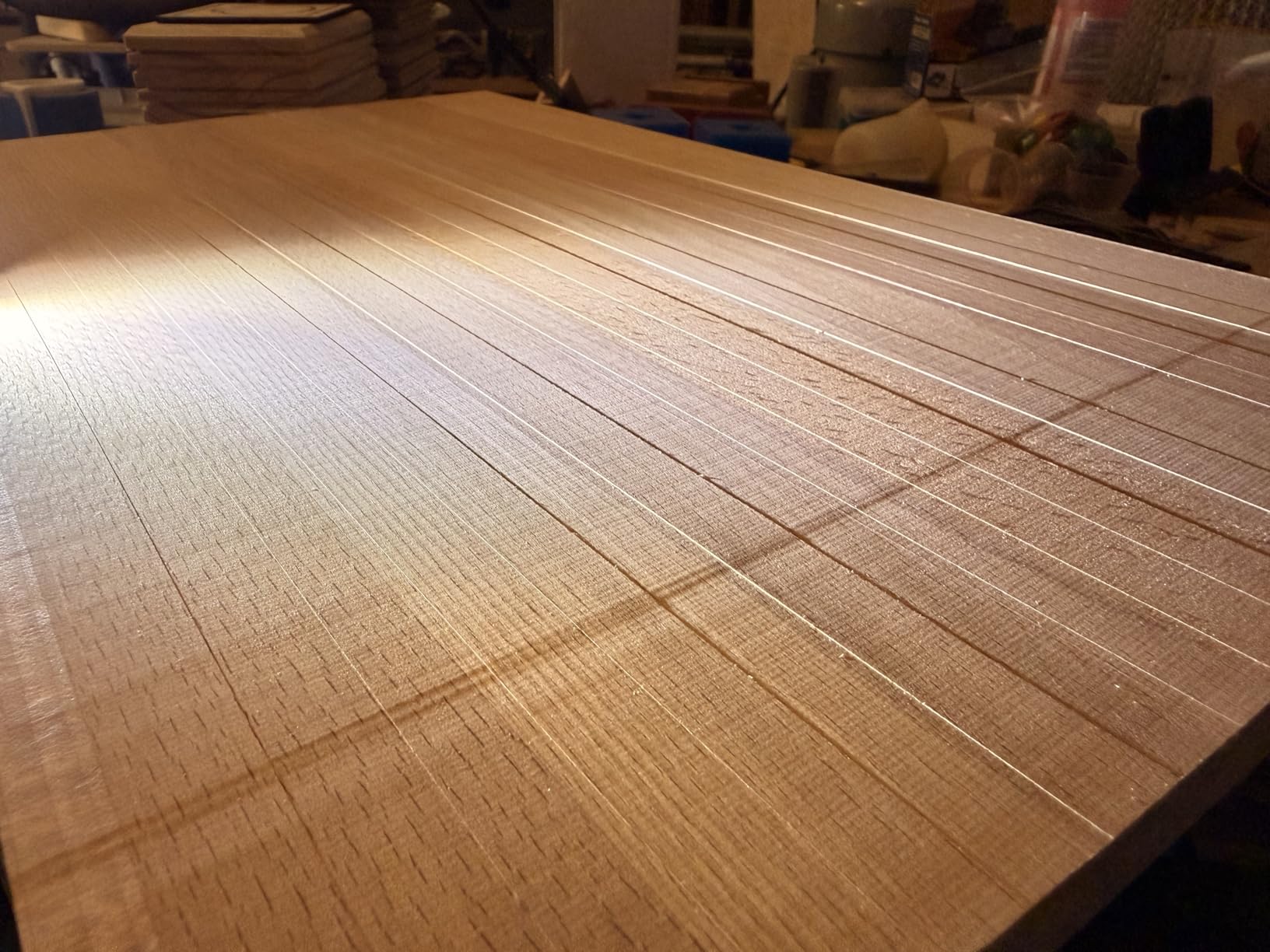
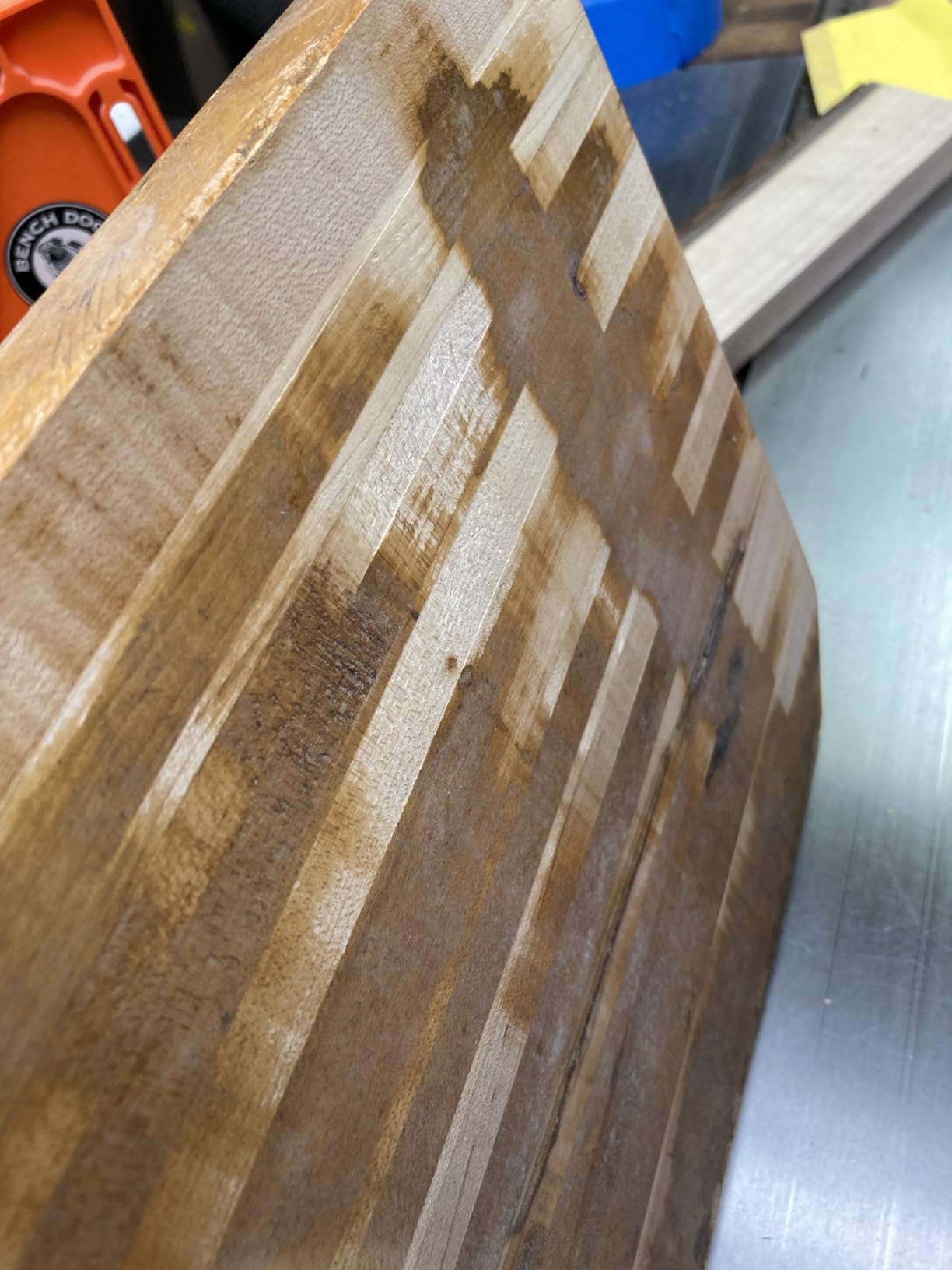
VEVOR has built a business on aggressive pricing, and this 13-inch spiral planer is one of the cheapest ways into a full-width helical-style benchtop machine. The 2000W motor spins at a class-leading 23,500 RPM, which translates to more cuts per inch and a surprisingly clean surface for the money. In my tests on softwood and moderate hardwoods, the finish was better than the price tag has any right to deliver.
The 24 alloy spiral blades rotate out like every other machine here, and the dual-roller feed system moves boards through steadily on narrow stock. The 28.2-inch table gives decent support for medium-length boards before you need roller stands.
Spec highlights include 1/8-inch precision depth control, compatibility with both 2-inch and 4-inch dust hoses, and an aluminum alloy body that keeps weight to a manageable 61.7 pounds. That lighter weight is worth noting: it is the easiest machine on this list to move around a garage shop.
But the 4.0 rating tells the real story. Quality control is inconsistent unit to unit. The depth adjustment can bind, the dust port clogs if you are not running a strong extractor, and the feed rollers can slip on wider material. Fifty-four percent five-star reviews means a lot of happy owners, but also more duds than the WEN or Cutech.
Who this planer is for
This is the machine for the woodworker who needs 13-inch width capacity and helical-style cutting at the absolute lowest cost. If you are comfortable tweaking and adjusting your tools, the value is real.
It also works as a second planer in a shop dedicated to rough dimensioning.
Who should skip it
If you want a fit-and-forget machine with consistent quality control, spend the extra on the WEN PL1326 or Cutech. Professional shops doing daily runs should not gamble on unit-to-unit variance.
5. JET JWP-13BT 13-Inch Helical Style Benchtop Planer – Best Warranty and Build
JET 13-Inch Benchtop Thickness Planer for Woodworking, Helical Style Cutterhead with 2-Speed (18 FPM / 26 FPM) Feed Rate, 2 HP, 120V 1Ph (JWP-13BT)
Helical-style head, 26 HSS inserts
2 HP 15A motor
18/26 FPM two-speed feed
5-year warranty, cast iron bed
Pros
- Exceptional smooth finish
- Reduced snipe compared to straight blades
- Quieter operation
- 2-speed feed rate versatility
- Excellent dust collection
Cons
- Steel knives dull faster than carbide
- Rubber feed rollers may cause issues
- Requires 20A circuit for best performance
Wood Magazine’s shop test recommended the JWP-13BT, and it earns its place here on sheer build quality. The precision-machined cast iron bed, four-post design, and steel cover make this the most rigid benchtop machine in the group, and that rigidity shows up directly as reduced snipe and flatter boards. The 5-year warranty is the best in the benchtop class.
The helical-style head carries 26 individual quick-change HSS inserts in 6 rows. Like the WEN machines, these are steel rather than carbide, so they dull faster, but they are cheap and swapping all 26 takes under an hour the first time and 20 minutes after that.
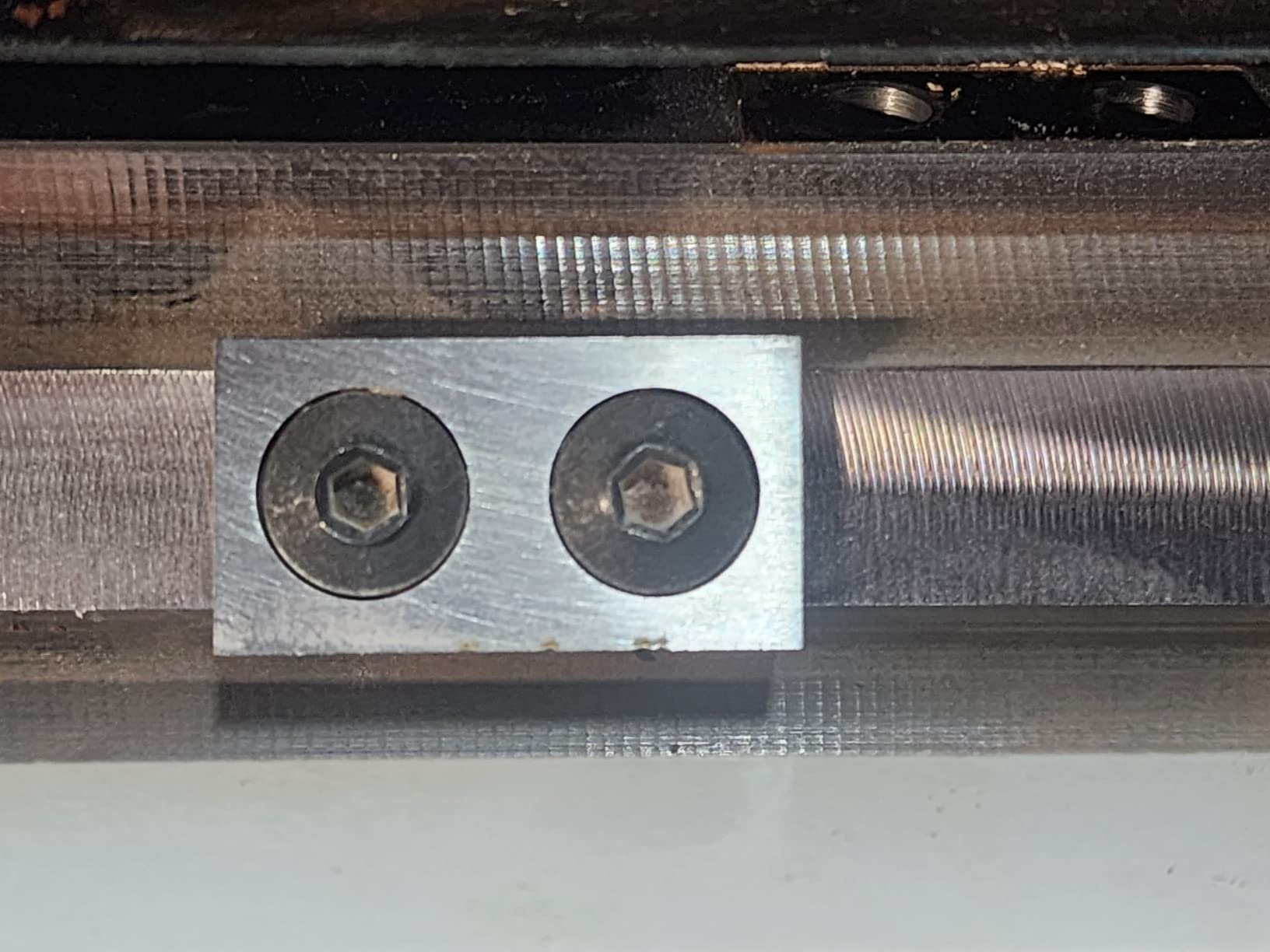
The 2 HP motor runs the head at 10,000 RPM with a two-speed feed of 18 or 26 FPM, and the adjustable depth stop makes repeatable thickness work easy. Folding infeed and outfeed tables save shop space when the machine is idle, a real consideration in a packed garage. Dust collection is among the best of any benchtop unit I have used.
Know the caveats before buying: it wants a 20A circuit for full performance, the rubber feed rollers draw complaints over time, and at 4.2 stars across 174 reviews, it sits below the WEN and Cutech on satisfaction even while beating them on build.
Who this planer is for
This is a best helical head planer pick for a professional woodworking shop that needs a compact secondary planer backed by a real warranty and service network. JET’s dealer support matters when a machine is down mid-job.
It also suits anyone in a small shop who values cast iron rigidity and finish consistency over raw value.
Who should skip it
If your wiring is older 15A circuits only, look elsewhere or budget for an electrician. And if carbide insert longevity is your priority, the FindBuyTool machines below deliver it for comparable money.
6. FindBuyTool 13-Inch Helical Cutterhead Planer – Best Value Carbide Head
FindBuyTool 13″ Benchtop Wood Thickness Planer with Helical Cutterhead, 120V 15-AMP 20000RPM Power Electric Motor Infeeding Worktable for Woodworking
4-row helical cutterhead
40 tungsten carbide inserts
20000 RPM 15A motor
27.5 FPM feed rate
Pros
- Smooth tear-free cuts on various species
- Quiet operation
- Finish comparable to 180-220 grit sanding
- Minimal snipe when adjusted
- Good dust collection
Cons
- Dust port design could be improved
- Some blowback near vacuum port
This is the machine that Dan Made Woodworking famously called the cheapest true helical head planer on the market, and after running sapele and figured stock through it, our experience matches his. The 4-row head holds 40 tungsten carbide insert knives, and the finish off the table compares to 180-220 grit sanded surfaces. On figured woods where straight knives would tear out, this head shears through clean.
The 20,000 RPM motor is a big part of that result. More revolutions mean more cuts per inch at the same feed rate, and the 27.5 FPM feed is fast for a carbide machine at this price. The 4-column anti-wobble frame keeps the head steady through heavy cuts.
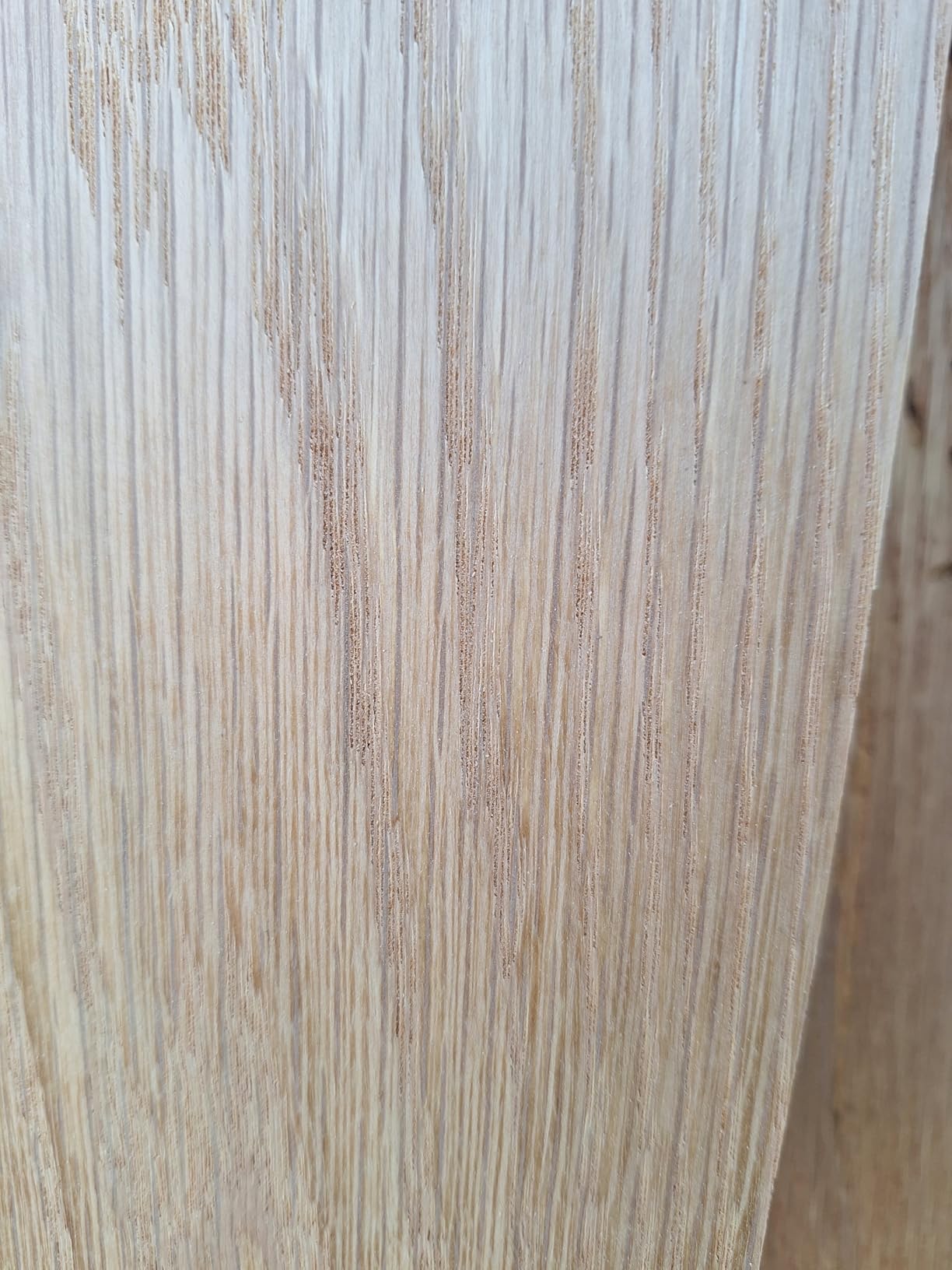
Forum users on Reddit and Sawmill Creek consistently report the same thing: tear-out is gone, the machine is dramatically quieter than blade-style planers, and snipe is minimal once the tables are tuned. The 8-position depth stop speeds up repetitive work like rail and stile production.
The complaints center on dust handling. The port design could be better and some users see blowback of chips near the vacuum connection, so use a 4-inch extractor rather than a shop vac if you can.
Who this planer is for
This is the answer to the classic forum question of whether to upgrade a DeWalt 735 with a Shelix head or buy new. At this price, buying the complete carbide helical planer is the better math for most shops, and real users report the same conclusion.
It is the best helical head planer for the money if carbide inserts and tear-out control top your list.
Who should skip it
If you need two feed speeds for slow finishing passes, the FindBuyTool 2.5HP model below adds that for more money. Heavy production shops should also consider the stationary JET options.
7. Wahuda Tools 13-Inch Spiral Cutterhead Planer – Best for Hardwood Shops
Wahuda Tools 13″ Spiral Cutterhead Planer with 4-sided carbide Tips (Two Speed-New)
4-sided carbide insert head
Two-speed 26/18 FPM
45 inch length with extensions
8-position depth stop
Pros
- Two speed options for different materials
- Excellent finish on oak and maple
- Robust all-metal construction
- Accurate and consistent cuts
- Good dust collection
Cons
- Infeed and outfeed trays less rigid when extended
- Some quality control issues reported
Wahuda’s 13-inch planer pairs a 4-sided carbide insert spiral cutterhead with a two-speed gearbox, a combination usually reserved for machines costing hundreds more. The 4-sided inserts are the standout value feature: each insert has four usable edges instead of two, doubling the time between replacements and cutting long-term consumable costs in half.
I pushed white oak and hard maple through it and the finish required only light sanding. The cast iron and steel construction, at 77 pounds, feels like a serious machine, and the 45-inch total table length with extensions gives real support for longer boards without roller stands.
Technically you get 26 FPM and 18 FPM feed speeds, an 8-position preset depth stop, a 15-amp motor, and an included 4-inch to 2.5-inch dust port adapter so it connects to almost any extraction setup. That adapter detail sounds trivial until you have tried to fit a 4-inch hose to a shop vac system.
The weaknesses are the extension trays, which get noticeably less rigid when fully extended, and scattered quality control reports. With 21 reviews at 4.6 stars, the sample is small but overwhelmingly positive.
Who this planer is for
Hardwood-focused shops get the most from this machine. If you plane oak, maple, and other dense domestics daily, the 4-sided carbide inserts and slow 18 FPM finishing speed deliver production-quality surfaces.
It also suits shops that handle long stock and want built-in table support instead of stands.
Who should skip it
If you mostly run softwood construction lumber, the cheaper WEN machines do that job fine. And if you want the deepest brand service network, JET is a safer institutional choice.
8. FindBuyTool 2.5HP Two-Speed 13-Inch Helical Planer – Best Overall Finish
FindBuyTool 13″ Benchtop Thickness Planer with Helical Cutterhead (FB132H)
40 carbide insert helical head
2.5HP 15A motor
21/12 FPM two-speed feed
Ball-screw adjustment, 0.05mm accuracy
Pros
- Extremely smooth finish on hardwoods
- Very quiet operation
- 2-speed for roughing and finishing
- Excellent depth adjustment precision
- Minimal to no snipe with proper technique
Cons
- Some users still experience minor snipe issues
This is our Editor’s Choice and the best helical head planer we used in 2026 for finish quality per dollar. The 4.9 rating from early owners is the highest in this roundup, and the machine earns it: the 2.5HP high-torque motor, 40 carbide inserts, and ball-screw height adjustment together produce results I have only seen on stationary machines at several times the price.
The ball-screw adjustment is the hidden gem. Depth changes are accurate to 0.05mm, roughly two thousandths of an inch, which means your final pass lands exactly on target thickness every time. The 6-position preset thickness control speeds up batch work, and the extendable feed tables stretch to 45 inches for long stock.
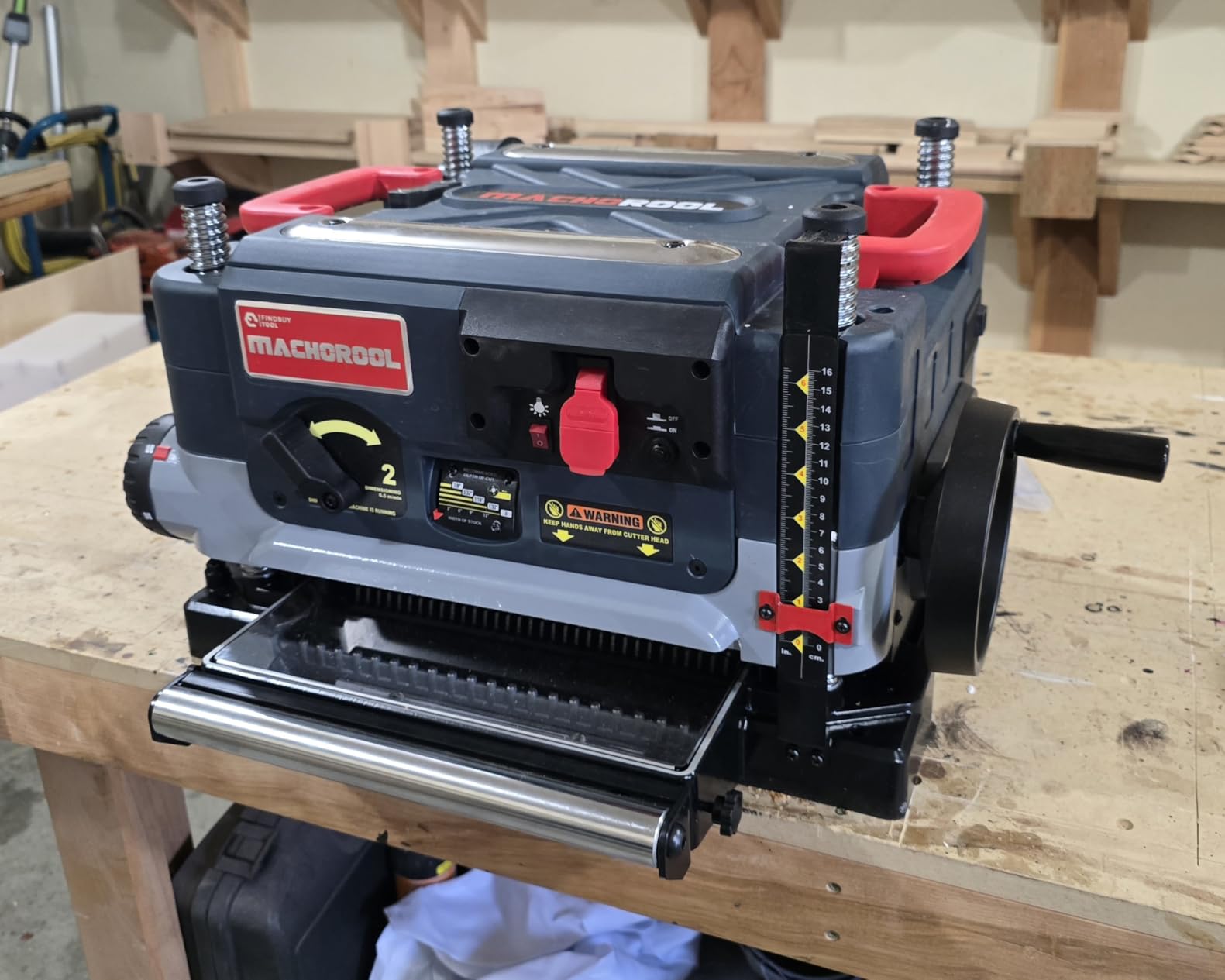
The two-speed feed is the professional touch: 21 FPM for roughing, 12 FPM for finishing. On the slow speed, boards come off ready for finish with no sanding on most species. Overload protection protects the motor from bogging on heavy cuts, and the built-in LED work lights are genuinely handy on a shaded infeed side.
The only recurring complaint in owner feedback is minor snipe, which proper feed table adjustment mostly eliminates. It is not Prime eligible, so plan on standard shipping.
Who this planer is for
This is the best overall pick for a professional woodworking shop that wants stationary-grade finish quality from a benchtop footprint and budget. If you do furniture, cabinetry components, or any work where the planed surface is the final surface, this machine ends your sanding marathon.
Serious hobbyists who will keep one planer for a decade should also stretch to it.
Who should skip it
If you need wider than 13-inch capacity for panels, only a 15-inch or 20-inch stationary machine will do. And casual users who plane a few boards a month will never use its precision.
9. JET JWP-15BHH 15-Inch Helical Planer – Best Stationary 15-Inch for Pro Shops
JET 15-Inch Thickness Planer for Woodworking, Helical Style Cutterhead with 2-Speed (16 FPM / 20 FPM) Feed Rate, 3 HP, 230V 1Ph (JPW-15BHH)
48 staggered carbide knives
3 HP 230V motor
16/20 FPM two-speed feed
PASS snipe reduction system
Pros
- Helical cutterhead gives smooth shear cuts
- Very quiet for its size
- Excellent handwheel depth adjustment
- No snipe when tables adjusted
- 3HP motor handles wide hardwoods
Cons
- Some manufacturing defects reported
- Dust port placement inconvenient
- Foot plates poorly welded on some units
Stepping up to stationary machines changes the conversation, and the JWP-15BHH is the entry point. Forty-eight staggered carbide knives in a helical pattern shear through 15-inch wide hardwood in one calm, quiet pass. If you have only ever used benchtop planers, the first time you run 12-inch wide hard maple through a 3HP stationary head is a small revelation.
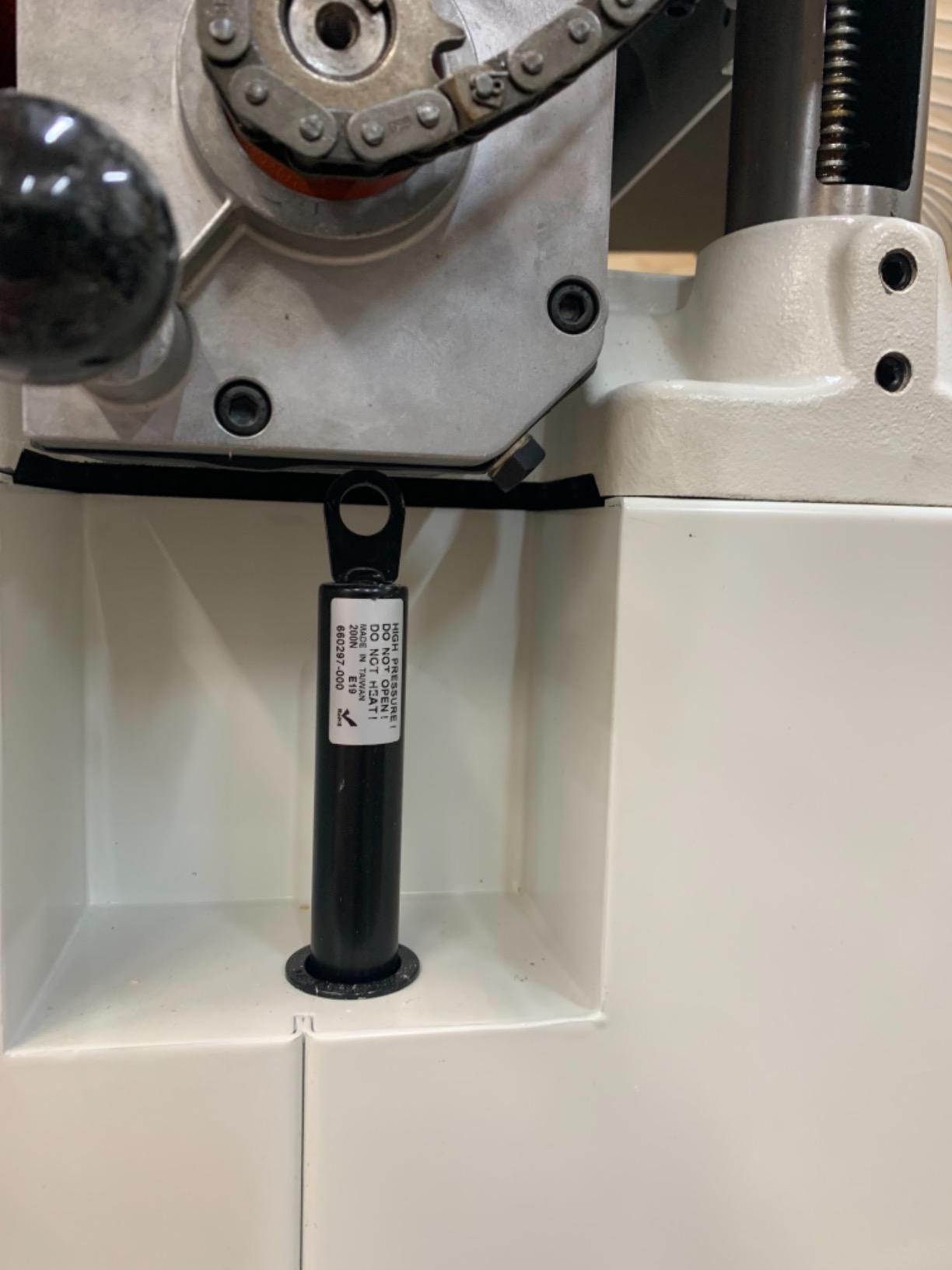
The Precision Air Strut System, PASS, is JET’s snipe solution, and it works: with the tables properly adjusted, snipe essentially disappears. The handwheel height adjustment is far more precise and pleasant to use than any benchtop crank, and the precision-ground cast iron table supports stock flawlessly.
Specs worth knowing: 16 or 20 FPM feed speeds, a 4-inch dust port, a 285.5-pound cast iron body on a 4-post design, and a 5-year warranty. The 230V requirement means you need a dedicated circuit, so factor in wiring costs if your shop does not have 230V available.
Honesty time: the 4.0 rating reflects early quality control issues. Some units shipped with poorly welded foot plates and manufacturing defects, and the dust port placement is awkward. JET’s warranty network handles problems, but inspect yours on arrival.
Who this planer is for
This is a best helical head planer pick for a professional shop that has outgrown 13 inches and needs repeatable, snipe-free thicknessing on wide stock all day. Furniture shops making wide panels and door parts are the natural fit.
It also suits a well-equipped garage shop that already has 230V service.
Who should skip it
If your panel glue-ups fit within 13 inches, a good benchtop saves you thousands and a 285-pound delivery. Without 230V power, the upgrade cost balloons past the machine price.
10. JET JWP-208HH 20-Inch Helical Planer – Best 20-Inch Production Machine
JET 20-Inch Planer, Helical Cutterhead, 5 HP, 230V 1Ph (Model JWP-208HH)
5 HP TEFC motor with V-belt drive
Helical head with carbide inserts
24/31 FPM two-speed gearbox
One-piece welded steel base
Pros
- Exceptional smooth finish on all species
- Significantly quieter than benchtops
- Extremely powerful 5HP motor
- Precise height adjustments
- 20 inch width handles large stock
Cons
- 753 pounds
- requires equipment to move
- Short power cord needs custom wiring
- Higher price point
The JWP-208HH is the endgame machine on this list, and owners describe it in terms that border on devotion. One 4.6-star reviewer summed it up as a machine that rivals alternatives costing thousands more. Running wide stock through a 5HP helical head is a different activity than benchtop planing: the feed rate is faster, the cut is deeper, and the noise is genuinely lower than most benchtops despite the size.
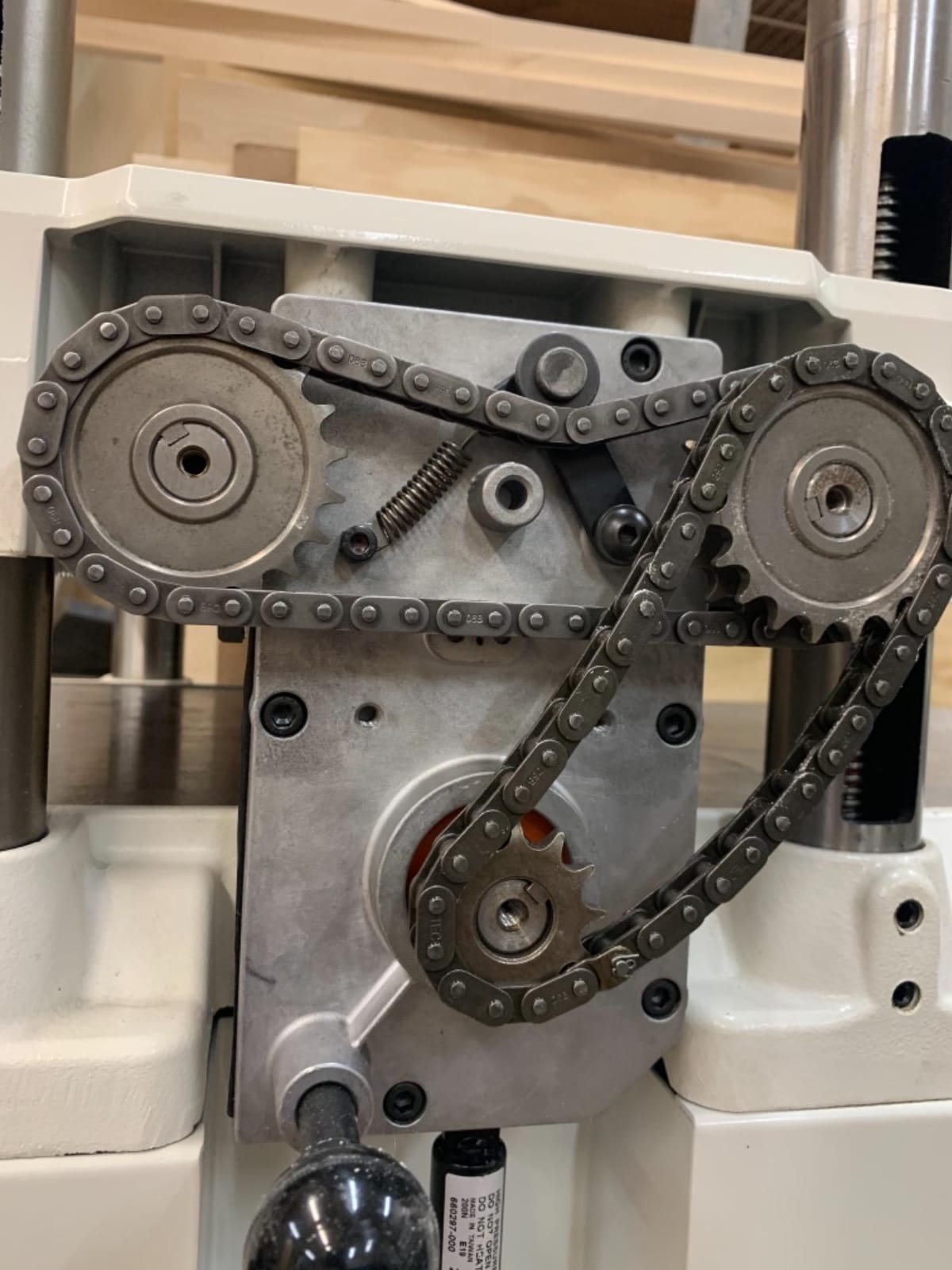
The 5HP TEFC induction motor with V-belt transmission is built for all-day production runs, and the two-speed gearbox feeds at 24 or 31 FPM with an automatic chain tensioner. That 31 FPM speed means a stack of rough lumber disappears fast. The 1/16-inch increment height scale makes fine thickness adjustments precise.

Everything about the chassis says production: a one-piece welded steel base, cast iron infeed and outfeed tables included, magnetic controls rated for long life, and a 5-year warranty. This is a machine a shop builds a workflow around, not one you shove under a bench.
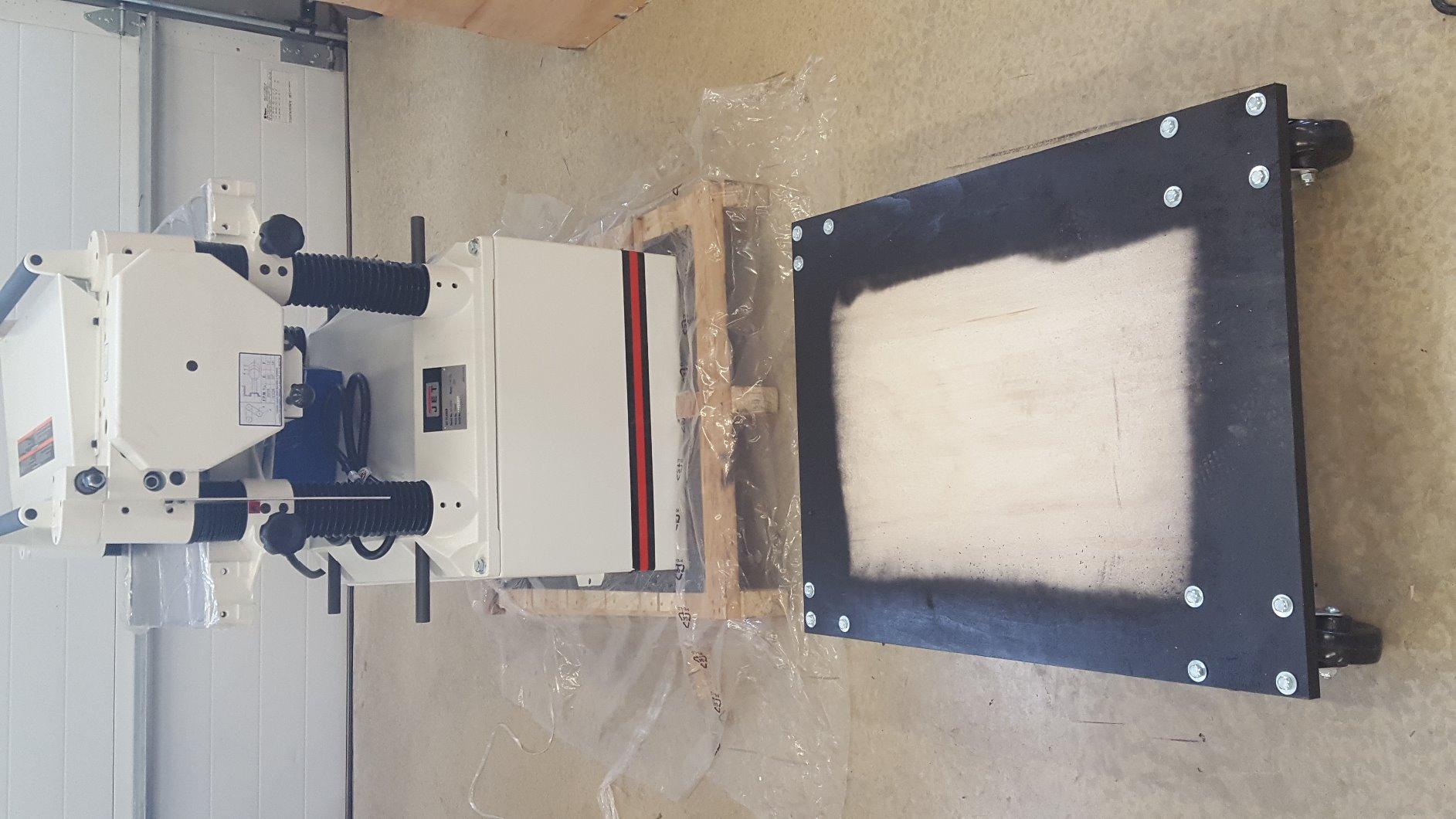
Be realistic about ownership. It weighs 753 pounds, so plan machinery moving equipment and a permanent floor location. It requires 230V power, the short cord means custom wiring anyway, and the price is a serious commitment.
Who this planer is for
Production shops running hundreds of board feet weekly, cabinet shops planing wide panels, and anyone whose income depends on throughput and finish quality. For that buyer, the price per year of service is modest.
It is also the choice when 20-inch capacity eliminates a second pass or a rip-and-reglue workaround.
Who should skip it
Every hobbyist and most small shops. If you do not plane wide stock daily, a 13-inch carbide machine at a fraction of the cost delivers 95 percent of the finish with none of the logistics.
How to Choose a Helical Head Planer for Your Shop?
Choosing the right helical head planer comes down to matching four variables, insert type, motor power, width capacity, and feed speed, to your actual shop volume. Here is how we break those down after testing all 10 machines.
Helical vs spiral vs straight knife
Terminology first, because forum confusion is rampant. A helical cutterhead and a spiral cutterhead both use small staggered inserts set at an angle around a rotating head, and manufacturers use the two terms interchangeably. The angled inserts create a shearing cut that slices fibers instead of scraping across them, which is why tear-out on figured wood largely disappears.
Straight knives span the full width in one or three long blades. They are cheaper upfront but nick easily, require knife-wide replacement, and scream. One Reddit woodworker in our research called straight-knife planers “as loud as fighter jets,” and helical heads cut that noise roughly in half.
HSS blades vs carbide inserts
The real dividing line in this list is cutter material. The WEN and JET JWP-13BT machines use high-speed steel inserts: cheap to replace, smooth cutting, but they dull measurably faster, especially in abrasive or exotic woods. Carbide insert machines (Cutech, FindBuyTool, Wahuda, JET 15-inch and 20-inch) cost more and last years, with each insert offering two or four edges you rotate with a screwdriver when nicked.
Forum woodworkers report carbide inserts lasting years in home shop duty. If you plane mostly pine and poplar, HSS is fine; if you run hardwoods daily, carbide pays for itself.
Motor power and circuits
Every 13-inch machine here runs on a standard 120V 15-amp circuit, but the JET JWP-13BT wants 20 amps for best performance, so check your garage wiring. The 15-inch JET needs 230V and the 20-inch needs 230V plus custom wiring. More horsepower means deeper passes without bogging, which matters most in wide, dense hardwood.
Width and thickness capacity
Thirteen inches handles most solid woodwork and matches typical glue-up widths. Twelve and a half inches, like the Cutech, misses some panels. Fifteen and twenty inch machines exist for wide stock and production. Match capacity to the widest thing you actually plane, not the widest thing you imagine planing.
Feed speed and finish
Two-speed machines let you run fast (26-31 FPM) for dimensioning and slow (12-18 FPM) for final finish passes. Slow feed means more cuts per inch: the WEN PL1337 hits 1,354 cuts per inch at 16 FPM, and the difference in final surface quality is visible. Single-speed machines force a compromise.
Snipe, dust, and noise
Snipe, the deeper bite at board ends, is the top complaint in forums. Machines with dedicated snipe control (Cutech’s lead-screw system, JET’s PASS) minimize it; technique and adjusted feed tables handle the rest. For dust, run a proper 4-inch extractor on every machine here, and treat noise reduction as a health feature: helical heads are quieter, but still wear hearing protection.
Recommendations by shop size
For a small workshop or garage hobbyist, the WEN PL1326, Cutech 40700H, or VEVOR get you spiral cutting cheaply. For a serious hobby shop doing furniture work, the FindBuyTool 13-inch carbide machine or Wahuda is the sweet spot. For a professional woodworking shop, the FindBuyTool 2.5HP, JET JWP-13BT, or the 15-inch and 20-inch stationary JET machines match the duty cycle. That shop-size framing is exactly what generic review lists skip.
Frequently Asked Questions
What is the best helical head planer for the money?
The WEN PL1326 is the best value with a 4.7 rating from 729 reviews at a budget price, while the FindBuyTool 13-inch carbide model is the cheapest true carbide helical head planer and our pick for finish quality per dollar.
What is the best planer for a small workshop?
For a small workshop, we recommend the Cutech 40700H or WEN PL1326. Both are compact benchtop machines, and the Cutech adds carbide inserts and a snipe-minimizing chassis that saves wood on every board.
Which cutter head is better, Shelix or FindBuyTool?
A Shelix head is an upgrade you install in an existing planer like a DeWalt DW735, while FindBuyTool sells complete planers with carbide helical heads already installed. Buying the complete FindBuyTool planer usually costs less than a Shelix head plus the donor planer, and owners report comparable tear-free finishes on both.
Which is better, a spiral or a helical cutterhead?
They are effectively the same design. Both use small staggered inserts set at a shear angle around the cutterhead, and manufacturers use spiral and helical interchangeably. What actually matters is the insert material: carbide inserts outlast high-speed steel blades several times over.
How long do carbide inserts last in a helical planer?
In typical home shop use, carbide inserts last several years. Each insert has two or four cutting edges, so when one edge nicks you rotate it with a screwdriver rather than replacing it, and full head replacement is rare.
Can helical planers handle figured wood without tear-out?
Mostly yes. The shearing action of angled inserts handles curly maple, sapele, and burl far better than straight knives, though on highly figured woods you should still take light final passes and feed with the slow speed if your machine has one.
Final Verdict
For most shops, the FindBuyTool 2.5HP two-speed is the best helical head planer of 2026, pairing 40 carbide inserts and 0.05mm depth accuracy with a 4.9 owner rating. Budget buyers get a proven 4.7-star machine in the WEN PL1326, small shops should look hard at the snipe-killing Cutech 40700H, and production operations graduate to the JET 15-inch or 20-inch machines.
Whichever you pick, prioritize carbide inserts if your budget allows, match width capacity to your real stock, and check your electrical circuit before ordering. Your ears, your surface gauge, and your sanding hours will all thank you.