
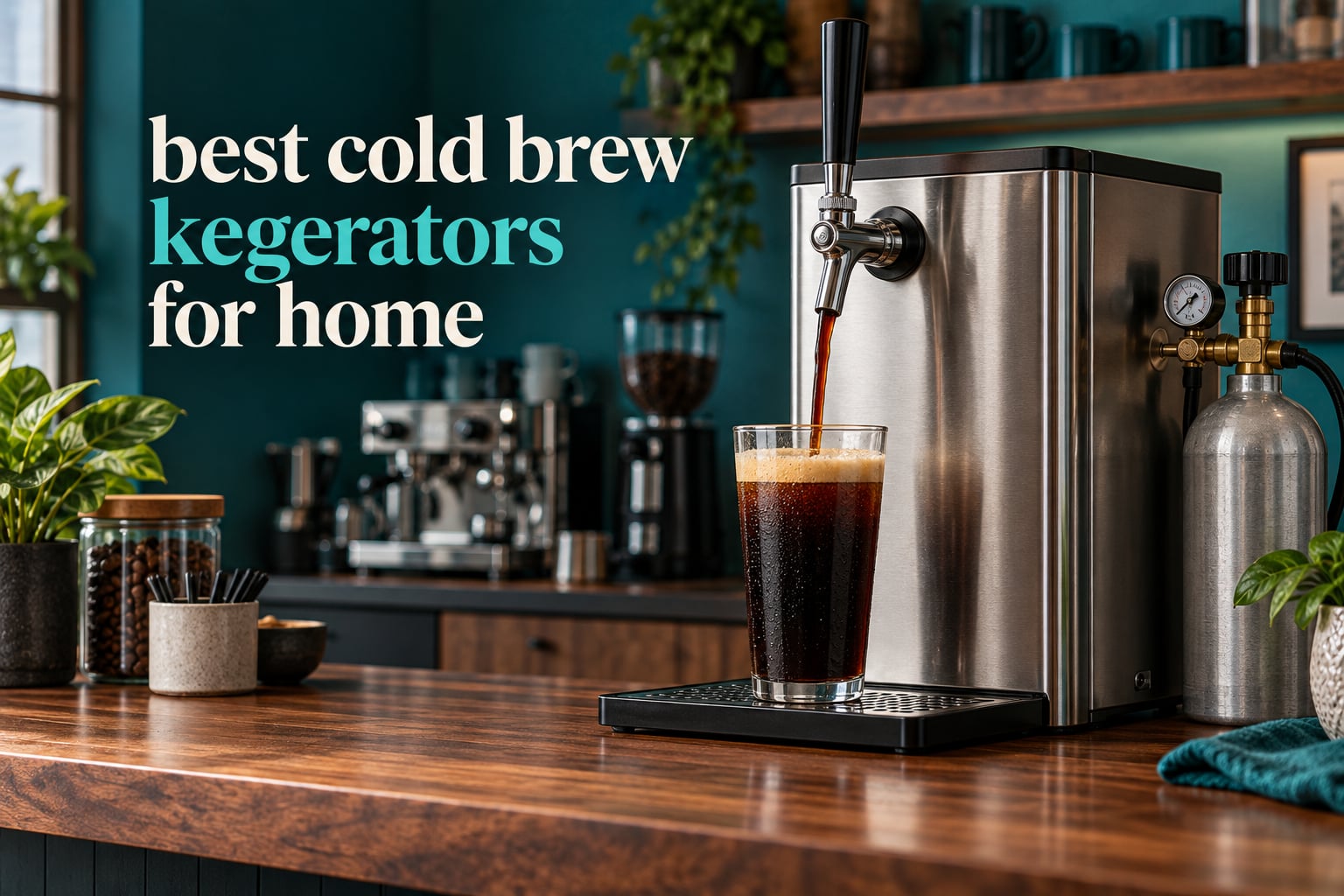
The best all-round option is the NutriChef Pressurized Growler Tap System, a 64 oz stainless mini keg that holds carbonation for weeks and slips onto a normal fridge shelf. If you want a full appliance instead, the Kegco K309SS-1 gives you a digital thermostat, a deep chill mode and a complete dispense kit in one box.
Most people searching this topic are not looking for a beer fridge with a tap bolted to the front. They want a cabinet or a canister that keeps cold brew at a controlled temperature and pours it like a draft pour instead of hauling concentrate out of a bottle every morning. That distinction matters, because a kegerator built for ales runs at warmer settings than cold brew likes, and a plain beer kegerator will not give you a creamy nitro pour no matter how good the compressor is.
We compared twelve pressurized keg dispensers, countertop coolers and conversion refrigerators to build this list. We weighed them on serving temperature, keg format, tap count, how well the included hardware actually works, cleaning burden and the total cost of the gas hardware you have to add on top. We also read long-term ownership reports rather than spec sheets, because a compressor that still runs in year three is worth more than a perfect box on day one.
A note before we start: we earn a commission when you buy through the links on this page, at no extra cost to you. That never changes the ranking. If you want the coffee side of the equation rather than the hardware, our cold brew coffee maker guide covers the brewing methods, and nitro cold brew systems for cafes covers larger setups.
Table of Contents
Top 3 Picks: Best Cold Brew Kegerators for Home

NutriChef Pressurized Mini Keg
- 64 oz 304 stainless mini keg
- Adjustable PSI regulator with gauge
- 13.4 inch tall fits a fridge shelf
- 16g CO2 cartridge powered

Kegco K309SS-1 Single Tap
- Digital temperature display
- Deep chill mode
- Holds three homebrew kegs
- CO2 tank and dual gauge regulator included

EdgeStar BR2001BL Fridge
- 4.9 cubic foot compressor fridge
- Low 30s to mid 40s range
- Pre-drilled tower and CO2 holes
- Holds a full half barrel Sankey keg
These three cover the realistic choices most households end up making. The NutriChef is the smallest and cheapest way to get a genuine pressurized pour. The Kegco is the appliance you buy once and keep for a decade. The EdgeStar is a bare refrigerator that costs less than a finished kegerator and lets you pick your own dispense hardware.
Quick Picks: The Best Cold Brew Kegerators for Home Right Now
If you are short on time, here is where each of the twelve lands.
Best overall: NutriChef Pressurized Growler Tap System for anyone starting out. Sixty-four ounces is about eight servings of cold brew and the whole thing weighs 4.1 pounds.
Best appliance: Kegco K309SS-1. Digital control, deep chill mode and a bonus 5 lb CO2 tank in the box.
Best dual tap: Kegco HBK309S-2 for serving a still pour and a nitro pour from the same cabinet.
Best budget build: EdgeStar BR2001BL plus a separate dispense kit, the cheapest path to a full half barrel on tap.
Best countertop: SPT BD-0538 for a small kitchen, with three CO2 cartridges already in the box.
Best for hosting: GANCOWISE 270oz Mini Keg at about sixteen cups per fill.
How We Picked the Best Cold Brew Kegerators for Home
Six criteria decided the order. First, serving temperature: cold brew tastes best colder than most ales, and a cabinet that stalls around 41F is a poor fit. Second, keg format, since a fifth-barrel Sankey and a 5 gallon corny keg are not interchangeable.
Third, dispense hardware. Units that ship with a tap, a regulator and couplers that actually work save you a trip and a hundred dollars of troubleshooting. Fourth, cleaning, because coffee oils behave differently from beer sugar and you will be flushing lines more often. Fifth, noise, since a compressor that hums in a home bar is worse than one in a garage. Sixth, the running cost of gas and refills.
All 12 Best Cold Brew Kegerators for Home Compared Side by Side
Every product below appears in the table with its tap style and keg format so you can match it to your brewing setup at a glance.
| Product | Specifications | Action |
|---|---|---|
| NutriChef Pressurized Growler Tap System |
|
Check Latest Price |
 TMCRAFT 128oz Mini Keg Tap System TMCRAFT 128oz Mini Keg Tap System |
|
Check Latest Price |
 Kegco HBK309S-2 Home Brew Keg Dispenser Kegco HBK309S-2 Home Brew Keg Dispenser |
|
Check Latest Price |
 SPT BD-0538 Mini Kegerator and Dispenser SPT BD-0538 Mini Kegerator and Dispenser |
|
Check Latest Price |
| Kegco K309SS-1 Keg Dispenser |
|
Check Latest Price |
| EdgeStar BR2001BL Ultra Low Temp Refrigerator |
|
Check Latest Price |
 EdgeStar BR3002 24 Inch Kegerator Conversion Refrigerator EdgeStar BR3002 24 Inch Kegerator Conversion Refrigerator |
|
Check Latest Price |
 VEVOR BF152-2 Dual Tap Beer Kegerator VEVOR BF152-2 Dual Tap Beer Kegerator |
|
Check Latest Price |
 VEVOR BF92 Single Tap Kegerator VEVOR BF92 Single Tap Kegerator |
|
Check Latest Price |
 GANCOWISE 270oz Mini Keg Growler GANCOWISE 270oz Mini Keg Growler |
|
Check Latest Price |
 Coldbreak ColdOne Non-Electric Kegerator Coldbreak ColdOne Non-Electric Kegerator |
|
Check Latest Price |
 MRbrew 128oz Mini Keg Growler System MRbrew 128oz Mini Keg Growler System |
|
Check Latest Price |
1. NutriChef Pressurized Growler Tap System: Best Overall Cold Brew Kegerator for Home
NutriChef Pressurized Growler Tap System, 64oz Stainless Steel Mini Keg Dispenser Portable Kegerator Kit, Co2 Pressure Regulator Keeps Carbonation for Craft Beer, Draft and Homebrew
64 oz capacity
304 stainless steel
13.4 inch tall
4.1 pounds
16g CO2 cartridge
Pros
- Holds carbonation far longer than a plastic growler
- Food-grade 304 stainless body
- 13.4 inch height fits a standard fridge shelf
- PSI gauge and adjustment knob on the regulator
Cons
- CO2 cartridges are not included
- Not actively chilled so it depends on a cold room
- Sixty-four ounces runs out quickly at a gathering
This is the unit we recommend first, and the reason is unglamorous: it pairs a genuine pressurized pour, a food-grade 304 stainless interior and a footprint you can actually find room for. Sixty-four ounces of cold brew concentrate diluted one to one gives you roughly eight twelve-ounce servings.
Owners consistently point to carbonation retention as the headline. The vacuum-pressurized stainless body keeps a filled mini keg drinkable for weeks, which is dramatically longer than a plastic growler. The regulator has a real gauge and an adjustment knob, so you can dial pressure instead of guessing.
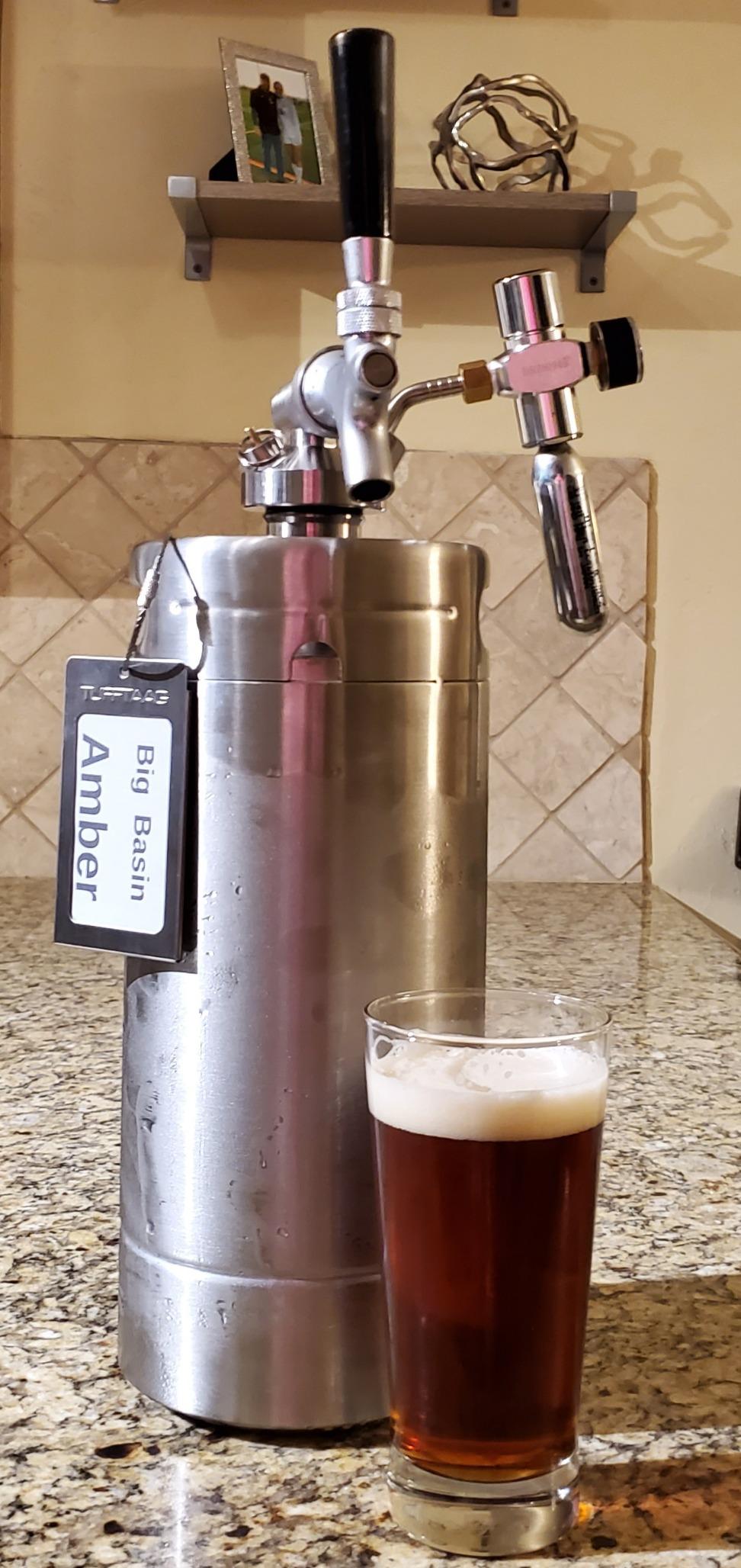
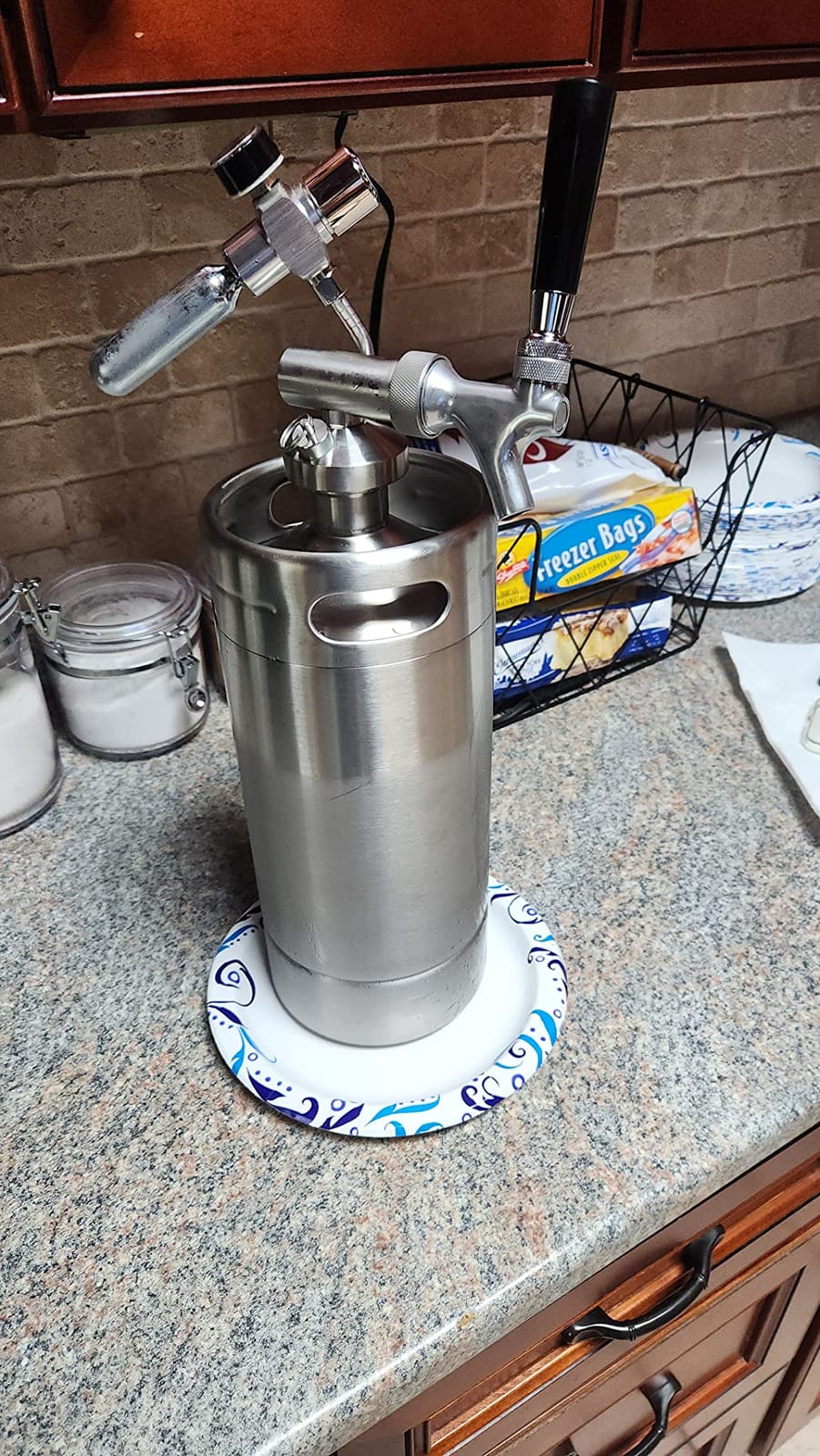
At 13.4 inches tall and 6.89 by 7.49 inches across, it stands on a fridge shelf without drama. The laser-marked fill line helps you dilute consistently, and a pressure release valve lets you take the tap hardware off safely when you want to refill.
It runs on standard 16g threaded CO2 cartridges, and each cartridge pushes through roughly 128 ounces. The cartridges are not in the box, so budget for that separately. The screw-on metal lid is what makes it portable, and the whole assembly weighs just 4.1 pounds.
Why this one works for cold brew specifically
Because it is not a refrigerator at all. It is a vessel you place in cold storage, which means the temperature question is already answered by your fridge rather than by a weak thermoelectric module. For cold brew, that is a feature. Cold brew wants to sit at or below 40F, and a compressor-free canister placed in a fridge already holds that.
It also suits the smaller batches most people actually brew at home. A full fifth barrel requires a serious brew day and a serious cleanup, while a 64 oz canister matches what a home brewer or a concentrate buyer puts up in a session.
Where it falls short
It does not chill anything, so it needs a cold environment to work. In a warm garage during summer it will not hold serving temperature no matter how good the seals are. If you want cabinet-style cold brew service that runs itself around the clock, you need one of the refrigerators further down.
Capacity is the other limitation. Sixty-four ounces is fine for a couple of days of personal drinking and short of useful for a party of six or more. Reviewers also note that CO2 cartridges cost adds up faster than a refillable tank if you brew weekly.
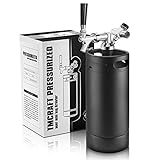
2. TMCRAFT 128oz Mini Keg Tap System: Best for Large Portable Batches
TMCRAFT 128oz Mini Keg Tap System, Stainless Steel Growler, Matte Black
128 oz capacity
5.3 x 7.7 x 18.3 inches
4.97 pounds
16g CO2 cartridge
Pros
- Large capacity for the portable mini keg class
- Insulated cooler jacket holds cold about 3 hours
- Accurate regulator improves carbonation control
- Food-grade stainless interior
Cons
- CO2 cartridge is not included
- 18.3 inch height will not fit every fridge shelf
- Passive insulation only with no active chilling
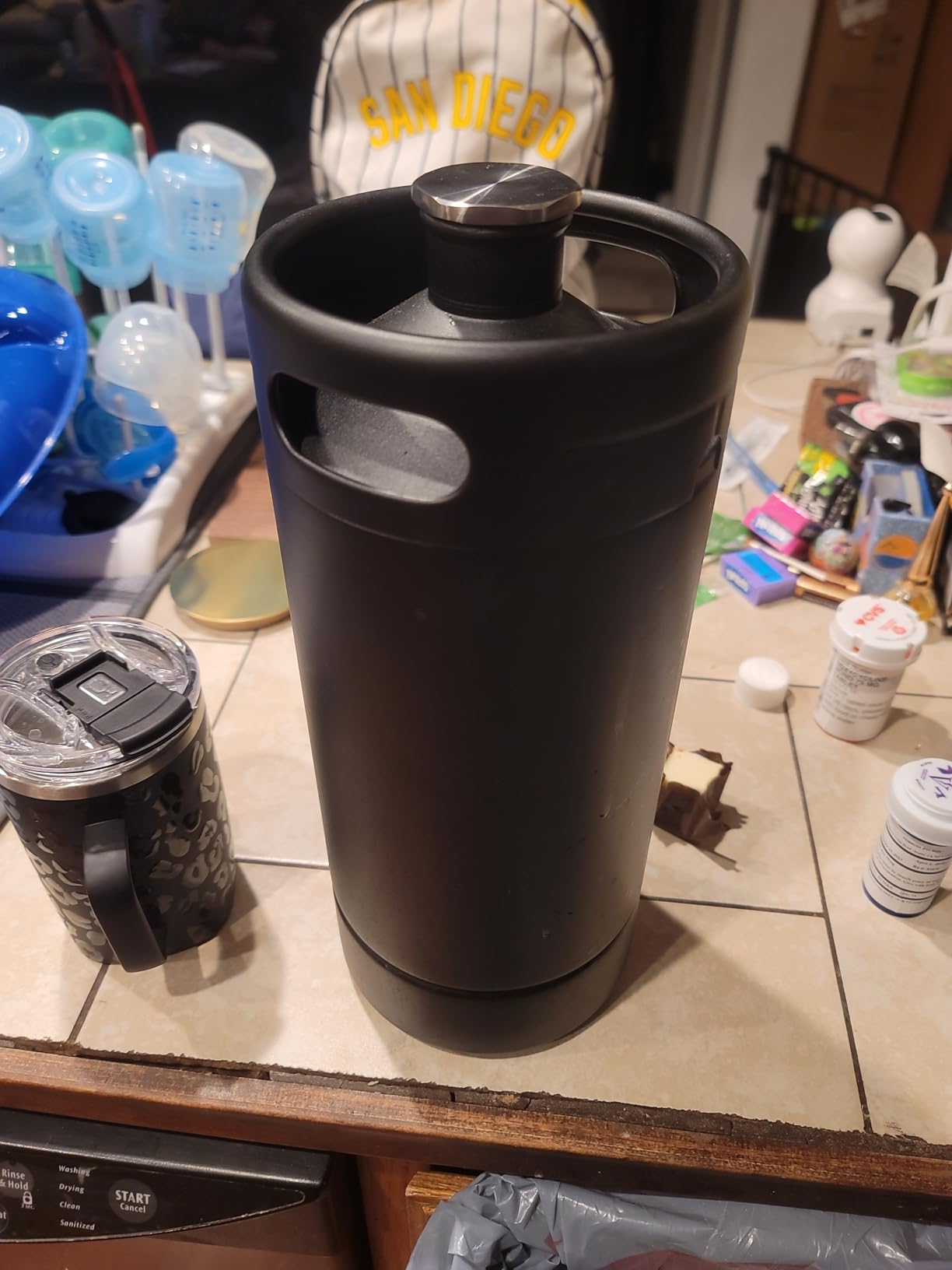
Doubling the capacity to 128 oz solves the single biggest complaint about portable dispensers, which is running dry halfway through an afternoon. This model also includes an insulated keg cooler jacket, something most competitors in this class make you buy separately.
At 128 oz you get roughly sixteen servings of cold brew at a one-to-one dilution, which lines up with what most people drink in a weekend. Reviewers highlight the jacket most, because three hours of cold retention at room temperature is enough for a party or a tailgate even though it is not enough for storage.
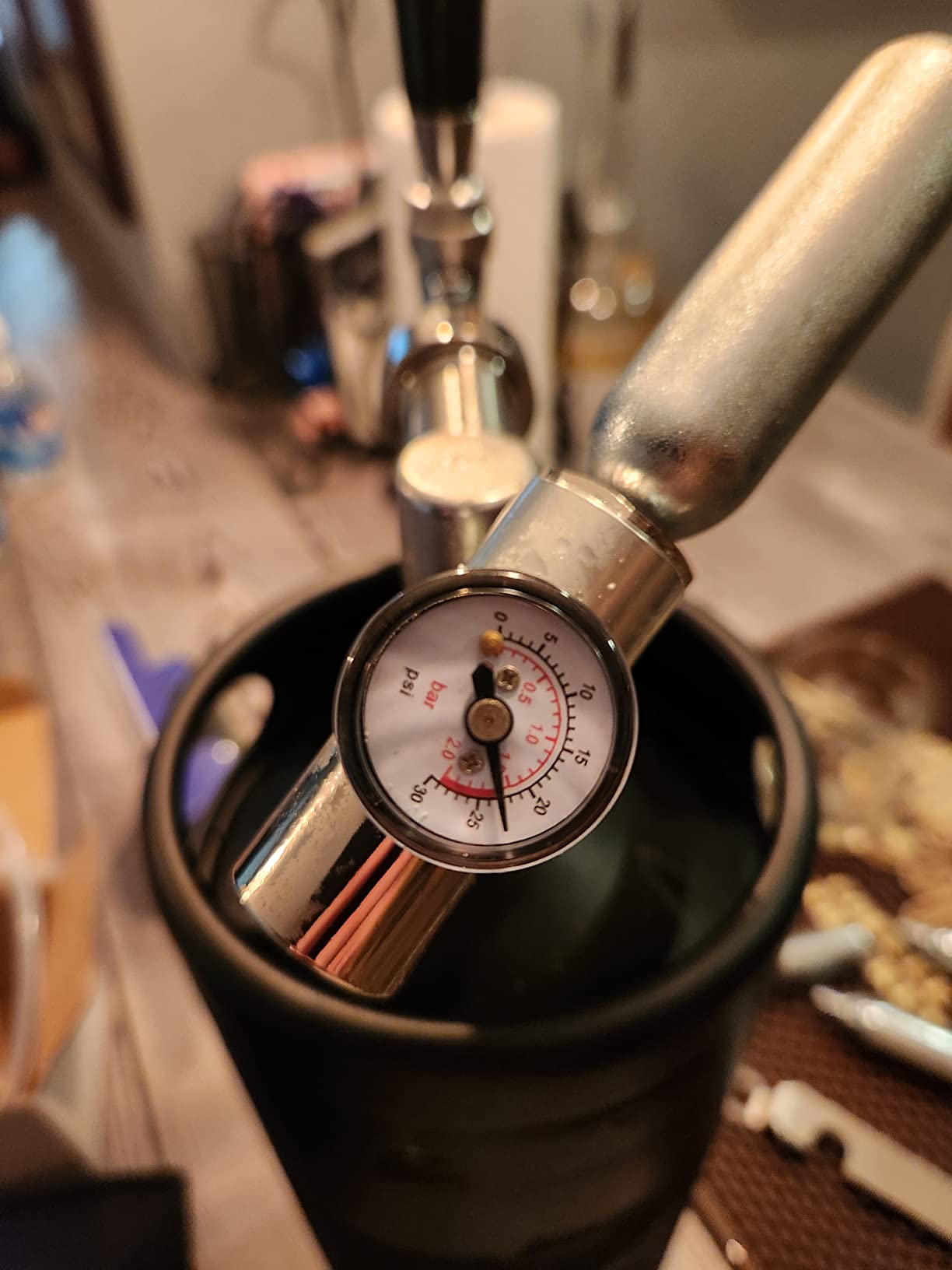
The regulator is the upgraded version, with more accurate pressure graduation than the older budget kits. That matters more for cold brew than for beer because coffee is more sensitive to over-carbonation, and a wandering regulator is the fastest route to a gassy, harsh pour.
It uses 16g CO2 cartridges with a 3/8 inch thread, and one capsule handles the full 128 oz. The food-grade stainless interior is listed specifically to preserve flavor, which matters more for a 24 hour steep than it does for a beer that is consumed in a sitting.
The tradeoff is height. At 18.3 inches tall, this is one of the few mini kegs that will not clear a low-profile fridge shelf, so measure before you commit.
When it beats the 64 oz option
Choose it when you brew in batches larger than a weekend or serve groups regularly. The doubled volume means fewer refills, fewer coupler connections and fewer chances of losing pressure mid-session. It also ranks well as a general home kegerator for entertaining because guests can pour themselves.
Because the jacket is included, this setup also works as a stand-alone dispenser at an event where electricity is not available, as long as the ambient temperature is reasonable.
When to skip it
If your fridge has a shallow shelf, the height is a dealbreaker with no workaround. It is also passive like its smaller sibling, so it cannot hold serving temperature on its own and you will still be relying on cold storage or the jacket.
The missing cartridge is the same caveat buyers flag most. Plan to have a sleeve of 16g capsules on hand, especially since each one only covers one full fill.
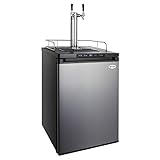
3. Kegco HBK309S-2 Home Brew Keg Dispenser: Best for Dual Tap Service
Kegco HBK309S-2 Home Brew Keg Dispenser, Stainless Steel, 2 Tap
25 x 24 x 33.35 inches
97 pounds
32 to 75 degree range
Holds three Cornelius kegs
Pros
- Precise digital temperature control
- Two taps let you serve two styles at once
- Deep Chill mode cooled a warm keg in about an hour
- Roomy interior holds three homebrew kegs
Cons
- Comes with homebrew ball lock couplers only
- Stock plastic taps gum up quickly and get replaced
- Heavy 97 pound cabinet with thin setup instructions
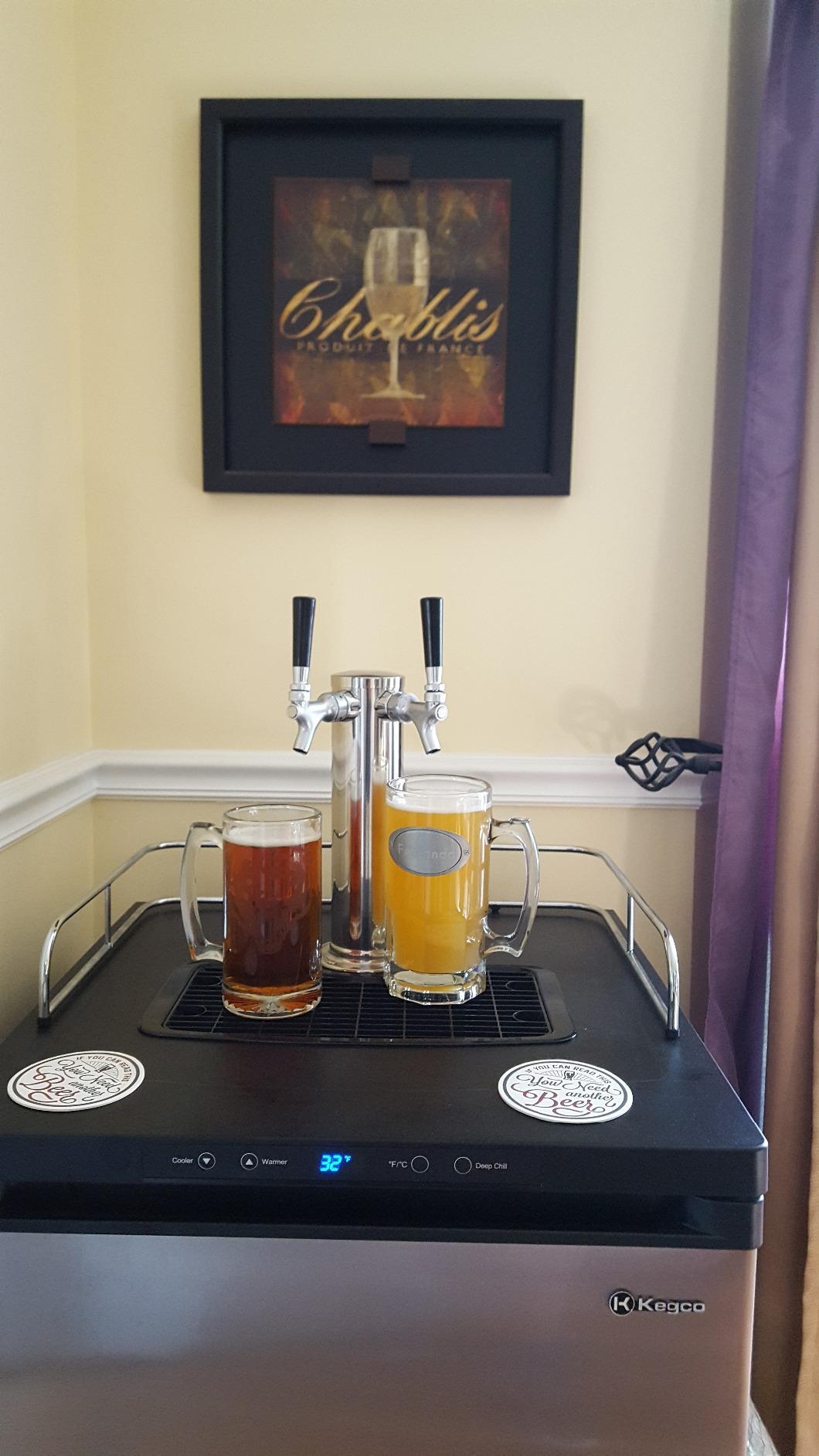
Two taps is the feature that separates this from the single-faucet Kegco, and for cold brew it opens up the most interesting option in the category: serving a still pour from one side and a nitrogen pour from the other in the same session.
The digital LED display adjusts in one-degree increments and can be switched between Fahrenheit and Celsius. The interior measures 33.25 inches high by 23.6 wide by 23.6 deep, which holds three Cornelius ball lock kegs with room to spare.
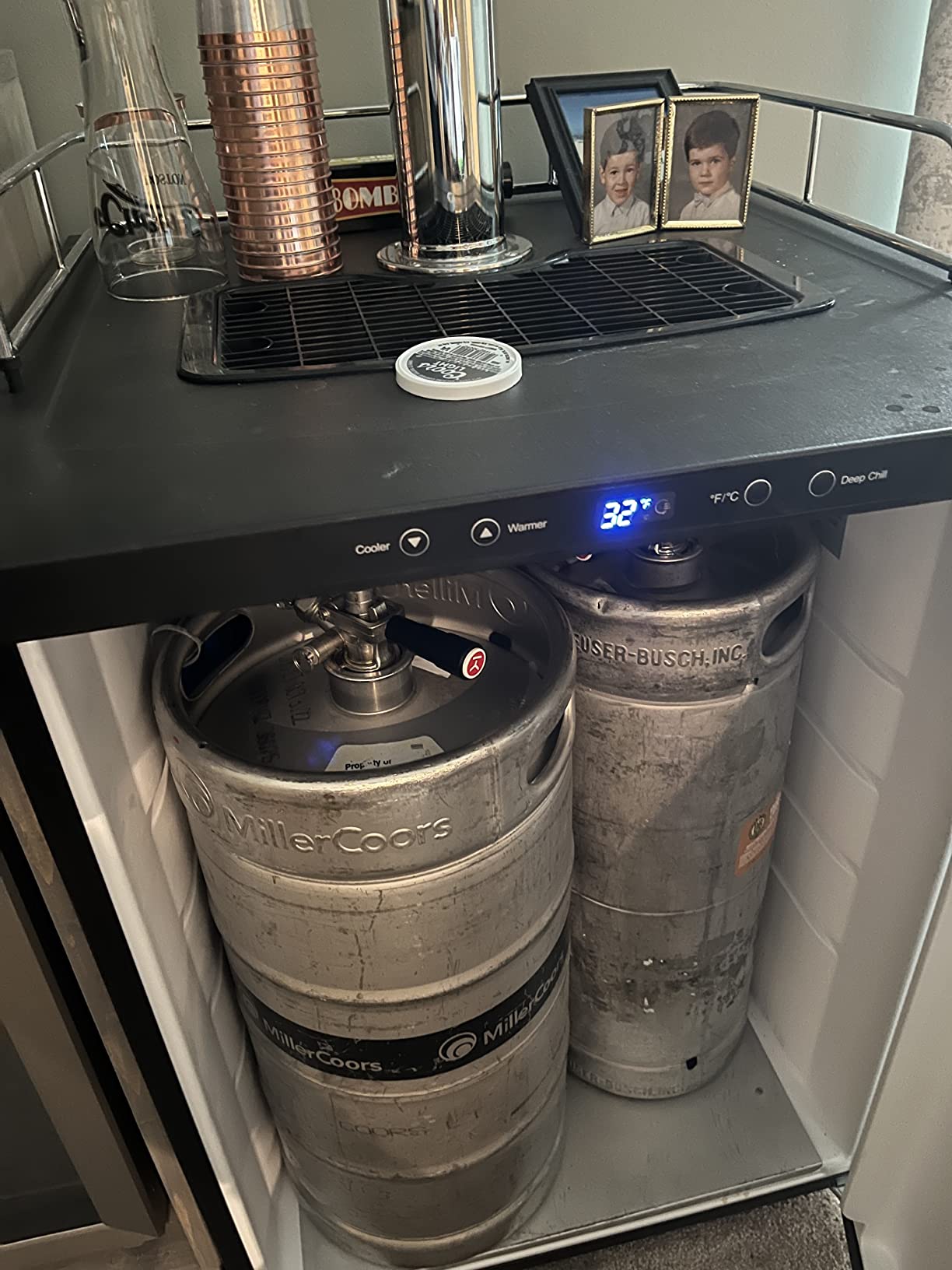
Owners who tracked temperature report a steady 34F in a 70 degree room, which is exactly the range you want for cold brew on tap. The operating range runs from 32F for dispensing up to 75F for fermentation, so the same cabinet doubles as a fermenter during brewing season.
Deep Chill runs the compressor continuously for up to 24 hours, which is how you drop a room temperature keg down before guests arrive. It is not gentle on electricity, but it takes about an hour to bring a warm keg to temperature according to owners.
A usable 5 lb CO2 canister is included, which covers the small stuff and gets you running without a separate purchase.
Why dual tap matters for cold brew drinkers
Two taps mean one cabinet can serve an unsweetened concentrate and a nitro batch side by side, or a strong batch and a mild batch. That matters because most households brew more than one recipe at a time, and swapping kegs mid-party is the fastest way to lose a guest.
It is also the natural upgrade path from a single faucet unit. If you are unsure whether you will ever make nitro, this cabinet gives you room to experiment without buying twice.
What you will need to buy anyway
The included couplers are ball lock homebrew style. If you plan to serve Sankey or other commercial formats, you need D system couplers, which are not in the box.
The stock plastic taps are the most common owner complaint. Reviewers report they gum up from sugars and residue within roughly 48 hours of use and get swapped for metal or stout style faucets. Budget for that as part of the build, not as a surprise.
At 97 pounds, plan the move with two people and check the route to wherever this will live.
4. SPT BD-0538 Mini Kegerator and Dispenser: Best Countertop Unit
SPT BD-0538 Mini Kegerator & Dispenser, Stainless Steel
16.3 x 10.71 x 16.93 inches
13.89 pounds
0.17 cubic feet
38 dB noise rating
Pros
- Compact 16 inch countertop footprint
- Three CO2 cartridges included in the box
- Removable drip tray and cleaning bottle included
- Adjustable LED temperature display
Cons
- Lowest rated model here at 3.5
- Thermoelectric cooling struggles to reach proper serving temperature
- Only fits 5 liter and 5L mini keg formats
- Very small 0.17 cubic foot capacity
This is the smallest self-chilling option here, and it is the only countertop model in the group that arrives with CO2 cartridges already included. That alone removes the most common complaint about portable dispensers.
The stainless housing looks better on a counter than most plastic cabinets, and the LED display with adjustable temperature is a genuine step up from unregulated mini kegs. The removable water drip tray makes cleanup fast.
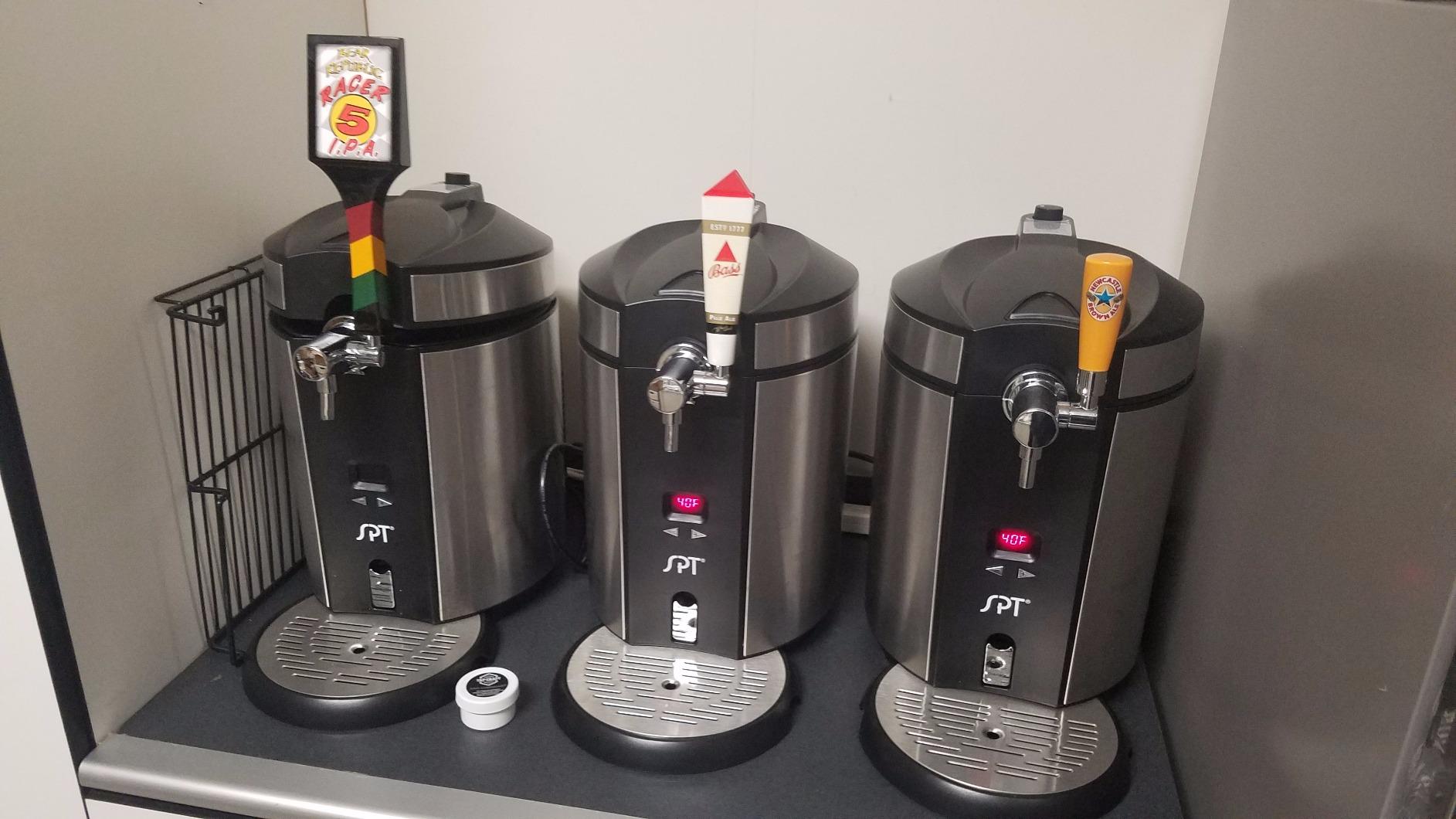
Be clear-eyed about the cooling method though. Thermoelectric modules cool a small box by moving heat outside, and the design targets small enclosures. Reviewers report it struggles to reach the sub-40F range that cold brew wants, which is the single biggest reason this model carries the lowest rating in the lineup.
It accepts standard 5 liter kegs and 5L Heineken mini kegs, so it is not a cabinet you will grow into. Rated 38 dB and 800 watts at 120 volts.
The included components list is genuinely complete: mini kegerator, three CO2 cartridges, two Heineken connectors, connector seals, tubing, a keg seal and a cleaning bottle.
Where it fits in a home setup
Small apartments and dorm-style kitchens where floor space is the constraint. At 16.3 inches tall and 13.89 pounds, it is the only self-chilling unit here you could actually move with one hand and set on a counter.
It is also a reasonable first taste-test appliance. If you are considering whether tap cold brew suits your routine, this is a low-commitment way to find out before buying a compressor cabinet.
Why the rating is low
Cooling performance is the driver. Around 21 percent of reviews are one star, and the recurring theme is a unit that will not hold a genuinely cold serving temperature for long enough to matter for coffee.
The 0.17 cubic foot capacity also caps batch size, and the keg format restriction means you cannot move up to a fifth barrel later without buying different hardware. For still cold brew served occasionally, it is usable. For a daily pour, look further down the list.
5. Kegco K309SS-1 Keg Dispenser: Best Premium Single-Tap Cabinet
Kegco K309SS-1 Keg Dispenser, Stainless Steel
23.69 x 23.69 x 33 inches
97 pounds
Holds three homebrew kegs
Includes 5 lb CO2 tank
Pros
- One owner reports seven years of continuous operation
- Complete dispense kit in the box including tank and dual gauge regulator
- Cold beer flowing within minutes of setup
- Stainless cabinet suits an indoor home bar
Cons
- Included regulator needs cleaning roughly annually
- Single faucet limits you to one style at a time
- Heavy 97 pound cabinet
This is the durability story on the list. The most striking review we found describes seven years of flawless continuous operation, which is the kind of long-term evidence most spec-sheet-driven roundups never surface.
What arrives in the box matters here. You get an empty 5 lb aluminum CO2 tank, a dual gauge regulator and ball lock couplers, so the cabinet is functional out of the box rather than being a shell you have to build out.
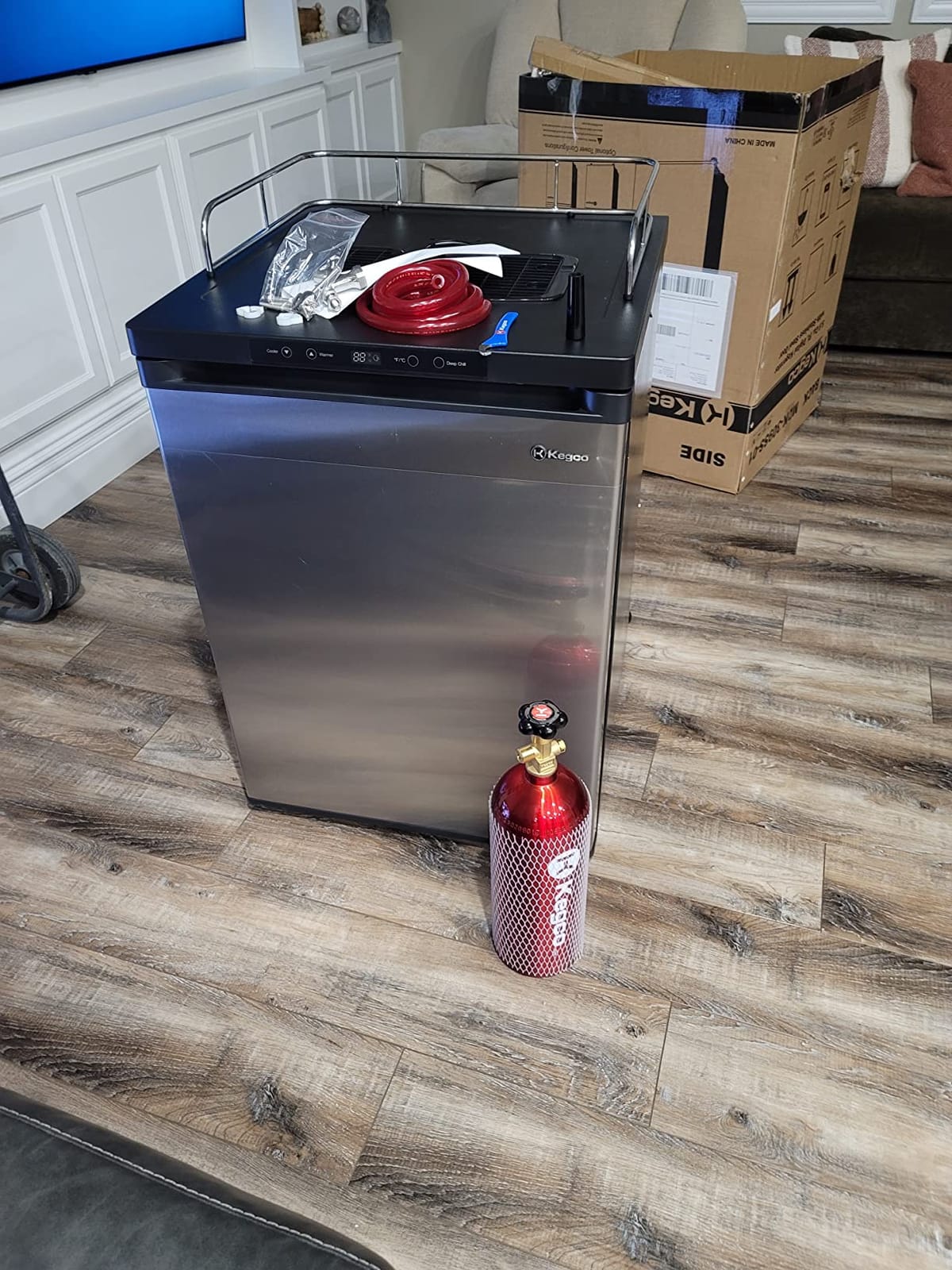
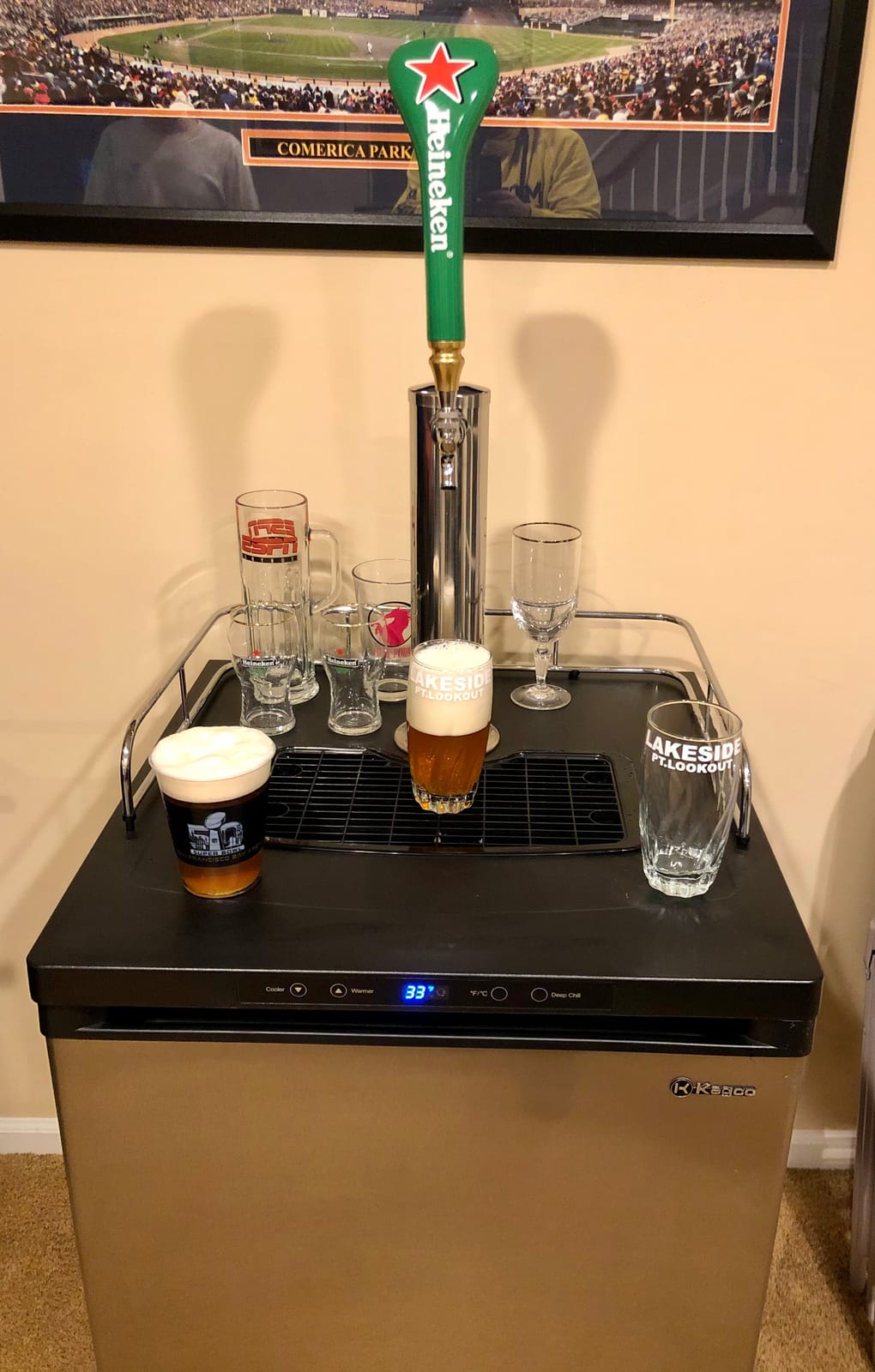
The interior stores three homebrew kegs and the manufacturer notes it can double as a fermentation chamber or a plain refrigerator. Digital temperature display with push button controls keeps the dial simple.
Deep chill functionality drops the internal keg temperature quickly, which is what you want when a room temperature keg goes in hours before serving.
Owners also like the pop-out drip tray, which is the part you will touch every single pour and the part most often skipped in cheaper cabinets.
Why this is the appliance to buy once
Its compressor sits among the coldest operating ranges of any kegerator we looked at, and cold brew wants cold. A narrow low temperature band means less ice-cold, undrinkable coffee sitting in the bottom of the keg.
The stainless cabinet is sized for an indoor home bar rather than a garage, and the pop-out tray makes it practical in a living space. If you intend to keep this for a decade, this is where the money belongs.
What you will need to add
The included regulator is serviceable but not immortal. Owners report needing to clean it or replace parts roughly once a year, which is normal for a mechanical dual gauge unit but worth knowing.
One faucet means one style at a time. If you want a still and a nitro side by side, the dual tap Kegco earlier in this list is the better fit.
At 97 pounds and 33 inches tall, this is a permanent piece of furniture. Measure the space and the doorway before ordering.
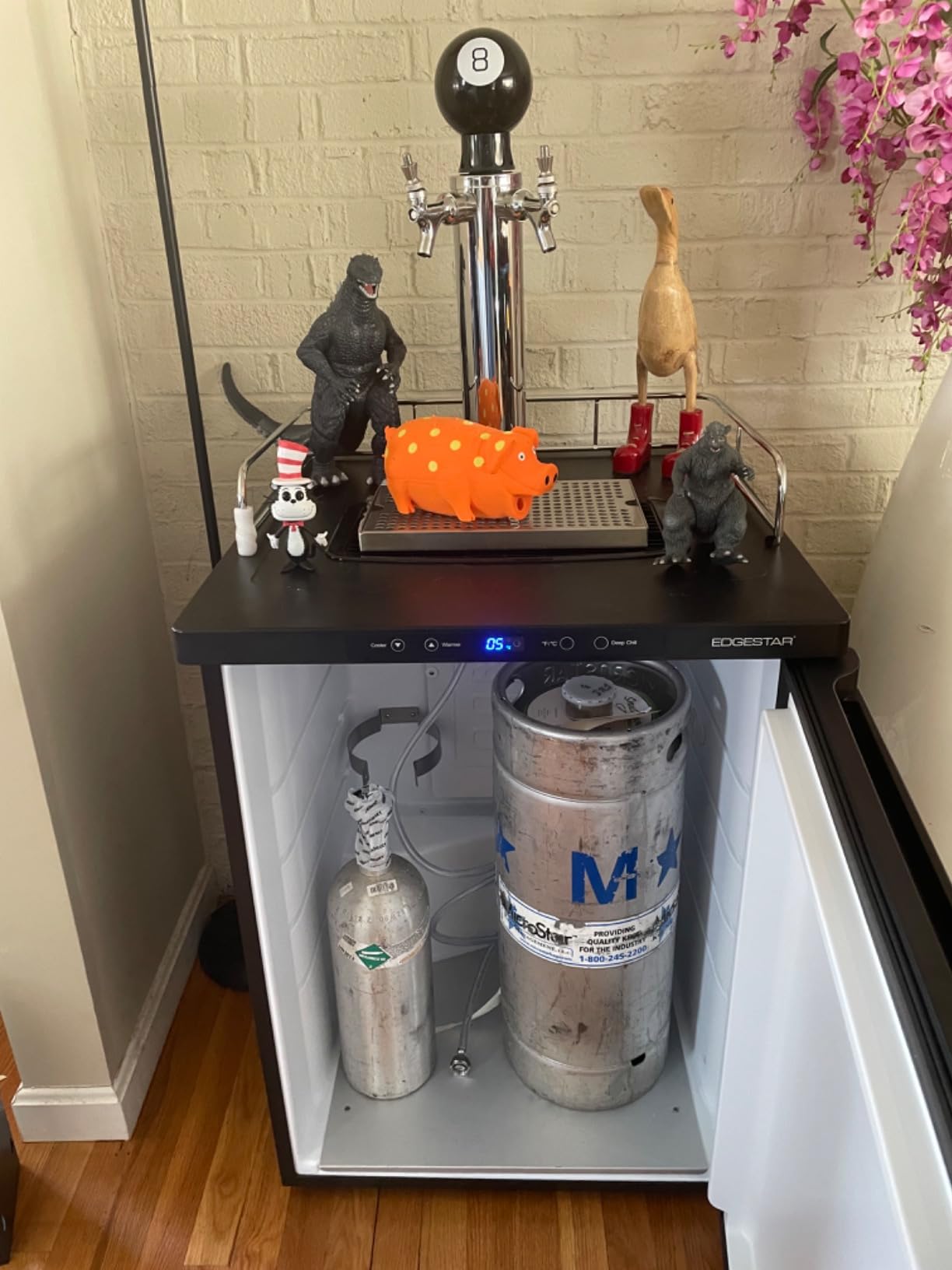
6. EdgeStar BR2001BL Ultra Low Temp Refrigerator: Best Value Build
EdgeStar BR2001BL Ultra Low Temp Refrigerator for Kegerator Conversion
4.9 cubic feet
25.69 x 20.19 x 35 inches
98 pounds
32 to mid 40s range
Pros
- One owner measured a steady 34F after three days on the coldest setting
- Runs very quietly
- Lowest cost route to full size keg storage here
- Pre-drilled tower and CO2 holes simplify conversion
Cons
- Refrigerator only so the dispense kit is a separate purchase
- The rear CO2 pass-through hole is narrow
- Wire shelves do not fit with two corny kegs loaded
This is a refrigerator, not a kegerator, and that distinction is the whole point. You get low temperature performance and full size keg storage at a fraction of what a finished cabinet costs, then add your own tap tower and gas hardware.
Temperature runs from the low 30s to the mid 40s with digital control, and one owner measured 34F after three days on the coldest setting. For cold brew that is exactly the band you are aiming for.
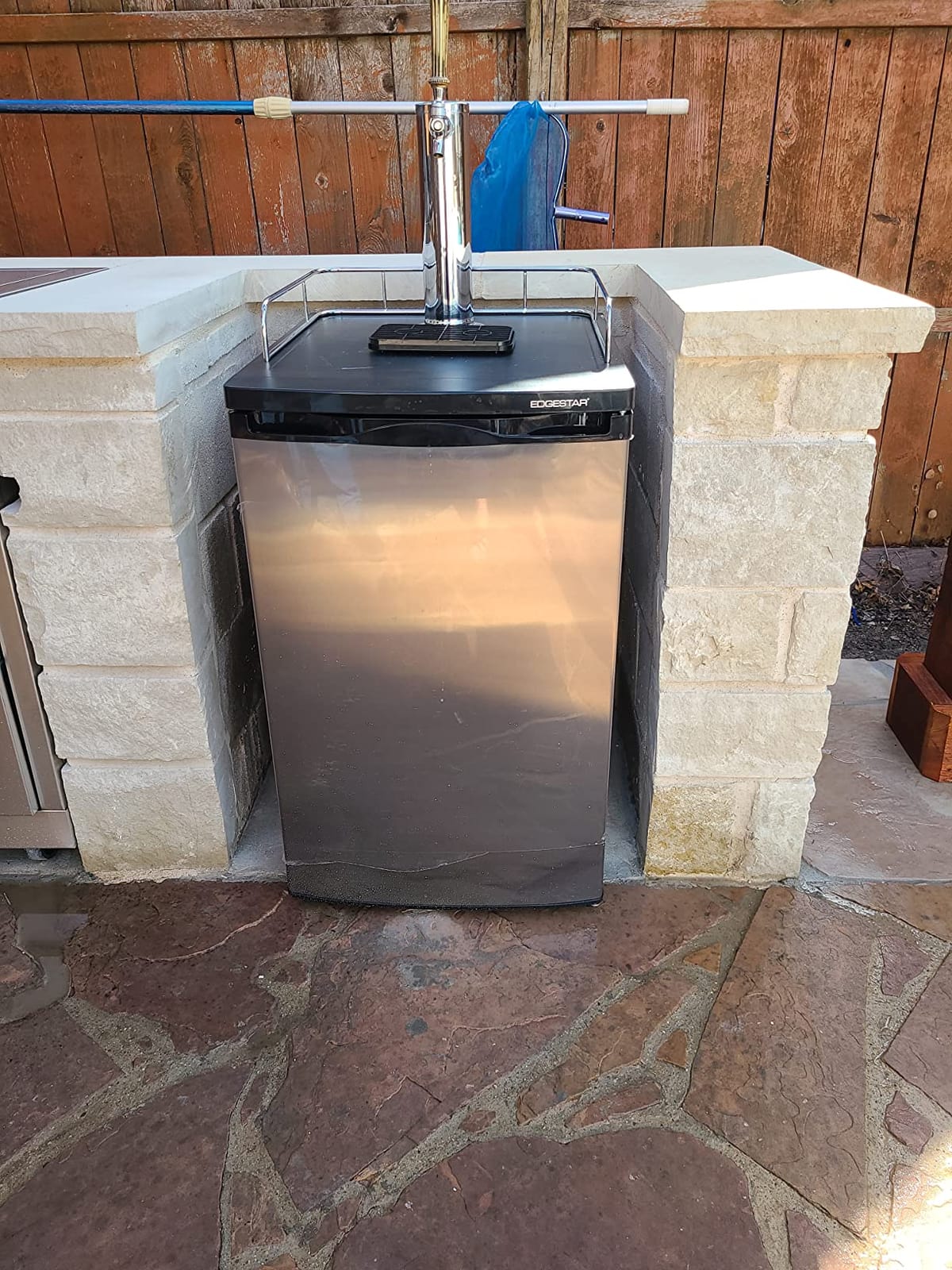
The conversion hardware is thoughtfully laid out. There is a pre-drilled rear opening for a CO2 line and a top knockout for a tap tower, plus an included tower hole cap so you can run it as a plain fridge before you commit.
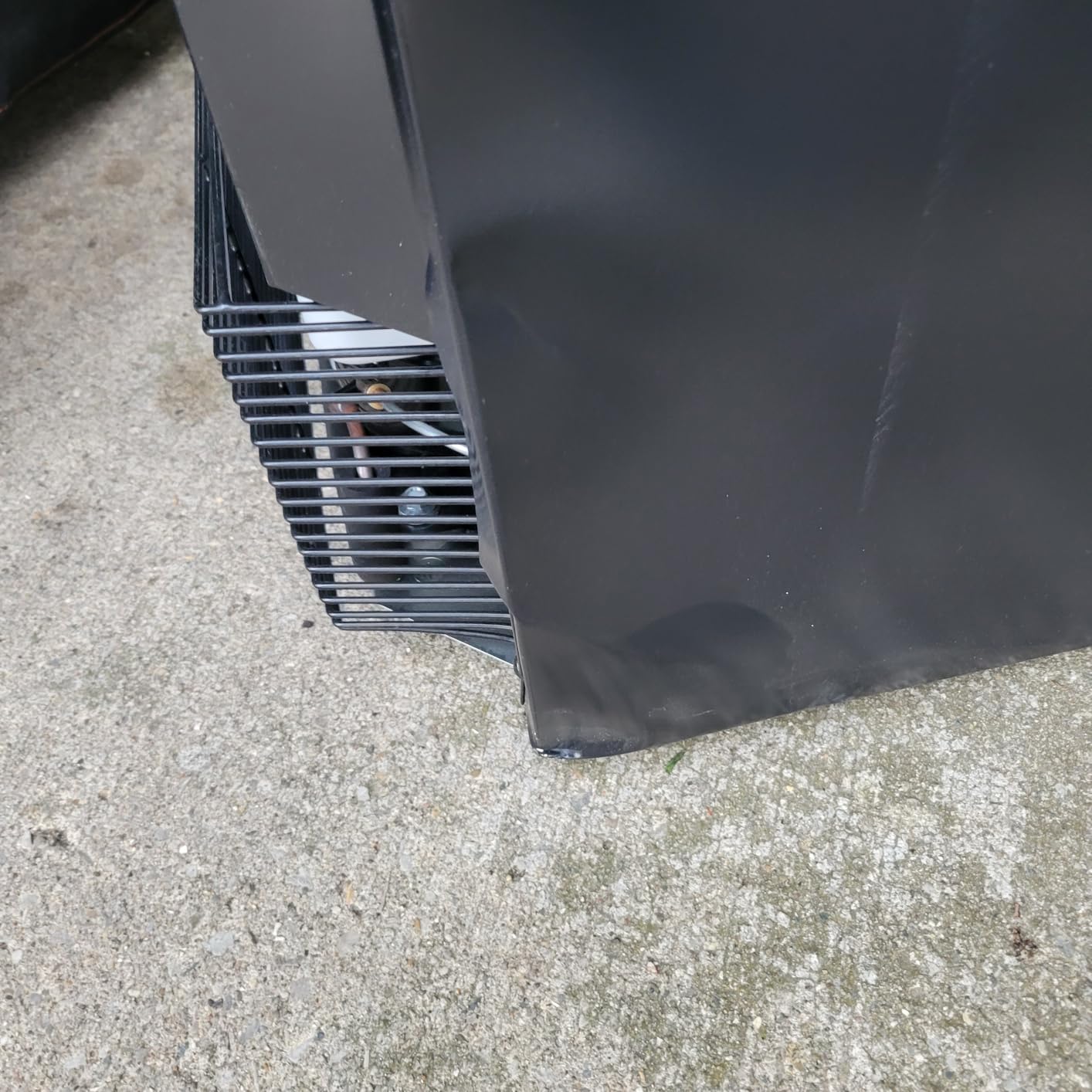
A rotary scroll compressor at 105 watts and 1.5 amps keeps it quiet, and casters make it easy to reposition. The door is reversible.
Keg compatibility is honest about its limits: it stores one full half barrel Sankey keg, and it does not support Coors, Miller rubberized or other oversized formats.
Why the DIY route is worth considering
Home brewing communities consistently recommend a DIY build over a retail unit when budget is the deciding factor, and this refrigerator is the middle path. You get a purpose-built low temperature compressor instead of converting a random old fridge, but you still choose and pay for the dispense side.
That flexibility has a real advantage: you can fit a stout creamer faucet for nitro now and a standard faucet later. You are not locked into whatever tap came in the box.
What to plan for
You will need a tap tower, beer lines, a regulator and couplers on top of the refrigerator. That kit is where most of the money goes, and it is also where you control quality.
Two build details catch people out. The rear CO2 pass-through is narrow and some owners have to remove the plastic gasket to run a line through it. And the included wire shelves do not fit once two corny kegs are loaded, so plan on a shelf solution.
Reported 90 day labor warranty and freestanding use only. Not Energy Star certified.
7. EdgeStar BR3002 24 Inch Kegerator Conversion Refrigerator: Best for Three Keg Capacity
EdgeStar BR3002 24 Inch Wide Kegerator Conversion Refrigerator for Full Size Kegs with Deep Chill Mode – Black
5.6 cubic feet
25.25 x 23.81 x 35.25 inches
140 pounds
32 to 50 degree range
Pros
- Genuinely fits three corny kegs including larger pinlock style
- Fits three sixth barrel or three Cornelius kegs
- Accurate and quiet compressor
- Includes guard rail
- drip tray
- casters and two shelves
Cons
- Some models will not hold below about 41F
- Not well insulated for a warm garage
- Included casters have the wrong thread size
- Dispense hardware must be sourced separately
Capacity is the argument here. Multiple owners confirm this cabinet genuinely fits three corny kegs, including larger pinlock style kegs, which is a claim plenty of smaller cabinets make and cannot honour.
At 5.6 cubic feet in a 24 inch wide body, it delivers capacity that premium built-ins advertise while costing a fraction as much. For a household that brews a full keg of cold brew on a weekend, that is the difference between refilling twice and refilling once.
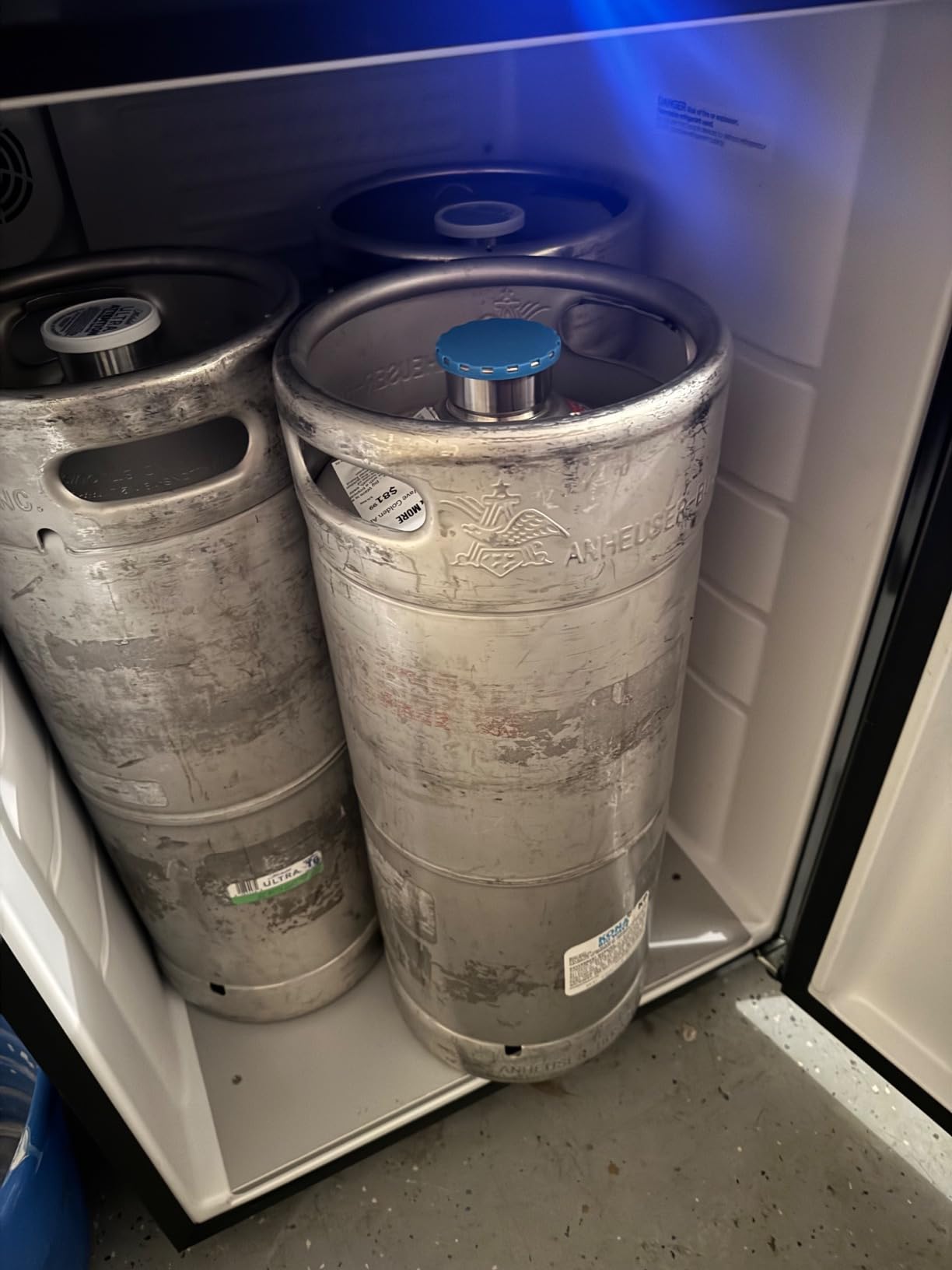
The control panel runs 32 to 50 degrees with a Deep Chill mode for rapidly chilling a new keg. Rear knockout allows an optional CO2 tank mount, and the listed energy consumption is 310 kWh annually, which is worth knowing if the unit lives somewhere you are paying to heat in winter.
It includes a guard rail, four mobility casters, a surface mount drip tray and two wire shelves. The reversible door helps with layout.
Warranty is listed as one year parts and 90 day labor.
Who should buy the bigger cabinet
People who batch brew. If you steep two gallons, filter it and want that entire run on tap for two weeks, three keg positions means one keg per recipe and no mid-week swapping.
The three sixth barrel or three Cornelius arrangement also suits a house that splits the same batch across two kegs and keeps a backup of a different recipe cold.
Where owners report disappointment
A minority of models will not hold temperature below roughly 41F even on Deep Chill, and that is a problem for cold brew specifically because the drink is not properly chilled. Check the thermostat with an external thermometer in the first week.
Insulation is modest. In a warm garage it will struggle to hold serving temperature even though the compressor works fine, so treat this as an indoor or basement unit.
The included casters have the wrong thread size according to several owners, with the rear rollers partly compensating. Packaging is also prone to arriving with dented panels, so inspect the cabinet before accepting.
8. VEVOR BF152-2 Dual Tap Kegerator: Best Complete First Kit
VEVOR Beer Kegerator, Dual Tap Commercial Draft Beer Dispenser for D system, Full Size Keg Refrigerator with 5lbs CO2 Tank, Hold 2 Sixth / 2 Ball lock keg, Black
21.7 x 20.7 x 33.2 inches
102.6 pounds
32 to 50 degree knob control
Holds two sixth barrel kegs
Pros
- Comes fully kitted with tower
- beer line
- CO2 tank
- regulator and install kit
- Extra O-rings included proved useful when a seal leaked
- Lockable front casters make it easy to move
- Compact enough for a home bar
Cons
- Some two sixth keg claims fall short
- Several owners report foam-only pours from an inconsistent regulator
- Arrives prone to dents and detached door panels
- Taps need frequent cleaning
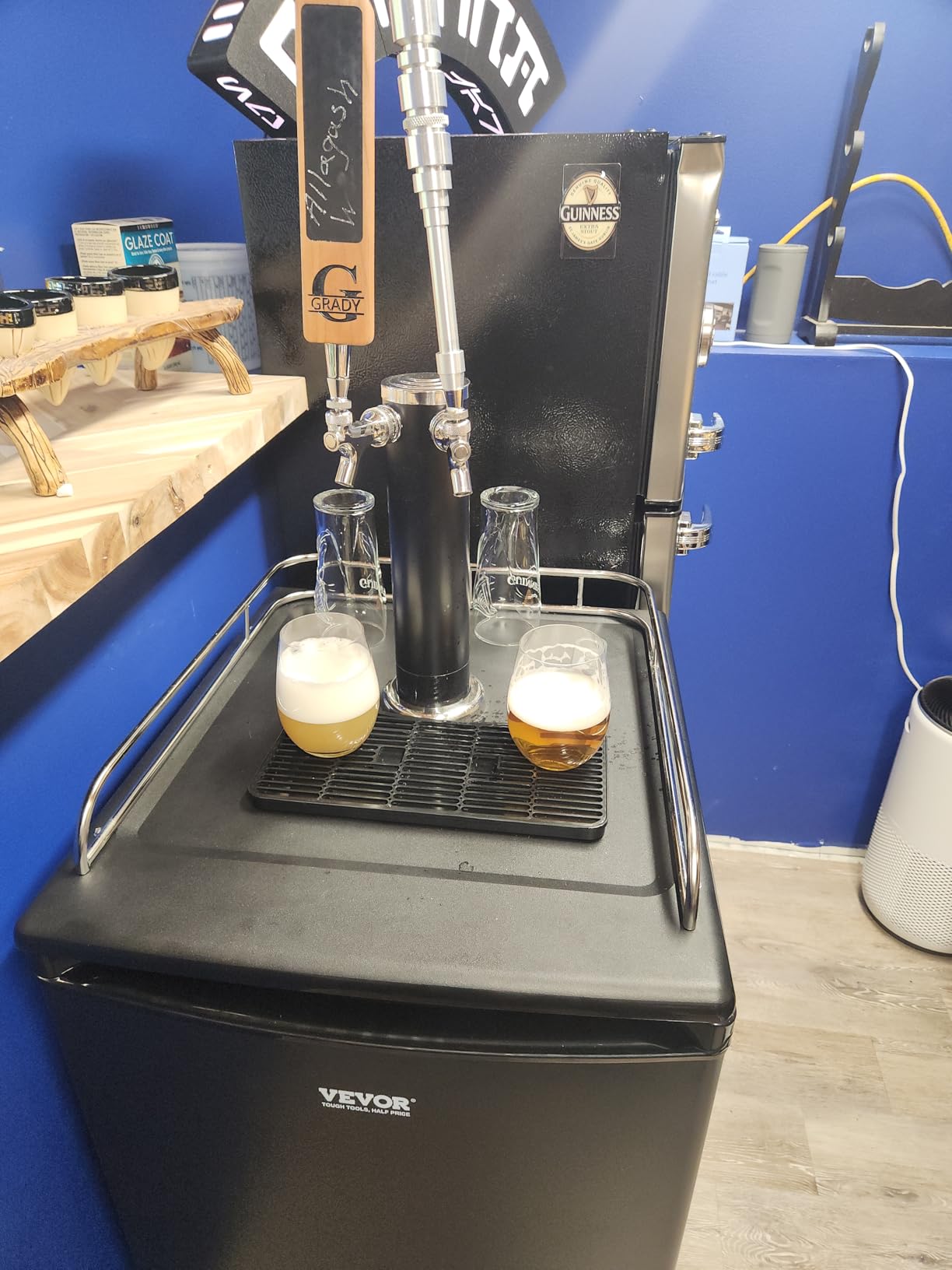
The strongest argument for this model is completeness. The box contains the kegerator, a 5 lb CO2 tank, a regulator, a wrench, two shelves and an install kit, so there is nothing to buy before your first pour.
It ranks first in its Appliances category, and for the right buyer that matters: this is the model most likely to be bought by someone who has never tapped a keg before and does not want to research fittings first.
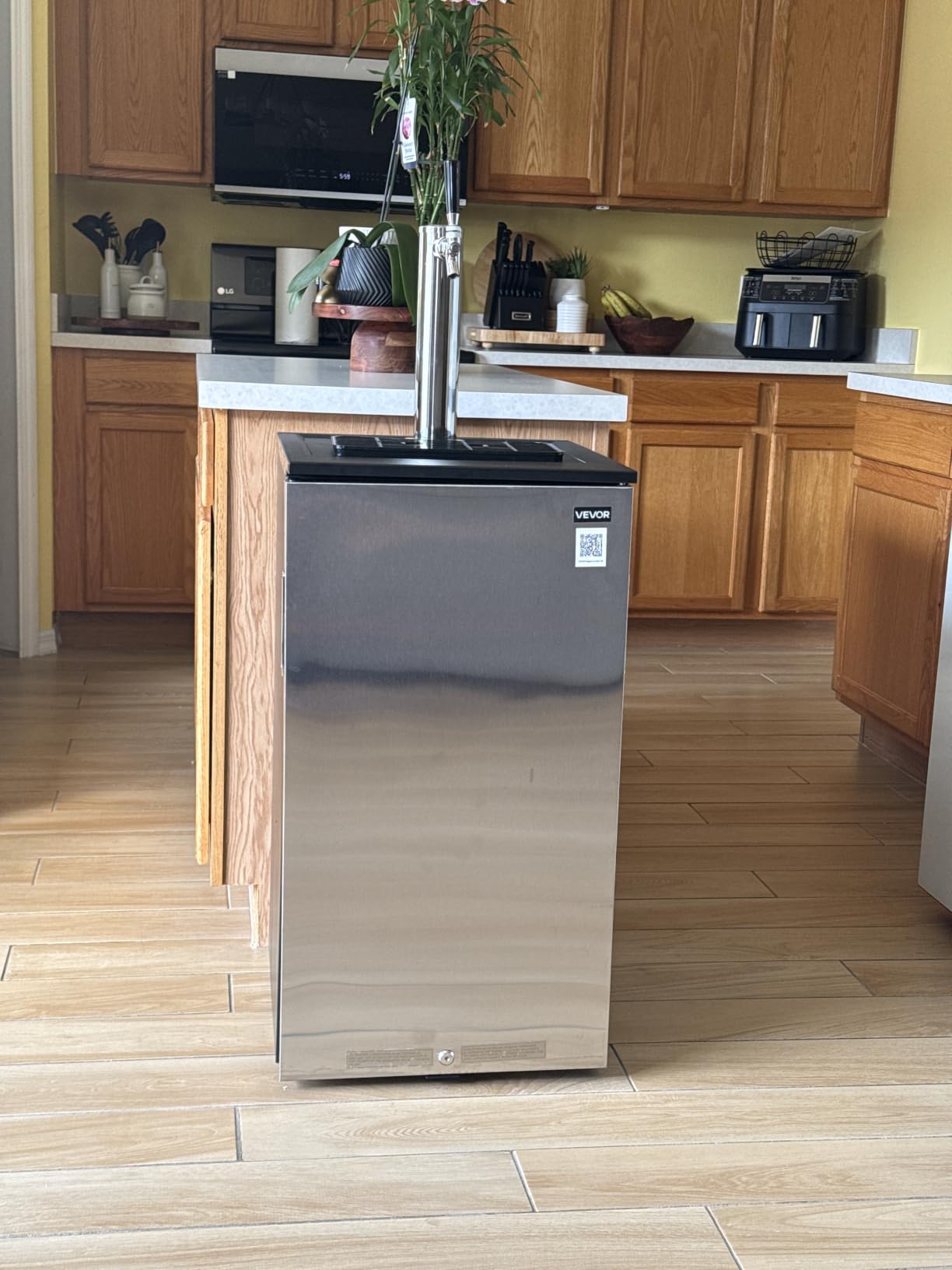
Temperature control is a knob rather than a digital panel, running 32 to 50 degrees with automatic restore of the set point after a power outage. Auto-defrost is included, and the extended 9.8 foot beer line is long enough to manage foam properly.
The external CO2 tank bracket frees interior space, and the unit accepts full size, quarter and sixth barrel kegs. Four wheels with lockable front casters mean you can move it outside for a gathering.
Two shelves let it double as a refrigerator when it is not tapping.
Why the kit matters more than it sounds
First-time buyers lose the most time to mismatched hardware. A coupler that does not match the keg format, a regulator without a gauge, a missing wrench. Having all of it in one box removes the most common reason a first setup goes wrong.
The extra O-rings are a small touch that saved at least one owner when a keg leaked at the seal. Cheap insurance at no cost to you.
The honest catch
The 3.8 rating is the lowest of the refrigerators in this group. Owners frequently report foam-only pours and describe the regulator as inconsistent, which is the exact failure mode that makes a cold brew pour undrinkable rather than merely disappointing.
Capacity claims also fall short in practice for some owners, with two sixth barrel kegs not always fitting on standard keg dimensions. Arrives prone to cosmetic dents and detached door panels, so inspect on arrival.
If you want the completeness but not the uncertainty, the Kegco single tap cabinet further up this list has a stronger long-term record.
9. VEVOR BF92 Single Tap Kegerator: Best for Narrow Spaces
VEVOR Beer Kegerator, Single Tap Commercial Draft Beer Dispenser for D system, Refrigerator With Shelves, Hold 1 Sixth Keg, 2.5lbs CO2 Tank, 92L
17.72 x 19.09 x 48.43 inches
63.9 pounds
32 to 46 degree digital control
Holds one sixth keg
Pros
- One owner measured a steady 37 to 38F on the coldest setting
- Quiet compressor
- Arrives complete with tower
- coupler
- clamps and a CO2 tank
- Converts to a beverage cooler with shelves
Cons
- Tall slim cabinet is much smaller inside than expected
- Cannot accommodate a quarter barrel despite expectations
- Some units dispensed foam only on first pulls
- Tap is not refrigerated
This is a vertical cabinet with a narrow footprint, and that shape is the reason to consider it. At 17.72 by 19.09 inches across it fits corners and alcoves where a 24 inch wide box simply will not go.
The digital control runs 32F to 46F with a push-button interface, auto defrost and fan-forced circulation. Memory recall restores settings after power interruptions, which is a small courtesy in a garage or basement where power flickers.
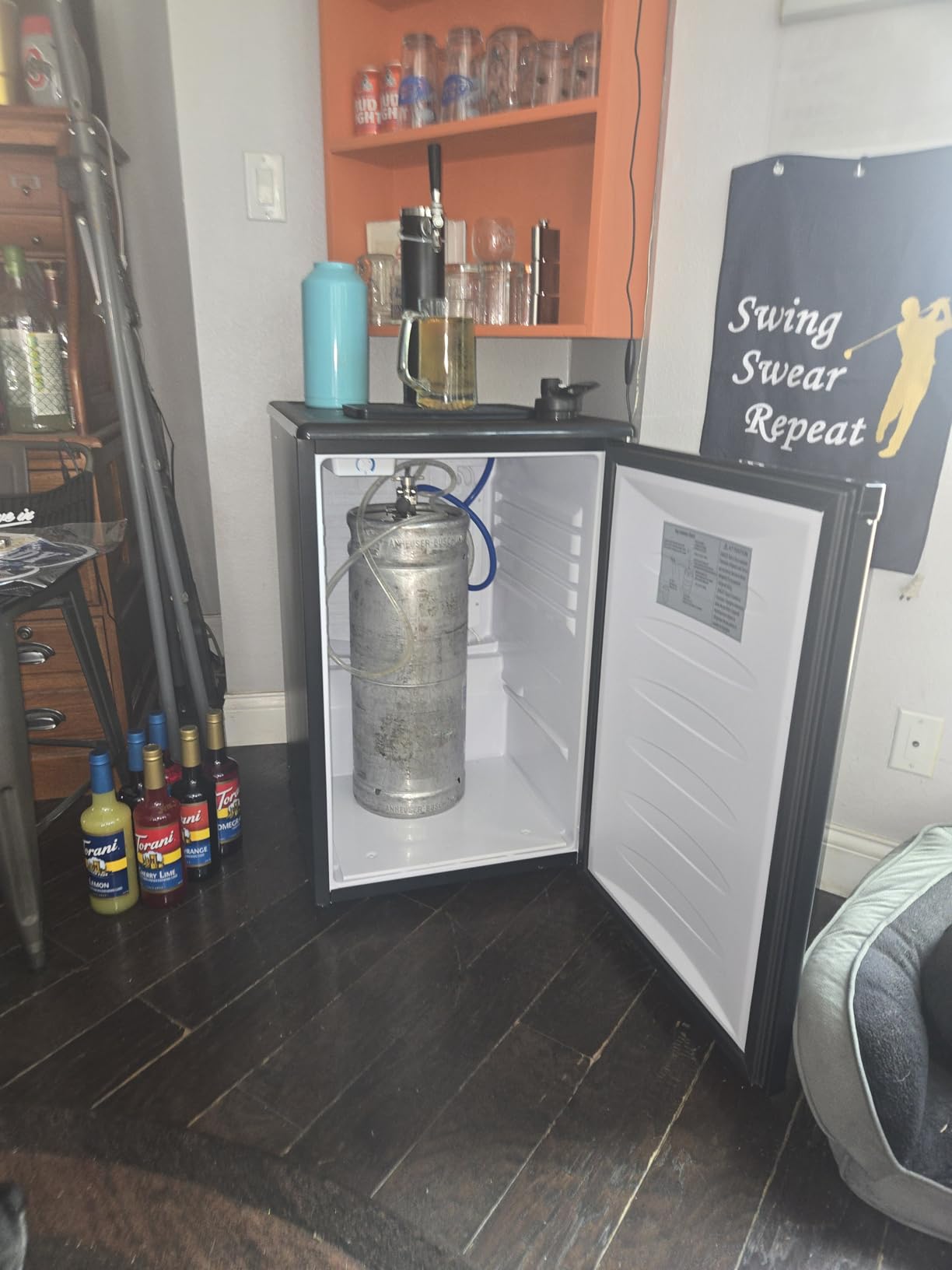
Owners report a quiet compressor and one measured a steady 37 to 38F on the coldest setting, which is a good cold brew number. Included components are a faucet, handle, single tap tower, two clamps, a dual gauge single valve regulator, a D type coupler and a 2.5 lb CO2 tank.
Interior lighting is noted as a genuine plus, since you will be checking the level of a clear keg more often than you think.
It weighs 63.9 pounds, noticeably lighter than the 97 to 140 pound cabinets, which makes it the easiest full unit in this group to reposition.
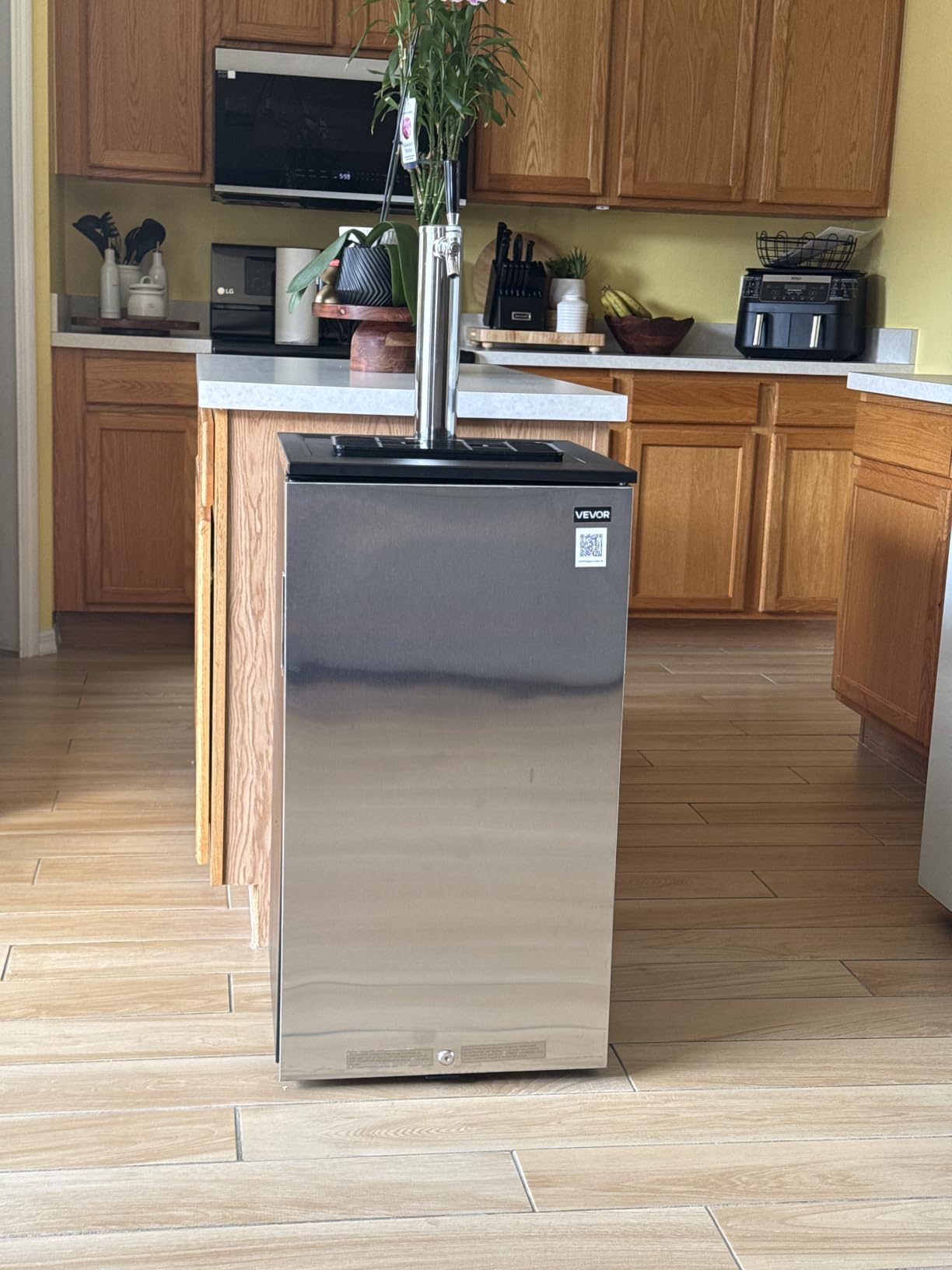
When a narrow footprint is the deciding factor
If you have measured a dedicated nook rather than an open floor area, this shape solves a real problem. A home bar built into a corner, a basement alcove, or a workshop with one usable wall all fit a 48 inch tall slim unit far better than a squat 24 inch wide cabinet.
At one sixth keg capacity it suits a single recipe on rotation, which is honestly how most home cold brew drinkers operate anyway.
The mismatch to plan around
The listed 92 liter capacity does not translate to a large interior. Several owners report the cabinet is much smaller than expected, and it cannot take a quarter barrel despite some assumptions. If you want more than one keg, choose the EdgeStar BR3002 instead.
Some units dispensed foam only on the first pulls, and the tap itself is not refrigerated. Build quality is described as cheap by some reviewers, so inspect on arrival and expect to spend a little time settling the regulator.
10. GANCOWISE 270oz Mini Keg Growler: Best for Cider, Mead and Hosting
GANCOWISE 270OZ Mini Keg Growler, Pressurized Home Dispenser System
270 oz capacity
14.92 x 11.26 x 7.83 inches
7.59 pounds
3/8 inch CO2 thread
Pros
- Highest average rating of the portable dispensers
- Used successfully to force carbonate hard cider
- Adjustable faucet gives smooth pours with minimal foam
- Does not leak and uses cartridges efficiently
Cons
- Not actively chilled so it relies on a cold environment
- The CO2 cartridge itself can leak after use
- Small 2 gallon capacity compared with cabinets
At 270 oz this is the largest portable vessel here, holding about sixteen sixteen-ounce cups per fill. That makes it the pick for a gathering rather than a personal daily drink.
The adjustable self-closing faucet is the feature owners praise most. It lets you control flow rate, which directly limits foaming, and for cold brew that is the difference between a clean head and a mess.
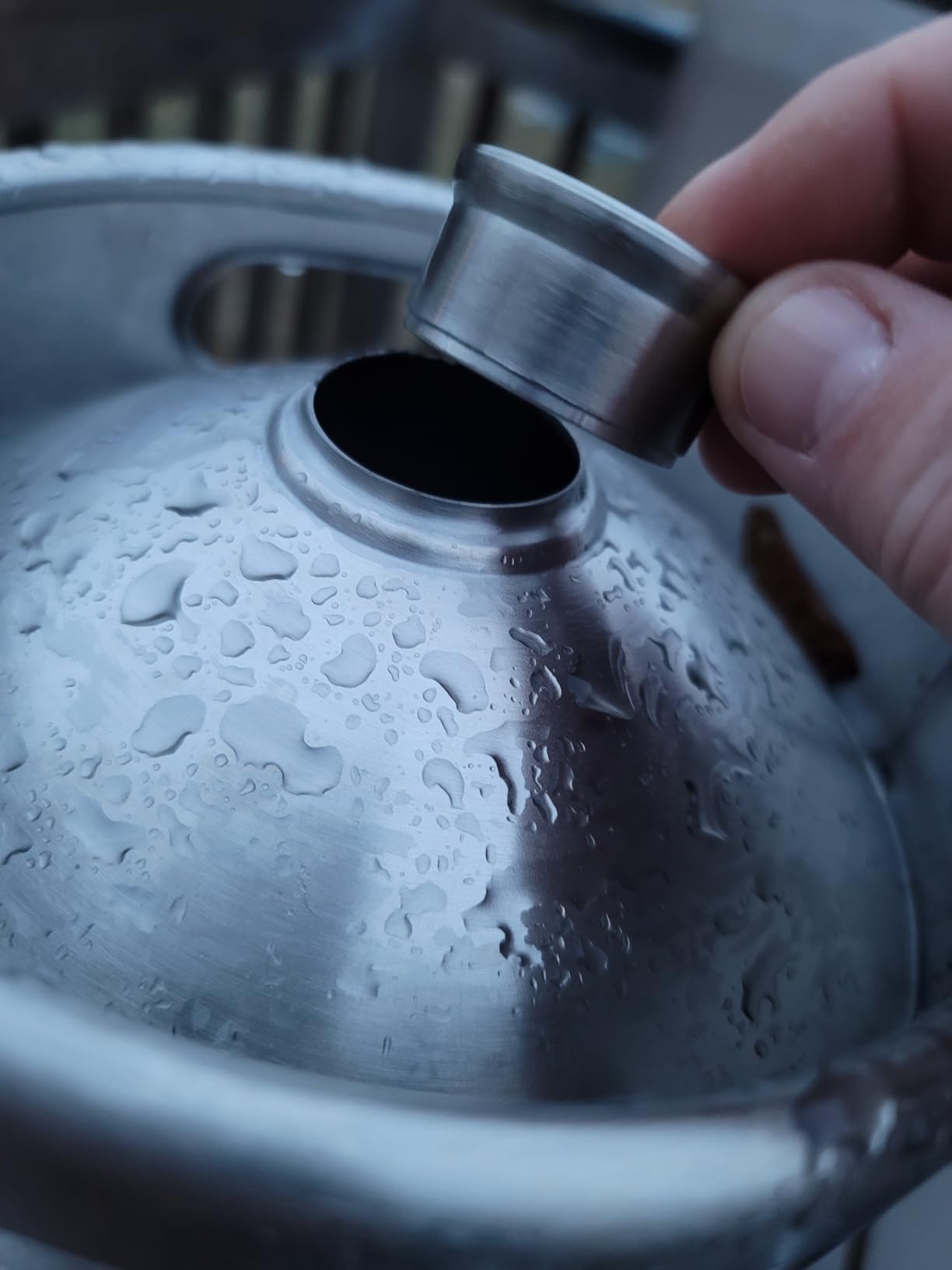
Homebrewers report using this unit to force carbonate hard cider at roughly three cartridges per two gallons, which tells you the regulator and seal hold pressure well under sustained load. That is a harder test than a single afternoon of beer.
The stainless mini keg holds vacuum pressure for months, and the regulator carries a gauge on a 3/8 inch thread for 16g cartridges.
It is backed by a one year warranty with support responding within 12 hours, which is better after-sales coverage than most of the cabinets in this group.
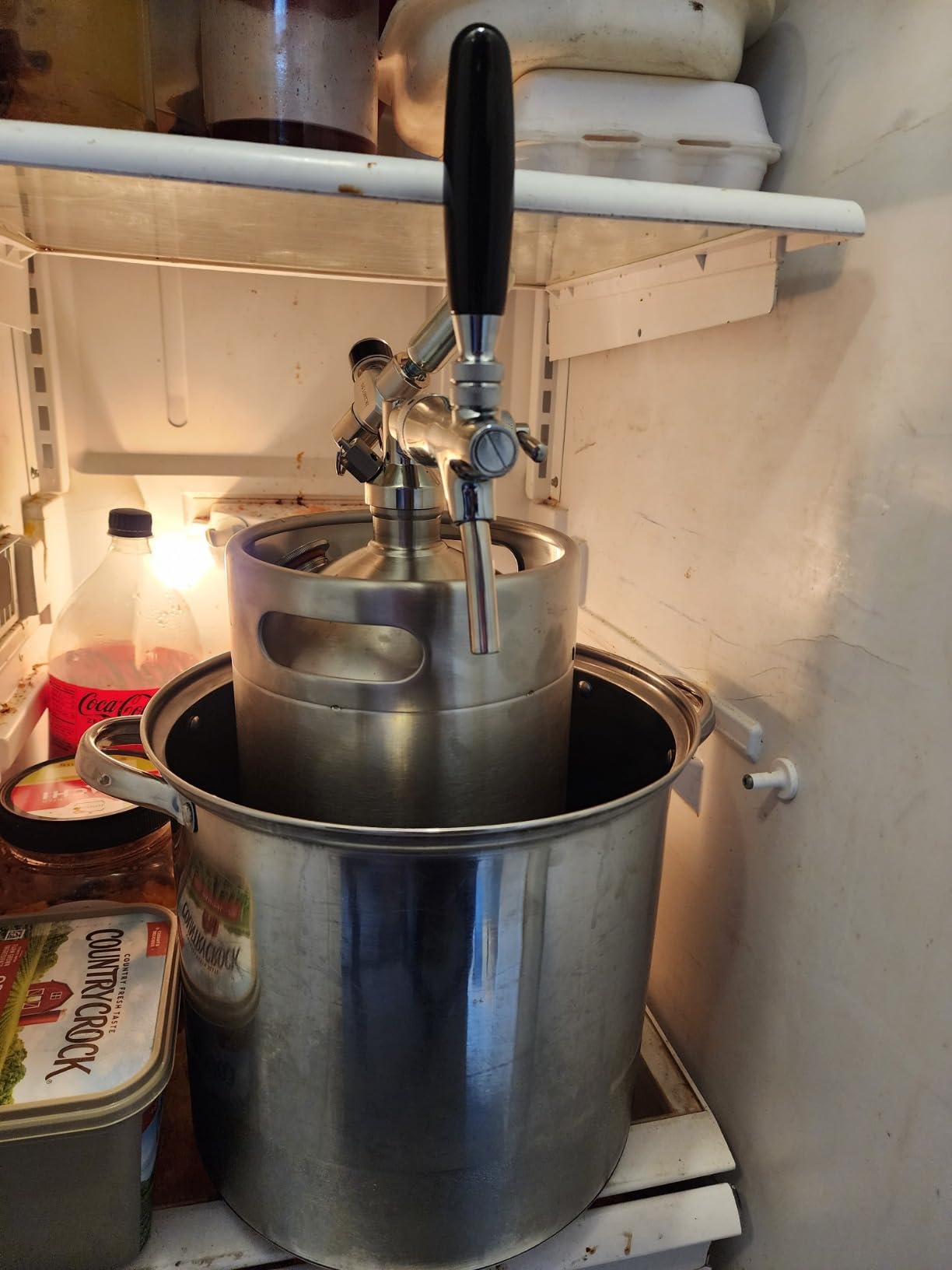
Why this suits more than coffee
Cold brew is not the only thing worth putting on tap. Homebrew soda, cold brew tea, kombucha and hard cider all work in this format, and the force carbonation reports suggest the hardware handles the job properly.
The larger capacity means fewer cartridge changes during an event. At 270 oz you are looking at far fewer refills than a 64 oz canister during a party.
Where the limits are
It is not actively chilled, so it needs cold storage or a cooler to hold serving temperature. In warm conditions the cold window shrinks quickly.
Cartridges can leak after use, which is a common complaint across this whole portable category rather than something unique to this model. One isolated report involved the neck separating on first fill, which was resolved by a fast replacement under warranty.
Choose it for gatherings and variety. For a daily single keg on your counter, a refrigerated cabinet is the better tool.
11. Coldbreak ColdOne Non-Electric Portable Kegerator: Best for Off-Grid and Events
Coldbreak ColdOne Non-Electric Portable Kegerator, 2 Gallon Refillable Keg for Craft Beverages, CO2 Regulator with Stainless Steel Parts, Easy to Fill and Clean, Cold for 5 Days, Made in USA
2 gallon refillable keg
17 x 20 x 30 inches
37 pounds
Cold for up to 5 days
Pros
- No electricity required so it works anywhere
- Keeps drinks cold for up to five days
- Hand-built in Michigan with stainless steel parts
- Simple regulator that attaches directly to the tower
Cons
- Two gallon capacity limits batch size
- Not actively chilled so warm conditions shorten the cold window
- Small review base so long-term durability is less documented
This is the only model here that needs no power at all. Passive cooling holds beverages cold for up to five days, which makes it the answer for tailgates, camping, outdoor events and any location where running a compressor is simply not an option.
The build quality is a step above the plastic portable dispensers. It is hand-built in Michigan using professional grade stainless steel parts, and that construction is why it costs more than the other canister options despite holding less. Buyers report no electricity required and multi-day cold retention as the deciding factors.
The gas system is refreshingly simple. A mini CO2 regulator attaches directly to the tower with no manifold, and each 74g cartridge pressurises and dispenses three to four kegs. That is a much better cartridge economy than the 16g capsules used by the smaller canisters on this list.
The 2 gallon keg is refillable and designed for easy filling and cleaning, which matters more than it sounds because coffee residue is harder to shift than beer sediment.
At 37 pounds and 17 by 20 by 30 inches, it is genuinely portable rather than portable in theory.
Where it earns its place
Outdoor entertaining is the clear use. Bring it to the barbecue, the tailgate or the campsite and pour cold brew or cider without needing a single outlet. Five days of cold retention covers most multi-day trips.
It also works as a second vessel indoors. Many owners run a main cabinet at home and use this for events, which spreads the capital cost across two use cases.
What the small review base means
There are only 16 reviews on this listing, with 87 percent five star. The sentiment is strongly positive but the sample is small, so long-term durability is not well documented and independent service data is limited.
Two gallons is the practical limit. If you brew in larger batches, this is a companion rather than a primary system.
The honest caveat: passive cooling works in mild conditions. Warm ambient temperatures shorten the cold window, so keep it shaded and pre-chilled.
12. MRbrew 128oz Mini Keg Growler System: Budget Pick
MRbrew 128oz Mini Keg Growler Mini Kegerator Draft Beer Dispenser System
128 oz capacity
5.3 x 5.3 x 13 inches
2.26 kg
Pressure tested to 150 PSI
Pros
- Lowest cost model in the lineup
- Self-closing spring loaded faucet seals tightly without leaks
- Accurate gauge and adjustment dial on the regulator
- Includes cleaning brushes
- tubing and a spear
Cons
- CO2 cartridge not included and must be the threaded type
- Setup is fiddly enough that some owners return the unit
- Modest capacity for large gatherings
- Not actively chilled
This is the cheapest way into a properly sealed pressurized pour, and it is the one most people on a tight budget should actually buy. The build quality at this entry point surprises people more than the spec sheet suggests.
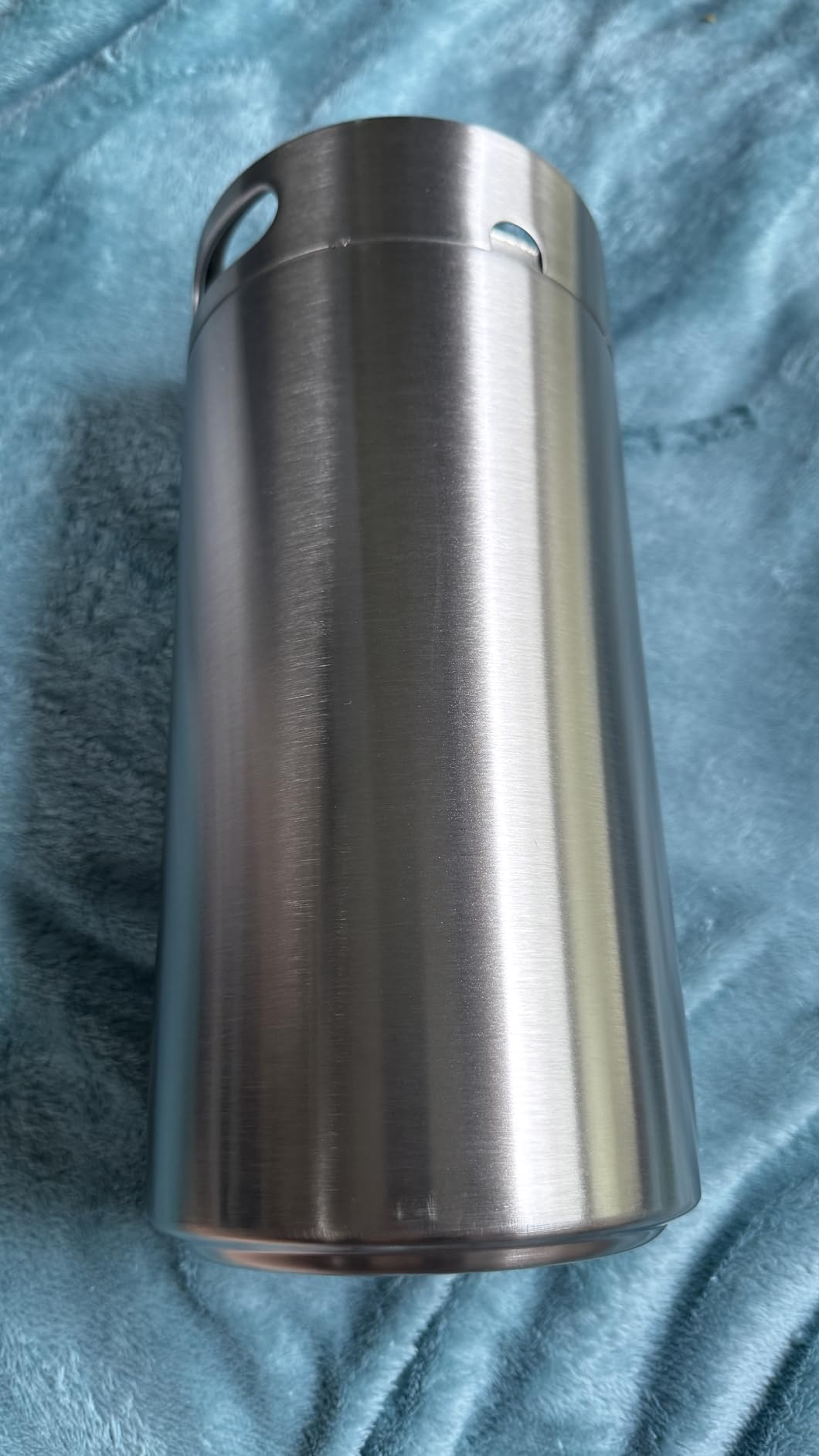
The body is triple-polished 304 stainless steel and the unit is pressure tested to 150 PSI, well above the 80 PSI industry standard. Double-layered vacuum insulation is claimed to hold drinks cold for over 12 hours.
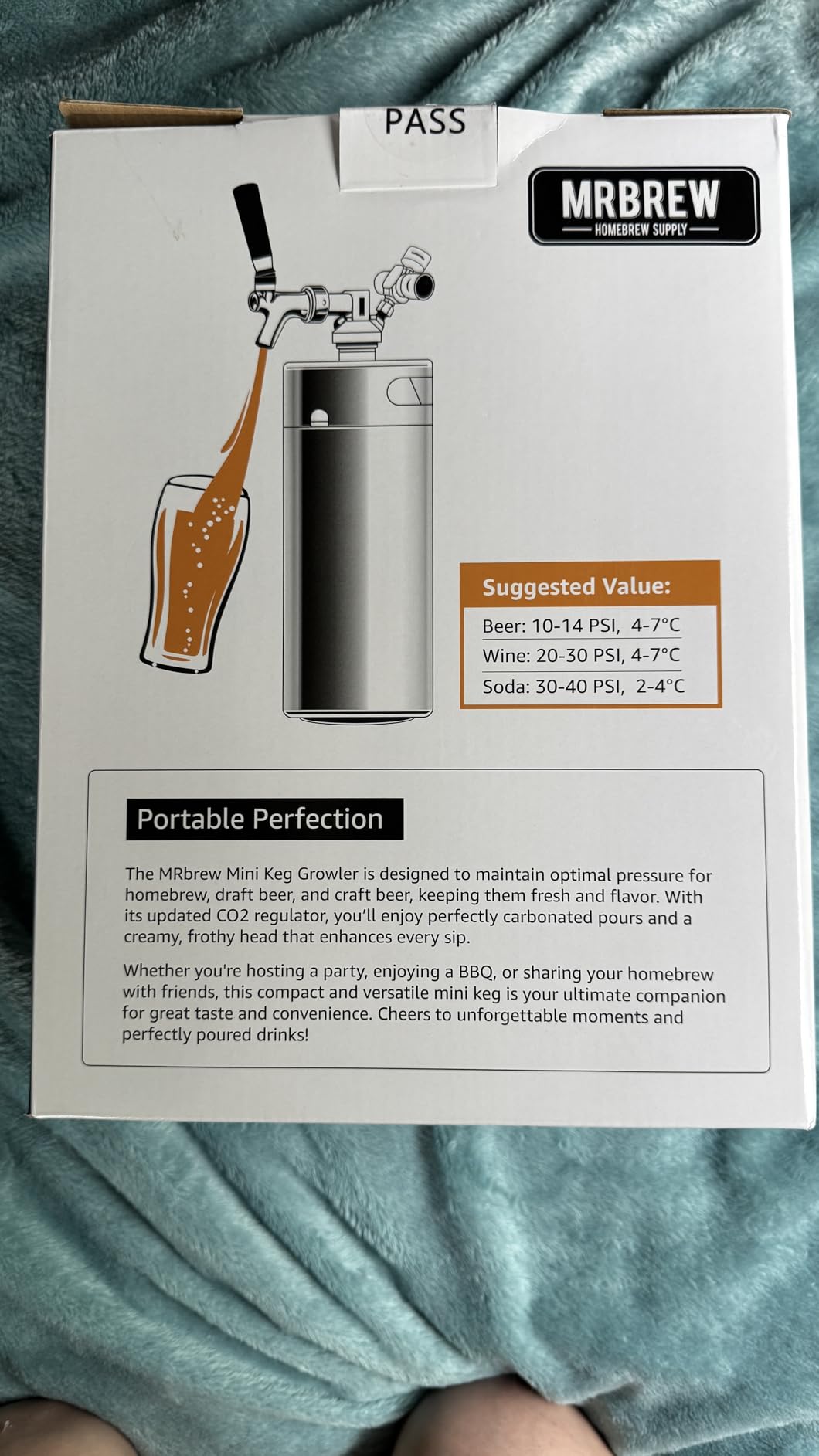
The regulator gives you a 0 to 60 PSI range with an accurate gauge and a real adjustment dial, which is more control than most portable dispensers at twice the cost offer. The self-closing spring loaded stainless faucet is what owners consistently praise.
The box includes the 128 oz stainless mini keg, a faucet and tap handle, a mini CO2 regulator, silicone tubing and a spear dispenser, plus cleaning brushes and a one year warranty with lifetime technical support.
At 128 oz it is sized for six to eight people and fits a mini fridge shelf at 13 inches tall.
Where it beats more expensive portable kits
The seal. Multiple owners report the internal spring in the self-closing faucet sealing tightly with no leaks, which is the number one failure mode on cheap dispensers. Leaking couplers and taps are the most common pain point reported in home brewing forums, so this matters.
The regulator accuracy also beats competitors. If you care about consistent carbonation across fills, a gauge and dial you can actually trust is worth more than extra capacity.
The fiddly part, and who it suits
Setup is where buyers struggle. Some owners reported repeated O-ring failures and returned the unit. Expect to spend time getting the seals seated properly before your first pour, and check each connection under pressure before you trust it.
The CO2 cartridge is not included and must be the threaded type. At 128 oz the capacity is modest for large gatherings, and like the other portable options it relies on cold storage or ice rather than chilling anything itself.
For a personal or two person setup that wants to stay in budget, this is the honest entry point.
How to Choose a Cold Brew Kegerator: Keg Size, Cooling and Tap Count
Start with keg format. A fifth barrel Sankey, a quarter barrel, a sixth barrel, a Cornelius ball lock and a 5 gallon corny keg are different objects with different couplers. Decide what you will actually brew before you shop. If you are buying concentrate rather than brewing, you still need to match the format your concentrate is sold in, which is usually 5 gallon corny or sixth barrel.
Home brewing forums converge on a simple rule: a household rarely needs more than two sixtel kegs. People routinely overspend on an oversized cabinet and then discover it dominates a room they now resent. Measure the space and check door swing before you commit.
Cooling method decides your serving temperature. Compressor fridges reach the low-to-mid 30s and hold there. Thermoelectric units are practical for small enclosed boxes but struggle to reach true serving temperature for coffee, which is why the countertop model in this group carries the lowest rating. Cold brew tastes best colder than most ales, so if coffee is the priority, a compressor cabinet is the safer bet.
Tap count is a lifestyle choice. A single faucet keeps cost and footprint down. Two taps let you run a still pour and a nitro pour at the same time, which is the setup most people who make both end up wanting. Three taps in a home cabinet is usually wasted capacity unless you brew constantly.
Cleaning is where coffee catches people out. Beer sugar residue is manageable. Coffee oils clog lines and turn off-flavors quickly, so plan a flush on a schedule rather than waiting for taste problems. Line cleaning supplies and brewery wash are inexpensive relative to the cabinet. First-time owners who never clean lines are the most common source of complaints in forum threads.
Noise and placement matter. Rotary scroll compressors are quieter than older reciprocating units. If the cabinet lives in a home bar or a living-adjacent space, listen for compressor cycles before you settle on a model. For a garage or patio, noise is less relevant, but insulation still is, since warm ambient conditions stretch the compressor and narrow the achievable temperature band.
Count the running cost, not just the cabinet. A complete home cold brew setup includes a tank or cartridges, a regulator, a tower, couplers, lines and cleaning supplies. Forum users routinely budget in the several-hundred-dollar range for a full build including a spare fridge, which lands well under the cost of a finished retail cabinet plus the dispense kit. The running costs are the CO2 or nitrogen refills and the cleaning supplies. Our guide to nitro systems breaks down the larger-format gas hardware in more detail.
Serving temperature guidance. Aim for 36 to 40F for cold brew on tap. That is colder than typical beer service, which is why a cabinet that stalls around 41F disappoints with coffee even when it performs well with ale. Check your actual temperature with an external thermometer during the first week rather than trusting the panel.
CO2 vs Nitrogen for Cold Brew: Getting the Gas Right
This is the single most repeated technical mistake in home cold brew, and it is worth reading before you buy any gas hardware.
Home brewing communities are consistent on one point: pure nitrogen at roughly 40 PSI is the community standard for nitro coffee. Using plain CO2 or a beer gas blend on a nitro batch is reported to make the coffee bitter, because CO2 produces larger bubbles and a sharper carbonation bite that nitrogen does not.
Nitrogen dissolves into the coffee differently from CO2. It forms microbubbles that give the creamy, cascading, stout-like pour people associate with cafe nitro. That texture cannot be replicated by pouring cold brew through the same faucet you use for beer, which is why tap hardware matters.
For still cold brew, the gas choice is far simpler. A light carbonation from a standard CO2 setup, or no pressurisation at all, works well and is far cheaper to run. Many home setups start with still cold brew and add nitro only once they are confident with the basics.
A stout creamer faucet is the tap hardware most associated with nitro pours, and it is worth including in any build plan that includes a nitrogen bottle. Several of the cabinets in this group ship with standard faucets that would need replacing for that use.
Pressure regulation is the practical skill here. A gauge-equipped regulator lets you set pressure and read it, which is why we weighted gauge quality when ranking. Blindly pressurising a keg to a number you read on a forum is how people end up with foam-only pours and bitter coffee.
One last practical note. Cold brew in a keg has a shorter window than bottled concentrate once opened and repeatedly exposed to gas and temperature, so brew what you will drink in a week or two and keep the rest as concentrate.
Frequently Asked Questions
What is the best cold brew system for home use?
For most households the NutriChef Pressurized Growler Tap System is the best starting point: a 64 oz 304 stainless mini keg with an adjustable PSI regulator that holds carbonation for weeks and fits a normal fridge shelf. If you want a self-chilling appliance instead, the Kegco K309SS-1 gives you a digital thermostat, deep chill mode and a complete dispense kit.
Can I use a kegerator for cold brew coffee?
Yes. Most home kegerators serve cold brew well, with two caveats. Cold brew wants to be colder than ale, usually 36 to 40F, so check that the cabinet reaches the low 30s rather than stalling near 41F. And the standard tap hardware is usually a beer faucet, so plan on a stout creamer faucet if you want a nitro pour.
Is nitro cold brew better than regular cold brew?
Nitro is a texture change more than a strength change. Pure nitrogen at roughly 40 PSI forms microbubbles that produce a creamy, cascading pour that standard cold brew cannot match. Nitrogen also serves as a gentler carbonation, so nitro cold brew is typically perceived as smoother and less sharp. It costs more to run because nitrogen hardware and refills add up.
Do I need CO2 or nitrogen for nitro cold brew?
Pure nitrogen at roughly 30 to 40 PSI is the community standard for nitro. Home brewers report that plain CO2 or a beer gas blend on a nitro batch produces bitter coffee, because CO2 creates larger bubbles and a harsher carbonation bite. For still cold brew, a standard CO2 setup is simpler and cheaper to maintain.
How long does nitro cold brew last in a keg?
Kegged cold brew keeps well once sealed and chilled, but it does not keep indefinitely the way concentrate does. Repeated gas contact and temperature swings shorten that window, so plan to brew what you will drink within a week or two and keep the remainder as bottled concentrate. Keep the keg cold and use a clean, pressurised spear to slow oxidation.
How cold should a kegerator be for cold brew?
Aim for 36 to 40F. That is colder than typical beer service, which is why a cabinet that holds around 41F tastes fine with ale and undrinkably warm with coffee. Verify with an external thermometer during the first week, and use the deep chill mode to bring a room temperature keg down before serving.
The Verdict: Which Cold Brew Kegerator Should You Buy?
The NutriChef Pressurized Growler Tap System wins this roundup because it does one thing well: it holds a properly carbonated cold brew pour in a package you can put anywhere a fridge exists. Sixty-four ounces, 304 stainless, a regulator with a real gauge, and a 4.6 average across 786 reviews.
Buy the Kegco K309SS-1 if you want an appliance that runs itself at temperature for a decade, or the Kegco HBK309S-2 if you plan to run still and nitro side by side. Buy the EdgeStar BR2001BL if you would rather assemble your own dispense hardware and keep the cost down. Buy the GANCOWISE if the main event is a party rather than a weekday pour.
Whichever you choose, get the gas right. Pure nitrogen around 40 PSI for nitro, and verify the actual cabinet temperature with a thermometer rather than trusting the display. These are still the best cold brew kegerators for home in 2026.