
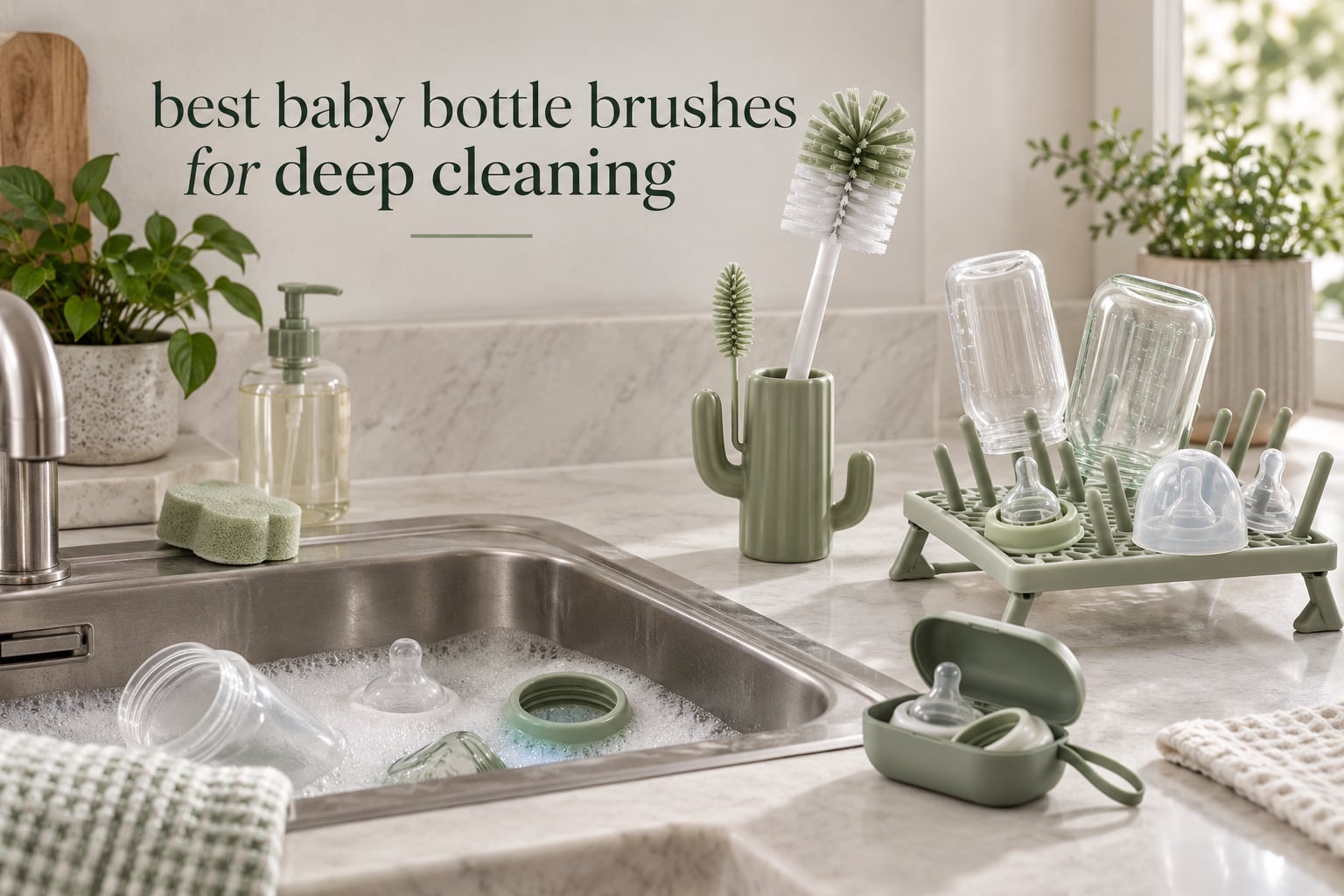
A good baby bottle cleaning brush has a long handle and a full-length head that reaches the bottom of tall bottles, plus a small nipple cleaner for the narrow openings most brushes miss. For deep cleaning, the head needs firm-but-not-scratchy bristles, a diameter matched to your bottle neck, and a ventilated drying spot so the brush itself does not become a bacteria source.
Bottles trap dried milk in three places that a quick rinse never touches: the seam around the base, the threads inside the neck, and the bore of the nipple. A baby bottle brush is the only tool that physically lifts that residue out of those corners, which is why the best baby bottle brushes for deep cleaning matter more than their packaging suggests. Residual milk is a growth medium, and an infant’s developing immune system turns a routine wash into a safety step.
We compared ten of the highest-rated brushes over several weeks of daily sink duty, checking each one against dried milk film, a strong-smelling bottle, narrow and wide necks, and the small parts most parents skip. We also weighed what happens to each brush after a month of scrubbing, because a brush that fails at day 40 is not a deep-cleaning tool. The picks below cover the range: a two-piece bristle and sponge brush, a multi-piece set, a silicone kit with a drying rack, and specialist tools for sippy cups and straws.
Table of Contents
Top 3 Best Baby Bottle Brushes for Deep Cleaning in 2026

Dr. Brown’s Pink 1-Pack Brush
- Sponge plus bristle head
- Built-in nipple cleaner
- Suction cup base
- Dishwasher top rack safe

Munchkin Sponge 2-Pack Brush
- Sponge base for bottle bottoms
- Scratch-free nylon bristles
- Stands upright
- Soft rubber nipple brush

Boon Cacti 4-Brush Set
- Four brush sizes
- Nylon bristles
- Straw and nipple tools
- Drip-catching vase
Baby Bottle Brushes for Deep Cleaning at a Glance in 2026
| Product | Specifications | Action |
|---|---|---|
| Dr. Brown’s Pink 1-Pack |
|
Check Latest Price |
| Munchkin Sponge 2-Pack |
|
Check Latest Price |
 Munchkin Bristle Munchkin Bristle |
|
Check Latest Price |
| Boon Cacti 4-Brush Set |
|
Check Latest Price |
 Philips Avent Brush Philips Avent Brush |
|
Check Latest Price |
 Dr. Brown’s Soft Touch Dr. Brown’s Soft Touch |
|
Check Latest Price |
 Munchkin Details 4-Piece Kit Munchkin Details 4-Piece Kit |
|
Check Latest Price |
 OXO Tot 2-Pack with Stand OXO Tot 2-Pack with Stand |
|
Check Latest Price |
 Tommee Tippee Closer to Nature Tommee Tippee Closer to Nature |
|
Check Latest Price |
 Momcozy 7-in-1 Kit Momcozy 7-in-1 Kit |
|
Check Latest Price |
Here is the short version if you want the answer without reading ten reviews.
Dr. Brown’s Pink 1-Pack — the all-rounder: sponge and bristles on one head, nipple cleaner on the other end.
Munchkin Sponge 2-Pack — the value pick, with a sponge base that scrubs the part of the bottle other brushes skip.
Munchkin Bristle — the narrow-neck option, with a flexible neck that reaches bottom corners.
Boon Cacti 4-Brush Set — the set that covers bottles, straws, nipples and pump valves with four sizes.
Philips Avent Brush — the curved-head brush for rounded glass bodies.
Dr. Brown’s Soft Touch — the no-scratch option for delicate and glass bottles.
Munchkin Details 4-Piece Kit — the specialist for sippy cup straws, spouts and lid threads.
OXO Tot 2-Pack with Stand — two brushes plus a water-catching stand, handy for two sinks or travel.
Tommee Tippee Closer to Nature — the sponge-free design for parents who dislike fabric heads.
Momcozy 7-in-1 Kit — the travel system with a folding rack and a carry case.
How We Tested These Brushes for Deep Cleaning
Each brush was run through the same routine: a bottle rinsed of loose milk, coated in dried formula film, and washed in warm soapy water. We then checked the seam at the bottle base, the threads inside the neck, the collar, and the nipple bore for remaining film, then dried the bottle and smelled it the next morning.
Three things decided the rankings. First, base and seam coverage, because that is where dried milk hides and where an open-head bristle brush falls short. Second, neck fit, since a head that is too wide for a narrow neck cannot physically enter the bottle. Third, what happens to the brush itself: bristles that splay, sponges that tear out of the wand, and handles that fail after a month all count against a deep-cleaning tool.
We also noted the parts parents mention most often in reviews, like the nipple cleaner and drying storage, and used the manufacturer instructions for care and replacement. Where ratings and review counts appear below, they are copied directly from the retailer listing rather than estimated.
1. Dr. Brown’s Bottle Brush, Pink, 1-Pack — Best Baby Bottle Brush Overall
Dr. Brown’s Bottle Brush, Pink, 1-Pack
Sponge and bristle head
Built-in ridged nipple cleaner
Suction cup base
BPA free, top rack dishwasher safe
Pros
- Sponge and bristle head clears base and sides in one twist
- Built-in nipple cleaner removes the need for a second tool
- Suction cup base keeps the brush upright and off the counter
- Soft bristles clean glass and plastic without scratching
- Also works on pump parts
Cons
- Sponge head deforms or falls out of the wand after about a month of daily use
- Thin nipple-cleaner end can tear a teat if pressed too hard
Dr. Brown’s Pink 1-Pack is the brush we kept reaching for, because its single head carries both a sponge and bristles and covers the two failures of most brushes. The sponge half works the base and the seam ring where dried formula bakes on, and the bristle half runs the sidewalls. One twist, one tool, one pass.
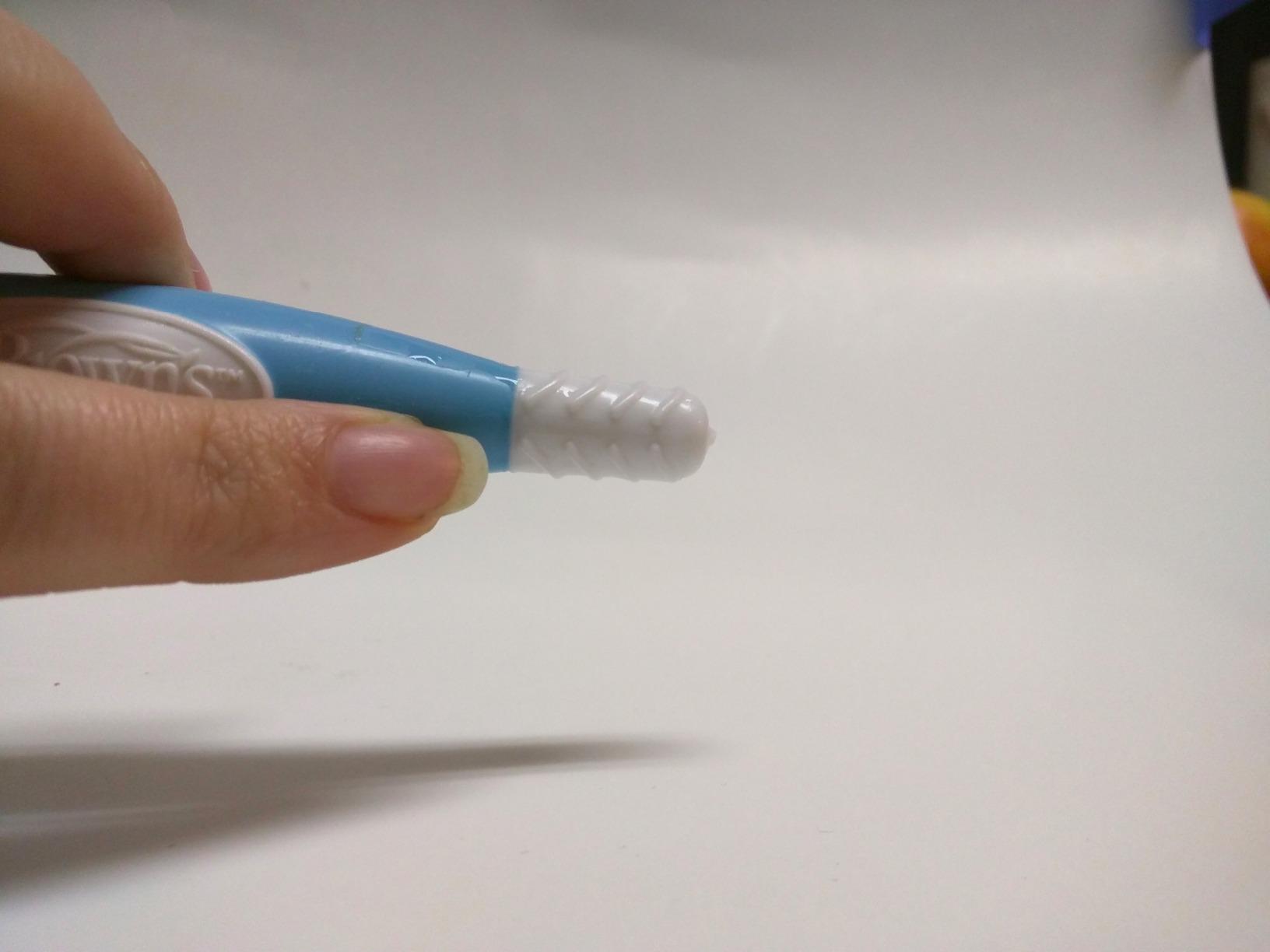
What sold us was the ridged nipple cleaner on the opposite end. It is the feature forum parents name most often as their top decision factor, and on this brush it is genuinely useful rather than decorative, though it is thin enough to be careful with on a delicate teat. The grooved handle is sized for a secure grip with wet or soapy hands, which matters more than it sounds during a 10pm wash.
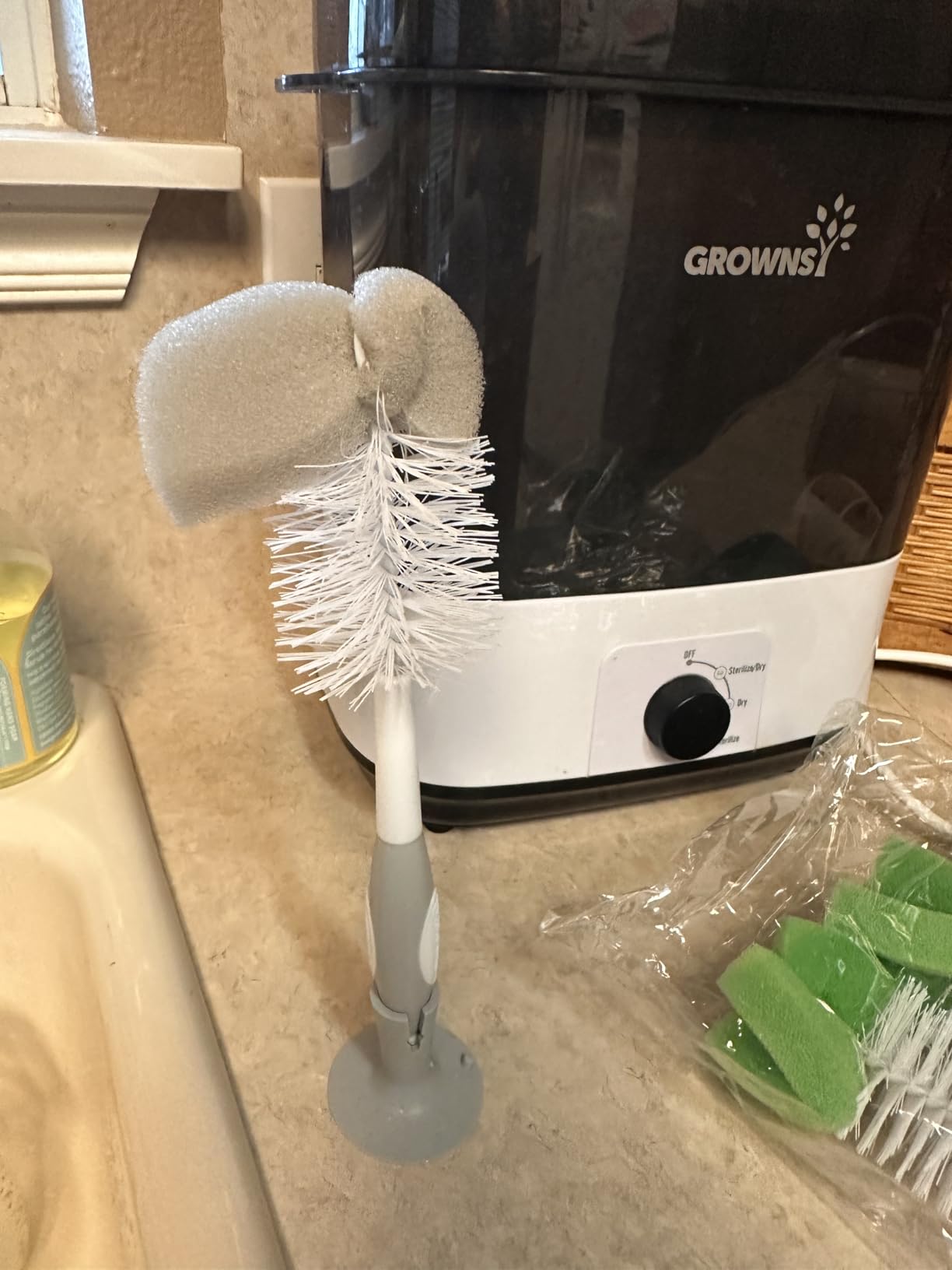
The suction cup base is the quiet hero. It stands the brush upright at the sink so you are not laying a wet sponge head on a wet counter, and it detaches so you can clip it inside the sink instead. The listing rates it 4.6 stars across more than 65,000 reviews, with about 80% five-star feedback, and it suits Dr. Brown’s bottles plus most narrow and wide-neck brands.
The honest drawback is lifespan. After roughly a month of daily use the sponge head deforms or works loose from the wand, and it is the sponge rather than the bristles that fails first. That is a consumable part of the deal, not a defect, and it is the one thing you must not ignore: a worn sponge stops lifting dried milk and starts smearing it.
Why this brush suits a daily bottle washer
It is the rare brush that handles a whole bottle in one tool, so you are not juggling a bottle brush and a separate nipple brush over a full sink. The combination head means one rinse cycle covers the body and the teat, which is exactly the deep-cleaning routine that dries milk fastest.
It is a natural first choice for a family using anti-colic or wide-neck bottles, and the listing states it works across most narrow and wide-neck brands. On our balance of rating and review volume it is the strongest all-round brush here, and the one to buy first if you want a single dependable tool.
When you should pick something else
If you clean pump parts, straws and valve openings as well as bottles, a single-head brush makes you hunt for a second tool. The Boon 4-Brush Set covers those parts with dedicated pieces rather than relying on one small cleaner.
Anyone washing bottles twice a day will also replace this brush more often than the price of a new one suggests. Budget for a fresh brush roughly monthly, and watch the sponge rather than the bristles: splayed or shedding sponge is the signal to swap it out.
2. Munchkin Sponge Bottle Brush, Modern Design, 2 Pack — Best Value
Munchkin® Sponge™ Baby Bottle Brush Set with Nipple Brush, 2 Pack
Two brushes that stand upright
Scratch-free nylon bristles with sponge tip
Soft rubber nipple brush
Twist-off bottom cleaner
Pros
- Sponge bottom scrubs the full base where bristles miss
- Bristles soft enough to avoid scratches but firm enough to lift residue
- Twist-off bottom cleaner reaches narrow jars and pump parts
- Stands upright on its own so counters stay dry
- Non-slip handle stays secure with soapy hands
Cons
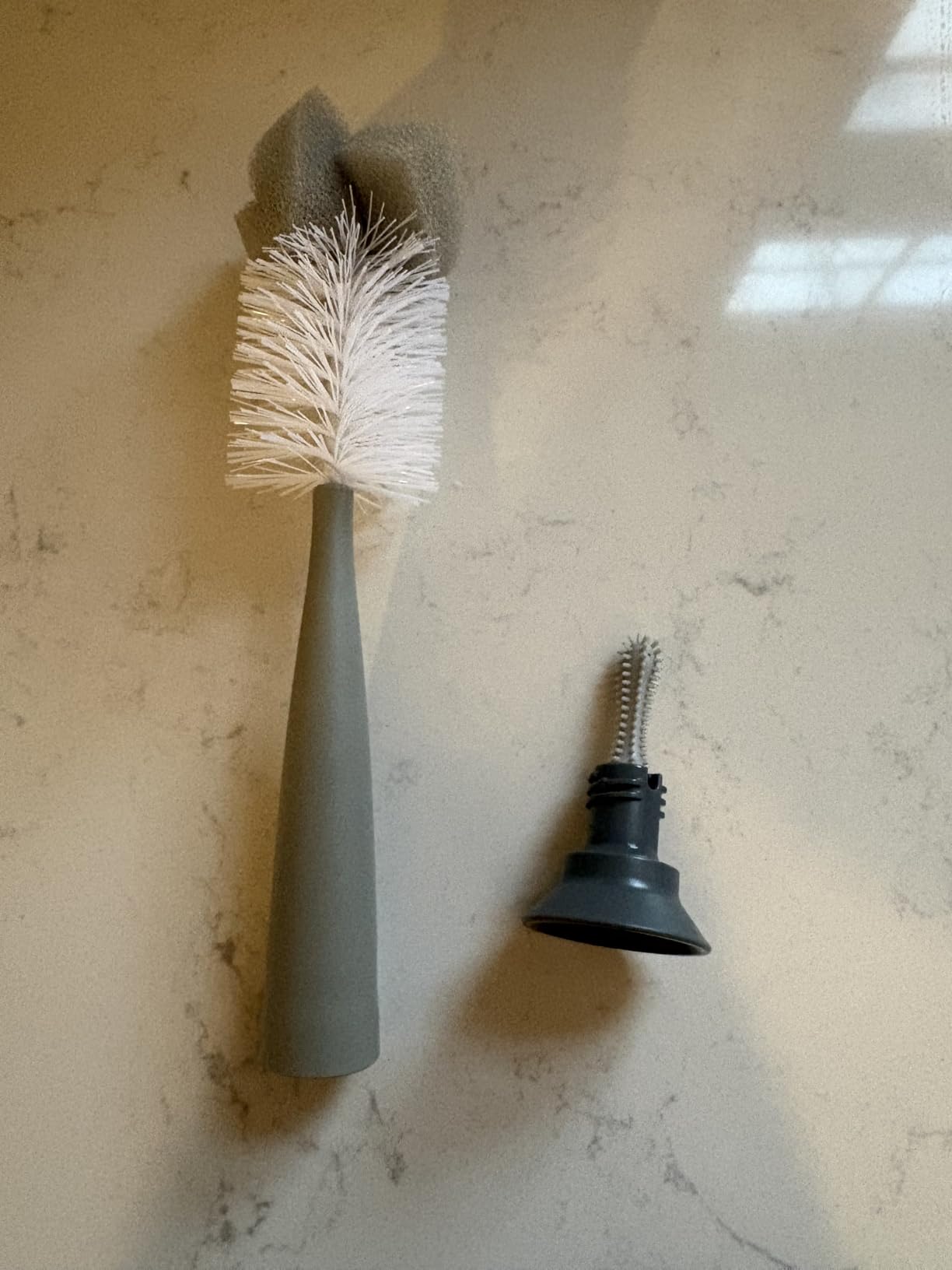
- Sponge tip wears out quickly and needs regular replacement
- Bottom cleaner piece can occasionally twist off mid-wash
- Bottom cleaner is shorter than some users would like
The Munchkin Sponge 2-Pack is the brush to buy when you want the base-seam coverage of a sponge head without giving up bristle scrubbing on the walls. The sponge sits on the bottom of the head and does the work in the one spot most bottles are still dirty after a rinse.
Bristles are nylon and described as scratch-free but durable, which is the balance you want for glass and plastic alike. The soft rubber nipple brush is built into the same tool, so teats get cleaned with the bottle. It is also a two-pack, and with one brush per sink you stop losing the single brush to a neighbour or a travel bag.
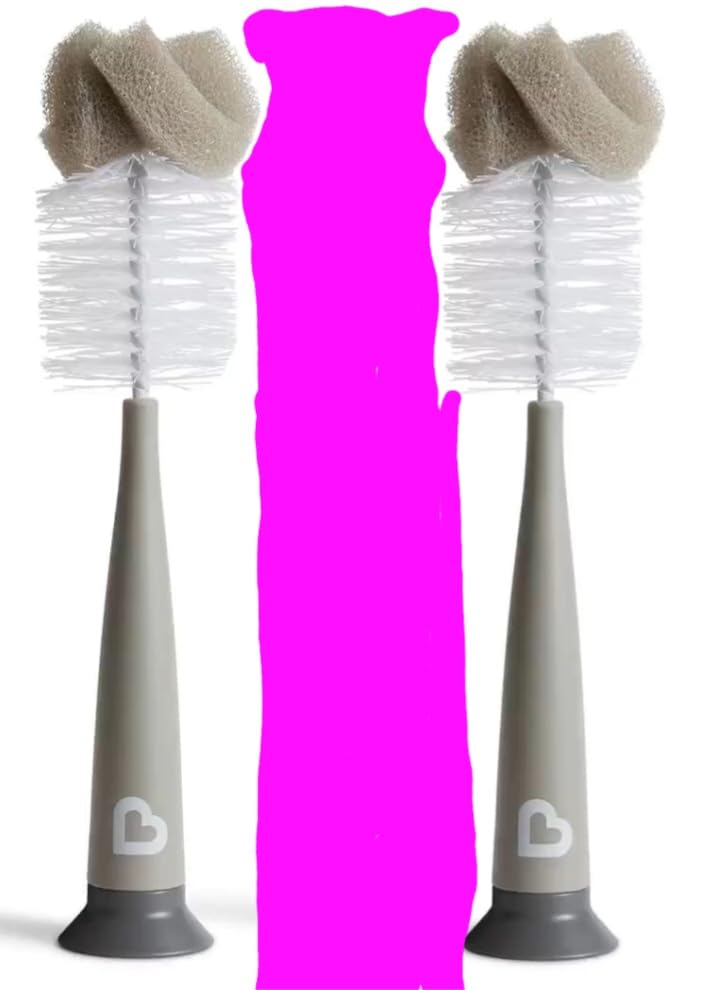
What we liked most in daily use was that these brushes stand upright on their own. No suction cup to lose, no brush lying in a puddle of dirty water. The twist-off bottom cleaner unscrews for narrow jars and pump parts, though it is short and some users find it fiddly.
The listing shows 4.7 stars across more than 52,000 reviews, with roughly 82% five-star feedback, and Munchkin recommends replacing the brush every 30 to 45 days. That replacement guidance is not a flaw; it is the manufacturer being clear that a sponge head is a consumable.
Why two brushes is genuinely useful here
A second brush is not a luxury when you clean bottles at two sinks, or when one set travels to a grandparent’s house. Parents in forum discussions about the best bottle brush repeatedly mention keeping more than one, and this two-pack removes the excuse to share a single wet brush.
The upright design also solves a hygiene problem. A brush lying flat in a sink traps the water it just used, and that standing water is exactly what you are trying to avoid on bottle parts. These stand up, drip, and dry.
When it falls short
The sponge tip is the weak point and it wears out faster than the bristles. If you wash bottles daily, plan to swap the brush roughly every month and a half rather than treating it as a permanent fixture.
The twist-off bottom cleaner is also the piece most likely to work loose in the middle of a wash, and it is short enough that deep pump valves may still need a narrower tool. For pump-heavy households, the Boon set covers more part types.
3. Munchkin Bristle Bottle Brush, Grey — Best for Narrow Necks
Munchkin® Bristle™ Bottle Brush, Grey
Flexible neck reaches bottle corners
Suction cup standing base
Soft scratch-free nylon bristles
Rubber nipple brush in handle
Measures 11.5 inch tall
Pros
- Flexible neck reaches the bottom corners of narrow and wide bottles
- Textured rubber handle stays secure with wet or soapy hands
- Suction cup base keeps the brush standing at the sink
- Soft nylon bristles are scratch-free and reduce splash-back
- Rubber nipple brush integrated in the handle
Cons
- Munchkin recommends replacing the brush every 30-45 days so regular replacement is expected
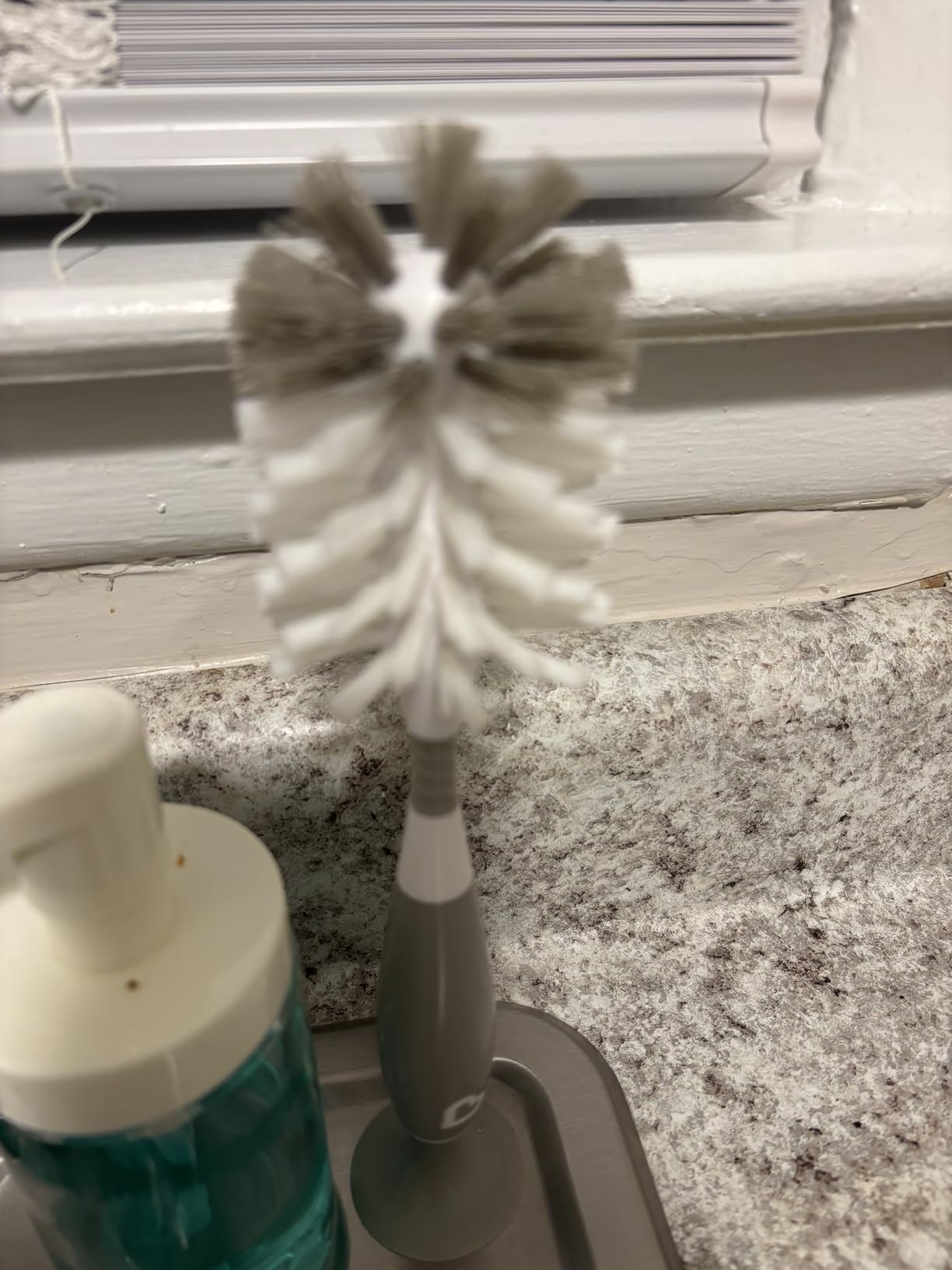
The Munchkin Bristle is the one to pick when your bottles are narrow and tall and a straight shaft keeps bumping the base without working into the corner. Its flexible neck bends to the bottle wall, so the bristles reach the seam ring at an angle rather than stopping short.
It measures 4.5 by 2.75 by 11.5 inches, which is a long enough shaft for tall narrow bottles without feeling unwieldy at the neck. The listed surface recommendation covers glass, plastic and silicone, and the round brush head suits standard bottle shapes well.
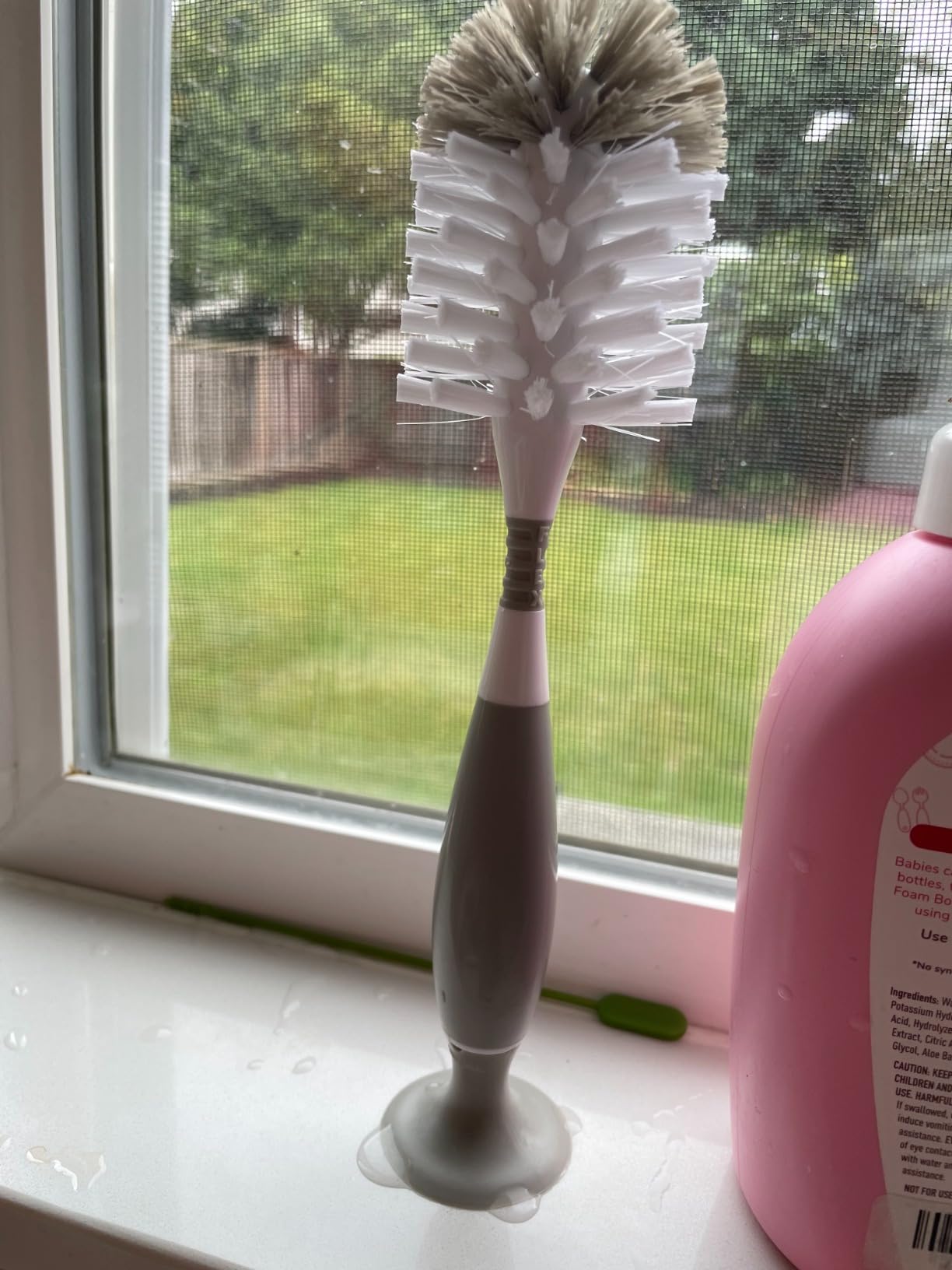
Handling is where this brush wins. The textured rubber handle stays put with soapy hands and is rated medium firmness, meaning it scrubs without being abrasive. The soft nylon bristles reduce splash-back, which is a small thing until you are washing a bottle in a full sink at the end of the day.
The suction cup base stands the brush at the sink, and the rubber nipple brush is built into the handle rather than left out. The listing shows 4.7 stars across more than 20,000 reviews, and it ranks #11 in Baby Bottle Brushes and #782 in Baby overall.
Why the flexible neck matters most
Most residue in a bottle sits where the base meets the wall, in a curved seam. A straight-necked brush touches the flat floor and the vertical side, but the diagonal corner is where the film survives. A flexible neck closes that gap, and it is the single feature that most improves a deep clean.
It also makes the brush forgiving across bottle shapes. A narrow-neck bottle, a wide-mouth jar and an angled bottle can all be cleaned with the same twist, rather than buying a separate tool per shape.
When to choose a different brush
There is no sponge on this head, so the base film has to be lifted by bristles alone. If your bottles tend to sit dried, a sponge-ended brush such as the Munchkin Sponge 2-Pack or the Dr. Brown’s Pink will clear the base faster with less scrubbing.
Also note the manufacturer’s own guidance to replace the brush every 30 to 45 days. That is a deliberate consumable design, and treating it as a long-term purchase means budgeting for regular swaps.
4. Boon Cacti Bottle Cleaning Brush Set — Best Multi-Piece Set
Boon Cacti Bottle Cleaning Brush Set – Includes Bottle Brush, Nipple Brush, Detail Brush, and Straw Brush – Baby Bottle Brush Set for Bottle Drying Rack – Baby Essentials – 4 Count
Four brushes in one set
Durable nylon bristles
Drip-catching storage vase
Made without BPA or PVC
Measures 10.8 inch tall
Pros
- Four sizes of brushes cover bottles
- straws
- nipples and pump valves
- Stiff nylon bristles provide a strong deep clean
- Integrated drip-catching vase keeps brushes contained and hygienic
- Cactus design looks good displayed on the counter
- Reported to hold up well over multiple years of use
Cons
- Large brush showed visible wear after a few months of light use
- Inner cup of the vase can be awkward to remove for emptying water
- Bristles can push through the holes of a teat if pressed too hard
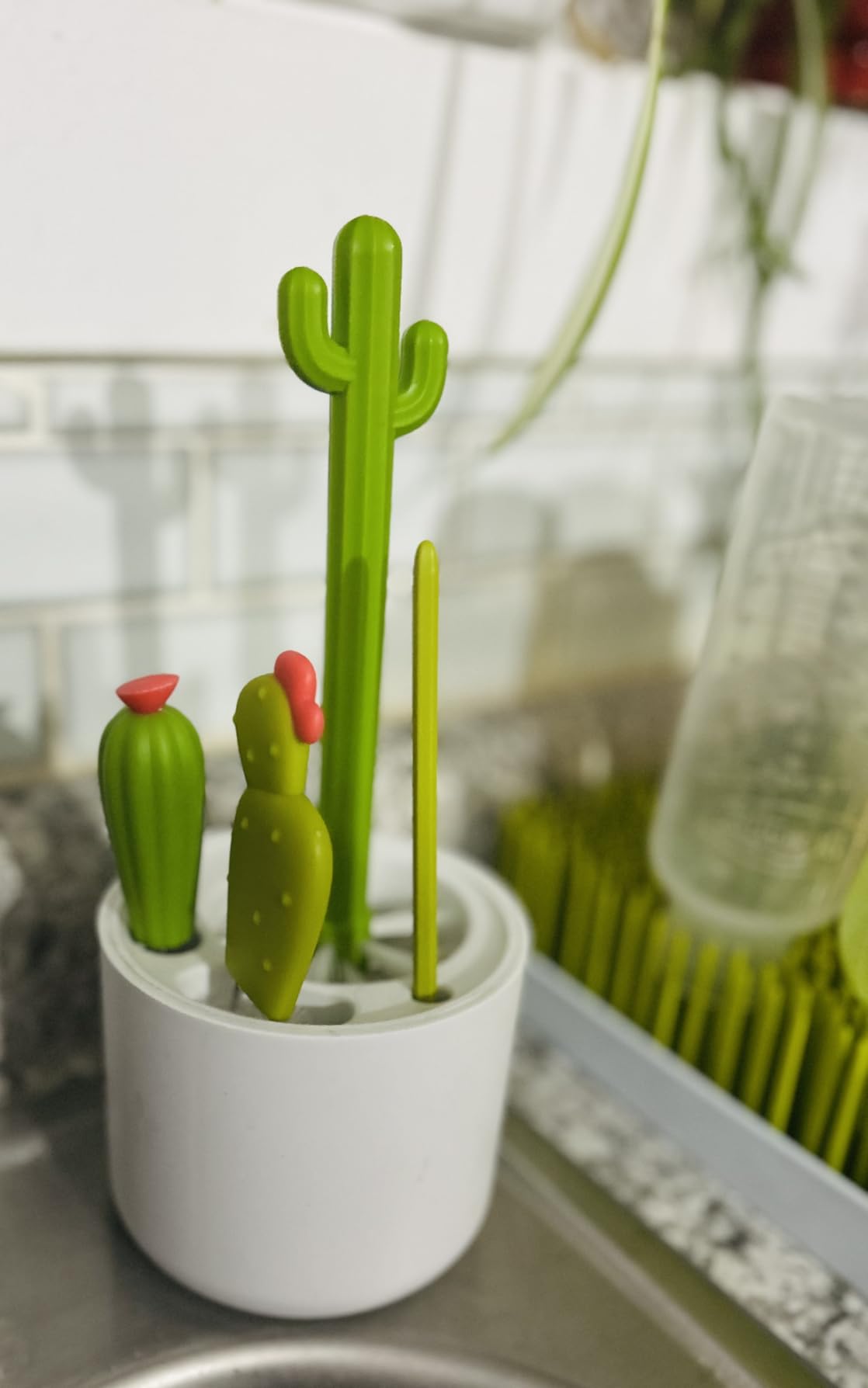
The Boon Cacti set is the deep-cleaning answer for anyone whose sink contains more than bottles. It includes a bottle brush, a nipple brush, a detail brush and a straw brush, and each one is sized for the part it is meant to clean rather than being a duplicate in a different colour.
The bristles are nylon and described as durable, and they run stiff enough to give a genuinely aggressive scrub on dried formula. In practice that matters most on pump valves, collar threads and sippy cup interiors, where a soft head slides over the residue instead of removing it.
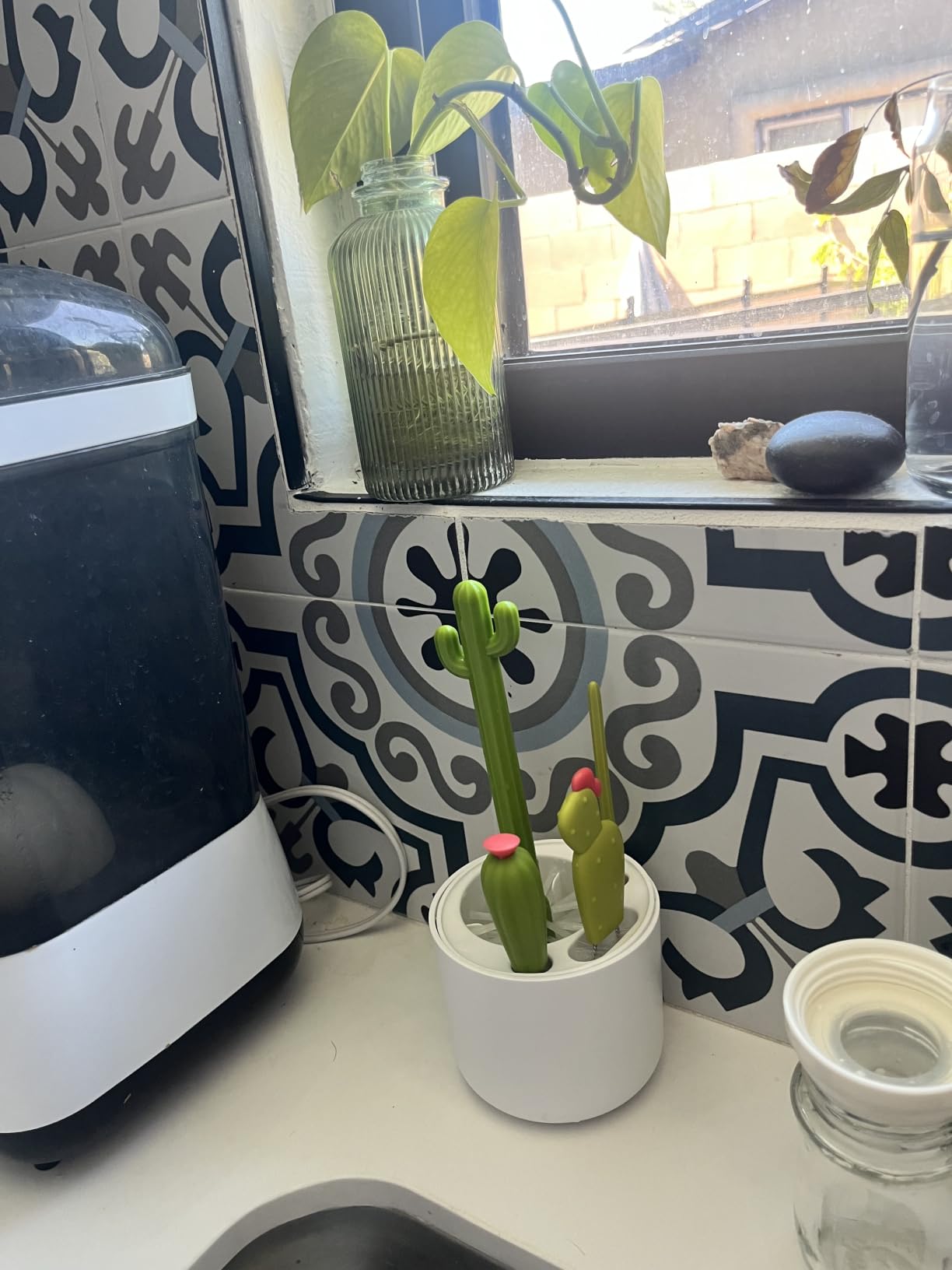
Storage is the part that sets it apart from a loose bundle of brushes. The included vase catches drips, so the four tools stay contained and the counter stays dry, and the cactus shape means it is not something you hide in a cupboard. The set is made without BPA or PVC and measures 1.22 by 1.22 by 10.81 inches at 1.92 ounces.
The listing rates it 4.8 stars across more than 18,000 reviews, with about 88% five-star feedback, and it holds a #1,649 rank in Baby and #13 in Baby Bottle Brushes. Plenty of buyers report the set lasting across years of use.
Why the extra tools earn their place
Straws and pump valves are the two places where a full-size bottle brush simply cannot go. A straw brush runs the full length of the tube, and a detail brush handles the small openings in a lid or a valve that a bottle head would never enter. If you express milk or use a sippy cup, those tools replace a frustrating workaround with a proper clean.
It also solves the forum question about whether a nipple attachment is a gimmick. Here it is one of four tools in a set built around the idea that different parts need different sizes, which is a more honest answer than one brush claiming to do everything.
When it is not the right buy
Some buyers report the large brush showing visible wear after only a few months of light use, so if your bottles are large and few, a single dedicated bottle brush will serve you longer.
The vase also has an inner cup that can be awkward to remove when you empty the water, and the bristles are stiff enough that pressing them into a teat can push through the holes. Treat the nipple brush as a gentle tool even though the others are aggressive.
5. Philips Avent Baby Bottle and Nipple Brush — Best for Rounded Bottles
Philips Avent Baby Bottle and Nipple Brush, Gray
Curved brush head for rounded surfaces
High-density durable bristles
Molded nipple-cleaning tip
Dishwasher safe and BPA free
Measures 11 inch long
Pros
- Curved head follows the rounded walls of bottles for full contact
- High-density bristles lift milk residue without scratching the material
- Molded tip doubles as a silicone nipple cleaner
- Dishwasher safe and BPA free
Cons
- Single-brush format means no dedicated straw or detail tool is included
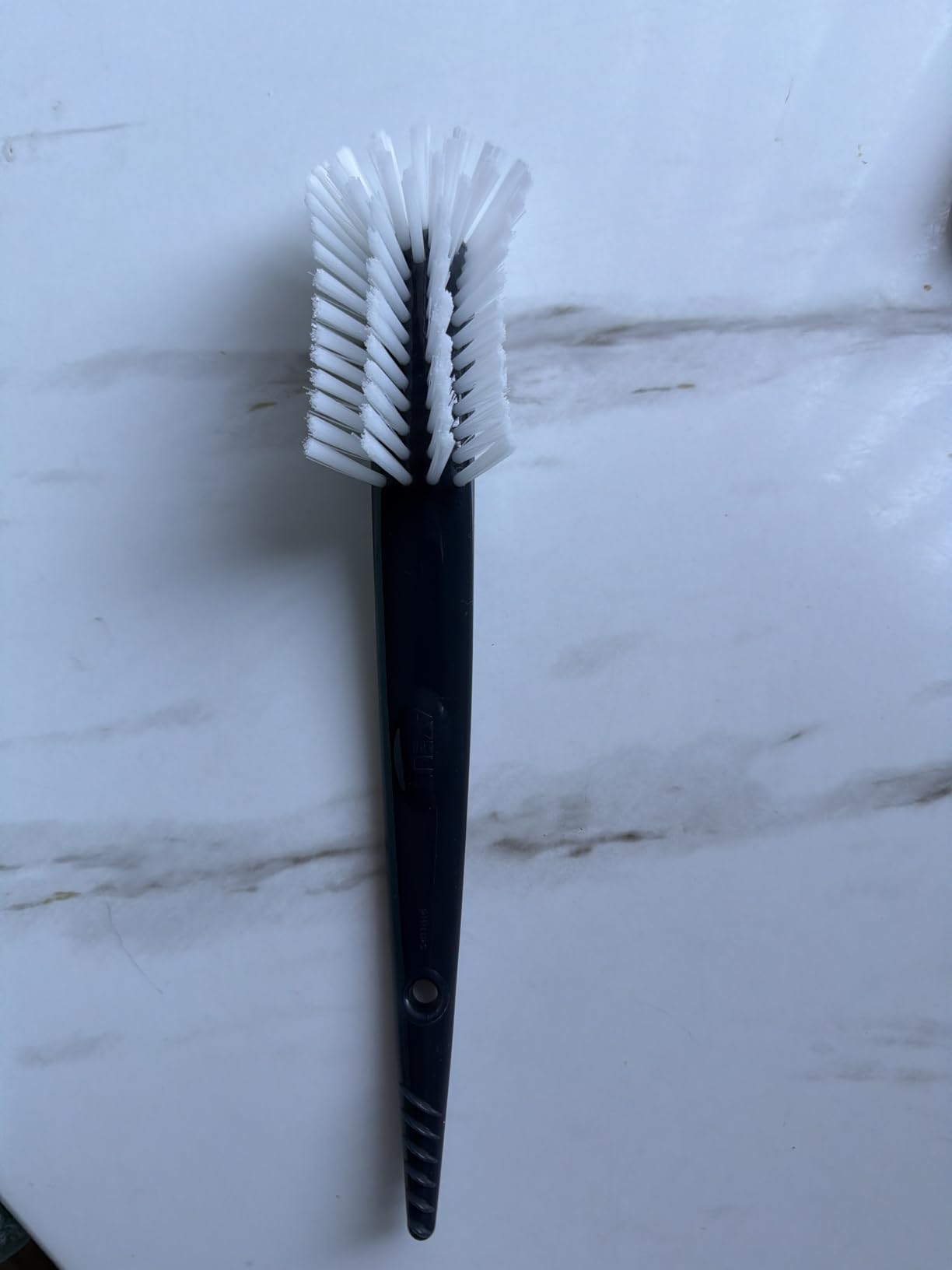
The Philips Avent brush is shaped around a simple observation: bottle walls are curved, so a straight cylindrical head only touches them in strips. Its curved head sits against the bottle wall and keeps the bristle tips in contact across a wider area, which means fewer passes for the same film.
The bristles are high-density, and that density is what shifts dried milk off a rounded surface. It is one of the few brushes here that lifts residue rather than merely loosening it, and the listing confirms it is dishwasher safe and made of BPA-free material.
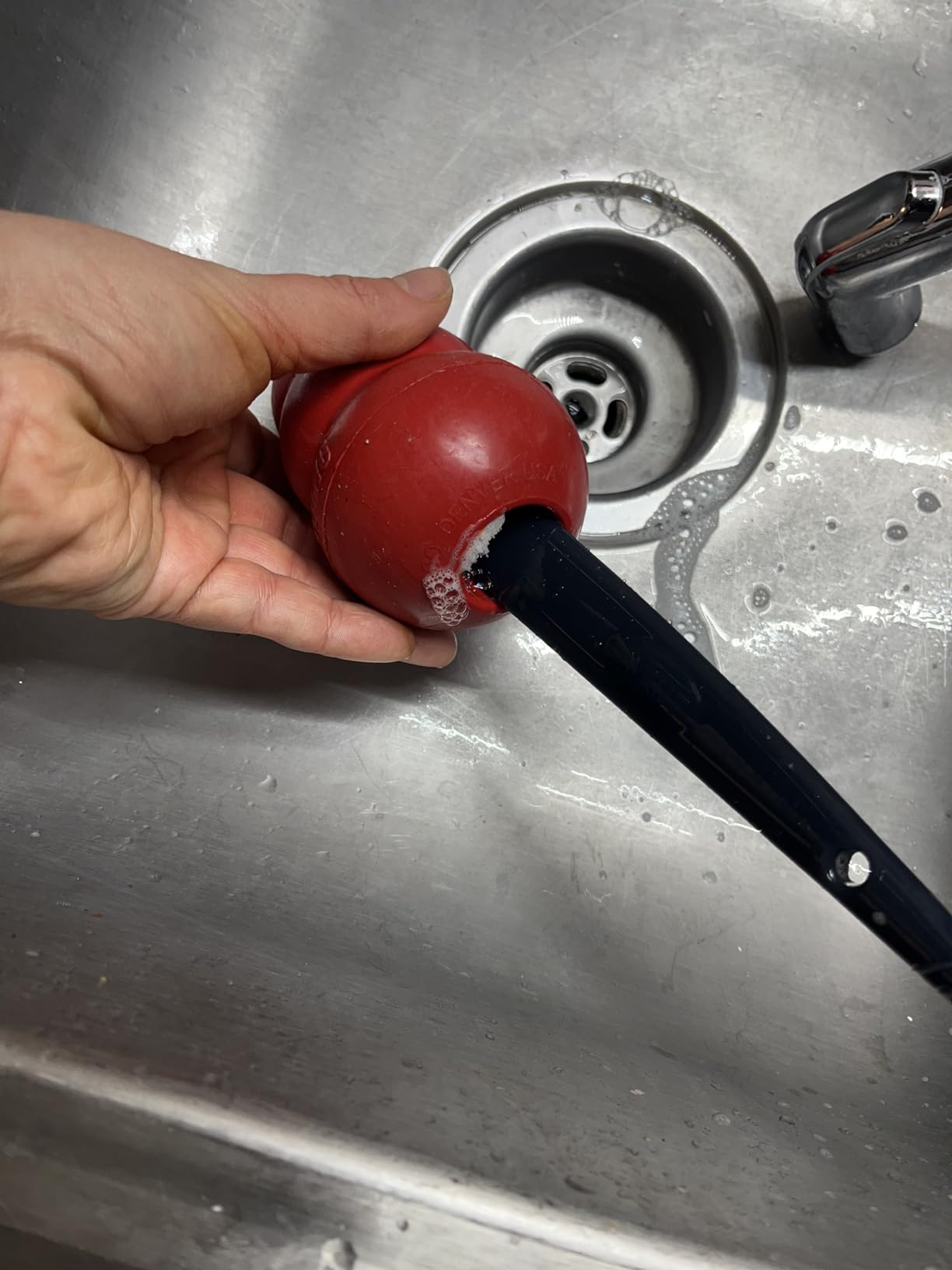
At the end of the handle, a molded tip doubles as a silicone nipple cleaner, so the same tool handles teats designed for Avent bottles and other silicone nipples. It measures 11 by 1.5 by 1.5 inches and weighs 4.8 ounces, a size that feels substantial in the hand without being clumsy.
The listing shows 4.8 stars across more than 10,000 reviews and a #31 rank in Baby Bottle Brushes. For Avent households in particular, the shaped head matches the bottle family it was designed around.
Why curved heads beat straight ones on round bottles
Contact area is the whole argument. Denser bristle contact means more mechanical work on the dried film with each stroke, and on a rounded bottle that is where the difference shows. On flat-sided bottles the advantage narrows, so this is a shape-specific recommendation rather than a universal one.
The molded nipple tip is a real second function, not a stub. It is sized for silicone nipples and sits where a brush end would otherwise be dead weight, which makes the single-brush format feel complete for bottle plus teat cleaning.
When it leaves gaps
This is a single-brush format with no straw or detail tool, so straws, lid valves and pump flanges will need a second tool. If your sink collects those parts daily, the Boon 4-Brush Set or the Munchkin Details kit is a better fit.
It is also a conventional bristle brush with no sponge and no drying base, so it needs a proper ventilated drying spot at the sink rather than standing in water. That is a small habit, but it is the difference between a brush that dries and one that stays damp.
6. Dr. Brown’s Soft Touch Baby Bottle Cleaning Brush — Best for Delicate Bottles
Dr. Brown’s Soft Touch Baby Bottle Cleaning Brush, Gray, 1-Pack
Soft synthetic rubber bristles
Grooved no-slip long handle
Ridged nipple cleaner at the base
Suction cup standing base
Top rack and sterilizer safe
Pros
- Soft rubber bristles clean without scratching or distorting bottles
- Retains its shape better than traditional bristle brushes
- Long grooved handle stays comfortable through long washing sessions
- Suction cup base keeps the brush off the counter
- Easy to sanitize in a dishwasher or sterilizer
Cons
- Nipple cleaner end is stiff plastic and does not clean nipples well
- Bulky head fits snugly through narrow Dr. Brown's plastic bottle inserts
- Soft head is designed for bottles not general dish washing
- Some units report a small piece of bristle breaking off early
The Dr. Brown’s Soft Touch is the one for anyone who scratches bottles without meaning to. Its head is made of soft synthetic rubber rather than bristle filaments, and it glides over glass and thin plastic without the micro-scratches that appear around a bottle base after months of stiff-bristle scrubbing.
It is also the easiest brush here to sanitize properly. The listing states it is safe for the dishwasher top rack and for a sterilizer, which for a new parent matters more than the styling: a brush that can be boiled or steam-cleaned does not have to be replaced on a schedule as aggressively.
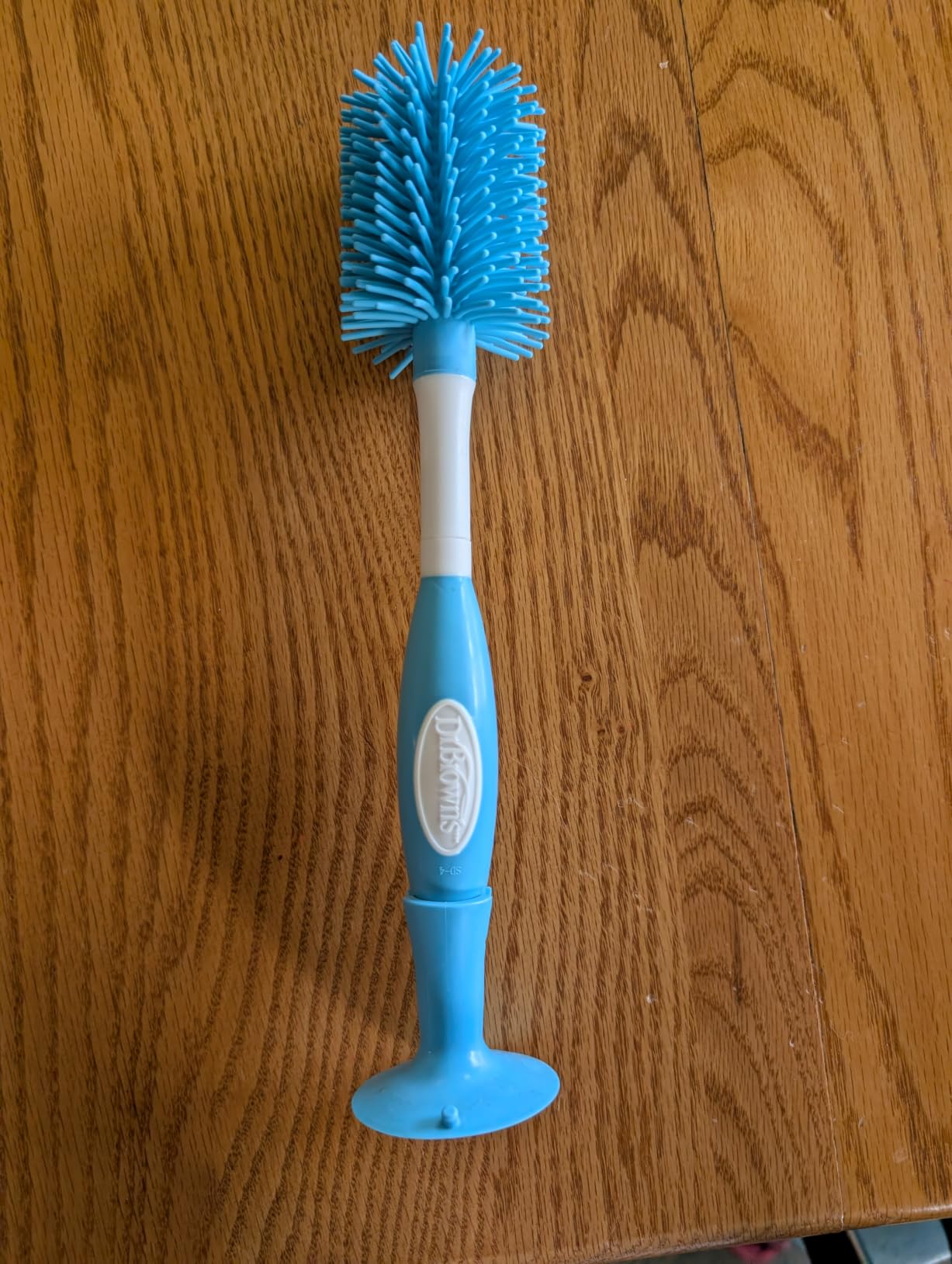
The long grooved handle is comfortable through a long session and the suction cup base keeps the brush off the counter, and reviewers commonly praise the fact that this head holds its shape better than a traditional bristle brush. It also works on cups and breast pump parts.
It is the lowest rated brush in our roundup at 4.4 stars across nearly 9,900 reviews, with around 71% five-star feedback, so treat it as a specialist rather than a default. The complaints are consistent enough to plan around: the ridged nipple cleaner at the base is stiff plastic and does not clean nipples well, and the head is bulky through narrow plastic bottle inserts.
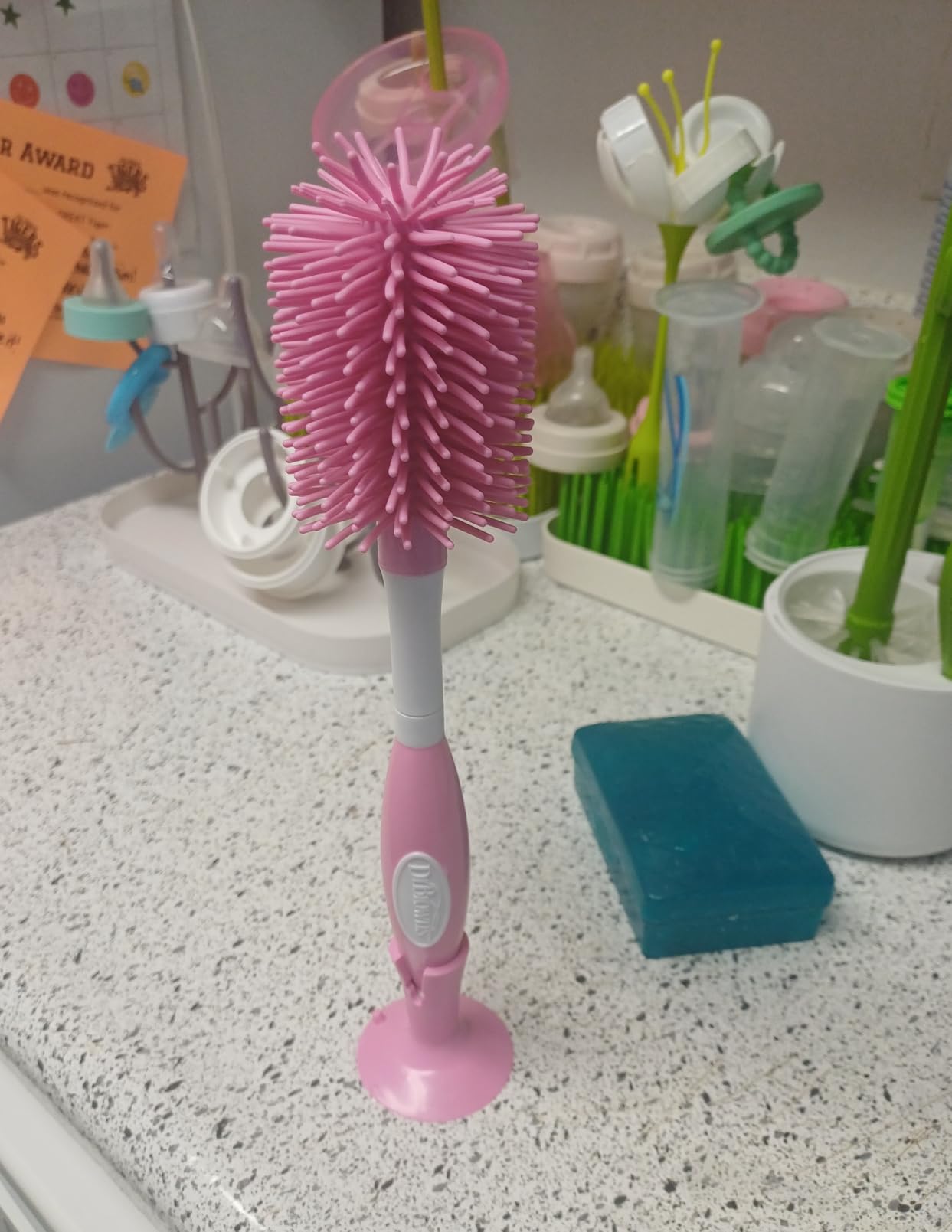
Why no-scratch heads earn a place
Two situations make a soft head the right call. Bottles with printed decorations or measurement markings degrade faster under stiff bristles, and parents cleaning glass bottles worry about scratches long before a crack appears. For both cases this is the brush to buy.
Shape retention is the quiet advantage. Traditional bristles splay within weeks and start pushing residue around rather than lifting it, while a rubber-style head keeps its profile. Combined with sterilizer-safe care, that pushes the useful life beyond what a sponge head offers.
When to skip it
Do not buy it for a lot of narrow-neck plastic inserts. The head is bulky and fits snugly, and you will find yourself scrubbing the outside of the neck while the inside goes untouched. The Dr. Brown’s Pink 1-Pack handles that bottle family better.
It is also not a nipple cleaning solution, despite carrying a cleaner at the base, and it is a bottle tool rather than a general dish brush. Pair it with a dedicated teat tool or a set like the Boon Cacti if nipples are part of your daily wash.
7. Munchkin Details Bottle Brush Set, 4-Piece — Best for Sippy Cups and Straws
Munchkin® Details™ Bottle Brush Set, 4-Piece Cup & Straw Cleaning Kit
Four purpose-sized tools
Straw,spout,thread and detail brushes
Detachable storage ring with hanging loop
Built-in sealing ring pick
Pros
- Four purpose-sized brushes reach straws
- spout
- lid threads and tight corners
- Detachable clip keeps the set organised and easy to grab
- Sealing ring pick helps lift residue from stubborn lid details
- Ergonomic handle with finger recess stays comfortable in soapy hands
Cons
- Set is specialised for small parts and does not include a full-size bottle brush
The Munchkin Details kit is deliberately not a bottle brush, and that is why it earns its place. Once a baby moves onto sippy cups, the hard-to-clean parts stop being the bottle and start being the straw, the spout, and the screw threads inside the lid.
This four-piece set includes a straw brush, a spout brush, a lid and threads brush, and a detail brush, each sized for one of those parts. The straw brush runs the full length of the tube, which is the only way residue at the bottom of a straw ever comes out.
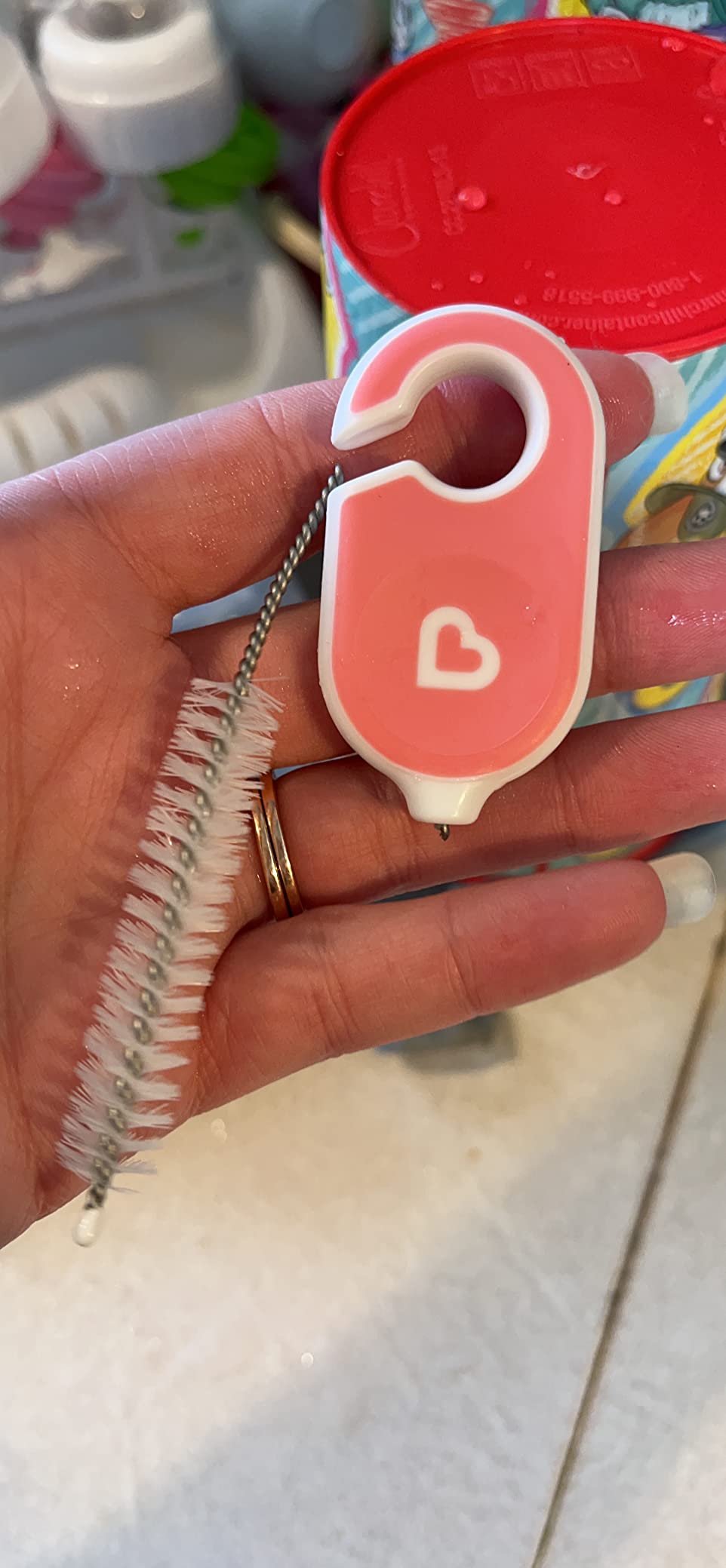
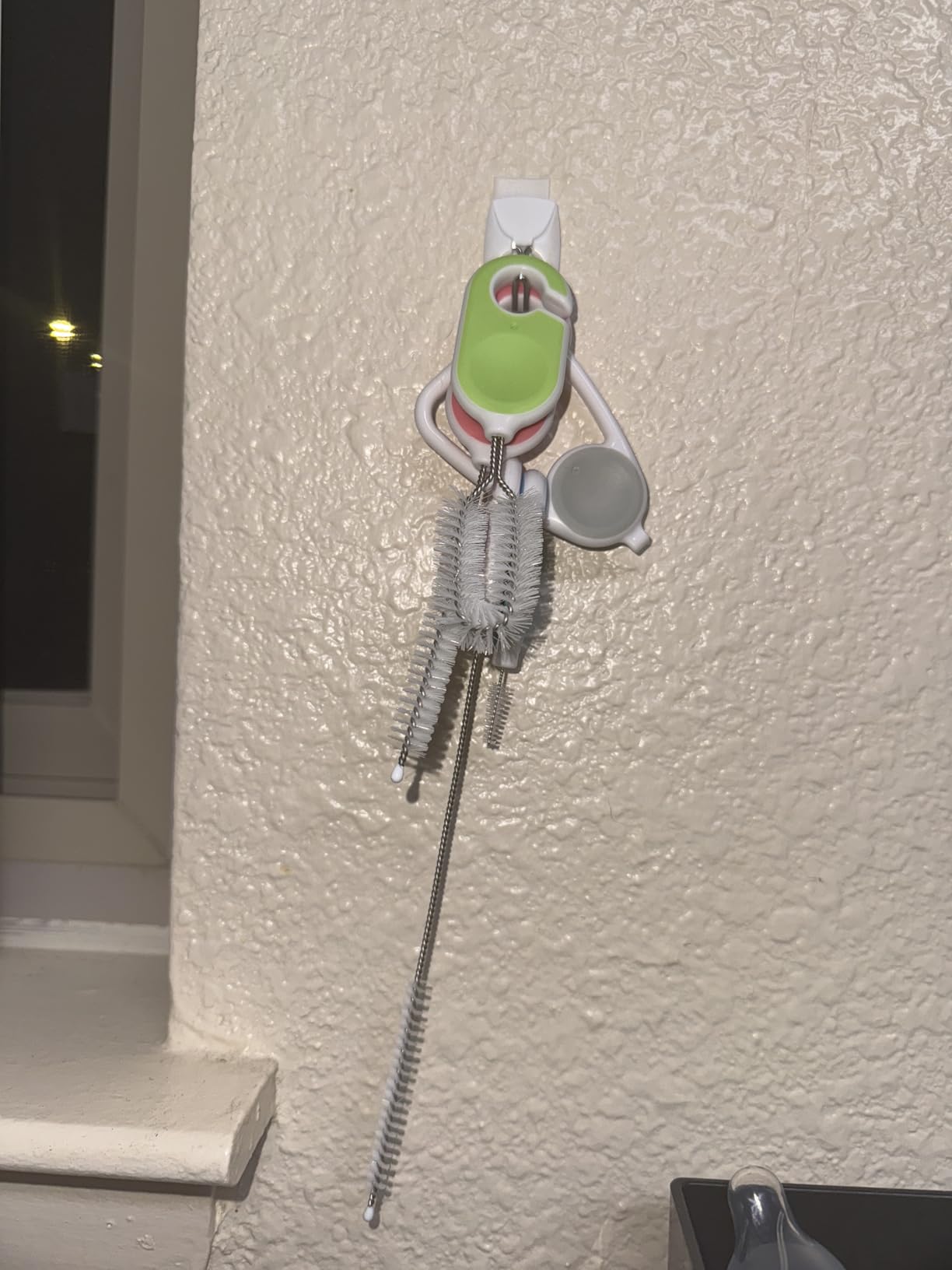
The built-in sealing ring pick is the detail that turns a bundle of tools into a real kit. A silicone seal in a sippy cup lid traps a thin film that fingers and cloth cannot shift, and the pick gets under its edge. The detachable storage ring with a hanging loop keeps all four tools together, and the handle has a finger recess for a secure hold with soapy hands.
It measures 4.25 by 1 by 11.4 inches, the listing rates it 4.8 stars across more than 7,800 reviews with about 86% five-star feedback, and it holds a #2,269 rank in Baby. The recommended surface is glass, and the handle and body material are plastic.
When a specialist kit beats a bottle brush
After around six months, most of the cleaning surface in your kitchen is not a bottle. It is a straw, a spout, a valve and a threaded lid, and none of those fit a bottle brush. This is the kit for that stage, and it is also the right addition to a straw-heavy water bottle routine.
Storage is handled well. The detachable ring means the four tools stay together instead of disappearing into the sink, and a hanging loop keeps them off the counter entirely. Tools that are easy to find get used; tools that get lost do not.
When it falls short
There is no full-size bottle brush in the set, so you will still need a separate brush for bottles. Buy it as a companion to one of the single bottle brushes here rather than instead of one.
It is also a plastic tool set intended for glass surfaces, so it is less useful on heavy silicone or soft plastics that need a gentler touch. For a kit that covers bottles and parts together, the Boon Cacti set or the Momcozy kit does both in one case.
8. OXO Tot Baby Bottle Brush with Nipple Cleaner and Stand, 2-Pack — Best for Two-Sink Households
OXO Tot Baby Bottle Brush with Nipple Cleaner and Stand, Gray 2-Pack
Two brushes plus drying stand
Dual soft and firm bristle head
Flexible neck and detail cleaner
Dishwasher safe, BPA and PVC free
Pros
- Dual bristle design lets users switch between gentle and aggressive scrubbing
- Tight bristles clean more thoroughly than open-headed brushes
- Stand catches dripping water and keeps the counter dry
- Flexible neck and detail cleaner reach into narrow bottles and tight spaces
- Two-pack allows a spare or a second sink location
Cons
- Brush head can stiffen and shrink over time
- Small nipple brush could be larger and more prominent
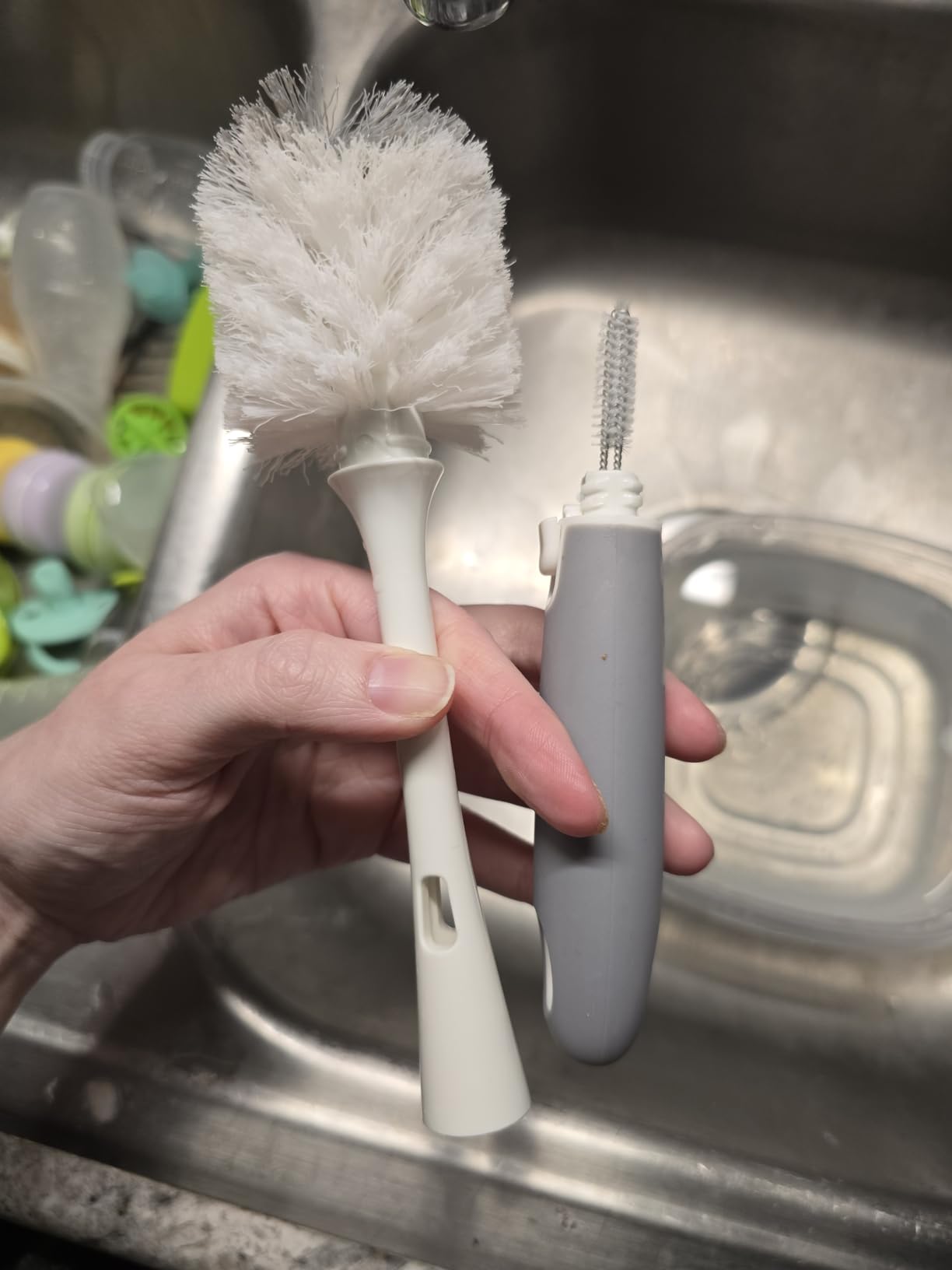
The OXO Tot set is the most complete single purchase in this roundup, because it ships two brushes and a stand. The dual bristle head is the feature that separates it from everything else here: soft bristles for teats and delicate surfaces on one side, firmer bristles for serious scrubbing on the other, on the same head.
Tight bristle spacing is the other half of that. Open-headed brushes leave gaps that dried milk bridges over, while a dense head puts more bristle tips on the same patch of bottle wall and lifts the film instead of riding over it.
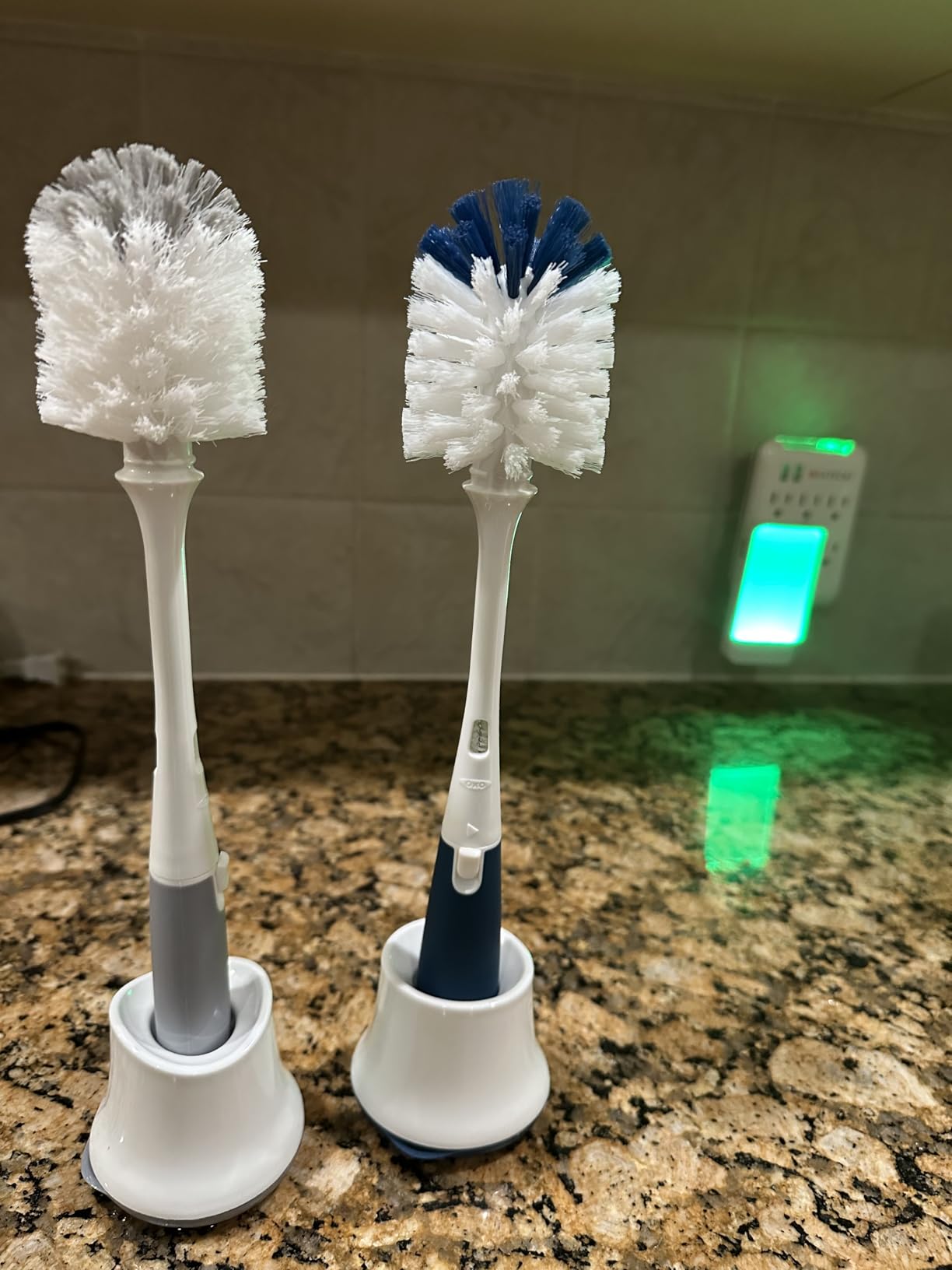
The stand catches dripping water and keeps the counter dry, and the flexible neck and detail cleaner reach into narrow bottles and tight spaces. It is BPA, phthalate and PVC free and dishwasher safe, and it measures 12 by 3 by 0.04 inches.
It sits at 4.8 stars with 90% five-star feedback, the highest five-star share in this roundup, across roughly 5,200 reviews, and it ranks #9 in Baby Bottle Brushes. Buyers frequently note it is bought as a travel set, which is fair: two brushes, one stand, and a bag between them covers a weekend away.
Why the dual head is a real upgrade
One brush for a baby bottle and another for a teat is the usual arrangement, and it doubles your sink clutter. The dual head removes that split: the soft side handles a nipple or a decorated surface, and you rotate the wand to the firm side for the base seam. It is a small design decision that removes a real step from the routine.
The two-pack matters for households with two cleaning stations. Parents cleaning bottles for daycare, or splitting duties between a home kitchen and a grandparent’s house, end up with one brush per location instead of washing a single brush back and forth.
When it is not worth the spend
One brush is enough if you wash at a single sink and travel light. The stand also takes counter space, and the small nipple brush is criticised by some buyers as too small to feel effective, so teat cleaning here is more of a bonus than a solution.
Expect the head to stiffen and shrink over time. It performs best early and mid-life, and once the soft side loses its softness the dual advantage is mostly gone, so set a replacement reminder rather than judging it by week one.
9. Tommee Tippee Closer to Nature Bottle and Teat Brush — Best Sponge-Free Design
Tommee Tippee Closer to Nature Bottle and Teat Brush Cleaning Baby
Soft durable nylon bristles
No sponge anywhere in the design
Integrated teat cleaner
Flexible 360-degree head
Pros
- Sponge-free construction avoids harbouring residue
- Flexible head reaches around the bottle for 360-degree cleaning
- Integrated teat cleaner handles nipples in the same tool
- Soft bristles suitable for Closer to Nature bottles
Cons
- Designed primarily for Tommee Tippee bottles
- Half-head shape covers less of the bottle base than a full sponge head
The Tommee Tippee brush solves one problem the rest of this roundup cannot: a sponge-free build. There is no fabric head anywhere on it, and that removes the part of a bottle brush most likely to trap a wet film of milk against the wand and go soft.
Instead, soft durable nylon bristles run along a half head that flexes around the bottle for 360-degree coverage. A dedicated teat cleaner is integrated into the tool, so nipples are cleaned with the same implement rather than a second item.
It is built for Tommee Tippee bottles, including the Closer to Nature range, which is the family it was shaped around. For a household that uses one brand across bottles, teats and formula accessories, a matched brush simply fits the geometry better than a generalist one.
The listing shows 4.6 stars across more than 4,600 reviews, with about 81% five-star feedback. That is a solid score for a specialist tool, and the recurring feedback centres on thorough cleaning with a narrower head.
Why a sponge-free design is worth choosing
Wet sponge is the weak link in bottle cleaning. A saturated sponge head pressed against a bottle base spreads a film rather than lifting it, dries slowly, and eventually sheds. A brush with no sponge at all dries between washes and has no fabric surface for residue to lodge in.
For parents who wash bottles several times a day, that is a meaningful difference in the brush’s useful life. The trade is a narrower cleaning head, and that is the honest reason this is not our top pick.
When another brush fits better
The half-head shape covers less of the bottle base than a full sponge head, so on a wide-mouth bottle with a broad floor you will make more passes than you would with the Dr. Brown’s Pink or the Munchkin Sponge.
It is also designed primarily for Tommee Tippee bottles. If your household mixes brands or collects bottles at a daycare, a neutral brush with a flexible neck and a full head will serve you more reliably.
10. Momcozy 7-in-1 Baby Bottle Brush Set with Drying Rack — Best for Travel
Momcozy 7-in-1 Baby Bottle Brush Set with Drying Rack, Green
Seven pieces in a carry case
Food-grade silicone heads
Foldable drain rack
Soap dispenser and storage box
BPA free, heads boilable
Pros
- All-in-one kit covers bottles
- straws
- nipples
- pump parts and drying in one case
- Silicone heads are hygienic
- quick-drying and odour-free
- Built-in foldable rack dries several bottles and small parts at once
- Compact waterproof case fits in a diaper bag for travel
- Everything disassembles for sanitising
Cons
- Silicone brush head builds less lather than a traditional bristle brush
- Drying rack poles comfortably hold only about three bottles at a time
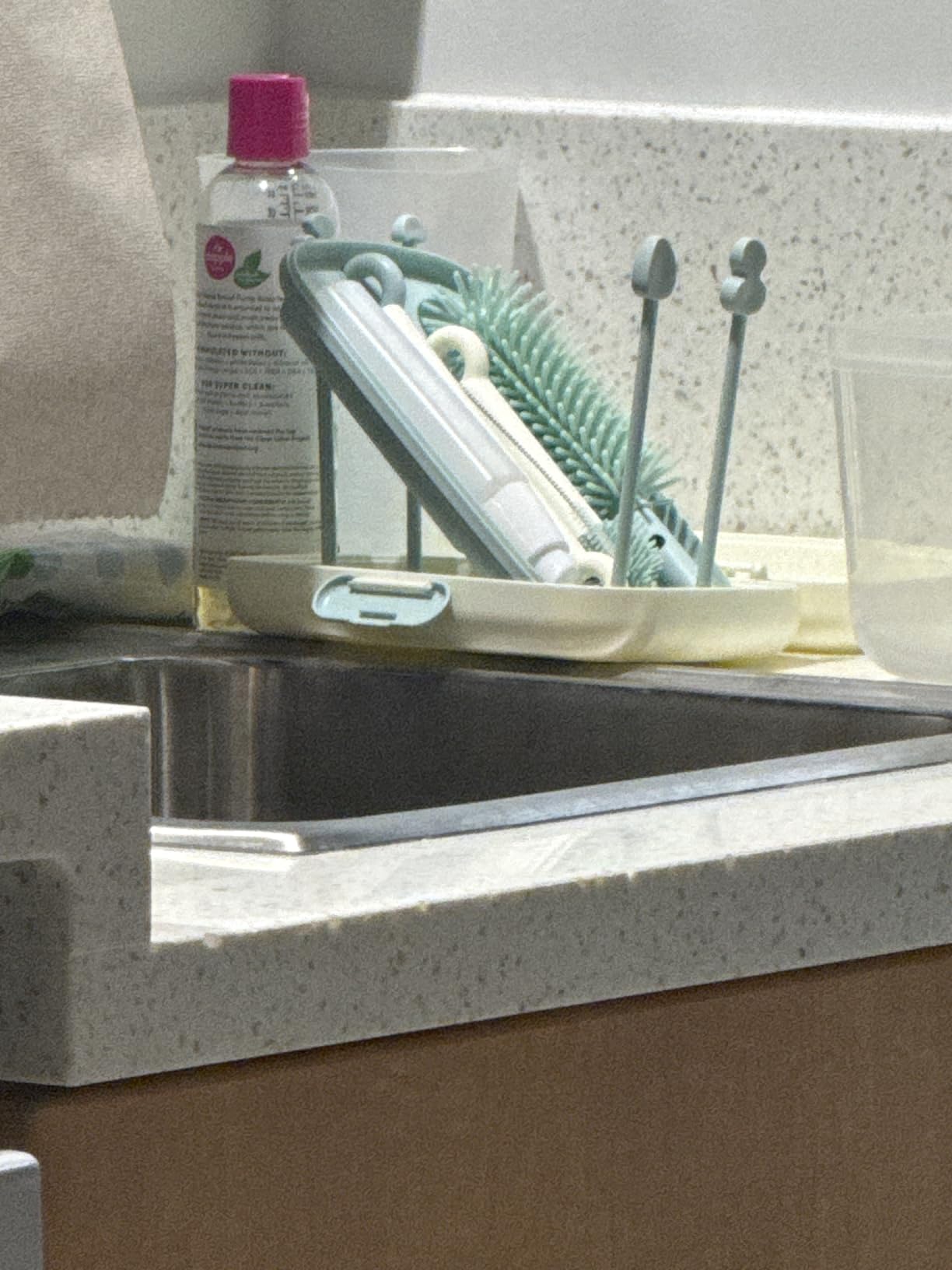
The Momcozy kit is built around a trip rather than a sink. It comes in a portable waterproof storage bag with a silicone bottle brush, a straw cleaner, a nipple brush, a soap dispenser, a drying rack and a storage box, and the whole system is sized to fit in a diaper bag.
Food-grade silicone heads are quick-drying and do not hold odour the way a sponge can, and the listing notes the heads can be boiled for sterilisation. That combination makes it the one to pack when you have no access to a proper kitchen.
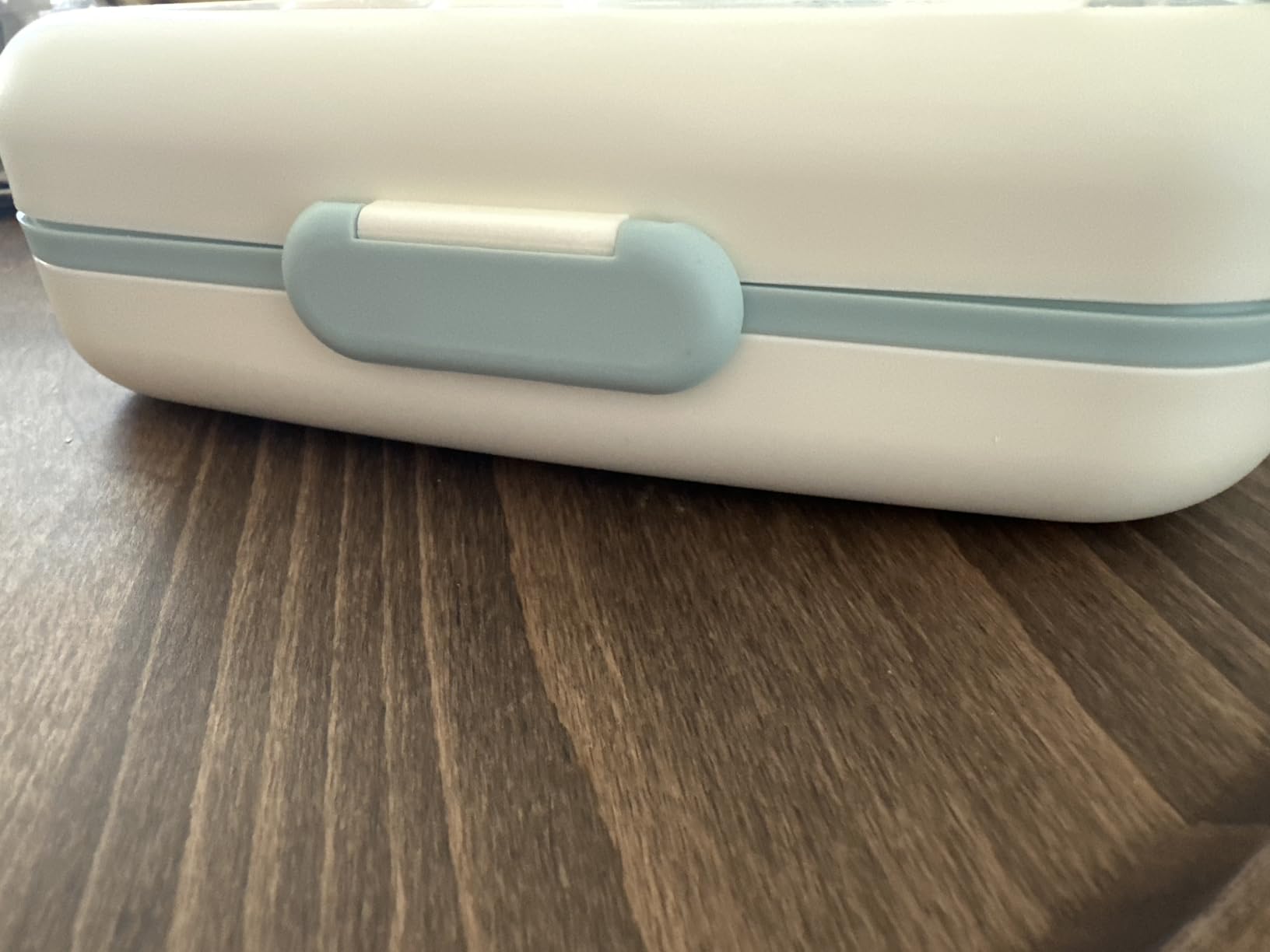
The foldable drain rack is the piece that earns its slot, because it holds multiple bottles and pump parts at once instead of balancing them on a towel. The integrated soap dispenser is small, but it removes the need to carry a bottle of detergent separately. It measures 19.1 by 11.2 by 6.8 inches folded into its case.
The listing shows 4.6 stars across more than 3,100 reviews, and it sits at #1 in Baby Bottle Brushes and #107 in Baby. The set also works on teethers, soothers and other small baby items, which broadens its use beyond bottles.
Why travel changes what you need
A travel kit is judged on setup speed, not scrubbing power. At a grandparent’s house or in a hotel sink you want everything within one case, nothing to assemble, and a way to dry parts without a rack of bottles crowding a small counter. This set answers all three.
Everything disassembles for sanitising, so you are not washing the case itself at the same time as the bottles. For a family feeding on the go, that single detail removes the most annoying part of travelling with a baby.
When to keep it at home
Silicone heads build less lather than a traditional bristle brush, and lather is what carries detergent into the bottom seam. For daily bottles that have dried on the base, a bristle or sponge head clears them with less effort.
The drying rack poles comfortably hold about three bottles at once, so on a heavy evening of multiple feeds you will be drying in batches. If your washing happens in one kitchen with plenty of space, a single full-size brush plus a stand is the simpler setup.
How to Deep Clean a Baby Bottle with a Brush?
Deep cleaning is two jobs, and parents often conflate them. Washing removes residue with detergent and mechanical scrubbing. Sanitizing reduces the microbes that survive washing, and it needs heat: boiling, steam, or a sterilizing dishwasher cycle. A brush does the first job thoroughly. For the second, read our guide to bottle sterilizers for new parents to weigh the options.
Rinse immediately after use. Cold or lukewarm water first, before milk protein sets. Scrubbing dried film takes three times the work of scrubbing a fresh bottle.
Wash and soak in hot soapy water. Let the bottle sit for a few minutes so detergent loosens the film in the base seam and neck threads.
Scrub the body. Work the head from the base upward, paying attention to the seam ring and the corners, then a second pass up the neck threads and around the collar.
Clean the nipple separately. Use the ridged nipple cleaner on the brush handle or end, working the bore and the flange, then rinse with the bottle.
Rinse, air dry and store upside down. Air drying on a rack in open air, not a closed cabinet, prevents a wet brush and a damp bottle from becoming the next problem.
Most missed cleaning happens at step three and four. The base seam and the nipple bore account for the residue that produces a bad smell the next morning, and both take only a few extra seconds with the right tool.
How to Choose a Baby Bottle Brush for Deep Cleaning
What brush to use to clean baby bottles comes down to one question: where does the dried milk actually sit? In most households it is the seam around the base, the threads inside the neck, and the nipple bore. Choose the head type that reaches those three places, and the rest is preference.
Silicone, bristle or sponge heads
Do silicone bottle brushes actually work? Yes, with one qualification. Silicone heads are non-porous, so they do not absorb milk, they dry faster than a sponge, they will not scratch glass or decorated plastic, and boil-safe models can be sterilized. What they do not do is build lather well, and lather is what carries detergent into a dried seam. Use silicone for glass, delicate bottles and travel; use bristles or sponge for a base that has genuinely dried on.
Nylon bristle brushes are the generalists. They scrub hard, tolerate boiling and a sanitizer, and the firmer heads handle pump valves and threaded lids. The cost is splaying: bristles flatten within weeks and start pushing residue rather than lifting it. Sponge-ended brushes add a soft head that works the bottle floor, which is the single most useful upgrade for deep cleaning, at the cost of a part that wears out and needs replacing.
Matching the head to your bottle neck
No competitor on this topic covers fit, and it decides whether a brush works at all. A head that is too wide simply will not enter a narrow-neck bottle, so you are cleaning the outside of the neck. Narrow-neck bottles need a slim head that can pass the collar with room to rotate; wide-mouth and wide-neck bottles accept a larger sponge-ended head and reward it, because there is more floor to cover. If you fill wide-mouth glass bottles at home rather than by hand, our automatic glass bottle filling machine guide covers the other half of that routine.
Angled bottles are the awkward middle case. A flexible neck handles the offset base far better than a straight shaft, which is the main reason the Munchkin Bristle earns its place in this roundup. If you own more than one bottle shape, neck adjustability matters more than bristle type.
Cleaning the parts most parents skip
Nipples, collars, vent inserts, sippy cup straws and lid valves are where odour survives a wash. A brush with a ridged nipple cleaner on the handle handles teats in the same motion as the bottle, and a straw brush is the only thing that reaches the bottom of a straw. Neither needs to be a separate purchase if you choose a multi-piece set, and both are worth having if you do not.
Drying matters as much as scrubbing. A ventilated stand, a suction cup base, or an upright brush design keeps water draining instead of pooling. A brush that lies in a puddle of the water it just used is carrying residue back to the next bottle. Cleaning the surrounding surfaces matters too, so our steam mop picks for deep cleaning is a reasonable next read for the kitchen floor around the sink.
How to sanitize a bottle brush and when to replace it
To sanitize a bottle brush, separate the head from the handle if it detaches and wash both. Put the head on the dishwasher top rack weekly, and keep it on a clean hook or stand to air dry head-down between uses. Check the manufacturer’s instructions before boiling, and only boil a head the manufacturer rates boil-safe, since plastic handles and glued sponge cores do not all survive it.
Replace a brush at the first sign of splayed bristles, a shedding sponge, or a head that no longer returns to shape. Manufacturers on this list suggest 30 to 45 days for daily use, and most parents ignore that guidance for far longer than they should. Parents on parenting forums report bristles flattening and being reluctant to replace them, but a flattened brush is the reason bottles need re-scrubbing twice.
One last point on sourcing. Parents frequently default to an in-store brush from a big-box retailer, and forum users report that a budget brush with a nipple attachment works well. Our verdict is that the nipple attachment and a sponge-ended head are what matter, not the brand, so a capable brush from any shelf can do this job as well as the picks above.
Frequently Asked Questions
What is a good baby bottle cleaning brush?
A good baby bottle brush has a long handle and a full-length head that reaches the bottom of tall bottles, plus a small nipple cleaner for the narrow opening most brushes miss. For deep cleaning, look for firm but non-scratchy bristles, a head diameter matched to your bottle neck, and a ventilated drying spot so the brush itself does not become a bacteria source.
How to deep clean a baby bottle?
Rinse bottles immediately after use, then soak them in hot soapy water so detergent loosens dried film. Scrub the base seam, corners and neck threads, clean the nipple separately with a ridged nipple cleaner, then rinse and air dry upside down on a rack in open air. A brush removes residue; sanitizing needs a separate heat step such as boiling, steam or a sterilizing cycle.
Do silicone bottle brushes actually work?
Yes, with one qualification. Silicone heads are non-porous, dry faster than a sponge, will not scratch glass or decorated plastic, and boil-safe models can be sterilized. They build less lather than a bristle brush, and lather is what carries detergent into a dried seam, so bristle or sponge heads are better for heavily dried bottles.
How often should I replace a baby bottle brush?
Replace a brush at the first sign of splayed bristles, a shedding sponge, or a head that no longer returns to shape. Manufacturers commonly recommend every 30 to 45 days for daily bottle washing, since bristles flatten and sponges tear out of the wand, and a worn brush smears residue instead of lifting it.
Can I put a baby bottle brush in the dishwasher?
Most models are dishwasher safe on the top rack, which is the easiest way to sanitize a brush head. Check the manufacturer instructions before boiling, because handles and glued sponge cores do not all survive high heat. Dry the head completely between uses rather than leaving it in a wet sink.
Our Best Baby Bottle Brushes for Deep Cleaning in 2026
The Dr. Brown’s Bottle Brush in pink is the best baby bottle brush for deep cleaning because it is the only tool in this roundup that covers the base seam, the sidewalls and the nipple without changing heads. The Munchkin Sponge 2-Pack is the value answer, the Boon Cacti set covers pumps and straws, and the OXO Tot 2-Pack is the one to buy when two sinks or a travel bag are part of your week.
Whichever you choose, the brush only works if it is used on the base seam and the nipple bore, dried properly afterwards, and replaced when the bristles or sponge give out. Start with one brush, watch those three parts of the routine, and the rest takes care of itself.