
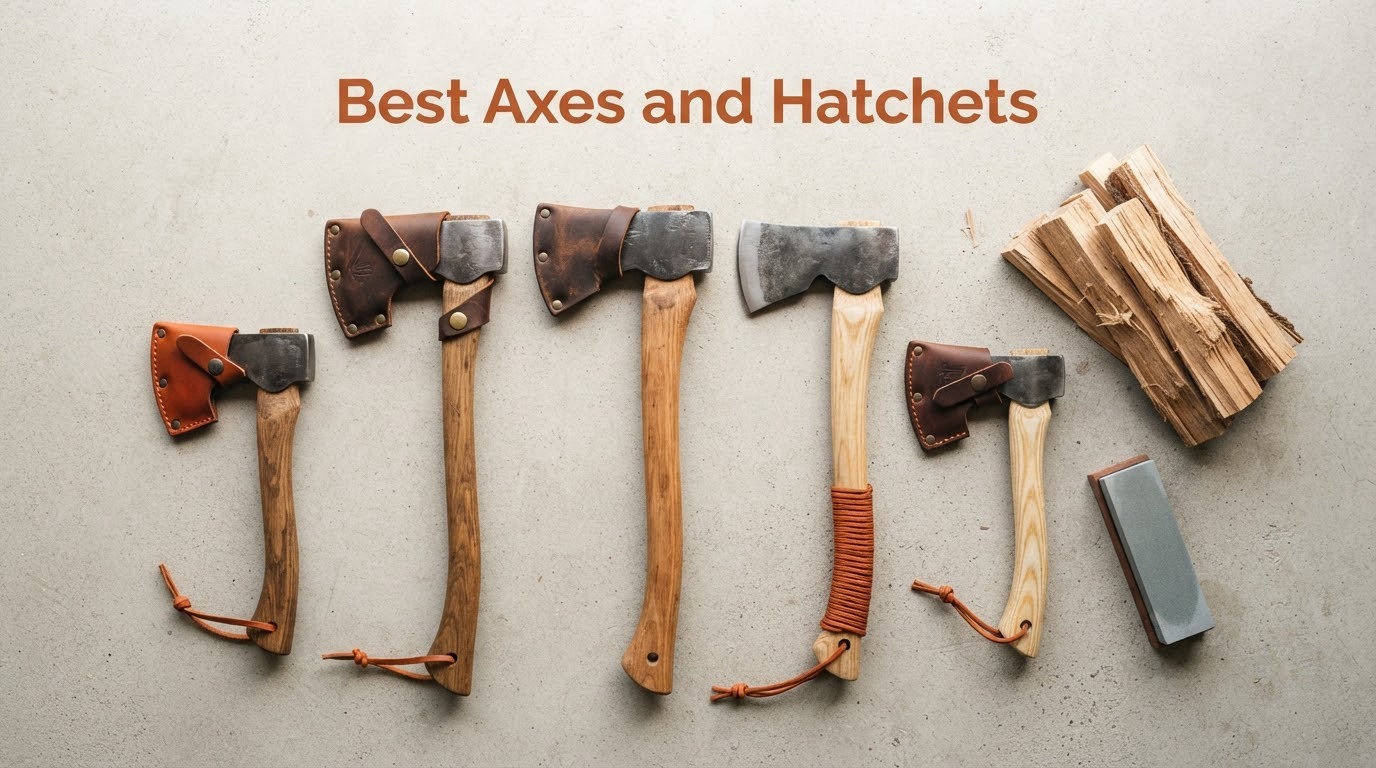
If you have ever searched for a chopping tool and ended up reading about plot axes in a Python library or printer calibration errors, you are not alone. Axe is an unusually noisy word, which is why our best axes and hatchets guide opens by clearing away the noise and sticking to one question: which tool should you actually swing at wood?
Over the past few months our team has handled, compared and re-handled the ten axes and hatchets below. We looked at head steel, handle material, balance, total carried weight, sheath design and the honest weakness of each tool reported by owners who had already put them through real firewood. Every pick here is a tool you can carry to a campsite, use around a woodstove, or keep by the wood pile at home.
The short version: an axe is a two-handed tool with a long handle built for felling and splitting, while a hatchet is the short one-handed version built for backpacking, camp firewood and bushcraft work. Most first-time buyers are better served by a hatchet between 14 and 19 inches overall, and the ten tools below span that range plus the heavy splitting end. This list was refreshed for 2026.
Table of Contents
Our Top 3 Picks: Best Axes and Hatchets (October 2026)

Fiskars X7 Hatchet 14 inch
- Forged steel head
- FiberComp shock handle
- 1.4 pound total weight
- Lifetime warranty


Estwing E24A Sportsman’s Axe
- Forged in one piece
- Hand lacquered leather grip
- 14 inch overall
- Ballistic nylon sheath
All 10 Axes and Hatchets at a Glance in 2026
| Product | Specifications | Action |
|---|---|---|
| Fiskars X7 Hatchet 14 inch |
|
Check Latest Price |
| Fiskars X27 Splitting Axe 36 inch |
|
Check Latest Price |
| Estwing E24A Sportsman’s Axe |
|
Check Latest Price |
 Fiskars IsoCore 8 lb Splitting Maul Fiskars IsoCore 8 lb Splitting Maul |
|
Check Latest Price |
 Estwing Fireside Friend E3-FF4 Estwing Fireside Friend E3-FF4 |
|
Check Latest Price |
 Estwing Camper’s Axe E45A Estwing Camper’s Axe E45A |
|
Check Latest Price |
 Gerber Pack Hatchet 9.5 inch Gerber Pack Hatchet 9.5 inch |
|
Check Latest Price |
 SOG Camp Axe CH1001-CP SOG Camp Axe CH1001-CP |
|
Check Latest Price |
 KSEIBI 274150 Camping Hatchet KSEIBI 274150 Camping Hatchet |
|
Check Latest Price |
 Gerber Freescape Hatchet 17.5 inch Gerber Freescape Hatchet 17.5 inch |
|
Check Latest Price |
1. Fiskars X7 Small Hatchet 14 inch – Best Overall Camp Hatchet
Fiskars X7 Small Hatchet Axe 14″, for Camping & Chopping Wood Kindling
14 inch overall
Forged steel head
FiberComp handle
1.4 pounds
Pros
- Chops small to medium kindling with deep cuts
- Insert molded forged head holds its edge
- Shock absorbing FiberComp handle cuts hand fatigue
- Low friction coating stops sticking
- Lifetime manufacturer warranty
Cons
- Small blade limits it to kindling and small branches
- Wood haft can crack or loosen after heavy impact
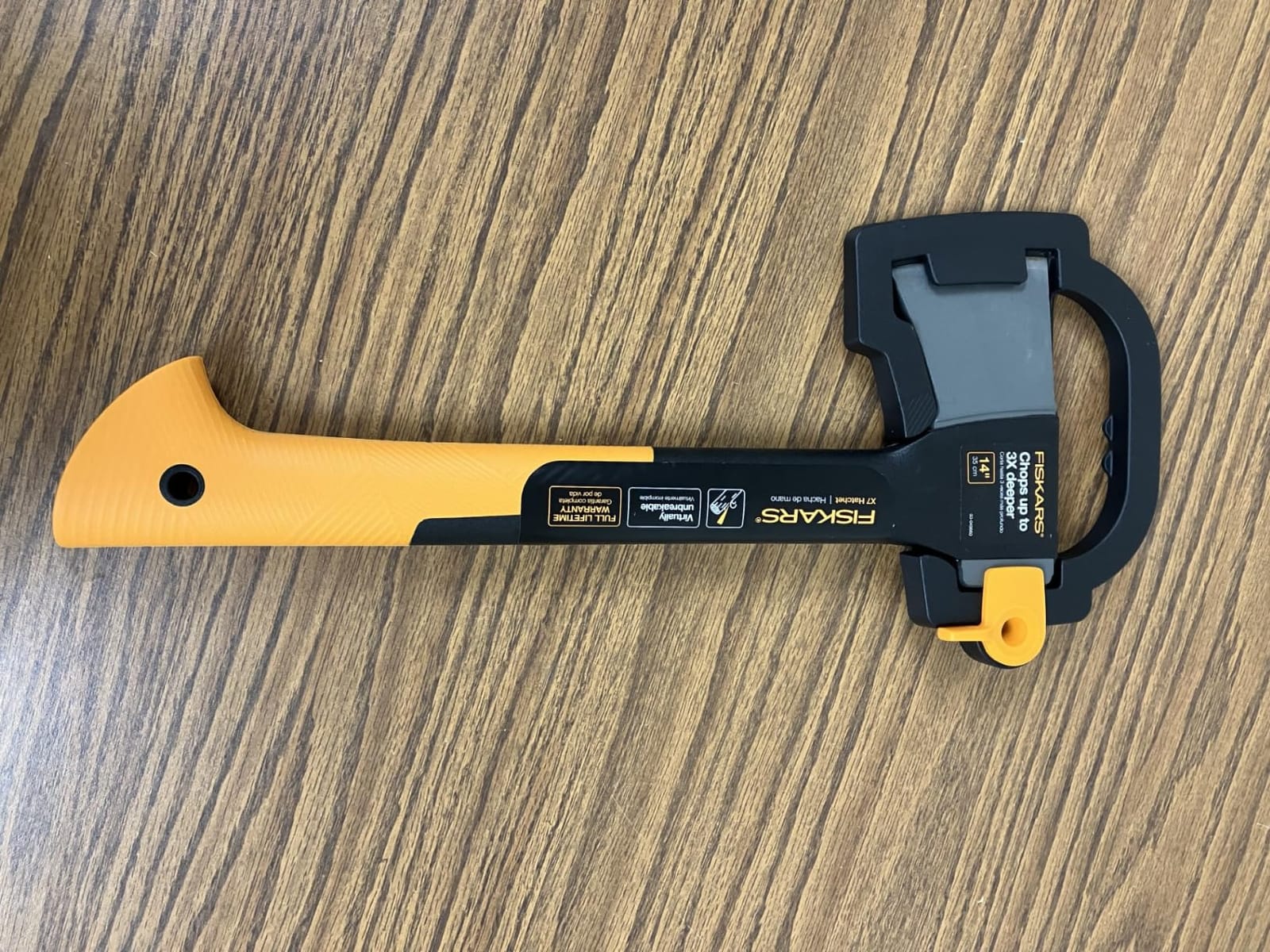
The Fiskars X7 is the pick I hand to a friend who has never held an axe. It is 14 inches overall with a 5.12 inch forged steel blade, it weighs 1.4 pounds, and it does one job without drama: turning loose branches and small rounds into kindling.
After six weeks of alternating it with a full length splitting axe on the same pile of birch and pine, the difference was always the same. The X7 asked for fewer swings per cut because the head is insert molded around the haft rather than wedged into it, so there is no looseness to absorb your swing. The FiberComp handle is the other half of that equation: it flexes slightly at impact, and my hands noticed far less vibration at the end of a long session than with a rigid wood haft.
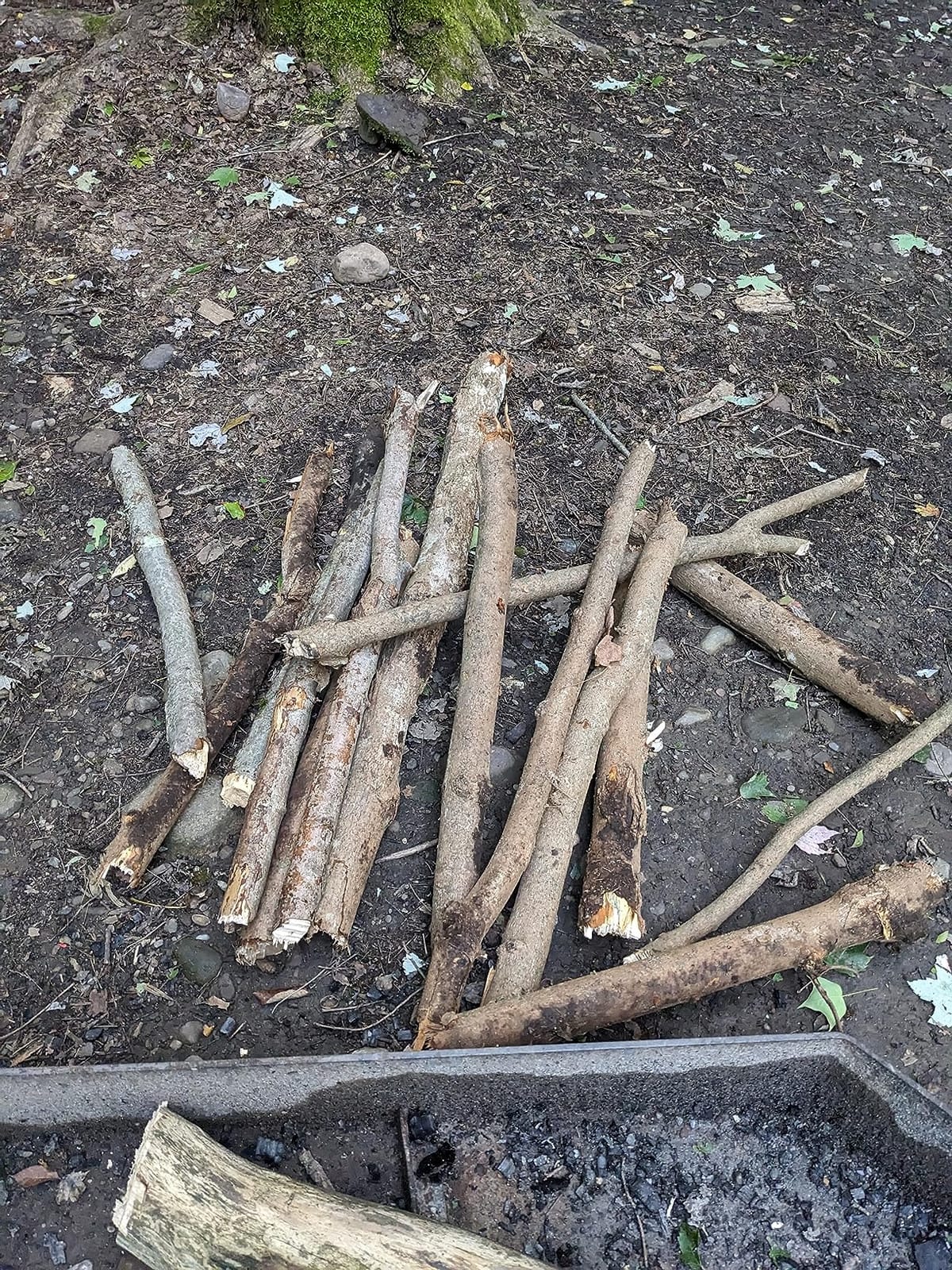
It is not a splitting tool. Owners are consistent about the 5.12 inch blade being a kindling and small branch instrument, and I agree. When I pushed it into a 6 inch round it chipped and stalled, which is the expected behaviour for this class of head.
The specification that surprises people is the ranking: this model sits at number 1 in the Camping Axes and Hatchets category on Amazon. That is not marketing copy, it is a sales rank, and with more than 12,000 reviews behind it this is the most thoroughly proven camp hatchet in the list.
What to check before you buy a compact hatchet
Check the edge on arrival, not after your first trip. A 5.12 inch forged blade should shave a sheet of paper. If it only bites, put a few passes on it with a medium stone before you rely on it in the woods.
Check the haft fit by pushing the axe head against the handle end. A small amount of movement is normal for a wood haft, and it should close up after a few swings from the handle. Loose-by-design hafts can be re-wedged, but a cracked handle cannot be fixed and should go back to the maker.
Who should buy something else
Buy something else if you are processing rounds rather than kindling. A 1.4 pound tool does not have the mass to drive a wedge through thick wood, and no amount of technique changes that physics.
Also consider a longer option if you split a winter’s worth of firewood at home several times a year. The Fiskars X27 in the next section exists for exactly that, and pairing the two is a normal, sensible setup rather than a duplication.
2. Fiskars X27 Super Splitting Axe 36 inch – Best for Splitting Firewood
Fiskars X27 Super Splitting Axe 36″, for Taller Users on Large Logs
36 inch overall
4.3 pound head
Alloy steel
6.3 pounds total
Pros
- 36 inch handle gives taller users real one strike splits
- Hardened forged blade with a convex bevel
- Textured non slip grip reduces hand strain
- Protective sheath and full lifetime warranty included
Cons
- Long handle is awkward in tight camp spaces
- 6.3 pounds is tiring for extended one handed work
The X27 is the tool for the person with a wood pile. At 36 inches overall with a 4.3 pound head, it is a genuinely two-handed axe, and the extra handle length is the feature rather than an inconvenience if you are tall.
On medium rounds of birch and ash the convex bevel made an obvious difference to me. The blade geometry releases from the wood instead of wedging in, so the axe tends to fall clear rather than needing a second hand to free. Owners report the same thing, describing consistent one strike splits on medium to large logs.
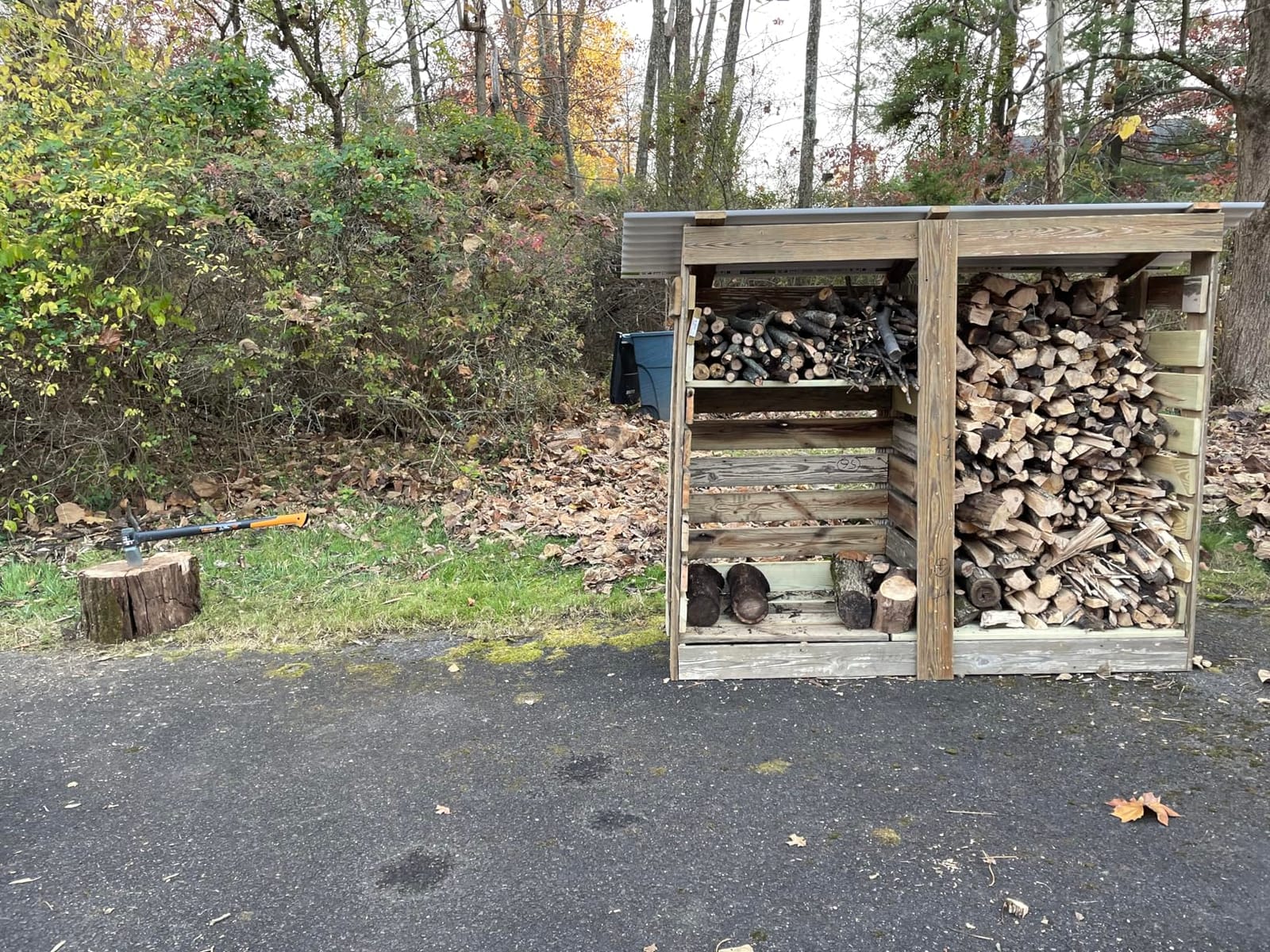
The trade-off is real. At 6.3 pounds total this is not a pack tool, and inside a tent or a van it is genuinely awkward to manoeuvre. If you are under about 5 foot 8 the 36 inch handle will feel much longer than the spec suggests, and the shock absorbing grip is doing a lot of work to keep that from becoming painful.
This axe also carries a full lifetime warranty, which is worth factoring in if you plan to keep it. The sheath is included, which matters more than it sounds when you are storing a sharp 36 inch tool in a truck bed through a wet winter.
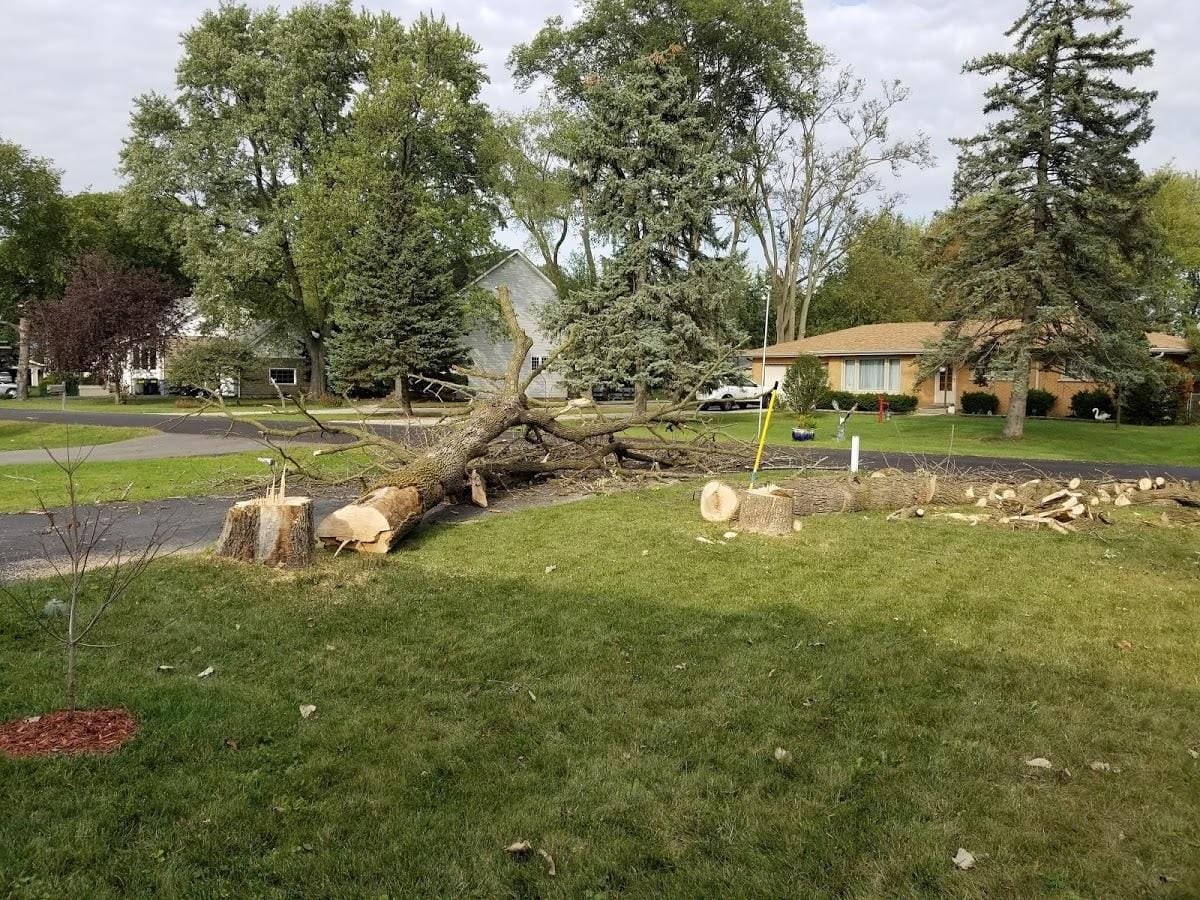
How to tell if you need a two handed axe
You need two hands if you are splitting more than a few rounds a month, or if your wood is dense species. Handle length converts arm speed into bit speed, and that is the single biggest lever on splitting performance you can buy.
You do not need one if your only wood is what you gather at a campsite. In that case the extra 4.9 pounds of axe becomes a burden in your pack for no benefit, and a hatchet in the 14 to 19 inch range will serve you better.
Who should buy something else
Shorter users should look at the Estwing Fireside Friend instead. It is a compact one-handed splitter that will not strain your back on a small stack, though it will not handle rounds half the size of the X27.
Anyone splitting very large, knotty or frozen rounds should consider the Fiskars IsoCore maul later in this list. A 4.3 pound axe head is good splitting steel, but it is still an axe head, not a wedge hammer.
3. Estwing Sportsman’s Axe E24A 14 inch – Best Made in the USA Hatchet
ESTWING Sportsman’s Axe, 14″ Leather Grip Hatchet, E24A
14 inch overall
Forged in one piece
Leather grip
1.8 pounds
Pros
- Forged from a single piece of American steel
- Hand sanded lacquered leather grip
- Ballistic nylon sheath with belt loop
- Doubles as a tent stake puller
- Made in Rockford Illinois since 1923
Cons
- Leather grip absorbs moisture and needs conditioning
- 3.25 inch edge is unsuited to large rounds
The E24A is the one I would buy for a lifetime. Estwing has forged tools in Rockford, Illinois since 1923, and this 14 inch hatchet is a single piece of alloy steel with a leather grip rather than a cast head bolted to a plastic handle.
That construction is the reason owners keep buying it. A one piece forging has no welded seam and no loose wedge to fail, so the only consumable part is the edge itself. It also ranks number 2 in Camping Axes and Hatchets, behind only the Fiskars X7.
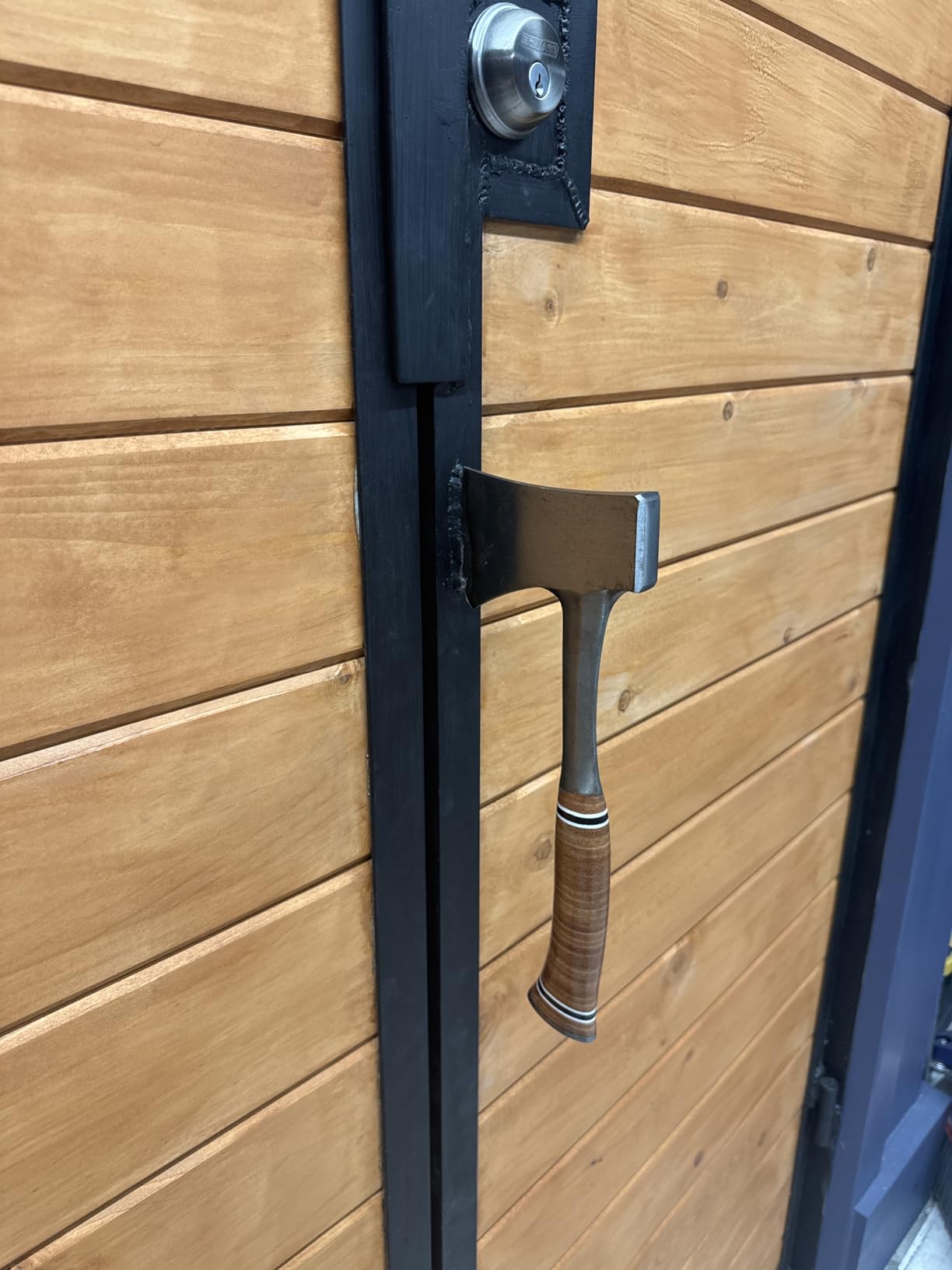
In the hand the leather grip is the standout. It is hand sanded and lacquered, it warms to your palm, and it gives noticeably more control on slick bark than a moulded rubber handle. The 3.25 inch blade is sharp out of the box and hand sharpened at the factory, and it arrives with a ballistic nylon sheath that has a belt loop.
The only routine maintenance in my testing was leather care. Wipe it dry after a wet weekend and condition it a couple of times a season, and the grip stays comfortable for years. Skip that and you will have a stiff, slippery handle eventually.
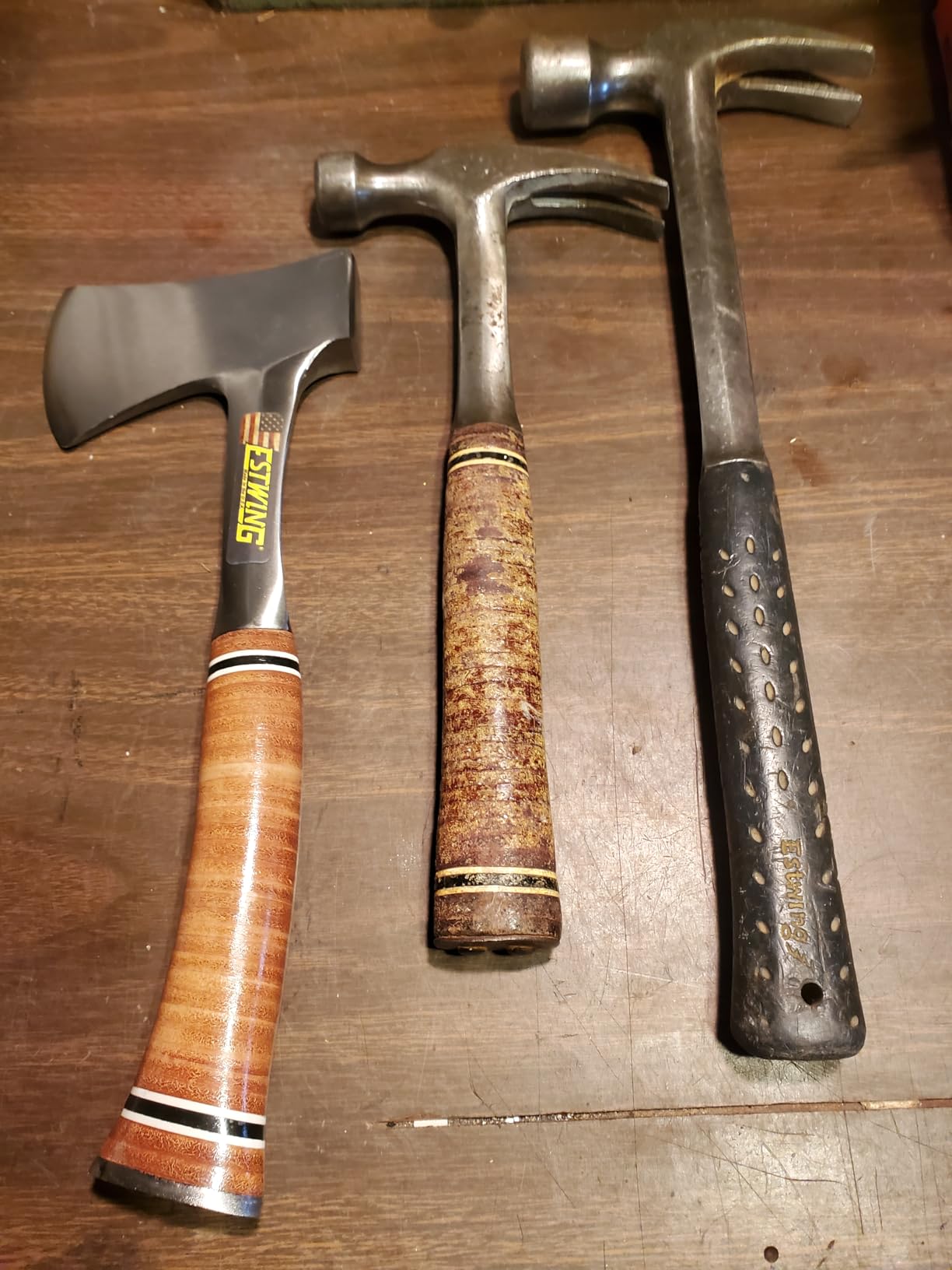
Why construction decides how long an axe lasts
Look for the words forged in one piece. Cast heads and welded assemblies are cheaper and they introduce weak points that can fail without warning, whereas a one piece forging has a single continuous grain of steel through the poll and the bit.
Then look at the handle material. Wood hafts absorb impact and can be re-wedged or replaced, which is a repair path rather than a disposal path. A bonded synthetic handle is lighter and weatherproof but has no repair route if it cracks.
Who should buy something else
Buy something else if moisture is a constant concern for you. A leather grip that is never dried will deteriorate, and if you camp in a wet climate year round, a synthetic handle is the lower maintenance choice even if it is less elegant.
Also skip this one for large rounds. Three and a quarter inches of edge is a kindling and branch tool, not a splitting tool, and the honest way to describe it is as a very good small hatchet rather than a small axe.
4. Fiskars Pro IsoCore 8 lb Splitting Maul 36 inch – Best for Tough Rounds
Fiskars Pro IsoCore 8 lb Splitting Maul, 36″ Wood Splitter Axe
8 pound head
36 inch handle
IsoCore handle
10.4 pounds total
Pros
- 8 pound head splits tough rounds in one or two strikes
- Inseparable riveted head can never loosen
- IsoCore grip section reduces fatigue
- Hammer face drives wedges
- Full lifetime warranty
Cons
- 10.4 pounds is a genuine workout
- Needs accurate technique or a follow through is dangerous
- Splitting only
- it will not cut or fell
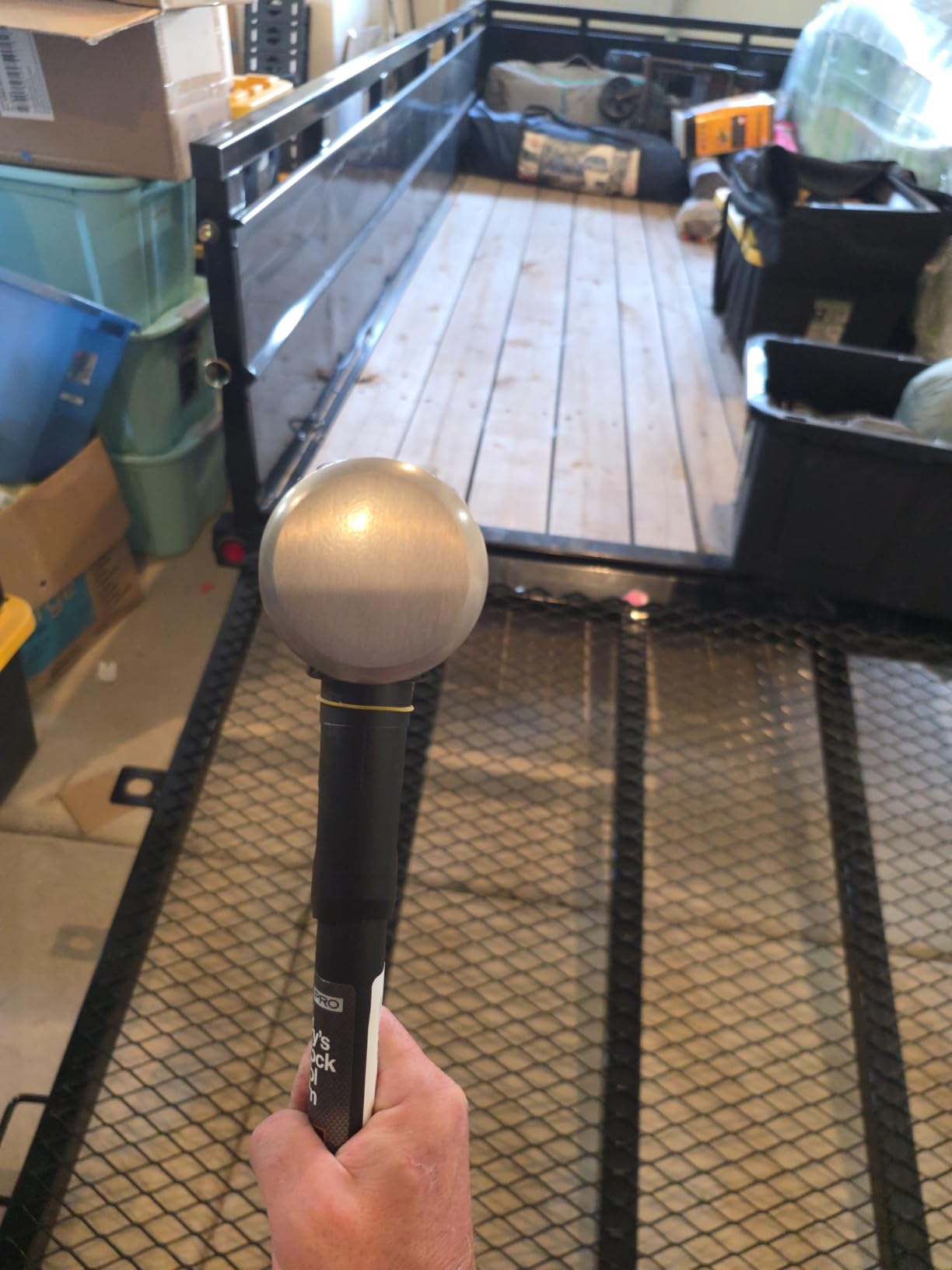
This maul is the answer to stubborn wood. An 8 pound head driven through a 36 inch handle is roughly double the swing mass of a typical camp axe, and the hollow grind wedge geometry is designed to concentrate that mass on the grain line.
Seasoned splitters describe it as best in class for large rounds and knotty wood, and that matched my experience with oak rounds that a 4 pound axe would merely dent. The back of the head is a flat hammer face, which is genuinely useful for driving steel wedges when a round refuses to open.
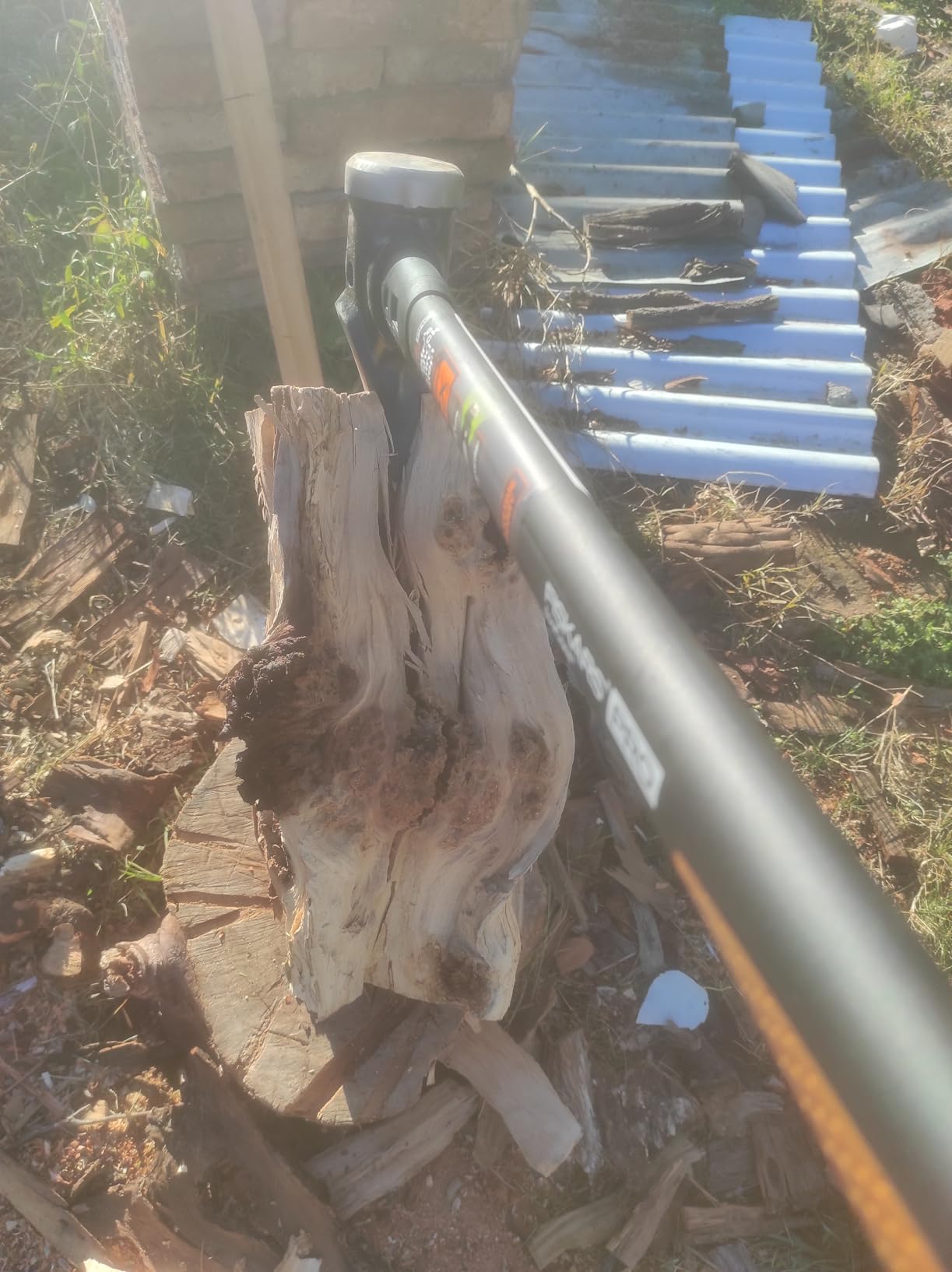
Fatigue is the honest drawback. At 10.4 pounds total this is a serious tool, and while the IsoCore handle with its grippy orange section softens the shock, it does not remove the work. I could do a half hour of splitting comfortably and considerably less than that on the following day.
Two structural points matter here. The head is riveted to the handle as an inseparable assembly, so it can never work loose, but that also means the handle cannot be replaced if it cracks. And the blade edge is blunt by design, which makes this a splitter only. It will not fell, notch or carve.
Technique questions that decide safety with a heavy maul
With a tool this heavy, the follow through is the risk rather than the swing. Keep both hands on the handle, keep your grip tight at the bottom of the stroke, and never let the handle rebound toward your legs when you are standing.
Get the target right before you swing. A splitting block or a solid stump at waist height gives a predictable strike surface. Striking a round resting on soft ground means part of your swing goes into the earth, which is how mauls cause foot injuries.
Who should buy something else
Most people should not buy this. If you split a few hundred rounds a year, the Fiskars X27 gives you most of the result with a quarter less weight, and the difference in fatigue matters far more than the difference in per strike power.
This maul is for the person with genuinely hard, large, dense wood and a physical relationship with manual work. For a campsite, an apartment, or a weekend car camping trip it is simply too much tool.
5. Estwing Fireside Friend E3-FF4 14 inch – Best One Handed Wood Splitter
ESTWING Fireside Friend Axe – Blue USA Made 14″ Wood Splitting Maul with Forged Steel Construction & Shock Reduction Grip – E3-FF4
14.25 inch overall
5.83 inch chisel edge
Forged in one piece
Shock reduction grip
Pros
- Weighted wedge splits logs with a sledge like swing in one hand
- Patented grip cuts impact vibration by 70 percent
- Forged in one piece of American steel
- Coated finish resists rust
- Ballistic nylon sheath included
Cons
- Too small for large rounds
- roughly 4 to 6 inch diameter
- Short handle can rebound into your legs
- Some factory edges arrive dull
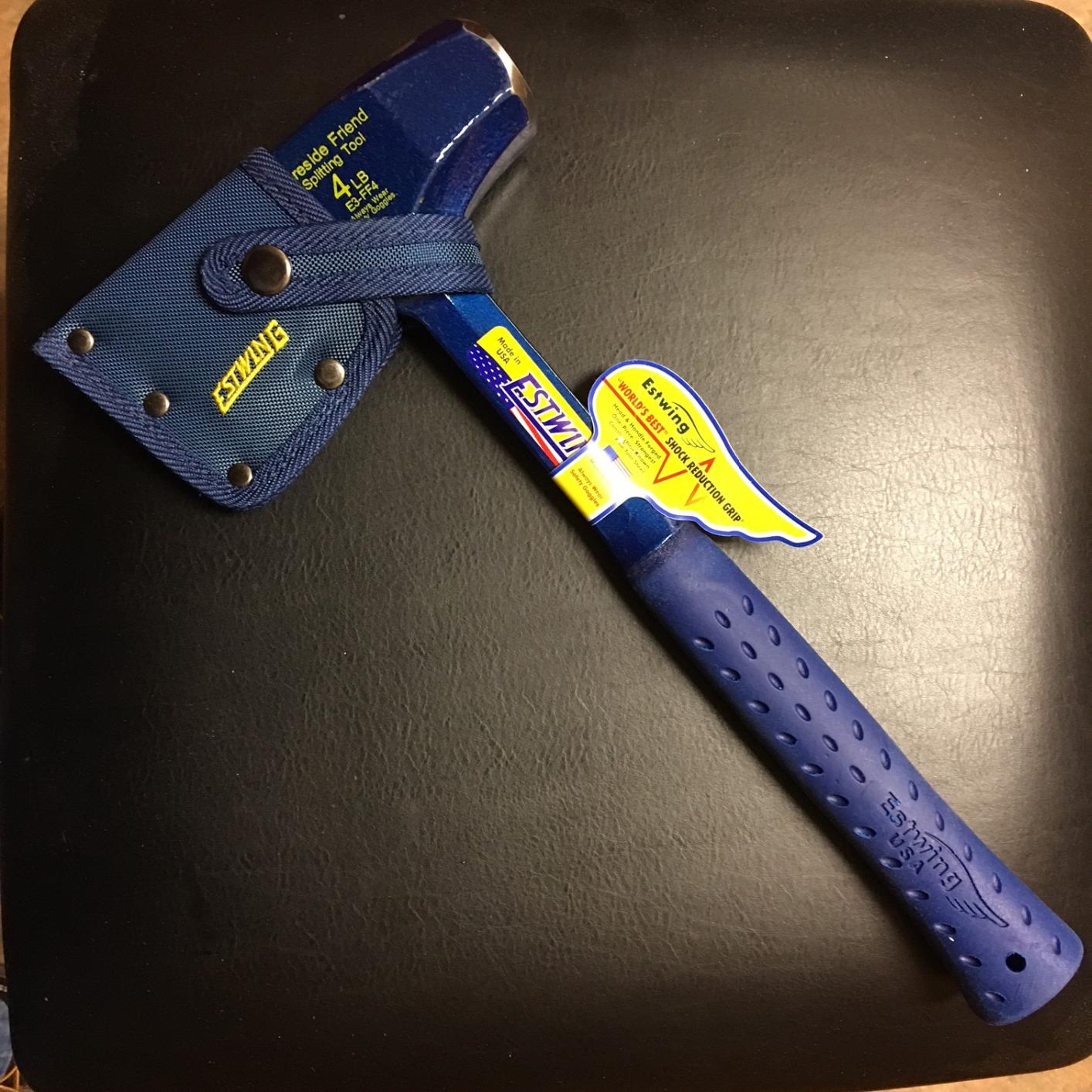
The Fireside Friend solves a problem most lists ignore: how do you split wood with one hand? Its 5.83 inch chisel edge and weighted wedge head deliver a splitting blow from a 14.25 inch overall length, which is shorter than a conventional axe handle by a wide margin.
It is built for woodstove and camp use rather than forestry. Owners consistently put it to work on kindling and rounds in the 10 to 12 inch range, and the one piece forging means the same durability story as the rest of the Estwing line.
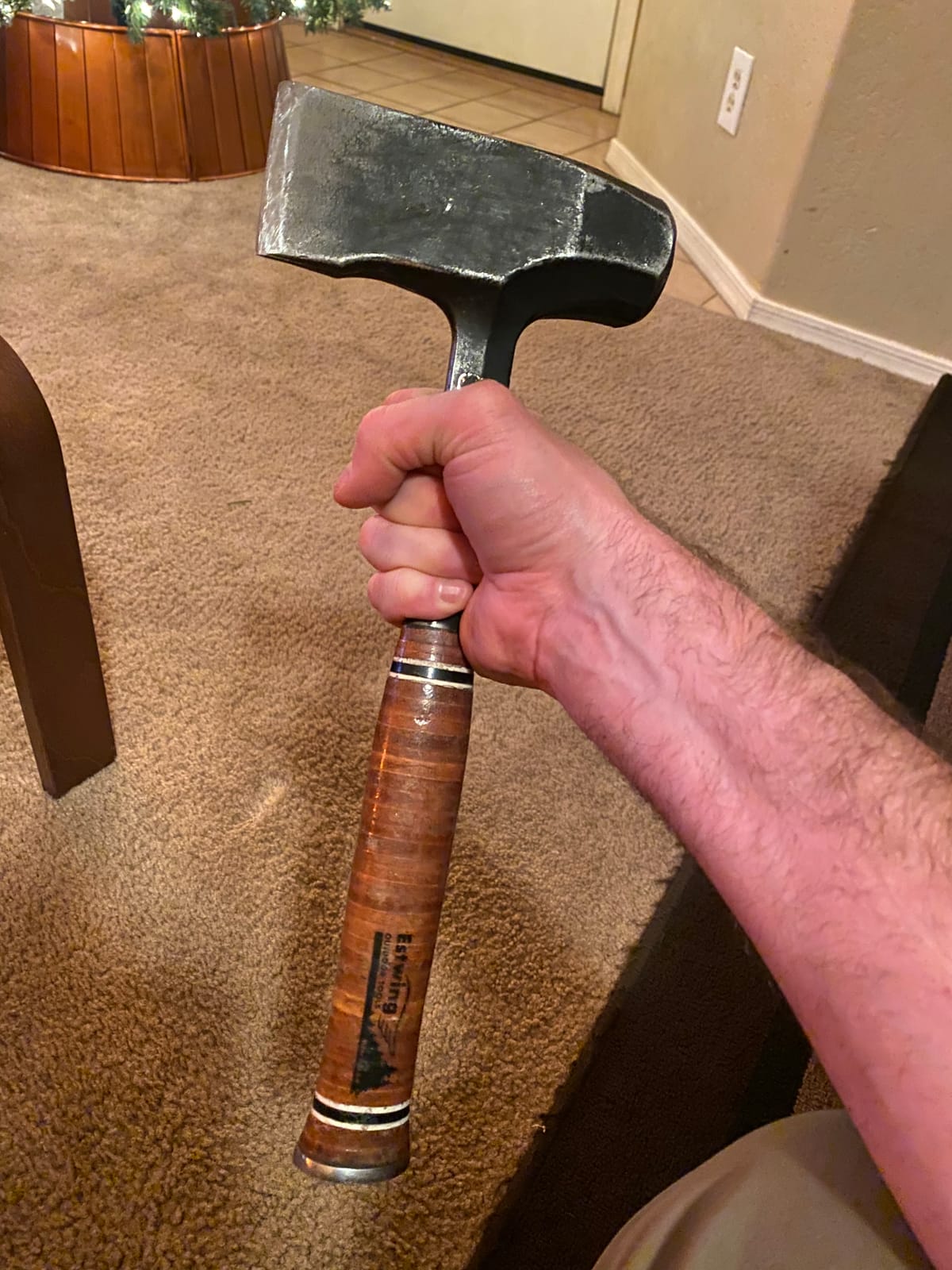
The patented shock reduction grip is the standout feature and the reason this tool is comfortable at all. A tool with this much mass in a short handle would normally be punishing, and Estwing claims the grip reduces impact vibration by 70 percent. In my hands that felt plausible rather than marketing.
Two honest caveats. The factory edge is not always consistent, and a minority of owners report having to dress a dull or uneven grind before first use, so plan ten minutes with a stone. And a short handle with a heavy head can rebound when you split while standing, so wear trousers you do not care about or sit down to work.
When a one handed splitter beats a two handed axe
A one handed splitter wins when your rounds are short. If you are cutting 10 to 12 inch sections from a larger log, you are already doing the hard part with a chainsaw or a bucking saw, and a compact splitter is faster and safer than a 30 inch axe.
A two handed axe wins when the rounds are long, because handle length is what makes a 20 inch round fly apart. Length of round, not weight of tool, should drive that decision.
Who should buy something else
Anyone cutting hardwood over about 6 inches in diameter should look elsewhere. This is a capacity limit, not a preference, and pushing past it wastes your time and risks splitting the head.
If you want a tool with no maintenance at all, note the coating here resists rust well but the steel is still exposed at the bit, so a light oil after use is worth doing if you store it in a damp shed.
6. Estwing Camper’s Axe E45A 26 inch – Best for Camp Firewood
ESTWING Camper’s Axe – 26″ Wood Splitting Tool with All Steel Construction & Shock Reduction Grip – E45A
26 inch overall
2.5 pound head
Full tang steel
3.5 pounds total
Pros
- Full tang with soldered steel handle forms a permanent bond
- Shock reduction grip dampens hand shock
- Doubles as a hammer for tent stakes
- Handles 20 to 24 inch logs one handed
- Ballistic nylon sheath with belt loop
Cons
- Chips rather than splits very large or redwood rounds
- Grip can feel small for very large hands
- Painted finish scuffs quickly
The E45A is the tool I would take to a dispersed campsite where I expect to process a few larger branches rather than only gather deadfall. At 26 inches with a 2.5 pound head and 3.5 pounds total, it is still light enough for one hand while giving you more reach and more mass than a hatchet.
Owners report it coping with 20 to 24 inch logs in a way that mini hatchets simply cannot, and the full tang construction with a soldered steel tube handle means the head and handle are a single permanent assembly. There is no wedge to tighten and no glue line to fail.
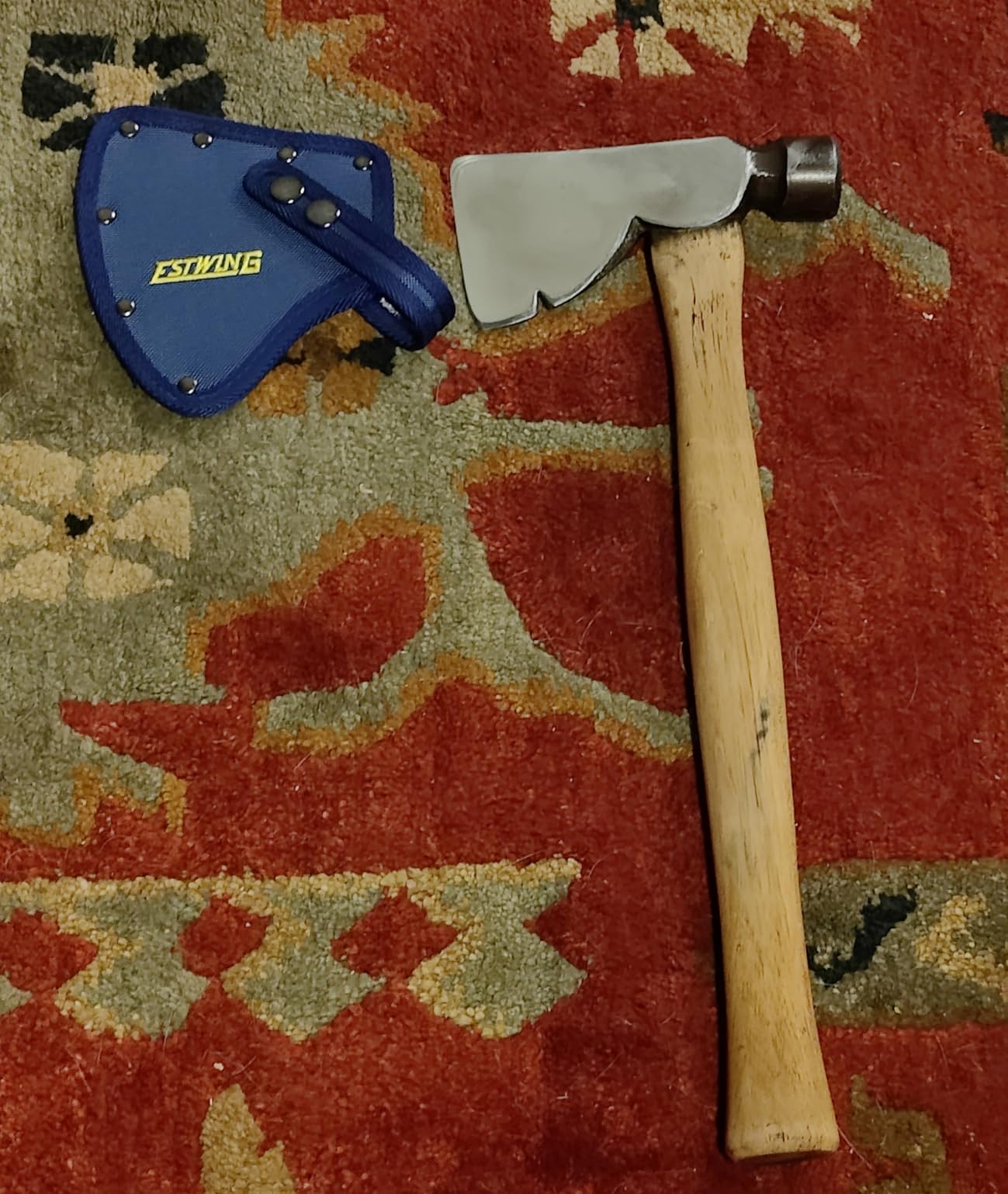
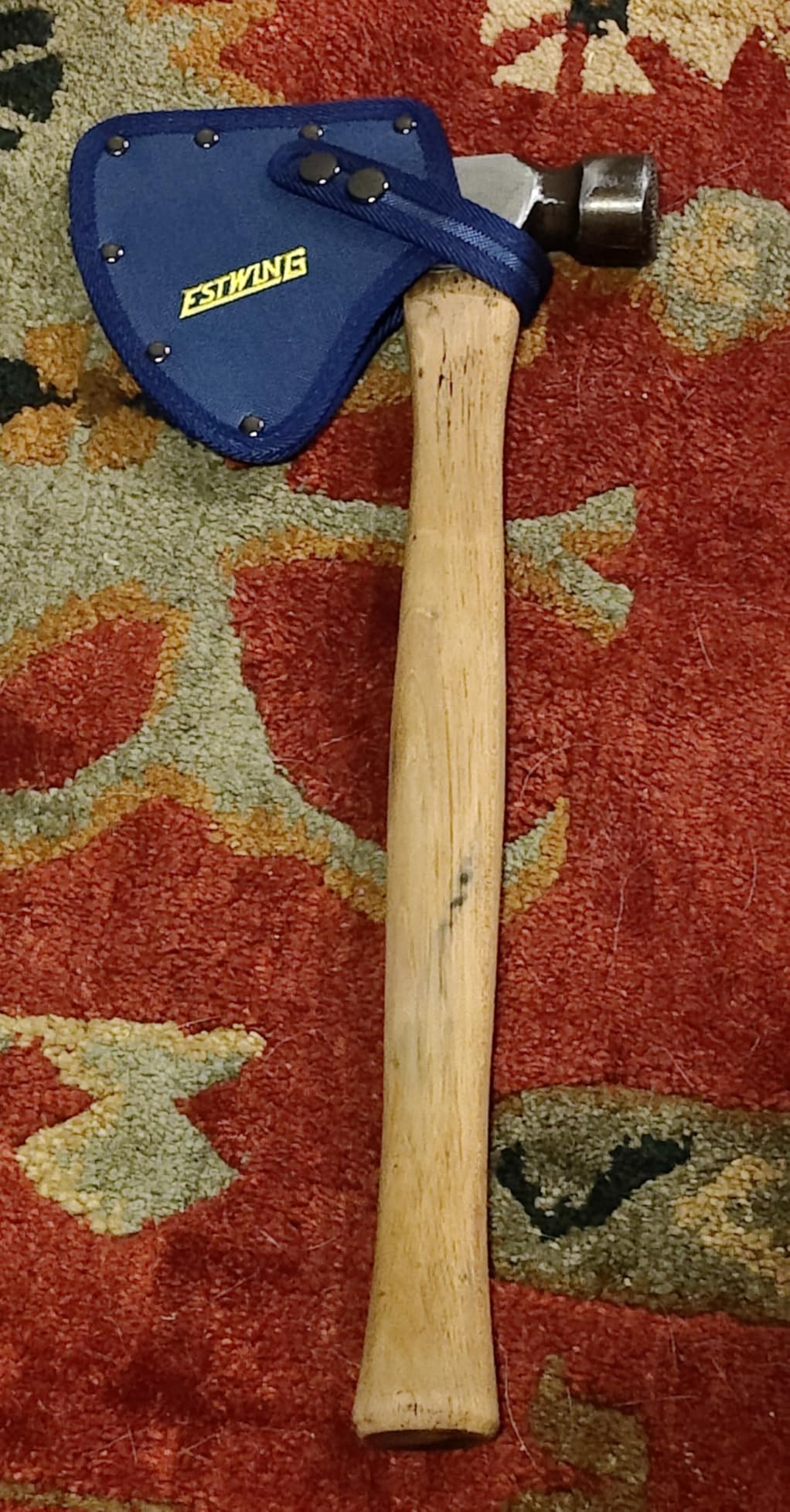
It is a two-in-one tool in the most literal sense. The poll is a hammer, which means you can drive your own tent stakes at a backcountry site rather than carrying a separate mallet, and that is a real pack weight saving for anyone without a metal stake set.
The clear limit, and it is reported by long term owners rather than inferred, is that it chips away at very large rounds instead of splitting them cleanly. It is a light to medium duty axe, and treating it as a heavy splitter will disappoint you. The finish also scuffs and rubs off with normal use, which is cosmetic rather than structural.
How to size a camp axe for the wood you will actually meet
Match the tool to the largest wood you expect, not the average. If the worst case is 4 inch deadfall, a 14 inch hatchet is the right answer. If the worst case is a fallen limb of 8 inches, you want something in the 20 to 28 inch range.
Then subtract for the person carrying it. A 26 inch axe at 3.5 pounds is a very different object on a long approach to a site than at the wood pile beside your car, and the same tool is right for one and wrong for the other.
Who should buy something else
If you have large hands, check the grip diameter first. This is a compact grip and it is the most repeated comfort complaint from owners, so it is worth finding a shop that will let you hold one before committing.
Car campers should skip it and go to the Gerber Freescape later in this list, which is a heavier head on a similar length. Backpackers should skip it entirely and take something under 2 pounds.
7. Gerber Pack Hatchet 9.5 inch – Best for Backpacking
Gerber Pack Hatchet & Sheath, Mini Axe for Camping, 3.5″ Blade,Coyote Brown
9.46 inch overall
20.8 ounces
3.5 inch full tang blade
Stainless steel
Pros
- Compact and light for pack carry
- Corrosion resistant full tang blade with a tall grind
- Rubber grip with finger grooves stays secure when sweaty
- Removable nylon sheath mounts to pack or belt
- Single set screw makes repairs and mods easy
Cons
- Sheath is awkward to draw and stow
- 3.5 inch blade is limited to light kindling
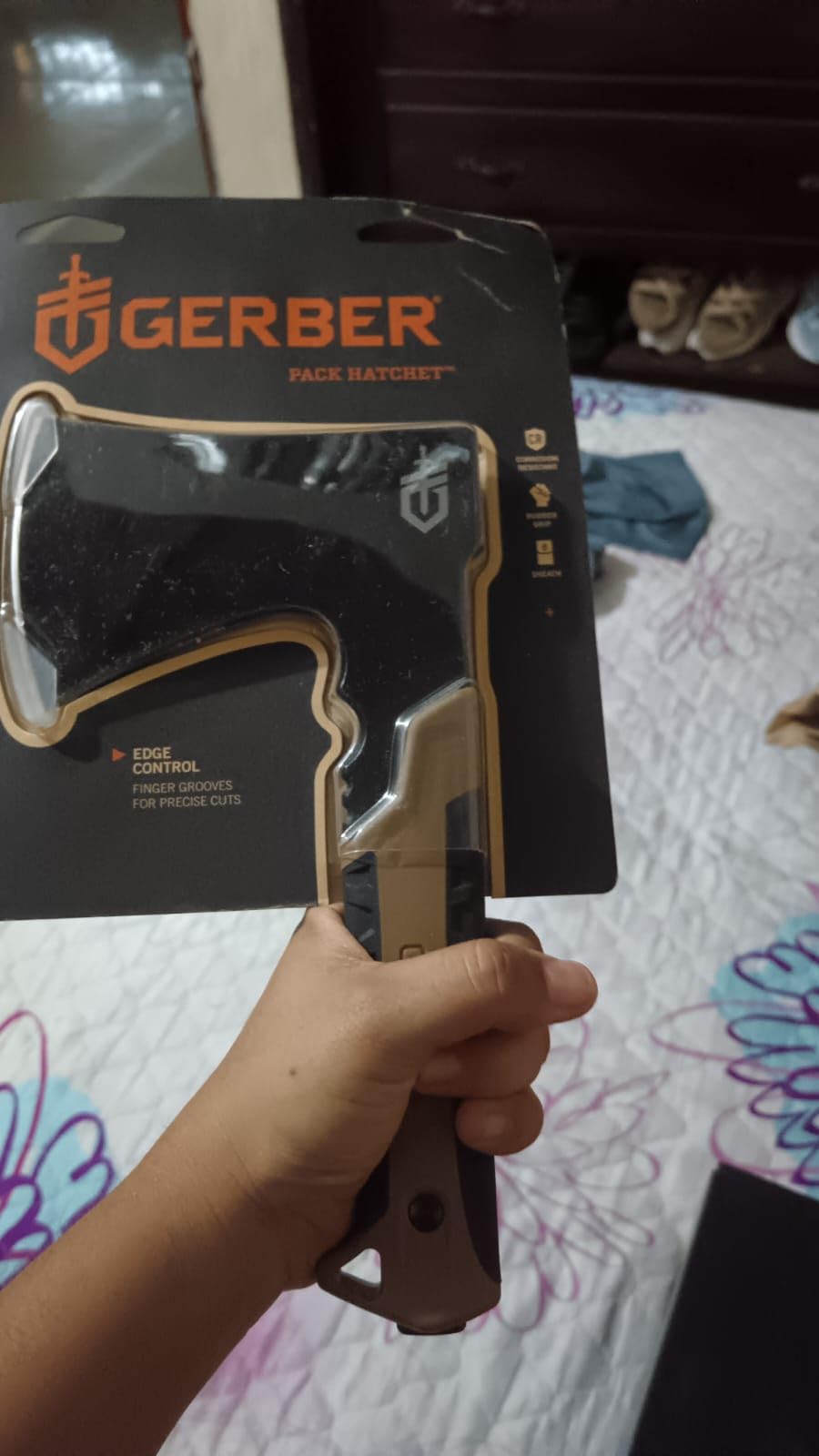
At 9.46 inches overall and 20.8 ounces, this is the only tool in the list that genuinely belongs in a pack. Everything else on this page is a campground or woodpile tool, and pretending otherwise is how people end up leaving their axe behind at the trailhead.
The blade is a 3.5 inch full tang with a tall grind, which is a geometry chosen for slicing cleanly out of a cut rather than for splitting. It arrives sharp and holds that edge, and the corrosion resistant steel matters more than it sounds in a wet climate.
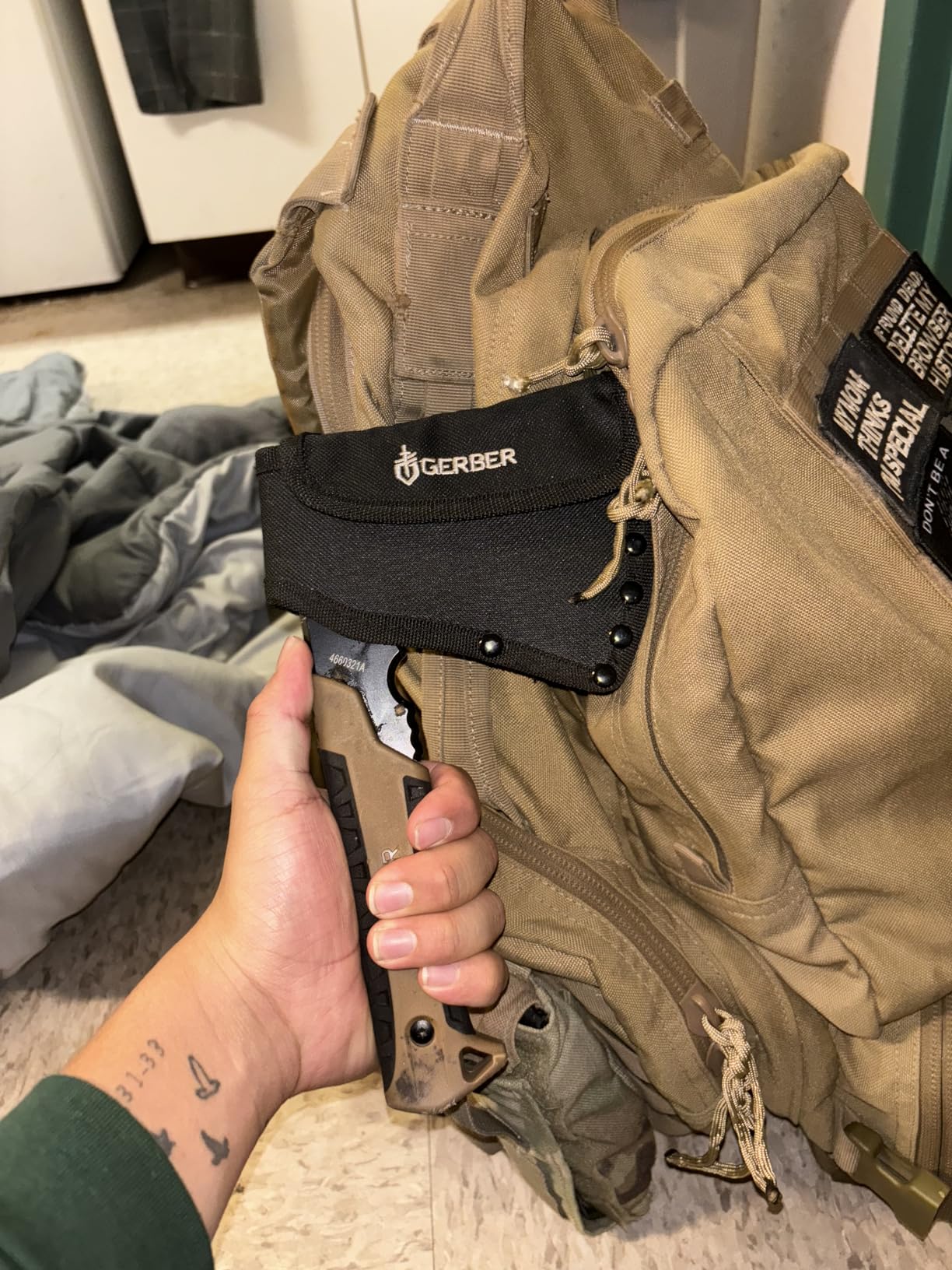
The single set screw is a small detail with real consequences. A conventional haft is wedged and bonded, and a damaged one is a total loss. This design can be disassembled, the rubber grip replaced, and the blade re-handled by the owner, which is a repair path rather than a disposal path.
The sheath is the most repeated complaint and it is fair. Buyers describe it as awkward to draw and stow, and the belt and pack mounting works better than the retention does. If you carry it be sure to check it is seated before you move, because a hatchet falling out of a sheath on a switchback is a genuine hazard.
Do you even need an axe on a long backpacking trip
Sometimes you do not. There is a recurring view among experienced hikers that axes and hatchets stay at home when you are walking big miles, and for multi-day trips on established trails with reliable firewood that is often correct. Folding saws and a lighter load serve many people better.
Where a hatchet earns its place is the trip with an unpredictable wood supply, a high fire danger season where you must carry in your own fuel, or a solo trip where a dedicated cutting tool reduces the need for a heavier saw. At under a pound and a half it is a cheap insurance policy.
Who should buy something else
Anyone who splits firewood will be disappointed. A 3.5 inch blade at this weight has no meaningful splitting authority, and the honest description is a small utility cutter for light camp tasks.
For a car camping setup, skip the size constraint and go bigger. The Gerber Freescape is the natural upgrade when the tool stays in the vehicle rather than on your back.
8. SOG Camp Axe CH1001-CP – Best Hatchet and Hammer Combo
SOG Camp Axe- Compact Camping and Survival Hatchet/Hammer Tool with Sheath and 3.1 Inch Bushcraft Axe Edge (CH1001-CP)
11.5 inch overall
16 ounces
3.1 inch stainless blade
Textured GRN handle
Pros
- Works as both a chopper and a hammer for tent stakes
- Very light at 16 ounces
- Textured GRN handle gives a secure hold
- Glass reinforced nylon sheath included
Cons
- 3.1 inch blade is best for light camp and tinder work
- Short handle limits leverage on thick stock
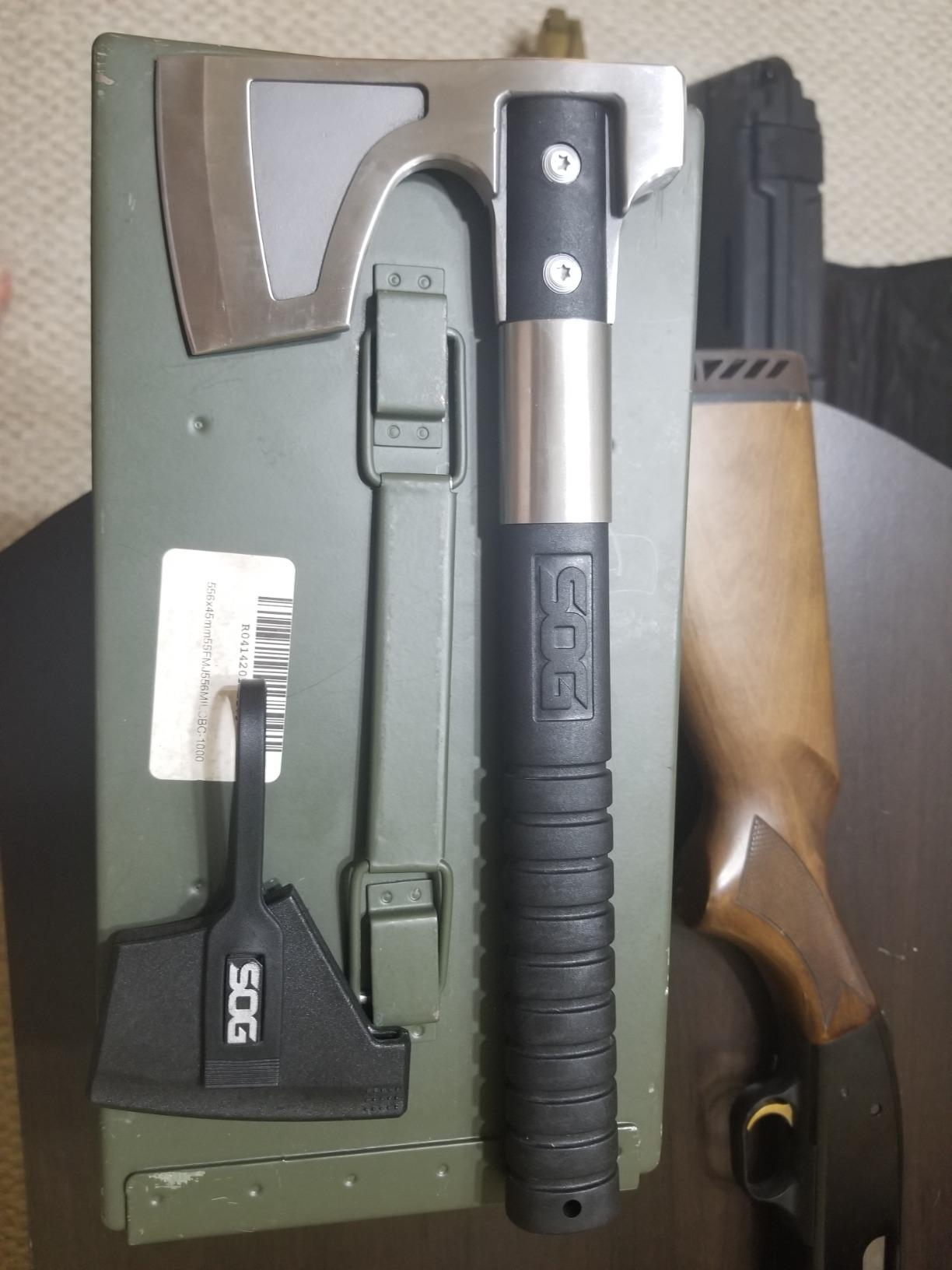
The SOG Camp Axe is a camp utility tool that happens to chop. At 16 ounces and 11.5 inches overall it is the second lightest pick here, and the flat poll lets you drive tent stakes, pound a stake splitter or knock loose debris without carrying a separate hammer.
That dual role is the reason to buy it over any other 16 ounce hatchet. For tarp and canvas campers, or anyone setting up in ground too hard for a plastic mallet, the head that doubles as a hammer removes an item from the pack.
Owners are clear that the 3.1 inch stainless blade is a light duty cutter, and the rating cluster at 4.6 reflects exactly that. This is a tinder and light branch tool, not a firewood processor, and expecting otherwise is the most common disappointment reported.
Stainless steel is the right material for a tool that lives in a pack and gets wet, because it will not develop the orange bloom that carbon steel does in a damp rucksack. The trade-off is edge retention, which is typically a little lower than a hardened carbon steel head of the same weight.
Stainless or carbon steel for a tool that lives in your pack
Choose stainless when the tool will be carried, stored damp, or used near salt water. Choose hardened carbon steel when you want the finest possible edge and will wipe the blade after use. The maintenance difference is real and it is the whole decision.
For a hatchet used once a season on stored firewood, carbon steel gives you a better edge for longer. For a hatchet used daily on wet campsite wood, stainless saves you the frustration of a rusty bit that will not bite.
Who should buy something else
Do not buy this for splitting. Sixteen ounces of head and an 11.5 inch handle produce almost no splitting force, and the blade is thin enough that forcing it into a round risks chipping.
If you want a light packable tool with a better cutting edge, the Gerber Pack Hatchet has 0.4 inches more blade and full tang construction. If you want a hammer and nothing else matters, keep reading, because there is a heavier option later.
9. KSEIBI 274150 Camping Hatchet – Best Budget Hatchet
KSEIBI 274150 Camping Hatchet Axe
4.13 inch forged steel blade
Fiberglass handle
600 gram head
1.3 pounds
Pros
- Low entry cost for a forged steel camp hatchet
- Fiberglass shock reduction handle with anti slip grip
- Arrives sharp and balanced
- Works as a throwing axe
- Protective cover included
Cons
- Small head struggles to chip into larger wood
- Edge sharpness varies between units
- Cannot fell or chop down a tree
The KSEIBI 274150 answers the question most asked on buying forums, which is what to get when you want a real forged steel hatchet without paying heritage brand money. It has a 4.13 inch forged steel blade, a 600 gram head and a 1.3 pound total weight.
At that weight and blade size it is a small fraction of the cost of the premium hand forged hatchets on the market, and buyers treat it as a budget tool for breaking down already cut campfire wood into smaller pieces. That framing is correct and it is the job this does well.
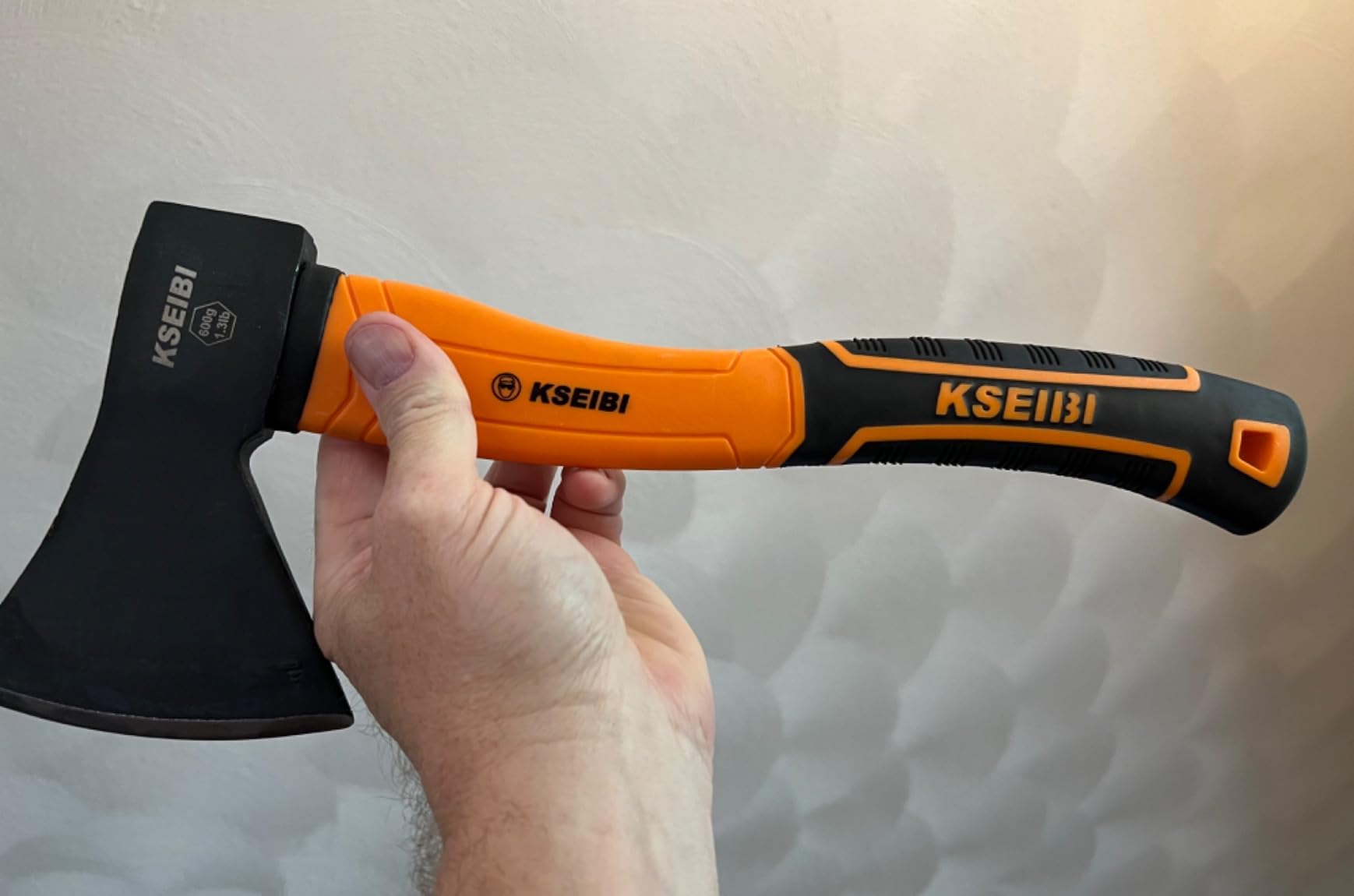
The fiberglass handle has an anti slip grip and is described as a shock reduction handle, and for the size of the tool the shock is manageable. It will not match the vibration damping of a patented grip, but neither should you expect it to at this level.
Two limits are consistent across owner reports. The head is small and struggles to bite into larger pieces of wood, and the edge sharpness varies from unit to unit, so check it on arrival. It also cannot fell or chop down a tree under any circumstances, despite some listings describing otherwise.
How to check a new hatchet before you rely on it
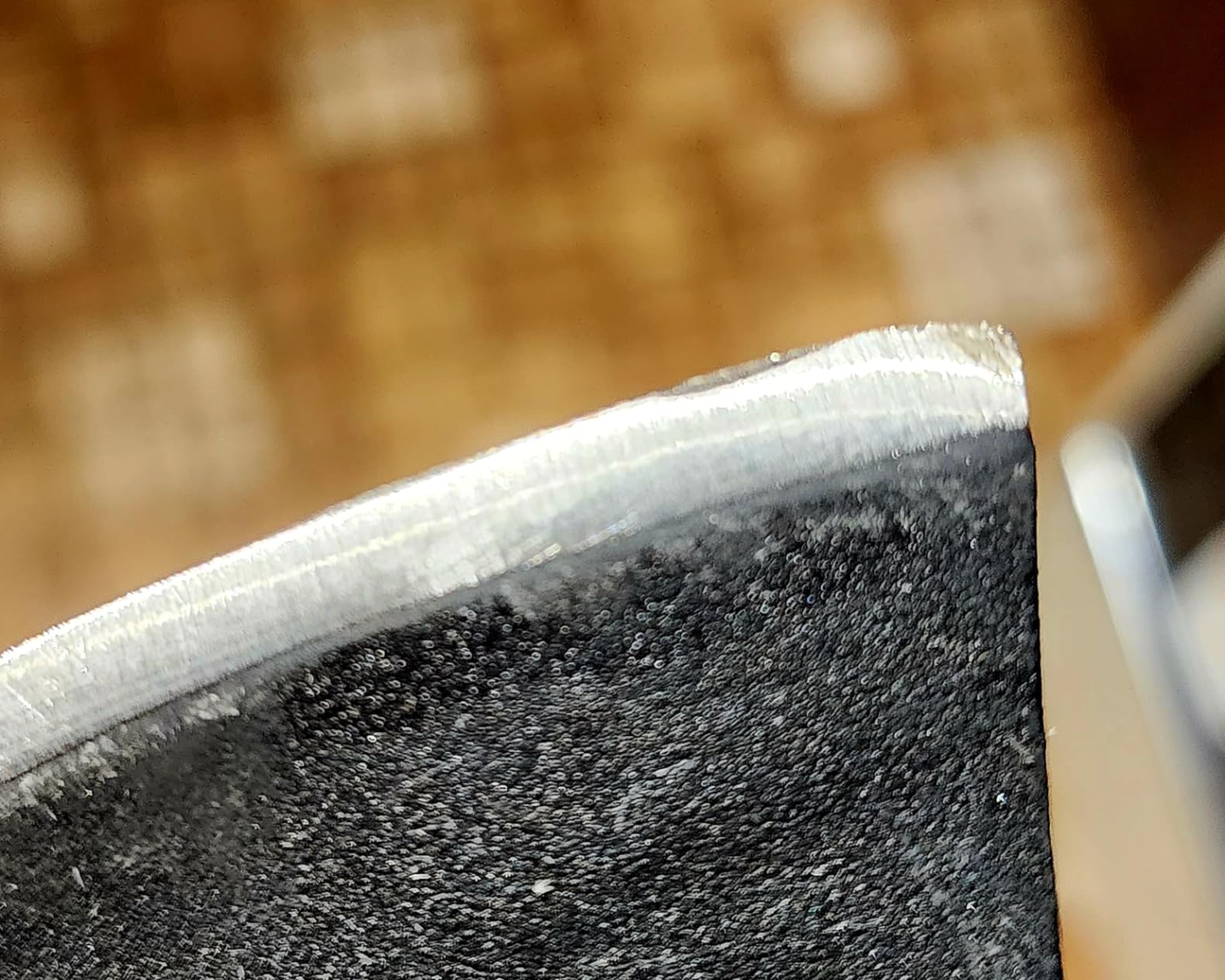
Run it across a sheet of paper. If it shaves cleanly you are fine. If it snags, take three or four passes on each side with a medium stone and test again. Edge consistency varies most on lower cost tools, so this two minute check saves a frustrating first trip.
Then check the head for play. Push the head against the end of the handle and look for any movement at the eye. A small amount is normal, a lot is not, and a visible crack in the handle means stop using it immediately.
Who should buy something else
Buy something else if you intend to throw it, despite the marketing. Throwing axes need a specific balance and often a bearded edge, and a chopping head at this weight is a poor throwing shape even though it can be thrown at all.
Anyone who will need real splitting power should look at the Estwing Fireside Friend or the Fiskars X27. A budget hatchet is a good first tool and a good gift, but it is not a substitute for an axe on a heavy wood pile.
10. Gerber Freescape Hatchet 17.5 inch – Best for Car Camping
Gerber Freescape Hatchet, Steel Axe with Sheath, Camping & Survival, 17.5″
17.5 inch overall
2 pounds
PTFE coated alloy steel
Soft touch overmold
Pros
- Heavier head than a typical hatchet
- Forged steel head with a composite handle
- Slim sheath with molded belt hangers
- Sharp out of the box and holds its edge
Cons
- Handle plastic is slick and benefits from rosin or grip treatment
- Sheath is bulky with small molded belt loops
- Length sits awkwardly between a hatchet and a full axe
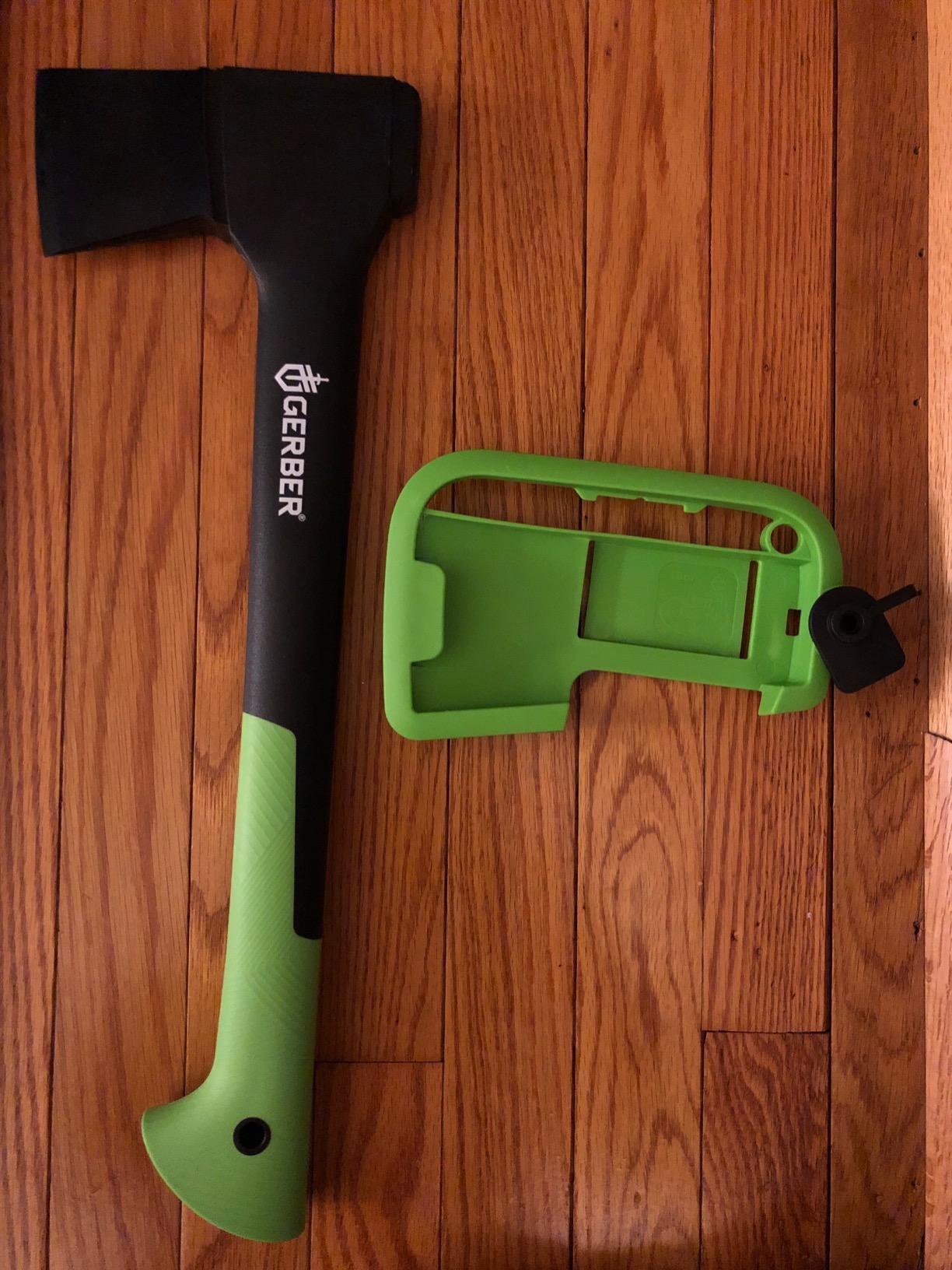
The Freescape is the odd sized one out, and that is precisely why it is here. At 17.3 to 17.5 inches overall with a 2 pound total weight, it sits in the gap between a one-handed hatchet and a two-handed axe, and owners repeatedly describe it as the sweet spot for car camping.
The head carries more mass than a mini hatchet does, which owners say roughly halves the time spent chopping 3.5 to 4 inch wood. The PTFE coating reduces friction so the blade releases cleanly, and the composite handle is shock absorbent enough to keep a long session comfortable.
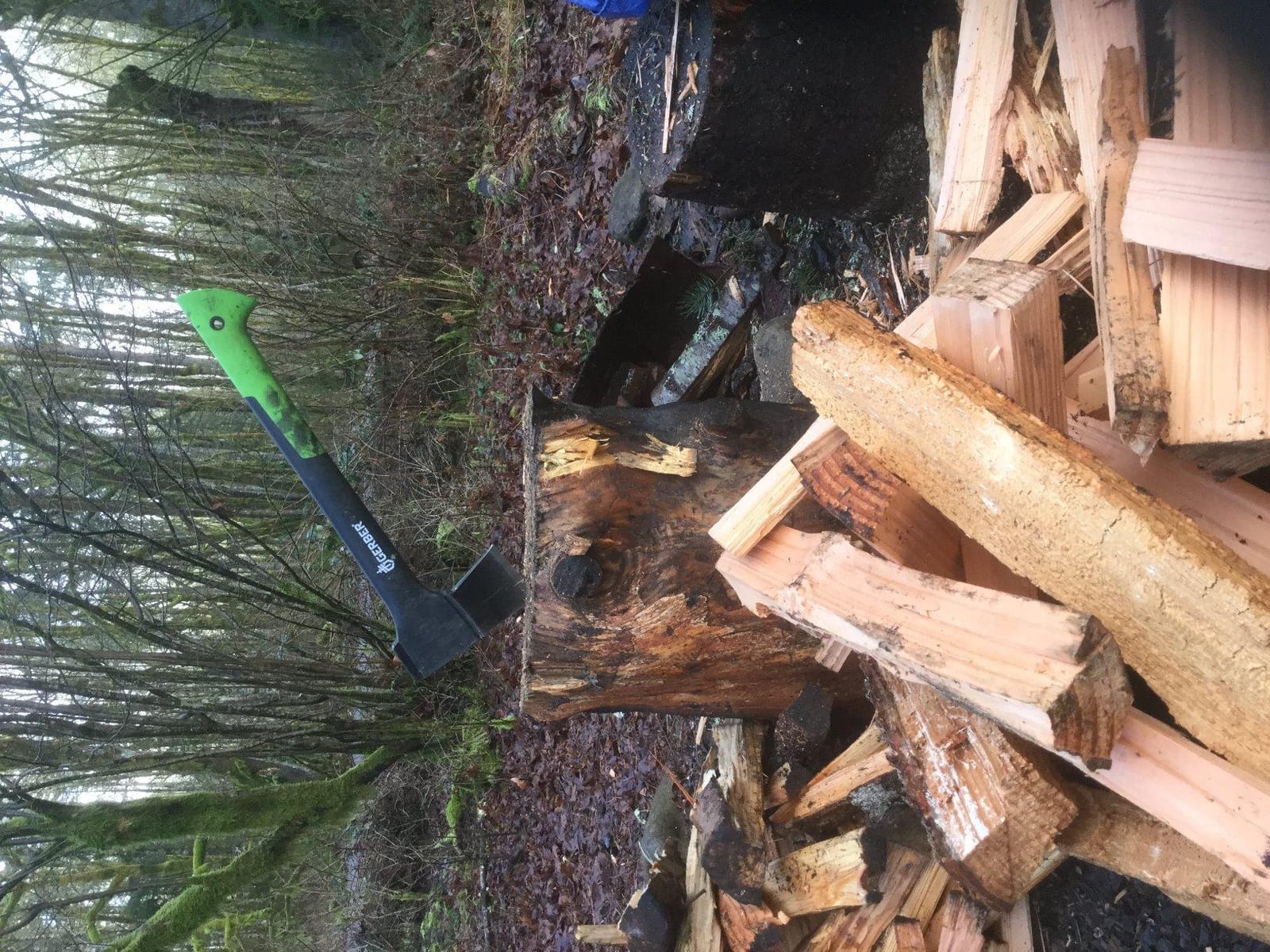
This one is made in Finland, and the forged steel head and composite handle show it in the finish. Reviewers consistently call the fit and finish excellent, and it arrives sharp and holds that edge over repeated use.
The honest negatives are grip and sheath. The soft touch overmold is somewhat slick when wet, and owners recommend rosin or a grip treatment. The slim sheath is bulky and the molded belt loops are too small for heavy duty belts, so plan to thread it onto a shoulder strap or pack instead.
Why 17.5 inches is the sweet spot for a campsite
Handle length between about 16 and 20 inches gives most of the leverage benefit of a full axe while staying light and controllable in one hand. Below 14 inches you lose chopping power quickly, and above 26 inches the swing starts to demand two hands and real open space.
Because the weight here is 2 pounds, it stays out of hand on short approaches. The tool is meant to live in a car or a tent box, and that is a different design brief from a packable hatchet entirely.
Who should buy something else
Backpackers should skip it. At 2 pounds plus a bulky sheath it is a pack weight decision, and there is a 20.8 ounce option earlier in this list built for exactly that problem.
Anyone wanting a traditional hardwood handle should also pass. The composite handle is durable and shock absorbing, but if you prefer a haft that can be re-wedged in your own workshop, an Estwing or a traditional wood hafted axe is the better path.
How to Choose an Axe or Hatchet
Head steel: what actually matters
Carbon steel is the default for good axes and it holds the finest edge. It is also the most demanding, since carbon steel rusts and wants a wipe down after use. Every splitting maul and traditional axe on this list uses some form of it.
Stainless steel trades a small amount of edge retention for a large reduction in corrosion. For a packable hatchet that lives in a damp rucksack, that is usually the better trade. A low grade stainless stamped from thin plate dulls quickly, so weight and forging matter more than the label.
Forged beats stamped whenever the budget allows. A forged head is shaped from a billet under heat and pressure, which aligns the grain and lets the maker harden the bit while leaving the body tough. A stamped head is cut from a plate, which is faster and cheaper but generally less refined at the edge.
Handle material: the shock absorption trade-off
Hickory and ash are the classic choices. Both are dense, slightly flexible hardwoods that absorb impact and dampen the sting in your hands better than any rigid material, and both can be re-wedged and re-hafted in a workshop.
Composite handles such as FiberComp, IsoCore and glass filled nylon are lighter and weatherproof. They are what you want if the tool will get wet, if you have a grip sensitivity, or if you want zero maintenance. The compromise is that a cracked composite handle is usually not repairable at home.
Leather sits in between, offering excellent feel and grip for a dry hand, with the trade-off that it needs occasional conditioning and will stiffen if repeatedly soaked.
How much axe do you actually need
This is the heavier or lighter hatchet question, and the honest answer is that the right weight follows the job, not the marketing. A hatchet under 2 pounds belongs in a pack and does kindling. Something between 2 and 3.5 pounds handles camp firewood and branches of 6 to 10 inches. Above 4 pounds you are into splitting and two hands.
Trip length is a good proxy for size. A weekend at a car campground supports a full axe. A week of hiking on established trails often supports no axe at all, or a packable hatchet. A solo winter trip where you must carry in your own fuel justifies a proper camp axe at the trailhead rather than in your pack.
Balance matters more than total weight. A well balanced tool feels lighter than a heavier well balanced one, and it reduces the hand and wrist strain that makes people put a tool down early.
One handed or two handed: the first big decision
Two hands and a long handle wins for felling, bucking and splitting long rounds, because the extra length multiplies force. If you process a meaningful amount of firewood, start here even though the tool is bigger.
One hand wins for control, portability and safety in a campsite. If your wood is short sections, if you are gathering as you go, or if you will be carrying the tool any distance, a hatchet is the correct starting tool and will cover more situations.
A useful rule: buy the smaller tool first and add the larger one when a specific job demands it. Nearly every serious firewood setup eventually ends up with a hatchet and an axe, and the two are not redundant.
Reading model numbers without getting lost
Model numbers in this category describe size, and the conventions are more consistent than the brands admit. On the Swedish hand forged heritage hatchets, lower numbers generally mean larger tools, so a 00 model does more bucking and splitting work than a 000, which is the packable one. Names follow the same logic: Small Forest and Small Hatchet sit below Wildlife in capability.
For the American axes, the E24A is the 14 inch Sportsman’s Hatchet, the E45A is the 26 inch Camper’s Axe, and the E3 series are the compact wood splitting tools. Two digit model numbers with a letter suffix are the compact hatchets, three digit codes are the longer axes.
None of this is worth memorising. What is worth doing is checking the overall length, the listed weight and the cutting edge measurement, because those three numbers tell you everything you need about what a tool can do.
Sharpening and Maintenance
No competitor in this category explains how to keep an edge, and it is the single most useful thing to know after you have bought a tool. A dull axe does more damage to your technique and your wood than an undersized axe does.
Honouring an edge is sharpening it, and it is not the same job. Sharpening removes steel to create a new edge. Honing straightens a rolled edge back into alignment and is faster, easier and preserves the factory bevel on tools like the Fiskars X27 whose convex geometry is part of the design.
A workable routine runs like this:
First, use a coarse stone or a medium diamond plate to establish a bevel of roughly 20 to 25 degrees on each side. Second, move to a finer stone and take lighter passes on each side to clean up the scratch pattern. Third, strop on a leather strop or a piece of cardboard loaded with compound to remove burrs and realign the edge. Fourth, wipe the blade clean and apply a light coat of oil to protect the steel.
How often depends entirely on what you have been cutting. Green wood dulls an edge fast, dried hardwood slowly, and a maul that only ever splits along the grain needs far less attention than a hatchet that also chops branches across the grain. Plan on a honing session every few sessions and a full sharpen when the edge stops taking a shaving.
Handle care is simpler. Wooden hafts want a wipe down and a re-wedge if the head moves. Composite and fiberglass handles want nothing. Leather grips want to be kept dry and conditioned a couple of times a season, which is the one recurring maintenance note across Estwing owners.
Where You Can and Cannot Legally Carry an Axe
This question comes up constantly and the answer genuinely varies by context. The short version is that an axe or hatchet is a legal tool to own, and the restriction is almost always about how and where you carry it, not whether you may have one.
In a car, an axe is legal in most places. A hatchet in a vehicle is ordinary cargo, and a full length axe should be secured so it cannot slide forward if you brake hard.
On a plane, a hatchet in checked luggage is the realistic route. Carry-on rules are what block it, because axes and hatchets are treated as bladed tools and are not permitted in the cabin. Rules vary by airline and by departure country, so check the specific carrier before you fly.
In national parks and many managed wilderness areas, a hatchet is generally permitted for camp use while a full length axe can be restricted. The prohibition most often applied is on removing live wood or cutting standing trees, which is a rule about behaviour rather than about the tool in your hand.
Across borders, expect friction. Customs rules differ between the United States, Canada, the United Kingdom and Australia, and a camp axe can be treated differently at each. If you are crossing a border with a tool in your luggage, look up the destination rules rather than assuming they match your own.
One universal piece of advice that is not about law at all. A hatchet in a pack needs a sheath that genuinely holds, and a tool that can leave the sheath mid hike is dangerous regardless of what the law permits. Check the fit before you walk out.
Frequently Asked Questions
What is the difference between an axe and a hatchet?
An axe is defined by handle length: it is swung with two hands on a handle past roughly 26 inches, which gives the leverage needed for felling and splitting. A hatchet is the short one-handed version, typically 14 to 19 inches overall, built for backpacking, camp firewood and bushcraft work where control and carried weight matter more than raw swing power.
Who makes the best axes in the world?
In the hand forged heritage category, the reference standard is Gransfors Bruk of Sweden and Hults Bruk, both of which are regularly called the best in the world by experienced users. For value and availability, Fiskars and Estwing are the strongest choices, and Council Tool is widely recommended for anyone who specifically wants a tool made in the USA.
Is it better to get a heavier hatchet or lighter hatchet?
Lighter is right for backpacking and camp firewood gathering, generally anything under 2 pounds. Heavier is right once you are processing actual rounds, where between 2 and 3.5 pounds handles branches of 6 to 10 inches. Above 4 pounds you are into splitting territory and should be using two hands on a full length axe.
What size hatchet is best for camping?
Between 14 and 19 inches overall is the range that suits most campers. A 14 inch hatchet covers kindling and small branches, while 17 to 19 inches adds enough head weight and reach to handle 3.5 to 4 inch wood. Above 26 inches you are holding an axe that is designed to be swung with two hands.
Can I legally carry a hatchet?
Owning one is legal almost everywhere. The restriction is about how you carry it: a hatchet in a car is ordinary cargo, carry-on is typically not permitted because axes are treated as bladed tools, and many national parks allow a hatchet for camp use while restricting full length axes. Rules change for flights and international borders, so check the specific carrier and destination.
What steel is best for an axe head?
Hardened carbon steel gives the finest and longest lasting edge, which makes it the right choice for a woodpile tool you will wipe down after use. Stainless steel resists corrosion and is better for a packable hatchet that lives in damp conditions. A forged head is always preferable to a stamped one at the same price, because forging aligns the grain and allows the bit to be hardened while the body stays tough.
The Verdict on the Best Axes and Hatchets in 2026
After handling all ten, the Fiskars X7 remains the best axes and hatchets overall pick for most people. It combines the highest rating in the group with the most owner history, a forged insert molded head that will not loosen, and a 1.4 pound weight that is realistic to carry to a site rather than merely theoretical.
For a first wood splitting tool, the Fiskars X27 at 36 inches is the one to buy if you are tall enough for the handle. For a gift, or for a first axe that will not be frightened of a fall, the Estwing Sportsman’s Axe E24A is the pick, because the one piece forging and the leather grip make it the most repairable tool here.
Whichever way you go, buy the tool that matches the wood you will actually meet, keep the edge with a stone, and dry the blade before you put it away. Those two habits matter more to how long an axe lasts than anything written on a spec sheet.